Design of a Precise, Affordable Braille
Label Maker for the Blind
by
Hilary Anna Johnson
B.A., B.E. in Engineering Sciences
Dartmouth College, 2015
Thayer School of Engineering, 2015
A 14 SETTSINS ITUTE
FEB
0 9
201"'
LIBRARIES
ARCHIVES
Submitted to the Department of Mechanical Engineering
in partial fulfillment of the requirements for the degree of
Master of Science in Mechanical Engineering
at the
MASSACHUSETTS INSTITUTE OF TECHNOLOGY
February 2018
C 2018 Massachusetts Institute of Technology. All rights reserved.
Author...
Signature
redacted--( )
6'
Department of Mechanical EngineeringJanuary 15, 2018
ertfiedby,Signature
redacted_____
Professor Alexander H. Slocum
Walter M. May and A. Hazel
A ccepted by...
Mlay Professor of Mechanical Engineering
Thesis Supervisor
Signature redacted
Rohan Abeyaratne
Professor of Mechanical Engineering
Chairman, Department Committee on Graduate Theses
Design of a Precise, Affordable Braille Label Maker for the Blind
by
Hilary Anna Johnson
Submitted to the Department of Mechanical Engineering on January 15, 2018 in Partial Fulfillment of the Requirements for the Degree of Master of Science in
Mechanical Engineering
ABSTRACT
Braille labels are a simple technology that can enable people with blindness to independently identify objects and spaces in their workplaces, homes and schools. For children learning to read and write, braille labels on their toys and objects in the home and at school could catalyze learning by helping them to associate written words with physical objects. For an adult, identifying objects such as file folders, boxes, and medications is a functional skill essential in the workplace. Labels on these objects leads to an increase in daily efficiency. Yet, even though braille labels present the potential for increased independence and efficiency in the lives of people with blindness, there is no label maker on the market that meets the requirements of users. The goal of this thesis is to design a precise, affordable, language independent, personal braille label maker as a tool for the blind.
The work presented couples methods and tools from both deterministic design and human centered design philosophies. This integrated methodology drove the final design to meet both the precision and human requirements. The two most critical modules in the device are the braille dot embossing flexures and the braille cell indexing ratchet, which both require precision to meet international braille dot standards for the geometry and spacing.
This device is designed to address the needs of Indian users as a beachhead market because of their desire for independence and employment. Furthermore, an educational focus on braille literacy for people with blindness in India motivates the use of this device.
The result of this thesis is a braille label making device with precision alignment between the embossing punch and die and indexing of 6.2 mm, that creates durable braille labels on Scotch MagicTM Tape. The device form factor allows users to independently emboss each of the six dots so that labels can be written in any of the 133 braille languages that exist worldwide. Comprised of only six parts, the entire device is injection moldable out of ABS plastic, which lowers both the variable and fixed costs of part production and mold tooling.
Thesis Supervisor: Alexander H. Slocum
ACKNOWLEDGEMENTS
This thesis is a tribute to the incredibly able and intelligent people with blindness that provided insights, design reviews, critique and encouragement in the development of Braille-It. Thank you in particular to Lindsay Yazzolino, Duaa Elyounes, staff at the Perkins School for the
Blind, and teachers at the Blind lnstitute of Chandigarh, the National Association for the Blind
India and Dr. Sam Taraporevala at the XRCVC.
A hearty thank you to my advisor, Professor Alex Slocum, for giving me the opportunity to work on a meaningful and technically challenging project, and for pushing me to constantly learn and grow as a deterministic designer. 1/= 0
A big thank you to the MIT-Tata Center and the Tata Trusts for funding this project and my work. Your investment in impactful projects is creating a ripple effect of positive change in India and beyond. Thank you to Dr. Rob Stoner and Dr. Diane Rigos as the leadership of the Center. Thank you to Dr. Nevan Hanumara who guided my work in India and to Dr. Jason Prapas for supporting efforts to actualize this device as a real product.
Thank you to the Precision Engineering Research Group for your camaraderie, design input, and questions. In particular, Kevin Simon thank you for being a friend and mentor; always willing to be a sounding board and ask and answer questions. Thank you to Sally Miller for your friendship and design reviews.
Thank you to my parents Jay and Alice and sister Serena for your love and support. I appreciate your interest in the work that I'm so passionate about and all the edits of this thesis. Finally, thank you to Gurkaran Singh, a constant source of patient encouragement, wild ideas, edits, strategizing, and life design.
CONTENTS
Abstract...3
Acknow ledgem ents ... 5
Contents...7 Figures... 9 Tables...13 Nom enclature...15 1 Introduction...19 1.1 Overview ... 19
1.2 Integrating Deterministic and Human Centered Design Methodologies... 20
2 Literature Review & Prior Art... 22
2.1 Review of Braille Code... 23
2.2 Education for the Visually Impaired in India ... 25
2.3 Stakeholder Analysis ... 26
2.3.1 Blind People... 27
2.3.2 Indian N ational Governm ent... 27
2.3.3 For Profit, Non-Profit and Academ ic Organizations ... 28
2.3.4 Hospitals and M edical Facilities... 29
2.4 Prior Art Review ... 32
2.4.1 Patented Prior Art ... 34
3 Design ... 37
3.1 Functional Requirem ents and Design Param eters ... 37
3.2 Strategies and Concepts ... 40
3.3 User Journey ... 45
4 Prototyping and Testing ... 49
4.1 Prototypes and M odeling ... 49
4.2 Design Analysis ... 57
4.2.1 Flexural Beam M odel ... 57
4.2.2 Capstan Ratchet Indexing M odel ... 61
4.2.3 Elastic Averaging for Alignment and Attachm ent ... 66
4.3 Ergonom ic Analysis ... 67
5 Final Design ... 69
5.1 The M aster M odel ... 75
5.2 Component Level Detail ... 79
5.2.1 Em bossing Beam s ... 80 5 .2 .2 A n v il ... 8 1 5 .2 .3 B a se ... 8 2 5.2.4 Buttons ... 83 5.2.5 Ratchet ... 84 5.2.6 Rollers ... 84 5.3 System Integration ... 85
5.4 Design for M anufacturing ... 86
6 Conclusion ... 89
6.1 Future W ork ... 89
6.2 Conclusion ... 91
References ... 93
Appendices ... 98
Appendix A .I Dim ensions for the CAD M odel ... 98
Appendix A .2 Em bossing Force Test ... 99
Appendix A .3 IRB Oral Consent ... 100
FIGURES
Figure 1: The standard 6 dot braille cell with numbering... 23
Figure 2: Grade 1 Un-contracted English Braille Code [11]... 23
Figure 3: English Braille Numbers [9]... 24
Figure 4: English Braille Punctuation [11]... 24
Figure 5: English Braille Special Characters [11] ... 24
Figure 6: Common Words in Grade 2 Contracted English Braille [11] ... 24
Figure 7: Child using a metal slate and stylus ... 32
Figure 8: Generations of Braillers. Top left, a Perkins Smart Brailler@, bottom left and top right the Perkins Brailler@, and bottom right a digital Humanware BrailleNote. ... 32
Figure 9: Prototype of braille label maker that makes dots on 3M Scotch Magic Tape... 33
Figure 10: Images of patented braille related inventions. Left US8549998. Right U S 2 0 0902 74 50 5 ... 3 5 Figure 11: Braille related patents. Left US20120304875. Center EP0962909. Right US07996325. ... 3 6 Figure 12: Braille related patents. Left US20060118507. Right US4079825... 36
Figure 13: Finger to D ot M apping ... 45
Figure 14: User journey creating a label... 45
Figure 15: Early version 1 prototype with actual and 3D printed LegoTM interfaces... 49
Figure 16: Prototype 2 cross sectional view and held in a user's hands... 50
F igure 17 : P rototyp e 3 ... 5 1 Figure 18: Prototype 4 cross section view on the right and angled view of the embossing colum ns, beam s and anvil... 5 1 Figure 19: Prototype 5 - Section view on the right and an assembled view with transparent top to see in terio r... 5 2 Figure 20: Prototype 6 cross section and hand holding prototype... 53
Figure 21: Four images of Prototype 6 showing the embossing beams with elastically averaged connectors, the rolling-indexing anvil and the long top buttons... 53
Figure 23: Prototype 7 held by a user as she creates a label... 55
Figure 24: Line drawings of the final prototype in isometric and side views... 55
Figure 25: Section view of the final prototype ... 56
Figure 26: Cantilevered beam model with concentrated force P [45] ... 57
Figure 27: Cross Section View of Beams with Hinge ... 58
Figure 28: On the right a beam based flexure joint coupled with a rigid body, on the left a beam subjected to a m om ent end load [44]... 59
Figure 29: Fixed-Roller Cantilevered Beam... 60
Figure 30: Tape routing in yellow through the device, the yellow dots indicate the adhesive side o f th e tap e ... 6 1 Figure 31: Capstan diagram showing the forces and angles on the ratchet and the placement of the ratchet relative to the tape and rollers ... 62
Figure 32: Critical Angle for Range of Coefficients of Friction ... 62
Figure 33: Free Body Diagram of the Ratchet and Pawl Interaction. On the right are the external forces acting on the system ... 63
Figure 34: Force necessary to overcome the pawl force for range of angles ... 64
Figure 35: Wrap angle required for a range of forces... 65
Figure 36: Lego Elastic Averaging Points demonstrated on Beams Part ... 66
Figure 37: Ergonomic Hand Data for Woman and Man [43]... 67
Figure 38: Small woman hands on the right and large man hands on the left holding the device dem onstrates range of fits. ... 68
Figure 39: Rendering of the final design ... 69
Figure 40: Sketch and cross-section views of the final prototype ... 70
Figure 41: Components of the final prototype labeled ... 70
Figure 42: Right section view with labeled components ... 71
Figure 43: Tape routing through the device... 73
Figure 44: Process of replacing the tape in five stages... 74
Figure 45: Flow of information through the model ... 75
Figure 46: Front M aster M odel Sketch... 76
Figure 47: Front Master Model Sketch with Dimensions [mm]... 76
Figure 48: Master Model Sketch of Lego Features [mm] [deg]... 77 10
Figure 49: Master Model Sketch of Beam Orientation, Length and Force Point [mm] [deg]... 77
Figure 50: Master model sketch of the dot spacing and size [mm]... 78
Figure 51: The six components that comprise the final device ... 79
Figure 52: Embossing beams annotated ... 80
Figure 53: Anvil top and side view annotated ... 81
Figure 54: Base part top and side view annotated ... 82
Figure 55: Buttons top and bottom view annotated ... 83
Figure 56: Buttons, Beams and Anvil Stackup Annotated ... 83
Figure 57: Ratchet Side and Top View Annotated ... 84
Figure 58: R ollers A nnotated... 84
Figure 59: Alignment Guides between the Buttons and Beams and Anvil and Base... 85
Figure 60: Example SolidWorks Draft Analysis for the Ratchet and Base Parts, Draft of 20, Green is positive draft, Yellow requires draft and Red is negative draft... 86
TABLES
Table 1: Stakeholder Matrix: Influence Oriented ... 31
Table 2: Comparison of state of the art devices based on functional requirements ... 34
T able 3: P atented prior art... 35
Table 4: G lobal Specifications... 38
Table 5: Functional Requirements and Design Parameters ... 39
Table 6: Identification Strategies... 41
Table 7: Selecting a label medium... 42
Table 8: Creating Braille Dots on the Label... 42
Table 9: Selecting an Embossing Mechanism ... 43
Table 10: Selecting a Haptic Feedback Mechanism for Embossing... 44
Table 11: Indexing Strategies ... 44
Table 12: Most Critical Modules ... 47
Table 13: Functional Requirements fulfilled by the final prototype... 72
Table 14: Recommended Wall Thickness for Potential Materials ... 87
Table 15: Mold and per part costs for all six parts in the device ... 88
NOMENCLATURE
smax Max deflection of the pawl [mm] Fv The vertical force pushing on the beams transmitted by the columns [N]
IV Length from the base of the beam to the point where the F. is applied [mm] 1B Length of the beam from point A to point B [mm] E Modulus of elasticity [GPa]
I Area moment of inertia [mm4]
47bending Bending stress of the beam [MPa]
M Moment created by the applied force on the beam [N*mm]
c The distance from the outermost fibers of the beam to the neutral axis [mm]
Uflexural The flexural strength of the material [MPa]
Of Slope of the flexure [deg]
if Length of the flexure [mm]
if Area moment of inertia of the flexure [mm4]
16b Displacement at the tip from the deflection of the flexure and the [mm]
angular offset of the rigid body
ir Length of the rigid member [mm] Of Angle at the tip of the flexure [deg]
RA Vertical reaction force at point A [N]
RB Vertical reaction force at point B [N]
MA Reaction moment at point A [N*mm]
4v Deflection of the beam at point B from force F, [mm]
RB Deflection of the beam at point B from force RB [mm]
Fhold Holding force applied to the tape in the capstan [N] F Force applied to the tape to pull it forward and move the ratchet [N]
mechanism
0 a R1 R2 R 3 FR FBeam Funwind D d r (5 ABS CAD CNC COUHES DFM EDM FRDPARRC IAB ID IIT IRB LDPE NAB NIVH
Wrap angle of the tape around the ratchet Angle of the pawl surface from vertical
Normal reaction forces between the ratchet and pawl Vertical reaction force acting on the ratchet body Horizontal reaction force acting on the pawl body Force applied by the tape pull to the ratchet Force applied on the ratchet by the deflected pawl
Force to unwind 0.75" width Scotch MagicTM tape Efficiency of the rollers with tape moving across Outer diameter of the roller
Inner diameter of the rolling element
Repeatability of the elastically averaged coupling Dimensional error of the elastically averaged feature Acrylonitrile butadiene styrene
Computer aided design Computer Numerical Control
Committee on the Use of Human Subjects Design for Manufacture
Electrical Discharge Machining
Functional Requirements, Design Parameters, Analysis, References, Risks, Counter Measures
Indian Association for the Blind Industrial Design
Indian Institute of Technology Institutional Review Board Low density polyethylene
National Association for the Blind India
National Institute for the Visually Handicapped India
[deg] [deg] [N] [N] [N] [N] [N] [N] [mm] [mm] [mm] [mm] 16
SCMC Strategies, Concepts, Modules, Components
USPTO United States Patent and Trademark Office
VI Visually Impaired
CHAPTER
1
INTRODUCTION
1.1 Overview
People with blindness and visual impairment wrestle with the stereotype that people with disabilities are not capable of living and working independently. This is simply not true. The physical spaces we live in and products we use were designed with predominantly sighted people in mind, thus it's not surprising that people without sight must adapt and develop new tools and techniques to navigate, identify and learn. In India, instead of using the word "disability", it is now common to refer to people as differently abled. Indeed, in the absence of sight, people with blindness use other senses in creative and subtle ways to understand the world around them.
In India alone, there are an estimated 10 million people with visual impairments according to the National Association of the Blind, based on the 2011 national census [1]. Globally, the World Health Organization estimates 36 million fully blind individuals [2]. The visually impaired (VI) experience daily challenges performing tasks that sighted people take for granted, and as a result many depend on family members for help with identification and navigation. Simple tasks, such as identifying food items in generically shaped packaging or differentiating medications in identical bottles are difficult without braille labels or help. A key challenge, still unsolved at scale, is independent non-visual identification of generically shaped objects like boxes, cans, identification cards, important documents, or medication containers.
The question then emerges: how might we enable people with blindness to live more independently within their homes, schools, workplaces and communities?
Many people with visual impairments articulate their need for a simple identification solution. For people who are braille literate, braille tape labels that can be stuck to the objects and identify
them are a simple and accessible solution. Labels are a particularly powerful tool to enable literacy among blind school children. Much early learning in sighted children comes from vision, connecting words with pictures in books, or words written on objects. For a child with blindness, putting braille labels on objects allows them to make the same connection between written word and tactile object.
Numerous state-of-the-art devices attempt to meet this labeling challenge using touch and auditory feedback. However, current label makers on the market do not meet the functional requirements of users, in particular, the price point and ease of use required to make widespread adoption affordable and accessible. The features and challenges of current devices are detailed in the Prior Art Review.
The core innovation of this thesis is to design, build, and test a precise, personal and affordable device that empowers people with blindness to modify their environments with braille labels to make identification efficient, accurate and independent. The Braille-It label maker is a handheld, language independent, personal braille label maker manufactured at a price point accessible to blind persons both in India and globally. Braille-It enables users to quickly label items when first encountered and identified by creating tape labels that can be applied to objects, making quick identification easier in the workplace, in schools and at home.
1.2 Integrating Deterministic and Human Centered
Design Methodologies
In order to develop precise machines or products for human use, it is essential to integrate both deterministic and human centered design methodologies. This section will describe both methods and lay out the integrated process followed in this thesis.
"Deterministic design is a catalyst to funnel creativity into a successful design." [3] The goal of deterministic design is to effectively and efficiently create innovative solutions to technical challenges. Deterministic design starts with strategies, then funnels down to concepts, modules and components - moving from coarse to fine level of detail in the design. Strategies are the high
level methods of achieving a given goal, but many types of machines can be used. [3, pp. 1-13] Concepts are ideas for a specific machine that can execute the strategy. Modules are sub-20
assemblies within a machine and components are individual parts within the modules. At each level, many creative ideas can be generated and then are evaluated based on functional requirements, design parameters, analysis, references, risks and counter measures. [3, pp. 1-14] The structure of this thesis follows this course to fine methodology. Deterministic design can be effective in capturing potential strategies and rigorously choosing between them based on an understanding of the fundamental physics that play into the "error budget" of the machine. This methodology mitigates the potential risk of fixating on a cool idea without understanding whether or not it will meet the requirements.
The FUNdaMENTALS of Design [3] teaches a high level process of explore, experiment, create, detail, build and test. As part of the exploration, it is important to assess resources, time, materials, manufacturing processes and people. The designer must also understand the problem, the human stakeholders, the desired outcomes, physics and constraints. Following problem understanding, the process moves through selection of strategies, concepts, modules and components, at each iteration including increasing levels of design detail and analysis.
Human centered design also strives to develop innovative solutions to tough human challenges. It does not always assume a technical solution. The central premise claims that the best way to develop effective solutions is to place the users at the center of the process. This user-centric approach strives to mitigate the risk of solving for the wrong problem, or presenting an undesirable solution, by engaging users at every stage of the process. The IDEO methodology laid out in the Human Centered Design Toolkit [4] articulates an iterative process of Empathize, Define, Ideate, Prototype and Test, that starts with understanding the user needs and allows those insights to inform the ideation, strategy and concept selection.
For projects like Braille-It, which integrates challenging machine and human requirements, it is important to integrate tools from both of these methodologies. Empathizing with the user informs the development of the functional requirements, and user insights drive decision making during the prototyping phase.
This thesis follows the deterministic design process of explore, experiment, create, detail, build and test and integrates important human centered design methods and tools throughout.
CHAPTER
2
LITERATURE REVIEW
&
PRIOR ART
Using vocabulary about disability that captures the spirit of the people is challenging. To quote Dr. Nidhi Singal in her report on the education of children with disabilities in India [5]
"Disability is a multi-dimensional and complex construct and there is no single universally accepted, unproblematic definition of disability. Not only do definitions differ across countries but these also differ and change within a country with evolving legal, political and social discourses." While the discourse about blindness is historically framed as a disability, in India, people with disabilities often refer to themselves as "differently abled", which reframes their blindness as something to live in spite of rather than a reason for excuses. The braille label maker described in this thesis was designed as a tool for independence, to enable rather than disable.
This literature review strives to give a social, cultural, and political context to the mechanical design of this braille label maker. The chapter begins by providing a review of braille code globally and its many languages, then provides particular context on education for the visually impaired in India. The stakeholder analysis gives perspective on the interests of different people and organizations in this braille label maker. Finally, the prior art review documents the current state of the art and demonstrates the technological need for which this label maker is designed.
Literature on the technical aspects of the design analysis is included throughout the narrative in Section 4.2
Design Analysis.
2.1 Review of Braille Code
Braille is a tactile written code that uses a system of raised dot
00 4
combinations that correspond to letters or contracted phrases in many
200
5
different languages. English, for example, can be written in print, cursive, or
300
6
braille. Braille is a manner of writing English, not an independent language. Figure 1: Thestandard 6 dot
There are 133 global braille languages [6]. Therefore, when referring to a braille cell with
language in braille, it is correct to say English, Hindi or Japanese braille numbering code.
Braille's raised dot combinations, grouped in cells of six dots arranged in two columns and three rows, are read by gently running a finger over them. Dots are numbered one through six, and there are 64 possible combinations. [7][8] In un-contracted Grade 1 braille, often used for early learners, each cell represents a single letter. Grade 2 braille, also known as contracted braille, represents words or phrases with a single 6 dot cell. Grade 2 braille is more practical because it is faster to read and write and more compact. According to the American Foundation for the Blind, contracted braille is considered standard in the US for use in public spaces. In India, regulations are not currently enforced, but suggestions are made by the Ministry of Urban Affairs and Employment. [9] According to a 1990 UNESCO report titled "World Braille Usage" [6] there are 85 countries globally that have official braille languages with both grade 1 and grade 2, and in some cases more than one language per country. BANA, the Braille Authority of North America, publishes braille codes and guidelines for text, music, math, science and tactile graphics. [10] 00 0 *0 ** 0 @0 0 9 1110 0 0 a b C d e f g h k I m 00 00 00 0 0 0 0 0 x 0 0 0 00 00 0 0 0 00 0 * 0 0 0 0 0 00 00 00 00 * n o p q r S 1t u V w x y 2
Figure 3: English Braille Numbers [91
9 ** 00 9 9*
9 9 9. 9 9
Figure 4: English Braille Punctuation [111
letter capitl numeral " erAl itaic
sign s*gn sign index sign
Figure 5: English Braille Special Characters 1111
a but can do every from go have just Imowledg like more not
peopie qute rather so that us very va it yOU as and for
. . . 0 99 * *. 99 . .
@0 09 99 90 90 0 9
** * w* * *h* * e o1*/ * b
of the %ith chikh gh sheftah thisAh Ywhich ed er Iout/ou I m bb
0* .9
9 09 9
9
0.
cc dd en Iggwe in I t ing I w
Figure 6: Common Words in Grade 2 Contracted English Braille [111
The braille system was first invented by Louis Braille in 1869 while he was a student at the National Institute for Blind Youth in Paris, France. Previously, students were taught to read raised print, but difficulties embossing the letters as well as reading and writing the complicated geometries were significant barriers to use. Louis was inspired by a night writing code, also called sonography, which was invented at Napoleon's request for military use at night without sound or light. [12, p. 212]
24
I I
2.2
Education for the Visually Impaired in India
Education and braille literacy for the visually impaired is emphasized in India with a number of dedicated resources and institutions. The National Association for the Blind (NAB) India [13] has historically played an important roll in promoting education for the visually impaired and multiple disability children. The Department of Education at the NAB provides resources and tools to training centers, parent training, educator training, and schools for the blind in addition to running an integrated education program which supports visually impaired children who attend sighted schools. For these children, the NAB provides training to their teachers and dedicated assistants to help the children in the classroom. The Blind People's Association details this multifaceted system including residential education, integrated education and inclusive education and compares and contrasts the benefits and challenges of each system. [14, pp. 240-244]
The importance of education for the visually impaired is articulated in a 1995 study on childhood blindness published in Eye Nature. The study estimates that there were 1.5 million children worldwide in 1995 with visual impairment, which leads to a total loss of 75 million blind years due to duration of life with the disability. [15]
Looking at education for the visually impaired in India, the National Council of Educational Research and Training [16] publishes the AISES report [17] which reported a 17.36% increase in visually impaired students in the Indian education system between 2002 and 2009. This statistic could indicate that more visually impaired students are attending schools, a desired outcome for integrated education efforts. However, support for these students is lacking; the same 2016 AISES report states that less than 7% of schools offer braille books, slate and stylus, Taylor Frame or abacus, all commonly used tools for visually impaired students. The study cites that approximately 250,000 visually impaired students are enrolled in school in India. [17, p. 38]
Many of the teaching resources and techniques are taught to teachers through seminars and workshops, like the ones developed by the NAB in India. There are a few written resources,
including Foundations of Education: Instructional Strategies for Teaching Children and Youths with Visual Impairments [18], which is an informative resource for education theory and
studies, subject specific techniques, assistive technology, and even independent living and social skills.
There are a multitude of stakeholders invested in providing assistance to blind and low vision people including their families, local and international NGOs, government organizations and corporations. The key stakeholders influencing the physical design of the solution are the end users. Investment from other stakeholders will drive the manufacturing and distribution networks for the device.
Each of the stakeholders have different priorities, interests, resources and alliances. This stakeholder analysis presents the stakeholders influential in or influenced by this research with the dual aims of identifying strategic partnerships to cultivate, and building a foundational understanding of the stakeholder network to guide the implementation and business model generation.
2.3 Stakeholder Analysis
This stakeholder mapping provided a foundation for research, and outlines the landscape in which the braille labeler will be implemented. Core insights influenced the physical design of the labeler and guided strategic partnerships, ultimately moving towards sustainable implementation and dissemination of the device to users who need it most.
During the January field work period in 2017, two strategic focus areas were: first, collecting user feedback to iterate and solidify the design and product architecture, and second, developing key partnerships for manufacturing and distributing the device.
Providing resources for the blind is a semi-developed market in which there are a number of institutions and organizations with long term stake and influence who have developed methodologies for their work. One potential risk is that adoption of new technology, like the labeler which is the subject of this thesis, may not immediately fit within currently methodologies and work flows and teachers may be slow to incorporate it into the curriculum. This risk also offers a reciprocal potential opportunity insofar as the market for "low-cost" devices enabling the blind is not saturated with solutions and users could be open to affordable new solutions.
2.3.1 Blind People
Blindness is a complex diagnosis with many different pathologies. Cataract blindness, one of the most common causes, is commonly diagnosed at more advanced stages in the developing world due to a lack of screening. Often caused by untreated diabetes or a lifetime of sun radiation exposure, cataract blindness can often be completely reversed through cataract surgery by implanting an artificial intraocular lens.
Congenital blindness, the highest cause of childhood blindness, is often not fully reversible and has significant adverse effects on "[infant] development, education, and future social, marital, and economic prospects."[19] Srikanth Bolla, a young blind Indian CEO and MIT graduate, articulates the unnecessary challenges of being dependent and isolated from birth as a differently abled person. [20]
2.3.2 Indian National Government
The Indian national government is significantly invested in providing resources for the blind. Government support for this braille label maker would supplement corporate and NGO resources towards successful distribution and adoption by providing subsidies or schemes for those who cannot afford the device.
The main government entities are the National Programme for Control of Blindness within the Ministry of Health and the Department of Empowerment of Persons with Disabilities within the Ministry of Social Justice and Empowerment. The Department of Empowerment of Persons with Disabilities offers government schemes for the provision of educational scholarships and resources for students and adults to purchase assistive devices.[21, p. 57] They also resource District Disability Rehabilitation Centers to provide financial, infrastructure, administrative and technical support from the Central and State governments to people who are differently abled. [21, p. 75] These district centers are funded 10.2 lakh per year and an extra 7 lakh the first year for equipment.
The National Institute for Visually Handicapped (NIVH) Dahradun trains educators and subsidizes biomedical engineering research for special instruments related to disabilities. Furthermore, the National Institute promotes braille literacy, maintaining the largest library for persons with blindness, operating both the Central Braille Press (est. 1951) and the Regional
Braille Press (est. 2008), and running the workshop for Manufacturing Braille Appliances (est.
1952). [21]
The Department of Empowerment of Persons with Disabilities also funds organizations supporting differently abled events. In 2015 and 2016 the department funded 150 lakhs to the Blind Cricket Association of New Delhi for organizing a cricket tournament, 440 lakh to the Indian Heritage Society of New Delhi for printing yoga books for the visually challenged, and 750 lakh to the Indian Blind and Para Judo Association for the 4th national championship. [21, p.
74] Funding extends to numerous schools for the blind in Andhra Pradesh, Bihar, Chhatisgarh, Delhi, Gujarat, Karnataka, Mizoram, Odisha, Punjab, Rajasthan, Tamil Nadu, Telangana, and West Bengal [21, pp. 194-231]. The current investment in programs and devices indicates potential sources of funding and community level connections for distribution.
Future work might investigate the following questions: Are district centers interested in collaborating on the distribution of this device? At what price point are government institutions willing to subsidize a cost braille label maker? What is the government demand for a low-cost label maker? How many devices would district centers or the national departments want to purchase or distribute? How are state governments invested in providing resources for the blind?
2.3.3 For Profit, Non-Profit and Academic Organizations
Within the for profit realm, several companies are uniquely invested in developing technology for the blind and creating job opportunities for people who are differently abled. One example, WORTH Trust, located in Vellore, Tamil Nadu, is a self-sustained rehabilitation organization which includes engineering production centers employing people with disabilities. The profit from this manufacturing then supports both a technical training center and early intervention centers for people with speech and hearing impairment. WORTH is the sole manufacturer of the Perkins Brailler worldwide and the distributor for braillers in India.
Another example is Bollant Industries Pvt. Ltd. led by CEO Srikanth Bolla, an MIT alumnus and a blind man himself. Bolla's trifold company vision is to address employment, economic and environmental issues in an integrated for profit model producing eco-friendly disposable products and packaging solutions for manufacturers. The company primarily employs differently-abled people, providing the necessary skills training to produce high quality products.
Phoenix Medical Systems based in Tamil Nadu is also interested in manufacturing products for the blind. One of Phoenix's principal products is a smart cane that uses a distance sensor to measure obstacles in front of the cane and vibrates the handle silently to alert the user of obstacles in their path. Currently, the blind cane is the only product for the blind that Phoenix manufactures.
Throughout India there are multiple NGOs committed to providing education, vocational training and resources for blind and low vision people. Among the most influential are the National Association for the Blind NAB [22], the Indian Association for the Blind IAB [23], the National Institute for the Empowerment of Persons with Disabilities and the Blind Foundation for India [24]. The resources these organizations provide are similar, often focusing on primary and secondary education and vocational training to give people basic skills to find jobs in their communities.
Several academic institutions also focus on conducting research and providing resources for the visually impaired. The St. Xavier's Resource Center for the Visually Challenged XRCVC in Mumbai is led by Dr. Sam Taraporevala, a blind man and the chair of St. Xavier's Sociology Department. [25] Furthermore, the Assistech Research Group at IIT Delhi developed a Smart Cane as part of their research goal to "serve individuals with special needs through research and innovation in affordable assistive technologies." [26]
2.3.4 Hospitals and Medical Facilities
Much of the medical community is focused on blindness prevention and optimizing cataract surgeries in an effort to minimize preventable blindness. Amazing developments in surgical cataract procedures occurred over the last several decades. Aravind Eye Care System [27], one of India's major players, manufacturers intraocular lenses and other surgical tools for cataract surgeries reducing costs significantly from Western supplier. Cost cutting efforts like Aravind's and technique development by the Himalayan Cataract Project [28] based in Nepal means that a cataract surgery can now be performed for $25 in 10 minutes, completely restoring a person's sight.
LV Prasad is another major hospital player, promoting a health pyramid model based on widespread "vision guardians" in communities, and service centers with increasingly more services to provide widespread tertiary care and funnel people with complicated cases to "centers
of excellence." LV Prasad invests in a number of eye health verticals including clinical services, education, research, rehabilitation, eye banks and community outreach. [29]
Although prevention and reversal of blindness is an essential focus for these medical establishments, there are many millions of blind people for whom modern treatments cannot yet fix their blindness. These are the people this project is focusing on, aiming to provide them with another tool to lead more independent lives.
Observations of the stakeholders in the categories presented above are summarized in Table 1: Stakeholder Matrix: Influence Oriented below.
Table 1: Stakeholder Matrix: Influence Oriented
Reason for Tradeoffs Resources for Degree Actual and Potential
Stakeholder Exerting Confronting Influencing Alliance among
Influence Stakeholder Outcomes Influen stakeholders
ce
Solution would Ineffective device, As users and Work with NGOs and Braille literate .ion wuld difficult to learn, customers they drive High government institutions
blind people improve quality or breaks easily - demand serving them
__f_____ife____ no incentive to use
Device enables Allocation of funds Strong connections Closely connected with Empowerment independently - to purchase this to large user/ most organizations for
of Persons with easily solution over customer groups High the blind. Could provide ofDPsaons dith esiby investing in other influences solution distribution channels and Disabilities distributable solutions perception spread solution
solution
Either due to an Allocation of Large network of High interest in braille National interest in the literacy, supports the Institute for the solution's resources as people and control . Braille Press. Also Visually efficacy or worry investment and over written Medium facilitates biomedical Handicapped about providing staff to resources through research and device
competition distribute solution the printing presses development. Schools and Want to use Access to large Most schools receive vocational solutions to Might replace communities of funding from
centers for the accelerate current solutions blind and partially High government schemes to Blind student leaming ' sighted people who provide education and
outcomes need solution training and equipment Solution could Access to financial Private sector care Validate need compete with other and human eve to resaviage
in house resources, providesleltorsac
LV Prasad potential for innovs, reoes, funding Medium facilities. Works with
solution innovations, connections, fudgthe government and
assistive tech not and customer NGOs to build holistic priority perspectives eye care
eye care Hires limited Connected with Would want to number of people, Manufacturing government gam a contract may not have the equipment and organizations and WORTH Trust for cay t technical knowledge Medium customers within the
manufacturing caact to to produce 10,00 - visually impaired product manufacture in 50,000 devices community in India
2.4 Prior Art Review
Traditionally, the slate and stylus is the most widespread tool used for handwriting braille. In this method an awl instrument called a stylus is used to depress the dots and cells into thick paper, moving from right to left writing backwards to account for the flipped sheet of paper. This reversal makes learning to read and write more difficult as they are mirrored
processes. The slate and stylus is the least Figure 7: Child using a metal slate and stylus
expensive tool for writing braille and most widespread in India.
Braillers, shown in Figure 8, build off of a traditional typewriter mechanism, but use six keys to actuate the dots, and typically include a space bar, a next line button and a backspace. The Perkins Brailler developed at the Perkins school for the Blind is the industry standard brailler most widely distributed in the US and in India, in collaboration with WORTH Trust [30].
Figure 8: Generations of Braillers. Top left, a Perkins Smart Brailler®, bottom left and top right the Perkins Brailler®, and bottom right a digital Humanware BrailleNote.
A shorthand braille writer, similar to a brailler, found in some schools in India, but not commonly found in the US, is used to emboss braille on 1-inch-wide strips of paper. This allows a blind person to take notes and then transcribe them later onto a computer, a process observed at the National Association for the Blind in India at their blind workshop in Mumbai.
Electronic braillers, like the Humanware BrailleNote, are the newest and most advanced braille writing technology. Many function as complete computers that allow the user to scroll through applications and documents and functionally use a computer similar to a sighted person, but using audio and tactile braille feedback to navigate and read.
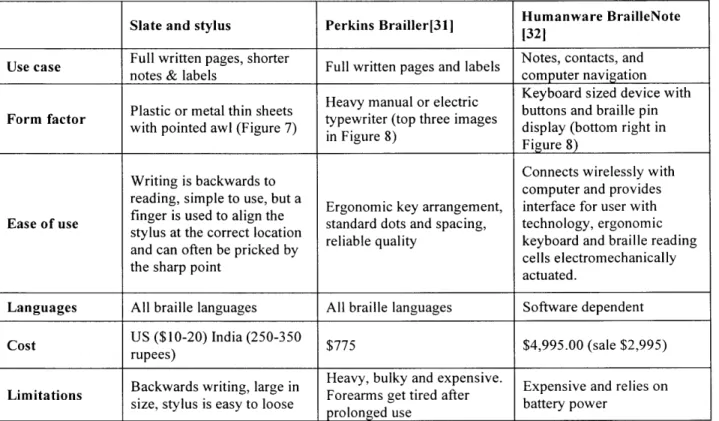
There is no shortage of ideas for braille label makers. A review of patents and products reveals several mechanisms that emboss braille dots on various tapes and strips of paper. The most commonly used devices are shown in Table 2 below. The engineering division at the Perkins School for the Blind keeps a closet full of all the "failed" braille label makers to document the challenge of meeting the full set of requirements and needs of the blind. The two most common complaints are that the labelers are too expensive to be desirable, or that they are too bulky and inconsistent to provide convenient reliable labels.
A label making device, shown in Figure 9, designed by Theodore Moallem, provided the initial inspiration for embossing braille
dots on 3M ScotchTM Magic@ tape used in
this thesis. The device houses two rolls of tape and punches the dots into the tape
using the buttons on the upper left in the Figure 9: Prototype of braille label maker that makes dots on
image. 3M Scotch Magic Tape
After conducting preliminary market research and interviews with stakeholders and users, this study determined a set of functional requirements that must be met to fulfill the user needs. A label maker must emboss readable, durable dots, create cells of equal spacing, meet a low cost point for manufacturing and assembly, be portable and compact, and emboss the dots on inexpensive commonly supplied tape. Table 2 compares the best state of the art with these functional requirements.
Table 2: Comparison of state of the art devices based on functional requirements
Slate and stylus Perkins Brailler[31] umanware BrailleNote Use case Full written pages, shorter Full written pages and labels Notes, contacts, and
notes & labels computer navigation Keyboard sized device with
Frfatr Formfacor Plastic or metal thin sheets lasic r mtalthi shets Heavy manual or electric typewriter (top three images btosadbriepnbuttons and braille pin
with pointed awl (Figure 7) typewr e ag display (bottom right in
in Figure 8) Figure 8)
Writing is backwards to Connects wirelessly with reading, simple to use, but a computer and provides finger is used to align the Ergonomic key arrangement, interface for user with Ease of use stylus at the correct location standard dots and spacing, technology, ergonomic
and can often be pricked by reliable quality keyboard and braille reading the sharp point cells electromechanically
actuated.
Languages All braille languages All braille languages Software dependent Cost US ($10-20) India (250-350 $775 $4,995.00 (sale $2,995)
rupees)
Backwards writing, large in Heavy, bulky and expensive. Expensive and relies on Limitations size, stylus is easy to loose Forearms get tired after
battery power
prolonged
use6-Dot [331 3M / Reizen Braille Labeler [341 Use case Dymo tape labels Dymo tape labels
Form factor Handheld plastic exterior with 6 Handheld plastic with turn dial to choose buttons letters
6 dots arranged similar to brailler Smaller hands have trouble gripping
Ease of use handle, slow to find the letters around arrangement the wheel
Languages All braille languages Limited to a single language, and only includes limited characters
Cost $749.00 $39.95 (some online discounts)
Limitations Relies on battery power and Dymo Only available for English. 3M used to
label tape make a similar device.
2.4.1 Patented Prior Art
Several patented braille embossing mechanisms substantiate the current state of the art. Although there is prior art within the realm of this research, the result of conducting a preliminary patent search for similar devices and mechanisms, using the advanced Innography
[35] tools as well as the USPTO website, reveals that there is no patented work on a label maker
using a similar cantilevered beam mechanism that addresses the functional requirements articulated above. Most of the recent braille related patents involve electromechanical systems for embossing, or directly transmitting the braille through actuated pins. Older patents focus on typewriter manifestations. Table 3, shown below, lists most relevant patents in use or in function. The relevance column notes why each patent is relevant to this research.
Table 3: Patented prior art
Image Patent No. Title Issued Relevance
Fig. 9 Left US8549998 Portable electromechanical 2013 6-Dot Braille Label Maker
braille label maker [36] [33]
Fig. 9 Right US20090274505 Braille Writer [31] 2009 Updated Perkins Brailler
Fig. 10 Left US20120304875 Embossing wheel and anvil 2012 Wheel used for embossing
for braille printer [37]
No image W09641320 Touch-readable product and 1996 Assignee Universal Braille associated process [38] Dots Inc.
Fig. 10 Center EP0962909 Braille label writer [39] 2000 Solenoid actuation Fig. 10 Right US07996325 Apparatus for embossing 1995 Embossing lever and
Braille labels [40] platform Device and method for
Fig. 11 Left US20060118507 identifying containers personal 2006 Band with embossed braille to sighted and visually to identify objects
handicapped individuals [41]
Fig. 11 Right US4079825 Portable braille typewriter[42] 1978 Full sheet typing
60 88 821 3 9 00112a 10 0 0 0
0
611*Ra
0
74
7 ZFigure 10: Images of patented braille related inventions. Left US8549998. Right US20090274505. o 0
ps ffr_ I __
t. ? 3 34 U Zc ?b 2. 3' FIG. lA Fom. 10 SWMtm A-A U.S. Poltent Sw LX ""' sbm 1 5,448.240 1'-W FP 3
Figure 11: Braille related patents. Left US20120304875. Center EP0962909. Right US07996325.
GANT 1 -iz ii .33,. .. II 34
I~j
III
~v 2Figure 12: Braille related patents. Left US20060118507. Right US4079825.
36
FG 18
FIG. 18
4 xM
CHAPTER
3
DESIGN
This chapter demonstrates the Course-to-Fine design process moving from strategy and concept selection to module and component refinement for the device. Ideas at each level are evaluated using functional requirements and analysis. The following sections enumerate these modes of evaluation and show the decision making process. There is a dual focus on error apportionment and understanding the user journey to meet the precision and human use specifications.
3.1 Functional Requirements and Design Parameters
Within the FRDPARRC method [43], functional requirements and design parameters provide the framework for design and decision making in the deterministic process.
There are six key functions of the device: embossing, indexing, cutting, holding, assembly and manufacturability. Embossing is the imprinting of the dots on the tape. Indexing is the movement of the tape at discrete intervals for inter-cell spacing. Cutting, finishes the label and allows the user to put it on the object. Hands must hold the device and apply forces to emboss, index and cut the tape. Assembling the device occurs initially but also when the user needs to replace the tape. The manufacturability of the device significantly impacts the cost of the device.
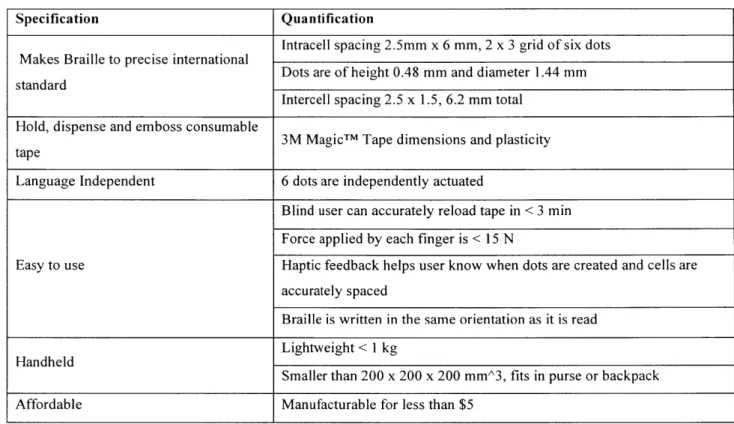
The overall functional requirements for the device were derived from both the deterministic and humanistic facets of the device functionality. Braille-It is designed to be an easy to use, language independent, personal braille label maker manufactured at a price point accessible to blind persons both in India and globally. Breaking this down, the specifications are laid out in Table 4.
Table 4: Global Specifications
Specification Quantification
Intracell spacing 2.5mm x 6 mm, 2 x 3 grid of six dots
Makes Braille to precise international
Dots are of height 0.48 mm and diameter 1.44 mm standard
Intercell spacing 2.5 x 1.5, 6.2 mm total
Hold, dispense and emboss consumable
3M MagicTM Tape dimensions and plasticity
tape
Language Independent 6 dots are independently actuated
Blind user can accurately reload tape in < 3 min
Force applied by each finger is < 15 N
Easy to use Haptic feedback helps user know when dots are created and cells are accurately spaced
Braille is written in the same orientation as it is read Lightweight < 1 kg
Handheld
Smaller than 200 x 200 x 200 mm^3, fits in purse or backpack Affordable Manufacturable for less than $5
Several heuristics drove the system integration and design of all parts. In particular, working to minimize the number of parts and designing all parts for two-part injection mold manufacturing significantly reduces the cost of mold production, which then reduces the fixed
costs. Balancing cost and capability was a significant factor driving the iterative design of the
device as well as a deciding factor when selecting strategies, concepts, modules and components
(SCMC). When particular features or capabilities did not initially meet these restrictive
manufacturing constraints, then alternate modules and components were designed.
Functional requirements resulted from a refinement of the broad specifications. These
requirements clustered around the six key actions of the device. For each functional requirement there is a matching design parameter. These functional requirements are tuned to the particular strategy selection of embossing braille dots on tape as laid out in the Design Section.
Table 5: Functional Requirements and Design Parameters
Functional Requirements Design Parameters
I
Precise alignment between punch and die1
+/- 0.15 mmForce applied to die to emboss Scotch 1ON of Force (See Appendix A.2 Embossing
Magic tape Force Test )
Repeated elastic bending 105cycles estimates the use with a factor of
safety of 10
Embossers fit dot model geometry Reference dot model geometry
Dots can be created independently 6 actuators for 6 independent dots
Force applied to mechanism to transmit Determined by spreadsheet cantilever beam
embossing force to tape calculation
Haptic feedback indicates dot is created Tactile and audible click after 1ON of force to emboss dot is applied
Move tape in discrete increments for cell Intercell spacing of 6.2 mm spacing
Provide haptic feedback to user that Tactile click after spacing is achieved
Indexing spacing is achieved
Tape exit doesn't interfere with holding Tape exits device out of the way of hands Fingers grip tape and pull to manually index Geometry allows fingers to grip tape (quantify)
Cutting Easily cut tape Only need to use one hand and single motion
Fits in two hands Meets ergonomic requirements for 5-95% of
users ages 15 to 65 [44]
Dots written in same direction and
Holding orientation as they are read Dots created upwards towards the user
All buttons can be used simultaneously All fingers fit on the buttons at the same time
Extended use does not fatigue user Keep wrists and hands in neutral (unstrained) position
Parts must be assembled accurately in the 0.15 mm in the x and y sensitive directions, correct orientation
Assembling Correct part orientation Parts designed to only fit one way
Can be done without sight in under 5 min, < 10
Re-assembly, tape I is easy to replacestp I steps
Manufacturing Low cost Design for 2 part molds, minimize parts
Some functional requirements constrained the design too much and were eliminated. For example, designs to minimize the distance from the embossing anvil to the tape cutting mechanism, which would reduce the amount of tape used, were eliminated because it was not as important a requirement as the cutting geometry such that the user can grip the tape and pull it
for indexing and cutting. A second requirement that was expanded was the size of the overall device. Initially, the goal was to make it pocket sized, but eventually, in order to make space for all the mechanisms and integrated attachments, the allowable envelope expanded.
3.2 Strategies and Concepts
Integrating the ergonomic and mechanism design requires an iterative process to prototype and test the overall Strategy, Concepts, Modules and Components (SCMC) as the design evolves from coarse to fine amounts of detail. Proof-of-concept, bench-top prototypes are refined in modules that integrate into an ergonomic product. Selecting the SCMCs is based on the functional requirements.
The key question that underlies this project is: how might we enable blind people to live more independently within their homes, schools, workplaces and communities? One simple answer is to enable them to efficiently and effectively identify objects and spaces. Several strategies could be functional solutions to this challenge, including digital, electro-mechanical and purely mechanical/physical. Braille labels are a relatively simple, inexpensive solution that leverages the prevalence of braille globally and enables a personal, customizable solution.
The core insight was there is a market need for a language independent mechanical braille label maker. Through his work with people with blindness in India, Ted Moallem, a former MIT postdoc, identified this need as a strategic area for innovation. While the trend in assistive technology is heavily weighted towards digital solutions, mechanical solutions are simple to implement and cost accessible.
Braille is written and produced with several primary strategies; embossing methods such as the manual slate and stylus, brailler typewriter and industrial printer are the most common. With the introduction of computing technology, numerous electromechanical braille devices have emerged, most commonly using actuators to elevate or depress pins arranged in cell formations. Thermoforming, displacement and deposition methods are more rarely encountered but are useful in the creation of graphs and other charts, primarily for educational purposes. An alternate identification strategy is using a scanning smart phone application to identify the object, logo or barcode on a product. There are many apps in distribution and being developed that address this need. Table 6 clarifies the strategies described above, and by identifying the advantages and risks
of each strategy makes the selection of a mechanical solution, leveraging labels created with independent actuators clear. In the context of this thesis, the "actuators" are the beams that hold the embossing elements and guide them, but the actual force to emboss is provided by a person's fingers pressing on the actuators.
Table 6: Identification Strategies
Strategies Concepts Modules Advantages Risks
Independent Language Geometric constraints to fit actuators Independent 6 actuators in small area
Mechanical Labels
Integrated, pre- Geometrically Limited to a single language combined dot cells compact and slower to emboss
embosser
Don't require Requires users to own Image Processing label creation expensive smart phone,
step or braille need significant database to Digital Cell phone apps or literacy identify objects
independent device Requires smart phone and Scanning bar/QR Doesn't require user still needs to locate the codes braille literacy bar code on the object to
I scan
Moving forward with labels as the chosen identification strategy, the next choice was selecting a label medium. Pressure sensitive adhesive tape was a natural category because it integrates the label with adhesive to stick to objects. Paper strips were also considered but would require an extra step to apply tape or adhesive. 3M Scotch Magic Tape was selected because it meets the cost, embossing force, and dot durability requirements, even though backless adhesives are more difficult to use.
Tapes are comprised of a film/backing combined with an adhesive. 3M Scotch tape is significantly different than most matte tapes, and while the exact composition of 3M Scotch® MagicTM tape is a trade secret, it is known that the film has a higher modulus of elasticity than polypropylene and is made out of a semi-crystalline polymeric material. [45] These properties compliment the physical testing of Scotch Magic tape, which showed that it captured the embossed dot shape better than other tapes and did not tear or break through as easily during embossing. 3M Scotch tape sticks well to a variety of materials including stainless steel, LDPE, polypropylene, and coated natural fibers.