HAL Id: tel-03135102
https://tel.archives-ouvertes.fr/tel-03135102
Submitted on 8 Feb 2021HAL is a multi-disciplinary open access archive for the deposit and dissemination of sci-entific research documents, whether they are pub-lished or not. The documents may come from teaching and research institutions in France or abroad, or from public or private research centers.
L’archive ouverte pluridisciplinaire HAL, est destinée au dépôt et à la diffusion de documents scientifiques de niveau recherche, publiés ou non, émanant des établissements d’enseignement et de recherche français ou étrangers, des laboratoires publics ou privés.
Adverse drug reactions detection in clinical notes
Edson Alejandro Florez Suarez
To cite this version:
Edson Alejandro Florez Suarez. Adverse drug reactions detection in clinical notes. Data Struc-tures and Algorithms [cs.DS]. Université Côte d’Azur, 2020. English. �NNT : 2020COAZ4034�. �tel-03135102�
Détection des Effets Indésirables des
Médicaments dans les Notes Cliniques
Adverse Drug Reactions Detection in
Clinical Notes
Edson Alejandro FLÓREZ SUÁREZ
Laboratoire I3S
Présentée en vue de l’obtentiondu grade de docteur en Informatique d’Université Côte d‟Azur
Dirigée par : Michel Riveill Soutenue le : 01 juillet 2020
Devant le jury, composé de : Andrea G.B. Tettamanzi, Professeur, Université Côte d‟Azur, Examinateur Pascal Staccini, Professeur, Université Côte d‟Azur, Examinateur
Christian Retore, Professeur, Université de Montpellier, Rapporteur
Marc Cuggia, Professeur, Université Rennes 1, Rapporteur
Abstract
The Information Extraction from clinical notes provides relevant information to identify adverse side effects in post-marketing surveillance of medications (Pharmacovigilance), which is more difficult to discover by traditional medical studies since patients are taking several treatments at the same time. In recent years, data mining techniques have allowed to discover knowledge stored in big datasets, such as the clinical records collected by hospitals throughout patient's life. The goal of this work is identify adverse side effects caused by treatments. Then, we have to identify relations between medications and Adverse Drug Events (ADE) entities, which is called Adverse Drug Reaction relation. This problem is divided Named Entity Recognition (NER) and Relation Extraction tasks. Nowadays, supervised approaches based on Deep Learning and Machine Learning algorithms solve this problem in the state of the art. These supervised systems require rich features in order to learn efficient models during training, therefore, we focus on building comprehensive word representations (the input of the neural network), using character-based word representations and word representations. The proposed representation improves the performance of the baseline model, and the final model reached the performances of state of the art methods. Then we have extracted contextual information through Deep Learning models and other different features obtained from the relations, in order to identify the Adverse Drug Reaction relations. The proposed model improved the overall accuracy and the extraction of Adverse Drug Reaction compared to the baseline, indicating the effectiveness of combining Deep Learning models and extensive feature engineering.
Keywords: Deep Learning, Information Extraction, Adverse Drug Reaction, Adverse Drug Event, Clinical Notes
Résumé
L'extraction d'information de textes médicaux fournit des renseignements très utiles pour identifier les effets indésirables dans la surveillance après consommation (Pharmacovigilance), qui sont plus difficiles à découvrir à travers des études médicales typiques puisque les patients prennent plusieurs traitements en même temps. Récemment, les techniques de Data Mining ont permis de découvrir les connaissances enregistrées dans de grands ensembles de données, comme les dossiers cliniques collectés par les hôpitaux tout au long de la vie du patient. L'objectif de cette thèse est d'identifier les effets indésirables causés par les traitements. Pour cela, nous devons extraire les relations entre les médicaments et Adverses Drug Events (ADE), qui est la relation de réaction indésirable des médicaments. Ce problème est divisé en tâches de reconnaissance d'entités nommées (NER) et d'extraction de relations. Aujourd'hui, les approches supervisées basées sur des algorithmes de Deep Learning et Machine Learning résolvent ce problème dans l'état de l'art. Les méthodes supervisées ont besoin de caractéristiques riches afin d'apprendre des modèles efficaces au cours de la formation, par conséquent, nous nous concentrons sur la construction de représentations de mots larges (l'entrée du réseau neuronal), nous utilisons des représentations de mots basées sur des caractères et des représentations de niveau de mots. La représentation proposée améliore la performance du modèle de référence et le modèle final a atteint les performances des méthodes de pointe. Ensuite, nous avons extrait des informations contextuelles à travers des modèles de Deep Learning, afin d'identifier les réactions indésirables aux médicaments. Le modèle proposé a amélioré la précision globale et l'extraction des réactions indésirables aux médicaments obtenu avec le modèle de base, ce qui indique l'efficacité de combiner des modèles de Deep Learning et une vaste ingénierie des caractéristiques.
Mots-clés: Deep Learning, Extraction d'Information, Adverse Drug Reaction, Adverse Drug Event, texte médicaux
Acknowledges
Dr. Michel Riveill proposed the research topic at the I3S laboratory, with the support of MD. Pascal Staccini from the CHU de Nice (UCA). I am very grateful to Professor Michel Riveill for his full dedication and leadership to this PhD thesis, with the continuous advising of Professor Frederic Precioso (I3S Laboratory, UCA).
This work was partly funded by the French government labelled PIA program under its IDEX UCA JEDI project (ANR-15-IDEX-0001). The Provence-Alpes-Cote d‟Azur (PACA) region and the France Labs company finance the doctoral work in Laboratoire d'Informatique, Signaux et Systèmes de Sophia-Antipolis (I3S) - UMR7271 - UCA CNRS.
Many thanks to Cédric Ulmer, CEO of France Labs, the industrial partner of this PhD work, and its researcher PhD. Romaric Pigetti for his collaboration in the publications of this thesis.
Thanks to MD. Virginie Lacroix-Hugues and MD. David Darmon from the Faculté de Médecine of UCA, for their specialized advising and provision of the PRIMEGE database (Regional Information Platform in General Medecine).
Thanks to researcher Clement Jonquet from Montpellier from LIRMM (Laboratoire d‟Informatique, de Robotique et de Microélectronique de Montpellier) at the Université de Montpellier, for the collaboration to use the BioPortal (LIRMM) annotator of French biomedical ontologies and terminologies.
Thanks to researcher Chloé Cabot from CISMef (Catalog and Index of French Language Medical Sites) at the CHU Hôpitaux de Rouen, for the support to use the ECMT annotator (Extracting Concepts with Multiple Terminologies).
We also work with Master Students in Computer Science at UCA. Eliane Birba Delwende for pre-processing of PRIMEGE clinical notes using Deep Learning (Delwende, 2018), project started with Athip Ponna and Upasana Biswas. Jacqueline Neef for data analysis of PRIMEGE database.
I also would like to thank to Dr. Carlos Jaime Barrios, professor at Universidad Industrial de Santander (UIS), Colombia, for his support during the whole process of this PhD thesis.
Thanks to my colleagues and friends in the Côte d'Azur, for sharing many unforgettable moments. To Nice la Belle (Nissa La Bella), my home for three years.
Contents
Introduction 1 1.1 Motivation ... 1 1.2 Problem ... 2 1.3 Objective ... 4 1.4 Contributions ... 4 1.5 Outlines ... 5Information Extraction for Adverse Drug Reaction Detection 8
2.1 Introduction ... 8
2.2 Formal definition of the problem ... 8
2.3 Word Representations ... 10
2.4 Methods of Solution ... 14
2.5 Supervised approach for Adverse Drug Reaction Detection ... 16
2.6 Conclusion ... 18
Named Entity Recognition in Clinical Notes 20
3.1 Introduction ... 20
3.2 Related Work ... 20
3.3 Supervised Approach ... 23
3.3.1 Datasets ... 24
3.3.2 Supervised Learning Models ... 26
3.4 Results and Discussion ... 35
3.4.1 MADE Results ... 35
3.4.2 Results with Dataset in Spanish ... 40
3.4.3 Important issues in clinical notes... 42
3.5 Conclusion ... 43
Relation Extraction in Clinical Notes 45
4.1 Introduction ... 45
4.2 Related Work ... 45
4.3 Relation Extraction Model ... 48
4.3.1 Candidate Generation ... 49
4.3.2 Feature Extraction... 49
4.3.4 Transfer Learning ... 51
4.4 Experiments ... 52
4.4.1 Dataset ... 52
4.4.2 Experimental settings ... 53
4.5 Results and Discussion ... 54
4.6 Conclusion ... 57
Real Life Scenario 60
5.1 Introduction ... 60
5.2 Raw Clinical Data ... 60
5.3 Clinical Notes Pre-processing ... 63
5.4 Automatic annotators based on ontologies ... 64
5.5 NER for Medical Text in French ... 68
5.6 Conclusion ... 74
Conclusions and Future Work 76
6.1 Conclusions ... 76
6.2 Future Work ... 78
Appendices 81
List of Tables
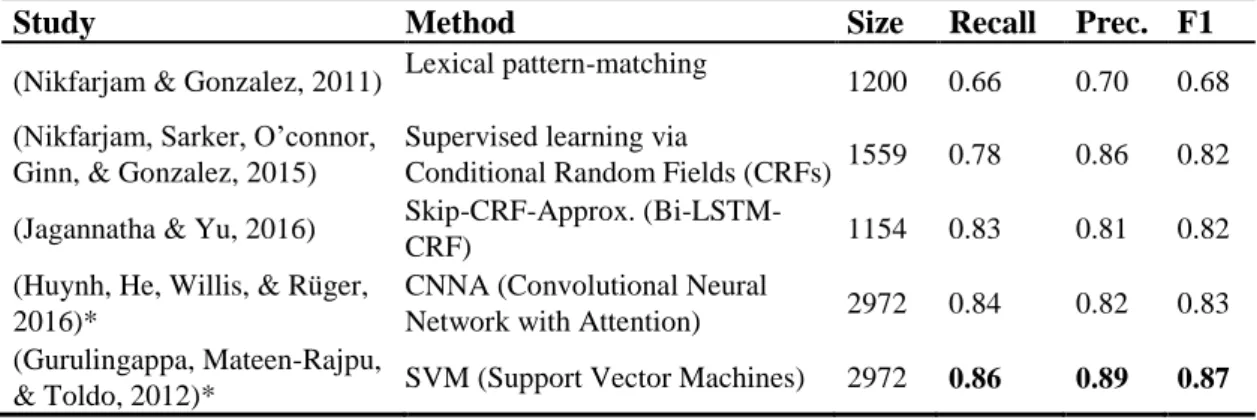
3.1: Methods for ADE extraction ... 23
3.2: Performance of models with MADE dataset ... 36
3.3: Performances of models for NER task in MADE Challenge (test set) ... 37
3.4: Performance by category on test dataset of our best model in MADE challenge ... 37
3.5: Confusion matrix between entities ... 38
3.6: Performance of models... 39
3.7: Performance by category on test dataset of our best model ... 39
3.8: NER task results in MADE Challenge (Strict Evaluation) ... 40
3.9: Overall performance for NER task on test set... 41
3.10: F1 score by category on test dataset ... 41
3.11: Performance by category on test dataset of the best model ... 42
4.1. Relation Extraction results in MADE Challenge, NER Task ... 47
4.2: Performance of LSTM+Features model with Test dataset of MADE Challenge ... 54
4.3: Performance metrics for the relation extraction task ... 55
4.4: Performance (F1) with Test dataset of MADE Challenge ... 56
4.5: Comparison with MADE challenge task 3 ... 57
5.1: UMLS type of entities identified by ECMT in PRIMEGE notes ... 67
5.2: Number of annotations of original and corrected PRIMEGE clinical notes ... 67
5.3: Number of annotations by category ... 69
5.4: Results for entity recognition task in CLEF eHealth 2015 (Névéol, et al., 2015) .. 70
5.5: Results for entity recognition task in CLEF eHealth 2016 (Névéol, et al., 2016) .. 70
List of Figures
2.1: Example of entities and ADR relation in a sentence ... 10
2.2: One-hot encoding for N words ... 11
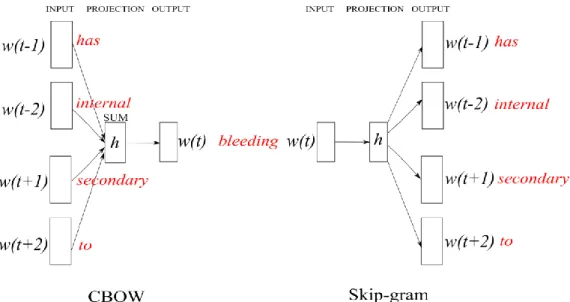
2.3 CBOW and Skip-gram models (Mikolov, Chen, Corrado, & Dean, 2013) ... 12
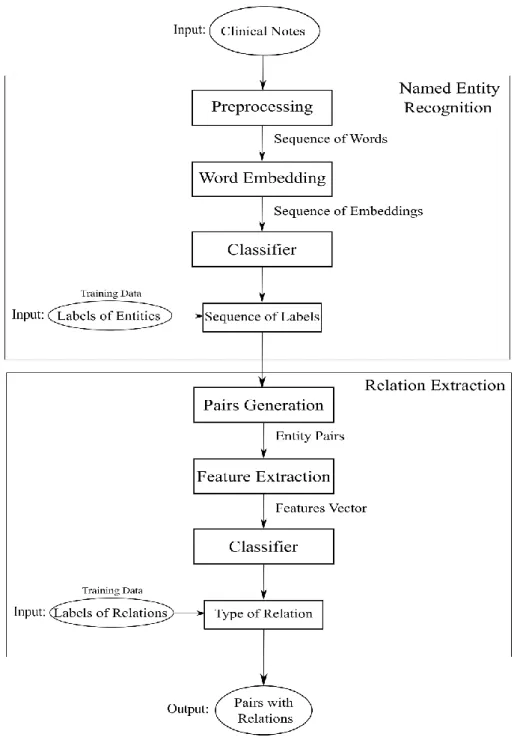
2.4: Pipeline for full ADR detection ... 16
2.5: Clinical Note sample with annotations in XML format ... 17
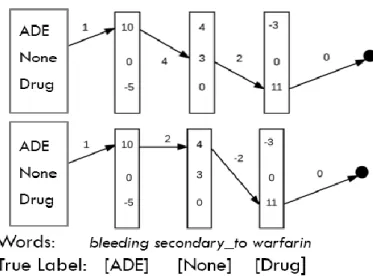
3.1: Sequence label scoring of sentence with linear-chain CRF ... 27
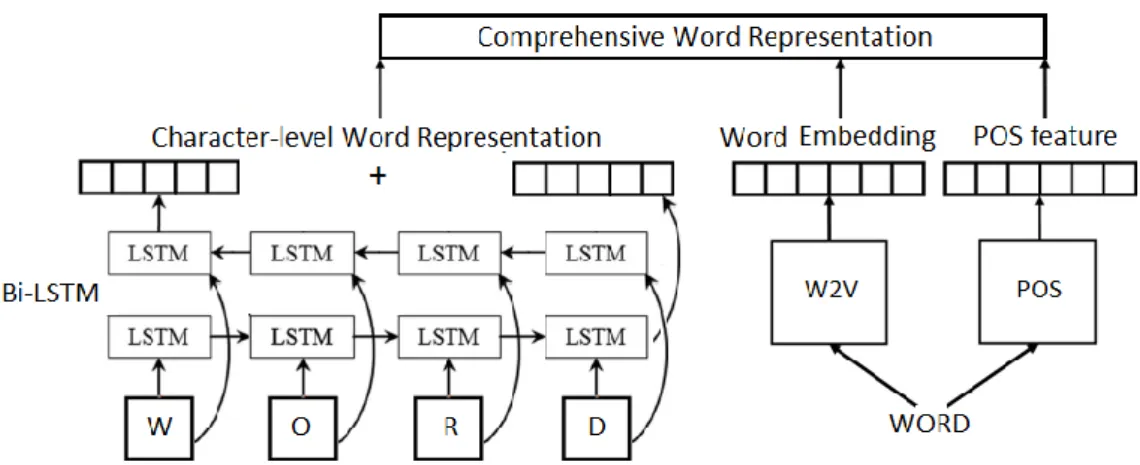
3.2: Comprehensive word representation ... 29
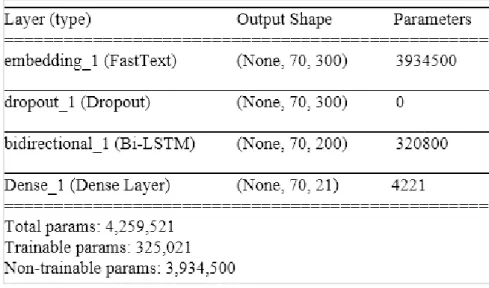
3.3: Baseline model based on LSTM for NER on MADE dataset ... 31
3.4: Final model for sequence tagging ... 32
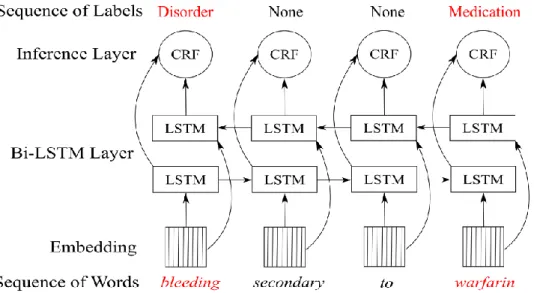
3.5: Model based on LSTM and CRF for NER on MADE dataset ... 32
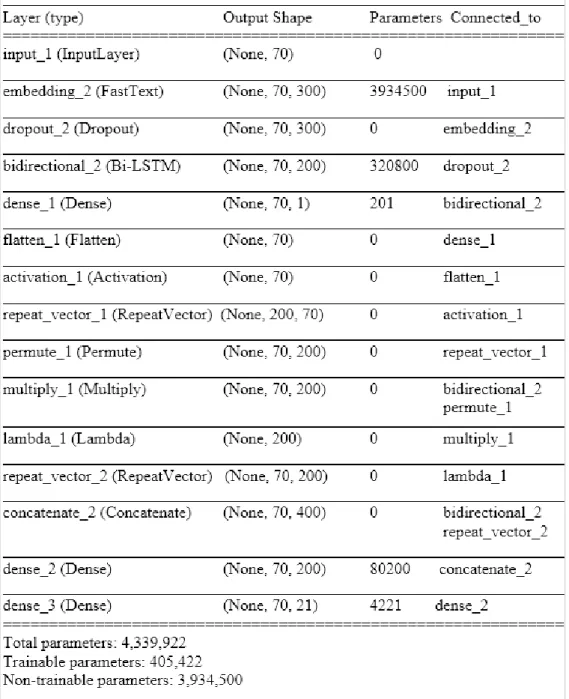
3.6: Model based on LSTM and Attentional model for NER on MADE dataset ... 34
3.7: Attentional model (Luong, Pham, & Manning, 2015) ... 35
4.1: Relation Extraction module ... 48
4.2: Relation Extraction model ... 51
4.3: BERT model for Sentence Pair classification tasks. ... 52
4.4: Number of annotations for every type of relation in MADE dataset ... 53
4.5: Pipeline for Joint task ... 57
5.1: Description of data collected in PRIMEGE ... 61
5.2: Entity–relationship model of PRIMEGE database ... 62
5.3: Number of elements in PRIMEGE ... 63
5.4: ECMT annotation through web service ... 65
5.5: Samples of annotations of PRIMEGE ... 68
5.6: The best model for NER in MEDLINE dataset ... 71
5.7: Full model for ADR detection on PRIMEGE dataset ... 73
CHAPTER 1
Introduction
1.1 Motivation
The detection of adverse side effects of medications is a complex problem in post-marketing surveillance, which belongs to the field of Pharmacovigilance. Nowadays, patients are taking several treatments at the same time, therefore their bodies are under Drug Drug Interaction (DDI) that could yield undesirable effects. Drug Drug Interactions are changes in a drug‟s effect when the drug is taken together with one or more drugs. It can delay, decrease or increase the action of the drugs, or even cause adverse effects. Therefore, the motivation of this research is the emergence of new adverse drug effects, which are more difficult to detect by traditional medical studies and experiments since patients are taking more medications at the same time today.
In recent years, data mining techniques for Information Extraction have allowed to discover knowledge stored during many years in big datasets, such as the clinical records collected by hospitals throughout patient's life. The data mining is necessary to exploit the huge amounts of clinical data available, in order to discover new side effects that are affecting people‟s health. Electronic Health Records save the patient‟s health in structured records but also in rich unstructured text, such as clinical notes that are written by general practitioners and medical specialists, who use medical vocabulary and jargon like medication and disease names. Some medical centers collect anonymous clinical data and provide it for research purpose.
Clinical notes contains medical observations, symptoms, diagnoses, reasons of encounter, etc., that also provides important information for surveillance of adverse effects of medications (Hauben & Bate, 2009). The future work could provide tools to support the doctor's decisions during the medication prescription, taking into account the potential adverse side effects in real-time Pharmacovigilance (Drug Safety) (Wang, Hripcsak, Markatou, & Friedman, 2009). For this purpose, several automated methods
of Information Extraction have been proposed in the literature, which try to overcome the specific challenges related to information extraction applied to clinical data.
1.2 Problem
The problem consists in detecting side effects of treatments. If an adverse effect occurred in presence of any drug, it is called Adverse Drug Event (ADE), and then if the ADE is consequence of taking a drug, it is considered or classified as an Adverse Drug Reaction (ADR). The data mining of Electronic Health Records is necessary to discover that specific information. This is an Information Extraction task between named entities in Natural Language Processing field. Previous approaches to the problem merely identified ADE mentions, without look for relations with treatments.
Moreover, previous approaches are dictionary-based and rule-based, thus they cannot be generalized, and the systems are inflexible to recognize ambiguous events (such as ADE) in different context of sentences, because the dictionaries (or terminologies) do not have all possible forms of the entities. For instance, the Adverse Reaction Terminology (WHO-ART) collects a list of common vocabulary of Adverse Drug Events, but this terminology has no links with medications that could produce it. Although such approaches have been accurate for detecting explicit entities, such as Drug‟s names, which are proper names well defined in specific terminologies or ontologies. Instead, supervised learning approaches can be trained to predict entities from any domain defined by the annotated data.
This problem is complex due to different reasons, for example, the system receives unknown vocabulary such as new medications or chemicals products, or ambiguous entities that cannot been defined completely by dictionaries. Therefore, it is necessary an appropriate representation of clinical data, to represent words that do not have standard representations. The approaches could fail to distinguish between different events that include same words, for instance the word “fever” could be consider as ADE or symptom of diseases according to the context. They are just entities in this initial procedure, with no relation recognized with other type of entities (e.g. relations between ADE and medications).
The last systems related to Adverse Drug Reactions are based on Machine Learning and Deep Learning algorithms. Mostly, these systems address the sequential problem of
Named Entity Recognition, such as the work done by (Nikfarjam, Sarker, O‟connor, Ginn, & Gonzalez, 2015), without obtain relations between entities. Machine Learning algorithm such as Support Vector Machines (SVMs) was used for the identification of adverse effects mentions of drugs with a dataset of ADE annotations in medical text (Gurulingappa, Mateen-Rajpu, & Toldo, 2012). ADR mentions were detect using Deep Learning models (Huynh, He, Willis, & Rüger, 2016) such as CNN (Convolutional Neural Network), and RNN (Recurrent Neural Network) is more specialized on this type of sequential problems (Liu, et al., 2017). RNN is limited due to the vanishing gradients problem (Bengio, Simard, & Frasconi, 1994), then another RNN architecture known as Long Short-Term Memory (LSTM), reduced this problem using a short memory connection along the input sequence. LSTM has been used to exploit the long-term dependencies inside word sequences to increase the accuracy of this Named Entity Recognition tasks (Jagannatha & Yu, 2016).
It is important to feed the neuronal network with an appropriate input representation (Chiu & Nichols, 2016), in order to improve accuracy of LSTM, for example, a vector representation like the Skip-gram word embedding in (Jagannatha & Yu, 2016). We could also improve the accuracy with additional features, such as character-level features and concatenate character and word representations inspired by the work of Chiu et. al. (Chiu & Nichols, 2016).
Results of works for ADE detection were collected in the review made by (Sarker, et al., 2015), where Machine learning and Deep Learning algorithms are outstanding, although the comparison is not precise because each author used different datasets. Therefore, recently, some challenges have been organized in this research field, to allow comparison of systems executed under the same conditions.
Previous works for detection of relations between medical entities (like medications and ADE) (Jagannatha, Liu, Liu, & Yu, 2019) were approaches grouped into rule-based, lexicon-based, and supervised learning mostly (Jagannatha, Liu, Liu, & Yu, 2019). Nowadays, the works use supervised learning due to the high accuracy of Machine Learning and Deep Learning methods. The systems are based on Deep Learning models such as Bidirectional Long Short-Term Memory with Attention layer (Dandala, Joopudi, & Devarakonda, 2018), and Machine Learning algorithms such as Random Forests (Chapman A. B., Peterson, Alba, DuVall, & Patterson, 2018; Magge, Scotch, &
Gonzalez-Hernandez, 2018) and Support Vector Machines (Xu, Yadav, & Bethard, 2018).
The researchers in (Munkhdalai, Liu, & Yu, 2018) take the previous words with a fixed window size of both candidate entities as an input of the LSTM layer. In the LSTM model proposed by (Dandala, Joopudi, & Devarakonda, 2019), the input of the LSTM layer is the sentences between the entities of the relation, included the sentences in which the entities appeared. Some works were evaluated in the MADE Challenge (Yu, Jagannatha, Liu, & Liu, 2018), where a system based on Random Forest archives the best result (Chapman A. B., Peterson, Alba, DuVall, & Patterson, 2018). See more details of the state-of-the-art in Chapters 3 and 4.
1.3 Objective
The goal of the thesis is to develop models for automatic detection of Adverse Drug Reactions in clinical data. We address the problem by a supervised approach divided into Named Entity Recognition and Relation Extraction tasks, with a model able to learn patterns during training with annotated data from clinical notes. We base the model on recently proposed Deep Learning methods, and we try to exploit contextual information and different features of clinical notes for classification of entities into categories defined bylabelled data, to finally extract relations between the entities with the trained model. Therefore, given a clinical note asinput to the trained model, the model returns pairs of entities and their relations such as the Adverse Drug Reaction relation between Adverse Drug Events and medications.
1.4 Contributions
The global contribution of this dissertation is the full data pipeline for identification of entities and its relations, using supervised models focused on Adverse Drug Reactions (ADR). The identification of relations between ADE and medications is the most challenging task for detecting Adverse Drug Reactions in clinical notes. Most of the existing works only have performed the Named Entity task, so their models do not get any relation. Instead, we developed the full procedure to extract relations between entities, using the annotated relations provided in datasets for supervised learning.
First, we explore the impact of character embedding to classify named entities involved in the ADR relation (ADE and Drug entities). We have implemented models based on Long Short-Term Memory (LSTM) with a wide word representation (with character embedding, word embedding and Part of Speech), which improves the performance of LSTM by itself. We validated our approach through the participation of international NLP (Natural Language Processing) challenges, for evaluation and comparison of official results with state–of–the–art methods executed under the same conditions. This work was published in Proceedings of NLP Challenges for Detecting Drug and Adverse Drug Events from Electronic Health Records (MADE 2018) (Yu, Jagannatha, Liu, & Liu, 2018), with the collaboration of PhD. Romaric Pigetti (Florez, Precioso, Riveill, & Pighetti, 2018), researcher of France Labs company, the industrial partner of this doctoral work. Additionally, we test the generalization skill of the model for identification of medical-related entities using other language (Spanish dataset), with the gold standard dataset provided by PharmacoNER Challenge, and the results were published in the Workshop on BioNLP Open Shared Tasks by (Agirre, et al., 2019).
Second, we extract information from external features to enrich a model based on Deep Learning, for identification of relations between the entities. The combination of that features vector and contextual knowledge is effective to detect relations, because the external features provide other important type of information to improve the accuracy of the baseline model. We also used the dataset provided by the recent challenge as benchmarking to compare with state-of-the-art models (Yu, Jagannatha, Liu, & Liu, 2018). This work was published in Proceedings of the International Conference on Natural Language Processing (Florez, Precioso, Pighetti, & Riveill, 2019). Finally, we can perform the full task (NER and Relation Extraction) with a pipeline to detect Adverse Drug Reactions, given only raw clinical notes as input of the pre-trained model.
1.5 Outlines
The rest of the dissertation is organized as follows:
Chapter 2 describes the main concepts related to this thesis. It presents state-of-the-art approaches for the problem specifically focused on the medical field. We define the formal problem and introduce the main methods to solve it. Finally, we review the word
representations available for the sequential input, and we present the overall view of the model to address the full problem, with modules for Named Entity Recognition and Relation Extraction tasks.
Chapter 3 reviews the state-of-the-art for supervised approaches for Named Entity Recognition. We describe the proposed supervised models to identify entities in clinical notes, based on Machine Learning and Deep Learning algorithms. The experiments were carried out with gold-standard datasets of challenges to evaluate the models in same conditions as other research teams (during the challenges), and we present the experimental setup to allow the reproduction of experiments.
Chapter 4 describes the full Relation Extraction model, with the preliminary Candidate Generation and Feature Extraction of entity pairs, before the Deep Learning based method for identification of relations between entities. There we compare against the most recent state-of-the-art methods to validate the results, methods mostly based on Machine Learning algorithms.
Chapter 5 describes a real life scenario for Adverse Drug Reaction detection in raw clinical notes in French. There we explain the issues of raw data provided directly from the source with minor pre-processing, where we shows the necessity of de-noising procedures. Then the annotations were made using Dictionary-based methods available for medical data in French. Finally, we could compare these type of approaches with our model for Named Entity Recognition in a gold-standard corpus in French.
Chapter 6 summarizes the conclusions of the thesis and we propose perspectives to continue the research in future work.
CHAPTER 2
Information Extraction for Adverse
Drug Reaction Detection
2.1 Introduction
EHR (Electronic Health Records) storages the patient health in both structured records and unstructured text such as clinical notes, which are written by general practitioners and medical specialists with medical vocabulary, e.g. medication and chemical names. Some medical centers collect and publish anonymous data for research purpose.
Clinical notes contain medical observations, symptoms, diagnoses, reasons of encounter, etc. it also provides important information for surveillance of adverse side effects. A tool for adverse side effects detection can support the doctor's decisions during the medication prescription in real-time Pharmacovigilance (Drug Safety) (Hauben & Bate, 2009).
In the Supervised approach for automatic detection of entity mentions in clinical notes, we learn a model from annotated data, and then we try to identify and annotate the medical entities found in the raw clinical notes. Deep Learning methods can do the automatic extraction of adverse events from large number of Clinical Notes.
2.2 Formal definition of the problem
In the supervised data mining approach, an unlabeled sequence of words have to be classified into some category or None. Usually, it is a multi-class classification problem where the model is trained to classify in more than two classes, the labeled entities are composed by one or more words.
Formally, given the sets of words X and its labels Y for the words sequence of length t, get a classification function f : X → Y that assigns every word
testing set, the training set for leaning the classification model from text and its labels. The test set is unlabeled texts that are used to evaluate the accuracy of the model in predicting the target labels.
The categories are selected according to the interests/necessities of the domain annotators (applications). The scientific community publishes corpus for medical research purpose, for example, the dataset made with Medical Case Reports for detecting sentences only with ADE or non ADE (Gurulingappa, et al., 2012), and datasets with finer-grain annotations like the QUAERO French Medical Corpus, which has ten categories (Névéol, Grouin, Leixa, Rosset, & Zweigenbaum, 2014) such as Anatomy, Devices, Chemical and Drugs, Disorders, etc.
The Named Entity Recognition (NER) tasks belong to Natural Language Processing domain (Information Extraction precisely), where we need to identify objects (one or many words) that belong to some predefined categories. The common categories are proper names for places, persons and organizations (Poibeau & Kosseim, 2001), numbers such as quantities and percentage, and temporal expressions such as dates. Categories with complex vocabulary of specific domains such as chemical products, diseases and genes.
We try to establish if a side effect has been caused by any treatments, therefore, it is necessary to identify the medicine and side effect categories. For example, we only identify the event internal bleeding in the sentence “The patient has internal bleeding
…”. Then if we find any medication in the same context, we can consider this event as
an Adverse Drug Event (ADE). ADE is an adverse event that happens simultaneously when the patient takes a medication, whether it is identified as a cause of the event or not. For instance in the sentence “The patient has <ADE>internal bleeding</ADE>
secondary to <Drug>warfarin</Drug>.”, where an ADE and Drug entities are
labelled. There given the pair of entities and the set of labels Y for relations (None included), we get a classification function f : → Y that assigns every possible pair to its corresponding relation ∈ Y.
The Relation Extraction tasks begins after the identification of medications and ADE using NER models, then we have to consider the context of the full sentences to know if there is a relation between the ADE and Drug entities (see Fig. 2.1). If the Adverse Drug Event was caused by the drug, it is a relation called ADR (Adverse Drug
Reaction), as in the explicit statement “the patient has internal bleeding secondary to
warfarin”.
Figure 2.1: Example of entities and ADR relation in a sentence
The evaluation metrics reported by most of the authors are F1 score, Precision and recall. Precision and recall take into account the True Positives (TP) or number of correct predictions of the gold standard evaluation data. The unlabeled elements or negative samples belong to the None class (True Negatives).
Precision is focused on False Positives (FP) predictions. Precision is the ratio of True Positives predictions to the total positive predictions made by the model:
Recall is focused on False Negatives (FN) or number of samples of the gold standard evaluation data that the model did not predict. Recall is the ratio of True Positives predictions to all the samples of the gold standard evaluation data:
F1 Score is the weighted average of Precision and Recall, then F1 score takes into account both False Positives and False Negatives. Therefore, it is considered the main metric to evaluate the models:
The classification problems based on word sequences typically need informative representations as input, instead the original word without any type of features.
2.3 Word Representations
The input of word sequences should provide relevant information for the classification, thus there is necessary good representations or features. The sequence of words (or tokens) are replace by any representation or vectors obtained through
algorithms such as Bag of Words (BoW), CBOW (Continuous BoW), N-grams, Skip-Gram, Word vectors and FastText. The first following models are count-based machine learning applied to NLP tasks, which storage the representations as a vocabulary in lookup tables.
We can cluster words in classes, where similar words share the same class (or parameters) for the purpose of generalization, because Word Classes method assumes that similar words appear in similar contexts. Therefore, each word of the vocabulary is mapped to a single class, for example one class for cities (Berlin, Paris, Rome) and other class for countries (Germany, France, Italy).
One-hot (1-of-N) representations is a simple way to encode categorical data, such as words, using only discrete values 1 and 0. N is the size of the vocabulary in the 1-of-N encoding, then we will have a matrix of N x N, and every word w receives only its corresponding 1 (see Fig 2.2). The main problem One-hot representations is the high dimension of the matrix, then it is used in our work only to encode the set of classes (labels) that contains less than 50 elements.
Figure 2.2: One-hot encoding for N words
Bag-of-words (BoW) for documents or sentences is the number of occurrence of each word in the given sample, i.e. it is the sum of one-hot codes without take into account the order of words. Then the input sequence is represented as a vector of words, which can be considered as the N-gram model with N=1. For example in “The patient
has internal bleeding secondary to warfarin, another patient has neuropathy due to the same medication”, we would get the BoW:
{"The":2, "patient":2, "has":2, "bleeding":1, "secondary":2, "to":2, "warfarin":1, "another":1, "neuropathy":1, "due":1, "same":2, "medication":1}
The N-gram models are able to store contextual information, using the same frequency method of BoW, however it splits the sequences of text in more than one word (unigram), to conform bigrams (term of two words) or N-grams of N words. For example, “internal bleeding” would be a bigram and the model will count the number of occurrences in the text.
Continuous Bag-of-Words models (CBoW) add inputs from words within short window (the context) to predict the current word (Mikolov, Chen, Corrado, & Dean, 2013). The weights for different positions are shared in the weight matrix of the hidden layer (projection), then it is computationally more efficient but it cannot model n-grams. Skip-gram is a CBoW variation (the inverse) that try to find word representations for predicting the surrounding words (the context) of the target word in a sentence during training (see Fig. 2.3). Larger training context results in more training examples and thus can lead to a higher accuracy (Mikolov, Chen, Corrado, & Dean, 2013). For example with a window size 2 in the sentence: The patient has internal
<Target>bleeding</ Target> secondary to warfarin, CBoW would take the context
words (vectors) of the target word as input for training, i.e. “has internal” and “secondary to” are used to predict “bleeding” (the label). On the contrary, “bleeding” would be the input in Skip-Gram, and the model predict the context words “has internal” and “secondary to”. Then the model back propagates to minimize the prediction error, from the output layer to the weight matrix using Cross Entropy as loss function.
The Word Vectors (or embeddings) have some similar properties to word classes, but word vectors capture many degrees of similarity (Paris is similar to Rome, but also to France) and also capture linguistic properties such as gender (queen and king, aunt and uncle) (Mikolov, Yih, & Zweig, 2013). The word embeddings (word vectors) are dense vectors in the matrix (usually the matrix of weights) between the input and hidden layer. The model will learn a continuous representation of words represented by a real valued vector compressed in a low N-dimensional space (Bengio, Ducharme, Vincent, & Jauvin, 2003), where words that appear in similar contexts are mapped to nearby vectors by the parameterized function. Word embeddings are learned on large unlabeled datasets through different algorithms (Collobert & Weston, 2008). The classifier algorithm have many outputs as there are words in the vocabulary, where the previous word (encoded as one-hot) is used to predict the current word by going through hidden layer.
The word2vec project implements CBOW and Skip-Gram for training embedding (Mikolov, Chen, Corrado, & Dean, 2013), with the extensions of the original Skip-gram model using sub-sampling of frequent words improves accuracy of less frequent words representations, and a variant of Noise Contrastive Estimation for training the Skip-gram model that results in better vector representations for frequent words compared to Hierarchical Softmax.
FastText extends the continuous skip-gram model of word2vec (Mikolov, Chen, Corrado, & Dean, 2013) by adding subword information, in order to obtain representations of rare words by a sum of its character n-grams (Bojanowski, Grave, Joulin, & Mikolov, 2017). This method is efficient to text representation learning on large corpora. FastText outperforms CBOW and Skip-gram models of word2vec in almost all datasets of the state-of-the-art models for word representations (Mikolov, Grave, Bojanowski, Puhrsch, & Joulin, 2017).
Word vectors can be also trained in a layer of full neural network language model, as projection vector of the input, but it involves dense matrix multiplications and supervised training that is not efficient (Mikolov, Chen, Corrado, & Dean, 2013). Pre-trained word representations are provided as vectors into a lookup table (dictionary shape). The pre-trained word vectors provide generalization for systems trained with limited amount labelled data in tasks such as Named Entity Recognition (Sienčnik,
2015). Then we represent words through Word2Vec and FastText embeddings to add worthy generalization features to the classifiers.
2.4 Methods of Solution
The main approaches for Information Extraction arerule-based models and supervised learning. Rule-based approaches are usually based on handcrafted rules for sentences. These systems are difficult to build because it requires extensive domain knowledge. The rules are provided as language patternsusing grammatical and syntactic (e.g. Part of Speech POS and word precedence), thus rule-based are inflexible to understand all the different contexts in which entities appear in the sentences. Rule-based systems are implemented in combination with dictionary-based approaches to increase the accuracy (Budi & Bressan, 2003). They are used commonly in domains with high formalism that facilitates the creation of terminologies, e.g. biomedical annotators based in ontologies (like BioPortal, ECMT and LIRMM). However, dictionary-based approaches are limited to one domain because they are only capable to detect entities that are in the dictionary.
Supervised Learning methods consist in training algorithms that pick up statistical patterns in labelled data, in order to learn discriminative features and apply them to unseen data. Supervised models learn to classify specific categories defined in annotated samples, in consequence, these models require large annotated datasets and they have to be adapted to every domain. Most of supervised models are based on Machine Learning algorithms such as Hidden Markov Models (HMM) (Rabiner, 1989), Decision Trees (Rokach & Maimon, 2008), Support Vector Machines (SVM) (Joachims, 1998), Conditional Random Fields (CRF) (Lafferty, McCallum, & Pereira, 2001), they have been used in works for clinical entities recognition such as SVM (Tang, Cao, Wu, Jiang, & Xu, 2013) and CRF (Settles, 2004). Recently, Deep Learning algorithms such as Recurrent Neural Networks (RNN) have been state of the art in biomedical NLP task (Li, Jin, Jiang, Song, & Huang, 2015). The most recent approaches will be review in the following chapters (see Chapters 3 and 4).
Semi-Supervised Learning (SSL) models are able to use un-labelled data in addition to labeled data for learning (Nadeau D. , 2007), such as semi-supervised model based on CRF that trains on both type of data simultaneously (Liao &
Veeramachaneni, 2009). The main problem to work in new domains is the need of specific annotations, then semi-supervised learning reduce the annotation efforts of training data, although supervised models still get more accuracy. In contrast to labeled data, unlabeled data is available in huge amounts from sources like Wikipedia.
Unsupervised methods have been used for entity recognition some years ago, however they still need the support of domain dictionaries or handcrafted rules. An unsupervised system for Named-Entity Recognition creates large lists of entities for a given type of entity or semantic class such as car brands or cities, and then it uses heuristics to perform named-entity classification (Nadeau, Turney, & Matwin, 2006). Other unsupervised method to biomedical named-entity recognition does not need rules or training data, the system uses term collection extracted from terminologies for each target entity (disorders, treatments, etc.), boundary detection to keep entities correlated with noun phrases, and a classifier to predict the semantic category of candidate entities in clinical notes and biomedical data (Zhang & Elhadad, 2013).
Dictionary-based approaches are not suitable for Relation Extraction tasks. Relation Extraction also includes distant supervision based techniques and some few techniques which jointly extract entities and relations (Pawar, Palshikar, & Bhattacharyya, 2017). Distant supervision (Mintz, Bills, Snow, & Jurafsky, 2009) does not require labelled data, instead it needs a large semantic database for automatically obtaining relation labels. This method is based on heuristics as any sentence might express a relation if contains both entities of the relation, so the database contains entity pairs for each relation type. They train a multi-class logistic classifier using lexical, syntactic and entity type features.
Jointly extraction models for entities and relations, such as graphical models approach, train local independent (entity and relation) classifiers with dependencies between entities and relations, which are encoded by a Bayesian Belief network (Roth & Yih, 2004). It is a directed acyclic graph where entities and relations are represented as nodes in two different layers, each relation node has two incoming edges from its entity nodes. They provide a feature vector for the sentences, with constraints encoded through the conditional probabilities estimated from the entities and relations labelled corpus or set manually. The best reported F-measure for joint modelling is still low (on dataset ACE2004) (Pawar, Palshikar, & Bhattacharyya, 2017).
2.5 Supervised approach for Adverse Drug Reaction
Detection
We propose a full method for identification of entities and their relations through supervised approach in clinical notes (see Fig. 2.4). The approach is based on Machine Learning and Deep Learning algorithms. We could collect data from clinical corpus made publicly available from the research community. Clinical notes divide into sequences of words are the input for the pipeline (final trained model).
First, we preprocess and tokenize the raw clinical notes (see Fig. 2.5), each document is split into sequence of words (with N tokens length) until the end of sentences in the document. Sentences longer than N tokens were cropped to size, and shorter sentences were pre-padded with masks to indicate where the last word is. The sequences of words need pre-processing with a regular expression tokenizer into individual word and special character tokens in lower case to match with the word embedding.
Figure 2.5: Clinical Note sample with annotations in XML format
We add features and word representation in the input layer. Then Named Entity Recognition module is performed and the output is the predicted entities, it is another input to the Relation Extraction module in the pipeline. The supervised learning is based on annotations for both entities and relations presented in clinical notes, for example, the annotations of entities:
[Begin, End, Text, Label, #Entity] [2272, 2282,"neuropathy", ADE, 716] [2295, 2302,"Velcade", Drug, 717]
Annotations of relations:
[#Entity1, #Entity2, Type, #Relation] [716, 717, Adverse, 1]
The final output is the relation between the entities. The description of each module of this model is in Chapters 3 and 4.
2.6 Conclusion
Clinical notes contain rich information such as medical observations, diagnoses, medications, etc, and the information required for our surveillance of adverse side effects. The information extraction on clinical notes can be performed by Supervised Learning methods that overcome the limitations of other methods such as dictionary based models. In the supervised approach for detection of entity mentions, we learn a model from annotated data, then it try to identify and annotate the medical entities in raw clinical notes.
We propose a full method for identification of entities and their relations through supervised approach in clinical notes. The input of word sequences can provide relevant information for the supervised model, the state of the art of word embeddings shows FastText and word2vec (Skip-gram) as good representations for words, so we used them in our models.
CHAPTER 3
Named Entity Recognition in Clinical
Notes
3.1 Introduction
Extracting medical events from clinical notes provides relevant information for surveillance of adverse side effects, because clinical notes contain richer information about patient health than structured records. Patients are often subject to multiple treatments, which may be the cause of adverse effects. Therefore, it is necessary to establish if an Adverse Drug Event (ADE) has occurred after taking medicines. ADE refers to any adverse event occurring at the time a drug is taken, whether it is identified as a cause of the event or not. In case one can establish a relation between the ADE and the drug, then the relation is considered as an Adverse Drug Reaction (ADR), which is a Relation Extraction (RE) task. Deep Learning models could improve the identification of possible ADEs in real-time Pharmacovigilance (Drug Safety).
In the Supervised Learning approach for automatic detection of entity mentions in clinical notes, we learn a model from annotated data, then we try to identify and annotate the medical entities found in raw clinical notes. We can find ADE mentions in clinical notes provided in EHR (Electronic Health Records). These notes contain mentions of medical entities like medications, ADE (Adverse Drug Event), symptoms, etc. These terms have to be identified in the classification problem known as Named Entity Recognition (NER). A named entity is a term (one or many words) that can be annotated with a label (tagging) if it belongs to any predefined category. The next subsection presents related works to NER in medical domain.
3.2 Related Work
Adverse Drug Event detection has been performed with systems based on Machine Learning and Deep Learning algorithms recently. Machine Learning algorithm such as
Conditional Random Fields (CRFs) is used for ADR extraction (Liu, et al., 2017), CRF can take context (around the current word) into account for sequence modeling, it takes every neighbour word in a fixed window of words (Nikfarjam, Sarker, O‟connor, Ginn, & Gonzalez, 2015). Support Vector Machines (SVMs) is other Machine Learning algorithm used commonly for NER. Gurulingappa et. al. (Gurulingappa, Mateen-Rajpu, & Toldo, 2012) built a system for the identification and extraction of potential adverse events of drugs with SVM. Their dataset is an ADE corpus from MEDLINE (Medical Literature Analysis and Retrieval System Online) case reports annotated manually. The corpus contains annotations for the mentions of drugs, ADE, and relations between drugs and medical conditions representing clear adverse reactions (relation drug-cause-condition).
The CLEF (Cross-Language Evaluation Forum) eHealth Evaluation Lab provides system performance for NER, the Task 1b in CLEF 2015 (Névéol, et al., 2015), using the QUAERO French Medical Corpus (Névéol, Grouin, Leixa, Rosset, & Zweigenbaum, 2014). It has ten categories for annotations of medical entities, with data collected from the EMEA (European Medicines Agency) documents and titles of research articles indexed in the MEDLINE database. A Dictionary-based concept recognition system overcame CRF and SVM classifiers in CLEF 2015 on the MEDLINE corpus (Névéol, et al., 2015), according to the Exact Match metric, which considers a term (word or group of words that have a label) as correctly classified only if all the words in the term received the correct label.
Deep learning models like CNN (Convolutional Neural Network) are used to detect the presence of ADR (Huynh, He, Willis, & Rüger, 2016), such as the binary classification problem on two medical datasets from Twitter and case reports (Gurulingappa, Mateen-Rajpu, & Toldo, 2012). Overall, CNN appears to perform better compared to other more complex CNN variants that have a RNN (Recurrent Neural Network) layer (Gurulingappa, Mateen-Rajpu, & Toldo, 2012). However, CCNA (Convolutional Neural Network with Attention) is better on the dataset of case reports. In overall, results of the case reports are better than results obtained with the Twitter dataset of medical domain. Tweets contain a lot of ill-grammatical sentences and short forms that hinders the performances (Huynh, He, Willis, & Rüger, 2016), which highlights the importance of de-noising the data.
The adverse event detection problem focused on clinical notes is a sequential problem, and RNN is specialized for it because at time step t, the recurrent node takes as input the outputs produced by the previous state. RNN models were limited to make separate classifications at every time step on an input sequence (Liwicki, Graves, Fernàndez, Bunke, & Schmidhuber, 2007), but they face the problem of vanishing gradients (Bengio, Simard, & Frasconi, 1994), instead another RNN architecture known as Long Short-Term Memory (LSTM), reduces the impact of this problem using a short memory connection along the sequence. LSTM was designed to take into account the long-time dependencies between relevant inputs of the sequence. LSTM has been applied to sequential problems such as Handwriting Recognition (Liwicki, Graves, Fernàndez, Bunke, & Schmidhuber, 2007) and Named Entity Recognition (Jagannatha & Yu, 2016). LSTM exploits the long term label dependencies for sequence labelling in clinical text, e.g. in “the patient has internal bleeding (ADE) secondary to warfarin (Medication)”, the sentence contains an ADR relation between ADE and Medication entities, and the label for ADE is strongly related to the label prediction of Medication. Then “internal bleeding” is tagged as ADE using information of Medication label, which is stored in the memory of LSTM cells.
LSTM was used with an annotated corpus of English Electronic Health Records (EHR) from cancer patients in (Jagannatha & Yu, 2016), with labels for several medical entities (like Adverse Drug Event, drug name, dosage, etc.) and relations between entities. The best model in (Jagannatha & Yu, 2016) is the Approximate Skip Chain CRF-RNN network (see Table 3.1), which implements a CRF algorithm after the bidirectional LSTM output, and a Skip-gram word embedding calculated using unlabelled data from PubMed, English Wikipedia and unlabeled EHR corpus (called MADE dataset), these EHRs are not used in the annotated dataset for training and test. This network has a high accuracy for Drug name detection, but a low accuracy for ADE, probably because the dataset in unbalanced and has less ADE samples and the confusion between ADEs and categories with the same vocabulary (such as SSD).
Table 3.1 shows results of NER algorithms dedicated to ADE detection, some of them were collected in the review article made by (Sarker, et al., 2015), but each author used different datasets so it is not possible to make comparisons in same conditions. This review shows that Machine learning and Deep Learning algorithms are outstanding at this task, but those results were obtained with different datasets, making the
comparison somewhat unfair. However, the best result used the same dataset, (Huynh, He, Willis, & Rüger, 2016) and (Gurulingappa, Mateen-Rajpu, & Toldo, 2012) (last lines of Table 3.1), the SVM model in (Gurulingappa, Mateen-Rajpu, & Toldo, 2012) obtained slightly better results than CNNA on Recall, Precision and F-score.
Study Method Size Recall Prec. F1
(Nikfarjam & Gonzalez, 2011) Lexical pattern-matching 1200 0.66 0.70 0.68 (Nikfarjam, Sarker, O‟connor,
Ginn, & Gonzalez, 2015)
Supervised learning via
Conditional Random Fields (CRFs) 1559 0.78 0.86 0.82 (Jagannatha & Yu, 2016) Skip-CRF-Approx.
(Bi-LSTM-CRF) 1154 0.83 0.81 0.82
(Huynh, He, Willis, & Rüger, 2016)*
CNNA (Convolutional Neural
Network with Attention) 2972 0.84 0.82 0.83 (Gurulingappa, Mateen-Rajpu,
& Toldo, 2012)* SVM (Support Vector Machines) 2972 0.86 0.89 0.87
Table 3.1: Methods for ADE extraction Note: *Systems using the same dataset
LSTM model has shown to be appropriate on the state of the art for sequential problems. However, in order to improve performance, it is important to feed the network with an appropriate input representation (an embedding) (Chiu & Nichols, 2016). This representation replaces each unique word with a dense vector representation, which tries to provide closer vectors among word synonyms or related words. In (Jagannatha & Yu, 2016) the embedding layer values used were initialized using a Skip-gram word embedding and unlabelled data from three open access corpus mentioned before. We could also improve the precision of LSTM with additional features for its input, such as character-level features from each word extracted using CNN or LSTM (Liu, et al., 2017), and then concatenate character and word representations inspired by the work of Chiu et. al. (Chiu & Nichols, 2016).
3.3 Supervised Approach
This section presents the experiments to validate our model for NER in clinical notes. We describe the datasets, models (Sections 3.3.1 and 3.3.2) and present results (Section 3.3.3).
3.3.1 Datasets
We participated in two challenges in order to validate and compare the results on gold-standard corpus. The first NLP Challenges for Detecting Drug and Adverse Drug Events from Electronic Health Records, the MADE challenge (Yu, Jagannatha, Liu, & Liu, 2018) with text in English, and the first NER task on chemical, drug, gene/protein mention recognition from clinical case studies in Spanish, which is called PharmaCoNER challenge (Agirre, et al., 2019). We also studied a medical NER task with text in French, the CLEF eHealth Evaluation Lab 2015 (Névéol, et al., 2015) that used the QUAERO French Medical Corpus (MEDLINE source) abovementioned (Névéol, Grouin, Leixa, Rosset, & Zweigenbaum, 2014), which requires specific embedding for text in French to classify ten types of medical entities (see Subsection 5.5).
MADE Dataset
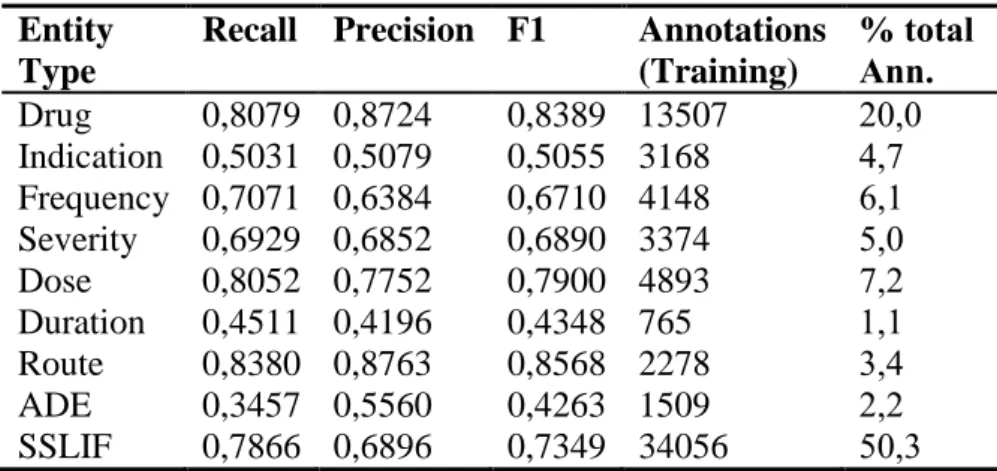
The dataset for ADE research was provided by the MADE Challenge (Yu, Jagannatha, Liu, & Liu, 2018). MADE challenge is focused on extracting fine grained structured information related to Drug Safety (Xu, Yadav, & Bethard, 2018). This dataset was created with 1092 EHR notes from 21 cancer patients (Jagannatha & Yu, 2016), which contains annotations for nine entity types: ADEs, indications, other signs and symptoms, medication, dosage, route, frequency, duration, severity. It also provides relations among those medical entities for the Relation Extraction task, e.g. the Adverse relation between Medication and ADE entities. The dataset contains 876 clinical notes for training and 213 clinical notes for test dataset established by the MADE challenge (see Table 3.1). The full 1089 clinical notes have 79003 annotations, about 86% of annotations for training, and average of 800 Words/Document approx.
Annotations Training Test ADE 1509 431 SSLIF 34056 5328 drug 13507 2395 indication 3168 636 frequency 4148 658 duration 765 133 route 2278 389 dosage 4893 801 severity 3374 534 Total Ann. 67698 11305 Number of files 876 213
Table 3.1: Distribution of annotations by entity in MADE dataset
Dataset in Spanish
We compare another dataset for NER in other language, a dataset in Spanish provided by PharmaCoNER (Pharmacological Substances, Compounds and proteins and Named Entity Recognition) organization (Agirre, et al., 2019). They hold the first NER task on chemical, drug and gene/protein from medical notes (clinical case studies) in Spanish, for identifying particular problems of non-English corpus and develop dedicated NER tool for other languages. The Spanish clinical notes are a manually classified collection of clinical case sections gathered from Spanish Clinical Case Corpus (SPACCC) (Agirre, et al., 2019), with annotations related to the medical domain. These clinical cases cover multiple medical topics, including oncology, urology, cardiology, diseases, etc., which is important to obtain a diverse collection of chemicals and medications. Clinical cases from other fields such as psychology or historical forensics were removed. The dataset contains annotations of 1000 clinical cases, which includes four entity types (Normalizables, No_Normalizables, Proteinas and Unclear):
– “Normalizables”: 4426 mentions of chemicals that can be manually normalized to a
unique concept identifier (mostly SNOMED-CT).
– “No_Normalizables”: 55 mentions of chemicals that could not be normalized
manually to a unique concept identifier.
– “Proteinas”: 2291 mentions of proteins and genes that include also peptides,
peptide hormones and antibodies.
– “Unclear”: 159 cases of general substance class mentions of clinical and biomedical
general substances (e.g. Estragón, Melanina, Vaselina, Alcohol, Tabaco, Cannabis and
Gluten), etc.
These Named Entity Recognition (NER) annotations allow training for tagging medical entities found in clinical notes (raw text files). The corpus contains 16504 sentences (average of 16.5 sentences per clinical case) and 396988 words (average of 396.2 words per clinical case).
3.3.2 Supervised Learning Models
The main structure of the model has three layers, Embedding layer, Bi-LSTM (Bidirectional LSTM) layer and CRF layer, in the middle of the input layer and inference layer. We seek to combine Machine Learning and Deep Learning algorithms (LSTM), to consider most of the available information like the contextual information exploited by Bi-LSTM, which by itself does not require intense feature engineering.
Although we exploit information from the context with LSTM layer, the tagging decision in the inference layer is still local, so we do not use the neighbouring tagging decisions. Instead, the linear-chain CRF inference layer look for the best sequence of labels in all possible sequences, i.e. CRF get the maximum global score ∈ of the sentence given by the sum of transition scores and network scores, thus it learns the transition matrix T ( labels) and vectors of scores of beginning and ending with a specific label (see Eq. 1) (Genthial, 2017), to capture linear dependencies (one step) between tagging decisions.
(1)
For instance, the linear-chain CRF would choose the best score between all possible sequences of labels, for example the scoring for sentence bleeding secondary_to
warfarin (see Fig. 3.1), the tagging of bleeding as an ADE should help to tag the next
words with the correct labels. The sequence with the best score is ADE-None-Drug (score of chain 31), which is the correct prediction, meanwhile other algorithm that make independent predictions only based on the maximum score for each label, it would choose the sequence of labels ADE-ADE-Drug (score of chain 26).
Figure 3.1: Sequence label scoring of sentence with linear-chain CRF The full models are described in the following subsections.
3.3.2.1 Embedding Layer
The model implemented for the MADE dataset includes a specific word representation to exploit features of its entities, which extends the generic word embedding in French. Meanwhile, the model for the Spanish dataset includes generic word embeddings made with ordinary text in Spanish.
MADE Embedding
We created a comprehensive word representation, which concatenates character-level representations, word embedding and POS features. The following subsections describe the word representation, as well as the full network using that representation to solve the NER task.
The character-level features can exploit prefix and suffix information about words (Lample, Ballesteros, Subramanian, Kawakami, & Dyer, 2016), to have closer representations among words of the same category. This is particularly useful for terms that may be Out-Of-Vocabulary (appearing in the test data and not in the training data). OOV is a common issue with domain specific words, and prefix and suffix representations can help a lot. For example, the words “Clonazepam” and “Lorazepam” both belong to the medication category in the medical context and may be OOV. However, they share the same suffix, making them closer to each other on a
character-level feature. Therefore we build a LSTM network (see sub-section 2.2) that get representations of words based on their characters.
The character-level embedding for words was built by a Bi-LSTM network (represented on the bottom left of Figure 3.2). First, each character takes an integer value from a lookup table, and then a one-hot vector replaces it. The final state of the forward and backward LSTM is the representation of the suffix and prefix of the word. The Character-level embedding is the concatenation of both LSTM layers, so with LSTM layers of 20 cells (units), we get a vector of 40 dimensions. This character-level representation is concatenated to the word embedding and the Part-of-speech feature to form the final comprehensive word representation (see Fig. 3.2) (Lample, Ballesteros, Subramanian, Kawakami, & Dyer, 2016).
Part-of-speech (POS) tags the words with labels like noun, verb, adjective, adverb, etc. It classifies words according to its roles within the grammatical structure of the sentence. Medications for example will always belong to the Noun category, making them close together with respect to this feature. The tagging was performed using an Averaged Perceptron algorithm (Honnibal, 2015).
Finally, we also use word embeddings learned from a large corpus, to consider the contexts in which words appear usually. It can create similar vectors (representations) for words that appear in similar contexts, such as the names of different countries. The word embedding (dimension 200) used was provided by (Yu, Jagannatha, Liu, & Liu, 2018), as well as another of 300 dimensions provided by FastText (Bojanowski, Grave, Joulin, & Mikolov, 2017). Both pre-trained with skip-gram using unlabeled data mainly from Wikipedia. The comprehensive word embedding is the input of a Bi-LSTM network, which takes a sequence of words and returns a sequence of hidden states at every time step (see Fig. 3.3).
Figure 3.2: Comprehensive word representation Spanish Embedding
The NER model for clinical notes in Spanish used different word representations during the PharmacoNER challenge. We evaluated three word embeddings learned from different corpus. The embedding considers the contexts in which words appear usually, and then it can create similar representations (vectors) for words that appear in similar contexts, such as the names of different countries. We built a word embedding using Skip Gram algorithm and the training set, with size set at 300 dimensions, context window of size 5, and minimum word frequency of one to keep even the uncommon words such as underused medications. We used other Spanish word embedding created by FastText (Bojanowski, Grave, Joulin, & Mikolov, 2017), which was pre-trained on unlabeled Wikipedia data. Finally, we tested the model with the embedding learned during training of full layers of the neural network. Results were obtained on test set defined by the PharmacoNER challenge (Agirre, et al., 2019).
3.3.2.2 Neural Network Description
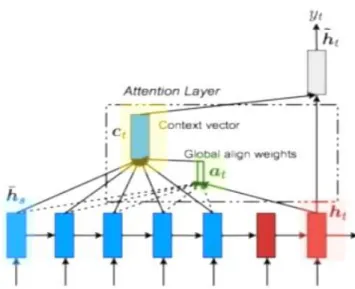
The input layer receives words represented by its corresponding vectors in the word embedding. Long Short-term Memory (LSTMs) Neural Networks can learn long term dependencies among the words of the sentence (Jagannatha & Yu, 2016). LSTM keeps information in a memory-cell (ct gate) that is updated using input it and forget gates ft
(Lample, Ballesteros, Subramanian, Kawakami, & Dyer, 2016), and then it adjusts the output gate and hidden state (see equations 2, 3, 4 and 5). LSTM extracts contextual information to take into account long term dependencies among the words of the input sequence of length t (Hochreiter & Schmidhuber, 1997). LSTM keeps information through a memory cell ( ), which is updated using input gate