Wood-based Products
LCA Case Studies
LCA Cas s dies
:i [i I
Allocation in LCA of Wood-based Products
Experiences of Cost Action E9
P a r t I. M e t h o d o l o g y
Gerfried. J u n g m e i e r i*, F r a n k W e r n e r 2, A n n a J a r n e h a m m a r 3, C a t h a r i n a H o h e n t h a l 4 a n d Klaus R i c h t e r 2 1JOANNEUM RESEARCH, Institute of Energy Research, Elisabethstrasse 5, A-8010 Graz, Austria
2 Federal Laboratories for Materials Testing and Research (EMPA), Duebendorf, Switzerland 3 Trfitek, Swedish Institute for Wood Technology Research, Stockholm, Sweden
4 KCL, Helsinki, Finland
* Corresponding author ([email protected])
Preamble, The treatment of allocation is a crucial matter in the LCA of wood-based products, because the allocation method might influence the results significantly. This paper outlines in two parts - M e t h o d o l o g y (Part I) and Examples (Part II) - practical experiences for the treatment of allocations for LCAs of wood-based products that are the result of the Cost Action E 9 'Life cycle assessment of forestry and forest
products' and reflect the experience of Cost E9 delegates. Part II will be published in Int J LCA 7 (6) 2002.
DOI: http://dx.doi.or~10.1065/Ica2002.08.091.1 ,Abstract
Goal and Background. The treatment of allocation in the descrip- tive LCA of wood-based products has been discussed for a long time and different solutions have been presented. In general, it is accepted that the influence of different allocation procedures on the results of LCA of wood-based products can be very signifi- cant. This paper is a result of the Cost Action E9 'Life cycle as- sessment of forestry and forest products' and represents the expe- rience of involved Cost E9 delegates.
Objective. Wood is a renewable material that can be used for wood products and energy production. Consistent methodologi- cal procedures are needed in order to correctly address the two- fold nature of wood as a material and fuel, the multi-functional wood processing generating large quantities of co-products, and reuse or recycling of paper and wood. Ten different processes in LCAs of wood-based prodticts are identified, where allocation questions can occur: forestry, sawmill, wood industry, pulp and paper industry, particle board industry, recycling of paper, recy- cling of wood-based boards, recycling of waste wood, combined heat and power production, landfill.
Methodology. Following ISO 14 041 a step-wise procedure for system boundary setting and allocation are outlined. As a first priority allocation should be avoided by system expansion, thus adding additional functions to the functional unit. Alternatively, the avoided-burden approach can be followed by subtracting substituted functions of wood that are additionally provided. If allocation cannot be avoided, some allocations methods from case studies are described.
Conclusions. The following conclusions for allocation in LCA of wood-based products are given. 1) Avoid allocation by ex- pansion of system boundaries by combining material and en- ergy aspects of wood, meaning a combination of LCA of wood products and of energy from wood with a functional unit for products and energy. 2) Substitute energy from wood with con- ventional energy in the LCA of wood products to get the func-
tional unit of the wood product only, but identify the criteria for the substituted energy. 3) Substitution of wooden products with non-wooden products in LCA of bioenergy is not advis- able, because the substitution criteria can be too complex. 4) If avoiding allocation is not possible, the reasons should be docu- mented. 5) Different allocation procedures must be analysed and documented. In many cases, it seems necessary to make a sensitivity analysis of different allocation options for different environmental effects. It can also be useful to get the acceptance of the chosen allocation procedure by external experts. 6) Dif- ferent allocation factors, e.g. mass or economic value, are al- lowed within the same LCA. 7) For allocation of forestry proc- esses it is necessary to describe the main function of the forest where the raw material is taken out. In some cases different types or functions of forests must be considered and described. 8) Regarding the experiences from the examples, the following most practical allocation for some specific processes are identi- fied: forestry: mass or volume; sawmill: mass or volume and proceeds; wood industry: mass and proceeds.
Keywords: Allocation; bioenergy; forest products; forestry; Cost E9; life cycle assessment; wood products
.... ~ T m - - -
-Introduction
The treatment of allocation in the descriptive L C A of w o o d - based products has been discussed for long time and differ- ent solutions have been presented. It is accepted that the influence of different allocation procedures on the results of L C A of w o o d - b a s e d products can be very significant. T h a t is w h y the chosen allocation procedures must be described and justified in detail, but they still remain a point for con- troversial discussion in each case study. This paper outlines practical experiences for the treatment of allocations for LCAs of wood-based products that are the result of the Cost Action E 9 'Life cycle assessment of forestry and forest prod- ucts' and reflect the experience of Cost E9 delegates.
290
Int J LCA 7 (5) 290 - 294 (2002)First, the inherent linkage of wood products and energy from biomass ('bioenergy') is shown. After some methodological re- marks on allocation options, an approach for solving the allo- cation problems related to wood and its products is discussed based on the limited number of relevant processes. From that, a list of preferences for different allocation situations is derived, which are illustrated in some case studies. Finally, the experi- ences are summarised for LCA practitioners in the field of LCA of forestry, wood, bioenergy and wooden products.
1 Problem Description
One of the basic characteristics of wood is its twofold na- ture as a widely used material and an energy carrier. Due to this fact different LCAs have been made concentrating on one of the two aspects, namely LCA on:
9 wood-based products (e.g. particle boards, timber, pa- per) and on
9 bioenergy (e.g. wood chips for heat supply).
A closer look at the two groups of LCAs of wood-based products shows that an LCA of wood products usually con- sists of three main phases (Fig. 1):
1. production (e.g. fibre wood to pulp and paper produc- tion and printing of a newspaper)
2. use (e.g. reading the newspaper) and 3. end of life (e.g. combustion of newspaper)
In LCA of wood-based products, the infrastructure of the production facilities is usually not taken into account. It is assumed that the infrastructure for the production of differ- ent wood products or for products from other materials with the same functions are similar, and that the differences are negligible compared to the over-all environmental impacts of the product's life cycle (see e.g. Werner et al. [1]). The infrastructure can have more significant influence when com- paring energy systems (see e.g. Frischknecht et al [2]). An LCA on bioenergy is normally structured according to the following three phases (see Fig. 1):
1. construction (e.g. building the facilities of a power plant) 2. operation (e.g. supply of biomass fuel and energy gen-
eration) and
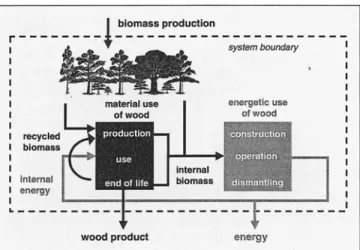
3. dismantling (e.g. decommissioning of the facilities) Within both types of LCA the twofold nature of wood is a key aspect which has to be dealt with in an adequate man- ner. Fig. 1 shows the linkage between the material and ener- getic use of biomass:
9 forestry provides biomass for both the production phase of wood products and for the operation phase of the bioenergy generation
9 production and end of life phases of wood products can provide biomass for the operation phase of the bioenergy generation
9 operation phase of bioenergy generation can provide energy for the production phase of wood products (e.g. wood drying).
The close linkage between the material use and the use for energy production of wood causes one of the main alloca- tion problems for LCAs of wood and its products.
Fig. 1: Linkage between the material and energetic use of wood in the LCA of wood-based products
Another characteristic of the wood chain is the generation of high amounts of co-products during the different produc- tion steps. This is especially true for products of solid wood where the material yield for a solid wood product lies at around or even less than 50% of the sawn log. Thus, the generation of various co-products in a production process results in another typical and crucial allocation problem for the wood chain.
2 Methodological Considerations
First, general options for dealing with allocation problems are shown and processes, which might need allocation in LCA of wood-based products, are discussed. Afterwards, two proce- dures - first and second priority - to avoid allocation are de- scribed and different allocation procedures are outlined.
2.1 Allocation overview
According to ISO 14 040, allocation is defined as partition- ing the input or output flows of a unit process to the prod- uct system under study. Allocation means that the environ- mental aspects are partitioned among the different products and/or among subsequent product systems. Three generic processes for allocation are distinguished:
9 multi-output processes providing e.g. sawn timber, side-
cuts and sawdust from the sawmill, where the material flows of the process and its up-stream processes have to be allocated to the various outputs,
9 multi-input processes, e.g. the combustion of different fractions of waste wood, where the emissions and the generated energy have to be allocated to the different products or product systems,
9 recycling and reuse, where, besides the recycling process itself, primary production and final disposal may have to be allocated to several subsequent product systems. As a guiding principle, allocation procedures should (...) approximate as much as possible (...) fundamental input- output relationships and characteristics (ISO 14 041). As a procedure for modelling situations where a process could
Wood-based Products
LCA Case Studies
possibly be shared by several products or product systems, ISO 14 041 recommends to
9 avoid allocation by a subdivision of the process or an extension of the system boundary
9 make allocation of the process and of its preceding up- stream processes based on fundamental input-output re- lationship and characteristics (ISO 14 041). This causal relationship should be based on physical relationship (re- flecting the physical, chemical or biological interdepend- ence of processes and their products)
9 use other relationships (such as economic value) For further considerations of the wood chain based on ISO 14 041 three types of products in the LCA of forest prod- ucts, wood, bioenergy and wooden products are character- ised according to their relative market price:
9 co-products with a high market price, 9 co-products with a low market price and 9 waste with a 'negative' market value.
2.2 Allocations in LCA of wood-based products
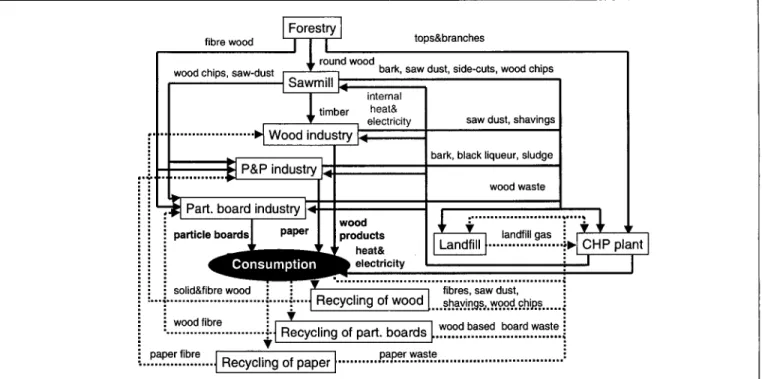
A close look at all possible processes in LCA of wood-based products shows that at least 10 processes in the wood chain are subject to allocation (Fig. 2). These 10 processes can be subdivided in multi-output processes (e.g. forestry, sawmill), multi-input processes (e.g. energy generation in CHP plant) that are typical end-of-life situations and processes related to reuse and recycling, which may imply that the inputs and out- puts associated with unit processes for extraction and process- ing of raw materials and final disposal of products are to be shared by more than one product system (ISO 14 041). The
recycling issue has to be considered under different aspects of multi-functionality:
a) the recycling process itself as a bi-functional process serv- ing as a waste treatment process as well as for secondary material extraction, and
b) the aspect of open/closed loop recycling which may re- quire allocating primary production and final disposal as shared processes to several subsequent product systems. Much methodological effort has already been made to prop- erly address the recycling of paper (e.g. Ekvall [3], Pliitzer et al. [4], Reichart et al. [5]; ISO 14 049). For wooden prod- ucts, the recycling issue has commonly been solved by the cut-off procedure (see e.g. Consoli et al. [6]) - thus mainly by system boundary setting.
Remark: The so-called 'other functions' of forestry, like rec- reation and bio-diversity, are not further treated in this pa- per (see Part II, section 1.1).
Fig. 2 illustrates the whole wood chain with its different interlinkages of material and energy flows. Forestry provides the raw material for a variety of different products, such as particle boards, paper, wood products, heat and/or electric- ity for consumption. For the functional unit of LCA of wood- based products this means that allocation can be avoided by a system expansion taking all these different products into account. With this whole-system approach all the wood- related material flows are internalised while the system pro- vides various products. As a consequence of the system ex- pansion, a variety of functions is added up to the 'functional unit', as is shown in the following example:
Forestry I
fibre wood I / I tops&branches
wood chips, saw-dust ~ l u ' "-"-'~ wood bark, saw dust, side-cuts, wood chips internal
~_ timber heat& . . . .
t ~ ' L_ electricity saw Qusz, snavings ... I~ 1 Wood industry ~ - -
. _ _ - ~ ~ b a r k , b l a c k l i q u e u r , s l u d g e
... .~,[ P&P industry~- 4
g Q ~
.,--~ Part. board industry
particle boardsl paper
solid&fibre wood i J wood waste wood products heat& b electricity
...
0,a J
r_ I fibres, saw dust, i
Recycling of wood L..shavings~.w,o2,d.,chi.e.,s ... ~.
... i.4 9 V ' Recycling of part. boards l.,w,,~176176 was~,e,,i
9 ..paper.f!br.e.... t Recycling of paper } ... paper.waste ...
Fig. 2: Processes in the LCA of wood-based products that might require allocation (simplified, transportation, and other upstream environmental aspects of processes are not shown)
CH 4 emission is 6 t for the consumption of 1 wooden table, 0.5 t of paper, 13 m 3 particle boards, 1 GWh electricity and 2 GWh heat.
Of course, this 'functional unit' is not very manageable, es- pecially in comparative studies. Also, the data requirements of this approach are high. Depending on the goal and scope of the study, this extensive functional unit can be reduced by allocation concentrating on one type of material use and energy from the wood combustion. This leads, e.g. to the following functionals:
9 LCA particle boards: 1 m 3 particle board + y kWh elec- tricity + z kWh heat
9 LCA paper products: 1 t paper (if all energy is used as internal energy) or 1 t paper + y kWh electricity + z kWh heat (if not all energy is used as internal energy) 9 LCA wooden products: I wooden product § y kWh elec-
tricity + z kWh heat (if co-products are only used for energy)
9 LCA bioenergy for heat and electricity: y kWh electric- ity + z kWh heat
9 LCA sawmill: 1 m 3 timber + y k w h electricity + z k w h heat
(if co-products from sawmill are only used for energy) As system expansion and substitution are first priority strat- egies for dealing with muhifunctional situations, their ap- plication in specific LCAs of wood-based products are pre- sented in the following section.
Remark. For the allocation issues it has to be considered that the carbon content and the embodied energy content are material-inherent properties of wood. C-uptake and C- release of wood as well as its embodied energy content are intrinsically related to the mass of wood. Allocating the CO 2 uptake to just one of several co-products generates artefacts that do not consider the causal, biological relationships of wood (see e.g. De Feyter [7]). A 'warning' example is given in Part II, section 1.3 in the case study on window frames.
2.3 First priority procedures:
Avoiding allocation by system expansion or substitution 2,3.1 System expansion
The comparison of wooden products to non-wooden prod- ucts must be based on equal functional units. An example is given in (Fig. 3) illustrating system expansion to avoid allo- cation): Two tables made of wood and aluminium are com- pared on the basis of the functional unit 'per table'. During the production of the wooden table, co-products originate, which - used for energy generation - can substitute other energy generating systems (e.g. systems based on fossil fu- els). The allocation problem can be avoided if the system boundary is extended to include energy production. This is associated with a change of the functional unit 'per table' into 'per table and x kWh of heat'. Now, the LCA of a wooden table and x kWh of bioenergy can be compared to an aluminium table and x kWh of fossil energy (see Jungmeier et al. [8]. This is the ideal situation referring to the linkage of material and energetic use of biomass.
I .c. ,,
bio- H+I wood-Lo. ,r
I= non-wooden + Iconventional I.c. 1, .c. ,
enerqv II ~ product
J
Fig. 3: Comparison of wood-based products with non-wooden products in an LCA by system expansion
2.3.2 Substitution
Substitution can be seen as a special case of system expansion, but substitution follows another reasoning: On the right side in Fig. 3 the supply of a non-wooden product and of fossil energy can be considered independently. This means that, in the LCA of a wooden product, the energy generated substi- tutes other energy carriers (e.g. fossil fuels). Therefore, the equivalent process of the fossil energy supply can be given as credit to the wooden product as avoided environmental ef- fects. The equivalent process is the supply of fossil energy that is substituted by bioenergy. In this case, the functional unit is only the wooden product (Fig. 4). For the substitution of con- ventional energy, however, certain criteria have to be taken into account (see Jungmeier et al. [8]), which can lead to a substitution rate of less than 100%. Examples for these sub- stitution criteria are kind of energy, energy supply/demand characteristic, kind of substituted energy and costs.
In LCA of bioenergy, a substitution of the wood product is not advisable or possible. Substitution of wooden products in LCA of energy does not seem to be practicable, because substitution criteria for wooden products and non-wooden products are very complex to define. As an example, in an LCA of bioenergy using bark from a sawmill, what are the non-wooden products that could be substituted by paper? According to the goal and scope in some LCA, it might not be advisable to calculate 'mixed' functional units by system expansion or substitution, e.g. establishment of public data bases. Therefore, allocation procedures are required, which are outlined in the following section.
I LCA ] I bio- / I LCA p "1" I wood- J ,cA I c~176 I I LCA = I non-wooden I
Fig. 4: Comparison of wood-based products with non-wooden products in an LCA by substitution of energy
Wood-based Products
LCA Case Studies
2.4 Second priority procedure: allocation of unit processes
The second priority to deal with the multi-functionality prob- lem of LCA is to allocate unit processes to the various prod- ucts. It is generally agreed that only products with a positive economic value, which are the 'aim of the process' or the 'in- tended output', shall carry environmental burdens related to the process (see e.g. ISO 14 041; Robson and Esser [9]). This agreement certainly has a subjective and case specific compo- nent depending on the goal and scope of the study. Even out- comes of low market price can be considered as co-products of the wood processing industries, if the structure of the ac- quiring industrial sector depends on these outflows and would otherwise have to be substituted by virgin material.
In LCA of wood-based products (see Fig. 2), the following allocation procedures are discussed: no allocation (all to the 'intended product'), mass/volume and market price (in fact, the relative share of proceeds). From the practical experi- ence of the Cost E9 delegates, it is also possible to use differ- ent allocation factors within one LCA sawmill.
References
[1] Werner F, Richter K, Bosshart S, Frischknecht R (1997): Okologischer Vergleich von Innenbauteilen am Bsp. von Zargen aus Massivholz, Holzwerkstoff und Stahl (Ecological comparison for indoor building materials - Comparison of frames made of solid wood, fibre wood and steel), EMPA/ ETH-Forschungsbericht, Diibendorf, Ziirich
[2] Frischknecht R, Hofstetter P, Knoepfel I, M6nard M (1995):
Relevanz der Infrastruktur in Okobilanzen- Untersuchungen anhand der Okoinventare fiir Energiesysteme (Relevance of infrastructure in life cycle assessments - Outlined with examples from LCA of energy systems). ETH Ziirich, Ziirich
[3] Ekvall T (2000): A Market-based Approach to Allocation at Open-loop Recycling. In: Resources, Conservation and Re- cycling, 29 (1-2): 91-109
[4] Plfitzer E, Hamm U, G6ttsching L (1996): Okobilanzen:
Lassen sich Umweltbelastungen gerecht auf die Papierkette verteilen? (Life cycle assessment: Is it possible to allocate environmental loads fairly on the paper chain?) In- Papier, 50 (10A):V63-V70
[5] Reichart I, Hischier R, Schefer H, Zurkirch M (2001): Oko- bilanz Medienkonsum - Elektronisch versus Print (Life cy- cle assessment of media consumption - electronic versus paper). EMPA-Forschungsbericht, St. Gallen
[6] Consoli F, Allen D, Boustead I, Fava J, Franklin W, Jensen AA, de Oude N, Parrish R, Perriman R, Postlethwaite D, Quay B, Seguin J, Vigon B (1993): Guidelines for Life-Cycle Assessment: a Code of Practice. 1st edition, Society of Envi- ronmental Toxicology and Chemistry (SETAC), Brussels, Washington, DC
[7] De Feyter S (1995): Handling of the Carbon Balance of Forests
in LCA. In: Friihwald A, Solberg B (eds.)." Life-Cycle Analysis - A Challenge for Forestry and Forest Industry. EFI Proceedings No 8, European Forest Institute, Hamburg, 33-39
[8] Jungmeier G, Schwaiger H, Spitzer J (1998): The Treatment of Fossil Energy Substitution in LCA for Forest Products - Criteria and Case Studies, published in proceedings of Cost E9 Workshop 'Life Cycle Assessment of Forestry and Forest
Products', 14-16 September 1998
[9] Robson DJ, Esser P (1999): Life-Sys Wood: Consistent Life
Cycle Analysis of Wood Products, Contract no. FAIR-CT95- 0726, Consolidated Report. TNO, Helsinki
Received: May 9th, 2001
Accepted: August 5th, 2002
OnlineFirst: August 12th, 2002
Part II of this paper
to be published in Int J LCA 7 (6) 2002
will present examples from different case studies which are outlined to substantiate the reasoning from Part I.
The examples are taken from LCA studies in which the authors were involved. The examples are given in an order following that of the wood chain. In two examples - recycling of particle boards, combined heat and power production - an allocation is avoided; in the other
examples, one or more different allocation procedures are applied: Section 1.1: Forestry Section 1.2: Sawmill Section 1.3: Windows Section 1.4: Bio-energy Section 1.5:
Combined heat and electricity
Section 1.6:
Recycling