
DOI 10.1140/epja/i2006-10383-2 Regular Article – Hadron Physics
P
HYSICAL
J
OURNAL
A
Double pion photoproduction off
40
Ca
F. Bloch1, J. Ahrens2, J.R.M. Annand3, R. Beck2, L.S. Fog3, D. Hornidge2, S. Janssen4, M. Kotulla1,a, B. Krusche1,b,
J.C. McGeorge3, I.J.D. MacGregor3, J.G. Messchendorp4,c, V. Metag4, R. Novotny4, R.O. Owens3, M. Pfeiffer4,
M. Rost2, R. Sanderson3, S. Schadmand4,d, A. Thomas2, and D.P. Watts3
1
Department of Physics and Astronomy, University of Basel, Ch-4056 Basel, Switzerland 2
Institut f¨ur Kernphysik, Johannes-Gutenberg-Universit¨at Mainz, D-55099 Mainz, Germany 3
Department of Physics and Astronomy, University of Glasgow, Glasgow G12 8QQ, UK 4
II. Physikalisches Institut, Universit¨at Giessen, D-35392 Giessen, Germany Received: 28 August 2006 / Revised: 27 March 2007
Published online: 23 May 2007 – c Societ`a Italiana di Fisica / Springer-Verlag 2007 Communicated by R. Milner
Abstract. The photoproduction of π0 π0
and π0
π± pairs off 40
Ca has been investigated with the TAPS detector using the Glasgow photon tagging spectrometer at the Mainz MAMI accelerator. Data have been taken for incident photon energies in the energy range from 200–820 MeV. Total cross-sections have been extracted from threshold up to the maximum photon energy and invariant-mass distributions of the pion pairs have been obtained for incident photon energies between 400–500 MeV and 500–550 MeV. The double π0
invariant-mass distributions show some relative enhancement with respect to the mixed charge channel at small invariant masses. The effects are smaller than previously observed for lead nuclei and the distributions do not significantly deviate from carbon data. The data are in good agreement with the results of recent calculations in the framework of the BUU model, with careful treatment of final-state interaction effects but without an explicit in-medium modification of scalar, iso-scalar pion pairs. This means that for Ca most of the experimentally observed effect can be explained by final-state interactions. Only at low incident photon energies there is still a small low mass enhancement of the double π0
data over the BUU results.
PACS. 13.60.Le Meson production – 25.20.Lj Photoproduction reactions
1 Introduction
In-medium properties of hadrons are a hotly debated topic since they are closely related to the properties of low-energy, non-perturbative QCD. QCD at high energies or short scales (r < 0.1 fm) is well explored by tive methods. However, at larger distances the perturba-tive picture breaks down and at scales between 0.1 fm and 1 fm the full complexity of the interaction manifests itself in the many-body structure of hadrons composed of va-lence quarks, sea quarks, and gluons. Chiral symmetry is at the very heart of the theory. In the limit of vanishing current quark masses the QCD Lagrangian is invariant un-der chiral rotations, right- and left-handedness of quarks is
a Present address:
II. Physikalisches Institut, Universit¨at Giessen, D-35392 Giessen, Germany.
b
e-mail: [email protected] c Present address:
Kernfysisch Versneller Institut (KVI), Groningen, The Netherlands.
d Present address:
Institut f¨ur Kernphysik, Forschungszen-trum J¨ulich, D-52425 J¨ulich, Germany.
conserved and right- and left-handed fields can be treated independently. The explicit breaking of the symmetry due to finite u, d current quark masses (5–15 MeV) is small. However, it is well known that spontaneous breaking oc-curs since the ground state, the QCD vacuum, has only part of the symmetry. This is connected to a non-zero ex-pectation value of scalar q ¯q pairs in the vacuum, the chi-ral condensate. The symmetry breaking is clearly reflected in the hadron spectrum. Without it, hadrons should ap-pear as mass-degenerate parity doublets, which is neither true for baryons nor for mesons. The first Jπ = 1/2−
excited state in the baryon spectrum, the S11(1535) lies
much above the Jπ = 1/2+ nucleon ground state. The
lowest-lying Jπ = 1−
vector meson, the ρ, has a smaller mass than the Jπ = 1+ a
1, and the Jπ = 0− pion (the
Goldstone boson of chiral symmetry), is much lighter than its chiral partner, the Jπ= 0+σ-meson.
However, model calculations (see, e.g., [1]) indicate a significant temperature and density dependence of the chi-ral condensate which is connected with a partial restora-tion of chiral symmetry at high temperature and/or large
reported a strong broadening of the in-medium spectral function of the ρ-meson. A signature for in-medium mod-ifications of ρ and ω mesons was also reported from the E325 experiment in 12 GeV p + A reactions at KEK [5]. An in-medium mass shift of the ω-meson has been found in photon-induced ω-production from heavy nuclei [6]. Due to their coupling to vector mesons, nucleon reso-nances should also be modified in the nuclear medium. Self-consistent calculations of the respective spectral func-tions [7] predict in particular significant effects for the D13(1520)-resonance, which have also been searched for in
photon-induced meson production reactions [8–11], how-ever so far without conclusive results. As discussed in de-tail by Lehr and Mosel [12], part of the problem is, that due to the averaging over the nuclear volume, a possible broadening of the resonance can be only observed via de-cay channels which cause the broadening, but not in other exclusive reactions.
A particularly interesting case is the mass split be-tween the Jπ = 0−
pion and the Jπ = 0+ σ-meson. The
naive assumption that the two masses should become de-generate in the chiral limit is supported by model cal-culations. A typical result is the density dependence of the mass calculated in the Nambu-Jona-Lasino model by Bernard, Meißner and Zahed [13]. The σ-mass drops sig-nificantly as a function of nuclear density. Compared to the vacuum the predicted effect is already large for the normal nuclear-matter density ρ0 at which the pion mass
stays still stable. The nature of the σ-meson itself has been controversely discussed in the literature. The review of particle properties [14] lists as σ the f0(600) with a
mass range from 400–1200 MeV and a full width between 600 MeV and 1000 MeV. Recently, Caprini, Colangelo and Leutwyler [15] have derived precise predictions for mass and width from dispersion relations. In some approaches it is treated as a pure q ¯q (quasi)bound state [13,16,17], in other approaches as a correlated ππ pair in a I = 0, Jπ= 0+ state [18–20]. But in any case a strong coupling
to scalar, iso-scalar pion pairs is predicted. As a conse-quence, the different model approaches agree in so far, as they predict a significant in-medium modification of the invariant-mass distribution of such pion pairs. This is either due to the in-medium spectral function of the σ-meson [16] or the in-medium modification of the pion-pion interaction [19] due to the coupling to nucleon-hole, ∆-hole and N?-hole states. In any case the predicted net effect is a downward shift of the strength in the invariant-mass distributions of scalar, iso-scalar pion pairs in nuclear matter.
Pion-induced reactions have the disadvantage that the signal is diluted by final (FSI) and initial (ISI) state inter-action of the pions, so that effectively only the low-density surface zone of the nuclei is probed. Pions can be produced in the entire volume of the nuclei by photon-induced reac-tions, although their FSI also suppresses the contributions from the deep interior of the nuclei. The FSI can be min-imized by the use of low incident photon energies, giving rise to low-energy pions which have much larger mean free paths than pions that can excite the ∆-resonance [9]. Pho-toproduction of the different charge states of pions from the free proton and the quasifree neutron has been pre-viously studied in detail with the DAPHNE [27–32] and TAPS detectors [33–38] at MAMI in Mainz from thresh-old to the second resonance region and for the π0π0
chan-nel also at higher incident photon energies at GRAAL in Grenoble [39] (see [40] for an overview).
First results from a measurement of double π0 and
π0π±
photoproduction off carbon and lead have been re-ported in [41]. A shift of the strength to lower invariant masses was found for the heavier nucleus for the π0π0
channel but not for the mixed charge channel. In the present paper, experimental details and the results of an additional measurement of double pion photoproduction off calcium nuclei are presented and compared to model calculations.
2 Experimental setup
The experimental setup was identical to the measurement of double pion photoproduction off carbon and lead nuclei reported in [41]. Some further experimental details have been discussed in [9].
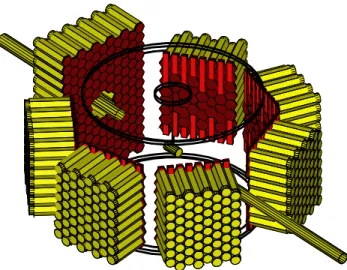
Quasi-monochromatic photons were produced with the Glasgow tagged photon facility [42] at the Mainz MAMI accelerator [43]. The experiment covered the photon en-ergy range from 200–800 MeV with an enen-ergy resolution of approximately 2 MeV per tagger channel. The target was a 10 mm long cylinder of calcium with 50 mm diameter and the beam spot size at the target position was approxi-mately 30 mm. The reaction products from the target were detected with the electromagnetic calorimeter TAPS [44, 45]. This detector consists of 510 hexagonally shaped BaF2
crystals of 25 cm length with an inner diameter of 5.9 cm. As shown in fig. 1 they were arranged in six blocks of 64 modules and a larger forward wall of 138 modules. The blocks were arranged in one plane around the target at a distance of 55 cm from the target center and at polar angles of ±54◦
, ±103◦
, and ±153◦
Fig. 1.Setup of the TAPS detector at the Mainz MAMI accel-erator. The beam entered the target chamber from the lower right edge.
was placed 60 cm away from the target center at 0◦ and
the photon beam passed through a hole in the center of the forward wall. Each detector module is equipped with an individual plastic veto detector, read out by a separate photomultiplier. The setup covered approximately 37% of the full solid angle.
3 Data analysis
The first step of the analysis for both final states —π0π0
and π0π±— requires the identification of photons. This
was done with the help of the veto detectors, a time-of-flight analysis (time resolution: 550 ps FWHM), and a pulse shape analysis of the signals from the BaF2
scintil-lator. The latter is based on the two different components of the scintillation light from the BaF2crystal, which have
very different decay times. The relative intensity of the fast component depends on the ionization density produced by the incident particle, in particular it is suppressed for nucleons in comparison to photons. This feature was ex-ploited by integrating the output signals over a short gate (40 ns) and a long gate (2 µs). Both signals Es(short gate)
and Ew (wide gate) were calibrated for photons so that
in an Es versus Ew plot photons are lying on the 45◦
line. This is shown in the left-hand side of fig. 2. For the discrimination between photons and nucleons a represen-tation in polar coordinates (see right-hand side of fig. 2) is more efficient. The respective coordinates are the ra-dius R = pE2
s+ E2w and the angle Φ = arctan(Es/Ew).
The combination of the different discrimination methods provides a clean sample of photons.
For the investigation of the π0π0final state events with
four photons were selected. The invariant masses of all possible combinations of the four photons into two pairs were calculated and the “best” combination was chosen
Fig. 2.Pulse shape analysis. Left-hand side: plot of Esversus Ew. Right-hand side: plot in polar coordinates.
50 100 150 200 50 100 150 200 0 0.2 0.4 0.6 0.8 1
m
inv1[
MeV/c
2]
m
inv2[
MeV/c
2]
counts
[
a.u.
]
Fig. 3. Invariant mass of photon pair 1 versus invariant mass of photon pair 2 for events with four detected photons.
via a χ2analysis which minimizes
χ2= (mγi,γj−mπ) 2 (∆mγi,γj) 2 + (mγk,γl−mπ) 2 (∆mγk,γl) 2 (1)
with 1 ≤ i 6= j 6= k 6= l ≤ 4, where mπ is the pion mass,
the mγ,γ are the invariant masses of the photon pairs,
and the ∆mγ,γ are the associated uncertainties. A
two-dimensional representation of the invariant masses of these pion pairs is shown in fig. 3. Events with both invariant masses in the range 100–150 MeV were selected.
At incident photon energies below the η production threshold this analysis results in a practically background-free data sample for the π0π0 final state. Above the
η-threshold, background arises from η → π0π0π0 decays,
where the decay photons from one π0 escape detection
due to the limited solid angle of the calorimeter. This background can be partly suppressed by a missing-mass analysis. It is assumed that the reaction occurs quasi-free off one participant nucleon. The initial momentum of this bound nucleon is neglected. The mass of the missing parti-cle —the participant nuparti-cleon— is then determined by the energy of the incident photon Eb and the four-vectors of
(below threshold), middle and right-hand side above η-threshold: Eγ around 650 and 800 MeV, respectively. Closed circles: experiment, shaded histograms: simulation of 2π0 pho-toproduction (around zero) and η phopho-toproduction, solid his-tograms: sum of both.
the four decay photons apart from the effects of Fermi mo-tion, which broaden the missing-mass distributions. The missing mass ∆M is given by:
∆M = v u u t Eb+mN− 4 X i=1 Eγi !2 − Pb− 4 X i=1 Pγi !2 −mN, (2) where Eγiand Pγi are energies and momenta of the decay
photons and mN is the nucleon mass. The resulting
dis-tributions are shown in fig. 4 for energies below and above the η production threshold. They are compared to Monte Carlo simulations which take into account Fermi motion, a simple approximation of the final-state interaction (FSI) of the mesons, and the detector acceptance and detec-tion efficiency. The simuladetec-tion of the detector response was based on the GEANT3 package [46]. At incident pho-ton energies below the η-threshold the data agree very well with the results of the simulation and no indication of background is visible. The background from η decays is prominent at higher incident photon energies, but the data can still be reproduced by a superposition of simulated double π0and η → π0π0π0events. Due to the large
broad-ening of the missing-mass structures by Fermi motion and FSI (responsible for the shoulders of the double π distribu-tions) a clear separation of the two reaction channels is not possible. However, the cross-section for η photoproduction is simultaneously measured via their η → γγ decay. With this cross-section and the known decay branching ratios it is possible to simulate the contribution of η → π0π0π0
decays to the analysis of double π0decays. If this is done
without any cut on missing mass, the result becomes inde-pendent of the simulated shapes of the distributions, but the statistical quality suffers since at high incident photon energies the η background contribution is large. Therefore as a compromise only events with missing mass between −100 and 100 MeV were selected, so that the background contribution from the η decays did not exceed 20%.
The analysis of the π0π±
final state is more difficult. In the first step events with two photons and the invariant mass of the photon pair (see fig. 7, left-hand side) between 100 and 150 MeV were selected. In the second step an
ad-0
100
200
300
400-2 0
2
4
6
8 10
12
0
0.2
E
p
[M
eV
]
Tp [
ns]
d
↓ ↓
←−
-2 0 2 4 6 8 10 12 0 100 200 300 400 10 102 103 -2 0 2 4 6 8 10 12 0 100 200 300 400 10-1 1 10 Tp [n s] Tp [n s] Ep [MeV] Ep [MeV]Fig. 5.Time of flight versus energy. The upper part shows a three-dimensional representation of the TOF versus E spec-trum. The bands for electrons, charged pions, protons, and even deuterons are clearly visible. The bottom part shows a projection. Left-hand side: data, right-hand side MC simula-tion for the π0π±
reaction (only the charged pions were tracked by GEANT). The lines indicate the applied cuts.
ditional particle was required. Candidates for charged pi-ons were then selected by a time of flight versus energy analysis. The corresponding distributions of deposited en-ergy Ep versus time of flight Tpare summarized in fig. 5.
They are compared to the results of an MC simulation of π0π±
production. The shape of the pion bands in the data and the simulation are in good agreement. It should be noted that π+ and π− behave identically in the TOF
ver-susE spectra. This is not trivial since the π−get absorbed
by nuclei once they have deposited their kinetic energy, while the π+ decay via the chain π+ →µ+ν
µ →e+νeνµ
after they have been stopped. However, the kinetic energy of the decay muons is small and their lifetime (2.2×10⁻⁶s)
is much longer than the electronic gates so that the en-ergy deposition from the decay positrons is not measured. In the MC simulations particles were only tracked for times corresponding to the hardware gate lengths used in the experiment. Since the time of flight is more pre-cisely known than the deposited energy of the pions, their kinetic energies were re-calculated from the time of flight.
-200 -100 0 100 200 300
counts (a.u.)
∆m[MeV] ∆ m (MeV)
counts (a.u.)
-100 -50 0 50 100 150 200 250 300
Fig. 6. Missing-mass spectrum of π0 π+
events for the back-ground hypothesis pπ0
(Eγ= 400–460 MeV).
The region accepted for pion candidates in TOF versus E is indicated in fig. 5. In order to suppress background from η → π0π+π−
decays it was furthermore required in the event selection that no second particle fulfilled the charged-pion condition.
The pion band in the TOF versus E analysis is not background free (see fig. 5). There is some chance that protons leak into it. This happens for example for high-energy protons which punch through the BaF2 modules
and thus deposit too little energy or for protons that scatter on their way to the detector (e.g., in the target chamber). These misidentified protons are in particular a problem at low incident photon energies, where the cross-section for the potential background final state pπ0 from
single π0production via the ∆-resonance is larger than the
π0π± cross-section by more than an order of magnitude.
A suppression of this background is only possible via the reaction kinematics. However, one must take into account that protons, which are misidentified as pions, are assigned wrong kinetic energies since the energies of charged parti-cles are based on the time-of-flight measurement using the mass of the particle. Therefore, only constraints based on the kinematics of the π0 mesons can be used. At very
for-ward angles this background was so large that the forfor-ward wall of the detector setup was not used for the charged-pion analysis, which means that charged charged-pions were only identified for laboratory polar angles larger than 22◦
. The most efficient method for the identification of sin-gle π0 photoproduction is again the missing mass ∆m
calculated under the assumption of a quasi-free reaction mechanism (analogous to eq. (2) with the sums running only over the two decay photons). The result of this analy-sis for the critical low-energy region is shown in fig. 6. The plot on the left-hand side shows the missing mass for the hypothesis of single π0 production for events where only
the detection of a neutral pion was required. It shows a clear peak around zero corresponding to single π0
produc-tion and the contribuproduc-tion from multiple pion producproduc-tion at larger missing masses. The right-hand side shows the spec-trum under the condition that an additional particle was detected which fulfills the pion TOF versus E condition. The data are compared to a MC simulation of the π0π±
final state. Some residual background from misidentified protons is visible at missing masses lower than 150 MeV.
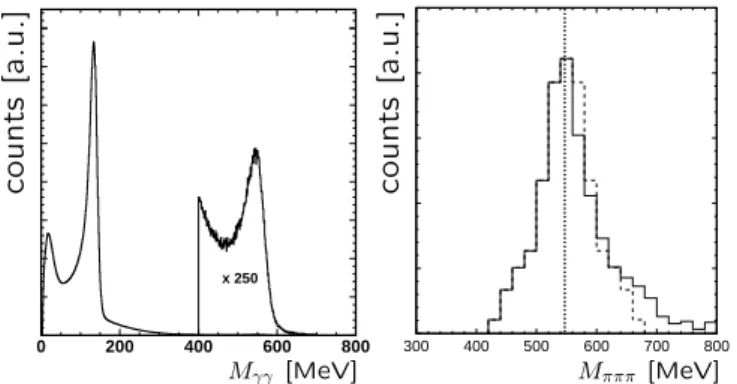
x 250 0 200 400 600 800 300 400 500 600 700 800 c o u n ts [a .u .] c o u n ts [a .u .] Mγγ [MeV] Mπππ[MeV] Fig. 7. Left-hand side: invariant-mass spectrum of photon pairs. Right-hand side: invariant-mass spectrum of π0π±
π± events. The dotted line indicates the nominal position of the η peak. The dashed histogram is the mirror image of the left-hand side of the peak (see text).
For further analysis only events with a single π0 missing
mass above 150 MeV were accepted.
Finally, the photoproduction of η-mesons was analyzed for the two decay modes η → γγ and η → π0π+π−. Since
the cross-section for the 40Ca(γ, η)X reaction is known
from previous experiments [47], this reaction can be used to estimate systematic effects in the detection of photons and charged pions and thus it helps to approximate the systematic uncertainties of the double pion production cross-sections. The η → γγ decay channel was identified with a standard invariant-mass analysis of photon pairs (see fig. 7, left-hand side). Events with invariant masses between 500 MeV and 600 MeV were selected. This is the range where the invariant-mass peak is practically free of background, which has been investigated in detail for previous η production experiments with TAPS at MAMI at incident photon energies below 800 MeV [47–50]. For the analysis of the η → π0π+π− decay in a first step
π0π±
pairs were selected with the same cuts as for dou-ble pion production. In a second step a further hit ful-filling the TOF versus E condition for charged pions was required and finally the invariant mass of the three pions was constructed (see fig. 7, right-hand side). The spectrum is dominated by the invariant-mass peak of the η-meson, however there is also a small contribution from π0π±
π±
final states not related to η decays. Since the sum of the mass of the three pions sets a low mass limit and the total available energy a high mass limit of the distribu-tion, the background populates similar invariant masses as the η decays and cannot be efficiently suppressed by a cut on invariant mass. For further analysis all entries in the invariant-mass spectrum have been accepted, but the resulting cross-section has been corrected for the obvi-ous background contribution at large invariant masses. For this correction the left-hand side of the peak was mirrored around the peak position (dashed histogram) and the ac-cess on the right-hand side above this mirror image was assigned to the background. This procedure results most likely in a slight underestimation of the total background.
0 50
500 550 600 650 700 750 800
E
γ[
MeV
]
σ
Fig. 8.Total cross-sections for η photoproduction off calcium. The results for the η → γγ and η → π0π+π−
decays are com-pared to the results from a previous measurement [47].
4 Determination of cross-sections
The absolute normalization of the cross-sections was ob-tained (see ref. [34] for details) from the target density ((1.52 ± 0.01) g/cm2), the photon flux, the decay
branch-ing ratio of π0 → γγ, and the acceptance and detection
efficiency of the TAPS detector. The latter was obtained from MC simulations with the GEANT3 package [46]. For the simulations the pion pairs have been generated accord-ing to phase space distributions in quasifree kinematics taking into account the Fermi motion of the nucleons. FSI was taken into account as in [41] in a simple approxima-tion, where pions scatter randomly off nucleons according to their mean free path. It was then checked that miss-ing mass, kinetic energy, and angular distributions were in agreement with the simulations.
For the extraction of the η photoproduction cross-section from the η → γγ decay the detection efficiency was obtained from MC simulations as a function of the laboratory angle and energy of the mesons as in [47]. This means that it becomes independent of assumptions about energy or angular distributions of the mesons. This is not possible for the η → π0π+π− channel since the analysis
used cuts on the reaction kinematic which depend on the incident photon energy. However, in this case the cross-sections extracted from the η → γγ channel can be used as input for the event generator. This is possible since the relatively long-lived η-mesons decay always outside the nucleus so that the decay pions are not influenced by ad-ditional FSI effects. The results for the total cross-section of η production are summarized in fig. 8. The agreement between the previous data from [47] and the present re-sults is quite good for both decay channels and can be used to estimate the systematic uncertainties.
0
300 350 400 450 500 550 600
E
γ[
MeV
]
Fig. 9.Total cross-sections for double π0
production extracted from events with three [9] and four detected photons.
5 Systematic uncertainties
The systematic uncertainties for the two reaction channels and for different energy ranges arise from different sources, which are briefly discussed in this section.
We start with double π0 photoproduction below the η
production threshold (i.e. for Eγ ≤550 MeV). The
identi-fication of photons in the TAPS detector is very clean (see, e.g., ref. [50]), and the suppression of background by the invariant-mass analysis (see fig. 3) is efficient. As shown in fig. 4 (left-hand side), no background is visible in the missing-mass spectrum for incident photon energies be-low 500 MeV, and the shape of the missing-mass spectrum is excellently reproduced by the Monte Carlo simulation. The missing-mass cut is therefore irrelevant in this energy region. Furthermore, in a previous experiment [9], with an earlier stage of the TAPS detector, the reaction was inves-tigated below the η-threshold from an analysis of events with three photons. In this case, only identification of one π0-meson and an additional photon was required. Such an
analysis was possible since the only physical background in this energy range comes from the reaction γN → γ0
π0N .
Compared to double π0 production, the cross-section of
this background reaction is smaller by more than an or-der of magnitude [51], and the contribution to the three-photon sample was suppressed by another order of magni-tude relative to the π0π0 channel via detection efficiency
(three-out-of-three versus three-out-of-four detected pho-tons). The result of this analysis for the total cross-section is compared in fig. 9 to the present result. The systematic difference between the two excitation functions is only 3%, although the detector geometry, the cuts for the reaction identification, and the detection efficiencies were very dif-ferent. We therefore estimate the systematic uncertainty of the double π0 data below the η-threshold with 5%.
At higher incident photon energies two effects increase the systematic uncertainty for the double π0 channel.
Background from η → 3π0 decays, where the decay
pho-tons from one pion escape detection, becomes impor-tant. At the same time, the probability of re-scattering of the pions from the double π0 production in the
nu-cleus increases, since the mean free path of pions decreases strongly with increasing kinetic energy [9]. Together with the smearing of the reaction kinematics due to Fermi mo-tion, the re-scattering results in a significant fraction of events which in the missing-mass analysis overlap with the η background (see fig. 4). In the analysis, only events with missing masses between 100 and −100 MeV were accepted for double π0production. The fraction of true 2π0events,
which do not pass this cut, was determined from the Monte Carlo simulations and corrected. The background from η events which pass this cut can be subtracted, since the η cross-section is precisely known from the η → γγ decay channel. This, however, involves a Monte Carlo sim-ulation of η → 3π0events. Both simulations contribute to
the systematic uncertainty. Among these two, the 2π0
sim-ulation is more critical since it involves model assumptions about the pion FSI. From a variation of the missing-mass cut we estimate the uncertainty at the 10% level for the highest incident photon energies. Therefore a linearly ris-ing systematic error (0% at 550 MeV, 10% at 800 MeV) is added in quadrature.
The systematic uncertainty for the mixed charge chan-nel is larger since for the charged pion we do not have the efficient invariant-mass filter. A check of the simu-lated detection efficiency for charged pions is obtained from the analysis of the η → π0π+π−
decay, where it enters squared. The agreement between the cross-sections from the two different η decays (see fig. 8) limits the sys-tematic uncertainty for the detection of a π0π± pair to
the 15% range. At low incident photon energies the main source for systematic uncertainties is the background due to the misidentification of recoil protons from single π0
production as charged pions (see sect. 4), which is sup-pressed by a missing-mass cut (see fig. 6). Also from the comparison of the simulated missing-mass spectrum to the measured distribution, a 15% uncertainty at the low-est incident photon energies appears realistic. It should be noted that the fraction of true double pion events, which do not pass the 150 MeV cut, enters of course via the Monte Carlo simulations into the detection efficiency. Systematic effects therefore arise only from the correct representation of the double pion reaction in the simula-tion and from residual proton background, which is not eliminated by the cut. The relative importance of the pro-ton background decreases with increasing incident phopro-ton energy since the cross-section ratio of single π0 to π0π±
production drops by more than an order of magnitude be-tween 450 and 600 MeV, although at the same time the kinematic separation of the background gets worse due to pion re-scattering.
The relative contribution of the background from η decays (η → π0π+π−) is smaller by roughly an order
of magnitude compared to the neutral channel. This is a combined effect of cross-section ratios, η decay branch-ing ratios and misidentification probability (π0and one of
the charged pions must be detected while any pair out of three π0’s is possible). Therefore it was not attempted to
suppress this background with further cuts, but the simu-lated contribution was subtracted from the cross-section.
0 10 20 30 40 50 300 400 500 600 700 800 40
Ca(
γ
,
π
oπ
+/-)X
p(
γ
,
π
oπ
+)n
n(
γ
,
π
oπ
-)p
40Ca(
γ
,
π
oπ
o)X
d(
γ
,
π
oπ
o)np
E
γ[
MeV
]
σ
/A
eff[
µ
b
]
Fig. 10.Total cross-sections for π0 π0 and π0 π± photoproduc-tion off 40 Ca compared to d(γ, π0 π0 )np [36], respectively, to p(γ, π0 π+ )n [37] and n(γ, π0 π− )p [28, 29]. Cross-sections are normalized to Aef f = A2/3 for calcium and Aef f = A for A = 1, 2.
The related systematic uncertainty rises from threshold to high incident photon energies to a few per cent and counteracts the dropping of the uncertainty related to the above discussed background from single π0production. In
addition, at higher incident photon energies a small con-tamination from π0π±π± events not originating from η
decays may contribute (few percent level, see fig. 7). We have thus assumed a conservative total uncertainty of 15% for all incident photon energies.
Finally, an overall normalization uncertainty for the luminosity (target surface thickness and photon flux) of 2–3% must be added.
6 Results
The total cross-sections for the two double pion produc-tion channels are compared in fig. 10 to data off the nu-cleon. Two remarks must be made. The unpolarized dou-ble pion data off the nucleon measured with DAPHNE at MAMI [27,28] was recently revised [32]. The data shown for the n(γ, π0π−
)p reaction are the result of this re-analysis [29]. The total cross-section for π0π±
produc-tion off 40Ca from the TAPS experiment reported in [9]
is slightly higher than the present result (approximately 10% at 800 MeV). This discrepancy is due to the back-ground from protons leaking into the pion TOF versus E band, which was not efficiently enough suppressed in the earlier analysis.
When properly scaled by the mass number dependence (as discussed in detail in [9,10]) the total cross-section
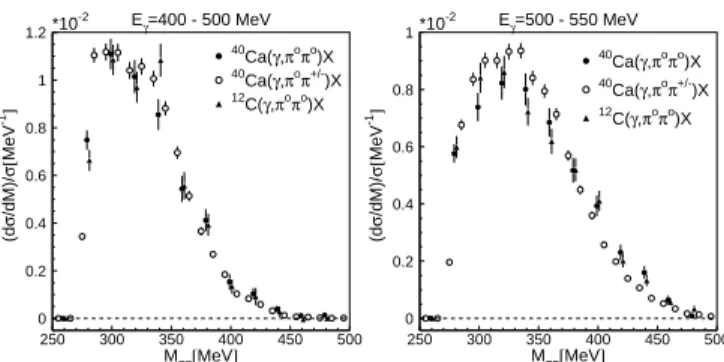
Fig. 11. Pion-pion invariant-mass distributions for two dif-ferent ranges of the incident photon energy normalized to the total cross-section. The distributions from40
Ca for π0 π0
and π0
π±
are compared to each other and to the π0 π0
distributions from12
C [41].
for the π0π0 channel is in excellent agreement with the
deuteron data over the full energy range, indicating that only trivial effects like FSI influence the nuclear cross-section. The situation is less clear for the π0π± reaction.
The nuclear data show a smooth behavior very similar to the n(γ, π0π−
)p reaction, while the p(γ, π0π+)n
excita-tion funcexcita-tion has a pronounced peak in the second reso-nance region. This behavior might contribute to the still not understood complete suppression of the second reso-nance bump in total photoabsorption data [52]. At least for this channel, a part of the effect might be due to a difference in proton and neutron cross-section. However, since the π0π+ cross-section is measured off the free
pro-ton and the π0π− cross-section off the neutron bound in
the deuteron a more detailed investigation of possible nu-clear effects in the deuteron is highly desirable.
The main motivation for this experiment was the in-vestigation of the π-π invariant-mass distributions in view of possible in-medium modifications of the strength in the scalar, iso-scalar channel. For two reasons low inci-dent photon energies are advantageous for this analysis. First, this avoids the additional background from triple pion decays of the η-meson, which would give rise to addi-tional systematic uncertainties. Furthermore, at low inci-dent photon energies the kinetic energies of the produced pions are small. This is advantageous because low-energy pions, which have only a small chance to excite the nucleon to the ∆-resonance, are much less affected by FSI [9]. On the other hand, the cross-section drops strongly towards the production thresholds, so that some compromise is necessary.
The measured distributions for two ranges of inci-dent photon energies (400 MeV–500 MeV and 500 MeV– 550 MeV) are summarized in fig. 11 and compared to pre-vious results for carbon [41]. The distributions for the two different charge channels and also for the two different nuclei are very similar. For 40Ca we do not observe such
an important shift of the π0π0 invariant-mass
distribu-tions towards small invariant masses as has been found for lead [41], neither relative to the π0π±
channel for Ca nor in the comparison to π0π0 off carbon nuclei.
Fig. 12. Cross-section ratios Cππ(Ca/C) and Cππ(π0π0/π0π±) for low invariant masses.
For a more detailed comparison the cross-section ratios Cππ(Ca/C) and Cππ(π0π0/π0π±) defined by:
Cππ(Ca/C) = dσCa(π0π0) σCa(π0π0)dM dσ C(π0π0) σC(π0π0)dM , (3) Cππ(π0π0/π0π±) = dσCa(π 0π0) σCa(π0π0)dM dσCa(π0π±) σCa(π0π±)dM , (4)
where σX(π0πc) with X = carbon, calcium are the
to-tal cross-sections and dσ/dM the invariant-mass distri-butions shown in fig. 12. In line with the previous results for carbon and lead [41] some low mass enhancement of the π0π0 final state versus the π0π±
final state is also visible for calcium. However, there is no significant dif-ference between the π0π0 distributions off carbon and off
calcium. This means that the size of possible in-medium effects is comparable for carbon and calcium, while signif-icantly stronger effects had been found for lead [41].
7 Comparison to results of the BUU model
The quantitative discussion of the experimental results re-quires a detailed understanding of the “trivial” in-medium effects like the smearing of cross-sections due to the mo-mentum distributions of the bound nucleons, collisional broadening of nucleon resonances due to additional de-cay channels like N N? → N N , Pauli-blocking of final
states, and final-state interactions of the pions. These effects have been intensively studied in the framework of coupled-channel transport models based on the semi-classical Boltzmann-Uehling-Uhlenbeck (BUU) equation (see [53–55] for details of the model). Recently, M¨uhlich et al. [56] and Buss et al. [57] have performed detailed calculations of the nuclear double pion photoproduction reactions in the framework of this model. In the latter work, special emphasis was laid on the description of the scattering and absorption properties of low-energy pions.
Apart from the inherent assumptions and approxima-tions made in semi-classical transport models, systematic uncertainties of the calculations arise from the uncertainty of the cross-sections of the elementary production reac-tions and the uncertainty of the cross-secreac-tions involved in the description of pion FSI. Some indication for the cor-rect treatment of pion FSI comes from a comparison [58]
0 20 40 60 80 100 120 400 600 800
σ
[
µ
b
]
E
γ[
MeV
]
π
oπ
o 0 100 200 300 400 500 600 400 600 800π
oπ
+/-Fig. 13. Total cross-sections compared to results of the BUU model [57]. The bars at the bottom represent the systematic uncertainty of the data (see sect. 5), the dashed lines represent the error band for the BUU calculation.
of model calculations and experimental results for pion-induced double charge exchange reactions, which are very sensitive to details of pion FSI. It is thus assumed, that the major uncertainty is related to the experimentally deter-mined elementary production cross-sections of pion pairs off nucleons. Buss and co-workers [57] estimate a system-atic 20% uncertainty of their results for the π0π0 channel
from a simultaneous variation of all input cross-sections to their ±1σ limits. This estimate is conservative since no cancellation of systematic errors from different reaction channels is considered. The largest uncertainty is related to the γn → nπ0π0 channel. The uncertainty estimated
in [57] for the π0π±
final state is much smaller, however this was based only on the statistical uncertainties of the input data and has neglected the systematic ones, which are also typically on the 10–15% level. Therefore we as-sume also for this channel a 15% systematic uncertainty. These model uncertainties and also the systematic uncer-tainties of the data are indicated in figs. 13, 14 as dashed lines, respectively bar charts.
The overall agreement between the model results and the data for the total cross-sections is good within the systematic uncertainties (see fig. 13), it is excellent for the π0π0 channel in the energy range of interest for the
invariant-mass distributions. Up to now, reliable BUU calculations are not available for incident photon ener-gies above 700 MeV, since in this region the elementary free-nucleon cross-sections have too large uncertainties for some channels.
An important result of this model calculations is, that even without any explicit in-medium modification of the π0π0 channel, the respective invariant-mass distributions
show a significant softening for heavy nuclei [57]. In the model, this effect arises solely from FSI of the pions. Part of it comes from the fact that the πN absorption cross-section increases strongly with pion kinetic energy, so that pions with larger kinetic energies are more strongly
de-0 1 2 3
d
σ
/dM
[
nb/MeV/A
]
πoπo Eγ = 400 - 500 MeV 0 2 4 6 πoπo Eγ = 500 - 550 MeV 0 5 10 15 250 300 350 400 450 Mππ[MeV] πoπ +/-0 10 20 30 300 400 500 πoπ+/-Fig. 14. Pion-pion invariant-mass distributions compared to results of the BUU model [57]. The bars at the bottom repre-sent the systematic uncertainty of the data (see sect. 5), the dashed lines represent the error band for the BUU calculation.
0.5 1 1.5 300 350 400 Mππ[MeV] Cππ ( π oπ o/π oπ +/-) Eγ= 400 - 500 MeV 0.5 1 1.5 300 350 400 Mππ[MeV] Eγ= 500 - 550 MeV
Fig. 15. Cross-section ratio Cππ(π0π0/π0π±) compared to the results of the BUU model [57]. Symbols: data, curves BUU results [57]. Left-hand side: incident photon energies 400–500 MeV, right-hand side: incident photon energies 500– 550 MeV.
pleted via the πN → ∆, ∆N → N N reaction path. But not only the absorptive part of the FSI is impor-tant, also important are re-scattering processes which tend to decrease the pion kinetic energy and thus the average pion-pion invariant masses. This effect is enhanced due to charge exchange scattering, which mixes the contributions from the different charge channels. Since the total cross-section for π0π±
production is much larger than the π0π0
cross-section, the latter receives significant side feeding from the mixed charge channel via π±
N → N π0
scatter-ing, which increases the fraction of re-scattered low-energy pions in this channel. In the same way, re-scattering of π+π−
contributes to the π0π±
channel. This result means that the relative softening of the π0π0 invariant mass by
itself is no evidence for an in-medium modification of the pion-pion interaction, but the argument becomes quanti-tative, requiring a comparison of the experimental results to calculations which account for the trivial FSI effects.
mass dependent but rather related to the absolute scale of the cross-section. The cross-section for the mixed charge channel is somewhat overestimated by the model, in par-ticular for large invariant masses. This absolute normaliza-tion cancels in the Cππ(π0π0/π0π±) ratio, which is
com-pared to the BUU results in fig. 15. Within the statistical uncertainties, the agreement between data and model re-sults is good. This means that the relative shapes of the π0π0and π0π±
invariant-mass distributions can be almost completely reproduced from FSI effects.
8 Summary and conclusions
Total cross-sections and pion-pion invariant-mass distri-butions have been measured for π0π0 and π0π±
photo-production off40Ca nuclei. When scaled by A2/3the total
cross-sections agree quite well with the average of the ele-mentary cross-sections off the proton and the neutron. The only exception is the mixed charge final state in the second resonance region, where the reaction off the free proton shows a more pronounced signal for the resonance bump. The invariant-mass spectra show a similar effect as already reported in [41] for carbon and lead nuclei, namely a softening of the π0π0 distributions relative
to the π0π±
distributions. The strength of the effect is comparable to carbon.
The data have been compared to calculations in the framework of the BUU model [57]. A sizable part of the in-medium effects can be explained by the model by final-state interaction effects, which tend to shift re-scattered pions to smaller kinetic energies. Only for the lowest inci-dent photon energies a small additional downward shift of the strength to small invariant masses for the π0π0
chan-nel may be visible.
We wish to acknowledge the excellent support of the accel-erator group of MAMI, as well as many other scientists and technicians of the Institut f¨ur Kernphysik at the University of Mainz. We thank O. Buss, U. Mosel, and P. M¨uhlich for many valuable discussions and the communication of the BUU results. This work was supported by Schweizerischer Nation-alfonds, Deutsche Forschungsgemeinschaft, and the UK Engi-neering and Physical Sciences Research Council.
References
1. M. Lutz, S. Klimt, W. Weise, Nucl. Phys. A 542, 521 (1992).
2. G. Agakichiev et al., Phys. Rev. Lett. 75, 1272 (1995). 3. D. Adamova et al., Phys. Rev. Lett. 91, 042301 (2003).
14. W.-M. Yao et al., J. Phys. G 33, 1 (2006).
15. I. Caprini, G. Colangelo, H. Leutwyler, Phys. Rev. Lett. 96, 132001 (2006).
16. T. Hatsuda, T. Kunihiro, H. Shimizu, Phys. Rev. Lett 82, 2840 (1999).
17. Z. Aouissat, G. Chanfray, P. Schuck, J. Wambach, Phys. Rev. C 61, 012201 (2000).
18. H.C. Chiang et al., Nucl. Phys. A 644, 77 (1998). 19. L. Roca, E. Oset, M.J. Vicente Vacas, Phys. Lett. B 541,
77 (2002).
20. G. Chanfray et al., Eur. Phys. J. A 27, 191 (2006). 21. F. Bonutti et al., Phys. Rev. Lett. 77, 603 (1996). 22. F. Bonutti et al., Phys. Rev. C 60, 018201 (1999). 23. F. Bonutti et al., Nucl. Phys. A 677, 213 (2000). 24. P. Camerini et al., Nucl. Phys. A 735, 89 (2004). 25. N. Grion et al., Nucl. Phys. A 763, 80 (2005). 26. A. Starostin et al., Phys. Rev. Lett. 85, 5539 (2000). 27. A. Braghieri et al., Phys. Lett. B 363, 46 (1995). 28. A. Zabrodin et al., Phys. Rev. C 55, R1617 (1997). 29. P. Pedroni, private communication.
30. A. Zabrodin et al., Phys. Rev. C 60, 055201 (1999). 31. J. Ahrens et al., Phys. Lett. B 551, 49 (2003). 32. J. Ahrens et al., Phys. Lett. 624, 173 (2005). 33. F. H¨arter et al., Phys. Lett. B 401, 229 (1997). 34. B. Krusche et al., Eur. Phys. J. A 6, 309 (1999). 35. M. Wolf et al., Eur. Phys. J. A 9, 5 (2000). 36. V. Kleber et al., Eur. Phys. J. A 9, 1 (2000).
37. W. Langg¨artner et al., Phys. Rev. Lett. 87, 052001 (2001). 38. M. Kotulla et al., Phys. Lett. B 578, 63 (2004).
39. Y. Assafiri et al., Phys. Rev. Lett. 90, 222001 (2003). 40. B. Krusche, S. Schadmand, Prog. Part. Nucl. Phys. 51,
399 (2003).
41. J.G. Messchendorp et al., Phys. Rev. Lett. 89, 222302 (2002); S. Schadmand, private communication.
42. I. Anthony et al., Nucl. Instrum. Methods A 301, 230 (1991).
43. Th. Walcher, Prog. Part. Nucl. Phys. 24, 189 (1990). 44. R. Novotny, IEEE Trans. Nucl. Sci. 38, 379 (1991). 45. A.R. Gabler et al., Nucl. Instrum. Methods A 346, 168
(1994).
46. R. Brun et al., GEANT, Cern/DD/ee/84-1, 1986. 47. M. R¨obig-Landau et al., Phys. Lett. B 373, 45 (1996). 48. B. Krusche et al., Phys. Rev. Lett. 74, 3736 (1995). 49. B. Krusche et al., Phys. Lett. B 358, 40 (1995). 50. B. Krusche et al., Z. Phys. A 351, 237 (1995). 51. M. Kotulla et al., Phys. Rev. Lett. 89, 272001 (2002). 52. N. Bianchi et al., Phys. Lett. B 325, 249 (1994). 53. M. Effenberger et al., Nucl. Phys. A 614, 501 (1997). 54. S. Teiss et al., Z. Phys. A 356, 421 (1997).
55. P. M¨uhlich et al., Phys. Rev. C 67, 024605 (2003). 56. P. M¨uhlich et al., Phys. Lett. B 595, 216 (2004).
57. O. Buss, L. Alvarez-Ruso, P. M¨uhlich, U. Mosel, Eur. Phys. J. A 29, 189 (2006); O. Buss, private communication. 58. O. Buss, L. Alvarez-Ruso, A.B. Larinov, U. Mosel, Phys.

![Fig. 9. Total cross-sections for double π 0 production extracted from events with three [9] and four detected photons.](https://thumb-eu.123doks.com/thumbv2/123doknet/14847766.628212/6.892.61.405.130.473/total-sections-double-production-extracted-events-detected-photons.webp)
![Fig. 10. Total cross-sections for π 0 π 0 and π 0 π ± photoproduc- photoproduc-tion off 40 Ca compared to d(γ, π 0 π 0 )np [36], respectively, to p(γ, π 0 π + )n [37] and n(γ, π 0 π − )p [28, 29]](https://thumb-eu.123doks.com/thumbv2/123doknet/14847766.628212/7.892.454.819.133.498/fig-total-cross-sections-photoproduc-photoproduc-compared-respectively.webp)
![Fig. 15. Cross-section ratio C ππ (π 0 π 0 /π 0 π ± ) compared to the results of the BUU model [57]](https://thumb-eu.123doks.com/thumbv2/123doknet/14847766.628212/9.892.457.822.505.733/fig-cross-section-ratio-ππ-compared-results-model.webp)
