Improvement of cassava shoot organogenesis by the use of silver nitrate in
vitro
Peng Zhang
1, Salak Phansiri
2& Johanna Puonti-Kaerlas
1,∗1Institute for Plant Sciences, ETH-Zentrum, CH-8092 Zürich, Switzerland; 2Central Lab, Kasetsart University
Research and Development Institute, Kasetsart University, Chatuchak, Bangkok 10900, Thailand (∗requests for offprints and present address: European Patent Office, D-80298 Munich, Germany. E-mail: [email protected])
Received 11 April 2000; accepted in revised form 24 April 2001
Key words: Manihot esculenta (Crantz), regeneration, selection, silver nitrate
Abstract
To improve the regeneration efficiency of cassava (Manihot esculenta Crantz) in vitro, the effect of silver nitrate (AgNO3) on shoot organogenesis from somatic cotyledons was assessed. Adding AgNO3 to the regeneration
medium improved the regeneration frequency and reduced callus formation in all tested cultivars. Both the extent of the response to and the optimum concentration of AgNO3were cultivar dependent. In the model cultivar MCol22,
the use of AgNO3at concentrations between 4 and 12 mg l−1 increased shoot organogenesis frequency and the
number of shoot primordia per explant, the maximum effect being observed on a medium containing 12 mg l−1 AgNO3. At this concentration, the frequency of shoot organogenesis was enhanced from 60 to 90%, while callus
formation decreased from 100 to 5%. The highest shoot organogenesis rates were obtained by supplementing the medium with 2 and 1 mg l−1AgNO3in KU50 and Hanatee, respectively, while cultivar T5 showed an optimum
response at 4 mg l−1. The shoots regenerated from explants cultured on a medium containing AgNO3were more
elongated than those cultured on a medium without AgNO3. The application of AgNO3did not change the dose
response of shoot organogenesis for the selective agents hygromycin and mannose.
Abbreviations: BA – 6-benzylaminopurine; CBM – cassava basic medium; CEM – cassava elongation medium;
CMM – cassava embryo maturation medium; COM – cassava shoot organogenesis medium; IBA – indole-3-butyric acid
Introduction
Cassava (Manihot esculenta Crantz) is a perennial tropical root crop used as a staple by more than 500 million people world-wide (for a review see Puonti-Kaerlas, 1998). Genetic engineering of cassava has high potential as an efficient complement to tradi-tional breeding in improving agriculturally valuable traits such as pest and virus resistance or improved root quality. However, the transformation efficacy of cassava, like many other crops, depends on plant re-generation efficiency. Direct shoot induction (shoot organogenesis) from cotyledons of somatic embryos (somatic cotyledons) of cassava is a rapid regen-eration system minimising somaclonal variation (Li et al., 1998) and has already been demonstrated to
be efficient for genetic transformation using particle bombardment (Zhang et al., 2000) as well as for transformation using Agrobacterium (Li et al., 1996; Puonti-Kaerlas et al., 1997). The regeneration ef-ficiency is nonetheless genotype-dependent, varying between 5 and 70% (Puonti-Kaerlas, unpublished), which may constrain the use of genetic engineering in cultivars with low regeneration capacity.
Silver nitrate has been shown to be effective in improving somatic embryogenesis and plant regenera-tion in a number of crop species including Brassica spp. (Palmer, 1992; Zhang and Ling, 1995, 1996; Eapen and George, 1997; Kuvshinov et al., 1999), maize (Vain et al., 1989a,b; Carvalho et al., 1997), muskmelon (Yadav et al., 1996), cucumber (Roustan et al., 1992; Mohiuddin et al., 1997), cowpea (Brar
et al., 1999), peanut (Pestana et al., 1999), wheat (Lashermes, 1992), rice (Lentini et al., 1995) and bar-ley (Castillo et al., 1998). As Ag+ions can prevent a wide variety of ethylene-induced plant responses, in-cluding growth inhibition and senescence, the effect is assumed to be mediated via the inhibition of the physiological action of ethylene (Beyer et al., 1984), a potential inhibitor of many plant regeneration systems (Vain et al., 1989a; Chraibi et al., 1991; Kong and Yeung, 1994). In this paper we present the results of the first study on the effect of AgNO3on cassava shoot
organogenesis from somatic cotyledons. Our study shows that AgNO3can be used to improve the in vitro
regeneration frequencies of cassava without affecting adversely the efficiency of selectable markers required for selection of transgenic plants.
Materials and methods
Somatic embryogenesis
One Colombian (MCol22) and three Thai cultivars (T5, KU50 and Hanatee) obtained from CIAT, Colom-bia and Kasetsart University, Thailand, respectively, were used in this study. The plant material was main-tained as shoot cultures on CBM (MS salts and vit-amins [Murashige and Skoog, 1962] supplemented with 2% sucrose and 2 µM CuSO4, solidified with
0.6% plant agar (Duchefa, pH 5.8) at 26◦C with a 16-h p16-hotoperiod (fluorescent tubes, 200 µM m−2 s−1) and subcultured at 4-week intervals. Apical shoot mer-istems and 2–5-mm long immature leaf lobes were isolated from shoot cultures and cultured on CIM me-dium (CBM supplemented with 12 mg l−1 picloram) at 26◦C in the dark. After 2 weeks, the develop-ing embryos were transferred to fresh CIM medium to initiate cycling secondary embryo cultures. After two to three cycles on CIM medium, the somatic em-bryos were harvested and cultured onto CMM medium (CBM with 0.1 mg l−1 BA) at 26◦C with a 16-h photoperiod (90–110 µM m−2s−1) for production of maturing somatic embryos.
Shoot organogenesis
Green cotyledons were collected from somatic em-bryos cultured on maturation medium (CMM) for 10–15 days, cut into 5-mm2pieces and transferred to COM medium (CBM with 1 mg l−1 BA and 0.5 mg l−1 IBA) for shoot organogenesis at 26◦C in the dark. Shoot primordia developing on the explants were
transferred after 3 weeks to CEM (CBM supplemented with 0.4 mg l−1 BA) for shoot elongation.
Silver nitrate test
COM medium supplemented with AgNO3was used
for assessing the effect of silver nitrate. An 8 mg ml−1 stock solution of AgNO3 (Merck, Darmstadt)
was filter sterilised, stored at 4◦C and added into the autoclaved medium. The effect of various silver ni-trate concentrations (0, 1, 2, 4, 8 and 12 mg l−1) on callus formation and on shoot regeneration ability of cotyledon explants was tested. Fifty explants per cultivar were cultured per treatment. Each experiment had three replicates and was repeated 2 times. After 3 weeks, the status of shoot organogenesis and callus formation were recorded. Three different degrees of organogenesis and callus formation were used to eval-uate the response of the cotyledon explants to silver nitrate. Organogenesis degree 1 (OD1) indicates less than five shoot primordia per explant, organogenesis degree 2 (OD2) between five and 10 shoot primordia per explant and organogenesis degree 3 (OD3) more than 10 shoot primordia per explant. In the evaluation of callus development, callus degree 1 (CD1) indicates callus size less than 0.25 cm in diameter, callus degree 2 (CD2) callus size between 0.25 and 0.5 cm in dia-meter and callus degree 3 (CD3) indicates the size of calli larger than 0.5 cm in diameter.
Plant regeneration
The developing shoot primordia and regenerating shoots were detached from the explants and trans-ferred to CEM medium for shoot elongation. In one experiment, the effect of AgNO3 on the competence
of shoot primordia to produce elongating shoots was evaluated. Twenty clusters of shoot primordia per treatment were transferred to CEM for elongation. After 4 weeks, the number of elongated shoots was recorded. The shoots were transferred to CBM for rooting and further growth.
Effect of silver nitrate on selection agents
In order to test whether AgNO3 influences the
effi-ciency of hygromycin and mannose used for selection of transgenic cassava shoots, cotyledon explants were cultured on COM supplemented with 8 mg l−1AgNO3
and either with 20 mg l−1 hygromycin or 20 g l−1 mannose. Fifty explants of MCol22 were used in each
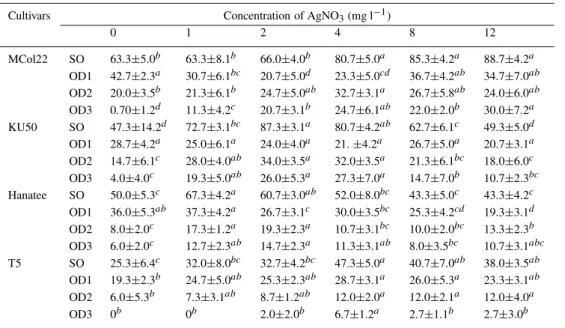
Table 1. The effect of silver nitrate on the frequency of shoot organogenesis (SO)
Cultivars Concentration of AgNO3(mg l−1)
0 1 2 4 8 12 MCol22 SO 63.3±5.0b 63.3±8.1b 66.0±4.0b 80.7±5.0a 85.3±4.2a 88.7±4.2a OD1 42.7±2.3a 30.7±6.1bc 20.7±5.0d 23.3±5.0cd 36.7±4.2ab 34.7±7.0ab OD2 20.0±3.5b 21.3±6.1b 24.7±5.0ab 32.7±3.1a 26.7±5.8ab 24.0±6.0ab OD3 0.70±1.2d 11.3±4.2c 20.7±3.1b 24.7±6.1ab 22.0±2.0b 30.0±7.2a KU50 SO 47.3±14.2d 72.7±3.1bc 87.3±3.1a 80.7±4.2ab 62.7±6.1c 49.3±5.0d OD1 28.7±4.2a 25.0±6.1a 24.0±4.0a 21.±4.2a 26.7±5.0a 20.7±3.1a OD2 14.7±6.1c 28.0±4.0ab 34.0±3.5a 32.0±3.5a 21.3±6.1bc 18.0±6.0c OD3 4.0±4.0c 19.3±5.0ab 26.0±5.3a 27.3±7.0a 14.7±7.0b 10.7±2.3bc Hanatee SO 50.0±5.3c 67.3±4.2a 60.7±3.0ab 52.0±8.0bc 43.3±5.0c 43.3±4.2c OD1 36.0±5.3ab 37.3±4.2a 26.7±3.1c 30.0±3.5bc 25.3±4.2cd 19.3±3.1d OD2 8.0±2.0c 17.3±1.2a 19.3±2.3a 10.7±3.1bc 10.0±2.0bc 13.3±2.3b OD3 6.0±2.0c 12.7±2.3ab 14.7±2.3a 11.3±3.1ab 8.0±3.5bc 10.7±3.1abc T5 SO 25.3±6.4c 32.0±8.0bc 32.7±4.2bc 47.3±5.0a 40.7±7.0ab 38.0±3.5ab OD1 19.3±2.3b 24.7±5.0ab 25.3±2.3ab 28.7±3.1a 26.0±5.3a 23.3±3.1ab OD2 6.0±5.3b 7.3±3.1ab 8.7±1.2ab 12.0±2.0a 12.0±2.1a 12.0±4.0a OD3 0b 0b 2.0±2.0b 6.7±1.2a 2.7±1.1b 2.7±3.0b
The numbers indicate the mean number of responding explants (SO) as percent of all explants, and the distribution of the response between different organogenesis degrees (OD1, OD2 and OD3). Letters a–d indicate significant differences (p=0.05) within each row using an LSD test.
treatment with three replicas. After 4 weeks, the num-ber of developing shoots was recorded. For statistical significance, the data were analysed by the LSD test at the 5% level.
Results
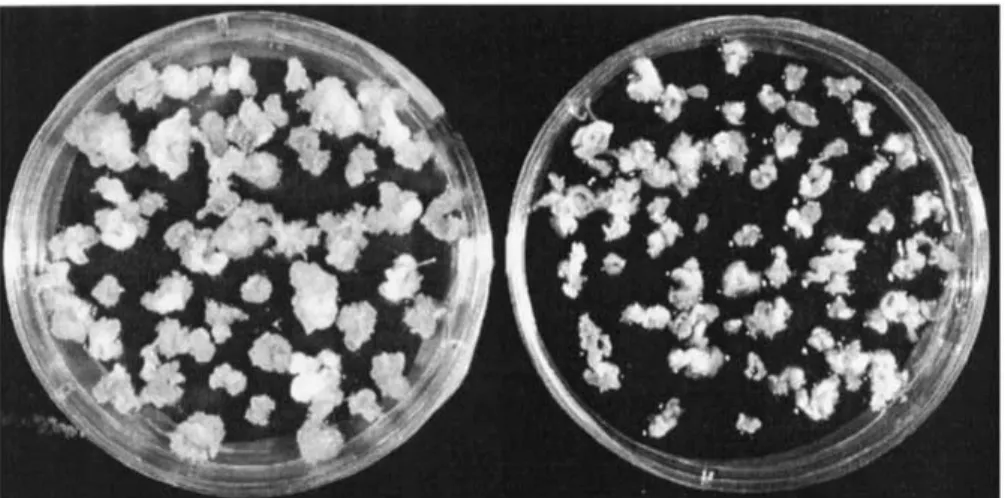
Differences were observed between the four cultivars in their competence for organogenesis under standard conditions (Table 1). MCol22 had the highest organo-genesis frequency (63%); while in T5, only 25% of the explants were able to produce shoot primordia. The organogenesis frequency of KU50 and Hanatee was about 50%. In most of the explants organogenesis de-gree one (less than five shoot primordia per explant) was dominant. At the same time, large amounts of non-morphogenic callus were produced from the cut edges of the explants (Figure 1).
Enhancement of organogenesis frequency
After 4 weeks of culture on COM supplemented with different concentrations of AgNO3, different
responses could be observed among the tested cul-tivars both in shoot organogenesis frequencies and the numbers of developing shoot primordia per explant
(Table 1). In MCol22, the frequency of shoot or-ganogenesis and oror-ganogenesis degree increased with increasing AgNO3concentrations of up to 12 mg l−1.
On a medium containing 12 mg l−1 AgNO3, 89% of
the explants produced shoot primordia, and 30% of these had more than 10 shoot primordia per explant (organogenesis degree 3); whereas in the controls, the organogenesis frequency was 63%, and only 0.7% of the explants showed organogenesis degree 3. In KU50 and Hanatee, the highest increase in organogenesis rate could be obtained by supplementing the medium with 2 and 1 mg l−1AgNO3respectively; while in T5,
the best response was observed using 4 mg l−1AgNO3
in the medium. Concentrations higher than 8 mg l−1 had a slightly inhibitory effect on shoot organogenesis of the Thai cultivars.
Inhibition of callus formation
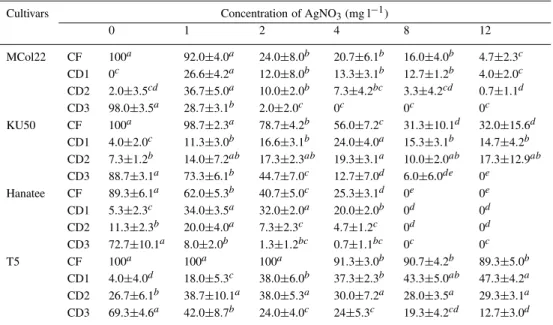
On COM, 100% of the somatic cotyledon explants of MCol22, KU50 and T5 formed callus, more than 70% of which was degree 3 (callus size larger than 0.5 cm in diameter) (Table 2). In Hanatee, 89% of the explants produced callus and 73% of this was de-gree 3. In all cultivars, increasing concentrations of AgNO3reduced callus formation, both in terms of
cal-lus frequency and of calcal-lus degree. In MCol22, calcal-lus frequency was decreased from 100% (control) to 5%
Figure 1. The effect of silver nitrate on shoot organogenesis and callus formation in MCol22; left, without silver nitrate; right, with 4 mg l−1
silver nitrate.
(12 mg l−1AgNO3) and the frequency of callus degree
3 was reduced from 98 to 0% (Figure 1). In Hanatee, callus formation was reduced to 25% by 4 mg l−1and totally inhibited by 8 mg l−1 AgNO3; while in KU50
and in T5, the effect was less pronounced, but still significantly different from the controls.
Improvement of shoot elongation
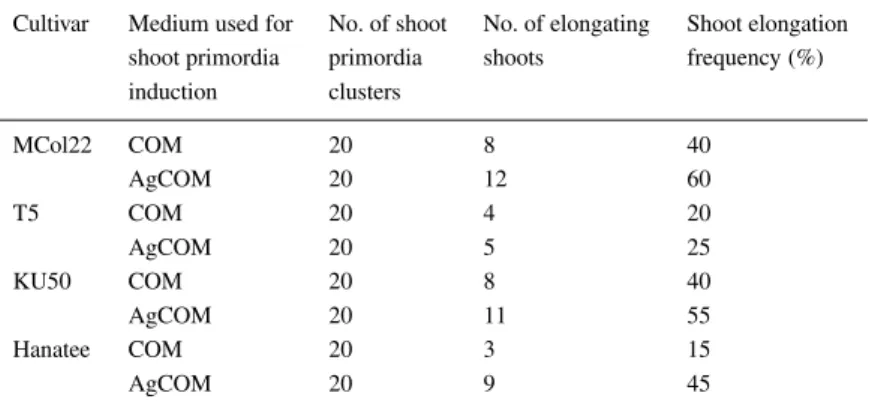
Shoot primordia of MCol22 induced on COM with or without 4 mg l−1AgNO3were transferred individually
onto CEM to test the effect of silver nitrate on shoot elongation. In all the tested cultivars, shoot primordia induced on COM with AgNO3produced more
elong-ating shoots than those induced on a medium without AgNO3(Table 3).
Effect of silver nitrate on the dose response to selective agents
Hygromycin and mannose, used for production of transgenic cassava were tested for their efficacy in inhibiting shoot organogenesis of MCol22 cotyle-don explants cultured on COM supplemented with AgNO3. Addition of 8 mg l−1 silver nitrate did not
affect the sensitivity of shoot primordia regeneration to hygromycin or mannose (Table 4).
Discussion
Many reports have demonstrated the positive effect of AgNO3 on plant tissue culture, although in some
plants and tissue types no positive or even an inhib-itory effect has been reported (Puonti-Kaerlas, 1991;
Palmer, 1992; Jun et al., 1997; Teo et al., 1997; Kumar et al., 1998; El Meskaoui and Tremblay, 1999). In the case of cassava, it has been shown that the matura-tion and regeneramatura-tion of secondary somatic embryos of one cultivar could be improved by the use of 16 mg l−1AgNO3and 0.25 mg l−1ABA (Zhu et al., 1998).
We show here that the capacity of shoot organogen-esis in a number of cassava cultivars can be improved by supplementing the medium with AgNO3. The
op-timum concentration of AgNO3 was found to differ
among the different cultivars. In MCol22, using 4– 12 mg l−1 AgNO3 increased the frequency of shoot
organogenesis from 63% (control) to over 80%. At the same time, the number of regenerated shoots per explant increased as well, with concomitant inhibition of callus growth. The optimum AgNO3concentrations
for shoot regeneration in the other cultivars were lower than in MCol22; 2 mg l−1 in KU50, 1 mg l−1 in Hanatee and 4 mg l−1 in T5. Hence, different cas-sava cultivars appear to have quantitatively different responses to AgNO3 and the optimal concentration
needs be determined separately for each cultivar. The genotype and the developmental stage of explants have been shown to affect the response of other plant spe-cies to silver nitrate as well (Palmer et al., 1992; Evans and Batty, 1994; Hyde and Phillips, 1996; Mohiud-din et al., 1997; Santos et al., 1997). Of the cassava lines tested in this study, MCol22 appears to have a broader optimum for AgNO3than the Thai cultivars.
In contrast to MCol22, the most efficient concentra-tions for improving shoot regeneration in the Thai cultivars are lower than those required for maximal suppression of callus growth. The highest number of
Table 2. The effect of silver nitrate on the frequency of callus formation (CF) and the callus degrees (CD1, CD2 and
CD3)
Cultivars Concentration of AgNO3(mg l−1)
0 1 2 4 8 12 MCol22 CF 100a 92.0±4.0a 24.0±8.0b 20.7±6.1b 16.0±4.0b 4.7±2.3c CD1 0c 26.6±4.2a 12.0±8.0b 13.3±3.1b 12.7±1.2b 4.0±2.0c CD2 2.0±3.5cd 36.7±5.0a 10.0±2.0b 7.3±4.2bc 3.3±4.2cd 0.7±1.1d CD3 98.0±3.5a 28.7±3.1b 2.0±2.0c 0c 0c 0c KU50 CF 100a 98.7±2.3a 78.7±4.2b 56.0±7.2c 31.3±10.1d 32.0±15.6d CD1 4.0±2.0c 11.3±3.0b 16.6±3.1b 24.0±4.0a 15.3±3.1b 14.7±4.2b CD2 7.3±1.2b 14.0±7.2ab 17.3±2.3ab 19.3±3.1a 10.0±2.0ab 17.3±12.9ab CD3 88.7±3.1a 73.3±6.1b 44.7±7.0c 12.7±7.0d 6.0±6.0de 0e Hanatee CF 89.3±6.1a 62.0±5.3b 40.7±5.0c 25.3±3.1d 0e 0e CD1 5.3±2.3c 34.0±3.5a 32.0±2.0a 20.0±2.0b 0d 0d CD2 11.3±2.3b 20.0±4.0a 7.3±2.3c 4.7±1.2c 0d 0d CD3 72.7±10.1a 8.0±2.0b 1.3±1.2bc 0.7±1.1bc 0c 0c T5 CF 100a 100a 100a 91.3±3.0b 90.7±4.2b 89.3±5.0b CD1 4.0±4.0d 18.0±5.3c 38.0±6.0b 37.3±2.3b 43.3±5.0ab 47.3±4.2a CD2 26.7±6.1b 38.7±10.1a 38.0±5.3a 30.0±7.2a 28.0±3.5a 29.3±3.1a CD3 69.3±4.6a 42.0±8.7b 24.0±4.0c 24±5.3c 19.3±4.2cd 12.7±3.0d Letters a–e indicate significant differences (p=0.05) within each row using an LSD test.
responding explants, however, was obtained in all cul-tivars at the same concentration as the highest number of developing shoot primordia.
Histological studies in Brassica parachinensis showed that AgNO3 influenced the mode of plant
regeneration, allowing direct shoot primordia devel-opment without an intermediate callus phase (Zhang and Ling, 1995, 1996). Also in Albizia procera the use of silver nitrate has been reported to promote callus-free shoot regeneration (Kumar et al., 1998). In our experiments with cassava, supplementing COM with AgNO3 altered the regeneration mode from
organo-genesis involving a callus phase to that without an intervening callus phase (Figure 1). Callus formation is often considered to inhibit plant regeneration and, in cassava, reproducible plant regeneration from cal-lus has only been reported for one cultivar (Mussio et al., 1998). We assume therefore that the increased capacity of shoot organogenesis is at least partially related to the inhibition of callus formation. The cor-relation between organogenesis frequency and callus frequency in MCol22 is −0.82, indicating that or-ganogenesis and callus formation are indeed inversely correlated.
The elongation of shoots was more efficient from primordia induced on a regeneration medium contain-ing AgNO3 than from those cultured on a medium
without AgNO3 (Table 3). Thus, the use of AgNO3
during shoot primordia induction also has a positive effect on later plant development at the shoot elong-ation step. Silver nitrate has been shown in Brassica
rapa to improve the frequency of shoot organogenesis
from seedling explants pre-treated with AgNO3during
seed germination (Burneet et al., 1994). In some cases, the use of AgNO3has reduced or inhibited rooting of
the regenerated shoots (Castillo et al., 1998; Madsen et al., 1998) but in cassava no adverse effects on rooting ability could be observed.
The mode of action of AgNO3in plant tissue
cul-ture is assumed to be associated with the physiological effects of ethylene, silver ions acting as a competit-ive inhibitor of ethylene action rather than inhibiting ethylene synthesis per se. Ethylene production may in fact increase in plant cultures treated with silver ni-trate (Pua et al., 1993, 1999; Lee et al., 1997; Zhang et al., 1998). Until now, the mechanism of ethylene action on plant tissue culture has not been elucidated. While ethylene may act as an inhibitor in some plant regeneration systems (Vain et al., 1989b; Chraibi et al., 1991; Kong and Yeung, 1994), it may on the other hand function as stimulator in others (Hatanaka et al., 1995, Nissen, 1994). Biochemical studies sug-gested that a transition metal is involved in binding of ethylene to receptors, since addition of CuSO4 to
Table 3. The frequency of shoot elongation from four cassava cultivars on CEM from shoot
primordia induced either on COM or AgCOM (COM with 4 mg l−1silver nitrate) Cultivar Medium used for No. of shoot No. of elongating Shoot elongation
shoot primordia primordia shoots frequency (%)
induction clusters MCol22 COM 20 8 40 AgCOM 20 12 60 T5 COM 20 4 20 AgCOM 20 5 25 KU50 COM 20 8 40 AgCOM 20 11 55 Hanatee COM 20 3 15 AgCOM 20 9 45
Table 4. The influence of silver nitrate (Ag) on inhibition
of shoot primordia development by hygromycin (Hm) and mannose (Man) in MCol22
Type of medium Shoot organogenesis frequency (%)
COM 63.0±4.0a
COM+Hm 0.7±1.2b
AgCOM+Hm 1.3±1.2b
COM+Man 2.5±2.3b
AgCOM+Man 1.0±1.7b
Letters a–b indicate significant differences (p=0.05) using an LSD test.
membranes isolated from ETR1-expressing yeast res-ulted in up to a 20-fold increase in ethylene binding (Bleecker, 1997). Very interestingly and surprisingly, Ag+ ions also increased receptor affinity for ethyl-ene in the yeast system, suggesting that silver ions act by interfering with intramolecular signal transduc-tion rather than by ligand binding (Bleecker, 1997). Other studies showed that silver ions may interact with polyamines, which have been shown to promote or-ganogenesis and embryogenesis (Feirer et al., 1984; Meijer and Simmonds, 1988; Pua et al., 1999) since ethylene and polyamines compete for the same pre-cursor, SAM (S-adenosyl methionine). Few studies have addressed the interaction between silver ions, ethylene and polyamines (Pua et al., 1999), and so far the nature of these interactions is not known.
The enhancement of in vitro shoot organogenesis by AgNO3 should not interfere with transformation
or selection efficiencies, so as not to prevent the use of AgNO3in transgenic plant production. Our results
show that silver nitrate did not influence the dose
re-sponse of cassava tissues to the selective agents hygro-mycin and mannose. Shoot organogenesis is inhibited by 20 mg l−1hygromycin or 20 g l−1mannose both in the presence and absence of AgNO3. The addition of
AgNO3in shoot regeneration medium has been shown
to be essential for regeneration of transformed tissues in Brassica napus and Brassica oleracea (DeBlock et al., 1989), Brassica campestris (Mukhopadhyay et al., 1992; Kuvshinov et al., 1999) and Brassica
rapa (Radke et al., 1992). The present study shows
that it is also possible to improve the frequencies of shoot organogenesis in cassava by supplementing the regeneration medium with AgNO3. This should allow
higher transformation frequencies and more efficient regeneration of transgenic cassava plants in the future.
Acknowledgements
We would like to thank Prof. Dr Ingo Potrykus for his keen interest and his generous support. The skilful assistance of Mr Bertrand Hankoua is acknowledged. This project was partially supported by the Swiss De-velopment Agency (SDC) through the Swiss Centre of International Agriculture (ZIL).
References
Beyer EM, Morgan JPW & Yang SF (1984) Ethylene. In: Wilkins MB (ed) Advanced Plant Physiology. (pp 111–126) Pitman Press, Bath, UK
Bleecker AB (1997) The ethylene binding site of the ETR1 protein. In: Kanellis A, Chang C, Kende H & Grieraon D (eds) Biology and Biotechnology of the Plant Hormone Ethylene (pp 63–70) Kluwer Academic Publishers, Dordrecht, The Netherlands
Brar MS, Moore MJ, Al Khayri JM, Morelock TE & Anderson EJ (1999) Ethylene inhibitors promote in vitro regeneration of cowpea (Vigna unguiculata L.). In Vitro Cell. Dev. Biol. 35: 222–225
Burneet L, Arnoldo M & Yarrow S (1994) Enhancement of shoot regeneration from cotyledon explants of Brassica rapa ssp.
oleifera through pretreatment with auxin and cytokinin and use
of ethylene inhibitors. Plant Cell Tiss. Org. Cult. 37: 253–258 Carvalho CHS, Bohorova N, Bordallo PN, Abreu LL, Valicente FH,
Bressan W & Paiva E (1997) Type II callus production and plant regeneration in tropical maize genotypes. Plant Cell Rep. 17: 73– 76
Castillo AM, Egana B, Sanz JM & Cistue L (1998) Somatic em-bryogenesis and plant regeneration from barley cultivars grown in Spain. Plant Cell Rep. 17: 902–906
Chi GL, Lin WS, Lee JEE & Pua EC (1994) Role of polyamines on de novo shoot morphogenesis from cotyledons of Brassica
campestris ssp. pekinensis (Lour) Olsson in vitro. Plant Cell Rep.
13: 323–329
Chraibi BKM, Latche A, Roustan JP & Fallot J (1991) Stimulation of shoot regeneration from cotyledons of Helianthus annuus by ethylene inhibitors, silver and cobalt. Plant Cell Rep. 10: 204– 207
DeBlock M, DeBrouwer D & Tennig P (1989) Transformation of Brassica napus and Brassica oleracea using Agrobacterium
tumefaciens and the expression of the bar and neo genes in the
transgenic plants. Plant Physiol. 91: 694–701
Eapen S & George L (1997) Plant regeneration from peduncle seg-ments of oil seed Brassica species: influence of silver nitrate and silver thiosulfate. Plant Cell Tiss. Org. Cult. 51: 229–232 El Meskaoui A & Tremblay FM (1999) Effects of sealed and vented
gaseous microenvironments on the maturation of somatic em-bryos of black spruce with a special emphasis on ethylene. Plant Cell Tiss. Org. Cult. 56: 201–209
Evans JM & Batty NP (1994) Ethylene precursors and antagonists increase embryogenesis of Hordeum vulgare L. anther culture. Plant Cell Rep. 13: 676–678
Feirer RP, Mingnon G & Litray JD (1984) Arginine decarboxylase and polyamines required for embryogenesis in the wild carrot. Science 233: 1433–1435
Hatanaka T, Sawabe E, Azuma T, Uchida N & Yasuda T (1995) The role of ethylene in somatic embryogenesis from leaf discs of
Coffea canephora. Plant Sci. 107: 199–204
Hyde CL & Phillips GC (1996) Silver nitrate promotes shoot de-velopment and plant regeneration of chile pepper (Capsicum
annuum L.) via organogenesis. In Vitro Cell. Dev. Biol. 32:
72–80
Jun JH, Yae BW, Hwang JH & Shin YU (1997) Plant regeneration from leaf tissue of Malus domestica cv. ‘Fuji’ in vitro. RDA J. Hort. Sci. 39: 102–105
Kong L & Yeung EC (1994) Effects of ethylene and ethylene inhib-itors on white spruce somatic embryo maturation. Plant Sci. 104: 71–80
Kumar S, Sarkar AK & Kunhikannan C (1998) Regeneration of plants from leaflet explants of tissue culture raised safed siris (Albizia procera). Plant Cell Tiss. Org. Cult. 54: 137–143 Kuvshinov V, Koivu K, Kanerva A & Pehu E (1999)
Agrobac-terium tumefaciens-mediated transformation of
greenhouse-grown Brassica rapa ssp. oleifera. Plant Cell Rep. 18: 773–777 Lashermes P (1992) Improved anther culture method for obtaining
direct regeneration in wheat (Triticum aestivum L). J. Genet. Breed. 46: 99–102
Lee T, Huang MEE & Pua EC (1997) High frequency shoot re-generation from leaf disc explants of garland chrysanthemum
(Chrysanthemum coronarium L.) in vitro. Plant Sci. 126: 219– 226
Lentini Z, Reyes P, Martinez CP & Roca WM (1995) Androgen-esis of highly recalcitrant rice genotypes with maltose and silver nitrate. Plant Sci. 110: 127–138
Li H-Q, Sautter C, Potrykus I & Puonti-Kaerlas J (1996) Ge-netic transformation of cassava (Manihot esculenta Crantz). Nat. Biotechnol. 14: 736–740
Li H-Q, Huang YW, Liang CY, Guo JY, Liu HX, Potrykus I & Puonti-Kaerlas J (1998) Regeneration of cassava plants via shoot organogenesis. Plant Cell Rep. 17: 410–414
Madsen MH, Nauerby B, Frederiksen CG & Wyndaele R (1998) Regeneration of pea (Pisum sativum L.) by the thin cell layer nodal system: Influence of explant culture media on rooting and plantlet formation. Acta Agric. Scand. Sect. B Soil Plant Sci 48: 58–64
Meijer EGM & Simmonds J (1988) Polyamine levels in relation to growth and somatic embryogenesis of Medicago sativa. J. Exp. Bot. 203: 787–794
Mohiuddin AKM, Chowdhury MKU, Abdullah Zaliha C & Napis S (1997) Influence of silver nitrate (ethylene inhibitor) on cucum-ber in vitro shoot regeneration. Plant Cell Tiss. Org. Cult. 51: 75–78
Mukhopadhyay A, Arumugam N, Nandakumar PBA, Pradhan AK, Gupta V & Pental D (1992) Agrobacterium mediated genetic transformation of oilseed Brassica campestris: transformation frequency is strongly influence by the mode of shoot regenera-tion. Plant Cell Rep. 11: 506–513
Murashige T & Skoog F (1962) A revised medium for rapid growth and bioassays with tobacco tissue cultures. Physiol. Plant 15: 473–497
Mussio I, Chaput MH, Serraf I, Ducreux G & Sihachakr D (1998) Adventitious shoot regeneration from leaf explants of an African clone of cassava (Manihot esculenta Crantz) and analysis of the conformity of regenerated plants. Plant Cell Tiss. Org. Cult. 53: 205–211
Nissen P (1994) Stimulation of somatic embryogenesis in carrot by ethylene: effects of modulators of ethylene biosynthesis and action. Physiol. Plant. 92: 397–403
Palmer CE (1992) Enhanced shoot regeneration from Brassica
campestris by silver nitrate. Plant Cell Rep. 11: 541–545
Pestana MC, Lacorte C, de Freitas VG, de Oliveira DE & Mansur E (1999) In vitro regeneration of peanut (Arachis hypogaea L.) through organogenesis: effect of culture temperature and silver nitrate. In Vitro Cell. Dev. Biol. 35: 214–216
Pua EC & Chi GL (1993) De novo shoot morphogenesis and plant growth of mustard (Brassica juncea) in vitro in relation to ethylene. Physiol. Plant. 88: 467–474
Pua EC, Deng X & Koh ATC (1999) Genotypic variability of de novo shoot morphogenesis of Brassica oleracea in vitro in re-sponse to ethylene inhibitors and putrescine. J. Plant Physiol. 155: 598–605
Puonti-Kaerlas J (1991) Tissue culture and genetic transformation of pea (Pisum sativum L.). Acta Universitatis Upsaliensis, Com-prehensive Summaries of Uppsala Dissertations from the Faculty of Science (p. 340)
Puonti-Kaerlas J (1998) Cassava biotechnology. In: Tombs MP (ed) Biotechnology and Genetic Engineering Reviews. Vol. 15 (pp 329–364) Intercept Ltd, Andover, Hants, UK
Puonti-Kaerlas J, Li HQ, Sautter C & Potrykus I (1997) Production of transgenic cassava (Manihot esculenta Crantz) via organo-genesis and Agrobacterium-mediated transformation. African J. Root Tuber Crops 2: 181–186
Radke SE, Turner JC & Facciotti D (1992) Transformation and re-generation of Brassica rapa using Agrobacterium tumefaciens. Plant Cell Rep. 11: 499–505
Roustan Jean P, Latche A & Fallot J (1992) Enhancement of shoot regeneration from cotyledons of Cucumis melo by silver nitrate, an inhibitor of ethylene action. J. Plant Physiol. 140: 485–488 Santos KGB, Mundstock E & Bodanese Zanettini MH (1997)
Genotype-specific normalization of soybean somatic embryo-genesis through the use of an ethylene inhibitor. Plant Cell Rep. 16: 859–864
Teo W, Lakshmanan P, Kumar P, Goh CJ & Swarup S (1997) Direct shoot formation and plant regeneration from cotyledon explants of rapid-cycling Brassica rapa. In Vitro Cell. Dev. Biol. 33: 288– 292
Vain P, Flament P & Soudain P (1989a) Role of ethylene in embryo-genic callus initiation and regeneration in Zea mays L. J. Plant Physiol. 135: 537–540
Vain P, Yean H & Flament P (1989b) Enhancement of production and regeneration of embryogenic type II callus in Zea mays L. by silver nitrate. Plant Cell Tiss. Org. Cult. 18: 143–152
Yadav RC, Saleh Mohamed T & Grumet R (1996) High frequency shoot regeneration from leaf explants of muskmelon. Plant Cell Tiss. Org. Cult. 45: 207–214
Zhang P & Ling DH (1995) Enhancement of plant regeneration rate of Brassica parachinensis cultured in vitro. Acta Bot. Sinica 37: 902–908
Zhang P & Ling DH (1996) Histological studies of plant regenera-tion modes of Brassica parachinensis by affecting AgNO3and ABA. J. Trop. Subtrop. Bot. 4(1): 71–76
Zhang FL, Takahata Y & Xu JB (1998) Medium and genotype factors influencing shoot regeneration from cotyledonary ex-plants of Chinese cabbage (Brassica campestris L. ssp.
pekin-ensis). Plant Cell Rep. 17: 780–786
Zhang P, Legris G, Coulin P & Puonti-Kaerlas J (2000) Production of stably transformed cassava plants via particle bombardment. Plant Cell Rep. 19: 939–945
Zhu J, Huang YW & Liang CY (1998) Improvement of plant re-generation from cyclic secondary somatic embryos in cassava (Manihot esculenta Crantz). J. Trop. Subtrop. Bot. 6(2): 144–151