Urban aquatic ecosystems: Habitat loss and depletion
of native macrophyte diversity during the 20th century
in four Swiss cities
Gregor Kozlowski&Loraine Bondallaz
Published online: 13 December 2012
# Springer Science+Business Media New York 2012
Abstract Urban areas are among the most affected by human activities. In Europe, urbani-zation has essentially occurred since the end of the 19th century. However, the influence of this dramatic process on aquatic ecosystems has rarely been quantified and analyzed using historical data. In this study, we investigate the evolution of the hydrological system and native aquatic macrophytes in urban areas between the end of the 19th century and the beginning of the 21st century. Four urban areas in Switzerland were chosen for the analyses, Zürich, Basel, Lausanne and Fribourg, and we analyzed the changes in aquatic plant diversity based on the historical and recent floristic data available for the same areas and the same time periods. Our results show that a significant proportion (∼30 %) of aquatic habitats has disappeared from the investigated locales during the last 130 years and that the extinction rate of the aquatic plant species is notably higher in the studied cities (28 %) than in Switzerland as a whole (2 %). Thus, between the end of the 19th and the beginning of the 21st centuries, urban development in Swiss cities has prompted a degradation of aquatic habitats that resulted in a significant reduction of the aquatic biodiversity. However, our study shows that urban areas still have the capacity to shelter a large diversity of aquatic organisms, including some of the most threatened species. Thus, it is important to integrate urban areas in the conservation strategies for these species.
Electronic supplementary material The online version of this article (doi:10.1007/s11252-012-0284-x) contains supplementary material, which is available to authorized users.
G. Kozlowski
Natural History Museum Fribourg, Chemin du Musée 6, 1700 Fribourg, Switzerland G. Kozlowski
Department of Biology and Botanical Garden, University of Fribourg, Chemin du Musée 10, 1700 Fribourg, Switzerland
L. Bondallaz
Department of Geosciences, Geography, University of Fribourg, Chemin du Musée 4, 1700 Fribourg, Switzerland
G. Kozlowski (*)
Natural History Museum Fribourg, Chemin du Musée 10, 1700 Fribourg, Switzerland e-mail: [email protected]
Keywords Basel . Fribourg . Habitat loss . Hydrography . Lausanne . Zürich
Introduction
Aquatic ecosystems and aquatic organisms have been affected during the last centuries by multiple anthropogenic pressures (Egertson et al.2004). Both flowing and standing water bodies have been regulated, dried out, affected by nutrient enrichment or directly destroyed (Roelofs 1983; Cronk and Fennessy2001; Preston and Croft2001; Kozlowski and Vallelian2009). As a consequence, aquatic macrophytes, i.e., vascular plants inhabiting water, are among the most threatened group of organisms in many countries (Moser et al.2002; Kozlowski et al.2009).
Urban development and the associated environmental changes have been significant during the last centuries and are expected to continue during the next decades (Alberti and Marzluff 2004; UN-HABITAT2011). Urbanization is one of the most important causes of fragmentation and degradation of natural habitats and it simplifies species composition and disrupts hydro-logical systems (Arnold and Gibbons1996; Booth and Jackson1997; Marzluff2001; Paul and Meyer2001; Walsh et al.2005; Wenger et al.2009; Francis2012). Nevertheless, scientific literature on the theoretical and practical aspects of urban nature and conceptual works on the conservation of urban biodiversity are rather sparse (e.g., Collins et al.2000; Savard et al.2000; Pickett et al. 2001; Alberti and Marzluff2004; Francis and Lorimer2011; Kowarik2011; Ramalho and Hobbs2012). Thus, maintenance of biodiversity for residents and for its intrinsic value in the face of an increasing human population and expanding cities requires a better understanding, including more research on urban ecosystems (Niemelä 1999). However, scientists, especially ecologists, have historically been reluctant to study urban biodiversity because the systems have been regarded as less worthy than non-urban ecosystems (Gilbert 1989; McDonnell and Pickett1993; McDonnell1997; Gaston2010).
Clearly, human-dominated ecosystems represent an insufficiently studied issue in eco-logical research, even though most people live in urban areas (50–60 % worldwide and 80 % in industrialized countries) (UN-HABITAT 2011). Urbanization is often a threat to many natural habitats and species, yet the depletion of species diversity in urban areas has been poorly documented. Nevertheless, predicting changes as urbanization proceeds should be an important issue for modern research (Shepherd1994; Landolt2001). For example, over 180 plant species have become locally extinct in the past 100 years in the German city of Munich (Riley and Page 2000), and more than 300 plant species in the city of Fribourg in Switzerland have become extinct (Purro and Kozlowski2003). To counteract these adverse effects of urbanization and to ensure that urban expansion proceeds in a sustainable manner, further ecological data need to be collected. However, there is a scarcity of such knowledge in many countries. Furthermore, the incorporation of scientific information into urban management and planning is weak, which is surprising considering that urban nature is important for both recreation and the well being of the residents (Douglas1992; Sukopp et al.1995; Vandruff et al.1995; Niemelä1999; Francis and Lorimer2011; Kowarik2011).
The aim of this study was to quantify the changes in urban water bodies and the native aquatic vascular plants inhabiting them between the end of the 19th century and the beginning of the 21st century. The following questions were addressed: (1) What was the change in the river and stream lengths in the chosen urban areas during the last 130 years? (2) What was the alteration of the standing water surfaces (i.e., lakes and ponds)? (3) What was the level of persistence of pre-urban aquatic macrophytes in areas under intensive urbanization pressure? The results of our study will provide a basis for more effective conservation measures of aquatic habitats and organisms and appropriate conservation priority settings in urban areas.
Methods
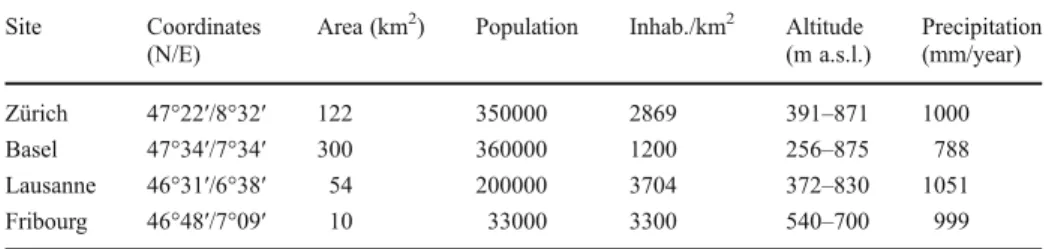
Four urban areas in Switzerland, Zürich, Basel, Lausanne and Fribourg, were chosen for the analyses. The choice of these cities was justified by the existence of detailed local floras describing the past and present occurrence of native aquatic plants and by the existence of ancient and recent maps for the regions under consideration. The main characteristics of the locations are given in Table1.
To analyze the change in water bodies (rivers, streams, lakes and ponds) during the last century, two digital map sets, ancient and recent, were utilized for each study site. The hydrography at the end of the 19th century was analyzed using so-called Siegfried maps (Swisstopo2010), which showed the geographical situation between 1873 and 1902. These ancient maps were scanned and digitized. The hydrography at the beginning of the 21st century was analyzed using the current national maps of Switzerland (scale 1:25000, Swisstopo2006), which are available in electronic form. All of the maps were further arranged, geo-referenced and assembled using Idrisi (Eastman 1987–2006). The delimitation of the studied zones corresponding to the areas covered by flora was performed using CartaLinx (Eastman1998– 1999). Lastly, we digitalized and measured the lengths of the rivers and streams and the surfaces of the lakes and ponds for both time periods and each city.
Among the 3000 vascular plants occurring naturally in Switzerland (Aeschimann and Burdet1994; Lauber and Wagner2007), 104 native species are making part of the ecological group of aquatic macrophytes following the classification of the Swiss flora of Moser et al. (2002) (Appendix S1). The nomenclature of botanical names follows the synonymic index of the Swiss flora (Aeschimann and Heitz2005). Using the available literature, we generated a databank that included all native aquatic plants of Switzerland and recorded the presence or absence of all 104 studied taxa for two time periods: (1) the end of the 19th century to the beginning of the 20th century and (2) the end of the 20th century to the beginning of the 21st century. The information was extracted mainly from recently published local floras and detailed ancient data (Zürich: Landolt2001; Basel: Brodtbeck et al.1997,1999; Lausanne: Hoffer-Massard et al.2006; Fribourg: Purro and Kozlowski2003). Additional information was extracted from Binz (1901), Schneider (1880), Cottet and Castella (1891), Jaquet (1930), Durand and Pittier (1882), Cruchet (1933) and Naegeli and Thellung (1905).
Results
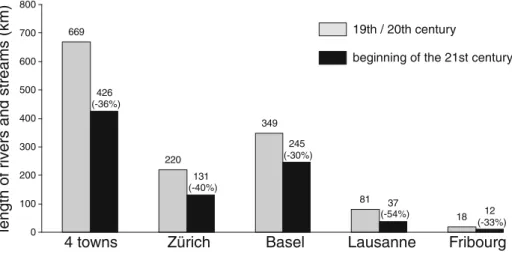
At the end of the 19th century, a total of 669 km of running water (rivers and streams) existed in the four Swiss cities investigated in this study (Fig.1), with the longest hydro-graphic systems found in the largest cities, Basel (349 km) and Zürich (220 km). However, 36 % (243 km) of these running bodies of water were absent at the beginning of the 21st
Table 1 Study sites and their general characteristics Site Coordinates
(N/E)
Area (km2) Population Inhab./km2 Altitude (m a.s.l.) Precipitation (mm/year) Zürich 47°22′/8°32′ 122 350000 2869 391–871 1000 Basel 47°34′/7°34′ 300 360000 1200 256–875 788 Lausanne 46°31′/6°38′ 54 200000 3704 372–830 1051 Fribourg 46°48′/7°09′ 10 33000 3300 540–700 999
century; the highest percentage of habitat depletion occurred in Lausanne (−54 %) and Zürich (−40 %), whereas the loss was approximately 30 % in Basel and Fribourg. The most extensive kilometric losses were detected for Basel (a loss of 104 km of running water) and Zürich (89 km). The majority of the running water bodies that disappeared were small streams, mainly in the intensively developed central regions of each of the studied cities (see the comparative maps in Appendix S2).
The surface areas of the lakes and ponds in the four studied urban areas were already relatively low in the past (11.8 km2, thus 2.4 % of the total studied area) (Table1, Fig.2). Due to large lakes included into their administrative borders, the largest surface area existed in Zürich and Lausanne. However, during the last∼130 years, only 2 % of this standing water area was lost when considering all four of the cities together. Figure2shows that this loss occurred almost exclusively in Zürich where more than 0.6 km2disappeared. In contrast, our survey
669 220 349 81 18 426 131 245 37 12 0 100 200 300 400 500 600 700 800 (-36%) (-40%) length of riv ers and str eams (k m)
4 towns Zürich Basel Lausanne Fribourg
(-30%)
(-54%)
(-33%)
19th / 20th century
beginning of the 21st century
Fig. 1 Cumulative lengths of the rivers and streams in the four investigated Swiss cities and changes between the end of the 19th century and the beginning of the 21st century
11.768 5.56 0.097 6.109 0.002 11.493 4.918 0.149 6.257 0.17 0 2 4 6 8 10 12 14 sur
face of lakes and ponds (k
m2)
4 towns Zürich Basel Lausanne Fribourg
(-2%) (-12%) (+35%) (+2%) (+99%) 19th / 20th century
beginning of the 21st century
Fig. 2 Cumulative surface areas of the lakes and ponds in the four investigated Swiss cities and changes between the end of the 19th century and the beginning of the 21st century
detected an increase in the standing water surface area in all of the other cities. The most accentuated increases were in Basel and, especially, Fribourg (due to dam construction and the creation of artificial lakes). See also the comparative maps in Appendix S2.
Our survey shows that 87 native aquatic plant species were found in all four of the investigated urban areas at the end of the 19th century and at the beginning of the 20th century (Fig.3, Appendix S1). The highest diversities of native macrophytes were recorded in Zürich (76 species) and Lausanne (58 species), in contrast to the urban area of Basel where only 17 species were found. Figure3also demonstrates that the four urban areas faced much higher extinction rates of the aquatic plants (loss of 28 %) in comparison with relatively low extinction rate of Switzerland as a whole (2 %). The differences between the specific cities are, however, very high. During the 20th century, Basel lost almost 60 % of its aquatic plants, and Lausanne and Fribourg each lost approximately 45 %, whereas Zürich only lost 26 % of its macrophytes. Numerically, Lausanne and Zürich lost the highest number of native aquatic plant species (26 and 20 species, respectively).
Discussion
To meet the needs of humans, urban environments and, especially, urban water bodies and their shores were dramatically transformed during the recent centuries (Duncan et al.2011). Although the degradation of aquatic habitats and their fauna and flora was described in many urban areas, the extent of this phenomenon was rarely measured using historical data (Booth and Jackson1997; Purro and Kozlowski 2003; Tait et al.2005). Accordingly, our study provides very valuable account of the depletion of aquatic habitats and native macrophytes during the 20th century in a selection of European cities. The most dramatic changes were detected for small urban streams and rivers: more than 35 % of these water bodies were buried (covered and moved underground) or completely destroyed and dried out during the last 130 years. In the large Swiss cities, the aquatic organisms lost more than 100 km of running waters and their shores. Moreover, in certain Swiss cities (e.g., Lausanne) the covering of streams had already begun at the beginning of the 19th century (Bondallaz 2010); therefore, the original lengths of streams and the total historical loss of running water
number of aquatic plants
104 87 76 17 58 24 2 18 20 10 26 11 0 20 40 60 80 100 120
Switzerland 4 towns Zürich Basel Lausanne Fribourg
(2%)
(28%) (26%)
(59%)
(45%)
(46%) present in the past (19th/20th century) extinct (beginning of the 21st century)
Fig. 3 Level of extinctions among aquatic plants in Switzerland and in the four investigated cities between the end of the 19th century and the beginning of the 21st century
length should be even higher than measured in our study. Additionally, more than 80 % of the running waters still existing in Swiss cities exhibit a very low ecomorphological quality, which is especially true for the large rivers, e.g., the Rhine and Birse in Basel and the Limmat in Zürich (Zeh Weissmann et al.2009).
The dramatic decrease in the length of running water contrasts with the minimal overall loss of the surface areas of urban lakes and ponds in the four investigated cities. In fact, due to the transformations of riverbeds, the construction of dams (e.g., in Fribourg) and creation of small ponds for amphibian conservation (e.g., in Basel), some cities actually gained relatively large amounts of standing water areas (Brodtbeck et al.1997; Bondallaz2010). Fribourg has the most important augmentation of the standing water surface (+99 %) due to the new large lakes created after the construction of two dams by Maigrauge (year of construction: 1874) and Schiffenen (year of construction: 1963). Surprisingly, the highest percentage of aquatic plant extinctions during the 20th century was measured for Basel and Fribourg, that is, in the cities with significant increases in the surface area of standing water. Furthermore, the majority of the extinct plants are typical inhabitants of lakes and ponds. This seemingly paradoxical result suggests the poor ecomorphological quality of these artificial water bodies. Although relatively old, such urban lakes and ponds remained less attractive for native aquatic organisms, perhaps because they are affected by pollution, eutrophication, shore transformation and recreational activities. The high level of aquatic plant extinction in Lausanne and Zürich, both possessing large natural lakes, additionally indicates a strong deterioration of the quality of natural water bodies in the urbanized environments. One of the most important problems is the filling up and transformation of shores. As a consequence, the majority of the large lakes in urbanized areas no longer possess natural shore fragments (Bondallaz2010). Delarze et al. (2006) demonstrated that less that 3 % of the total 200 km of Geneva Lake shorelines can be described as natural: 40 % are completely artificial, in the form of concrete or rocky wall constructions, and an additional 34 % have been transformed into roads, railways, bridges and harbors. Furthermore, even in Switzerland, which has a very well-functioning network of sewage systems, the majority of lakes are affected by pollution and eutrophication (Armin2006). Additionally, the temperature of the Swiss lakes increased during last 50 years by 2 °C (Perritaz and Mayerat Demarne2007), which might negatively influence their suitability for aquatic macrophytes. More research is clearly needed to ascertain which factors are playing the most important role in the degradation of the suitability of urban lakes and ponds for aquatic plants and other organisms that are inseparable from a water source.
All of the four studied cities have lost an important proportion of their aquatic plants during the 20th century. Our results clearly demonstrate that urbanization had a negative effect on the persistence of pre-urban aquatic organisms. However, the differences between the cities are very important and further indicate that many other factors not specifically analyzed in this study are playing important roles in the deterioration of urban nature (e.g., the history of a given city and the speed and character of urbanization). For example, in Basel, which possesses the largest area, only 17 aquatic plants have been observed in the past (in spite of intensive historical floristic studies in this area), and almost 60 % of them were lost during the 20th century. On the one hand, this particularity of Basel can be explained by the absence of large lakes and the karstic geology of this area. On the other hand, Basel has a very small density of streams and rivers, with 1.16 km of running water per km2, much less than Lausanne (1.5 km/km2) and Fribourg (1.8 km/km2).
Urban areas have been often described as hotspots of neophyte distribution (Klotz and Kühn2010). Interestingly, the loss of native aquatic macrophytes in Swiss cities cannot be explained by introductions of non-native species. Only six alien aquatics have been observed
in the four studied urban areas during the last 130 years: Aldrovanda vesiculosa (Zürich), Acorus calamus (Basel and Zürich), Sagittaria latifolia (Basel and Zürich), Elodea canadensis (all four cities), E. densa (Basel) and E. nuthallii (Lausanne, Basel and Zürich) (Brodtbeck et al. 1997,1999; Landolt2001; Purro and Kozlowski2003; Hoffer-Massard et al.2006). Some of them, such as Aldrovanda vesiculosa in Zürich, disappeared soon after its introduction in 1907 (Landolt2001). For S. latifolia, A. calamus and E. densa the time of their introduction in Zürich and Basel is not known but the species are very rare. Only E. canadensis, widespread in certain cities (e.g. Zürich) already at the end of the 19thcentury, may be perhaps the only aquatic neophyte responsible for local extinction in the studied cities. Interestingly, the species itself is becoming rarer, partially due to spread of the other Elodea species (E. nuthallii), e.g. in Lausanne since 1960 (Hoffer-Massard et al.2006).
Regardless, our results show that the urban areas did and still possess a high potential for aquatic macrophytes. More than 84 % of all of the Swiss aquatic plants were previously found in the four studied Swiss cities, that is, in merely 1.2 % of the total area of Switzerland (Brodtbeck et al.1997,1999; Landolt2001; Purro and Kozlowski2003; Hoffer-Massard et al.2006). Even today, Swiss cities are home to 69 species of native aquatic macrophytes, some of them endangered with extinction at the Swiss level (e.g., Trapa natans in Lausanne, Moser et al.2002). This result demonstrates that urban areas are important for the conser-vation of this plant group and should be, therefore, integrated into both local and national conservation plans and strategies.
Acknowledgements We would like to thank Claude Collet, Alexandre Vaira and David Frey (University of Fribourg, Switzerland) as well as Emanuel Gerber and André Fasel from the Natural History Museum Fribourg (Switzerland) for their technical support and advice during preparation of the manuscript.
References
Aeschimann D, Burdet HM (1994) Flore de la Suisse. Le nouveau Binz. Editions du Griffon, Neuchâtel Aeschimann D, Heitz C (2005) Index synonymique de la Flore de Suisse et territoires limitrophes (ISFS).
CRSF/ZDSF, Genève
Alberti M, Marzluff JM (2004) Ecological resilience in urban ecosystems: linking urban patterns to human and ecological functions. Urban Ecosyst 7:241–265
Armin P (2006) Revitalisations: dans quel but et dans quel cadre? Eawag News 61:4–8
Arnold CL, Gibbons CJ (1996) Imprevious surface coverage: emergence of a key environmental indicator. J Am Plann Assoc 62:243–258
Binz A (1901) Flora von Basel und Umgebung. Lendorff, Basel
Bondallaz L (2010) L’urbain et la biodiversité aquatique: une cohabitation difficile? Master Thesis. Départe-ment des Géosciences, Université de Fribourg, Switzerland
Booth DB, Jackson CR (1997) Urbanization of aquatic systems: degradation thresholds, stormwater detection, and the limits of mitigation. J Am Water Res Assoc 33:1077–1090
Brodtbeck T, Zemp M, Frei M, Kienzle U, Knecht D (1997) Flora von Basel und Umgebung. Teil 1. Mitteil Naturforsch Ges Basel, Liestal
Brodtbeck T, Zemp M, Frei M, Kienzle U, Knecht D (1999) Flora von Basel und Umgebung. Teil 2. Mitteil Naturforsch Ges Basel, Liestal
Collins JP, Kinzig A, Grimm NB, Fagan WF, Hope D, Wu J, Borer ET (2000) A new urban ecology. Am Sci 88:416–425
Cottet M, Castella F (1891) Guide du botaniste dans le canton de Fribourg. Imprimerie Fragnière Frères, Fribourg Cronk JK, Fennessy MS (2001) Wetland plants. Biology and Ecology. CRC Press LLC, Boca Raton Cruchet E (1933) La flore rudérale et adventice de Lausanne et de ses environs. Mém Soc vaud Sci Nat 4:273–328 Delarze R, Strehler Perrin C, Gander A, Clerc C, Antonniaza M, Ghiraldi A, Rubin J, Frossard P (2006) Synthèse de l’étude des rives du Léman et de leur potentiel de renaturation. Commission internationale pour la protection des eaux du Léman (CIPEL), Lausanne
Douglas I (1992) The case for urban ecology. Urban Nat Mag 1:15–17
Duncan RP, Clements SE, Corlett RT, Hahs AK, McCarthy MA, McDonnell MJ, Schartz MW, Thompson K, Vesk P, Williams NSG (2011) Plant traits and extinction in urban areas: a meta-analysis of 11 cities. Global Ecol Biogeogr 20:509–519
Durand T, Pittier H (1882) Catalogue de la flore vaudoise. 1 and 2 partie. Librairie Rouge, Lausanne Eastman JR (1987–2006) Idrisi. Version 15.00. Clark Labs, Worcester
Eastman JR (1998–1999) CartaLinx. The spatial data builder. Version 1.2. Clark Labs, Worcester
Egertson CJ, Kopaska JA, Downing JA (2004) A century of change in macrophyte abundance and compo-sition in response to agricultural eutrophication. Hydrobiologia 524:145–156
Francis RA (2012) Positioning urban rivers within urban ecology. Urban Ecosyst 15:285–291
Francis RA, Lorimer J (2011) Urban reconciliation ecology: the potential of living roofs and walls. J Environ Manage 92:1429–1437
Gaston K (ed) (2010) Urban ecology. Ecological reviews. Cambridge University Press, Cambridge Gilbert OL (1989) The ecology of urban habitats. Chapman and Hall, London
Hoffer-Massard F, Bornand C, Vuste M (2006) Flore de Lausanne et de sa région. Tome 1 and 2. Rossolis, Bussigny Jaquet F (1930) Catalogue raisonné des plantes vasculaires du canton de Fribourg et des contrées limitrophes.
Imprimerie Fragnière Frères, Fribourg
Klotz S, Kühn I (2010) Urbanisation and alien invasion. In: Gaston KJ (ed) Urban ecology. Cambridge University Press, Cambridge, pp 120–133
Kowarik I (2011) Novel urban ecosystems, biodiversity, and conservation. Environ Pollut 159:1974–1983 Kozlowski G, Vallelian S (2009) Eutrophication and endangered aquatic plants: an experimental study on
Baldellia ranunculoides (L.) Parl. (Alismataceae). Hydrobiologia 635:181–187
Kozlowski G, Rion S, Python A, Riedo S (2009) Global conservation status assessment of the threatened aquatic plant genus Baldellia (Alismataceae): challenges and limitations. Biovers Conserv 18:2307–2325 Landolt E (2001) Flora der Stadt Zürich (1984–1998). Birkhäuser, Berlin
Lauber K, Wagner G (2007) Flora Helvetica. Haupt, Berne
Marzluff JM (2001) Worldwide urbanization and its effects on birds. In: Marzluff JM, Bowman R, Donnelly R (eds) Avian ecology and conservation in an urbanizing world. Kluwer Academic Publishers, Norwell, pp 19–47 McDonnell MJ (1997) A paradigm shift. Urban Ecosyst 1:85–86
McDonnell MJ, Pickett STA (1993) Introduction: scope and need for an ecology of subtle human effects and populated areas. In: McDonnell MJ, Pickett STA (eds) Humans as components of ecosystems: the ecology of subtle human effects and populated areas. Springer, Berlin, pp 1–5
Moser D, Gygax A, Bäumler B, Wyler N, Palese R (2002) Liste rouge des espèces menacées de Suisse. Fougères et plantes à fleurs. Office fédéral de l’environnement, des forêts et du paysage (OFEFP), Centre du réseau suisse de floristique (CRSF), Conservatoire et Jardin botanique de la Ville de Genève (CJBG), Berne et Chambésy
Naegeli O, Thellung A (1905) Die Flora des Kantons Zürich. 1. Teil Die Ruderal- und Adventivflora des Kantons Zürich. Vierteljahrschr Naturf Ges Zürich 50:225–305
Niemelä J (1999) Ecology & urban planning. Biodivers Conserv 8:119–131
Paul MJ, Meyer JL (2001) Streams in the urban landscape. Annu Rev Ecol Syst 32:333–365
Perritaz N, Mayerat Demarne A (2007) Environnement Suisse 2007. Office fédéral de l’environnement (OFEV), Office fédéral de la Statistique (OFS), Berne
Pickett STA, Cadenasso ML, Grove JM, Nilon CH, Pouyat RV, Zipperer WC, Costanza R (2001) Urban ecological systems: linking terrestrial ecological, physical, and socioeconomical components of metro-politan areas. Annu Rev Ecol Syst 32:127–157
Preston CD, Croft JM (2001) Aquatic plants in Britain and Ireland. Harley Books, Colchester Purro C, Kozlowski G (2003) Flore de la Ville de Fribourg. Editions Universitaires, Fribourg
Ramalho CE, Hobbs RJ (2012) Time for a change: dynamic urban ecology. Trends Ecol Evol 27:179–188 Riley JO, Page SE (eds) (2000) Habitat creation and wildlife conservation in urban and post-industrial
environments. Packard Publishing, Chichester
Roelofs JGM (1983) Impact of acidification and eutrophication on macrophyte communities in soft waters in the Netherlands. I. Field observations. Aquat Bot 17:139–155
Savard J-PL, Clergeau P, Mennechez G (2000) Biodiversity concepts and urban ecosystems. Landscape Urban Plan 48:131–142
Schneider F (1880) Taschenbuch der Flora von Basel und der angrezenden Gebiete. H. Georg’s, Basel Shepherd PA (1994) A review of plant communities of derelict land in the city of Nottingham, England and
their value for nature conservation. Memorabilia Zool 49:129–137
Sukopp H, Numata M, Huber A (eds) (1995) Urban ecology as the basis for urban planning. SPB Academic Publishing, The Hague
Swisstopo (2006) Office fédéral de topographie. Edition carte numérique de la Suisse. http:// www.swisstopo.admin.ch. Accessed Feb 2011
Swisstopo (2010) Office fédéral de topographie. Edition carte Siegfried numérique.http://www.swisstopo.admin.ch. Accessed Feb 2011
Tait CJ, Daniels CB, Hill RS (2005) Changes in species assemblages within the Adelaide metropolitan area, Australia, 1836–2002. Ecol Appl 15:346–359
UN-HABITAT (2011) United Nations State of the World’s Cities.http://www.unhabitat.orgAccessed October 2012 Vandruff LW, Leedy DL, Stearns FW (1995) Urban wildlife and human well-being. In: Sukopp H, Numata M, Huber A (eds) Urban ecology as the basis for urban planning. SPB Academic Publishing, The Hague, pp 203–211
Walsh CJ, Roy AH, Feminella JW, Cottingham PD, Groffman PM, Morgan RP II (2005) The urban stream syndrome: current knowledge and the search for cure. J N Am Bentholl Soc 24:706–723
Wenger SJ, Roy AH, Jackson CR, Bernhardt ES, Carter TL, Filoso S, Gibson CA, Hession WC, Kaushal SS, Marti E, Meyer JL, Palmer MA, Paul MJ, Purcell AH, Ramirez A, Rosemond AD, Schofield KA, Sudduth EB, Walsh CJ (2009) Twenty-six key research questions in urban stream ecology: an assessment of the state of the science. J N Am Bentholl Soc 28:1080–1098
Zeh Weissmann H, Könitzer C, Bertiller A (2009) Ecomorphologie des cours d’eau suisses. Etat du lit, des berges et des rives. Résultats des relevés écomorphologiques. Office fédéral de l’environnement (OFEV), Berne