RESEARCH OUTPUTS / RÉSULTATS DE RECHERCHE
Author(s) - Auteur(s) :
Publication date - Date de publication :
Permanent link - Permalien :
Rights / License - Licence de droit d’auteur :
Dépôt Institutionnel - Portail de la Recherche
researchportal.unamur.be
University of Namur
Digital Media Literacy in Teamwork and Distance Work
Jacques, Jerry; Collard, Anne-Sophie
Publication date:
2019
Document Version
Publisher's PDF, also known as Version of record
Link to publication
Citation for pulished version (HARVARD):
Jacques, J & Collard, A-S (eds) 2019, Digital Media Literacy in Teamwork and Distance Work: Competences,
Discourse and Organizational Design. 1ère édition edn, Presses universitaires de Namur, Namur.
General rights
Copyright and moral rights for the publications made accessible in the public portal are retained by the authors and/or other copyright owners and it is a condition of accessing publications that users recognise and abide by the legal requirements associated with these rights. • Users may download and print one copy of any publication from the public portal for the purpose of private study or research. • You may not further distribute the material or use it for any profit-making activity or commercial gain
• You may freely distribute the URL identifying the publication in the public portal ?
Take down policy
If you believe that this document breaches copyright please contact us providing details, and we will remove access to the work immediately and investigate your claim.
in Teamwork and Distance Work:
Competences, Discourse
and Organizational Design
Edited by Jerry Jacques
and Anne-Sophie Collard
www.litmeatwork.be
© Presses universitaires de Namur, 2019 Rempart de la Vierge, 13
B 5000 Namur (Belgique) E-mail : [email protected] Site web : http://www.pun.be
Reproduction of this book or any parts thereof, is strictly forbidden for all countries, outside the restrictive limits of the law, whatever the process, and notably photocopies or scanning. Printed in Belgium.
ISBN- paper : 978-2-39029-048-3
ISBN - electronic version : 978-2-39029-049-0 Registration of copyright: D/2019/1881/15
LITME@WORK Research Project
Anne-Sophie Collard
1, Jerry Jacques
1and Jan Zienkowski
21 CRIDS/NaDI – Université de Namur
2 PReCoM – Université Saint-Louis – Bruxelles
Digital technology has become ubiquitous in the workplace, especially for office workers. Processes and services are more and more digitalized, allowing paperless work and changing ways of working. The digitalization of organizations implies a wide diffusion of Information and Communication Technologies (ICT) like mobile devices, multimedia content, groupware, cloud computing and big data technologies (Holtgrewe, 2014). It also enables the implementation of distance work. Furthermore, work spaces change as organizations try to find ways to reduce building costs, deal with energy issues or implement organizational change projects. In NWOW projects (New Ways of Working, or “New World of Work” as Microsoft has called it), spaces are reduced, diminishing the number of workstations and suppressing desks allocated to individuals in open spaces or flexible workspace configurations. These changes imply the development of mobile work inside workspaces but also outside, in coworking spaces, for example, or at home. Such transformations are grounded in new ways of thinking about organizations but also in contemporary concerns with mobility. Working at a distance, supported by digital tools, is seen as a possible answer to the difficult question on how to resolve mobility problems (Marzloff, 2013).
So-called “new ways of working”, practiced both individually and collectively, gradually emerge, enabled by technological, organizational and social evolutions. For example, workers have to deal with increasing quantities of information and need to develop strategies to avoid information overload. They have to coordinate with multiple people through synchronous and asynchronous computer-mediated communication. This has become commonplace and workers are now often equipped with mobile technologies that may be necessary to perform at least a part of their professional activities in these increasingly mobile contexts. Collaboration at a distance has become more and more common over the years but it also raises questions regarding the evolution of the infrastructures provided by organizations, the changing ways through which work is achieved by individuals and teams, the complex relationship between one’s professional activity and private life, and the new set of competences that workers need to have. These transformations cross all sectors and are visible in both public and private organizations.
This book addresses these changes through the lens of digital media literacy1 (DML) for
office work (from clerical work to managerial tasks), focusing specifically on teamwork and distance work. Changing ways of working require a new range of technical, social and communicative competences. For instance, office workers are expected to engage in collaborative writing, to manage personal and shared information, to re-create and maintain one’s personal work environment in multiple contexts of work, and/or to manage teams at a distance. These competences have been the focus of the LITME@ WORK project, entitled “Digital and media literacy in teamwork and distance work
environments”, funded by BELSPO2 during four years (2015-2019). This lens has allowed
us to gain insights into the ways office workers use ICTs. We were also able to shed light on the job demands as well as on the needs and the fears regarding DML. It has also provided information about workers’ expectations, for instance in terms of opportunities for using and learning DML competences.
Competences are often approached on the basis of a concern with efficacy and performance. The LITME@WORK project also explored other dimensions of competence in organizations undergoing a digital turn. First, being competent is a factor of inclusion not only within the organization but also in the broader work environment, as today’s collaborations within and across organizations are sustained through diverse ICTs. A related point is that DML has implications for well-being at the workplace: a lack of competence can create stress and frustration, and ultimately lead to demotivation and isolation. A third issue is the redefinition of time and space. ICT-supported work practices such as distance collaborative writing tend to blur the boundaries between work time and leisure time, professional life and private life, workplace and home. These new conditions also require a range of competences in order to be handled in an effective and meaningful way.
LITME@WORK asked the following research questions: (1) how is DML addressed and practiced in today’s office work and (2) how can DML be further integrated in emerging distance teamwork structures and practices in order to support effective, stimulating and meaningful ways of working. Starting from these questions, LITME@WORK has pursued four objectives: (i) to understand changing work environments and their DML requirements, (ii) to develop a systemic approach to DML in office distance teamwork, (iii) to provide resources for societal and policy stakeholders, and (iv) to contribute to research efforts in relevant fields of research.
Relying mainly on qualitative analyses, LITME@WORK has investigated DML from three different but complementary perspectives, each corresponding to one work package (WP) in the research project structure: (1) a critical discourse analysis focusing on the sense-making processes office workers rely on when they conceptualize (DML) competences in organizations transitioning to new ways of working; (2) an organization
1 Digital media literacy is defined as a set of interrelated informational, technical and social
compe-tences (Fastrez, 2010; Fastrez & De Smedt, 2012) involved in digital media practices (see chapter 2).
design analysis focusing on the relationship between work organization, workplace design and structural conditions for (DML) competence utilization and learning; and (3) a practice-oriented perspective focusing on the relationship between digital media uses and competences in employees’ new work practices. As is shown in Figure 1.1, these three perspectives treat different levels of analysis.
Figure 1.1: The work packages of the LITME@WORK project and their approaches.
Firstly, WP4 focused on workers’ practices as performances revealing competences. Competences are therefore considered as a priori theoretical categories. Observation and analysis of work practices lead to the identification of DML competences required by distance collaboration. The WP4 team was composed of researchers and academics in
information and communication sciences from UCLouvain3 and Université de Namur4.
Secondly, WP3 studied the characteristics of virtual teams and the organizational constraints and opportunities. Specifically, it has analyzed team and job characteristics as opportunities to learn and utilize competences. Competences are considered as the ultimate outcome of a dependent variable, defining successful learning opportunities. The results aim to reveal learning opportunities from which work-related competences
can be developed. The WP3 team was composed of sociologists from HIVA, KU Leuven5.
3 Valèria Ligurgo, Thibault Philippette, Thierry De Smedt and Pierre Fastrez (coord. WP4).
4 Jerry Jacques and Anne-Sophie Collard (coord. WP1).
Thirdly, WP2 focused on discourse as a sense-making process structuring the interpretative experience of work. Competences were analyzed as discursive constructs whose meanings emerge in close articulation with work-related identities, practices, attitudes, values and other relevant discursive elements. The team in media and communication
studies at Université Saint-Louis – Bruxelles6 was in charge of WP2. Finally, the team from
the Université de Namur was in charge of the overall coordination of the LITME@WORK project (WP1).
Each approach has used specific methods, adapted to its particular focus and theoretical framework, but the WPs did work with a shared data set of case studies. The LITME@WORK project studied ten Belgian organizations that took measures to enhance ICT supported teamwork and distance work. The selected cases represent a variety of work contexts that can be distinguished on the basis of parameters such as the public/private distinction, the sector of activity and/or the size of the organization. This diversity is represented in the nicknames attributed to these organizations that will be used throughout this book to ensure the anonymity of these companies and their workers. Each nickname combines a clue about the size of the organization with a clue about its activity sector:
• SmallBusiness – private sector • SmalIT – private sector
• BigEmp (for big Employment) – private sector • BigTransport – public sector
• BigHealth – public sector • MediumTerritory – public sector • MediumHealth – private sector • MediumIT – private sector • BigInsuranceOne – private sector • BigInsuranceTwo – private sector.
As presented in Figure 1.2, the data collected in each organization included interviews with managers, union representatives and HR managers. We collected organizational documents relevant to the organizational transition. We also conducted interviews with team members and team leaders, supplemented by observations made in their respective work environments. Each worker in each organization also participated in a two-waves quantitative survey, the first wave at the beginning of the data collection process and the second six months later. Finally, the WP2 perspective required interviews with additional stakeholders such as politicians and unionists without direct affiliations with any of the ten cases chosen for the research.
and Monique Ramioul (coord. WP3).
Figure 1.2: Summary of the data collected by the work packages of the LITME@WORK project.
The research provides an up-to-date, encompassing knowledge of DML in teamwork and distance work, which will enhance stakeholders’ understanding of DML and their capacity to take action. Specifically, LITME@WORK delivers as main research results: a research framework for analyzing the many aspects of DML in distance teamwork practices and environments, ranging from the broader context of organizational structures to the point of view of individual workers themselves; an in-depth analysis of the ways in which organizations understand and negotiate the “(digitally) competent worker”; an up-to-date description of the changing office work competences, practices and structures, with a focus on teamwork and distance work trends; and a conceptual map of DML competences aimed at serving as a resource for societal and policy stakeholders in terms of defining, evaluating, monitoring, recognizing and supporting DML in office work.
Book Structure
This book is divided into seven chapters. Each chapter can be read independently. Nevertheless, readers are encouraged to read the whole volume to come to terms with the complexity of the problematic nature of DML competences in team and distance work. Following this first introductory chapter, the three teams of LITME@WORK present their perspectives, methods and results in four chapters.
Chapter 2 answers the following question: what are the digital competences needed
by workers to collaborate in distance work environments? This question is addressed from the perspective of digital media literacy (DML), defined as a set of interrelated informational, technical and social competences (Fastrez, 2010; Fastrez & De Smedt, 2012) involved in digital media practices. The authors develop a perspective that goes
beyond a technology-centered approach to DML competences. They consider how workers integrate the use of ICT into meaningful activities that articulate tools, contents and relationships.
For this reason, the authors adopted an interpretive approach that allowed them to define these competences from the point of view of workers, by documenting how they conceive their work situations of distant collaboration, and to what extent they are able to deal with them in meaningful and appropriate ways. Sixty-one interviews were conducted with managers and workers which took the form of guided tours of the informants’ workspaces.
The main findings consist of a definition of the competences which takes the form of a matrix crossing activities involved in distance collaborative work with dimensions workers take into account when they think about and engage in these activities. This chapter ends with a detailed description of these activities and dimensions followed by a complementary look at the qualitative data presented in the form of aggregated quantitative indicators.
Chapter 3 revolves around the organizational structure of virtual teams. Although
increasingly popular, virtual teamwork is often associated with communication and collaboration challenges. Studies identify a multitude of coordination challenges that negatively impact on team members’ autonomy. Such factors include knowledge barriers or losses in communicative richness. Research often focuses on managerial (e.g. trust and leadership) and technical factors to solve coordination problems within virtual teams, and overlooks the fact that virtual teams are embedded within a larger organizational structure. In this chapter, we examine whether the organizational structure utilized in virtual teamworking matters for the coordination challenges outlined above. Interviews were conducted with human resources managers as well as with team leaders and team members. The findings outline a strong relationship between the organizational structure of virtual teams and coordination issues present in these teams. We found two types of teams. A first type includes teams working in silos with high levels of division of labor work. This division creates a lot of interdependencies between team members and results in higher levels of coordination requirements. The virtual environment makes everything even more complex to organize. In such teams, centralized information and communication technologies are often used to constrain team members’ control capacity by imposing standardized procedures. A second type includes teams working in autonomous cells with low task interdependencies and coordination requirements. Such teams can therefore absorb the complexity related to working in a virtual environment. This chapter contributes to the literature by showing that the organizational context in which virtual teams are embedded matters. The manner in which tasks are divided across team members in virtual teams explains whether organizations have few or many coordination problems.
In Chapter 4, the authors ask under which circumstances teleworking and virtual teamwork lead to learning outcomes for team members (i.e. developing skills, acquiring
technical and communication literacy to deal with virtual teamwork). Indeed, despite advances in information and communication technologies, there are still challenges attached to teleworking and virtual teamwork, most of which pertain to lower communication frequency and worsened professional relationships. Because of these challenges, learning outcomes for team members are not obvious and only occur when these challenges have been overcome. The authors therefore investigate which circumstances can help in safeguarding these learning outcomes. Specifically, they focus on knowledge sharing within a team, on team trust, and on consistencies among team members (i.e. in terms of use of communication channels, hours of teleworking per week, and learning climate perceptions), three circumstances that many experts consider to be important for successful team and distance work but currently lack empirical evidence. Hypotheses were tested with a two-wave survey study involving a sample of employees (N1 = 1297, N2 = 564) nested in nine Belgian organizations among the ten chosen for the research. The results of this study showed that trust and consistency in hours of teleworking are indeed needed to ensure learning outcomes such as skill development, technical literacy and communication literacy. Knowledge sharing, consistency in use of communication channels and consistency in learning climate, on the other hand, did not show the expected results.
In Chapter 5, the issue of (DML) competences is addressed as part of a wider analysis that focuses on the interpretive frameworks office workers rely on in order to make sense of so-called New Ways of Working (NWOW). The authors name and identify the logics constitutive of celebratory accounts of NWOW, while also exploring the logics office workers who criticize and even resist aspects of the associated techno-managerial apparatus.
The authors base their analysis on principles derived from Critical Discourse Analysis (CDA) and Poststructuralist Discourse Theory (PDT) (Fairclough, 1992; Glynos & Howarth, 2007; Zienkowski, 2017). They analyze interviews conducted with employees (managers, team leaders and team members) working in a selection of public and private enterprises where NWOW are being or have been implemented. The authors show that celebrations and critiques of NWOW are both marked by complex articulations of norms, values, practices, and identities that follow specific interpretive logics. The analysis shows that even though office workers generally use several logics to embrace celebratory NWOW discourse, many of them are able to engage in a limited form of critique regarding real or potential perverse effects of NWOW. At times they even rely on certain logics in order to develop micro-resistances to specific aspects of the NWOW apparatus without calling its raison d’être or constitutive logics into question. Nevertheless, truly oppositional critiques remain rare and do not necessarily lead to actual practices of resistance. Overall the analysis demonstrates the extent to which celebratory accounts of NWOW enjoy a relatively high degree of hegemony on the work floor.
The two final chapters address key dimensions and challenges for DML in collaborative and distance work. In these chapters, the authors of this book create bridges between
their respective approaches. As such, the final two chapters constitute an integration effort whereby the different contributors to this volume provide a number of reflections on key issues in contemporary debates about office work, collaboration, technology and competences, based on their respective observations.
In Chapter 6, authors of this book therefore address the following themes: (1) DML in collaborative and distance work; (2) the concept of “newness” in discussions about DML and NWOW; (3) DML as a social construct; (4) implications of collaborative and distance work for well-being; (5) the issue of digital (social) inclusion; (6) the role of technology; and (7) management in team and distance work.
Finally, Chapter 7 asks the question how digital and media literacy can be further integrated in emerging team and distance work structures and practices, in order to support effective, stimulating and meaningful ways of working. In this chapter, the researchers of the LITME@WORK project then formulate seven recommendations for policy makers and practitioners: (1) treat competences as abilities to perform particular practices rather than abstract values; (2) use the DML matrix presented in Chapter 2 in a reflexive way; (3) (re)consider the organizational design of teams as a strategic factor for organizations; (4) acknowledge the value of articulation work in hiring and career development; (5) focus the team leader’s role on facilitating a shared understanding of teamwork and supporting distributed articulation work; (6) re-design training and evaluation initiatives beyond individual practices, operational skills and digital tools; (7) integrate the development of DML in a more balanced discourse about organizational change.
Acknowledgements
This book is the result of a four-year research project (2015-2019) funded by the Belgian Science Policy Office (BELSPO – <http://www.belspo.be/>) and its Brain-be program (contract n° BR/143/A5/LITME@WORK). The authors would like to thank Marieke Zwartjes and Emmanuèle Bourgeois for their help in the management of the LITME@WORK project.
The authors also appreciated the support of all the members of the follow-up committee, whose advice was both inspiring and enlightening.
Lastly, the authors wish to express special thanks to all the workers and managers who agreed to participate in this study as informants and who helped them to understand the complexity of the contemporary world of work better.
Contributors to this Book
Anne-Sophie Collard: Professor, Université de Namur, Research Center in Information,
Law and Society (CRIDS) member of the Namur Digital Institute (NaDI), <anne-sophie. [email protected]>
Sabri Derinöz: Researcher, Université Saint-Louis – Bruxelles, Pôle de Recherches sur
la Communication et les Médias (PReCoM), <[email protected]>
Marie Dufrasne: Associate Professor, Université Saint-Louis – Bruxelles, Pôle de
Recherches sur la Communication et les Médias (PReCoM), <marie.dufrasne@usaintlouis. be>
Pierre Fastrez: Senior Research Associate, Fund for Scientific Research – FNRS, and
Professor, Université catholique de Louvain, Groupe de Recherche en Médiation des Savoirs (GReMS), <[email protected]>
Irina Nikolova: Assistant Professor, Open University of the Netherlands, Faculty of
Management, Science & Technology, <[email protected]>
Jerry Jacques: Postdoctoral Researcher, Université de Namur, Research Center in
Information, Law and Society (CRIDS) member of the Namur Digital Institute (NaDI), <[email protected]>
Valèria Ligurgo: Doctoral Fellow, Université catholique de Louvain, Groupe de
Recherche en Médiation des Savoirs (GReMS), <[email protected]>
Geoffroy Patriarche: Professor, Université Saint-Louis – Bruxelles, Pôle de Recherches
sur la Communication et les Médias (PReCoM), <[email protected]>
Thibault Philippette: Assistant Professor, Université catholique de Louvain, Groupe de
Recherche en Médiation des Savoirs (GReMS), <[email protected]>
Monique Ramioul: Associate Professor, KU Leuven, HIVA Research Institute for Work
Arne Vanderstukken: Senior Researcher, KU Leuven, HIVA Research Institute for Work
and Society, <[email protected]>
Yennef Vereycken: PhD Student, KU Leuven, HIVA Research Institute for Work and
Society, <[email protected]>
Jan Zienkowski: Senior Researcher, Université Saint-Louis – Bruxelles, Pôle de
Recherches sur la Communication et les Médias (PReCoM), <jan.zienkowski@usaintlouis. be>
Bibliography
Fairclough, N. (1992). Discourse and social change. Cambridge: Blackwell Publishers. Fastrez, P. (2010). Quelles compétences le concept de littératie médiatique englobe-t-il?
Une proposition de définition matricielle. Recherches En Communication, 33, 35–52. Fastrez, P., & De Smedt, T. (2012). Une description matricielle des compétences en
littératie médiatique. In M. Lebrun-Brossard, N. Lacelle & J.-F. Boutin (eds), La littératie médiatique multimodale. De nouvelles approches en lecture-écriture à l’école et hors de l’école (pp. 45–60). Québec: Presses de l’Université du Québec.
Glynos, J., & Howarth, D. (2007). Logics of critical explanation in social and political
theory. London: Routledge.
Holtgrewe, U. (2014). New new technologies: The future and present work in information and communication technology. New technology, Work and Employment, 20(1), 9-24.
Marzloff, B. (2013). Sans bureau fixe. Transitions du travail, transitions des mobilités, Limoges: Fyp éditions.
Zienkowski, J. (2017). Articulations of self and politics in activist discourse: a discourse
Media Literacy Competences
Required by Workers
to Collaborate in Distance
Work Environments
Valèria Ligurgo
1, Pierre Fastrez
1, Jerry Jacques
2,
Anne-Sophie Collard
2and Thibault Philippette
11 GReMS – Université catholique de Louvain
2 CRIDS/NaDI – Université de Namur
Introduction
Over the years, information and communication technology (ICT) has become a cornerstone of the world of work, as it has for all other aspects of our lives. Digital technology is now ubiquitous in the workplace, especially for office workers. Technological and social evolutions have given way to new ways of working individually and collectively. Digital tools contribute to redefining the content of work, as much of the information workers deal with is now digitized, and comes in increasing volumes, creating risks of information overload. The context of work has also undergone major changes, with more and more people teleworking from their homes, sharing coworking spaces, or working on the go with mobile technology. Additionally, how people work together, and coordinate to do so, heavily relies on (synchronous and asynchronous) computer-mediated communication, shared information spaces, social networks and authoring tools and platforms.
In all of these domains, digital technologies create challenges for workers as much as they offer opportunities and support. As they are both the objects and the agents of these massive evolutions, workers need to develop new strategies, build new knowledge, acquire new skills. In a word: they must develop their competences. This chapter focuses on the issue of the competences related to the digitization of work, in the specific area of distance collaboration. The main question it attempts to answer is: what are the digital competences needed by workers to collaborate in distance work environments?
Rather than considering this question from the perspective of technical skills, we address it from the perspective of digital media literacy (DML). Defined as a set of interrelated informational, technical and social competences (Fastrez, 2010; Fastrez & De Smedt, 2012) involved in digital media practices, digital media literacy extends the view of the competences required to collaborate in the distance beyond technology-centered approaches, to consider how workers integrate the use of ICT into meaningful activities that articulate tools, contents and relationships.
Discourses in organizations emphasize the need for people to collaborate in teams and to work at a distance, to be able to share information in various formats and to cooperate in flexible ways through the mediation of technology, especially in “New Way of Working (NWOW)” contexts. In this view, workers seem required to simply follow technological transformations and adapt to the ever-changing work landscape. In comparison, we consider that digital media literacy cannot be limited to a set of skills that enable workers to comply with the evolution of organizational socio-technical systems. These evolutions of work environments also call for the ability to be critical towards them, as well as to be creative and to combine, invent and modify innovative technologically-mediated practices.
The focus of this chapter is set on the very definition of this array of competences. Contrary to most existing approaches, we chose to adopt an agnostic stance towards our object of study, by acknowledging that we did not know what competences composed the digital media literacy of distance collaboration. Consequently, rather than proposing a definition of DML competences for distance teamwork based on the opinion of experts, a literature review, or a theoretical construction, we set ourselves to define these competences from the perspective of the actors who exert them: the workers. Hence, our overall approach is an interpretive one. Our goal is to propose a map of the DML of distance collaboration based on the discourse of workers: how they conceive the work situations of distance collaboration, and to what extent they are able to deal with them in meaningful and appropriate ways from their perspective.
This chapter is structured as follows. First, we lay out the theoretical framework for our work. We introduce the concept of digital media literacy and discuss how it positions our object of study beyond a technologically-centered approach, encompasses both basic operational skills and full-fledged competences, and allows us to articulate both functional and critical aspects of these competences. We then specify the relationship between DML and the social practices that actualize them. Finally, we define categories of collaborative work that are essential to our observation of distance collaboration practices. Second, we detail the methods of data collection and analysis we used to infer a map of DML competence from the interview and observational data of sixty workers engaged in distance collaboration in ten public and private Belgian organizations. Third, we present an overview of the results of our analyses, followed by a detailed description of the domains of competence we identified, in terms of activities collaborators perform, and dimensions these activities include. Fourth, we offer an alternative, complementary
look at our data in the form of aggregated quantitative indicators. Finally, our conclusions are presented based on the discussion of the results.
Theoretical Framework
Digital Media Literacy Competences
Abilities related to the use of digital technology have been called a number of names: online skills (Hargittai, 2002), internet skills (Hargittai, 2010; Litt, 2013; Scheerder, van Deursen & van Dijk, 2017), digital skills (Curtarelli, Gualtieri, Jannati & Donlevy, 2017; Eynon & Geniets, 2016; J. A. G. M. van Dijk & van Deursen, 2014), e-literacy (Brandtweiner, Donat & Kerschbaum, 2010), digital literacy (Buckingham, 2006; Eshet-Alkalai, 2004), digital competence (Carretero Gomez, Vuorikari & Punie, 2017), to name only a few. Considering the multiple approaches to these abilities that this diversity of
names reflects, digital media literacy7 does not necessarily appear as the obvious first
choice when it comes to choosing a concept to frame the description of how people are able to work together with and through technology. Why, then, treat the issue of distance teamwork from this perspective?
Our argument is that studying technologically-mediated collaborative work practices in terms of digital media literacy anchors our analyses in a conceptual framework that broadens the way they are viewed. In brief, it allows us to use the conceptual apparatus built to conceptualize media literacy (mostly originating in the field of media education) and specify it in the realm of digital technology (hence the expression “digital media literacy”). This position justifies itself by the limitations we see in the common approach to digital literacy.
Describing how the presence of media literacy in the public agenda has evolved over time, Buckingham (2009) warned that the proximity between media literacy and digital literacy, another concept that gained substantial importance in the official discourses, may have dire consequences on what is included in the concept of media literacy. His argument, to which we subscribe, stemmed from the claim that media literacy and digital literacy fostered participation:
Participation is clearly seen here as a good thing in itself – although it is often rather loosely defined. In practice, participation seems to be largely confined to basic functions such as accessing e-government, job seeking, finding health information, online training, paying your taxes, and of course shopping. It stops quite a long way
7 In this chapter, we will use the phrase “digital media literacy” to name the general category of
abilities in which we place the competences of distant collaboration studied in our research. These competences could arguably also be seen as related to information literacy – a perspective we have adopted in other publications (Collard, De Smedt, Fastrez, Ligurgo & Philippette, 2016; Ligurgo, Philippette, Fastrez, Collard & Jacques, 2018). Rather than viewing digital literacy, media literacy and information literacy as exclusive categories, we consider them as concepts designating largely overlapping phenomena.
short of the kinds of democratic participation that some of the more enthusiastic proponents of digital activism find so exciting. The skills that are involved here are also essentially functional or operational – “how-to” skills. (Buckingham, 2009: 17)
We identify three distinct shortcomings in the view of digital literacy denounced by Buckingham: it is technologically-centered; it is limited to basic, operational skills; and it is essentially functional and instrumental. These three shortcomings may easily be applied to the way distance collaborative work is studied. The view we advocate for constitutes an attempt at overcoming them. Let us consider them each in turn.
First, our research veers away from tool-oriented approaches that reduce digital competences to technology-related skills. Such approaches tend to define their unit of analysis based on the use of specific software or hardware tools by workers, and to focus on the individual’s ability to operate them. By examining digital competences through the lens of literacy, we mean to focus on meaning-making rather than on technical operation. Literacy, traditionally defined as the ability to read and write,
is beginning to be defined as the ability to share meaning through symbol systems in order to fully participate in society. Similarly, the term “text” is beginning to be understood as any form of expression or communication in fixed and tangible form that uses symbol systems, including language, still and moving images, graphic design, sound, music and interactivity. (Hobbs, 2010, pp. 16–17).
We associate this broad view of literacy, conceived as calling “us to generate and communicate meanings and to invite others to make meaning from our texts in turn” (Knobel & Lankshear, 2007, p. 4), with a similarly broad view of media. As Anderson and Meyer defined it, “a medium is a recognizable human activity that organizes reality into readable texts for engagement” (1988, p. 316). The combination of these two definitions of media and literacy leads us to envision media literacy as the ability to share meaning in order to participate in human activities that organize reality into readable texts for engagement.
The choice of studying how people are able to use technology (for distance collaboration at work) through the lens of media literacy represent a shift from a focus on digital technology to a focus on the human activities they support, and on the meaning these activities have for those who participate in them. Referring to digital media literacy limits the abilities under scrutiny to those related to digital technology, or, to be more specific, to digital information and communication technology (ICT), that is, those technologies involving the production, diffusion and reception of “readable texts”. In this view, digital technology is best seen as means of producing texts (calls, messages, documents, reports, job descriptions, meeting agendas, file collections, digital workspaces, ...), or as texts themselves (as a technology’s interface needs to be readable and meaningful to its user). The notions of “engagement” in Anderson and Meyer’s definition of media, and of “participation in society” in Hobbs’ definition of literacy, can be easily specified in the
context of the digitized world of work: digital media literacy at work enables workers to engage into meaningful work activities through the use of digital technology: meaningful for their employers, as well as meaningful for themselves and their coworkers.
A second potential shortcoming of the study of the abilities related to digital media and technology lies in its limitation to basic, operational skills, such as using a search engine to find information online, connecting to content providers (news, movies, television programs…), interacting with public or private institutions through the web, staying in touch with friends, family or colleagues through the use of mobile telephony, e-mail or social networks, or posting statuses, comments or pictures on the web for others to see.
This is where the difference between competences and skills needs to be introduced. The concept of competence emerged as an attempt to reduce a gap between formal education and the employment market, that is, between qualifications, defined as a set of techniques and know-hows recognized by a degree or a certification (Rey, Carette, Defrance & Kahn, 2012), and the reality of the job. The competent worker is able to “manage a complex professional situation” (Le Boterf, 1997). Whereas skills enable the reproduction of learnt procedures in ways and contexts that are similar to those in which they were assimilated, the concept of competence (Rey et al. 2012; Scallon, 2004) refers to the ability of the individual to engage intentionally in relevant courses of action in complex, novel and non-stereotyped situations, by drawing on their knowledge, skills and attitudes, and on the external resources available in the situation. Rey et al. (2012) mentioned four inherent properties of the concept of competence: (1) the adaptability it confers to a person, allowing her to face unexpected situations efficiently; (2) its singularity which connects it to the personality and the history of the person; (3) the fact that one cannot observe a competence directly, but only its effects through the performance of an activity and (4) the fact that it exceeds the simple possession of knowledge and know-hows to include the capacity to call upon them selectively to act in relevant ways in novels situations.
In brief, the basic skills needed to operate digital technology are only part of the resources available to the competent (media literate) individual (or in our case, worker), among which they can select, combine and apply the most relevant ones depending on the situation they are part of. Such cognitive resources not only include other skills than technical ones, but also knowledge of various types. Cognitive resources are themselves part of what Masciotra and Medzo call internal resources, which also include conative (e.g. motivational, attitudinal) and corporeal (e.g. one’s dexterity, motor skills, strength, morphology...) ressources, as opposed to external (human and material) resources (Masciotra & Medzo, 2009, pp. 65–70). Confronted with a novel situation, the competent individual can intentionally choose and articulate the most relevant internal and external resources at their disposal to provide a solution to the problem they are facing. As a matter of fact, the very ability to define the problem and its constitutive dimensions (and hence how to best solve it) is part of the individual’s competence (Schön, 1983). In addition to being able to act in relevant ways in the face of the unexpected, the same
authors insist that the competent individual is also able to take a reflective stance on their own actions, rather than mindlessly execute them. Intentional action and reflection both call upon the individual’s metacognitive abilities, which have been associated both with competence (Westera, 2001) and with media literacy (Piette, 1996).
The distinction between skill and competence, as defined above, is what motivates us to define the digital media literacy of distance work collaboration as a set of competences. But even when one embraces the concept of digital competence (rather than skill) and integrates reflexivity in its definition, a third potential limitation concerns the general orientation of such competence, and correlatively the very purpose of its development.
Livingstone (2008) contrasted the different purposes that may be assigned to the development of media literacy. According to her, a first purpose is related to democracy, participation, and active citizenship. In this view, media literacy benefits individuals in that it allows them to be informed citizens that are well equipped to participate actively in the democratic process. The ability to access, understand and evaluate information and media allows them to inform themselves and think autonomously and critically. The ability to create media supports them in making their voice heard in the public sphere.
A second purpose cited by Livingstone et al. (2008) is related to the knowledge economy, competitiveness, and choice. Here, the individual is considered in their relationship to the economy, that is, the market economy, in two respects: as a consumer, or as a worker. As consumers, the media literate individuals are expected to be able to maximize their knowledge of alternatives in a transparent market, in order to make informed choices. For example, their ability to search for information online, coupled with their capacity to forestall the strategies of advertisers, would empower them in the choices they make regarding the products and services they wish to acquire. As workers, they are expected to put their media competences to use as part of their professional activity: accessing, selecting and evaluating the most relevant information for their job, and producing media messages in the context of work, all to achieve more on the workplace, and possibly climb up the ladder of employability. In both cases, media literacy is meant to allow people to reap the benefits of the use of media and technology to achieve their personal (or professional) goals (van Deursen, Courtois & van Dijk, 2014).
While the first purpose detailed above is historically linked to the media education movement, this second purpose is very much in line with the emergence of digital skills in the public (and particularly political) discourse (e.g. European Commission, 2009). In this context, the skilled use of digital technology (and especially the internet) is seen as essential for participation in a knowledge economy (Grant, 2007), and is considered as a way of reducing the second-level digital divide (Brotcorne, Damhuis, Laurent, Valenduc & Vendramin, 2010; Hargittai, 2002; J. van Dijk, 2005; J. A. G. M. van Dijk & van Deursen, 2014).
These two purposes delineate two horizons for digital media literacy, based on an opposition between compliance and inventivity in the uses of digital media. The first term
of this opposition is represented by the individual who develops compliant uses of media and technology. In this perspective, media literacy is defined as a set of functional skills necessary for being a “good citizen” or a “good economic agent” (e.g. a “good worker”). In other words, the literate individual is the one that is able to make use of technology to access information and maintain their relationships to other people and organizations. From this perspective, individuals must be able to adapt to the system. Technological innovation corresponds to an ineluctable evolution, with which they must keep up by developing appropriate uses of media and technology. As such, the citizen or economic agent is the object of change. The second term of the opposition is the individual who develops inventive uses of media and technology. In this perspective, media literacy is defined as a set of creative and critical competences that enable individuals to emancipate themselves from power relations and to adjust and rethink their media environment to improve their participation. In this case, the media literate individual is seen as an agent of change towards the media system they are a part of: instead of adapting to the system, they can trigger adaptive transformations of the system.
Of course, the relationship between compliance and inventivity cannot be conceived as a dichotomy. Rather, they define two alternative views of digital media literacy, one narrower than the other. In our research, we support the second, more inclusive view. The first view is functional, instrumental, and centered on the notion of compliance only. It poses that people should be able to use digital media and technology to properly function in their everyday life and not live in isolation: have access to information and entertainment media, be registered with public services, shop online, and maintain contacts with other people. At work, this means having access to the digital information required to perform one’s job, using a mailbox, video calls or instant messages with colleagues, producing and distributing documents (possibly with the cooperation of others), managing one’s files on storage devices, etc. This perspective also corresponds to a minimal view of autonomy, in which the individuals are able to “manage themselves” and to function within the established frames of society or work without the constant and necessary assistance of others. We call this first-order autonomy.
The second view is not opposed to the first one, but rather extends it considerably, and combines compliance with inventivity. Instead of limiting media literacy to functional skills, it defines it as the set of media competences that enables active citizenship (or workmanship), critical emancipation from media discourses, and creative appropriation of media devices. This means they can be both compliant and inventive, depending on the situation. This second view poses that the digital media literate person is able to (re)define, or (re)invent, the conditions of their own inclusion to society (or to the workplace), that is, how they perform their roles within the different communities to which they belong, how they maintain, nurture or alter their relationships with institutions and organizations, or how they achieve their duties as citizens or workers. We call this second-order autonomy.
Whereas the first, instrumental and functional view of digital media literacy may appear as a natural fit for the contemporary world of work, where pressure towards competitiveness and employability is high, we advocate the wider view combining compliance with inventivity. In this view, we consider workers’ abilities to go beyond the mindless execution of their tasks with technology, and take a critical and reflexive perspective on the way digital media and technology supports (or hinders) their work, potentially leading to the formulation of inventive technological solutions to the problem-situations they encounter as part of their work. Of course, the level of inventivity in any worker’s practices may be a function of their position, or of the organizational context in which they evolve. Still, considering inventivity as a possible horizon beyond compliance in digital media use is important. More fundamentally, our perspective on DML is centered on meaning-making rather than on technology use itself, and on competence rather than on skills.
Literacies as Competences and Social Practices:
An Interpretive Approach
In the previous section, we highlighted how studying distance collaborative work
practices from the perspective of digital media literacy lead us to focus on
meaning-making rather than on technology use. However, the relationship between literacy and practices needs to be elaborated a little further, and this is the purpose of this section.
The very concept of literacy has been the topic of lively discussion in the scientific literature, and has lent itself to diverging interpretations. On the one hand, literacy has traditionally been defined in terms of generic cognitive skills that, in themselves, have effects on the development of the individual’s cognitive life. Street (2006) cites Goody (1977) as the primary advocate for this view in the field of social anthropology. In the field of media literacy, Potter (2004) represents a notable example of such an approach, rooted in the information-processing tradition of cognitive science, and founding the definition of media literacy in seven skills (analysis, evaluation, grouping, induction, deduction, synthesis, and abstracting) and five types of knowledge structures (on media content, media industries, media effects, the real world, and oneself). As such cognitive skills are highly abstract, they are assumed to lend themselves to assessment through standardized tests independently of the specific context of their use. On the other hand, an alternative view of literacy, developed through a body of research known as the New Literacies Studies, has emerged in reaction to this cognitive view. This alternative view describes literacy in terms of situated social practices that depend on the socio-cultural context in which they develop. Street (1984) uses the terms “ideological models of literacy” to describe this approach, as opposed to the (cognitive) “autonomous models” of literacy. An important aspect of ideological models of literacy is the recognition that there is no such thing as one literacy, but rather that many different literacies exist, all tied to their respective contexts, each involving “a diverse range of skills and understandings,
for example digital literacies” (Stordy, 2015, p. 459). As a matter of fact, what counts as literacy (and who is in a position to decide it) is an essentially political question. Considering literacies as a social practices means that “some conceptions of literacy are more powerful and imposed on other cultures or classes” (Stordy, 2015, p. 457). From this standpoint, autonomous models simply reflect the western view of literacy, and impose it on other cultures without acknowledging it (B. Street, 2006).
Based on how we framed digital media literacy in terms of competence, one may believe we place ourselves in the cognitive “autonomous” tradition of literacy studies. This is not the case, for the following reasons. While we don’t specifically identify with the New Literacy Studies movement, we do adopt the perspective of studying social practices in order to define digital media literacy, or, more specifically, of studying distance collaborative work practices to define the specific form of digital media literacy they are associated with. Yet, we emphasize the importance of defining digital media literacy in terms of abilities (what people are able to do) and not just in terms of practices (what people do), as any definition of (digital media) literacy includes the notion of ability, not just practice.
Still, our approach to DML competences is (1) situational (we consider skills as merely one type of resources that can be combined in the context of situated action) and (2) rooted in the analysis of digital media practices. Framing what workers do when they collaborate from a distance in terms of social practices emphasizes three features of their action. First, they are habitual, routinized ways of acting that both have a material and a mental dimension.
A “practice” (Praktik) is a routinized type of behaviour which consists of several elements, interconnected to one other: forms of bodily activities, forms of mental activities, “things” and their use, a background knowledge in the form of understanding, know-how, states of emotion and motivational knowledge. (Reckwitz, 2002, p. 249) The elements in Reckwitz’s definition echo the notion of multiple (internal and external) resources combined by the competent individual in the context of their situated action. In addition to be routinized or habitual, these practices are also social, in the sense that they are shared: they represent “socially developed and patterned ways of using technology and knowledge to accomplish tasks” (Scribner & Cole, 1981, p. 236). Finally, they are inseparable from the meaning that individuals invest in them, as there is neither “practice without meaning”, nor “meaning outside of practice” (Knobel & Lankshear, 2007, p. 2).
Shove and colleagues proposed a model of social practices that includes several of the elements we already mentioned. Their model connects three types of elements:
materials ‒ including things, technologies, tangible physical entities, and the stuff of which objects are made;
meanings – in which we include symbolic meanings, ideas and aspirations.
(Shove, Pantzar & Watson, 2012, p. 14)
Let us briefly examine how these different elements affect our own approach to distance collaborative practices. As far as their material and social dimensions are concerned, when documenting these practices, we examine how courses of action depend on their material and social circumstances, and consider office spaces as “ecologies where office and inhabitant co-evolve” (Kirsh, 2001, p. 308). Treating distance teamwork as shared social practices also means looking at practices in teams, and how they are constructed through social interaction between team members. This requires collecting data on how team members work together, that is, coordinate (establish routines) and cooperate (enact them). (The distinction we make between coordination and cooperation will be covered in the next section.)
The inextricable relationship between practice and meaning is what justifies our interpretive approach: we mean to examine the practices of distance collaboration from the perspective of the lived experience of workers (i.e. the meaning they associate with the practices they engage in), and to derive the competences of distance collaboration from this perspective as well.
As for the relationship between competences and practices, we consider it to be the following. Practices are situated performances that are shaped by the affordances and constraints of the material and social resources of the site in which they unfold. Practices make the individual’s competences manifest: their ability to opportunistically make relevant use of the material and social resources available in the context in which work is achieved, along with their own knowledge and skills. In this sense, digital media literacy can be interpreted both as a set of competences and as a set of situated practices.
Hence, we examine the practices of distance teamwork to infer the DML of the individuals that perform them. Specifically, we examine how they define work situations that involve distance collaboration from their perspective, how they position themselves in these situations, and how they consequently adopt relevant conducts (Masciotra & Medzo, 2009). We will come back to these distinctions in the Methods section.
Categories of Collaborative Work
In the previous sections, we described distance teamwork as an array of activities involving the use of digital media and technology, and proposed to study it as a form of literacy, thereby focusing on meaning-making rather than on technology use. We now turn to another central aspect of our research object: its collective dimension. Two distinctions need to be introduced in order to further frame our analyses: a distinction between coordination work and cooperation work, and a distinction between articulation work and production work.
Coordination Work vs. Cooperation Work
Working with others within a team at a distance is a form of collaboration. In this chapter, we use the terms “collaboration” or “collaborative work” as the general category
describing the activity of people who work together8 towards a common goal and share
the responsibility of the outcomes of their activity (see Chapter 4). Within collaborative work, we distinguish between cooperation (or cooperative work) and coordination (or coordinative work).
Cooperation9 indicates the collective performance of work, the achievement of
interdependent work-related tasks itself. As Schmidt and Bannon put it: “The term ‘cooperative work’ should be taken as the general and neutral designation of multiple persons working together to produce a product or service” (Schmidt & Bannon, 1992, p. 15). In brief, cooperation means doing one’s job collectively. By contrast, we define
coordination10 as the activities through which coworkers produce the necessary
organization of the tasks, resources and roles that allow them to perform their cooperative work together. In that respect, coordination work represents a type of “meta-work” (working collectively on how collective work is performed). The concept of coordination mechanism helps specify the role of technology in coordination.
A coordination mechanism is a construct consisting of a coordinative protocol (an integrated set of procedures and conventions stipulating the articulation of interdependent distributed activities) on the one hand and on the other hand an artifact (a permanent symbolic construct) in which the protocol is objectified. (Schmidt & Simone, 1996, pp. 165–266)
Coordination work involves the design or re-design of coordination protocols, which, in many cases, come to be objectified into a technological artifact (hardware or software, analog or digital, possibly combining many bits of technology), which both stipulates and mediates how cooperative work is supposed to be coordinated.
Articulation Work vs. Production Work
Strauss (1985, 1988) introduced a distinction between production work and articulation work, which, at first sight, may look similar to the distinction between cooperation and
coordination11. This distinction is based on the recognition that collaborative work
8 As the etymology of collaboration indicates it: from “co-” (from latin “cum”, with) and “labor”
(from latin, work).
9 From “co-”, ‘together’ (from latin “cum”, with) and “operor” (from latin, to work, to produce an
effect, to be efficient).
10 From “co-”, ‘together’ (from latin “cum”, with) and “ordinare” (from latin, to order, from “ordo”,
order).
11 Other authors have reused Strauss’ distinction but relabeled production work as ‘cooperative
work’ (Schmidt & Simone, 1996). For the sake of clarity, we will stick to Strauss’ original choice of words.
dedicated to the production of goods or services entails, by nature, a division of labor (both between actors and between actions), and that the different tasks it involves, and the relation of actors to tasks, need to be articulated. Hence, articulation work is
a kind of supra-type of work in any division of labor, done by the various actors (themselves accountable to others). Articulation work amounts to the following: First, the meshing of the often numerous tasks, clusters of tasks, and segments of the total arc. Second, the meshing of efforts of various unit-workers (individuals, departments, etc.). Third, the meshing of actors with their various types of work and implicated tasks. (Strauss, 1985, p. 8)
The concept of articulation work highlights the fact that cooperative work does not consist in the simple execution of coordination protocols, be they imposed by the organization or chosen and designed by the team members. “Articulation work arises as a integral part of cooperative work as a set of activities required to manage the distributed nature of cooperative work.” (Schmidt & Bannon, 1992, p. 18). As Schmidt and Simone noted, coordination mechanisms do not direct action per se. They are not simply or mindlessly executed. Rather, they act as resources (either internal when they only exist in workers’ minds, or external when they are objectified in an artifact) that can be called upon as part of the cooperative work. Just like a map does not control the traveler’s movements, but is produced to guide travelers, and interpreted by them in context (Suchman, 2007), a coordination mechanism is designed to guide workers, but needs to be instantiated and interpreted during cooperation (Schmidt & Simone, 1996). This means that coordination protocols are by nature underspecified, and that in many cases, workers need to adapt them, circumvent them or deviate from them, and make ad hoc decisions based on the contingencies of the situation they are in. These decisions are part of the articulation work.
The relationship between production work and articulation work is a recursive one, as the management of articulation work is itself articulation work (as when team members pause a meeting to discuss the necessity to change how the meeting is managed), ad infinitum (Schmidt & Simone, 1996; Star & Strauss, 1999). It is also worth noting that articulation work is most often “invisible work” that fails to appear in job descriptions or be valorized as actual work (Star, 1991; Star & Strauss, 1999).
Articulation Work in Coordination Work and in Cooperative Work
The place of articulation work within collaborative work is subject to what appears to be different interpretations among the authors who described it. For example, Star (1991) seems to equate articulation work with real-time adjustments to put cooperative work “back on track”.
Articulation work is work that gets things back “on track” in the face of the unexpected, and modifies action to accommodate unanticipated contingencies. The important
thing about articulation work is that it is invisible to rationalized models of work. (Star, 1991, p. 275)
We do not share this view, which positions articulation work solely as a part of what we called cooperative work. In contrast, we consider coordination work to be another type of articulation work, as explained in this description of coordinative protocols by Schmidt and Simone:
A coordinative protocol is a resource for situated action in that it reduces the complexity of articulating cooperative work by providing a precomputation of task interdependencies which actors, for all practical purposes, can rely on to reduce the space of possibilities by identifying a valid and yet limited set of options for coordinative action in any given situation. (Schmidt & Simone, 1996, p. 174)
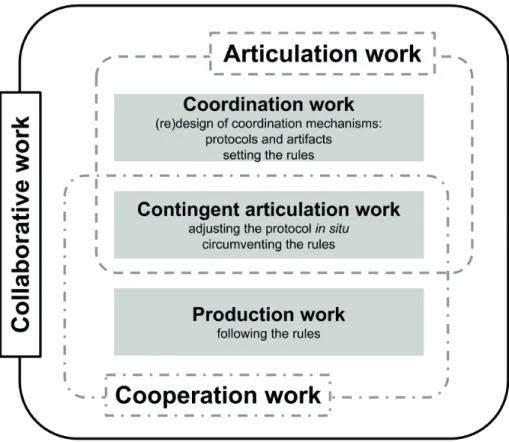
Figure 2.1 depicts how we conceive the relationship between coordination work, cooperation work, articulation work and production work.
Figure 2.1: Categories of collaboration: coordination and cooperation, articulation and production.
Hence, we examine how office workers perform articulation work both as they design coordination mechanisms and as they adapt their execution of coordination protocols to accommodate the “unanticipated contingencies” of the distribution of their work (Star, 1991, p. 275). Whereas research on computer-supported cooperative work (CSCW) has devoted its attention to the design of systems that adequately support cooperative work by providing coordination mechanisms in the form of “artifactually imprinted protocols” (Schmidt & Simone, 1996), we look at the workers’ ability to design their own coordination mechanism using technology, and use and adapt them as part of their collaborative work. Of course, this assumes that team members are actually in a position to design anything at all (either by developing their own technologies, or ‒in most cases‒ by adopting and assembling existing and available technologies), which critically depends on the organizational context they work in. To the extent that they have the possibility to do so, our observations include, for example, how workers are able to combine systems, create specific tools or bypass the devices implemented by their employers, all of which may be required by the workers’ team activities to achieve their objectives. In all of such instances, workers switch from complying with an established coordinative protocol involving the use of digital technology, to inventing ways of adapting the protocol to the current situation.
The use of the concept of articulation work allows us to emphasize how workers are able to develop a mindful posture towards the role played by technology in their work, as articulation work is necessarily a process of conscious thought, whether in the form of precomputation produced by coordination work, or in the form of ad hoc adaptation of the designed procedures. This mindful posture, that exceeds the routine application of technological know-hows, is in line with the idea that competence involves intentional,
conscious behavior (Westera, 2001)12.
Method
Data Collection Instruments and Process
Our data collection process primarily involved interviews with office workers, complemented by observations in their everyday work environments. Two teams were selected within each of the ten organizations participating in the research program, which each introduced changes in the way their employees work in team and at a distance. In each of these teams, one manager and two team members were interviewed, making up
a total of forty-one workers13 and twenty managers.
12 Westera notes that even if competent behavior can be highly routinized and automated, its
routi-nization necessarily starts from intentionally elaborated action sequences.
13 The configuration of one team, which included a project manager in addition to the team members
and team leader, lead us to interview and observe four participants instead of three, leading to a total of 41 workers.
Our informants’ work practices were documented through interviews which turned into guided tours of the informants’ workspaces (Malone, 1983; Barreau & Nardi, 1995), led by the informants. Our interview protocol was based on a set of collaborative activities identified by reviewing the computer-supported cooperative work (CSCW) literature (Olson & Olson, 1997, 2012; Grudin & Poltrock, 2012, 2013), a subfield of the Human-Computer Interaction dedicated to the design of collaborative technologies, based on observational research on collaborative work practices. We used the CSCW literature to identify the activities related to distance teamwork that could be supported by digital technology. The following eleven activities (Collard et al., 2016) were selected as an initial, tentative inventory of technologically-mediated distance collaborative activities:
1) Making collective decisions regarding task distribution, team governance and roles, and overall team functioning
2) Managing one’s tasks in relation with others 3) Planning the team’s activity
4) Planning a meeting
5) Working synchronously in the distance with other team members 6) Organizing one’s workspaces for collaboration
7) Managing incoming information 8) Managing outgoing information 9) Using others to find information 10) Sharing a collection of documents 11) Authoring a document collectively
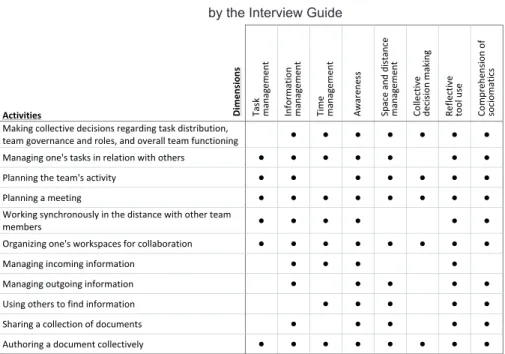
Our interview guide detailed each of these eleven activities into up to eight dimensions of distance teamwork, which were systematically accounted for in our data collection. These eight dimensions allow for the fine-grained analysis of how workers are able to perform these activities. The necessary redundancy between activities and dimensions accounts for the intricate relationships between the technologically-mediated activities of distance teamwork. These dimensions are the following:
1) Task management 2) Information management 3) Time management 4) Awareness
5) Space and distance management 6) Collective decision making 7) Réflective tool use
8) Comprehension of “sociomatics”14
Not all eight dimensions are relevant for all eleven activities. Table 2.1 represents which dimension was explored for which activity. Each dot in the table corresponds to a (set of) follow-up question(s) in our interview guide.