DEMOCRATIC AND POPULAR REPUBLIC OF ALGERIA
MINISTRY OF HIGHER EDUCATION AND SCIENTIFIC RESEARCH MENTOURI UNIVERSITY - CONSTANTINE
FACULTY OF LETTERS AND LANGUAGES DEPARTEMENT OF FOREIGN LANGUAGES / ENGLISH
Dissertation Submitted to the Department of Foreign Languages in Partial Fulfilment of the Requirements for the Degree of
MAGISTER
inREADING AND WRITING CONVERGENCES
Presented by: Supervised by:
Djamila BABAA Professor Farida ABDERRAHIM
Board of Examiners:
Chairman: Dr. Abdelhak Nemouchi University Mentouri, Constantine Supervisor: Pr. Farida Abderrahim University Mentouri, Constantine Member: Dr. Naima Hamlaoui University Badji Mokhtar, Annaba Member: Dr. Sarah Merrouche University Larbi Ben Mhidi (OEB)
2009
THE EFFECTS OF TRAINED PLANNING
STRATEGIES ON THE PERFORMANCE OF
E F L INEXPERIENCED WRITERS
..
.
It is completely raw, the sort of thing I feel free to do with the door
shut – it’s the story undressed, standing up in nothing but its socks and
undershorts.
Stephen King.
. . . . .TO MY FAMILY
. .
ACKNOWLEDGEMENTS
I wish to pay my gratitude to the following people who have accepted to be part of this challenging but rewarding research work.
I am particularly indebted to Pr. Farida ABDERRAHIM, my supervisor, for her expert guidance, her patience, her support and valuable suggestions throughout the duration of this work.
My gratitude also goes to Dr Abdelhak NEMOUCHI, Dr. Naima HAMLAOUI, and Dr. Sarah MERROUCHE for accepting to be in the board of examiners and for carefully reading the present research.
My many thanks go to the teachers of the Department of Foreign Languages/English (Mentouri University; Algeria) for discussing and commenting the difficulties encountered by the majority of students enrolled in the Written Expression Class.
Finally, I wish to thank my students for their personal involvement and motivation during the experimentation.
. .
ABSTRACT
Research into the writing process has come out with the observation that writing in university environments is strictly connected with a lucid awareness of the conventions and expectations of the academic community we are addressing. One of these expectations sees writing as a knowledge-transforming process capable of adapting primitive information to the specificities of a given assignment. The transformation of knowledge is always conducted through a preparatory stage called `planning’, a sum of cognitive processes all connected and managed to build an operational framework which is supposed to guide the geographical as well as rhetorical organization of unstructured items.
This study explores the effects of one possible trained planning strategies combination on the performance of student writers enrolled in second year Written Expression class at Mentouri University (Constantine, Algeria). It presents the case of sixty (60) participants displaying an average English proficiency level and a limited (if not inexistent) knowledge of the planning conventions.
The researcher has collected data from the planning episodes transcribed on rough drafts and from the final papers presented by the subjects. To explain and comment on the participants’ planning behaviours and final papers, the researcher has used three prominent models of writing: that of Hayes and Flower (1980) and those of Bereiter and Scardamalia (1987).
No noticeable differences have been found between final papers presented by subjects involved in the proposed planning strategies instruction (Experimental
. .
.
Group) and those presented by subjects who have followed the usual planning strategies instruction (Control Group).
LIST OF ABBREVIATIONS
ALC Academic Linguistic Conventions CPS Constructive Planning Strategies EFL English as a Foreign Language ESL English as a Second Language FL Foreign Language
KDS Knowledge Driven Strategies L1 First Language
L2 Second Language
MLO Material Logically Organized
MSRT Material Sufficient and Relevant to the Task N Number of Students
PRT Potential Reader Targeted PWA Purpose of the Writer Apparent SDS Schema Driven Strategies
LIST OF FIGURES
Page
Figure 1.1:Hayes and Flower's Model (1980) ……… 15
Figure 1.2:Bereiter and Scardamalia's
Knowledge Telling Strategy (1987)………... 20
Figure 1.3:Bereiter and Scardamalia's
LIST OF TABLES
Page
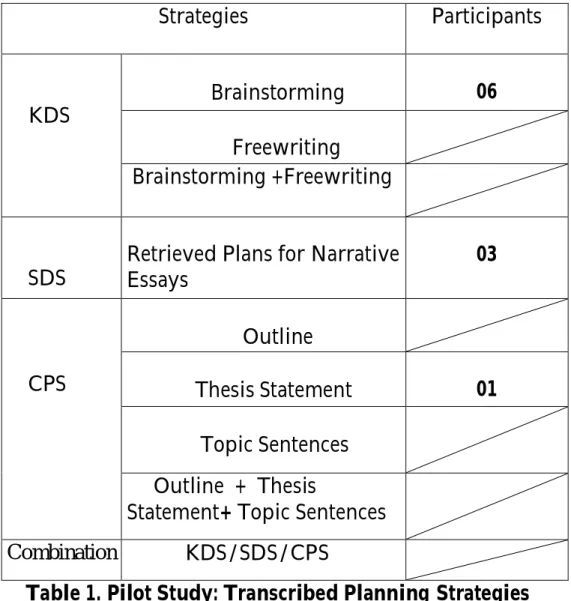
Table 1. Pilot Study: Transcribed Planning Strategies...……….…… 62
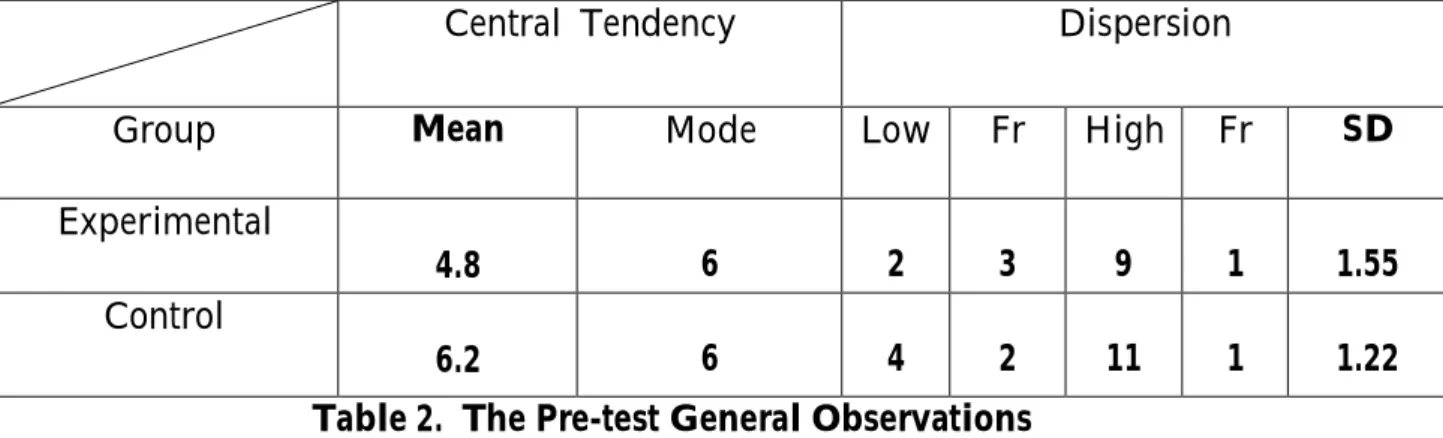
Table 2. The Pre-test General Observations…..………..……. 90
Table 3. The Pre-test Means and Scores of the Different Criteria……….92
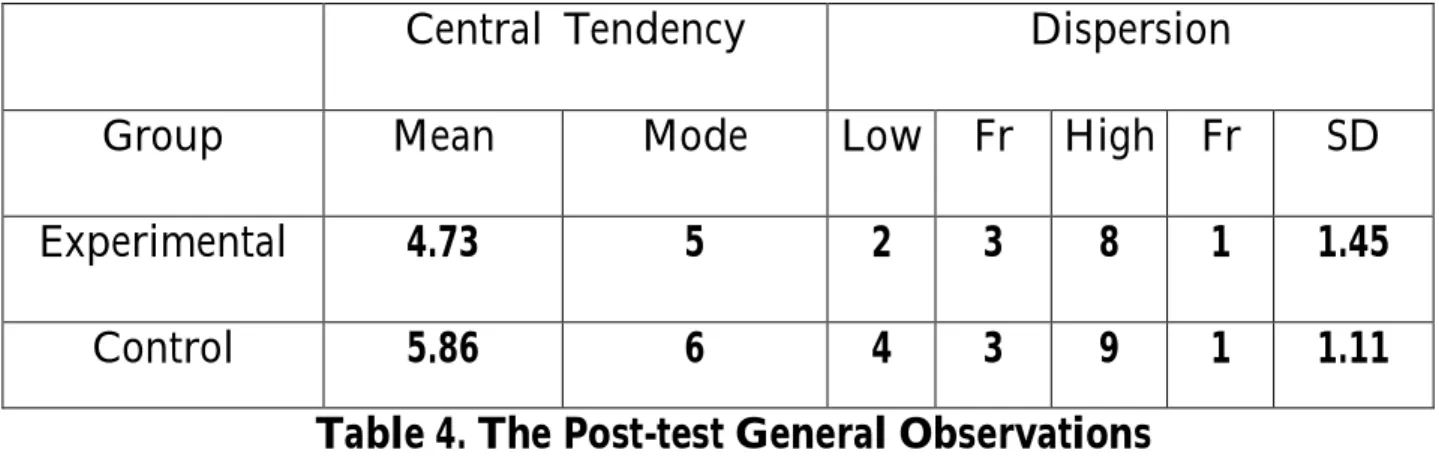
Table 4.The Post-test General Observations……….…..117
Table 5. The Post-test Means and Scores of the Different Criteria……….….118
Table 6.The Improvement Means………....… 119
Table 7. The Pre-test and Post-test Scores and their Improvement………….……121
Table 8.Normality Indicators………...….………122
Table 9.Control Group/ Student 09/ Comparative Achievements ………….….126
Table 10. Control Group/ Student 30/ Comparative Achievements …………...127
Table 11. Control Group/ Student 03/ Comparative Achievements ………..….128
Table 12.Experimental Group/ Student 04/ Comparative Achievements ….…..131
Table 13.Experimental Group/ Student 21/ Comparative Achievements ….….132
CONTENTS
Page
Introduction……… 1
1. Statement of the Problem………. 2
2. Aim of the Study………. 3
3. Research Questions and Hypothesis……….……….. 4
4. Means of Research……….. 5
5. Organization of the Dissertation……….……… 5
Chapter One: The Process Of Writing………..…………. 7
Introduction………. 8
1.1. Early Research on Cognitive Processes in Writing……….………. 8
1.2. Stages of Development of the Writing Activity……….. 11
1.2.1. Planning……….………....… 11
1.2.2. Drafting………..….... 12
1.2.3. Reviewing……….. 13
1.3. Main Models of the Writing Activity………....…….. 14
1.3.1. Hayes and Flower's Model (1980)………..…… 14
1.3.2. Bereiter and Scardamalia’s Models (1987)………..….. 18 1.4. Applicability of Process Writing Research in the
ESL/EFL Classroom………. 23
1.4.1. The Population……….. 23
1.4.2. The Activities………. 24
1.4.3. The Students' Performance……….. 26
1.5. Limitations of the Process Writing Theory in the ESL/EFL Classroom……….……….. 29
Conclusion……….………... 31
Chapter Two: The Planning Stage……….………….. 32
Introduction………..……… 33
2.1. The Planning Research Interest……….. 33
2.2. Definition of Planning………. 37
2.3. Planning and its Sub-stages……… 38
2.3.1. The Generating Sub-stage……… 39
2.3.2. The Organizing Sub-stage……… 41
2.3.3. The Goal Setting Sub-stage……….. 42
2.4. Teaching the Planning Sub-stages………...……….. 43
2.4.1. Knowledge Driven Strategies (KDS)……….. 43
2.4.1.1. Brainstorming………..……… 43
2.4.1.2. Freewriting………..……… 46
2.4.2. Schema Driven Strategies (SDS)……….…………. 47
2.4.3. Constructive Planning Strategies (CPS)………. 48
2.4.3.1. The Outline………... 48
2.5. Potential Effects of KDS, SDS, and CPS on
the Students' Performance……… 51
2.5.1. Effects on the Material and its Organization…... 51
2.5.2. Effects on the Purpose of Writing and the Audience………... 52
2.5.3. Effects on the Linguistic Components………..….. 53
Conclusion………..……….. 54
Chapter Three: Data Collection Procedure…….………... 55
Introduction……….……. 56
3.1. The Sample………..………….. 57
3.2. The Pilot Study ……….. 59
3.2.1. Description………...………….……….. 59
3.2.2. Results………..……… 61
3.2.2.1. Group Analysis……….……….. 61
3.2.2.2. Subgroup Analysis………. 62
3.2.2.3. Overall Analysis………. 63
3.3. The Main Study……….………..…….. 65
3.3.1. The Evaluation Criteria and Grading……… 65
3.3.2. The Pre-test ………..……….. 70
3.3.3. Planning Strategies Instruction ………. 71
3.3.3.1. Objectives…………..……….………. 72
3.3.3.2. Stages of Instruction……….………. 72
3.3.5. Statistical Tools………. 85
3.3.5.1. The Dispersion Indicators ……… 85
3.3.5.2. The T-Test………..……….. 86
Conclusion………..………. 88
Chapter Four: Data Analysis and Results………... 89
Introduction ………..……….. 90
4.1. The Pre-test……… 90
4.1.1. General Observations……….………. 90
4.1.2. Means and Scores of the Different Criteria……….. 91
4.1.3. Discussion of some Pre-test Participants' Final Papers………. 95
4.1.3.1. The Control Group……… 95
4.1.3.2. The Experimental Group………... 104
4.2. The Post-test………..…………... 117
4.2.1. General Observations………..………..…………. 117
4.2.2. Means and Scores of the Different Criteria……….. 118
4.2.3. Hypothesis Testing………...……… 119
4.3. Overall Results……….……… 124
4.3.1. The Control Group Comparative Achievements……… 124
4.3.2. The Experimental Group Comparative Achievements….……….. 129
4.3.3. Overall Qualitative Comparison and Evaluation………..………….. 134
. .
4.3.3.1. A Comparative Analysis
of the Planning Behaviours……… 134
4.3.3.2. A Comparative Analysis of the Performances Displayed on the Final Papers……….…….……… 136
Conclusion……….……….. 140
Chapter Five: Pedagogical Implications…………..………. 141
Introduction……….……… 142
5.1. Implications for Teaching……….…….. 142
5.1.1. Implications for the Planning Strategies……….. 142
5.1.2. Implications for the Writing Process………..……… 145
5.2. Implications for Further Research………..……..…. 146
Conclusion……… 148 CONCLUSION………... 149 APPENDICES……….. 152 BIBLIOGRAPHY……… 191 . . .
INTRODUCTION
1. Statement of the Problem
2. Aim of the Study
3. Research Questions and Hypothesis
4. Means of Research
INTRODUCTION
1. Statement of the Problem
Writing in English as a Second Language/English as a Foreign Language academic contexts has always been a complex activity. A great majority of student writers often fail to meet the university’s expectations; they do not know how to manipulate language to produce meaningful papers. Seeking for the reasons behind that situation, several researchers in the last two decades have carefully scrutinized the writing processes of experienced and non-experienced writers. Among many of these researchers are Flower and Hayes (1980) and Bereiter and Scardamalia (1987) who have discovered that experienced writers view writing as problem solving and planning (which is described as a process including the generation of information and the organization of that information according to pre-defined rhetorical goals) as a strategic response to the issue presented by a given task. Academic writing appears then to be, in the majority of cases, a knowledge transforming process and writers incapable of handling that process have been identified as unsuccessful writers.
Although most of the research has considered first language and second language composing processes, the Process Approach is directly suggested and adopted as a potential solution for English as a Second Language/English as a Foreign Language student writers. Writing in the English as a Second Language/English as a Foreign Language contexts is no more regarded as a product but as a meaning construction process. To manipulate adequately that
process, student writers should be able to plan, draft, and revise their text before presenting it to an external audience. During planning, writers need to be able to generate, organize, and adapt information to the specificities of a given task. The planning stage reveals to be a necessary stage through the production of academic papers because it enables writers to manage both the cognitive constraints and rhetorical features and to integrate them in global operational goals. A great majority of process researchers deduce then that English as a Second Language/English as a Foreign Language writing competence is more a process competence than a linguistic competence and that advanced levels of English proficiency do not guarantee writing ability. Following that, a process instruction is strongly recommended to provide for the necessary planning skills to university student writers so that they become able to propose personal and meaningful focused responses to academic complex tasks.
2. Aim of the Study
This exploratory study aims at investigating the effects of a set of acquired planning strategies on the performance of Algerian University inexperienced student writers. It sees planning as a transcribed episode. Thus, it uses the planning sheet (or rough draft) to explore the amount, type and quality of the planning session. The papers presented as final are used to evaluate the performance of the participants to the study.
The interpretations of results are based on pre-determined performance criteria. These results will add information to the planning assumptions of process researchers. If planning instruction does not contribute to ameliorate the
.
performance of university student writers, the reasons for a limited English as a Second Language/English as a Foreign Language writing proficiency are to be sought elsewhere. If, on the contrary, planning strategy training improves the performance of these student writers, the idea according to which English as a Second Language/English as a Foreign Language writing competence is mainly a process competence will be undoubtedly confirmed. The results of the present study may also suggest that, although planning is an important component of English as a Second Language/English as a Foreign Language writing, it is not the only determinant of efficient academic papers.
3. Research Questions and Hypothesis
As we have already pointed out, the aim of this study is to investigate the effects of planning strategy instruction on the performance of non-experienced Algerian university student writers. The participants in the Experimental Group are presented with a six - months training on a combination of pre-determined planning strategies. They are asked to use the latter while answering a given task because, as argued in the review of literature, the development of a planning policy ameliorates the final performance.
This study is motivated by two research questions. The first question deals with the effects of the planning instruction on the performance of student writers: If inexperienced Algerian student writers are taught the planning strategies combination suggested in the experiment, would it make a qualitative difference in their final papers?
.
.
The second research question is related to the necessity of teaching the planning stage in the Written Expression Class: Does teaching the writing activity in our English as a Foreign Language academic context necessarily involve planning strategies instruction?
We hypothesize that when the proposed combination of trained planning strategies is introduced prior to writing, it has a positive noticeable impact on the performance of Algerian student writers.
4. Means of Research
Before testing the above hypothesis, a pilot study is carried out in order to give a clear picture of the planning habits of our students, to try out the type of assignment that can facilitate the work of student writers freshly introduced to a planning habit, and to help set out a valid and reliable scoring scale to be used in the main study. A pre-test/post-test experimental design involving two groups, Experimental and Control, is then opted for. The Experimental group attends an explicit teaching on the proposed planning strategies combination and the Control group follows the usual implicit method of teaching the planning stage. The pre-test and post-pre-test results are compared and the hypothesis is validated through a t-test computation.
5. Organization of the Dissertation
This dissertation is composed of five chapters. Chapter One proposes a review of the literature related to the process of writing comprising some
.
.
discussion of its potential implementation in the English as a Second Language/English as a Foreign Language class.
Chapter Two discusses the planning stage in details, and the potential effects of the developed planning strategies on the final performance of student writers.
In Chapter Three, the researcher exposes the data collection procedure of the study. This chapter considers the selection of the experiment’s participants, their description, the findings of the pilot study, the pre-test description, the treatment description, the post-test description, and the statistical tools used to validate the hypothesis.
Data analysis and results are presented in Chapter Four. The discussions related to the participants’ performance are based on the two major rhetorical issues, audience and purpose, which appear to be affected by the planning work. The amount and relevance of the material presented in the final papers are also carefully scrutinized.
Chapter Five discusses implications for teaching and further research. The Conclusion reports on the foundations and results of the study and opens the door to other investigations in the vast domain of writing pedagogy.
CHAPTER ONE
THE PROCESS OF WRITING
Introduction
1.1. Early Research on Cognitive Processes in Writing 1.2. Stages of Development of the Writing Activity 1.2.1. Planning
1.2.2. Drafting 1.2.3. Reviewing
1.3. Main Models of the Writing Activity 1.3.1. Hayes and Flower’s Model (1980)
1.3.2. Bereiter and Scardamalia’s Models ( 1987)
1.4. Applicability of Process Writing Research in the ESL/EFL Classroom
1.4.1. The Population 1.4.2. The activities
1.4.3. The Students' Performance
1.5. Limitations of the Process Writing Theory in the ESL/EFL Classroom
Conclusion
Introduction
While the Product Approach continues to be the focus of a substantial part of our writing classes, new trends which consider the cognitive nature of text writing have appeared, providing as such for a solid background to the Process Approach. The techniques and outcomes of Process Writing Research have given birth to an important number of writing models among them the three most prominent ones: that of Hayes and Flower (1980) on the one hand, and those of Bereiter and Scardamalia (1987) on the other hand.
These models have served as a basis for a potential implementation of the Process Writing philosophy, thus initiating methods attempting to answer students’ needs and requirements in the writing class. The Process Writing Theory, although limited, has also inspired teachers in second language (L2) as well as foreign language (FL) contexts.
1.1. Early Research on Cognitive Processes in Writing
Early research on the cognitive nature of text production has revealed that writing is a process. During that process, the writers are involved in a group of mental mechanisms which interact to process knowledge while trying to answer internal (the processing capacity of the writers’ memory) as well as external (the topic) constraints in order to reach a specific goal. In Reid's words (1993:10): ‘the writing situation puts … psychological, as well as rhetorical, constraints on the writer.’
Process research has had the objective to provide for a full understanding of the internal constraints and of the differences that exist between good and bad
.
.
. .
writers. The researchers have collected their data from case study, through carefully detailed and pertinent observations of individuals or small groups of writers. Mischel 1974, Emig 1971, Pianko 1979, Matsuhashi 1981b, Flower and Hayes 1980, and Bereiter and Scardamalia 1982 (cited in Hillocks, 1986), among others, have been interested in the writing comportments of students in post-secondary classes. They have also examined the writing processes of experienced adult writers as opposed to those of inexperienced ones.
The ‘compose aloud’ or ‘think-aloud’ protocols analysis has been widely used by these researchers to penetrate the mind of the writers while composing. This technique allows the researchers to follow the mental activity and decision-making processes of writers during the planning and composing of their text. In practice, the protocol technique exhibits writers thinking loudly (i.e. saying) the decisions they are framing all through their composing activity.
The protocol method has been considerably criticized. According to Kellogg (1994:52), one of the major disadvantages of this method is the `problem of intrusion’ because writers are required to explain loudly the different stages of their composing activity while trying, at the same time, to manage them efficiently. This double cognitive constraint prevents them to conduct effectively their writing activity. Moreover, this technique seems to rely exclusively on the intuitions of the researchers because there is no real evidence of what goes on in the mind of writers while these are composing.
Despite its limitations, the protocol method has revealed that the process of writing is a set of non-linear steps all combined for the realization of a final
product. Precisely, Emig 1971(cited in Hillocks, 1986) and Sommers 1980 (cited in Reid, 1993) have noticed that the writers do not necessarily follow a ‘plan, draft, and review’ pattern of composition; their way is rather recursive since they often go back to what they have already written in order to re-read, add, or edit information before carrying on their writing activity. The same conclusion is suggested by Pianko 1979 (cited in Hillocks, 1986) who also insists on the fact that her experiment’s subjects could not build an exact picture of what they intend to write on their papers unless they actually start writing it.
The protocol method has also revealed considerable differences between inexperienced and experienced writers. Scardamalia (1981:88, cited in Hillocks, 1986:34) has discovered that for inexperienced writers, ‘staying on the topic [is] an achievement in itself’ and that, in fact, the difference between these writers and more mature ones resides in the strategies they use to develop their writing. Inexperienced writers tend to use the ‘what’s next’ strategy whereas mature writers focus on the ‘means-end’ strategy. The ‘what’s next’ strategy is illustrated through papers displaying a structure similar to that of conversations because each sentence initiates the following. The writers add and associate the items one after the other with no attention to the text as a whole. The paper thus produced is controlled by no purpose at all. On the contrary, the ‘means-end’ strategy is evident in papers where the writers are trying to commit all the discourse constituents to a specific and restricted aim.
. .
.
1.2. Stages of Development of the Writing Activity
An acute analysis of the `compose aloud' protocols has conducted to a clarification of the nature as well as function of the different mental steps involved in the writing activity. Clearly, three major stages appear: planning, drafting, and reviewing.
1.2.1. Planning
The fact that the process of writing always starts with the generation of ideas either from personal experience and knowledge or from reading and discussing has widely appeared. This planning stage is defined by Emig (1971:39; cited in Hillocks, 1986:2) as:
that part of the composing process that extends from the time a writer begins to perceive selectively certain features of his inner and/or outer environment with a view to writing about them – usually at the investigation of a stimulus- to the time when he first puts words or phrases on paper elucidating that perception.
Planning initiates the actual writing by trying to build a clear image of the physical as well as mental contexts (i.e. the topic and the related potential knowledge situated in the writers' memory) searching for their adequate combination for their future verbal expression. Hillocks (1986: 3) explains that, during this period, the writers ‘consider three or four possibilities and choose the one which [they] regard as more manageable under the circumstances, thus eliminating rather systematically those ideas which appeared too difficult to handle.’ In other words, the writers first establish mental links between the topic and their previous experience, then they try to translate these abstract relations
.
into written words by brainstorming on the topic, thus producing material to be developed during the drafting session.
It seems that the longer the planning stage is, the more ripeness and depth the final paper shows. Inexperienced writers, however, allow very little time to this stage (about one minute) and tend to be more preoccupied with mechanics, particularly spelling, instead of organization and arrangement (which they consider of secondary importance). More experienced writers, on the other hand, devote more time to this phase (about five minutes) as well as to examining what they have written. They, also, pay more attention to matters of content and organization.
For Emig (1971; cited in Hillocks, 1986), Oshima & Hogue (1999), and numerous other researchers, the planning stage is a simple preparatory stage necessary for the production of information. Other professionals in the field, however, have suggested that the production of information is only the visible part of the planning ‘iceberg’. The Hayes and Flower’s model (Section 1.3.1 of this chapter) illustrates clearly the point.
1.2.2. Drafting
The drafting stage is the ‘physical act of writing’ (Lindemann, 1987:26). One important and significant aspect of this stage is concentration, often materialized through pauses. It has been noticed that writers make quite frequent pauses. During these pauses, their faces reveal satisfaction or frustration with what they have written. Pauses allow writers to scan their text in order to be able to change some aspects of it; they also help them design subsequent ideas. According to Emig (1978; cited in Lindemann, 1987:26), the pauses of the drafting stage reduce
considerably the writing speed, thus enabling the production and maturation of ideas.
1.2.3. Reviewing
The reviewing stage always follows the drafting stage. The reviewing stage ‘is the process of seeing again, of discovering a new vision for the writing produced in planning and drafting’ (Trimmer, 1995:77). In other words, it is the stage during which the writers correct mechanical errors and/or realize substantial changes in their writing. Reviewing includes both reading, an important aspect of the `global’ as well as `local’ revising steps described by Trimmer (1995), and editing (or proofreading) which is considered as the last step in the writing process because it deals with errors related to grammar, spelling or punctuation.
During the reviewing stage, the writers consider all the potential adjustments or re-adjustments linked to their purpose and readership. In general, there are two different reviewing attitudes: for experienced writers, ‘revision means creating the final draft’ whereas novices consider that stage a necessary step toward the ‘fixing [of] the first draft’ (Trimmer, 1995:77). In truth, reviewing requires from the writers a mental predisposition toward creativity and criticism. It demands important rethinking capacities.
Researchers maintain that ` [t]he need for major rewriting is usually the result of inefficient-or non-existent-planning.’ (Burgess& Head, 2005:61). They also agree to say that reviewing is an effective planning instrument. Indeed, peer review, a key classroom activity for effective revision, enhances the students’ ability to organize texts and increases their awareness of the importance of
readership and that of purpose. Reviewing also appears to be a stage during which writers may generate new ideas and drop old ones.
1.3. Main Models of the Writing Activity
To incorporate the different stages of the writing activity and clarify the way they activate, function, and interconnect, process writing models are proposed. We will refer to the ones developed by the two pioneers in the field, Hayes and Flower (1980), and Bereiter and Scardamalia (1987).
1.3.1. Hayes and Flower’s Model (1980)
The model established by Hayes and Flower represents a valid reference in the field. It is based on the `think-aloud' protocol analysis and describes the ideal mature writer’s processes. It divides the writing activity into three major components: the task environment, the writer’s long-term memory, and the writing process (see Figure 1.1). The task environment and the writer’s long-term memory (which contains the knowledge of the topic, that of the audience and some stored writing plans) determine the general planning policy. The writing process consists of three main stages namely planning, translating and reviewing governed by a process labelled `Monitor' whose main function is to organize the recursive aspect of their application .
. .
.
Hayes and Flower divide the planning stage into three sub-stages: generating, organizing, and goal setting. During the generating sub-stage, the writers retrieve from their long-term memory the information relevant to the topic at hand. This sub-stage furnishes the raw material to the organizing sub-stage whose concern is to choose the most pertinent information among the retrieved items, and to arrange it into an initial plan. Finally, the goal setting sub-stage develops criteria that will help evaluate the retrieved material in relation to the two crucial rhetorical elements, namely the purpose and the audience. As such, in Hayes and Flower’s model, planning appears to be a huge task that determines the subsequent writers' activity.
For Hayes and Flower, the drafting stage is, in fact, a `translating’ stage. It is concerned with the translation of ideas and images into language. During that phase, the information produced and transformed during the planning stage is translated into correct written discourse. Likewise, Hayes and Flower, insist on the necessity of pauses during this stage. They explain that questions like ‘how can I best express that idea?’ are necessary to enhance the writers’ concentration and to plan what should be written next.
In Hayes and Flower’s model, reviewing is also a stage directed toward the amelioration of the quality of the produced text vis-à-vis a pre-defined goal. It consists of two sub-stages: Reading and Editing. Editing is a complex procedure used to situate and correct misuses in writing conventions and expressions of meaning. It also estimates materials (i.e. ideas) in relation to the established objectives. Editing is said to be activated automatically thus interrupting the other
processes in progression. Although it is a sub-stage of reviewing, it is quite different from the latter. Indeed, while editing is, as we have said, activated automatically at any moment, the writers, on the contrary, always decide for the time period to be devoted to the revision and improvement of their text.
The fact that writing is a recursive process is not fully illustrated by the inter-connections (notice the arrows in the figure presented) between the stages of the composing scheme. In truth, editing may well be stopped by some generating considerations; organizing could be cut off because writers decide to go back, for a moment, to the generation of a more consistent amount of material or to some editing matters. Translating is, in some cases, also interrupted by generating and editing. Flower and Hayes (1977:387; cited in White, 1988:8) explain:
One of the central premises of the cognitive process theory presented here is that writers are constantly, instant by instant, orchestrating a battery of cognitive processes as they integrate planning, remembering, writing and rereading. The multiple arrows, which are conventions in diagramming of this sort of model, are unfortunately only weak indications of the complex and active organization of thinking processes which our work attempts to model.
The organization of thinking processes imposes many constraints on writers. An obvious constraint is to be able to hold in their immediate memory what has already been written and what they intend to write until they determine the global meaning they want to convey. However, more important constraints are dictated on writers. Indeed, according to Hayes and Flower (cited in Lindemann, 1987), writers face sometimes a ‘knowledge problem’ in their search for the most
. .
accurate information. They may also face a ‘language problem’ in the case they know precisely what to put on the paper, but cannot actually find the words that best express it. Most importantly, writers may find themselves facing a ‘rhetorical problem’ when they are unable to determine their purpose and to target a specific audience. The hesitation concerning these two crucial elements of the process of writing prevents writers from producing the adequate material and the appropriate language. According to Hayes and Flower (Ibid), the writers always need to develop strategies to face the above constraints. Among these strategies is the development of an efficient planning policy.
1.3.2. Bereiter and Scardamalia’s Models (1987)
While the Hayes and Flower’s model insists on the internal influences of the writer on the process of writing, the Bereiter and Scardamalia’s models attempt to draw a difference between the processes used by inexperienced writers and those used by experienced ones. Undoubtedly then, the two other most influential writing models are those proposed by Bereiter and Scardamalia in 1987 (Alamargot and Chanquoy, 2001). These models schematise out two essential writing strategies, namely the ‘knowledge telling’ and the ‘knowledge transforming’ (See Figure 1.2 & Figure 1.3) and explain how they can be handled to develop writing expertise.
The knowledge telling process describes a strategy consisting in the presentation of a pattern of information the way it is retrieved. This pattern does not need to be modified in order to suit the specificities of the task at hand. The writing expected from children is a good example of the knowledge telling process. It requires little planning because it does not need a selection and
adaptation of the writers' topic knowledge in order to answer complex rhetorical goals. Adult writers, on their part, can use this strategy to generate content while planning answers to complex topics or to answer uncomplicated tasks. According to Bereiter and Scardamalia, the knowledge telling strategy is intensely used by unskilled writers to answer academic assignments. The texts produced by these writers often display restricted goals, the major one being that of generating content.
Most academic tasks, however, require the building of quite elaborated criteria for information processing. As such, more mature writers consider the knowledge telling process as a process embedded in the knowledge transforming one because it generates most of the content transformed later on. The knowledge transforming process is far more complex and frustrating than the simple presentation of retrieved information. It is always structured around problem-solving operations. It is explained by Higgins, Flower and Petraglia (1991:5) as follows: ` College students often must adapt what they know or what they have read to a variety of purposes in their courses, purposes other than recitation.’ In the process of knowledge transformation, the writers deal with two crucial aspects: the ‘content problem space’ and the ‘rhetorical problem space’. The content problem space proposes solutions to issues linked to the generation of appropriate knowledge, and the rhetorical problem space deals with how to best use that knowledge in order to achieve the goals of the writing assignment. These two processes (content problem space and rhetorical problem space) are in continual interaction. Once some solutions to the content and rhetorical problems emerge, these become the input for the knowledge-telling process during which the actual text is produced. To enable the writers to negotiate the content problem space and the rhetorical problem space, planning is spread all through the composing activity and is mainly directed towards a detailed analysis of the rhetorical problem for the main purpose of constructing complex goals and sub-goals (the reader can notice the prominent place given to the `Problem analysis and Goal Setting' task in the knowledge transforming strategy, Figure 1.3).
Bereiter and Scardamalia are vigorously convinced that these ‘knowledge telling versus knowledge transforming’ characteristics constitute the basic reason for the differences that exist between proficient and less proficient writers. These characteristics demonstrate why ignorant writers succeed well in tasks demanding a simple knowledge telling process and why more complex tasks, demanding a knowledge transformation process, are accessible to more experienced writers only. In other words, and as Harmer (1998:80) declares, ` [some] students can write a simple story but they are not equipped to create a complex narrative.’
The models discussed in this section are primarily concerned with first language (L1) writing. They appear, however, to be of strategic importance for English as a Second Language (ESL) / English as a Foreign Language (EFL) student writers because the latter are always required to produce texts displaying a native-like proficiency.
1.4. Applicability of Process Writing Research in the ESL/EFL Classroom 1.4.1. The Population
According to Hyland (2003:50) `L2 writers are unique because of their bilingual, bicultural, and biliterate experiences, and these can facilitate or impede writing in various ways.' Yet, some researchers (among them Shaughnessy 1977, Arapoff 1969, Lawrence 1975, and Zamel 1982; cited in Reid, 1993) have revealed three major similarities existing between the L1 population and the ESL/EFL population. First, they have found that the ESL/EFL writing process is also recursive. Indeed, most of the students, when they engage in the composing activity, develop three main phases: a preparatory phase, a drafting phase, and a
reviewing phase and manage these phases in a recursive way. Researchers have also discovered that the inexperienced ESL/EFL writers always resort to the knowledge telling strategy while answering academic tasks. They often produce completely disorganized texts and think that this is the best they can achieve. Shaughnessy (1977:10-11; cited in Reid, 1993:9) summarizes the fact as follows: ‘What has been so damaging about the experience of BW [Basic Writing] students with written English is that it has been so confusing, and worse, that they have become resigned to this confusion, to not knowing,…’. The third and most significant similarity is related to the difficulties encountered during the planning stage. This stage, qualified by Cushing Weigle (2002: 10) as ‘…the most demanding level of cognitive processing …’, has never been adequately handled by the ESL/EFL students. The latter do not take enough time to anticipate the content and the linguistic form of their future text.
1.4.2. The Activities
The activities developed in the process-oriented class require an extensive and successful manipulation of all the stages of the process of writing for the main purpose of producing essays. Process-oriented teachers insist that students achieve a clear purpose to a pre-determined audience through an adequate and logical development and organization of ideas carefully supported by pertinent arguments and sub-arguments. The process-oriented class also assumes that writers engage in the multiple-drafts strategy which enables the building of a syntactic and lexical variety in the final product, and develops the students’ ability to go through the different stages of the writing process. As Alamargot and Chanquoy (2001:217) write: ` … the preparation of a draft increases planning
duration (and also translating duration) and improves the quality of the production.’ They add (Ibid): ` [t]hus, learning how to produce drafts and to plan before writing the final text surely provides a fundamental basis to become an experienced writer.’
In the process-oriented class, the choice of the topic is of significant importance. Topics must include some authentic aspects to help student writers target and express a purpose for an audience that they could possibly consider as real. This real-world dimension also enables the ESL/EFL teachers to help their students plan and complete significant sentences. As Brookes and Grundy (1990: 26) assert , ‘[i]t is particularly helpful to work at meaningful sentence completion because of the difficulty of keeping long sentences in mind while sorting out sense, syntax, vocabulary, and the process of writing down…’.
In order to deal efficiently with the topics presented in the process-oriented class, Shaughnessy (1977; cited in Reid, 1993) advices that teachers help writers, especially those who are inexperienced, to develop strategies for the identification of audience and purpose. Consequently, some planning strategies, proposed by founders of the new rhetoric as Elbow (1981) and Trimmer (1995) and primarily designed to solve problems in the L1 writing class, have rapidly been introduced in the ESL/EFL environment.
The proposed planning strategies are as varied and numerous as the learning styles, personalities, nationalities, ages, and background experiences of the students are. They enable the students to answer the crucial questions of what (the material) and how (the organization of that material) and to identify, restrict,
and target the purpose and audience of their future essays. The researchers who have tested their efficiency agree to say that they provide more writing practice in a less anxious environment thus leading to some more positive students’ attitudes towards writing. One example of these strategies is the ‘quickwriting’ described by Jacobs (1988:284; cited in Reid, 1993:32) as follows: ‘Concentrate on ideas. Forget about mechanics, grammar and organization. Take care of those at another stage in the writing process’ (the reader will find a more complete treatment of the planning strategies and of their effects on the performance of student writers in Chapter Two).
1.4.3. The Students' Performance
The extensive written performance that takes place in the process-oriented class demands that the students display the following macroskills (adapted from Brown, 2004:221):
- Use the rhetorical forms and conventions of written discourse.
- Appropriately accomplish the communicative functions of written texts according to form and purpose.
-Convey links and connections between events, and communicate such relations as main idea, and supporting idea.
-Develop and use a battery of writing strategies, such as accurately assessing the audience's interpretation, and using prewriting devices.
In other words, the essays presented by the students must display:
-1/ A material (or content): The material is the essence of academic texts. It is a group of ideas used by the writers to express a specific message. These ideas form sub-groups with different functions:
a- sub-group expressing the topic of the essay, b- sub-group expressing the thesis of the essay,
c- sub-group supporting the thesis (i.e. the `topic sentences'), and d- sub-group supporting the topic sentences (i.e. the `details').
All the ideas have to be clearly expressed. They have to show a relevance to the point under discussion, and a logic in their sequence and connections. They also have to be unified and presented as a whole.
-2/ A purpose: According to Trimmer (1995), the purpose of an essay is both the subject and the strategies (from the general organization to the refining of the
style) used by the writers to communicate that subject most effectively. A simpler definition presents the purpose as the effect we want to have on a pre-determined audience. This effect depends on the intended audience and, as such, greatly influences the selection of ideas and the choice of words. At the university, most of the writing is done to show the teachers that the students know the topic and can organize it clearly to reach a specific and personal goal. Since the teachers probably already know the majority of the elements they are asking for, writing such academic essays has the objective of raising the students’ awareness that there is always a goal while writing and that this goal considerably affects the way people write.
The purpose of an essay is always stated in a thesis statement. The thesis statement is a sentence drafted after the writers have determined their purpose. It usually appears in the first paragraph of the essay and expresses the main idea the writers will develop.
Stating a purpose implies that the assigned subject is clearly understood and that the student writers have definite expectations of what they want to accomplish. It also implies that all the possible audiences have been considered.
-3/ An audience: The writer Woolf (Cited in Cooper & Patton, 2007:11) labels the audience in writing `the face beneath the page’ and discusses the point to which this `face’ influences the writers’ mind and pen. Its importance is such that Flower and Hayes (1981b; cited in Hillocks, 1986) advice that the writers think about their audience at the beginning of the composing activity. They argue that: ‘…planning for a reader is an intimate part of idea generation…’ (1981b:49; cited in Hillocks,
1986:24) and explain that when the writers leave the audience issue to the drafting stage, they become extremely frustrated and anxious; at that point, they have all the chances to drop it because it imposes too much stress on their processing capacities.
The capacity to identify a specific audience and write for it is undoubtedly one of the marks of the competent writers. These writers always develop two broad intention types: global intentions and local intentions. Global intentions give hints on the general topic of a text and on the way it is dealt with. These intentions structure local intentions like those expressed at the level of the paragraph; the latter being always organized around sentences and words working the general focus. Global intentions determine, as such, every argument and sub-argument and help build consistent texts.
According to Boud (2001:15; cited in Young, 2002:7), ‘the expectation of writing for an external audience can profoundly shape what we write and even what we allow ourselves to consider’. In academic contexts, for example, student writers are inclined to produce writings that they think are expected by their teachers. This tension between the teachers' assessment and the students’ struggle for reflection and meaning often prevents the students to produce well-connected texts; their attention being more local than global. Audience motives, thus, always lead writers to use different rhetorical devices in order to construct meaning in a different way. If the intended audience is felt as a ` high authority’, writers operate cautiously and avoid presenting opinions that they think will shock or provoke anger. The amount of cognitive effort involved then is more important than when the audience is of low social status (for instance, a friend).
-4/ A correct use of the academic writing conventions: Academic texts must display a correct use of the English writing conventions. These conventions gather a battery of grammatical items like, for example, the relative clauses, the prepositions, the articles, the pronouns, the sequencers, the conjunctions, the verbs, and tense forms. They also include the punctuation and the spelling conventions.
1.5. Limitations of the Process Writing Theory in the ESL/EFL Classroom
Zamel (1982; cited in Krapels 1990) has considered the process competence a determining factor in the ESL/EFL writing proficiency. Yet, one obvious obstacle to the applicability of the process approach to writing has been the limitation of the linguistic competence of the ESL/EFL student writers. These students do not possess all the linguistic tools necessary to express themselves adequately. As such, while planning, drafting and reviewing do lead to more thoughtful work by the L1 student writers, the quality of the essays produced by the ESL/EFL students does not show a considerable improvement.
Another group of researchers, among them Krashen (1984:25; cited in Myers, 1997:3) have, for their part, discovered that a focus on the linguistic aspects of the English language ‘… [does] not guarantee [the students] writing competence…’. Likewise Reid (1993:35) asserts that: ‘second language proficiency and writing expertise are cognitively different’ and that the ability to write an English linguistically correct does not lead to the development of a `composing ability’. What can help, according to him, is the automatic repetition of utterances which will lead to the production of correct language since correct linguistic forms
have been internalized. This will, in turn, guarantee a more ‘native-like’ composition, free from errors of syntax, spelling and punctuation. This way, ESL/EFL students can develop some kind of automaticity in the use of articles, tenses, subject/verb agreement, spelling (what we call ‘surface’ features) and engage successfully in the learning of the process writing conventions. Myers (1997) shares this kind of eclectic approach and asserts that the ‘reformulation’ technique can help students improve vocabulary, word usage, and grammar matters while at the same time, providing them with efficient guidance towards the development of process competence.
The process theory reveals other issues. Indeed, class time being often too short, most teachers develop an inefficient management of the different process activities. Their textbooks, even when they are process-oriented, do not really help in providing their instructions. The outline, for example, is always presented as an elaborated, clear-defined, and rigid plan for the text the student writers have to produce whereas professional writers and even less experienced ones, among them students, always develop informal outlines adapted to their writing styles and to the type of topic dealt with.
Conclusion
Writing in academic environments is a process of knowledge transformation which involves three major highly interactive, recursive, and dependent stages, namely planning, translating and reviewing. All these stages help the student writers in the management of the extensive writing activities proposed in the university class. The stage that appears to be most prominent,
however, is the planning stage. This stage initiates the writing activity and determines the adequate development of the subsequent stages. Most importantly, it enables the writers to develop strategies in order to face the knowledge, language and rhetorical problems encountered while organizing academic texts.
CHAPTER TWO
THE PLANNING STAGE
Introduction
2.1. The Planning Research Interest 2.2. Definition of Planning
2.3. Planning and its Sub-stages 2.3.1. The Generating Sub-stage 2.3.2. The Organizing Sub-stage 2.3.3. The Goal Setting Sub-stage 2.4. Teaching the Planning Sub-stages 2.4.1. Knowledge Driven Strategies (KDS) 2.4.1.1. Brainstorming
2.4.1.2. Freewriting
2.4.2. Schema Driven Strategies (SDS)
2.4.3. Constructive Planning Strategies (CPS) 2.4.3.1. The Outline
2.4.3.2. The Thesis Statement and the Topic Sentence
2.5. Potential Effects of KDS, SDS, and CPS on the Students' Performance 2.5.1. Effects on the Material and its Organization
2.5.2. Effects on the Purpose of Writing and the Audience 2.5.3. Effects on the Linguistic Components
Conclusion
Introduction
The previous chapter has presented the writing activity in academic contexts as a recursive process of knowledge transformation mainly handled through the planning stage. This chapter attempts to provide a full definition of this stage and its sub-stages, and discusses its pedagogical implementation. This implementation involves the introduction of strategies considered to influence the elements of the students' performance, presented in the first chapter, namely the raw substance (i.e. material), the purpose of writing and audience, and the linguistic elements of final academic papers.
2.1. The Planning Research Interest
A number of researchers show interest in the planning strategies of writers. Among others, Bereiter and Scardamalia (1982; cited in Hillocks, 1986) conduct their works by providing a particular attention to what they label `production factors’. They reveal that these factors are concerned with such operations as exploring memory or identifying pertinent material. Production factors represent, in fact, essential signals by which writers decide for switches (from organizing to goal setting for example) within the planning stage. Flower and Hayes (1981b:49; cited in Hillocks, 1986:26), on the other hand, explain the non-planning discovered in the think-aloud protocols they have collected from writers as follows: ‘For some, writing is simply a printout of the writer’s mental state at the moment of composition’. They add: ‘[a]s he composed, [the writer]’s top-level plan appeared to be ‘Write whatever comes to mind.’…His protocol showed almost no
discernable attention given to audience or purpose, and the final product, as you might guess, read rather like a transcript of free association, even though the writer considered it quite adequate’ (Ibid:46). Other researchers (among them Berninger & Swanson 1994, and McCutchen 1988; cited in Alamargot and Chanquoy 2001) confirm these findings, and assert that immature writers do not make the difference between the planning stage and the translating stage. As a result, the texts these writers produce during translating are no more than integral reproductions of the material generated during planning. Successful writers, however, appear to be writers capable of planning their texts. These writers can spend more than half their composing time preparing their final production. They are able to impose audience and purpose considerations on their text, and they always produce a `reader-based’ directed prose in Flower’s terms (1979; cited in Reid, 1993:8), as opposed to inexperienced writers who produce a `writer-based’ prose (Ibid).
Planning appears to be related to both creativity and critical thinking. Indeed, the data collected by Flower, Schriver, Carey, Haas, and Hayes (1989) show that planning is based on three different strategy types: knowledge driven strategies (KDS), schema driven strategies (SDS), and constructive planning strategies (CPS). This model of the planning stage appears to be somewhat similar to Bereiter and Scardamalia’s models of knowledge telling and knowledge transforming (1987; exposed in Chapter One). The knowledge telling model can be considered as the basis of knowledge driven and schema driven planning because it relies on the ‘What’s next’ strategy implying that the writer possesses the knowledge. The knowledge transforming model, on the other hand, can be
.
equated to what Flower et al (1989) have labelled the `constructive planning strategy’. This strategy has appeared to permit the adaptation of the generated material to the characteristics of the task at hand (critical thinking) whereas KDS and SDS are mainly used to retrieve raw information and raw plans from long-term memory (creativity). A combination of these strategies activates memory nodes relevant to the topic at hand and facilitates their expression on the page.
Some researchers have been mainly interested in the type of interconnections existing between the planning stage and the other stages involved in the writing process. Zamel (1982; cited in White, 1988: 9), for example, has discovered that `planning is not a unitary stage, but a distinctive thinking process which writers use over and over again during composition.’ Caudery (1997:7), on his part, has confirmed this assumption by pretending that `[p]lanning and re-planning at all levels can take place at all stages of the writing process; planning is not something which occurs in a separate process before any writing of the actual text begins.’ He explains that the reading and re-reading strategies are not only used to revise a finished text but also to initiate further text because writers, during that stage, often engage in ‘a complete re-creation of the world of [the] writing’ Trimmer (1995:5) by rethinking, reordering, and rewriting substantial parts of their text.
Alamargot and Chanquoy (2001:33) remark that `…this type of processing can be found within each writing level…’ They explain Flower, Schriver, Carey, Haas, and Hayes’ (1989) works in the following words (2001:200):
According to these authors, expert writers could be distinguished from novices by their more important competence, not only in elaborating pragmatic […] and content […] plans, but especially in integrating the construction of these different content plans within a unique structure (Constructive Planning). This structure would control the whole progress of the writing process…
The constructive planning is spread all through the composing activity and is, as we have said previously, used to reach well-connected goals. The constructive planning structure is attained by combining less complex strategies: knowledge-driven strategies (KDS) and schema-knowledge-driven strategies (SDS) (Flower et al, 1989); these three strategy types are discussed in more details in section 2.4.
Very often, during the process of writing, writers pause and repeat orally short parts of sentences. Matsuhashi (1981; cited in Hillocks, 1986), who has studied these interruptions, asserts that they probably constitute planning attempts. She also pretends that the type of discourse influences considerably these pauses and their length. Writers, for example, have longer pauses when dealing with persuading as opposed to the pauses made when dealing with reporting. Clearly, persuading seems to demand more decision making than simply reporting an event.
Hillocks (1986) has found that sentences like those starting paragraphs and which serve as transitions demand more planning than those within paragraphs which specify an argument or idea. Writers also seem to plan within sentences ‘often after a function word introducing a clause or phrase’ (Hillocks, 1986:20). This fact implies a dynamic movement from ‘high-level’ plans to a more restricted
word choice before turning back to a global planning. As such, writers develop simultaneously several plans, switching from one to another. These switches denote a sense of planning all through the composing process.
2.2. Definition of Planning
According to Hedge (2001:44) and Lindemann (1987:14) planning is a necessary tool in the struggle against the `writer’s block’. This fact explains why ‘…a major writing assignment is frequently the culmination of several weeks of study of a content area, comprising readings, listening texts, discussions, and short writing tasks such as summaries or journal entries.’ (Cushing Weigle, 2002:187). Most precisely, and as concluded by the research into the planning stage, planning in writing is a prediction process, a complex activity managed by various mental operations. It is not only a process of recursive strategies that help writers ‘…explore and get started with their ideas on a given topic…’ (Raimes, 1983:69) but also a critiques building process that enables rhetorical modifications, redefinitions and redirections. As such, it needs to be regarded as the act of ‘[d]eciding what elements of language knowledge and background knowledge are required to reach the established goal’ (Douglas, 2000:35; cited in Cushing Weigle, 2002:43).
In the models discussed in the previous chapter, planning is seen as a `preparatory thought’ (Hayes and Nash, 1996; cited in Alamargot and Chanquoy, 2001:36) that permits to elaborate a plan for the future text. This plan is determined by the type of topic, the presupposed audience and intended purpose, the text type, and the amount of domain knowledge found in long-term memory.
In the case this plan does not already exist in the writer’s memory -in Hayes and Nash’s words (Ibid), a `Planning by Analogy’ is performed when the text plan is entirely retrieved from long-term memory - it has to be completely generated through three main sub-stages: generating, organizing, and goal setting (see the Hayes and Flower’s model in the previous chapter and section 2.3. in this chapter). Planning always comes after an awareness of the need to write provoked by a stimulus either external (a teacher’s assignment) or internal (the intrinsic motivation of novelists, for example). Since it is here to help for “the schematisation of a complex situation that has to be solved” (Hoc, 1987:37, our translation; cited in Alamargot and Chanquoy, 2001:33), it is necessarily a writing activity. Indeed, and as Trimmer (1995: 25) explains,
Inexperienced writers mistakenly regard planning as essentially a thinking activity. First, they think, they must plan inside their heads what they want to say and then they must copy these thoughts onto a piece of paper. Unfortunately, they discover that such planning usually produces two kinds of failure: (1) They cannot think through everything they want to say before they write, and (2) they cannot simply transfer their thinking into writing.
2.3. Planning and its Sub-stages
As we have said, a text plan can be entirely retrieved from the writer’s long-term memory. Yet, if this writing plan cannot be recovered from memory - it has not been previously used and stored- it has to be produced through three
interactive planning stages: the generating stage, the organizing sub-stage, and the goal setting sub-stage (Hayes and Flower’s writing model, 1980).
2.3.1. The Generating Sub-stage
The generating sub-stage has appeared in Hayes and Flower's Model (1980) and Bereiter and Scardamalia's Knowledge Telling Strategy (1987) as having mainly a recovery function. During that sub-stage, writers retrieve ideas from their long-term memory. This retrieval of information (also called `domain knowledge recovery') is said to be done automatically when the task is familiar to the writer. In the case it is less familiar, the retrieval becomes more painful because more strategic, i.e. directed towards more complex rhetorical goals. In fact, content retrieval can be handled through two different modes: the automatic recovery mode and the controlled creativity mode. The automatic recovery mode answers the knowledge-telling strategy, also labelled the knowledge-driven strategy (Flower et al, 1989), whereas the controlled creativity mode would be more associated to the knowledge-transforming strategy. ` [T]hese two strategies (Knowledge Telling and Knowledge Transforming) […] allow the writer to develop from a very local planning to an increasingly global planning of the text content.’ (Alamargot and Chanquoy, 2001:200).
The main purpose of the generating phase is to enable the writers avoid a situation where they would be trying to ‘write the right thing in the right way while playing the right social role and (appearing) to hold the right values, beliefs, and attitudes’ (Gee, 1989:6; cited in Young, 2002:9). Writers search in their long-term memory for information that could be relevant to the topic at hand, the
audience, and the task environment as a whole. They do not have to think about lexical correctness or punctuation conventions. Criticism must in no way emerge at that stage of text production because it would considerably slow down and even prevent the production of the text substance.
According to Hayes and Flower (1980; cited in Hillocks, 1986), the search for raw material starts with the information presented in the assignment. If writers produce ineffective elements, they immediately turn to new memory investigations for the purpose of producing more relevant information. This behaviour, displayed by skilled writers, is quite different from that demonstrated by less mature writers who may generate directions which are not really relevant and actually employ them to draft their texts. Writing expertise, then, seems to be closely tied with the ability to identify irrelevant information, to break useless successions of items, and to start new investigations.
In order to be able to conduct an appropriate identification of the retrieved items, writers need to see the generating sub-stage as a stage "not only dedicated to the mental content recovery but also [involved in] an operation named `Consider Notes' that evaluates the possibility to linguistically translate the knowledge unit via an operation labelled `Write Note'." (Alamargot and Chanquoy, 2001:37). In other words, the retrieved items need to be transcribed in order to facilitate the recognition of successful and/or unsuccessful directions.
Hayes and Flower have suggested in their model (1980) that `the Generating sub-process has a crucial position within the Planning process, because it determines and limits the contents to be written.' (Alamargot and Chanquoy,
2001:47). Yet, the generated information is, in the majority of cases, not directly accessible and has to be organized and translated.
2.3.2. The Organizing Sub-stage
The step of organization of ideas is crucial after primitive lists have been produced. Organizing `…enable[s] reaching a strong coherence within the text content, by establishing links between idea units.’ (Alamargot and Chanquoy, 2001: 49). According to Hayes and Flower (1980), the main purpose of this sub-stage is the analysis and the comprehension of the generated elements. Bereiter and Scardamalia (1987), however, see it as a problem-solving process because it enables the construction of semantic relationships between the retrieved elements leading, as such, to the building of a structured text plan. As mentioned previously in this chapter, problem-solving operations are fundamental in the Knowledge Transforming Strategy of text production. These operations are managed under two major constraints: the characteristics of the domain knowledge (content space) and the linguistic and rhetorical potentialities (rhetorical space) i.e. ` what I have to tell' and `how I must or can tell it'.
Because organizing operations are highly controlled and strategic, they would mainly concern expert writers. Hayes and Flower (1980:14; cited in Hillocks, 1986:23) argue that these writers use ‘elementary operators’ to organize their material. Elementary operators may be considered as headings or categories guiding the very first steps towards an effective organization of the initial material. Writers can also use SDS and CPS to select the most interesting and pertinent information and to organize it into a plan. When SDS, for example, have