HAL Id: hal-02423547
https://hal.archives-ouvertes.fr/hal-02423547
Submitted on 24 Dec 2019HAL is a multi-disciplinary open access archive for the deposit and dissemination of sci-entific research documents, whether they are pub-lished or not. The documents may come from teaching and research institutions in France or abroad, or from public or private research centers.
L’archive ouverte pluridisciplinaire HAL, est destinée au dépôt et à la diffusion de documents scientifiques de niveau recherche, publiés ou non, émanant des établissements d’enseignement et de recherche français ou étrangers, des laboratoires publics ou privés.
From teacher’s naming system of resources to teacher’s
resource system: Contrasting a Chinese and a Mexican
case
Chongyang Wang, Ulises Salinas-Hernández, Luc Trouche
To cite this version:
Chongyang Wang, Ulises Salinas-Hernández, Luc Trouche. From teacher’s naming system of resources to teacher’s resource system: Contrasting a Chinese and a Mexican case. Eleventh Congress of the European Society for Research in Mathematics Education, Utrecht University, Feb 2019, Utrecht, Netherlands. �hal-02423547�
From teacher’s naming system of resources to teacher’s resource
system: Contrasting a Chinese and a Mexican case
Chongyang Wang1,2 Ulises Salinas-Hernández3 and Luc Trouche2
1
ECNU, China; 2IFÉ, ENS de Lyon, France; [email protected]
3
CCH-UNAM, Mexico; [email protected]
With an interest on curriculum resources of mathematics teachers, this study works as part of an emerging research program of analyzing teachers’ resource systems through their naming systems of resources in contrasting contexts. This study presents the preliminary analysis results of two cases from China and Mexico. Using a conceptual framework drawn on Documentational Approach to Didactics (DAD) and Cultural-Historical Activity Theory (CHAT), we explored teachers’ resources within a linguistic and cultural background. Three key resources of each case were selected and analyzed for finding their features and links with the teachers’ resource system. By contrasting the two cases, we find that naming system provides us a lens on teachers’ resource system (both the content and structure), and evidences the influences from linguistic and culture contexts.
Keywords: Curriculum resources, mathematics teachers, resource system, naming system, international comparison
Introduction and research questions
In 2018, the Re(s)sources 2018 International Conference1 was hold, dedicated to teachers’ resources work analysis with reflections on DAD for the past ten years. A young researcher workshop session was organized (Gitirana et al., 2018, p. 373) specifically for exploring secondary teachers’ resource work by analyzing their lexicons in naming and describing their resources and their documentation work (Trouche, to be published). A name is a syntactic entity denoting an object, and “a naming system resembles a restricted database system that infers the object(s) referenced by a name” (Bowman, 1993, p. 795). In addition, considering the views of the teachers, and the influences from their own languages, cultural and institutional contexts, we refer to two cross-cultural comparative projects: the Lexicon Project (Clarke et al., 2017), which investigates the pedagogical naming systems used by different research communities speaking different languages to describe the phenomena of the mathematics classroom; and the project of Remillard et al. (2014), which addresses the influences from cultural contexts and educational traditions.
We situated our study as part of the research program “contrasting naming systems used by teachers in describing their resources and documentation work: towards a deeper analysis of teachers’ resource systems” (Trouche, to be published). Holding a similar concern of Lexicon Project on the cultural contexts and educational traditions through cross-cultural analysis, this program involves researchers from eight languages/cultural contexts (Algerian, Brazilian, Chinese, Dutch, French, Mexican, Turkish and Ukrainian) for a better understanding of teachers’ resource work through documenting lexicons (naming systems) on resources employed by teachers. Particularly in this
study, to deepen the understanding of teachers’ resource systems, two contrasting cases (Chinese and Mexican) are analyzed from two research questions: (1) How understanding teachers’ resource system through their naming systems? (2) To what extent each case can illuminate the other one?
Conceptual framework
The resource concerned in the project is from Adler (2000), anything with potential “to source again or differently” (p. 207) teachers’ activities, “encompassing materials and also all elements intervening ‘upstream’ of teaching” (Gueudet, Pepin & Trouche, 2013, p. 1003). However in this study we focus more on the curriculum resources from Pepin and Gueudet (online first): all the
material resources that are developed and used by teachers and students in their interactions with
mathematics in/for teaching and learning, inside and outside the classroom.
This study is situated in the theoretical field of Documentational Approach to Didactics (DAD) and Culture-History Activity Theory (CHAT). DAD is an empirical approach to teachers’ work and professional development through a lens of resource. The creative work of mathematics teachers’ interactions with resources in their daily work is coined as documentation work (Trouche, Gueudet, & Pepin, online first). As a process of appropriation and transformation of resources, the interaction includes selecting, modifying and creating new resources, by individual or by a group of teachers working together, in- and out-of-class (Gueudet & Trouche, 2009). During these interactions, teachers develop schemes of usage that are attached to the resources for a same class of situations, and generate a document as outcome (resources + scheme of usage = document). A resource is never isolated, “each resource must be viewed as a part of wider ‘set of resources” (ibid, p. 200), and the “set of resources” is named as his/her resource system. Originated from Vygotsky (1978), CHAT (Engeström, 2001) emphasizes that the dynamic of consciousness is essentially subjective and shaped historically by social and cultural experiences. The structure and development of human psychological processes emerge through cultural mediation, historical development, practical activity, and the three are interrelated (Cole, 1996). CHAT inspires us that individual teacher’ documentation work could be situated into the cultural/social/linguistic contexts where they work in. Tools inspired by these two theories will be introduced in the following methodology part.
Methodology
The naming system project adapts the methodology of reflective investigation from DAD, emphasizing the involvement of teachers throughout research with five principles: (1) long-term follow up; (2) in- and out-of-class follow up; (3) broad collection of resources; (4) reflective follow-up; and (5) confronting teacher’s views on his/her documentation work (Trouche et al., online first). As a priliminary work, this study mainly takes the fifth principle. To differ the views of teachers from the researchers’, we use the methodological tool of Reflective Mapping of the Resource System (RMRS) (Wang, 2018), where the teacher is invited to draw a RMRS by reflecting on his/her resources, and linking them into a structured way with his/her own naming and category of resources. RMRS emphasizes the teacher’s views through his/her continuous reflections: the namings of resources and the structure of RMRS are all from teachers, and it could be incomplete with different versions, and improved along with the development of teacher’s resource system, and teacher’s deeper understanding on it.
This is a qualitative study performed through cases study. For feasibility and convenience reasons, we chose the teachers from schools associated to the authors’ universities (in China and Mexico), which allows us to do further research with them. The criteria of the cases are: middle career mathematics teachers; from secondary schools in big cities (not from rural areas); with willingness to join our research and improve his/her teaching; “open minded” towards new resources.
Gao graduated in 1993, majored in education management (bachelor), then she started to teach mathematics in middle schools. She was the ex leader of mathematics Teaching Research Group (TRG) in her school, a school-based non-administrational professional group composed by teachers who teach the same discipline, where the leader is usually the most experienced teacher and in charge of organizing teachers’ collective teaching research activities (Pepin et al., 2016). She had two classes in grade 8 and 5 lessons for each class per week. In China, curriculum program is national. There are a limited number of textbooks edited under the control of the national government. Teachers cannot decide which textbooks to use, but they have diverse learning-aid materials as supplementary resources to choose.
For the Mexican part, Brenda is a high school mathematics teacher majored in mathematics (bachelor) and Earth sciences (master). During her bachelor study, she attended a mathematics teaching seminar. Then after graduated, she started to work as a volunteer in elementary schools teacher training. Till the interview, she worked as coordinator of mathematics in a primary school. In Mexico, private high schools can use the national curriculum -coordinated by the government- or the curriculum of the autonomous (public) university of the state where the school is located. Brenda works in a private high school, which follows (with some adjustments made by the school) the curriculum of an autonomous university.
Both of Gao and Brenda were interviewed concerning: (1) their working experience, current work and the teaching equipment conditions of their school; (2) their resources used in daily teaching, including the name, the content, the usage, the source, and the way to maintain and organize these resources; (3) an example of resources integration for a lesson preparation about functions (or algebra); (4) a RMRS by reflecting on her/his resources mentioned. The analysis of the interview was made following a common grid: with the interview transcription texts, we selected out the names of the resources most frequently mentioned by the teacher with personal features/preferences, and analyzed them combining the language and culture with the teacher’s description on the usages, then situated these resources into the RMRS to infer the structure of teacher’s resource system.
Results
This section presents the results of each case.
Selected resources from resource system in the Chinese case of Gao
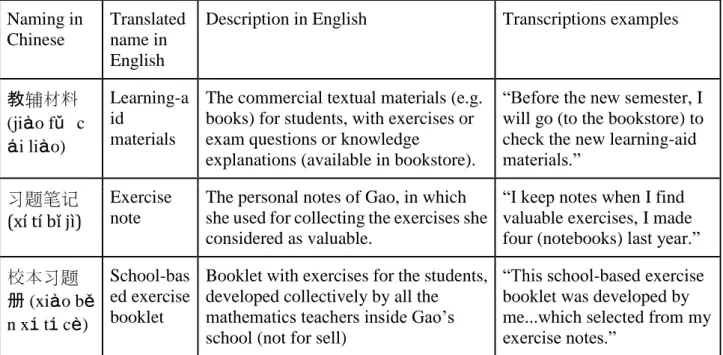
In the Chinese case of Gao, a most frequently mentioned character is “题(tí)”. In Chinese language morphology, word is formed by a combination of characters. In Gao’s interview, by combining with other characters, “题(tí)” forms into words like “习题(xí tí)” (exercise), “试题(shì tí)” (examination/test question), “例题(lì tí)”(example), “问题(wèn tí)” (question/ problem) etc. In Gao’s case, the three selected resources (see in Table 1) are the sources of the “题(tí)”.
Naming in Chinese
Translated name in English
Description in English Transcriptions examples
教辅材料 (jiào fǔ c ái liào) Learning-a id materials
The commercial textual materials (e.g. books) for students, with exercises or exam questions or knowledge
explanations (available in bookstore).
“Before the new semester, I will go (to the bookstore) to check the new learning-aid materials.”
习题笔记 (xí tí bǐ jì)
Exercise note
The personal notes of Gao, in which she used for collecting the exercises she considered as valuable.
“I keep notes when I find valuable exercises, I made four (notebooks) last year.” 校本习题 册 (xiào bě n xí tí cè) School-bas ed exercise booklet
Booklet with exercises for the students, developed collectively by all the mathematics teachers inside Gao’s school (not for sell)
“This school-based exercise booklet was developed by me...which selected from my exercise notes.”
Table 1: Three typical expressions on resource naming by Gao
(1) Learning-aid materials (教辅材料, jiào fǔ cái liào) is a kind of printed and bound materials sold in bookstores, to “aid” learning. It generally contains examples, knowledge explanations and exercises. Gao knew the learning-aide material market well due to her experiences working as an author of a learning-aid book some years ago: “The learning-materials also have life-cycle, and have to be updated regularly”, so she visited the bookstore almost before new academic year, to see if there is anything new in the materials that she was following. She bought lots of learning-aid materials as her self-owned resources, and she had an awareness of following the trends of the learning-aid material markets, selecting and accumulating the valuable ones.
(2) Exercise note (习题笔记, xí tí bǐ jì) is a personal paper-pencil notes of Gao. She kept such habits for several years: after a whole day’s work, she liked to do exercises (e.g. from the learning-aid materials), and keeps the notes of the valuable ones. She also did the category of these exercises according to the contents (e.g. functions) or types (e.g. drawing). The source of the exercises is not limited to the learning-aid materials, but also from Internet. Many big professional websites/forums for mathematics teaching propose their enterprise applications with the popularization of smart mobile phone. Besides these apps, Gao used a social communication application “Wechat”, with which she can discuss and share resources (as file or picture) with colleagues, receive articles about exercises explanation, analysis on knowledge, information about exams, or even videos of other teachers’ lessons. She kept all the valuable information in her notes.
(3) School-based exercise booklet (校本习题册, xiào běn xí tí cè) is a series booklets developed collectively by the mathematics TRG in her school. As a teacher of grade 8, Gao was in charge of the two booklets in her grade. The booklets are sent to students as homework, consisted mainly with exercises, as Gao explained, “most of them were selected from my exercise notes.”
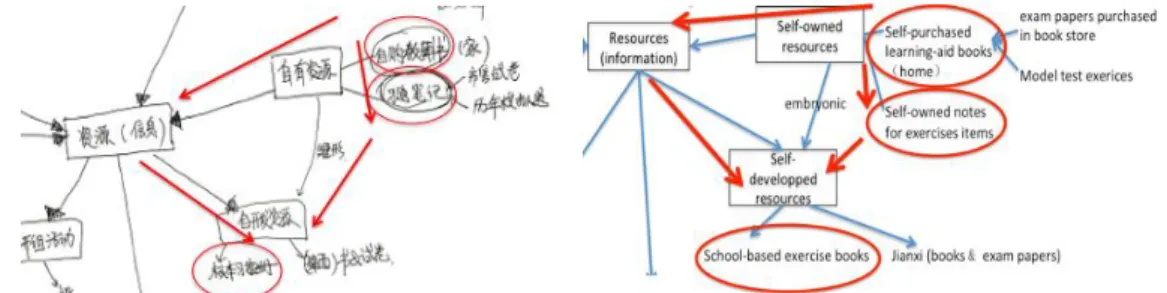
Crossing the three resources, there appears a chain: the learning-aid materials nourish her exercise notes (self-owned resource), which in return “re-source” her exercise booklets (self-developed
resource). This evidenced a kind of “resource cycle” in her resource system (Figure 1 left, the red circiles and arrows were marked by the author according to Gao’s explanation in the interview).
Figure 1: Part of RMRS of Gao (original left, and digital transposition by the researcher right) When situating these resources in Gao’s RMRS, we find the different roles of resources as “input”, “output” and “hub” (evidenced by the arrows). For the inputs, Gao had resources from learning-aid materials, feedbacks from students in their homework; for the output, she developed her self-owned resources into self-developed resources: her personal exercise notes worked as a hub. Gao selected exercises carefully for students, and kept their feedbacks as important resources. This could be referred to her education background (education management): “I pay much attention on students, and try to maintain good relationship with them, they will like mathematics if they like me.”
Selected resources from resource system in the Mexican case of Brenda
Three selected resources of the Mexican case were presented in Table 2. Naming in
Spanish
Translated name in English
Description in English Transcriptions examples
Manual (Versions for teacher/ student)
Textbook School textbook produced by the school, adjusted and improved by the teachers every year.
“Then we [teachers] use a manual, where we all see the same
[contents].”
Diagramas (Figure 2a) / esquemas (Figure 2b)
Diagrams A geometric drawing with which one gets the resolution of a problem, the relationships
between different parts of a set or a system.
"I make diagrams to see what is my objective and what do they need." “Then [at the end] those schemes, I give them copies of the scheme or I give them blank to be filled.” Calendario
escolar
School calendar
Teaching schedule designed institutionally to mark dates of activities at school. It is a reference for planning lessons.
“I need a calendar, because the time is very important; [we have] the normal calendar, the school calendar…”
Table 2: Three typical expressions on resource naming by Brenda
(1) Textbook (manual) is the resource that guides the development of the different topics that are addressed throughout the school year. The elaboration of each textbook (for each of the three secondary degrees) is based on the curriculum (another important resource not analyzed in this study)
of the largest university in the country and to which the school where the interview was conducted is incorporated. The work of (re)elaboration of the textbooks is directed by a coordinator of mathematics (who is also the teacher of the school). However, teachers are free to suggest and contribute any concerns or observations they may have. Table 2 shows how collaborative work guides the activity of teachers in a particular way: “...we all see the same”. In the use of the textbook as a resource, all stages of Brenda's documentation work (review, analysis of resources, adaptation, reorganization, implementation and reflection) are involved. It is also interesting to notice that in Spanish, “manual” refers to something “we have in hands” and something related and available to the usage, whereas quite different with textbooks. The translation makes one lose the meaning-production universe around.
(2) Two resources (diagramas/esquemas) in which Brenda emphasized its use, during the interview, were the use of diagrams/schemes. It is important to note that both words (diagram and scheme) were used by indistinctly to refer to the same resource: diagram (Figure 2). However, the term “scheme” is incorporated to show how the teachers name their resources in relation to their teaching activities. Brenda elaborated the diagrams according to her teaching contents. The diagramas were initially used as a way of learning by Brenda when she was a student. This stage is closely related to the analysis of the textbook (manual), as she pointed out: “I make diagrams to see what my objective is and what they [students] need to know for reaching that goal” (see in Table 2). Then, during the lessons, Brenda incorporated the resource as learning material for the students: “I give them copies of the scheme, or blank ones to be filled.”
Figure 2: Part of RMRS of Brenda (original left, and digital transposition by the researcher right) (3) School calendar (Calendario escolar). In relation to the resources selected from the interview, the use of the textbook and the elaboration of diagrams are closely related to the teaching plan and lesson design. This includes both the textbook that will be addressed in each class and the elaboration of diagrams for each topic. These two resources are organized from a school calendar.
Crossing the three resources within her RMRS (Figure 2), they are all resources for her “lesson”. Brenda did not draw her RMRS centered on “resource” like the Chinese case. However, considering the particularity of the textbook she used, we can still infer that the textbook bridges Brenda’s individual documentation work with her collective work with others: The textbook is developed based on the university curriculum with the involvement of the school teachers, and as a teacher, Benda worked as both user and usage feedbacks provider; To implement the curriculum and textbook, she adapted her personal learning strategy (diagram) into classroom teaching, and diffused it with other teachers through resources related to school calendar (teaching plan).
Discussion and perspectives
Resource system is not easy to be inferred from or interviews. In this paper, we took a method of combining teacher’s naming system and her/his RMRS, with two contrasting cases from different cultural contexts, China and Mexico, to have more elements (theoretical and methodological) to analyze teacher’s resource system. Far more work need to be done for a deeper understanding on their resource systems. Although Gao and Brenda are two very different cases -in terms of their teaching activity and their sociocultural context-, one from public middle school and using national curriculum, and one from private high school using a university curriculum. However, by documenting the name/content/usage as well as their positions in RMRS, we can still find some features that allow us to develop and deepen our further analysis works.
Related to research question (1): In the Chinese case, the resource naming system showed an emphasis on “tí(exercise in English)”, and the three selected resources evidenced its position of central element in the teacher’s resource system, linking both the teacher's personal working habits (taking notes) and the cultural context (exams-emphasized culture and huge learning-aid material markets) of mathematics education. In the Mexican case, the resource naming system evoked an adaption of personal choices (e.g. diagram adapted from learning teaching) and consideration on others’ work (e.g. school calendar), mediated by a collective used/developped/revised manuel (textbook). For research question (2): Crossing the two cases, they are both following a fixed curriculum (national curriculum and local unified textbook in Chinese case, unified curriculum and textbooks produced by the university in Mexican case); they are both trying to integrated the supportive resources (learning-aid materials in Chinese case, disciplinary academic books in Mexican case); they are both organizing their resource work centered on students (selecting exercises from diverse sources and paying attention on their feedbacks in the Chinese case, adapting her own learning strategy, diagram, into classroom teaching in the Mexican case). Additionally, there are school-based resources involving the two teachers in both two cases: the school-based exercises booklets collectively developed by the mathematics TRG in the Chinese case, and the university-curriculum based textbooks developed and revised by the school mathematics teachers in the Mexican case. In the case of Gao, the different terms related to “tí(exercise) reveal a potential resource category from the teacher’s view. In the case of the Mexican teacher, the ambiguity of naming the same resource in two different ways infers a more individual work of the teacher. To summarize, analyzing teacher’ naming systems on resources by actuating it within specific cultural contexts could be a promising method for us researchers to deepen the understanding on teacher’s resource system. Due to the limited space, we were not able to analyze the mathemtics components of their resource system. As a beginning of this exploration, we hope that involving other cases and crossing with other projects will help us to go further in this direction.
References
Adler, J. (2000). Conceptualizing resources as a theme for teacher education. Journal of Mathematics
Teacher Education, 3(3), 205–224.
Bowman, M., Debray, S. K., & Peterson, L. L. (1993). Reasoning about naming systems. ACM
Clarke, D., Mesiti, C., Cao, Y., & Novotna, J. (2017). The lexicon project: examining the consequences for international comparative research of pedagogical naming systems from different cultures, In T. Dooley, & G. Gueudet (Eds.) . Proceedings of the Tenth Congress of the
European Society for Research in Mathematics Education (CERME 10, February 1–5, 2017)
(pp. 1610–1617). Dublin, Ireland: DCU Institute of Education and ERME.
Cole, M. (1996). Cultural psychology: A once and future discipline. Cambridge: MA: Harvard University Press.
ngestr m, Y. (2001). Expansive learning at work: Toward an activity theoretical reconceptualization. Journal of Education and Work, 14(1), 133–156.
Gitirana, V., Miyakawa, T., Rafalska, M., Soury-Lavergne, S., & Trouche, L. (Eds.) (2018).
Proceedings of the Re(s)sources 2018 international conference. ENS de Lyon,
https://hal.archives-ouvertes.fr/hal-01764563
Gueudet, G., & Trouche, L. (2009). Towards new documentation systems for mathematics teachers?
Educational Studies in Mathematics, 71(3), 199–218.
Gueudet, G., Pepin, B., & Trouche, L. (2013). Collective work with resources: an essential dimension for teacher documentation. ZDM - Mathematics Education, 45(7), 1003–1016.
Pepin, B., & Gueudet, G. (online first). Curriculum resources and textbooks in mathematics education. In S. Lerman (Ed.), Encyclopedia of Mathematics Education. New York: Springer.
Pepin, B., Xu, B., Trouche, L., & Wang, C. (2016). Developing a deeper understanding of mathematics teaching expertise: Chinese mathematics teachers’ resource systems as windows into their work and expertise. Educational studies in Mathematics, 94(3), 257–274, http://rdcu.be/koXk
Remillard, J.T., Van Steenbrugge, H., & Bergqvist, T. (2014). A cross-cultural analysis of the voice of curriculum materials. In K. Jones, C. Bokhove, G. Howson, & L. Fan (Eds.), Proceedings of the
International Conference on Mathematics Textbook Research and Development (ICMT–2014)
(pp. 395–400). Southampton: University of Southampton.
Trouche, L. (to be published). Evidencing missing resources of the documentational approach to didactics. Towards ten programs of research and development for enriching this approach. In L. Trouche, G. Gueudet, & B. Pepin (Eds.). The ‘resource’ approach to mathematics education. Springer.
Trouche, L., Gueudet, G., & Pepin, B. (online first). The documentational approach to didactics. In S. Lerman (Ed.), Encyclopedia of Mathematics Education. New York: Springer.
Vygotsky, L. S. (1978). Thought and language. Cambridge: MIT Press.
Wang, C. (2018). Mathematics teachers’ expertise in resources work and its development in collectives. A French and a Chinese Cases. In L. Fan, L., Trouche, C. Qi, S. Rezat, & J. Visnovska (Eds.), Research on Mathematics Textbooks and Teachers’ Resources: Advances and issues (pp. 193–213). Cham: Springer.