A Computational Linguistic Analysis of Bangla
bv
Zeeshan Rahman Khan
Submitted to the Department of Electrical Engineering and
Computer Science
in partial fulfillment of the requirements for the degrees of
Master of Engineering
and
Bachelor of Science in Computer Science and Engineering
at the
MASSACHUSETTS INSTITUTE OF TECHNOLOGY
June 1995
©
Zeeshan Rahman Khan. MCMXCV. All rights reserved.
The author hereby grants to MIT permission to reproduce and
distribute publicly paper and electronic copies of this thesis
document in whole or in part. and to grant others the right to do so.
.i',SSACHUSETTS INSiSTITU'TE OF TECHNOLOGY
AUG 101995
haaer N
Author
.-...
LIBRARIESDepartment of Electrical Engineering and Computer Science
_
Ma 26, 1995
Certified
by ....
,...
-..
..
r.
.
...
...
Robert C.Berwick
Professor of Computer Science and Engineering and Computational
,(
,f
k
heLinguistics
I' \
^
~
~J/----__
I) hesis Supervisor
Accepted
by ... - ...
A Computational Linguistic Analysis of Bangla
by
Zeeshan Rahman Khan
Submitted to the Department of Electrical Engineeringon May 26, 1995. in partial fulfillment requirements for the degrees of
Master of Engineering and
Bachelor of Science in Computer Science and
and Computer Science of the
Engineering
Abstract
The 'Government and Binding'(GB) framework developed by Noam Chomsky and others describes the grammars of different human languages in terms of universal, atomic principles and language specific parameters. In this thesis, I describe the design and implementation of a parser that analyzes a range of Bangla sentences according to these universal principles. The system was built on the Pappi principles-and-parameters interface system, and it successfully handles leftward and rightward scrambling, anaphor binding, quantifier raising, and clausal extraction. I discuss the issues and difficulties faced in implementing such a parser, comparing it against other possible implementations. I also discuss the potential for using it as the front-end for a Bangla-English translator.
Thesis Supervisor: Robert C.Berwick
Acknowledgments
I would like to express my gratitude to my supervisor Professor Robert Berwick for giving me the opportunity to explore the computational linguistic phenomena of my native language Bangla. I would also like to thank Sandiway Fong for helping me with the implementation on his Pappi development system. I would like to specially thank my wife Fahria for putting up with my late hours at the AI Lab. And last but not least I would like to thank my father, mother and brother, without whose encouragement I would never had made it through five years at MIT.
Contents
1 Introduction
-1.1 The Principles and Parameters framework
1.2 'Government and Binding Theory ... 1.2.1 X-bar theory ... 1.2.2 Case Theory ... 1.2.3 Movement . . . . 1.2.4 Binding Theory ... 1.2.5 Other Theories ... 2 Implementation 2.1 P & P parsers ... 2.1.1 Pappi . . . . 2.1.2 Other parsing approaches ... 2.2 Bangla in the p & p framework ...
2.2.1 Parameters . . . . 2.2.2 Lexicon . . . .
3 Bangla
3.1 Bangla linguistic phenomena ...
3.1.1 Scrambling . . . . 3.1.2 Quantifier Raising ... 3.1.3 Clausal Extraposition ... 3.1.4 Semantic Filtering. 8 9 11 11 13 13 14 .15 17 17 18 18 20 20 26 27 27 27 36 37 39
...
...
...
...
...
...
...
...
...
...
3.1.5 Questions . . . ... 40
4 Conclusion 42
4.1 Remaining Problems and Limitations ... 42 4.2 Future Work ... 43 A Tables 45 B Figures 47 C Code 49 C.1 parametersBangla.pl . . . ... 49 C.2 lexiconBangla.pl .. ... ... 51 C.3 peripheryBangla.pl ... 62
List of Figures
1-1 Scrambled sentences.1-2 Phrase Structure Representation ....
2-1 2-2 2-3 :2-4 '2-5 2-6 3--1 3-2 3-3 3-4 3-5 3-6 3-7 3-8 3-9 3-10 3-11 The pappi interface ... Non-configurational parses ... Case assignment for scrambled objects Pro drop example ... Wh-question example ... Preposition stranding example. VP internal scrambling ... Medium distance scrambling ... "Bob John-er maa-ke taake dekhalo". "John-er maa taake bhalobashe" ... Rightward Scrambling ... Anaphor Binding ... No weak-crossover effect in scrambling ... Implementation of Quantifier Raising in Bangla Clausal Extraposition with overt complementizer Clausal Extraposition with empty complementizer Wh-questions and Binding ... 13-1 The Bangla Font implementation 8 12 . . . .19 . . . . ... .. . . . .21 . . . .. . -... . . . 23 . . . .. 24 . . . .24 . . . 25 28 29 31 32 34 35 36 38 40 41 41 48
List of Tables
2.1 GB Parameter Settings for Bangla, Japanese, English,French and Dutch 21
A.1 Run-time for parses:simple scrambling examples ... 45 A.2 Run-time for parses:general examples ... 46 A.3 Run-time for parses:detailed scrambling examples . . . 46
Chapter 1
Introduction
The word order of sentences in Bangla or Hindi is more flexibile than corresponding sentences in English, Japanese or Korean. For example, in English. there is not much flexibility in the word-order of the sentence 'She loves Karim'. But in Bangla, all six permutations of the three words of the corresponding sentence 'shey karim-ke bhalobashe' are acceptable. This thesis describes a parser implementation that can correctly and efficiently identify and parse this kind of free word order or scrambling in Bangla sentences. Figure 1-1 is a preview of our Bangla system, and it shows parses of three of those six derivations of the basic Bangla sentence.
Iarsing: bhalobashe shey karim-ke LF (1): CZ C 12 12 NP[2] 12 NP[1] Ff49 NPt-A-P[1] 11 R3 karim VP I(AGR)t[l] shey NPt-A-P[2] V[3] I(AGR)[1] V[3] bhalobashe One oarse found
Parsing: karim-ke shey bhalobashe LF (1):
C2 C 12 NP[1] 12 7' ~ NP[2] 11
karim t ~gkarim I VP I(AGR)t[Z]
hey NPt+A-P[1] V[3] I(AGR)[Z] V[3]
ff lt T1
~t9EI
bhalobashe One parse foundParsing: shey karim-ke bhalobashe LF (1): C2
A
C 12 NP[1] 11 :C VP I(AGR)t[l] shey NP[2] V[3] ta{r- I(AGR)[1] V[3] karim I 1 t1 ; 1 t t bhalobashe One parse foundFigure 1-1: Scrambled sentences
trend where different human language grammars are described in terms of just a few universal principles and language-specific parameters. It accomplishes this by outlining a parametrized description of Bangla and then using that description to
parse Bangla sentences. A detailed specification of grammar rules is not necessary, but with only a few parameter settings, simple Bangla sentences can be parsed. A few extra rules are needed to handle free word order. This is because we have to ensure the correct parsing of sentences that involve the interaction of scrambling with other components of grammar. To understand these interactions and more specifically how the Bangla parser implementation successfully handles interactions with different syntactic binding conditions, I shall start out by describing in this chapter the Government and Binding' theory. This is the theory that specifies the different grammar components in the principles-and-parameters (p & p) framework. In Chapter two of this thesis, I will go over the p & p approach from a computer implementation point of view and show how it is implemented in Sandiway Fong's 'Pappi'[Fon94] system. In this chapter, I will also give an overview of the parameter specifications for Bangla and compare these parameters with the settings for other languages such as French and Japanese. In Chapter Three I will describe specific
Bangla syntactic phenomena, and explain how my system handles sentences with these kinds of phenomena. Chapter Four concludes by outlining the prospects of implementing a translator based on the Bangla parser.
1.1 The Principles and Parameters framework
When we examine sentences from different languages, at. first glance it might seem that there is a vast difference between each of these languages. But, for simple sentences from different languages, other than using a different set of words, the main differences seems to be the word order:
(1) (i) Bangla: (Subject-Indirect Obj-Direct Obj-Verb)
Hasina Karim-ke ek-ti boi dilo Hasina Karim-dat one book gave
"Hasina gave Karim a book." (ii) Hindi: (Subject-Obj-Verb)
raam-ne kelaa khayaa
raam banana ate Ram ate a banana.
(iii) Korean: (Subject-Indirect Obj-Direct Obj-Verb)
Sunhee-ka Youlee-eykey [chayk hankwen]-ul senmwulhayssta Sunhee-nom Youlee-dat [book one-volume]-acc gave-a-present
"Sunhee gave Youlee a book as a present."
(iv) Japanese: (Subject-Indirect Obj-Direct Obj-Verb) Mearii-ga taroo-ni sono hon-o watashita Mary-nom Taroo-DAT that book-ACC handed "Mary handed that book to Taroo."
(v) Dutch: (Verb second in matrix clause, but verb final in embedded clauses)
* Hilde verslaat Adje Hilde defeats Adje Hilde defeats Adje.
* Ik weet dat Janneke de auto probeert te naderen I know that Janneke the car tries approach
I know that Joanne tries to approach the car.
(vi) French (Subject-object-verb)
I1 lit le livre He reads the book He reads the book
English and French sentences have the subject-verb-object order, while languages like Bangla and Japanese exhibit subject-object-verb order. We can see that if we know what each word means in a new language and if we know the word-order in that language, we should be able to understand and compose the simplest sentences in the language. In other words, we can describe the grammars for simple sentences in
different languages just by describing a general principle: sentences contain subjects, objects and verbs". Of course. we also need to specify the parameter 'word-order' for a particular language - whether the order of the sentence elements specified in the principle is 'subject-object-verb' or 'subject-verb-object'. etc.
This is the main idea behind the principle-and-parameters framework. The logical next step is to ask whether this approach can be extended to cover more and more complicated sentences of different languages. The 'Government and Binding'(GB) theory, developed by Chomsky and others, answers the quesion by allowing the anal-ysis of a wide range of sentences from different languages using relatively few principles
and parameters.
1.2 'Government and Binding Theory'
Government and Binding (GB) theory[Cho8la, Cho8lb] describes the knowledge of language grammars as an interlocking set of subtheories, consisting of a universal component and a language-specific component. The universal component contains principles that are shared among all languages in the world. The language-specific component consists of a lexicon and a set of parameter settings; so the difference between language grammars stem from parametric settings of universal principles within highly constrained limits.
Here I will not go into many details of the GB theory. Rather, I shall briefly survey the subtheories on different universal principles, which are relevant to understanding the analysis of Bangla.
1.2.1 X-bar theory
X-bar theory describes how the syntactic structure of a sentence is hierarchically
formed by successively smaller units called phrases. In natural languages, every phrase contains a head word. The head of a noun phrase(NP) is a noun(N), and the head of a verb phrase(VP) is a verb(V). The head is a single word that determines the main characteristics of the phrase and how the phrase as a whole can be use. For
example, in the NP 'the big tower by the Thames'. the head word is 'tower'. X-bar theory outlines the universal constraint that all phrases are headed. The associated parameters are whether a language is head-final or head-initial. For example, since japanese verb phrases end with a verb. it is a head-final language, but english is a head-initial language. The X-bar theory states that phrases must adhere to the following schema in their structure:
1. XP - YP Xbar where YP is called the specifier of X. 2. Xbar - Xbar YP where YP is called an adjunct of X
3. Xbar - X YP1 ... YPk where YPi's are called the complements of X
C2 C 12 NP[1] 11 DET Ni I(AGR)t[l] VP I _ the A N V[2] C2
clever boy V[2] I(AGR)[1] C 12
I I_ said that NP[3] 11 I john I(AGR)t[3] VP VP PP V[4] I(AGR)[3] P NP[5] I I I
talked about mary
Figure 1-2: Phrase Structure Representation
For example, in the phase-structure representation for the sentence 'The clever boy said that John talked about Mary' in Fig 1-2,the determiner 'the' and the adjective 'clever' are specifiers in the first noun-phase. The prepositional phrase 'about Mary' is an adjunct to the inner verb phrase which has the head 'talked'. The clause marked by 'C2' - 'that John talked about Mary' is the complement of the verb 'said'. A clause consists of a complementizer, such as, 'that' followed by a sentence 'I2'. The head of 12 is the node marked as 'I' in the parse-tree. 'I' represents an inflectional element which indicates the tense or verbal inflection aspects of a sentence. There are two types of the inflectional phrases(IP) marked as 'I12' here. A finite IP is headed
by an 'I' with tense, while an infinite IP is 'tenseless'. An example of an infinite IP is the infinitive 'to go' in I don't want to go". In GB theory, the sentence subject is considered to be the specifier of I', but for infinite IPs it is postulated that an empty category 'PRO' occupies the subject position. GB theory differentiates between the specifier, complements and other positions in a parse-tree. The specifier of IP and the verb-complements are known as A-positions(argument positions) while all other positions are A'-positions(non-argument positons).
1.2.2 Case Theory
A case is an attribute of a noun or pronoun that indicates the type of position occupied by it. In English, the four cases are Nominative for subjects, Accusative for objects,
Genitive for nouns expressing possession, and Oblique for complements of prepositions.
There might be other cases in other languages, for example, in Japanese, the Dative case is used to express indirect objects. Case can be morphologically manifested, e.g. in English, from the form of the noun 'John's', it is obvious that it has genitive case. But other cases are assigned structurally by case assigners, such as active verbs, and prepositions. The Case Theory requires that every overt NP be assigned an abstract case. The Case Filter rules out sentences containing an NP with no case.
1.2.3
Movement
1. I read the book.
2. The book was read by me.
For sentences as above where the meaning is essentially the same, but the surface structure is different, GB theory exposes the similarity through an underlying
struc-ture called the D-strucstruc-ture. In the underlying D-strucstruc-ture' for the second sentence
above, 'the book' is in the complement position of the verb 'was read'. It moves to the subject position from its base position so that it can be assigned 'nominative'case.
This is because the passive verb 'was read' cannot assign case to its complement. In general, in GB theory the rule Move-c specifies that any element can be moved anywhere. Whether a particular movement is allowed depends on other constraints in the grammar. One of these constraints is the Structure Preserving Principle: 'The result of a movement must satisfy the X-bar schema'. When a head moves out of its base position, it leaves an empty element, a trace, behind. GB theory specifies a
special syntactic relationship that must hold between the moved head(the antecedent)
and the trace it left behind: the trace must be 'governed' by the antecedent.
There are two common types of movements: WH-movements and NP-movements[LD94]. 1. Whol does Kim like tl?2
2. Kiml was defeated tl.
In the first sentence. a WH-question, the initial trace is case-marked, while in the passive construction of the second sentence, the initial trace is not case-marked. 'Kim' had to move to the subject position to get case. The first sentences is an instance of WH-movement while the second one is an instance of NP-movement. In WH-movement, a wh-element moves to an position, which is an instance of A'-movement, while NP-movement is an instance of A-movement.
1.2.4
Binding Theory
In the example sentences above there are coreference relationships between traces and NPs. Binding theory is concerned with this kind of coreference relationship of Noun Phrases. Binding is a special structural relationship in a parse tree for a sentence. And the principles of binding apply to a specific part in a parse-tree - the 'binding
domain' or 'the governing category'. The three principles outlining binding conditions
for NPs are as follows:
1. Condition A: An anaphor3 must be bound in its governing category.
2Here t stands for trace and the subscript shows the co-reference relationship. In this case 'who'
and the person Kim likes, stands for the same person.
3The term anaphor covers reflexives, such as 'himself','herself' and reciprocals, such as 'each
2. Condition B: A pronoun must be free in its governing category.
3. Condition C: An R-expression4 must be free everywhere.
1.2.5 Other Theories
Other than these three theories that are directly pertinent to understanding the Bangla implementation, I will just briefly mention some of the other subtheories
of GB theory[vdA93].
1. The Projection Principle requires that all the levels of syntax should observe the specifications for each lexical item given in its entry in the lexicon.
2. Bounding Theory prevents the relationship of movement from extending too far
in the sentence.
3. Control Theory deals with the subject of infinitival clauses, i.e, the properties
of 'PRO's.
4. 0-theory deals with the assignment of semantic-roles (0-roles) to elements in the
sentence
.5. The Phonetic Form (PF) Component interprets the surface-structure to
repre-sent is as sounds
6. The Logical Form (LF) Component represents the sentence as syntactic
mean-ing, one aspect of semantic representation
In general, every principle included in the theories above makes a statement about the (un) grammaticality of a sentence. The interaction of all these principles gives an overall judgement of the grammaticality of a sentence. If these constraints succeed in assigning a legal structure to the sentence, the sentence is considered grammatical; otherwise, it is considered somehow deviant. A sentence that can be assigned more
4
Referential(R) expressions are all the other NPs except for anaphors and pronominals that select a referent from the universe of discourse[Hae91],e.g, Kim, the boy.
than one structural representation fulfilling all the requirements set by the principles, is considered syntactically ambiguous.
Chapter 2
Implementation
Now that we know how GB theory and the principle-and-parameters framework works, the next question is how this framework can be used to build parsers for natural languages. We also need to know how Bangla fits in the p & p framework so that the Bangla language can be implemented in a principles-and-parameters based parser. This chapter addresses these two questions.
2.1 P & P parsers
Currently there are few parser implementations available that have been built around the principles-and-parameters framework. Among the the most notable are Dekang Lin's Principar, Bonnie Dorr's Unitran. and Sandiway Fong's Pappi. Unitran is a p & p based translation system implemented in LISP, while Principar is implemented in C++ and based on a message-passing algorithm. Pappi, implemented in Prolog, is the most easily extensible of these three systems. with over eight languages already implemented on the system 1. Its prolog implementation of the GB theory principles is the closest among the three parsers to a plain English description of the GB principles. Also it comes with a user-friendly customizable interface. Although a potential future goal of my work is machine translation of Bangla, because of the modular nature of
'As of now, Japanese, Korean, Dutch, US English, Hindi, Bangla, Spanish, French, and German have been implemented on Pappi
the principles in Pappi, and the accumulated experience in implementing different languages on the system, I opted for Pappi as the platform to implement the Bangla parser.
2.1.1 Pappi
Pappi can be viewed as a kind of direct translation of GB Theory into a principle and parameter based parser. The parser is true to the principles and parameters approach of the underlying theory[vdA93]. This is evident from figure 2-1 which shows the interface to the Pappi system. The input is typed in the space on top, and a tree representation is printed out in the output panel. On the left panel, we can see a number of principles, which are applied to derive the output tree.
Pappi uses the generate-and-test approach in parsing. The surface-structure can-didates for input sentences are generated in accordance with the X-bar theory
(gen-erate). Then all the linguistic constraints as described in the GB principles filter out
invalid parses (test). Pappi is implemented in the PROLOG language, and to ensure that the parser parses grammatical sentences, and filters out ungrammatical ones, the GB theory has to be implemented in an accurate and unambiguous way.
2.1.2 Other parsing approaches
We could ask the question, is there a better way of implementing a parser other than the p& p approach? Among the other approaches to parsing human languages, the main one is a rule-based approach. In this approach usually a 'context-free gram-mar' is written to handle different types of sentences[C.B94]. This grammar would include a different set of rules for different types of sentences, such as, passive con-structions, scrambling and wh-phrases. For simple scrambling between subject and verbal complement, the following kinds of rules will be needed:
1. Sentence - Subject NP + Verb + Object NP
Examples ... )
nije-ke karim bhalobashe _
bhalobashe _
Run r) Language r) Theory r) Parsers r) History r) Options r)
Parsing: bhalobashe LF (1): C2 C 12 pro[l] 11 VP I(AGR)t[1] english(love) pro[2] V[3] english(love) I(AGR)[1] V[3] english(love) bhal obashe bhalobashe One parse found
Parsing: Bob john-ke oi bhari chithi-ta dilo LF (1): C2 C 12 NP[1] I1 english(Bob) ,nglih(%ob VP I(AGR)t[1] english(give) bob NP[2] V1 english(John) english(give) NP[3] V[4]
john english(letter) english(give)
DET Ni I(AGR)[1] V[4]
english(that) english(letter) english(give)
A N d
english(heavy) english(letter) dilo
One narse found
bhari chithi
J New Tree Layout option settings are now in effectl
Info... ) Demo ... ) 2 2 4 4 U
i
i
a 2 2 2i
4 4 4 3 3 2 2 2 4 4 2 2 2 2 2 2 2. 2 2 2 2 2i
i
2 2 2 £ 11 104 £04 104 104 11 104 4 4 72 4 8 -4 8 2 2 Filters Theta Criterion-D-structure Theta Condition Subjacency
Wh-movement in Syntax S-bar Deletion
Case Filter
Case Condition on ECs Coindex Subject Condition A Condition B Condition C ECP Control License Clitics License Object pro ECP at LF
Fl: License operator/variables FI: Quantifier Scoping FIl: Reanalyze Bound Proforms License Clausal Arguments License Syntactic Adjuncts Wh Comp Requirement Semantic Restrictions Generators Parse PF Parse S-Structure Assign Theta-Roles
Inherent Case Assignment Assign Structural Case Trace Theory
Functional Determination Free Indexation Expletive Linking
LF Movement
Figure 2-1: The pappi interface
I 11ele II _ ~ ~ ~ ~ ~ ~ ~ ~ ~ ~ ~ ~ ~ ~ ~. .~ ~ ~ ~ ~ II III -- --- - --- ---- --- -- ---- --- - --- --- -- ---- --- __ .... -- r--- --- I I
3. Sentence . Object NP + Subject NP + VP
So we can see a huge amount of very specific language-particular systems of rules are needed to parse different kinds of sentences. Also, no knowledge of linguistics is reflected in the parsing systems. On the other hand, the p & p approach takes advantage of the universality of human language structures. Rather than viewing the grammar as a large set of ad hoc language specific rules, it views the grammar as a modular system of principles. The principles in the p & p approach are compiled into language-specific rules at a lower level. So, this approach abstracts away from unnec-essary details when we are specifying a new language. We need to be aware of the generated rules only for efficiency concerns. For example, in a p & p parser like Pappi, a large number of illicit structures have to be generated to be filtered out by the filter principles. When we design the permutation mechanism for scrambling in Bangla we will have to make sure that we do not have the problem of over-generation[BF92].
2.2 Bangla in the p & p framework
Before I explain my implementation of Bangla scrambling, I will describe the overall Bangla implementation. To incorporate Bangla into the p & p framework of Pappi, other than specifying relevant parameter settings, I needed to build a lexicon with Bangla lexical entries, and make enhancements to the universal principles in Pappi to handle phenomena specific to Bangla.
2.2.1 Parameters
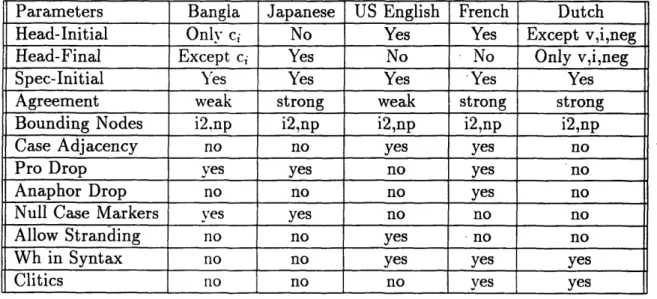
Table 2.1 shows parameter settings for Bangla and compares the settings to those of Japanese. U.S. English, French, and Dutch.
The reasoning and explanation of these parameter settings is outlined below.
Head position
Bangla is a SOV language, i.e, the default word order in Bangla sentences is subject-object-verb. Sengupta[Sen90O] establishes this by first proving the parses of Bangla
Table 2.1: GB Parameter Settings for Bangla, Japanese,
Parameters Bangla Japanese US English French Dutch
Head-Initial Only ci No Yes Yes Except v,i,neg
Head-Final Except ci Yes No No Only v,i,neg
Spec-Initial Yes Yes Yes Yes Yes
Agreement weak strong weak strong strong
Bounding Nodes i2.np i2,np i2,np i2,np i2,np
Case Adjacency no no yes yes no
Pro Drop yes yes no yes no
Anaphor Drop no no no yes no
Null Case Markers yes yes no no no
Allow Stranding no no yes no no
Wh in Syntax no no yes yes yes
Clitics no no no yes yes
sentences to be not flat as in Figure 2-2 but configurational or tree-structured as in Figure 1-1. He shows that among all the different scrambled permutations of Bangla sentences only one is base-generated and the other parse-trees are created from the
deep structure representation by applying the move-a rule2 [Sai85].
IP NP John's mNzhr V loves NP
Figure 2-2: Non-configurational parses
We pick out the SOV order as the base-order and the other ones as moved/scrambled structures because this way we can capture the most common types of sentences as the principle structure, and the others as derived ones. This assignment fits with the universal descriptions of different languages. Asian languages with similar syntactical
2
ref: described in chapter 1.2.3
properties as Bangla, such as, Japanese, Korean, and Hindi are all Head-Final SOV languages. More importantly, making head-final the base-case and other examples derived-cases, facilitates the parsing of Bangla sentences despite the constraints im-posed by other GB principles. We have to remember that at the base-position in the D-structure, different binding conditions and GB principles must hold. For this reason, we cannot take the object-subject-verb ordering as the default because in this configuration the verb cannot govern its complement. the object. The subject in the middle blocks the governing relationship.
We could have probably adopted a description of Bangla grammar that closely reflected that of English. In this representation, sentences like 'shey bhalobashe karim-ke' with subject-verb-object ordering would be considered base-generated and the parameter Head-Initial would be set to true, so that verbs heading verb-phrases would begin VPs. But if we do this, there would be no uniformity in the way we treat different sentence elements. In Bangla prepositional phrases, such as, 'tomar jonno'3 the prepositions follow their complements. So PPs are compulsorily
Head-Final. With all these reasons in mind, I set the Head-Final parameter to be true for Bangla. But as we shall see in the next chapter we can not ensure total uniformity. In the case of complementizers ('c') in clausal constructions, 'c' has to be head-initial.
Specifier Position
Most languages are spec-initial as shown in the table above. Although Bangla sub-jects(specifier of IP) can appear in any position in scrambled sentences, the concern of universality led me to specify the position of Bangla specifiers as 'initial'. This was done also to preserve uniformity. In Bangla noun phrases the determiners precede the noun. For example, in the noun-phrase 'oi boi' (that book)4 the determiner(a specifier) precedes the noun(the head, in this case).
3'tomar jonno' = 'for you'. Preposition: 'jonno' = for; Complement: 'tomar'=your
4
Agreement
Unlike Japanese, French and Dutch. but similar to English, Bangla has weak agree-ment between the verb and the subject NP. This stems from the fact that only two parameters affect subject-verb agreement in Bangla: person and status[Kla81]. Bangla has auxiliary verbs, just as in English, and the movement of lexical verbs in not allowed in Bangla, as in Dutch[Hae91, page 602].
Case Adjacency
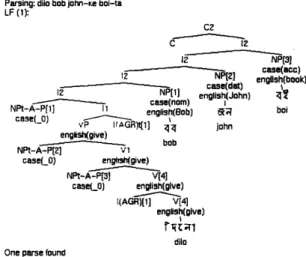
An NP doe not have to be adjacent to a case assigner in a Bangla sentence. This is in general true for scrambling languages. Figure 2-3 shows an example scenario when object NPs are scrambled out of the VP. In the sentence 'dilo bob john-ke boi-ta' meaning 'Bob gave John the book', the subject Bob is in between the case assigner verb 'dilo' and the two objects. But the object NPs are still assigned case by the verb.
Parsing: dilo bob john-re boi-ta LF (1): CZ C 12 12 NP[3] case(acc) 12 NP[() engllsh(book) case(dat) 12 NP[1J english(John) 4 case(nom) I NPt-A-P[I] I1 english(Bob case(_) enlisho]v vP IrGR)t[1] 4 john englishgive)
__
bob
NPt-A-P[2] vi diloOne parse found
Figure 2-3: Case assignment for scrambled objects
Pro-Drop
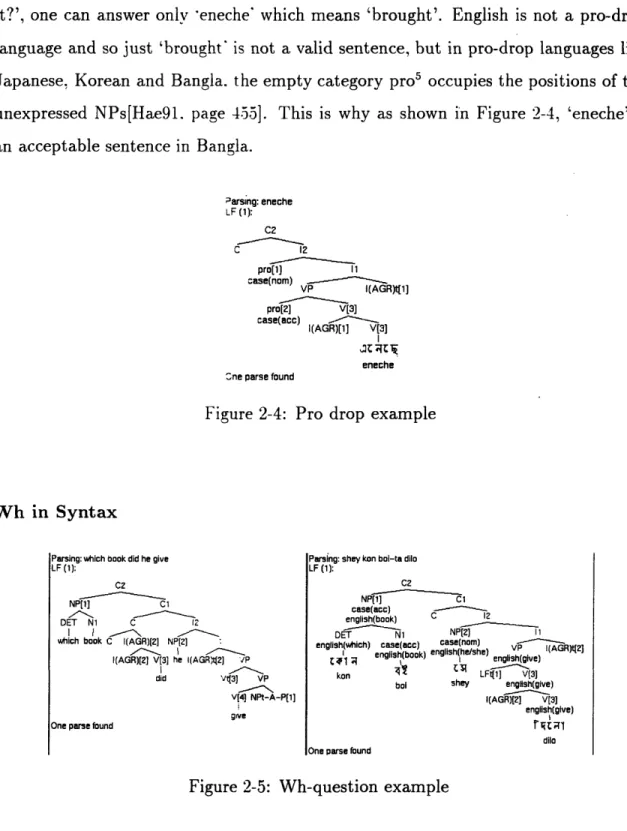
In Bangla, a pronominal subjecthtor be left unexpressed depending on the context of utterance. For example. in response to the question, 'Has he brought
it?', one can answer onlv eneche' which means 'brought'. English is not a pro-drop language and so just 'brought' is not a valid sentence, but in pro-drop languages like Japanese, Korean and Bangla. the empty category pro5 occupies the positions of the
unexpressed NPs[Hae91. page 455]. This is why as shown in Figure 2-4, 'eneche' is an acceptable sentence in Bangla.
arsing: eneche LF (1): C2 C 12 pro[1] I1 case(nom) VP l(AGR)t[1] pro[Z] V[3] case(acc) I(AGR)[1] V[3] eneche
.ne parse found
Figure 2-4: Pro drop example
Wh in Syntax
Parsing: which book did he give LF (1):
CZ
NP[I] C1
DET N1 C 12
I I _
which book C I(AGR)[2] NP[Z]
I(AGR)[2] V[3] he I(AGR-2] VP
did V1I3] VP
V[4] NPt-A-P[1]
give
One parse found
Parsing: shey kon boi-ta dilo
LF (1): CZ NP[1] C1 case(acc) english(book) C 12 DET N1 NP[Z] I
english(which) case(acc) case(nom)
english(book) english(he/she) VP english(give)(AGRt2]
kon LFt[1] V[3
bol shey english(give)
I(AGR)[2] V[3]
english(glve)
dilo
One parse found
Figure 2-5: Wh-question example
Figure 2-5 compares English wh-questions with Bangla wh-questions. In English,
at the surface structure level. the wh-question word has to move to the beginning of the sentence. But in Bangla and Japanese, in the surface structure. the wh-question
5
word can be situated at the base-position. Only at the logical form level, discussed in section 1.2.5. does the question word have to move to the beginning of the sentence. This is because Bangla is a wh-in-situ language[Hae91, pages 501-503].
Stranding
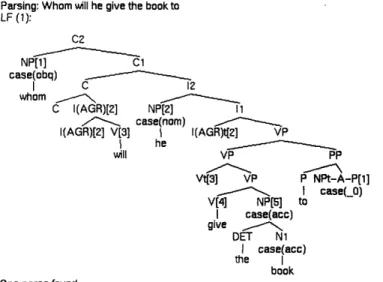
In English wh-questions, a wh-phrase can move out of a prepositional phrase leaving the head of the PP behind. In this kind of preposition-stranding, case assignment has to look at the other end of the antecedent-trace chain to assign (oblique) case. This is shown in Figure 2-6. But preposition-stranding is not allowed in Bangla (sentence i2ii) is unacceptable in Bangla) and so the parameter is set accordingly.
Parsing: Whom will he give the book to LF (1): C2 NP[1] C1 case(obq) I C 12 whom -C I(AGR)[2] NP[Z2] 11 case(nom) I(AGR)[Z2] V[3] i I(AGR)t[2] VP I he will VP PP Vt[3] VP P NPt-A-P[1] I case(_o) V[4] NP[S] to I case(acc) give \ DET Ni I case(acc) the I book One parse found
Figure 2-6: Preposition stranding example
(2) (i) noyon kon des theke eymatro fireche? noyon which country from just-now returned Which country has Noyon just returned from?
(ii) *[kon des]i noyon t theke eymatro fireche? which country Noyon from just-now returned
Other parameters
Unlike French, anaphors cannot be dropped in Bangla. For example. in the following sentence the anaphor 'nije-ke' or 'poroshpor-ke' cannot be dropped.
(3) (i) shey nije-ke bhalobashe
he/she himself/herself loves
"'He/She loves himself/herself". (ii) taaraa poroshpor-ke bhalobashe
they each-other love "They love each other".
Also in Bangla, there are no clitics as in French, and as in most other languages the bounding nodes for movement are i2 and np[Hae91, page 402].
2.2.2 Lexicon
Other than specifying the relevant parameters, I built a lexicon of about a hun-dred entries. This included proper names, common nouns, adjectives, prepositions, adverbs, markers and verbs. In the specification of verbs, the respective argument structures had to be specified, so that the parser would know what arguments each verb would require. Also, information about what kind of semantic properties should be associated with the agent performing a verb was included to facilitate semantic filtering6. Different case-markers were specified for the different cases, such as: '-ke' for the dative and accusative case, and '-re' or '-er' for the genitive case. In Bangla the two determiners 'ta' and 'ti', which are similar to the articles 'a','an' and 'the' in English, append to the end of NPs. These were specified as markers also. but only as markers that do not assign any case.
Chapter 3
Bangla
In this chapter we will take a closer look at Bangla and present an overview of the syntactic phenomena associated with this language. I will give an overview of the analyses proposed in the literature to account for these phenomena. As we shall see, for some of the phenomena, the analyses are not sufficient and as a result we came up with alternative analyses. These alternative analyses will help me explain the last step of the Bangla implementation - enhancements to the universal principles in
Pappi.
3.1 Bangla linguistic phenomena
In general, the grammar rules for Bangla are similar to that of Japanese and Hindi. All of these languages exhibit scrambling of noun-phrases consisting of nouns, adjec-tives, and determiners, etc. But unlike Japanese, Bangla sentences exhibit clausal extraposition, rightward scrambling, PP and adverbial scrambling, etc., which are distinct linguistic properties. Bangla language sentences also exhibit standard behav-ior such as, quantifier raising, and wh-questions. We begin the discussion of these phenomena with an overview of scrambling.
3.1.1
Scrambling
1. Short-distance (VP-internal) scrambling:
(4) (i) John Karim-ke boi-ta dilo John Karim book gave John gave Karim the book. (ii) John boi-ta Karim-ke dilo
John book Karim gave John gave Karim the book.
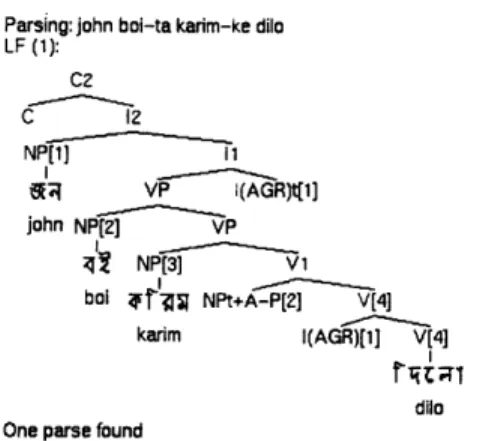
In the second sentence above the direct object 'boi' scrambles inside the VP towards its left as shown in figure 3-1. This kind of short-distance scrambling occurs when the complements in a verb-phrase are scrambled.
Parsing: john boi-ta karim-ke dilo LF (1): C2 C 12 NP[1] II1 HER VP I(AGR)t1] john NP[2] VP by NP[3] VT 1 bolt T;f5 NPt+A-P[2] V[4] karim l(AGR)[1] V[4] dilo
One parse found
Figure 3-1: VP internal scrambling
2. Short (or medium) distance scrambling to IP:
(5) (i) John Karim-ke boi-ta dilo John Karim book gave John gave Karim the book. (ii) boi-ta John Karim-ke dilo
book John Karim gave (iii) Karim-ke John boi-ta dilo
Karim John book gave (iv) Karim-ke boi-ta John dilo
(v) boi-ta Karim-ke John dilo book IKarim John gave
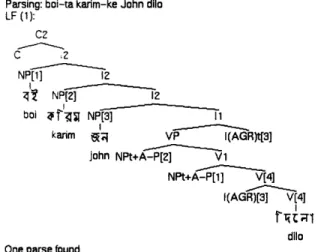
As we can see in the last four examples above, the VP-internal arguments can scramble leftward and adjoin IP at any possible order. The last two sentences are examples of multiple scrambling: more than one noun phrase belonging to the same verb's argument structure is moved. This movement is shown explicitly in the parse-tree output in Figure 3-2. In this figure we can see that both 'boi' and 'karim' has scrambled to the left of 'john',the specifier of IP.
Parsing: boi-ta karim-ke John dilo LF (1): CZ C 2 NP[1] 12 B NP(2] 12 boi NP[] 11 kanrim ;; VP I(AGR)t[3] john NPt+A-P[2] V1 NPt+A-P[1] V[4] I(AGR)[3] V[4] dilo One parse found
Figure 3-2: Medium distance scrambling
3. Long-distance scrambling:
(6) (i) bob bollo je john karim-ke boi-ta dilo Bob said that John Karim book gave Bob said that John gave Karim the book. (ii) * boi-ta bob bollo je john karim-ke dilo
book Bob said that John Karim gave (iii) * karim-ke boi-ta bob bollo je john dilo
Karim book Bob said that John gave
The last two sentences above show that scrambling cannot cross clausal bound-aries. If either or both of the VP-internal arguments of the internal clause'
scramble out to the front of the sentence, it produces unacceptable sentences. This is unique to Bangla, in Japanese or Korean, there can be long-distance scrambling.
These scrambling processes exhibit interesting results when considered in con-junction with other GB principles. We shall consider the interactions with different Binding Conditions. the weak-crossover effect and anaphor binding.
Interaction with Binding conditions
(7) (i) bob taake john-er maa-ke dekhalo
Bob him/her John's mother showed
Bob showed him John's mother. (ii) taake bob john-er maa-ke dekhalo
him/her Bob John's mother showed
(iii) bob john-er maa-ke taake dekhalo
Bob John's mother him/her showed
(iv) john-er maa-ke bob taake dekhalo John's mother Bob him/her showed
All the sentences above have two different senses. Since the marker assigning dative and accusative case2 in Bangla is the same ('-ke'), the sentences have two senses: 'Bob showed to him John's mother' and 'Bob showed him to John's mother'. For this reason, we get two parses for the first sentence above. But for the third sentence as shown in figure 3-3 there are a total of four parses. This is because in parse 1 and 3 in the figure, 'John' and 'him' refer to the same person. But in parse 2, Bob shows John's mother to some person other than John, and in parse 2, Bob shows some other person to John's mother. This we know by the numbers associated with the NPs in the parse-tree. If they are equal, then they refer to the same person. The same kind of situation happens for sentence (7iv) above. The explanation of the different number of parses lies in the interaction of scrambling with Binding Condition C described in section 1.2.4. In sentence (7i) and (7ii) the pronominal
Parsing: bob john-er maa-ke taake dekhalo LF (1): CZ C 12 NP(I] jI casenom) VP I(AGR)t[ 1] NP[2 VP bob case(acc) ---NP[3I VI NP[3] N1 case(dat)
case(gen) case(acc) I NPt+A-P[Z] V[4]
CT1 C case(_O) -(AR)1] 87 f q(AGRXII T1 V(4] john man C, 1i C Rt dekhalo LF (2): C2 C 12 NP[1] case(nom) VP I(AGR)X[11 NP12 VP bob case(acc) --- NP[4) VI NP[3] N1 case(dat)
case(gen) case(acc) I NPI+A-P(21 V'1(] aER ~ 1 - (C I(AGRXI] VLS] john mna e1 RI ,IAbh.In LF (3): C2 C 12 NP[1] 11 case(nom) VP I(AGR)t[1] NP[2] Vi bob case(dat) NP- 4 NP(3] V(4] NP[3] N1 case(acc)
-casegen) csed(d ) i I(AGRXI] V(4]
taake
john maa ekhaio
LF (4): CZ C 12 NP[1I il case(nom) VP I(AGR)[i] NP[2] VI bob case(dat) NP[4] VM NP(3] N1 caseacc) ----.
case(gen) ce(dat) I I(AGRXI[ V[5] taaks
john maa cekhalo
4 parses found
Figure 3-3: "Bob John-er maa-ke taake dekhalo"
'taake' precedes the R-expression 'John'. If they refer to the same person(when they are co-indexed by the same number), then 'taake' binds 'John', and this directly violates condition C. But in sentence (7iii) and (7iv) scrambling 'saves' the parses where 'taake' and 'John' are co-indexed, because in these cases 'taake' cannot bind
.John'.
The reverse situation happens in the following sentences:
(S) (i) john-er maa taake bhalobashe
John 's mother him/her
John's mother loves him.
loves
(ii) taake john-er maa bhalobashe
him/her John's mother loves
In this case, the first sentence has two parses as shown in figure 3-4. In the first parse, 'John's mother' loves 'John', and in the second parse, 'John's mother' loves someone else. But because of filtering by Condition C, the second sentence has only one parse meaning 'John's mother' loves someone else. Note that these are the actual meanings that these two sentences convey to native Bangla speakers. GB theory and the parser implementation associated with it, correctly retrieves all of the senses of these sentences.
Parsing: john-er maa taake bhalobashe LF (1): CZ C 12 NP[1] II case(nom) VP I(AGR)t[1] NP[2] N1 case(gen) case(nom) NP[21 V[3] I(AGR)[1] V[3] john maa ; { I taake bhalobashe LF (2): C2 C 12 NP[1] I1 case(nom) VP I(AGR)t[l] NP[2] N1 case(gen) case(nom) NP[3] V[4] I;~ case(acc) E1 case(a c) I(AGR)([1] V[4]
jonn maa tai ; I taake
bhalobashe
2 parses found
Figure :3-4: "John-er maa taake bhalobashe"
A scenario similar to the above sentences occurs for the following two sentences:
(9) (i) shey john-er bhai-ke bokbe he/she John's brother will scold
He will scold John's brother. (ii) john-er bhai-ke shey bokbe
John's brother he/she will scold
Here also in the first sentence, Condition C filters out the parses where shey' and 'john' are co-indexed. But this does not happen in the second sentence where 'shey' cannot bind 'john'. Note that this is different from Korean. where Condition C would be applied to sentences similar to the second one above. This is explained by Lee[Lee94] through a generalization of subject binding. But Subject Binding Generalization' is not necessary in Bangla.
Rightward Scrambling
In Bangla, as well as in Hindi, subject and object NPs can be displaced towards the right of the verb. Anup Mahahan and Gautam Sengupta mention these kind of sentences[Mah!90, Sen90O] in their treatments of these two languages. But an adequate explanation of this phenomena is not included in their exposition on scrambling. In
general. when NPs move to the right of a verb in a verb-final language like Hindi or Bangla. it is thought of as a specialized form of topicalization3. Since 'pro-drop' is
allowed in Bangla4. sentence (10ii) below is thought of as analogous to sentence (10i)
in English.
(10) (i) He loves it, the apple.
(ii) bhalobashe aapel loves apple 'pro' loves 'pro', apple. (iii) john bob-ke boi dilo John Bob book gave John gave Bob books.
But in Bangla, a much wider variety of sentences are available. If we take
sen-tence (10iii) all 24 permutations of the 4 words is acceptable in Bangla. Of these 24
only 6 have the verb at the end of the sentence. In all other configurations there are NPs after the verb. So this cannot be just a phenomenon of repeated stress of one or two words. All the NPs of the matrix clause can move after the verb, in any order. As shown in figure 3-5, I decided to implement this as rightward scrambling by adjunc-tion to the IP. I could have made a special case for VP-internal NPs and right-adjoin them to VPs. But this would not allow free-order between the VP-internal NPs and the spec-IP(subject) moved to the right of the verb.
Scrambling and Anaphor Binding
(11) (i) shey nije-ke bhalobashe he/she self loves
She loves herself.
(ii) nije-ke shey bhalobashe (iii) shey bhalobashe nije-ke
3
From personal communications with Douglas Jones[Jon93]
Parsing: dJ0o 0o bol-ta lohn-e LF (1): CZ C 12 12 NP[2] case(dat) :2 NP[3] I - NP[1] case(acc) 5I NPt-A- - - case(nom) g john
caseLO) P "AG h bo CaeVP (AGR)[1] bob NPt-A-PZj] .1 caseL Oi _ NPt-A-P[3] V[4] case(_0) I(AGR)[1] V[4] dilo
One parse buna
Figure 3-.5: Rightward Scrambling
(iv) nije--ke bhalobashe shey
(v) bhalobashe nije-ke shey
(vi) bha]obashe shey nije-ke
(vii) taaraa poroshpor-ke bhalobashe they each-other love They love each other.
Condition A of GB theory5 stipulates that an anaphor must be bound in its
binding domain. This means that in the parses for all of the above sentences, the anaphor has to be coreferenced with the binder element. But Condition C poses problems for sentence (lIii). This is because the anaphor 'nije-ke' is before its binder 'shev' and therefore cannot be bound by it. GB theory resolves this problem by moving back the anaphor to its previous position, and applying Condition A to the reconstructed structure. This is known as 'reconstruction' in GB theory. Note that the other scrambling examples do not require machinery for 'reconstruction' in order to be parsed correctly. Two examples are shown in figure 3-6. This is because the scrambling mechanism posits the subject before the object in the base position.
i2 I 21 Ca - 0l cz-_ 41
lE-A-Ptl I--"T I c .,-,, [I Ci__ .
e3" °3) -"> 'ta-lins
Figure 3-6: Anaphor Binding
Linguistic explanation and implementation
There is some disagreement among linguists regarding whether scrambling is an in-stance of A'-movement or A-movement. Sengupta in his treatise claims that scram-bling is A'-movement. Iahajan argues that some instances of scrambling are NP-movement(A-movement) and other ones(A'-movement). But I adopt the hypothesis
of Fong[Fon94]:
1. Scrambling is movement by adjunction in Syntax; adjoining to either VP (short-distance) or IP (medium).
2. The landing site is an A-position.
One of the main reasons for this is the 'weak-crossover effect'(WCO). This is the effect where a noun phrase "crosses over" a co-indexed pronoun, resulting in ungram-maticality. An example is the sentence, "Whoi [does [hisi mother] [love ei]]?". This effect is caused by s ntactic relationships between A'-positions. Since scrambling in Bangla does not show this effect, we consider scrambling to be A movement. This is shown in the examples in Figure 3-7. In the first parse all the schema satisfying the WCO conditions are in effect, but still the sentence is grammatical in Bangla, and so it is parsed by the Bangla parser implementation.
It may be noted here that a lot of GB principles, especially the binding conditions are affected by the A/A' distinction. As shown above I have succeeded in parsing quite a few sentence constructions with the A-movement hypothesis.
Once I decided on the theory behind scrambling, the implementation of scrambling in Pappi, was not very difficult. This is because of the framework already built by
Parsing: kaake taar maa bhalobashe LF (1): CZ NP[1] C1 · 1 C 12 kaake LFt1] IZ NP[Z] I1 NP(1] Ni VP I(AGRt[2] 5Il R t NPt A-P[ V[3 taar maa I(AGR)[2] V[3]
131 1 C 1 bhalobashe LF (2): C2 NP[1] C1 41t C 12 kaake LFt1] 12 NP[Z1 II NP(3] N1 VP I(AGR)t2] ~I l l1 , NPt+A-P[l] V[4
taar maa I(AGR)[2] V[4] bhalobashe
2 parses found
Figure 3-7: No weak-crossover effect in scrambling
SandiwaV Fong to handle Japanese scrambling. Most of my work involved modifica-tion of the scrambling mechanism to handle rightward scrambling, and to decide the appropriate landing sites for the moved elements. I also implemented prepositional
phrase and adverb scrambling6. A printout of the 'periphery' file containing my
Prolog code is included in the appendix. I also had to design Bangla fonts in or-der to display them on the sun and X-windows architecture. A printout of all these characters is also appended at the end of this report.
3.1.2 Quantifier Raising
In English the following sentence has two meanings,
(12) Everyone saw someone.
(i) For every x there is some y such that it is the case that x saw y. (ii) There is some y, such that for every x. it is the case that x saw y.
6
Different permutations of the sentence 'shey shohoje boi-ta dilo'= 'he easily gave the book' is possible
In the first interpretation, the persons that observe or see. the number of x's, depend on the quantifier7 everyone. The persons seen, the number of y's depend
on the quantifier someone. In the second example, the quantifiers everyone and
someone determine the scope of the variables x and y in the reverse manner. GB
theory explains this kind of ambiguity through the process of Quantifier Raising. In this process,quantifiers are assumed to be moved to the leftmost position in a sentence, where they can be interpreted as binding variables or determining the scope of variables in the sentence[R.L93]. This process is very similar to the way quantifiers are represented in predicate calculus in the field of Logic. For this reason, GB theory assumes that there is a separate level of representation for sentences, where this kind of logico-semantic properties are encoded; The level is called Logical Form or LF and it is this level that the Pappi interface displays in its output. For example, sentence (13i) and (13ii) are the two logical forms for sentence (12), corresponding to its two interpretations.
(13) (i) everyonej someonej e saw ej
(ii) someonei everyonej e saw ej
The same can be said for Bangla, and it is shown for the corresponding Bangla sentence (14) in figure 3-8. The figure explains the pappi implementation. In this case, the the parse is exactly the same as the corresponding English example.
(14) keu-na-keu prottekke bhalobashe someone everyone-acc loves "Someone loves everyone.'
3.1.3 Clausal Extraposition
Since Bangla is a verb-final language, in complex sentences we would expect that the verb would follow the embedded clause which is a complement of the verb. For
7[R.L93]A quantifier is a determiner whose meaning expresses some notion of quantity: many,
Parsing: keu_nakeu prottekke bhalobashe LF (1): C2 C 12 NP[1] 12 english(someone) NP[2] IZ C4 -1 a 4gi english(everyone)QR]
keu na keu [- ~FCF VP I(AGR)t[1] prottekke english(love) QRt[2] V[3] english(love) I(AGR)[1] V[3] english(love) bhalobashe LF (2): C2 C 12 NP[1] 12 english(everyone) 12 NP[2] 12 ,,-- 7j F english(someone) QR prottekke r;f i VP ---I(AGR)t[2] keu_na_keu english(love) QRt[l] V[3] english(love) I(AGR)[2] V[3] english(love) bhalobashe 2 parses found
example, in the Bangla translation of Karim said that he loves himself' we would expect that the clause 'that he loves himself' would precede the verb 'said'. But this is not the case. On the contraryv. the clause follows the verb. Also the head of the clause, the complementizer is not at the final position in the clause, it begins the clause. This is shown in sentence (15i). The complementizer might be empty, in
which case we will end up with sentences like (15ii).
(15) (i) john bollo je shey nije-ke bhalobashe John said that he self loves John said that he loves himself. (ii) john bollo shey nije-ke bhalobashe
John said he self loves
John said he loves himself.
(iii) john nije-ke je bhalobashe shey taa bollo
John self that loves he that said
That John loves himself. he said that.
We account for this anomaly with a special construction called 'clausal extra-position'. We assume that the clause was originally situated in the complement position of the verb, but since the verb assigns case, and a clause cannot take case, the clause has to move out of the VP. This phenomenon is also exhibited by dutch sentences. But in dutch, to avoid case assignment the verb can move also, which is not possible in Bangla. I considered a more complicated form of embedded clauses in Bangla(not implemented yet) exhibited in sentence (15iii) to be closer to Dutch 'verb-raising'[vdA93]. But this also might be considered as just an irregular form of topicalization. The clausal extraposition implementation for sentences (15i) and
(15ii) is shown in figures 3-9 and 3-10
3.1.4 Semantic Filtering
For the Bangla sentence 'John Bob-ke boi-ta dilo', initially, I would get two parses: one meaning 'John gave the book to Bob' and the other meaning 'The book gave John to Bob'. The nonsensical second parse was the result of the purely syntactical
PFM M" Doe s rr, nqe-e bhaioashe LF"L
engish(that)
l 1 eng h(that) N1 VAGR%
:rtI' V[31 shey NP V41
(41 THE! I(AGR)[1] V[41 eqgltth(sy) egs1( hil english(hfl eM e enGlhIove)
bOls o nmle engl tNh(Iove)
T1 c[1 si1 ( o bhlobashe LF :Z C1 eh(Jdnl ,~--(AG l ]english(that)C ;;;; "tn say) NP[4] - I 1
a., C.CI '3 1 engIlsh(he/she) VP I(AGR)4
.~s ~y) j Le C english(love)
A;11 V3]1 shey NP[4 vs5]
englh(sny ) englsh(himselherselO engllsh(love) 4P ;ql TrRE I(AGR)[4" V[5]
~~~bsli~o mie~~~~ english(love)
i51 t,; ;1 l C bhalobashe
2 fouCs
Figure 3-9: Clausal Extraposition with overt complementizer
nature of my parser implementation. To filter out these kind of non-sensical parses, I incorporated a semantic filters into the Bangla implementation. By specifying that the agent who performs the action 'giving' should be animate and possibly a human, I filtered out extraneous parse where 'book' was the agent.
3.1.5
Questions
My Bangla implementation also handles different types of questions. As outlined by Sengupta [Sen90, page 95]. the question words move to C at LF. Also, the Binding Conditions interact with the wh-movement to filter out unnecessary parses. For example, sentence (16i) results in the parse in figure 3-11. Here the parse shown in sentence (16ii) is filtered out. Parses for other questions parsed by my system are attached in Appendix B.
(16) (i) taar bhai kaake dekheche? his brother who saw
Who did his brother see?
(ii) taari bhai kaake, dekheche?
Parsing: john bollo shey nije-ke bhajobashe LF (1): C2 C 12 12 2[2] NP[ll I1 C 12 a7] VP I(AGR)t[1] NPr[1 I1 john C2[2]t V[3] [ VP I(AGR)t[l] I(AGR)[1] V[3] snhey NP[1] V[4] I I 7;;;; Rl r[R I(AGR)[I] V[4] bollo nije It ;; ; bhalobashe LF (2): NP[1] iR C2 C 12 12 C2[2] II C 12 VP I(AGR)t[1j NP[4] I1 jonn C22]t V[3] I(AGR)[1] S l VP I(AGR)t[4] V[3] shey NP[4 V[5] I I _ [R; ;4t ]j RCbR (AGhR)[4] V[S] bollo nije ;i bhalobashe
Figure 3-10: Clausal Extraposition with empty complementizer
Parsing: taar bhai kaake bhalobashe LF (1): C2 NP[1] C1 I ; c 12 kaake NP[2] 11 NP[3] N1 VP I(AGR)t[2] I I i . ~'[ q LFt1] V[4]
taar bhai I (AGR)[2] V[4]
bhalobashe One parse found
Figure 3-11: Wh-questions and Binding
-Chapter 4
Conclusion
The parser implementation outlined in this thesis handles a wide range of Bangla sentences. But because of the vast nature of the natural language domain, there is room for much improvement over my implementation. I shall conclude by outlining some of the problems and limitations that I faced in implementing Bangla. and some of the future enhancements that I would like to make to my system.
4.1 Remaining Problems and Limitations
The main problem I encountered when I started my work on Bangla was the shortage of linguistic explorations of Bangla syntactic phenomena. I started out by comparing Bangla to other languages, and thus coming up with my own explanations for many Bangla properties. I found the work of Sengupta and Klaiman[Kla81. Sen90] at a stage where I had already formulated my main hypotheses about the Bangla parser implementation. Now, I would like to explore the linguistic theory in more detail.
Other than going in deeper into the linguistic theory, my parser implementation needs work on cleaning up the interactions between the different components. For example, I implemented clausal extraposition and Binding Condition filters on scram-bling. But I have not been able to completely test out and implement the different combinations of these two phenomena.
efficient. Scrambling, in general, adds additional computational complexity into pars-ing. This is why on complex sentences, the performance of our parser implementation isn't very fast. But it was a tradeoff designed into the Pappi system - the tradeoff between flexibility in implementing languages and efficiency concerns. In the ap-pendix, I have included a table describing the timing and total number of parses considered while parsing different example sentences. Considering the wide variety of sentence structures that the system parses, the performance is still comparable to other efficient parsers[LD94].
4.2
Future Work
Future extensions to the Bangla parser implementations will be in two main directions:
1. Towards a more powerful system by providing the capability of parsing more and more complicated Bangla sentences and
2. Towards an integrated Translator implementation which would translate from English to Bangla and vice versa.
For making the parsing system more powerful. the first step would be to scale up the Bangla dictionary. Also a mechanism to handle Bangla verbal morphology should be added. A mechanism to handle the volitional and non-volitional aspect of passive construction in Bangla[Kla8.] would be a useful addition.
For translation, I would like to follow a structure like Bonnie Dorr's unitran[Dor87]. This uses an inter-lingua approach - the text in the source language is first trans-lated into an intermediate language, and then a generation module builds sentences in the target language, based on the GB parameters of that language. Right now we have the English transcriptions of each Bangla word listed as a feature in the lexicon. This can be adapted to be used with an inter-lingua. The translator would map the tree-structure generated in Bangla, to the tree-structure in English, for example. For Bangla-English translation, this would mean that the subj-obj-verb word order would be mapped to subj-verb-obj order. But there are lots of other problems we have to
deal with before making such a syntax-directed translator powerful enough, for in-stance, to translate some of the noted Bengali poet Tagore's work. I will just mention one category of problems: the problem of translating idioms and complex phrases. By making special entries for idioms in the lexicon and adopting other heuristic ap-proaches. we can attempt to overcome some of these problems. That is precisely the next step in the computational linguistic analysis of Bangla - to build a powerful translation system based on our Bangla parser implementation.
Appendix A
Tables
The following run-time data is based on testing done on a networked Sun IPX sparc-station running OpenWindows. In the tables, the second column denotes the maxi-mum number of parses that were generated in the process of finding the right parse. The third column describes the sum of the time taken to generate these candidate parses, and the time required to filter out the incorrect parses. The correct parse-trees for all the sentences mentioned here are included in appendix B.
Table A.1: Run-time for parses:simple scrambling examples
Sentences maximum parses generated runtime(in seconds)
mita o-ke bhalobashe 3 1.20
o-ke mita bhalobashe 6 1.75
bhalobashe mita o-ke i 47 3.82
bhalobashe o-ke mita i 47 3.83
mita bhalobashe o-ke 20 2.38
Table A.2: Run-time for parses:general examples
Sentences maximum parses generated runtime
keu-na-keu prottekke bhalobashe 5 2.39
karim bollo je shev nijeke bhalobashe 18 9.06 karim bollo shev nijeke bhalobashe 2583 225.14
eneche 3 1.23
taar bhai kaake bhalobashe 4 2.74
kaake taar maa bhalobashe 16 5.28
Table A.3: Run-time for parses:detailed scrambling examples Sentences maximum parses generated runtime
bob karim-ke boi-ta dilo 104 8.94
bob boi-ta karim-ke dilo 49 6.27
karim-ke bob boi-ta dilo 116 9.43
karirn-ke boi-ta bob dilo 116 9.73
boi-ta karim-ke bob dilo 104 8.86
boi-ta bob karim-ke dilo 49 6.06
bob karim-ke dilo boi-ta 141 11.41
bob boi-ta dilo karim-ke 370 23.08
karirn-ke bob dilo boi-ta 192 16.46
karirn-ke boi-ta dilo bob 192 14.95
boi-ta karim-ke dilo bob 141 11.88
boi-ta bob dilo karim-ke 370 24.72
boi dilo bob karim-ke 274 17.39
boi dilo karim-ke bob 274 17.03
karirn-ke dilo bob boi-ta 198 14.32
karimn-ke dilo boi-ta bob 198 14.60
bob dilo karim-ke boi-ta 274 17.53
bob dilo boi-ta karim-ke 274 17.69
dilo boi bob karim-ke 660 38.09
dilo boi karim-ke bob 660 38.08
dilo karim-ke bob boi-ta 660 38.58
dilo karim-ke boi-ta bob 660 37.82
dilo bob karim-ke boi-ta 660 38.27
Appendix B
Figures
This appendix contains the parse-tree output of the sentences mentioned in Appendix A and throughout the report. A listing of the Bangla font implementation is also included here.