Publisher’s version / Version de l'éditeur:
Engineering Journal, 53, 8-9, pp. 53-59, 1970-10-01
READ THESE TERMS AND CONDITIONS CAREFULLY BEFORE USING THIS WEBSITE.
https://nrc-publications.canada.ca/eng/copyright
Vous avez des questions? Nous pouvons vous aider. Pour communiquer directement avec un auteur, consultez la première page de la revue dans laquelle son article a été publié afin de trouver ses coordonnées. Si vous n’arrivez pas à les repérer, communiquez avec nous à [email protected].
Questions? Contact the NRC Publications Archive team at
[email protected]. If you wish to email the authors directly, please see the first page of the publication for their contact information.
NRC Publications Archive
Archives des publications du CNRC
This publication could be one of several versions: author’s original, accepted manuscript or the publisher’s version. / La version de cette publication peut être l’une des suivantes : la version prépublication de l’auteur, la version acceptée du manuscrit ou la version de l’éditeur.
Access and use of this website and the material on it are subject to the Terms and Conditions set forth at
A new model for hydrated portland cement and its practical
implications
Feldman, R. F.; Sereda, P. J.
https://publications-cnrc.canada.ca/fra/droits
L’accès à ce site Web et l’utilisation de son contenu sont assujettis aux conditions présentées dans le site LISEZ CES CONDITIONS ATTENTIVEMENT AVANT D’UTILISER CE SITE WEB.
NRC Publications Record / Notice d'Archives des publications de CNRC:
https://nrc-publications.canada.ca/eng/view/object/?id=4de674ce-d01f-4236-a6bc-7bbe0d03d936
https://publications-cnrc.canada.ca/fra/voir/objet/?id=4de674ce-d01f-4236-a6bc-7bbe0d03d936
Ser
T H l
N21r2
no.
454
c .
2
BLDG
NATIONAL RESEARCH COUNCIL OF CANADA
CONSEIL NATIONAL DE RECHERCHES DU CANADA
A NEW MODEL FOR HYDRATED PORTLAND CEMENT
AND ITS PRACTICAL IMPLICATIONS
by
R. F. Feldman and P. J. Sereda
Reprinted from
ENGINEERING JOURNAL
Vol. 53, No. 819, August/September 1970
P. 53-59
B U I L D I N G
RESEAZCH
1
5
N A T I O N A L R E S C A R C H C O U N C I L
i
Research Paper No. 454
of the
Division of Building Research
44509
OTTAWA
October 1970
Price
10
cents
I
UNE NOUVELLE
REPRESENTATION POUR LE CIMENT PORTLAND
Les concepts anterieurs et les representations relatives au ciment portland hydrate sont Btudies et plusieurs observations experimentales sui ne peuvent pas &re expliquees par ces representations sont enumerees.
Le progres de la recherche est decrit et on indique comment certaines techniques passees n'etaient pas satisfaisantes dans I'etude du cirnent portland hydrate.
Une nouvelle representation est proposee pour expliquer certaines des anomalies presentes dans certains secteurs. Les donnees obtenues par I'absorption, par les phenomenes de changements de longueur et par les variations des proprietes mecaniques en fonction de I'humidite relative servent au developpement de cette representation.
En se fondant sur la nouvelle representation, des conclusions et des predictions sont avancees concernant des parametres tels que la contraction et le fluage.
A N e w M o d e l
for
Hydrated Portland
Cement a n d its Practical Implications
d*' \p.
&
& y
t2
-
>
*.
;>
dirR. F. Feldman, Research It is now recognized in this era of rapid develop- Models exist for the atomic arrangement of many Officer, Materials ment of materials science and engineering that a materials. They include concepts involving ordered Section, Division of greater understanding of the nature of a material arrays of atoms which led to theoretical predictions Building Research, and can lead to its wider and more efficient use. This of strength far in excess of those practically attain-
P. J. Sereda, Head, is no less true of portland cement, the most com- able. Subsequently the Griffith flaw concept pro- Materials Section, mon and the most extensively used of industrial vided a new model to account for decreased failure Division of Building chemicals, than of more sophisticated and costly stress and significant advances in the technology Research. NRC, Ottawa materials. The setting property of portland cement have resulted. Similarly, more advanced models for
determines its usefulness as a binding agent by hydrated cement paste and concrete can be EIC-70-CHEM 1 which various aggregates can be formed into a expected to generate advances.
stone-like material and is of such overriding import- A number of Canadian research laboratories en- ance that it outweighs any deficiencies or departures gaged in the study of cement and concrete are now from ideal performance in other directions. Although emphasizing the basic aspects of engineering mate- these can be "diluted" by the relatively high propor- rials and are concerned with microstructure and its tion of aggregate to cement in concrete, significant relation to mechanical behavior. In view of this, it is and important characteristics of concrete are deter- useful to review new developments and ideas as mined by the inherent characteristics of the hard- reflected in any proposed new model. This paper, ened cement paste. therefore, discusses the evolution of the older
In recent years there has been considerable effort models and their weaknesses, the general direction to understand the microstructure of hydrated cement research has taken in advancing and paste and to explain its behavior. The Division of the new model itself and how it sheds light on Building Research has been active in this area of Several Problems.
I work, devoting special attention to the properties
of dimensional stability and durability of concrete Previous Models
I
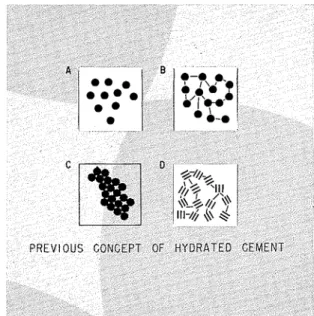
and other building materials. This has led, inevi- Hydrated portland cement paste saturated with re- tably, to work designed to answer certain basic spect to water was first consjderedVo be an questions and ultimately to new concepts of the assemblage of spheres 100 A in diameter, separated character of hydrated portland cement paste, i.e., by films of water 6 A thick. To provide this body to a new model, as described in a recent paper.1 with strength and to keep it together the existence
~h~ term umodelw is used frequently in connec- of solid bonds between the spheres was postulated. tion with materials. It is, essentially, a hypothetical Figure 1 (a and b) depicts these stages. Where the physical representation or structure that, like other cement is the spheres are said to hypotheses in science, should be compatible with come together (Figure 1 (c) ). Finally, when it was all that is known about a material. A model for discovered through electron microscopy3 that any material, therefore, shows its average chemical, cement paste was composed of thin sheets physical, and mechanical properties and provides a and foils, the model was changed to that represent- concept of its microstructure. This model, if valid, ed in Figure 1 (d). The explanations for expansion can be used in predicting or explaining behavior and shrinkage on wetting and drying (i.e., the sepa- under all conditions. ration and rejoining of units) were, however,
New hypotheses must be developed when new retained. facts indicate that previous models are inadequate.
Shortcomings of Previous Models
The original model introduced several concepts that
Figure 1 must now be questioned. Several experimental
Previous concept of observations have recently been made that it cannot
hydrated cement explain. The main points are listed below:
(1) The nature of the solid links between units and the way the links transform from the water- saturated to the dry state are difficult to conceive.
(2) The mechanism on wetting by which the ad- sorbed water molecule is able to penetrate between units, overcoming the more powerful solid-to-solid forces, is not clear.
(3) Experimental observations concerning the variation of Young's modulus, flexural strength, length and weight change with relative humidity cannot be accounted for.
(4) The irreversibility and hysteresis effects ob- served in the length-and weight-change water isotherms cannot be explained; neither can porosity values determined by helium, nitrogen, methanol and water, and sllrface area values determined by nitrogen, methanol and water.
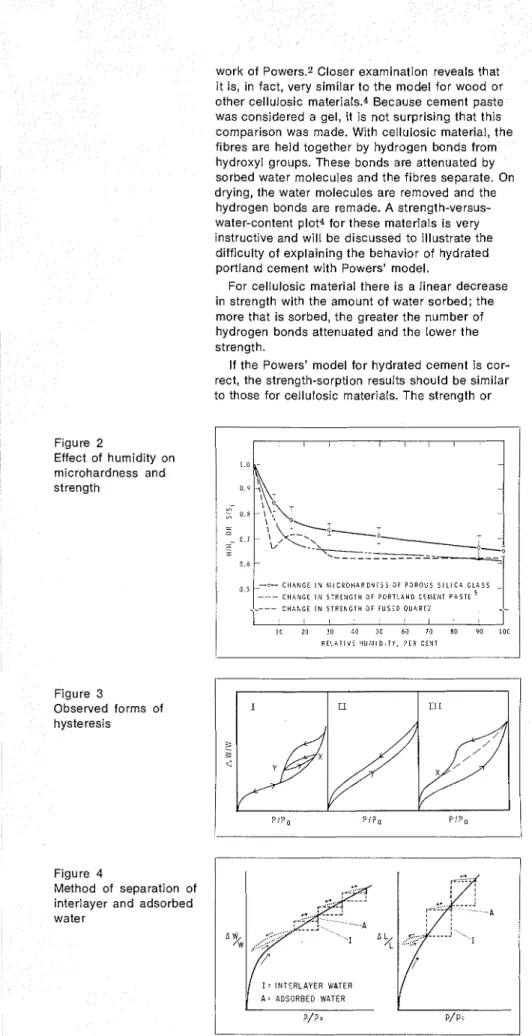
Figure 2 Effect of humidity on microhardness and strength Figure 3 Observed forms of hysteresis Figure 4 Method of separation of interlayer and adsorbed water
work of Powers.2 Closer examination reveals that it is, in fact, very similar to the model for wood or other cellulosic materials.4 Because cement paste was considered a gel, it is not surprising that this comparison was made. With cellulosic material, the fibres are held together by hydrogen bonds from hydroxyl groups. These bonds are attenuated by sorbed water molecules and the fibres separate. On drying, the water molecules are removed and the hydrogen bonds are remade. A strength-versus- water-content plot4 for these materials is very instructive and will be discussed to illustrate the difficulty of explaining the behavior of hydrated portland cement with Powers' model.
For cellulosic material there is a linear decrease in strength with the amount of water sorbed; the more that is sorbed, the greater the number of hydrogen bonds attenuated and the lower the strength.
If the Powers' model for hydrated cement is cor- rect, the strength-sorption results should be similar to those for cellulosic materials. The strength or
C H I N C E I N S T R E N G T H O F P O R T L A N D CEtAENT P A S T E
--- C H A N G E I N S T R E N G T H O F F U S E D Q U A R T Z
/ / / 1 l ' / I I
10 20 10 4 0 5 0 6 0 70 80 PO 1 0 0
R E L A T I V E H U b l l D I T Y . P E R C E N T
I
PIP, PIP, PIP,I
A : ADSORBED WATER
P/P 0
micro-hardness of hydrated portland cement, quartz, and porous glassl-6 as a function of relativ humidity is shown on Figure 2. There is a lar decrease in strength up to 15% RH and littl after that. There is a great similarity ia these re but they are completely different from those of cellulosic materials.
Despite the dissimilar nature of the materials referred to in Figure 2 (quartz is non-porous; por glass, 97% silica, has a high porosity and surfa area of 150 m2/gm), the results can be explain Breaking will be initiated at the apex of pointe cracks (Griffith, cracFs) where there are stre centrations; -4-0-~i- bonds will be strained and this strain energy wili contribute to a greater ease of
I formation of hydroxyl groups (-4-OH HO-Si-)
I I
in the presence of water vapor. Thus the breaking of the bonds will occur at a lower stress level in the presence of water vapor. When the concentration of water molecules is sufficient to maintain a rate of diffusion that will deliver a mini- mum amount of water into a spreading crack no further decrease in strength will occur.4 In this view, the decrease in strength is not due to a change in state of the solid or to a modification of bonding between units, as with cellulosic materials, but to a change in the environment where the breaking pro- cess is occurring. This concept is recognized and incorporated in the new model.
Although Powers' model laid the foundation, the new experimental evidence strongly suggests that the model needs to be modified.
Problems in Research on Hydrated Cement At first thought one might be surprised at how little is known of a material so long in use, but the difficulties of studying hydrated portland cement are great. Hydrated cement is a mixture of several compounds, all hydrates.7 It is the process of formation of these hydrates from the anhydrous cement powder that yields a structure with strength.
The most important hydrates are the calcium silicate hydrates, but they are not well-developed crystals. Normal methods of investigation do not reveal much. X-ray diffraction and microscopy, for instance, could only reveal that the individual crystals were small and made up of flexible fibres and sheets bearing some similarity to a naturally occurring class of mineral called tobermorite. It is known that the crystals are a layered type7 with water between the layers, called interlayer water, but it is not really known how many layers exist in the average crystal.
The layers are probably badly aligned and there are probably not very many of them. This would explain why there is no X-ray pattern for the c-axis. Surface Area Determination and
Stability of Hydrated Cement
During the evolution of the model, several workers used surface chemical techniques.8 If one
knows the total surface area, i.e., all the surface within the small pores in the material, then an
estimate of the size of the crystal can be made and more will be known of its morphology and
crystallography.
Surface areas are usually measured with gases or vapors, such as N,, H,O, and CH,OH. One can calculate the surface area from:
(1) surface chemical theory;
(2) the knowledge of the cross-section of one molecule of the gas used;
(3) the number of molecules required to cover a surface completely.
Physically adsorbed water is attracted to the surface by a gravitational-type force (van der Waals forces) and is generally non-specific. There is a dynamic equilibrium, a reversible process of
molecules have to be removed from the surface; this usually takes both heat and vacuum. Hydrated portland cement, however, is unstable both chemically and structurally, and cannot take this kind of treatment. An example of its structural instability is the shrinkage on first drying from a saturated state.9 A fair portion of this shrinkage is irreversible and cannot be recovered on rewetting. This phenomenon, though known to exist, has not been given enough attention and should be
recognized in considerations of creep and durability of concrete.
Chemical instability occurs when cement is dried below 30% RH or possibly even a higher
humiditylo; decomposition of the hydrates occurs. placement and removal of molecules. The state of Of great importance is the decomposition of the the adsorbed gas is then considered to be silicates; the interlayer water is removed when a compressed perpendicular to the surface, with a sample is "d-dried" (i.e., dried to the vapor gaseous-type pressure tangentially (spreading pressure of ice at -7goC, about 0.5 micron). This pressure) along the surface. The solid is considered decomposition involves a large shrinkage of the to be unperturbed. hydrated cement. It is clear that an important area
Before surface areas can be measured, all the of investigation is the stability of the silicate Figure 5
Effect of various gases upon Young's modulus for acetate silk
F~gure 6
Variation of modulus of elasticity with relative humidity
Figure 7
lnterlayer water and modulus of elasticity Figure 8
Model of entry and exit of interlayer water C o n c e n t r a t l o n . % EFFECT O i V A R I O U S G A S E S U P O N Y O U N G ' S h 1 O D U L U S OF A C E T A T E S I L K . [ F r o m Z h u r k o v ) I - M E T H Y L A L C O H O L . 2 - E T H Y L A L C O H O L , 3 - B U T Y L A L C O H O L . 4 - ACETONE. 5 - W A T E R ; C O N C E N T R A T I O N , % 5
Figure 9
Young's modulus vs porosity relations for various gypsum specimens Figure 10
Young's modulus vs porosity relations for various hydrated cement specimens
Figure 11
Model for hydrated cement
hydrates under stress; this is another area that should provide some answers with regard to the creep mechanism.
The instability of hydrates has made it difficult to distinguish between adsorbed and interlayer or other hydrate water in surface chemical experi- ments,'l and it is now clear that work in this area alone is not going to yield a complete answer. Investigations to date have made it clear, however, that the role of the various types of water is important in understanding the behavior, structure and chemistry, i.e. the nature, of hydrated portland cement.
Techniques and Experiments for Development of a New Model
The aim of experiments at the Division of Building Research of the National Research Council of Canada was threefold: to obtain information concerning the classification and role of water in hydrated portland cement, to find how water modifies its properties, and to gain information concerning the structure of the solid and its effect on various mechanical properties.
The experiments can be divided into two categories:
Methods of fabrication involved:
(1) compaction of hydrated portland cement powder at different pressures to form rigid porous bodies of different porosities;
(2) cast samples at different water-cement ratios: (3) recompacted cast samples.
All samples were made very small (30 mm diameter and 1 mm thick) to avoid stresses due to tempera- ture gradients and to facilitate equilibrium. These methods of fabrication have provided insight into the nature of the bond between crystallites, i.e., the basis for strength development of hydrated portland cement. (Before some of the results derived from these experiments are discussed. however, a few pertinent points concerning adsorption hysteresis will be presented.) Separation of Physically Adsorbed and Interlayer Water
Figure 3 shows the various types of isotherms and the associated hystereses obtained for different materials.lz The first is reversible in the lower pressure region from which surface area may be calculated. The high pressure region exhibits a primary hysteresis generally explained by capillary effects. The second is the kind of isotherm obtained for cellulosic materials and some clavs. (1) measurement of the variation of adsorbed As the vapor pressure increases, the adsorbate water, length (E), flexural strength, and micro- continually enters the structure of the solid, thus hardness with variation of relative humidity; changing the structure. In this case it is
(2) measurement of the variation of E, flexural difficult or even impossible to calculate the strength, and microhardness with method of fabri- surface area of the material. The third is the cation and porosity at constant conditions of isotherm obtained for layered crystals like clays,
relative humidity. graphites and hydrated portland cement. The
I I i c a s t G Y ~ S U M I
-
U C o m p a c t e d C a s t G y p s u m - 2 0 4 0 6 0 T O T A L P O R O S I T Y , P E R C E N T 5 I I I I I I I - . * D - -* - - I C e m e n t P a s t e I3 C o m p a c t e d C e m e n t P a s t e EU C o m p a c t s o f B o t t l e H y d r a t e d - - C e m e n t I I I I I I I 20 4 0 6 0 T O T A L P O R O S I T Y , P E R C E N Thysteresis obtained at low pressures has been observed, by X-ray where possible, to be due to penetration between the layers (interlayer hydrated water for the cement system). If some of this penetration occurred for the cement-water system at the low pressure region where calculations for surface areas are made, then surface areas and many other conclusions made from this isotherm would be invalidated. (This includes conclusions made with regard to the morphology and size of the c-axis of the hydrated silicate crystals.) Figure 4 illustrates the
irreversibility of the sorption and length change isotherms of water on hydrated portland cement. These experiments involved the interruption of sorption by intervals of desorption in order to test whether the isotherm is reversible. The main continuous line is the path followed when sorption occurs; the small lines are scanning loops and are the paths followed when desorption occurs. The isotherm is irreversible at all points.
lnterlayer water, it was concluded,1° enters while adsorption occurs up the isotherm. It was
possible to separate the interlayer and physically adsorbed water and to construct isotherms for both.10 This will be shown later, but Figure 4 illustrates how the interlayer and adsorbed water were separated. Generally, over small increments on the isotherm, the adsorbed water was considered to go on and off reversibly while the interlayer water was considered, once sorbed, not to come off over the small pressure increment. From these calculations it is possible to draw conclusions that completely support this approach and account for many of the properties of hydrated portland cement. The conclusions made from the isotherm of physically adsorbed water will be presented first. Figure 3 (1) shows the kind of isotherm obtained.
(1) Surface areas from N, and H,O adsorption are very similar; one of the major discrepancies in adsorption work was that surface areas obtained by nitrogen were even less than 1/10 that of water.
(2) For many samples the total volume of interlayer water found by calculation from scanning isotherms was equal to the difference between the total volume of water sorbed and the total volume of nitrogen or methanol sorbed. This was previously ascribed to small-necked pores that prevented nitrogen, but not water, from entering, i.e.,
(3) A length-change versus weight-change plot for physically adsorbed water is similar to that observed for many relatively inert materials. The data also conform to thermodynamic equations that describe the length-change sorption process.
From these equations calculations of E for the solid material could be made. This value was very similar to that obtained by direct measurement of E as a function of porosity and extrapolated to zero porosity.
(4) Porosity values obtained by helium pyknometryl3 were very similar to those obtained
by methanol or water adsorption with correction for interlayer water (obtained from scanning isotherms).
Determination of Young's Modulus and Its Correlation with lnterlayer Water
Before supporting evidence derived from the irreversible isotherm is presented, a short discussion of E of porous, high surface area materials is given.
Measurements of Young's modulus E as a function of relative humidity for high surface area materials have revealed two types of responses:
(1) no change for rigid porous bodies; this has been observed with porous glass$
(2) a continuous decrease; this has been observed largely with cellulosic materials, and is shown on Figure 5. 4
Hydrated portland cement gave results; that conform to the first type but, in addition, presented certain features that could not be explained. These results are presented on Figure 6, where it may be seen that there is no change in E from 100% RH to low humidities on drying. On 'd-drying,' a large decrease in E is obtained. On adsorption, an increase in E is observed only above 50% RH.
At this point the discussion of the evidence derived from the separation of interlayer and physically adsorbed water can be continued. If one considers the irreversible (interlayer hydrate water) isotherms for length change, A H , and weight change, Aw/w, vs relative humidity (Figure 7), one will note the similarity between them and the E vs relative humidity plot, also shown on Figure 7. Hysteresis and effects beyond 50% RH are the same, and the A l / l vs ~ w / w plot shows a sharp break beyond 50% RH. There is also a large hysteresis in the n l / l vs A w / w plot.
It was possible1 to incorporate these results in a simplified model that gives a satisfactory explanation for most of the results. (Naturally it is tentative and modifications may have to be made.)
The New Model Individual Units
Silicate hydrate crystallites are of a layered type, and the new model represents this simply, as in Figure 8. Two thin sheets are used to represent the layers; water between layers is interlayer water. The other diagrams are included in this figure to illustrate how the many parameters change simultaneously. A, B to G each represents the same state of the material on the three diagrams.
The main points are that water enters from the edges, causing expansion by the opening of the layers from A to B to C. The water acts as a web or cross-link; there will be no real increase in E until the middle starts to fill as for a sandwich-
type construction, then increases markedly to D. The length-to-weight-change results indicate a rapid increase of interlayer water with a not-so- great length change beyond 50% relative humidity. The model shows that most of the expansion has already taken place from the edges. Emptying starts from the edges from D to G, but only at low vapor pressures; this explains the hysteresis obtained in the curves for A M , A w / w and E versus relative humidity. E does not decrease until the middle part of the water has gone out and this does not take place until very low vapour pressures. In addition, because desorption starts from the edges, while the middle is still full, the whole configuration is different, the A l / l vs A W / W characteristics will be changed, and a
hysteresis must be expected in this plot also.
Assemblage of Units-Hydrated Cement Paste This part of the model is based mainly on the final area of experimental work, which was earlier placed in the second category, i.e., the
measurement of mechanical properties as a function of porosity and method of fabrication.
Preliminary work involved using another material as a model: plaster of paris (CaSO, %H,O) water system,l4 which hydrates to give gypsum. One may observe that plaster moulded &to bodies and allowed to hydrate produces a higher E at a given porosity than bodies made from
compacted, prehydrated gypsum; the two methods of fabrication produce equal E at zero porosity. The gypsum system is known to develop strength by intergrowth of crystals, and it was concluded that these bonds are partly broken in compacted cast gypsum.
With hydrated portland cement,ls there is no difference in result with method of fabrication; powder compacted into a rigid body, normal paste hydration and remoulding of paste give very similar characteristics. These results are shown on Figure 10.
One may thus conclude that the same type of solid-solid bonds in hydrated cement result from the different methods of preparation. It was concluded that tobermorite sheets, forced into proximity, may produce a connection composed of both short- and long-range bonds (van der Waals), the relative amount depending on the degree of matching of the lattice. The results from the variation of E and strength with relative humidity has led to the conclusion that these bonds are not, on the whole, affected by physically adsorbed water. More detailed calculations based on previous sorption experiments showed that, from 0 to 100% relative humidity, less than 18% of the length change (expansion) was due to physically adsorbed water and the rest to interlayer rehydration. This leads to the possible conclusion that tobermorite crystal containing interlayer water decomposes under stress and that this is a cause of the creep phenomenon.
Conclusions
A simplified diagram illustrating the conclusions i s presented on Figure 11. It shows the various types of water and bonds discussed. In addition, the disorganized nature of the crystal
by C.
Although much remains to be done and it recognized that each development is but a forward in the evolution of the final model o hydrated portland cement, it is believed tha this model allows a greater physical unders of the material (solid-water system) and some the phenomena. Some speculation is inevitabl (1.) First Drying Shrinkage.
Saturated, hardened portland ce which has never been dried, will p some form of equilibrium between water in solution and the solid with the respect bonds formed between units. As water is during drying some surfaces will approac other, into their mutual solid-solid
forming new bonds (A in Figure 11). This wou account for the irreversible shrinkage observ on first drying, because many of these bonds will remain on rewetting.
(2.) Irreversible Creep.
This phenomenon may be associated with irreversible first-drying shrinkage, but induced mechanically. It may also be associated with displacement of one layer in relation to the other, forming situations like C in Figure 11, or involve a process of breaking and remaking interparticle bonds such as A. Experiments on compacting and remouldina seem to show that this i s possible. (3.) Reversible Creep.
This could be associated with a slow decom- position of the interlayer hydrate when under stress with the liberation of water. Some of the water should return to its original position after stress is removed.
(4.) Expansion and Contraction.
These phenomena are associated with capillary effects, surface-free energy changes and
hydration-dehydration of some of the components present in hydrated paste. Even when these effects are considered separately, one still encounters irreversibilities in the hydration- dehydration phenomenon and in the capillary effects. In addition, 'aging,' a term that can include both decrease in surface area and slow chemical effects leading to changes in the chemical structure of the silicates, may contribute to the complexity of the length-change phenomenon in the high humidity region.
Generally, between 100 and 35% RH shrinkage on drying can be considered the result of capillary and surface-energy effects, with the possibility of some dehydration. Below 35% RH
down to the d-dried state, dehydration provides by E A Flood, New York. Marcel Dekker Inc., 1967.
Voi. 2, p 729-761
the major cause of contraction. On rewetting to 5. Sereda, P.J , R F. Feldman, and E.G. Swenson "Effect of
100% RH over 80% of expansion is due to Sorbed Water on Some Mechanical Propert~es of Hydrated Portland Cement Pastes and Compacts." Highway Research
rehydration. Board. Spec~al Report No. 90, 1966, p. 58-73.
These explanations lead to the final C O ~ C ~ U S ~ O ~
6
Feldman, R.F. and P.J. Sereda. "Discusslon (No. 111-25) ofthat hydrates of portland cement paste cannot be R.A. Helmuth and G J. Verbeck Presented at 5th lnternat~onal Structures and Physical Properties of Cement Pastes" by
regarded as inert, and that their chemical stability ~ ~ On the Chemistry ~ p Of Cement. ; ~ Japan. ~
under various conditions plays an important role 7 Taylor. H.F.W. "The Chemistry of Cements " VOI. I, Edited
in many phenomena. by H.F W. Taylor Academ~c Press (London and New York)
1964.
This paper is a contribution from the Division 8. Brunauer, S. "The Adsorption of Gases and Vapors."
of Building Research, National Research Council of Princeton UnlversitY Press, 1943.
Canada, and is published with the approval of 9 Irreversible Drying Shr~nkage of, Hardened Portland Cement Helmuth, R A. and D H. Turk. "The Revers~ble and the Director of the Division. and Trlcalcium Silicate Pastes J Portland C e m e n ~ Assoc. Research and Development Lab., Vol. 9. May 1967, p. 8-21.
References
1. Feldman, R.F. and P.J. Sereda. "A Model for Hydrated Portland Cement Paste as Deduced from sorption-length Change and Mechanical Properties." Materiaux et Construction, Vol. 1, No. 6, 1968, p. 509-520.
Vol. 1, No. 6, 1968, p. 509-520.
2. Powers, T.C. and T.L. Brownyard. "Studies of the Physical Properties of Hardened Portland Cement Paste." Proc., Amer Concrete Inst.. Vol. 43, 1947, p. 469-504.
3. Grudemo, A. "An Electronographic Study o f the Morphology and Crystallization Properties of Calcium Silicate Hydrates." Svenska Forskminginstlt fiir Cement Och Betong vid Kgl. Tek. Hog. Skol., Stockholm; Handlingar No. 26, 1955, 103 p.
4. Sereda. P.J. and R.F. Feldman. "Mechanical Properties and the So!id-gas Interface" I n The Solid-Gas Interface, Edited
10. Felaman, R.F. "Sorption and Length-Change Scanning Isotherms o f Methanol and Water on Hydrated P,ortland Cement." Presented to 5th lnternat~onal Symposium on the
Chemistry of Cement, Tokyo, Japan, 1968.
11. Feldman. R.F. and P.J. Sereda. "A Datum Point for Esti- mating the Adsorbed Water in Hydrated Portland Cement." J. Appl. Chem., Vol. 13, 1963, p. 375-382.
12. Everett, D.H. "The Solid Gas Interface." New York,
Marcel Dekker lnc., 1967, p. 1055-1110.
13. Feldman, R.F. Unpublished data.
14. Sorok? I. and P.J Sereda. "Interrelation of Hardness, Modulus of Elasticity, and Porosity i n Various Gypsum Systems. J. Amer. Ceram. Soc., Vol. 51, No. 6, June 1968, D. 337-340. 15. Soroka. I. and P J. Sereda. "The Structure of Cement-stone and the Use of Compacts as Structural Models." 5th Inter-
This publication is being distributed by the Division of Building Research of the Na- tional Research Council of Canada. It should not be reproduced in whole or in part without permission of the original publisher. The Division would be glad to be of assistance in obtaining such permission.
Publications of the Division may be obtained by mailing the appropriate remittance (a Bank, Express, or Post Office Money Order, or a cheque made payable at par in Ottawa, to the Receiver General of Canada, credit NRC) to the National Research Council of Canada, Ottawa. Stamps are not acceptable.
A list of all publications of the Division is available and may be obtained from the Publications Section, Division of Building Research, National Research Council of Canada, Ottawa 7, Canada.