Digitized
by
the
Internet
Archive
in
2011
with
funding
from
Boston
Library
Consortium
Member
Libraries
-, i-^k=,VV* U.-m
31 il5
\0
Massachusetts
Institute
of
Technology
Department
of
Economics
Working
Paper
Series
COMMITMENT
vs.
FLEXIBILITY
Manuel
Amador
Ivan
Werning
George-Marios
Angeletos
Working
Paper
03-40
November]
5,2003
Room
E52-251
50
Memorial
Drive
Cambridge,
MA
02142
Thispapercanbedownloaded withoutchargefromthe SocialScience ResearchNetworkPaperCollectionat
MASSACHUSETTS |^''T1TUTE
Commitment
vs.
Flexibility'
Manuel
Amador"'
Ivan
Werning-^
George-Marios
Angeletos^
November
15.2003
Abstract
Thispaperstudiestheoptimaltrade-offbetween
commitment
and flexibil-ity in an intertemporal consumption/savings choice model. Indi\iduals expect to receive relevant informationregarding theirown
situation and tastes -gen-erating a value for flexibility - but also expect to suffer from temptations
-generating a value for commitment.
The
model combines the representations ofpreferencesforflexibihty introduced byKreps (1979) withitsrecentantithe-sis for
commitment
proposed by Gul and Pesendorfer (2002), which nests the h\T>erbolic discounting model.We
set up and solve amechanism designprob-lem that optimizes over theset ofconsumption/savingoptionsavailable to the individual each period.
We
characterize the conditions under which the solu-tiontakes a simple threshold formwhereminimum
sa\dngspoliciesareoptimal.Our
analysis isalso relevant forother issuessuchassituationswith externalities or theproblem faced by a "paternahstic" planner, whichmay
be important forthinking about some regulations such as forced
minimum
schoolinglaws.Introduction
If people suffer from temptation
and
self-control problems,what
should bedone
tohelp
them? Most
analysis lead to a simpleand
extreme conclusion: it is optimal totake over the individual's choices completely. For example, in
models
withh\-per-'We'd like to thank comments and suggestions from Daron Acemoglu, Andy Atkcson, Peter
Diamond and especiallyPablo Werning. 'Stanford
GSB
tmx,
NBER
andUTDT
§MIT
andNBER
bolic discounting preferences it is desirable to impose a particular savings plan on
individuals.
Indeed, one
commonly
articulated justification forgovernment
involvement in re-tirement income inmodern
economies is the beliefthat an important fraction of the populationwould
save "inadequately" if left to theirown
devices (e.g.Diamond,
1977).
From
the workers perspective most pension systems, pay-as-you-goand
capi-talizedsystems alike, effectively impose aminimum
saving requirement.One
purposeof this paper is to see ifsuch
minimum
saving policies are optimal in amodel where
agents suffer from the temptation to "over-consume".
In aseriesof recent papers
Gul
and
Pesendorfer (2001, 2002a,b) have givenprefer-ences that value
commitment
an axiomatic foundationand
derived a useful represen-tation theorem. In their representation the individual suffersfrom
temptations andmay
exert costly self-control. This formalizes the notion thatcommitment
is useful as away
to avoid temptations that either adversely affect choices or requireexert-.
ing costly self-control.
On
the opposite side of the spectrum,Kreps
(1979) provided an axiomatic foundation for preferences for flexibility. His representationtheorem
shows
thatthey can be represented by including taste shocks intoan
expected utilityframework.
Our
model
combinesKreps' withGul
and Pesendorfer'srepresentations.Our
main
application modifiestheintertemporal taste-shock preferencespecification introduced by Atkesonand
Lucas (1995) to incorporatetemptation. In theirmodel
the individual has preferences overrandom
consumption
streams.Each
period an i.i.d. taste shockis realized that affects the individual's desire for current consumption. Importantly, the taste shock at time-t is
assumed
to be private information.We
modify these preferencesby
assuming that agents suffer from the temptation for higher present consumption. This feature generates a desire forcommitment.
The
informationalasymmetry
introduces a trade-offbetween
commitment
and
flexibility.
Commitment
is valued because it reduces temptation while flexibility isvalued becauseit allows the use ofthe valuable private information.
We
solvefor the optimal incentive compatible allocation that trades-offcommitment
and
flexibility.One
can interpret our solution as describing the optimalcommitment
device.In addition to
Gul and
Pesendorfer's framework,models
with time-inconsistentthe hyperbolic discounting
model
has provenuseful forstudying the effectsofatemp-tation to 'over-consume' as well as the desirability of
committment
devices (Phelpsand
Pollack, 1968,and
Laibson, 1994).As
Krusell,Kuruscu and Smith
(2002) have pointed out, however, the temptationframework
providedby
Gul
and
Pesendorfereffectivelygeneralizes the hyperbolic discounting model: it results inthe limitingcase
when
the agent cannot exert any self-control, giving in fully to his temptations. For expositional purposeswe
first treat the hyperbolicdiscounting case in detailand
thenshow
that the results extend toGul and
Pesendorfer's framework.We
beginby
considering a simple hyperbolic discounting case withtwo
possible taste shocks.By
solving this case,we
illustratehow
the optimal allocationdepends
critically on the strength of the temptation for current
consumption
relative to the dispersion of the taste shocks. For the resulting second-bestproblem
there aretwo
important cases to consider.For low levels of temptation, relative to the dispersion of the taste shocks, it is
optimal to separate the high
and
low taste shock agents. If the temptation is not too low, then in orderto separatethem
the principalmust
offerconsumption
bundles that yieldsomewhat
to the agent'stemptation for higher current consumption. Thus, both bundles providemore
presentconsumption
than their counterparts in the first best allocation.When
temptation is strong enough, separating the agentsbecomes
too onerous.
The
principal then finds it optimal tobunch
both agents: she offers asingle
consumption
bundleequaltoheroptimaluncontingentallocation. Thissolutionresolves the average over-consumption issue at the expense of foregoing flexibility. In this way, the optimal
amount
offlexibilitydepends
negativelyon
the strengthof the temptation relative to the dispersion of the taste shocks.
These
results withtwo
shocks aresimpleand
intuitive. Unfortunately, withmore
thantwo shocks, theseresults are not easily generalized.
We
show
that with three shocks there are robust exampleswhere 'money
burning' is optimal: it is optimal to have one of the agentsconsuming
in the interior of his budget set. Moreover, bunching can occurbetween
any
pair of agents.The
examples present a wealth of possibilities with no obviousdiscernible pattern.
Fortunately, strong results are obtained in the case with a
continuum
of tasteshocks.
Our
main
result is a condition on the distribution of taste shocks that isminimum
savings level is imposed, with full flexibility allowed above thisminimum.
The
optimalminimum
savings level depends positively on thestrengthoftemptation. Thus, themain
insight from thetwo
type case carries over here: flexibility falls with the strength of temptationand
this is accomplishedby
increased bunching.We
extend themodel
to include heterogeneity in temptation of currentconsump-tion. This is important because it is reasonable to
assume
that agents suffer from temptation at varyingdegrees. Indeed, perhapssome
agents donot sufferfrom
temp-tation at all. Allowing for heterogeneity in temptation
would
imply that those in-dividuals thatwe
observe saving less aremore
likely to be the ones suffering from higher temptation. However,we
show
that themain
result regarding the optimalityof a
minimum
saving policy is robust to the introduction ofthis heterogeneity.The
rest ofthe paper is organized as follows. In the remainder ofthe introductionwe
briefly discuss the related literature. Section 1 lays out the basic intertemporalmodel
using the hyperbolic discounting model. Section 2 analyzes thismodel
with two and three taste shocks while Section 3 works with acontinuum
ofshocks. Sec-tion 4 extends the analysis to arbitrary finite time horizonsand
Section 5 extends theresults to the case
where
agents are heterogenous with respect to their temptation. Section 6 containsthemore
general casewith temptationand
self-control proposedby
Guland
Pesendorfer (2001,2002a,b). Section 7 studies the casewhere agents discount exponentially at a different rate than a 'social planner'and
preferences are logarith-mic. Section 8 diverges to discusssome
alternative interpretationsand
applicationsofour
main
resultsregarding the optimal trade-ofl[between
committment and
flexibility.The
final Section concludes.An
appendixcollectssome
proofs.Related
Literature
At
least sinceRamsey's
(1928) moral appeal economists have long been interested in the implications of,and
justifications for, socially discounting the future at lowerrates than individuals. Recently, Caplin
and
Leahy
(2001) discuss a motivation for awelfare criterion that discounts the future at a lower rate than individuals. Phelan
(2002) provides another motivation
and
studies implications for long-run inequalityofopportunity of a zero social discount rate. In both these papers the social planner and agents discount the future exponentially.
Some
papers on social security policies have attempted to take into account thepossible "undersaving"
by
individuals.Diamond
(1977) discussed the casewhere
agentsmay
undersavedue
to mistakes. Feldstein (1985) modelsOLG
agents that discount the future at a higher rate than the social plannerand
studies the optimal pay-as-you-go system. Laibson (1998) discussespublicpoliciesthat avoid undersavingin
hyperbohc
discounting models. Imrohoroglu, Imrohorogluand
Joines (2000) use amodel
with hyperbolic discounting preferences to perform a quantitative exerciseon the welfare effects ofpay-as-you-go social security systems.
Diamond
and
Koszegi(2002) use a
model
with hyperbolic discounting agents to study the policy effects ofendogenous retirement choices.
O'Donahue
and Rabin
(2003) advocate studying pa-ternalismnormativelyby
modellingtheerrors or biases agentsmay
haveand
applying standard public finance analysis.Finally, several papers discuss trade-offs similar to those emphasized here in var-ious contexts not related to the intertemporal consumption/saving
problem
that isour focus. Since
Weitzman's
(1974) provocativepapertherehas beengreat interest inthe efficiency ofthe price system
compared
to acommand
economy, seeHolmstrom
(1984)
and
thereferences therein. In a recent paper, Athey, Atkesonand
Kehoe
(2003) study aproblem
of optimalmonetary
policy that also features a trade-off between time-consistencyand
discretion. Sheshinski (2002) models heterogenous agents thatmake
choices over a discrete set ofalternatives but are subject torandom
errorsand
shows that in such a setting reducing the set of alternativesmay
be optimal. Laib-son (1994,Chapter
3) considers a moral-hazardmodel
with a hyperbolic-discounting agentand shows
that the plannermay
reward the agent for high outputby
tiltingconsumption
towards the present.1
The
Basic
Model
For reasons of exposition
we
first study aconsumer
whose
preferences aretime-inconsistent. Following Strotz (1956), Phelps
and
Pollack (1968), Laibson (1994)and
many
otherswe model
the agent in each period as different selvesand
solve forsubgame
perfect equilibria of thegame
played between selves. In section 6we
show
that all our results go throughwhen we
use themore
generalframework
intrapersonal
game
interpretation.Consider first the case with two periods of consumption, t
=
1,2,and
an initial periodt=
from whichwe
evahiateexpected utihty. Section 4extendstheanalysis to arbitraryfinite horizons.Each
period agentsreceive ani.i.d. tasteshock9, normalizedso that
Ed
=
\ which affects the marginal utility of current consumption: higher 9make
current consumptionmore
valuable.The
taste shock is observed privately by the agent at time t}We
think of the taste shock as a catch-all for the significant variation one actually observes inconsumption and
saving data after conditioning on the available observable variables.We
denote firstand
second periodconsumption
by
cand
k, respectively.The
utility for selj-1 from periods i=
1, 2 with taste shock 9 is9U
(c)+
[3W
{k).
where
U
{)and
W
{) are increasing, concaveand
continuously differentiable"and
/3
<
1.The
notation allowsW
()^
U
{), this generality facilitates the extension toN
periods in section 4.The
utihty for self-0 from periods t=
1, 2 is9U
(c)+
W
{k) .Agents have quasi-geometric discounting: self-t discounts the entire future at rate
/?
<
1and
in this respect, there is disagreementamong
the different t-selvesand
1
—
/3 is ameasure
ofthis disagreement or bias.On
the otherhand, there is agreementregardingtasteshocks: everyonevalues theeffectof 9 inthe
same
way.Below
we
often associate the value of B to the strength of a 'temptation' for current consumption;thus,
we
say that temptation is stronger if13 is lower.An
alternative interpretation to 'hyperbolic' discounting is availableifwe
consideronly periods 1
and
2.One
can simplywork
withthe assumption that the correct wel-fare criterion does not discount future utility at thesame
rate as agents do, although both do so exponentially.Although
this alternative interpretation is available for'With exponential
CARA
utility income shocks are equivalent to tasteshocks.^Note thata tasteshockfor periodi
=
2 isnot included inthis expression. However, its absence is onlyapparent since k cannot depend on 60 and EOo=
1.two-periods
we
will see that in general it does not permit a straightforwardexten-sion of the analysis to
more
periods. In section 7we
discuss a case in which it doesgeneralize.
We
investigate the optimal allocation from the point ofview of self-0 subject tothe constraint that 6 is private information ofself-1.
The
essential tension is betweentailoring
consumption
to the taste shockand
the self-1's constant higher desire forcurrent consumption. This generates atrade-off
between
commitment
and
flexibilityfrom the point ofview ofself-O.
To
solve the allocation preferredby
self-0 with totalincome
ywe
now
setup
the optimal direct truth tellingmechanism
given y.Two
Periods
V2 {y)
=
max
/
[OU(c {9))+
W
{k{6))]dF
[9)eU
(c {9))+
m'
(k{9))> 9U
(c {9'))+
PW
{k{9')) for all 9,9'eQ
(1)c{9)
+
k {9)<
y for allG
6
where
F
(9) is the distribution of the taste shocks with support O.This
problem
maximizes, given total resources y, the expected utilityfrom
the point of view of self-0 (henceforth: the principal) subject to the constraint that 9is private information of self-1 (henceforth: the agent).
The
incentive compatibility constraint (1) ensures that it is in agent-^'s self interest to report truthfully, thus obtaining the allocation that is intended for him. In the budget constraints theinterest rate is normalized to zero for simplicity.
The
problem
above imposes abudget constraint for each ^G
0, so that insurance across ^-agent's is ruled out.The
planner cannot transfer resources across different agent's types. This choicewas
motivatedby
several considerations.First, it
may
be possible to argue that the case without insurance is of directrelevance in
many
situations. This could be the case if pooling risk is simply not possible or if insurance contracts are not available because of other considerations outside the scope of our model.Second, thecardinality ofthe taste shocks plays a
more
important role in an anal-ysis with insurance.The
taste shock 9 definitely affects ordinal preferences betweencurrent
and
future consumption, cand
k. However,we
would
like to avoid taking a strong standon
whether or not agents with high taste for currentconsumption
alsohave a higher marginal utility from total resources as the expression 9u
+
w
implictlyassumes. Focusing on the case without insurance avoids
making
our analysisdepend
strongly on such cardinality assumptions.Third, without temptation (/?
=
1) incentive constrained insurance problemssuchas Mirrlees (1971) or Atkeson
and
Lucas (1995) are non-trivaland
the resulting op-timal allocations are not easily characterized. Thiswould
make
a comparison with the solutions with temptation (/?<
1)more
difficult. In contrast, without insurance the optimal allocation without temptation [j3=
1) is straightforward ~ every agent chooses their tangency point on the budget set - allowing a clearer disentangling ofthe effects ofintroducing temptation.
Finally,
we
hope
that studying the case without insurancemay
yield insights intothe case with insurance which
we
are currently pursuing.Once
theproblem
aboveissolved the optimal allocationfor selj-0solves astandard problem:max
{9oU
[cq)+
(iv2 {yo-
co)}CO
where
yo, Cqand
^o represents the initial t—
0, income,consumption and
tasteshock,respectively. In
what
followswe
ignore the initialconsumption
problem and
focus onnon-trivial periods.
2
Two
Types
In this section
we
study the optimalcommitment
with onlytwo
taste shocks, d^>
6i,occuring with probabilities
p and
1—
p, respectively.Without
temptation,/3=
1, thereis no disagreementbetween
theplannerand
theagent
and
we
canimplement
the ex-ante first-best allocation definedby
the solution to eU'{cfb {9))/W
{kfb {9))=
1and
Cfh (9)+
kfb {9)=
y. For lowenough
levels oftemptation, so that /3 is close
enough
to 1, the first-best allocation is still incentivecompatible. Intuitively, if the disagreement in preferences is small relative to the dispersion oftasteshocks then, at the first best, the low shock agent
would
not envy the high shock agent's allocation.Proposition
1 There exists a (3*<
1 such thatforP
6
[/5*, 1] thefirst-best allocationis implementable.
Proof.
At
/5=
1 theincentiveconstraintsare slack atthe ex-antefirst-bestallocation.Define /3*
<
1 to be the value of(3 for which the incentive constraint ofdi holds withequality at the first best allocation.
The
result follows.This result relies
on
the discrete diflFerence in taste shocksand
no longer holdswhen
we
study acontinuum
ofshocks in Section 3.For higher levels of temptation, i.e. lower /3, the first best allocation is not
in-centive compatible. If oflfered, agent-^;
would
take the bundlemeant
for &gent-9hto obtain a higher level of current consumption.
The
next proposition characterizes optimal allocations in such Ccises.Proposition
2The
optimwn
can always he attained with the budget constraint hold-ing with equality: c* {9) -I- k* (6)=
y for 9—
9h, 9i.We
have that 9i/9h<
P* and:(a) if
P
>
6i/9h separation is optimal, i.e. c*{9h)>
c* {9i)and
k{9h)<
k{9i)(b) if
P
<
9i/9h hunching is optimal, i.e. c{9i)=
c{9h)and
k{9i)=
k{9h)(c) if
P
=
9i/9h separatingand
hunching are optimalProof. First, P*
>
P
follows sinceu{c*{eH))-u{c*{ei))
p*=
Wiy-c*{9i))-W{y~c*{9H))
U'{c{e,)){c{9,)-c{9^)) U'{c{9,)) 9i
_
'W'{y-c
{9h)) (c{9n)-
c{9i))'W'{y-c
{9^))9h~-where
c* is the first best allocation.Now,
consider the casewhere
P
>
P
and
suppose that c {9h)+
k(9^)<
y.Then
an increase in c{0k)
and
a decrease in k {9h) that holds {9i/P)U
{c{9h)) -\-U
{k (9^))unchanged
increases c{9h)+
k{9h)and
the objective function.Such
a change is in-centive compatiblebecauseit strictly relaxes theincentive compatibility constraint ofthehigh type pretendingto bealowtype
and
leavesthe other incentive compatibility constraint unchanged. It followsthatwe must
have c {9h)+
k{9h)=
y at anoptimum.
This also
shows
that separating is optimal in this case, proving part (a).Analogous
arguments establish parts (b) and (c).
Proposition 2 shows that for /?</?* the resulting non-trivial second-best
problem
can be separatedinto essentially twocases. For intermediate levels oftemptation, i.e.61/dh
<
P, it isoptimal to separate the agents. Inorder to separatethem
theprincipalmust
offerconsumption
bundles thatyieldsomewhat
to the agent's ex-post desire forhigher
consumption
givingthem
higherconsumption
in the first period than the firstbest.
For higher levels of temptation, i.e. /?
<
9[/9h, separating the agents is too onerous, bunchingthem
is then optimal at the best uncontingent allocation - withU
{)—
W
{) this implies c(-)=
k{-)=
y/2. bunching resolves the disagreement problem at the expense of flexibility. In this way, the optimalamount
of flexibihtydepends negatively
on
the size of the disagreement relative to the dispersion of thetaste shocks as
measured by
9i/9h-Proposition 2 also
shows
that it is always optimal toconsume
all the resourcesc{9)
+
k{6)=
y. In this sense,'money
burning', i.e. setting c(0/j)+
k{9h)<
y, isnot required for optimality.
As
discuss below, withmore
than two types this is not aforegone conclusion.
Figure 1 below
shows
a typical case that illustrate these results.We
setU
(c)=
c^-"/{1-a),
U
(•)=
W
() ,and
a
=
2, 9^=
1.2, 9i=
.8, p=
111and
y=
\.The
figure
shows consumption
in thefirst period, c(0) , as afunctionof/3. For comparisonwe
also plots the optimal ex-postconsumption
for both types (i.e. the full flexibilityoutcome).
Note
thattheseare always higherthantheoptimalallocation: theprincipaldoes
manage
to lowerconsumption
in the first period.0.54
1
"" Q. E c o o 0.48 --..^ i--^___ """---^,ex-antec^ ^"^--^^^ '~"--~-_._ ex-anleC|_ 0.46\
0.6 0.8 1 pvaluesFigure 1:
Optimal
first periodconsumption
(c) with two shocks as a function of/3.The
figure illustrates Proposition 1and
2 in the following way. For high /3 thefirst best allocation is attainable so the optimal allocation does not vary with /? in
this range. For intermediate (3
consumption
in the first period rises as /? falls. In thisway
the principal yields to the agent's desire forhigher consumption. For lowenough
P
bunchingbecomes
optimaland
c{6)=
y/2.To
summarize, with two typeswe
are able to characterize the optimal allocationwhich
enjoys nice properties. In particular, the budget constraint holds with equalityand
we
found simple necessaryand
sufficient conditions for abunching or separatingoutcome
to be optimal.Unfortunately, with
more
than twotypesextendingtheseconclusionsis notstraight-forward. For example, with three taste shocks, 9^
>
0^
>
Oi-, it is simple to constructrobust examples
where
the optimal solution has the following properties: (i) thebud-get constraint for agent
9m
is satisfied with strict inequality - i.e.'money
burning' is optimal; (ii) although (3<
9m/9h
remains a sufficient condition for bunchingm
and
h, it is no longer necessary: there are cases with /3>
9m/9hwhere bunching 9m
and
9h is optimal; (iii) bunching can occurbetween
9iand
9m, with 9h is separated.The
examplesseem
toshow
avariety ofpossibilities that illustrate the difficulties incharacterizing the
optimum
withmore
thantwo
types.Fortunately, with a
continuum
of typesmore
progress can be made. In the nextsection
we
find conditions onthe distribution of 9 which allows us to characterize the optimal allocation fully.3
Continuous
Distribution
of
Types
Assume
that thedistribution oftypesisrepresented bya density / (9) over theinterval=
[9,6].We
find it convenient to change variables from {c,k) to {u,'w) where u=
U
{c)and
w =
VV(k)and we term
either pair an 'allocation'. LetC
(u)and
K
{w) be the inverse functions ofU
{c)and
W{k),
respectively, so thatC
{)and
A'(•) are increasing
and
convex.To
characterize the incentive compatibilityconstraint (1) in this case consider theproblem
facedby
agent-^when
confronted with a directmechanism
{it.{9) ,w
[6)):V{9)
=
m&xl^u(9')
+
tu(9')0'ee
[P
If the
mechanism
is truth telling thenV
(9)=
|u
[9)+ w
(6)and
integrating theenvelope condition
we
obtain,^u
{9)+
w
[9)=
j^
~u[9)de
+
^u{9)
+
w{9) (2)(see
Milgrom and
Segal, 2002). Incentive compatibility of (u, u') also requiresu
tobe anon-decreasing function of9. Thus, condition (2)
and
the monotonicity ofu
are necessary for incentive compatibility. It is wellknow
that these two conditions are also sufficient (e.g. Fudenbergand
Tirole, 1989).The
planner's problem is thus,vo (y)
=
max
f
[9u{9)+
w
{9)]f
{9)d9,subject to (2),
C
(u{9))+
K
{w
[6))<
yand
u{9')>
u(9) for 9'>
9. Thisproblem
is convex since the objective function is linearand
the constraint set is convex. In particular, it follows that ih (y) is concave in y.We
now
substitute the incentive compatibility constraint (2) into the objective functionand
the resource constraint,and
integrate the objective function by parts.This allows us to simplify the
problem
by dropping the function iu{9), except forits value at 9. Consequently, the maximization below requires finding a function
n
:9
^
R
and
a scalarw
representingw
{9).Continuous
Distribution
ofTypes
v^ (y)
=
max
i|u(0
+
^
+
i
A(l
-
F
[9))-
9(1-
/3)f
[9)]u
{9)cWK-'
{y-C
{u {9)))+ ^u
{9)-^u{9)-w-j^
^u{9)d9
>
u
{9')>
u
(9) for 9'>9
3.1
Bunching
For
any
feasible allocation u it is always feasible to modify the allocation so as tobunch
some
upper tail of agents.That
is, the allocationu
givenby
u {9)=
u
(9) for 9<
9and
u
(9)=
u{9) is feasible for any 9.Thus
bunching the upper tail is alwaysfeasible,
we
now
show
that it is always optimal.To
gainsome
intuition, note that agents with9<
(59share the ordinal preferencesoftheplanner with ahigher taste shock equalto 9/13.
That
is, the indifference curves9u
+ ^w
and
9/[5u+ w
are equivalent. Informally, these agents canmake
a case for their preferences. In contrast, agents with 9>
(59 display a blatant over-desire forcurrent
consumption
from the principal's point of view, in the sense that there isno
taste shock that
would
justify these preferences to the planner. Thus, it is intuitivethat these agentsare
bunched
since separatingthem
istantamount
to increasingsome
ofthese agents consumption, yet they are already obviously "over-consuming"
.
The
next resultshows
that bunching goes even further than ^9.Proposition
3 Define 9p as the lowest value in such thatfor9>
9p:E
>
91
<
-9
-
P
Note that 9p
<
j39and
9p<
l39 as long as f>
0.An
optimal allocation u* hasu* {9)
=
u* {9p) for9>
9p (i.e. it bunchs all agents above 9p)Proof.
The
contribution to the objective functionfrom
9>
9p is1 f
{{i-F{e))-e{i-p)f{e})u{9)d9.
Substituting
u
=
Jg
du
+
u
{9p)and
integrating by partswe
obtain,^i{Op)-
I\{i-F{9))-9{1-P)f{9))d9
Note
that,J'
((l-
F
[§))-
9{1-^3)f
(0")) d9=
(1-
F{9))9
I^
-E
9\9>9
<0,
9for all 9
>
9p so it is optimal to setdu
=
0, or equivalently u(9)=
u
{9p) , for 6*>
9p.With
two
types Proposition 2showed
that bunching is strictly optimalwhenever
9h/9i
<
1//3. Proposition 3 generalizes this result since with two typeswhen
9h/9i<
1/P then according to the definition essentially 9p
=
9i.Ifthe support is
unbounded
then 9pmay
not exist. This occurs, for example, with the Pareto distribution.One
canshow
that in this case it is either optimal toallow full flexibility or
bunch
all agents dependingon
the Pareto parameter.3.2
Assumption
A
To
solve for the optimal allocation for 9<
9pwe
require the following conditionon
the density/ and
/3.A. The
densityf
{9) is differentiableand
satisfiesJ'iO)^
2-/3
f{e)-
i-P
for all 9
<9p.
Assumption
A
places a negative lowerbound
on the elasticity of/
that iscontin-uous
and
decreasing in /?.The
highest lowerbound
of—2
is attained for /3=
and
as /3
—
> 1 the lowerbound
goes off to—
oo.Note
thatA
does not impose thebound
on the whole support 0, only for 9
<
9p.For anydensity
/
such that9f'/f isbounded
from below assumptionA
is satisfied for /3 closeenough
to 1. Moreover,many
densities satisfy assumptionA
for all /3.For example, it is trivially satisfied for all density functions that are non-decreasing and also holds for the exponential distribution, the log-normal, Pareto
and
Gamma
distributions for a large subset of their parameters.
3.3
Minimum
Saving
Policies
Define u* {9) ,
w*
{9) to be the unconstrainedoptimum
for agent-^:r 9
{u* (9) ,
w*
(9))=
argmax
<^—u
+
w
s.t.
C
(u)+
K
[w]<
yOur
next resultshows
that under assumptionA
agents with 9<
9p are offered theirunconstrained
optimum
and
agents with 9>
9p arebunched
at the unconstrainedoptimum
for 9p.That
is, the optimalmechanism
offers the whole budget line tothe left of
some
point (c*,fc*), given by the ex-post unconstrainedoptimum
of the^p-agent.
Define the Lagrangian function as:
L{w,u\A)
= ^ui9)+w
+
^j
[ip-l)9f{9)
+
{l-Fi9))]u{9)d9
+
1
(^K-'{y-C{u{9)))
+
^u{9)-(^^ui9}+w^-J^
^u{9)d9^
dA
{9)where the function
A
is the Lagrange multiplier associated with the incentivecom-patibility constraint.
We
require the Lagrange multiplierA
tobe non-decreasing (seeLuenberger, 1969,
Chapter
8).Intuitively, the Lagrange multiplier
A
can be thought of as acumulativetion function'^. If
A
happens
to be differentiable with density A then thecontinuum
ofconstraints can be incorporated into the Lagrangian as the famihar integral of the product of the left
hand
side of each constraintand
the density function X{6).Al-thoughthis isa
common
approachinmany
applications, ingeneral,A
may
havepointsof discontinuity
and
thesemass
points are associated with individual constraints thatare particularly important. In such cases, working with a density A
would
notbe
valid.
As
we
shall see, in our case the multiplierA
is indeed discontinuous at twopoints: 6
and
9p.Consider the allocation {u,w) given
by
(u{9) ,w
(6))=
{u* {6) ,w*
[6)) for 9<
9pand (u* (9) , lu* (9))
=
{u* {9p) ,w*
{9p)) for 9>
9p.Proposition 4
The allocation {u,w)
is optimal ifand
only ifassumptionA
holds.Proof.
Without
loss of generality setA
((9)=
1.We
will constructA
tobe
left continuous. Integrating the Lagrangian by parts:L{w,u\A)
=
{^u{9)
+
w)A
/3
+
^j
i{f3-l)ef{9)-F{9)
+
A{e))u{9)d9
+
J'
(a-^
(y-
C
{u {9)))+ ^u
(^))dA
{9)Note
that the Lagrangian is asum
of integrals of concave functions of toand u
[9). This implies that theGateaux
differential existsand
is easilycomputed
(see theLemma
on
Gateaux
differentiability in theAppendix)
. In particular, at the proposed^Exceptfortheintegrabilitycondition. Also,fornotationalpurposes,wemakeAa left-continuous
function, insteadofthe usual right-continuousconvention for distribution functions.
allocation for lu,
u
theGateaux
differential is given by:dL
{w,u;h^,/7,„|A)=
r|/i„(0
+
O
A
{6} (3)+
-^y
((/3-
1)ef
{9)-
F
(^)+ A
(^)-
1) /i„ (0)d^^
r
(I
+
^
I(^-llX[,„,]MA(^)
where
x\g g\ is the indicator function over [6'p,^, i.e. x\q gi=
1 for 6*e
\9p,6\and
zero otherwise.The
problem
is convex, the Lagrangian is differentiableand
the proposed alloca-tion is continuous. It follows that ty,u is optimal ifand
only if there existssome
non-decreasing function
A
such that:5L(u),n;M,u|A)
=
(4)c>L(«;,u;/i„,/i„|A)
<0
(5)for all /ij^
and
hu that belongs to the convex cone givenby
A'=
{w,u
:w
E
R
and u
is a non-decreasing function
u
: Q, ^^R}
(see Luenberger,Chapter
8).Condition (5) requires that
A
{9)=
0. Using thisand
integrating (3)by
partsleads to
dL
{w,u-h^,/i„|A)=
7
[9)K
{d)+
[
1
{0)dK
{0) (6) Je where,1(0)^^1
HP
-
1)Of
{e)-F{9) + A
(9))d^+
I
y
(^i
-
1j
X[e,^^^dAIt follows that condition (4) requires
7
(^)=
for 9 G [9,9p] , i.e.where u
is strictlyincreasing. This implies,
A(^)
=
(l-,5)^/(^)
+
F(^),
(7)9
G
{9,9p).The
proposed allocation thus determines aunique candidate multiplierA
in the separating region [9,Op)
and
assumption ^4 is necessaryand
sufficient forA
{6) to be non-decreasing. It follows that assumptionA
is necessary for the proposedsolution to be optimal.
We
now
provesufficiency by showingthat there exists a non-decrccising multiplierA
over the whole range fi such that the proposedUku
satisfies (4)and
(5).We've
specified
A
for [9_, 9p) sowe
only need to specify the value ofA
for [9p, 9jand
we
setA
(^)=
1 in this interval.The
constructedA
is not continuous, it has anupward
jump
at 9and
ajump
atOp.
To show
thatA
is non-decreasing all that remains is toshow
that thejump
at 9pis upward,
\-[{l-P)9pf{9p)
+
F{9p)]>0,
which
follows from the definition of9p.To
see this, note that if^p=
^ the result isimmediate
sinceA
jumps
from to 1 at 9. Otherwise, recallthat9p isthe lowest 9suchthat
7
(^)<
for all9>9,
which implies 7' {Op)=
{1-
p)Of
{9)-
{1-
F
(0))<
0.The
proposed allocation,w
and
u,and
the Lagrange multiplier. A, imply that7
<
and
that 7=
whereveru
is increasing. Using (6) it follows that (4)and
(5)are satisfied.
The
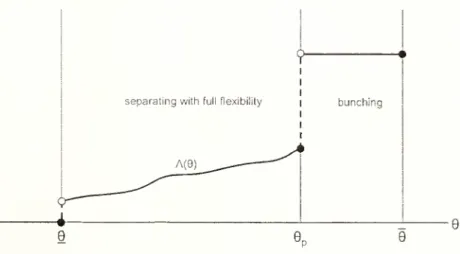
figure below illustrates theform
of the multipherA
{0) constructed in theproof ofthe proposition.
separatingwithfullflexibility
Figure 2:
The
Lagrange
multiplierA
{0)Proposition4 showsthat under assumption
A
the optimal allocation is extremelysimple. It can be
implemented
by imposing amaximum
level ofcurrent consumption,or equivalently, a
minimum
level of savings.Such
minimum
saving policies are a pervasive part of social security systems around the vi^orld.The
next resultshows
the comparative statics ofthe optimal allocation with re-spect to temptation/5.As
the temptation increases, i.e. /? decreases,more
types arebunched
(i.e. 6p decreases). In terms of policies, as the disagreement increases theminimum
savings requirement decreases so there is less flexibility in the allocation.Proposition
5 The bunching point 9p increases with j3.The
minimum
savingsre-quirement, Smin
=
y—
C
{u{9p)) , decreases with j3.Proof.
That
Op is weakly increasing follows directlyfrom
its definition.To
see thatSmin is decreasing note that Smin solves
9pU' {y
-
Sm\n)_
..and
that 9p,when
interior, solves,^-^
=
E[9\9>9p].
Combining
these,we
obtainE
[9\9>
9p] U'[y-
s^in)/W
{smm)=
1- SinceE[9\9>9p]
is increasing in 6p the result follows from concavity ofU
and
W.
3.4
Drilling
In this subsection
we
study caseswhere
assumptionA
does not holdand
show
that the allocation described in Proposition 4 can beimproved
upon
by
drilling holes inthe separating section
where
the condition in assumptionA
is not satisfied.Suppose
we
are offering the unconstrainedoptimum
for a closed interval [9a,Oi,] ofagents
and we
considerremoving
theopen
interval {9a, Oh). Agents that previously found their tangency within the interval willmove
to one ofthe two extremes, 9a or6b.
The
critical issue inevaluating the changein welfare iscountinghow
many
agentsmoving
to 9a versus Oi,. For a smallenough
interval, welfare rises from thosemoving
to 9a
and
falls from thosemoving
to 9h.Since therelative
measure
ofagentsmoving
tothe right versus theleft dependson
the slope of the density function this explains its role in assumption A. For example,if /'
>
thenupon
removing {0a, Oh)more
agentswould
move
to the right than theleft.
As
a consequence, such a change is undesirable.The
proof of the next resultformalizes these ideas.
Proposition
6 Suppose an allocation {u,w) has {u{9),w
{9))=
(u* {6),w* {9)) for6
€
[^a,^fc] with db<
9p. If the condition in assumptionA
does not hold /o7' 9 G[9a,9),] then removing the interior of the set {{u* {9) ,
w*
[9]) for9G
(&„,9b)} improveswelfare.
Proof. In the appendix.
Propositions 6 illustrates by construction
why
assumptionA
is necessary for a simple 'thresholdrule' to be optimaland
givessome
insight into this assumption.Of
course. Proposition 6only identifies particular
improvements whenever
assumptionA
fails.
We
have not characterized the fulloptimum
when
assumptionA
does not hold.It seems likely that
'money
burning'may
be optimal insome
cases.4
Arbitrary
Finite
Horizons
We
now
show
thatourresultsextend toarbitraryfinitehorizons.We
confine ourselves to finite horizons because with infinite horizons anymechanism
may
yield multipleequilibria in the resulting game.
These
equilibriamay
involve reputation in the sense that agood
equilibrium is sustained by a threat of reverting to abad
equilibriaupon
a deviation.Some
authors have questioned the credibility of such reputationalequilibria inintrapersonal
games
(e.g.Gul and
Pesendorfer, 2002a,and
Kocherlakota,1996).
We
avoid these issues by focusingon
finite horizons.Considerthe
problem
withN
<
oo periods t=
1, ...,TVwhere
thefelicity functionis
U
(•) in each period. Let 9^=
(6'i,^2, •,^t) denote the history ofshocksup
to timet.
A
directmechanism
now
requires that at time t the agentmake
reportson
thehistory of shocks r*
=
{r\,r2,,rl).
The
agent'sconsumption
is allowed todepend
on the whole history of reports:q
{r^,r^~^, ...,r^).A
strategy for self-t is amapping
from the history of shocks
and
past reports into current reports: /?* (6'*,r'~\••,'"^)-Truth
telling requires R^ {9^9*-'^,...,9^)=
9^ for all tand
all histories 9KWe
first argue that without loss in optimahtywe
can restrict ourselves to mecha-nisms that at time t require only a report r^ on the current shock 9t,and
not of the whole history ofshocks 6*. This is the case in Atkesonand
Lucas (1995) but in theirsetup since preferences are time-consistent there is a single player
and
theargument
is straightforward.
In contrast, in the hyperbolic
model
we
have A'' playersand
the difference inpreferences
between
these selves can be exploited to punish past deviations. For example, an agent at time t that is indifferent between allocations can be askedto choose
amongst
them
according to whether there has been a deviation in thepast. In particular, she can 'punish' previous deviating agents by selecting the worst
allocations
from
their point ofview. Otherwise, ifthere have been no past deviations,shecan 'reward' thetruth-telling agents
by
selecting theallocation preferredby
them.Such
schemesmay
make
deviationsmore
costly, relaxing the incentive constraints,and
are thus generally desirable.One way
toremove
the possibility of thesepunishment
schemes is to introduce the refinement thatwhen
agents are indifferent between several allocations choose the one thatmaximizes
the utility ofprevious selves. Indeed,Gul
and
Pesendorfer's (2001,2002a,b) framework, discussed in Section 6, dehvers, in the limit withoutself-control, the hyperbolic
model
with thisadded
refinement.However, with a continuous distribution for 9 such a refinement is not necessary
to rule out these
punishment
schemes.We
show
that for anymechanism
the subsetof over
which
^-agents are indifferent is atmost
countable. This implies that the probability that future selveswillfind themselves indifferent is zero so thatthe threatof using indifference to punish past deviations has no deterrent effect.
For any set
A
of pairs (^i,w)
define the optimal correspondence over xE
X
M
[x;A)
=
argmax
{xu
+
w}
{u,w)eA
(we allow the possibility that
M
{x,A)
isempty)
thenwe
have the following result.Lemma
(Indifference is countable).For
anyA
the subsetX^ C
X
for whichM
(x;A)
has two ormore
points (set of agents that are indifferent) is atmost
count-able.
Proof.
The
correspondenceM
{x;A) ismonotone
in the sense that if xi<
X2and
21(ui.wi) e
M{xi;A)
and
(u2,u'2)€
M{x2;A)
then ui<
U2- Thus, in an obvioussense, points at which there are
more
than a single element inM
{x;A)
representupward
'jumps'.As
withmonotonic
functions, it follows easily thatM
(.t;A)
canhave at
most
a countablenumber
ofsuch 'jumps'.This result relies only on the single crossing property of preferences
and
noton
thelinearity in
u and
w.We
make
use ofthislemma
again in Section 5.These
considerations lead us to write theproblem
with A'^>
3 remaining periodsrecursively as follows.
N
Period
Problem
vn
(y)=
max
/
[OU (c (9))+
v^-i {y [9))] clF{9)c,y
J
9U
{c{9))+
(3vr,-i [y' [9])>
9hU
(c(9)^
+
3v^^,
(ij (/5)) for all 9,9^Q
c {9)+
y' {9)<
y for all ^ G9
where 112 (•)
was
defined in Section 2.In the above formulation
we
assume, without loss in optimality, that the optimalmechanism
is ex-post optimal given the resources available i.e. t',v-ishows
up
in theobjectivefunction
and
incentive constraint. Thisis without loss in optimality because any inefficient continuation utility w' {9)<
v^-i [y'[9)) can be achievedby
'money
burning' with thesame
effect: setting xu' {9)=
i'at-i (y'[9)) forsome
y' [6)<
y' {9).For the simple recursive representation to obtain it is critical that, although the
principal
and
the agent disagreeon
theamount
of discounting between the current and next period, they both agreeon
the utility obtained from the next period on,given by uw-i- This is not true in the alternative setup where the principal
and
the agent both discount exponentially but with different discount factors.We
treat this case separately in Section 7.For
any
horizon A'' thisproblem
has exactly thesame
structure as the two-period problem analyzed previously, with the exception that Vjsi-i (•) has substitutedW
{).We
only requiredW
{) to be increasingand
concaveand
since I'yv-i (•) has theseproperties allthe previous resultsapply.
We
summarize
this result in the nextpropo-sition.
Proposition
7Under
assumptionA
the optimal allocation vnth a horizon ofN
pe-riods can be implemented by imposing aminimum
amount
ofsaving St {yt) inperiodt.
In Proposition 7 the
minimum
saving is a function of resources yt-With
CRRA
preferencesthe optimal allocationis linearly
homogenous
iny, sothat c{9,y)=
c{9)yand
y'{9,y)=
y' {9) y. It follows that the optimalmechanism
imposes aminimum
saving rate for each period that is independent of
yt-Proposition
8Under
assumptionA
and
U
(c)=
c^^'^/ {I—
a) the optimulm.echa-nism
for the N-period problem imposes aminim.um
saving rate St for each, period tindependent
ofyt-4.1
Hidden
Savings
Another
property ofthe optimalallocation identified in Propositions 4and
7is worthmentioning.
Suppose
agents can save, but not borrow, privately behind the planner's back at thesame
rate ofreturn as the planner, as in Coleand
Kocherlakota (2001).The
possibility ofthis 'hiddensaving' reduces theset ofallocations that are incentivecompatible sincetheagent has astrictlylargerset ofpossible deviations. Importantly, the
mechanism
describedin Proposition 7 continuestoimplement
thesame
allocationwhen we
allow agents to save privately,and
thus remains optimal.To
prove this claimwe
argue that confronted with themechanism
in Proposition7 agents that currently have
no
private savingswould
never find it optimal toac-cumulate private savings.
To
see this, first note that by Proposition 7 the optimalmechanism
imposes only aminimum
on savingsin each period.Thus
agent-^ always have the option ofsavingmore
observablywiththeprincipal thanwhat
the allocationrecommends,
yet by incentive compatibility the agent chooses not to.Next, note that saving privately
on
hisown
can beno
better for the agent than increasing theamount
ofobservable savings with the principal. This is true because the principal maximizes the agents utility given the resources at its disposal. Thus, fromthe point ofviewofthecurrentself, futurewealthaccumulated by hiddensavingsis
dominated by
wealth accumulated with the principal.It follows that agents never find it optimal to save privately
and
themechanism
implements thesame
allocationwhen
agents can or cannot save privately.Proposition
9Under
assumptionA
the m.echanism describedm
Proposition 7im-plern.ents the sam.e allocation
when
agents can save privately.5
Heterogeneous
Temptation
Consider
now
the case where the leveloftemptation,measured
by,i5, israndom. Het-erogeneity inf3 captures thecommonly
held viewthat thetemptation tooverconsumeis not uniform in the population
and
that it is the agents that save the least thatare
more
likely to be 'undersaving' because of a higher temptation toconsume
(e.g.Diamond,
1977).Ifthe heterogeneity in temptation were due to
permanent
differences acrossindi-viduals then the previous analysis
would
apply essentially unaltered. If agentsknew
their /3 at time time they
would
truthfully report it so that theirmechanism
could be tailored to their /3 as described above"*.To
explore other possibilitieswe assume
the other extreme, that differences in temptation are purely idiosyncratic, so that j3
is i.i.d. across time
and
individuals. Thus, each period 9and
(3 are realized togetherfrom a continuous distribution -
we
do
not require independence of 6and
[3 for ourresults.
We
continue toassume
that /3<
1 for simplicity.For any set
A
of available pairs [u,w)
agents with {6,/3)maximize
their utility:/^
arg
max
<—u +
w
{u,w)eA yjj
Note
thatthis argmax
set is identical for alltypes withthesame
ratiox
=
9/^
which implies thatwe
can without loss in optimalityassume
the allocationdepend
only onX.
To
see this note that the allocationmay
depend
on 9and
/3 independently fora given x only if the x-agent is indifferent
amongst
several pairs of u,w. However, thelemma
in section 4showed
that the set of x for which agents are indifferent is*0fcourse, ifagents canonly report at f
=
1 then one cannot costlesslyobtain truthful! reports on(5. However, with largeenoughN
it is likely that the cost ofrevealing /3 would besmall.of
measure
zero.As
a consequence, allowing the allocation todepend
on 6 or /3independently, in addition to x, cannot improve the objective function.
Without
loss in optimalitywe
limit ourselves to allocations that are functions ofx only^.The
objective function is then:E
[eu(x)+
w
{x)]=E[E
[Ou (x)+
w
(x)| x]]=
f
[a (x)u{x)
+ w
(x)]/
(x)dx
where
a
(x)=
E
{6\x)and
/ (x) is the density over x. LetX
=
[x,x] be the supportofX
and
F
(x) be its cumulative distribution.Define Xp as the lowest value such that for x
>
XpE
[a(x)|X>
x]X
"
We
modify our previous assumptionA
in the following way.Assumption
A.
For xe
[x,Xp],we
have thatxf'ix)^
2-«'(x)
/(x)
-
l-a(x)/x
Note
that without heterogeneitya
(x)=
/3x so that assumptionsA
and
A
areequivalent in this case.
Heterogenous
Temptation
Problem
max
/{a
(x)u[x)+
w
(x)}dF
(x)<-)M)
Jsubject to
xu
(x)+
ly(x)=
xu
(x)+ w
(x)+
u
(x)dx
c{u{x))
+
k{w{x))
<
1u{x)
>
u
(y) for allx
>
y^Given/3
<
1 a simplerargumentisavailable. Theplanner can simplyinstructagentswithgiven X to choose the elementofthe argmax
with the lowest u, since the planner has a strict preferencefor the lowestuelement. The argument inthe textissimilar to the one usedto extendthe analysis to arbitraryhorizonsand can be appliedto the case where/?
>
1 is allowed.The
proofofthe next result closely follows the proofof proposition 4.Proposition 10
Under
assumptionA
agents with x<
Xp are offered theiruncon-strained
optimum and
agents with x>
Xp are bunched at the unconstrainedoptimum
for agent Xp.6
Commitment
with
Self
Control
Gul
and Pesendorfer (2001,2002a,b) introduced an axiomatic foundation forprefer-ences for
commitment.
We
review their setupand
representation result briefly ingeneral terms
and
then describehow
we
apply it to our framework.In their static formulation the primitive is a preferences ordering over sets of choices, with utility function
P
{A) over choice sets A. In the classical caseP
(A)=
maXagyip(a) forsome
utility function p defined directly over actions.Note
that in this case if a setA
is reduced to A' without removing the best element, a* from A, thenP
is not altered. In this sense,committment,
a preference for smaller sets, isnot valued.
To
model
a preference forcommitment
theyassume
aconsumer
may
strictlyprefera set A' that is a strict subset .4, i.e.
P
{A')>
P
(.4)and
A'C
A.They
show
that such preferences can be represented by two utility functionsU
and
V
over choices a by the relation:P
{A)=
max
{p(a)+
t{a)}— max
t(a)a€.4 ae.4
One
can think of t(a)—
maXag^
t(o) as the cost of self-control sufferedby
an agentwhen
choosing a instead ofargmax^g^i
(a). In adynamic
setting recursiveprefer-ences with temptation can be represented similarly (Gul
and
Pessendorfer (2002a,b). In ourframework
the action is a choice for currentconsumption and
savings, cand
k. In order to nest the hyperbolic preferencesmodel
we
follow Krusell,Kuruscu
and Smith
(2001)and
use:p
(c,k)=
On(c)+
w
{k)t (c,k)
=
(p[On(c)+
i5w(A:))where
the parameter>
captures the lack ofself control.As
—
^ oo the agent has noself-controland
yields fully to his temptation. His preferences essentially convergeto those implied
by
thehyperboHc
model.The
only difference is that in the limit as—
* oowe
obtain a tie-breaking criteria thatwhenever
an agent is indifferent heselects whatever is best for his previous 'selves' (i.e. maximizes t).
The
objective function is:/ {9u{e)
+
w{e))f{9)de
+
(p {9u{9)+
pwie))f{9)de
Je Je,
-(p f
[9u{9)+l3w{9))f{9)d9
Je,
where
{u,w)
is the allocation for the "temptation agent"and
{u,w)
is the allocation ofthat is chosenby
the "self-control agent". It is convenient to define everything forasupport larger than
9
given by=
[9, 9]where
9=
9/3/13<
9.Given asetof offered (m,
w)
pairs,the "self-control agent" will choose anallocationthat
maximizes 9u
+
f3w with /3=
(1+
4>/3)/(1+
0), while the "temptation agent" will choosean
allocation that maximizes9u
+
(3w. Since both the "temptation"and
the "self-control" agents choose from thesame
set it follows that,u{9)=u{9l3/P),
(8)so that the "self-control agent" 9 acts as a "temptation-agent" with a lower taste
shock.
Substituting (8) into the objective function
we
obtain,(1
+
0) /" (9u (^/3//3)+
/3io (913/l3\) f {9) d9-
4>f
{9u{9)+
(3w{9))f
(9) d9.The
firstterm
can beshown
to equal,(1
+
(/.)13//3/ {9u{9)
+
f3iu {9))f
(9P/I3) P/pd9. JiJ3/0 ^ 'Note that h[9)
=
f (9p//3] ^/l3 is thedensity oftherandom
variable9P/^; letH
{9) represent its corresponding distribution function.The
objective function can be written as,3 rS-e r§
(1
+
<^)§
r
{9u(9)+
/3w(9))hi9)d9-d
{9u(9)+
Biv{9))f
(9) d9.Substituting in the incentive constraint,
9u
(9)+
/3w{9)=
I u{9)de
+
vo,Je
where vq
=
{9J3/P)u{9)+
(3w{§)and
integratingby
parts,we
obtain:{l
+
(P)^Jf
il-H{9))u{9)de-(l>J^
{l-F{9))uie)d9+(^il
+
<P)p/l3-cP^vo.where
we
are taking both intervals of integration as being from ^ to ^by
lettingh{9)
=
0, for all 9>
^/3//5and /
(^)=
for all 9<
9. In additionwe
requireu
to be non-decreasingand
the budget constraint:vo+
(
u (9^ d9-
9u
{9)<
(3K~' {y-
C
{u{9))).
Definition. Let 9p be the lowest value such that for 9
>
9p,y_7(l
+
0)^
(1-
^
m
-<P{1-F
{9))] d9<
Assumption
A.
For 9€
[9,9p],we
have that(l
+
,/.)(/3//3)'/(^/3//3)-0/W>O
We
now
show
that the optimalallocation is to offer all types below 9p theiruncon-strained
optimum
and
tobunch
types higher than 9p at the unconstrainedoptimum
for 9p.Denote
this allocation by {w*,u) as before.The
Lagrangian isL
=
jU{l
+
<l>)^{l-H{9))-<l>{l-F{9))-il-A{e))\u{e)d9
+
/ {/3K-'{y-C
{u(9)))+9ii)dk
/3
+
l(l+</>)^-0
(l-A(0)No
where
A
isa non-decreasing Lagrange multipUer for thebudget constraint,normahzed
so that A(^)
=
1.Proposition
11The
allocation {w*,u) is optimal ifand only ifassumptionA
holds.Proof.
We
follow the proofof Proposition 4 as closely as possible.At
the proposedallocation
we
have:dLiw,u-h^Ji^\A)=
l^{{l
+
<P)^{l-H{9))-cl){l-F{9))-{l-A{9))]h^{9)d9
+
(^Pl^^[^f^-^]\\9..e]hudA
+
;i+
0)|-(/.-(l-A(^))
L,Equation (5) requires
A{9)
—
{1+
4>) (/3//9—
1). Using thisand
integrating (3)by
parts leads to
dL
{w,u-/i„, /),„!A)=
7
[9) hu{9)+
7 (0)dh^, {9) (9)where,
^{9)^
Nil
+
4>)t[I-
H
{9))- <t^{l-F [9))-
{I-
K{9))\d9+e,j'^(^~^
It follows that (4) requires