HAL Id: hal-02364183
https://hal.archives-ouvertes.fr/hal-02364183
Submitted on 14 Nov 2019HAL is a multi-disciplinary open access archive for the deposit and dissemination of sci-entific research documents, whether they are pub-lished or not. The documents may come from teaching and research institutions in France or abroad, or from public or private research centers.
L’archive ouverte pluridisciplinaire HAL, est destinée au dépôt et à la diffusion de documents scientifiques de niveau recherche, publiés ou non, émanant des établissements d’enseignement et de recherche français ou étrangers, des laboratoires publics ou privés.
PROXIMITY COOPERATION DRIVING
INNOVATION. THE NATUROPÔLE CASE-FILE
Anne Albert-Cromarias, Alexandre Asselineau
To cite this version:
Anne Albert-Cromarias, Alexandre Asselineau. PROXIMITY COOPERATION DRIVING INNO-VATION. THE NATUROPÔLE CASE-FILE. Problems and Perspectives in Management, Business perspectives, 2013. �hal-02364183�
P
ROXIMITY COOPERATION DRIVING INNOVATION.
T
HEN
ATUROPÔLE CASE-
FILE.
Anne ALBERT-CROMARIAS* & Alexandre ASSELINEAU†
After a long period in the back seat, the proximity—competitiveness link is now emerging to the forefront as a focus for study. Proximity is thought to bring a number of advantages, including fostering the emergence of innovative business practices: for smaller organizations, cooperation — facilitated by proximity ties — may often prove decisive in resolving certain organizational or managerial issues.
To gain deeper insight into these dimensions, we led an exploratory study focusing on Naturopôle — a ‘micro-cluster’ harnessing together four French SMEs. Despite being based in a territory that, on paper, offers few economic asset-strengths, these four firms have managed to achieve outstanding growth by implementing innovative collaborative business projects.
The first results from this research warrant confirmation show that starting out with a tough territorial groundbase can spark local firms to develop collaborative business practices as a platform for strategic, functional and social innovations geared to the overarching goal of competitive differentiation.
Keywords: territory; proximity; collaborative innovation; SME
JEL : D22 - Firm Behavior: Empirical Analysis / L25 - Firm Performance:
Size, Diversification, and Scope / R11 - Regional Economic Activity: Growth, Development, Environmental Issues, and Changes
1. Introduction
Fifty years of social and economic transformation have reshaped our spatio-temporal frame, culminating in what today could be qualified as a ‘long-space short-time’ frame where firms are forced into longer-distance, faster-timespan interactions (Torrès-Blay, 2004).
* Anne ALBERT-CROMARIAS, Professor in Strategy and Management, France Business School,
CRCGM, France. [email protected]
† Alexandre ASSELINEAU, Professor in Strategy, Burgundy School of Business, CEREN, France.
Globalization may have become a contingent feature of today’s market arena, but many SMEs still evolve in a “proximity mix” (Torrès, 2004), commonly imposed by their geographic location.
This paper examines how SMEs can tackle worldwide competition by becoming sufficiently innovative to turn their local setting into a plus, specifically through cooperative interplay with neighbouring firms.
After recapping on the theoretical foundations grounding our research (section I), we outline the case-brief of the four SMEs organized into a ‘micro-cluster’ in a rural French territory and show how they innovate (section II), before moving on to keynote our reread of how these firms forged their success (section III).
2. SMEs, globalization, and proximity
2.1 SMEs and ‘glocalization’
After a long period in the back seat, the proximity—competitiveness link is now emerging to the forefront as a study focus for industrial economics scholarship. It may seem paradoxical that the recent upsurge in literature on the proximity—competitiveness link has occurred just as the pace of generalized free-market exchange is gathering speed and bringing with it increased business mobility: “globalization allows companies to source capital, goods, and technology from anywhere and to locate operations wherever it is most cost-effective” (Porter, 1998). This encapsulates the paradox of the small world network model, which combines both local and global relational ties. The complementarity between local relations and global relations takes local systems outside the local cohesiveness box and compels consideration of their ability to tap into an extended resource base (Watts & Strogatz, 1998). Over and above the balancing act between these two conceptions of territory — local one side, global the other — dubbed ‘glocalization’, “what is really interesting is to see how the global economy finds different ways to send roots into historically-anchored territorial structures. In short, how global constantly feeds on local” (Veltz, 2005: 13). In other words, we are witnessing a shift in the relationship between the firm and its territory, switching from a location-based strategy where space is simply the arena of business activity, to a territorial groundbase strategy where the interests of different agents (local authorities, individuals, and of course firms) converge in a territory recast as an active player (Bramanti, 1999).
In parallel to this shift, the market vs hierarchy paradigm is being reframed with network
important role played by ‘clusters’ of inter-industry cooperation as a source of competitiveness (Porter, 2000). This setting, which mobilizes proximity and territorial groundbase as key principles, is the appropriate arena for tackling the issue of locational rationale, where the firm’s motivations cannot be reduced solely to finding comparative advantages for factors of production.
The case of SMEs offers a rich vein of learnings when seen from the standpoint that they are characterized by a “proximity mix” (Torrès, 2004):
Hierarchical proximity, characterized by an owner-manager who is both physically close (sharing the same address and the same work conditions as the on-salary workforce) and personally close (as they tend to personally know each individual member of staff).
Functional proximity, visible in the absence of segregation of duties, the way the owner-manager is omnipresent and multiversatile.
Proximity information systems, combining simple and informal internal communication with flexible, no-nonsense coordination mechanisms fronted by mutual adjustment and direct supervision.
Temporal proximity, with a short time horizon, and where entrepreneurial vision essentially hinges on the owner-manager’s own strategic vision.
Territorial proximity, which hinges on proximity marketing in a relatively tight marketplace space, generally gauged at local/regional scale, and on a network of neighbours that the SME preferentially uses to recruit.
Looking out from this angle, what kind of process can lead SMEs sharing the same territory to co-innovate new solutions enabling them to carve out business in today’s highly-globalized context-setting?
2.2 Scholarship paints the link connecting proximity and innovation
Work in the locational approach starts out by lending territory a geographic scaffold. A given territory will house different firms of different sizes operating in different sectors, each chasing their own strategic orientations. The focus here will be to address how ‘close’ firms can go about orchestrating cooperative effort. That said, the term ‘close’ should leave no room for confusion, as exemplified in proximity economics which splits closeness into two dimensions:
Geographic proximity comes first, characterized by distance gauged either in miles or in travel-time. From this stance, then, it is spatial proximity that shapes firm location.
Next comes organized proximity — a non-spatial construct characterized by exchanges between agents and their coordinatedness.
These two dimensions do however remain tightly linked, resurfacing as core concepts in the ‘proximist’ approach (Bouba-Olga & Zimmermann, 2004), which is platformed on spatial proximity but places the onus on the role of interpersonal relationships in building inter-organizational cooperation.
Parrilli (2009), studying Italian industrial districts, shows that although spatial proximity may well facilitate inter-firm cooperation, it is not — nor can it be — the only driver. Parrilli’s analysis concludes that three decisive development drivers need to combine: ‘collective efficiency’, ‘policy inducement’, and ‘social embeddedness’.
The proximity—innovation link has been heavily analyzed in the scholarship literature on ‘clusters’ and spin-off SME-based forms such as Italy’s ‘industrial districts’ and, more recently, France’s competitiveness clusters (“pôles de compétitivité”). The precursor work dates back a century to Alfred Marshall, but his concept was not picked up by his contemporaries. Not until Michael Porter’s work did the managerial literature show signs of exploring deeper into the relationships linking business strategy and micro-environment (the forces acting on a marketplace) or linking business strategy and immediate geographic environment (through studies on topics such as the magnetic Silicon Valley clustering effect for ICT start-ups).
By building on the idea that clustering organizations that share similar operational rationales into the same territory is relevant and should be promoted through pro-active public policy planning, most cluster development analysis actually posits a logic driving the ‘international division of labour’ via the creation of magnetic clusters with worldwide renown. The fundamental principle is essentially that proximity-based partnerships act as a positive facilitator of business growth drivers, chiefly innovation, through:
cross-fertilization of competencies and cooperation initiatives (especially on R&D)
mutual recognition between agents (access to capital funding, lobbying leverage, etc.)
key competences (Prahalad & Hamel, 1990) that are easily adoptable (through universities and research centers, engineering schools, management schools)
the wider presence of what Marshall (1890; 1919) dubbed ‘industrial atmosphere’ as a source of collective emulation.
These foundations are thought to provide the platform enabling endogenous factors like knowledge and innovation to spur territory-wide economic growth (Vaz & Nijkamp, 2009).
Our research takes a different angle — an angle we see as particularly fitting at a juncture when territorial development issues have returned centrestage (especially since proximity has been thrown back into the spotlight as a factor of sustainable development), but that is still yet to attract scholarship interest. We turn away from settings where a territory is already economically active before the firm’s arrival, refocusing instead on cases where firms are settled in a territory (in this instance, a rural zone) that ex ante has little economic pull and zero “industrial atmosphere”.
Our aim in this focus scenario is to understand how the firm goes about developing business, how it ‘builds up’ proximity relationships (public-sector or private-sector) and partnerships, and how these initiatives can orchestrate or facilitate innovative approaches. Will this new angle ultimately pinpoint the linkage between innovation approaches and proximity relations?
3. The Naturopôle case-file: methodology and backgrounding
3.1 Research methodology
The methodology framework scaffolding this research is grounded in a single case study approach recycled here for the lead-in exploratory phase setting the scene for our research focus (Yin, 2003). Case selection was guided by a set of standout feature-criteria geared to our research problem: a resources-based entrepreneurial approach (Vaz & Nijkamp, 2009; Barney, 2001) translating into strong self-driven business development; a ‘think global, act local’ approach; innovative functional and business dimensions; a rural territory groundbase far remote from policy decision-making, research institutes and training institutions; running to an endogeneously-formed small world network-type system.
Our work essentially mobilizes qualitative research tools, primarily semi-structured face-to-face interviews with the key players (business leaders and local community partners such as the community council, chamber of commerce and industry, economic development agencies, and others) but backed up with numerous secondary sources of insider data (handed over by Naturopôle and its resident businesses) and independent data (student reports, press articles).
Our contributions target two audiences: first, on-the-ground practitioners looking for generic actionable local-development knowledge (Avenier, 2010), who should find the fundamentals in this exploratory research; second, scholarship, by bridging our work over to research in corporate social responsibility as well as local and territorial governance.
3.2 Naturopôle — keynote background data
3.2.1 Square one
Naturopôle was the brainchild of just one man, Philippe L., Pharm.D., who back in 1986 set out to create LPH [Laboratory of Phytotherapy and Herbalism] specializing in medicinal plant preparations. The originality of the project had less to do with the products (custom compounding for dispensing pharmacies) and everything to do with the conscious choice to set up the firm on his home commune — a small rural village (counting 656 inhabitants) deep in the Allier département, 50 miles north of Clermont-Ferrand and 30 miles west of Vichy. Philippe L’s decision to start up LPH in rural Saint-Bonnet-de-Rochefort was essentially sentimental. Born and bred in the commune, into a family with strong local ties, he sums up his project in these words: “The challenge I was set was to start my own business. The challenge I set myself was to do it on my home soil”.
Starting out in his own small workshop, the early days were tough. Business development hinged on diversifying production, originally based around compounding services, into manufacturing packaged capsules. His efforts led the business to open talks with industrials on stepping into physical processing. As early on as 1991, Philippe L. managed to convince one of his suppliers to join the adventure at Saint-Bonnet-de-Rochefort. This is how, after six years in business, the packaging, screenprinting and labelling specialists Eskiss Packaging upped roots and moved in.
As LPH then hit a real surge in development, Philippe L. decided to create affiliates to handle the product distribution side. It was also around this period that he informed Saint-Bonnet-de-Rochefort municipal council of his plans to expand LPH, within the commune boundaries if possible, and potentially under a project to set up a lightweight business park. At that time, today’s mayor Anne-Marie D. was on the municipal council team, but only in an assistantship role. Looking back, she remembers that “When they outlined that project in front of the local council, they said “— What on earth are you thinking? There’s no way it can work, we’ll end
up saddled with it…” Then, two, three of us got to thinking “sure, it’s risky, but if we don’t grab the opportunity this time around, we won’t get a second chance.” The council u-turned,
with the local council, was founded in 1995. The original idea was to invest a business park in a spotless environment, cluster together firms operating in the human nutrition segment, and sew up the services offer for major contractor-sponsors. This backstory is a progressively-building trend where contracts were increasingly signed with industrial alliance partners, who in some cases would even co-opt the firm into the upstream product engineering process.
3.2.2 Naturopôle — the picture today A thematic business park.
Naturopôle is a segment-themed business zone set in a rural environment and centred exclusively on the healthcare nutrition segment. In terms of legal-administrative organization, Naturopôle is a non-profit association federating the human resource capital of the local territory. Parc Naturopôle Nutrition Santé [the French full name] is a business platform harnessing input from local leader businesses LPH, Eskiss Packaging, Nutraceutics DS and Biosphère alongside Saint-Bonnet-de-Rochefort community council, the Val de Sioule Forterre association through Leader+ territorial development funds, Montluçon-Gannat chamber of commerce and industry, the Allier département general council, and the Auvergne regional council”.* It hosts four firms employing a headcount
of 170 permanent staff: LPH (acronym re-translated as the ‘Laboratory of Phytotherapy and Herbalism’), founded in 1987 and employing 100 staff, designs and produces plant-based food supplements; Eskiss Packaging, who joined the park in 1991, specializes in the manufacture and labelling of environmentally-friendly packaging for pharmacy, cosmetics and drugstore industry clients, and employs 21 staff; NDS (Nutraceutics Development & Services), a two-person team at the park since 2005, prototypes system solutions for processing plant-based powders and pastes; Biosphère, the latest to join in 2007, specializes in developing and producing plant extracts for the nutrition, cosmetics and pharmacy industry segments, and employs 30 staff.
A micro-cluster.
The four Naturopôle firms operate as a micro-cluster. The team that created Naturopôle outlines the basic principle in these terms. Firms hosted at the park will evolve in the neutraceuticals niche and need to be complementary, not in competition. Core skillsets shared by these firms need to be identified to see which can be pooled. In concrete terms, the micro-cluster concept is encapsulated in the ‘package solution’ deal offered to
* Excerpt from the media kit promoting the 1st
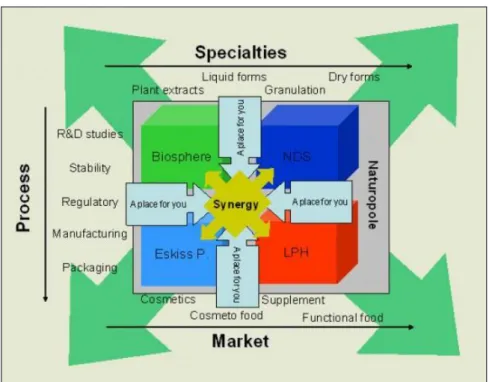
customers. Each firm adopts a position geared to its processual role in production (from R&D through to packaging), target market (from cosmetics to functional foods), and proprietary specialty (from source-plant to dried-form substance). Each of the four Naturopôle firms thus holds a clearly-defined position in the graph plotting these three axes (Figure 1). This means that Naturopôle can only open its doors to new arrivals if they can slot into a complementary position in the package solution currently offered by the resident firms. The candidate skillsets targeted would slot into the following activity-fields: powder blending and granulation, cosmetics packing, logistics, specialized international regulatory consultancy, and any industrial or services activity harnessing skills that prove complementary to the current neutraceuticals marketplace.
Figure 1. The ‘package solution’ offered by the Naturopôle-based micro-cluster
It is this consciously thought-through complementarity that enables Naturopôle firms to position as suppliers to the major worldwide brand giants (including Yves Rocher).
A Pôle d’Excellence Rurale.
‘Pôles d’Excellence Rurale’ [rural-based business competency clusters], or ‘PER’, are the lesser-known younger brother of the French competitiveness clusters. In 2005, the French government’s interdepartmental delegation on spatial planning and competitiveness (‘DIACT’) launched a program backing “ambitious, innovative, local-scale job opportunity initiatives built around public-private partnerships”. With 379 projects
successfully securing backing in 2006, the project submission process was repeated in late-2009. These DIACT projects are classed under four theme-focused categories: projects focused on heritage assets and tourism; projects focused on bioresources; projects centred on the services and hospitality industry; and lastly, projects centred on technologies — and encompassing the Naturopôle project. The PER program assessment was made public in May 2009, and the scheme posted impressive figures: of 379 PER tagged, 357 effectively ploughed back investment capital — with a hundred or so (Naturopôle included) making 100% paybacks.
Naturopôle is one of three PER registered in the Allier département, with PER ‘Parc Naturopôle Nutrition Santé’ making it into program portfolio one as a “development
project co-led by a business cluster of firms organized into a locally-driven production system, and whose core business entails using innovative technologies to employ or process plant-based raw materials for the nutraceuticals markets”*. The project actions
registered revolve around five primary objectives: pool the high-added-value competencies of the four firms through R&D initiatives; sell products and secure positions on European markets; improve the all-road performance of the member-firms; build and promote the park’s sustainable development record; implement territorial-scale marketing to galvanize the park’s activity-theme, brand identity, and natural-health image.
In reality, the PER tag simply brought an official seal of approval to cooperative arrangements that had been around for years, especially between private-sector actors and public-sector agencies. For Philippe L., securing the PER seal is “recognition of all the work and social-centric commitment engaged by the whole team over more than a decade now. [The PER tag needs to] anchor sustainable, territory-wide economic activity that creates jobs. […] The ‘PER’ tag lends the site and its people credibility”. Current mayor of Saint-Bonnet-de-Rochefort Anne-Marie D. echoes the message: “Ever since LPH was founded, we have continually fostered tight partnership relations with the firms by cooperating on ways to meet their objectives. In fact, our public-private partnership was there from the outset. We didn’t have to wait for the PER”.
All the actions were dealt with on schedule, as PER approval was not there to initiate cooperation between the actors but to cap a long-standing approach. Anne-Marie D. adds: “I think we were the only ones in the department to have finished. That’s because we were ready. There were teams grappling to put together PER Tourism projects that needed
building wholesale from the ground up… whereas all we had to do complete the application bid was put everything down on paper in the right language. We were so far ahead on the operational front that getting the job done was just a logical extension of what we were doing”. The PER experience has proven so positive across the board that the stakeholders are unanimously advocating pressing ahead with the approach, along the lines of the second-step system that government proposes to competitiveness clusters.
3.3 Naturopôle — an innovational test platform
3.3.1 “Creating jobs in rural communities”
Philippe L.’s ambition was to start business in a rural community. His objective was to prove it was possible to launch a new venture in a rural ‘area’ [as the term is sometimes negatively-connotated, Philippe L. systematically uses ‘natural environment’], creating jobs to consolidate and develop vibrant community clusters. This core idea also extended to demonstrating that it was possible to garner top-flight services and business activities requiring advanced technical and technological know-how without necessarily having to relocate to the city. HR manager Francine D. stresses that “Creating jobs in rural communities is a deep-set conviction — it’s not about joining a bandwagon.”
At the time, the project looked no more than a reckless gamble, not just in terms of product-positioning (“they took us for tree huggers making herb tea”) but also in terms of creating jobs. However, the doubters have been silenced, as the project has clearly met with success. So much so that the Naturopôle firms are regularly showcased as a standout example, attracting local institutional representatives* , the regional press†, and even national
recognition, with the President of France touring Naturopôle in 2008‡.
3.3.2 A package solution deal
The four affiliate firms forming Naturopôle harness complementary skillsets for the package solution deal that Naturopôle offers its customers, i.e. an end-to-end turnkey solution running from full product development through to distribution and back to compound extract, manufacture, physical processing and packaging. This ‘package solution’ is the unique
* Illustrated by a visit on 15 July 2009 from the Prefect of the Region.
† Massif Central Entreprendre, issue 24, November-December 2008, pp. 27-30; La Montagne [the local regional newspaper], 12 June 2009, p.3
‡ A full report is available through the Naturopôle website, at
http://www.parc-naturopole.fr/pp_actu.asp?reference=12&lg=fr; the Elysée website also carries a photo archive:
proposal differentiating Naturopôle in a crowded me-too marketplace. It is also this package solution that best translates the micro-cluster concept where firms interconnect with seamless complementarity to unleash compelling synergies (see earlier, and figure 1).
The Naturopôle firms are also proactively engaged in a highly stringent quality management approach that provides their customers with vital assurances of their motivational drive and no-nonsense professionalism in a fiercely competitive international market arena. Quality certifications have already been secured (or are in the process) to formally hallmark this committed approach, including ISO 22000, ISO 9000, ISO 14001, Ecocert, and Good Manufacturing Practice. This kind of quality policy obviously speaks to direct customers through the ‘package solution’ and custom-tailored orders, but it also talks to consumers through the traceability, hygiene and stability conditions that guarantee all products delivered are 100% safe. Manuel B., CEO of LPH, soundbites this market positioning strategy: “Quality in everything we do leverages the added-value we share with our customers”.
3.3.3 Converging towards mutually-shared HRM Professional mobility.
Naturopôle’s companies integrate professional mobility management as a core concern. From the outside looking in, the firms operate as a micro-cluster of complementary non-competing business functions, yet inside the cluster, their people possess key competences that could prove valuable to several other the firms under certain factor configurations. Professional mobility is obviously a feature at Naturopôle, like any other company, but the workforce numbers involved mean that a ceiling is quickly reached. Naturopôle has responded by proposing intra-micro-cluster mobility as a solution offering perspectives for progression through a broad spectrum of channels, from promotion advancement or a position switch through to reclassification following occupational injury or medical imperatives. Progression may stem from a top-down ‘pull’ initiative, where a firm with a vacancy to fill informs its staff as well as the staff of its Naturopôle neighbour firms (via annual performance appraisals, noticeboard displays, or staff representatives). Progression may also be driven by a bottom-up ‘push’ initiative by staff voicing the need to move ahead, for person reasons (desire to change position, medical imperatives) or professional motives (career advancement perspectives). This inter-firm mobility may be fairly rare, but it remains a reality. Every year, around two staff switch firms — the figure looks small, but given the total headcount involved, it is significant.
Each firm devises then delivers its own professional training plan, as different set-ups have different reskilling needs in different years. Joint programmes are sometimes co-organized, particularly on cross-functional focuses such as management issues. In 2006, LPH led attempts to network firms from outside the Naturopôle cluster into the professional training community, the aim being to set up joint professional development schemes to tick the quality, health–hygiene–safety, and technical foundation training boxes. The project attracted buy-in from all the Naturopôle firms plus other pharmaceutical-sector businesses located in the Gannat and Vichy zones. Ultimately, the project never blossomed into its extended mutualized network format, as the two big outside pharma labs pencilled in did not ultimately cement their commitment to the approach. The initiative was thus scaled back and led at Naturopôle level.
Outsourced skills pooling for R&D
In the fiercely competitive functional foods market, pharma and cosmetics giants market and distribute food supplements under their own brandnames. That said, the production process, starting upstream at ingredient selection and running through to blending and manufacturing different compound forms (dry or fluid) and on to packing and traceability, all hinges on ingredient suppliers and subcontractors — including the Naturopôle firms. R&D is the critical leverage for securing brand exposure in a marketplace where the key account customers are the global pharmaceutical companies. The time is clearly ripe for Naturopôle to make a move for the fast-emerging probiotics and antioxidants segments, where it can recycle today’s expertise into tomorrow’s high-growth markets. But innovation costs money, and Naturopôle is revenue-dependent on self-financing under the governance principle adopted and adhered to by Naturopôle directorships — directorships that now have to innovate and forge partnerships to finance a share of the R&D bill. Two innovations — both eminently strategic for Naturopôle (and understandably kept confidential) — were implemented through a system that uses a core collaborative project framework to pool highly-skilled labour.
On business development projects that are not so tightly meshed into the major Naturopôle segments, the firms are looking at following the impetus of LPH into a spin-out scheme for financing innovation (possibly through the ‘Young Innovative Company’ tax break status for R&D expenditure-heavy SMEs) while keeping their competencies anchored to the territory — ready for when fresh new start-ups set up inside Naturopôle’s radius.
3.3.4 Outstanding public-private relationships
Naturopôle, registered under the ‘PER’ rural competency clusters scheme, is a business park run at exclusively local commune level, enabling Philippe L., managing director of lead firm LPH, and Anne-Marie D., local mayor and President of Naturopôle, to build and develop strong synergies.
This commonsense intelligence essentially stems from the cohesiveness of the visions of each partner–agent: business leaders one side of the table, local councillors the other. Anne-Marie D. delivers her viewpoint as mayor, in these terms: “For a councillor, being involved in an experience like this day-in day-out is just a fantastic — and rare — opportunity. This is not my home region. Philippe L. was a chance meeting. We work well together. We share the same objectives, the same motivations. Our dialogue is direct, open, no-nonsense, and that’s a positive”. Philippe L. has a different take, explaining he wanted to give something back to the region that raised him.
Both these figures have learnt to pull together to secure the economic development of their territory by cultivating consistent and cogent cohesiveness between the territory’s brand image, the cluster’s business sector, and environmentally-friendly policy. This is the message Naturopôle image management communications translate as a “locally-driven groundbase [of firms] committed to securing long-term sustainability and business development for rural zones while adopting an environmentally-responsible stance”.
4. Proximity — the catalyst driving collaborative innovation?
This case study highlights three forms of innovation: strategic innovation, tied to the business leader and their entrepreneurship goals; functional innovation, spanning marketing (micro-cluster, package solution) and HR; social innovation, with heightened integration of the firm’s multifaceted, multi-stakeholder environment, and qualifiable as “local sustainable development” (Asselineau & Cromarias, 2010).
At this juncture, the aim is to zero in on the linkage between inter-firm proximity and innovational ability. In other words, does the proximity factor drive innovation, and if so, which form of proximity is the key?
4.1 Geographic proximity: necessary but not sufficient
While all the firms case-studied here do share spatial proximity (as they are all localized to the same business park, at no further than a few hundred meters apart), this dimension does not come as naturally as might first be thought.
In their attempt to differentiate proximity and localization, Rallet and Torre (2005) stressed how simply being next to someone does not automatically open up cooperation. Neighbours might ignore or even hate one another, for a host of reasons stretching from the scarcity of certain resources or a prior history of ‘bad blood’. In the first scenario, a business leader clearly adopts the position that firms are always wary about pooling their human resource capital, as there is always latent competitiveness and the fear of losing good staff to a rival. In the second scenario, there are latent conflicts fuelled by previous relationships between certain participants. These observations converge on the conclusion that not only is an agglomeration of firms (i.e. firms spatially concentrates within a relatively limited geographic radius) unable to guarantee quality relational ties between co-localized organizations, but that this shared proximity can even turn into yet another barrier hampering the chances of the firms coming together and moving forward on a common project.
Spatial proximity is thus a necessary requisite — one achieved at Naturopôle — but turns out to be not enough. To enable projects such as the emergent flexicurity model to come to fruition, spatial proximity has to dovetail with organized proximity, as “organized proximity can be mobilized to solve […] tensions and conflicts […] through processes of cooperation and negotiation” (Rallet & Torre, 2005: 9).
4.2 The key role of organized proximity
4.2.1 From network to collective communityship
The Naturopôle firms network is both territorial (characterized by the geographic proximity of the clustered firms) and social (forged through collaboration between their agents). The territorialized network turns out to be far more complex that it looks, as it integrates paradoxical dimensions such as those illustrated in the parallel drawn with neighbourship. A territorial network “escapes the over-simplistic logic of a binary inclusion/exclusion model, since it has to stay open and receptive to the idea that it may extend further in the future. While an area needs boundary-lines and fencing for it to exist, a network can only hope to survive if it has the power to extend and spread” [translation] (Lauriol et al. 2008: 98). Research on French-model competitiveness clusters, which were created to fit an
agglomeration mindset, has actually surfaced how, in reality, it is the cluster’s ability to reach beyond its geographical boundaries that makes it possible to forge new partnerships and, from there, credentialize its legitimacy and superiority (Barabel et al., 2009). The paradigmatic issue, then, revolves around the collaborations that need to be built between the different agents, with the human factor becoming increasingly decisive as the frame shifts towards the “non-natural”. The notion-term collaboration can thus be distilled into ‘coordination’ and ‘cooperation’ (Camarinha-Matos & Afsarmanesh, 2006). Coordination becomes the project structuring and follow-through given by the project leader, making it hierarchical, compulsory, and procedures-based. Cooperation refers to the mutual readjustment that translates the readiness of the entities involved to work together in what Rallet and Torre (2005) dubbed a “logic of similarity” based on a shared system of representations.
At Naturopôle, these two dimensions are visibly impelled by the same agent, Philippe L., who radiates the values and mindset that resonate with the others. This naturally nurtures a communityship dimension, which translates into i) a pro-flexibility outlook that systematically leans towards internal flexibility over external flexibility, and ii) the need to enculturate network-driven thinking between corporation and subcontractors by developing “a relational dynamic [that facilitates] a new breed of joint social development” (Le Boulaire & Leclair, 2006: 1141). The communityship concept highlighted in this analysis unequivocally characterizes the network configuration developed between Naturopôle member firms to facilitate innovation emergence. This communityship concept is solidly aligned to the cooperation concept detailed above as part of a shared vision.
4.2.2 Innovation — cause and consequence of proximity cooperation?
The two constructs — innovative milieu and collaborative innovation network — hinge on the interplay between three dimensions: a cognitive dimension, materialized in a mindset geared to creating, learning and acquiring technological innovation-focused know-how; an organizational dimension, characterized by partnership-driven cooperation between the agents and the formation of innovation-oriented networks; a territorial dimension, which needs to be read as the capacity to convert outside-network connectivity into comparative advantage to ultimately increase the competitive advantage of the milieu (Quévit & Van Doren, 1997). The other network dimension with relevance to our analysis is social networking. Explored by scholarship via studies on high-tech clusters or via small-world network theory (Watts & Strogatz, 1998), Granovetter’s social network theory (1973), when re-applied at territory scale, highlights the “interplay and porousness of disjointed yet complementary communities”
(Suire & Vicente, 2008, p.132) — in other words, weak ties that promote innovation. This analysis reads communityship as being dependent on weak network ties, as both cause and consequence. For collective innovation, communityship between firms — via their business leaders — upstream of the project can set innovation in motion but is not the only factor necessary. Conversely, downstream of the project, once collective innovation has been effectively implemented, it will necessarily build communityship between the SMEs directly leading the project, and possibly also all the actors enrolled in the project, even if only indirectly involved (local government authorities, for instance).
5. Conclusion
The preliminary insights collected over this research look to confirm the innovative nature of the micro-cluster, not just on functional front but also, most critically, in terms of the strategic vision of the cluster itself — federated here in the Naturopôle case-file through a vision matching private-sphere (the firms) interests to public-sphere (the territory) interests.
This case-file galvanizes previous research groundwork on the potential of clusters to unlock innovation (Porter, 2000). Structures whose groundbase was initially perceived as a straightjacket to development have demonstrated agility in adapting to these weakness by initiating collaborative operational practices that, with hindsight, have proven an asset in terms of competitive differentiation — a differentiation that business management literature is increasingly spotlighting as pivotal to business strategy (Hamel, 2007, 2012).
Our conclusions offer early answers to the research problem tackled, surfacing linkages between innovative approaches and proximity groundbase at the cluster firms studied. The Naturopôle micro-cluster has demonstrated a “reticular self-organizing dynamic” (Maillat et
al. 1994). This dynamic is grounded in Naturopôle’s history and development curve, but also
its ability to build a relational capital driving a virtuous spiral enabling the actors to go on to develop new innovation projects.
These first results are reported as partial findings, and certain strands warrant deeper investigation. The methodology framework scaffolding this research is a single case study — an approach that, although comfortably meeting the objectives set here, does have its limits, especially the risk of rushing to generalizable conclusions. To illustrate, the personality of the senior directors guiding the focus-organizations actually turns out to be a specific and wholly separate dimension in its own right, independently of any factors tied exclusively to the proximity issue. While this micro-cluster project has met with success, there are still question
marks over the long-term survivability of this network configuration, as business growth at Naturopôle to date has essentially revolved around the competences and drive of a handful of actors. Within this construct, Philippe L.’s leadership, backed by the committed engagement from a handful of local councillors and government authority figures, has proven decisive. They now face the task of institutionalizing the system set-up — although this task could well be facilitated by the welcome recognition as a ‘PER’ rural competency cluster, which should help cement and formalize a framework for future action and initiatives.
References
Asselineau A., Cromarias A., 2010, “Entreprise et territoire, architectes conjoints d’un développement local durable ?”, Management & Avenir, n°36, 92-107.
Avenier M.-J., 2010, “Shaping a constructivist view of organizational design science”,
Organization Studies, September, vol. 31 no. 9-10, 1229-1255.
Axelsson B., Easton G. (eds), 1992, Industrial Networks. A New View of Reality, Routledge. Barabel M., Chabault D., Meier O., Tixier J., 2009, “La dynamique de territoire et l’évolution
d’un pôle de compétitivité : le cas de Cosmetic Valley”, Management & Avenir, n°25, juin, pp.144-163.
Barney J.B., “Resource-based theories of competitive advantage: A ten-year retrospective on the resource-based view”, Journal of Management 27, 643-650.
Bouba-Olga O., Zimmermann J.-B., 2004, “Modèles et mesures de la proximité”. In Pecqueur B. et Zimmernann J.-B. Economie de proximités, Hermès, p.89-111.
Bramanti A., 1999, “From space to territory: relational development and territorial competitiveness.”, Revue d’Economie Régionale et Urbaine, n°3, 633-654.
Camarinha-Matos L., Afsarmanesh H., 2006, “Collaborative Networks. Value creation in a knowledge society”, in International Federation for Information Processing (IFIP), vol.207,
Knowledge Enterprise: Intelligent Strategies in Product Design, Manufacturing, and Management, eds Wang K., Kovacs G., Wozny M., Fang M., Boston: Springer, pp.26-40.
Granovetter M., 1973, “The strength of weak ties”, American Journal of Sociology, vol.78, issue 6, May, 1360-1380.
Hamel G., 2007, The Future of Management, Harvard Business School Press.
Hamel G., 2012, What Matters Now: How to Win in a World of Relentless Change, Ferocious
Competition, and Unstoppable Innovation, Jossey-Bass.
Lauriol J., Perret V., Tannery F., 2008, Dossier “Stratégies, espaces et territoires”, Revue
Française de Gestion, n°184, 2008/4, pp. 91-198.
Le Boulaire M., Leclair P., 2006, “Entreprise-réseau et gestion des ressources humaines”, in Allouche J. (coord.), Encyclopédie des Ressources Humaines, 2ème édition, Vuibert, pp. 1136-1146.
Maillat D., Crevoisier O., Lecoq B, 1994, “Innovation Networks and Territorial Dynamics: A Tentative Typology”. In Johansson B., Karlsson C., Westin L. (ed.). Patterns of a Network
Economy, Springer Verlag, p. 33-52.
Marshall A., 1890, Principles of Economics, MacMillan. Marshall A., 1919, Industry and Trade, Mac Millan.
Parrilli M. D.. “Collective efficiency, policy inducement and social embeddedness: Drivers for the development of industrial districts”. Entrepreneurship & Regional Development, Jan2009, Vol. 21 Issue 1, 1-24.
Porter M., 1998, On Competition, Harvard Business School Press.
Porter M., 2000, “Location, competition and economic development: Local clusters in a global economy”, Economic Development Quarterly 14: 15-34.
Prahalad, Hamel G., 1990, “The core competence of the corporation”, Harvard Business
Review, May-June, 79-91.
Quévit M., Van Doren P., 1997, “The Problem of Innovative Milieux and Territorial Structural Adjustment Policies”, in R. Ratti, A. Bramanti and R. Gordon (eds.), The
Dynamics of Innovative Regions. The GREMI Approach. GREMI, Ashgate.
Rallet A., Torre A., 2005, “Proximity and Localization”, Regional Studies Vol. 39.1, February, pp. 1–13.
Semlinger K., 2008, “Cooperation and competition in network governance: regional network in a globalised economy”, Entrepreneurship & Regional Development, Nov.2008, Vol. 20, Issue 6, 547-560.
Suire R., Vicente J., 2008, “Théorie économique des clusters et management des réseaux d’entreprises innovantes”, Revue Française de Gestion, n° 184, 2008/4, pp. 119-136. Torrès-Blay O., 2004, Organisation, stratégie et territoire à l’aube de la nouvelle économie,
2ème édition, Economica.
Torrès O. (2004), “The proximity law of small business management: between closeness and closure”, 49th International Council of Small Business (ICSB), Johannesburg, South Africa
Vaz T., Nijkamp P., 2009, “Knowledge and innovation: The strings between global and local dimensions of sustainable growth”. Entrepreneurship & Regional Development, July, Vol. 21, Issue 4, 441-455.
Veltz P., 2005, Mondialisation, villes et territoires, PUF.
Watts D., Strogatz S., 1998, “Collective dynamics of ‘small-world’ networks”, Nature, 393, p.440-442.
Yin R., 2003, “Case study research, design and methods”, 3rd ed., Applied Social Research