Autonomous gathering of livestock using a
multi-functional sensor network platform
The MIT Faculty has made this article openly available.
Please share
how this access benefits you. Your story matters.
Citation
Marek Doniec, Carrick Detweiler, Iuliu Vasilescu, Dean M. Anderson,
and Daniela Rus. 2010. Autonomous gathering of livestock using
a multi-functional sensor network platform. In Proceedings of
the 6th Workshop on Hot Topics in Embedded Networked Sensors
(HotEmNets '10). ACM, New York, NY, USA, Article 5, 5 pages.
As Published
http://dx.doi.org/10.1145/1978642.1978649
Publisher
Association for Computing Machinery (ACM)
Version
Author's final manuscript
Citable link
http://hdl.handle.net/1721.1/72542
Terms of Use
Creative Commons Attribution-Noncommercial-Share Alike 3.0
Autonomous Gathering of Livestock Using a Multi-functional
Sensor Network Platform
Marek Doniec
*, Carrick Detweiler
*, Iuliu Vasilescu
*, Dean M. Anderson
†
, and Daniela Rus
** Computer Science and Artificial Intelligence Laboratory †USDA-ARS, Jornada Experimental Range Massachusetts Institute of Technology, Cambridge, MA Las Cruces, NM
{
doniec,carrick,iuliuv,rus
}
@mit.edu
[email protected]
Abstract
In this paper we develop algorithms and hardware for the au-tonomous gathering of cattle. We present a comparison of three dif-ferent autonomous gathering algorithms that employ sound and/or electric stimuli to guide the cattle. We evaluate these algorithms in simulation by extending previous behavioral simulations for cat-tle. We implemented one of these algorithms and present data from experiments in which cattle were equipped with sensor nodes that allowed cueing with sound and electric stimuli. We discuss the min-imum requirements for algorithms and hardware for autonomous gathering.
1
Introduction
Using sensor networks to control livestock is of great interest to the agricultural community. The use of sensor networks for live-stock allows farmers to monitor and control the herd even when the farmer is far away. This can, for example, help detect illness-related behavior, improve land management, and develop animal behavior models. In this paper we focus on using wireless sensor networks to autonomously gather animals. Gathering is a routine husbandry practice that requires animals to be gathered to a specific location, for example a corral. Currently, when a producer performs gather-ing, he determines the animals’ locations and drives out to manually gather the animals. If the paddock and herd are large, the cost of gathering is significant. We aim to automate this process.
In this paper we present algorithms and hardware to au-tonomously gather cattle. We present experiments demonstrating the use of our hardware to gather cattle both manually using remote radio control and autonomously based on a predetermined sched-ule.
This paper is organized as follows. Section 2 reviews wireless sensor network applications in animal monitoring and control. In Section 3 we present the initial algorithm for autonomous gather-ing and verify it in simulation. Section 4 presents the sensor node hardware platform used for experiments. Section 5 describes the experiments and results. Section 6 discusses experimental results and presents extensions to the first algorithm. Section 7 concludes.
2
Related Work
An early experiment performed in 1966 by Albright et al. [1] demonstrated the use of sound to move animals. The experiment strapped large tape recorders to one animal of the herd. The tape recorder was monaural, preset to trigger at a set time using voice commands that the cows were previously habituated to from routine husbandry practices.
More recently, sensor networks have provided autonomous methods to monitor animals. Thorsten et al. [11] presented a low-cost, wireless communication network system they call the ‘ Elec-tronic Shepherd’ in order to track sheep during the grazing season. Schwager et al. [10] and Guo et al. [4] used wireless sensor
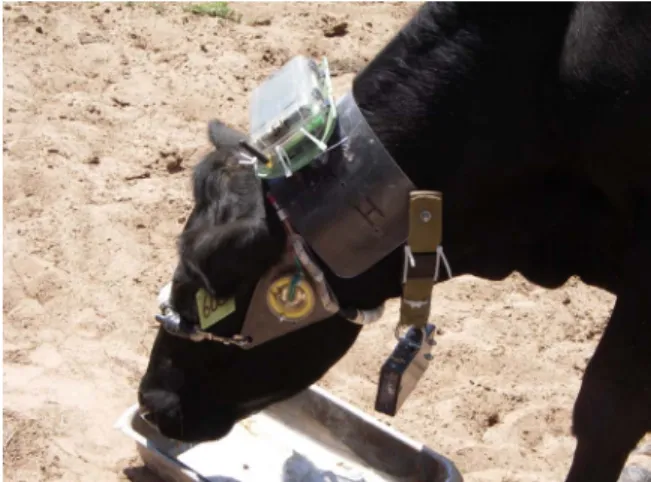
net-Figure 1. Cow wearing autonomous gathering sensor node. works to monitor cattle and calibrated behavioral models for live-stock using the gathered data. Kwong et al. [6] presented a similar system for cattle monitoring with no additional modeling. Zhang et al.[12] presented a platform to monitor zebras called ‘ZebraNet’.
In the past few years there have been efforts to extend these sensor networks to control free-ranging animals. Butler et al. [2] proposed the use of wireless sensor networks for virtual fencing. Lee et al. [7] used wireless sensor networks for bull separation. Both use similar stimuli as autonomous gathering but achieve dif-ferent goals and require difdif-ferent algorithms. To our knowledge, this paper presents the first work in autonomous gathering using wireless sensor networks.
3
Gathering Algorithm
In this section, we formalize the problem of autonomously gath-ering animals, provide the intuition on which we based our initial gathering algorithm, and present the gathering algorithm consisting of a repetitive cueing loop using only sound.
3.1
Problem Statement
We assume there are n cows with positions Pi∈
R
2 for i ∈{1..n}. We are given a goal position Pg∈
R
2where we want thecattle to gather. The problem is to move all the animals to the goal location such that ∥Pi− Pg∥ ≤ ε for some ε ∈
R
.3.2
Repetitive Cueing with Sound
We designed the gathering algorithm based on the experience and intuition of animal scientists who routinely work with livestock. The goal is to develop an automatic herding algorithm that is low-stress and natural for the animals. Humans gather animals by riding or driving behind the group and giving voice commands. The gath-ering algorithm presented here tries to simulate this experience.
GPS 2MB Data Flash 3‐Axis Magnetic 3‐Axis Accelerometer Mini SD Card Storage Stereo Amplifier 2 Channel LPC2148 60MHz ARM7 40 KB RAM 512 KB Flash Low‐power FPGA FPGA 3D‐sound 3‐Axis Magnetic Compass Temperature 2 Channel 24 bit DAC 2 Channel MOSFETs Aerocomm AC4790 900 MHz Radio 512 KB FRAM Transformers for Electric Shock LTC1733 Battery Circuit
Sensor Board Extension Board
Sensor Board Extension Board
Figure 2. Overview of the platform used during gathering experiments. The extension board (right side) is usually turned off to save power. It is only activated when the sensor board (left side) decides to cue the animal.
Figure 3. Simulation of Algorithm 1. See Section 3.3 for a description.
Algorithm 1 outlines a gathering algorithm utilizing only sound cues. Every iteration provides an aural cue to the cow with the loop condition ensuring that the algorithm repeats until the cow is within ε of the goal position. The parameters tsoundand twaitcan be random
variables to make habituation of the animals to the cues less likely.
3.3
Simulation
Figure 3 shows the results of a simulation of Algorithm 1. The simulation was based on the behavioral model presented by Schwa-ger et al. [10]. SchwaSchwa-ger’s model simulates the interaction forces between animals as well as their interaction with the environment using parameters based on previously collected data. For the pur-pose of this simulation the animals’ responses to 3D sound cues was assumed to be probabilistic. In the simulation the animals walk in the cued direction 50% of the time and do not react to the cue oth-erwise.
Schwager’s model describes two forces acting upon the animal (between animals and environment to animal). We add a third force representing the cueing effects. The simulation weights each of these forces by a factor to determine the absolute force acting upon the animal. Relative to the Schwager model, we use a weight of 1.0 for the interaction force between animals and a weight of 0.4 for the interaction force between the environment and the animal. In determining the cueing force, no scientific data defines the relation-ship between applied stimuli and animal response. We specifically choose cueing to have a higher impact than the environment, but a lower impact than interactions between the animals, giving it a value of 0.6.
The results of one simulation run can be seen in Figure 3. The cows began at a random location near the middle of the paddock and the simulation ran until the cows gathered. We performed a total of 20 such simulation runs and in all simulations the cows were gathered successfully within 45 minutes. This validates the theory behind Algorithm 1.
4
Platform
For the experiments we need a platform capable of gathering basic information such as GPS position and orientation of the cow. The platform should offer enough computational power to run all necessary algorithms. A radio is also required to allow continuous real-time monitoring and remote triggering of the gathering algo-rithm. Further, we need the ability to cue the animals. We would like to use two different methods: (1) a sound cueing system and (2) an electric stimuli system. As a last requirement the platform should be able to run continuously for at least a week to allow for reasonable length, maintenance free, deployments.
Figure 1 shows an animal wearing our in-house developed sen-sor platform outlined in Figure 2. This platform provides the re-quired functionality discussed above. It is based on the LPC2148 ARM7 processor [8] running at 60 MHz. The processor has 40 KB
of on-chip RAM and 512 KB of on-chip program flash. In addition there is a 32 KB FRAM and a mini-SD card slot for data storage and logging. Communication between different sensor boards and the user is available via a 900 MHz Aerocomm AC4790 radio link. The sensor board is equipped with all necessary sensors: temperature, compass, accelerometers, and GPS. An expansion board provides electric and aural cueing functionality.
4.1
Electric Stimuli Subsystem
To provide electric stimuli the board is equipped with two drivers and two transformers to generate a high voltage. Each trans-former’s power output is up to 500mW, but can be scaled by adjust-ing the duty cycle. The drivers are controlled by two pulse gen-erators running inside an FPGA mounted on the expansion board. The length of each pulse, the distance between pulses, and the total number of pulses can be configured independently for the left and right electric stimuli channel from the sensor board using a serial peripheral interface.
4.2
3D Sound Subsystem
To provide sound cuing the extension board utilizes a FPGA for 3D sound processing and is further equipped with a 2 MB Data flash to store the sound file, a 24bit stereo digital to analog sound converter, and a stereo amplifier. We simulate directionality of the sound by computing the running length distances between the vir-tual location of the sound source and the computed locations of the cows ears. When cueing the animal aurally, the sensor board uses the onboard accelerometer and magnetometer to continuously com-pute the yaw, pitch, and roll of the cow’s head. The virtual sound source is placed at a simulated distance of 10 meters away from the animal’s head location in the direction from which we wish to cue the animal. Using the orientation of the cow’s head, the location of the virtual sound source, and the assumption that the cow’s ears are spaced by 50cm, the cpu computes the running length distances be-tween the source and each of the cow’s ears. From this, it computes the attenuation in percent for each ear and their relative phase dif-ference in milliseconds. This information is computed at 20 Hz and forwarded to the FPGA on the expansion board using a serial pe-ripheral interface. The FPGA fetches data from a monoaural wave file stored inside the flash. It then attenuates and appropriately de-lays the signal for each ear to create a stereo, directional sound. The delay can be set between 0 to 2048 samples for each channel. Since the sound file is recorded at 22 KHz this results in a resolution of Algorithm 1 Repetitive Gathering Using Sound
while ∣Pcow,i− Pgoal∣ > ε do
SOUND(tsound)
WAIT(twait)
Fig. dist. cue time each cue no. cues time to gather
(m) (min) (sec) (min)
4b 700 5 30 7 13 c 700 40 30 15 55 d 900 20 30 16 50 e 850 48 30 26 no f 700 20 60 21 no g 3000 240 10 720 no h 1700 70 10 210 70
Table 1. Experimental results. See Section 5.3 for details. 0.05 ms and a maximum delay of 93 ms. This delay is sufficient to simulate the sound originating from any direction. The signal is then synthesized using the ADC and amplifier and output on two speakers mounted close to the cow’s ears. We measured the max-imum output of each speaker at a frequency range of 1 KHz to 10 KHz to be 90dB at a distance of 10cm.
The entire system is housed inside an OtterBox 3000 case to protect all the components from dirt and water. The electrodes and speakers are connected using Switchcraft EN3 connectors. The sen-sor box is mounted on the neck of the animal with a specially de-signed collar that also holds the speakers and electrodes.
5
Experiments
We performed gathering experiments to validate our algorithm. In the first set of experiments we gathered the animals by manu-ally applying stimuli using radio control. We then performed two autonomous gathering experiments using Algorithm 1. All exper-iments were performed on a group of 5 animals. Each of the 5 animals was equipped with a sensor node. However, prior to our radio controlled gathering experiments two of the animals managed to sever the connection between the battery at the bottom of the collar and the sensor node at the top. As a result, during the ra-dio controlled gathering, only 3 our of 5 animals were cued and the GPS plots show only these 3 animals. However, we observed dur-ing the experiments that the other 2 animals remained continuously in the group and gathered successfully.
The experiments occurred on paddocks 7B and 10B on the Jor-nada Experimental Range of the United States Department of Agri-culture. Paddock 7B was used during the radio controlled gathering experiments and can be seen in Figure 4(b). It has the shaped of an isosceles triangle with sides of approximately 1500 m west and east and 1300 m south. The corral is located at the northern tip. Paddock 10B is diamond-shaped with side lengths of approximately 2100 m shown in Figure 4(g). The corral is located in the southern corner. The vegetation is a Chihuahuan Semidesert Grassland [5]. It is rel-atively bush-free but offers the occasional obstacle to the cows in the form of Yucca trees and mesquite. Figure 4(a) shows a sample of the vegetation.
5.1
Gathering with Radio Control
We performed a total of 5 gathering experiments with radio con-trol in paddock 7B between Jan. 29th and Feb. 2nd, 2009. In prepa-ration for the experiments, we drove a boom-truck to the middle of the paddock about 800 m south of the corral as seen in Figure 4(b). The boom-truck served as the observatory and base station for the researchers during the experiments. The goal was to gather and move the animals to a corral located at the northern end of the pad-dock. The animals are usually moved to this location when manual gathering is performed. For all 5 experiments the animals’ initial start locations were between 700 m and 900 m from the goal loca-tion.
The cows were equipped with the sensor nodes the day before the experiments started, ensuring they were not influenced by hu-man presence when the experiments began. We performed one gathering on each of the following 5 days at which point we re-moved the boxes.
For each of the 5 experiments, we began the experiment between 7:00 h and 10:45 h local time. In starting the experiment, we trav-eled with the base station equipment to the boom truck at least 30 minutes before starting the experiment. We chose a 30 minute in-terval to prevent possible influence of the scientists on the animals. Once the experiment started, we used the base station to send aural cuing commands to the animals over the radio.
5.2
Autonomous Gathering
We performed two autonomous gathering experiments on Au-gust 11th and 12th, 2009 in paddock 10B. Both experiments uti-lized Algorithm 1 presented in Section 3. We stopped the algorithm once the animals were gathered successfully or after 4 hours, in case gathering was not successful. In preparation for the experiments we drove the boom-truck serving as the observatory and base station to the middle of the north-east fence of the paddock as seen in Fig-ure 4(g).
On August 11th we released the cows at the north end of the pad-dock at approximately 13:00 h. We set the sensor boxes to initiate gathering at 14:30 h on August 11th and 8:45 h on August 12th. On August 11th the cows were approximately 3000 m away from the goal location while on August 12th, when the gathering algorithm started, the animals were located in the middle of the paddock, ap-proximately 1700 m away from the goal location. During the sec-ond experiment, the animals did not initially respsec-ond to sound cues. While the gathering algorithm was running autonomously, we man-ually used the radio link to apply electrical stimuli to the animals. Specifically, we applied this stimuli in 100 ms bursts every 20 sec for approximately a 5 min period. After this period, the cattle began moving and we did not interfere further with the autonomous aural gathering algorithm.
5.3
Results
Table 1 summarizes the experimental results for gathering with radio control (Figures 4 (b)-(e)) and autonomous gathering (Fig-ures 4 (g)-(h)). The second column gives the animals’ approximate distance from the goal at the beginning of the gathering experiment. The third column is the time from the beginning of the first sound cue to the end of the last sound cue during the experiment. The fourth column is the length of each individual sound cue applied. The fifth column gives the total number of cues applied during the experiment averaged across the 3 animals. For the autonomous gathering cues were applied every 20 seconds (0.05 Hz) resulting in the total seen in the fifth column. The last column gives the total time from the beginning of the experiment (first cue applied) un-til the animals gathered. A ’no’ means the animals did not gather successfully in that experiment.
The GPS plots for all gathering with radio control experiments are shown in Figure 4. In experiments (b), (c), and (d) the cows were successfully gathered. In (e), the cows showed no long lasting reactions to cueing and did not gather successfully into the corral at all. In (f), the cows initially showed a reaction to cueing and started walking towards the corral. However, after cueing stopped the cows resumed foraging.
The possible reasons for failing to gather are that the cues in (e) were not administered frequently enough and in (f) the cows should have been cued again once they stopped gathering. Unfor-tunately, the radios we used during the experiments performed very poorly offering a range of communication of only a few hundred meters and dropping messages frequently even for distances below 100m. As a result, we were not always able to continuously cue the animals when desired and had no feedback as to when a cue was actually applied apart from seeing the animals reaction (though all applied cues were recorded in log files on the sensor boxes for later analysis). This prevented us from always being able to cue the an-imals when desired. We believe that the bad radio communication
(a) Chihuahuan Semidesert Grassland landscape. Mesquite shrub is visible in the front.
(b) Jan. 29th: 5 minutes of aural cues were applied.
(c) Jan. 30th: Cues were sent in multiple bursts over the course of 40 minutes.
(d) Jan. 31st: 30 second long cues were used with 5-30 second pauses in between.
(e) Feb. 1st: Cued for 30 seconds every 60-90 seconds.
(f) Feb. 2nd: Cued almost con-tinuously for 20 minutes.
(g) Aug. 11th: First autonomous gathering.
(h) Aug 12th: Second au-tonomous gathering.
Figure 4. (b)-(f): GPS plots of 3 cows during radio controlled gathering experiments. (g)-(h): GPS plots of 5 cows for au-tonomous gathering experiments. The boom-truck’s location is marked by a star and cues are marked by yellow dots (b-f) and green diamonds(g-h). The corral is located at the northern (b-g) and southern (g-h) end of the paddock. In all experiments the cows were foraging when the first cues were applied. The cows gather successfully in (a), (b), (c), and (h) and did not gather in (d), (e), and (g).
was a significant reason for why we were not able to gather the ani-mals in (e) and (f). We believe that the use of autonomous gathering algorithms can help overcome this problem since radio communi-cation is not essential once the autonomous gathering algorithm is started.
The GPS plots for the two autonomous gathering experiments can be seen in Figures 4 (g) and (h). In the first experiment the cows started gathering successfully. However, during the gather-ing the weather changed significantly. We observed stronger winds as well as clouds and lightning. Since cattle do not behave pre-dictably in storms [3, 9] we attribute this failed gather to the weather change. In Section 3.3 we explained how we simulated three forces acting upon each animal (between animals, environment to animal, and queuing force). We propose that changes in weather introduce changes in the environmental force upon the animal. In the case of our failed gather we presume that the force introduced by the light-ning storm simply outweighed the force exerted by aural cueing. The utilization of electric stimuli could possibly overcome this and is introduced as a possible extension in Section 6.1.
In the second autonomous gathering experiment the cows did not initially move when the gathering algorithm started cueing them. Only after we cued the cows with electric stimuli using the radio link did the cows start moving. However, once they were moving no additional electrical stimuli were necessary and the cows gather directly into the corral. Looking at the forces acting upon the animal, the cows behavior during the second autonomous gathering experiment suggests that the state of the animal presents a fourth force that possibly needs to be overcome. In this model, the ini-tial cueing with only sound did not present a strong enough force
to overcome the force exerted by the animal’s desire to remain for-aging. However, once we increased the cueing force acting upon the animal, by using electric stimuli, the animals started gathering. This changed their state and thus the force exerted by the animals state making it possible to gather the cows without further electric stimuli.
It is also worth noting that the walking pattern visible on the GPS plot is actually a path frequently utilized by the animals. Both the reaction to changing weather and the cows adherence to an ex-isting path are examples of how the environment plays a major role in controlling cattle.
6
Extensions
Our results demonstrated the need for a variety of cueing mech-anisms and more adaptive mechmech-anisms.
Based on this we propose two extension of Algorithm 1: (1) adding mild electric stimuli and (2) providing more adaptivity.
6.1
Repetitive Cueing with Sound + Electric
Stimuli
Algorithm 2 shows repetitive cueing with sound and electric stimuli. It extends Algorithm 1, which utilized only sound cues. If the cow is not moving after the algorithm plays a sound, the al-gorithm will apply electric stimuli to the cow.
In our second experiment, we would not have had to intervene were we using Algorithm 2, suggesting that it is a better candidate for gathering. In our first experiment, it is difficult to predict the outcome had we used Algorithm 2. It might have provided suffi-cient stimulus to overcome the effect of the thunderstorm; however
Algorithm 2 Repetitive Gathering Using Sound and Electric Stim-uli
while ∣Pcow,i− Pgoal∣ > ε do
SOUND(tsound)
if cowspeed== 0 then
SHOCK(tshock) WAIT(twait2) else WAIT(twait) end if end while
Algorithm 3 Adaptive Gathering Using Sound and Electric Stimuli intensity= 0.1;
while ∣Pcow,i− Pgoal∣ > ε do
if cowspeed== 0 then
SOUND(tsound)
if intensity > 0.3 then SHOCK(tshock, intensity)
end if
intensity= min(1.0, intensity + 0.1) else
intensity= max(0.1, intensity − 0.1) end if
WAIT(twait)
end while
this is not certain. This is because the behavior of cattle in a thun-derstorm is difficult to predict. In such a case, continued electrical stimuli might gather the animal or only increase its stress levels without positive effect. The study of this relationship remains fu-ture work.
6.2
Adaptive Cueing with Sound + Electric
Stimuli
During the radio controlled gatherings, we observed that the animals responded better to longer aural cue windows of approx-imately 30 seconds or longer. Algorithm 1 and Algorithm 2 should provide cues of this length to ensure that the animals respond. How-ever, prior observations of gathering by humans suggests that the animals need the voice command only when they stop moving or begin moving in the wrong direction. The animals did not need to be cued by the humans when their heading towards the gathering goal was approximately correct. Part of the reason is that the ani-mals make a network of roads on their paddocks. They know where these roads are and tend to follow roads once on them. Therefore, once the animals are on on these paths we are less likely to need to provide stimuli.
Based on these observations, we present Algorithm 3 as an ex-tension to Algorithms 1 and 2. Algorithm 3 adapts cueing fre-quency and intensity to the animal’s behavior. The outermost loop is responsible for stopping the cueing once the animal has reached the goal location.
The first of the two if statements are responsible for checking if the cow is moving. It is important to note that cowspeedis the
component of the cow’s actual speed that points towards the goal position. If the cow is not moving (cowspeed== 0), we first cue
the cow with sound. If the cow has not been moving for a few cycles (intensity > 0.3), then we also apply electric stimuli to the cow. The strength of the electric stimuli increases with the value of intensity. The variable intensity always remains in the range {0..1}. Its value increases when the cow is not moving and decreases when the cow is moving. This means that when the cow does not move the strength of the electric stimulus gradually increases. Therefore, to
prevent excessive electrical electric stimuli to the animal we upper bound intensity. If, on the other hand, the cow is moving (not cowspeed== 0) then we do not cue the animal and decrease the
value of intensity with a lower bound of 0.
This algorithm ensures that the animal is cued only if it is not already moving towards the goal. If it stops moving, we always first use sound cues. If the animal habituates to the sound and does not respond to the cue, the sound cues are reinforced with increas-ing electric stimuli. Both cues stop as soon as the animal starts responding. An advantage of Algorithm 3 is that it will automat-ically perform long bursts of cues if the animals are not moving given proper choices for its parameters tsound, twait, etc. We plan to
conduct autonomous gathering experiments using Algorithm 3 in the summer of 2010.
7
Conclusion
We present a set of algorithms and experiments to gather cattle. We provide two sets of stimuli. We performed 7 experiments.
In summary, our experiments show that to successfully gather animals we have to take into account many environmental factors such as weather and existing paths in the landscape. Further, we showed that to reliably gather animals electric stimuli are neces-sary in addition to sound cues. Sound cues will keep the animal going for most of the time, but electrical stimuli can help if the an-imal is not reacting to sound. This can happen at the beginning of the gather because the animal is resting, such as during our second autonomous gathering experiment. This could also happen in the middle of a gather, such as seen in Figure 4(f). Further, our ex-periments demonstrated the necessity for robust and fault-tolerant hardware because of the harsh environmental conditions (heat, dirt, rain) and rough handling of the sensors by the animals.
8
Acknowledgments
We would like to acknowledge the following groups for their fi-nancial support: Microsoft Research, NSF, and Smarts MURI. We would like to thank the following people for their assistance: Eliz-abeth Basha, Roy Libeau, Steven Proulx, and Mac Schwager.
References
[1] J. L. Albright, W. P. Gordon, W. C. Black, J. P. Dietrich, W. W. Snyder, and C. E. Meadows. Behavioral responses of cows to auditory training. Journal of Dairy Science, 49:104–106, 1966.
[2] Z. Butler, P. Corke, R. Peterson, and D. Rus. From robots to animals: Virtual fences for controlling cattle. Int. J. Rob. Res., 25(5-6):485–508, 2006. [3] M. Culley. Grazing habits of range cattle. J. For., 36:715–717, 1938. [4] Y. Guo, G. Poulton, P. Corke, G. Bishop-Hurley, T. Wark, and D. Swain. Using
accelerometer, high sample rate gps and magnetometer data to develop a cattle movement and behaviour model. Ecological Modelling, 220(17):2068–2075, September 10 2009.
[5] K. Havstad, L. Huenneke, and W. Schlesinger. Structure and Function of Chi-huahuan Desert Ecosystem. New York, USA: Oxford University Press, 2006. [6] K. H. Kwong, T. T. Wu, H. G. Goh, B. Stephen, M. Gilroy, C. Michie, and
I. Andonovic. Wireless sensor networks in agriculture: Cattle monitoring for farming industries. Progress In Electromagnetics Research Symposium, 5(1):31– 35, March 23-27 2009.
[7] C. Lee, K. C. Prayaga, A. D. Fisher, and J. M. Henshall. Behavioral aspects of electronic bull separation and mate allocation in multiple sire mating paddocks. Journal of Animal Science, 86:1690–1696, 2008.
[8] Phillips. LPC241x User Manual, 2 edition, July 2006.
[9] N. Rutter. Time lapse photographic studies of livestock behaviour outdoors on the college farm aberystwyth. J. Agric. Sci., 71:257–265, 1968.
[10] M. Schwager, C. Detweiler, I. Vasilescu, D. M. Anderson, and D. Rus. Data-Driven identification of group dynamics for motion prediction and control. Jour-nal of Field Robotics, 25(6-7):305–324, 2008.
[11] B. Thorstensen, T. Syversen, T.-A. Bjørnvold, and T. Walseth. Electronic shep-herd - a low-cost, low-bandwidth, wireless network system. In MobiSys ’04: Proceedings of the 2nd international conference on Mobile systems, applica-tions, and services, pages 245–255, New York, NY, USA, 2004. ACM. [12] P. Zhang, C. M. Sadler, S. A. Lyon, and M. Martonosi. Hardware design
expe-riences in zebranet. In SenSys ’04: Proceedings of the 2nd international confer-ence on Embedded networked sensor systems, pages 227–238, New York, NY, USA, 2004. ACM.