HAL Id: hal-01790529
https://hal.archives-ouvertes.fr/hal-01790529
Submitted on 13 May 2018
HAL is a multi-disciplinary open access
archive for the deposit and dissemination of
sci-entific research documents, whether they are
pub-lished or not. The documents may come from
teaching and research institutions in France or
abroad, or from public or private research centers.
L’archive ouverte pluridisciplinaire HAL, est
destinée au dépôt et à la diffusion de documents
scientifiques de niveau recherche, publiés ou non,
émanant des établissements d’enseignement et de
recherche français ou étrangers, des laboratoires
publics ou privés.
Stability of Sulphur Dimers (S 2 ) in Cometary Ices
O. Mousis, O. Ozgurel, J. Lunine, A. Luspay-Kuti, T. Ronnet, F. Pauzat, A.
Markovits, Y. Ellinger
To cite this version:
O. Mousis, O. Ozgurel, J. Lunine, A. Luspay-Kuti, T. Ronnet, et al.. Stability of Sulphur Dimers
(S 2 ) in Cometary Ices. The Astrophysical journal letters, Bristol : IOP Publishing, 2017, 835 (2),
�10.3847/1538-4357/aa5279�. �hal-01790529�
Stability of Sulphur Dimers (S
2) in Cometary Ices
O. Mousis1, O. Ozgurel2, J. I. Lunine3, A. Luspay-Kuti4, T. Ronnet1, F. Pauzat2, A. Markovits2, and Y. Ellinger2
1Aix Marseille Université, CNRS, LAM (Laboratoire d’Astrophysique de Marseille) UMR 7326, F-13388, Marseille, France;[email protected] 2Laboratoire de Chimie Théorique, Sorbonne Universités, UPMC Univ. Paris 06, CNRS UMR 7616, F-75252 Paris CEDEX 05, France
3Department of Astronomy and Carl Sagan Institute, Space Sciences Building Cornell University, Ithaca, NY 14853, USA 4Department of Space Research, Southwest Research Institute, 6220 Culebra Road, San Antonio, TX 78228, USA
Received 2016 July 27; revised 2016 October 21; accepted 2016 December 5; published 2017 January 23
Abstract
S2has been observed for decades in comets, including comet 67P/Churyumov–Gerasimenko. Despite the fact that
this molecule appears ubiquitous in these bodies, the nature of its source remains unknown. In this study, we assume that S2is formed by irradiation (photolysis and/or radiolysis) of S-bearing molecules embedded in the icy
grain precursors of cometsand that the cosmic ray flux simultaneously creates voids in ices within which the produced molecules can accumulate. We investigate the stability of S2 molecules in such cavities, assuming that
the surrounding ice is made of H2S or H2O. We show that the stabilization energy of S2molecules in such voids is
close to that of the H2O ice binding energy, implying that they can only leave the icy matrix when this latter
sublimates. Because S2has a short lifetime in the vapor phase, we derive that its formation in grains via irradiation
must occur only in low-density environments such as the ISM or the upper layers of the protosolar nebula, where the local temperature is extremely low. In the first case, comets would have agglomerated from icy grains that remained pristine when entering the nebula. In the second case, comets would have agglomerated from icy grains condensed in the protosolar nebula and that would have been efficiently irradiated during their turbulent transport toward the upper layers of the disk. Both scenarios are found consistent with the presence of molecular oxygen in comets.
Key words: astrobiology – comets: general – comets: individual (67P/Churyumov–Gerasimenko) – methods: numerical – solid state: volatile
1. Introduction
The nature of the source of sulphur dimers (S2) observed in
comets is still unknown. The first detection of S2in a celestial
body was in the UV spectra of Comet IRAS-Araki-Alcock (C/ 1983 H1) acquired with the International Ultraviolet Explorer (IUE) space observatory (Ahearn et al.1983). Emission bands of S2 were subsequently identified in many comets observed
with IUE in the eighties, including 1P/Halley (Krishna Swamy & Wallis 1987). S2 was also identified in comets Hyakutake
(C/1996 B2), Lee (C/1999 H1), and Ikeya-Zhang (C/2002 C1; Laffont et al.1998; Kim et al.2003; Boice & Reylé2005). More recently, S2 has been detected in comet
67P/Churyu-mov–Gerasimenko (hereafter 67P/C-G) by the ROSINA mass spectrometer on board the Rosetta spacecraft at a distance of ∼3 au from the Sun in 2014 October (∼4–13 × 10−6 with
respect to water; Le Roy et al.2015; Calmonte et al.2016). All ofthese observations suggest that S2is ubiquitous in comets.
Because the lifetime of S2 is very short in comae
(approximately a few hundredseconds at most; Reylé & Boice 2003), two main scenarios have been invoked in the literature to account for its presence in comets. In the first scenario, S2is the product of reactions occurring in the coma.
Ethylene was thus proposed to act as a catalyst allowing the formation of S2molecules in the inner coma (Saxena & Misra
1995; Saxena et al.2003). Also, the presence of atomic S (as the photodissociation product of CS2) reacting with OCS was
suggested to form S2in comae (A’Hearn et al.2000). However,
models depicting the chemistry occurring in cometary comae show that these two mechanisms do not account for the observed levels of S2(Rodgers & Charnley2006).
In the second scenario, S2 molecules are believed to be of
parent nature and reside in cometary ices (Ahearn et al.1983;
Ahearn & Feldman 1985; Feldman 1987; Grim & Green-berg 1987; A’Hearn 1992). Ahearn & Feldman (1985) proposed that the UV photolysis of S-bearing species embedded in ISM ices could form sufficient amounts of S2
that remains trapped in the icy matrix. Since then, a number of mechanisms based on UV or X-ray irradiation have been proposed, starting mainly from H2S (the most abundant
S-bearing volatile observed in comets; Irvine et al. 2000; Bockelée-Morvan et al.2004) and H2S2, and involving radicals
like HS and HS2(Grim & Greenberg1987; Jiménez-Escobar &
Muñoz-Caro 2011; Jiménez-Escobar et al. 2012). It has also been proposed that S2could be formed from the radiolysis
of S-bearing compounds in cometary ices (Ahearn & Feld-man1985; Calmonte et al.2016) despite the fact that so far, there is no experimental proof showing that this mechanism is effective.
In the present study, we postulate that S2is formed from H2S
molecules embedded in icy grains by irradiation of UV, X-ray, and cosmic ray fluxes (CRF), whether icy grain precursors of comets formed in the protosolar nebula or the ISM. Because radiolysis generated by the impact of cosmic rays simulta-neously creates voids in ices within which the produced molecules can accumulate (Carlson et al. 2009; Mousis et al.
2016b), we investigate the stability of S2 molecules in such
cavities, assuming that the surrounding ice is made of H2S or
H2O. We show that the stabilization energy of S2molecules in
such voids is close to that of the H2O ice binding energy,
implying that they can only leave the icy matrix when this latter sublimates. We finally discuss the implications of our results for the origin of cometary grains, with a particular emphasis on those agglomerated by comet 67P/C-G.
2. Irradiation of Icy Grains
Three irradiation mechanisms leading to the formation of S2
are considered in this study. The first two mechanisms, namely UV and X-ray irradiation, have been proven to produce S2from
H2S and H2S2 (Grim & Greenberg1987; Jiménez-Escobar &
Muñoz-Caro2011; Jiménez-Escobar et al.2012). Experiments have shown that S2can be produced and stabilized in icy grains
over thicknesses of a few tenths of microns. Despite the lack of experimental data, radiolysis has also been considered as a potential candidate for S2 formation from S-bearing
com-pounds in cometary icy grains (Ahearn & Feldman1985). This mechanism has recently been proposed to explain the detection of S2in 67P/C-G (Calmonte et al.2016) and is often invoked
to account for its presence in Europa’s exosphere (Carlson et al. 1999; Cassidy et al. 2010). Cosmic rays reach deeper layers than photon irradiation and simultaneously creates voids in which some irradiation products such as O2or here S2can be
sequestrated (Mousis et al. 2016b). Whatever the irradiation process considered, we assume that, once S2has been created
and trapped in the microscopic icy grains, the latter agglomerated and formed the building blocks of comets.
3. Stability of S2Molecules in an Icy Matrix
The S2 stabilization energy arises from the electronic
interaction between the host support (H2O ice or H2S ice)
and the S2foreign body. The stabilization energy is evaluated
as
= +
-Estab (Eice ES2) E, ( )1
where ES2is the energy of the isolated molecule, Eicethe energy
of the pristine solid host and E is the total energy of the [host+ S2] complex, with all entities optimized in isolation.
All simulations are carried out by means of the Vienna ab-initio simulation package (Kresse & Hafner1993,1994; Kresse & Furthmüller1996; Kresse & Joubert1999). The long range interactions in the solid and the hydrogen bonding being the
critical parameters in the ices, we use the PBE generalized gradient approximation functional (Perdew et al.1996), in the (PBE+D2) version corrected by Grimme et al. (2010),that has been specifically designed to deal with the present type of problem. This theoretical tool has proved to be well adapted to model bulk and surface ice structures interacting with volatile species (Lattelais et al.2011,2015; Ellinger et al.2015; Mousis et al.2016b). More details on the computational background can be found in the aforementioned publications.
Since S2 is created well inside the icy grain mantles, the
initial description of the irradiated ice is taken as that of the internal structures of ice clusters obtained from Monte-Carlo simulations of ice aggregates constituted of hundreds of water molecules. The important point in the simulations by Buch et al. (2004) is that the core of the aggregates consists in crystalline domains of apolar hexagonal ice Ih. However, in the present context, the irradiation creates significant defects inside the ice, namely, voids and irradiation tracks that, at least locally, modify the crystalline arrangement.
3.1. S2 Embedded in H2O Ice
Because H2O is the dominant volatile in comets
(Bockelée-Morvan et al. 2004), most of the cavities created by CRF irradiation are expected to be surrounded by H2O molecules.
Table1shows the stabilization energy of S2as a function of the
size of these cavities. How the S2 stabilization evolves as a
function of their size is summarized below.
1. Starting with no H2O removed, we find no stabilization
for the inclusion of S2 in the ice lattice. It is in fact an
endothermic process, as it is for O2 inclusion (Mousis
et al.2016b).
2. With one H2O removed, we have an inclusion structure
for which stabilization is negative, meaning that S2
cannot stay in such a small cavity.
3. With somewhat larger cavities obtained by removing two to four adjacent H2O molecules from the ice lattice, we
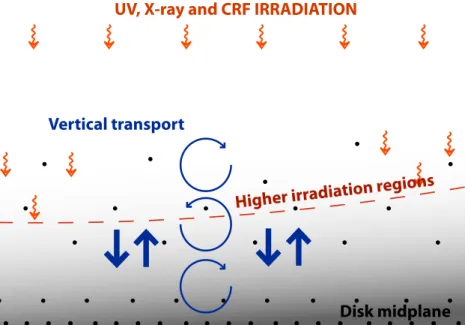
Figure 1. Illustration of the vertical transport of small icy grains toward disk regions where they are efficiently irradiated. Dust is concentrated in the midplane of the disk due to gravitational settling and gas drag. However, turbulent eddies lift the icy grains toward the upper regions and also drag them downbecausethe direction of the velocity is random and coherent during a timecale comparable to the local keplerian period. Small dust grains finally spend a non-negligible fraction of their lifetime in the disk’s upper regions, where the irradiation attenuation is low.
obtain increasing stabilization energies from 0.3 to 0.5 eV.
4. With larger cavities that form along the irradiation track, the stabilization energies are found to be at least of the order of 0.5 eV.
In short, as soon as the space available is sufficient, the energy stabilizes around 0.5 eV. This stabilization energy is (1) higher (more stabilizing) than what is found in the case of O2
(0.2–0.4 eV; Mousis et al.2016b) and (2) larger than that of a water dimer (∼0.25 eV). Hence, the presence of S2should not
perturb the ice structure until it is ejected into the coma via sublimation with the surrounding H2O molecules. The results
of our computations are consistent with the laboratory experiments of Grim & Greenberg (1987) who showed that S2 remains trapped in icy grains until they are heated up to
∼160 K, a temperature at which water ice sublimates at PSN conditions.
3.2. S2Embedded in H2S Ice
H2S behaves similarly to H2O because of its ability to
establish hydrogen bonds. This implies that small domains of H2S could have formed in the bulk of the ice and served as
local sources for the formation of S2. The stabilization of these
aggregates is addressed by numerical simulations in which H2S
entities are progressively introduced by replacing an equal number of H2O molecules in the water-ice lattice. Table 2
shows the stabilization energies with values around 0.5 and 0.75 eV for neighboring and far away H2S, respectively.
Consequently, substituting several neighboring H2O by H2S is
a possibility to be considered if the H2S is abundant enough,
thus creating small islands of H2S within the water ice.
If small clumps of H2S ices in the bulk of water ice are a
plausible hypothesis, as suggested by the aforementioned numbers, then the proper conditions are realized for the in situ formation of S2 by deep irradiation. The case in which H2S
molecules replace H2O along the irradiation track is a less
favorable situation but it could be at the origin of the Sn
oligomers observed in some laboratory experiments (Meyer et al. 1972; Jiménez-Escobar et al. 2012). We evaluate the stabilization of S2in H2S clumps, assuming that they behave as
pure condensates. The results, presented in Table 1 and summarized below, are quite close to those derived for water ice.
1. With one H2S removed, we have a substitution structure
whose stabilization is on the order of 0.30 eV.
2. With larger cavities obtained by removing two to four adjacent H2S molecules, we obtain increasing
stabiliza-tion energies between 0.40 and 0.45 eV.
3. With even larger cavities, extended in the direction of the irradiation, the stabilization energies are found to be similar to the preceding ones, between 0.40 and 0.50 eV. Again we find that the presence of S2should not perturb the
ice structure, even when trapped in H2S clumps, until the latter
sublimate, due to increasing local temperature. 4. Implications for Cometary Ices
It has recently beenshown that the radiolysis of icy grains in low-density environments, such as the presolar cloud, may induce the production of amounts of molecular oxygen high enough to be consistent with the quantities observed in 67P/C-G (Mousis et al.2016b). Higher density environments such as the PSN midplane were excluded because the timescales needed to produce enough O2in cometary grains exceeded by
far their lifetimes in the disk. Also, the efficiency of ionization by cosmic rays in the PSN midplane is now questioned because of the deflection of galactic CRF by the stellar winds produced by young stars (Cleeves et al.2013,2014).
On the other hand, because the lifetime of S2is very short in
the gas phase (approximatelya few hundred seconds at most; Reylé & Boice2003), its formation conditions are even more restrictive than those required for O2. Assuming that S2indeed
formed from H2S or any other S-bearing molecule via UV,
X-ray, or CRF irradiation, this implies that this molecule never left the icy matrix in the time interval between its formation and trapping. In other words, S2 never condensed from the PSN
before being trapped in cometary grains. This stringent constraint requires S2 to form within icy grains irradiated by
CRF in low-density environments such as ISM, where the local temperature is extremely cold. In this picture, comets, including 67P/C-G, would have agglomerated in the PSN from icy grains originating from ISM, whose compositions and structures remained pristine when entering the nebula.
Alternatively, because the CRF irradiation should be poorly attenuated in the upper layers of the PSN, these regions also constitute an adequate low-density environment, allowing the formation of S2 in cometary grains. Turbulence plays an
important role in the motion of small dust grains that are well coupled to the gas (see Figure1). Micron-sized grains initially settled in the midplane are entrained by turbulent eddies and diffuse radially and vertically with an effective viscosity roughly equal to that of the gas for such small particles (see Ciesla 2010, 2011 for details). Consequently, solid particles
Table 1
Computed Stabilization Energies (eV) of S2Interacting with H2O Ice or
H2S Ice
Environment H2O Ice H2S Ice
Adsorption 0.28 L Inclusion (n= 1)a −0.12 0.30
Inclusion (n= 2) 0.28 0.45 Inclusion (n= 4) 0.50 0.40 Inclusion (fine track) 0.51 0.41 Inclusion (large track) 0.53 0.50 Note.
an=number of H
2O or H2S molecules destroyed to create the void in which
S2is trapped.
Table 2
Computed Stabilization Energies (eV) of H2S Interacting with H2O Ice
Environment H2S
Adsorption 0.61
Substitution (n= 1)a 0.77
Substitution (n= 2 far away) 0.73 Substitution (n= 2 close) 0.56 Substitution (n= 3 close) 0.50 Substitution (irradiation track) 0.51 Note.
an=number of H
follow a Gaussian distribution in the vertical direction. The scale height of dust (corresponding to the standard deviation of the distribution) is a fraction of the gas scale height, this fraction being larger and possibly equal to the gas scale height in the cases of small grains and higher degrees of turbulence (Dubrulle et al.1995; Youdin & Lithwick2007).
The vertical transport of solids exposes them to very different disk environments. Dust grains are stochastically transported to high altitude and low-density regions above the disk midplane. Ciesla (2010) developed a numerical simulation to integrate the motion of individual particles and showed that micron-sized grains spent ∼32% of their lifetime at altitudes above the scale height of the disk, including∼5% at heights above four times its scale height,regardlessofthe distance from the Sun. In such low-density environments, photochem-istry plays a primordial role, as demonstrated by Ciesla & Sandford (2012), because UV photons are weakly attenuated at those heights. This also holds for the CRF irradiation of grains that should be substantially enhanced compared to the dose received by particles residing in the midplane. Under those circumstances, the production of S2 should be favored in icy
grains over several cycles of vertical transport toward the surface of the disk. This scenario should also favor the formation of O2from irradiation of H2O ice (see Mousis et al.
2016bfor details).
5. Discussion and Conclusions
It is reasonable to assume that the multiple forms of irradiation hitting the microscopic icy grains in low-density environments such as ISM or the upper layers of protoplanetary disks can lead both to the formation of S2 molecules and the
development of cavities in these grains, in which the molecule remains sequestered. The same scenario has been proposed for O2formation and stabilization in cometary icy grains (Mousis
et al. 2016b). In the case of S2 formation, the possibility of
forming the dimer via the radiolysis of S-bearing ices remains an open question. Future experimental work is needed to check the viability of this mechanism.
The possible formation of S2 in icy grains via their
irradiation in ISM, together with the short lifetime of this molecule in the gas phase, leads to the plausible possibility that comets agglomerated from pristine amorphous grains that never vaporized when entering the PSN, as already envisaged for the origin of 67P/C-G’s material (Rubin et al. 2015a; Mousis et al.2016b). On the other hand, the formation of S2in
icy grains that migrated toward the upper layers of the disk is compatible with their condensation in the PSN midplane. This mechanism leaves open the possibility that these grains are made of crystalline ices and clathrates, as proposed by Mousis et al. (2016a) and Luspay-Kuti et al. (2016) to account for several pre-perihelion compositional measurements made by the Rosetta spacecraft in 67P/C-G. The same process could explain the presence of O2measured in situ in comets 67P/C-G
and 1P/Halley (Bieler et al. 2015; Rubin et al. 2015b). Interestingly, whatever the ice structure considered for the icy grains, the voids allowing the stabilization of S2 can be
considered as analogs of clathrates in terms of cage sizes and intermolecular interactions.
The fact that one H2S replacing one H2O has little influence
on the stability of the solid lattice is a favorable situation for the formation of a mixed ice. It is plausible that some segregation occurs with the formation of H2S islands in the bulk of
crystalline or amorphous water ice. Then, the proper conditions would be realized for the in situ formation of S2, especially if
we remember that the formation of one S2requires at least the
destruction of two imprisoned sulphur species. The plausible formation of H2S clumps is a strong argument in favor of a
non-uniform distribution of S2within cometary ices. Note that
in the case of irradiation of crystalline grains condensed in the PSN and transported toward the upper layers of the disk, the formed S2 may be entrapped in clathrates (Grim &
Green-berg1987), also forming a solid phase distinct from water ice in cometary grains.
The immediate consequence of the presence of distinct S2
-bearing solid phases is the difficulty to predict the S2
correlation with H2O or H2S in 67P/C-G from Rosetta
measurements. The S2/H2O abundance ratio is directly linked
to the region of the comet whose desorption is observed. Contrary to O2 whose apparent good correlation with H2O is
explained by its trapping in water ice (Bieler et al. 2015; Mousis et al.2016b), no global trend should be drawn between the variation of S2 and H2O abundances if S2 is distributed
within both the S-bearing and H2O ices. Indeed, S2 may be
released simultaneously from the H2O layer present close to the
surface and from H2S clusters localized deeper in the
subsurface. Our results are supported by the ROSINA data collected between 2015 May (equinox) and 2015 August (perihelion), showing that there is no clear correlation of S2
with H2O or H2S in 67P/C-G (Calmonte et al.2016). These
observations allow us to exclude the trapping of S2 in a
dominant ice reservoir. If S2 was mainly trapped in H2
S-bearing ice, then the outgassing rates of S2 and H2S should
have been well correlated during the period sampled by the ROSINA instrument. The same statement applies if S2 had
been essentially trapped in water ice.
O.M. acknowledges support from CNES. This work has been partly carried out thanks to the support of the A*MIDEX project (n° ANR-11-IDEX-0001-02) funded by the “Investisse-ments d’Avenir” French Government program, managed by the French National Research Agency (A.N.R.). This work also benefited from the support of CNRS-INSU national program for planetology (P.N.P.). J.I.L. appreciates support from NASA through the JWST project. A.L.-K. acknowledges support from NASA JPL (subcontract no. 1496541).
References
A’Hearn, M. F. 1992, in IAU Symp. 150, Astrochemistry of Cosmic Phenomena, ed. P. D. Singh (Dordrecht: Kluwer),415
A’Hearn, M. F., Arpigny, C., Feldman, P. D., et al. 2000, BAAS, 32, 44.01 Ahearn, M. F., & Feldman, P. D. 1985, ASIC, 156, 463
Ahearn, M. F., Schleicher, D. G., & Feldman, P. D. 1983,ApJL,274, L99
Bieler, A., Altwegg, K., Balsiger, H., et al. 2015,Natur,526, 678
Bockelée-Morvan, D., Crovisier, J., Mumma, M. J., & Weaver, H. A. 2004, in Comets II, ed. M. C. Festou, H. U. Keller, & H. A. Weaver (Tuscon, AZ: Univ. Arizona Press),391
Boice, D. C., & Reylé, C. 2005,HiA,13, 501
Buch, V., Sigurd, B., Devlin, J. P., Buck, U., & Kazimirski, J. K. 2004,IRPC,
23, 375
Calmonte, U., Altwegg, K., Balsiger, H., et al. 2016,MNRAS,462, S253
Carlson, R. W., Calvin, W. M., Dalton, J. B., et al. 2009, in Europa, ed. R. T. Pappalardo et al. (Tucson, AZ: Univ. Arizona Press), 283
Carlson, R. W., Johnson, R. E., & Anderson, M. S. 1999,Sci,286, 97
Cassidy, T., Coll, P., Raulin, F., et al. 2010,SSRv,153, 299
Ciesla, F. J. 2010,ApJ,723, 514
Ciesla, F. J. 2011,ApJ,740, 9
Ciesla, F. J., & Sandford, S. A. 2012,Sci,336, 452
Cleeves, L. I., Adams, F. C., & Bergin, E. A. 2013,ApJ,772, 5
Cleeves, L. I., Bergin, E. A., Alexander, C. M. O., et al. 2014,Sci,345, 1590
Dubrulle, B., Morfill, G., & Sterzik, M. 1995,Icar,114, 237
Ellinger, Y., Pauzat, F., Mousis, O., et al. 2015,ApJL,801, L30
Feldman, P. D. 1987, in IAU Symp. 120, Astrochemistry (Dordrecht: D. Reidel),417
Grim, R. J. A., & Greenberg, J. M. 1987,ApJ,321, L91
Grimme, S., Antony, J., Ehrlich, S., & Krieg, H. 2010,JChPh,132, 154104
Irvine, W. M., Schloerb, F. P., Crovisier, J., Fegley, B., Jr., & Mumma, M. J. 2000, in Protostars and Planets IV, ed. V. Mannings, A. P. Boss, & S. Russell (Tuscon, AZ: Univ. Arizona Press),1159
Jiménez-Escobar, A., & Muñoz-Caro, G. M. 2011,A&A,536, A91
Jiménez-Escobar, A., Muñoz Caro, G. M., Ciaravella, A., et al. 2012,ApJL,
751, L40
Kim, S. J., A’Hearn, M. F., Wellnitz, D. D., Meier, R., & Lee, Y. S. 2003,Icar,
166, 157
Kresse, G., & Furthmüller, J. 1996,PhRvB,54, 11169
Kresse, G., & Hafner, J. 1993,PhRvB,48, 13115
Kresse, G., & Hafner, J. 1994,PhRvB,49, 14251
Kresse, G., & Joubert, D. 1999,PhRvB,59, 1758
Krishna Swamy, K. S., & Wallis, M. K. 1987,MNRAS,228, 305
Laffont, C., Boice, D. C., Moreels, G., et al. 1998,GeoRL,25, 2749
Lattelais, M., Bertin, M., Mokrane, H., et al. 2011,A&A,532, A12
Lattelais, M., Pauzat, F., Ellinger, Y., & Ceccarelli, C. 2015,A&A,578, A62
Le Roy, L., Altwegg, K., Balsiger, H., et al. 2015,A&A,583, A1
Luspay-Kuti, A., Mousis, O., Hässig, M., et al. 2016,SciA,2, e1501781
Meyer, B., Stroyer-Hansen, T., & Oommen, T. V. 1972,JMoSp,42, 335
Mousis, O., Lunine, J. I., Luspay-Kuti, A., et al. 2016a,ApJL,819, L33
Mousis, O., Ronnet, T., Brugger, B., et al. 2016b,ApJL,823, L41
Perdew, J. P., Burke, K., & Ernzerhof, M. 1996,PhRvL,77, 3865
Reylé, C., & Boice, D. C. 2003,ApJ,587, 464
Rodgers, S. D., & Charnley, S. B. 2006,AdSpR,38, 1928
Rubin, M., Altwegg, K., Balsiger, H., et al. 2015a,Sci,348, 232
Rubin, M., Altwegg, K., van Dishoeck, E. F., & Schwehm, G. 2015b,ApJL,
815, L11
Saxena, P. P., & Misra, A. 1995,MNRAS,272, 89
Saxena, P. P., Singh, M., & Bhatnagar, S. 2003, BASI,31, 75