HAL Id: hal-00913479
https://hal.archives-ouvertes.fr/hal-00913479
Submitted on 10 May 2021
HAL is a multi-disciplinary open access
archive for the deposit and dissemination of
sci-entific research documents, whether they are
pub-lished or not. The documents may come from
teaching and research institutions in France or
abroad, or from public or private research centers.
L’archive ouverte pluridisciplinaire HAL, est
destinée au dépôt et à la diffusion de documents
scientifiques de niveau recherche, publiés ou non,
émanant des établissements d’enseignement et de
recherche français ou étrangers, des laboratoires
publics ou privés.
Distributed under a Creative Commons Attribution| 4.0 International License
salmon farms: community structure and stable isotope
analyses.
Myriam D Callier, Sébastien Lefebvre, Mary K Dunagan, Marie-Paule
Bataillé, Jennifer Coughlan, Tasman P Crowe
To cite this version:
Myriam D Callier, Sébastien Lefebvre, Mary K Dunagan, Marie-Paule Bataillé, Jennifer Coughlan,
et al.. Shift in benthic assemblages and organisms’ diet under salmon farms: community structure
and stable isotope analyses.. Marine Ecology Progress Series, Inter Research, 2013, 483, pp.153-167.
�10.3354/meps10251�. �hal-00913479�
INTRODUCTION
Aquaculture now contributes almost 50% of the global aquatic food supply. As the demand for aqua -tic food is increasing, the sustainable development of aquaculture is crucial to contribute to food safety, community development and to reduce overexploita-tion of natural aquatic resources (FAO 2010). Today, most aquaculture activities are located in coastal areas, where anthropogenic pressures are already high. A better understanding of
aquaculture−envi-ronment interactions is therefore needed to deter-mine the environmental carrying capacity of coastal areas for on-going and future aquaculture operations (McKindsey et al. 2006).
Benthic marine food webs are an important compo-nent of coastal ecosystems as they contribute to organic matter recycling, linking the pelagic and benthic compartments through various processes (e.g. feeding and bioturbation) (Herman et al. 1999). However, little is known about how changes in biodi-versity affect these processes and the extent to which
© Inter-Research 2013 · www.int-res.com *Email: [email protected]
Shift in benthic assemblages and organisms’ diet
at salmon farms: community structure and stable
isotope analyses
Myriam D. Callier
1, 2,*, Sébastien Lefebvre
3, Mary K. Dunagan
2,
Marie-Paule Bataille
4, Jennifer Coughlan
2, Tasman P. Crowe
21Ifremer, Département Ressources Biologiques et Environnement, Unité Biologie des Organismes Marins Exploités,
Station de Palavas, UMR 5119 ECOSYM, Chemin de Maguelone, 34250 Palavas-les-Flots, France
2School of Biology and Environmental Science, University College Dublin, Belfield, Dublin 4, Ireland 3Université de Lille 1 sciences et technologies, Station Marine de Wimereux,
UMR CNRS 8187 LOG Laboratoire d’Océanologie et Géosciences, 28 av. Foch, 62930 Wimereux, France
4UMR INRA 950 EVA, Institut de Biologie Fondamentale et Appliquée, Université de Caen, 14032 Caen, France
ABSTRACT: The extent of the influence of salmon farming on the environment and on the uptake of particulate and dissolved effluents by benthic organisms was assessed using community struc-ture and stable isotope analyses. Sediment cores were collected in 2 directions: perpendicular and parallel to the main residual current, 0, 25 and 200 m from 2 salmon farms (Millstone and Cran-ford) located in Mulroy Bay, Ireland. In addition, artificial substrates were placed for 2 mo at 1 m depth 0, 25 and 200 m from one farm to trace the uptake of farm-related nutrients by fouling organisms. The extent of measurable change in benthic communities (abundance, diversity, struc-ture, trophic composition) depended on residual current direction. Intraspecific variation in iso-topic values in benthic invertebrates was mostly explained by distance from cages. Organisms collected at impacted sites exhibited a shift in isotopic composition towards that of farm wastes. A shift in δ13C was observed in several invertebrates, including the polychaetes Malacoceros fuligi nosus and Nephtys hombergii, Nematoda and the anemone Anthopleura balii. Fouling
com-munities collected on artificial structures, mainly composed of the tunicate Ascidiella aspersa, showed higher δ15N values at fish cage sites compared to sites 200 m away. The study
demon-strated that fish effluents were assimilated and became food sources for several organisms. KEY WORDS: Aquaculture · Organic matter · Stable isotope · Community structure · Diet shift · Trophic structure
ecosystems can absorb and recover from recurrent stresses (Hughes et al. 2005). The introduction of cultured species into the ecosystem may influence trophic interactions by locally modifying the sources of natural food (Lefebvre et al. 2009). One of the pre-dominant environmental impacts related to fish farming is the accumulation of faeces and uneaten food under cages that may lead to organic enrich-ment of the sea bottom and water column. Organic enrichment may have profound effects on both pela -gic and benthic communities (including macrofauna, meiofauna, phytoplankton, seagrasses and bacteria) by modifying: (1) the physico-chemical characteris-tics of the sediment or water (e.g. decrease in oxy-gen, change in nutrient ratio, sulphate reduction leading to sulphide accumulation; see review by Hargrave 2005) and (2) the quality and quantity of food sources for auto- and heterotrophic organisms (Dubois et al. 2007a). Most of the waste from aqua-culture (70% of nitrogen waste for fish farms; Lefeb-vre et al. 2001) is released into the water column as dissolved nutrients. The remainder (between 5 and 30% of nitrogen waste) is released as particulate organic matter (POM). POM may be ingested by con-sumers, such as heterotrophic bacteria, invertebrates and fish, and the dissolved component may enter the food web by being assimilated by autotrophs such as cyanobacteria, phytoplankton and macroalgae (Pitta et al. 2009). Although numerous studies have docu-mented the effects of organic enrichment due to fish farming on biodiversity and community structure (see review by Hargrave 2005), little has been done to understand the assimilation of fish waste into the biota and its effects on trophic interactions between organisms and the food web (Sarà et al. 2004). Shifts in benthic communities along a gradient of organic enrichment may be caused by the loss of sensitive species due to change in environmental conditions and/or the enhancement of opportunistic species, which may benefit from these novel food sources.
Stable isotope analysis is increasingly being used to study the pathways of organic matter in food webs and to determine the contributions of various food sources to organisms’ diets (Dubois et al. 2007a). In fish aquaculture studies, natural stable isotopes can be efficient tracers if the particulate waste (faeces and uneaten food) present intrinsic characteristics that clearly differ from the natural environment (Kutti et al. 2007a) and if the local environment is not influenced by other terrestrial inputs (Vizzini & Maz-zola 2004, Dolenec et al. 2007). Nutrients and organic material derived from fish waste are generally enriched in 15N and depleted in 13C (Mazzola & Sarà
2001). Cultured carnivorous fish, such as salmon, are high-level predators and are thus fed with animal products such as fish meal, fish oil and crustacean meal. The flesh and wastes of farmed fish are usually enriched in 15N because of trophic step fractionation
(natural enrichment of heavy isotopes along the trophic web) (Yokoyama et al. 2009). In addition, δ13C
may be used as a tracer (Yokoyama & Ishihi 2007) as feed pellets are not only composed of fish, but of terrestrial vegetables depleted in 13C (such as wheat
and soya bean). Moreover, due to isotopic discrimi-nation against 12C during feeding, lighter 12C is pre
-ferentially excreted with respect to the heavier 13C
isotope (Michener & Schell 1994). Benthic filterfee -ders are able to feed on material derived from fish faeces (Lefebvre et al. 2000), and the use of natural δ13C and δ15N tracers has shown that POM from
aquaculture wastes may be incorporated into the food chain by both suspension-feeders (Lojen et al. 2005) and deposit-feeders that process sediments (Dubois et al. 2007a). Dolenec et al. (2007) created a geochemical map of δ15N values in POM and selec
-ted invertebrates, and were able to trace the disper-sal of 15N loading generated by aquaculture and
sewage and its subsequent incorporation into the adjacent biota. Vizzini & Mazzola (2006) have sug-gested that benthic sessile species are better indica-tors of point-source pollution than nectobenthic ones (fish around cages) which disperse incorporated wastes over larger spatial scales. Some studies have also shown that species changed their trophic beha viour directly because of shellfish aquaculture parti -culate wastes (Dubois et al. 2007a). From a manage-ment perspective, there is a need to evaluate the efficiency of quantitative and qualitative indices such as stable isotopes to detect the extent of influence of fish farms on the environment.
The objective of the study was to evaluate the fate of aquaculture-related organic loading by combin-ing analyses of community structure and δ13C and
δ15N isotopic signatures. Specifically, we assessed: (1)
the spatial variation in macrofaunal diversity, abun-dance, community structure and the biotic index M-AMBI under and around 2 salmon farms to evaluate the extent of salmon farm impacts; (2) the inter- and intraspecific variation in isotopic values of inverte-brates at impacted and non-impacted sites to deter-mine whether species were benefiting from salmon waste as a food source; and (3) the transfer of par ticulate and dissolved nutrients generated by aqua -culture into naturally occurring benthic species and fouling organisms growing on artificial structures, us-ing natural isotopic (δ13C and δ15N) abundance.
MATERIALS AND METHODS Study sites and sampling design
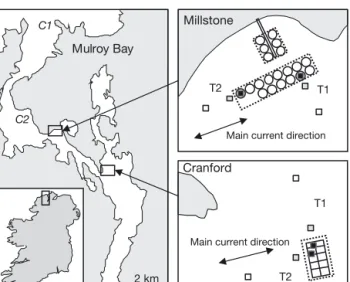
The study sites were located in Mulroy Bay — a fully marine, fjordic inlet, situated on the northern coast of Co. Donegal, Ireland (Fig. 1). Production levels of Atlantic salmon within Mulroy Bay are ~800 to 900 t yr−1. The study was done at 2 farms,
Millstone (M) and Cranford (C), to assess the gen -erality of any observed patterns. It was expected that the extent of influence of the farms would be greater in the direction of the main water current due to the dispersion of farm waste, as shown by previous studies using a hydrodynamic model such as DEPOMOD (Cromey et al. 2002). To test this hypothesis, sampling was done along 2 separate transects perpendicular (T1) and parallel (T2) to the main water current direction, at distances of 0, 25 and 200 m from the fish cages (12 stations in total). The effects related to the accumulation of faeces and uneaten food under cages are generally limited to within 200 m of the farm (Mayor et al. 2010). Far-field effects are usually difficult to detect due to the dispersion and dilution of dissolved nutrients by currents (Hargrave 2003, Modica et al. 2006). In the present study, we focused on the near-field effects of fish farms on the benthic environment and
fouling communities, known as integrators of envi-ronmental variation. Water depth in the sampling area ranged from 8 to 10 m. The study was done in the summer of 2009, when the effects of lo -cal organic enrichment related to salmon farming operation were likely to have been maximal due to increased salmon production rates on the farms, organic matter deposition and increased water tem-perature, which may enhance mineralisation rates and thus benthic oxygen demand. We sampled po -tential sources of particulate nutrients (salmon feed pellets, salmon faeces, cage deposit, macro algae), the water column and sediments (POM and sedi-mentary organic matter [SOM]) and the potential consumers (benthic organisms, fouling organisms).
Potential sources of particulate nutrients Salmon feed pellets were composed of fish meal, fish oil, wheat, soya bean, crustacean meal and wheat gluten (30% oil, 37% protein, 9% ash, 1% fibre, based on the manufacturer’s description). Samples of feed pellets (ca. 200 g) were randomly collected at the farm in March 2009, June 2009 and May 2010 to evaluate the average feed pellet iso topic ratios and the seasonal variation between stocks. Salmon at both farms were fed with the same feed pellet stock. To determine the composi-tion of salmon faeces, 2 salmon were sacrificed in March and July 2009 to collect their gut contents. Faeces were rinsed with filtered seawater to remove mucus as it may influence the isotopic ratios. Iso-topic analyses were performed on both faeces with mucus and rinsed faeces. Data from March 2009 could not be used as the fish had been starved for several days before the sampling, which may have modified the faeces stable isotope ratios. To deter-mine cage deposit composition (including uneaten feed pellets, salmon faeces plus faeces of fouling organisms and any other or ganic material drifting down from the farm or the surrounding areas), 2 sediment traps were placed under 2 random salmon cages for 24 h. Although faeces and deposit values should be interpreted with care as they represent only a snapshot measure, they are valuable data and may be interpreted in relation to the feed pellet composition. Macroalgae, including Ulva sp., Fucus sp. and Laminaria sp. were collected by hand on the rocky shore in Mulroy Bay at sites not influenced by the farms (> 2 km away), as macro algae settling to the bottom may be a source of organic matter for benthic invertebrates.
Millstone
T1 T2
Main current direction
T2 2 km
Cranford
T1
Main current direction
Mulroy Bay
C2 C1
Fig. 1. Locations of the 2 farms studied: Millstone and Cran-ford, in Mulroy Bay, Co. Donegal, Ireland. Sampling sites were located 0 m (jh), 25 (jh) and 200 m (h) from the salmon cages (open symbols enclosed in dotted rectangles), in 2 di-rections: perpendicular (T1) and parallel (T2) to the main water current direction. Map of Mulroy Bay adapted from Telfor & Robinson (2003). Macroalgae were collected at sites
Benthic community characteristics
In July 2009, sediment samples (n = 3) were collected by divers using a PVC corer (11 cm in dia -meter) at each station to determine characteristics of the benthic community (total abundance, diversity, structure, trophic composition). Samples were gen-tly sieved through a 500 µm mesh. Organisms were sorted, identified, cleaned of epibionts and kept alive for 24 h in filtered seawater to evacuate their gut content before isotopic analysis (see ‘Stable iso-tope analyses’). Infaunal specimens were stored in a freezer at –20°C until analysed. The remaining material was fixed in a 5% formaldehyde-saline solution and then stored in 70% ethanol. Identifica-tion was done to the lowest taxonomic level pos -sible, usually to species. Sites were characterised in terms of total abundance, diversity (number of species per site [S] and Shannon-Wiener diversity index [H ’]) and multivariate community structure (see ‘Statistical analysis’). Species were separated into trophic groups according to the classification available in the literature (Fauchald & Jumars 1979, Word 1990). The AZTI marine biotic index (M-AMBI) was used to evaluate the ecological quality of the macrofaunal communities. This index was developed in Europe and is now used worldwide (Muxika et al. 2007, Callier et al. 2008), thus show-ing its wide applicability. Each identified species is classified into 1 of 5 ecological groups, based on their sensitivity/tolerance to pollution (Borja & Muxika 2005). The organisms thus classified were used to calculate the AMBI biotic index (software AMBI 5.0). Subsequently, the AMBI index was com-bined with richness and Shannon Wiener index to give the multivariate biotic index M-AMBI (Muxika et al. 2007) and to determine the ecological quality status (high, good, moderate, poor or bad status). In the present study, sampling stations with a good/ high status were considered as ‘non-impacted’ and poor/bad status as ‘impacted’.
The same specimens collected for the analysis of benthic communities were used for stable isotope analysis. To ensure an adequate biomass of each infaunal species was collected and to sample epi -benthic species, a second sampling was done 4 wk later by collecting 2 grab samples at the same 12 sta-tions. In the laboratory, the organisms were cleaned of epibionts and kept alive for several hours in fil-tered seawater from the sampling areas to eva cuate their gut contents. For abundant and small species, individuals from the same replicate were combined, as the present study was focussing on small-spatial
scale differences within a species re lated to aqua -culture effluents and not on differences between individuals of a single species.
Fouling organisms
To evaluate whether farm-derived nutrients (dis-solved and particulate) were assimilated by the fouling communities, artificial structures (stone tiles attached to plastic mesh cylinders suspended from a buoy) were deployed at 1 m water depth at Millstone, 0, 25 and 200 m along the T1 transect for 71 d (from 3 April 2009 to 23 June 2009). At each distance, 3 structures covered with 6 tiles were placed. Early colonising species were collected 2 mo after deploy-ment. At a distance of 200 m, 2 structures were lost. For this station, variation was therefore calculated on the 6 tiles from the 1 remaining structure. Tiles were frozen separately, and fouling organisms growing on the inner and outer sides of each tile were then sorted and pooled per tile for isotopic analyses. They were cleaned carefully to remove epibionts before drying and grinding.
Sediment OM and water POM
Sediment samples (n = 2) were collected at each station by divers using a cut-off 30 ml plastic syringe. Total carbon and nitrogen content and isotopic com-position of the surficial (0 to 1 cm) and deeper (1 to 5 cm) sediment layers were analysed separately.
Water POM was collected at each station (4 l water sample) at 8 m depth. Extra water samples were collected at 1 m depth along the transect (Mill-stone−T1) where artificial structures were deployed. After collection, water samples were prefiltered through a 200 µm mesh to remove the largest parti-cles, then filtered onto pre-weighed, pre-combusted (450°C, 4 h) Whatmann GF/C filters. Filters were then freeze-dried until subsequent stable isotope analysis.
Stable isotope analyses
Before isotopic analysis, sediment samples, GF/C filter and sampled calcareous organisms were divi -ded into 2 subsamples. Subsamples of sediment and calcareous organisms were treated with 1 N HCl (12 h) to remove inorganic carbon and were used for
water to remove the acid. GF/C filters were treated with concentrated HCl flumes to remove carbonates (Lorrain et al. 2003). Subsamples for isotopic nitrogen analyses were not decarbonated because this has been reported to affect the δ15N and total organic N
values (Ryba & Burgess 2002).
Freeze-dried, powdered and homogenised sam-ples were analysed using a CHN elemental analyser (EA 3000, EuroVector, Université de Caen Basse-Normandie) for particulate organic carbon and par-ticulate nitrogen to calculate their C/N atomic ratios. Analytical precision for the experimental procedure was estimated to be better than 0.01% dry weight for C and 0.03% dry weight for N. The resultant gas of elemental analyses was introduced into an isotope ratio mass spectrometer (IRMS) (IsoPrime, Elemen-tar) to determine 15N/14N and 13C/12C ratios. Stable
isotopic values are ex pres sed as the relative differ-ences (in ‰) between the samples and the conven-tional standards, Pee Dee Belemnite (PDB) for carbon and atmospheric N2 for nitrogen, according to the
following equation: δ = [(Rsample/Rstandard)–1] × 1000,
where δ is 13C or 15N relative abundance (in ‰)
regarding the conventional standard and R is the
13C/12C or 15N/14N ratio. The internal standard was
the USGS 40 of the International Atomic Energy Agency (δ13C = −26.2; δ15N = −4.5). The typical
preci-sion in analyses was ± 0.25 ‰ for carbon and ± 0.40 ‰ for nitrogen isotope ratios.
The carbon and nitrogen isotopic compositions of consumer tissues are thus functions of the ratios of
13C to 12C (δ13C) and 15N to 14N (δ15N) of each
assimi-lated food source. A comparison between stable iso-topic compositions of several consumers to estimate their trophic relationships must be made under the strong assumption that trophic step fractionation is accurately estimated for each species. However, very few values of trophic step fractionation are available for marine invertebrates and, as done in most ecolo -gical studies using isotopic approaches (e.g. Lefebvre et al. 2009), we assumed that the fractionation values were the same for all species, sites and seasons. Trophic step fractionation values of 1 for δ13C and 3.4
for δ15N were chosen. Trophic levels (TL) were
calcu-lated using primary consumers. Long-lived primary consumers, such as mussels, satisfy these criteria in aquatic food webs and can provide an appropriate baseline to quantify the trophic position of secondary consumers. We used the equation TLconsumer = 2 +
(δ15N
consumer− δ15Nbase)/3.4 (van Oevelen et al. 2009),
with δ15N
base = 5.1 corresponding to the Mytilus edulis value collected on pontoons at the entrance to
Mulroy Bay (Fig. 1).
Statistical analysis
Variations in univariate indices (abundance, diver-sity, sediment %C total and %N total, and sediment stable isotope values) were evaluated using ANOVA followed by Tukey’s multiple comparison tests with SYSTAT. The normality and homogeneity of variance were tested using the Kolmogorov-Smirnov test and Cochran’s test, respectively. ANOVA factors were: farm (2 levels, fixed: Millstone and Cranford), di -rection (2 levels, fixed: T1 perpendicular and T2 par-allel) and distance (3 levels, fixed: 0, 25 and 200 m from the farm), n = 3. Non-parametric multivariate analyses of community structure, in cluding multi-dimensional scaling were performed using PRIMER (Clarke & Warwick 1994). Analyses were done using individual cores as replicates. Variation in benthic community structure was evaluated using PERMA -NOVA (a distance-based nonparametric multivariate analogue of ANOVA) (An derson & Ter Braak 2003). The level of similarity and the contribution of each species to the total similarity among samples were determined using SIMPER. Data were square-root-transformed for all multivariate analyses to reduce the influence of the dominant taxa, and similarity matrices were based on the Bray-Curtis index of sim-ilarity. Based on community analysis, 2 clusters were defined, one containing sites impacted by the salmon farm, the other one containing sites not impacted. For invertebrate stable isotope analysis, the difference between isotopic composition of the species collected both at impacted and nonimpacted sites was ana -lysed through ANOVA.
RESULTS
Potential source of particulate nutrients in the vicinity of salmon farms
Although feed pellet composition was similar through out the year, significant variation in nitrogen and carbon isotopic composition was measured in fish feed pellets between the 3 sampling dates (Table 1; δ15N: March 2009 ≠ June 2009 ≠ May 2010,
p < 0.001; δ13C: March 2009 ≠ June 2009 = May 2010,
p = 0.002). Compared to other potential sources of organic matter in the environment, fish feed pellets were depleted in 13C and relatively enriched in 15N
(Table 1). Salmon faeces presented similar values for δ15N, but lower values for δ13C compared to the
average (± SD) feed pellet composition (8.8 ± 1.2 ‰, −23.0 ± 0.5 ‰). Isotopic values of cage deposits were
Collection date n δ15N %N δ13C %C C/N
Farm organic matter
Feed pellet Mar 2009 4 8.5 ± 0.3 7.3 ± 0.3 −23.5 ± 0.1 51.6 ± 1.2 7.1 ± 0.3 Feed pellet Jun 2009 4 7.9 ± 0.2 6.4 ± 0.3 −22.6 ± 0.2 54.6 ± 1.0 8.5 ± 0.6 Feed pellet May 2010 2 10.2 ± 0.3 7.0 ± 0.5 −22.9 ± 0.4 51.6 ± 0.4 7.3 ± 0.6 Faeces Jul 2009 3 7.9 ± 0.1 3.1 ± 1.5 −21.7 ± 0.2 27.5 ± 0.1 10.0 ± 3.7 Faeces rinsed Jul 2009 2 8.6 ± 0.5 2.1 ± 0.0 −20.3 ± 0.0 23.2 ± 0.5 11.3 ± 0.0 Cage deposits Jul 2009 4 6.4 ± 0.8 1.8 ± 0.2 −22.3 ± 0.1 23.2 ± 3.0 12.9 ± 0.6
Macroalgae
Fucus sp. 2 6.5 ± 1.2 1.3 ± 0.0 –16.7 ± 0.1 32.5 ± 0.4 24.5 ± 0.2
Laminaria sp. 2 4.4 ± 0.3 0.8 ± 0.1 –19.4 ± 0.3 25.5 ± 0.5 32.0 ± 3.2
Ulva lactuca 1 4.7 3.2 –18.2 30.2 9.4 Enteromorpha (Ulva) sp. 1 6.3 1.8 –18.8 27.2 15.5 Table 1. Mean (± SD) stable isotopic values (δ15N and δ13C), %N, %C and C/N ratio of salmon farm organic matter and macro -algae. Salmon feed pellets were collected from the feed stock at Millstone and Cranford (same feed used at both farms). Salmon faeces were collected from gutted salmons, and cage deposits from sediment traps deployed beneath Millstone cages for 24 h. Macroalgae were collected in Mulroy Bay at sites located > 2 km from the farms (C1 for Fucus sp., and C2 for Laminaria sp. and
Ulva spp.; see Fig. 1). n = number of samples
Water POM δ 15 N 4 5 6 7 8 9 10 % N to ta l 0.0 0.0 0.1 0.1 0.2 δ 13 C –28 –26 –24 –22 –20 % C to ta l 0.0 0.2 0.4 0.6 0.8 1.0 C/N 0 2 4 6 8 10 12 14 16
Sediment organic matter
5 6 7 0 m25 m 200 m 0–1 cm 1–5 cm Sediment 8 0.0 0.2 0.4 0.6 0.8 –23 –22 –21 –20 0.0 1.0 2.0 3.0 4.0 0 2 4 6 8 10 M-T1 M-T2 C-T1 C-T2 M-T1 M-T2 C-T1 C-T2 0 m 25 m 200 m 8 m 1 m Water Fig. 2. δ15N, %N, δ13C, %C and the C/N ratio (mean + SD, n = 2) of the sediment organic matter (2 layers) and of the water particular organic matter (POM) (at 2 depths) sampled at the salmon farms Millstone (M) and Cranford (C) in Aug 2009. Sediment and water samples were collected at 3 stations (0, 25 and 200 m from the farms) along each of 2 transects (perpendicu-lar [T1] and parallel [T2] to the current). Horizontal lines over bars indicate groups that are not significantly dif ferent (Tukey’s pairwise com parison, p > 0.05). When no lines are shown, there are no significant differ-ences. Note some y-axes do
inter mediate between salmon feed pellets, faeces and algae for δ13C, but depleted in 15N, probably
because cage deposits may include salmon faeces, uneaten feed pellets as well as faeces from fouling organisms and macroalgae detritus. Algae (Fucus sp., Laminaria sp., Ulva spp.) sampled in Mulroy Bay at sites located > 2 km from the farms (Fig. 1) were en riched in 13C and depleted in 15N compared to farm
sources of organic matter (OM).
Sediment OM and water POM analysis Overall, no clear pattern was observed in either sediment or water characteristics (Fig. 2). Sediment δ15N, %N, δ13C, %C and C/N did not differ among
distances (0, 25 and 200 m), directions (parallel vs. perpendicular to water current) or depths (0 to 1 cm vs. 1 to 5 cm). Average (± SD) sediment %C, %N and C/N were higher at Cranford farm (2.5 ± 0.6%, 0.4 ± 0.1% and 6.7 ± 0.7, respectively) than at Millstone farm (0.7 ± 0.5%, 0.1 ± 0.1% and 5.6 ± 0.9, respec-tively) (p < 0.005, Fig. 2). Averaged for the 2 farms, δ15N and δ13C were 6.5 ± 0.4 ‰ and −21.2 ± 0.5 ‰,
respectively. Although variation in water POM iso-topic values did not differ significantly in relation to farm, distance, direction, or depth, slightly higher δ15N were ob served at Millstone under the cages
(0 m) compared to 25 and 200 m away from them (Fig. 2). The C/N of water POM (maximum: 10.6 ± 4) was also slightly higher at the Millstone 0 m station.
Benthic community
A total of 63 macrofaunal species were identified at Millstone and Cranford farms. At both farms, a lower
0 0.5 1 1.5 2 2.5 Shannon H’ a b b a a a b b b a b a 0 75 150 225 300
Abundance per core sample
b a a a a a a a a a a a 0 4 8 12 16 20 M-T1 M-T2 C-T1 C-T2 Number of species 0 m 25 m 200 m a b b a a b a b b b a a
Sources of df Number of species Total abundance H ’
variations MS F p MS F p MS F p FA 1 0.028 0 0.945 20164 6.27 0.019 0.009 0.12 0.733 DIR 1 8.028 1.41 0.247 2272.11 0.71 0.409 0.826 11.06 0.003 DIS 2 214.750 37.71 < 0.001 27 346.08 8.5 0.002 3.893 52.11 < 0.001 FA × DIR 1 42.250 7.42 0.012 3680.44 1.14 0.299 0.335 4.48 0.045 FA × DIS 2 6.194 1.09 0.353 22 481.58 6.99 0.004 0.102 1.37 0.273 DIR × DIS 2 45.986 8.05 0.002 5095.03 1.58 0.226 1.128 15.1 < 0.001 FA × DIR × DIS 2 1.083 0.19 0.828 8172.53 2.54 0.099 0.723 4.84 0.017 Residual 24 5.694 3218.16 1.793
Table 2. ANOVA results for benthic macrofaunal characteristics (number of species, total abundance, Shannon-Wiener diversity [H ’]) observed at 2 salmon farms. Fixed factors were farm (FA; Millstone and Cranford), direction (DIR; perpendicular and parallel to the main water current) and distance (DIS; 0, 25 and 200 m from the salmon cages). Bold: significant (p ≤ 0.05) Fig. 3. Number of benthic species, total abundance and Shannon diversity index (H’ ) per core sample (mean ± SD, n = 3, corer surface = 105.7 cm2) at Millstone (M) and Cran-ford (C) farms, at 3 stations (0, 25 and 200 m from the farms) along each of 2 transects (perpendicular [T1] and parallel [T2] to the current) in July 2009. See Table 2 for ANOVA re-sults. Significant differences among groups as identified by Student-Newman-Keuls pairwise contrasts are indicated by
diversity (number of species and Shannon H ’) was observed under the cages (0 m stations) compared to the stations 200 m from the cages in both water cur-rent directions (Fig. 3). Diversity at 25 m was either similar to diversity at 0 m along the dominant current direction transect or similar to 200 m sites along the transect perpendicular to the dominant water current (Table 2). Therefore, at both farms, the extent of the effect on diversity was < 25 m when perpendicular to the main water current and > 25 m but < 200 m along the main current direction. Macrofaunal abundances did not vary significantly with distance from cages (Fig. 3), except under Cranford cages (C-T1-0 m), which exhibited a particularly high abundance of
Capitella sp.
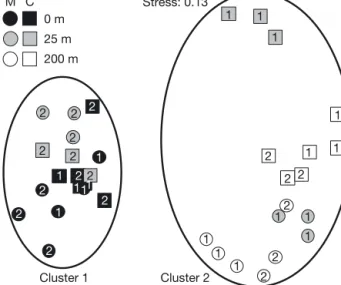
Community structure analysis, based on abun -dan ce, revealed 2 distinct clusters (Fig. 4; PERM -ANOVA, p < 0.05). The first cluster included the 0 m stations and 25 m T2 stations (i.e. along the main current direction) at both Millstone and Cranford farms. SIMPER analysis indicated that Cluster 1 was characterised by 3 dominant species:
Capitella capitata, Malacoceros fuliginosus and Tubificoides sp., with particularly high abundance
of C. capitata under Cranford cages (up to 252 ind. core−1, corres ponding to 26 517 ind. m−2) and high
abundance of M. fuliginosus under Millstone cages (66 ind. core−1, corresponding to 6945 ind. m−2).
The second cluster included the 200 m stations and the 25 m T1 stations (i.e.
per-pendicular to the main water cur-rent direction). Contrary to Clus-ter 1, ClusClus-ter 2 was characClus-terised by very low abundance of C.
capi-tata and M. fuliginosus, and a
more diverse community. Further-more Cluster 2 exhibited subdivi-sions between stations: The com-munities located at 25 m from Millstone and 200 m from Mill-stone and Cranford were characterised by the presence of Malda -nidae, Heteromastus filiformis, Lumbri neris gracilis, the bivalve Tellimya ferruginosa and the holothurid Leptosynapta inhaerens. Dissimilarity between the Cranford 25 m station (T1) and the other stations of Cluster 2 was largely related to the presence of
Galathowenia oculata and Poly-dora sp. in samples from the
for-mer station.
Trophic groups and M-AMBI
Of the 63 species observed, 32 were surface/sub-surface deposit-feeders (e.g. Capitella sp.,
Malaco-ceros fuliginosus), 9 were suspension-feeders (e.g. Telli mya ferruginosa) and 12 were carnivores (e.g.
Station Abundance (%) Biotic index
Df Sf Car H O AMBI M-AMBI Status
M-T1-0 99 ± 1 – – – – 6.0 0.2 Poor M-T1-25 88 ± 10 9 ± 10 2 ± 2 – 0 ± 1 1.1 0.9 High M-T1-200 65 ± 22 25 ± 20 9 ± 3 1 ± 1 0 ± 1 3.4 0.9 High M-T2-0 99 ± 1 – – – – 6.0 0.1 Bad M-T2-25 95 ± 5 3 ± 6 2 ± 3 – – 5.8 0.1 Bad M-T2-200 45 ± 7 44 ± 3 9 ± 11 – 2 ± 2 1.4 1.0 High C-T1-0 100 ± 0 0 ± 0 – – – 6.0 0.2 Bad C-T1-25 67 ± 28 7 ± 5 19 ± 19 – – 3.2 0.7 Good C-T1-200 65 ± 7 5 ± 5 29 ± 9 – – 1.5 0.9 High C-T2-0 95 ± 6 0 ± 1 1 ± 1 – – 5.8 0.3 Poor C-T2-25 99 ± 1 0 ± 1 0 ± 0 – – 5.9 0.3 Poor C-T2-200 40 ± 13 40 ± 9 18 ± 9 – 1 ± 1 1.4 0.9 High
Table 3. Trophic group composition of benthic communities, biotic index classification (AMBI and M-AMBI) and ecological status at Millstone (M) and Cranford (C) farms. Samples were collected at 3 stations (0, 25 and 200 m from the farms) along each of 2 transects (perpendicular T1 and parallel T2 to the current) in July 2009. Df: deposit-feeder; Sf: suspension-feeders; Car: carnivores; H: herbivores; O: omnivores. The trophic group of a few species was undetermined (max. 7% per station). AMBI and M-AMBI are based on the sen sitivity/tolerance level of species to organic enrichment. (–)
no species found belonging to that trophic group
Stress: 0.13 M C Cluster 1 Cluster 2 0 m 25 m 200 m 1 1 1 1 1 1 2 2 2 1 1 1 1 1 12 2 2 2 2 2 2 2 2 2 2 2 2 2 2 1 1 1 1 1 1
Fig. 4. Non-metric multi-dimensional scaling illustrating variation in benthic community structure (using square-root-transformed abundance data) near 2 salmon farms: Millstone (M) and Cranford (C). Benthic samples were col-lected in July 2009 at 3 stations (0, 25 and 200 m from the farms) along 2 transects (perpendicular [1] and parallel [2]
Lumbrineris gracilis, Ophiocomina ni gra) (Table 3).
Benthic communities of Cluster 1 (i.e. 0 m-T1, 0 m-T2, 25 m-T2 at both farms) were almost exclu-sively dominated by deposit-feeders (95 to 100%). The benthic status at those stations was classified as poor/bad by M-AMBI (Table 3). Stations in Cluster 2 were characterised by more diverse trophic groups, with the proportion of suspension feeders varying from 5 to 44% and carnivores from 2 to 29% (Table 3). The benthic status of the Cluster 2 station was classified as good/high by M-AMBI.
Based on the benthic community analysis, 2 condi-tions were observed at Millstone and Cranford farms: communities that were highly impacted by the salmon farms and communities that were not or only slightly impacted by the farms. We hypothesized that species assimilating salmon waste as a food source will present different isotopic signatures at impacted versus non-impacted sites.
Inter- and intraspecific variations in isotopic signatures
Interspecific variations in isotopic signature of the benthic organisms confirmed the trophic position of species within the community (Fig. 5a). At non-impacted stations, at Millstone and Cranford, respec-tively, Maldanidae (δ15N: 8.7 ‰ and 8.6 ‰), Pherusa plumosa (δ15N: 8.2 ‰ and 8.3 ‰) and Malacoceros fuliginosus (δ15N: 8.1 ‰ in Millstone) presented lower
δ15N, relative to the anemone Anthopleura balii
(δ15N: 9.3 ‰ and 9.5 ‰), the polychaetes Nephtys hombergii (δ15N: 9.9 ‰ and 10.7 ‰) and Lumbrineris gracilis (δ15N: 11.2 ‰ in Cranford), the ophiuroids
Ophiocomina nigra (δ15N: 10.4 ‰ in Millstone) and
the holo thurids Leptosynapta inhaerens (δ15N: 9.8 ‰
and 10.3 ‰). Nematoda had a similarly high δ15N
(10.6 ‰ in Cranford).
At impacted stations, the 2 dominant depositfee -ders, Capitella capitata (δ15N: 7.1 ‰ and 7.8 ‰) and Malacoceros fuliginosus (δ15N: 7.7 ‰
and 8.0 ‰) presented low δ15N as
did the polychaetes Pherusa plumosa (δ15N: 7.5 ‰ in Cranford) and Antho-pleura balii (δ15N: 7.5 ‰ in Millstone)
(Fig. 5a). The polychaetes Nephtys
hombergii (δ15N: 9.0 ‰ and 9.8 ‰) and Lumbrineris gracilis (δ15N: 11.1 ‰
in Cranford), the ophiuroids Ophioco
-mina nigra (δ15N: 9.6 ‰ in Millstone),
the holo thurids Leptosynapta inhae
-rens (δ15N: 8.6 ‰ in Millstone) and the
Nematoda (δ15N: 10.1 ‰ and 11.0 ‰)
were en riched in δ15N compared to
Capitella sp. and M. fuli ginosus.
Intraspecific variation observed for several species between impacted (poor/bad benthic status) and non-impacted stations (good/ high benthic status) (Fig. 5b) allowed us to detect variation in the assimilation of food by these species. Among these spe-cies, a clear shift in isotopic values towards the farm waste values was ob -served in Malacoceros fuliginosus,
Nephtys hombergii, Oph io comina ni-gra and Nematoda. Those spe cies collected at impacted stations were depleted in 13C relative to
con-specifics collected at non-impacted stations (variation of 2 ‰ in δ13C).
Slight interspecific variations in δ15N
(<1 ‰) were observed for species
δ
13C (‰)
5 6 7 8 9 10 11 12 –23 –22 –21 –20 –19 –18 –17 –23 –22 –21 –20 –19 –18 –17 –23 –22 –21 –20 –19 –18 –17δ
15N (‰)
δ
15N (‰)
δ
13C (‰)
5 6 7 8 9 10 11 12Non-impacted
Lgr Nem Nem Lgr Nho Nho Mfu Mfu Lin Nem Mfu Lin Oni Oni Nho Ppl Aba Mal Mal Ner Lin Aba Ppl Aba Ppl Cap Cap Nho Nem Oni Nho Lin Mfu Aba PplImpacted
Aba: Anthopleura balii Cap: Capitella spp. Lgr: Lumbrineris gracilis Mfu: Malacoceros fuliginosus Nem: Nematoda
Ner: Nereidae
Nho: Nephtys hombergii Oni: Ophiocomina nigra Ppl: Pherusa plumosa Lin: Leptosynapta inhaerens Mal: Maldanidae Nho Lgr
a
b
Millstone Non-impacted Impacted M C Fom10 Foj9 Fom9 Dep Far Fom10 Foj9 Fom9 Dep Far Fom10 Foj9 Fom9 Dep Far Fa Fa Fa Cranford Millstone CranfordFig. 5. (a) Interspecific and (b) intraspecific variation of mean (± SD, only shown in [a]) stable isotopic ratios in benthic species sampled at sites impacted (poor/bad biotic index status; see Table 3 for site status) or non-impacted (good/high status) by salmon waste at Millstone (M) and Cranford (C) farms. Red polygons represent the farm waste isotopic values for fish feed pellets collected in March 2009, June 2009 and May 2010 (FOm9, FOj9and FOm10, respectively); deposits collected beneath cages (Dep); faeces with mucus (Fa); and faeces without mucus (Far)
sampled at impacted vs. non-impacted sites; this vari-ation was more pronounced for N. hombergii (Fig. 5b).
Pherusa plumosa and Leptosynapta inhaerens had
lower δ15N at impacted than at non-impacted sites but
were the only species with higher δ13C. No variation
was observed for Lumbrinereis gracilis.
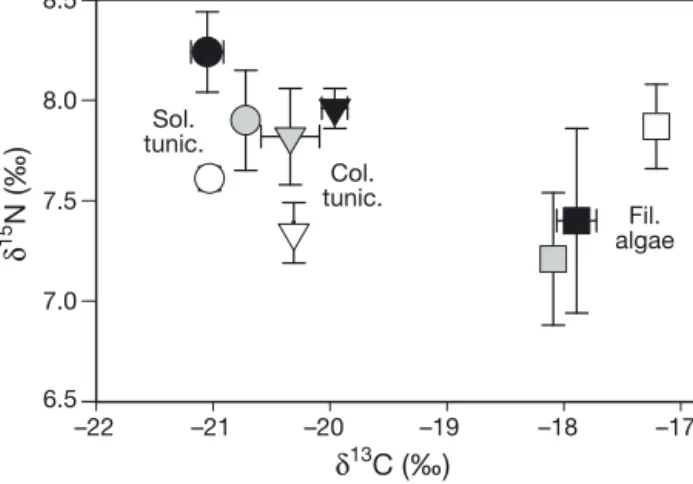
Intraspecific variation in isotopic values was also observed for fouling communities on sampling tiles (Fig. 6). After 2 mo, the early colonizing community was dominated in terms of biomass by the solitary tunicate Ascidiella aspersa, colonial tunicate Diplo
-soma sp. and filamentous alga Enteromorpha sp. Mytilus edulis, hydroids and gastropod larvae were
also present, but in very low abundance. The tuni-cates A. aspersa and Diplosoma sp. showed relatively little variation (~1 ‰ δ13C) (Fig. 6). A. aspersa and the
colonial tunicates at the 0 m station were enriched in
15N (δ15N mean ± SD: 8.2 ± 0.5 ‰) relative to those at
the 200 m station (δ15N: 7.6 ± 0.1 ‰), while no
signifi-cant difference in isotopic values was observed for fouling algae (Fig. 6).
DISCUSSION
We observed a gradient of organic enrichment around the studied fish farms such that benthic com-munities were strongly impacted by the farms (low diversity, dominance of opportunistic species) at some distances and orientations, whereas other com-munities were not or were only slightly impacted by the farms (higher diversity, presence of sensitive spe-cies). Stable isotope analysis supports the hypothesis that fish farm effluents contributed to the diets of several benthic and fouling organisms present in the vicinity of the farms.
Potential source of nutrients
Isotopic analysis (δ15N,δ13C) was used to track the
fate of salmon-farm-related products (e.g. fish feed and waste) in the environment to determine if waste was used as a new source of food by adjacent biota (Yoko yama et al. 2006). Variation in isotopic signatures of the food sources was sufficient to identify variation in the orga nisms’ diets. Effluent derived from salmon cages presented an isotopic composition that was dis-tinct from other potential food sources (e.g. algae), and the point-source nature of the fish farm effluent re-duced the confounding effects of mixed nutrient sources (Costanzo et al. 2003). As ex pected, fish feed pellets and faeces were enriched in15N compared to
other organic matter sources such as macroalgae, as they were composed of fish and crustacean meal, and depleted in13C, probably due to the presence of
terres-trial vegetables (see ‘Materials and methods’) and fish oil in their composition (Yoko yama et al. 2006). Deposits collected within sediment traps placed under fish cages were depleted in 15N compared to feed
pellets and faeces. This suggests that deposits were probably composed of a mixture of uneaten feed pel-lets, faeces and other material which may include faeces from fouling organisms, macroalgae etc. settling from the cages. However, caution should be taken with the interpretation of the deposit isotopic values, as these values only reflected 24 h of deposition.
High temporal variation was observed in the iso-topic values of the fish feed pellets (δ15N varied from
7.9 ‰ in 2009 to 10.2 ‰ in 2010). Although food com-position was similar, the fish meal and oil composing the pellets may have varied through time, as sources may differ over time, depending on wild fish supply. It is therefore important to consider seasonal varia-tion in the stable isotope composivaria-tion of fish feed pel-lets, as this may also change the isotopic value of both faeces and dissolved inorganic nitrogen. That being said, in the present study, fish feed pellets col-lected in March 2009 and June 2009, just before the organisms were sampled, presented similar isotopic compositions and were distinct from other food sources. Additionally, both farms were using the same pellet stock, which allows the findings from the 2 farms to be compared. –22 –21 –20 –19 –18 –17 7.0 6.5 7.5 8.0 8.5 Sol. tunic. Col. tunic. Fil. algae δ 15 N (‰) δ13 C (‰)
Fig. 6. Intraspecific variation of mean (± SD, n = 3) stable iso-topic signatures of fouling organisms collected on sus-pended structures in June 2009 (6 tiles fixed on 3 structures per distance) placed 0 m (black), 25 m (grey) and 200 m (white) from cages, at Millstone salmon farm, perpendicular to the main water current direction. Data are pooled per structure (see ‘Materials and methods’) for the solitary tuni-cate Ascidiella aspersa, colonial tunituni-cate Diplosoma sp. and
Fate of aquaculture waste in the environment Water column and sediment isotopic composition did not vary with distance from the fish cages (except for the water POM at 1 m depth). However, sig nifi cant variation in isotopic values was observed in benthic organisms (see next subsection). This suggests a rapid incorporation of fresh settling material by the local biota, thus preventing the accumulation of POM in the sediment. This observation is in accordance with the observations made by Kon et al. (2009), who showed that, even though no changes could be found in the isotopic composition of the SOM, shrimp far -ming waste induced a food availability shift to aqua-culture feed in benthic animals (fiddler crabs Uca
an-nulipes, U. forcipata, and U. bengali). Kon et al. (2009)
suggested that biological accumulation, i.e. the assim-ilation of organic matter by animals, is a better indica-tor than sediments. The lack of a clear sediment iso-topic signal suggests that the proportion of labile OM in fish wastes was high. Lefebvre et al. (2000) showed that fish faeces were assimilated by suspension feed-ers with an absorption efficiency of 60%. The low C/N ratios measured in fish feed pellets (7.9) confirmed the great nutritional value of fish waste.
Benthic community characteristics and diet Abundance, diversity and community structure At both studied farms, similar trends were ob -served in terms of variation in macrofaunal diversity and structure. The extent of measurable change in benthic communities was a function of residual cur-rent direction. Along the transect parallel to the main current direction, communities at 0 and 25 m sites were more similar to each other than those observed at 200 m, suggesting that the extent of influence was between 25 and 200 m. Along the transects perpen-dicular to the residual currents, the communities at a distance of 25 m were more similar to those at 200 m than to those directly under the farms. The current data combined with previous observations made at the Millstone and Cranford farms (Telfor & Robinson 2003) suggest that the extent of influence in this direction was < 25 m, which is consistent with previ-ous studies considering the impacts of fish farming on benthic communities (Mazzola et al. 2000, Nickell et al. 2003, Kutti et al. 2007b).
Changes in benthic community structure and de -creased diversity were observed under fish cages. Low diversity is consistent with the general pattern of
community changes due to organic enrichment, as increasingly anoxic sediment favours the prolifera-tion of organisms that can tolerate such condiprolifera-tions (Pearson & Rosenberg 1978, Diaz & Rosenberg 1995, Holmer et al. 2005). Indeed, increased sediment oxy-gen demand may lead to anoxia and higher sulphide concentration that may not be tolerated by certain species (Findlay et al. 1995, Pearson & Black 2001, Kinoshita et al. 2008). At Millstone farm, no differ-ence in total abundance was observed among dis-tances, but at Cranford, the abundance of inverte-brates was increased beneath the cages relative to other distances, indicating that tolerant species ben-efited from localized conditions, probably in res -ponse to increased food availability derived from the salmon cages (faeces, uneaten feed pellets, fouling), with a reduction of predators and competitors that are sensitive to high organic loading. Indeed, com-munities under salmon cages were dominated by deposit-feeders, whereas stations further away from the farm were dominated by carnivores and suspen-sion-feeders, which are sensitive to organic loading. Species able to assimilate this new source of food and to tolerate new habitat conditions may have outcom-peted species that were normally dominant.
Interspecific stable isotope variation
Interspecific variations in stable isotope values re-veal the trophic position of each species composing the macrobenthic communities. At non-impacted sites, communities were diverse and were represented by species within a wide range of trophic levels, includ-ing deposit-feeders, suspension-feeders and preda-tors. The lowest trophic level was represented by polychaete deposit-feeders of the family Maldani -dae, Pherusa plumosa and Malacoceros fuliginosus. Species representing higher tro phic levels included the anemone Anthopleura balii, the predatory poly-chaetes Nephtys hombergii and Lumbrineris gracilis and the ophiuroid Ophiocomina nigra (higher δ15N).
Under the influence of salmon cages, communities were almost exclusively dominated by deposit-feeders that are able to thrive under high organic loading (Pearson & Black 2001). The polychaetes Capitella
capitata and M. fuliginosus became dominant and
presented the lowest trophic level of the macrofaunal community (relatively low 15N). C. capitata and M. fuliginosus are known to be tolerant to high organic
loading (Cardell et al. 1999, Lindqvist et al. 2009). Part of their diet was probably composed of fish farm waste (as shown by the intra specific variation in
stable isotope values; see next subsection). Fish waste may have been incorporated by the deposit-feeders through direct or indirect assimilation (e.g. through the consumption of bac teria feeding on waste). C.
capitata is a subsurface deposit-feeder that ingests
sediment as it burrows, absorbing nutrients from the surfaces of sediment particles (Tsutsumi et al. 1990).
C. capitata is often highly abundant in sediment
en-riched by organic material from detritic algae (Bolam et al. 2000), sewage (Tsutsumi 1990), mussel farming (Callier et al. 2007), or fish farming (Black 2001), and can reach very high abundances, depending on the quality and quantity of food. Tsutsumi et al. (2005) and Kinoshita et al. (2008) evaluated the capacity of C.
capitata to bioremediate organically enriched
sedi-ment under fish cages by introducing mass-cultured colonies of C. capitata, and showed that populations could reach 400 000 ind. m−2. M. fuliginosus are
tentaculate (palp) surface deposit-feeders, which col-lect food particles directly from the substrate surface using their tentacles to carry food to their mouths, thus further supporting the hypothesis of a rapid in-corporation of nutrients by the biota before accumula-tion into the sediments. Other less dominant species in communities at farm-impacted sites were omnivo-rous or predatory species. The polychaetes Nephtys
hom bergii presented a high trophic level (3.1 to 3.7)
compared to C. capitata (2.6 to 2.8) and M. fuliginosus (2.8 to 2.9). N. hombergii, known to be a predator, was potentially feeding on the 2 deposit-feeders. However, considering the low abundance of N. hom bergii, its influence on the population size of deposit-feeders was probably low. Similarly, the sea ane mones
Antho-pleura balii represented a high trophic level (2.7 to
3.3). Part of their diet was probably composed of small polychaetes (C. capitata and M. fuliginosus). Ane -mones are known to be omnivores/ predators; obser-vation of gut contents confirmed the presence of poly-chaetes in their diet (M. Callier pers. obs.). Anemones also harbor photosynthetic endo symbionts (Davy & Turner 2003). Nematodes presented a high trophic level and a different range of δ13C values compared
to species at similar trophic levels. It is possible that nematodes feed on a different fraction of OM than do macro benthic taxa, as suggested by Franco et al. (2008) and van Oevelen et al. (2009), or on the same sources but different proportions of OM.
Intraspecific stable isotope variation
Intraspecific variation in isotopic values in benthic invertebrates was mostly explained by farm-related
effects. A significant shift in δ13C was observed for the
polychaetes Malacoceros fuliginosus and Neph tys
hombergii, for Nematoda and for the anemone Antho pleura balii. Individuals collected at impacted
stations were depleted in 13C relative to individuals
collected from nonimpacted stations. This is in ac -cor dance with other studies on the fate of aquacul-ture-related wastes evaluated using 13C as a tracer
(Kullman et al. 2009). This provides direct evidence that detritivorous species benefit from the higher or-ganic loading from the salmon cages. With respect to predators, the decreased trophic level (lower δ15N)
observed for N. hombergii indicates that they too may have assimilated salmon wastes as a new source of food when located under the cages. In non-impacted communities, the feeding mode of N. hombergii was mostly predatory, but under the fish cages the species may have acted as a deposit-feeder. This result sup-ports the concept of small-scale trophic plasticity, in which consumers adapt to modifications of food avail-ability (Pinnegar & Polunin 2000), as observed in sus-pension-feeding invertebrates influenced by oyster biodeposition (Dubois et al. 2007a). It is also possible that the lower δ15N may have induced a variation in
its signature. Among the species collected at im -pacted and non-im-pacted sites, Lumbrineris gracilis did not show variation in isotopic signature, so it could be classified as a trophic specialist (Dubois et al. 2007b). Only a few species were present both un-der cages and at 200 m sites. It is therefore difficult to draw general conclusions about trophic plasticity in these communities. Moreover, an average trophic fractionation value of 3.4 was used, as this value has been shown to be correct in numerous studies (Post 2002). However, this value could differ among spe-cies. To better determine the trophic plasticity of ben-thic species, further studies are needed to determine specific isotopic fractionation values.
After 2 mo, the fouling community was dominated in terms of biomass by the solitary tunicate Ascidiella
aspersa, colonial tunicate Diplosoma sp. and
filamen-tous algae Ulva spp. Mytilus edulis, hydroids and gastropod recruits were also present but in very low abundance. Previous studies observed similar results considering fouling communities on pontoons and nets and showed that dominant species near sal -mon cages included hydroids, tunicates and bivalves (Cook et al. 2006, Rensel & Forster 2007). The present study showed that A. aspersa, a filter-feeder, was enriched in 15N at farm sites. This result indicates
that tunicates may efficiently filter and assimilate particulates from fish cages. As suggested by Lojen et al. (2005), considering the water current speed and
distance of the substrates, the fouling community probably feeds on fresh fish farm effluent, whereas the benthic community further away may feed on altered faecal ma terial, thus potentially modifying the δ15N due to bacterial activity. Algae potentially
assimilating the inorganic dissolved nutrients pre-sented no clear difference in isotopic values between stations. This may be due to the faster dispersion of dissolved nutrients relative to POM (Lin & Fong 2008).
CONCLUSION
Our study showed small-scale influences of salmon farms on benthic and fouling communities, with pos-sible effects on trophic structure. Stable isotope com-position was shown to be a powerful tool for tracing the fate of fish waste into the biota, allowing the assimilation of salmon waste by benthic species to be detected and thus showing that they shifted their diets to include this nutrient input. The study high-lights the need to sample multiple sites in order to consider both inter- and intraspecific variability and to better determine the fate of aquaculture waste in the structure of the food web. Sedimentary and foul-ing organisms — potential sinks for fish effluents — play an important role in the carrying capacity of ecosystems for aquaculture. Adapted hus bandry practices, such as integrated multi-trophic aquacul-ture, could promote biomass of species able to assim-ilate fish waste and, therefore, dampen environ -mental impacts (Cook et al. 2006). However, further experiments are needed to confirm that adjacent biota can significantly reduce nutrient concentrations in the water column and sediments surrounding fish cages and effectively prevent aquaculture en -closures from organically enriching the surrounding environment.
Acknowledgements. We thank University College Dublin
and University of Caen and especially the MARBEE team for their precious help during field work. Thanks to Francis O’Beirn (Marine Institute) and Grainne O’Brien (Bord Ias-caigh Mhara) for advice and assistance. Thanks to Marine Harvest and Catherine McManus who kindly provided access to the farms. Thanks also to all the Mulroy Bay salmon farmers and divers who helped with the work. The manuscript has been improved thanks to the comments of Dr. C. W. McKindsey and 3 anonymous reviewers. This paper has been published as part of the SIMBIOSYS project (2007-B-CD-1-S1), part of the Science, Technology, Re -search and Innovation for the Environment (STRIVE) Pro-gramme 2007−2013. The proPro-gramme is financed by the Irish Government under the National Development Plan 2007−2013; it is administered on behalf of the Department of
the Environment, Heritage and Local Government by the Environmental Protection Agency which has the statutory function of co-ordinating and promoting environmental research.
LITERATURE CITED
Anderson MJ, Ter Braak CJF (2003) Permutation tests for multi-factorial analysis of variance. J Statist Comput Simulation 73: 85−113
Black KD (2001) Environmental impacts of aquaculture. Sheffield Academic Press, Sheffield
Bolam SG, Fernandes TF, Read P, Raffaelli D (2000) Effects of macroalgal mats on intertidal sandflats: an experimen-tal study. J Exp Mar Biol Ecol 249: 123−137
Borja A, Muxika I (2005) Guidelines for the use of AMBI (AZTI’s Marine Biotic Index) in the assessment of the benthic ecological quality. Mar Pollut Bull 50: 787–789 Callier MD, McKindsey CW, Desrosiers G (2007) Multi-scale
spatial variations in benthic sediment geochemistry and macrofaunal communities under a suspended mussel culture. Mar Ecol Prog Ser 348: 103−115
Callier MD, McKindsey CW, Desrosiers G (2008) Evaluation of indicators used to detect mussel farm influence on the benthos: two case studies in the Magdalen Islands, east-ern Canada. Aquaculture 278: 77−88
Cardell MJ, Sarda R, Romero J (1999) Spatial changes in sublittoral soft-bottom polychaete assemblages due to river inputs and sewage discharges. Acta Oecol Int J Ecol 20: 343−351
Clarke KR, Warwick RM (1994) Change in marine commu-nities: an approach to statistical analysis and interpreta-tion. Plymouth Marine Laboratory, Plymouth
Cook EJ, Black KD, Sayer MDJ, Cromey CJ and others (2006) The influence of caged mariculture on the early development of sublittoral fouling communities: a pan-European study. ICES J Mar Sci 63: 637−649
Costanzo S, O’Donohue M, Dennison W (2003) Assessing the seasonal influence of sewage and agricultural nutri-ent inputs in a subtropical river estuary. Estuar Coast Shelf Sci 26: 857−865
Cromey CJ, Nickell TD, Black KD (2002) Depomod — mod-elling the deposition and the biological effects of waste solids from marine cage farms. Aquaculture 214: 211−239 Davy SK, Turner JR (2003) Early development and acquisi-tion of zooxanthellae in the temperate symbiotic sea anemone Anthopleura balii (Cocks). Biol Bull 205:66–72 Diaz RJ, Rosenberg R (1995) Marine benthic hypoxia: a review of its ecological effects and the behavioural responses of benthic macrofauna. Oceanogr Mar Biol Annu Rev 33: 245−303
Dolenec T, Lojen S, Kniewald G, Dolenee M, Rogan N (2007) Nitrogen stable isotope composition as a tracer of fish farming in invertebrates Aplysina aerophoba, Balanus
perforatus and Anemonia sulcata in central Adriatic.
Aquaculture 262: 237−249
Dubois S, Marin-Leal JC, Ropert M, Lefebvre S (2007a) Effects of oyster farming on macrofaunal assemblages associated with Lanice conchilega tubeworm popula-tions: a trophic analysis using natural stable isotopes. Aquaculture 271: 336−349
Dubois S, Orvain F, Marin-Leal JC, Ropert M, Lefebvre S (2007b) Small-scale spatial variability of food partition-ing between cultivated oysters and associated
suspen-➤
➤
➤
➤
➤
➤
➤
➤
➤
➤
➤sion-feeding species, as revealed by stable isotopes. Mar Ecol Prog Ser 336: 151−160
FAO (Food and Agriculture Organization) (2010) The state of world fisheries and aquaculture 2010. FAO, Rome Fauchald K, Jumars PA (1979) The diet of worms: a study of
polychaete feeding guilds. Oceanogr Mar Biol Annu Rev 17:193–284
Findlay RH, Walting L, Mayer LM (1995) Environmental impact of salmon net-pen culture on Maine marine ben-thic communities: a case study. Estuaries 18: 145−179 Franco MA, Soetaert K, Costa MJ, Vincx M, Vanaverbeke J
(2008) Uptake of phytodetritus by meiobenthos using 13C labelled diatoms and Phaeocystis in two contrasting sed-iments from the North Sea. J Exp Mar Biol Ecol 362: 1−8 Hargrave BT (2003) Far-field environmental effects of marine finfish aquaculture. In: A scientific review of the potential environmental effects of aquaculture in aquatic ecosystems. Can Tech Rep Fish Aquat Sci 2450: 1−35 Hargrave BT (ed) (2005) Environmental effects of marine
finfish aquaculture. The handbook of environmental chemistry, Vol 5. Water pollution, Part M. Springer, Berlin Herman PMJ, Middelburg JJ, Van de Koppel J, Heip CHR (1999) Ecology of estuarine macrobenthos. In: Advances in ecological research, Vol 29. Academic Press, San Diego, CA, p 195−240
Holmer M, Wildish DJ, Hargrave B (2005) Organic enrich-ment from marine finfish aquaculture and effects on sed-iment biogeochemical processes. In: Hargrave BT (ed) The handbook of environmental chemistry, Vol 5. Water pollution, Part M. Springer, Berlin, p 181–206
Hughes TP, Bellwood DR, Folke C, Steneck RS, Wilson J (2005) New paradigms for supporting the resilience of marine ecosystems. Trends Ecol Evol 20: 380−386 Kinoshita K, Tamaki S, Yoshioka M, Srithonguthai S and
others (2008) Bioremediation of organically enriched sediment deposited below fish farms with artificially mass-cultured colonies of a deposit-feeding polychaete
Capitella sp. I. Fish Sci 74: 77−87
Kon K, Kawakubo N, Aoki JI, Tongnunui P, Hayashizaki KI, Kurokura H (2009) Effect of shrimp farming organic waste on food availability for deposit feeder crabs in a mangrove estuary, based on stable isotope analysis. Fish Sci 75: 715−722
Kullman MA, Kidd KA, Podemski CL, Paterson MJ, Blanch-field PJ (2009) Assimilation of freshwater salmonid aqua-culture waste by native aquatic biota. Can J Fish Aquat Sci 66: 1965−1975
Kutti T, Ervik A, Hansen PK (2007a) Effects of organic efflu-ents from a salmon farm on a fjord system. I. Vertical export and dispersal processes. Aquaculture 262: 367−381
Kutti T, Hansen PK, Ervik A, Hoisaeter T, Johannessen P (2007b) Effects of organic effluents from a salmon farm on a fjord system. II. Temporal and spatial patterns in infauna community composition. Aquaculture 262: 355−366
Lefebvre S, Barille L, Clerc M (2000) Pacific oyster
(Cras-sostrea gigas) feeding responses to a fish-farm effluent.
Aquaculture 187: 185−198
Lefebvre S, Bacher C, Meuret A, Hussenot J (2001) Model-ing approach of nitrogen and phosphorus exchanges at the sediment−water interface of an intensive fishpond system. Aquaculture 195: 279−297
Lefebvre S, Marin Leal JC, Dubois S, Orvain F and others (2009) Seasonal dynamics of trophic relationships among
co-occurring suspension-feeders in two shellfish culture dominated ecosystems. Estuar Coast Shelf Sci 82: 415−425
Lin DT, Fong P (2008) Macroalgal bioindicators (growth, tissue N, δ15N) detect nutrient enrichment from shrimp farm effluent entering Opunohu Bay, Moorea, French Polynesia. Mar Pollut Bull 56:245–249
Lindqvist S, Norling K, Hulth S (2009) Biogeochemistry in highly reduced mussel farm sediments during macrofau-nal recolonization by Amphiura filiformis and Nephtys sp. Mar Environ Res 67: 136−145
Lojen S, Spanier E, Tsemel A, Katz T, Eden N, Angel DL (2005) δ15N as a natural tracer of particulate nitrogen effluents released from marine aquaculture. Mar Biol 148: 87−96
Lorrain A, Savoye N, Chauvaud L, Paulet YM, Naulet N (2003) Decarbonation and preservation method for the analysis of organic C and N contents and stable isotope ratios of low-carbonated suspended particulate material. Anal Chim Acta 491: 125−133
Mayor DJ, Zuur AF, Solan M, Paton GI, Killham K (2010) Factors affecting benthic impacts at Scottish fish farms. Environ Sci Technol 44: 2079−2084
Mazzola A, Sarà G (2001) The effect of fish farming organic waste on food availability for bivalve molluscs (Gaeta Gulf, Central Tyrrhenian, Mediterranean): stable carbon isotopic analysis. Aquaculture 192: 361−379
Mazzola A, Mirto S, La Rosa T, Fabiano M, Danovaro R (2000) Fish-farming effects on benthic community struc-ture in coastal sediments: analysis of meiofaunal recov-ery. ICES J Mar Sci 57: 1454−1461
McKindsey CW, Thetmeyer H, Landry T, Silvert W (2006) Review of recent carrying capacity models for bivalve culture and recommendations for research and manage-ment. Aquaculture 261: 451−462
Michener RH, Schell DM (1994) Stable isotope ratios as trac-ers in marine aquatic food webs. In: Lajtha K, Michener RH (eds) Stable isotopes in ecology and environmental sciences. Blackwell Scientific, Oxford, p 138–157 Modica A, Scilipoti D, La Torre R, Manganaro A, Sarà G
(2006) The effect of mariculture facilities on biochemical features of suspended organic matter (southern Tyrrhen-ian, Mediterranean). Estuar Coast Shelf Sci 66: 177−184 Muxika I, Borja À, Bald J (2007) Using historical data, expert judgement and multivariate analysis in assessing refer-ence conditions and benthic ecological status, according to the European Water Framework Directive. Mar Pollut Bull 55: 16−29
Nickell LA, Black KD, Hughes DJ, Overnell J and others (2003) Bioturbation, sediment fluxes and benthic com-munity structure around a salmon cage farm in Loch Creran, Scotland. J Exp Mar Biol Ecol 285/286: 221−233 Pearson TH, Black KD (2001) The environmental impacts of marine fish cage culture. In: Black KD (ed) Environmen-tal impacts of aquaculture. Sheffield Academic Press, Sheffield, p 1−32
Pearson TH, Rosenberg R (1978) Macrobenthic succession in relation to organic enrichment and pollution of the marine environment. Oceanogr Mar Biol Annu Rev 16: 229−311
Pinnegar JK, Polunin NVC (2000) Contributions of stable isotope data to elucidating food webs of Mediterranean rocky littoral fishes. Oecologia 122: 399−409
Pitta P, Tsapakis M, Apostolaki ET, Tsagaraki T, Holmer M, Karakassis I (2009) ‘Ghost nutrients’ from fish farms are
➤
➤
➤
➤
➤
➤
➤
➤
➤
➤
➤
➤
➤
➤
➤
➤
➤
➤
➤
➤
➤
➤
➤
➤
transferred up the food web by phytoplankton grazers. Mar Ecol Prog Ser 374: 1−6
Post DM (2002) Using stable isotopes to estimate trophic position: models, methods, and assumptions. Ecology 83: 703−718
Rensel JE, Forster JRM (2007) Beneficial environmental effects of marine finfish mariculture. NOAA National Marine Fisheries Service, Office of Oceanic and Atmos-pheric Research, Washington, DC
Ryba SA, Burgess RM (2002) Effects of sample preparation on the measurement of organic carbon, hydrogen, nitro-gen, sulfur, and oxygen concentrations in marine sedi-ments. Chemosphere 48: 139−147
Sarà G, Scilipoti D, Mazzola A, Modica A (2004) Effects of fish farming waste to sedimentary and particulate organic matter in a southern Mediterranean area (Gulf of Castellammare, Sicily): a multiple stable isotope study (δ13C and δ15N). Aquaculture 234: 199−213
Telfor T, Robinson K (2003) Environmental quality and car-rying capacity for aquaculture in Mulroy Bay, Co. Done-gal. Marine Environment and Health Series, No. 9. http://oar.marine.ie/handle/10793/1/browse?type=author &order=ASC&rpp=20&value=Telfor%2C+T (accessed April 2012)
Tsutsumi H (1990) Population persistence of Capitella sp. (Polychaeta; Capitellidae) on a mud flat subject to envi-ronmental disturbance by organic enrichment. Mar Ecol Prog Ser 63: 147−156
Tsutsumi H, Fukunaga S, Fujita N, Sumida M (1990) Rela-tionship between growth of Capitella sp. and organic enrichment of the sediment. Mar Ecol Prog Ser 63: 157−162
Tsutsumi H, Kinoshita K, Srithongouthai S, Sato A and oth-ers (2005) Treatment of the organically enriched sedi-ment below the fish farm with the biological activities of artificially mass-cultured colonies of a small deposit feeding polychaete, Capitella sp. I. Benth Res 60: 25−38 van Oevelen D, Soetaert K, Franco MA, Moodley L, van Ijz-erloo L, Vincx M, Vanaverbeke J (2009) Organic matter input and processing in two contrasting North Sea sedi-ments: insights from stable isotope and biomass data. Mar Ecol Prog Ser 380: 19−32
Vizzini S, Mazzola A (2004) Stable isotope evidence for the environmental impact of a land-based fish farm in the western Mediterranean. Mar Pollut Bull 49: 61−70 Vizzini S, Mazzola A (2006) The effects of anthropogenic
organic matter inputs on stable carbon and nitrogen iso-topes in organisms from different trophic levels in a southern Mediterranean coastal area. Sci Total Environ 368: 723−731
Word JQ (1990) The infaunal trophic index, a functional approach to benthic community analyses. PhD disserta-tion, the University of Washington, Seattle, WA
Yokoyama H, Ishihi Y (2007) Variation in food sources of the macrobenthos along a land−sea transect: a stable isotope study. Mar Ecol Prog Ser 346: 127−141
Yokoyama H, Abo K, Ishihi Y (2006) Quantifying aquacul-ture-derived organic matter in the sediment in and around a coastal fish farm using stable carbon and nitro-gen isotope ratios. Aquaculture 254: 411−425
Yokoyama H, Takashi T, Ishihi Y, Abo K (2009) Effects of restricted feeding on growth of red sea bream and sedi-mentation of aquaculture wastes. Aquaculture 286: 80−88
Editorial responsibility: Jana Davis, Annapolis, Maryland, USA
Submitted: December 13, 2011; Accepted: January 7, 2013 Proofs received from author(s): May 7, 2013
![Table 2. ANOVA results for benthic macrofaunal characteristics (number of species, total abundance, Shannon-Wiener diversity [H’]) observed at 2 salmon farms](https://thumb-eu.123doks.com/thumbv2/123doknet/14797127.604355/8.918.471.819.129.664/results-benthic-macrofaunal-characteristics-abundance-shannon-diversity-observed.webp)