Earth abundant materials for high efficiency
heterojunction thin film solar cells
The MIT Faculty has made this article openly available.
Please share
how this access benefits you. Your story matters.
Citation
Yun Seog Lee et al. “Earth abundant materials for high efficiency
heterojunction thin film solar cells.” Photovoltaic Specialists
Conference (PVSC), 2009 34th IEEE. 2009. 002375-002377. © 2009,
IEEE
As Published
http://dx.doi.org/10.1109/PVSC.2009.5411314
Publisher
Institute of Electrical and Electronics Engineers
Version
Final published version
Citable link
http://hdl.handle.net/1721.1/59535
Terms of Use
Article is made available in accordance with the publisher's
policy and may be subject to US copyright law. Please refer to the
publisher's site for terms of use.
EARTH ABUNDANT MATERIALS FOR HIGH EFFICIENCY
HETEROJUNCTION THIN FILM SOLAR CELLS
Yun Seog Lee1,2, Mariana Bertoni1,2, Maria K. Chan3, Gerbrand Ceder4, and Tonio Buonassisi1,2,*
Massachusetts Institute of Technology, Cambridge, MA 02139, USA
1Department of Mechanical Engineering; 2Laboratory for Manufacturing Productivity; 3Department of Physics; 4Department of Material Science and Engineering;
*Corresponding author: [email protected]
;
ABSTRACT
We investigate earth abundant materials for thin-film solar cells that can meet tens of terawatts level deployment potential. Candidate materials are identified by combinatorial search, large-scale electronic structure calculations, and literature reviews. We identified cuprous oxide (Cu2O) as a prototype candidate for
investigation as an absorber layer in thin film solar cells. Cu2O thin films are deposited by reactive DC magnetron
sputtering and characterized. In order to tailor electrical properties, we modify grain structure, and add defects that enhance electron transport, maintaining desired optical gap.
INTRODUCTION
Photovoltaics (PV) is perhaps the most promising renewable energy source that can meet the global energy demand while keeping low concentrations of CO2 in the atmosphere. To become a major energy
source, module costs should be reduced significantly and energy conversion efficiencies should be increased. In terms of reducing module cost, thin film solar cells are a viable option due to their lower material usage and inexpensive manufacturing potential. However, current materials for thin film solar cells such as CdTe and CIGS suffer from concerns over resource scarcity (e.g., Tellurium and Indium)[1] and toxicity (e.g., Cadmium) respectively and are therefore limited to sub-terawatts deployment. We are developing thin film solar cells with the inherent advantages of thin film materials, and can be deposited atop Si substrates. The material should have proper optical and electrical properties including a direct bandgap (1.6-2.0 eV).
COMPUTATIONAL BANDGAP-PREDICTION
In order to find good candidate materials efficiently, we have developed computational methods that predict the bandgap of a given material. The prediction of
bandgap can be carried out to various levels of accuracy by using different computational methods, with more computationally intensive methods generally producing more accurate results.
The most efficient method is the calculation of the bandgap using standard Density Functional Theory (DFT). Although DFT typically underestimates the bandgap compared to experimental values, it is still useful as a first screening tool. We found by investigating hundreds of compounds that the most efficient way to obtain the points in reciprocal space (k-points) corresponding to the valence and conduction band edges depends on the crystal symmetry of the compound. By automating the selection of k-points based on the crystal symmetry, we have reduced the computational effort to obtain a DFT estimate of the bandgap by an average of 70%.
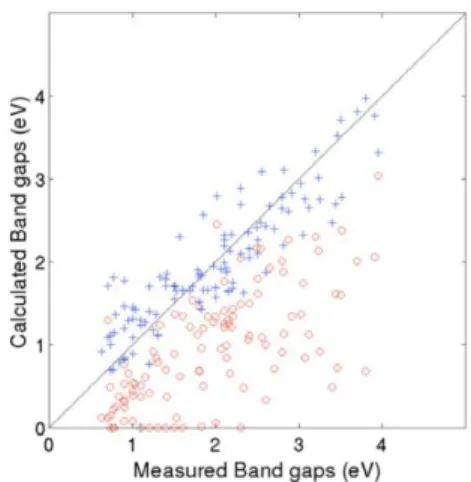
Fig. 1. Improvement in band gap prediction accuracy. Calculated band gaps are plotted against the experimentally measured values for 111 compounds. Red circles are obtained from standard DFT (mean error 1.0 eV) and blue crosses are from newly-developed method taking into account the dielectric screening (mean error 0.3 eV).
To improve on the accuracy of bandgap prediction, existing methods typically require 100-1000 times the computational effort of DFT. We have developed improvements in prediction accuracy of the DFT bandgap, without significant increase in computational efforts, by making use of the dielectric screening properties of the material. As a result, we have made improvements in the mean error of the estimated bandgaps from 1.0 eV to 0.3 eV for compounds in the relevant bandgap range, as shown in Fig. 1. When combined, the new efficiency and accuracy allow for more rapid and reliable screening of the thousands of compounds for suitability as PV materials.
MATERIAL SELECTION
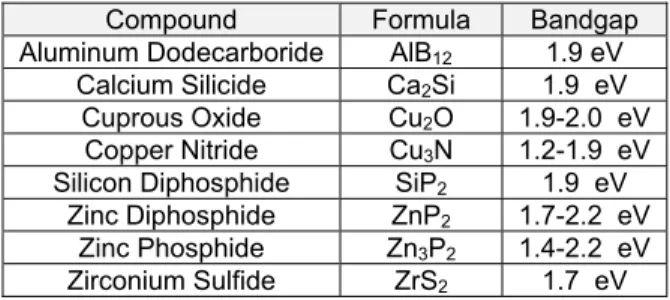
Over 500 semiconductor compounds were found from combinatorial materials search. We have analyzed material’s availability based on the abundance in Earth’s crust and manufacturing production capacity. We derived a list of low-cost elements that can meet terawatts level deployment. Computational prediction of bandgap and literature reviews were performed which reduced the list to tens of earth-abundant semiconductor compounds (Table 1). As the first selection for thin film solar cells materials, cuprous oxide (Cu2O) was
investigated.
THIN FILM DEPOSITION Experimental
Cu2O films were deposited by DC magnetron
sputtering using AJA international ATC 2200. The base pressure of the chamber was 5.6
×
10-5 Pa. A constant power (50-250W) sputtering mode was used with 99.999% pure Copper target. Ar, O2 and N2 gas flowswere controlled from 0 to 40 sccm for reactive sputtering
deposition. Quartz lamps were used to control substrate temperature from room temperature up to 850°C during film deposition as well as post-annealing processes. 2mm-thick soda lime glass and quartz substrates are cleaned in acetone for 5 minutes and rinsed by DI water before deposition.
Film thickness was measured by a Dektak surface profilometer, and resistivity was measured by a 4-point probe station. The phase and crystal structure of Cu2O
was studied using PANalytical's X'Pert PRO materials research diffractometer with Cu-Kα radiation. Optical absorption and reflection properties were measured by Cary 500i UV-Vis-NIR dual-beam spectrophotometer. A JEOL 6320FV field-emission high-resolution SEM was used to characterize the morphology of Cu2O thin films.
Result
Copper has two stable oxide phases: CuO and Cu2O. In order to control the phase, sputtered copper
flux and oxygen partial pressure were varied by changing the sputtering power and the argon / oxygen flow rate ratio. From the X-ray diffraction pattern in Fig. 2, optimal sputtering parameters were determined to obtain a highly-crystalline Cu2O film with a dominant
grain orientation of (111). The optical bandgap was Compound Formula Bandgap Aluminum Dodecarboride AlB12 1.9 eV
Calcium Silicide Ca2Si 1.9 eV
Cuprous Oxide Cu2O 1.9-2.0 eV
Copper Nitride Cu3N 1.2-1.9 eV
Silicon Diphosphide SiP2 1.9 eV
Zinc Diphosphide ZnP2 1.7-2.2 eV
Zinc Phosphide Zn3P2 1.4-2.2 eV
Zirconium Sulfide ZrS2 1.7 eV
Table 1. Candidate semiconductor compounds
Fig. 2. XRD patterns of as-deposited films at room temperature with different O2/Ar flow rates (∆:Cu2O
(200), Ο:Cu2O(111))
Fig 3. Experimental light absorption coefficient of as-deposited Cu2O thin film at room temperature
determined to be ~2.0 eV, as shown in Fig. 3. The resistivity varied between 1.7
×
103 and 4.3×
105 Ω-cm.In order to use Cu2O thin films as a solar cell
absorber layer, the columnar grain structure with a large grain size is preferred [3] to minimize carrier interactions with grain boundaries and thus improve carrier mobility. We increased the substrate temperature during film deposition and annealed Cu2O films in a vacuum
chamber for morphology modification. Increasing the substrate temperature during deposition resulted in larger grains. In Fig. 4, Cu2O films deposited at 850°C
(a) showed a columnar grain structure with 348nm average grain size, while films deposited at room temperature (b) have 54nm average grain size.
It was found that undoped Cu2O films have p-type
conductivity due to Cu vacancy with acceptor level 0.25-0.4 eV.[4,5] Nitrogen is reported to act as a p-type dopant with a shallow state at VB+0.14 eV.[5] During the deposition process, nitrogen gas was introduced at
room temperature. The resistivity of the Cu2O film
decreased to 5.5
×
102 Ω-cm as the N2 flow rateincreased to 1.0 sccm (Fig. 5).
CONCLUSIONS
In this collaborative effort, we have developed computational tools that enable predictive screening for compounds with desired optoelectronic properties. The enhanced accuracy of bandgap prediction enables the identification of appropriate PV materials made from Earth-abundant elements. We have determined the elemental basis set comprising Earth-abundant materials, both from the perspective of resource availability as well as annual production. We reviewed the experimentally determined physical properties of hundreds of Earth-abundant semiconductor compounds, and selected ten of the most promising candidates for further exploration. Of these, we deposited Cu2O thin
films as one of the more promising candidate compounds, and tailored its structural properties, a precondition towards enabling high-efficiency photovoltaic devices.
ACKNOWLEDGEMENTS
We acknowledge the support of the MIT Energy Initiative and the Chesonis Family Foundation.
REFERENCES
[1] A. Feltrina et al,. “Material considerations for terawatt level deployment of photovoltaics”, Renewable Energy
33 (2), 2008, pp.180-185.
[2] T. Coutts et al., “Modeled performance of polycrystalline thin-film tandem solar cells”, Progress in Photovoltaics: Research and Applications, 10 (3), 2002, pp. 195-203.
[3] A. Morales-Acevedo et al., “Physical basis for the design of CdS/CdTe thin film solar cells “, Solar Energy Materials and Solar Cells, 90 (6), 2006, pp. 678-685. [4] G. P. Pollack et al., “Photoelectric properties of cuprous oxide”, Journal of Applied Physics, 46 (1), 1975, pp. 163-172.
[5] S. Ishizuka et al., “Nitrogen doping into Cu2O thin
films deposited by reactive radio-frequency magnetron sputtering”, Japanese Journal of Applied Physics, 40, 2001, pp. 2765-2768.
(a) (b)
Fig. 4. Top and cross-cut SEM images of Cu2O thin
films deposited at (a)room temperature, and (b)850°C
Fig. 5. Resistivity changes by introducing nitrogen gas during deposition