DEVELOPING A FRAMEWORK FOR GLOBAL DISTRIBUTION IN THE BIOPHARMACEUTICAL INDUSTRY
By
Swaminathan Sekar
B.Eng. 2001 Electrical and Electronics Engineering Nanyang Technological University, Singapore
Submitted to the MIT Sloan School of Management and the Department of Electrical Engineering and Computer Science in Partial Fulfillment of the Requirements for the Degrees of
Master of Business Administration AND
Master of Science in Electrical Engineering and Computer Science In conjunction with the Leaders for Manufacturing Program at the
Massachusetts Institute of Technology June 2010
( 2010 Massachusetts Institute of Technology All rights reserved
Signature of Author Certified by Executive Director,
ARCHVES
MASSACHUSETTS INSTITUTE OF TECHNOLOGYJUL
12
2010
LIBRARIES
May 7, 2010 Electrical Engineering and Computer ScienceMIT Sloan School Management
hris Caplice, Thesis Supervisor CTL and MLOG PfogramEngineering Systems Division Certified by
Donald Rosenfield, Thesis Supervisor Senior Lecturer, Director of LGO Fellows Program, MIT Sloan School of Management
1<
Accepted b
Terry Orlando, Professor of $'ectrical Engineering and Computer Science Chair Committee on Graduate Students Accepted by
Debbie Berechman, Executive Director of MBA Program MIT Sloan School of Management y
DEVELOPING A FRAMEWORK FOR GLOBAL DISTRIBUTION IN THE BIOPHARMACEUTICAL INDUSTRY
By
Swaminathan Sekar
Submitted to the MIT Sloan School of Management and the Department of Electrical Engineering and Computer Science on May 7, 2009 in partial fulfillment of the requirements for the degrees of
Master of Business Administration and Master of Science in Electrical Engineering and Computer Science
ABSTRACT
This paper addresses two basic questions about the outbound distribution operations with a case study example of a large biopharmaceutical company. First, the research work focuses on developing an efficient, scalable truck distribution system to help reduce transportation cost, while maintaining the service level and capacity constraints. In doing so, the paper examines the Vehicle Routing Problem (VRP), a NP-hard combinatorial optimization in the context of
biopharmaceutical customer demand fulfillment process. The thesis presents a model developed to perform distribution center decisions, with Amgen North America market as case study. The second question addressed in this paper is a study on the number of distribution centers and possible locations. In a market with a certain geographic distribution of customers, and a desired number of distribution centers to operate, the analysis compares the different potential locations from standpoint of transportation cost, inventory level and site loading. The model is well suited for a company expanding into a new market to make decision on location of distribution centers to cater to a certain spread of customers in that region.
The paper presents analyses for a real case study to provide contextual example, as well as more broad recommendations in the field. Both models are scalable to markets outside North America for similar companies.
Thesis Supervisor: Chris Caplice
Title: Executive Director, CTL & MLOG Program, Engineering Systems Division Thesis Supervisor: Donald Rosenfield
Table of Contents
ABSTRACT ...--- ...-- ... . ---... 3 LIST OF FIGURES...---...---7 LIST OF TABLES ...---... ----...-. .. ---... 8 1. INTRODUCTION ...-...-...--- 11 1.1. PROJECT DRIVERS... . ...--- 11 1.2. PROBLEM SELECTION ... 121.3. PROBLEM STATEM ENT...-... ... 13
1.4. THESIS OVERVIEW ... ... -... 14
2. BACKGROUND ...-... ... 15
2.1. BIOPHARMACEUTICAL INDUSTRY ... 15
2.2. AM GEN, INC... ----... ---... 16
2.3. AM GEN SUPPLY CHAIN (DISTRIBUTION)... 17
2.4. VEHICLE ROUTING PROBLEM ... 20
2.5. ORGANIZATIONAL ASSESSM ENT... 20
THREE LENSES ANALYSIS...- 21
2.5.1. THE STRATEGIC LENS... 21
2.5.2. POLITICA L LENS ...----... 22
2.5.3. CULTURAL LENS ...---.-. 23
3. LITERATURE REVIEW ... 23
3.1. FUNDAM ENTALS OF VEHICLE ROUTING PROBLEM ... 23
3.2. CURRENT FORM S OF VEHICLE ROUTING PROBLEM ... 27
3.3. THE GREAT CIRCLE EQUATION... 28
3.4. DISTRIBUTION CENTER FOOTPRINT... 31
4. IDENTIFYING OPPORTUNITIES ... 33
4.1. MAP CURRENT GLOBAL DISTRIBUTION ... 33
4.2. DEVELOP DECISION DRIVERS... 35
4.3. ANALYZE DATA AND INITIAL FINDINGS... 37
4.4. DEVELOP HYPOTHESES ... 42
4.4.1. OPERATIONAL ... 42
5. METHODOLOGY AND TOOLS -MODEL DEVELOPMENT... 43
5.1. 'TRUCK ROUTING MODEL' - OPERATIONAL... 43
5.1.1. MODEL FUNDAMENTALS... 43
5.1.2. MODEL DESCRIPTION... 45
5.1.3. MODEL ASSUMPTIONS... 48
5.2. 'DC FOOTPRINT MODEL' - STRATEGIC... 49
5.2.1. MODEL DESCRIPTION... 49
5.2.2. MODEL ASSUMPTIONS... 49
5.3. IMPLEMENTATION... 49
5.3.1. 'TRUCK ROUTING MODEL' - OPERATIONAL ... 49
5.3.1.1. MODEL OUTPUT - AMGEN BUSINESS CASE... 50
5.3.1.2. MODEL DEPLOYMENT, PILOT AND TRAINING... 54
5.3.2. 'DC FOOTPRINT MODEL' - STRATEGIC... 54
5.3.2.1. MODEL OUTPUT... 55
5.3.2.2. ANALYSIS AND DISCUSSION... 55
6. SUMMARY... 59
6.1. OPERATIONAL - 'TRUCK ROUTING MODEL'...59
6.2. STRATEGIC - 'DC FOOTPRINT MODEL'... 60
6.3. CHALLENGES AND NEXT STEPS... 60
LIST OF FIGURES
Figure 1: Typical Distribution structure for Amgen... 18
Figure 2: The great circle on the spherical earth surface ... 29
Figure 3: Latitude and Longitude of start and end points on earth surface ... 30
Figure 4: Global distribution map with product flow starting from Site 1 packaging stage 34 Figure 5: Total operations costs, segmented to reflect distribution spend ... 35
Figure 6: Product flow across different supply chain channels in ICO market... 36
Figure 7: Forecast model used to understand future distribution need... 36
Figure 8: M ap of US distribution flow ... 40
Figure 9: Sample representation of distribution spread of all outgoing trucks to wholesalers ... 4 1 Figure 10: T ruck routing m odel... 47
Figure 11: SAP input to Truck routing model in Amgen case example ... 50
Figure 12: Flowchart of model execution and map of multi-city route based on given weekly d em an d ... 5 1 Figure 13: Multi-city route recommended for the given week based on demand data... 53
Figure 14: US Map with potential DC locations... 55
Figure 15: Model output two-DC network transportation cost... 56
Figure 16: Model output one-DC network transportation cost... 57
LIST OF TABLES
Table 1: List of commercially successful biotechnology drugs and their market size...16
Table 2: Description of distribution structure for Amgen... 19
Table 3: Types of Vehicle Routing Problem ... 27
Table 4: Com m ercially available VRP software... 28
Table 5: Overview of distribution across different markets ... 34
Table 6: Decision drivers of distribution network development process... 37
Table 7: Cost-to-serve detailing distribution cost components across all markets... 38
Table 8: Description of variables critical to model development based on interviews... 47
Table 9: Output variables related to truck loading... 51
Table 10: Output variables related to transportation logistics... 52
Table 11: Output variables related to Transportation cost ... 52
Table 12: Model output with input, demand data and COGS by customer and zone... 53
Table 13: 'Truck routing model' output comparing multi-city and direct delivery ... 54
ACKNOWLEDGEMENT
I would like to thank the Leaders for Global Operations (LGO) Program at MIT, and Amgen for
giving me such a rewarding learning experience. I'd like to thank Chris Caplice and Don Rosenfield (MIT), and Rayne Waller, Som Chattopadhyay, Naren Kadaba and Leigh Hunnicutt
(Amgen) for their support without which this work would not have materialized.
I'd like to give my special thanks to the Operations Strategic Planning team at Amgen, my peers
at LGO and at MIT Sloan for their support. There are others at Amgen that I'd like to recognize -Julie Matthew, Gary Hutchinson, Robert-Jan, Robert Hardy and JoonHaeng Lee for their
support.
Finally, and most importantly, the author is extremely grateful to his parents and sister for their wisdom, support, understanding, and encouragement through the years.
1. INTRODUCTION
1.1.
Project Drivers
The biopharmaceutical industry has grown significantly in the last few years, but the growth seen in its R&D and commercial aspect of business are more profound than that of its operations. In the case of market leaders, the scale and complexity concomitant with many products and SKUs for different markets makes it important to manage cost and efficiency of their operations (manufacturing and distribution).
The big drivers in biotechnology sector are cost, risk, availability and growth. In recent times, Amgen has been focusing on the risk profile at its different phases of operations. Firms usually hold enough safety stock to ensure no demand fluctuation or plant shutdown due to disaster would result in losing the opportunity to deliver the drug to a patient. Amgen's customers also place orders that vary in quantity and expected time to delivery. Amgen is committed to meeting
customer turnaround time, and this leads to low utilization and high cost in their distribution process. With anticipated growth leading to more quantity and variety in products and packaging, there is a need to create a strategy to manage Amgen's global distribution and manage current processes in an optimal way to realize savings.
The scale and nature of businesses in US make logistics an important component of a successful operations strategy in almost all industries. The broad umbrella of logistics accounts for an estimated 9.9% of GDP in 2006 ($635 billion annually on trucking costs)1. Of this, the cost of distribution is estimated to take up about half2. In biopharmaceutical industry, however, the entire cost of distribution may represent less than a fifth of the value added costs of goods. Yet, factors such as time-to-delivery, risk and inventory levels indirectly impact the top or bottom
1 (Schulz, 2007) 2 (De Backer, 1997)
line, making distribution a critical strategic component for this industry.
Based on the organization's need, Amgen defined the project scope that serves as the subject of this research. While the analysis on distribution center locations was a direct outcome of the original proposal, the VRP and Site 3 truck optimization work stream was developed as a
consequence of initially mapping out the current distribution to identify potential opportunities in current operations. The thesis provides insight from literature and the methodology deployed to develop a distribution model for a specific context. It presents analysis pertaining to the Amgen case study, as well as more general recommendations in the field.
1.2.
Problem Selection
Pharmaceutical and biotechnology companies are improving their supply chain for their current markets while creating robust processes and models to guide them in their expansion markets. With the threat of biosimilars and generics, there is an increasing need to reduce costs.
Optimizing their supply chain creates opportunities to do so. The purpose of the business case is to examine the methodology of developing models to reassess and improve distribution process using Amgen, Inc as a model large biopharmaceutical company.
For the purpose of this thesis, the following names are used as a reference to Amgen sites of operation:
Site 1: Amgen primary location for packaging drug products
Site 2: Amgen primary distribution center in North America market Site 3: Amgen secondary distribution center in North America market
Site 4: Logistic Service Provider (LSP) managed site in Canada for distribution in that market Site 5: Amgen Europe distribution center for distribution to most non-North America markets
DC 1, DC 2, DC 3, ... : Locations of alternate distribution center being considered
Amgen's global distribution is a result of several regional strategies. Amgen will need to evaluate its current global distribution network to best manage costs, service levels, inventory levels, and risk. Options under evaluation include optimization, consolidation of logistics providers, and outsourcing of Amgen's warehousing/distribution operations.
The entire distribution operations can be segmented into three key phases - inbound material
flow, material warehousing, and outbound material flow. This paper will focus on the outbound
material flow for order fulfillment process, developing a custom vehicle routing system. The paper will study the rich literature in this field and use features of traditional VRP systems to develop a model to aid decision-making process at a distribution center.
Subsequently, the paper will also look at another aspect of the distribution operations, namely the footprint. In this segment, the paper will present a model based on the Great Circle Equation that will help determine transportation cost for any company operating from a few distribution
centers (fulfillment centers) to deliver goods to a set of customers spread over the geography of a region.
The DC footprint analysis essentially analyzes at a region (market) and determines the transportation cost for fulfilling demand from the customers in that region for various
combinations of numbers and locations of distribution centers. It is imperative to understand the transportation cost, the time-to-delivery (customer service), and volume of product flow through each distribution center (risk profile). These change based on the number of distribution centers, and their locations in that specific market. The model developed to analyze the DC footprint of the case study, Amgen North America, is applicable in ground transportation models anywhere in the world and not just for biopharmaceutical, but other industries too.
1.3.
Problem Statement
The initial evaluation of current distribution operations in biopharmaceutical space led to two key areas of focus for this paper. The selection of these two topics as the scope of research is based on the following factors:
- The priority of the sponsor company (Amgen) for focusing on these issues
- The cost impact they deliver (see section 7 for the savings estimated through simulated pilot deployment)
- Low time to impact (identify improvement opportunities that need first attention and can be tackled during the time with sponsor company)
Operational
This paper will address the question of optimizing an existing distribution process. With the case example, the paper looks into whether Amgen can reduce its transportation costs through
increased truck utilization without changes to customer service levels.
Strategic
This paper will address some general questions regarding determination of distribution footprint. It will answer these questions in the context of Amgen, the case study company.
Evaluate the distribution center (DC) footprint of a company based on its customer locations. Compare cost of similar DC network (e.g. potential 2-DC networks) to understand if the company incurs close to optimal transportation costs in current state.
Determine if the Periodic VRP (PVRP) structure of demand fulfillment (common in
biopharmaceutical industry) is more cost effective with multi-DC network or direct shipments from packaging center.
Amgen currently runs its distribution operation out of Site 2 and Site 3. Products are packaged from Site and transferred to Site 3. Hence, the paper seeks to address optimality of Site 2 - Site 3
DC network, cost analysis of other 2-DC networks against current state, and feasibility of direct
distribution from Site 1. Based on initial analysis of current distribution network, the intern project scope was focused on North America distribution for model development and analysis.
1.4.
Thesis Overview
This thesis is organized into five chapters as follows,
Chapter 1 outlines the motivation and problem addressed by the thesis and provides an overview of the thesis contents. Chapter 2 details the industry landscape, company background and the current distribution network at Amgen. A section of this chapter performs an organizational assessment of Amgen using the three lenses framework -the strategic, political and cultural lenses. Chapter 3 presents literature on the vehicle routing problem and associated concepts that are central to the outbound demand fulfillment model (truck routing model). The chapter also
presents some background on the great circle equation, used in computing physical distances between nodes in the model. Chapter 4 focuses on the thesis approach and states the major
questions that need to be answered. In doing so, it explains the process of mapping current state, the key decision drivers, and the initial analysis outcome. These led to the hypothesis identified. Chapter 5 describes the formulations used to perform the analysis contained in this thesis. This chapter highlights process used to develop the model parameters (inputs, outputs) and illustrates the model applications through examples. Finally Chapter 6 discusses the recommendations for the two work streams and touches upon the challenges and next steps.
2.
BACKGROUND
2.1.
Biopharmaceutical Industry
The field of Biotechnology became a reality in 1982 with the introduction of the first drug, Humulin (Human Insulin), and has grown ever since. The biopharmaceutical industry is a segment of the pharmaceutical industry that focuses primarily on products consisting of 'large molecules' including living cells, proteins and DNA. This is in contrast with traditional
pharmaceuticals that are typically produced through chemical synthesis. There were more than 450 biopharmaceuticals on the market in 2008, and countries such as China, India, Taiwan,
South Korea and Singapore were fostering innovation with massive investments in new R&D centers of their own, primarily focused on stem cell technology.
Among the most well known products of the modem biotechnology industry are the mammalian polypeptides3, shown in table below
-Polypeptide Market size
Erythropoietin (EPO) $ 7 billion
Human insulin $ 4 billion
Interferon-a (Intron A) $ 1.8 billion
Granulocyte-colony stimulating factor (G-CSF) $ 2.6 billion
human growth hormone (HGH) $ 1.7 billion
Interferon-B $2.1 billion
Recombinant hepatitis B vaccine $725 million
Somatotropin $ 700 million
Cerezyme (glucocerobrosidase) $700 million
Tissue plasminogen activator (tPA) $600 million
Table 1: List of commercially successful biotechnology drugs and their market size
Analysts predict that biotech products will drive growth in the pharmaceutical industry with a compound annual growth rate (CAGR) of approximately 11.6% through 2014. The global market size of publicly held biopharmaceutical firms was about $89.7 billion, of which $66.1 billion came from US. However, it continues to become more difficult and expensive to introduce a new drug in the U.S market. A majority of the growth in the future will come from other global markets - and in these markets, the firms will be selling more drugs to get a certain amount of revenue than in the United States.
This aspect has led the biopharmaceutical firms to focus on building robust global distribution strategies to manage the complexity in product SKUs and other requirements needed to cater to the markets. At the same time, potential competition from other players and bio-similar products have led these firms to focus heavily on reducing their costs to impact the bottom-line. The opportunities in supply chain and distribution in this industry provides avenues to achieve this goal.
2.2.
Amgen, Inc.
Amgen, the world's largest biopharmaceutical company, discovers, develops and delivers innovative human therapeutics to patients around the world. Headquartered in Thousand Oaks,
CA, Amgen has approximately $ 15 billion in product sales and 17,000 staff worldwide. Amgen
has several manufacturing/distribution sites across continental US, Puerto Rico and Europe.4 As
a leader in the biopharmaceutical industry, Amgen can offer valuable insight into the opportunities for innovation and efficiencies in the supply chain distribution process in this
industry for relatively large-scale manufacturing.
Over the last 29 years, Amgen, Inc has applied a science-based approach to drug development, and has 10 products on the market today. Amgen pioneered the use of recombinant DNA and molecular biology to develop biologically derived therapeutic products provide supportive cancer care and treat conditions of anemia, rheumatoid arthritis and other autoimmune diseases.5 In the 1990's, the company introduced EPOGEN@ (Epoetin alfa) and NEUPOGEN@
(Filgrastim), both becoming Amgen's and the industry's first blockbusters.
2.3.
Amgen Supply Chain (Distribution)
Amgen supply chain for distribution purposes start at the packaging plant in Site 1 where over
90% of Amgen's products are packaged. The products are then shipped via the US port of entry
to Site 3 (Amgen primary distribution center, US) or to a depot (managed by logistic service provider) in Canada for the corresponding North America markets. Amgen Site 5 handles the distribution of products worldwide for most other markets. This includes the complex European distribution network requiring several SKUs, product packages, distribution requirements such as in-country presence, and engagement with several levels of supply chain before the product reaches the patient. Figure 1 describes the Amgen distribution structure discussed above.
btk. kn*: Amgen confroned "tnSpt - s (c*rris ontactd0y Am n)
Red ine Amgu nonrvaed rwWort - irdke (sub-corucd to eaurta)
814 1ti trn4rt ntv een&*med by Angan
* Source: Amgen Distribution Maps
Figure 1: Typical Distribution structure for Amgen
There are several types of companies involved in the distribution supply chain. They fall into 4 main categories that define their role in terms of activities, responsibilities, product ownership etc. The role of different participants in the distribution supply chain is elaborated table below:
Type of Operator Role/tasks performed
Amgen Distribution Hold inventory and manage distribution to wholesalers, other
Centers distributors or hospitals/pharmacies.
Logistic Service Performs logistics functions such as order processing, storage, and Provider (LSP) transportation.
Does not take title of the products or assume risk of loss. Acts on behalf of manufacturer or distributor who hold title of products. Distributors Perform sales and promotion activities in the territory in accordance
Wholesalers
Responsible for applicable legal and regulatory compliance, e.g. control of advertising, recall.
Assumes risk and takes title of the products and re-sells to its customers (wholesalers, hospitals, pharmacies).
Do not perform sales & promotion activities
Do not have primary obligations for regulatory or undertaking local registration. Like a distributor, assumes risk and takes title of the products
Wholesaler can also operate as LSP, offering specific services for a fee (e.g., homecare delivery, nursing, marketing before the product ownership is transferred to wholesaler, which usually coincides with payment terms)
Wholesaler distributes medicines to pharmacies or hospitals. Table 2: Description of distribution structure for Amgen
This thesis focuses on North America Distribution, primarily consisting of the Site 3 Amgen Distribution Center and its customers, predominantly wholesalers. The primary mode of
transportation is using truck runs, and is responsible for delivery of over 90% of the commercial demand. The remaining (small volume) commercial demand and some samples are shipped as small parcel using logistic service providers.
In a pull-based supply chain, procurement, production and distribution are demand-driven so that they are coordinated with actual customer orders, rather than forecast demand. The supply chain is pull-based at this stage (from Site 3 onward) with customers (wholesalers) placing order request based on their inventory and demand levels. Typical to most supply chains in this
industry, Amgen has a combination of push-based and pull-based with the push-pull boundary at the packaging and warehousing stage (Site 1 and Site 3).
The operations is marked by: -Highly uncertain demand pattern
- Short time to demand fulfillment
-Need to meet demand without delay or shortage
truck capacity is subject to the demand level during that week. High order frequency and low order quantity result in low truck utilization.
2.4. Vehicle Routing Problem
The underlying principle of optimizing Amgen's distribution is the Vehicle Routing Problem (VRP). The method aims to minimize total transportation cost, subject to location of distribution centers and customers with a certain truck dispatch heuristic. It is one of the most discussed combinatorial optimization problems and is critical to the field of logistics, since Dantzig and Ramser introduced it in 1959.
Methods to reach a precise or approximate (heuristic) solution have been presented in literature for less complicated problems. Ever-changing constraints, input conditions, and decision drivers are factors that make finding such solution of global minimum cost in real-life complex scenarios computationally difficult.
2.5.
Organizational Assessment
This project will impact the supply chain and distribution teams in different markets directly, but was being initiated and spearheaded by the Operations Strategic Planning team, the internal consulting team at Amgen. Successfully developing a distribution model would require a coordinated effort from different departments at Amgen such as Transportation & Logistics, Clinical Supply Chain, Commercial Supply Chain, Finance Operations, Global Strategic Sourcing and Planning, both in North America (US) and International Operations (Europe primarily). Some departments were primarily engaged to get access to data required for the project while others had a greater role because of the impact of the recommendations on their division.
The following is an assessment of the key organizations involved, highlighting some of the key challenges the project implementation could face. The implementation aspect of the
Three Lenses Analysis
A Three Lenses Analysis6 was performed in order to better understand how Amgen would
respond internally to the proposed changes. The Three Lens Analysis, developed at the MIT Sloan School of Management, analyzes an organization from three perspectives. The Strategic Design Lens focuses on organizational structure and the grouping, linking and aligning of the organization. The Political Lens examines the contest for power within the organization among different stakeholders with different goals and underlying interests. The Cultural Lens looks at the history of the organization and the underlying assumptions with which it functions. The three lenses together can help provide a complete picture of an organization in transition and help uncover potential barriers to change.
In the following sections, the Strategic lens analyzes the company structure and current position with regards to industry, products and growth. The Political lens highlights the role and
perspective of different groups. The Cultural lens looks at the behavior and communication habits the organization has with regards to current distribution and possible changes to it.
2.5.1. The Strategic Lens
Amgen at a high level has three main groups - Research & Development, Marketing (Commercial) and Operations. This project is being sponsored by the Executive Director of Supply Chain, and will be led by the Operations Strategic Planning (OSP) group. OSP is an internal consulting team that handled operations projects that are predominantly strategic in nature. The clients are the top management from Operations, and other departments relevant to the project. The focus on distribution and cost reductions aligns well with the strategic goals issued by the senior management for 2009. There are parallel initiatives aimed at fill-finish strategy and packaging strategy that were initialized. Together, the three projects will cover the strategic goals of operations department, and primarily assess cost, risk and inventory levels.
Though the OSP team manages the project, the impact of the recommendations is directly upon other groups that typically have team member representation in the project.
A team was put together involving people from Amgen US and International (Europe) locations,
involving clinical and commercial supply chain, transportation, finance, global strategic sourcing and planning groups. The team reported to a governing board that consisted of senior
management of these departments, including the project sponsor.
The US members represented North America or, in some cases, global distribution. The
European members represented any supply chain activity in current and new markets outside of North America.
Amgen has had several initiatives on operations improvement including Lean, Inventory
Management and such. The company however has several product SKUs and wants to ensure it designs a good supply chain network to manage the current and future demand by reducing cost and managing complexity.
In North America, which is the prime focus of this thesis, the illustrative sites (Site 2 and Site 3) are representative of the network responsible for both clinical and commercial distribution. The clinical trial products are split fairly evenly across the two sites, with each trial running out of only one site. Most of the commercial volume flows through Site 3.
2.5.2. Political Lens
It is critical to understand the right drivers that are critical to Amgen Distribution. In industries such as semiconductor where margins are small, this is the most critical driver for projects aimed at reevaluating distribution. There, the costs incurred by the company for operations (including distribution) are high. In the Biopharmaceutical industry, majority of the expenses go towards R&D activities and Commercial (Marketing, sales and such). The operations division represents a smaller percentage of firm's overall costs, but has to reduce cost. There is an inherent tension this causes among the different functional units.
On the other hand, the industry is very cautious about quality, safety, customer service (time to delivery) and stock availability. All these require significant increase in capital expenditure. In Amgen's case, the market expansion plans demand robust support in its distribution network.
These are critical factors alongside cost when evaluating the distribution network.
2.5.3. Cultural Lens
The company encourages employees to communicate across different groups, which helps develop relationships critical for managing a multi-functional team effectively. Amgen is very science-driven company and that resonates across different functional units of the company. Traditionally, the company had a motto of 'Every patient, every time' that led them to operate with high inventory and operating cost in ways that impacted the bottom-line. In recent times, the company has started to reassess its perspective towards delivering products to the market. This is primarily due to the need for reducing cost and managing their supply chain more efficiently.
Few of the hypotheses considered involved relocation or consolidation of facilities, and these could raise concern or false alarm. Hence, it is essential that the project findings be
communicated in a well-planned manner. Confidentiality of data during the course of the project is necessary in order to prevent perceptions or conclusions getting formed in groups outside project members.
The main takeaways from the organizational analysis are that there is a strategic focus to reduce operations cost. There are significant opportunities to do so by optimizing their distribution spend, which makes this work very timely and relevant. This project involves several
stakeholders from across the organization, and aligning incentives and getting consensus is a big challenge.
3.
LITERATURE REVIEW
3.1.
Fundamentals of Vehicle Routing Problem
The Vehicle Routing Problem (VRP) refers to a class of problems where optimal routes are determined to fulfill demand from a set of customer locations using certain truck capacity from an available set of warehouses. The objective of the VRP is to deliver a set of customers with
known demands on minimum-cost vehicle routes originating and terminating at a distribution center. The VRP arises naturally7 as a central problem in the fields of transportation, distribution
and logistics. In some market sectors, transportation means a high percentage of the value added to goods. Therefore, the utilization of computerized methods for transportation often results in significant savings ranging from 5% to 20% in the total costs8.
The VRP falls under the category of nondeterministic polynomial time hard (NP Hard)
problems9, with no exact known polynomial time exact solution algorithm0. The computational
effort required for solving such problems increases exponentially with the problem complexity and sample size. The common approach is to use heuristic approaches to achieve sufficiently accurate (approximate) solutions in short time, based on an understanding of the specific problem characteristics.
The combinatorial Vehicle Routing Problem is a marriage of two well-studied NP Hard problems - the Traveling Salesman Problem (TSP) and the bin Packing Problem (BPP).
The TSP studies the shortest possible trip for a salesman, starting from his origin location, covering a set of customer locations, and ending back at his origin point. It assumes each location is touched once. The TSP aims to find the shortest length Hamiltonian cycle of a completely weighted graph N = (L, R) where N represents the set of customer locations (nodes) and R represents the set of routes (edges) connecting the locations. Each route carries a weight (say cost c) that is a function of its length and corresponds to the distance between the two locations it connects.
The objective function:
? (Dantzing & Ramser, 1959) 8 (Toth & Vigo, 2001)
9 (Lenstra and Rinnooy Kan, 1981)
10 (Garey and Johnson, 1979)
n-I n-I
min 11cixii
i=1 j-1 where
= if the TSP routes include (i,j)
P 0 otherwise s.t xii = l
for j=1,2,...,m
i-i Ixii =1Ifori=,.., j=1 I Ix s|.KI-lfor all K C{1,2,...,m}
isK jsKxy =0 or 1 for all i,j
Problems in which no constraints are specified are known as "salesman" problems. The goal is to design a minimum tour for a single salesman (vehicle) using a single origin-destination with no capacity or tour-length constraints.'1
A version of this called m-tsp is the design of a pre-specified number, m, of distinct tours that
collectively visit each of the demand points at least once while using a single common origin-destination. The objective is to minimize the total distance covered in the m tours. A vehicle routing problem is a case where there are constraints of the vehicle-capacity or maximum-distance types. The origins and destinations are usually referred to as depots. Here, the required number of vehicles and their routes are usually unknown. The solution aims to minimize an objective function that is representative of the cost of the system.'2
The Bin Packing Problem (BPP) looks at arranging a set of products into bins with constraint on physical dimension (number, volume, weight etc.) of the products going into each bin. The BPP
1 Larson, R. C., & Odoni, A. R. (1981). Urban Operations Research. Prentice-Hall.
has known finite set of products with a certain volume or weight associated with each. A high cost is assigned to structure constraint on specific arrangement of products (e.g., high cost assigned when product i is placed after product j). A certain arrangement (ordered grop) is
defined as an ordered subset of products when total weight of the ordered group is within bin capacity, and cost between adjacent products in the group is infinite. The primary goal is to create a feasible solution with the minimum number of ordered groups.
In our context, we see the products as the locations that trucks have to stop at and arrange them in a certain sequence to reduce cost of transportation.
There are a few algorithms that have been developed to tackle this problem - The first-fit
algorithm is a simple one that assigns products in the order they come, to the first bin they fit in.
J. Ullman proved in 1973 that this algorithm could differ from optimal packing by as much as 70%. A different algorithm arranges the products from largest to smallest before assigning them
sequentially to the first bin they fit in. In 1973, D. Johnson showed that this algorithm is never suboptimal by more than 22%. It was also shown that no efficient bin-packing algorithm could be guaranteed to do better than 22%. In some product arrangement scenarios, applying the packing algorithm after removing a product results in one more bin being required than the number obtained if the product is included1 3. The first such example was constructed by Sylvia
Halasz and published by Graham.
The BPP is conceptually equivalent to a VRP model in which all edge costs are taken to be zero (so that all feasible solutions have the same cost). VRP problem is solved in two stages, first relaxing the underlying packing (BPP) structure and then relaxing the underlying routing (TSP) structure. A feasible solution to the whole VRP problem is a TSP route that also satisfies the BPP constraints (the total demand along each of the n segments joining successive copies of the depot does not exceed capacity of vehicles). Since the TSP and BPP are inherently NP Hard problems, the merging of these two makes VRP significantly complex and difficult to solve in real-life scenarios.
13 (Hoffman, 1998) 14 (Graham, 1976)
3.2.
Current forms of Vehicle Routing Problem
There are variants of VRP due to additional constraints that usually exist in real-life scenarios:
Abbreviation Type of VRP Description
CVRP Capacitated VRP Every vehicle has limited capacity
VRPTW VRP with time window Every customer order has to be delivered within a specific time window
MDVRP Multi Depot VRP Use many depots to fulfill demand
VRPPD VRP with pick-up and Case where goods can be returned to warehouse
delivering by customer
SDVRP Split Delivery VRP Customers served by different vehicles
SVRP Stochastic VRP Variables like number of customers, their
demands, serve time or travel time are random
PVRP Periodic VRP Delivery done on specific days
PVRPTW Periodic VRP with time Deliver on specific times of the assigned days window
DVRP Dynamic VRP Information such as demand level and customers
for the period are dynamic inputs across time Table 3: Types of Vehicle Routing Problem
Common real world scenarios are usually solved using heuristic approach rather than being solved exactly using algorithms. The most commonly available heuristic approach, such as the Savings Algorithm'5 will be discussed in section 5.1.1. The Vehicle Flow Model16 showed
typical VRP cases as being modeled as a mixed integer program (MIP). The variables associated with each route between notes (locations) hold integer values.
15 Clarke and Wright, 1964)
The pharmaceutical industry, including the Amgen case, will resemble a mix of Periodic VRP with Time Window and dynamic VRP due to specific customer service (order delivery) requirements and unknown demand pattern till close to order fulfillment.
The later sections in this paper describe the modified VRP structure used to develop the Truck Routing Model in the context of drivers that are critical for biopharmaceutical distribution process with Amgen as a case study.
Currently, there are a few commercially available vehicle routing software solutions. The prominent ones based on survey data17 from 1999 onward are listed below:
Product JOpt.AAS
Mobile Asset Route Optimization
QMms - Quant Methods for
Management Science StreetSync Basic Roadnet Anywhere JOpt.SDK
StreetSync Desktop Route Planning Suite DRTraCK
Accellos One Optimize
IBM ILOG Transportation Analyst Table 4: Commercially available VRP softwai
Vendor
DNA Evolutions - Distributed
Natural Algorithms GmbH FreshStart Logistics QuantMethods
RouteSolutions
UPS Logistics Technologies DNA Evolutions - Distributed
Natural Algorithms GmbH RouteSolutions
Descartes Systems Group Appian Logistics Software, Inc. Prophesy Transportation Solutions, an Accellos Company IBM Year Introduced 2009 2009 2009 2008 2006 2005 2005 2004 2003 1999
3.3. The Great Circle Equation
In order to measure travel distances between two points on the surface of earth, the first step is to measure their orthodromic distance. The great circle distance or orthodromic distance is the shortest distance between any two points on the surface of a sphere measured along a path on the surface of the sphere (as opposed to measuring the straight line distance through the sphere's
17Vehicle Routing Software Survey (2010):
interior).1 8
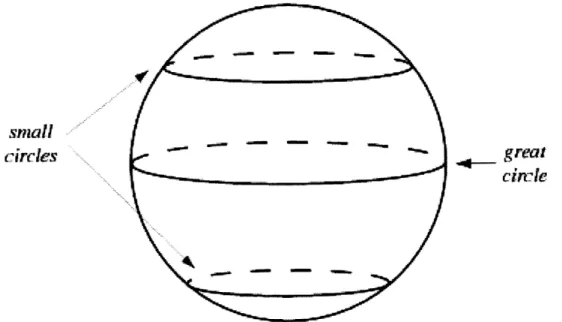
A great circle is a section of a sphere that contains a diameter of the sphere9. Sections of the
sphere that do not contain a diameter are called small circles.
small
circles greai
chin,,le
Figure 2: The great circle on the spherical earth surface
Unlike Euclidean space where distance between two points is measured using a straight line connecting them, the non-Euclidean geometry uses geodesics. On spherical surface, the
geodesics are the great circles, circles that have centers coinciding with the center of the sphere. For any non-diametrically opposite points on a sphere, there is a unique great circle. Conversely, any two points on a sphere separate the great circle into two arcs. The length of the shorter arc is defined as the great-circle distance between those two points.
18 Weisstein, E. W. (n.d.). Retrieved from MathWorld--A Wolfram Web Resource:
http://mathworld.wolfram.com/GreatCircle.html
(ps, xs
(If,
Xf Figure 3: Latitude and Longitude of start and end points on earth surfaceThe great circle equation between two points is defined by (latitude, longitude) as (CDs, ks) and
(<Df, Xf) for start and finish points respectively, and A<, AX which represent their differences.
Assume earth as a spherical surface,
d
=
r
A&.
d is the arc length on a sphere of radius r andLAo
is the angular distance between the two pointsThe angular distance is computer using
A&
-
2 arcsin*x
Sin2
(AO
± cos0,cos ofsi
2(v))
Although this formula is accurate for most distances, it too suffers from rounding errors for the special case of antipodal points. A modified version for calculating the distance can be derived using the Vincenty's formulae. Vincenty's formulae are two related iterative methods used in
geodesy to calculate the distance between two points on the surface of a spheroid, developed by Thaddeus Vincenty in 1975. 20 This is more accurate because it assumes the shape of earth to be
an oblate spheroid.
(cos
#f
sin AA)2 + (cos4,
sin#f
- sin , cos#
cos AA)2sin
#,
sin#f
+ coso#, cos#f
cosA A)The above formulae are used in this thesis work to measure the great circle distance between two locations that are either distribution centers or wholesaler sites. In order to translate the above distance to actual ground distances, the models developed in this paper uses d = 1.25* r * Au-. The circuity factor of 1.25 is used to translate the great circle distance to road distance for trucking. In developing a model for Oak Ridge National Laboratories National Highway Network,21 Qureshi et .al. showed that using a circuity factor of 1.22 gave a more accurate and consistent translation of great circle distance to road distance without statistical bias. A table of circuity factors for different countries has been developed that showed the circuity factor for United States based on 299 data points was 1.2 with a standard deviation of .17.22 However, note that the presence of physical bodies such as lakes, rivers and mountains significantly alter the circuity factor approximation between some nodes. Typical example in the United States involves cities located across the Lake of Michigan.
3.4. Distribution center footprint
The number of distribution centers to be built, and their respective locations are two of the most important decision issues for logistics managers. The typical factors of consideration include inventory levels and cost, warehousing and operating costs and transportation costs (both inbound and outbound). The locations also need to take into account customer service
requirements, availability of transportation infrastructure and 3rd party logistics service providers.
There are many branch and bound algorithms for locating warehouse (or DC) footprint have been developed. Efroymson presents an integer program based approach to solving the special class of discrete programming problems such as plant (DC) location. Branch and bound has been used here to successfully solve location problems with 50 or higher plants (DCs). Elson shows
21 (Qureshi A M, 2002) 22 (Ballou, H R, 2001)
how mixed-integer programming can be successfully applied in specific cases of warehouse location problem. The paper discusses the flexibility of mixed-integer models in developing decision-making tools to determine warehouse locations (footprint).24
Work by Nozick and Turnquist (1998) has shown how incorporating inventory costs in a location model can affect optimal decisions on the number and locations of DCs. A subsequent work built an iterative procedure that can alternate between solving a location problem (given an inventory policy), and solving an inventory optimization (given the number an locations of DCs) to integrate the inventory and location decisions. 25 The work by Nozick and Turnquist look at
distribution centers primarily from the perspective of inventory setup, while the work on this paper looks at the transportation costs incurred in making DC location decisions.
Chen proposed a new multiple criteria decision-making method to solve the distribution center location selection problem under fuzzy environment. In the proposed method, triangular fuzzy numbers are used to represent the weight of each criteria and preference of each alternative, and the same is format is used to represent the relative output value (evaluated score) of each DC pair. A stepwise ranking process is proposed to rank all the DC location options considered.2 6
The general formulation of the fixed-charge facility location model is as follows2 7
mi
Y fkXA +
4
10
G4idYA
s.t
L
k& =
1 Vi
Yj*<Xt
V i. k
X '11
Vk
Ya
>
0
V
i.
k.
where fk is the fixed cost of locating a facility at site k
Gi is the demand at wholesaler i
dik is the distance from site k to wholesaler i
24 (Elson, 1972)
25 (Nozick, Turnquist, 1998)
26 (Chen-Tung Chen, 2001) 27 (Daskin, 1995)
< is the cost per unit distance per unit demand
Xj= 1 if a facility is to be located at candidate site k
= 0 otherwise,
and Yik is the fraction of demand at location i which is served by a facility at k
Nozick and Tumquist developed a fixed-charge location model that considers trade off the costs of opening new warehouses against the transportation costs of serving demand from them. Transportation costs can be reduced by opening more DCs as that will reduce the distance of
commute, but each new facility has associated setup, fixed and variable operating costs that increases the overall cost of operating multiple DCs.28
In the later sections, we use the concepts of mixed integer models to develop a DC footprint model to analyze the DC footprint of our case study from the perspective of transportation costs.
4. IDENTIFYING OPPORTUNITIES
The process applied to tackling the question of evaluating Amgen's distribution was to first map the current distribution to best understand cost and volume across different markets. Other
factors like regulatory requirements vendor capability need to be considered too. The data is analyzed to extract key findings through understanding current map and identifying
opportunities. Key hypotheses are generated based on the analysis and opportunities. This process leads to the model development phase described in Chapter 5.
4.1.
Map Current Global Distribution
All interviews, data collection, and analyses were performed at Amgen, Inc. Data was obtained
from sites in US and Europe (Sites 1-5). Interviews of over 30 subject matter experts across departments at Amgen and external vendors went into developing the work for this thesis. Inputs from groups in Commercial Supply Chain, Clinical Supply Chain, Transportation, Finance, Planning, Commercial Operations, Regulatory and Manufacturing were integral to the business case.
An overview of the different Amgen markets across these factors is listed in Table below
Table 5: Overview of distribution across different markets
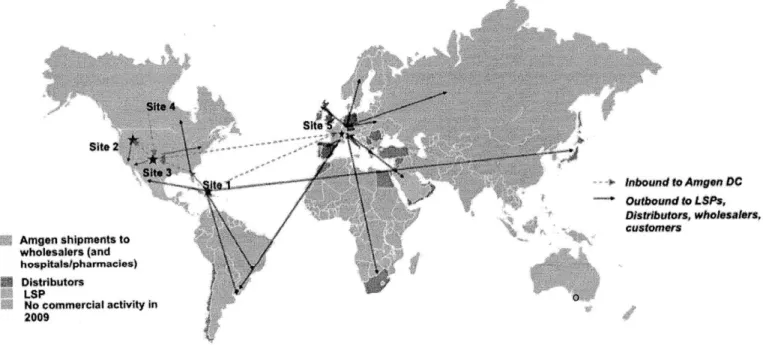
Amgen's commercial distribution process begins at Site 1. The figure below shows the overall product flow.
tok7
Amgen shipments to wholesalers (and hospitals/pharmacies) Distributors LSP No commercial activity in 2009For Illustrative purpose only
Figure 4: Global distribution map with product flow starting from Site 1 packaging stage
In the market of focus, North American Commercial Operations (NACO), the products reach US port of entry by ship and from there to Site 3 by trucks. The Primary Distribution Center is Site 3, and the first economic customers in North America are predominantly wholesalers. Amgen does about 90% of its commercial order fulfillment via trucks.
Inbound to Amgen DC Outbound to LSPs,
Distributors, wholesalers.
4.2. Develop Decision Drivers
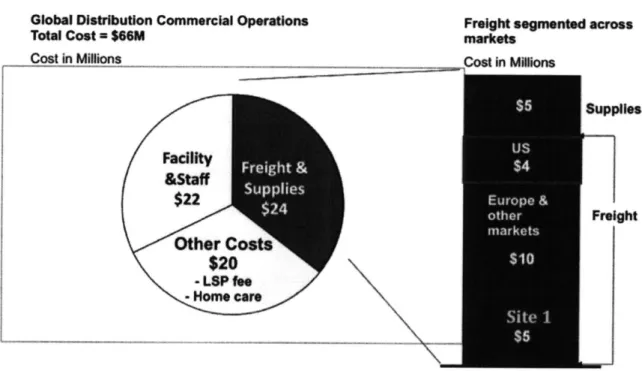
Mapping the current distribution will help understand the total cost of distribution in dollars and as percentage share of overall operations cost.
Global Distribution Commercial Operations Total Cost -$66M
Cost in Millions
Freight segmented across market nCost i Millions supplies Freight Fadisty &Staff $22
Other Cots
$20
- LSP fe* - Home careFor Illustrative purpose only, numbers are not representative of actual spend
Figure 5: Total operations costs, segmented to reflect distribution spend
Subsequently, transactional data is used to map annual volume of product flow across different segments of the supply chain (and across different channel modes). Figure 6 below shows the various channel partners engaged in moving a product from Amgen packaging site to a patient.
For Illustrative purpose only
Figure 6: Product flow across different supply chain channels in ICO market
Mapping order pattern of wholesalers, by week and by product helps determine potential multi-city routes that can cater to all customer orders while subject to capamulti-city constraint of trucks. Demand forecast for current and expansion markets are gathered to understand the future trend in volume and revenue growth across different markets. This analysis showed that larger volume of products would be sold in non-US markets to achieve a certain revenue figure compared to US.
Region 3 Region 2
Revenues
(SB)
RICO Region50 <7 Li NACO
20
1l0 Region1
"09 '10 '11 '12 '13 '14 '15 '16 '17 *18
Figure 7: Forecast model used to understand future distribution need
Data was gathered from SAP to understand customer service and order fulfillment pattern and determine how the Periodic VRP (PVRP) can be adapted to Amgen case study.
% values applies to units
units
A
shipmentsI
ustoer
10%
Amgen Wlarehouse Uis LlSP stoc< E shipmentspent nspa507
hray
50%
units sh ipmet shipments50
unitsThird party40%7
(wholesaler,Finally, specific biopharmaceutical constraints such as temperature and other transportation conditions are identified. Three temperature modes, Room Temperature, 2-8C and Frozen, are needed to transport the various drug products and raw materials during different stages of production, warehousing and delivery.
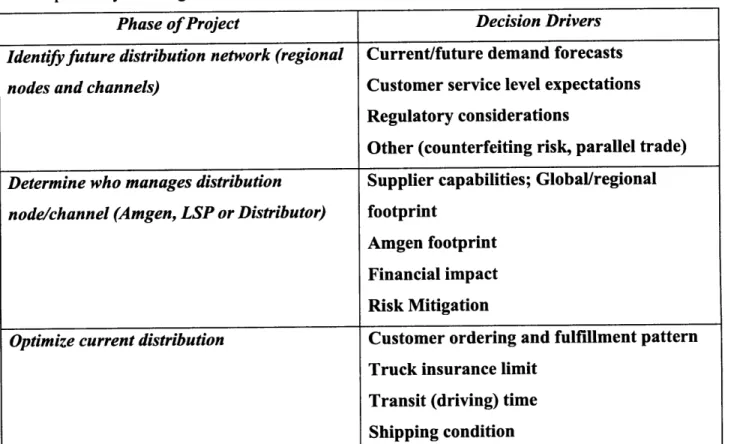
Based on these, a set of key decision drivers is identified (see Table 6: Decision drivers of distribution network development process). The decision drivers help guide the model development by defining the variables to be included.
Phase of Project Decision Drivers
Identify future distribution network (regional Current/future demand forecasts nodes and channels) Customer service level expectations
Regulatory considerations
Other (counterfeiting risk, parallel trade)
Determine who manages distribution Supplier capabilities; Global/regional node/channel (Amgen, LSP or Distributor) footprint
Amgen footprint Financial impact Risk Mitigation
Optimize current distribution Customer ordering and fulfillment pattern
Truck insurance limit Transit (driving) time
Shipping condition
Table 6: Decision drivers of distribution network development process
4.3. Analyze Data and Initial Findings
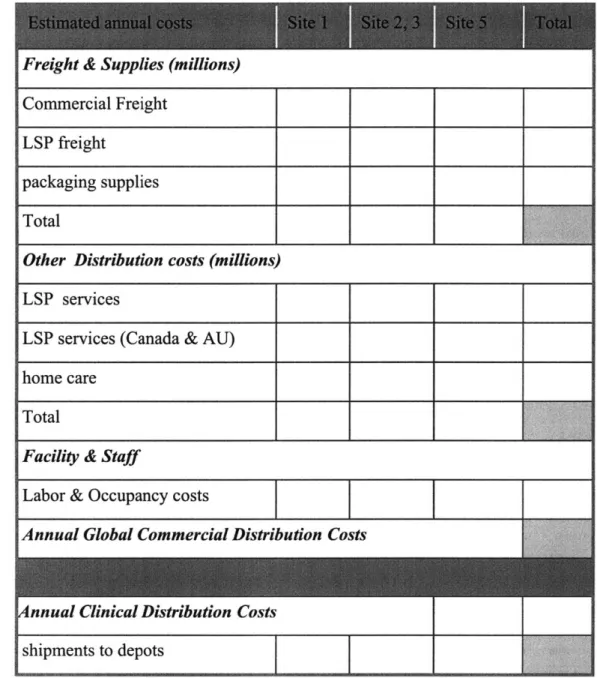
The transactional data obtained from SAP and the budgeting data from Finance will be used to reconcile the annual expense incurred for distribution. There are many components to this expense such as transportation expenses, packaging expenses, LSP fees (fee paid to a logistic service provider for his warehousing, transportation and customer support, and accounting services. Here, the costs that can be impacted by the optimization to distribution network can be
identified. A template structure was developed to capture the financial data from different sources, ranging from supply chain teams to finance operations teams.
Freight & Supplies (millions) Commercial Freight
LSP freight
packaging supplies Total
Other Distribution costs (millions)
LSP services
LSP services (Canada & AU)
home care Total
Facility & Staff
Labor & Occupancy costs
Annual Global Commercial Distribution Costs
Annual Clinical Distribution Costs
I
I
I
shipments to depots I II]
Table 7: Cost-to-serve detailing distribution cost components across all markets
A cost-to-serve model was built and transactional data from SAP and Operations Finance group
were used to analyze the current distribution process. This model would relate the pallet demand from each wholesaler to the truck schedule to determine truck loading. A pallet is a large
of the same size and a truck holds 22 pallets at full capacity. In some cases, the product costs are high and hence the insurance limit (on cost of goods carried on each truck) is reached before the pallet limit.
Description of North America Distribution
Packaged goods from Site 1 are shipped via ocean containers to Florida and from there via trucks to Site 3 (prime distribution center) twice every week. The trucks that carry products between port of entry and Site 3 have a larger configuration and 20% higher pallet space compared to trucks used for demand fulfillment at Site 3. Site 3 holds inventory of about 4-5 months to cover for the demand fluctuations (operational inventory) and meet demand during site recovery if a event (such as natural disasters) results in temporary closure of Site 1 or other earlier stages of supply chain (strategic inventory). Inventory is moved between Site 2 and Site 3, to meet demand variations and allow release of products with earlier expiry date (FIFO) first. Site 2 handles a small volume of commercial order fulfillment (-15%), predominantly to the customers in west coast region of US.
Based on initial data analysis, following key observations were noted
-- Most of the truck delivery today happens in a direct routing mode, where a truck leaves from the Amgen distribution center at Site 3 to a wholesaler location and returns to Amgen.
e Multi-city routes are used for less than 10% of products sent on outbound trucks. These
are done for 5 wholesalers in northeast and central US regions on a fixed route basis. In Figure 11, the historic multicity route involved customer 1, 2 and 3. The model presented later in this paper will consider other customers in that region to create dynamic multicity routes based on weekly demand. The senior manager for distribution at Site 3 assigns trucks to wholesaler routes in an adhoc (manual) manner. Automating this can aid the
decision making process.
e Outbound trucks carry over 90% commercial products at very low truck utilization - Order pattern was erratic; customers were allowed to place an order anytime during the
course of the week in order to get their shipment for that week. This made scheduling and capacity planning difficult. For instance, the top wholesaler customer had a 3x variation in
demand within each month of 2008. Hence, in a given week, the customer could need either a full truck or a 1/3rd of truck space to meet their order quantity. Here, the
opportunity to consolidate truck space using dynamic multi-city routes becomes evident. - Trucks were dispatched to wholesaler sites on a pre-determined fixed schedule. Hence, in
weeks with low demand, the truck capacity was significantly underutilized.
For illustrative purpose only
Sample
distribution Spread of all trucks out of Site 3
300
250
.g200
U 150 10050
0
1
2 3 4 5 6 7
8 9 10 11 12 13 14 15 16 17 18 19 20 21 22
# of paefts/truck
Figure 9: Sample representation of distribution spread of all outgoing trucks to wholesalers
Apart from these internal observations, several interviews were conducted with vendors who
provide logistic services, warehousing and transportation, to understand their capabilities in the different markets. The key findings were
-* The North America region had few dominant players (like UPS, DHL) with capabilities to handle transportation, warehousing and customer service across the region. They also handle cold-chain (frozen temperature) and room temperature conditions for the drug products.
* Europe has several regional players having varying levels of capability. No pan-European player has emerged yet to enable consolidation of vendors in that market.
* Other expansion markets, such as Latin America, have several challenges ranging from availability of LSP companies, high cross-border taxation, and security-safety issues. It is easier to ship products from Miami (US) or Panama (tax-free zone) to countries in Latin America than to ship across those countries.
" Clinical distribution requirements and processes are vastly different from that of
difficult. Most players have stronger niche in either commercial or clinical distribution capabilities. No player was dominant in both spaces.
Based on the above, for both optimization of current distribution (Operational piece of the thesis) and analyzing Amgen's distribution footprint (Strategic piece), we will focus on North American region. However, the models developed in the upcoming sections of the thesis are applicable to other markets.
4.4. Develop Hypotheses
The hypotheses that emerged from the initial findings were of operational or strategic nature. Thus, two work streams were developed as detailed here.
4.4.1. Operational
* There is significant cost saving opportunity in rationalizing the truck dispatch heuristics. * Creating multi-city routes will reduce some legs of transportation and improve truck
capacity utilization, potentially saving $400K annually.
e Current customer service model (fixed day delivery to a wholesaler) can be met while running a dynamic multi-city route.
In order to realize these changes, there should be a process-driven approach to decision-making and execution at the distribution center. The first goal then is to develop a model that handles the various constraints and variables to deliver recommendations that enable decision-making and demand fulfillment. Chapter 5 will describe the model in greater detail.
4.4.2. Strategic
The aim of the 'DC Footprint Model' is to
- Develop business scenarios and evaluated multi-DC options in North America e Validate current network based on Site 2 - Site 3 Distribution Center locations * Make it robust and scalable to other regions for distribution analysis
will be based on capital and operating expenditure of running a distribution center (warehousing, transportation). Developing a model that will help understand Amgen's transportation cost, site loading and inventory profile while varying the number of distribution centers and their locations across US. The hypotheses we explore here include confirming that current location for Amgen's distribution centers in Site 2 and Site 3 are a good choice given the customer footprint.
5.
METHODOLOGY AND TOOLS -MODEL DEVELOPMENT
This chapter will explore the methodology used to validate the hypotheses developed and realize the cost savings identified. Both 'Truck Routing Model' developed for operational hypotheses and the 'DC Footprint Model' developed for strategic hypotheses rely on the Great Circle Equation as underlying engine for their main calculations.
Typically, the physical zip codes of customer (wholesaler) sites and current/potential distribution centers are available. These can be converted using a master database of all zip codes mapped to corresponding latitudes and longitudes. The Great Circle Equation then helps dynamically determine the approximate distance between these two points in physical travel distance terms.
5.1.
'Truck Routing Model'
-
Operational
The truck routing model was developed to realize the saving opportunities identified in the analysis of current distribution process. The model would enable multi city routing, higher truckload utilization and more defined, automated process to aid weekly operations decisions.
5.1.1.
Model fundamentals
The most common algorithm for designing the heuristics of a single-depot VRP problem is the Savings Algorithm of Clarke and Wright. Consider a depot (D) and n customer sites. With n vehicles, we can dispatch one vehicle to each demand site. The total length of this 2*d(D, i) where d represents distance between depot and customer site.2 9