Deterministic Chaos in Alcator C-Mod Edge
Turbulence
Victoria R. Winters
Submitted to the Department of Nuclear Science and Engineering
in partial fulfillment of the requirements for the degree of
Bachelor of Science in Nuclear Science and Engineering
at the
MASSACHUSETTS INSTITUTE OF TECHNOLOGY
_______MASSACHUSET
OF TECHN
June 2014
JUL 2 S
@2014 Victoria R. Winters. All Rights Reserved.
LIBRA
The author hereby grants to MIT permission to reproduce and todistribute publicly paper and electronic copies of this thesis document in whole or in part.
Author....
Signature redacted
... .. .... .. .. ... ...Department of Nuclear Science and Engineering
Signature redacted
May 9, 2014Certified by ...
Accepted by ...
7.h
... Anne White Assistant Profess r of Ifclear Science and Engineering
* W ~ Thesis Supervisor
... !...
Richard Lester Professor of Nuclear Science and Engineering, Department Head Thesis Reader Ts INStTU'rE IOLOGY
2014
RIES
Ie-Acknowledgements
I would like to thank Professor Anne White for all her help with understanding basic plasma physics, learning IDL, and overall guidance through my research, as well as being a wonderful mentor throughout my undergraduate years at MIT.
Deterministic Chaos in Alcator C-Mod Edge
Turbulence
by
Victoria R. Winters
Submitted to the Department of Nuclear Science and Engineering in partial fulfillment of the requirements for the degree of
Bachelor of Science in Nuclear Science and Engineering Abstract
Understanding the underlying dynamics of turbulence in magnetic confinement fusion experiments is extremely important. Turbulence greatly reduces the confine-ment time of these devices and therefore greater knowledge of turbulent dynamics can help with its mitigation. Experiments from the Alcator C-Mod tokamak [18] provide support for a theory that edge turbulence in tokamak fusion plasmas is the result of deterministic chaos, rather than stochastic processes [15]. Using
read-ily available reflectometer data from Alcator C-Mod (C-Mod), analysis of C-Mod
edge turbulence in Ohmic plasmas and Ion Cyclotron Range of Frequencies (ICRF) heated L-Mode plasmas shows that density fluctuations just inside or at the Last Closed Flux Surface (LCFS) exhibit exponential power spectra. Theoretically, the characteristic slope of the data on a semi-log plot gives the full width of the un-derlying Lorentzian pulses, which give rise to the exponential power spectra due to the dynamics of deterministic chaos. Using a separate fitting routine, individ-ual Lorentzian pulses in the reflectometer time series data are identified, and the widths of the Lorentzian pulses match the inverse characteristic frequency of the exponential power spectra. Analysis of the waiting times between pulses and the pulse amplitudes indicate these are randomly distributed yet the pulse widths have a narrow distribution. These characteristics are consistent with a chaotic process. There is also a preliminary comparison of GPI data and a discussion of limitations of the analysis presented here and plans for future work. Overall, the experimental results in this study are consistent with edge turbulence that is at least partially generated by chaotic dynamics.
Thesis Supervisor: Anne White
Contents
1 Introduction
2 Background and Previous Work
2.1 The Alcator C-Mod Tokamak ...
2.2 History of Searching for Universality in Turbulence... 2.3 A Stochastic Process versus a Deterministic Chaos Process 2.4 The 0-Mode Reflectometer ...
2.5 Plasma Regimes in Magnetic Fusion Systems . . . . 3 Methods
3.1 Power Spectra ... 3.2 Time Series Data ...
3.3 Relationships between Plasma Parameters and Characteristic Slope .... 4 Results and Discussion
4.1 Power Spectra and Connection to Pulses ...
4.2 Trends among Plasma Parameters, Pulse Widths, and the Characteristic Slope .. . . . 4.3 Comparison of Experimental Data to Past Experiments and Theory . . . . 4.4 Overview of other Plasma Modes . . . . 5 Conclusion 9 9 9 10 11 12 12 13 13 14 15 15 16 21 23 25 27
List of Figures
1 A typical magnetic field shape for a tokamak. Image from [8} . . . 10 2 homodyne reflectometry signals at low amplitude and high amplitude
den-sity fluctuations, in both cases homodyne most consistent with Langmuir probe data. Figure from [6] . . . 12 3 Power spectra of different simulated pulses. It is clear that only the power
spectrum from the simulated Lorentzian pulse gives a straight line on the semi-log plot. Figure from [20] . . . .. .. . .. .. .. 14 4 Comparison between a similar Gaussian versus Lorentzian curve. The key
distinguishing feature is the longer tails of the Lorentzian. . . . 15 5 The power spectrum for shot number 1120224028 (Ohmic) plotted on a
linear, semi-log and log-log graph along with its exponential fit, Ae-0"'. 17 6 Additional exponential power spectrum from shot 1120224019 (L-Mode)
plotted on a linear, semi-log and log-log graph along with its exponential fit, Ae-0'. The peak shown at approximately 200kHz is noise. ... 18 7 The distribution of pulse widths found for experimental shot 1120224019,
with the highest amplitude being at around .0048. The characteristic slope found from a separate fit to the power spectrum matches at .0048. . . . . . 19 8 An example from experimental shot 1110215001 that shows a Lorentzian
pulse identified in the time series and its exponential power spectrum. With a pulse width of .00424 and a characteristic slope of .00419, the width of the pulse almost matches the slope of the power spectrum. . . . . 19 9 Two pulses found in the time series for experimental shot 1120224019, each
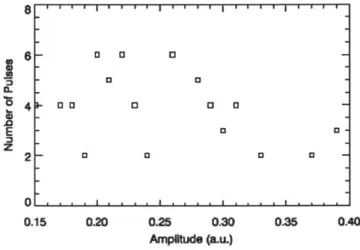
fitted to both a Lorentzian (red solid line) and a Gaussian (blue dashed line). Both fits appear to be good, however it is only the Lorentzian fit that captures behavior near the tails of the pulses. . . ... 20 10 A plot of the distribution of the absolute value of the pulse amplitudes.
The distribution appears random. . . . 21 11 The time series data as a whole has a Gaussian probability distribution
function, with equally likely positive and negative fluctuations. . . . 22 12 The characteristic slope of the power spectra plotted against the line
av-eraged density for the corresponding shot. A clear inverse relationship is seen. . . . 22 13 The characteristic slope plotted against: upper-left Ne, upper-right VNe,
lower-left Te and lower right VTe. It appears as though the local density and local density gradient have a weak inverse relationship to the charac-teristic slope of the power spectrum. . . . 23 14 The distribution of waiting times for C-Mod experimental shot number
1120224019 plotted semi-log. The independent best fit is shown with a blue dashed line, while the best fit line from the model proposed by Hornung is shown as a solid green line. Although the amplitudes of the two fits are
15 The power spectra for (a)an ELM-free H-mode, (b)an EDA H-Mode, and (c) an I-mode. The ELM-free H-mode appears to be largely exponen-tial, while the EDA H-mode is only exponential in the range from 300 to 700kHz. The I-mode appears to be exponential with a Gaussian riding on top, consistent with [6]. . . . 26 16 A Comparison of power spectra of I-Mode and L-Mode. (a) Shows the
power spectrum at all times throughout the experimental run. The power spectra dip at lower frequencies is only seen during the times during I-mode. Parts (c) and (d) show I-mode power spectra during this time window. They have a dip around 0-200kHz that is consistent with QCM and WCM. From (b) and (e), it is seen that L-mode sections of this same run do not have this feature. Figure provided by Arturo Dominguez [6]. . . . 27
List of Tables
1 Typical C-Mod Parameters. Data from [18]... . ... ... 10 2 Examples of the variety of shots analyzed. All shots with RF power are
L-Mode, and all without are Ohmic. All power spectra were calculated using a 100ms time window and all pulses found in the time series data were taken from that same 100ms time window. . . . . 16 3 A comparison ofR2 values between the Lorentzian and Gaussian fits. It is
clear that both pulses provide great fits, however overall the Lorentzian fits are slightly better. . . . 20 4 Comparison of various other theories to the deterministic chaos model and
how both this study (Winters experiment) and the TJK Stellarator
exper-iment fit to the different theories. . .
. .. . .*. .. 25
5 The reflectometer channels, where the numbers correspond to the number locations in the MDS tree. . . . 32
1
Introduction
As technology grows and is distributed throughout the world, the demand on the energy grid continues to climb. Currently the primary fuel supplying power to the energy grid are fossil fuels [1]. However, concerns over the large amounts of carbon dioxide produced by these sources of energy and their effect on climate change have caused scientists to look for newer and cleaner alternatives. While there are many such sources, such as geothermal, wind, solar and water, nuclear sources are extremely attractive because of their enormous energy density. On average, the fission of one uranium produces 210MeV of energy [91,
one fusion of two hydrogen atoms produces around 17.6MeV [9], while one combustion reaction of methane produces only 8.4eV[5}.
Fission energy production has already been realized and implemented throughout the world; however nuclear fusion energy production remains outside of society's grasp. Fusion occurs naturally in stars and supernovae through these systems' huge gravitational field that serves to both confine the plasma and keep it at a high enough density to overcome the electrostatic Coulomb repulsion between ions needed to produce this reaction.On earth, such a gravitational field is impossible. Therefore, one commonly used substitute is to confine the plasma via magnetic fields. However, these magnetic fields cannot sustain an extremely dense plasma, and so a less-dense but hotter plasma is created. One of the most effective devices for containing this plasma is a tokamak, which confines the plasma in a toroidal shape via a helically shaped magnetic field generated by both external magnets and an internal plasma current.
Because no system is capable of perfectly confining a plasma and the plasma itself is not perfect; the tokamak has its own instabilities and is turbulent. Turbulence causes enhanced transport of particles and energy across magnetic field lines, which lowers the time a plasma can be confined. Therefore, understanding the underlying mechanisms of turbulent processes is imperative for its mitigation. The focus of this thesis is to look for experimental evidence of a possible deterministically chaotic generation of turbulence at or just inside the last closed flux surface (the edge plasma) of the Alcator C-Mod tokamak. The experimental evidence required to support a deterministic chaos model is an experimental power spectrum in edge density fluctuations caused by Lorentzian-shaped pulses in the raw temporal fluctuation data. Should this theory be correct, it could support a larger, more general underlying universal aspect of plasma edge turbulence.
2
Background and Previous Work
2.1
The Alcator C-Mod Tokamak
A tokamak is a toroidally-shaped device that uses a combination of external magnetic fields and internal plasma current to create an overall helically-shaped magnetic field used to confine high temperature plasmas(see Figure 1). There are two plasma regimes inside a tokamak that are relevant to this thesis: Ohmic plasmas and L-Mode plasmas. An Ohmic plasma is heated by the internal current inside the plasma alone, whereas an
L-Mode plasma is generated by using both ohmic heating and ion cyclotron radio frequency (ICRF) heating.
Coils
ANWI
W0
_MBlanket Plasma field line
Figure 1: A typical magnetic field shape for a tokamak. Image from [8]
Alcator C-Mod, the tokamak at MIT, was used to produce both the Ohmic and L-Mode needed for this study. Alcator C-Mod is a compact tokamak that contains plasmas with high magnetic fields. Its parameters are given in Table 1
Table 1: Typical C-Mod Parameters. Data from [18]
Parameter Value
Maximum Magnetic Field 8.1T
Major Radius 0.68m
Minor Radius 0.22m
Maximum Plasma Current 2.01MA
ICRF Source Power 8MW
2.2 History of Searching for Universality in Turbulence
The origin of the search for universality of turbulence across different systems began with Kolmogorov's 1941 pioneering paper, which predicted that the energy of a turbulent sys-tem with a very high Reynolds number is proportional to the wavenumber to the -5/3 power when plotted on a log-log scale [13]. Since then, the power spectra of turbulent sys-tems, including fusion syssys-tems, have been traditionally plotted in the log-log format and fit to power laws. However, it is commonly seen that the power spectra from turbulence in plasmas cannot be fit with one power law. Often, they are fit to several different power laws [21].
It was recently proposed by Dr. Maggs and Dr. Morales at UCLA that turbulent power spectra from tokamak edge plasmas are exponential and are caused by the presence of
Lorentzian pulses in edge density fluctuations, and that these Lorentzians are a signature of deterministic chaotic generation of edge turbulence [15]. Experiments at the Large Plasma Device Upgrade (LAPD-U) at UCLA have shown that exponential power spectra in plasmas can be generated by a series of Lorentzian pulses in the time series data [15] [20] and can arise from nonlinear interactions of electromagnetic drift waves [24]. In addition, experiments at the low magnetic field TJK stellarator in Germany have also identified the presence of Lorentzian pulses and exponential spectra in the edge[12]. If tokamak edge turbulence is a deterministic and chaotic rather than stochastic and random, it could significantly alter the current theoretical, simulation and experimental approaches currently used to study and predict edge turbulence in tokamaks.
2.3
A Stochastic Process versus a Deterministic Chaos Process
A stochastic process is by definition random, meaning that there is no way of exactly predicting how that process will behave. It can be described by probabilities and nothing more. An example of a stochastic process is radioactive decay, where a certain element has a probability of decaying within a certain amount of time. However, it is impossible to correctly predict exactly when each decay will happen.A deterministic chaotic process, however, is different. This process in theory is gov-erned by a set of differential equations, thereby making it completely deterministic. How-ever, it is extremely sensitive to initial conditions, thereby making the process in reality completely unpredictable [11]. A good example of this kind of system is a double pendu-lum, where there is a governing set of differential equations but, with completely relaxed assumptions, it is impossible practically to predict exactly its trajectory at every point in time [28].
Lorentzians and the Power Spectrum
According to the recently proposed theory by Maggs and Morales [15], Lorentzian-shaped fluctuations (Lorentzians) are a signal of deterministic chaos in the edge turbulence of tokamak plasmas. The Lorentzians must also have a narrow distribution of widths. If this is the case, then the Lorentzians should have a significant effect on the shape of the power spectrum of the edge turbulence. A power spectrum of the turbulence is created by performing a fourier transform on the temporal data into frequency space. A Lorentzian is described by the following equation temporally [29]:
1 .51'
L(t) = 1(1)
7(t - to)2 + (.5r)2
where P is the full width at half maximum of the Lorentzian, and to is the center of the pulse. The fourier transform of a Lorentzian is of the form [20]:
F(w) oc exp(-w/wda,) (2)
Where w is the frequency, wh, is the characteristic frequency (the slope on a semi-log portion of the graph), and the inverse of wch., is the full-width of the Lorentzian.
Therefore, if Lorentzian pulses in the timeseries indeed have a large effect on the power spectrum, one expects the power spectrum to be exponential in shape with an inverse characteristic frequency equal to the full width of the pulses found in the time series data.
2.4 The 0-Mode Reflectometer
The O-Mode polarized reflectometer diagnostic on Alcator C-Mod was used to study the plasma edge density fluctuations. The reflectometer is capable of measuring fluctuations
by sending a polarized probing electromagnetic wave of a given frequency into a plasma.
The polarization and frequencies are chosen such that the wave reaches a propagation cutoff in the plasma and is then reflected back towards the detection antenna [6]. Because the index of refraction of the plasma is a function of magnetic field and density, one can determine density fluctuations knowing the value of the magnetic field and the relation between the transmitted and received waves.
For the purposes of this thesis, only the homodyne signals were used and analyzed, because the homodyne signals most closely match Langmuir probe measurements [6], see Figure 2.
a) b)
80.0000 ms 100.000 me
S*' ISI EIodyne
1 1000 10 100 1000
freueny (~z)frt cIWay (MIL)
Figure 2: homodyne reflectometry signals at low amplitude and high amplitude density fluctuations, in both cases homodyne most consistent with Langmuir probe data. Figure from [6]
2.5 Plasma Regimes in Magnetic Fusion Systems
While there are a variety of different types of plasma regimes in magnetic fusion systems,
the two most important in this study are Ohmic modes and L-modes. Ohmic mode
plasmas are heated purely by the current induced inside the plasma in a tokamak. L-mode plasmas are heated both through Ohmic means, but also by radio-frequency (RF) heating.
There are 3 other plasma modes which were looked at in this study, but due to time constraints were not capable of being studied thoroughly. These modes are EDA H-Mode, the ELM-Free H-mode and the I-mode. The ELM-Free H-mode is a highly confined mode
that contains no Edge Localized Modes (ELMs) [10]. These ELMs are an instability that causes sudden bursts of particles and energy out from the edge of a plasma [17]. The EDA H-Modes are similar to ELM-Free H-Modes, and typically don't contain ELMs either, but they have slightly lower energy confinement than ELM-Free H-modes but reduced impurity confinement [10]. The I-mode is an improved confinement regime (compared to Ohmic and L-Mode plasmas) that does not have the build-up of impurities that H-Mode plasmas have [17]. I-Modes and H-modes, unlike Ohmic and L-modes, tend to have various coherent modes that affect the shape of the power spectrum.
3
Methods
Alcator C-Mod has a large library of Reflectometer data from many different types of plasmas from previous years. Data samples that were either Ohmic or L-mode plasmas were selected from the library and analyzed to determine whether or not there is support for the deterministic chaotic theory proposed at UCLA.
3.1 Power Spectra
In order to calculate the power spectra, the raw homodyne fluctuation data from the reflectometer was imported into IDL, a vectorized programming language used for data analysis, and was then fourier transformed and graphed versus frequency on a linear plot, a semi-log plot and a log-log plot. Each power spectrum was then fit using the CURVEFIT routine in IDL to an exponential curve. The range of frequencies over which this curve fit well to the data was then evaluated and compared to the range of frequencies over which a power law fit. In Figure 3 are examples of different types of simulated pulses and their power spectra. Only the power spectrum from the simulated Lorentzian pulse yields a straight line on the semi-log plot.
The slope of the power spectra was then recorded. This slope was recorded as 1/fha, the inverse of the characteristic frequency. This slope was then compared to the full width at half maximum of the pulses found in the time series data. According to the deterministic chaotic model, this characteristic slope would be equal or near the half maximum of the pulses.
W/Ai
40 0.26 0.53 0.79 10 Lorentzian 10 Gaussian .10
sech
2 10 0 100 200 300 f (kHz)Figure 3: Power spectra of different simulated pulses. It is clear that only the power spectrum from the simulated Lorentzian pulse gives a straight line on the semi-log plot. Figure from [20]
3.2 Time Series Data
In addition to analysis of the power spectra of specific experimental shots (with each run of Alcator C-Mod called a "shot"), the raw density fluctuation data from the reflectometer was analyzed. Because pulses are often buried in the time series data, candidate pulses were found by manually going through the data. Once found, a separate CURVEFIT procedure was run to fit the candidate pulse to a Lorentzian curve. The full width at half maximums were recorded, as well as the amplitudes. The full widths were then compared to the characteristic slopes of the power spectra.
Comparison to Gaussian pulses
Because Lorentzian and Gaussian curves look very similar (see Figure 4), it is important to fit the pulses found in the raw time series data to both Lorentzian and Gaussian curves to see whether or not Lorentzians indeed provide a better fit. Therefore, after a Lorentzian fit was conducted, the pulses were fit indepedently to a Gaussian curve using the function
GAUSSFIT in IDL. The R2 value for each curve was then compared to see which had the
better fit.The R2 value is determined by Equation 3 [4]:
R= 1 -(y -fi)2 (3)
E(y, - y)2
where y is ith experimental data point, fi is the value produced by the fitted function, and y is the average value of the observed data.
-Gaussian 0.9- Lorentzian 0.8- 0.7- 0.6-'U 0.5-L 0.4- 0.3- 0.2-0.1 0 -5 0 5 arb. units
Figure 4: Comparison between a similar Gaussian versus Lorentzian curve. The key distinguishing feature is the longer tails of the Lorentzian.
3.3 Relationships between Plasma Parameters and
Character-istic Slope
In order to determine possible relationships between the characteristic slope of the power spectra and the plasma parameters, dwscope, a shot analysis tool used to see the values of plasma parameters for a given shot, was used to record the magnetic field, the plasma current, and the line averaged density for each experimental shot. In addition, the local density, the local density gradient, the local electron temperature and the local electron temperature gradient were also recorded from the Thomson Scattering diagnostic system [3].
These parameters were then plotted for each experimental shot with the characteristic slope in order to determine the relationship between the parameter and the slope of the power spectrum, if any.
4
Results and Discussion
In total, approximately 45 (half Ohmic and half L-mode plasmas) shots were studied and analyzed at Alcator C-Mod. A sample of some of these are seen in Table 2
Table 2: Examples of the variety of shots analyzed. All shots with RF power are L-Mode, and all without are Ohmic. All power spectra were calculated using a 100ms time window and all pulses found in the time series data were taken from that same 100ms time window.
Shot T1(ms) I T2(ms) Bt(T) Te local(eV) RF(MW)* NL..04 (m-3) Radius=()
1120224019 1000 1100 5.25 185 1.88 2.18 1.1e20 .878 .0095 1110201004 880 980 5.39 120 1.6 1.5e20 .890 .00098 1110309012 1300 1400 -5.76 180 3.64 3.967 1.78e20 .883 .0024 1110309013 1000 1100 -5.77 800 3.25 3.56 1.57e20 .877 .0068 1110215001 800 900 -5.85 190 .6 1.24e20 .880 .0046 1110201009 500 600 5.39 176 0 1.34e20 .89 .0038 1120224028 900 1000 4.6 126 0 1.58e20 .854 .0077 1110201026 770 870 5.39 138 0 1.03e20 .882 .0032 1120224030 900 1000 4.6 87 0 1.3e20 .867 .0037 1120224015 850 950 5.98 130 0 1.01e20 .876+.0024
Overall, in the plasmas studied at C-Mod, MW, the magnetic field ranged from 4.6 < Bt
from 1 x 10² < (ne) < 1.8 x 10" m-3.
RF heating ranged from 0.6 < Pap < 4.0
< 5.86 T, and the average density ranged
4.1 Power Spectra and Connection to Pulses
Of the 45 Ohmic and L-mode shots studied, all of them when plotted semi-log was a straight line, consistent with exponential behavior. As examples, in Figures 5 and 6, the power spectrum is plotted on all three types of graphs and its fit is overplotted. It is clear to see that the exponential curve fits over a broad range of frequencies. In general, the exponential provided a good fit for frequencies ranging from 200 <
f
< 800 kHz. Onepossible explanation for the poor fit at high frequencies is that the signal falls below the noise floor of the reflectometer. Therefore, the spectrum flattens to the noise floor at these higher frequencies. A possible explanation for the poorer fit at frequencies below 10kHz is that the reflectometer is picking up MHD fluctuations in addition to the broadband turbulence.
1120224028, ti =900, t2=1000 0.008
,
0.006 0.004 0.002 a. 0.000 0 200 400 600 800 1000 frequency (kHz) 0.010 L0.001--0 200 400 600 800 hreuency (kHz) 0.1000 E 0.0100 0.00100.0001
0.1
1.0 10.0 100.0 1000.0Figure 5: The power spectrum for shot number 1120224028 (Ohmic) plotted on a linear, semi-log and log-log graph along with its exponential fit, Ae.039
w
In addition to discrepancies at very low and very high frequencies, occasionally a large spike in the power spectrum is seen at approximately 200kHz. This spike can be seen in
1120224019, t1 1000, t2=1100 0.008 E 0.006L 0.004 CL 0.000-0 200 400 600 800 1000 frequency (kHz) 0.0100 1C -CU 0.0010 CO0.01 0 200 400 600 800 1000 frequency (kHz) U I e W3 0.1 1.0 10.0 100.0 1000.0 frequency (kHz)
Figure 6: Additional exponential power spectrum from shot 1120224019 (L-Mode) plotted on a linear, semi-log and log-log graph along with its exponential fit, Ae004"'. The peak shown at approximately 200kHz is noise.
Using the same 45 experimental shots with these exponential spectra, Lorentzian fits were calculated to candidate pulses in the raw fluctuation data. Because the exponential spectrum has one characteristic slope, it is necessary to have a narrow distribution of pulse widths with the same value as the characteristic slope in order to have them be the dominant factor in the power spectrum. As shown in Figure 8, the pulses found in the time series data have similar widths to the characteristic slope found through the separate fitting to the power spectrum.
In the cases analyzed, there was a narrow distribution of pulse widths, with the dis-tribution centered around the characteristic slope of the spectrum, as in Figure 7.
IO-~5
OF . ....B
0.0030 0.0006 0.0040 00045 0.0050 0.0055
Figure 7: The distribution of pulse widths found for experimental shot 1120224019, with the highest amplitude being at around .0048. The characteristic slope found from a separate fit to the power spectrum matches at .0048.
0.2 C '0 0.0 -0.2 1110215001 Pulse width: .00424 -0.4 1 - - -. 1 .801434 .801435 .801436 .801437 .801438 .801439 time (s) cd E ts CL U, a) 0 a-0.010 0.001 0 200 400 600 800 frequency (kHz)
Figure 8: An example from experimental shot 1110215001 that shows a Lorentzian pulse identified in the time series and its exponential power spectrum. With a pulse width of .00424 and a characteristic slope of .00419, the width of the pulse almost matches the slope of the power spectrum.
A sample of the >100 pulses found were also fit to Gaussian curves to determine
which curve provided a better fit to the data. Overall, although both fits gave good fits, as can be seen from Figure 9, the Lorentzians provide a slightly better fit. Because of the sampling rate of the reflectometer, it is hard to determine whether the very good fit to the Gaussian is truly because the pulses could be equally Gaussian or Lorentzian or if it is because there is not a good resolution on the tails of the pulses. Overall, the Lorentzian provides a better fit specifically near the tails of the candidate pulses. Table 3 provides a sample of some of the R2 values of each pulse for experimental shot number .
1120224019 I: 0 0.10 00 0a 0.05- 000 0 0 0 0 M wf 0 0% 00 0 0 C 36 00 00 -0.05 0 1.00135 1.00136 1.00137 0.15. 0.10-03 00 0.05- i 'coj P 0.00 0 0 C3:q7~ 0 b0 pFj 0P 0 0 -0.101 rip. 1.001385 1.001390 1.001395 1.001400 1.001405 1.001410 1.001415 1.001420 time(s)
Figure 9: Two pulses found in the time series for experimental shot 1120224019, each fitted to both a Lorentzian (red solid line) and a Gaussian (blue dashed line). Both fits appear to be good, however it is only the Lorentzian fit that captures behavior near the tails of the pulses.
Table 3: A comparison ofR2 values between the Lorentzian and Gaussian fits. It is clear that both pulses provide great fits, however overall the Lorentzian fits are slightly better.
Lorentzian R Gaussian R2 time(ms)
.998 .998 1001.0952
.992 .925 1001.3585
4.2 Trends among Plasma Parameters, Pulse Widths, and the Characteristic Slope
After finding both exponential spectra and a narrow distribution of pulse widths at or near the characteristic slope of the spectra, an investigation was made to determine if there were any relationships between the characteristic slopes and the plasma parameters. In addition, the amplitude and width distributions of the temporal pulses were analyzed.
A plot of the distribution of the absolute value pulse amplitudes was made. Figure 10 shows that the pulses have no bias toward a certain amplitude. In addition, the amplitudes are such that they are buried in the time series data, where the fluctuations can be equal or greater in amplitude. One possible reason for the lack of large and small amplitude pulses is that they are obscured because of the small sampling rate of the reflectometer.
The pulses themselves are equally likely to be negative or positive, consistent with the time series data as a whole which has a Gaussian probability distribution function (see Figure 11). E 8 6 4 2 0 0.15 0.20 0.25 0.30 Amplftude (&u.) 0.35 0.40
Figure 10: A plot of the distribution of the absolute distribution appears random.
value of the pulse amplitudes. The
0.3 0.2 0.1 0.0 -0.1 1,00 a I. -. . ~1 U ~ P VIF T .-1.02 1.04 1.06 1.08 1.10 time(s)
Figure 11: The time series data as a whole has a Gaussian probability distribution func-tion, with equally likely positive and negative fluctuations.
The characteristic slope of each power spectra was plotted against the line average density for the plasma, shown in Figure 12. There is a clear inverse relationship between the characteristic slope and the line averaged density.
x10A4 I, 5.5 5 3 2S 2 __-10 U 12 13 1 1is
Line AynWg Oensky 91 partksae Wigl)
16 17
Figure 12: The characteristic slope of the power spectra plotted against density for the corresponding shot. A clear inverse relationship is seen.
the line averaged
After finding the inverse relationship between the characteristic slope and the line av-eraged density, the local density (Ne), the local density gradient (VNe), the local electron temperature (Te) and the local electron temperature gradient (VTe) were also investi-gated. From Figure 13, there appears to be a weaker correlation between the character-istic slope and Ne and VNe. However, there is no correlation between the charactercharacter-istic slope and Te or VTe.
a a a OE~evimutOga a a a * a a aa a aa a a a a a a a a a a 2 a a
[00 o r ra ]
0.0021
0.0 U. 1.0 1.5 2.0
LOCal No M9% *Au VMSacu
0.006 on 00 Oa 0 -M.004 0 0~o 00 13 ~ ~ : 0 0.04 0. 200 * 000I- - - - - -oM G0 oOMk o Oar' 0. 0mom _ __ __ _ 0 50 100 150 200 250 300 0 50 100 10 200
Local Ta (95% kmamc Local Gad T (95% &iawda )
Figure 13: The characteristic slope plotted against: upper-left Ne, upper-right VNe, lower-left Te and lower right VTe. It appears as though the local density and local density gradient have a weak inverse relationship to the characteristic slope of the power spectrum.
4.3 Comparison of Experimental Data to Past Experiments and
Theory
According to the proposed deterministic chaos theory of [15], the characteristic slope obtained from an exponential fit to the experimental power spectrum should correspond to the average full width of a collection of Lorentzian pulses that would occur in the fluctuation time series data. We do see such a correspondence in our data set. According to the theory proposed by Maggs and Morales [16], a key feature of the deterministic chaos model is a narrow distribution of pulse widths. Similar to the results found in the TJK stellarator experiment, the distribution of pulse widths in the C-Mod tokamak is narrow, with a sharp peak at the value of the characteristic pulse width found from the power spectrum data fitting routine. Also consistent with theory, it appears that individual pulse amplitudes in the C-Mod data are random; however more data are needed to confirm this absolutely. Due to the sampling rate and the noise of the reflectometer, pulses with extremely high and extremely low amplitudes are harder to find manually.
There are strong similarities between the TJK Stellarator data and the data from the C-Mod tokamak. The distribution of waiting times between individual Lorentzian pulses in C-Mod was found to exhibit an exponential shape, consistent with what was found for the TJK Stellarator. Using an independent fitting routine to the exponential shape, the characteristic slope of the exponential was found to be 12.71kHz.
the model Hornung proposed in [12], of the form:
PDF(At) ~- fwte-flAt (4)
Where
f,,
is approximately the inverse of the average waiting time between the pulses, and is Equation 5 in [12]. The plot predicted by the Hornung model gave a characteristic slope to be 12.918kHz, extremely close to the independent fit (see Figure 14 . The characteristic slope is very close to the average of the individual waiting times.Furthermore, the distribution of pulse waiting times, and the distribution of pulse widths found in C-Mod are similar to those found in the TJK Stellarator, which is sur-prising for two devices of vastly different parameters. Both C-Mod and TJK found an exponential dependence on the distribution of waiting times between pulses, with the slope of the distribution roughly equal to the average waiting time between two individ-ual pulses. However, the TJK Stellarator results showed a dependence of pulse widths on magnetic field, but the C-Mod data show no such relationship. Interestingly, the typical widths of Lorentzian pulses found in the edge plasma at C-Mod are of the same order of magnitude as pulses found in the TJK Stellarator and in the LAPD device (a linear, non-fusion plasma device) [20].
100...
0.00 0.02 0.04 0.06 0.08 0.10 0.12
waiting time (ins)
Figure 14: The distribution of waiting times for C-Mod experimental shot number 1120224019 plotted semi-log. The independent best fit is shown with a blue dashed line, while the best fit line from the model proposed by Hornung is shown as a solid green line. Although the amplitudes of the two fits are different, it is clear that the characteristic slopes are nearly identical.
In addition to comparison with the TJK Stellarator Case, the results found in this study were compared with other existing edge turbulence theories, namely the Determin-istic Chaos theory [16], a dissipation range cascade theory proposed by Terry [26] and a self organized criticality theory proposed by van Milligen et al [19]. The results of these
Table 4: Comparison of various other theories to the deterministic chaos model and how both this study (Winters experiment) and the TJK Stellarator experiment fit to the
different
theories.Maggs[15] Terry26] van Milligen(19] Winters Hornung[12]
(deterministic (dissipation range (Self Organized experiment experiment
chaos) cascades) criticality) (tokamak) (stellarator)
Lorentzian pulses n/a Lorentz./Gauss. yes yes
in time series pulses in time series
Power spectra Power spectra are Power spectra are Exponential Exponential
are exponential exponential at high-f exponential spectra over spectra over
power law at low-f broad range of broad range of
frequency frequency
LP width n/a no relation LP width LP width
matches matches matches 7
LP widths narrowly n/a Pulse widths narrow narrow
distributed randomly distr. distribution distribution
n/a n/a waiting times waiting times waiting times
random exponentially exponentially
distributed distributed
n/a n/a n/a pulse amplitudes n/a
randomly
distributed
4.4
Overview of other Plasma Modes
In addition to the Ohmic and L-modes studied in depth here, a cursory look at both I-Mode and H-Mode plasmas was also done. Some examples of the power spectra are shown in Figure 15. Although the ELM-free H-mode appears to be largely exponential here, other examples did not appear to be exponential and the shape of any H-mode power spectrum varied widely. The shape of the I-mode power spectrum from this study can be compared to the shape shown in Figure 15c. The dip in the power spectra from 0 <
f
< 200 is consistent with previous results from the reflectometer at Alcator C-Mod [6]. In [6], Dominguez explains the Gaussian dip as the quasi-coherent mode (QCM) and weakly coherent mode (WCM), whose features in a power spectrum are expected to be seen in this range of frequencies, riding on top of a background exponential (see Figure 16).10~ E 2 0 O10 0 200 400 600 800 1 frequency (kHz) E 14
a
0 200 400 600 800 1 frequency (kHz) 0 0 10 0d 2 E 10 10 -o10 0 200 400 600 800 1000 frequency (kHz)Figure 15: The power spectra for (a)an ELM-free H-mode, (b)an EDA H-Mode, and (c) an I-mode. The ELM-free H-mode appears to be largely exponential, while the EDA H-mode is only exponential in the range from 300 to 700kHz. The I-mode appears to be exponential with a Gaussian riding on top, consistent with [6].
10-3 400 3000 N 0 g200 100 0 0. .5 1.0 1.5 l6 time[s] 33 (b) L-mode -2 (c)I-mode t=0.40s Data 0 Data Fit -5 Fit .3 0 Freq[kHz 500 0 Freq[kHz 500 5-2 =-3
-(d) I-mode (e) L-mode
t =0.82 s t = 1.50 s
Data - Data
-5 Fit Fit
0 Freq[kHz] 500 Im 0 Freq[kHz 500
Figure 16: A Comparison of power spectra of I-Mode and L-Mode. (a) Shows the power spectrum at all times throughout the experimental run. The power spectra dip at lower frequencies is only seen during the times during I-mode. Parts (c) and (d) show I-mode power spectra during this time window. They have a dip around 0-200kHz that is consis-tent with QCM and WCM. From (b) and (e), it is seen that L-mode sections of this same run do not have this feature. Figure provided by Arturo Dominguez [6].
Because of time constraints, it was not possible to analyze in-depth any other plasma modes besides the Ohmic and L-modes described previously.
5
Conclusion
Using the edge density fluctuation data from the reflectometer diagnostic taken just inside or at the Last Closed Flux Surface, an analysis of Ohmic and L-Mode plasmas in the Alcator C-Mod tokamak was conducted to search for evidence of exponential spectra and Lorentzian pulses. The power spectra of density fluctuations clearly exhibit an exponential shape. Lorentzian-shaped pulses are identified in the time series data as well. In all plasmas analyzed, the widths of the Lorenzian pulses found in the time series are found to match the characteristic width extracted from the slope of the exponential power spectrum data plotted semi-log. The Lorentzian pulse width is shown to vary most strongly with the line averaged density, although a weak correlation with local densities and local density gradients is also observed. The pulse width does not depend on magnetic field, local electron temperature, and local temperature gradient. The widths of the Lorentzian pulses are narrowly distributed, with a sharp peak at the value of the characteristic width, but
the pulse amplitudes are randomly distributed. The waiting times between Lorentzian pulses follow an exponential distribution. Overall, the observations of Lorentzian pulses and exponential spectra in reflectometer edge fluctuation data from the C-Mod tokamak are consistent with measurements of edge plasma turbulence made at the TJK Stellarator [121 and the LAPD plasmas [20], and are consistent with the deterministic chaos theory proposed by Maggs and Morales [16].
If the deterministic chaos theory is correct, as evidence from this study seems to sug-gest, there could be profound implications for the way edge turbulence theory is conducted for plasma systems. Understanding the underlying damage of at least part of the edge turbulence in a fusion system increases knowledge of the system as a whole and could therefore lead to better, more accurate modeling. A more in-depth knowledge of the underlying dynamics of the turbulence combined with more accurate modeling can help with increasing the confinement time in a magnetic confinement device.
There are limitations and uncertainties in the present data and analysis that warrant discussion. The main limitation is that only a relatively small data set has been analyzed, and only L-Mode and Ohmic plasmas were studied in detail. A preliminary analysis of I-mode data has been done. Data from I-Mode plasmas show that the power spectra are best fit by a sum of an exponential (broadband turbulent background) and a Gaussian (the Weakly Coherent Mode (WCM) feature). Given issues with automated pulse finding methods [20], we chose to use a brute-force approach to find and fit pulses in the raw time series. As a result, we analyzed all data sets by hand, and only analyzed 45 discharges, which results in a data base consisting of a few hundred pulses. In future work, adding an automated fitting routine could uncover more pulses, because it would allow a larger set of C-Mod plasmas to be examined quickly. Building a larger data base of pulses will improve the ability to identify the distributions of pulse characteristics (e.g. widths, am-plitudes, waiting times). Another limitation is that only reflectometer data was analyzed in detail. Some effects of the limited time resolution of the reflectometer on pulse fitting was identified which needs to be better understood. It was found that pulses fit with a Lorentzian shape are also reasonably well fit by a Gaussian shape, which could be caused by the low sampling rate of the reflectometer data, and using Langmuir probe data could help better discriminate between pulse shapes.
In terms of comparing reflectometer results with other fluctuation diagnostics, it was found that in all plasmas where GPI is available, the GPI measured density fluctuation power spectra are exponential. But we have not yet searched for Lorentzian pulses in the GPI time series data. Additionally, there is a limited number of shots where GPI and reflectometer are available simultaneously, making it difficult to directly compare the characteristic frequencies of the exponential spectra. From the limited data set, there are apparent differences between the GPI spectra characteristic frequency and the reflec-tometer spectra characteristic frequency. More work is needed to understand how this difference may be related to differences between the diagnostics (measurement location, time resolution, spatial resolution, wavenumber response, frequency response, etc.). An important next step will be to make detailed comparisons among several edge fluctuation diagnostics in dedicated experiments: reflectometer, Langmuir probes, new Mirror Probe [14}, and GPI. Consistency among these diagnostics would provide better evidence that
the Lorentzians and power spectra studied here are indeed produced by the plasma itself, and not just specific to the reflectometer. In the future, a search for exponential spectra and Lorentzian pulses should also be conducted using I-Mode and H-Mode data from C-Mod, and in Ohmic and L-Mode plasmas across a wider range of plasma parameters, in order to determine whether or not these Lorentzian phenomena and exponential power spectra are seen universally across all plasmas, or just in the special cases described in this study.
References
[1] International Energy Agency. 2012 Key World Energy Statistics. Date Accessed: 14
Mar 2014. 2012. URL: https://www.iea.org/publications/freepublications/ publication/kwes.pdf.
[2] R. Bruno and B. Bavassano. "Observations of magnetohydrodynamic turbulence in
the 3D heliosphere". In: Ad. Sp. Res. 35.5 (2005), pp. 939-950.
[31 J. A. Casey et al. "Construction of a two-dimensional Thomson scattering system for Alcator C-Mod". In: Rev. Sci. Instrum. 63 (1992), p. 4950.
[4] A. Coster. Goodness-of-Fit Statistics. Date Accessed: 5 May 2014. URL: http: //
web.maths.unsw.edu.au/-adelle/Garvan/Assays/GoodnessOfFit .html.
[5] A. Courtney. Energy Prom Fossil Fuels. Date Accessed: 14 Mar 2014. 2005. URL: https://www.wou.edu/las/physci/GS361/EnergyFromFossilFuels.htm.
[6] A. Dominguez. "Study of Density Fluctuations and Particle Transport at the Edge of I-Mode Plasmas". PhD thesis. Massachusetts Institute of Technology, 2012. [7] E. J. Doyle. "Chapter 2: Plasma Confinement and Transport". In: Nucl. Fusion
47.S18 (2007).
[8] M. Farrell. Tokamak: Future of Nuclear Power. Date Accessed: 2 Apr 2014. Dec. 2009. URL: http: //new.math.uiuc. edu/mathl98/MA198-2009/farrelli/.
[9] R. E. Faw and J. K. Shultis. Fundamentals of Nuclear Science and Engineering. 2nd ed. Boca Raton, FL: CRC Press, 2008.
[10] M. Greenwald, J. Rice, and R. Boivin et al. H-Mode Regimes and Observations of
Central Toroidal Rotation in Alcator C-Mod. Date Accessed: 7 May 2014.1998. uRL:
http://www.psfc.mit. edu/-g/papers/iaea98-paper .pdf.
[11] F. Heylighen. Deterministic Chaos. Date Accessed: 2 Apr 2014. 2002. URL: http:
//pespmc1.vub. ac .be/CHAOS.html.
[121 G. Hornung et al. "Observation of exponential spectra and Lorentzian pulses in the TJ-K stellarator". In: Phys. Plasmas 18.082303 (2011).
[13] A. N. Kolmogorov. "The local structure of turbulence in incompressible viscous fluid for very large Reynolds numbers". In: C. R. Acad. Sci. U. R. S. S. 30 (1941), p. 301. [14] B. LaBombard and L. Lyons. "Mirror Langmuir Probe: a technique for real-time measurement of magnetized plasma conditions using a single Langmuir electrode". In: Rev. Sci. Instrum. 78.7 (2007), p. 073501.
[15] J. E. Maggs and G. J. Morales. "Generality of Deterministic Chaos, Exponential Spectra, and Lorentzian Pulses in Magnetically Confined Plasmas". In: Phys. Rev.
Lett. 107.185003 (2011).
[16] J. E. Maggs and G. J. Morales. "Origin of Lorentzian Pulses in Deterministic Chaos". In: Phys. Rev. E 86.015401 (2012).
[171 E. Marmar. "I-mode Powers Up on Alcator C-Mod Tokamak". In: Y12.00003. Amer-ican Physical Society. 2011. URL: http: //www. aps .org/units /dpp /meetings/
vpr/2011/upload/MarmarPRIMode .pdf.
[18] E. S. Marmar and Alcator C-Mod Group. "The Alcator C-Mod Program". In: Fusion
Science and Technology 51 (2007).
[19] B. Ph. Van Milligen, R. Sanchez, and C. Hidalgo. "Relevance of Uncorrelated Lorentzian Pulses for the Interpretation of Turbulence in the Edge of Magnetically Confined Toroidal Plasmas". In: Phys. Rev. Lett. 109.105001 (2012).
[20] D. C. Pace et al. "Exponential Frequency Spectrum and Lorentzian Pulses in Mag-netized Plasmas". In: Phys. Plasmas 15.122304 (2008).
[21] M. A. Pedrosa et al. "Empirical Similarity of Frequency Spectra of the Edge-Plasma Fluctuations in Toroidal Magnetic-Confinement Systems". In: Phys. Rev.
Lett. 82.3621 (1999).
[22] J. J. Podesta, D. A. Roberts, and M. L. Goldstein. "Spectral exponents of kinetic and magnetic energy spectra in solar wind turbulence". In: The Astrophysical Journal 664 (2007), pp. 543-548.
[23] T. L. Rhodes et al. "Signal amplitude effects on reflectometer studies of density turbulence in tokamaks". In: Plas. Phys. Contr. Fusion 40.4 (1998), pp. 493-510. [24] M. Shi et al. "Structures generated in a temperature filament due to drift-wave
convection". In: Phys. Plasmas 16.062306 (2009).
[25] P. W. Terry. "Suppression of Turbulence and Transport by Sheared Flow". In: Rev.
Mod. Phys. 75.109 (2000).
[26] P. W. Terry et al. "Dissipation range turbulent cascades in plasmas". In: Phys.
Plasmas 19.055906 (2011).
[27] G. R. Tynan et al. "Turbulent-driven low-frequency sheared ExB flows as the trigger for H-mode transition". In: Nucl. Fusion 53.073053 (2013).
[28] E. Weisstein. Double Pendulum. Date Accessed: 2 Apr 2014. 2007. URL: http: //scienceworld.wolfram. com/physics/DoublePendulum.html.
[29] E. Weisstein. Lorentzian Function. Date Accessed: 10 Apr 2014. URL: http: //
Appendix
Both IDL and MATLAB were used to analyze the data and create the images used in this thesis. All files and data used to make the images can be found in vwin-ters/UROP.Winters/UROP-Winters.
Figures Created in IDL
All figures that required the use of data stored on the C-Mod servers were created in IDL through the methods that follow. For all procedures that require the use of refLstructure.pro, there are several unnecessary output graphs that are made. However, the graphs that each code were made to output are described in detail in each section. In addition, they are saved on the user's home directory in a png format.
Power Spectrum Graphs
All figures illustrating the power spectra were created with the procedure pngtest.pro. In order to run this procedure, two other procedures are needed for the code to func-tion properly: refLstructure.pro and simple-png.pro. In addifunc-tion, one code, known as gfunct.pro will be needed in order to provide curve fitting. Running the procedure re-quires two initial inputs that indicate which frequency channel of the reflectometer to use. The following numbers correspond to the different frequency channels used:
Table 5: The reflectometer channels, where the numbers correspond to the number loca-tions in the MDS tree.
Reflectometer Frequency(GHz) Number Number2
75 '05' '06'
88.5 '09' '10'
112 '11' '12'
Choosing which frequency of the reflectometer to use depends on the density of the plasma on a particular shot. Lower density plasmas will have lower cutoff frequencies, therefore a lower frequency of the reflectometer must be used in order to see the edge plasma (see section 2.4). To run the code, first start idl in the command prompt. Once idl is initialized, type the following command:
pngtest, a, b
Where a and b refer to Numberi and Number2 in Table 5, respectively.
Once the code is initially run it will ask for several inputs. It will prompt the user for information regarding the desired experimental shot number, the time range over which the power spectrum should be calculated and the maximum power spectrum frequency to plot. Once these inputs are given an image that contains 3 graphs will be outputted: The power spectrum on a linear-linear plot, the same spectrum on a semi-log plot and
on a log-log plot. Each of these plots is fit to an exponential curve which is plotted over the black experimental points with a dashed red line. In addition to the graphs, in the terminal window there will be two outputs: the fitted parameters and the status of the fit test. The fitted parameters will be ordered as: amplitude, slope. The amplitude is not a physically important parameter, but the slope is used as comparison for the width of the pulses found in the raw time series data.
Reading the Raw Time Series Data
Before fitting Lorentzian pulses in the raw time series data, this thesis required investi-gating the raw time series data by eye in order to find candidate pulses. This is done by using plot.timeseries.pro. plot-timeseries.pro also needs refl-structure.pro in order to function, since it is through refLstructure.pro that the reflectometer data is accessed.The command to run the procedure is as follows:
plQt-timeseries, a, b, x1, x2
Where a and b are the two numbers used to specify the reflectometer channel and x1 and x2 is the time (in milliseconds) for which the user wishes to plot the time series data. Because plot..timeseries.pro uses the same base code for calculating the power spectra, it will prompt the user for the same inputs as is prompted in the procedure png...test.pro. Therefore, the desired shot number is needed and also a beginning time, an end time, and the desired maximum frequency. For this code, only the desired shot number will actually be used and the beginning time, end time and maximum frequency can be any value the user wishes to put in that make sense. For example, a beginning time of 100, an ending time of 200 and a maximum frequency of 800 is acceptable. The only necessary thing is that the beginning time must be smaller than the ending time and within the range of times where the reflectometer has taken data. Once all inputs have been entered, a graph will output showing the raw time series data plotted from the beginning and ending times the user specified in the initial command. The user can then identify candidate pulses from the graph.
Fitting Pulses to a Lorentzian
Once candidate pulses are identified, the user can then fit the candidate pulse. All pulse fits to the raw time series data were created using the procedure: png-testtimeseries.pro.
png-test.timeseries.pro requires two other procedures in order to work properly: refl-structure.pro and simple.png.pro. reflstructure.pro is used once again to access the reflectometer data and simple..png.pro is used to make the png. In addition, in order for the curvefit func-tion used in png-test-timesereis to run correctly gfunct-timeseries.pro. This provides the function that curvefit will fit to. The following command should used in order to run the procedure:
Where a and b are the two numbers used to indicate reflectometer channel (see power spectrum fitting), x1 and x2 are the beginning and ending time in seconds for the pulse to be fitted, and Al, A2, A3 and A4 are guesses for the parameters to be fitted for the Lorentzian curve. Al is the amplitude of the pulse, A2 is the half-width of the pulse, A3 is the location of the center of the pulse, and A4 raises the pulse either up or down depending on sign. Again once the initial command is run, it will ask for the same inputs as png-test.pro. However just like viewing the time series data, only the experimental shot number is relevant.
Once all inputs have been entered, a graph of the time series data as well as three outputs on the terminal will be shown. It will print the reduced chi square of the fit, the fitted parameters as Al, A2, A3, A4 and finally whether or not the fit converged. Since A4 is simply an offset parameter it's not particularly important, however the other three fitting parameters are important for viewing the distribution of pulse amplitudes, the width of the pulses fitted in the time series to compare with the characteristic slope of the power spectrum, and the center to determine the time in between consecutive pulses.
The outputted graph will show the pulse with a red dashed fitted line over it.
Figures Created in MATLAB
All figures that did not require direct use of data stored at C-Mod were created in MAT-LAB. All graphs that were created in MATLAB used the data in the excel spreadsheet entitled: data-for-graphs-for-paper.xlsx. Please see the Methods section for detailed in-formation regarding how the excel spreadsheet was created. The following provides ex-planations of how the images were created with this data.
Dependence of the Characteristic Width on Line Averaged Density
In order to plot the dependence of the characteristic slope of the power spectra on the line averaged density, run the code titled lineavgdens.m on MATLAB. All data points were inputted by hand, from the excel spreadsheet called data-for-graphsfor-paper.xlsx. Therefore, running the code will immediately output a graph of all data points with a fit to the curve that was fitted using MATLAB's built-in "polyfit" function.
Best Fit line of the Consecutive Times between Pulses
Using the data from the excel spreadsheet, a number of other graphs were made in MAT-LAB, namely:
1. For experimental shot 1120224019, the distribution of Lorentzian pulse amplitudes. 2. For experimental shot 1120224019, the distribution of Lorentzian pulse widths 3. Characteristic power spectrum slope versus the local electron temperature (Te) 4. Characteristic power spectrum slope versus the local electron temperature density
5. Characteristic power spectrum slope versus the local electron density (Ne)
6. Characteristic power spectrum slope versus the local gradient of the electron density (VNe)
7. The distribution of times between consecutive pulses
This last graph on the list also includes two best fit exponentials: the best fit line from MATLAB (see "Dependence of the Characteristic Width on Line Averaged Density" and read the MATLAB file there to see how polyfit works) and the best fit line from Hornung et al (see section 4.3). For this thesis, all data was inputted by hand into MATLAB and then run separately to make the graphs. Please see lineavgdens.m in order to plot fitted lines over the experimental data set.
![Figure 1: A typical magnetic field shape for a tokamak. Image from [8]](https://thumb-eu.123doks.com/thumbv2/123doknet/14725802.571720/10.918.265.647.245.482/figure-typical-magnetic-field-shape-tokamak-image.webp)