E¡ects of EDTA-Induced Hypocalcaemia and Stress on
Plasma TNF-a, IL-1-ra, G-CSF, GM-CSF and S-100 in
Dairy Cows
J.-L. Riond1*, A. Liesegang1, M. Wanner1, C. Kaiser2, M. Do«beli2and H.I. Joller-Jemelka3
1Institute of Animal Nutrition and2Clinic for Andrology and Gynecology, Veterinary Hospital, University of Zu«rich;3Division of Clinical Immunology, Department of Internal Medicine, University Hospital of Zu«rich, Switzerland
*Correspondence: Institute of Animal Nutrition, University of Zu«rich, Winterthurerstrasse 260, CH-8057 Zu«rich, Switzerland
Riond, J.-L., Liesegang, A., Wanner, M., Kaiser, C., Do«beli, M. and Joller-Jemelka, H.I., 1999. E¡ects of EDTA-induced hypocalcaemia and stress on plasma TNF-a, IL-1-ra, G-CSF, GM-CSF and S-100 in dairy cows. Veterinary Research Communications, 23(5), 299^306
ABSTRACT
The pathophysiology of postparturient paresis is still not completely understood. Knowledge recently acquired in immunology, endocrinology and cell physiology has still to be integrated in order to elucidate the aetiopathogenesis of the disease. For that purpose, the e¡ect of the EDTA infusion model on the plasma concentrations of selected cytokines and growth factors, and of a calcium binding protein was examined in dairy cows. Six 6- to 11-year-old Brown Swiss cows in mid lactation were infused with a 5% solution of Na2EDTA in one jugular vein over a period of 5 h. Blood samples were
collected from the contralateral side daily two days before, and then hourly for ¢ve hours during the infusion, hourly for ¢ve hours after the end of the infusion, and once daily for 10 days thereafter. The plasma concentrations of cortisol, tumour necrosis factor-a, interleukin-1 receptor antagonist, granulocyte colony-stimulating factor, granulocyte and macrophage colony-stimulating factor, and the calcium binding protein S-100 were determined. Before the EDTA infusion, during the infusion and for two days thereafter, the mean plasma concentrations of cortisol were signi¢cantly higher than those from days 4 to 10 after the infusion. The plasma concentrations of tumour necrosis factor-a and interleukin-1 receptor antagonist followed a similar pro¢le. At the end of EDTA infusion, low concentrations of granulocyte colony-stimulating factor were detected in one cow only. On days 3 and 4, the mean plasma concentrations of granulocyte colony-stimulating factor were signi¢cantly higher than the pre-infusion values, but this was followed by a signi¢cant decrease on post-infusion day 5. From day 4 to 7, the plasma concentrations of S-100 were signi¢cantly lower than the pre-infusion values. The importance of these ¢ndings in the pathophysiology of postparturient paresis remains to be established.
Keywords: calcium binding protein; colony-stimulating factor, cortisol, cow, cytokines, ethylenediami-netetraacetate, interleukin receptor antagonist, stress, tumour necrosis factor
Abbreviations: S-100, calcium binding protein S-100; EDTA, ethylenediaminetetracetate; GM-CSF, granulocyte and macrophage colony-stimulating factor; G-CSF, granulocyte colony-stimulating factor; IL-1-ra, interleukin-1 receptor antagonist; TNF-a, tumour necrosis factor-a
INTRODUCTION
Postparturient hypocalcaemia of dairy cows is a commonly encountered disease with a complex pathogenesis (Go¡ et al., 1991; Horst et al., 1997). Many aspects of its pathophysiology have been investigated with the EDTA infusion model (van de Braak et al., 1984; Desmecht et al., 1995, 1996; Riond et al., 1997). However, knowledge recently acquired in immunology, endocrinology and cell physiology has still to be integrated to fully elucidate the aetiopathogenesis of the disease. Furthermore, the immune system is suppressed during the periparturient period (Kehrli and Go¡, 1989). Many cytokines and growth factors are important modulators of the immune responses and are also regulators of a variety of organ functions that are pivotal for calcium homeostasis, for example, bone remodelling (Mundy, 1993). A possible involvement of cytokines, growth factors and calcium binding proteins in the pathophysiology of postparturient hypocalcaemia has not been examined so far. Extensive reviews exist of the biological regulatory activities of tumour necrosis factor-a (Aggarwal and Natarajan, 1996; Bazzoni and Beutler, 1996; Hill and Lunec, 1996), interleukin-1 receptor antagonist (Nikolic-Paterson et al., 1996; Mantovani et al., 1996), granulocyte colony-stimulating factor (Hansson and So«derstro«m, 1993; Metcalf, 1997), granulocyte and macrophage colony-stimulating factor, and the calcium binding protein S-100 (Zimmer et al., 1995; Scha«fer and Heizmann, 1996). The purpose of this study was to investigate the e¡ects of EDTA-induced hypocalcae-mia on the serum concentrations of TNF-a, IL-1-ra, G-CSF, GM-CSF and S-100. MATERIALS AND METHODS
Animals and treatments
Six Brown Swiss cows, aged 6 to 11 years, in mid-lactation, weighing 610+22 (SD) kg and with an average daily milk production of 22.5+2.0 L, were used. The animals were housed in a closed barn and were fed 30 kg of a mixture of 2/3 grass silage, 1/6 corn silage, 1/6 beet chips, and 3 kg of concentrate in two daily portions at 06:00 and 17:00. The daily ration provided 100.1 MJ net energy for lactation, 1359 g absorbable protein in the intestine, 114 g calcium, 55 g phosphorus and 28 g magnesium. The cows were milked between 06:00 and 06:30 and between 17:00 and 17:30. After 2 days of acclimatization to a new place within the barn, a 5% solution of disodium ethylene-diaminetetracetate (Na2EDTA) was infused via a catheter in the right jugular vein at 0.90 mmol/min for 5 h. Blood was collected from the contralateral side via a catheter into blood tubes that contained potassium oxalate as an anticoagulant and sodium £uoride as a glycolytic inhibitor, daily 2 days before, shortly after and then hourly for 5 h during the infusion and hourly for 5 h after the end of the infusion. The catheters were implanted 1 day before the infusion. Further blood samples were collected twice daily on days 1 and 2 and then daily for 8 days thereafter. The blood was subsequently centrifuged at 1580g for 10 min at 48C and the plasma was aspirated. The samples were then stored at 48C and analysed within 1 week.
Biochemical analyses
The concentration of cortisol in plasma was determined by a radioimmunoassay (RIA) as previously described (Bahr et al., 1998). The sample (100 ml) was extracted in duplicate with ethanol (2.0 ml) for 30 min. The tubes with the precipitated proteins in them were centrifuged at 48C for 15 min and the ethanolic supernatants were decanted into incubation tubes. After evaporation of the organic solvent with nitrogen, the residues were reconstituted in 300 ml of assay bu¡er. Immunoreactive cortisol titres were determined by a cortisol RIA that included an iodinated tracer and a double-antibody separation of bound and unbound ligand, and phosphate-bu¡ered saline (0.01 mol/L, pH 7.0) with 0.1% gelatin as the assay bu¡er.
The concentrations of G-CSF, GM-CSF and IL-1-ra were determined using commercially available enzyme immunoassays (Quantikine Kit from R&D Systems, Minneapolis, MN, USA). The quantity of TNF-a was measured by an enzyme-linked immunosorbent assay (Bioassay TNF-a US ELISA Kit ultrasensitive, NBS Biologicals Ltd, Cambs, UK) and S-100 by a luminescence-immunoassay (LIA-mat Sangtec-100, BYK-Sangtec Diagnostica GmbH, Germany).
Statistical analyses
The changes with time in the concentrations of cortisol, TNF-a, IL-1-ra, G-CSF, GM-CSF and S-100 were examined by repeated measurements analysis of variance using version 6.11 of the mainframe computer-implemented SAS procedure GLM (SAS, 1989). For each parameter, the values of the concentrations during and after the infusion were compared with either the ¢rst or second pre-infusion value by use of the option contrast and adjacent levels of the parameters were compared by use of the option pro¢le. The level of signi¢cance was ¢xed at p50.05.
RESULTS
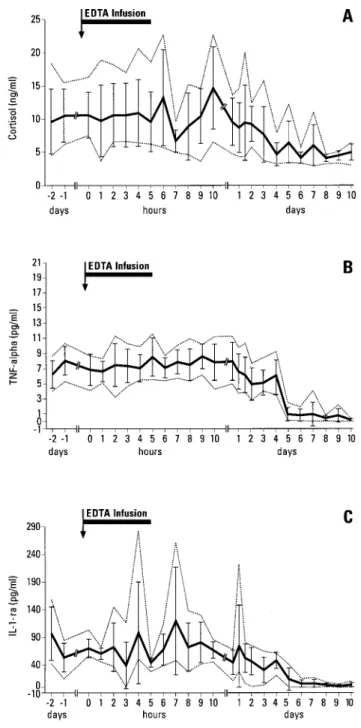
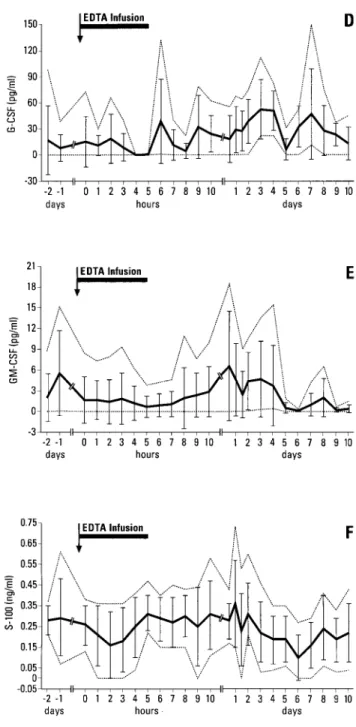
The pathophysiological e¡ects and the changes in the serum concentrations of total and ionized calcium and inorganic phosphate induced by the EDTA infusion have been reported elsewhere (Riond et al., 1997). The data (mean+SD) for cortisol, cytokines, growth factors and S-100 are presented in Figure 1A^F. During the days before the EDTA infusion, during the infusion and for 2 days thereafter, the mean plasma concentrations of cortisol were signi¢cantly higher than those from day 4 to day 10 after the infusion (Figure 1A). The SAS option contrast indicated a signi¢cant decrease in cortisol concentrations by day 3. The plasma concentrations of TNF-a and IL-1-ra followed a similar pro¢le with signi¢cantly lower concentrations on post-infusion day 5 (Figure 1B^C). The SAS option pro¢le revealed decreasing concentra-tions on day 2 for TNF-a and in the ¢rst part of day 1 for IL-1. During the last 2 h of the EDTA infusion, low concentrations of G-CSF were detected in one cow (Figure 1D). On days 3 and 4, the mean serum concentrations of G-CSF were signi¢cantly
Figure 1. The e¡ects of EDTA infusion and stress on the plasma concentrations (means+SD with minima and maxima shown as dotted lines) of (A) cortisol, (B) TNF-a, (C) IL-1-ra, (D) G-CSF, (E) GM-CSF and (F) S-100 in six dairy cows
higher than the pre-infusion values, but this was followed by a signi¢cant decrease on day 5. No signi¢cant changes with time were observed in the concentrations of GM-CSF (Figure 1E). From days 4 to 7, the serum concentrations of S-100 were signi¢cantly lower than the pre-infusion values (Figure 1F).
DISCUSSION
As the plasma concentrations of TNF-a and IL-1-ra, which were not directly related to the EDTA infusion, were unexpectedly elevated during the ¢rst part of the experiment, the cortisol concentrations were measured retrospectively. Psychological stress is the most likely cause of the elevated plasma concentrations of TNF-a, IL-1-ra and cortisol following activation of the sympathetic/adrenomedullary system with subsequent systemic release of the in£ammatory cytokines IL-6, IL-1 and TNF-a (Bellinger et al., 1992; Stratakis and Chrousos, 1995). The in£ammatory cytokines are known to activate the hypothalamic^pituitary^adrenal axis, with subsequent elevation of the concentrations of ACTH and cortisol (Besedovsky et al., 1986; Sapolsky et al., 1987; Perlstein et al., 1993; Woloski et al., 1985; Mastorakos et al., 1993). Glucocorticoids in turn suppress the stimulatory e¡ects of cytokines on the hypothalamic^pituitary^ adrenal axis (La¨za¨r et al., 1992; Besedovsky et al., 1986; Beutler et al., 1986; Dubois et al., 1989). In the present study, the concentrations of IL-1 and IL-6 were not determined. The elevated plasma concentrations of IL-1-ra before, during and for 4 days after the infusion may be explained by the fact that increased production of IL-1-ra is usually associated with an increased production of IL-1 (Mantavoni et al., 1996; Nikolic-Paterson et al., 1996). The source of the stress for these cows was probably their accommodation in a new place in the barn and/or new people. In contrast to the present study, cortisol concentrations increased signi¢cantly in assocation with EDTA infusion when the EDTA was infused at twice the rate (Desmecht et al., 1996) and cortisol concentrations were also signi¢cantly increased in postparturient cows with severe hypocalcaemia (Horst and Jorgensen, 1982). To properly evaluate the degree of the stress, it would be better to make serial determinations of cortisol plasma concentrations in the course of the day because episodic secretion, inducing large £uctuations of cortisol concentrations, occurs in cattle (Thun et al., 1981; Thun, 1986, 1987). Furthermore, a pronounced circadian rhythm has been observed for plasma cortisol. In the present study, TNF-a and IL-1-ra concentrations decreased signi¢-cantly before the cortisol concentrations did so. This observation con¢rms the controlling role of these two cytokines on the adrenomedullary axis.
The decreased G-CSF serum concentrations following the EDTA infusion may be the consequence of hypocalcaemia or hypophosphataemia or of the chelation of other ions, such as zinc. The relatively small volume of the carrier saline solution in comparison to the volume of the extracellular space is unlikely to have induced changes in the extracellular £uid that would explain such a change in the concentration of G-CSF. At the end of the infusion, the production of G-CSF by monocytes and endothelial cells was possibly decreased or their elimination may have been enhanced. The importance of this ¢nding in the pathophysiology of postparturient paresis of dairy cows remains to be established.
The period over which S-100 concentrations were signi¢cantly decreased corre-sponds to the beginning of the period with low concentrations in the serum of cortisol, TNF-a and IL-1-ra. This observation suggests a transient e¡ect from low concentra-tions of cortisol, TNF-a and/or IL-1-ra which lasts only until a readjustment has occurred, following feedback mechanisms.
CONCLUSION
Kits developed for the determination of human TNF-a, IL-1-ra, G-CSF, GM-CSF and S-100 in plasma may be used for cattle. The observations on the changes in the plasma concentrations of cortisol, TNF-a, IL-1-ra, G-CSF, GM-CSF and S-100 in relation to the infusion of EDTA may be useful for the design of future trials, which are still needed for a better understanding of the pathophysiology of postparturient paresis in dairy cows. This study strongly suggests an involvement of TNF-a and IL-1-ra in the stress response of cows. These two cytokines could be used as markers for stress in cattle. Also, the importance of stress as a confounding factor should not be neglected in this type of investigation. Finally, the role of G-CSF in postparturient paresis remains to be established.
ACKNOWLEDGEMENTS
This study was supported by the Swiss National Science Foundation grants numbers 32-33853.92 and 32-46791.96 and by funds from the canton of Zurich. The assistance of Mrs Marianne Mathys in the preparation of the Figures was greatly appreciated. REFERENCES
Aggarwal, B.B. and Natarajan, K., 1996. Tumor necrosis factors: developments during the last decade. European Cytokine Network, 7, 93^124
Bahr, N.I., Price, C.R., Do«beli, M. and Martin, R.D., 1998. Evidence from urinary cortisol that maternal behavior is related to stress in gorillas. Physiology and Behavior, 64, 429^437
Bazzoni, F. and Beutler, B., 1996. The tumor necrosis factor ligand and receptor families. New England Journal of Medicine, 334, 1717^1725
Bellinger, D.L., Lorton, D., Felten, S.Y. and Felten, D.L., 1992. Innervation of lymphoid organs and implications in development, aging, and autoimmunity. International Journal of Immunopharmacology, 14, 329^344
Besedovsky, H., del Rey, A., Sorkin, E. and Dinarello, C.A., 1986. Immunoregulatory feedback between interleukin-1 and glucocorticoid hormones. Science (Washington DC), 233, 652^654
Beutler, B., Krochin, N., Milsark, I.W., Luedke, C. and Cerami, A., 1986. Control of cachectin (tumor necrosis factor) synthesis: mechanisms of endotoxin resistance. Science (Washington DC), 232, 977^980 Desmecht, D.J.M., Linden, A.S., Godeau, J.M. and Lekeux, P.M., 1995. Experimental production of hypocalcaemia by EDTA infusion in calves: a critical appraisal assessed from the pro¢le of blood chemicals and enzymes. Comparative Biochemical Physiology A, 110, 115^130
Desmecht, D.J.M., Linden, A.S. and Lekeux, P.M., 1996. Ruminal, cardiorespiratory and adrenocortical sequelae of Na2EDTA-induced hypocalcaemia in calves.Veterinary Research Communications, 20, 47^60
Dubois, C., Bissonnette, E. and Rola-Pleszczynski, M., 1989. Platelet-activating factor (PAF) enhances tumor necrosis factor production by alveolar macrophages. Prevention by PAF receptor antagonists and lipooxygenase inhibitors. Journal of Immunology, 143, 964^970
Go¡, J.P., Reinhardt, T.A. and Horst, R.L., 1991. Enzymes and factors controlling vitamin D metabolism and action in normal and milk fever cows. Journal of Dairy Science, 74, 4022^4032
Hansson, M. and So«derstro«m, T., 1993. The colony stimulating factor. Medical Oncology and Tumor Pharmacotherapy, 10, 5^12
Hill, C.M. and Lunec, J., 1996. The TNF-ligand and receptors superfamilies: controllers of immunity and the Trojan horses of autoimmune disease? Molecular Aspects of Medicine, 17, 455^509
Horst, R.L., Go¡, J.P., Reinhardt, T.A. and Buxton, D.R., 1997. Strategies for preventing milk fever in dairy cattle. Journal of Dairy Science, 80, 1269^1280
Horst, R.L. and Jorgensen, N.A., 1982. Elevated plasma cortisol during induced and spontaneous hypocalcemia in ruminants. Journal of Dairy Science, 65, 2332^2337
Kehrli, M.E. and Go¡, J.P., 1989. Periparturient hypocalcemia in cows: e¡ects on peripheral blood neutrophil and lymphocyte function. Journal of Dairy Science, 72, 1188^1196
La¨za¨r, G., Duda, E. and La¨za¨r, G., 1992. E¡ect of RU 38486 on TNF production and toxicity. FEBS Letters, 308, 137^140
Mantovani, A., Muzio, M., Ghezzi, P., Colotta, F. and Introna, M., 1996. Negative regulators of the interleukin-1 system: receptor antagonists and a decoy receptor. International Journal of Clinical and Laboratory Research, 26, 7^14
Mastorakos, G., Chrousos, G.P. and Weber, J.S., 1993. Recombinant interleukin-6 activates the hypothalamic^pituitary^adrenal axis in humans. Journal of Clinical Endocrinology and Metabolism, 77, 1690^1694
Metcalf, D., 1997. The Molecular Basis of Cellular Defense Mechanisms, (Ciba Foundation Symposium 204; Wiley, Chichester), 40^50
Mundy, G.R., 1993. Cytokines and growth factors in the regulation of bone remodelling. Journal of Bone and Mineral Research, 8(supplement 2), S505^S510
Nikolic-Paterson, D.J., Lan, H.Y. and Atkins, R.C., 1996. Interleukin-1 receptor antagonism. Seminars in Nephrology, 16, 583^590
Perlstein, R.S., Whitnall, M.H., Abrams, J.S., Mougey, E.H. and Neta, R., 1993. Synergistic roles of interleukin-6, interleukin-1, and tumor necrosis factor in the adrenocorticotropin response to bacterial lipopolysaccharide in vivo. Endocrinology, 132, 946^952
Riond, J.-L., Liesegang, A., Fakler, A. and Spichiger, U.E., 1997. Serum concentrations of total and ionized calcium and magnesium and inorganic phosphate during Na2EDTA infusion in dairy cows.
Journal of Animal Physiology and Animal Nutrition, 75, 161^166
Sapolsky, R., Rivier, C., Yamamoto, G., Plotsky, P. and Vale, W., 1987. Interleukin-1 stimulates the secretion of hypothalamic corticotropin-releasing factor. Science (Washington DC), 238, 522^524 SAS (1989). SAS/STAT User's Guide Version 6, 4th edn, Vols 1 and 2, (SAS Institute, Cary, NC, USA) Scha«fer, B.W. and Heizmann, C.W., 1996. The S100 family of EF-hand calcium-binding proteins: functions
and pathology. Trends in Biochemical Sciences, 21, 134^140
Stratakis, C.A. and Chrousos, G.P., 1995. Neuroendocrinology and pathophysiology of the stress system. In: G.P. Chrousos, R. McCarty, K. Paca¨k, G. Cizza, E. Sternberg, P.W. Gold and R. Kvetnansky¨ (eds), Stress, Basic Mechanisms and Clinical Implications, (The New York Academy of Sciences, New York), 1^18
Thun, R., 1986. Tagesrhythmische Cortisolsekretion vor und nach der Geburt beim Rind. Fertilita«t, 2, 200^202
Thun, R., 1987. Untersuchungen u«ber die Tagesrhythmik von Cortisol beim Rind, (Ferdinand Enke Verlag, Stuttgart, Germany)
Thun, R., Eggenberger, E., Zerobin, K., Lu«scher, T. and Vetter, W., 1981. Twenty-four-hour secretory pattern of cortisol in the bull: evidence of episodic secretion and circadian rhythm. Endocrinology, 109, 2208^2212
van de Braak, A.E., van't Klooster, A.T., van Hal-van Gestel, J.C. and Malestein, A., 1984. In£uence of stage of lactation and calcium level of the ration on mobilisation rate of calcium and excretion of hydroxyproline in urine in dairy cows. Studies with Na2-EDTA infusions in monozygotic twins.
Zentralblatt fu«r Veterina«rmedizine Reihe A (Journal of Veterinary Medicine Series A), 31, 725^739 Woloski, B.M.R.N.J., Smith, E.M., Meyer III, W.J., Fuller, G.M. and Blalock, J.E., 1985.
Corticotropin-releasing activity of monokines. Science (Washington DC), 230, 1035^1037
Zimmer, D.B., Cornwall, E.H., Landar, A. and Song, W., 1995. The S100 protein family: history, function and expression. Brain Research Bulletin, 37, 417^429