
The Role of Explicit Classroom Instruction in Promoting Advanced EFL Learens Progmatic Competence and Reducing Pragmatic Language Deficit.with Sprcific Reference to Cultlral Scripts and Intercultual Pragmatics
343
0
0
Texte intégral
(2) Dedication. Again… to my parents.. I.
(3) Acknowledgements. I heartily would like to thank all who, in one way or another, assisted me in the completion of this Doctorate dissertation. Without their support, this thesis would not have been possible in its current form. I am particularly grateful to my research advisor, Prof. Atamna El Khiar, for his pertinent comments and suggestions, and for his constructive criticisms which not only greatly improved the content of this work, but also helped me grow as a researcher. It is with his help that this work came into existence. However, for any errors or inconsistencies contained within these pages, I take full responsibility. I would like to extend my earnest thanks to the members of the board of examiners, Prof. Belouahem, Dr. Kaouli, Dr. Benboulaid, Dr. Chelli and Dr. Bacher for accepting to examine the present thesis. I owe a special debt of gratitude to Dr. Nadir Kaouli for his untiring support and help. I am also deeply grateful to my interview informants (Abderahmane Gaouda, Hichem Melaksou, Mohammed-Lamine Zitouni, Lynda Ameur, Malek Beddiaf and Khaled Lebiar), and to students of M1 (language and civilisation specialty), who participated in this research. My warmest thanks go to my family. Words cannot express how grateful I am to my parents, my husband, and my children, whose support and unflinching encouragements always inspired me to do more. Last but not least, my heartfelt thanks to my friends and colleagues Hichem Souhali, Leila Djafri, Fedwa Mansouri, Fouzi Fellah, Samir Messaoudene and Mebrouk Khireddine ; I wonder if I ever will be able to pay back all what you did for me! I sincerely thank you from the bottom of my heart and will truly be indebted to you throughout my life time. THANK YOU ALL!. II.
(4) Abstract. Despite the significant importance of intercultural pragmatic competence in contemporary foreign language research, approaches to implementing it in instructional settings are still far from being fully explored. One of the conjectured efficient ways is the instruction using the cultural scripts methodology, a conceptual framework originally designed for articulating cultural values and practices in an ethnocentric free manner. The present research is inscribed under intercultural pragmatic research. It aims, through a triangulated design encompassing both an ethnopragmatic interview and a pretest-posttest experimental method, to test the accuracy of the conjectured hypothesis that the cultural scripts methodology could promote advanced English as Foreign Language learners’ intercultural pragmatic ability. A discourse completion task, targeting specifically the speech acts of requesting and compliment response, is administered (prior then subsequent to introducing the Anglo-American scripts of personal autonomy and phatic. Complimenting) to sixty eight student, constituting 56% of the. population of 120 master’s student ( Language and Culture Option, department of English, University of Batna2). The qualitative and quantitative description and interpretation of data demonstrate that a cultural scripts-based instruction can qualitatively promote the participants’ Intercultural requesting and complimenting strategies, thus, provide a practical groundwork for Intercultural pragmatics pedagogy.. Key words: Intercultural Pragmatic Competence, Cultural Scripts (Personal Autonomy and Phatic Complimenting), Ethnopragmatic Interview, Pretest-posttest Experiment, Discourse Completion Task, Speech Acts of requesting and compliment response, Advanced Learners of English as a Foreign Language.. III.
(5) List of Abbreviations. CCSARP: Cross Cultural Speech Act Realization Project . CMC: Computer-mediated Communication. CMIC: Computer-mediated Intercultural Communication. DCT: Discourse Completion Task/ Test. EFL: English as a Foreign Language. FLL: Foreign Language learning. FTA: Face Threatening Act. ICC: Intercultural Communicative Competence. IWTC: Intercultural Willingness to Communicate. MICT: Meta-informative Centering Theory. NSM: Natural Semantic Metalanguage. SAT: Speech Act Theory. TEFL: Teaching English as a Foreign Language UP: Universalist Pragmatics. IV.
(6) List of Tables. 1.. Table 1: The Intersection Between big C and small c Culture ....................................... 54. 2.. Table 2 : Byram’s dimensions of IC................................................................................. 65. 3.. Table 3: Summary of some major theories and factors that contribute to the development of intercultural competence. .......................................................................................... 68. 4.. Table 4: Relation between the Personal and Societal aspects of Communication.......... 85. 5.. Table 5: Semantic Primes .............................................................................................111. 6.. Table 6: Examples of Semantic Molecules ....... ..........................................................115. 7.. Table 7: Transition Types...............................................................................................162. 8.. Table 8 : The Three Layers of Linguistic Information....................................................167. 9.. Table 9: Pivots of Discourse .........................................................................................168. 10. Table 10: Alerter Modifiers to Core Request (CCSARP)………………………………194 11. Table 11: Core (Head act) Strategies Used in Making Requests………………………194 12. Table12: Supportive Moves……………………………………………………………194 13. Table 13: Herbert’s (1990) Taxonomy of Compliments Responses................................197 14. Table 14: Interviewees’ Observations Concerning the Characteristics of the Algerian Speech Act of Requesting ...............................................................................................216 15. Table 15: Interviewees’ Observations Concerning the Characteristics of the Algerian Speech Act of Compliment Response .............................................................................216 16. Table 16: Requests’componenents distributed across scenarios in leraners’ responses (pre-test and post-test(pilot study))………………………………………..……………….... 228 17. Table n17: The Experimental Group Requests (Pre-test Results)..................................234 18. Table n18: The Control Group Requests (Pre-test Results)………………………….....235 19. Table 19: The Experimental Group Compliment Response (Pre-test results).................235 20. Table 20: The Control Group Compliment-responses (Pre-test Results)………………236 V.
(7) 21. Table 21: Experimental Group DCT Description Grid for the Pre-test ..........................244 22. Table 22: Control Group DCT Description Grid for the Pre-test .................................. 245 23. Table 23: Comparing the Pre-test Results of Both Groups ............................................246 24. Table 24: The Experimental Group Requests Post-test Results......................................252 25. Table 25: Control Group Requests Post-test Results ......................................................252 26. Table 26: The Experimental Group Compliment-response Post-test Results ................253 27. Table 27: The Control Group Compliment-response post-test Results ..........................253 28. Table 28: Experimental Group DCT Description Grid for the post-test ........................257 29. Table 29: control Group DCT Description Grid for the post-test ..................................258 30. Table 30: Comparing the results of the two phases (pre-test and post-test)................... 259 31. Table 31: Summary of Data Required for the t-test Calculation ...................................267. V.
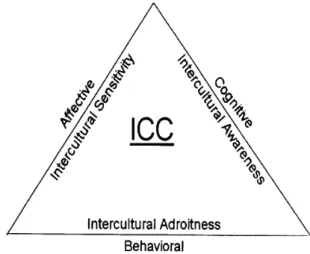
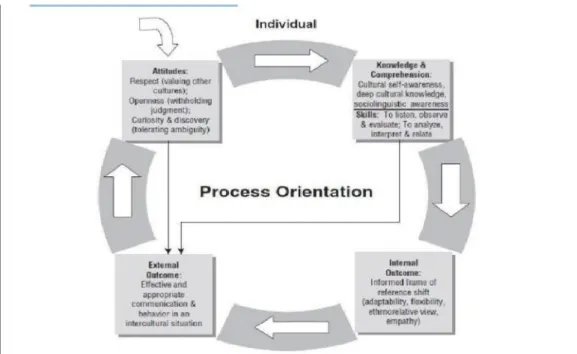
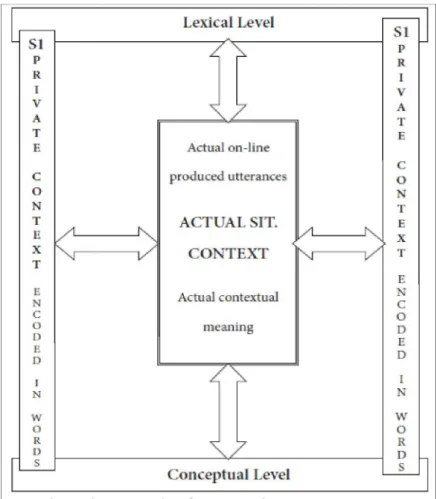
(8) List of Figures. 1. Figure One : Pragmatic Development Activities ………………………………………. 45 2. Figure Two: Chen and Starosta’s (1996) Triangular Model........................................... 63 3. Figure Three: Byram’s (1997) Model of ICC .................................................................. 67 4. Figure Four: Deardoff’s Process Model of Intercultural Competence ............................. 68 5. Figure 5: Understanding Context...................................................................................... 98 6. Figure 6: Diagram Illustrating the Experimental Design and Procedure......................... 185 7. Figure 7: Histogram Illustrating Difference in Scores Between the Two Phases of the Experiment ........................................................................................................................... 259 8. Figure 8: Histogram Illustrating the Experiment’s Means Distribution.......................... 257. VI.
(9) Table of Contents Dedication ................................................................................................................................... I. Acknowledgements...................................................................................................................... II. Abstract ....................................................................................................................................... III. List of Abbreviations .................................................................................................................. IV. List of Tables .............................................................................................................................. V List of Figures ............................................................................................................................. VI General Introduction Background of the Research ……….....…………………………….......................................... 1. Statement of the Problem…………….……………………………………….......................... 3. Research Questions .................................................................................................................... 4. Hypothesis and Assumptions…………………………………………………….............… ... 5. Rationale for the Research ……………………………………….………..........…................ 5. Significance of Research ........................................................................................................... 6. Aim and Objectives of the Research ……………………………………….....................…... 7. Operational Definition ............................................................................................................... 8. Delimitations of the research…………………………………………………....……...……... 9. Research Methodology Design.................................................................................................. 10. Participants ……………………………………………………………..........................…...... 11. Data Gathering Tools................................................................................................................. 12. Organization of the Research ..................................................................................................... 12. 1. Chapter One: Mainstream Pragmatics; Basic Notions and Instructional Issues Introduction ……………………………………………………………………………….… 15 1.1. The Pragmatic Turn in the History of Linguistic Studies …………………………… 16 1.1.1. From Competence to Performance………………………………….………... 16. 1.1.2. From an Introspective to an Empirical Enquiry……………..……….........…. 17 1.1.3. From Homogeneity to Heterogeneity……………………………...……..…… 18 1.1.4. From Synchronic to Diachronic Processing……….………………..….…….. 18. 1.2. Defining Pragmatics……………………………………………………...............…… 19 1.3. Pragmatics and Analogous Disciplines……………………………….………….…… 22 1.3.1. Pragmatics and Language Structure…………..……………………….…..….. 22 1.3.2. Pragmatics and Semantics……………………...…………………….……..… 23 1.4. The Pragmatic Lines of Research…………………………………………….......…… 25.
(10) 1.4.1. The Component View………………………………….....…………..……..… 25 1.4.2. The Perspective View……………………………...………………...........…… 26 1.5. Scope of Pragmatics………………………………………………..……………..….… 26 1.5.1. Speech Act Theory…………………………………………...……….……....... 27. 1.5.1.1.Criticism of the Speech Act Theory ……………………………………....…... 28. 1.5.2. Conversational Implicature……………………………………………..…...… 29 1.5.2.1.The Conversational Maxims…………………...………….…………….….….. 29. 1.5.2.2.The Cooperative Principle……………………..……………….………..….… 30 1.5.3. The Politeness Principle……………………………………………………..… 31 1.5.3.1. Lackoff’s View…………………………………………………………....…..… 32 1.5.3.2. Leech’s View………………………………………………..………………..….. 33. 1.5.3.3.Brown and Levinson’s View………………………………………………...….. 34. 1.5.3.4.Criticism to the Politeness Theory……………………...………….…….….… 35 1.6. Pragmatic Competence and Instruction……………………………………….….…… 37 1.6.1. Pragmatic Competence and Communicative Competence………..….....…..….. 37. 1.6.2. Pragmatic Competence and FLT: What Type of Pedagogical Intervention?....... 39. 1.6.3. Implicit and Explicit Instructions: Definitions and Implications.......................... 40 1.6.4. Effect of Focus on Form/Focus on Forms Instructional Approaches on FL Pragmatic Competence.......................................................................................... 42. 1.6.7. Some Implicit Instructional Strategies for Developing EFL Pragmatic Competence........................................................................................................... 43. 1.7. Pragmatic Competence: Pedagogical Implementations.................................................. 45 Conclusion..................................................................................................................................... 47. 2. Chapter Two: The Conundrum of Interculture Introduction................................................................................................................................... 49 2.1. The Hypostasis of Culture in Language Studies............................................................... 49 2.1.1. Culture as a Nation’s Defining Trait............................................................... 50 2.1.2. Culture as Artifacts, Values and Norms.......................................................... 50 2.1.2.1.Delimiting Cultural Values and Norms in Intercultural Studies............... 51. 2.1.3. Other Views on Culture................................................................................... 52 2.1.3.1.Culture as a Subjective/Objective Phenomenon........................................ 53 2.1.3.2.Culture as a Dynamic Dialectical Phenomenon........................................ 54 2.2. The Interplay of Cultures: Cross-Cultural, Intra-Cultural and Inter-Cultural Perspectives........................................................................................................................ 55.
(11) 2.2.1. What Makes Intercultural Communication Different from Intracultural Communication?............................................................................................. 58 2.2.2. Analyzing the Cultural Component during Intercultural Communication...... 61. 2.3. Intercultural Competence ................................................................................................. 62 2.3.1. Different Models of Intercultural Competence................................................ 62 2.3.1.1.Chen and Starosta’s Model........................................................................ 63 2.3.1.2.Byram’s Model........................................................................................... 64 2.3.1.3.Deardoff’s Process Model.......................................................................... 67 2.3.2. Intercultural Competence and the Process from Ehnocentrism to Ethnorelativism................................................................................................ 70 2.3.3. Intercultural Competence and Third Space...................................................... 71 2.4. Issues Related to Framing Intercultural Competence into the Foreign Language Classroom............................................................................................................................ 72 Conclusion.................................................................................................................................... 75 3. Chapter Three: On Intercultural Pragmatics Introduction.................................................................................................................................. 76 3.1. Defining Intercultural Pragmatics..................................................................................... 76 3.1.1. The Cultural Vs. The Intercultural Component in Intercultural Pragmatics... 78 3.1.2. Interculture in Intercultural Pragmatics............................................................ 80 3.1.3. The Difference between Intercultural Pragmatics and Mainstream Pragmatics........................................................................................................ 81 3.1.4. Intercultural, cross cultural and Interlanguage Pragmatics.............................. 87 3.2. Intercultural Pragmatics and Levels of Analysis................................................................ 88 3.2.1. Intercultural Pragmatics and Discourse Segments........................................... 90 3.2.1.1.The Pragma-semantics Approach.............................................................. 90 3.2.1.2.The pragma-dialogue Approach................................................................ 91 3.2.1.3.The Pragma-discourse Approach .............................................................. 91 3.3. Third Space Culture and Intercultural Pragmatics............................................................ 92 3.4. Hearer/Speaker and Change of Roles from an Intercultural Pragmatics .......................... 93 3.5. Some Issues Related to Intercultural Pragmatics.............................................................. 93 3.5.1. Intention, Attention and their Interaction........................................................ 93 3.5.2. Recipient Design, Intention and Salience........................................................ 96 3.5.3. Prior context and Actual Situational Context.................................................. 96 3.5.4. Formulaic Language........................................................................................ 99.
(12) 3.6. Developing Intercultural Pragmatics: What to Exactly Develop?.................................. 100 Conclusion.................................................................................................................................... 101 4. Chapter Four: Cultural Scripts, a Theoretical Background Introduction.................................................................................................................................. 103 4.1. Ethnopragmatics: The Inception of the Cultural Scripts Theory .................................... 104 4.1.1. Defining Ethnopragmatics............................................................................. 105 4.1.2. Ethnopragmatics as a Reaction to Universal Pragmatics............................... 106 4.1.3. Ethnopragmatics and Ethnocentrism............................................................. 107 4.1.4. Ethnopragmatics and the NSM Methodology............................................... 109 4.1.4.1.The Natural Semantic Metalanguage and Core Vocabulary................... 110 4.1.4.2.The Semantic Primes................................................................................ 111 4.1.4.3.Explicating Norms and Values Using the NSM Approach...................... 112 4.1.5. Nuclear English/NSM English: an Auxiliary International English.............. 116 4.2. Cultural Scripts: an Expansion to the NSM Theory ....................................................... 118 4.2.1. Defining Cultural Scripts .............................................................................. 118 4.2.2. Historical Sketch of the Cultural Scripts Approach....................................... 119 4.2.3. Some General Characteristics of Cultural Scripts.......................................... 121 4.2.4. Kinds of Cultural Scripts............................................................................... 124 4.3. Cultural Scripts, Communicative Styles and Non-Verbal Communication………….... 128. 4.3.1. How to Formulate Cultural Scripts?............................................................... 131 4.3.2. Who Can Formulate Cultural Scripts?........................................................... 134 4.3.3. Cultural Scripts and Intercultural Communication........................................ 135 4.4. Some Selected Cultural Scripts....................................................................................... 136 4.4.1. Personal Autonomy and the Anglo English Request Strategies ................... 136 4.4.2. Expressive Positivity, Phatic Complimenting and the American compliment/ Compliment Response Strategies. ................................................................. 139 4.5. Practical Implementations ............................................................................................... 142 Conclusion................................................................................................................................... 143 5. Chapter Five: Intercultural Pragmatics: Methodological Considerations Introduction................................................................................................................................. 144. 5.1. Considerations for Selecting the Research Data Analysis Tools.................................... 144 5.1.1. Considering Discourse Coherence...................................................................... 146 5.1.2. Considering the Contextualization Cues ............................................................ 147 5.1.2.1.Contextualization Cues and the Socio-Cognitive Theory ............................ 149.
(13) 5.2. Methods of Analysis in Intercultural Pragmatics Studies............................................... 151 5.2.1. Corpus Analysis ................................................................................................. 151 5.2.2. Computer Mediated Communication (and Computer-Mediated Intercultural Communication).................................................................................................. 153 5.2.3. Conversational Analysis ..................................................................................... 155 5.2.3.1. The Issue of Turn-taking in Intercultural Pragmatic Research................... 155 5.2.3.2. The Cultural Construct and The Socio-cognitive Theory ........................... 156 5.2.4. Discourse Segment Analysis ............................................................................... 157 5.2.5. Centering Theory.................................................................................................... 159 5.2.5.1.Centering Discourse Segments ................................................................... 161 5.2.5.2. Variations of the Centering Theory ........................................................... 163 a. Grosz, Joshi and Weinstein (1995)............................................................... 163 b. Kameyama (1998) ........................................................................................ 163 c. Włodarczyk and Włodarczyk Meta-Informative Centering Theory................ 164 5.3. The Meta-Informative Cenetring Theory and Intercultural Pragmatics........................... 163 Conclusion.................................................................................................................................... 169 6. Chapter Six: Research Design and Methodology Introduction................................................................................................................................. 170 6.1. Restatement of the Research Aim................................................................................ 170 6.2. Research Design........................................................................................................... 171 6.3. The Approach............................................................................................................... 172 6.3.1. The Quantitative Approach.................................................................................. 173 6.3.2. The Qualitative Approach................................................................................... 174 6.3.3. The Approach of the Present Study .................................................................... 174 6.4. The Research Methods.................................................................................................. 175 6.4.1. The Ethnopragmatic Method................................................................................ 175 6.4.1.1. The Interview................................................................................................. 176 6.4.1.2. Aim and Objectives of the Interview............................................................. 177 6.4.1.3. Designing the Questions of the Interview..................................................... 178 6.4.1.4. Ensuring the Validity of the Interview ......................................................... 178 6.4.1.5. The Interview Informants.............................................................................. 179 6.4.1.6. The course of the Interview .......................................................................... 180 6.4.2. The Experimental Method.................................................................................... 181 6.4.2.1.Description of the Variables.......................................................................... 181.
(14) 6.4.2.2.Population and Sampling............................................................................. 181 a. Sampling Techniques and Sample Size.................................................. 182 6.4.2.3.The Course of the Experiment ...................................................................... 184 6.4.2.4.The Research Instrument: the DCT............................................................... 187 a. Description of the DCT ........................................................................... 188 6.4.2.5.The Coding Schemes.................................................................................... 192 a. The Coding Scheme for the Requests ..................................................... 193 b. The Coding Scheme for the Compliment Responses ............................... 195 Conclusion .................................................................................................................................. 198 7.. Chapter Seven: Analysis and Interpretation of Data. Introduction................................................................................................................................. 199 7.1. Phase One: The Ethnopragmatic Interview.................................................................. 200 7.1.1. Description of the Interview................................................................................ 200 7.1.2. The Interview Informants.................................................................................... 201 7.1.2.1. Representativeness of the Informants .......................................................... 202 7.1.3. Data Processing and Interpretation: a General Inductive Analysis..................... 202 7.1.3.1. Step one: Recording, Transcribing and Synthesising Answers.................... 203 a. The First and Second set of Questions.......................................................... 203 b. The Third set of Questions ........................................................................... 206 c. The Fourth and fifth set of Questions .......................................................... 209 7.1.3.2. Step Two: Developing a Coding Scheme and Pattern................................ 215 a. Coding the Results of Speech Act of Request ................................... 217. b. Coding The Speech Act of Compliment Responses .......................... 218 7.1.3.3.Step Three: Juxtaposing the Informants’ Suggested Scripts with the NSM Assisted Coded Scripts................................................................................. 219 7.1.3.4.Step Four: Checking the Internal Consistency of the Interview.................. 221 7.1.4. Findings of the Interview ................................................................................... 225 7.2. Phase Two: The Experiment........................................................................................ 226. 7.2.1. The Experimental Design, Methodology and Procedure...................................... 227 7.2.1.1. Piloting the Study....................................................................................... 227 7.2.1.2. Main Experiment......................................................................................... 231 7.2.2. Restating the Aim and Objectives of the Experiment........................................... 231 7.2.3. Duration of the Experiments................................................................................. 232 7.2.4. Participants........................................................................................................... 232.
(15) 7.2.5. Data Gathering Tool................................................................................................. 233 7.2.6. The Course of the Experiment ................................................................................ 234. 7.2.6.1. The Pre-test Phase....................................................................................... 234. a. First Coding stage of the Pre-test Results………………………………… 234 b. Second Coding Stage of the Pre-test Results …………………………….. 243. c. Analysis and Interpretation of the Results………………………………... 246. 7.2.6.2. The Treatment Phase ……………………………………………....….… 247 a. Designing the Lessons …………….…………………………….………. 248 7.2.6.3. The Post-test Phase ………………..…………………………...………... 252. a. First Coding Stage of the Post-test Results ………………………...…….… 253 b. Second Coding Stage of the Post-test Results ………………………..… 256 c. Analysis and Interpretation of the Results ……………………………..... 259. 7.2.7. The Statistical Analysis of the Experiment Results ………………..……….….... 261. 7.2.7.1. The t-test .................................................................................................... 261 a. Rationale for Applying the Independent-samples t-test ............................... 261 b. Calculating the Independent-Sample t-test ................................................... 262 c. Calculating the Degree of Freedom ............................................................. 263 d. An Application of the Independent-samples t-test.......................................... 265 7.3. Pedagogical Implications .............................................................................................. 268 Conclusion.................................................................................................................................... 269 General Conclusion General Conclusion ................................................................................................................... 271. Recommendations for Further Research...................................................................................... 281 References.................................................................................................................................... 283 Appendices Appendix One Appendix Two Appendix Three Appendix Four Appendix Five.
(16)
(17) General Introduction. Background of the Research ……….....……………………………...................................... 1. Statement of the Problem…………….………………………………………....................... 3. Research Questions ................................................................................................................. 4. Hypothesis and Assumptions……………………………………………………..........… ... 5. Rationale for the Research ……………………………………….………..........…............. 5. Significance of Research ........................................................................................................ 6. Aim and Objectives of the Research ………………………………………..................…... 7. Operational Definition ........................................................................................................... 8. Delimitations of the Reserach…………………..……………………………....……...…... 9. Research Methodology Design............................................................................................. 10. Participants ……………………………………………………………............................... 11. Data Gathering Tools............................................................................................................ 12. Organization of the Research ................................................................................................. 12.
(18) GENERAL INTRODUCTION Background of the Research Pragmatic competence, an indispensable component of a speaker’s communicative competence, has gained ground over the last decades and become a central object of inquiry in a wide range of disciplines including Applied Linguistics, Discourse Studies and Foreign Language Learning (FLL henceforth). Because of the inherently intricate nature of. the. construct, attempts to define pragmatic competence have been rather divergent (Grabowski, 2009). Perhaps the clearest and most concise description is the oft-cited definition of Kasper (1997), which depicts it as “knowledge of how to use language to achieve goals in language interaction, or rather, competence of language interaction in a socio-cultural context” (cited in Kolotova and Kofanova (2012, p.10)). With regard to FLL, where the socio-cultural norms governing the use of the target language are generally different from those acquired by the learner in their native culture, defining pragmatic competence would impose taking into consideration the (foreign/target) cultural adequacy of language use, or the socio-pragmatic competence,. which is defined by. Leech and Thomas (1983) as the proper social behavior in the target language where “learners must become aware of the consequence of their pragmatic choices” (Wyner, 2017, p.85). This socio-pragmatic competence is reputed to be more challenging to develop than its sisternotion, the pragma-linguistic competence (Meier, 2007). And interestingly enough, it was long believed to be the ultimate objective of foreign language learning. In other words, a FL Learner was said to be fluent in the target language if they “could adapt to” and acquire a native-like socio-pragmatic competence. Many theories attempted to account for this FL Learners’ adaptation to the target language. Areas of investigation include, among others, the pragmatic features involved and the extent to which this said adaptation is recommended. Giles and Philips (1979) for e.g., report that the more foreign language learners are inclined to adjust their pragmatic behavior. 1.
(19) GENERAL INTRODUCTION to that of the native speakers, the more communication problems scale down and, consequently, better communication is achieved. Outside this theoretical framework however, and during actual intercultural encounters, it would be rather infelicitous for any speaker to adjust their pragmatic behavior to that of their interlocutor’s, especially if this adjustment infringes their own cultural identity. Instead of the total convergence towards the target culture’s norms, what was recently pleaded for is to find a common ground where a shared socio-pragmatic core is called upon, one that assures a mutual understanding without contravening the social and cultural norms of language use as allowed in the speakers’ respective cultures. In other words, one does not, a priori, view their interlocutor’s pragmatic model as optimal for a given speech situation simply because they are native speakers of the language being learnt or used. A shared communicative ground is to be established with. respect to the pragmatic and identity. attributes of both cultures. This concern, along with others, gave rise to Intercultural Pragmatics, a newly accredited field of research which focuses mainly on the use of the language system in “social encounters between human beings who have different first languages but communicate in a common language, and, usually, represent different cultures” (Kecskes, 2014, p.3). The complex nature of intercultural pragmatics coupled with the challenging task of TEFL (Teaching English as a Foreign Language) made researchers seek out ways to import it (intercultural pragmatics) in instructional settings, and to attempt to design some approaches in order to raise EFL (English as Foreign Language) learners’ awareness to the role it may play in helping them communicate effectively with native speakers of English.. 2.
(20) GENERAL INTRODUCTION Statement of the Problem Setting the development of Intercultural pragmatic competence as an objective, various researchers and foreign language practitioners around the globe (Wierzbicka, Goddard, Wong, Gladkova, Kecskes and many others) attempted to conceptualize some intercultural and contrastive approaches which could equip the FL learner with the necessary tools to create a pragmatic common-ground in intercultural interactional settings. When trying to parallelize this with the Algerian EFL context, it was often reported (Atamna, 2008, Neddar, 2010, Ahouari-idri, 2014) thatCulture and Pragmatics in general, along with their ramifications, are hardly implemented in the different language curricula. Add to this the constant and rather unmonitored exposure of the learners to the target language (Television, Internet and social media). Consequently, Algerian FL learners are barely aware of the role Pragmatics plays in language learning essentially vis-a-vis their identity. It is also important to mention the serious lack of contrastive studies counterpointing the pragmatic properties of both languages (Algerian-Arabic and English), and the total disregard paid to the implementation of a solid-grounded intercultural pragmatic oriented pedagogy, especially in higher education. All this results in a kind of language proficiency mostly characterised by being “anglocentric”, as language learners are not even able to perceive the differences between their own culture and that of English native speakers. Alternatively stated, most Algerian EFL learners still set the native-like pragmatic proficiency as an unquestioned objective, and during intercultural encounters, these same learners’ cultural/pragmatic identity almost entirely dissolves into their interlocutors’. If this attests for something, then it is for an intercultural pragmatic failure despite the learners’ acceptable (sometimes very proficient) mastery of the language being learned.. 3.
(21) GENERAL INTRODUCTION Among the dominant approaches which have so far been adopted as a promoter of intercultural pragmatic competence, is what came to be known as the Cultural Scripts approach. Cultural Scripts are formulated in the meta-language of semantic primes which tolerates the transposition of the scripts across cultures, thus, prove efficient at instilling a transparent and ethnocentric-free type of communication between speakers from different cultural backgrounds. Conforming to what precedes, the present research aims at investigating the possibility of applying the Cultural Scripts theory in intercultural pragmatic-oriented pedagogy, and seeks to examine whether it could be used as an instructional tool to boost the FL learners’ intercultural pragmatic ability. Research Questions The research questions which are addressed in this study are: 1. Can intercultural pragmatic competence be brought in instructional settings? 2. Could it be achieved in a mono-cultural context? 3. What are cultural scripts? And how can they “condition” the learner, at least cognitively? 4. Are Algerian EFL speakers and learners aware of the cultural scripts underpinning their own culture? 5. In what ways do the cultural scripts which influence the realization of a given speech act differ from one culture to another? 6. How useful are cultural scripts in developing a FL learner’s intercultural pragmatic competence? All in all, this work is an attempt to show how effective is a cultural scripts’ based instruction in developing and sustaining advanced EFL learners’ intercultural pragmatic ability.. 4.
(22) GENERAL INTRODUCTION Hypothesis and Assumptions The primary assumption which sets this research in motion is that the more Algerian EFL learners are familiarized with the cognitive processes underlying the formation of their own culture’s cultural scripts (and the Anglo/American cultural scripts,by extension), the higher their intercultural pragmatic proficiency will be. Thus, hypothesis that if proper instruction on cultural scripts. the study is built on the. is introduced to advanced level. learners of English, their ability to construct and negotiate meanings in intercultural settings will improve qualitatively. Rationale of the Study With the English language learning becoming. “en vogue”, and the present-day. profusion and easiness of access to authentic materials facilitated by technological progress (Internet, and social media specifically), the cultural component came to be,inadvertently oftentimes, absorbed as a “default” constituent of the language, something which would, in the absence of cautious supervision, jeopardize the third space element intercultural pedagogy advocates.. accentuated by. The direct result is the blurry distinction (not to say the. total absence) of clear cut defining cultural features, and, in more serious instances, the dissolution of the FL learner’s cultural identity into a form of emulation of the Other. The present study is supported by the belief that more work on intercultural pragmatics is an absolute necessity to remedy for the aforementioned issues, and to initiate learners to the basics of intercultural communication. The insight such a work is likely to provide is into the subject of cultural scripts and how they can bridge the pragmatic gap between interlocutors from different cultural backgrounds, while redressing misconceptions about the overall objective of this gap-bridging.. It will hopefully make a significant contribution to our. understanding of intercultural pragmatics, and as it is hoped, will bring new elucidations as to. 5.
(23) GENERAL INTRODUCTION how cultures could be scripted, and how this procedure can set straight some problems related to EFL teaching and learning. Significance of the Study Intercultural Pragmatics, Ethnopragmatics, Cultural Scripts, and the Natural Semantic Metalanguage are indisputably appealing concepts in the contemporary cross-cultural, intercultural and EFL research, not solely because they represent some interestingly intricate outcomes of the duality “language and Culture”, but also because they are relatively “new”, thus, not satisfyingly explored. Furthermore, this research can be viewed as significant for a number of other reasons: 1. From the theoretical point of view, and as far as the speech acts examined in this research (requests and compliment responses) are concerned, many investigations were carried out to inquire into many languages, including English and its many varieties (Wolfson (1983) for American English, Holmes (1988) for New Zealand English, Herbert and Straight (1989) for American and South African English, Chang, (1988); Chen (1993) and Yang (1987) for Chinese , Nelson et al, (1996) for Syrian Arabic, to name only few) However, few researches on Algerian Arabic (or one of its varieties) speech acts are referenced in the literature, especially those accounting for them (speech acts) from a sociocognitive perspective. Therefore, this study is of significant importance as it attempts to shed some light on the logic behind the choice of some norms and patterns of compliment responses and requests in Algeria, and to contrast them with those of English (American and British) speakers. 2. From an empirical perspective, the cultural scripts suggested and brought about by this research can be implemented in the Algerian EFL context as a strategy to inform the learners about the cultural values which determine the way some speech acts are verbalized the way they are in the target language as well as in their own, thus, will expectedly help them develop. 6.
(24) GENERAL INTRODUCTION their intercultural communicative competence in general, and intercultural pragmatic competence in particular. Aim and Objectives of the Research Given the significant role of intercultural pragmatic competence and the necessity of equipping FL Learners with strategies that enable them to communicate effectively in intercultural contexts, the present study aims at looking into the relevance of the cultural script theory as an instructional approach in the Algerian EFL context. It intends also to upraise the population-under-investigation’s current intercultural pragmatic competence level by suggesting a cultural script pattern to two chosen speech acts and pragmatic features captured from the Algerian culture (requests and compliment responses). Extensively explained, this research sets itself the following objectives: 1. To examine some “interactional routines” of the Algerian culture (from a pragmatic and socio-cognitive perspective), and draw out some of the most defining and recurrent cultural values reflected in the speech behaviour of the population under investigation. 2. To convert those values inferred from the analysis of the ethnopragmatic interview into Natural-Semantic-Metalinguistically constructed cultural scripts. 3. To juxtapose the Algerian and Anglo/American scripts assumingly responsible for the realization of the same speech act, and to analyze eventual similarities and/or differences. 4. To shed light on the concept/approach/methodology/strategy of Cultural scripts, and to raise the awareness of the experiment’s participants to its importance in maintaining a third space cultural and linguistic position during intercultural encounters, hence, to provide evidence for its effectiveness in helping them (participants) develop their intercultural pragmatic competence.. 7.
(25) GENERAL INTRODUCTION Otherwise stated, besides being an attempt to provide an in-depth analysis of the Algerian logic behind the verbalization of some chosen speech acts (requests and compliment responses), this research aspires to disseminate the cultural scripts methodology, and to try out ways to implement it in Foreign language teaching/learning as an effective strategy to develop advanced learners’ intercultural pragmatic competence. Operational Definition Intercultural pragmatics is comparatively a newly acknowledged concept in Intercultural and pragmatic studies, therefore, it is still hard to pin down. Numerous definitions (some of which are still in progress) are suggested, and although chapter three will attempt to compile and account for them, it is judged imperative to introduce, at this level, the one definition (Meier, 2007) which is adhered to throughout the research and, most importantly, which is adopted in the coding and scoring of the experiment’s results. The most distinguishing idea in Meier’s view of Intercultural competence is that it does not aim at achieving a native-like pragmatic competence, nor at inculcating some rules of conduct imposed by a the culture of the language being learnt. Instead, Meier (2007) describes intercultural pragmatics as a cluster of skills and abilities which are determined by a set of prerequisites. She defines it as “the ability to communicate effectively, negotiate desired meanings and identity, with those of different cultural backgrounds” (p.325). This ability is, according to her: facilitated by (at least) the following : awareness of cultural differences and the language culture connection, context sensitivity, an emic perspective, respect, tolerance of ambiguity, and communication skills or strategic competence (eg. reframing,. withholding. unexpected. linguistic. judgement, behavior,. considering. managing. alternative. conflict,. dealing. explanations with. for. different. communication styles, checking comprehensions and perception. (p.325). 8.
(26) GENERAL INTRODUCTION In other words, what Meier (2007) terms intercultural pragmatic competence (and what accordingly is espoused by the present research) encompasses both a predisposition of the interlocutor to transcend the world view forged and constructed by their culture, and a set of communication skills which could be of help when interacting with others. As such, this definition is adhered to not only because of its applicability to intercultural encounters, but also because of its “tangibility” and the possibility to convert it into palpable behaviours which could be easily observed,. scored and compared in the. experimental procedure. Delimitations of the Study As it is often the case with human sciences research projects, the executability of the current investigation proved challenging right from the beginning: besides the lack of relevant publications either documenting the key elements of the research (because of their recency) or the scarcity of previously conducted ethnopragmatic researches on the Algerian cultural norms of interaction (which would have substantiated the validity the results, or at least facilitated the investigation), and in addition to the numerous administrative impediments which delayed the execution of the experimental part, some procedural issues proved quite difficult to control, something which might “blemish” the general course of the research. The most intricate concern pertains to the question of “the interculturality” of this investigation: One needs to recall that the overall assumption underlying this research is that intercultural pragmatic competence will qualitatively improve if proper. training on the. cultural script approach is carried out. However, intercultural pragmatics requires, by definition, an intercultural setting, where non-native learners interact with native speakers of the language being learned, something which is difficult to bring into an instructional setting. Initially, and as an ideal scheme, a series of video-conferencing sessions were suggested to ensure the intercultural nature of the inquiry. Correspondences were exchanged with three. 9.
(27) GENERAL INTRODUCTION American universities, and an initial agreement was reached. Nevertheless, because of (again) some technical constraints (mainly time-difference between Algeria and the USA). this. primary plan was replaced by the in-class instruction scheme accomplished by the imaginative scenarios suggested in the Discourse Completion tests.Thus, it is important to note that the study results presented in this research are confined to the “awareness stage” where only the socio-cognitive ability is targeted. By the same token, the choice of the data gathering tool was settled on the “written” form of the Discourse Completion Task (DCT henceforth). Once again, it could be contested that DCTs do not perfectly reflect the respondents’ performance level, particularly when it comes to the socio-pragmatic features operating in real-life situations. But one could argue that this same point could also be approached as an advantage, when considering thatthe DCT here is helping the researcher isolate the contextual variables which are only targeted by the scenarios in question, and neutralize all the extraneous variables which may affect the way respondents answer the questions. Moreover, even though written DCTs could also be contended for their inability to elicit naturally occurring speech, they nonetheless have the merit of facilitating access to a large corpus of data within a relatively short period of time. For all these reasons, they were opted for as the major data eliciting and gathering tool of this research. Research Methodology Design Based on the problem to be investigated, the research questions and aim previously set, putting into effect this project requires a two-step spiral course of action: 1.. Inferring the cultural scripts potentially responsible for the verbalization of the. two speech acts being investigated: This is achieved via the systematic coding of an ethnopragmatic interview conducted with seven informants reasonably assumed to be able to clear up the differences between the two cultures (Algerian and Anglo/American).. 10.
(28) GENERAL INTRODUCTION 2.. The instrumentation of the same cultural scripts as a treatment pedagogical tool. in a pretest-posttest experiment: This experiment is carried out on sixty-eight students picked up randomly from the population of M1 students, Department of English, University of Batna2. All in all, two complementary stages constitute the triangulated design of the present research: an ethnopragramtic survey and an experiment. The Participants With respect to the two interconnected phases which constitute the present research, and based on the aims and objectives driving (separately) each, two populations of investigation are selected, namely: 1. The Interview Informants: Seven consultants, natives of the Aurassian region (Batna and Khenchela) are invited to take part in the research. In addition to their potential ability to offer a cultural insider’s perspective, these informants went through what Wierzbicka (2006) calls “the confusion of intercultural communication”, as they all lived/worked (for a considerable time) with American and/or English natives. Therefore, since the interview informants have got, not only the insider’s, but also the outsider’s perspectives of the target culture, they are deemed eligible to clear up the interactional differences between it (the target culture) and their mother-tongue related culture. 2. The Experiment Participants: Based on the premise that Intercultural pragmatic competence presupposes linguistic competence (Scarcella, 1983; Schimidt, 1983; BardoviHarlig and Dörnyei, 1998; Matsumura, 2003; Schauer, 2006; Taguchi, 2011), and because data are gathered using a written DCT, which is a relatively difficult task requiring full understanding of both the socio-pragmatic and pragmalinguistic features of the scenarios, Master-level students (assuming that they have a higher linguistic proficiency level than license students) are selected.. 11.
(29) GENERAL INTRODUCTION As to the sampling technique, a simple random sampling technique is opted for as it ensures the generalizability of the results over the whole population. Data Gathering Tool Reported as being the most appropriate tool for eliciting pragmatic productions, a Discourse Completion Task, which comprises ten situations distributed among two distinct sections, is designed and administered to the sample being tested. The suggested situations are designed (modified in the case of the first five situations) in a way that renders them likely to happen to any Algerian EFL learner studying abroad. The diversity of social contexts and interlocutors is particularly attended to: no two situations eliciting the same speech act display the same level of directness, formality, frequency, distance, power or rank of imposition. It is important to mention that the first five situations are a modified version of some of the situations suggested in Blum-Kulka’s (1986) Cross Cultural Speech Act Realization Project (CCSARP). Organization of the Research Besides the introductory and concluding chapters, the present work comprises seven chapters, altogether composing two global sections: the review of literature and a field work section. The first chapter, which is entitled “mainstream pragmatics: basic notions and instructional issues”, addresses the scope and interface of mainstream pragmatics (as contrasted to intercultural pragmatics), highlighting its core areas of investigation, and debating the role of instruction (explicit and implicit) in developing the EFL learners’ pragmatic ability. It finally puts forth a potential ground for its pedagogical implementation in the foreign language classroom.. 12.
(30) GENERAL INTRODUCTION As its title suggests (the conundrum of interculture), the second chapter seeks to delineate the research’s adopted working definition of “interculture” from other less relevant descriptions. It equally discusses the different orientations and forms of investigating the interplay of cultures during communication (cross cultural, Intracultural and intercultural approaches to communication). Intercultural competence is also framed into its theoretical then pedagogical stance, to pave the way, eventually, to discussions of intercultural Pragmatics. Chapter three is wholly dedicated to the research’s dependent variable, i.e. intercultural pragmatics. It first tries to demarcate it from mainstream pragmatics, focalizing not only on its intercultural construct, but also on aspects of communication it takes into account, and which are often disregarded by the other traditional pragmatic theories. It equally brings up its recurrently-related terminology, as well as the different levels of analysis advocated by Intercultural pragmaticians. The chapter finally addresses some controversial issues often encountered in intercultural pragmatic investigations. The fourth Chapter introduces the cultural script approach, tracing it back to its ethnopragmatic origins and explaining the language used in the process of scripting cultures, i.e. the Natural Semantic Metalanguage. It equally sheds light on other similar theories, namely, Shweder's (1984) cultural frames and Kitayama and Markus's (1992) culturally shared ideas. The chapter culminates in a critical overview of the theory, accounting thus for possible ways of its implementation, and finally provides some illustrating scripts retrieved from the literature, some of which are used in the treatment phase as elements of instruction. Chapter five is is an attempt to present intercultural pragmatics in its methodological frame. Its primary objective is to bring in some indications necessary for conducting investigations on intercultural pragmatics. The chapter also sets out to introduce the most. 13.
(31) GENERAL INTRODUCTION convenient methodologies adopted so far in accounting for intercultural (and intercultural pragmatic) phenomena, as well as the tools used for their implementation and analysis. The sixth chapter, being part of the field work section,. sketches the course outlined. and followed for the implementation of the conjectured hypothesis which sets the whole investigation off: That cultural scripts could be used as an effective means to enhance the intercultural pragmatic competence of foreign language learners. In addition to restating the aims of the research, the chapter discusses the overall design (including approach, methods an data gathering and analysis tools) of the research, offering each time what is hoped to be, a solid argumentation for the choice of each. Chapter seven, the longest and most empirical subdivision of the research,. is a two-. fold chapter which extensively explains the WHATs, the WHYs, and the HOWs of the whole investigation: First, the ethnopragmatic interview, then the experiment, are. presented,. outlined, explained, described and analyzed in what is hoped to be, the most convincing way. Their partial conclusions are finally combined in a conclusive section in which some practical implementations of the methodology are suggested, and the research questions restated at the beginning of the chapter are answered. Finally the work culminates into a general conclusion in which all the research is summarised; results and research findings are revisited. At the end of the general conclusion, a set of recommendations is suggested for further research.. 14.
(32) 1. Chapter One: Mainstream Pragmatics; Basic Notions and Instructional Issues Introduction ………………………………………………………………………………...… 15 1.1. The Pragmatic Turn in the History of Linguistic Studies …………………………...… 16 1.1.1. From Competence to Performance………………………………….…….….. 16 1.1.2. From an Introspective to an Empirical Enquiry……………..………...........…. 17 1.1.3. From Homogeneity to Heterogeneity……………………………...……..….… 18 1.1.4. From Synchronic to Diachronic Processing……….………………..….….…. 18 1.2. Defining Pragmatics…………………………………………………….....................… 19 1.3. Pragmatics and Analogous Disciplines……………………………….………….….… 22 1.3.1. Pragmatics and Language Structure…………..……………………….…..…... 22 1.3.2. Pragmatics and Semantics……………………...…………………….……...… 23 1.4. The Pragmatic Lines of Research…………………………………………….......…… 25 1.4.1. The Component View………………………………….....………..…………. 25 1.4.2. The Perspective View……………………………...………………..........…… 26 1.5. Scope of Pragmatics………………………………………………..…………….….… 26 1.5.1. Speech Act Theory…………………………………………...……….……..... 27 1.5.1.1.Criticism of the Speech Act Theory ………………………………………..... 28 1.5.2. Conversational Implicature……………………………………………..…..… 29 1.5.2.1.The Conversational Maxims…………………...………….……………..…... 29 1.5.2.2.The Cooperative Principle……………………..……………….……….....… 30 1.5.3. The Politeness Principle…………………………………………………….… 31 1.5.3.1. Lackoff’s View…………………………………………………………........… 32 1.5.3.2. Leech’s View………………………………………………..……………..…... 33 1.5.3.3.Brown and Levinson’s View……………………………………………..….... 34 1.5.3.4.Criticism to the Politeness Theory……………………...………….………… 35 1.6. Pragmatic Competence and Instruction……………………………………………… 37 1.6.1. Pragmatic Competence and Communicative Competence………..…......….... 37 1.6.2. Pragmatic Competence and FLT: What Type of Pedagogical Intervention?.... 39 1.6.3. Implicit and Explicit Instructions: Definitions and Implications........................ 40 1.6.4. Effect of Focus on Form/Focus on Forms Instructional Approaches on FL Pragmatic Competence...................................................................................... 42 1.6.7. Some Implicit Instructional Strategies for Developing EFL Pragmatic Competence.......................................................................................................... 44 1.7. Pragmatic Competence: Pedagogical Implementations............................................... 45 Conclusion................................................................................................................................. 47.
(33) CHAPTER ONE: ON MAINSTREAM PRAGMATICS; BASIC NOTIONS AND INSTRUCTIONAL ISSUES Introduction Ever since research in applied linguistics and foreign language teaching evidenced that what makes a second/ Foreign language learner competent is not merely their mastery of the grammatical and syntactic rules of the target language but also their adroitness in manipulating different “free-form communication” practices in different contexts, language teaching approaches set up to find out ways to introduce the contextual dimension of language use in the language classroom. This change in perspective gradually led the recognition of culture-specific norms of interpersonal interaction as inseparable from language use, and that foreign language instruction should set itself the objective of assisting the learner in manipulating language appropriately in different socio-cultural contexts. The problem is that the aforementioned objective, known as pragmatic competence development, requires among other things, introducing the relational and contextual functions native speakers use in different contexts, and this, as traditional methodologies have long claimed, could only be achieved by engaging the learner in direct meaningful communicative acts with members of the target language speech community. The challenging nature of this objective made researchers long believe that it is the aspect of communicative competence which is beyond the reach of FL learners, until the past four decades, when it has been validated as an “applicable” idea, and many approaches and techniques are suggested to describe the foreign language pragmatic system and bring it in to the FL learner within institutional settings. The present chapter addresses the scope and interface of mainstream pragmatics (as contrasted to intercultural pragmatics), highlighting its core areas of investigation, and debating the not-yet-settled issue of the role of instruction (explicit, more specifically) in developing the EFL learners’ pragmatic ability. It finally puts forth a potential ground for its pedagogical implementation in the foreign language classroom. 15.
Figure
Documents relatifs