Annals of Oncology 24: 1032–1037, 2013 doi:10.1093/annonc/mds600 Published online 12 December 2012
Phase III study of ACVBP versus ACVBP plus rituximab
for patients with localized low-risk diffuse large B-cell
lymphoma (LNH03-1B)
N. Ketterer
1*, B. Coif
fier
2, C. Thieblemont
3, C. Fermé
4, J. Brière
5, O. Casasnovas
6, S. Bologna
7,
B. Christian
8, T. Connerotte
9, C. Récher
10, D. Bordessoule
11, C. Fruchart
12, R. Delarue
13,
C. Bonnet
14, F. Morschhauser
15, B. Anglaret
16, C. Soussain
17, B. Fabiani
18, H. Tilly
19& C. Haioun
201
Department of Oncology, University Hospital, Lausanne, Switzerland;2
Department of Hematology, Lyon Sud University Hospital, Pierre-Bénite;3
Department of Hematology, St Louis University Hospital, Paris;4
Department of Hematology, Gustave Roussy Institute, Villejuif;5
Department of Pathology, St Louis University Hospital, Paris;6
Department of Hematology, University Hospital, Dijon;7
Department of Hematology, University Hospital, Nancy-Brabois, Vandoeuvre;8
Department of Hematology, Bon Secours Hospital, Metz, France;9
Department of Hematology, St Luc University Hospital, Bruxelles, Belgium;10
Department of Hematology, University Hospital, Toulouse;11
Department of Hematology, University Hospital Limoges, Limoges;12
Department of Hematology, François Baclesse Center, Caen;13
Department of Hematology, Necker University Hospital, Paris, France;14
Department of Hematology, Sart Tilman University Hospital, Liège, Belgium;15
Department of Hematology, Claude Huriez University Hospital, Lille;16
Department of Hematology, University Hospital, Valence;17
Department of Hematology, René Huguenin Hospital, Saint Cloud;
18
Department of Pathology, Saint-Antoine Hospital, Paris;19
Department of Hematology, Henri Becquerel Center, Rouen;20
Department of Hematology, Henri Mondor University Hospital, Créteil, France
Received 29 June 2012; revised 5 October 2012; accepted 9 October 2012
Background:The superiority of a chemotherapy with doxorubicin, cyclophosphamide, vindesine, bleomycin and prednisone (ACVBP) in comparison with cyclophosphamide, doxorubicin, vincristin and prednisone plus radiotherapy for young patients with localized diffuse large B-cell lymphoma (DLBCL) was previously demonstrated. We report the results of a trial which evaluates the role of rituximab combined with ACVBP (R-ACVBP) in these patients.
Patients and methods:Untreated patients younger than 66 years with stage I or II DLBCL and no adverse
prognostic factors of the age-adjusted International Prognostic Index were randomly assigned to receive three cycles of ACVBP plus sequential consolidation with or without the addition of four infusions of rituximab.
Results:A total of 223 patients were randomly allocated to the study, 110 in the R-ACVBP group and 113 in the ACVBP group. After a median follow-up of 43 months, our 3-year estimate of event-free survival was 93% in the R-ACVBP group and 82% in the ACVBP group (P = 0.0487). Three-year estimate of progression-free survival was increased in the R-ACVBP group (95% versus 83%, P = 0.0205). Overall survival did not differ between the two groups with a 3-year estimates of 98% and 97%, respectively (P = 0.686).
Conclusion:In young patients with low-risk localized DLBCL, rituximab combined with three cycles of ACVBP plus consolidation is significantly superior to ACVBP plus consolidation alone.
Key words: chemotherapy, localized lymphoma, low risk, rituximab, treatment
introduction
In the past, patients with limited-stage aggressive lymphomas were treated with radiation therapy (RT) alone, but a minority were cured [1]. Then, a brief course of chemotherapy followed by RT was shown to improve the outcome of these patients [2], but other authors suggested that chemotherapy alone could also cure some of them [3]. In the nineties, the Southwest Oncology Group (SWOG) 8736 trial demonstrated the superiority of three cycles of chemotherapy with
cyclophosphamide, doxorubicin, vincristin and prednisone
(CHOP) followed by involved-field RT compared with eight cycles of CHOP alone [4], and for many years, abbreviated chemotherapy + RT was considered as the standard for the treatment of limited-stage diffuse large B-cell lymphoma (DLBCL). This contention was subsequently challenged by the LNH 93-01 trial of the Groupe d’Etude des Lymphomes de l’Adulte (GELA), which showed that young patients treated for localized low-risk DLBCL with a dose-intense regimen combining doxorubicin, cyclophosphamide, vindesine, bleomycin and prednisone (ACVBP) plus consolidation had a longer event-free survival (EFS) and overall survival (OS) than patients treated with three cycles of CHOP plus RT [5].
The controversy concerning the best treatment in limited-stage DLBCL is far to be resolved, especially as *Correspondence to: Dr N. Ketterer, Clinique Bois-Cerf, Av. D’Ouchy 31, CH-1006
Lausanne, Switzerland. Tel: +41-21-619-69-11; Fax: +41-21-619-69-12; E-mail: [email protected]
© The Author 2012. Published by Oxford University Press on behalf of the European Society for Medical Oncology. All rights reserved. For permissions, please email: [email protected].
chemo-immunotherapy has become the new standard [6,7]. Following the results observed in the LNH 93-01 study [5], the GELA launched the prospective phase III randomized LNH 03-1B trial to explore whether the addition of four doses of rituximab to three cycles of ACVBP could further improve the outcome of low-risk patients without any adverse prognostic factor of the age-adjusted International Prognostic Index (aa-IPI 0).
methods
participants and randomization
Between December 2003 and March 2008, we did a phase III multicenter randomized trial in 43 centers of GELA in France, Belgium and
Switzerland (see supplementary Appendix, available at Annals of Oncology online). Patients were eligible if they were aged from 18 to 65 years and had untreated DLBCL diagnosed in accordance with the World Health Organization (WHO) classification [8]. We required that patients had no adverse prognostic factor of the aa-IPI [9]. Patients were not eligible if they had central nervous system (CNS) involvement by lymphoma;
contraindication to any drug included in the chemotherapy regimens; any serious, active disease (according to the investigator’s decision); abnormal renal or hepatic function or poor bone marrow reserve unless these abnormalities were related to the lymphoma; any history of treated or non-treated indolent lymphoma.
Patients had to provide written informed consent before registration. Our study complied with all provisions of the Declaration of Helsinki and its current amendments. The protocol and informed consent forms were approved by the local and national institutional review boards in each participating country. Our trial was not masked. We randomly assigned patients in a one-to-one ratio to receive ACVBP or ACVBP plus rituximab (R-ACVBP). Treatment allocation was stratified by center and by the presence or absence of a bulky disease. GELA, via GELARC, was involved in the random assignment procedure, distribution and collection of case report forms, data entry and validation, coordination of monitoring procedures, elaboration and mailing of queries, reporting of serious adverse events (SAEs), coordination of histological review, statistical analysis and production of the report.
procedures
The extent of the disease was assessed by physical examination; relevant laboratory tests; computed tomography of the chest, abdomen and pelvis; bone marrow biopsy; and other investigational procedures, depending on clinical symptoms.18Fluorodeoxyglucose–positron emission tomography (PET) was not mandatory for staging or assessment of response to treatment. Stage was defined in accordance with the Ann Arbor
classification. Tumor measurements were assessed by treating physician or local radiologist. We defined bulky disease as any mass ≥10 cm at the maximal diameter.
A central review was conducted by at least two pathologists from the GELA, without knowledge of the patient outcome, to confirm the diagnosis of CD20-positive DLBCL. Tumors were classified in accordance with the WHO classification [8].
Chemotherapy regimen consisted of an induction phase of three cycles of ACVBP given every 2 weeks with a subsequent consolidation phase containing different treatment sequences, as previously described [5]. The administration of granulocyte colony-stimulating factors (G-CSFs) was at the discretion of each investigator. Prophylaxis of CNS relapses with intrathecal chemotherapy was not administered. In the R-ACVBP group, patients received four doses of rituximab (375 mg per square meter) on
days 1, 15, 29 and 43 of the regimen. Radiotherapy was not permitted in the protocol.
Tumor responses were assessed by the local investigator after three cycles and at the end of treatment in each group. Responses were classified as complete response (CR), unconfirmed complete response (CRu) or partial response (PR), and disease state was identified as stable or
progressive disease, based on the International Workshop 1999 criteria [10]. All AEs reported by the patient or observed by the investigator were collected from the case report form and was graded according to the National Cancer Institute Common Toxicity Criteria grading system (Version 3.0). All grade 3 and 4 events and grade 2 infections were recorded in detail.
statistical analysis
We used EFS, our primary end point, to assess sample size. Given a 2-year rate of EFS of 83% in the group assigned to ACVBP in the LNH 93–01 trial and to detect an improvement of 10% (null hypothesis: 60%, alternate hypothesis: 70%), it was calculated that 400 patients would be required over a period of 4 years and followed for a minimum of 1 year to provide the trial with 90% power at an overall 5% significance level. An interim analysis was planned after the inclusion of 200 patients. The trial was opened in December 2003. Because of a slow rate of inclusions, the data and safety monitoring committee recommended to close the study in March 2008, at which time 223 patients had been randomly allocated to the study.
We measured EFS from the date of randomization to the date of thefirst event. We defined events as death from any cause, disease progression during or after treatment, relapse for complete responders and
unconfirmed complete responders and implementation of any lymphoma treatment not stipulated by the protocol, including radiotherapy. Secondary end points were response to treatment, progression-free survival, disease-free survival, OS, safety and rate of CNS progression or relapse.
Survival curves were computed by the Kaplan–Meier method and compared by the log-rank test. We calculated hazard ratios (HR) and 95% confidence intervals (CI) with the use of a Cox proportional-hazards analysis. Univariate analyses assessed the effect of pretreatment-specified factors (age, sex, stage I/II, presence or absence of extranodal site or bulky disease, B symptoms, beta2-microglobulin level, serum albumin level) on PFS and OS. Interaction between these factors and treatment arms was also evaluated with the Cox analysis.
Analyses of efficacy and safety were of the intention-to-treat population. One patient who withdrew consent before any procedure was excluded from the population. All P-values are two-sided. Statistical analyses were carried out with the SAS 9.1.3 software (SAS Institute, Cary, NC) by the GELARC statistical office.
This trial is registered with ClinicalTrials.gov, number NCT00140595.
results
patient characteristics
We enrolled 223 patients in the trial, of which 222 received at least one dose of planned treatment; 112 were assigned to the ACVBP and 110 to the R-ACVBP arm. The main
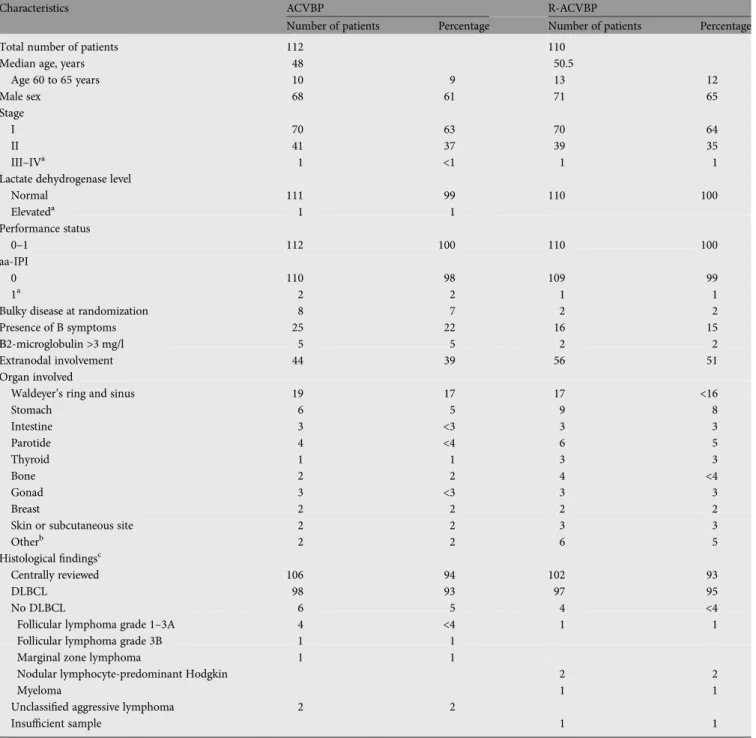
characteristics did not differ between the treatment groups (Table1). The pathological central review was carried out in 93% of the patients and confirmed DLBCL in 95% of them. Median age was 49 years (range 18 to 65 years), and 10% of the patients were older than 60. Stage I disease was diagnosed in 63% of the patients. Bulky disease was present in 4% of the cases. Forty-five percent of the patients had primary extranodal
disease (Table1). At the data cut-off point, 1 April 2009, the median follow-up was 43 months.
treatment and response
Ninety-nine percent of the patients in both arms received the three induction cycles. G-CSFs were administered to 80%, 89% and 87% of the patients during thefirst, second and third induction cycles, respectively, without any difference between the two groups. At the end of the treatment, CR/CRu was
observed in 105 (94%) patients treated with ACVBP chemotherapy and in 107 (97%) patients who received R-ACVBP (Table2). Progression occurred under treatment in three and in one patient treated with ACVBP and R-ACVBP, respectively.
safety
The most common toxic effects were represented by
hematological toxicity in both groups (Table3). A total of 209
Table 1. Patient characteristics
Characteristics ACVBP R-ACVBP
Number of patients Percentage Number of patients Percentage
Total number of patients 112 110
Median age, years 48 50.5
Age 60 to 65 years 10 9 13 12 Male sex 68 61 71 65 Stage I 70 63 70 64 II 41 37 39 35 III–IVa 1 <1 1 1
Lactate dehydrogenase level
Normal 111 99 110 100 Elevateda 1 1 Performance status 0–1 112 100 110 100 aa-IPI 0 110 98 109 99 1a 2 2 1 1
Bulky disease at randomization 8 7 2 2
Presence of B symptoms 25 22 16 15
Β2-microglobulin >3 mg/l 5 5 2 2
Extranodal involvement 44 39 56 51
Organ involved
Waldeyer’s ring and sinus 19 17 17 <16
Stomach 6 5 9 8 Intestine 3 <3 3 3 Parotide 4 <4 6 5 Thyroid 1 1 3 3 Bone 2 2 4 <4 Gonad 3 <3 3 3 Breast 2 2 2 2
Skin or subcutaneous site 2 2 3 3
Otherb 2 2 6 5
Histologicalfindingsc
Centrally reviewed 106 94 102 93
DLBCL 98 93 97 95
No DLBCL 6 5 4 <4
Follicular lymphoma grade 1–3A 4 <4 1 1
Follicular lymphoma grade 3B 1 1
Marginal zone lymphoma 1 1
Nodular lymphocyte-predominant Hodgkin 2 2
Myeloma 1 1
Unclassified aggressive lymphoma 2 2
Insufficient sample 1 1
a
Some included patients had an aa-IPI >0 at data review.
bOther categories include: spleen, bladder, gingival mucosa, bronchia, vagina and uterus cervix. cWHO classification was used.
AEs in the ACVBP arm and 183 AEs in the R-ACVBP group were reported, concerning 79 (71%) and 75 (68%) patients, respectively. Forty-seven SAEs were declared in the ACVBP group and 50 in the R-ACVBP arm, in 30 patients (27%) in each group. There were mainly related to infections (13 SAEs in the ACVBP group and 19 SAEs in the R-ACVBP group). There was one treatment-related death in the R-ACVBP arm, secondary to a pneumocystis jiroveci pneumonia.
outcome
Twenty-eight events were observed, 19 in the ACVBP arm (17% of the patients) and 9 in the R-ACVBP arm (8% of the patients). EFS differed significantly between the groups (P = 0.0487; HR 0.46) with a 3-year estimate of 82% (95% CI: 73% to 88%) in the ACVBP group and 93% (95% CI: 87% to 97%) in the R-ACVBP group (Figure1).
There were 23 relapses or progressions, 17 in the ACVBP arm and 6 in the R-ACVBP arm. All progressions occurred during the follow-up period, except for three patients in the ACVBP and for one in the R-ACVBP group who progressed during treatment. Progression in the initial site was observed in 15 out of 17 patients (88%) who relapsed after ACVBP and in 4 out of 6 patients (67%) who relapsed after R-ACVBP. Three of the 10 patients presenting bulky disease progressed, 2 after ACVBP and 1 after R-ACVBP. None of the patient developed CNS progression in this trial. PFS was significantly different (P = 0.0205; HR 0.37) with a 3-year estimates of 83% (95% CI: 74% to 89%) in the ACVBP group and 95% (95% CI: 89% to 98%) in the R-ACVBP group (Figure2). R-ACVBP treatment reduced the risk of experiencing a progression or death by 63% compared with ACVBP (P = 0.0261; HR 0.371). In a
multivariate analysis, PFS was independently affected by the treatment with chemo-immunotherapy (P = 0.0302; HR 0.324; 95% CI: 0.117 to 0.898) and by aβ2-microglobulin level ≥3 mg/l (P = 0.0164; HR 5.256; 95% CI: 1.355 to 20.382).
Fifteen of the 17 patients (88%) who progressed after ACVBP received salvage chemo-immunotherapy. Twelve
Table 2. Response to treatmenta
Characteristics ACVBP (n = 112) R-ACVBP (n = 110)
Number of patients Percentage Number of patients Percentage CR or CRu 105 94 107 97 PR 2 2 0 0 Primary failure 3 3 1 1 Death 0 0 1 1 Not evaluated 2 2 1 1 a
Response was assessed 1 month after the completion of the treatment in 212 assessable patients.
Table 3. Toxic effects according to treatment groups (safety population) ACVBP (n = 112) R-ACVBP (n = 110) Any grade Grade ≥3 Any grade Grade ≥3 Number of patients (%) with an event in at least one cycle
Anemia 99 (89) 23 (21) 94 (85) 21 (19) Neutropenia 88 (79) 81 (73) 90 (81) 84 (76) Thrombocytopenia 76 (68) 14 (13) 70 (63) 17 (15) Febrile neutropenia 49 (44) 49 (44) 39 (35) 39 (35) Infection in neutropenic period 17 (15) 10 (9) 17 (15) 15 (14) Infection out of neutropenic
period 11 (10) 2 (2) 17 (15) 4 (4) Vomiting 39 (35) 3 (3) 34 (31) 1 (1) Diarrhea 18 (16) 0 (0) 14 (13) 0 (0) Mucositis 62 (56) 21 (19) 60 (54) 12 (11) Cardiac toxicity 4 (4) 1 (1) 5 (5) 0 (0)
Coagulation and/or vascular toxicity 3 (3) 1 (1) 6 (6) 2 (2) Lung toxicity 13 (12) 1 (1) 11 (10) 3 (3) Aminotransferase elevation 36 (32) 2 (2) 28 (25) 0 (0) Creatinine elevation 6 (5) 0 (0) 6 (5) 0 (0) Neurologic toxicity 24 (22) 3 (3) 20 (18) 2 (2) Skin toxicity 28 (25) 0 (0) 17 (15) 1 (1) Other 62 (56) 11 (10) 64 (58) 8 (7)
Figure 1. Event-free survival among patients assigned to chemotherapy with doxorubicin, cyclophosphamide, vindesine, bleomycin and prednisone (ACVBP) regimen alone or to ACVBP plus rituximab.
Figure 2. Progression-free survival among patients assigned to
chemotherapy with doxorubicin, cyclophosphamide, vindesine, bleomycin and prednisone (ACVBP) regimen alone or to ACVBP plus rituximab.
(71%) achieved a CR, one (6%) a PR, three (18%) progressed and one patient was not evaluated for response. Eleven (65%) of them received an intensified regimen with autologous stem cell transplant. All the six patients who progressed following R-ACVBP received second-line chemo-immunotherapy, three (50%) achieving a CR and two (33%) a PR. The last patients did not respond to the salvage treatment. Four of these six patients (67%) went to autologous stem cell transplantation.
There were eight deaths at the time offinal analysis, four in each arm. OS did not significantly differ between the two groups (P = 0.686; HR 1.36) with a 3-year estimates of 97% (95% CI: 90% to 99%) in the ACVBP group and 98% (95% CI: 92% to 100%) in the R-ACVBP group (Figure3). The causes of deaths could be documented in all patients except for one in the R-ACVBP arm. Four deaths were related to lymphoma progression (three after ACVBP and one after R-ACVBP). One patient in the R-ACVBP group died because of toxicity of study treatment ( pneumocystic jiroveci pneumonia), one patient in each arm died for a reason unrelated to lymphoma or treatment.
discussion
The present randomized trial planned initially to recruit over 4 years 400 patients younger than 66 years of age, but a slow rate of inclusions resulted in a premature closure of the study. This was probably due to the increasing reluctance of the
investigators during this period of time to not administer rituximab even to these low-risk patients. However, a longer follow-up allowed this study to keep its 90% power and the expected level of significance despite a smaller patient population. In total, 222 patients were enrolled and we could demonstrate that the addition of rituximab to three cycles of ACVBP plus consolidation improves significantly the outcome of patients with localized low-risk DLBCL. We observed with a median follow-up of nearly 4 years a 3-year EFS of 93% for patients receiving chemo-immunotherapy compared with 82% for those treated with ACVBP. At this time, no difference in OS is observed, with 98% and 97% of the patients being alive in the respective groups.
The best treatment for localized aggressive non-Hodgkin lymphoma has been a topic of long debate in the pre-rituximab area. The SWOG 8736 randomized trial published by Miller et al. [4] demonstrated a longer PFS and OS following a treatment combining three cycles of CHOP with involved-field RT, compared with eight cycles of CHOP alone. However, long-term updated results of the study no longer demonstrated differences in survival because of an excess of late relapses in patients treated with combined chemo-radiotherapy [11]. Horning et al. [12] reported another trial conducted by the ECOG which randomly compared consolidative RT after eight cycles of CHOP in patients with limited stage aggressive lymphoma. The combined approach marginally improved the EFS but did not significantly affect the survival. Conversely, two randomized trials conducted by the GELA failed to show any benefit of consolidative RT after chemotherapy in this setting. The LNH 93-4 trial carried out in elderly patients treated for a low-risk localized aggressive lymphoma did not show any superiority of four cycles of CHOP plus RT over four cycles of CHOP alone [13]. In a younger population, similar to those of the present trial, the LNH93-1 trial compared three cycles of CHOP followed by RT with ACVBP and sequential consolidation without RT. Significantly longer EFS and OS were demonstrated for patients treated with ACVBP regimen, independently of the tumor stage and of the presence of bulky disease [5]. The present LNH 03-1B trial confirms the results obtained with ACVBP in the LNH 93-1 study and demonstrates an
additional improvement of EFS with the addition of rituximab. Along these last years, the dramatic improvement observed with the addition of rituximab to chemotherapy has called further into question the role of consolidative RT in localized DLBCL. In the MabThera International Trial (MInT), patients with favorable risk-localized DLBCL received six cycles of CHOP-like chemotherapy with or without rituximab and no radiation (except to bulky disease). When treated with rituximab-containing regimen, the subgroup of patients with no risk factor according to the IPI score had a 3-year PFS of 89% and 78% for non-bulky and bulky disease, respectively [7]. Obviously, these two trials are not fully comparable, and notably the impact of tumor bulk cannot be assessed in our current trial in which <5% of the patients presented bulky disease. Moreover, our study might include a larger proportion of patients with more favorable characteristics, stage I without bulky disease being not included in the MInT trial. In a phase II study carried out by the SWOG, patients with early-stage DLBCL were treated with three cycles of R-CHOP followed by involved-field RT. Most patients had one IPI risk factor, and the 88% PFS observed at 4 years was better compared with historical controls that included patients treated with chemo-radiotherapy without rituximab [14]. Another pilot study including patients with primary mediastinal B-cell lymphoma showed that rituximab combined with dose-adjusted EPOCH regimen provides 3-year EFS of 94% without consolidative RT [15]. Furthermore, Sehn et al. [16] demonstrated in a
retrospective analysis that patients presenting a DLBCL without any adverse prognostic factors of the IPI score and treated with R-CHOP had an excellent outcome with a 4-year PFS of 94%. Finally, a randomized trial carried out in young
Figure 3. Overall survival among patients assigned to chemotherapy with doxorubicin, cyclophosphamide, vindesine, bleomycin and prednisone (ACVBP) regimen alone or to ACVBP plus rituximab.
patients treated for DLBCL and an age-adjusted IPI of 1 was recently published and demonstrated a superiority of R-ACVBP over R-CHOP in term of EFS and OS [17].
It is remarkable that the 10% EFS improvement observed in the R-ACVBP arm in our study was obtained with four infusions of rituximab only. While the current standard of treatment for DLBCL usually consists in six to eight cycles of chemotherapy combined with eight doses of rituximab, the optimal dose and schedule of rituximab administration is not fully well established. Pfreundschuh et al. [18] have suggested that a rituximab dose-dense regimen could increase the treatment efficiency and improve the outcome of patients with poor-prognosis DLBCL, compared with historical controls receiving standard R-CHOP. Interestingly, our results suggest that the outcome of patients with low-risk disease may be improved by only four doses of rituximab. Of course, we cannot speculate if the results would have been the same using eight infusions of rituximab.
In conclusion, our study demonstrates that the outcome of low-risk patients treated for localized DLBCL can be improved by the addition of only four doses of rituximab to ACVBP. The hematological toxicity, while manageable, is higher compared with the one observed following R-CHOP, and we assume that a significant proportion of our patients might have been cured with this latter regimen. Finally, questions persist today regarding the best treatment of localized low-risk DLBCL. The majority of these patients are currently cured with rituximab-containing chemotherapy regimens, and whether some of them could benefit safely from a decreased treatment intensity remains to be determined. Only randomized trials will be able to answer this question, such as the FLYER trial initiated by the German group which compares six to four cycles of R-CHOP in the subset of DLBCL patients with very good prognosis. Moreover, it could be anticipated that PET-CT may represent an important tool to tailor more precisely the best treatment in this setting and to determine among this low-risk population which patients could safely benefit from a decrease in the treatment intensity. In that respect, the GELA has recently launched a randomized trial to evaluate the feasibility to adapt the treatment according the early response evaluated by PET-CT in patients with low-risk DLBCL treated with R-CHOP21.
funding
Group d’Etudes des Lymphomes de l’Adulte and Amgen.
disclosure
BCoi, OC, FM, HT and CH have served as consultants, on advisory board, or both, for Roche. NK, CT, CFer, JB, SB, BChr, TC, CR, DB, CFru, RD, CB, BA, CS and BF declare that they have no conflicts of interest.
references
1. Sweet DL, Kinzie J, Gaeke ME et al.. Survival of patients with localized diffuse histiocytic lymphoma. Blood 1981; 58: 1218–1223.
2. Connors JM, Klimo P, Fairey RN et al.. Brief chemotherapy and involvedfield radiation therapy for limited-stage, histologically aggressive lymphoma. Ann Intern Med 1987; 107: 25–30.
3. Cabanillas F, Bodey GP, Freireich EJ. Management with chemotherapy only of stage I and II malignant lymphoma of aggressive histologic types. Cancer 1980; 46: 2356–2359.
4. Miller TP, Dahlberg S, Cassady JR et al.. Chemotherapy alone compared with chemotherapy plus radiotherapy for localized intermediate- and high-grade non-Hodgkin’s lymphoma. N Engl J Med 1998; 339: 21–26.
5. Reyes F, Lepage E, Ganem G et al.. ACVBP versus CHOP plus radiotherapy for localized aggressive lymphoma. N Engl J Med 2005; 352: 1197–1205. 6. Coiffier B, Lepage E, Briere J et al.. CHOP chemotherapy plus rituximab
compared with CHOP alone in elderly patients with diffuse large-B-cell lymphoma. N Engl J Med 2002; 346: 235–242.
7. Pfreundschuh M, Trümper L, Osterborg A et al.. CHOP-like chemotherapy plus rituximab versus CHOP-like chemotherapy alone in young patients with good-prognosis diffuse large-B-cell lymphoma: a randomised controlled trial by the MabThera International Trial (MInT) Group. Lancet Oncol 2006; 7: 379–391. 8. Swerdlow SH, Campo E, Harris NL et al.. World Health Organization Classification
of Tumours of Haematopoietic and Lymphoid Tissues. Lyon, France: IARC Press 2008.
9. The International Non-Hodgkin’s Lymphoma Prognostic Factors Project. A predictive model for aggressive non-Hodgkin’s lymphoma. N Engl J Med 1993; 329: 987–994.
10. Cheson BD, Horning SJ, Coiffier B et al.. Report of an international workshop to standardize response criteria for non-Hodgkin’s lymphomas. NCI Sponsored International Working Group. J Clin Oncol 1999; 17: 1244.
11. Miller TP, Leblanc M, Spier PM et al.. CHOP alone compared to CHOP plus radiotherapy for early stage aggressive non-Hodgkin’s lymphoma: update of the Southwest Oncology Group (SWOG) randomized trial. Blood 2001; 98(Suppl.): S742–S743.
12. Horning SJ, Weller E, Kim K et al.. Chemotherapy with or without radiotherapy in limited-stage diffuse aggressive non-Hodgkin’s lymphoma: Eastern Cooperative Oncology Group study 1484. J Clin Oncol 2004; 22: 3032–3038. 13. Bonnet C, Fillet G, Mounier N et al.. CHOP alone compared with CHOP plus
radiotherapy for localized aggressive lymphoma in elderly patients: a study by the Groupe d’Etude des Lymphomes de l’Adulte. J Clin Oncol 2007; 25: 787–792. 14. Persky DO, Unger JM, Spier CM et al.. Phase II study of rituximab plus three
cycles of CHOP and involved-field radiotherapy for patients with limited-stage aggressive B-cell lymphoma: Southwest Oncology Group study 0014. J Clin Oncol 2008; 26: 2258–2263.
15. Dunleavy K, Pittaluga S, Janik J et al.. Primary mediastinal large B-cell lymphoma (PMBL) outcome is significantly improved by the addition of rituximab to dose adjusted (DA)-EPOCH and overcomes the need for radiation. Blood 2005; 106(Suppl.): 929a.
16. Sehn LH, Berry B, Chhanabhai M et al.. The revised International Prognostic Index (R-IPI) is a better predictor of outcome than the standard IPI for patients with diffuse large B-cell lymphoma treated with R-CHOP. Blood 2007; 109: 1857–1861.
17. Recher C, Coiffier B, Haioun C et al.. A prospective randomized study comparing dose intensive immuno-chemotherapy with R-ACVBP versus standard R-CHOP in younger patients with diffuse large B-cell lymphoma (DLBCL). Groupe d’Etude des Lymphomes de l’Adulte (GELA) Study LNH03–2B. Lancet 2011; 378: 1858–1867.
18. Pfreundschuh M, Zeynalova S, Poeschel V et al.. Improved outcome of elderly patients with poor-prognosis diffuse large B-cell lymphoma (DLBCL) after dose-dense rituximab: results of the Dense-R-CHOP-14 trial of the German High-Grade Non-Hodgkin Lymphoma Study Group (DSHNHL). J Clin Oncol 2008; 26: 8508a.