LONG-TERM TECHNOLOGY
ASSESSMENT
Mortality, Hospitalization, and Work Loss Due
to Peptic Ulcer and Gastritis/Duodenitis in the
Federal Republic of Germany
Bernard S. Bloom
University of Pennsylvania
Urs Gessner
Interdisciplinary Research Center for Public Health, Switzerland
Abstract
Once the effects of short-term data analysis of new medical technology appear clear, additional or long-term analyses are infrequently performed on subsequent information. This often leads to incomplete
understanding of the technology's full medical, social, and economic effects.
Available data for the Federal Republic of Germany on mortality, hospitalization, and work loss due to gastric and duodenal ulcer and gastritis/duodenitis allowed long-term analysis of direct and in-direct impacts on the population from 1975 through 1984. Mortality rates declined for all ages (p < 0.01) except for those age 75 and older, and nearly equally for all study diagnoses. Hospital discharge rates for all diagnoses rose slowly and steadily, while those for persons diagnosed with gastric ulcer, duo-denal ulcer or gastritis/duodenitis declined sharply (p = 0.04). Declines of hospital discharges were greater for men than for women. The ongoing decline in rates of mortality and hospital discharges increased after 1977. Rates of work loss per 10,000 population-at-risk for study diagnoses were either stable or increasing until 1979, after which there was a marked decline (p = 0.03 for gastric ulcer, p = 0.02 for duodenal ulcer, p = 0.008 for gastritis/duodenitis). Work loss due to study diseases declined as a percentage of work loss for all diseases during the later study years. Only by examining many years' data could the accelerating declines be discerned, not only for mortality and hospitalizations, which have been examined before, but also for work loss, an infrequently analyzed effect of disease.
INTRODUCTION
Medicine is replete with examples of inadequately or incorrectly assessed technology. Internal mammary artery ligation for angina pectoris and extracranial-intracranial by-This work was funded by a grant from Smith Kline & French Laboratories, Philadelphia, PA, U.S.A.
216 BLOOM AND GESSNER
pass for reduced cerebral blood flow are but two dramatic examples of therapies that were introduced amidst great hope for success, used for some years, but, when finally tested by controlled clinical trial, were found to have no value.
Admittedly, these are extreme examples. More to the point of this article, which is concerned with population effects of peptic ulcer and gastritis/duodenitis, it is not that the technology currently used as the major treatment was not tested; rather, the first histamine H2 receptor antagonist was very well tested and found to be efficacious in treatment of duodenal ulcer. In addition, it was the first new technology subjected to cost-effectiveness analysis soon after clinical availability (2;4). Unfortunately, how-ever, nearly all evaluations were of the short time period immediately following wide-spread introduction.
Computerized axial tomography (CT) is a different example. Its introduction was followed by hundreds of studies defining its role, use, usefulness, substitutibility, diffu-sion, and cost. But few studies of CT have appeared in recent years reassessing original issues and hypotheses with many years' worth of data, experience, and judgment.
Studies of peptic ulcer disease clearly showed declines of prevalence and incidence of disease, and concomitant declines in adverse outcome and resource use, e.g., opera-tions, that were underway for decades. In addition, previously steady rates of decline increased soon after introduction of the first H2 blocker. However, this observation did not go unquestioned as some suggested that a cohort effect was responsible for these declines (14; 15), while others pointed to changes in lifestyle such as reductions of smoking (9), the introduction of fibreoptic endoscopy and changes in methods of coding data (8). Additionally, Fineberg and Pearlman (5) questioned whether the new rate of decline following the introduction of the first H2 blocker was but a short-term gain or whether a new trend was underway, and further asked whether there might not be a rebound phenomenon: Was the reduction of hospitalizations and operations for peptic ulcer only a delay caused by the new drug? Would there be a return at some future time to a higher level, if not to the original trends?
A 1983 study by Horisberger reviewed changes due to peptic ulcer disease in the Federal Republic of Germany from the early 1970s to 1980 (6). He found important declines beginning in 1977 in mortality, hospitalizations, and absenteeism from work due to peptic ulcer, primarily due to changes of duodenal ulcer. But, his study, coming as it did so soon after the advent of H2 antagonists, could not determine whether new trends had been established or whether persons with other gastrointestinal diseases would also benefit. Other investigators found similar results in comparable countries, including the United States, Netherlands, United Kingdom, and Sweden (2;3;4;5;7;17). All suggested that uniformly sharp declines, mainly of hospitalizations and opera-tions, were due to the introduction of H2 blockers.
The case to be made here is that only through periodic or continuous long-term assessment can the full effects of any technology be documented. For example, only by examining many decades of data was it found that tuberculosis death rates were declining long before any effective therapy was available (11;12).
STUDY DESIGN
The social security system (Gesetzliche Krankenversicherung) of the Federal Republic of Germany (FRG) requires that every employed person have health insurance. Each must be a member of a recognized sick fund (Gesetzliche Krankenkasse) that insures
against the costs of preventive measures, ambulatory and hospital care for acute ill-ness, and rehabilitation; each also provides sick pay as well as pensions for those dis-abled by illness and no longer able to work. Premiums are paid by both employee and employer (13).
The largest health insurance sick fund organization in FRG is Allgemeine Ort-skrankenkasse, or AOK (Federal Association of Community Sick Funds). It is comprised of 270 insurers and covers about 50% of all insured persons. The total and distribution of the population covered have remained relatively unchanged over the past few years. The AOK data system was used to track a relatively stable population over time to measure changes in resource use and outcome of gastric and duodenal ulcer and gastritis/duodenitis. Direct medical effects examined included mortality and hospital-ization; work loss, one indirect effect, was also measured. Although early assessments showed immediate changes after introduction of histamine H2 receptor antagonists for persons with peptic ulcer, questions remained of long-term impact on population, disease, and societal use of medical care resources.
Data from AOK on work loss and hospitalization due to gastric and duodenal ulcer and gastritis/duodenitis were used for analysis. Data on mortality were obtained from the World Health Organization for the entire FRG population.
As of 1984, the total population of the FRG numbered approximately 62 million; 16.5 million (26.4%) were members of AOK. Of the total working population of 25.2 million, 64.3% were compulsory members of AOK.
AOK has compiled and published statistics on population, disease, resource utili-zation, and outcome since the 1960s. However, certain caveats regarding this large data base are in order. First, AOK prepared its statistics for administrative and pay-ment purposes and not for research objectives. Second, there were changes during the study period in diagnostic classification and coding. Prior to 1976, AOK used its own coding scheme while after 1976 the International Classification of Diseases was used. Data from both periods were made comparable by AOK, but classification problems probably remained.
Data for our study comprised age-, sex-, and disease-specific numbers and rates per 10,000 AOK compulsory members for hospital discharges and work loss (number of cases, and days of absence per case) for the years 1975-1984, inclusive, and mortal-ity rates per 10,000 total FRG population for 1972-1985, attributed to peptic ulcer (ICD-9-CM 531 and 532) and gastritis/doudenitis (ICD-9-CM 535). These data ex-pand on earlier work of Horisberger (6) and Sonnenberg (14).
Analyses centered on identifying changes over time in each variable studied. Changes were evaluated by linear regression, where linear or near-linear changes were observed, or regression on a logarithmic scale, in instances where exponential changes were found.
RESULTS Mortality
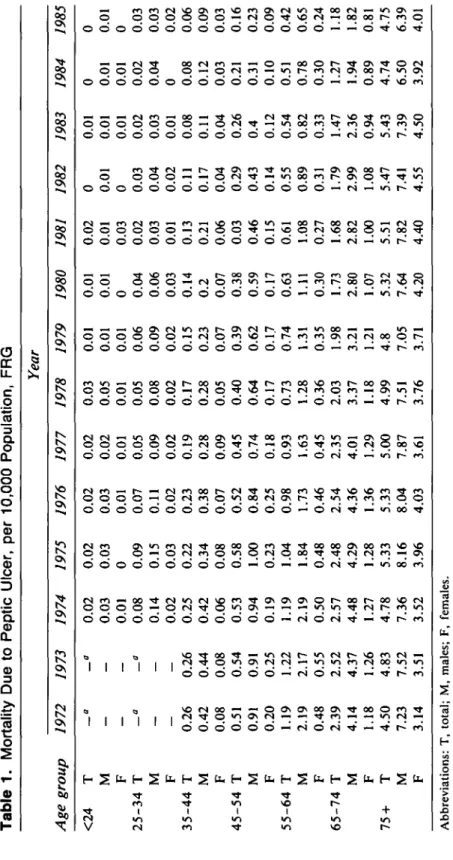
Mortality from peptic ulcer in the Federal Republic of Germany declined slowly and irregularly prior to 1977 (Table 1). After 1977, the rate of decline increased, especially for populations less than 65 years old; slower but steady reductions were also found for men and women aged 65-74. Among those aged 75 and above, mortality remained
Tabl e 1 . Mortalit y Du e t o Pepti c Ulcer , pe r 10,00 0 Population , FR G Age group <2 4 25-3 4 35-4 4 45-5 4 55-6 4 65-7 4 7 5 + T M F T M F T M F T M F T M F T M F T M F 1972 a — — a 0.2 6 0.4 2 0.0 8 0.5 1 0.9 1 0.2 0 1.1 9 2.1 9 0.4 8 2.3 9 4.1 4 1.1 8 4.5 0 7.2 3 3.1 4 1973 a — — a 0.2 6 0.4 4 0.0 8 0.5 4 0.9 1 0.2 5 1.2 2 2.1 7 0.5 5 2.5 2 4.3 7 1.2 6 4.8 3 7.5 2 3.5 1 1974 0.0 2 0.0 3 0.0 1 0.0 8 0.1 4 0.0 2 0.2 5 0.4 2 0.0 6 0.5 3 0.9 4 0.1 9 1.1 9 2.1 9 0.5 0 2.5 7 4.4 8 1.2 7 4.7 8 7.3 6 3.5 2 1975 0.0 2 0.0 3 0 0.0 9 0.1 5 0.0 3 0.2 2 0.3 4 0.0 8 0.5 8 1.0 0 0.2 3 1.0 4 1.8 4 0.4 8 2.4 8 4.2 9 1.2 8 5.3 3 8.1 6 3.9 6 1976 0.0 2 0.0 3 0.0 1 0.0 7 0.1 1 0.0 2 0.2 3 0.3 8 0.0 7 0.5 2 0.8 4 0.2 5 0.9 8 1.7 3 0.4 6 2.5 4 4.3 6 1.3 6 5.3 3 8.0 4 4.0 3 1977 0.0 2 0.0 2 0.0 1 0.0 5 0.0 9 0.0 2 0.1 9 0.2 8 0.0 9 0.4 5 0.7 4 0.1 8 0.9 3 1.6 3 0.4 5 2.3 5 4.0 1 1.2 9 5.0 0 7.8 7 3.6 1 Year 1978 0.0 3 0.0 5 0.0 1 0.0 5 0.0 8 0.0 2 0.1 7 0.2 8 0.0 5 0.4 0 0.6 4 0.1 7 0.7 3 1.2 8 0.3 6 2.0 3 3.3 7 1.1 8 4.9 9 7.5 1 3.7 6 1979 0.0 1 0.0 1 0.0 1 0.0 6 0.0 9 0.0 2 0.1 5 0.2 3 0.0 7 0.3 9 0.6 2 0.1 7 0.7 4 1.3 1 0.3 5 1.9 8 3.2 1 1.2 1 4. 8 7.0 5 3.7 1 1980 0.0 1 0.0 1 0 0.0 4 0.0 6 0.0 3 0.1 4 0. 2 0.0 7 0.3 8 0.5 9 0.1 7 0.6 3 1.1 1 0.3 0 1.7 3 2.8 0 1.0 7 5.3 2 7.6 4 4.2 0 1981 0.0 2 0.0 1 0.0 3 0.0 2 0.0 3 0.0 1 0.1 3 0.2 1 0.0 6 0.0 3 0.4 6 0.1 5 0.6 1 1.0 8 0.2 7 1.6 8 2.8 2 1.0 0 5.5 1 7.8 2 4.4 0 1982 0 0.0 1 0 0.0 3 0.0 4 0.0 2 0.1 1 0.1 7 0.0 4 0.2 9 0.4 3 0.1 4 0.5 5 0.8 9 0.3 1 1.7 9 2.9 9 1.0 8 5.4 7 7.4 1 4.5 5 1983 0.0 1 0.0 1 0.0 1 0.0 2 0.0 3 0.0 1 0.0 8 0.1 1 0.0 4 0.2 6 0. 4 0.1 2 0.5 4 0.8 2 0.3 3 1.4 7 2.3 6 0.9 4 5.4 3 7.3 9 4.5 0 1984 0 0.0 1 0.0 1 0.0 2 0.0 4 0 0.0 8 0.1 2 0.0 3 0.2 1 0.3 1 0.1 0 0.5 1 0.7 8 0.3 0 1.2 7 1.9 4 0.8 9 4.7 4 6.5 0 3.9 2 1985 0 0.0 1 0 0.0 3 0.0 3 0.0 2 0.0 6 0.0 9 0.0 3 0.1 6 0.2 3 0.0 9 0.4 2 0.6 5 0.2 4 1.1 8 1.8 2 0.8 1 4.7 5 6.3 9 4.0 1 Abbreviations : T , total ; M , males ; F , females . " No t available .
Table 2. Hospital Discharges, per 10,000 Population, FRG Diagnosis Gastric ulcer Cases Days LOS Duodenal ulcer Cases Days LOS Gastritis/duodenitis Cases Days LOS 1975 14.8 388.0 26.3 15.0 390.8 25.4 14.9 283.7 18.8 1976 15.4 404.2 26.5 16.7 429.3 25.6 15.0 290.7 19.2 1977 13.2 297.4 22.4 16.4 362.8 22.0 12.7 212.3 16.6 1978 11.7 250.5 21.2 15.1 323.5 21.3 13.2 210.0 15.8 Year 1979 11.0 231.0 21.1 14.0 284.8 20.3 12.8 195.5 15.2 1980 10.2 207.6 20.5 13.4 271.5 25.6 12.2 183.0 14.8 1981 9.5 188.5 19.7 12.1 236.5 19.5 11.2 171.2 15.2 1982 9.2 183.4 19.8 9.2 179.7 19.3 8.8 128.6 14.6 1983 9.3 178.2 19.2 8.6 160.6 18.6 7.8 113.6 14.4 1984 8.5 157.6 18.5 8.6 155.6 17.9 7.6 109.0 14.4 Abbreviation: LOS, length of stay.
relatively unchanged among males, and increased among females, similarly to results from studies of the British population (12).
In the mid-1970s, peptic ulcer mortality varied between 0.01-0.2/10,000 in the youn-gest groups, rising exponentially with age to 3.0-8.1/10,000 for the oldest group (Ta-ble 1). In all years, for all ages and sexes, mortality was always less than 1/10,000 until ages 55-64 for males. It did not rise to this level for females until ages 65-74. By 1985, mortality was 0.01-0.08/10,000 for the youngest and 0.5-6.4/10,000 for the oldest age groups. The 4- to 5-fold mortality differential favoring young females over young males declined to a 1- to 2-fold favorable difference by the oldest age group. Additionally, within age groups the greater differential favoring females in the 1970s was much reduced by the mid-1980s. Reductions for men were 8-12% and for women 5-10% per annum; the younger the group, the greater was the decrease. Decreases of peptic ulcer mortality for each age-specific group, except among those 75 years old and above, was significantly different between 1972-1977 and 1978-1985 (p < 0.001). Among women aged 75 and older, mortality actually increased (p = 0.006).
Hospitalization
Hospital discharges for all diseases rose steadily over time among the populations insured by AOK without important changes in population age and sex distribution, from 908.9/10,000 in 1975 to 1310.0/10,000 in 1984. In contrast, the rate of hospital discharges for people diagnosed with gastric or duodenal ulcer or gastritis/duodeni-tis, constant during 1972-1975 (2), declined sharply and steadily, especially after 1977 (Table 2).
Rates of hospital discharges for gastric ulcer among men were essentially halved during the 10-year study period, from 19.0/10,000 in 1975 to 16.8 in 1977 to 10.4 in 1984 (Figure 1). The rate per 10,000 males for duodenal ulcer increased from 19.5 in 1975 to 21.1 in 1977 and then began a steady decline to 10.7 in 1984. For women, gastric
220 BLOOM AND GESSNER 4 0 o o J - 30-• 20- 10-Men Women 1975 76 77 78 79 80 81 82 83 84 Year
Figure 1. Hospital discharges for peptic ulcer, by sex, per 100,000 population, FRG.
50-. 40^ o o © 20-CO a. I OH Men Women 1975 76 77 78 79 80 81 82 83 84 Year
Figure 2. Hospital discharges for gastritis/duodenitis, by sex, per 100,000
popula-tion, FRG.
ulcer hospital discharge rates were reduced from 6.3/10,000 in 1975 to 4.8/10,000 in 1984; those for duodenal ulcer increased by 14.8% from 1975 to 1977 (6.1 to 7.0/10,000) and then fell by 36.8% (6.9 to 4.4/10,000) from 1978 to 1984. Hospital discharge rates for gastritis/duodenitis for both males and females were also halved between 1975 and 1984, with the major decline occurring post-1978 (Figure 2).
The differential in hospital discharge rates between males and females, for gastric and duodenal ulcer, remained relatively constant over time, at 2.5-3:1 in favor of fe-males. However, the differential for gastritis/duodenitis favoring females was reduced from 1.7:1 in 1975 to 1.3:1 in 1984.
There were two distinct reductions in hospital discharges. The first came in 1978, the first full year of H2 antagonist use in the FRG, with declines in the rates of 14.3%
90- 80- 70-00 0 o CD OS CC 6 0 5 0 4 0 3 0 2 0 -Duodenal Ulcer -m—• Gastric Ulcer I975 76 77 78 79 80 81 82 83 84 Year
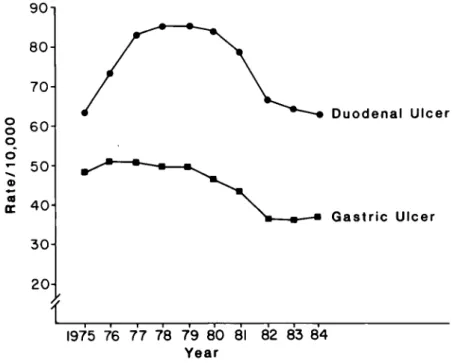
Figure 3. Work loss cases due to peptic ulcer per 100,000 population-at-risk, FRG.
for gastric ulcer, 1.8% for duodenal ulcer, and 13.5% for gastritis/duodenitis. An-other sharp decline occurred in 1982; 3.2% for gastric ulcer, 24.0% for duodenal ulcer, and 21.4% for gastritis/duodenitis.
Days spent in the hospital for peptic ulcer per 10,000 declined faster than disease rates (Table 2). Between 1977 and 1978 the reduction was 26.4% for gastric ulcer and 15.5% for duodenal ulcer, while for gastritis/duodenitis it was 27.0%. By 1984, days in the hos-pital/10,000 AOK population were less than half their 1977 rate.
Length of stay also showed steady decline throughout the study period, with the major discontinuity occurring between 1977 and 1978. Length of stay in 1984 relative to that of 1975 was nearly 30% lower for gastric and duodenal ulcer patients and 23.4% lower for those hospitalized with gastritis/duodenitis. The reduction in mean length of stay for patients with peptic ulcer was significantly more rapid than for all diag-noses (-0.83 vs. -0.56 days per annum, respectively, p = 0.04).
Work Loss
Figure 3 shows that the rate of cases of work loss for the population-at-risk due to gastric ulcer was stable through 1979. It declined by 18.7% between 1979 and 1982
(p = 0.03) and remained fairly constant thereafter. Absenteeism due to duodenal ulcer,
on the other hand, increased by one-third between 1975 and 1977 and was stable through 1980. Between 1980 and 1984, the rate declined by 24.4% (p = 0.02).
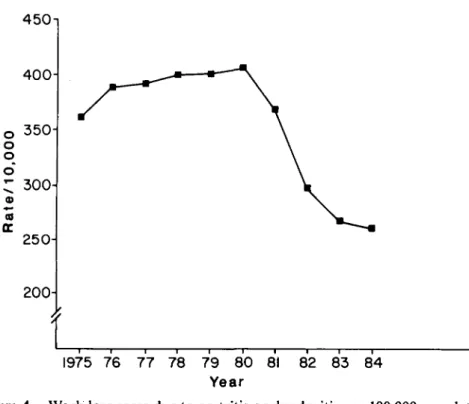
Rates of cases of work loss due to gastritis/duodenitis rose 15.0% between 1975 and 1980 (Figure 4). A sharp decline occurred after 1980 and a nadir of 275/10,000 was reached in 1984, 37.2% lower than the rate of 438/10,000 in 1980 (p = 0.008).
222 BLOOM AND GESSNER o o o 450-i 400- 350-
300-
250- 200-1975 76 77 78 79 80 81 82 83 84 YearFigure 4. Work loss cases due to gastritis or duodenitis per 100,000 population-at-risk, FRG.
Peptic ulcer disease accounted for approximately 70% of days of work loss rela-tive to gastritis/duodenitis (Table 3). While work loss due to peptic ulcer disease oc-curred less frequently, the length of absenteeism per case was longer than for gas-tritis/duodenitis (Figures 3 and 4).
Days lost from work/10,000 population-at-risk due to peptic ulcer decreased slowly during the 1970s (Table 3). The rate of decline quickened after 1979, sharper for duo-denal than gastric ulcer. Days of work loss due to gastric ulcer declined 19.8% from 2,212 days/10,000 in 1975 to 1,775 in 1979. Between 1980 and 1984 the decline was 34.5%, from 1,694 to 1,110 days/10,000 (p = 0.02 for difference in slope 1975-1979 and 1980-1984). Work loss days/10,000 population-at-risk for duodenal ulcer rose and fell irregularly between 1975 and 1979. However, between 1980 and 1984 the number of days declined by 40.6%, from 2,752 days/10,000 to 1,635 (p = 0.03).
Number of days absent from work due to gastritis/duodenitis was fairly constant during the 1975-1979 period. They declined by 45.1% between 1980 and 1984, from 5,834 to 3,201/10,000 (p = 0.009).
Reductions in days lost from work/10,000 females-at-risk were slightly less than for males. The differential, 30-33% favoring females in 1975-1977, declined to 17-19% by 1983-1984. Additionally, the annual decline, particularly after 1979, varied more for females than males.
The number of days of work loss from 1975-1977 was stable for peptic ulcer disease and gastritis/duodenitis per 1,000 days of work loss for all diagnoses (Table 3). Begin-ning in 1978, a marked decline began that continued through 1984, totalling 38.7%
Tabl e 3 . Day s o f Wor k Los s pe r 10,00 0 Population-at-Risk , FR G Diagnosis Al l diagnose s Gastri c ulce r Duodena l ulce r Gastritis/duodeniti s Pepti c ulce r an d gastritis / duodeniti s wor k los s pe r 100 0 day s o f wor k los s fo r al l diagnose s 1975 205,10 0 2,21 2 2,72 8 5,76 0 52. 2 1976 215,50 0 2,18 2 2,96 9 6,08 9 52. 2 1977 207,70 0 1,99 3 2,98 3 5,92 6 52. 5 1978 218,30 0 1,82 8 2,87 2 5,85 9 48. 4 Year 1979 224,40 0 1,77 5 2,82 4 5,77 8 46. 2 1980 228,10 0 1,69 4 2,75 2 5,83 4 45. 1 1981 216,30 0 1,46 6 2,54 3 5,00 6 41. 7 1982 187,50 0 1,20 5 1,88 2 3,71 0 36. 2 1983 187,50 0 1,11 2 1,67 9 3,13 4 33. 5 1984 176,80 1,11 1,63 3,20 32.
224 BLOOM AND GESSNER
over 7 years. The annual changes were similar for gastric and duodenal ulcer and gas-tritis/duodenitis relative to all diseases.
Absenteeism due to peptic ulcer and gastritis/duodenitis accounted for about 5% of the total of all days lost from work due to all diseases in 1975. In absolute terms, 11,000 days of work lost per 10,000 population-at-risk in 1975 were accounted for by study persons as opposed to 205,100 days lost from work per 10,000 for all diagnoses. By 1984 the proportion of days lost from work due to peptic ulcer and gastritis/duode-nitis declined to 3% of the total.
Two main causes can account for much of the overall decline of work loss for all diagnoses. First, during the 1970s, days of absenteeism per case decreased at an average rate of 0.3% per annum. Second, the number of cases and days lost from work declined significantly after 1980 and was especially pronounced in 1981 and 1982
(p = 0.002, 1975-1979 vs. 1980-1984). Although the reasons for this latter decline are
unknown, external economic factors were most likely the cause.
The sharp decline in 1982 for persons with peptic ulcer disease and gastritis/duode-nitis paralleled the decline in work loss for all diseases. However, the rate of decline for all diagnoses slowed substantially after 1982, while absenteeism due to peptic ulcer and gastritis/duodenitis declined nearly twice as rapidly as absenteeism due to all dis-eases (15% mean decline per year vs. 8% mean annual decline, respectively, p = 0.01). In 1975, 20% of persons out of work with peptic ulcer were hospitalized, with a mean length of stay of 26.3 days (Table 2). In 1984, one-sixth of peptic ulcer patients absent from work were hospitalized for a mean of 18.0 days. Thus, fewer patients out of work with peptic ulcer were hospitalized in 1984, and when they were, stayed a mean of 30.8% fewer days than in 1975 (p = 0.0007).
In 1975,3.5% of persons absent from work because of gastritis or duodenitis were hospitalized and had a mean length of stay of 18.8 days. In 1984, 2.2% (37.1% fewer) were hospitalized for 14.4 days on average, 26.3% fewer days than in 1975 (p = 0.009).
Although the mean number of hospital days declined by about 20% between 1975 and 1977 for absenteeism resulting from peptic ulcer and gastritis/duodenitis, between 1977 and 1981 a near exponential decrease occurred; declines continued through 1984, but at a reduced rate from that of 1977-1981. The reduction of hospital days for those with work loss due to peptic ulcer (averaging 10.7% per annum) was significantly greater than reductions for those with gastritis/duodenitis (5.1% per annum on average)
(p = 0.006).
In 1975, about 17% of all days absent from work due to peptic ulcer were spent in hospitals; by 1984 in-patient days declined to about 12% of all days lost from work
(p = 0.004). For persons with gastritis/duodenitis, about 5% of days absent from work
in 1975 were spent in the hospital while in 1984 approximately 3% of work loss days were spent in the hospital (p = 0.04). Thus, the proportion of days absent from work that were spent in the hospital declined by an average of 7% and 4.4% per annum, respectively, for those with peptic ulcer and gastritis/duodenitis. (The difference between the two rates of decline was not significant.)
DISCUSSION
There are medical, economic, and political reasons for assessing medical care technol-ogies. First, medical decisions are made under conditions of risk and uncertainty. Second, decisions made for individual patients have societal implications. Third,
re-sources are finite. And fourth, choices or trade-offs must often be made among mul-tiple options. Technology assessment can reduce the level of uncertainty and therefore increase the probability of success by evaluating and influencing medical, economic, and political decisions.
If every health care technology were like penicillin, with its extraordinarily posi-tive medical, economic, and social effects, rather little technology assessment would need to be done. But most technologies are usually only marginally different from existing alternatives, and real questions of efficacy and cost-effectiveness exist.
In addition, time is often overlooked in much of technology assessment. It is an additional factor usually included only in epidemiologically based studies, while it is often noted by its absence in most other evaluations. (Time is here defined as long-term, at least 10 years following introduction of any new technology.) Beyond elucidating medical and economic effects of new technology, time allows measured assessment of political issues and implications. For example, 20 years after its initial introduction, Waitzkin offered a Marxist interpretation of the reasons for rapid ac-ceptance of coronary intensive care units for the treatment of acute heart disease without any good evidence for their efficacy or cost-effectiveness (16). His hypothesis was coun-tered by alternate explanations (1), and a spirited public debate ensued allowing mul-tiple perspectives to be discussed (10). The objective of all such analysis is to learn useful lessons and to not repeat too many of our previous mistakes.
The issue raised by Fineberg and Pearlman remained even though all early studies found a discontinuous break in previous resource utilization trends for peptic ulcer. Other questions that went unanswered with early, short-term analyses included whether effects observed for duodenal ulcer would be replicated for gastric ulcer and other related gastrointestinal diseases, and whether changes of indirect effects would be com-parable to those of direct medical effects. The problem was that most studies analyzed only 2-4 years of data following the introduction of H2 blockers. There were decades
of prior peptic ulcer data clearly establishing long-term ulcer disease trends (5;8;9; 10;14;15).
Although the reasons for the decline of peptic ulcer disease over time are still being debated, the introduction of H2 blockers is associated with an increase in the rate of
decline. Accelerated reductions of mortality and hospitalizations occurred in the year following the first use of H2 blockers in the FRG, but comparable changes were not
observed for work loss until 3 years later.
The many years of data available for this review showed that the declining trend in the FRG for peptic ulcer previously noted by Horisberger (6) continues. There is no evidence of a rebound phenomenon, but rather all the evidence confirms a new trend. Additionally, and unexpectedly, declining trends were also found for hospitaliza-tions and work loss due to gastritis/duodenitis. These results were not observed in any of the early short-term assessments of H2 antagonist impact on peptic ulcer disease.
Thus, it is only through continued and long-term assessment that the full effects of any technology can be elucidated and measured. Certainly, this analysis should not be considered the final word either, but rather we should return again to the question in the future. The passage of time allows change to be appreciated most fully.
REFERENCES
1. Bloom, B. S. Stretching idealogy to the utmost: Marxism and medical technology.
226 BLOOM AND GESSNER
2. Bulthuis, R. Cimetidine and the cost of peptic ulcer in The Netherlands. Effective Health Care, 1984, 1, 297-311.
3. Coggon, D., Lambert, P., & Langman, M. J. S. Twenty years of hospital admission for peptic ulcer in England and Wales. Lancet, 1981, i, 1302-04.
4. Culyer, A. J., & Maynard, A. K. Cost-effectiveness of duodenal ulcer treatment. Social Science and Medicine, 1981, 15c, 3-11.
5. Fineberg, H. V., & Pearlman, L. A. Surgical treatment of peptic ulcer in the United States. Lancet, 1981, ii, 1305-07.
6. Horisberger, B. A review of the epidemiological development of peptic ulcers and an evalu-ation of duodenal ulcers in the Federal Republic of Germany before and after cimetidine. In A. J. Culyer & B. Horisberger (eds.), Economic and medical evaluation of health care technologies. Berlin: Springer-Verlag, 1983.
7. Jonsson, B. A review of the macroeconomic evaluation of cimetidine. In A. J. Culyer & B. Horisberger (eds.), Economic and medical evaluation of health care technologies. Berlin: Springer-Verlag, 1983.
8. Kurata, J. H., Elashoff, J. D., Haile, B., & Honda, G. D. A reappraisal of time trends in ulcer disease: Factors related to changes in ulcer hospitalization and mortality rates. Amer-ican Journal of Public Health, 1983, 73, 1066-72.
9. Kurata, J. H., Elashoff, D. D., Nogawa, A. N., & Haile, B. M. Sex and smoking differences in duodenal ulcer mortality. American Journal of Public Health, 1986, 76, 700-02. 10. Letters to the editor. American Journal of Public Health, 1980, 70, 436-38.
11. McKeown, T., & Record, R. G. Reasons for the decline of mortality in England and Wales during the nineteenth century. Population Studies, 1962, 16, 94-122.
12. McKinley, J. B., & McKinley, S. M. The questionable contribution of medical measures to the decline of mortality in the United States in the twentieth century. Milbank Memorial Fund Quarterly, 1977, 55, 405-28.
13. Raffel, M. W. Comparative Health Systems. University Park: Pennsylvania State Univer-sity Press, 1984.
14. Sonnenberg, A. Disability pensions due to peptic ulcer in Germany between 1953 and 1983. American Journal of Epidemiology, 1985, 122, 106-11.
15. Susser, M. Period effects, generation effects and age effects in peptic ulcer mortality. Journal of Chronic Diseases, 1982, 35, 29-40.
16. Waitzkin, H. A Marxian interpretation of the growth and development of coronary care technology. American Journal of Public Health, 1979, 69, 1260-68.
17. Walt, R., Katschienski, B., Logan, R., Ashlay, J., & Langman, M. Rising frequency of ulcer perforation in elderly people in the United Kingdom. Lancet, 1986, i, 489-92.