Soz Praventiv Med. 51 (2006) 273–280 0303-8408/06/050273–08
1 Institute of Social and Preventive Medicine, University of Zurich, Switzerland 2 Department of Public Health Sciences, University of Hawaii, USA
3
Department of Psychology, University of Basle, Switzerland
Transtheoretical Model-based exercise counselling for older adults
in Switzerland: quantitative results over a 1-year period
Submitted: 31 May 2005 Accepted: 8 June 2006
Summary
Objectives: To develop and test a counselling programme based on the Transtheoretical Model of behavioural change, for promoting exercise in people over the age of 65.
Method: The sample (n = 448) consisted of women and men aged between 65 and 92, recruited from Swiss GPs’ practices between 2000 and 2004. After a baseline measurement (T1) and an initial counselling session, they received two counsel-ling sessions, followed by a 12-month follow-up (T2). Changes in exercise behaviour were recorded by means of stage clas-sifi cation and the time spent on everyday moderate-intensity activities that increase the breathing rate.
Results: At T1 there was a tendency for women to be less physi-cally active than men. T1 to T2 the proportion of inactive peo-ple fell from 12.2 % to 4.2 %, and the proportion of peopeo-ple suffi ciently active rose from 19.0 % to 31.3 %. The changes in stage were signifi cant in both men and women. At T2 more than half of the participants in the study spent more time ex-ercising.
Conclusions: The results indicate that, with counselling, the exercise behaviour of the elderly can be positively infl uenced over a 1-year period.
Keywords: Physical activity – Transtheoretical Model – Elderly – Intervention – Behaviour change – Lifestyle activities.
Rationale for promoting exercise among older adults Regular physical activity of at least moderate intensity con-tributes to a number of health benefi ts for the elderly (U.S. Department of Health 1996; Mazzeo et al. 1998; Samitz & Mensink 2002). On the basis of international physical activity
recommendations (U. S. Department of Health 1996; Pate et al. 1995), Switzerland developed graded exercise recommen-dations for the whole population in the form of an “exercise pyramid” (Martin 2002). The fi rst stage of the pyramid (basic recommendation) recommends at least half an hour of lifestyle moderate-intensity activities or sport of at least moderate in-tensity, which increases breathing rate, such as brisk walking. These 30 min should be carried out every day or nearly every day for women and men of any age and can also be taken in a minimum of three 10-minute bouts. The second stage cor-responds to additional training for endurance or strength and mobility. The top of the pyramid provides for further sporting activities including competitive sports.
Despite the afore mentioned, among those over 65 (65–92 years), 45.4 % were active according to the basic recommen-dations, 4.9 % performed cardio-vascular endurance training and 49.7 % were inactive (Martin et al. 1999). As these fi gures are based on summative self-assessment, they are likely to be an overestimate (Martin & Mäder 2002; Martin 2002b). Lamprecht and Stamm (2001) therefore assessed the level of activity on the basis of minutes of activity per day. For 60- to 74-year-olds (n = 368 people), 70.0 % did not reach the basic recommendations, and can be considered inactive. In addition, longitudinal analysis of the Swiss health survey (Lamprecht & Stamm 2000) has shown that the proportion of inactive people (defi ned as no episode of perspiring per week in leisure time) increased by about 4 % from 1992 to 1997. For public health reasons, there is therefore a need to promote exercise in the elderly.
The status of exercise intervention research
Two reviews of the exercise intervention literature with older adults concluded that signifi cant, mainly short-term behav-ioural changes are achieved with the systematic promotion of exercise (King et al. 1998; Möller 1999). There are two
reviews for the GP setting (Eakin et al. 2000; Eaton & Menard 1998) with similar conclusions. In recent years, an increasing number of studies were published in the USA on promoting exercise in the elderly (Burbank & Riebe 2002; Jones et al. 2001; Burbank et al. 2000). Generally, however, a target cri-terion for moderate physical lifestyle activities was not used. On the basis of the literature search very few intervention studies relate to lifestyle moderate-intensity activities for the over 65 age group, as this criterion has only been adopted offi cially since the mid-1990s (U.S. Department of Health 1996; Pate et al. 1995).
Research question
This study was part of a project on multidimensional health promotion in people over 65 (Stuck & Born 2001) living in-dependently at home. As part of this project, specially trained nurses were to record the exercise behaviour of those taking part and encourage it by giving appropriate counselling dur-ing home visits. The target variable was lifestyle moderate-intensity activities.
The aim of the study was to develop and test stage-matched counselling on promoting exercise. The primary research question was: How does older adults’ exercise behaviour change during an exercise promotion programme based on the Transtheoretical Model of behavioural change (TTM) (baseline with counselling, two counselling sessions after about four months each and a 12-month follow-up)?
Methodology Study design
This exploratory longitudinal intervention study is a pre/post test design without a control group. A control group was not used as comparative data on exercise behaviour is available from Swiss population surveys. At baseline (T1), a specially trained nurse carried out activity monitoring and TTM classi-fi cation, provided stage-matched counselling and handed out stage-specifi c information material to the elderly person dur-ing a home visit. Two similar counselldur-ing sessions followed approximately 4 and 8 months later (details below). After 12 months (T2), the nurse carried out fi nal activity monitoring and TTM classifi cation.
Context of the study
This study was part of the multidimensional assessment “Health Risk Appraisal for Older Persons” (Stuck & Born 2001), which was developed and tested with 33 GPs in a rural area of German-speaking Switzerland (Canton of Solothurn) between 2000 and 2004. Apart from exercise, this programme
included also other health topics such as diet, fall prevention and mental well-being. All GPs invited their patients aged 65 years and above, in writing. Interested individuals were given an information sheet about the project and signed a consent form to take part. After a risk profi le had been drawn up, cor-responding multidimensional health counselling was given by specially trained nurses on home visits (Stuck & Born 2001). The study was approved by the ethics committee of Solothurn canton in October 2000.
Sample
Exclusion criteria for the overall project, or for receiving ex-ercise counselling, were living in senior residences or nursing homes, dementia or suspected dementia, a terminal illness, the presence of a severe psychiatric or mental disorder, in-suffi cient knowledge of German to be able to understand the project documents, the need to have help in basic activities of daily living and severe physical limitations such as serious cardiovascular or pulmonary disorders.
Of the 566 people (100 %) invited and not having any exclu-sion criteria, 118 people (20.8 %) did not take part in any counselling or only the initial counselling session (n = 74 and n = 44, respectively). Of these 118 people, 63 did not partici-pate in the majority of the counselling sessions due to health problems (e. g. infl uenza, accident), 28 said that they were al-ready very active, and 27 did not take part in the counselling for other reasons.
448 (59.4 % female; average age = 74.1 years (SD = 5.64), median age = 73.3 years) were given all three counselling sessions and were included in the following analyses. Edu-cation level, last occupation prior to retirement and current living situation were assessed. However, none of these factors signifi cantly infl uenced stage classifi cation at T1 or changes in physical activity between T1 and T2 and thus will not be discussed further.
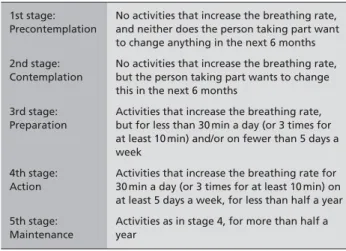
Operationalization and measurement of physical activity Based on the instrument of Marcus & Simkin (1993), the Swiss Federal Sports Offi ce developed a questionnaire for re-cording moderate physical activity which was validated in in-tervention studies (Titze et al. 2001) and under test conditions (Mäder et al. 2002; Bernstein et al. 1998). Based on the TTM, this questionnaire distinguishes fi ve stages for performing regular, lifestyle or sporting activities of at least moderate in-tensity which is defi ned as regularly increasing breathing rate for 30 min or 3 times a day for 10 min each time, on at least 5 days of the week (Pate et al. 1995; U.S. Department of Health 1996). For the present study, the wording was adapted for older people (Tab. 1). In addition, the exact type and duration (in minutes) of at least moderate-intensity activities which
in-creased breathing rate and which was carried out during the last four weeks was recorded in a table (activity monitoring). The overall number of minutes calculated on this basis allows for a fi ner differentiation of the level of exercise than the fi ve-stage TTM classifi cation (NSW Health 1999).
Exercise counselling programme
The exercise promotion programme developed for this study is based on the TTM (Prochaska et al. 1992). The TTM has been developed and operationalized for various behaviours, e. g. smoking, physical activity, abstinence from alcohol and drugs (Prochaska et al. 1994; Keller 1999; Nigg et al. 1999; Nigg & Riebe 2002). Studies have shown that a stage-specifi c approach led to more effective behaviour change than just providing general information material (Marcus et al. 1998; Eakin et al. 2000).
The stage-specifi c written information material was adapted for older adults from the Swiss project “From counselling to action” – a TTM-based exercise promotion initiative for all age groups in GPs’ practices (Martin et al. 2001). Stage-matched counselling was conducted and stage-Stage-matched writ-ten information material was provided based on Burbank et al. (2000), Jones et al. (2001), Burbank & Riebe (2002), and Marcus & Forsyth (2003).
Precontemplators received information aiming to facilitate cognitive-emotional processes, specifi cally to increase per-ceived advantages of regular physical activity of at least moderate intensity in the nurse-led sessions and in a leafl et. With people at Contemplation stage, the benefi ts and costs of exercise and activity preference were discussed by the nurse. It was agreed, in writing, which physical activities the older person would like to regularly engage in until the next coun-selling session in 4 months’ time. The participant was also given a stage-matched leafl et, which deals with the advan-tages and disadvanadvan-tages of exercise, similar to the Precon-templation leafl et. A list of suitable exercise courses in the area was also provided. The nurse asked Preparation stage people what additional activities they would like to do in or-der to increase their breathing rate more frequently or for a longer duration. Options for lifestyle physical activities were suggested, a stage-matched leafl et and a list of local exercise courses were handed out. Again it was agreed, in writing, which physical activities the older person would like to en-gage in. With people in the Action and Maintenance stage, physical activity options were provided to avoid boredom. An agreement was written down, a leafl et and a list with courses were given out.
At the 12 month follow-up, the nurse conducted an activity assessment with all participants. More intervention informa-tion can be found elsewhere (Märki 2004).
Statistical analyses
Changes between the fi ve TTM stages from T1 to T2 were analysed by a Wilcoxon signed rank test. Changes in the mean number of minutes of weekly physical activity between T1 and T2 were analysed by a paired sample t-test. Differences between women and men regarding stage distribution at T1 and at T2 were analysed by a Fisher’s exact test and by a Chi2
test. Differences between women and men regarding changes between T1 and T2 were analysed by a Chi2 test. SPSS 12.0.1
(for Windows) was used for statistical testing.
Results
Baseline activity level
At baseline 12.2 % (55 people) were inactive (Precontempla-tion and Contempla(Precontempla-tion), 68.8 % not suffi ciently active (Prep-aration, 308 people) and 19.0 % (85 people) suffi ciently active (Action and Maintenance).
Stage change from baseline (T1) to the 12-month follow-up (T2)
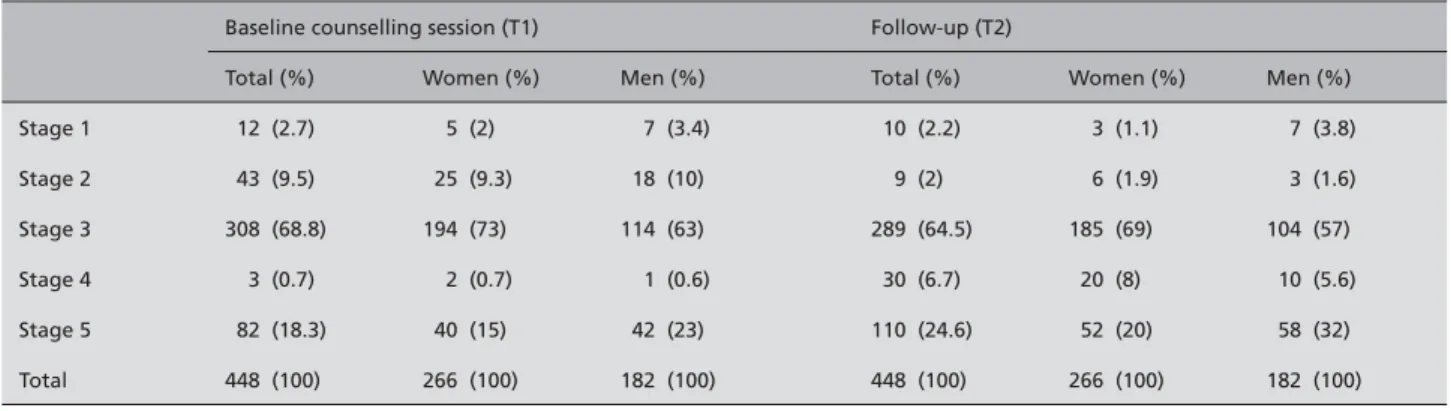
Stage change analyses revealed a decrease in the number of inactive people (Precontemplation and Contemplation) (55 people = 12.2 % vs. 19 people = 4.2 %) and an increase in the number of people suffi ciently active (Action and Mainte-nance) (19.0 % vs. 31.3 %). Of the 308 in Preparation at T1, 239 people stayed in Preparation, 60 people progressed in stage, and only 9 regressed. The change in stage from T1 to T2 is shown in Tab. 2.
Overall, 321 (71.6 %) stayed at the same stage, 20 (4.5 %) re-gressed by one or more stages and 107 (23.9 %) prore-gressed by one or more stages. A Wilcoxon signed rank test showed
Table 1 Operationalization of the lifestyle moderate-intensity activities
based on the fi ve TTM stages 1st stage:
Precontemplation
No activities that increase the breathing rate, and neither does the person taking part want to change anything in the next 6 months 2nd stage:
Contemplation
No activities that increase the breathing rate, but the person taking part wants to change this in the next 6 months
3rd stage: Preparation
Activities that increase the breathing rate, but for less than 30 min a day (or 3 times for at least 10 min) and/or on fewer than 5 days a week
4th stage: Action
Activities that increase the breathing rate for 30 min a day (or 3 times for at least 10 min) on at least 5 days a week, for less than half a year 5th stage:
Maintenance
Activities as in stage 4, for more than half a year
that the changes in stages from T1 to T2 were signifi cant (Z = –6.62, p < 0.001).
Physical activity in women and men across the TTM stages Baseline TTM stage classifi cation showed no signifi cant dif-ferences between women (n = 266) and men (n = 182) (Fish-er’s exact = 7.2; p = 0.107). There was, however, a tendency for fewer women than men to be classifi ed as suffi ciently ac-tive (15.7 % vs. 23.6 % in Action or Maintenance; see Tab. 2). About the same number of women as men were ranked as be-ing inactive (11.3 % vs. 13.4 % in Precontemplation or Con-templation) – however, more women were in Preparation than men (73.0 % vs. 63.0 %). At T2, women and men were signifi -cantly different in terms of stage classifi cation (Chi2 = 13.69,
df = 4, p = 0.008). The pattern seen at baseline became more marked – fewer women than men were suffi ciently physically active (28.0 % vs. 37.6 %). About the same number of women and men were classifi ed as inactive (3.0 % vs. 5.4 %; although n was only 19). Of the people in Preparation, there were con-siderably more women than men (69.0 % vs. 57.0 %). Regarding the change in stage from T1 to T2, there was no signifi cant difference between women and men (Chi2 = 1.23,
df = 2, p = 0.53): 3.8 % of women and 5.5 % of men went down a stage (for both genders: 4.5 %), 73.3 % of women and 69.2 % of men stayed at the same stage (for both genders: 71.6 %), 22.9 % of women and 25.3 % of men moved up a stage (for both genders: 23.9 %).
Change in the mean and median amount of time spent in regu-lar lifestyle moderate-intensity activities
The time spent on regular, lifestyle or sporting activities of at least moderate intensity was recorded for people in Prepara-tion, Action and Maintenance. People in Precontemplation or Contemplation did not exercise with moderate intensity, as a result of which there was no data for the number of minutes and therefore were not included in the analyses. At baseline
average time spent in lifestyle or sports was 172 min (SD = 185.3; median = 120 min; n = 381 [missing = 12]); at T2 the average time was 203 min (SD = 217.4; median = 150 min; n = 420, [missing = 9]).
Of the older adults who supplied data for both T1 and T2 (n = 368), there was an increase in the time spent regularly on physical activities for 209 people (56.9 %), a decrease in 90 people (24.4 %) no change in 69 people (18.7 %). From T1 to T2 there was a signifi cant increase in the mean number of minutes of physical activity of 31 min (SD = 184.5; t = –3.9; df = 367; p < 0.001).
Discussion
This project illustrates the feasibility to develop and imple-ment a TTM-based exercise promotion programme for the elderly with suitably trained nurses during home visits. Addi-tional qualitative evaluation of the participants and the nurses shows (Märki 2004) that the programme was well accepted by the patients and was perceived as practical by the nurses. As recommended in recent publications (Satarino & McCau-ley 2003; Sallis 2003), the counseling programme particularly addressed barriers and facilitators in the participants’ environ-ments. All GPs who were approached were willing to recruit their own patients and acceptance of the exercise promotion programme by the patients was very high. 79 % of the older adults who were asked to take part in the exercise promo-tion programme received all 3 counselling sessions and the 12-month follow-up. As about 80 % of the participants were not suffi ciently active at baseline, the programme obviously reached a particularly inactive clientele compared to the gen-eral population.
Our data showed that at baseline, barely a fi fth of people were taking part in suffi cient physical activity. This is considerably lower than in other Swiss surveys with similar age groups (Martin et al. 1999; Lamprecht & Stamm 2001). In the other
Table 2 Classifi cation at baseline and follow-up across the TTM stages by gender (N = 448)
Baseline counselling session (T1) Follow-up (T2)
Total (%) Women (%) Men (%) Total (%) Women (%) Men (%) Stage 1 12 (2.7) 5 (2) 7 (3.4) 10 (2.2) 3 (1.1) 7 (3.8) Stage 2 43 (9.5) 25 (9.3) 18 (10) 9 (2) 6 (1.9) 3 (1.6) Stage 3 308 (68.8) 194 (73) 114 (63) 289 (64.5) 185 (69) 104 (57) Stage 4 3 (0.7) 2 (0.7) 1 (0.6) 30 (6.7) 20 (8) 10 (5.6) Stage 5 82 (18.3) 40 (15) 42 (23) 110 (24.6) 52 (20) 58 (32) Total 448 (100) 266 (100) 182 (100) 448 (100) 266 (100) 182 (100)
studies, the data was obtained anonymously, by telephone or in writing. By contrast, in our intervention study, at baseline the subjects were assigned to their stages in a personal discus-sion by trained nurses. This setting would have encouraged the relationship of trust between interviewers (nurses) and the elderly and may have decreased social desirability. Further, our staging based on detailed activity monitoring may be a more reliable and valid tool for portraying moderate physical activities.
The results are not representative of older Swiss adults as our clientele is not a random sample of the population but consists of people who had GPs established and practising in Solothurn canton. This clientele may have more health prob-lems requiring treatment, which could partially explain the below-average exercise behaviour. From a public health point of view, this is a particularly relevant target group with poten-tially greater needs for counselling.
Somewhat surprisingly, about two thirds of the participants were in Preparation stage, i.e. people who increased their breathing rate through lifestyle or sporting moderate-intensity activities, but for less than 30 min a day. This included people who had the intention to do more, and people who did not want to do more. It would be useful for the counselling to be able to deal more specifi cally with these subgroups of Prepa-ration. This was adjusted in a revised version of the instrument for the project “Zurich GPs’ exercise counselling sessions for the over-65s” (Märki et al. in press), in that Preparation was subdivided into three differentiated algorithms. A similar di-vision was undertaken by Martin-Diener et al. (2004). Effectiveness analyses were based on stage change, and time spent in regular lifestyle moderate-intensity activities or sport of at least moderate intensity. The changes in behaviour from T1 to T2 pointed in the intended direction. About a quarter progressed in stage, just under three quarters stayed at the same stage and very few regressed in stage. There was a sig-nifi cant increase in the average time spent on lifestyle moder-ate-intensity activities or sport of at least moderate intensity among those people who at T1 and T2 had exercised with moderate intensity. The median number of minutes rose from 120 min a week at T1 to 150 min at T2, which corresponds to the basic recommendation (30 min on at least 5 days per week). Of those people with a value of at least 150 min per week, many however were not in Action or Maintenance, as the exercise was not distributed across fi ve or more days. In future interventions particular attention should be paid to the sequencing of regular exercise.
The positive changes that were observed countered the ex-pected secular trends over a one-year study period. The popu-lation-related studies referred to in the introduction show a rapid decrease in the level of exercise after the age of 65.
Similarly, the historical trend referred to in the introduction would suggest a further decrease in the level of exercise. As there was no control group it cannot be ruled out that the observed changes may have been triggered at least in part by interventions on other areas of the multidimensional health promotion programme. Also, the visit to the GP undertaken as part of this programme and the corresponding medical treatment alone could have a positive effect on activity in the short-term – but less likely in the long-term. Indeed, many other GP-based intervention studies found short-term posi-tive changes in exercise behaviour which disappeared in the longer term (Goldstein et al. 1999; NSW Health 1999). Regarding gender differences, at baseline men tended more towards higher stages than women. Even though the differ-ences were not signifi cant, they are consistent with the results for the overall random sample of 15- to 92-year-olds of the same-language Swiss population (Martin et al. 1999). The change in stage from T1 to T2 did not differ signifi cantly between women and men; though more men than women pro-gressed in stage. Both women and men achieved signifi cant improvements in terms of their physical activities. This inter-vention seems to be appropriate for both genders. Investigat-ing stage classifi cation at the 12-month follow-up did show signifi cant differences: of the people at Preparation, there were more women than men, but among those who were suf-fi ciently active there were more men than women.
Conclusions
This intervention study demonstrates that physical activity of elderly people recruited by their GPs can be promoted in the context of multidimensional health promotion counselling carried out at home by specially trained nurses. The design of the TTM-based exercise promotion counselling contributed to a clearly structured procedure and measurement of changes in exercise behaviour.
This exploratory study shows that the TTM-based exercise promotion programme was accompanied by a signifi cant increase in exercise behaviour during the one-year observa-tion period. As this positive change took place against the expected reduction in exercise behaviour under normal con-ditions in elderly people, the study provides an indication of the effectiveness of the programme. In order to determine its net effect more reliably, it is recommended that a follow-up study be carried out with a randomized control group design. At the same time we would recommend the examination of additional positive effects of the programme (e. g. on psycho-logical wellbeing) and the study of longer-term effectiveness of repeated counselling sessions beyond a one-year observa-tion period.
Although only a quarter of the participants progressed in stage, more than half increased the time spent on physical activity. Even small increases in the activity-induced use of energy result in health benefi ts (Martin 2002). The greatest benefi t is to those who have previously been inactive. After one year in our programme the proportion of inactive people fell from 12.2 % to 4.2 %. Considering this potential public health impact, it seems justifi ed to invest in exercise counsel-ling programmes as presented.
In order to reduce costs, future exercise counselling pro-grammes should be implemented in the primary care setting
by general practitioners or by specially trained nurses in the context of routine visits instead of more costly house visits. The feasibility of this approach has already been investigated in the primary care setting in Switzerland (Märki et al. in press).
Acknowledgements
The study received fi nancial support from Health Promotion Switzerland (project 1191).
Résumé
Promotion de l’activité physique auprès des personnes âgées sur la base du Modèle Transthéorique de changement des comportements en Suisse: résultats quantitatifs sur 1 an Objectifs: Développer et tester un programme de promotion de l’activité physique basé sur le Modèle Transthéorique de changement de comportement et ciblant des personnes âgées de plus de 65 ans.
Méthodes: Un échantillon (n = 448) de femmes et d’hommes âgés de 65 à 92 ans a été recruté auprès de médecins général-istes en Suisse entre 2000 et 2004. Après une mesure de base (T1) et une séance de conseil initial, ces participants ont béné-fi cié de deux autres séances et d’un suivi à 12 mois (T2). Les modifi cations dans la pratique de l’activité physique ont été classifi ées selon les différentes étapes du modèle et selon le temps consacré à une activité physique quotidienne augment-ant le rythme respiratoire.
Résultats: A T1, les femmes tendaient à être moins actives que les hommes. Entre T1 et T2, la proportion de personnes inactives est tombée de 12.2 % à 4.2 % ; la proportion de per-sonnes suffi samment actives a augmenté de 19.0 % à 31.3 %. L’évolution dans les étapes du modèle était signifi cative pour les hommes et les femmes. A T2, plus de la moitié des partici-pants consacraient plus de temps à la pratique d’une activité physique.
Conclusions: Par le conseil, l’activité physique des personnes âgées peut être positivement infl uencée sur une période d’une année.
Zusammenfassung
Bewegungsberatung für ältere Menschen auf Basis des Tran-stheoretischen Modells der Verhaltensänderung: quantitative Ergebnisse im 1-Jahres-Verlauf
Fragestellung: Ziel dieser Studie war die Bewegungsförderung bei über 65-Jährigen anhand eines auf dem Transtheoretischen Modell der Verhaltensänderung (TTM) beruhenden Beratung-sprogramms.
Methode: Studienteilnehmende wurden in den Jahren 2000– 20004 über Schweizer Hausarztpraxen rekrutiert. Die Stich-probe (n = 448) setzte sich aus Frauen und Männern im Alter von 65 bis 92 Jahren zusammen (Durchschnittsalter M = 74.1, SD = 5.64, Median = 73.3). Nach einer Baselineerhebung (T1) führten spezifi sch geschulte Pfl egefachfrauen eine erste sys-tematische Bewegungsberatung durch und im Abstand von rund vier Monaten während Hausbesuchen zwei weitere, gefolgt von einem 12-Monats-Follow-up (T2). Mittels Stufe-neinteilung für moderate körperliche Alltagsaktivitäten und aufgewendeter Zeit wurden die Veränderungen im Bewe-gungsverhalten erfasst.
Ergebnisse: Frauen waren bei T1 wie auch bei T2 weniger körperlich aktiv als Männer, was sich jedoch nur bei T2 signi-fi kant unterschied. Der Anteil Inaktiver nahm von T1 zu T2 von 12.2 % auf 4.2 % ab, der Anteil gesundheitswirksam aktiver Personen stieg von 19.0 % auf 31.3 %. Die Stufenveränderun-gen waren bei beiden Geschlechtern signifi kant. Mehr als die Hälfte der Studienteilnehmenden wendeten bei T2 mehr Zeit für Bewegung auf.
Schlussfolgerungen: Die Ergebnisse weisen darauf hin, dass sich mittels Beratungen das Bewegungsverhalten älterer Men-schen im 1-Jahres-Verlauf positiv beeinfl ussen lässt.
References
Bernstein MS, Sloutskis D, Kumanyika S, Sparti A, Schutz Y, Morabia A (1998). Data-based
approach for developing a physical activity frequency questionnaire. Am J Epidemiol 147(2): 147–54.
Burbank P, Riebe D, eds. (2002). Promoting
exercise and behavior change in older adults: interventions with the Transtheoretical Model. New York: Springer.
Burbank, PM, Padula CA, Nigg CR (2000).
Changing health behaviors of older adults. J Gerontol Nurs 26(3): 26–33.
Eakin EG, Glasgow RE, Riley KM (2000).
Review of Primary Care-Based Physical Activity Intervention Studies. J Fam Pract 49(2): 158–68.
Eaton CB, Menard LM (1998). A systematic
review of physical activity promotion in primary care offi ce settings. Br J Sports Med 32: 11–6.
Goldstein MG, Pinto BM, Marcus BH, Lynn H, Jette AM, Rakowski W, McDermott S, DePue JD, Milan FB, Dubé C, Tennstedt S (1999).
Physi-cian-Based Physical Activity Counseling for Middle-Aged and Older Adults: a Randomized Trial. Ann Behav Med 21 (1): 40–7.
Jones ND, Della Corte MR, Nigg CR, Clark PG, Burbank PM, Padula C, Garber CE (2001).
Seniorcise: A print exercise intervention in older adults. Educ Gerontol 27: 717–28.
King AC, Rejeski WJ, Buchner DM (1998).
Physi-cal activity interventions targeting older adults: A critical review and recommendations. Am J Prev Med 15: 316–33.
Keller S, ed. (1999). Motivation zur
Verhaltens-änderung – das Transtheoretische Modell in Forschung und Praxis. Freiburg i. Br.: Lambertus.
Lamprecht M, Stamm H (2001). Sport in der
zweiten Lebenshälfte, Analysen zum Senio-rensport in der Schweiz. Sekundäranalyse der SOV-STG-Studie „Sport Schweiz 2000“ im Auftrag des Bundesamtes für Sport, Magglingen. Zürich: Lamprecht & Stamm, Sozialforschung und Beratung AG.
Lamprecht M, Stamm H (2000). Bewegung, Sport
und Gesundheit in der Schweizer Bevölkerung. Sekundäranalyse der Daten der Schweizerischen Gesundheitsbefragung 1997 im Auftrag des Bundesamtes für Sport. Kurzfassung. Zürich: Lamprecht & Stamm, Sozialforschung und Beratung AG.
Mäder U, Martin B, Schutz Y, Bernstein M, Marti
(2002). Physiological validation study of fi ve widely-used epidemiological physical activity short questionnaires based on heart rate monitor-ing accelerometry and indirect calorimetry. (Forschungsbericht). Magglingen: Bundesamt für Sport Sportwissenschaftliches Institut.
Märki A, Bauer GF, Angst F, Nigg CR, Gillmann G, Gehring TM (in press). Systematic counselling
by general practitioners for promoting physical activity in elderly patients: a feasibility study. Swiss med weekly.
Märki A (2004). Entwicklung und Evaluation
eines Beratungsinstrumentes zur Förderung der körperlichen Aktivität bei älteren Menschen. Dis-sertation, Phil I, Universität Basel. http://pages. unibas.ch/diss/2004/DissB_6799.pdf [08 June 2006].
Marcus BH, Forsyth LA (2003). Motivating
People to be Physically Active. Champaign, IL: Human Kinetics.
Marcus BH, Emmons KM, Simkin-Silverman LR, Linnan LA, Taylor ER, Bock BC, Roberts MB; Rossi JS, Abrams DB (1998). Evaluation
of motivationally tailored vs. standard self-help physical activity interventions at the workplace. Am J Health Promot 12(4): 246–53.
Marcus BH, Simkin LR (1993). The stages of
exercise behavior. J Sports Med Phys Fitness
33(1): 83–8.
Martin BW (2002). Bewegung und Gesundheit:
Konsequenzen und Möglichkeiten für die haus-ärztliche Praxis. Prim Care 2: 9–11.
Martin BW (2002b). Physical activity related
attitudes, knowledge and behaviour in the Swiss population: comparison of the HEPA Surveys 2001 and 1999. Sportmed Sporttraumato 50(4): 164–8.
Martin BW, Mäder U (2002). Körperliches
Aktivitätsverhalten in der Schweiz. In Samitz G, Mensink G, eds. Körperliche Aktivität in Präven-tion und Therapie. München: Hans Marseille: 45–55.
Martin BW, Jimmy G, Marti B (2001).
Bewe-gungsförderung bei Inaktiven: Eine Herausfor-derung auch in der Schweiz. Therap Umsch 58: 196–201.
Martin BW, Mäder U, Calmonte R (1999).
Einstellung, Wissen und Verhalten der Schweizer Bevölkerung bezüglich körperlicher Aktivität: Resultate aus dem Bewegungssurvey. Sportmed Sporttraumato 47(4): 165–9.
Martin-Diener E, Melges T, Thüring N, Martin BW (2004). The Stages of Change in two modes
of physical activity: A comparison of Stage dis-tributions and practical implications. Health Educ Res 2004;19(4): 406–17.
Mazzeo RS, Cavanagh P, Evans WJ, Fiataron MA (1998). ACSM Position Stand on Exercise
and Physical Activity for Older Adults. Med Sci Sports Exerc 30(6): 992–1008.
Möller J (1999). Sport im Alter. Auswirkungen
von Sport auf die Gesundheit Erwachsener ab 50 Jahren: eine Meta-Analyse. Sportwi 29(4): 440–54.
Nigg CR, Riebe D (2002). The Transtheoretical
Model: Research review of exercise behavior and older adults. In: Burbank P, Riebe D, eds. Promoting exercise and behavior change in older adults: interventions with the Transtheoretical Model. New York: Springer: 147–80.
Nigg CR, Burbank P, Padula C, Dufresne R, Rossi JS, Velicer WF, Laforge RG, Prochaska JO (1999). Stages of change across ten health
risk behaviors for older adults. Gerontologist 39: 473–82.
NSW Health (1999). The Active Practice Project: A controlled trial of physical activity promotion in general practice. State Health Publication No: (HP) 99110: NSW Department of Health.
Pate RR, Pratt M, Blair SN, Haskell WL, Macera CA, Bouchard C, Buchner D, Ettinger W, Heath GW, King AC, Kriska A, Leon AS, Marcus BH, Morris J, Paffenberger RS, Patrick K, Pollock ML, Rippe JM, Sallis J, Wilmore JH (1995).
Physical activity and public health: a recommen-dation from the Centers for Disease Control and Prevention and the American College of Sports Medicine. JAMA 273: 402–7.
Prochaska JO, Velicer WF, Rossi JS, Goldstein MG, Marcus B, Rakowski W, Fiore C, Harlow LL, Redding CA, Rosenbloom D, Rossi SR
(1994). Stages of Change and Decisional Balance for 12 Problem Behaviors. Health Psychol 13(1): 39–46.
Prochaska JO, DiClemente CC, Norcross JC
(1992). In Search of How People Change. Am Psychol 13(1): 39–46.
Sallis J (2003). New thinking on older adults’
physical activity. Am J Prev Med 25 (3) Suppl 2: 110–1.
Samitz G, Mensink GBM eds. (2002).
Kör-perliche Aktivität in Prävention und Therapie. Evidenzbasierter Leitfaden für Klinik und Praxis. München: Hans Marseille.
Satarino WA, McCauley E (2003).
Promot-ing physical activity among older adults: from ecology to the individual. Am J Prev Med 25 (3) Suppl 2: 184–92.
Stuck A, Born S (2001). Gesundheitsförderung
im Alter: das Projekt SO!PRA. Managed care 1: 28–31.
Titze S, Martin BW, Seiler R, Stronegger W, Marti B (2001). Effects of a lifestyle physical activity
intervention on stages of change and energy ex-penditure in sedentary employees. Psychol Sport Exercise 2: 103–16.
U.S. Department of Health and Human Services, Centers for Disease Control and Prevention, National Center for Chronic Disease Prevention and Health Promotion (1996). Physical activity and health: a report of the Surgeon General. Atlanta, Georgia.
Address for correspondence
Address for correspondence Dr. phil. Anita Märki
Abteilung Gesundheits- und Interven-tionsforschung
Institut für Sozial- und Präventivmedizin der Universität Zürich
Hirschengraben 84 CH-8001 Zürich