Consistency of use of plant stanol ester margarine in Finland
Meri Simojoki
1, Riitta Luoto
2,*, Antti Uutela
1, John D Boice Jr
3,4, Joseph K McLaughlin
3,4and Pekka Puska
1,51Department of Epidemiology and Health Promotion, National Public Health Institute, Helsinki, Finland:2Health
Education Research Unit, The UKK Institute, Postbox 30, FIN-33501 Tampere, Finland:3International Epidemiology
Institute, Rockville, MD, USA:4Department of Medicine, Vanderbilt University Medical Center and
Vanderbilt–Ingram Cancer Center, Nashville TN, USA:5Department of Noncommunicable Disease Prevention and
Health Promotion, World Health Organization, Geneva, Switzerland Submitted 5 December 2002: Accepted 25 June 2003
Abstract
Objective: The aims of this study were to investigate the consistency of use of plant stanol ester margarine and to characterise consistent and inconsistent users. Design: A cohort of plant stanol ester margarine users was established based on 14 national surveys conducted by the National Public Health Institute in Finland between 1996 and 1999. A follow-up study questionnaire was developed and sent to 1294 users in 2000.
Setting: Subjects who reported using plant stanol ester margarine in both the original survey and the follow-up study were classified as consistent users, and the rest as inconsistent users.
Subjects: The study population consisted of 1094 subjects aged 18 – 87 years, 590 men and 504 women.
Results: There were 357 (33%) consistent and 737 (67%) inconsistent users of plant stanol ester margarine in the study population. Consistent users were more likely to be men and to have a higher household income than inconsistent users. Both consistent and inconsistent users were predominantly middle-aged persons with a healthy lifestyle and diet as well as a history of cardiovascular disease. Healthfulness was the main factor affecting bread spread choice among 94% of the consistent users and 59% of the inconsistent users.
Conclusions: The use of plant stanol ester margarine is more often inconsistent than consistent. There is nevertheless a relatively large subgroup of long-term users of plant stanol ester margarine. It is important to examine the health effects especially among these regular users.
Keywords Consistency Plant stanol Margarine Finland
Functional foods are foods that have been shown to have beneficial health effects beyond adequate nutritional effects1. During the past decade, there has been increasing availability and use of functional food products world-wide. Hence, there is a need for post-marketing research and surveillance of functional food use patterns and health effects2 – 4.
The plant stanol ester margarine Benecolw (Raisio Group, Raisio, Finland) is a functional food that effectively lowers serum total and low-density lipoprotein cholesterol according to several interventions5,6, and is recommended by the Finnish Society for Internal Medicine for the primary and secondary prevention of coronary heart disease7. A longitudinal study of the plant stanol ester margarine was launched at the National Public Health Institute in Finland in 1998 in order to evaluate the so far unknown potential health effects of long-term use of plant stanol ester margarine.
Our previous study showed that plant stanol ester margarine users are often elderly persons, many of whom have a history of cardiovascular disease8. The aims of this study were to investigate the consistency of use of plant stanol ester margarine and to characterise consistent and inconsistent users. This information is necessary in future studies of the possible health effects, both beneficial and adverse, of long-term use of plant stanol ester margarine. Methods
A cohort of users of plant stanol ester margarine was established based on 14 national surveys conducted by the National Public Health Institute in Finland between 1996 and 1999. The main surveys were the annual Finnish Adult Health Behaviour Surveys9and the Chronic Disease Risk Factor Survey (Finrisk)10. In each survey, sampling was either purely random or stratified random with respect to
age and geographical area, and subjects completed mailed questionnaires concerning their health and lifestyle. Participation rates in the surveys varied from 64 to 79%.
There were 1307 plant stanol ester margarine users aged 15 – 84 years in the cohort, which was 3.4% of the total number of respondents who gave non-missing infor-mation on the bread spread question in the 14 surveys (n ¼ 38 552). They had been identified using the following question in the survey questionnaire: ‘What type of fat do you usually use on bread?’ Choices were no fat at all, low-fat spread, soft margarine, butter – oil mixture, butter, and plant stanol ester margarine Benecol. The plant stanol ester margarine Benecol was the only plant sterol margarine available to consumers in Finland during the time the surveys were conducted.
A follow-up study questionnaire was developed in order to update the information gathered in the original surveys and to study the consistency of use of the plant stanol ester margarine. Variables that were updated covered socio-economic background, health status, medication, smoking, diet, use of alcohol, height, weight and physical activity. The same question on bread spread was used in the follow-up study as in the original survey to identify users of plant stanol ester margarine with the addition of the response option ‘plant sterol spread’, which had recently been launched on the Finnish market. New dietary questions were developed such as the type and amount of bread spread used during the past 5 years and the main factor affecting bread spread choice. A picture from a portion size picture booklet describing the amount of spread on bread was also included to improve the validity of the estimation11. In addition to the plant sterol margarines, an unripened cheese product with plant stanol ester was on the Finnish market at that time and a question concerning its use was thus added to the questionnaire. The questionnaire was tested among 19 employees of the National Public Health Institute and 40 customers of a store in Helsinki, Finland. Questions were well answered and not considered too difficult.
Addresses of the subjects were updated through the Population Register Centre of Finland. Questionnaires were sent to living users of plant stanol ester margarine who had a permanent address (n ¼ 1294) in October 2000. Two reminders were sent to non-respondents at 3 – 4 week intervals. Written consent concerning the use of questionnaire responses and future linkage of the cohort to health outcome registers was required.
Overall, 1122 persons responded to the follow-up study questionnaire (87%). Three subjects declined to give consent and were excluded. Six subjects, who gave permission to use questionnaire responses but not registry data, were included. There were 12 subjects who provided questionnaire responses but failed to provide consent despite reminders. They were included in this study because completing and returning the questionnaire was considered permission to use the questionnaire data.
Subjects with missing information on the bread spread question (n ¼ 25) were excluded from the analyses. The final study population thus consisted of 1094 subjects aged 18 – 87 years, 590 men and 504 women.
Subjects who reported using plant stanol ester margarine in both the original survey and the follow-up study were classified as consistent users. Subjects who reported using plant stanol ester margarine in the original survey but not in the follow-up study were classified as inconsistent users. The time interval between completion of the original survey questionnaire and the follow-up study questionnaire ranged from 1.5 to 4.5 years.
Consistent and inconsistent users were compared with respect to sex, age, socio-economic background, self-reported health, bread spread use, diet, body mass index and physical activity. Unadjusted prevalence percentages were computed. The Chi-square test was applied. Data management and statistical analysis were performed using the SAS System (version 6.12)12.
Results
There were 357 (33%) consistent and 737 (67%) inconsistent users of plant stanol ester margarine in the study population. Consistent users were more likely to be men and to have higher household income than users (Table 1). Both the consistent and the inconsistent users were predominantly middle-aged (mean age 62 and 61 years, respectively), married and retired citizens with middle or high education (mean years of education 12 and 11, respectively).
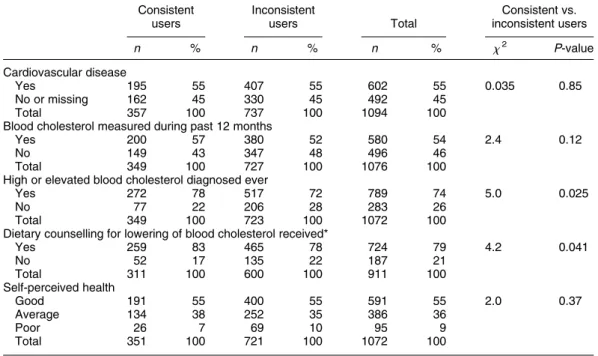
More than half of both consistent and inconsistent users of plant stanol ester margarine reported having a cardiovascular disease and having had their blood cholesterol measured during the past 12 months (Table 2). Of the consistent users, 78% reported a diagnosis of high or elevated blood cholesterol, and 83% of those with high cholesterol had received dietary counselling for lowering of blood cholesterol, compared with slightly lower proportions (72% and 78%, respect-ively) among inconsistent users. More than half (55%) of both the consistent and inconsistent users perceived their health as good.
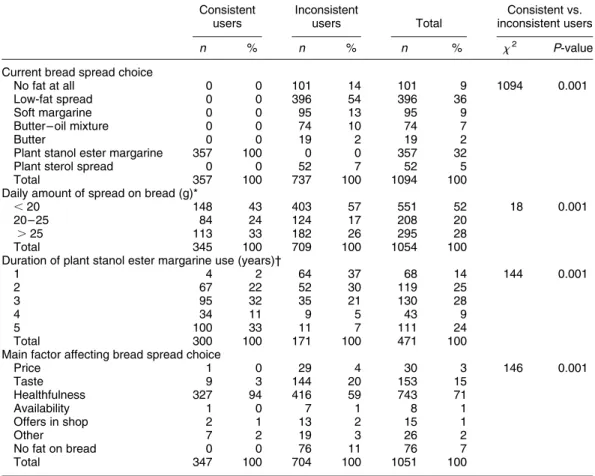
The inconsistent users had changed their bread spread type from plant stanol ester margarine to low-fat spread (54%), no fat at all (14%), soft margarine (13%), butter – oil mixture (10%), plant sterol spread (7%) or butter (2%) (Table 3). Consistent users used, on average, 24 g of plant stanol ester margarine on their bread daily, compared with 21 g of bread spread among inconsistent users. Almost all (98%) consistent users had used plant stanol ester margarine for at least 2 years, while one-third had used it for 5 years. Healthfulness was the main factor affecting bread spread choice among 94% of the consistent users and 59% of the inconsistent users. Of the consistent users, 23% reported using the unripened cheese product with
Table 1 Sex, age and socio-economic background among consistent and inconsistent users of plant stanol ester margarine Consistent users Inconsistent users Total Consistent vs. inconsistent users n % n % n % x2 P-value Sex Men 225 63 365 50 590 54 18 0.001 Women 132 37 372 50 504 46 Total 357 100 737 100 1094 100
10-year age group
18 – 24 years 0 0 7 1 7 1 12 0.058 25 – 34 years 1 0 10 1 11 1 35 – 44 years 11 3 41 6 52 5 45 – 54 years 79 22 146 20 225 21 55 – 64 years 103 29 229 31 332 30 65 – 74 years 124 35 220 30 344 31 75 – 87 years 39 11 84 11 123 11 Total 357 100 737 100 1094 100 Education 1 – 9 years 142 40 283 39 425 40 5.1 0.077 10 – 12 years 72 21 190 26 262 24 13 years or more 139 39 248 35 387 36 Total 353 100 721 100 1074 100 Marital status Married, cohabiting 282 79 553 75 835 77 1.8 0.18 Single 75 21 181 25 256 23 Total 357 100 734 100 1091 100 Employment status Unemployed 9 3 30 4 39 3 1.7 0.42 Employed 138 39 288 40 426 40 Retired 202 58 406 56 608 57 Total 349 100 724 100 1073 100 Household income Low 96 27 252 36 348 33 17 0.001 Middle 117 34 257 37 374 36 High 136 39 186 27 322 31 Total 349 100 695 100 1044 100
Table 2 Self-reported health among consistent and inconsistent users of plant stanol ester margarine Consistent users Inconsistent users Total Consistent vs. inconsistent users n % n % n % x2 P-value Cardiovascular disease Yes 195 55 407 55 602 55 0.035 0.85 No or missing 162 45 330 45 492 45 Total 357 100 737 100 1094 100
Blood cholesterol measured during past 12 months
Yes 200 57 380 52 580 54 2.4 0.12
No 149 43 347 48 496 46
Total 349 100 727 100 1076 100
High or elevated blood cholesterol diagnosed ever
Yes 272 78 517 72 789 74 5.0 0.025
No 77 22 206 28 283 26
Total 349 100 723 100 1072 100
Dietary counselling for lowering of blood cholesterol received*
Yes 259 83 465 78 724 79 4.2 0.041 No 52 17 135 22 187 21 Total 311 100 600 100 911 100 Self-perceived health Good 191 55 400 55 591 55 2.0 0.37 Average 134 38 252 35 386 36 Poor 26 7 69 10 95 9 Total 351 100 721 100 1072 100
plant stanol ester 6 – 7 days per week, compared with 12% of the inconsistent users.
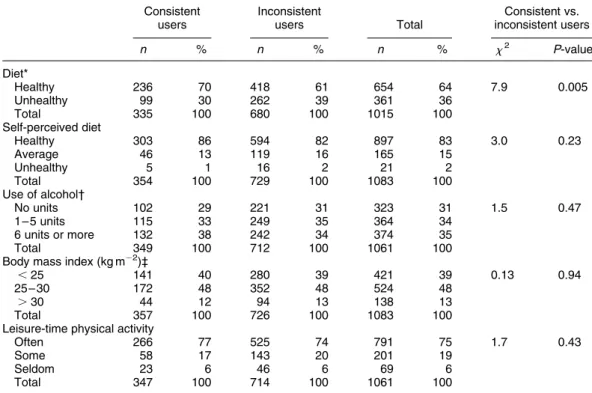
Diet could objectively be regarded as healthy among most of the consistent (70%) and inconsistent (61%) users (Table 4). Still higher proportions of consistent (86%) and inconsistent (82%) users perceived their own diets as healthy. Both the consistent and inconsistent users reported to have consumed on average 6 alcoholic units during the past 7 days, while one-third had not consumed any alcohol during that time. Body mass index (mean 26 kg m22) and leisure-time physical activity were similar among consistent and inconsistent users.
Discussion
Plant stanol ester margarine has been a major innovation in the field of functional foods. The type of dietary fat has a critical influence on blood lipid levels, and consequently on cardiovascular risk5,6,13. In addition to studies of efficacy and safety, post-marketing surveillance studies provide valuable additional information regarding the use patterns of functional foods.
According to our study, consistent and inconsistent users of plant stanol ester margarine share several characteristics. They are predominantly middle-aged persons with a
healthy lifestyle and diet. Among consistent users, men and persons with a high household income are relatively more represented compared with inconsistent users.
By the time of the follow-up study, there were two plant sterol margarines on the Finnish market: the plant stanol ester margarine Benecol (60% and 32% fat) and the plant sterol spread Becel pro.active (35% fat). The plant stanol ester margarine was introduced to the Finnish market in November 1995. Plant sterol spread was launched 2 months before the follow-up study questionnaires were sent. Plant stanol ester margarine and plant sterol spread are sold as ordinary foods in Finland and their marketing is regulated by legislation. Both products cost three to five times more than other margarines. Our study suggests that price has little influence on bread spread choice among plant stanol ester margarine users.
People who use plant stanol ester margarine seem to have problems with blood cholesterol levels and a history of cardiovascular disease. Therefore, it is likely that they use plant stanol ester margarine in order to control blood cholesterol levels through dietary practices. Indeed, the consistent users in our study overwhelmingly regarded healthfulness as the main factor affecting bread spread choice. Most of them had also received dietary counselling for lowering of blood cholesterol.
Table 3 Bread spread use among consistent and inconsistent users of plant stanol ester margarine Consistent users Inconsistent users Total Consistent vs. inconsistent users n % n % n % x2 P-value
Current bread spread choice
No fat at all 0 0 101 14 101 9 1094 0.001
Low-fat spread 0 0 396 54 396 36
Soft margarine 0 0 95 13 95 9
Butter – oil mixture 0 0 74 10 74 7
Butter 0 0 19 2 19 2
Plant stanol ester margarine 357 100 0 0 357 32
Plant sterol spread 0 0 52 7 52 5
Total 357 100 737 100 1094 100
Daily amount of spread on bread (g)*
,20 148 43 403 57 551 52 18 0.001
20 – 25 84 24 124 17 208 20
.25 113 33 182 26 295 28
Total 345 100 709 100 1054 100
Duration of plant stanol ester margarine use (years)†
1 4 2 64 37 68 14 144 0.001 2 67 22 52 30 119 25 3 95 32 35 21 130 28 4 34 11 9 5 43 9 5 100 33 11 7 111 24 Total 300 100 171 100 471 100
Main factor affecting bread spread choice
Price 1 0 29 4 30 3 146 0.001 Taste 9 3 144 20 153 15 Healthfulness 327 94 416 59 743 71 Availability 1 0 7 1 8 1 Offers in shop 2 1 13 2 15 1 Other 7 2 19 3 26 2 No fat on bread 0 0 76 11 76 7 Total 347 100 704 100 1051 100
* Amount of spread on one slice of bread estimated using a picture from a portion size picture booklet. † Between the years 1996 and 2000.
Similarly, healthfulness is an important factor affecting bread spread choice among inconsistent users. This was reflected by the fact that two-thirds of the inconsistent users in our study had changed their bread spread type from plant stanol ester margarine to low-fat spread or soft margarine. On the other hand, a variety of other factors affect the bread spread choice of inconsistent users. In our study, 20% of the inconsistent users regarded taste as the main factor affecting bread spread choice, compared with only 3% among the consistent users.
In this study, the users of plant stanol ester margarine divided themselves into consistent and inconsistent users according to the follow-up question: ‘What type of fat do you usually use on bread?’ In fact, the question as such measures current bread spread choice and does not necessarily reveal the consistency of use, although the question was repeated after 1 or more years. Therefore, a validation was needed through the question on the type of bread spread during the past 5 years. According to this question, long-term use of plant stanol ester margarine was indeed more pronounced among consistent users compared with inconsistent users. This confirmed the validity of the approach.
Four consistent users reported that they have used plant stanol ester margarine only for 1 year. Because the time interval between completion of the two questionnaires ranged from 1.5 to 4.5 years, they probably used plant
stanol ester margarine by the times of the studies and during a 1-year period between the studies. The small number of such apparent discrepancies among the consistent users (four out of the total of 357) further shows that our repeated question concerning current bread spread choice is a relatively good indicator of long-term use.
Consistent users consumed on average 24 g of plant stanol ester margarine daily, which is considered optimal for lowering blood cholesterol5,7. However, one-third of them consumed more than 25 g day21. Nearly one in four consistent users also reported the use of other plant stanol ester product in addition to the margarine. Health effects of high daily amounts of plant stanol ester are not known and need to be examined.
The follow-up study questionnaire was also sent to 3921 original non-users of plant stanol ester margarine to serve as a reference group for our users in our forthcoming studies. Original non-users who have become users will then be studied separately to elucidate the factors that lead to the use of plant stanol ester margarine.
Although the use of plant stanol ester margarine is more often inconsistent than consistent, there is nevertheless a relatively large subgroup of long-term users of plant stanol ester margarine. This new information is vital when the health effects, both beneficial and adverse, of long-term use of plant stanol ester margarine are assessed. In future,
Table 4 Diet, body mass index and physical activity among consistent and inconsistent users of plant stanol ester margarine Consistent users Inconsistent users Total Consistent vs. inconsistent users n % n % n % x2 P-value Diet* Healthy 236 70 418 61 654 64 7.9 0.005 Unhealthy 99 30 262 39 361 36 Total 335 100 680 100 1015 100 Self-perceived diet Healthy 303 86 594 82 897 83 3.0 0.23 Average 46 13 119 16 165 15 Unhealthy 5 1 16 2 21 2 Total 354 100 729 100 1083 100 Use of alcohol† No units 102 29 221 31 323 31 1.5 0.47 1 – 5 units 115 33 249 35 364 34 6 units or more 132 38 242 34 374 35 Total 349 100 712 100 1061 100
Body mass index (kg m22)‡
,25 141 40 280 39 421 39 0.13 0.94
25 – 30 172 48 352 48 524 48
.30 44 12 94 13 138 13
Total 357 100 726 100 1083 100
Leisure-time physical activity
Often 266 77 525 74 791 75 1.7 0.43
Some 58 17 143 20 201 19
Seldom 23 6 46 6 69 6
Total 347 100 714 100 1061 100
* Healthy diet includes at least three of following: daily use of vegetables, avoidance of fatty milk, use of margarine or no spread on bread, use of bread more than 5 slices per day.
† Number of alcoholic units (120 ml wine, 40 ml spirits or one 330 ml bottle of beer, long drink or cider) during the past 7 days. ‡ Self-reported height and weight.
we hope to address this issue by linking data from available health registries to the cohort of users of plant stanol ester margarine.
Acknowledgements
Funding for this study was provided in part by the International Epidemiology Institute through a grant by the McNeil Consumer Healthcare Company and Raisio Group, Raisio, Finland.
References
1 Diplock AT, Aggett PJ, Ashwell M, Bornet F, Fern EB, Roberfroid MB. Scientific concepts of functional foods in Europe: consensus document. British Journal of Nutrition 1999; 81: S1 – S27.
2 Plat J, Kerckhoffs DAJM, Mensink RP. Therapeutic potential of plant sterols and stanols. Current Opinion in Lipidology 2000; 11: 571 – 6.
3 Vainio H, Mutanen M. Functional foods – blurring the distinction between food and medicine. Scandinavian Journal of Work, Environment & Health 2000; 26: 178 – 80. 4 Raulio S, Nurttila A, Mannonen L. Adding Phytosterols and
Stanols to Food. Modelling the Amount Received by Finnish Adults. Publication No. 10. Helsinki: National Food Agency, 2001.
5 Miettinen TA, Puska P, Gylling H, Vanhanen H, Vartiainen E. Reduction of serum cholesterol with sitostanol-ester
margarine in a mildly hypercholesterolemic population. New England Journal of Medicine 1995; 333: 1308 – 12. 6 Law M. Plant sterol and stanol margarines and health. British
Medical Journal 2000; 320: 861 – 4.
7 Suomen Sisa¨tautila¨a¨ka¨rien Yhdistys, Suomen Kardiologinen Seura, Suomen Verenpaineyhdistys, Kunnallisla¨a¨ka¨rit-yhdistys, Suomen Teollisuusla¨a¨ketieteen Yhdistys, Suomen Syda¨ntautiliitto. Prevention of coronary heart disease in clinical practice [in Finnish]. Suomen La¨a¨ka¨rilehti 1996; 51: 783 – 802.
8 Anttolainen M, Luoto R, Uutela A, Boice JD Jr, Blot WJ, McLaughlin JK, et al. Characteristics of users and nonusers of plant stanol ester margarine in Finland: an approach to study functional foods. Journal of the American Dietetic Associ-ation 2001; 101: 1365 – 8.
9 Helakorpi S, Patja K, Pra¨tta¨la¨ R, Uutela A. Health Behaviour and Health among Finnish Adult Population, Spring 2001. Publication No. B16. Helsinki: National Public Health Institute, 2001.
10 Vartiainen E, Jousilahti P, Alfthan G, Sundvall J, Pietinen P, Puska P. Cardiovascular risk factor changes in Finland, 1972 – 1997. International Journal of Epidemiology 2000; 29: 49 – 56.
11 Pietinen P, Hartman AM, Haapa E, Ra¨sa¨nen L, Haapakoski J, Palmgren J, et al. Reproducibility and validity of dietary assessment instruments, I. A self-administered food use questionnaire with a portion size picture booklet. American Journal of Epidemiology 1988; 128: 655 – 66.
12 SAS Institute, Inc. The SAS System. Cary, NC: SAS Institute, Inc., 1989 – 1996.
13 Puska P. Nutrition and mortality: the Finnish experience. Acta Cardiologica 2000; 55: 213 – 20.