Depolarizing the Process: Residential Redevelopment and Seattle's Design Review
By MASSACHUSETTS INSTITUTE
OF TECHNOLOGY
Ellen Corinne Lohe
JN232016
B.A. in ArchitectureYale UniversityLIR
IE
New Haven,iCTrs2011)
LIBRARIES
ARCHIVES
Submitted to the Department of Urban Studies and Planningin partial fulfillment of the requirements for the degree of
Master in City Planning at the
MASSACHUSETTS INSTITUTE OF TECHNOLOGY June 2016
@ 2016 Ellen Corinne Lohe. All Rights Reserved
(The author hereby grants to MIT the permission to reproduce and to distribute publicly paper and electronic copies of the thesis documents in whole or in part in any medium now known or hereafter
created.)
Author
Signature redacted
'tllen Corinne Lohe Department of Urban Studies and Planning
/A
, May 17, 2016)Certified by
Signature redacted
_Associate Pr6feisor Brent Ryan Department of Urban Studies and Planning
/--) 17j qThesis Supervisor
Accepted by
Signature redacted
Assrciae 'rofessor. Christopher zegras
Chair, MCP Committee
Department of Urban Studies and Planning
ABSTRACT
DEPOLARIZING THE PROCESS:
RESIDENTIAL REDEVELOPMENT AND SEATTLE'S DESIGN REVIEW
By Ellen Corinne Lohe
Submitted to the Department of Urban Studies and Planning in partial fulfillment of the requirements for the degree of Master in City Planning
In Seattle, a city with a robust public process around issues of urban growth, recent rapid rede-velopment in low-rise neighborhoods has intensified the public debate over design and density. Conflict over individual development projects has escalated as the city struggles to balance
economic and population growth with community needs, leaving many residents anxious about
congestion, affordability, and a changing built environment. This thesis examines Seattle's design review, which is the central public piece of the city's development review process, and evaluates its success as a collaborative process in this context of divisive growth.
Urban design and regulations such as design review are often regarded as the exclusive realm of design professionals; this thesis argues that design review must embrace its role in a partici-patory planning process. Research draws on existing models of design review as well as collab-orative planning theory to evaluate how Seattle's design review can further employ deliberative strategies to reduce polarization over growth and better address community needs. Analysis suggests that the city's framework for design review, which fosters stakeholder relationships and local knowledge as well as design expertise, could be further enhanced by emphasis on dialogue, training, and alignment with other city departments and neighborhood plans.
Thesis Supervisor: Brent Ryan Associate Professor of Urban Design and Public Policy Department of Urban Studies and Planning Thesis Reader: Matthew Kiefer Land Use Lawyer Goulston and Storrs, Boston
ACKNOWLEDGMENTS
Thank you to my advisor, Brent, for his guidance and support throughout this process. Thank you also to the countless in-dividuals in Seattle who generously offered their time and knowledge for this research and taught me so much about a wonderful new place.
To my family and friends, whose support, love, and encourag-ment has sustained me through my time in graduate school. And most importantly to my classmates at DUSP - you have made my two years at MIT meaningful and have truly been my best teachers - thank you.
5
TABLE OF CONTENTS
1 . Introd uctio n ... . . 6
1.1 Background 6
1.2 Research Question + Hypothesis 8
1.3 Thesis Structure 10
2. Seattle C ontext ... 12
2.1 Seattle's Urban Form and Growth 12
2.2 Current Conflict over the Built Environment 18
2.3 Real Estate Development Process 21
2.4 Seattle's Entitlement Process 23
2.5 Design Review 25
3. Critical Perspectives on Design Review...29
3.1 Origins of Design Review 29
3.2 Debate over Design Review 31
3.3 Deliberation in Design Review 35
3.4 Communicative Theory as an Evaluative Tool 39
4. Case Studies in Seattle's Design Review ... 41
4.1 Case Summaries 41
4.2 1001 James Street Case 44
4.3 1427 NW 65th Street Case 53 5 . A n a lys is ... 6 0 5.1 Procedure 60 5.2 Participation 65 5.3 Communication 71 5.4 Content 75 5.5 Scope 80 6 . C o nc lusio n ... . 8 4 6.1 Recommendations 84 6.2 Further Research 91 6.3 Final Thoughts 93
6 DEPOLARIZING THE PROCESS: RESIDENTIAL REDEVELOPMENT AND SEATTLE'S DESIGN REIVEW
CHAPTER ONE: INTRODUCTION
1.1: Background
Tension over redevelopment and neighborhood change is widespread in cities experiencing strong economic growth across the U.S. In what Kevin Lynch calls our "future anxious" society
(Lynch, 1984), growth and change in the built environment is often regarded in the public
with concern: fears of congestion, loss of neighborhood character, and rising housing prices. Increasingly, this concern has driven residents to seek greater control, not just over planning processes, but also over the urban design and physical appearance of the city. Scholars have also noted this shift - in his article "Democracy Takes Command: New Community Planning and the Challenge to Urban Design," architect John Kaliski argues that city design increasingly re-flects the visions of its residents, writing that "citizen experts rather than planners or designers
are firmly in charge of the evolution and design of the city" (Kaliski, 2005).
This thesis takes the case of Seattle, the largest and wealthiest city in the Pacific Northwest
and one with a strong history of public involvement in the built environment, and explores the role of deliberation over design in this changing city. Seattle has long been a prosperous and small city that prides itself on its quality of life - access to the outdoors, low-rise living, and
neighborhoods of distinctive character. The city also has a robust history of public engagement,
cemented by a neighborhood planning process in the 1990s that gave residents input into local development and resulted in the creation of new community centers, parks, and libraries. In the last decade Seattle has experienced strong urban growth due in large part to the expansion of the technology sector and the relocation of one large technology firm, Amazon, to the down-town. The resulting economic boom has contributed to dramatic changes in the city's urban fabric and illuminated issues in the city's zoning and development review regulation. Fear and anxiety over issues of homogenization, gentrification, and affordability have spread, making new development a hotbed for conflict. Citizens are also increasingly dissatisfied with changes to the city's built form, and are making their voices heard. As a result, the city's urban design
CHAPTER ONE: INTRODUCTION 7
Increased density is responsible for much of citizen complaint. Seattle, which plans its growth through the state of Washington's Growth Management Act, carefully allocates density into core areas to allow coordination with transit, infrastructure, and service provision. Much of the city is zoned for single-family homes only, but many areas with higher zoning designations have been underdeveloped due to lack of demand. Now, as population growth surges and is being directed into these areas, land values for the underutilized parcels have increased and real estate developers have sought to replace older, lower-density housing stock with taller
multi-family buildings.
One example of such a transformation is that of Franklin Avenue East, in Seattle's residential Eastlake Neighborhood. In 2011, the block bounded by Louisa Street and Lynn Street, which is zoned to permit multi-family dwellings up to five stories, was a mix of single-family and du-plexes and tridu-plexes. The block was well below its full zoning build out with its one and two story houses. But in 2013, a single family home was replaced by a narrow five-story apartment building; in 2014, another similar project broke ground. By 2015, the lots for two more houses had been combined to begin construction on a four story multi-family building; and in 2016, four other projects had finished the permitting process to construct townhouse or multi-family developments.
The character of the block has undoubtedly changed - and the transformation did not happen without conflict. Residents voiced disapproval about the new buildings: they didn't fit in with neighborhood's Craftsman style homes, they blocked long-cherished views of Lake Union, and they were "out of scale." The new projects were compliant with the neighborhood's zoning regulations - large, dense, projects were slated for Eastlake neighborhood - but residents did have the opportunity to impact how these projects might look by participating in Seattle's
development review process.
8 DEPOLARIZING THE PROCESS: RESIDENTIAL REDEVELOPMENT AND SEATTLE'S DESIGN REIVEW
across the city, giving a board of experts along with residents like those on Franklin Avenue the opportunity to comment on a project's design and interaction with the public realm. Design
review also provides residents with the opportunity to meet each other, developers, designers, and city planners to build working relationships as the project develops. Design review is a discretionary process through which the city coordinates review of development proposals. Design review's stated goal is to reduce conflict over development and encourage buildings of high quality design. Does it succeed? In this thesis, I seek to understand not how this process impacts the design outcomes of development, but rather whether the process helps to amelio-rate the conflict over development and density that plagues Seattle.
1.2: Research Question + Methods
Given Seattle's commitment to public process - often referred to as the "Seattle Process" - the city presents an opportunity to examine urban design regulation and participation in a place committed institutionally to shaping a built environment that incorporates the values of its residents. Seattle's design review is important to analyze for its commitment to public engage-ment, its widespread application across the city, and its high profile role in the debate over a
changing city.
Additionally, the success of Seattle's design review is linked to debates about important policy directions for the city's future. For many cities across the country, growth is divisive. Frustration and anger between stakeholders mean continued polarization on issues of zoning, housing, and affordability. Neighborhood planning processes can't keep up with the speed of redevelop-ment; frustration with lack of real dialogue about new development and change leads to disillu-sionment between the public, developers, and the city. Urban designer and scholar Gary Hack has noted that in many such environments, "design review becomes a real time substitute for planning" (Hack, 1994). It seems imperative, therefore, to think about how design review might provide an on-going public conversation about the city's values as manifest in the built
CHAPTER ONE: INTRODUCTION 9
'IN
Figure One: 2359-2371 East Frankline Ave, 2010 and 2015 (Google Streetview)
--mmoo-lim
-Nw
E m
i
...
10 DEPOLARIZING THE PROCESS: RESIDENTIAL REDEVELOPMENT AND SEATTLE'S DESIGN REIVEW
This thesis examines the potential for design review as a solution to the conflict over density by asking: how well does Seattle's design review conform to collaborative model of planning? This thesis analyzes data collected through design review meeting observation and interviews with design review stakeholders through a framework grounded in collaborative planning theory. I conclude that the process has a strong deliberative foundation but that the city must focus fur-ther support into facilitation, coordination, and local empowerment in order to create a process that will ideally, project after project, consistently manages conflict over growth and promotes
individual design solutions that are in line with community, developer, and city visions.
To examine design review in Seattle, this thesis relies on qualitative data derived mostly from semi-structured interviews and meeting observations. Interviews with city officials, develop-ers, architects, board membdevelop-ers, and community activists intimately familiar with design review provide insight into the many aspects of the design review process. Further data was drawn from field notes taken at design review board meetings in three different districts of the city in March 2016. Observations of meeting format, dialogue, and materials inform the thesis analysis, as does the design of the projects being debated in the meetings. Additionally, public permitting information and commentary about specific projects were consulted for the thesis, as were citywide documents such as zoning codes, neighborhood plans, and neighborhood design guidelines.
1.3: Thesis Structure
In Chapter Two, I define the context of the debate over growth in Seattle: its origins in the Growth Management Act and resulting neighborhood planning processes of the 1990s through the recent economic boom, Comprehensive Plan for 2035, and the corresponding post-2005 housing crisis. This history is important to understanding Seattle's culture around public partic-ipation, the built environment, and neighborhood change. Additionally, I discuss the real estate development process and Seattle's development review regulation to explain required public review procedures and the relationships between the stakeholders involved in design review.
CHAPTER ONE: INTRODUCTION 11
Chapter Three examines critical lenses from urban design and planning literature to analyze Seattle's program: approaches to design review, theories of city form, and communicative planning. Although all three may be used to understand Seattle's design review, I rely mainly on theory of city form and communicative planning to analyze the program's successes and challenges, not in terms of design outcomes but rather as a deliberative process. These the-ories focus on incremental, community-led, and deliberative strategies for regulating
develop-ment and provide insight into best practices for deliberative public processes.
My main analysis of Seattle's design review is found in Chapters Four and Five and draws on my interviews, meeting observations, and published public project data. Chapter Four provides an overview of six cases of design review projects and focuses in depth on two that demonstrate how design review can help cities manage conflict or cement divisions between stakeholders. Chapter Five is then organized by five elements - procedure, participation, communication, concept, and scope - that emerged from the interview and meeting observation data. Using a framework developed from collaborative planning literature, I evaluate these five elements by assessing their contributions to a deliberative process or a polarizing process. In Chapter Six, I conclude by offering recommendations for a more deliberative design review as well as future
12 DEPOLARIZING THE PROCESS: RESIDENTIAL REDEVELOPMENT AND SEATTLE'S DESIGN REIVEW
CHAPTER TWO: SEATTLE CONTEXT
This chapter provides a brief background on Seattle's urban fabric, its history of growth man-agement and neighborhood planning, and its current development and regulatory environ-ment. This provides context for the public and private framework between which design review operates, highlighting a real estate industry eager to capitalize on an economic surge post-2005 and a citizenry accustomed to a participatory and democratic process. The chapter con-cludes with an overview of the Seattle design review program to explain how the process works and how the different actors are involved.
2.1: Seattle's Urban Form and Growth
Seattle's urban fabric is defined by neighborhood main streets, low-rise residential commu-nities, and a strong connection to the natural environment. The city's development is con-strained by water bodies and topography - it is situated between Lake Washington to the east, the Puget Sound to the west and is dominated by hill formations that run north to south. In the city's early history, much of its land was graded and filled, especially in the downtown and areas to its south. The Olmsted Brothers planned a parks system for the city in 1903. During the early 20th century, Seattle expanded extensively through annexation, which is part of the reason that neighborhoods such as Ballard (1907 and 1916), West Seattle (1907) and North Park (1954) have retained strong individual character (Skelton & Meier, n.d.)
Seattle's population grew rapidly at the beginning of the twentieth century, and the advent of streetcars made it possible for new residents to move out of the center city where land was being platted to build single-family homes. Today, many of Seattle's residential neighborhoods are still defined by the small craftsman style homes built during the early twentieth century. As the city instituted zoning in 1923 and produced its first comprehensive plan in 1956, sin-gle-family areas were protected. Like many cities around the country, the center of the city declined in the 1970s but began to recover in the late 1980s, when the city's current zoning
CHAPTER TWO: SEATTLE CONTEXT 13
designations were put in place, defining single-family and multi-family residential zones as well as commercial and industrial districts (Skelton & Meier, n.d.).
Seattle's history of controlling growth - delineating in which part of the city density will occur - has its origins in Washington State's Growth Management Act (GMA) of 1990. The need for
compliance with this state act led Seattle to develop its first comprehensive plan and establish the Urban Village Strategy in 1994, designating certain city neighborhoods for growth,
preserv-ing others as "fortresses" of spreserv-ingle family homes, and sparkpreserv-ing debate over where and how
development should be changing the built environment (Sirianni, 2007).
The GMA was also intended to create a framework to guide regional growth and to coordinate local transportation and land use decisions. After decades of uncontrolled suburban expan-sion and lack of environmental preservation, the state legislature found that comprehensive regional planning was necessary to restrain uncoordinated and unsustainable growth (RCW 36.70A.010.) The provisions of the GMA localize control over growth by passing responsibility to the county and city level to meet state targets for reducing sprawl, providing affordable housing, coordinating transportation infrastructure, and supporting economic development. The state of Washington requires localities to develop comprehensive plans and create corresponding development regulations, such as zoning, to help implement these plans. Counties and munic-ipalities work together to designate urban growth areas, which are planned to accommodate the Washington Office of Financial Management's projections for twenty years of growth. These comprehensive plans must be reviewed and updated every seven years, and there is special emphasis on consistency both within a locality and across the region (Steinbrueck, 2014).
After the GMA passed in 1990, the City of Seattle began its first comprehensive planning
14 DEPOLARIZING THE PROCESS: RESIDENTIAL REDEVELOPMENT AND SEATTLE'S DESIGN REIVEW
inaugurating the "Urban Village Strategy" that the city continues to employ today. The strategy calls for strategically directing growth into established mixed-use areas and coordinating pub-lic investment in infrastructure and services with community goals. The four core values an-nounced by the plan are "community," "environmental stewardships," "economic opportunity
and security," and "social equity."
The design provisions of the Urban Village Strategy sought to strengthen the existing character
of established neighborhoods in the city, creating four categories of urban villages based on
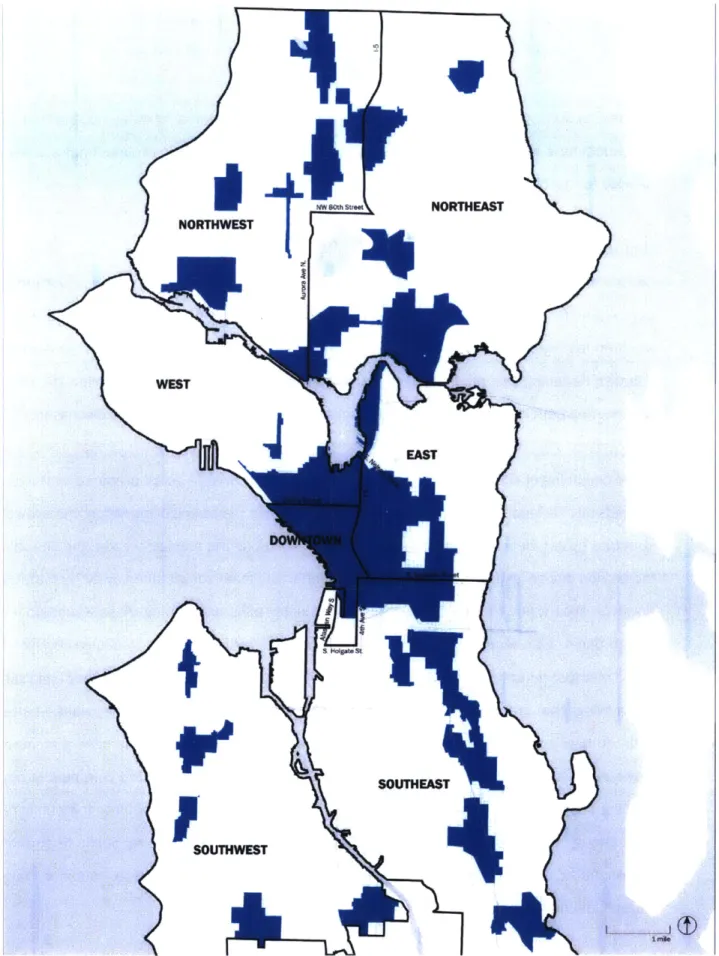
scale and intensity of use. The stated goals of the urban village strategy include supporting housing and job growth, creating compact business districts served by transit, encouraging efficient use of public investment, and protecting single-family neighborhoods. Urban Center villages are the densest designation, established as regional centers of housing, employment, and transportation. Hub urban villages denote a slightly less dense mix of housing and em-ployment, with substantial potential for growth. Residential urban villages label small neigh-borhood centers, primarily residential in nature but with accompanying local services. Final-ly, manufacturing/industrial centers identify areas with significant industrial use, focused on manufacturing job growth and not seen as appropriate for significant amounts of housing.
The Urban Village classifications were of crucial importance to existing neighborhoods, as each designation shapes density, use, transportation, and open space policy according to the new comprehensive plan. Limited citizen participation was invited prior to the passing of the plan in 1994. A non-profit organization called Sustainable Seattle ran a series of participatory work-shops and a civic panel to develop sustainability indicators for the plan, but the Seattle City Council chose not to include engage neighborhoods at the early stages of planning, perhaps out of concerns over the NIMBYism and conflict that had emerged over the 1985 Seattle Down-town Plan (Sirianni, 2007).
CHAPTER TWO: SEATTLE CONTEXT 15
b
Lake Washington
V
p
Center Urban Village
Hub Urban Village
Residential Urban Village Manufacturing/industrial Centers
Figure Two: Seattle's Urban Villages (Data: City of Seattle)
i
jJ.m4'U
11
U'
4
40
16 DEPOLARIZING THE PROCESS: RESIDENTIAL REDEVELOPMENT AND SEATTLE'S DESIGN REIVEW
Due to this lack of participation, a neighborhood rights campaign emerged after the
Com-prehensive Plan was passed, moving the city to create a decentralized planning process that would focus on community building to reach consensus around how to best meet the new city-wide goals. Accordingly, the City Council created a Neighborhood Planning Program at the end of 1994 as well as a new Neighborhood Planning Office that reported directly to the Mayor. Over the next five years, the city would provide assistance for the neighborhood planning process through the form of funding, trainings, and tools, helping to empower residents and create a
platform for conversation about the changing built environment (Sirianni, 2007).
The city asked neighborhoods whether or not they wanted to create a local plan to build on the
comprehensive plan or whether they would rather simply defer to the comprehensive plan; all
38 of the neighborhoods that had been identified as growth areas chose to participate. Neigh-borhoods were given free rein to create their own scope and were given grants of $10,000 to define a neighborhood vision, provided they could demonstrate a comprehensive stakeholder analysis that promoted a diverse and inclusive participant mix. The city also provided an
"out-reach tool kit" to further assist to attracting participants who might not otherwise engage.
Neighborhoods were then given grants of $60-100,000, GIS software and data, and a neigh-borhood planning toolbox consisting of guidebooks and reference material, to develop the actu-al plan. Some neighborhoods chose to hire consultants to help lead the process; others formed new, cross-cutting non-profit organizations to facilitate collaboration between adjacent commu-nities. The process was generally regarded as robust, collaborative, and inclusive, and by 1999, the City Council had approved all 38 neighborhood plans (Seattle Planning Commission, 2001).
Each neighborhood plan was reviewed by the city's Strategic Planning Office and approved by the City Council. Mayor Paul Schell, who took office in 1998, subsequently turned his focus to implementation, looking for ways to fund neighborhood capital projects. Unable to rely on the
CHAPTER TWO: SEATTLE CONTEXT 17
small sum of neighborhood matching funds in the city's budget, he looked to a bond and levy strategy, and Seattle residents ultimately supported ballot initiatives that approved almost $200 million for local library branches and $470 million for community centers, parks, and open spaces. Mayor Schell also decentralized city departments to work at the neighborhood level with community-led groups on implementation, creating "approval and adoption matri-ces" that explained the priority ranking, city departments involved, available funding sources, and timeframe for each neighborhood recommendation. This process deepened city officials'
understanding of community goals as well as citizen exposure to the political and financial realities of implementing projects (Sirianni, 2007).
This neighborhood planning process helped Seattle respond locally to a regional growth man-agement policy and is widely recognized as a leading model for citizen empowerment, commu-nity development, and relationship building (Sirianni, 2007). However, the city only maintained the momentum for a few years after the process concluded. Staffing and support for neigh-borhood planning implementation and relations was cut under Mayor Greg Nickels in 2003 and further reduced and re-centralized under Mayor Nickels in 2007, threatening the survival of the program. The comprehensive plan was revisited in 2004 - a required ten-year update to refresh growth predictions. However, most neighborhood plans have remained untouched (with the exception of three neighborhoods: North Beacon Hill, North Rainier, and MLK Jr., where plans for new light rail prompted each of these plans to be revisited in 2008) ("Neigh-borhood Planning," 2014). As the other plans have transitioned from living proposals to static documents, I perceive that the lack of focus on neighborhood planning despite changing mar-ket conditions has caused the NIMBYism that had characterized Seattle's prior plans to creep back in to the city's neighborhood development processes.
18 DEPOLARIZING THE PROCESS: RESIDENTIAL REDEVELOPMENT AND SEATTLE'S DESIGN REIVEW
2.2: Current Conflict Over the Built Environment
In the decade since the 2004 Comprehensive Plan Update, Seattle has seen rapid population and housing growth and startling changes in the built environment. Unprecedented construc-tion activity and increasing traffic has caused tension among residents, many of whom are displeased by the influx of young affluent tech workers and high-density residential buildings
to house them.
Seattle has added 70,000 people and almost 40,000 housing units since 2004. Seattle's latest comprehensive plan, Seattle 2035, was completed in 2015 and forecasts that the city will need to be prepared to accommodate 120,000 more residents, 115,000 jobs, and 70,000 housing units in the next twenty years. The plan designates the city's "Urban Centers" and "Ur-ban Villages," which make up 17% of Seattle's total land area as absorbing more than 80% of job and housing growth (Seattle 2035 Draft, 2015).
Seattle's building boom has been caused primarily by the emergence of a strong tech sector.
Rooted in the strength of large companies like Microsoft and Amazon who have been
power-houses in the region since the 1990s, the last ten years has also seen the rise of a number of large technology companies based not in Silicon Valley but in Seattle: Expedia, Zillow, Tableau, and others. In addition, the city has attracted engineering offices of powerful domestic tech firms including Google, Facebook, Apple, and Twitter, as well as even a handful of international firms, notably China's Alibaba. Many of these firms have already hired or plan to hire thousands of tech workers - Seattle is an attractive choice due to its high number of software engineers, mostly due to Microsoft's recruitment efforts in the 1980s and 1990s and the strength of the University of Washington's computer science program (Partovi, 2015).
CHAPTER TWO: SEATTLE CONTEXT 19
to the city's downtown in 2013, beginning the development of a new campus that will
head-quarter some 30,000 workers in the formerly industrial neighborhood of South Lake Union. Much of the land is owned by Microsoft co-founder Paul Allen, and he has leased or sold land to Amazon to develop 11 buildings through his real estate development firm Vulcan. This move has drawn many of Amazon's competitors to the downtown, as well - though Microsoft and its roughly 40,000 regional employees remain in the suburb of Redmond, Washington, about thirty minutes from the downtown, Google, Facebook, and others are now located within the
city (Johnson & Wingfield, 2013).
Amazon's move and the corresponding downtown tech boom has placed a strain on housing and transportation within the city. The changing demographics have impacted prices, culture, and built form in the city, and many longtime residents are deeply unhappy. Neighborhoods that have seen the greatest change, such as Capitol Hill and Ballard, are embattled by debates over gentrification and loss of neighborhood character. Seattle street artist John Criscitello has plastered Capitol Hill, a longtime center of counterculture and nightlife in the city, with posters reading "Tech money kills queer culture dead," "Welcome! Rich kids," and "Wish you weren't here." In Ballard, rents have gone up 60% between 2005 and 2014; Capitol Hill has seen an increase of 33%, and many neighborhoods are averaging 15-20% (HALA Background, 2015). Analysis done by the city's Department of Planning and Development shows that communities of color are most at risk for displacement and access to opportunity faces serious geographic inequalities (Seattle 2035: Growth and Equity, 2015). Changes do not seem to be slowing -more than 10,000 building permits were issued in 2012 and the city cites historically high permitting and construction volumes in recent years. And there is still plentiful zoning capacity in the city - more than 150,000 units beyond even the 2035 housing figures (Seattle 2035 Draft, 2015).
20 DEPOLARIZING THE PROCESS: RESIDENTIAL REDEVELOPMENT AND SEATTLE'S DESIGN REIVEW
Some of the most vocal opponents of the city's building boom have been the city's single-family homeowners. Although a majority - around 65% of land area - of the city is zoned single-fam-ily, many more single-family homes exist outside these areas in historically underdeveloped low-rise districts. Low-rise districts, intended to serve as transition districts between denser housing and single-family homes, can accommodate multi-family housing up to four stories and underwent a height limit change from 30 to 40 feet in 2010. The upzoning, coupled with the strength of the real estate market has made the redevelopment of single-family homes into
townhomes, apartment buildings, and microunits financially advantageous for the first time,
causing radical changes to neighborhood fabric - in massing, architectural style, and height,
as we saw in the introduction on Franklin Avenue East.
Residents, angry about blocked views and bulky buildings, have been searching for outlets to
demand action from the city. In the public comment portions of city council meetings, many argue that the development community has outsized influence in the city. Others fear for their
property values and still others call the new, denser buildings "ugly" and the resulting built environment "a dystopia" (Jaywork, 2015). Residents have also formed anti-density groups
focused on lobbying city officials to restrict density. 'Livable Ballard' describes itself as "a group of Ballard residents concerned by the recent, drastic, and developer-led changes to our neighborhood," noting that "Ballard Urban Village surpassed targeted growth for 2024, three times bigger, ten years early" ("Livable Ballard," 2014). The organization 'Seattle Speaks Up,' whose tagline is "too much building, not enough sky," collected over one thousand signatures in one neighborhood to demand modification to the zoning code in the low-rise district ("Seattle Speaks Up," 2013). Changes did occur; a rezoning, which mitigated some of the built form
im-pacts from the 2010 upzoning but left its general height limit intact, was spearheaded by
coun-cil member Tom Rasmussen and approved by the Seattle City Councoun-cil in 2015. On the other side of the debate, pro-growth organizations, developer groups, and some housing advocates
CHAPTER TWO: SEATTLE CONTEXT 21
argue that increasing housing supply through density is the only means to maintaining afford-ability in the city - the neighborhood change is unavoidable ("Smart Growth Seattle," 2013).
Mayor Ed Murray, elected in 2014, has weighed in on the conflict, too, offering a plan for
hous-ing called the Houshous-ing Affordability and Livability Agenda (HALA). This was released in 2015
and now awaits approval by the city council. The plan's centerpiece is the so-called "Grand Bar-gain" which refers to recommendations for mandatory inclusionary housing and linkage fees
to promote affordable housing development. HALA, which includes sixty recommendations,
also contains provisions for the expansion of urban village boundaries and extensive upzoning (by density or height) across the city to make multifamily housing more economically efficient to build (HALA Recommendations, 2015). The proposal's first version included a plan to allow duplexes and triplexes in single-family zones across the city (although without more FAR [den-sity]), but media coverage and outrage was so strong that the mayor immediately backed down
(Stokes, 2015).
Positioned in the middle of this conflict is the city's development review process. As the debate about density and neighborhood change is waged by politicians, the media, and organizations at the policy level, it has also trickled down to create disagreement at the project level, where developers, abutters, city planners and a design review board attempt to reconcile conflicting desires - preserved views, taller buildings, contextual design - and differing visions for the built environment, one building at a time.
2.3: Overview of Real Estate Development Process
The development process moves between the worlds of design, policy, finance, and markets. Real estate development is what scholar James Graaskamp calls an "iterative and multidisci-plinary" decision making process (Geltner, et al, 2013). As projects are developed, they cycle
22 DEPOLARIZING THE PROCESS: RESIDENTIAL REDEVELOPMENT AND SEATTLE'S DESIGN REIVEW
through four 'analysis perspectives': architecture/engineering, law and policy, financial
eco-nomics, and urban economics. Each of the four phases of development has an associated level of risk (Geltner, et al, 2013).
The first and most creative phase is that of predevelopment, in which developers acquire and assemble land, develop the design concept and program, and begin to assemble permits for the project. This process can take months or many years, and risk is highest in this phase, as unforeseen problems in permitting or design can make a project economically infeasible. The second phase is construction, when the bulk of the developer's financial expenditures are
required. Risk is still high - all speculative developments are risky due to uncertainty about
how soon occupancy will be absorbed and at what rental rate, while the investor has already
incurred the opportunity cost of purchasing the land and committing to pay the construction
costs. The final two phases, lease-up and stabilization, are significantly less risky and reflect the finishing of the project towards a steady-state operation period of full purchase or lease up (Geltner et al., 2013).
The predevelopment phase is most important to understanding any city's development debate, because it is during the design concept and program development period that developers must typically engage a city and public to discuss a proposed project and, potentially, its impact on the city and neighborhood. This must happen to meet city regulations, but may also happen informally, through conversations between developers, neighbors, and a variety of community groups and advocacy organizations.
The entitlement process - obtaining permission to construct a project from the requisite local (and if necessary, state and federal) government bodies - generally requires navigating com-plex legal requirements and demands from multiple stakeholders. The process can add delays,
CHAPTER TWO: SEATTLE CONTEXT 23
especially when developers receive conflicting information from different city departments or must satisfy community groups with competing demands. Because the permitting process is controlled by the city and is also subject to market forces (as regulations or negotiations may tighten during a strong market and soften during a weak one), the entitlement phase holds
high risk for the developer. However, entitlements also hold enormous potential value,
provid-ing developers an opportunity to request zonprovid-ing variances for additional height or density, as
well as to receive stakeholder input that may 'improve' the project in the stakeholders' eyes and/or build trust in the community (Suchman, 2002).
2.4: Seattle's Entitlement Process'
Development in Seattle is managed by the Department of Planning and Development (DPD), a city agency which handles land use and environmental regulation, construction regulation, and code compliance. Separate from comprehensive planning, a process that includes developing the citywide and neighborhood plan documents and making changes to the land use code (Seattle's zoning code), DPD's regulatory functions center on the Master Use Permit (MUP), a land use permit that integrates the procedures and reviews of the city's land use decisions.
DPD makes five types of MUP decisions, based on level of impact and level of discretion as determined by staff. Type I decisions are non-appealable decisions requiring little discretion, such as lot boundary adjustments. Type I decisions are discretionary and appealable; they are made by DPD and are subject to administrative appeal. These decisions include variances, de-sign review, and environmental review, and are applied towards private development projects. Type Ill decisions are made by the hearing examiner; Type IV and V are city council land use decisions (Seattle DPD, 2011).
1In
early 2016, Seattle's Department of Planning and Development (DPD) split into two departments - Depart-ment of Construction and Inspections (DCI) and the Office of Planning and Community DevelopDepart-ment (OPCD), the former focused on development review and the latter on strategic planning - but for the purposes of this project, which focuses on development conflict over the last decade under Seattle DPD, I will refer to the development review arm of Seattle's government as DPD, not DCI.24 DEPOLARIZING THE PROCESS: RESIDENTIAL REDEVELOPMENT AND SEATTLE'S DESIGN REIVEW
The MUP procedure involves a series of applications, meetings, reviews, and reports and
in-volves the development team, the city, any discretionary boards, and the public. The MUP
ap-plication includes site and floor plans, environmental impact, design review, requests for zoning changes, and parking information. Once an applicant has been issued their MUP, they may apply for building permits from DPD to begin construction.
As per Seattle's municipal code, public notification is required in order to give the public the
opportunity to comment on the proposed land use activities that constitute a MUP application.
This may happen through mailings to adjacent property owners, notices or lawn posters on the project site, and online sources such as the Land Use Information Bulletin or Shaping Seattle,
an interactive map of all projects under review.
Most new private development projects in Seattle go through full design review as part of their MUP application. The city's municipal code includes size thresholds for each zoning district.
De-velopment above these thresholds triggers design review either in unit count (i.e. deDe-velopment above four and 20 units) or non-residential square footages (i.e. development above 4,000
to 12,000 square feet). The city reports that the design review process takes 8-16 months, although developers in the city indicate that the process can take up to six months longer. Developers are charged a fee based on DPD's hourly cost for reviewing applications, starting at $20,000 and rising to $50,000 should there be more complex action required, such as a zoning change requiring City Council action or a project facing significant public opposition (Seattle DPD, 2011).
All this permitting and procedural work sets the stage for a discretionary process of design
re-view in which developers present their project to members of a volunteer board of various
decision-mak-CHAPTER TWO: SEATTLE CONTEXT 25
ing. Design review is a multi-step process that aims to balance control with efficiency - those who are pro-growth tend to see it as unnecessarily complex, slow, and costly, while those op-posed to rapid development tend to regard the process as a necessary series of checks on otherwise unruly developers. The process is a negotiation between developers, often seeking
to build out the highest and best use on the site, and the city and public, looking to preserve
the public realm, adjacent property values, and neighborhood character. I explain the design review process in detail below.
2.5: Design Review
Seattle's design review is one of the city's most frequent public forums and is often a proj-ect-by-project stage for conflict over the design of the built environment. Created in 1994 as an implementation tool for the comprehensive plan to "encourage multiple perspectives on design issues to...enhance the character of the city and respect the surrounding neighborhood context," (Towards a Sustainable Seattle, 1994) design review now hosts conflicts ranging far outside its intended (design-focused) purview. One reason is because design review is a central component of the city's entitlement process and is therefore the main outlet for public comment on individual new projects under development.
The full design review process is represented visually in figure 4. Design review begins with a pre-application meeting between a city planner and the applicant team (usually a developer and their design consultants) to discuss the project proposal and to help the applicant put together an early design guidance application. The application includes all relevant project ma-terials, such as a draft of a design packet showing architectural concepts, preliminary requests for departures from zoning code, and any plans for neighborhood outreach. The design con-cept must respond to a set of design guidelines, which were created as part of a collaboration between DPD and neighborhood groups after the neighborhood plans were finalized in the late
STEP 2
Early Design Guidance
(EDG) App
Pre-application -- EDG Meeting
and coaching Notice
STEP 3 M UP Appica,,i /Intake EDG Report 0
e; P'
04 0
EDG Meeting] Public comments accepted (informal) Public comments (formal)
STEP 4 , ; et n I datior Meetin NotIcc Corrected M IIP P, C\1 iw Design Review Recommendation Meeting N Public Meeting STEP I T CD --- I CD (D CD C) CD 0 0 0 Prepare for pre-application meeting STEP 5 Published N) G) 0 0
~0
0 U) P1 0 0 U) G) U M P1 :E -mmendation RleporT MuF issued 0n 7 2 ek 7,tCHAPTER TWO: SEATTLE CONTEXT 27
1990s (Sirianni, 2007). Although neighborhood guidelines are used when applicable, there are not guidelines for all of the city's neighborhoods, so in some cases, citywide guidelines are used. The guidelines articulate community design goals for the area such as streetscape, response to context, or architectural style.
To prepare for design review, the applicant finalizes a design packet, a document that includes the development program, site plan, zoning, response to design guidelines, massing options,
departure requests (Seattle's term for zoning variances - design review has purview over vari-ances with the exception of density, height, and parking), and other drawings. This packet is used by the city to give public notice for the first of two required public meetings for the project;
notice is given both online and at posted on a large billboard at the development site, as well as through mailings to abutting residents.
This first meeting - called 'Early Design Guidance' - is intended to present the applicant's pre-liminary design thinking to the Design Review Board, a body that is made up of five design and development professionals and community representatives, as well as to the public. During a meeting, which lasts approximately one and a half hours, the applicant team presents, the board members ask questions, and the public comments. The meeting culminates in a board deliberation during which the planner records design comments or areas for study. Discussion is intended to center primarily on the design guidelines and the board's authority is correspond-ingly limited: they have no purview over zoning designation, building height, or parking. As part of their decision, the board may ask the applicant to return for a second EDG meeting or they may approve the project, moving it forward. The planner follows up with a report summarizing the board's guidance. This report is published online and sent to all involved parties.
28 DEPOLARIZING THE PROCESS: RESIDENTIAL REDEVELOPMENT AND SEATTLE'S DESIGN REIVEW
If approved, an applicant team typically then spends several further months developing their
design before applying for their MUP, which triggers public notice for the second design review meeting - the 'Recommendation'. For this meeting, the applicant produces a second design packet with drawings of greater refinement and detail, as well as graphic explanations of how the proposal has responded to the board's guidance from EDG. This meeting follows the same format as the EDG meeting, with presentations, comments, and board deliberation. The board may again ask the applicant team to return for another meeting or may recommend the
proj-ect's approval by the DPD director. The director has ultimate authority over any project within
the MUP application process but typically only overrides the board in extreme circumstances (Seattle DPD, 2011). The decision may be appealed to the Seattle Hearing Examiner during a
two-week window. Otherwise, applicants may submit building permits and move forward in the
development process.
In recent years, as larger development projects have moved into low-density neighborhoods, the design review process has become a key outlet for conflict over the built environment.
Se-attle has no other regular public forum for discussing new development, and some residents
have become frustrated that design review does not do enough to prevent unwelcome or poorly conceived projects. Some meetings have run until midnight and/or drawn media coverage in rapidly changing neighborhoods like West Seattle. In other cases, public outrage has held up or even rendered infeasible projects by forcing them to return for multiple meetings beyond the requisite two, and the city has accordingly convened stakeholder review committees or brought in external consultants to consider changes to the program seven times since 2002 (Design Review Program Improvements Background, 2015). Design review is now a central piece of the Seattle development boom narrative; but the process is complex and lengthy. To help under-stand which elements of the program do or don't work, the next chapter looks at best practices of design review beyond the city of Seattle.
CHAPTER THREE: CRITICAL PERSPECTIVES ON DESIGN REVIEW 29
CHAPTER THREE: CRITICAL PERSPECTIVES ON DESIGN REVIEW
This chapter introduces the academic perspective on how design review fits into the landscape of regulatory tools for controlling the planning and design of the built environment. The chapter also examines literature evaluating how design review functions both as a design tool and as a process. Subsequently, drawing on theory of city form and of communicative planning, I argue
that design review has an important role to play in a deliberative planning and design process. I use this theory to develop two opposing frames - deliberation and polarity - through which I
evaluate the case of Seattle's Design Review in Chapter Four.
3.1: Origins of Design Review
Design review emerged in the 1950s and 1960s after several decades of growth under zoning regulation revealed a lack of design quality in development. Zoning was upheld in the 1926 Supreme Court case Euclid v. Ohio, solidifying its place in planning efforts across the country. Zoning was created by businessmen and reformers in an attempt to improve urban social and sanitary conditions while also protecting property values (Marantz & Ben-Joseph, 2011). How-ever, the rigid formulas of zoning, which define function and dimensionality in order to control for incompatible uses in the city, are not equipped to tackle issues of quality and often fail to create anything more than a standardized urban landscape(Hinshaw, 1995). During the sec-ond half of the twentieth century, urban designers and planners began to develop new tools focused on regulating design (ibid.)
The notion of regulating design was certainly not new - issues of aesthetics in the city had been prominent since at least the City Beautiful movement and the World's Columbian Expo-sition in the 1890s - but the attempt to control the design of the built environment through regulation rather than master planning reflected the first contemporary attempts of cities to create "decision environments" for developers (Tiesdell & Adams, 2011). This change marked a shift from "command and control" style of development policy. New planning approaches,
30 DEPOLARIZING THE PROCESS: RESIDENTIAL REDEVELOPMENT AND SEATTLE'S DESIGN REIVEW
which extend beyond design review into a multitude of strategies that emerged around the same time, including restrictive covenants, planned unit developments, historic preservation, and zoning overlays, were an attempt to create frameworks, strategies, or incentives to help government influence developers' decisions (ibid).
This change also meant a new focus on negotiation, placing emphasis on the relationships be-tween stakeholders in a given development site or neighborhood. Design review originated in part from a public demand to maintain neighborhood character and have a say in any changes to that character. This corresponds with the emergence of communicative planning that arose from the bottom-up ideals of urbanists like Jane Jacobs, as well as the notion that development was no longer a private process, but instead also the domain of public actors. As such, scholars
have argued that the contemporary built environment is caught between multiple public and
private forces that each seek to control it. Design review must accordingly balance the private realm's desire for freedom with control that protects the public good (Scheer, 2007).
Design review gained popularity on the west coast in the 1970s and spread quickly throughout
many cities in the United States - a study done prior to a major design review conference in Cincinnati in 1992 revealed that 83 percent of cities employed some kind of design review as part of their development review process (Scheer, 2007). As in Seattle, design review generally involves an advisory board, which reviews a development proposal and then either levies a decision or provides an advisory recommendation to the city council or planning department. Design review typically steps outside the regulatory nature of land use or zoning review. The design dimension adds a layer of discretionary judgment to development review that can be legally and procedurally problematic.
controver-CHAPTER THREE: CRITICAL PERSPECTIVES ON DESIGN REVIEW 31
sial for being too variable, too subjective, and too vague. The legal backing for today's design review processes comes from the 1963 case Reid v. Architectural Board (119 Ohio App. 67) which ruled that the use of design professionals on a municipal design review board to protect the continuity of character in a neighborhood, and thereby property values, was a legitimate use of police powers. However later cases such as the 1978 New Jersey case Morristown Road Associates v. Borough of Bernardsville (163 N.J. Super 58), which declared the municipality's design review invalid on the grounds of being "impermissibly vague and indefinite," served as
a reminder to communities about the need for clearly defined criteria and guidelines. Today in
practice, despite the contentious discretionary qualities of design review and the continuing accusations of lack of objectivity, the process provides a platform for discussion that tends to reduce appeals and other legal challenges against development projects (Hinshaw, 1995). In Seattle, city officials credit design review with lowered appeal levels - down to as low as two percent annually (Design Review Background Report, 2015, DPD).
Although now firmly established as a part of development review in most U.S. cities for more than twenty years, design review is still subject to criticisms that call its results at best the lowest common denominator of design. It is seen as time-consuming and expensive, overly subjective and dependent on the individuals sitting on the board, and unpredictable. Design review is also critiqued for being an inefficient way to improve the design quality of the built environment. And together with debates over the best structure and format for design control, a debate still rages over the broad purpose of the policy (Scheer, 2007).
3.2: Debate over Design Review
The purpose of design review is wide ranging and architects, planners, developers, and the public debate where the procedure's focus should lie. In Scheer's comprehensive survey of design review in practice for her 1992 book Design Review: Challenging Aesthetic Control, she
32 DEPOLARIZING THE PROCESS: RESIDENTIAL REDEVELOPMENT AND SEATTLE'S DESIGN REIVEW
lists seven goals: preserving or enhancing place, comfort and safety, improving or protecting property values, making change more acceptable, making new development contextual, and
providing community input into development.
Despite that many municipalities state that their purpose for employing design review is to im-prove the quality of the built environment and that the courts support aesthetic considerations to be a sufficient public purpose to uphold design review regulations, scholars are careful to articulate the difference between good design and the process of delivering good design. Many question whether the process results in any improvement of design quality at all, or if the im-pact of design review may, in fact, be negative.
Nasar and Grannis (1999) begin their study of design review in Columbus, Ohio by noting that previous research indicates that discretionary design review does not improve the "publicly per-ceived compatibility and appearance of developments." Their quantitative analysis in Colum-bus, which compares projects that have undergone administrative design review (a relatively objective regulatory process) with projects that have been through discretionary design review (which relies on the personal discretion of board members) finds no appreciable difference in public opinion of design quality between the two. Other scholars critique the notion that the main purpose of design review is actually to produce good designs.
John Costonis' 1989 book Icons and Aliens suggests two key types of new development in the built environment. He terms "icons" as projects that "confirm our sense of order and identity," while "aliens" threaten icons and "our investments in icon's values." In her 1992 critique of design review, Brenda Lightner uses Costonis' categorizations to suggest that the process is really only concerned with aliens - it is a negative mechanism designed to keep out offensive development. She argues that design review was created when zoning failed to sufficiently
CHAPTER THREE: CRITICAL PERSPECTIVES ON DESIGN REVIEW 33
handle offensive projects and issues of scale and density and when architects lost the trust of the public during urban renewal. Outputs are homogenous, nostalgic attempts to disguise any
change in the city. Costonis also writes that "what is often described as the 'physical
environ-ment' is also a stage featuring explosive tensions between our love of the familiar and our fear of the unknown or uncertain;" Lightner labels this a base societal conflict between individual expression and the desire for stability and security. The result again is a process that rewards the ordinary project and punishes innovative design.
A 1997 survey of Massachusetts architects revealed that designers overwhelmingly believed the design review process to be better at avoiding bad design than encouraging good, sug-gesting that design review may not consistently inspire improved design. Instead, the survey suggested that design review is perhaps better suited to inducing and improving conversations about the role of design in the public realm. Another scholar found that newer iterations of design review place heavier emphasis on the public process of design review rather than on its results (Schuster, 1997).
Gary Hack (1994) argues that design review is most compelling in its ability to facilitate a dis-cussion about how neighborhoods should change. The sheer existence of design review indi-cates uncertainty about what communities should look like, Hack writes. There is no clear way to regulate urban form: there are too many trade-offs, site-specific conditions, and intangible elements. There is no true capacity to create plans that can manage the built environment, in-stead, Hack argues, "design review becomes a real-time substitute for planning." By this Hack means that design review is a forum for discussing community values and for thinking through how and at what speed the built environment should change.
34 DEPOLARIZING THE PROCESS: RESIDENTIAL REDEVELOPMENT AND SEATTLE'S DESIGN REIVEW
and community values, linking the built environment with identity, memory, and emotion. They wrote that change in the built environment is threatening, not only to property values, as is
often suggested by opponents of NIMBYism, but also to residents' value systems and identity. Lynch writes that the desire for design control emerges partially because the built environment is a "vast and mnemonic system for the retention of group history and ideals," (Lynch, 1984). Mumford considers the city to be the "best organ of history man has yet created" (Mumford, 1961) and Appleyard links the desire for preservation to the attempt to protect "our sense of self in a place" (Appleyard, 1979).
In Good City Form, Lynch writes extensively about notions of "fit" and "flexibility" noting both the
importance of the match between an environment's form and its use by its inhabitants and the need for adaptability as uses change. He pushes for flexibility, arguing that people can learn to handle change, and notes the importance of thinking critically about the rate of growth, the
ability to reverse our actions, and the notion of providing for future growth capacity. Lynch also argues that "perhaps the most powerful way of improving the fit of our environment...is to put the control of it into the hands of its immediate users, who have the stake and the knowledge to
make it function well," (Lynch, 1984). Designers often project their own values and perceptions into a neighborhood; Lynch argues that city form must arise from a decentralized decision mak-ing process that begins with the priorities of the users of a place. Accordmak-ing to Lynch, design control should incorporate local voices and increase their sense of control over change in the
built environment.
If design review is more productive as a way to engage community discussion around change than it is a means to realize good design, whose values matter? Costonis writes that aesthetic
control policies "confirm a sense of community, stability, and identity for some but shatter it for
CHAPTER THREE: CRITICAL PERSPECTIVES ON DESIGN REVIEW 35
and ways of life - a single-family neighborhood reinforces the norm of a family unit lifestyle (Lynch, 1984). Some critics argue that design review is overly focused on context, muting di-verse voices in the city in favor of dominant cultures (Lightner, 1992). Others note that aesthet-ic controls are not based on objective standards of judgment or consensus but rather the politi-cal, capitalist, and cultural elite (Pouler, 1994). According to these scholars, the trend in design control towards homogeneity is more than just formal, it is a trend towards social control.
A central challenge in design control is in managing the power dynamics that exist between the
different stakeholders who participate. It is a process in which lay people are at times exerting influence over design professionals and one in which the interest of neighborhood property rights can exceed the public interest at large. The legality of design control has been under scrutiny for decades, but the nature of participation in design review has received much less attention (Costonis, 1989). Failure to create a truly participatory process is endemic in plan-ning - is design review a process that can be flexible and deliberative, or does it too fail to be inclusive?
3.3: Communicative Planning Theory
Since the conception of aesthetic controls and design review in the 1960s, planning itself has shifted from a model of rationality towards a deliberative and communicative practice. Participatory democracy rose to prominence in the 1960s after a wave of dissatisfaction with urban renewal created support for a process that would encompass citizen participation and a greater diversity of voices. While academics and practitioners today recognize the power of planning to include a multitude of stakeholders, there is also the acknowledgement that these same planning processes can just as easily exclude. The literature on community planning fo-cuses on the problems with current participatory systems and thinks critically about how these approaches may be improved.
36 DEPOLARIZING THE PROCESS: RESIDENTIAL REDEVELOPMENT AND SEATTLE'S DESIGN REIVEW
Scholarship focuses on identifying means for effective and meaningful participation that in-vites citizens not only to make their voices heard but also to have full access and understand-ing of the information relevant to an issue. Two of the most cited articles are Sherry Arnstein's 1969 piece, "A Ladder of Citizen Participation" and Paul Davidoff's "Advocacy and Pluralism in Planning" from 1965, which each argue for increasing the power of the public in participation. Arnstein argues that participation needs to be more than a mere token, noting the different between the gesture of participation and the actual ability to impact a project's outcome. She
delineates eight "rungs" that indicate increasing citizen power: manipulation, theory, informing,
consultation, placation, partnership, delegated power, and citizen control. Davidoff describes an advocacy approach to planning that seeks to bring professional assistance to marginalized groups and draws inspiration from the methods of community organizing.
Innes and Booher (2004) argue that the legally required participatory processes in the Unit-ed States - hearings, reviews, comment procUnit-edures - are participation failures. According to Innes and Booher, these methods, commonly practiced across the country, leave out a large
portion of the public, do not provide satisfying results to the citizens involved, fail to improve
the decisions made by public agencies, and increase ambivalence about participation among all involved. The public hearing and comment process commonly feature one-way communica-tion with no requirements for public officials to respond to public quescommunica-tions or guidance on how to incorporate public comments. Innes and Booher write, "the citizen role is to react." According to the authors, the power structures in meetings - in terms of how conversation is organized and/or physically in terms of how the room is arranged - place citizens so far below those sit-ting on the review board that they must resort to polarized positions or inflammatory language in order to feel their voice is receiving equal attention. The inequality of power and information begins to erode the entire process, which descends into an "us versus them" mentality where citizens and public officials become caught up, not in creating the best solution for the problem