HAL Id: hal-02978206
https://hal.archives-ouvertes.fr/hal-02978206
Submitted on 12 Nov 2020
HAL is a multi-disciplinary open access
archive for the deposit and dissemination of
sci-entific research documents, whether they are
pub-lished or not. The documents may come from
teaching and research institutions in France or
abroad, or from public or private research centers.
L’archive ouverte pluridisciplinaire HAL, est
destinée au dépôt et à la diffusion de documents
scientifiques de niveau recherche, publiés ou non,
émanant des établissements d’enseignement et de
recherche français ou étrangers, des laboratoires
publics ou privés.
First nanoparticles of Per2[Au(mnt)2]
Dominique de Caro, Kane Jacob, C. Faulmann, Marine Tassé, Lydie Valade
To cite this version:
Dominique de Caro, Kane Jacob, C. Faulmann, Marine Tassé, Lydie Valade.
First
nanoparti-cles of Per2[Au(mnt)2].
Comptes Rendus Chimie, Elsevier Masson, 2020, 23 (4-5), pp.291-297.
Comptes Rendus
Chimie
Dominique de Caro, Kane Jacob, Christophe Faulmann, Marine
Tassé and Lydie Valade
First nanoparticles of Per
2[Au(mnt)
2]
Volume 23, issue 4-5 (2020), p. 291-297. <https://doi.org/10.5802/crchim.24>
© Académie des sciences, Paris and the authors, 2020.
Some rights reserved.
This article is licensed under the
Creative Commons Attribution 4.0 International License. http://creativecommons.org/licenses/by/4.0/
LesComptes Rendus. Chimie sont membres du Centre Mersenne pour l’édition scientifique ouverte
Comptes Rendus
Chimie
2020, 23, n 4-5, p. 291-297
https://doi.org/10.5802/crchim.24
Preliminary communication / Communication
First nanoparticles of Per
2
[Au(mnt)
2
]
Dominique de Caro
∗, a, Kane Jacob
a, Christophe Faulmann
a, Marine Tassé
aand Lydie Valade
aaLCC-CNRS, Université de Toulouse, CNRS, UPS, Toulouse, France
E-mails: [email protected] (D. de Caro), [email protected] (K. Jacob), [email protected] (C. Faulmann),
[email protected] (M. Tassé), [email protected] (L. Valade)
Abstract. Nanoparticles of the Per2[Au(mnt)2] (Per = perylene; mnt2− = maleonitrile dithiolate)
compound have been obtained by the electrochemical oxidation of perylene in the presence of [(n-C4H9)4N][Au(mnt)2] and, either an amphiphilic molecule (OATM), or a zwitterionic ionic liquid
(BIBS), acting as growth controlling agents. When the reaction is carried out with OATM, nanocrys-tals exhibiting sizes in the 35–100 nm range are grown whereas roughly spherical nanoparticles are observed if BIBS is used (10–40 nm in diameter). Infrared and Raman spectra confirm the presence of both perylene donor and maleonitrile dithiolate ligands within the nanopowders. Electrical conduc-tivity measurements at room temperature lead to about 0.025 S·cm−1, a typical value for
nanopow-ders of bis(dithiolene)-based conducting compounds. Finally, current–voltage characteristics for the spherical nanoparticles are fitted with a Shockley diode model. A saturation current of 19.3 pA and a threshold voltage of 0.149 V are extracted from this model.
Keywords. perylene, maleonitrile dithiolate gold(III) complex, electrocrystallization, amphiphilic
species, zwitterionic ionic liquid, nanoparticles, current–voltage curves. Manuscript received 25th February 2020, revised and accepted 23rd March 2020.
1. Introduction
In 2010, our group described the first nanoparti-cles of a molecule-based conductor containing a bis(dithiolene) complex, i.e., TTF[Ni(dmit)2]2(TTF:
tetrathiafulvalene, dmit2−: 2-thioxo-1,3-dithiol-4,5-dithiolato) [1]. Nanoparticles were precipitated from an acetone/acetonitrile solution containing an imidazolium-based ionic liquid, acting as growth controlling agent. Thereafter, TTF[Ni(dmit)2]2
nanoparticles exhibiting a mean diameter of 20 nm were obtained by electrodeposition on a platinum wire in the presence of an ionic liquid, acting as
∗Corresponding author.
both supporting electrolyte and growth control-ling agent [2]. In the series of bis(dithiolene) com-plexes, M(mnt)2 (M = Fe, Co, Ni, Pd, Pt, Cu, Au;
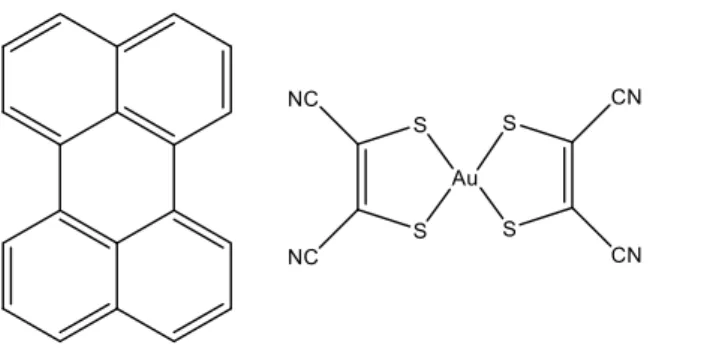
mnt2−: maleonitrile dithiolate, Figure 1) have led to a wide variety of molecular conductors. Among them, Per2[Au(mnt)2] (Per: perylene, Figure 1) is a
low-dimensional molecular conductor which con-tinues to attract great interest due to unusual physi-cal properties, such as anisotropic field suppression of the charge density wave [3], or superconduct-ing ground state under pressure [4]. Per2[Au(mnt)2]
is usually obtained by the electrocrystallization technique leading to single crystals as thin needles (several millimeters long and small cross sections, typically 0.05 × 0.02 mm2). This compound has also
292 Dominique de Caro et al.
Figure 1. Formulas for perylene (left) and
Au(mnt)2(right).
been grown as nano-sized needles on highly orien-tated pyrolytic graphite (HOPG), gold or platinum substrates [5]. At low current density conditions, nano-sized needles grow with the b-axis perpendic-ular to the substrate surface, following a homoge-neous nucleation process, being controlled by diffu-sion. Using (001)-oriented silicon wafers, our group has reported the preparation of Per2[Au(mnt)2]
nanowires [6]. Nanowires were grown in the an-odic compartment of an H-type electrochemical cell using perylene and [(n-C4H9)4N][Au(mnt)2]
as starting compounds. The oxidation of the pery-lene was performed at a constant current density of ∼0.30µA·cm−2at room temperature. Per2[Au(mnt)2]
nanowires exhibited a semiconducting behavior in the 100–298 K range and a room-temperature conductivity value of about 0.020 S·cm−1.
Amphiphilic molecules can control the growth of molecule-based conductors and allow the for-mation of nanoparticles [7]. In many cases, the molecule-based conductor contains at least one 5-membered heterocycle with two sulfur atoms. The amphiphilic 1-octanamine, N-(2-thienylmethylene) molecule (OATM, Figure 2) can afford two possibil-ities of interactions with the heterocycle, in favor of a better growth control of the nanoparticles:π–π in-teractions if the heterocycle contains unsaturation and S···S van der Waals interactions. Moreover, the long octyl chain can favor a better dispersion of the nanoparticles due to steric repulsions.
In this paper, we have explored the use of the am-phiphilic OATM and the zwitterionic ionic liquid 4-(3-butyl-1-imidazolio)-1-butanesulfonate (BIBS, Fig-ure 2) to control the growth of Per2[Au(mnt)2] as
nano-objects.
Figure 2. Formulas for OATM (above) and BIBS
(below).
2. Experimental section
2.1. Materials
Solvents are degassed immediately before use. Pery-lene, [(C2H5)4N]Br, sodium maleonitriledithiolate
(Na2mnt), potassium tetrachloroaurate (KAuCl4),
2-thiophenecarboxaldehyde, octylamine, 1-butyl-3-methylimidazolium tetrafluoroborate [BMIM][BF4],
1-butyl-3-methylimidazolium hexafluorophosphate [BMIM][PF6], 1-butyl-3-methylimidazolium bis
(trifluoromethylsulfonyl)imide [BMIM][(CF3SO2)2N]
and BIBS are commercially available and used with-out further purification.
2.2. Characterization
Elemental analyses are performed by the Microanal-ysis Service of LCC-CNRS. Nuclear magnetic reso-nance (NMR) of OATM is performed in dimethyl sulfoxide-d6 at room temperature on a Bruker Avance 400 spectrometer. All chemical shifts for
1H are relative to tetramethylsilane. Infrared
spec-tra are taken at room temperature (in KBr matrix) on a Perkin Elmer Spectrum GX spectrophotome-ter. Raman measurements are performed using a LabRAMHR800 (Jobin Yvon) set-up. The spectra are obtained at room temperature using the 632.8 nm line of a He–Ne laser. The incident beam is focused onto the sample through the ×100 optical micro-scope objective, giving a spot size of ∼1µm2. The back-scattered light is collected through the same
Dominique de Caro et al. 293
objective, dispersed (single-grating spectrograph, 1800 grooves·mm−1, focal length f = 80 cm) and then
imaged onto a CCD detector (Andor DU420-OE). Us-ing a laser power density of about 1.7 × 10⁶W·cm−2, no degradation of the material is observed. For transmission electron microscopy (TEM), the sam-ples are sonicated in ether and placed onto a ho-ley carbon-copper grid. TEM experiments are per-formed on a JEOL Model JEM 1011 operating at 100 kV. Powder conductivity measurements are car-ried out on pressed pellets of pure powder materials (size: 3.14 mm2× 1 mm thick) without any grind-ing. The cylinders used to press the materials play the electrodes role. Resistance data acquisition is achieved using a Hewlett-Packard model 4263A LCR meter. Current–voltage (I–V ) curves are acquired on an AFM Smarts SPM 1000 (AIST-NT) in conductiv-ity mode using Au-coated cantilever tips (PPP-NCL Au-10 from Nanosensors, resonance frequency: 146– 236 kHz, force constant: 21–98 N·m−1, tip radius: ∼10 nm). The particles are dispersed on a gold sub-strate previously cleaned with acetone, water, and carefully dried.
2.3. Syntheses
[(C2H5)4N][Au(mnt)2] is prepared by addition of
[(C2H5)4N]Br to a water solution of Na2mnt and
KAuCl4 at room temperature. Recrystallization is
performed in a 1:2 (vol./vol.) mixture of acetone and isopropanol (yield: 35%; elemental analysis, calculated: C 31.7%; H 3.3%; N 11.6%, found C 31.7%; H 3.2%; N 11.4%). OATM is prepared as a pale yellow oil by the condensation reaction of 2-thiophenecarboxaldehyde and octylamine in toluene (yield: 91%;1H NMR (ppm): 0.84 (3H, t), 1.23–1.30 (10H, m), 1.56 (2H, tt), 3.48 (2H, t), 7.12 (1H, dd), 7.43 (1H, dd), 7.62 (1H, dd), 8.43 (1H, s)).
The synthesis of Per2[Au(mnt)2] nanoparticles is
performed in a classical H-shaped electrocrystalliza-tion cell equipped with two platinum wire electrodes (length L = 1 cm, diameter d = 1 mm). The cathodic compartment is filled with [(C2H5)4N][Au(mnt)2]
(20 mg, 0.03 mmol) solubilized in a mixture of 8 mL dichloromethane and 4 mL acetonitrile. The anodic compartment is filled with perylene (30 mg, 0.12 mmol), [(C2H5)4N][Au(mnt)2] (40 mg,
0.07 mmol) and OATM (70µL, 0.30 mmol, i.e. 2.5 mo-lar eq. vs. perylene) [or BIBS, 78 mg, 0.30 mmol]
solubilized in a mixture of 8 mL dichloromethane and 4 mL acetonitrile. The electrolysis is conducted at room temperature under galvanostatic condi-tions (∼10 µA·cm−2). The anodic solution is vig-orously stirred during the entire electrolysis pro-cedure (∼3.5 days). The air-stable black powder of Per2[Au(mnt)2] is collected by filtration from the
anodic compartment (Scheme 1). Yield: 40%. Ele-mental analysis, calculated: C 58.7 %; H 2.5 %; N 5.7 %, found C 58.4%; H 2.2%; N 5.8%. IR (cm−1): 3055
(νCHethylenic for perylene), 2222 and 2208 (νCNfor
mnt2−ligands), 1536 and 1512 (νC=C), 813 (νC−S).
3. Results and discussion
The electrocrystallization technique under galvano-static conditions and low current densities is the method of choice to grow single crystals of molecule-based conductors which are suitable for physical studies [8,9]. In the absence of stirring of the solu-tion, the crystallographic quality of the product is much better. When the electrosynthesis is conducted in the presence of an amphiphilic molecule or an ionic species bearing bulky long carbon chains, the electrode can be rapidly passivated. A vigorous stir-ring is then necessary to favor the access of the elec-troactive species to the electrode.
We have performed the oxidation of perylene in the presence of [(C2H5)4N][Au(mnt)2], acting as both
reactant and supporting electrolyte, at 10µA·cm−2
under stirring for 3.5 days. Transmission electron mi-crographs for the Per2[Au(mnt)2] shiny black
pow-der collected from the anodic compartment evidence micro-sized crystals (Figure 3). We therefore note that the absence of a growth controlling agent in the solu-tion is accompanied by the absence of size control of the crystallites at the nanometer scale.
When the oxidation of perylene is conducted in the presence of [(C2H5)4N][Au(mnt)2] and OATM
(2.5 molar eq./perylene) at 10 µA·cm−2 under vigorous stirring for 3.5 days, a black powder of Per2[Au(mnt)2] is isolated in the anodic
compart-ment (see Section 2). Electron micrographs evidence nanocrystals exhibiting irregular shapes and sizes in the 35–100 nm range (Figure 4). Similar results are obtained for 5 molar eq. of OATM vs. perylene. The OATM molecule thus plays a crucial role in the con-trol of the growth of Per2[Au(mnt)2] as nano-objects.
We assume that aπstacking can occur between the
294 Dominique de Caro et al.
Scheme 1. Electrosynthesis of Per2[Au(mnt)2] nanoparticles (anodic reaction).
Figure 3. Electron micrograph for Per2
[Au(mnt)2] in the absence of growth
con-trolling agent (bar = 500 nm).
thiophene group of OATM and the AuS2C4ring of the
mnt2− ligand. Furthermore, OATM molecules can adsorb onto the platinum electrode surface. There-fore, the germination process of Per2[Au(mnt)2] is
more closely controlled at the electrode-solution interface, and the growth process is quickly blocked due to steric hindrance, leading to well dispersed nanocrystals. Finally, for higher current densities, namely, 40µA·cm−2, both well-dispersed
nanocrys-tals and aggregates are observed. A faster growth rate thus implies a poorer control of the state of dispersion of the nanocrystals.
As said in the introduction, ionic liquids con-taining the 1-butyl-3-methylimidazolium cation, [BMIM]+, are the most often used as growth con-trolling agents for the preparation of molecule-based conductors as nanoparticles. At low temper-atures, the ionic liquid organized into nonpolar mi-crodomains in which the confinement of the growing species is more efficient, affording small particles. The electrochemical oxidation of perylene in the presence of [(C2H5)4N][Au(mnt)2] and [BMIM][X]
where X− stands for BF−4, PF−6 or (CF3SO2)2N−
leads to Per2BF4, Per2PF6 or Per2[(CF3SO2)2N].
Figure 4. Electron micrograph for
nanocrys-tals of Per2[Au(mnt)2] grown in the presence of
OATM (bar = 500 nm).
The counter anion of BMIM+ prevails over the
[Au(mnt)2]−anion in the final product. To overcome
this problem, we have therefore evaluated the use of the zwitterionic ionic liquid, i.e. BIBS (Figure 2), as both supporting electrolyte and growth controlling agent in the electrosynthesis of Per2[Au(mnt)2].
We have performed the oxidation of perylene in the presence of [(C2H5)4N][Au(mnt)2] and BIBS
(2.5 molar eq./perylene) at 10µA·cm−2 under
stir-ring for 3.5 days. A black powder of Per2[Au(mnt)2]
is isolated in the anodic compartment (see Sec-tion 2). Electron micrographs evidence well dis-persed roughly spherical nanoparticles with sizes ranging from 10 to 40 nm (Figure 5). In compar-ison with OATM, the BIBS allows a better control of the morphology of the particles (spherical vs. ir-regular shapes). Furthermore, smaller particles are grown (10–40 nm vs. 35–100 nm). Per2[Au(mnt)2]
nanoparticles obtained in the presence of BIBS are very similar to those previously described for another bis(dithiolene) complex, i.e., TTF[Ni(dmit)2]2grown
with [BMIM][X], as growth controlling agent [2]. The BIBS could play a double role in the controlled growth of Per2[Au(mnt)2] as nanoparticles. As for
Dominique de Caro et al. 295
Figure 5. Electron micrograph for
nanoparti-cles of Per2[Au(mnt)2] grown in the presence of
BIBS (bar = 200 nm).
Figure 6. Raman spectrum for Per2[Au(mnt)2]
nanoparticles.
OATM, π–π interactions between the imidazolium cycle of the BIBS and the AuS2C4ring of the mnt2−
ligand can occur. Furthermore, at the electrode sur-face, the BIBS could stabilize the Per+ion via electro-static attraction with the sulfonate SO−3group.
The Raman spectrum for Per2[Au(mnt)2]
nanoparticles (Figure 6) is dominated by the C=C stretching modes for both the perylene molecules and the dithiolate ligands (in the 1320–1600 cm−1 range). Low frequency bands at 370, 518, and 800 cm−1 are assigned to Au–S stretching mode,
AuS2C2 ring deformation mode, C–S stretching
mode, respectively [10].
Per2[Au(mnt)2] single crystals present an
electri-cal conductivity of 700 S·cm−1along the stacking axis (b) at 25◦C [11]. For Per2[Au(mnt)2] nanoparticles
described in this paper, the conductivity at room temperature is found to be of about 0.025 S·cm−1.
This value is in agreement with those reported for TTF[Ni(dmit)2]2nanopowders prepared in the
pres-ence of BMIM-based ionic liquids (in the 0.01– 1 S·cm−1 range) [1]. The conductivity of a
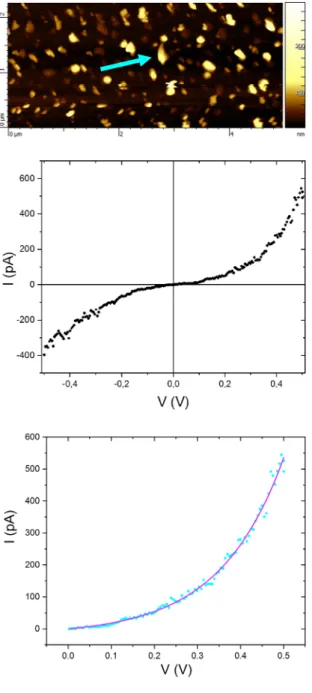
com-pressed pellet of a nanoparticle powder is the result of two main contributions: the conductivity of the particles (exhibiting random crystallographic ori-entations) themselves and the conductivity of the boundaries between them. The absence of a pref-erential crystallographic orientation of the particles within the nanopowder and the resistive bound-aries between the particles explain a much lower conductivity value than that for single crystals. Fig-ure 7 shows the I–V curve of an individual 40 nm high nanoparticle using conductive atomic force mi-croscopy (sample prepared in the presence of BIBS). The deviation from the linear ohmic behaviour that would be expected for a metallic nanoparticle arises from the involved boundaries, such as tip-nanoparticle and substrate-tip-nanoparticle. The ob-served energy gap is about 0.26 eV. A least-squares fit of the region corresponding to positive bias voltages (from 0.00 to 0.50 V) is shown on Figure 7. The fit is obtained using the Shockley diode equation:
I = I0[e V V0− 1]
where I0represents the saturation current and V0the
threshold voltage (energy barrier). From the fit, we obtain I0= 19.3±1.1 pA and V0= 0.149±0.03 V
(coef-ficient of determination: R2= 0.993). The activation energy barrier extracted from the fit (about 0.15 eV) is relatively consistent with half of the energy gap (0.26/2 = 0.13 eV). For the sample prepared in the presence of OATM, I–V curves are noisy and asym-metric in shape, the positive bias voltages being 2– 3 times higher than the negative ones (in absolute value).
4. Conclusion
In this paper, we have described the first nanoparti-cles of the metal-organic conductor Per2[Au(mnt)2].
The growth controlling agents evaluated in this study, namely, OATM and BIBS, prevented the prepara-tion of Per2[Au(mnt)2] as micro-sized crystals.
Irreg-ularly shaped nanocrystals are grown in the presence
296 Dominique de Caro et al.
Figure 7. Topographic image for Per2
[Au(mnt)2] nanoparticles prepared with
BIBS (top), I–V curve for the particle indicated by the arrow (middle), least-squares fit of the region corresponding to positive bias voltages (down).
of OATM, whereas spherical nanoparticles are ob-tained if the zwitterionic ionic liquid BIBS is used. It has been reported that Per2[Au(mnt)2] exhibits a
fairly good thermopower value of S = 40µV·K−1[12].
Moreover, the thermal conductivity λ is very low for organic-based conductors as nanoparticles [13]. As the thermoelectric efficiency of a material is evaluated by its figure of merit ZT in which S2 is in the numerator and λ in the denominator, Per2[Au(mnt)2] nanoparticles described in this paper
could be interesting as one of the components for organic-based thermoelectric devices. Furthermore, our study opens the way to the potential preparation of nanoparticles of Per2[M(mnt)2] systems in which
MIIIis a magnetic center such as NiIII, PdIIIor PtIII. Such systems as nanoparticles could be interesting for fundamental physical studies.
References
[1] D. de Caro, K. Jacob, C. Faulmann, J.-P. Legros, F. Senocq, J. Fraxedas, L. Valade, Synth. Met., 2010, 160, 1223-1227. [2] D. de Caro, C. Faulmann, L. Valade, K. Jacob, I. Chtioui,
S. Foulal, P. de Caro, M. Bergez-Lacoste, J. Fraxedas, B. Balles-teros, J. S. Brooks, E. Steven, L. E. Winter, Eur. J. Inorg. Chem., 2014, 8, 4010-4016.
[3] J. S. Brooks, D. Graf, E. S. Choi, M. Almeida, J. C. Dias, R. T. Henriques, M. Matos, Curr. Appl. Phys., 2006, 6, 913-918. [4] D. Graf, J. S. Brooks, M. Almeida, J. C. Dias, S. Uji, T. Terashima,
M. Kimata, Europhys. Lett., 2009, 85, 27009-27013.
[5] M. L. Afonso, R. A. L. Silva, M. Matos, A. S. Viana, M. F. Monte-mor, M. Almeida, Langmuir, 2012, 28, 4883-4888.
[6] J.-P. Savy, D. de Caro, C. Faulmann, L. Valade, M. Almeida, T. Koike, H. Fujiwara, T. Sugimoto, J. Fraxedas, T. Ondarçuhu, C. Pasquier, New J. Chem., 2007, 31, 519-527.
[7] D. de Caro, C. Faulmann, L. Valade, “Nanoparticles of Organic Conductors”, in Molecular Materials: Preparation, Charac-terization, and Applications (S. Malhotra, B. L. V. Prasad, J. Fraxedas (dir. publ.), eds.), CRC Press, Boca Raton, 2017, 127-149.
[8] P. Cassoux, L. Valade, P.-L. Fabre, “Fundamentals: Ligands, Complexes, Synthesis, Purification and Structure”, in Com-prehensive Coordination Chemistry II: From Biology to Nan-otechnology (A. B. P. Lever (dir. publ.), ed.), Elsevier, Amster-dam, 2003, 761.
[9] P. Batail, K. Boubekeur, M. Fourmigué, J.-C. P. Gabriel, Chem. Mater., 1998, 10, 3005-3015.
[10] M. K. Johnson, “Vibrational Spectra of Dithiolene Com-plexes”, in Dithiolene Chemistry Synthesis, Properties, and Ap-plications (E. I. Stiefel (dir. publ.), ed.), John Wiley & Sons, Hoboken, 2004, 213-266.
[11] M. Almeida, R. T. Henriques, “Perylene Based Conductors”, in Handbook of Organic Conductive Molecules and Polymers (H. Singh Nalwa (dir. publ.), ed.), vol. 1, John Wiley & Sons, Chichester, 1997, 87.
[12] M. Matos, G. Bonfait, I. C. Santos, M. L. Afonso, R. T. Hen-riques, M. Almeida, Magnetochemistry, 2017, 3, 22-34. [13] I. Chtioui-Gay, C. Faulmann, D. de Caro, K. Jacob, L. Valade,
P. de Caro, J. Fraxedas, B. Ballesteros, E. Steven, E. S. Choi,
Dominique de Caro et al. 297
M. Lee, S. M. Benjamin, E. Yvenou, J.-P. Simonato, A. Carella, J. Mater. Chem. C, 2016, 4, 7449-7454.
![Figure 4. Electron micrograph for nanocrys- nanocrys-tals of Per 2 [Au(mnt) 2 ] grown in the presence of OATM (bar = 500 nm).](https://thumb-eu.123doks.com/thumbv2/123doknet/13659935.429418/6.816.71.389.236.478/figure-electron-micrograph-nanocrys-nanocrys-grown-presence-oatm.webp)
![Figure 6. Raman spectrum for Per 2 [Au(mnt) 2 ] nanoparticles.](https://thumb-eu.123doks.com/thumbv2/123doknet/13659935.429418/7.816.70.391.435.636/figure-raman-spectrum-for-per-mnt-nanoparticles.webp)