HAL Id: tel-01872737
https://tel.archives-ouvertes.fr/tel-01872737
Submitted on 12 Sep 2018
HAL is a multi-disciplinary open access
archive for the deposit and dissemination of sci-entific research documents, whether they are pub-lished or not. The documents may come from teaching and research institutions in France or abroad, or from public or private research centers.
L’archive ouverte pluridisciplinaire HAL, est destinée au dépôt et à la diffusion de documents scientifiques de niveau recherche, publiés ou non, émanant des établissements d’enseignement et de recherche français ou étrangers, des laboratoires publics ou privés.
controlled optical properties
Sanaa Shehayeb
To cite this version:
Sanaa Shehayeb. Electrophoretic deposition of nanoparticles for controlled optical properties . Material chemistry. Université Montpellier, 2017. English. �NNT : 2017MONTT195�. �tel-01872737�
THÈSE POUR OBTENIR LE GRADE DE DOCTEUR
DE L’UNIVERSITÉ DE MONTPELLIER ET DE L’UNIVERSITÉ LIBANAISE
En Chimie Séparative, Matériaux et Procèdes
École doctorale Chimie Balard
-École
doctorale de Sciences et TechnologiesUnité de recherche Institut de Chimie Séparative de Marcoule (ICSM) et Laboratoire de Catalyse
Organométallique et Matériaux (LCOM)
Présentée par Sanaa SHEHAYEB
Le 30 Novembre 2017
Sous la direction de Xavier DESCHANELS et Iyad KARAME
Devant le jury composé de
Lara HAlAOUI, Professeur, American University of Beirut Ghassan YOUNESS, Professeur, Beirut Arab University Bilal NSSOULI, Professeur, CLEA, CNRS-L
Guillaume TOQUER, Maitre de Conference, ENSCM Xavier DESCHANELS, Chercheur, CEA
Iyad KARAME, Professeur, Université Libanaise Leila GHANNAM, Professeur, Université Libanaise
Présidente-Rapporteur Rapporteur Examinateur Examinateur Directeur Directeur Co-encadrante
Recepteur Solaire photo-thermique Obtenu par electrophorese
des nanoparticules a propriete optique selective
“Science knows no country, because knowledge belongs to humanity,
and is the torch which illuminates the world.”
This work wouldn’t have the spirit that it has without the invaluable academic, psychological and support, provided by my thesis supervisors and co-supervisors, colleagues, family and best friends.
I would like first to thank my thesis supervisors Dr. Xavier DESCHANELS (Responsible of LNER laboratory at the ICSM of CEA-Marcoule in France) and Prof. Iyad KARAME (Responsible of LCOM laboratory at the Lebanese University) for their thoughtful encouragement and careful supervision. Their guidance through these three years has empowered me with wide knowledge and better understanding of our subject. I also owe a debt of gratitude to Dr. Guillaume TOQUER (LNER/ICSM) and Prof. Leila GHANNAM (LCOM/LU) for their expert guidance, longtime discussions and tremendous efforts to offer every possible help to ensure a successful understanding and progress of the thesis work. Thank you for sharing the excitement of every discovery and for your unwavering enthusiasm every time I came up with a question. Thank you for your advice, patience and faith in me.
The ICSM is composed of different laboratories where I have found answers and solutions to most of my questions and challenges. I would like to thank all the ICSM family starting by the LNER group members and other laboratories’ permanents, engineers and technicians as well as post-docs and PhD students for their technical help and useful discussions. Equally, I would like to thank the EDST research platforms at the Lebanese university for the technical experimental help. I would like to thank particularly: Dr. Diane REBISCOUL (LNER/ICSM) for all the useful discussions as well as for advising and sharing her experience with me. Eng. Cyrielle REY (LNER/ICSM), thank you for all the useful discussions and all the chemical supplies especially the almighty “Isopropanol”. Similarly, I would also like to thank Dr. Jeremy CAUSSE and Eng. Alban JONCHERE (L2IA/ICSM) for all the spectroscopy analysis. Dr. Joseph LAUTRU, Dr. Renaud PODOR, and Dr. Michael ODORICO from the L2ME group at the ICSM, adding Bruno CORSO, Xavier LEGOFF and Henri-Pierre BRAU for all your tremendous efforts and the beautiful SEM and AFM images. Finally, I would like to thank Dr. Olivier DIAT (responsible of L2IA group) and L2IA group members for welcoming me at their laboratory to perform several experiments.
It is also my pleasure to thank the administrative department at the ICSM, Mr. Stéphane PELLET-ROSTAING (Director/ICSM) and Mrs. Dominique ALPE-CONCHY (Assistant director/ICSM) for their warm reception at the institute. Similarly, I would like to
It is also my pleasure to acknowledge Prof. Lara HALAOUI (Professor at AUB) for honoring me by being the president of the jury of the defense and for accepting to review the work of this PhD. along with Prof. Ghassan YOUNESS (Dean of Faculty of Sciences at BAU). Your valuable comments and advices have added a great value to the work reported. I would also like to thank Prof. Bilal NSSOULI for accepting to participate in the jury.
Moreover, our deepest appreciation goes to the University of Montpellier and the Lebanese National Council of Scientific Research (CNRS-L) for the co-joint funding of the work of this PhD.
I also wish to express my appreciation to many colleagues and friends for the discussion, communication and lovely company: Tamir SUKHBAATAR, Denis HAUCHARD, Suson SANANES I., Cindy COLLAINE, Helene ARENA, Clementine MANSAS, Frederick LACEMON, Sarah HOCINE, Ricardo NAVAM, Carlos ARRAMBIDE C., Moheddine WEHBI, Wissam ZAHREDDINE, Bilal ALASSAAD, Samira ZAHER, Shouaa BOUFAOUR, Nadim EID, Fatima RIDA, Dr. Sanaa N. SHEHAYEB, “French dudes”, and all the members of Khota Ashabab for their continuous support.
Every challenging work needs self-efforts as well as guidance and support of those who are very close to our heart. I dedicate this PhD to my sweet and loving family and especially my dad (Saad) and second mothers (Randa and Ola) whose affection, love, encouragement and prayers during day and night made the hardest challenges bearable. Finally, my deepest acknowledgements and dedication goes to my reason of being, my loving husband Mazen, for sharing my wish to complete this PhD and being a constant source of encouragement and support.
To the strongest and kindest soul, to the memory of my mother, engraved in my heart and mind forever. You are my deepest motivation!
growing in importance to limit the use of fossil fuels. Black copper (CuO) has proved to be one of the viable solar-selective coatings owing to its nearly intrinsic properties. The formation of a tandem absorber based on CuO thin film deposited onto a highly IR reflecting metallic substrate is processed by electrophoretic deposition (EPD).
In this way, the stabilization of a CuO colloidal suspension is studied previously by
adding Mg(NO3)2 in isopropanol (IPA) or polyethyleneimine (PEI) in water suspension. Both
acts as positively charging agents and allow the realization of a cathodic EPD. The colloidal stability as a function of the stabilizing agent content is studied prior to EPD, by dynamic light scattering (DLS) coupled with laser doppler velocimetry.
CuO tandem absorbers are obtained by varying different EPD parameters to control the final thickness and also the morphology. Consequently, the optical selectivity of the tandem material is tuned and optimized. The deposition yield is compared relative to the different applied voltage range, deposition time and nanoparticle concentrations.
Homogeneous deposits are obtained for [CuO]=5x10⁻⁴ g/cm3 from both suspensions. The
optimum applied voltage is found to be 50 V.cm-1 for IPA suspension and 2 V.cm-1 for H2O
suspension, for deposition times of 30 mins and 120 mins, respectively. The composition and the thickness of the coatings are analysed by Grazing Incidence X-ray diffraction (GIXRD), scanning electron microscopy (SEM) and the density is obtained from energy-dispersive X-ray spectroscopy (EDX). For the previously mentioned optimized conditions, CuO tandem
absorbers derived from IPA suspension possess a density of 1.69 g/cm3 with high surface
roughness. In contrast, homogeneous and regular surfaces is obtained from water suspensions
having a higher density of 5.7 g/cm3.
Moreover, absorptance (α) and emittance (ԑ) are calculated from the reflectance spectra of the UV-Vis-NIR and the Fourier transform InfraRed (FTIR) spectroscopy, respectively. α and ԑ were combined to determine the efficiency (ƞ) of the tandem material. Tandems obtained from water suspension has ƞ=0.8 -0.87 while from IPA ƞ=0.7. Besides, the applicability of this EPD is checked by performing other deposit of CuO on metallic substrates of different types.
CuO tandems obtained from water suspensions are clearly more prominent to be used as solar selective tandem absorbers due to the high calculated ƞ value reported. The efficiency of such selective tandem absorbers was further enhanced by carbonization (pyrolysis under inert atmosphere) of the polymer (PEI) embedded in the coating. Otherwise,
a thin film of SiO2 nanoparticles was deposited at the surface of the selective tandem
absorbers to protect them. Both routes were successfully processed and proved to raise ƞ to 0.9.
technique en expansion qui permet de limiter l'utilisation des sources conventionnelles d’énergie (combustibles fossiles, nucléaire…). Le cuivre noir (CuO) s’avère être un matériau possédant des propriétés optiques sélectives intéressantes pour cette application. Ainsi, son utilisation au sein d’un absorbeur sous forme d’un matériau « tandem » est une solution envisagée. Le challenge que nous avons tenté de relever au cours de ce travail, a été de réaliser ce type de matériaux par dépôt électrophorétique (EPD) de nanoparticules de CuO déposé sur un substrat métallique de type wafer de silicium métallisé (platine ou or). Ce substrat « modèle » a été utilisé premièrement car il facilite la mise en œuvre de techniques de caractérisation telles que l’analyse par diffraction X en incidence rasante (GIXRD) ou l’analyse en coupe transversale par microscopie électronique à balayage. Pour ce faire, la stabilisation de la suspension colloïdale de CuO (condition sine qua non pour la réalisation d’un dépôt électrophorétique) a été étudiée dans un solvant organique tel que l'isopropanol
par ajout de Mg(NO3)2, ainsi qu’n milieu aqueux en utilisant comme dispersant du
polyéthylèneimine. Ces deux adjuvants agissent comme des agents stabilisants et apportent aux nanoparticules une charge positive ce qui permet la réalisation d'un EPD cathodique. Afin d’optimiser la formulation des suspensions, la stabilité colloïdale en fonction de la teneur en stabilisant a été étudiée avant tout dépôt, par diffusion dynamique de la lumière (DLS) couplée à la vélocimétrie laser à effet Doppler.
Différents revêtements contenant le CuO ont été obtenus en faisant varier les paramètres inhérents à l’EPD (temps de dépôt, champ électrique, concentration en nanoparticules) pour pouvoir contrôler l'épaisseur finale ainsi que la morphologie. Par conséquent, la sélectivité optique et le rendement du tandem résultants peuvent être optimisés en jouant sur l’ensemble de ces paramètres. Des dépôts homogènes ont été obtenus pour
[CuO] =5x10⁻⁴ g.cm-3 pour les deux milieux. Les meilleures conditions sont 50 V.cm-1 // 30
mn pour la suspension d'IPA et 2 V.cm-1 // 120 mn pour la suspension en milieu aqueux. La
composition et l'épaisseur des dépôts sont analysées par GIXRD, et par microscopie électronique (MEB-EDS). Pour les conditions optimisées, les matériaux tandem obtenus à
partir de la suspension CuO/IPA possèdent une densité de 1.69 g/cm3 avec de la rugosité
micrométrique. Au contraire, des surfaces homogènes et régulières sont obtenues en milieu
aqueux où les dépôts présentent une densité beaucoup plus élevée autour de 5.7 g.cm-3.
L’absorptance (α) et l’émittance (ԑ) ont été calculées à partir des spectres de réflectance de l'UV-VIS-NIR et de l’Infrarouge lointain, respectivement. L'efficacité (ƞ) du revêtement tandem obtenu en milieu aqueux se situe dans l’intervalle 0.80-0.87 alors qu’elle n’est seulement de 0.7 dans l’IPA. De plus, la faisabilité de l’EPD sur d’autres substrats métalliques plus conventionnels (acier, aluminium, cuivre) en vue d’une application a été explorée. Par ailleurs, l'efficacité des dépôts a pu être améliorée par des post-traitements de deux types. D’une part, en pyrolysant à 400°C sous atmosphère inerte le polymère (PEI) incorporé dans le revêtement. Le carbone résiduel ainsi obtenu à l’issue de cette pyrolyse a permis d’augmenter l’absorptance. D’autre part, en déposant sur la surface des revêtements
une couche de nanoparticules de SiO2 qui joue le rôle de couche anti-réflective tout en
permettant de protéger la surface de CuO. Les deux voies ont été réalisées avec succès et le rendement le plus élevé obtenu pour ces revêtements est de 0.9 (valeur comparable aux absorbeurs commerciaux)
Table of Contents
Acronyms ... 1
Résumé Générale de La Thèse ... 2
General Introduction ... 6
Chapter One: ... 10
Designing Solar Tandem Absorbers by EPD... 10
1. Introduction ... 11
1.1. Solar Thermal energy ... 11
1.1.1. Principles for obtaining solar selective surfaces ... 14
1.1.2. CuO absorber reflector tandems ... 17
1.2. Electrophoretic deposition ... 20
1.2.1. Parameters controlling EPD ... 21
1.2.1.1. Suspension parameters ... 23
Solvent ... 23
Particle Size ... 23
Conductivity of the suspension ... 24
Zeta Potential ... 24
Stability of the suspension ... 25
1.2.1.2. EPD parameters ... 26
Effect of deposition time ... 26
Applied voltage ... 26
Concentration of the solid in the suspension ... 27
Conductivity of the substrate ... 28
1.2.2. Stabilization of a suspension for EPD ... 28
Steric Stabilization ... 30
Electro-steric Stabilization ... 30
1.2.4. How does a deposit form by EPD? ... 30
1.2.5. CuO and EPD ... 34
1.2.6. Suspensions of CuO... 34
1.2.7. CuO thin films formed by EPD ... 35
Conclusion ... 36
References ... 37
Chapter Two: ... 40
Materials and Experimental Methods ... 40
2. Introduction ... 41
2.1. CuO Nanopowder ... 41
2.1.1.a. TEM Analysis ... 41
2.1.1.b. Thermal analysis of bulk CuO ... 41
2.1.2. LUDOX Suspensions ... 43
2.2. EPD Setup... 44
2.3. Characterization of the suspension ... 45
2.3.1. Laser Doppler Velocimetry ... 45
2.3.2. Dynamic Light Scattering ... 48
2.4. Characterization of tandem absorbers ... 49
2.4.1. Scanning Electron Microscopy and Atomic Force Microscopy ... 49
2.4.1.a. EDX ... 51
2.4.1.b. X-film-EDX ... 51
2.4.2. Diffuse Spectroscopy ... 52
2.4.2.a. UV-VIS-NIR Spectroscopy ... 52
2.4.4. GIXRD... 55
Conclusion ... 56
References ... 56
Chapter Three: ... 57
Electrophoretic deposition of CuO in Isopropanol ... 57
3. Introduction ... 58
3.1. Stabilization of CuO in isopropanol ... 59
3.2. Electrophoretic deposition of CuO in IPA ... 61
3.2.1. Effect of Mg(NO3)2 as a binder material ... 61
3.2.1.a. Analysis of the composition of the deposit ... 62
3.2.1.b. FTIR measurement... 62
3.2.1.c. EDX-Elemental mapping ... 63
3.2.2. Effect of CuO concentration ... 65
3.2.3. Effect of applied electric field ... 67
3.2.4. Effect of deposition time ... 71
3.3. Spectral Selectivity ... 74
3.3.1. Effect of the deposition time on total reflectance (%R) ... 74
3.3.2. Spectral Selectivity ... 75
Conclusion ... 77
References: ... 78
Chapter Four: ... 79
Electrophoretic Deposition of CuO in Water ... 79
4 Introduction ... 80
4.1. Stabilization of CuO in Polyethylenimine ... 81
4.1.2. Effect of pH... 81
4.2. Effect of EPD parameters on the deposition process ... 90
4.2.1. Post deposition: Enhancing the quality of the deposits ... 90
4.2.2. Effect of applied electric field ... 91
4.2.3. Effect of deposition time ... 93
4.3. Composition of the deposits... 96
4.3.1. Grazing incidence X-ray diffraction ... 96
4.3.2. X-ray photoelectron spectroscopy (XPS) ... 98
4.3.3. Estimating the density of the film at E=2V.cm-1 ... 100
4.4. Spectral selectivity ... 101
4.4.1. Effect of applied electric field. ... 101
4.4.2. Effect of deposition time ... 103
Conclusion ... 104
References: ... 106
Chapter Five: ... 108
5 Introduction ... 109
5.1. Choosing a Suitable metallic substrate ... 109
5.2. Reproducibility ... 113
5.3. Protection of the deposit ... 115
5.3.1. Calcination ... 115
5.3.2. Anti-reflection layer ... 118
Setup ... 119
Effect of SiO2 as antireflection layer ... 119
5.4. EPD in Mixed Solvent ... 123
Conclusion ... 126
References: ... 128
1
Acronyms
PV: Photovoltaic
FPC: Flat plate collector STE: Solar Thermal Energy CSP: Concentrated Solar power AFM: Atomic Force Microscopy CE: Counter Electrode
DLS: Dynamic Light Scattering
EDX: Electron Dispersive X-Ray spectroscopy EPD: Electrophoretic Deposition
RE: Reference Electrode WE: Working Electrode IR: Infra-Red
SEM: Scanning Electron Microscopy PAA: Poly(acrylic acid)
PEI: Poly-ethylenimine PVA: Poly(vinyl alcohol)
SAXS: Small Angle X-ray Scattering
GIXRD: Grazing Incidence X-Ray Diffraction ELD: Electrolytic Deposition
2
Résumé Générale de La Thèse
L'énergie fournie par le soleil en une heure est équivalente à notre consommation annuelle d'énergie. Ainsi, l'énergie solaire peut subvenir à tous nos besoins, si on parvenait à la convertir d’une façon efficace et économiquement viable. Elle peut être exploitée par deux méthodes : la conversion photothermique ou la conversion photovoltaïque. La première technologie consiste à récupérer l’énergie fournie par le soleil pour chauffer un fluide, la seconde consiste à convertir le rayonnement solaire en électricité. Malgré l'exploitation accrue des énergies renouvelables ces dernières années, ce mode de production ne représente que 19 % de l’énergie produite à l’échelle de la planète, dont0.70 % relatif à l’énergie solaire. La plus grande partie de cette énergie est produite par du solaire photothermique (71%), pour le chauffage d'eau et des applications domestiques.
L'énergie thermique basse température se présente comme le moyen le plus intéressant d’exploiter l'énergie solaire. Dans le monde, c’est la chine qui détient le record de consommation d'énergie thermique solaire (65.07 %), suivi par l'union européenne (11.73 %) et les États-Unis (6.74 %). Ce sont les pays en voie de développement qui sont les moins avancés sur ce point dans ce domaine. Cette faible production est dûe au manque de conscience de l'importance de l'énergie solaire dans ces pays et au haut coût élevé des installations de capteurs solaires photothermiques.
Le principe de base de la conversion photothermique de l’énergie solaire consiste à transférer le rayonnement solaire à un fluide caloporteur par l’intermédiaire d’un élément absorbeur sélectif. L‘absorbeur sélectif est constitué d’un matériau ou d’un assemblage de
matériau qui possède une absorptivité élevée (typiquement a>0,9), équivalente à une
réflectance basse, sur la bande spectrale d'émission solaire (0.2-2 µm) et une émissivité faible (e<0,1), c’est-à-dire une réflectance élevée dans la région spectrale de l’infrarouge (2-20 µm) lointain. Il n’existe pas de composés qui possèdent intrinsèquement ces propriétés. Un moyen utilisé pour s’approcher des propriétés d’un absorbeur « idéal », consiste à réaliser un matériel tandem constitué d'un revêtement très absorbant déposé sur un substrat métallique (réflecteur en Infra Rouge).
Les films minces métalliques d'oxydes ont reçu une attention particulière pour des applications dans le domaine du solaire, en raison de leur potentialité pour réaliser des absorbeurs sélectifs, des couches anti réflectives…). Les couches d'oxyde de Cuivre CuO, ou "Cuivre Noir" ont notamment été utilisées pour des applications en tant qu’absorbeur solaire
3 sélectif du fait de leurs propriétés optiques. Des telles surfaces ont été obtenues par coating (dip-coating, spin-coating) de sels de cuivre (chlorure d'acétate ou d’acétate de cuivre) sur des substrats métalliques Cependant, de telles méthodes nécessitent un post-traitement thermique ou chimique, après le dépôt. Ce traitement peut conduire à la formation d'autres
formes de sous-oxydes Cu2O qui dégrade les propriétés thermiques et optiques de l'absorbeur.
La technique de Dépôt ElectroPhorétique (EPD) est largement utilisée depuis toujours, pour la réalisation de couches céramiques. Plus récemment, l’EPD est utilisée pour le dépôt de revêtements uniformes sur des substrats de formes diverses ; pour la formation des revêtements composites ou encore pour le dépôt de films minces de nanoparticules ou de nanotubes de carbone. Des progrès importants ont été réalisés ces dernières années, sur la compréhension des mécanismes de base de l’EPD, l'expansion des applications traditionnelles de l’EPD et l'exploration des nouveaux domaines d'application à des combinaisons de matériaux.
L’EPD est basée sur la migration de particules chargées par l'application d'un champ électrique et leur dépôt sur l'électrode de signe opposée. L’EPD est considérée comme une technique flexible permettant ainsi le contrôle de l'épaisseur et de la morphologie des films déposés en faisant variés les paramètres du procédé. Il est nécessaire d’avoir une suspension stable, homogène et chargée pour que les particules forment un dépôt. Pour un absorbeur tandem, l'épaisseur de la couche d’absorbeur doit être minutieusement contrôlée pour préserver les propriétés de réflexion du substrat, l’EPD est une technique qui offre une telle possibilité. La plus grande difficulté réside dans l’obtention d’une suspension stable de CuO.
L’objectif de ce travail est la réalisation par EPD d’absorbeurs tandem à base d’oxydes de cuivre pour des applications photo-thermiques à basse température. Les connaissances acquises sur ce système pourront être utilisées sur d’autres systèmes. Un effort particulier a été fait pour trouver les conditions de stabilisation d’une suspension de nanoparticules de CuO en milieu aqueux et dans l’isopropanol. Cette thèse est composée de cinq chapitres principaux, comme suit :
Le chapitre un est divisé en deux parties. La première partie explique le concept général et les procédés utilisés pour produire des absorbeurs sélectifs tandem et en particulier des absorbeurs à base de CuO. L'autre partie présente le procédé général d'EPD, l’influence des paramètres opératoires sur les caractéristiques du dépôt et les différents mécanismes associés à la technique EPD.
4 Dans le chapitre deux, les différents techniques et les procédures utilisées dans cette étude sont présentées ainsi que les méthodes utilisées pour leur caractérisation.
Dans le chapitre trois sont présentés les travaux réalisés sur la suspension de CuO
dans l’isopropanol en utilisant le Mg(NO3)2.6H2O comme stabilisant cationique. Cette
suspension a été déposée par EPD pour former un absorbeur tandem sélectif à base de CuO. L'épaisseur de la couche CuO a été contrôlée en faisant varier les paramètres opératoires lors du dépôt par EPD.
Dans le chapitre quatre, la stabilisation d’une suspension de CuO dans l'eau est présentée, en utilisant le polymère cationique (PEI). Cette suspension a été utilisée pour réaliser des absorbeurs tandem par dépôt électrophorétique (EPD). L’influence des paramètres expérimentaux tels que le champ électrique appliqué, le temps de dépôt est présenté, ainsi que l’évaluation de la sélectivité spectrale des films obtenus.
Dans le chapitre cinq est présentée l’influence du substrat utilisé sur la sélectivité des films obtenus par électrodéposition des suspensions CuO/IPA et CuO/H2O. Cette étude prouve l'applicabilité de l'EPD à différents types de substrats (électrode de dépôt), pour former des absorbeurs solaires tandem efficaces. L’influence de post-traitement (recuit thermique, dépôt de couches anti-réflexion) sur la sélectivité est également présentée.
En Conclusion :
L’EPD est un procédé ancien pour l’obtention de films céramiques qui pour la première fois a été mis en œuvre pour obtenir des absorbeurs solaires tandem. CuO est un bon candidat pour cette application car il présente une certaine sélectivité spectrale. Les conditions d’obtention d’une suspension colloïdale stable, prérequis indispensable pour la réalisation d’un dépôt par EPD, ont été optimisées en milieu aqueux par l’ajout d’un polymère cationique (PEI) et en milieu isopropanol par l’ajout d’un stabilisant le
Mg(NO3)2.6H2O. Les paramètres du procédé EPD (temps de dépôt, champ appliqué…) ont
été étudiés afin d’optimiser la sélectivité ainsi que la densification des revêtements. La densité de la couche déposée a été calculée en utilisant l'équation de Hamaker. L'épaisseur du dépôt augmente linéairement en fonction du temps de dépôt et du champ appliqué. Pour le système IPA/CuO, la densité du revêtement augmente en fonction du champ électrique appliqué, variant entre 0.35, 0.49 et 1.69 g/cm3 pour respectivement des champs de 5, 10, 50
V.cm-1. Les valeurs d’absorbance (α) et d’émissivité (ԑ) optimales obtenues sont 0.7 et 0.14
5 utilisé comme agent de stabilisation cationique, qui a d'abord un rôle de complexation de
Cu2+ à la surface de nanoparticules de CuO, puis qui permet de charger positivement ces
nanoparticules. La cinétique de dépôt a été étudiée à pH=9. Dans ces conditions, la densité du revêtement calculée en utilisant l'équation Hamaker est de 5.7 g/cm3. Cette valeur est en
accord avec d’autres estimations, 5.9 g/cm3, faites à partir du logiciel X-film et des analyses
obtenues spectroscopie à rayons X à dispersion d’énergie (EDS)).
Finalement, les deux systèmes ont donné des résultats reproductibles, applicables à différents substrats métalliques (Cu/acier inox/Al). Les revêtements tandems obtenus à partir de nanoparticules de CuO dispersées dans l'eau sont plus homogènes et plus denses en comparaison avec les revêtements élaborés à partir des suspensions CuO/IPA. Le rendement maximal obtenu sur les revêtements de type CuO/PEI est de 0.84-0.87, et d’environ 0.7 pour
les revêtements CuO/IPA. Une couche protective et anti réflective de SiO2 de 100 nm
d’épaisseur a été déposée sur les revêtements CuO/PEI. Dans ces conditions les propriétés optiques des revêtements ont été améliorées, et le rendement a atteint la valeur de 0.9. Une autre voie d’amélioration a consisté à calciner les revêtements de type CuO/PEI pour transformer le polymère en carbone, afin d’améliorer l’absorbance et de stabiliser le film. Cette optimisation a également conduit à obtenir un rendement proche de 0.9.
6
General Introduction
The energy that is provided by the sun in one hour is equivalent to our global energy consumption for one year. Thus, solar energy is able to supply all our needs, if it is converted economically and efficiently to renewable energy. It is harnessed either by thermal energy technology or by photovoltaic technology. The former relies on the heat supplied by the sun while the latter converts this solar radiation into electricity. Despite the increased exploitation of renewable energy, still accounts only 19% of the global energy consumption. Only 0.70% of the global renewable enrgy, is solar energy, in which 71% are dedicated to solar thermal energy for water heating and domestic applications (see Figure 1).
Figure 1: Global energy consumption and solar energy exploitation (retrieved from www.cnrs.fr/sagascience) Low temperature solar thermal energy presents the most obvious way of harnessing solar energy. It is usually installed on rooftops and used to heat water to supply taps and radiators. The highest solar thermal energy consumption is used by China (65.07 %), followed by the European union (11.73%) and the united states (6.74%), while the lowest consumptions are recorded for underdeveloped countries (see Figure 2). The low consumption in different countries is usually due to lack of awareness of the importance of solar energy and the high cost of installation of solar absorbers.
Nuclear 3% Renewable 19% (Solar 0.7%) Fossil 78%
Nuclear Renewable Fossil
Thermal 71% Photovoltaics 28% Concentrating towers 1%
7 Figure 2: Solar water heaters global consumption around the world. (retrieved from www.cnrs.fr/sagascience)
The basic principle of solar thermal conversion is the transfer of solar radiant energy into heat transfer fluid through an absorber. Selective absorbers for thermal energy conversion requires a high absorptivity or equivalently low reflectance over the spectral range of solar emission (0.5-2 µm) and a low emittance or high reflectance in the mid and far infrared spectral region (2-20µm). Finding a single material whose intrinsic optical excitation spectrum matches the required spectral profile of an ideal absorber has proved to be difficult. Thus, a tandem material consisting of a highly absorbing coating deposited on an IR reflecting metallic substrate, is usually regarded as a solution.
Metal oxide thin films have received great attention due to various applications finding also a significant role in solar energy applications. For decades Copper oxide layers or “Black Copper” have been well investigated as a solar selective absorber thank of their interesting spectral profile. Such surfaces were usually formed on IR reflecting metallic substrates by several processes starting from copper salts (copper acetate or copper chloride). More recent studies have used spin coating, dip coating and many other wet deposition techniques. However, such methods usually require a post deposition step involving thermal treatment that could lead to the formation of other Cu forms that are known to degrade the thermal and optical properties of the absorber.
Until the 1990s, EPD was widely known for ceramic processing. Nowadays EPD continues to attract attention as a processing technique used for the deposition of uniform coatings on substrates of various shapes, for the formation of composite coatings and most importantly for the deposition of thin films of nanoparticles or carbon nanotubes. Key advances have been made toward understanding the basic mechanisms of EPD of nano-structures, expanding traditional applications of EPD and exploring new application areas and new materials combinations.
12.48% 6.74% 11.73%
65.07%
3.99% Rest of the word
China European Union United States Next 6 contries
8 EPD is based on the migration of charged particles upon the application of an electric field and their deposition to the opposite sign electrode to which they are attracted. EPD is considered as versatile for the ability to control the thickness and morphology of the deposited films by varying simple EPD parameters. The basic principle of a successful EPD is to obtain a charged stable dispersion of the particles to be deposited. In a tandem absorber, the thickness of the absorber layer is important to be controlled in order to preserve the properties of the substrate and the EPD offers such possibility. CuO has proved to be a potential absorber layer in tandem absorbers for its high absorptance value. The formation of a thin CuO coating on a metallic substrate could be achieved by EPD if a stable suspension of CuO could be formed.
Achieving the aim of this PhD project will prove another range of applications for EPD as well as a simple, cost effective and fast way to form copper oxide tandem absorbers for low temperature thermal applications. It will open the path for other traditionally used materials to be formed and processed by EPD. Finding a suitable dispersing medium for CuO will expand the understanding and the research on the stabilization of CuO nanoparticles
The work of this PhD is presented in this thesis composed of five main chapters, briefly explained in the paragraph that follows:
Chapter One is divided into two distinct parts. The first part explains the general concept and the traditional processes used to produce thermal tandem absorbers, in particular CuO tandem absorbers. The second part discusses EPD process in general and its different parameters and mechanisms.
Chapter two presents the different techniques and procedures followed to form spectrally selective coatings by EPD and the methods used for their characterization.
In Chapter three we discuss the stabilization of CuO suspension in IPA using
Mg(NO3)2.6H2O as positively charging agent. Then the EPD of this suspension was
performed to form spectrally selective CuO tandem absorber. The thickness of the CuO layer was varied by varying different EPD parameters.
Chapter four debates the stabilization of CuO suspension in water using cationic polymer (PEI) followed by the EPD of this suspension. EPD parameters as applied electric field and deposition time are also studied. The spectral selectivity of the deposits was also evaluated.
9 Chapter five includes the variation of substrate used for both systems (recall the systems). This proves the applicability of EPD to different types of deposition electrodes, in order to form efficient tandem low temperature solar thermal absorbers Then the efficiency of the optimum system was ameliorated either by several post deposition procedures.
10
Chapter One:
Designing Solar Tandem Absorbers by
EPD
11
1. Introduction
In this chapter, the general concepts of solar thermal energy and electrophoretic deposition technique are presented. In the first part, the composition, the formation and the processing technique of tandem solar absorbers are presented. In the second part, the EPD technique, parameters and mechanisms controlling the deposition process are shown. Finally, the possibility of tailoring a tandem solar absorber of CuO by EPD is discussed.
1.1. Solar Thermal energy
Solar thermal energy (STE) is the direct transformation of solar energy into heat thus it is the most obvious way to use solar energy. Compared to photovoltaics (PV), it presents 72 % of the solar energy technologies around the world. STE finds various applications for industrial and domestic use determined by the operation temperature of the absorber and the mode of conversion of energy. It is classified into high temperature, mid-temperature and low temperature absorbers (see Table 1.1). STE is either directly transformed into heat for water heating or concentrated for higher temperature applications as solar cookers or solar power towers.
Table 1.1: Mode of transformation of energy
Type Low temperature Mid temperature High temperature
T (°C) ~100 100<T<300 T>600
Application Domestic water
heating
Cooking, refrigeration and AC
Electricity production, heat processing
Example
Flat plate collector Solar cooker Solar power tower
The most simple and obvious application for the thermal transformation of solar energy is for water heating. The setup of a flat plate collectors (FPC) is represented in Figure 1.1. It is used to supply residential buildings with hot water and heat. Solar radiation is trapped by the outer glass and transformed to the heats the metal tubes containing a coolant (mixture of water and antifreeze) through an absorber. Then when the coolant is sufficiently
12 heated, it is pumped through a heat exchanger that is connected to a water supply. In order for the fluid to be heated, the light should be efficiently captured by the collector with minimized optical losses at the surface of the absorber.
Figure 1.1: Principle of operation of flat plate collectors and storage tank collectors.
A solar selective absorber should efficiently capture solar energy in the high intensity visible and near-infrared spectral regions while maintaining weak thermal infrared radiating properties in the Mid-Far IR. The solar hemispherical spectral irradiance for Air Mass (AM) 1.5 in the wavelength range 0.3 to 4.045μm, the black body radiation spectrum calculated from Planck’s law for three different temperatures in the mid-far IR range, and the step function of ideal solar selective coating are presented in Figure 1.2. This shows that selective absorbers are required to have a high absorptance, α (>0.9) (i.e. low reflectance) over the spectral range of solar emission (0.5-2.5 µm). A non-selective absorber as a black body will lose the absorber energy as thermal radiation in the IR region. Thus, a selective absorber is required also to have a low emittance, ԑ (<0.1) (i.e. high reflectance) in the mid and far infrared spectral region (2.5-20µm) [2, 3].
13 Figure 1.2: Solar hemispherical spectral irradiance for Air Mass (AM) 1.5, black body radiation with increasing
temperature, and the step function of ideal solar selective coating.
The solar absorptance α of a surface may be defined as the weighted fraction (by total power density) of the absorbed radiation to that incident on the surface, given by:
ò
ò
-= 2 28 . 0 2 28 . 0 ) ( )] ( 1 )[ ( l l l l l a d I d R I solar solar 1.1Where R(λ) is the spectral reflectance of the sample surface and Isolar(λ) is the normal
spectral irradiance, defined by the ISO standard 9845-1 (1992) for air mass (AM) 1.5. The equation 1.1 completely describes the collection ability of the material over a given wavelength range, without any consideration given to the losses due to thermal emittance, hence the lower and the upper limit of the integration correspond to the solar spectrum range between 0.28 and 2 μm, respectively. Besides, the thermal emittance ε of a surface is defined from the weighted fraction (by total power density) of the emitted radiation at a particular temperature to the spectral Planck radiation at the same temperature as the surface:
ò
ò
-= 16 2 16 2 ) , ( )] ( 1 )[ , ( l l l l l e d T I d R T I blackbody blackbody 1.2The formalism of Equations (1.1) and (1.2) is justified by considering the Figure 1.2, which clearly illustrates that there is minimal overlap of the solar spectrum at AM 1.5 (ISO
14 standard 9845−1, 1992) and the blackbody spectra increasing with the temperature 100, 200 and 300 °C.
The simplified heat balance of a solar collector is therefore given by the following expression [1]:
Q = S!. ". E#− S%. &. σ(T%)− T
*)) − S%. H. (T%− T*) 1.3
Where Qu is the useful energy, Sc the collector’s surface (m2), Sa the absorber surface
(m2), H the thermal losses coefficient by conduction and convection (W. m-2. K-1), Es the
solar radiation flux W. m-2, σ the Stefan–Boltzmann constant (W. m-2. K-4), Ta the
temperature of the absorber (K), T0 the temperature of the environment (K), α the absorptance
and ε the emittance. If one considers only the optical losses, i.e. the heat losses by conduction and convection are not considered, the efficiency η of the collector is defined having the following expression: η = " −/0 -1σ(T% )− T 2)) 1.4 Where X = 45
46, the factor of concentration is considered equal to 1, for a low
temperature photothermal absorber, being exposed to direct solar radiation. At a fixed
processing temperature (Ta), this measure tracks the efficiency of the absorber. Thus, one can
conclude that it increases by the increasing of α value or by the diminishing of ε value. Ideal cases are obtained when α approaches 1 and ε approaches 0.
Others use the expression 1.5 and 1.6 to express the selectivity of the designed absorber. The problem faced with these expressions is that they don’t give a clear interpretation of the absorber’s efficiency. For example, if a very low ԑ is obtained (see equation 1.5) with a moderate α, the calculated selectivity will be very high or not justified
(e.g for α=0.6 ԑ=0.01 the selectivity 78ԑ
7 = 0.98 and 7 ԑ= 60) Selectivity= 78ԑ 7 or 7 ԑ 1.5
1.1.1. Principles for obtaining solar selective surfaces
The physical factors for obtaining spectral selectivity and solar selective surfaces are; surface texturing, intrinsic material and tandem material.
15 Surface texturing can increase the solar absorption factor by the surface irregularities of the selective coating (dendrites, roughness) which induce multiple reflections, without substantially increasing the infrared emissivity. This phenomenon called spectral selectivity, is possible only if the irregularities of the surface have a dimension compatible with the incident wavelengths as illustrated in Figure 1.3.
Figure 1.3: Schematic representation of surface texturing.
Intrinsic materials are those whose electronic structure presents a spectral selectivity. However, very few bulk materials possess nearly intrinsic properties. Pure metals present an early transition in the UV-VIS and NIR radiation into high reflectance in the IR. They preserve their reflectance along the IR region. Pure Tungsten is one of the most spectrally selective metals, but as other metals it shows an early transition in the radiation. Semiconductors and carbides have late transition in the UV-VIS and NIR than pure metals
but, possess a lower reflectance in the IR region. Well-known examples are Cu2S and HfC,
MoO3-doped Mo (see Figure 1.4).
Figure 1.4: Spectral reflectance of metallic tungsten (W), MoO3 doped molybdenum
16 Since it is difficult to find a single material whose intrinsic optical excitation spectrum matches the required spectral profile of an ideal absorber, a tandem material is usually developed. A tandem is composed of two or more optically selective superimposed materials that complement each other. An absorber-reflector tandem is composed of highly IR reflecting metallic substrate over which a highly solar absorbing coating transparent to blackbody IR radiation is deposited (see Figure 1.5).
Figure 1.5: Tandem absorber-reflector material.
The metallic substrate of the tandem material, could be copper, aluminum, silver, stainless steel, zinc or molybdenum while, other substrates like platinum and gold are usually avoided due to their high cost [4]. The used substrate should be durable and corrosion resistant. Moreover, the absorbing layer could be formed by various techniques such as electroplating, sputtering, vapor deposition, chemical oxidation or by applying some spectral selective paints. The absorption of the upper layer could be a result of the intrinsic properties of the material (e.g. black paint) or due to texturing created by the processing technique that
shift the absorption edge toward higher wavelengths. In the 20th century, selective surfaces of
absorber/ reflector tandems were metal-oxide and sulfide layers coated onto various metals. Metal oxides of Copper, Chromium, Zinc and Nickel were generally used. The total reflectance of these layers is presented in Figure 1.6. Selective tandems show low reflectance in the UV-VIS and NIR region (0.8-2 μm) and high reflectance in the Mid-Far IR region (2-20 μm). While non-selective paints for example display low reflectance for the whole range. Selective layers have showed high selectivity by having α>0.9 and a low ԑ. Non-selective layers like black paints have high α (>0.9) and very high ԑ (>0.9) (see Table 1.2).
17 Figure 1.6: Typical reflectance of some selective and non-selective coatings [2]
Table 1.2: Spectral selectivity and processing techniques of traditionally formed tandem absorbers [2]
Coating/Substrate Process α/ԑ CuOx/Cu CuO/Au Chemical oxidation Paint 0.91/0.16 0.8/0.06
CuOx/Cu Chemical spray 0.93/0.11
CrOx/Cr Electrodeposition 0.97/0.1
NiS-ZnS/Ni Electrodeposition 0.9/0.1
Nextel black paint - 0.96-0.98/0.9
Krylon paint - >0.95
Nowadays recent advances have been directed toward the creation of a solar selective material which has high selectivity and durability. The processing method should effectively be environmentally and economically friendly as well. Sol-gel techniques have been widely used for this reason [5] and the formation of nanocarbon embedded in dielectric oxide matrixes was also reported by several studies [6] [7] [8]. Along with other metal oxides, Copper oxide or “Black copper” has shown to have nearly intrinsic properties. Compared to other selective absorbers such as black nickel and chrome, CuO is not toxic and presents less hazardous effects on the environment.
1.1.2. CuO absorber reflector tandems
Among the available various metal oxides, Copper oxide (CuO, tenorite) has been extensively studied as a solar selective coating owing to its high solar absorptance and low thermal emittance [9]. It is a p-type semiconductor with a band gap of 1.21-1.51 eV having a
monoclinic crystal structure. The other principle oxide is Cuprous oxide (Cu2O), a n-type
18 reported the formation of tandem formed of a textured surface composed of crater-like
pattern of 0.2-2μm in diameter of carbon-dielectric nano-composite. Cu2O coatings were
formed by spin coating starting from a sol composed of Cu, carbon, and Ti precursors in ethanol. The carbonization of the corresponding coating resulted in the partial reduction of
Cu2O formed into Cu by the residual carbon present. The optimum optical properties with the
optimized conditions were α=0.8 and ԑ=0.08. Cu2O exhibits a lower solar absorptance
compared to CuO especially in the NIR region resulting in a lower absorptance (α). Figure
1.7 shows the UV-VIS and NIR diffuse spectra of Cu2O, Cu2O/CuO, and CuO formed on
FTO substrates which shows difference of the absorbance between CuO and Cu2O layers.
Figure 1.7: UV–vis diffuse reflectance spectra of the pure Cu2O (read line), pure CuO (black line), and Cu2O/CuO (blue line) composite films prepared on FTO substrates [12].
Copper oxide layers have been already investigated as solar selective absorbers. A variety of structures have been widely formed by using different formation techniques. Such surfaces are usually formed on IR reflecting metallic substrates by several processes starting from copper salts (copper acetate or copper chloride) through electrolytic and non-electrolytic processes, given in Table 1.3.
Table 1.3: Processes used to obtain CuO tandem solar absorbers.
Process α Ɛ Reference
Sol-gel 0.92 0.2 [13]
Chemical conversion method 0.94 0.08 [14]
Dc co-sputtering of copper and aluminium 0.73
0.91 (with AR) 0.17
0.18 [15]
Chemical oxidation method
0.7 0.95 0.97 0.01 0.07 0.14 [9] [16] [17]
19
Cathodic arc deposition 0.93 0.16 [18]
Spraying 0.92 0.1 [19]
The processing methods employed for the production of CuO thin films mostly
resulted in the production of Cu2O or CuS, due to post deposition thermal treatment required.
These CuO- composites exhibit lower absorption compared to CuO in the UV-VIS spectrum [12]. Hottel and Unger [19] were able to obtain pure CuO films by spraying a dilute solution
of copper nitrate onto an aluminum sheet. Then by heating it above 170oC, CuO films were
obtained. They found that the surface roughness plays an important role in enhancing the optical properties of the desired film. Knowing that these surfaces showed degradation at 150oC [17, 21] other authors [13] reported the formation of SiO2-CuO/SS tandems starting
from Silica precursors via sol-gel procedure. The optimized solar parameters (α=0.92, ε=0.2) were exhibited for the thinnest films (one dipping cycle) which consisted of CuO–Cu2O mixture embedded in a partially crystallized silica matrix. Kim et al. [22] have formed a tandem-structure spectrally selective layer by utilizing thermally grown copper oxide nanowires (NWs) and the hydrothermally synthesized cobalt oxide nanoparticles NPs. These tandems were formed to be used as solar selective coatings integrated in the concentrating solar power (CSP) systems. They consisted of a multi-scaled combination of copper NW and
cobalt oxide Co3O4 NPs embedded between the NWs. The CuO layer having a good visible
light absorption, the Co3O4 having good near-IR absorbing characteristics and the Cu
substrate as IR reflecting substrate. The authors used the “Figure of Merit” (FOM) in order to characterize the efficiency of the tandems, which was found ~0.90. The FOM gives a general verification of the efficiency of a tandem absorber relating the function of α to that of ԑ.
Sathiarg et al., [15] reported the formation of metallic composite films of CuO/Cu/Al2O3 by
DC co-sputtering. As more Cu pieces were used the formation of CuO was not favored and the film contained Cu metal. The thickness of the optimum coating obtained was 124 nm having the maximum calculated α and ԑ values 0.73 and 0.17, respectively. The authors then added an anti-reflection (AR) coating of SiO2 in order to optimize the optical properties,
raising the calculated α and ԑ values into 0.91 and 0.18, respectively. A more recent study by Jeong et al. [20] compared the operation of nanostructured CuO tandems to that of TiNOX, current-state-of-the-art solar absorber. The CuO tandems were formed by wet chemical oxidation method using Cu substrate. They found that CuO nanostructured tandems have
20 near-equivalent performance to that of TiNOX, having 95-97% overall performance of that TiNOX
1.2. Electrophoretic deposition
“Electrodeposition” term is divided into Electrolytic deposition (ELD) and electrophoretic deposition (EPD). Both are based on the migration of charged species upon the application of an electric field but differ in the suspension identity. The former is based on a suspension of ionic species whereas, the latter is based on a suspension of charged particles.
In EPD, the charged particles are suspended in a liquid medium (aqueous or organic), and migrate toward the opposite sign electrode to which they are deposited. A conventional EPD setup is composed of two electrodes connected to a power supply, one acting as the counter electrode (CE) and the other as working electrode (WE) (see Figure 1.8). Other setups include a third connection for the reference electrode (RE) which allows an accurate measurement of the applied electric field during EPD. Two types of EPD are then identified: anodic and cathodic EPD. The former occurs when negatively charged particles migrate toward the anode (+) while cathodic EPD occurs due to the movement of positively charged particles toward the cathode (-).
Figure 1.8: EPD setup
The first use of electrophoresis EPD dates back to 1740 by the Indian scientist, Bose, in a liquid-siphon experiment. Later in 1807 Reuss described the movement of clay particles in an aqueous suspension under the application of an electric field. 133 years later, Hamaker conducted a fundamental study on the deposition process resulting in Hamaker equation (see
21 section 1.2.1) [23]. Nowadays, EPD encompasses a broad range of applications due to the wide range of dimensions in terms of thickness of the deposit that is produced and the complex shapes that could be formed using wide range of materials (see Figure 1.9). This is due to several advantages such as fast deposition, applicability to any solid that is available in the form of a fine powder or charged colloidal suspension, and simple equipment requirement. These advantages can then define EPD as a cost effective, simple and versatile process [24-26].
Figure 1.9: Schema representing thickness of films obtained by different processing methods and the domain of interest of using EPD for the work of this PhD
The thickness of the deposit acting as the absorbing layer determines the efficiency of the tandem. The spectral selectivity of the tandem depends largely on the thickness of the deposited layer and EPD with its high versatility allows the control of deposited thickness by varying different parameters. If the deposit is too thick then the absorbed radiation is lost in the IR region in the form of heat, since the role of the substrate will be lost. While if the thickness of the absorbing layer is not enough thick, then the absorptance of the tandem will be very low decreasing its efficiency.
1.2.1. Parameters controlling EPD
The deposition process by EPD requires charged particles suspended in a suitable liquid medium and their subsequent migration upon the application of an electric field. Thus, the success of EPD is determined by two kinds of parameters: those we call EPD parameters
22 signifying parameters related to the EPD process and physiochemical parameters comprising the parameters related to the suspension used. For a successful EPD there is no rule of thumb or general and fixed values that has to be taken into account but each system has to be studied individually.
The first model used to describe EPD process was suggested by Hamaker [23], who related the deposited yield (m) to the applied electric field (E), the electrophoretic mobility
(μe), the surface area of the electrode (S), and the particle mass concentration in the
suspension (Cs) resulting in equation 1.6:
m = Cs. µe. S. E. t 1.6
Later, Sarkar and Nicholson considered again the Hamaker equation and discussed its applicability for long deposition time. In equation 1.7, the deposited mass is considered
directly proportional to deposition time supposing that Cs, ;<, S and E are constant. This is
true for ;< and S since they could be evaluated numerically contrary to Cs and E that vary as
the process goes on. The variation of the particle concentration is due to the mass powder consumed during the deposition by EPD. While the variation in E is due to the increased electrical resistance of the deposit compared to the suspension causing a drop in the electric field potential which decreases the motion of charged particles thus preventing further
deposition. This change causes the linear fit to deviate from linearity. The variation in mass
for short deposition time could be then evaluated, where it is equal to 0 when the deposition starts and then varies with time according to the expression:
m(t) = m*(1 − e8@A) 1.7
Where mo is the initial mass of powder in suspension (g) and k= B
DF40 defined as the
kinetic parameter while V is considered constant being the volume of the suspension.
Thus, for short deposition time, the Hamaker equation is directly used without considering the change in C and E during EPD. It is then convenient to convert the Hamaker equation in terms of thickness z instead of deposited mass [27]. We obtain the equation 1.9, where ρ is the density of the deposit:
m = ρ. S. z 1.8
23 According to equation 1.9, at a constant electric field, Cs, and μe, the thickness z is
considered directly proportional to the deposition time t. Thus, the slope of the graph of z vs t allows the determination of ρ.
1.2.1.1. Suspension parameters
Suspension features parameter comprise parameters related to the type of suspension, stability, zeta potential, and conductivity, and solid loading of the charged particles. The parameters discussed in this section, concern the formulation of a suspension and the physico-chemical parameters related to its stability.
Solvent
Two types of solvents could be employed as suspending medium, organic or water. Organic suspensions are known to result in high quality coatings due to low conductivity, good chemical stability and wide electrochemical window. But, they possess disadvantages such as high cost, volatility, flammability, low dielectric constant (high electric fields are required). On the other hand, aqueous suspensions have a lower cost, lower environmental load and high dielectric constant thus lower electric field is required. The major limitation of aqueous suspension is the electrolysis of water which yields damaged and low-quality
coatings due to the release of H2 and O2 gas bubbles at the cathode and anode, respectively.
Particle Size
EPD has been recognized as the most versatile technique for particulate processing in terms of the wide range of dimensions it can be applied to, for example in terms of the thickness of deposits it can produce, as compared to other processing routes and due to its applicability to nanoparticles and nanopowders assembly. Good deposition for a variety of ceramic and clay systems have been reported to occur in the range of 1-20µm while the main problem for larger particles is that they tend to settle due to gravity [24]. However, the last ten years have seen a significant increment of the applications areas where EPD is used with substantial technical advantages for manipulating nanoparticles, CNTs [28], and other nanostructures [29]. The general rule of thumb in EPD is that the particles have to possess a significant surface charge and remain well dispersed and stable to lead to homogeneous and smooth deposition. On the other hand, particle size has shown to have a prominent influence on controlling the cracking of the deposit during drying. Cracking in films deposited from
24 YBCO small nanoparticles (0.06µm) were reduced compared to those of greater size particles (3µm) [30].
Conductivity of the suspension
It has been pointed out by Ferrari and Moreno [1] [40] that if the suspension is too conductive, particle motion is very low since the current will be mainly carried by the ions present in the medium. While if the suspension is too resistive, the particles charge electronically and stability is lost. Thus, for a successful EPD the electrostatic or electrosteric stabilization of the suspension should be achieved by maintaining a low ionic concentration allowing the suspended particles to be the main current carriers.
Zeta Potential
The zeta potential of the particles is a crucial parameter in EPD and it is directly related to the electrophoretic mobility by Henry’s equation (equation 1.10) [31]:
; =IJԐLM N(OP) 1.10
Where Ԑ is the dielectric constant of the dispersion medium, ƞ the viscosity of the solvent, ζ is the zeta potential of the suspension and f(kr) is the Henry’s coefficient. f(kr) depends on the relation between the thickness of the double layer (1/k) and the core radius (r) of the particle. For non-polar medium f(kr) >1 considering Hückel–Onsager case while for polar medium f(kr)<1.5, Helmholtz –Smoluchowski case considered; this coefficient is 1.5 and 1, respectively (see
Figure 1.10). For particles in polar media, Smoluchowski’s approximation is used where f(kr)= 1.5 while for non-polar media the calculation is referred to Huckel’s approximation and f(kr)= 1.
Figure 1.10: Schema illustrating Hückel and Smoluchowski approximations used for the conversion of the electrophoretic mobility into zeta potential.
25 The electrophoretic mobility is inversely proportional to the viscosity of the
suspension. As R increases, μ decreases lowering the motion of the charged particles in the
suspension and consequently the ζ value (see equation 2.1). The dielectric constant has a direct effect on the kinetics of the deposition. Too low dielectric constant suspensions fail to cause deposition due to insufficient dissociative power and as a result, particles do not migrate upon the application of an electric field. A high dielectric constant reduces the size of the double layer region and consequently the electrophoretic mobility, due to the high ionic concentration in the liquid [32, 33].
As a result, the magnitude of zeta potential is a key factor in determining the stability of the suspension to be used in EPD. If all the particles in suspension have a large absolute zeta potential (/ζ/) then they will repel each other due to electrostatic interaction and there will be less tendency for the particles to aggregate. However, if particles have low zeta potential values then there will be no force to prevent the particles to come together and flocculate, due to attractive Van der Waals interaction. There is no general rule of thumb for the magnitude of ζ to consider a suspension suitable for EPD. Most references state that particles with zeta potential more positive than +30 mV or more negative than -30 mV are often most of the time stable. However, zeta potential value can be tuned by addition of charging agents such as acids, bases, specific adsorbed ions, surfactants or polyelectrolytes to the suspension [1, 34].
In aqueous solutions, the pH of the suspension plays an important role in determining its stability. Continued addition of alkali solution to negatively charged particles will enhance the negative zeta potential value. While if acid is added to the same suspension then a point will be reached where the charge will be neutralized resulting in zero zeta potential (isoelectric point). Further addition of acid will induce a positive charge towards higher positive zeta potential values.
Stability of the suspension
Suspension stability is characterized by settling rate and tendency to undergo or avoid flocculation. A stable suspension shows no tendency to flocculate, settle slowly and is expected to form dense and strongly adhering deposits. However, if the suspension is too stable, the repulsive forces between the particles will not be overcome by the applied electric field and deposition will not occur. Paradoxically, the suspension should be stable in the bulk but unstable at the vicinity of the electrode to perform suitably EPD.
26 As a conclusion, the size of the charged particles has to be <20μm otherwise the suspension is subjected to sedimentation. A suspension used for EPD has to possess a moderate conductivity but the ionic concentration has to stay low in solution, otherwise the applied current will be mainly carried by the ions rather than the charged particles. The zeta potential is an indicator of the stability of the suspension and it is directly related to the electrophoretic mobility, dielectric constant, and viscosity of the medium. All these parameters determine the stability of the suspension and the possibility of forming a deposit.
1.2.1.2. EPD parameters
Effect of deposition time
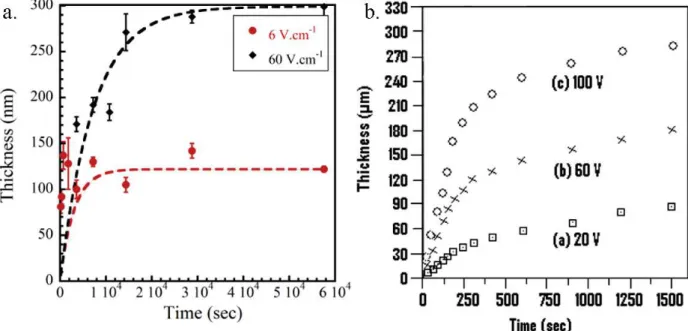
According to Hamaker, the deposit thickness has a linear relationship with time. This phenomenon occurs mainly in the case of constant applied electric field, when the potential difference between the electrodes is maintained constant. However, the electric field influencing electrophoresis decreases with deposition time because of the formation of an insulating layer of ceramic particles on the electrode surface. This prevents further deposition of charged particles resulting in a plateau in the graph of thickness versus time. Charlot et al.
and Wang et al. have proved that the EPD of SiO2 nanoparticle and ZnO is linear followed by
the formation of a plateau for a longer deposition time (see Figure 1.11).
Figure 1.11:Relationship of thickness as a function of deposition time at different applied potentials: b) SiO2
films on Si electrode in water [27]; b) ZnO films on Cu electrode in IPA [35]. Applied voltage
The applied voltage is directly related to the deposited mass or thickness which normally increases with the increase in applied potential. Although higher number of
27 particles is deposited at a faster rate but the quality of the deposit suffers with the increase of E. Loosely packed structures of high roughness are usually formed. At high electric fields, the particles migrate fast that they can’t find enough time to sit in their best positions to form a closely packed structure and at very low electric field the thickness is very low and the deposit formed possess low adhesion to the electrode. Thus, a careful study should be made to choose the suitable applied electric field.
On the other hand, high applied electric fields could have detrimental effects on the suspension and the deposition electrode. In aqueous suspensions, the increase in E increases the rate of water electrolysis reaction causing a great turbulence beside the deposition electrode due to the formation of gas bubbles preventing particles to deposit or to form a close packed structure. Charlot et al. [27] have detected the oxidation of Si electrode during
EPD for applied electric field higher than 20 V.cm-1. The oxidation of the electrode changes
the conductivity of the substrate affecting the homogeneity and density of the deposits. Basu
et al. [36], have reported that the formation of uniform and homogeneous coatings is
achieved, when moderate electric fields of ~15 V.cm-1 are applied. A low-quality deposit was
obtained for E<10 V.cm-1 due to the very slow rate of migration of charged particles. While a
non-uniform and a rough coating was also obtained for E>22 V.cm-1due to the fast migration
of particles resisting the best packing arrangement to produce a uniform and dense coating. Nigishi et al. [33] have studied the stability of n-propanol solvents in the absence of any powder as a function of applied electric field. They have found that the current density is proportional to the applied electric field but tends to be unstable for E>50 V. The instability in the current density is known to influence the morphology of deposit formed. All these data act as a guideline to the importance of choosing the applied electric field, to achieve a uniform and well-packed coating.
Concentration of the solid in the suspension
The deposit yield increases with the solid loading of particles in the suspension. It plays a more important role for multi-component EPD where, even if the particle species have the same sign of surface charge, they could deposit at different rates depending on the volume fraction of solids in the suspension. If the volume fraction of solids is high, the powders deposit at an equal rate. If, however, the volume fraction of solids is low, the particles can deposit at rates proportional to their individual electrophoretic mobility [37].

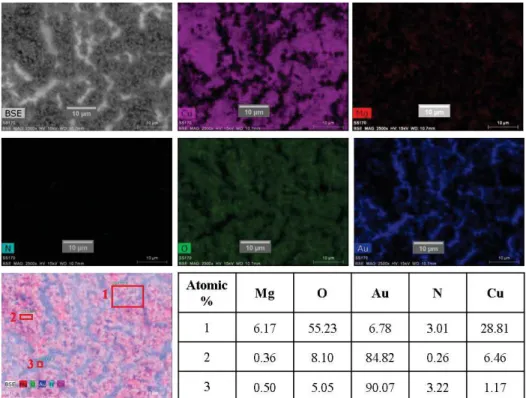
![Figure 3.2: SEM top view image of the CuO deposits form CuO/IPA suspension ([CuO]= 5x10 -4 g/cm 3 ): (a) absence of Mg(NO 3 ) 2 and (b) in presence of [Mg(NO 3 ) 2 ] = (1.5 x 10 -4 g/cm 3 ) with the corresponding EDX](https://thumb-eu.123doks.com/thumbv2/123doknet/12854761.368162/74.892.188.659.218.633/figure-sem-image-deposits-suspension-absence-presence-corresponding.webp)