Supramolecular
Metallomesogens: Hydrogen-Bonded Ferrocene-Containing
Liquid
Crystals Which Display Bicontinuous Cubic Phases
Philippe
Massiot,
†Marianne
Impe´ror-Clerc,
‡Miche`le
Veber,*
,‡and
Robert Deschenaux*
,†Institut de Chimie, UniVersite´ de Neuchaˆtel, AVenue de BelleVaux 51, Case Postale 2, 2007 Neuchaˆtel, Switzerland, and Laboratoire de Physique, des Solides, Baˆtiment 510, UniVersite´ Paris Sud, 91405 Orsay Cedex, France
Two series of hydrogen-bonded liquid-crystalline ferrocenes have been prepared by reacting ferrocene derivatives carrying a carboxylic acid function and two flexible alkyl chains (containing n ) 8, 10, or 12 carbon atoms) with stilbazoles bearing a flexible alkyl chain (containing m ) 6 or 10 carbon atoms). The first family of materials (m ) 6; n ) 8, 10, 12) gave rise to smectic A/C and/or cubic (Ia3hd space group) phases, and the second series of complexes (m ) 10; n ) 8, 10, 12) displayed cubic phases (Ia3hd space group). A subtle balance between the volume occupied by the central core and the flexible chains, as well as the surface between both parts, are responsible for the formation of the mesophases. Hydrogen bonding is an elegant alternative to covalent bonding for the design of ferrocene-containing liquid crystals.
Introduction
Hydrogen bonding, which plays a crucial role in biological processes (e.g., base pairing in DNA, folding of proteins), was successfully used for the construction of elegant supra-molecular architectures such as boxes,1 polymers,2 and capsules.3Numerous examples can be found in the literature, and the readers are referred to outstanding reviews.4 The reversibility of the H bond opened the doors for the elaboration of dynamically functional assemblies such as catalytically active capsules5and molecular machines.6
The use of the H bond is appealing for the design of libraries of liquid crystals. In 1989, pioneered by Kato and Fre´chet7and Lehn,8H-bonded liquid crystals were reported
and illustrated that supramolecular architectures, which display mesomorphic properties, can be obtained, providing the basic components that self-assemble induce the required molecular anisotropy and adequate intermolecular interac-tions for mesomorphism to occur. Following the above-mentioned reports,7,8 beautiful studies on H-bonded liquid crystals9were carried out (polycatenar liquid crystals,10 main-chain11 and side-chain12 liquid-crystalline polymers, ionic liquid crystals,13ferroelectric liquid crystals,14and discotic liquid crystals15).
* To whom correspondence should be addressed. E-mail: robert.deschenaux@ unine.ch.
†Universite´ de Neuchaˆtel. ‡Universite´ Paris Sud.
(1) Timmermann, P.; Vreekamp, R. H.; Hulst, R.; Verboom, W.; Rein-houdt, D. N.; Rissanen, K.; Udachin, K. A.; Ripmeester, J. Chem.-Eur. J. 1997, 3, 1823.
(2) Brunsveld, L.; Folmer, B. J. B.; Meijer, E. W.; Sijbesma, R. P. Chem. ReV. 2001, 101, 4071.
(3) Rivera, J. M.; Martı´n, T.; Rebek, J. Science 1998, 279, 1021. (4) (a) Lawrence, D. S.; Jiang, T.; Levett, M. Chem. ReV. 1995, 95, 2229.
(b) Sijbesma, R. P.; Meijer, E. W. Curr. Opin. Colloids Interface Sci. 1999, 4, 24. (c) Krische, M. J.; Lehn, J.-M. Struct. Bond. 2000, 96, 3. (d) Sherrington, D. C.; Taskinen, K. A. Chem. Soc. ReV. 2001, 30, 83. (e) Reinhoudt, D. N.; Crego-Calama, M. Science 2002, 295, 2403. (5) Kang, J.; Santamarı´a, J.; Hilmersson, G.; Rebek, J. J. Am. Chem. Soc.
1998, 120, 7389.
(6) Balzani, V.; Credi, A.; Raymo, F. M.; Stoddart, J. F. Angew. Chem., Int. Ed. 2000, 39, 3348.
(7) (a) Kato, T.; Fre´chet, J. M. J. J. Am. Chem. Soc. 1989, 111, 8533. (b) Kato, T.; Fre´chet, J. M. J. Macromolecules 1989, 22, 3818. (8) Brienne, M.-J.; Gabard, J.; Lehn, J.-M.; Stibor, I. J. Chem. Soc., Chem.
Commun. 1989, 1868.
(9) (a) Lehn, J.-M. Makromol. Chem., Macromol. Symp. 1993, 69, 1. (b) Kato, T. Handbook of Liquid Crystals; Demus, D., Goodby, J. W., Gray, G. W., Eds.; Wiley-VCH: 1998; Chapter XVII, pp 969-979. (c) Kato, T. Struct. Bond. 2000, 96, 95. (d) Kato, T.; Mizoshita, N.; Kanie, K. Macromol. Rapid Commun. 2001, 22, 797. (e) Paleos, C. M.; Tsiourvas, D. Liq. Cryst. 2001, 28, 1127. (f) Kato, T. Science 2002, 295, 2414.
(10) (a) Bernhardt, H.; Kresse, H.; Weissflog, W. Mol. Cryst. Liq. Cryst. 1997, 301, 25. (b) Tian, Y. Q.; Xu, X. H.; Zhao, Y. Y.; Tang, X. Y.; Li, T. J.; Huang, X. M. Mol. Cryst. Liq. Cryst. 1998, 309, 19. (c) Friot, B.; Boyd, D.; Willis, K.; Donnio, B.; Ungar, G.; Bruce, D. W. Liq. Cryst. 2000, 27, 605.
(11) (a) Lee, M.; Cho, B.-K.; Kang, Y.-S.; Zin, W.-C. Macromolecules 1999, 32, 8531. (b) Bladon, P.; Griffin, A. C. Macromolecules 1993, 26, 6604. (c) Pourcain, C. B.; Griffin, A. C. Macromolecules 1995, 28, 4116.
(12) (a) Kato, T.; Kihara, H.; Uryu, T.; Fujishima, A.; Fre´chet, J. M. J. Macromolecules 1992, 25, 6836. (b) Kato, T.; Kihara, H.; Kumar, U.; Uryu, T.; Fre´chet, J. M. J. Angew. Chem., Int. Ed. Engl. 1994, 33, 1644. (c) Kato, T.; Nakano, M.; Moteki, T.; Uryu, T.; Ujiie, S. Macromolecules 1995, 28, 8875. (d) Kato, T.; Kihara, H.; Ujiie, S.; Uryu, T.; Fre´chet, J. M. J. Macromolecules 1996, 27, 8734. (e) Stewart, D.; Imrie, C. T. Macromolecules 1997, 30, 877. (f) Stewart, D.; Paterson, B. J.; Imrie, C. T. Eur. Polym. J. 1997, 33, 285. (g) Kato, T.; Ihata, O.; Ujiie, S.; Tokita, M.; Watanabe, J. Macromolecules 1998, 31, 3551. (h) Kawakami, T.; Kato, T. Macromolecules 1998, 31, 4475. (13) (a) Bernhardt, H.; Weissflog, W.; Kresse, H. Liq. Cryst. 1998, 24, 895. (b) Masson, P.; Guillon, D. Mol. Cryst. Liq. Cryst. 2001, 362, 313.
pyrimidine derivatives,31 lipids,32 polycatenar silver com-plexes,33alkali metal phosphates,34and hexacatenar ferrocene derivatives35).
Cubic phases have different physical properties compared to other mesophases due to their 3D translational order. They constitute a new class of materials, the so-called “soft crystals”,36which are mainly characterized by a large lattice parameter (10 nm) and a small Young elastic modulus (105 N m-2). Contrary to ordinary crystals, they form a large number of facets at the surface of monocrystalline drop-lets.24,37The facets are easily observed by optical microscopy. They are constituted by molecular steps which have been visualized using atomic force microscopy.38 Thermotropic cubic phases represent a suitable model to study the surface fusion phenomena of those facets under heating to the isotropic liquid phase, because the transition temperatures (200°C) are much lower than the ones of usual crystals (1000 °C). The presence of ferrocene in cubic phases offers the opportunity to construct soft materials with redox and/or catalytic properties.
In this paper, we report the synthesis, characterization, liquid-crystalline properties, and supramolecular organization of two families of H-bonded ferrocene-containing liquid crystals that display smectic and/or cubic phases. The results presented here, together with those we have already de-scribed,20 demonstrate that structural engineering can be exploited to design H-bonded liquid-crystalline ferrocenes with tailor-made mesomorphic properties.
Results and Discussion
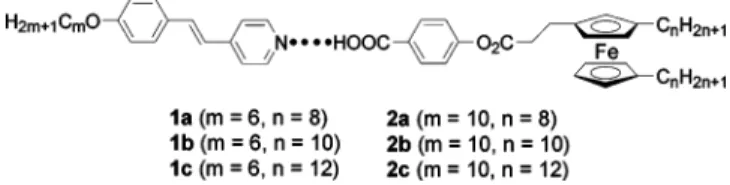
Design. This study is based on H-bonded ferrocenes 1a-c
and 2a-c (Figure 1) in which the length of the alkyl chains of both the ferrocene- and stilbazole-containing building blocks was varied (n and m, respectively). We anticipated that this structural modification would permit cubic phases to develop. Indeed, the formation of cubic phases requires
(14) (a) Kato, T.; Kihara, H.; Uryu, T.; Ujiie, S.; Imura, K.; Fre´chet, J. M. J.; Kumar, U. Ferroelectrics 1993, 148, 161. (b) Kihara, H.; Kato, T.; Uryu, T.; Ujiie, S.; Kumar, U.; Fre´chet, J. M. J.; Bruce, D. W.; Price, D. J. Liq. Cryst. 1996, 21, 25.
(15) (a) Sua´rez, M.; Lehn, J.-M.; Zimmerman, S. C.; Skoulios, A.; Heinrich, B. J. Am. Chem. Soc. 1998, 120, 9526. (b) Kraft, A.; Reichert, A.; Kleppinger, R. Chem. Commun. 2000, 1015.
(16) Kato, T.; Fre´chet, J. M. J.; Wilson, P. G.; Saito, T.; Uryu, T.; Fujishima, A.; Jin, C.; Kaneuchi, F. Chem. Mater. 1993, 5, 1094.
(17) So¨ntjens, S. H. M.; Sijbesma, R. P.; van Genderen, M. H. P.; Meijer, E. W. J. Am. Chem. Soc. 2000, 122, 7487.
(18) Chuard, T.; Cowling, S. J.; Fernandez-Ciurleo, M.; Jauslin, I.; Goodby, J. W.; Deschenaux, R. Chem. Commun. 2000, 2109.
(19) (a) Deschenaux, R.; Schweissguth, M.; Levelut, A.-M. Chem. Commun. 1996, 1275. (b) Deschenaux, R.; Schweissguth, M.; Vilches, M.-T.; Levelut, A.-M.; Hautot, D.; Long, G. J.; Luneau, D. Organometallics 1999, 18, 5553. (c) Turpin, F.; Guillon, D.; Deschenaux, R. Mol. Cryst. Liq. Cryst. 2001, 362, 171.
(20) Deschenaux, R.; Monnet, F.; Serrano, E.; Turpin, F.; Levelut, A.-M. HelV. Chim. Acta 1998, 81, 2072.
(21) Luzzati, V.; Vargas, R.; Mariani, P.; Gulik, A.; Delacroix; H. J. Mol. Biol. 1993, 229, 540.
(22) Raimondi, M. E.; Seddon, J. M. Liq. Cryst. 1999, 26, 305. (23) (a) Diele, S. Curr. Opin. Colloid Interface Sci. 2002, 7, 333. (b)
Kutsumizu, S.; Morita, K.; Ichikawa, T.; Yano, S.; Nojima, S.; Yamaguchi, T. Liq. Cryst. 2002, 29, 1447. (c) Kutsumizu, S. Curr. Opin. Solid State Mater. Sci. 2002, 6, 537.
(24) Impe´ror-Clerc, M.; Sotta, P.; Veber, M. Liq. Cryst. 2000, 27, 1001.
(25) (a) Fischer, S.; Fischer, H.; Diele, S.; Pelzl, G.; Jankowski, K.; Schmidt, R. R.; Vill, V. Liq. Cryst. 1994, 17, 855. (b) Borisch, K.; Diele, S.; Go¨ring, P.; Kresse, H.; Tschierke, C. J. Mater. Chem. 1998, 8, 529. (c) Borisch, K.; Tschierske, C.; Diele, S. Langmuir 2000, 16, 6701. (26) Nishikawa, E.; Samulski, E. T. Liq. Cryst. 2000, 27, 1457. (27) (a) Ungar, G.; Percec, V.; Holerca, M. N.; Johansson, G.; Heck, J. A.
Chem.-Eur. J. 2000, 6, 1258. (b) Yeardley, D. J. P.; Ungar, G.; Percec, V.; Holerca, M. N.; Johansson, G. J. Am. Chem. Soc. 2000, 122, 1684. (28) Lee, M.; Cho, B.-K.; Jang, Y.-G.; Zin, W.-C. J. Am. Chem. Soc. 2000,
122, 7449.
(29) Fang, Y.; Levelut, A.-M.; Destrade, C. Liq. Cryst. 1990, 7, 265. (30) Go¨ring, P.; Diele, S.; Wiegeleben, A.; Pelzl, G.; Stegemeyer, H.;
Thyen, W. Liq. Cryst. 1998, 25, 467.
(31) Takanishi, Y.; Takezoe, H.; Yoshizawa, A.; Kusumoto, T.; Hiyama, T. Mol. Cryst. Liq. Cryst. 2000, 347, 257.
(32) Luzzati, V.; Spegt, P. A. Nature (London) 1967, 215, 701. (33) (a) Bruce, D. W.; Donnio, B.; Hudson, S. A.; Levelut, A.-M.; Megtert,
S.; Petermann, D.; Veber, M. J. Phys. II France 1995, 5, 289. (b) Donnio, B.; Heinrich, B.; Gulik-Krzywicki, T.; Delacroix, H.; Guillon, D.; Bruce, D. W. Chem. Mater. 1997, 9, 2951. (c) Donnio, B.; Bruce, D. W.; Delacroix, H.; Gulik-Krzywicki, T. Liq. Cryst. 1997, 23, 147. (d) Donnio, B.; Bruce, D. W. J. Mater. Chem. 1998, 8, 1993. (34) Tsiourvas, D.; Kardassi, D.; Paleos, C. M.; Gehant, S.; Skoulios, A.
Liq. Cryst. 1997, 23, 269.
(35) Seo, J.-S.; Yoo, Y.-S.; Choi, M.-G. J. Mater. Chem. 2001, 11, 1332. (36) Nozie`res, P.; Pistolesi, F.; Balibar, S. Eur. Phys. J. B 2001, 24, 387. (37) (a) Pieranski, P.; Sotta, P.; Rohe, D.; Impe´ror-Clerc, M. Phys. ReV. Lett. 2000, 84, 2409. (b) Impe´ror-Clerc, M.; Veber, M.; Levelut, A.-M. Chem. Phys. Chem. 2001, 2, 533.
(38) Even, C.; Gourbil, A.; Impe´ror-Clerc, M.; Pieranski, P.; Veber, M. Chem. Phys. Chem. 2002, 3, 1031.
The association of a carboxylic acid derivative with a pyridine derivative represents a simple way to obtain a supramolecular H-bonded liquid crystal. The carboxylic acid and pyridine derivatives do not need to be mesomorphic.16 Liquid-crystalline tridentate4 and tetradentate17 H-bonded arrays have been reported.
Ferrocene is a valuable chemical for the design of liquid crystals: we have described ferroelectric ferrocenyl liquid crystals with planar chirality18 (based on unsymmetrically 1,3-disubstituted ferrocenes) and switchable liquid crystals19 (based on the redox behavior of the ferrocene-ferrocenium couple). Those examples demonstrate how the three-dimensional structure of ferrocene and its redox properties can be used for the elaboration of functional liquid crystals.
The development of supramolecular functional materials motivated us to incorporate ferrocene into H-bonded liquid crystals.20The latter were prepared from a ferrocene carrying two flexible chains and a carboxylic acid function and either 4,4′-bipyridine or a stilbazole functionalized with an alkyl tail. The H-bonded complex prepared from 4,4′-bipyridine and the ferrocene derivative gave a columnar hexagonal phase in agreement with its tetracatenar structure, and the one obtained from the stilbazole derivative and the ferrocene derivative (compound 1a below) showed smectic C and smectic A phases in agreement with its calamitic-like structure.
The aim of this paper is to describe H-bonded ferrocene-containing liquid crystals that display bicontinuous cubic phases, i.e., mesophases with complex three-dimensional (3D) architectures. Cubic phases are well-known for lyotropic systems21 formed by various lipids, surfactants, or block copolymers in concentrated solutions. Recently, they have been templated using silicon oxide (to synthesize new mesoporous materials).22They are also found for thermo-tropic compounds23(H-bonded liquid crystals: carboxylic acids,24polyols,25siloxanes;26covalent-type liquid crystals: dendrimers,27 coil-rod-coil molecules,28 biforked me-sogens,29 chiral and achiral hydrazine derivatives,30 chiral
the tuning of the curvature of the interface between two segregating moieties, i.e., the central core and the flexible alkyl chains. This can be achieved by varying the volume fraction occupied by the alkyl chains. Compound 1a, the liquid-crystalline properties of which have been reported,20 is used as a reference as it is the only member among the compounds described here that does not have a cubic phase.
Syntheses. The synthesis of H-bonded ferrocene
deriva-tives 1a-c and 2a-c is described in Scheme 1. Acylation of ferrocene with the desired alkanoyl chlorides under Friedel-Crafts conditions gave 3a-c, which were reduced into the corresponding alkyl derivatives 4a-c. Treatment of
4a-c with POCl3 and DMF gave aldehydes 5a-c, which
were transformed into carboxylic acid derivatives 6a-c by reaction with malonic acid. Esterification of 6a-c with 4-hydroxybenzoic acid benzylester furnished 7a-c. Removal of the benzyl protecting group under hydrogenation condi-tions gave ferrocene derivatives 8a-c. Complexes 1a-c and
2a-c were prepared by reacting the appropriate acid 8a-c
and stilbazole 9a and 9b derivatives in THF (room temper-ature). Stilbazoles 9a and 9b were synthesized as described in the literature.39
Liquid Crystalline Properties. The thermal and
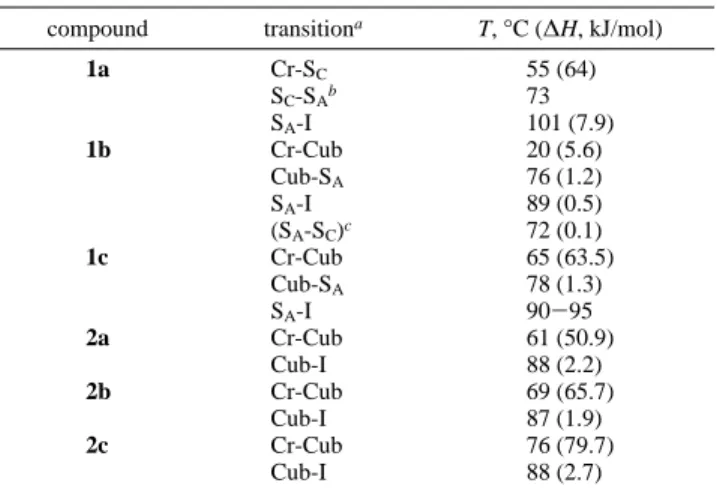
liquid-crystalline behavior of 1a-c and 2a-c were investigated by polarized optical microscopy (POM), differential scanning calorimetry (DSC), and X-ray diffraction (XRD). The phase transition temperatures and enthalpy changes are listed in Table 1.
No liquid-crystalline behavior was observed for acid derivatives 8a-c. Stilbazoles 9a and 9b gave rise to smectic B and smectic E phases.39
Compound 1a showed enantiotropic smectic C and smectic A phases. Complexes 1b and 1c gave rise to enantiotropic smectic A and cubic phases. An additional monotropic smectic C phase was detected for 1b. Broad endotherms were observed by DSC between the smectic A phase and the isotropic liquid. For 1c, the enthalpy associated with this transition could not be determined. This result is, most likely, the consequence of slow vanishing of the smectic A phase under the experimental conditions applied. Complexes 2a-c displayed enantiotropic cubic phases.
The smectic A and smectic C phases were identified by POM (and confirmed by XRD, see below) from the observa-tion of typical textures (smectic A phase, homeotropic domains; smectic C phase, broken focal-conic and schlieren textures). The cubic phases were identified by POM (and confirmed by XRD, see below) from the formation of a viscous and isotropic fluid, the viscosity of which decreased markedly when the isotropic point was reached.
XRD Studies. The variation of the d-layer spacing for 1a-c was measured as a function of temperature and
revealed that 1a gave rise to monophasic domains, wheareas
1b and 1c gave rise to biphasic regions. For 1a, the d-layer
spacing increased with temperature in the smectic C phase until the transition to the smectic A phase was reached (Figure 2); then, the d-layer spacing remained nearly constant (Table 2). This behavior is in agreement with the nature of the smectic C and smectic A phases. Compound 1a gave a reversible behavior: superimposable curves were obtained upon heating and cooling the sample.
On heating 1b, the formation of cubic and smectic A phases was established (Figure 3). In the smectic A phase, the d-layer spacing (Table 2) was found to be nearly constant with temperature. Upon cooling, the monotropic smectic C phase was followed by a biphasic domain formed by the coexistence of smectic C and cubic phases. In the biphasic region, when the temperature was further cooled, the d-layer spacing of the smectic C phase increased.
When 1c was heated, the formation of cubic and smectic A phases was confirmed (Figure 4). The d-layer spacing (Table 2) of the smectic A phase was nearly constant with temperature. When the sample was cooled from the isotropic liquid, a biphasic region (cubic and smectic A phases) was obtained.
The observation of biphasic regions is due to the slow crystallization kinetics of the cubic phase and is the sign that thermodynamic equilibrium was not reached.
The cubic phases displayed by 1b and 1c gave two diffraction rings corresponding to the 211 and 220 reflections of the bicontinuous Ia3hd cubic phase40 (Figure 5). The variation of the d211parameter as a function of temperature is reported in Figures 3 and 4. The values are smaller than the interlayer spacings of the smectic phases.
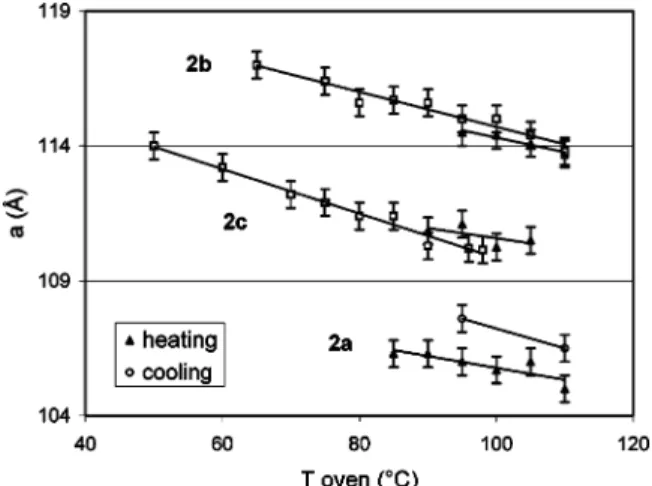
The cubic phases displayed by 2a-c also showed the 211 and 220 reflections, indicating that the same types of mesophases (as for 1b and 1c) are involved. The cubic phase of 2a was also examined with a synchrotron radiation source: six other weak diffraction peaks were detected (Table 3). The position of the peaks confirmed the Ia3hd space group. The cubic lattice parameters are compared in Table 4 at 70 °C. The variation of the lattice parameters with temperature is given in Figure 6 for 2a-c. They decrease slightly with temperature, with an average value da/dT ) -5× 10⁻²Å K-1(see Table 4). This behavior is similar to results obtained for other Ia3hd thermotropic cubic phases (such as for 3′ -nitro-4′-n-alkoxybiphenyl-4-carboxylic acids23). For 1b, the value of the lattice parameter is almost constant with temperature. This can be related to the coexistence of the cubic phase with the monotropic smectic C phase.
Discussion. In Table 2, the d-layer spacings of the smectic
A phases for 1a-c are compared with the molecular lengths. The latter values were determined for the fully extended conformation (i.e., L[ext(n+m)]) obtained by means of Hyper-chem software. In this case, the paraffinic chains are in the all-trans conformation. To take into account the mesomorphic state of the molecules (in which various conformations are (39) Bruce, D. W.; Dunmur, D. A.; Lalinde, E.; Maitlis, P. M.; Styring, P.
Liq. Cryst. 1988, 3, 385. (40) Levelut, A.-M.; Clerc, M. Liq. Cryst. 1998, 24, 105.
found), the molecular lengths were also calculated by summing the length of the core (25 Å, Hyperchem software) with the length of the paraffinic chains in the molten state (i.e., L[molten(n+m)]) (1.1 Å per methylene unit41).
The d-layer spacing is always larger than the calculated molecular length L[ext(n+m)]. This result is an indication that the smectic A phase is partially bilayered. Moreover, taking into account the bulkiness of the ferrocenyl group, a reasonable assumption is to consider a symmetrical head-to-tail organization of the molecules inside the layers.
By considering such an organization, we can assume that the d-layer spacing is governed by the longest alkyl chains
(i.e., the chains grafted onto the ferrocene). So, the d-layer spacing should be compared to L[ext(2n)]and L[molten(2n)]instead to L[ext(n+m)]and L[molten(n+m)]. For 1a, the d-layer spacing (51.2 Å) is larger than L[ext(2n)] (45.3 Å) and, obviouly, than
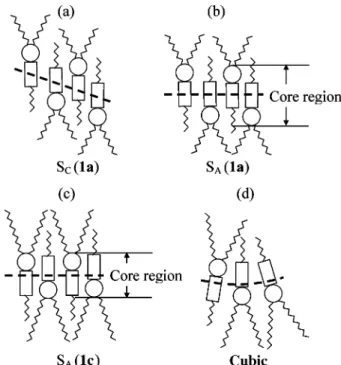
L[molten(2n)] (42.6 Å). This result implies that the cores of adjacent molecules are shifted (Figure 7b). For 1c, the d-layer (41) Levelut, A.-M.; Veber, M.; Francescangeli, O.; Melone, S.; Ghedini,
M.; Neve, F.; Nicoletta, F. P.; Bartolino, R. Liq. Cryst. 1995, 19, 241.
Scheme 1
(a) Cn-1H2(n-1)+1COCl, AlCl3, CH2Cl2, reflux, 2 h. (b) LiAlH4, AlCl3, diethyl ether, 0°C, 15 min. (c) DMF, POCl3, CH2Cl2, reflux, 16 h. (d) Malonic
acid, piperidine, pyridine, heat, 6 h. (e) 4-Hydroxybenzoic acid benzylester, N,N′-dicyclohexyl carbodiimide (DCC), 4-pyrrolidinopyridine (4-ppy), CH2Cl2,
room temperature, 2 h. (f) H2, Pd/C, CH2Cl2, room temperature, 14 h. (g) THF, room temperature, 30 min. Table 1. Phase Transition Temperatures and Enthalpy Changes of
1a-c and 2a-c
compound transitiona T,°C (∆H, kJ/mol)
1a Cr-SC 55 (64) SC-SAb 73 SA-I 101 (7.9) 1b Cr-Cub 20 (5.6) Cub-SA 76 (1.2) SA-I 89 (0.5) (SA-SC)c 72 (0.1) 1c Cr-Cub 65 (63.5) Cub-SA 78 (1.3) SA-I 90-95 2a Cr-Cub 61 (50.9) Cub-I 88 (2.2) 2b Cr-Cub 69 (65.7) Cub-I 87 (1.9) 2c Cr-Cub 76 (79.7) Cub-I 88 (2.7) aCr ) crystalline state, S
C) smectic C phase, SA) smectic A phase,
Cub ) Ia3hd cubic phase, I ) isotropic liquid; temperatures are given as the onset of the peak obtained during the second heating run.bNot detected by DSC, determined by polarized optical microcopy.cMonotropic transition, determined during the first cooling run.
Figure 2. Variation of the d-layer spacing (d100) as a function of temperature for 1a.
Table 2. Experimental d-Layer Spacings of the Smectic A Phases and Molecular Lengths for 1a-ca
compound n m dSA (Å) L[ext(n+m)] (Å) L[molten (n+m)] (Å) L[ext(2n)] (Å) L[molten (2n)] (Å) Stot (Å2) 1a 8 6 51.2 42.8 40.4 45.3 42.6 26.1 1b 10 6 51.1 45.3 42.6 50.4 47.0 27.8 1c 12 6 52.6 47.9 44.8 55.5 51.4 28.6
aKey: n, number of carbon atoms of the chains linked to the ferrocene;
m, number of carbon atoms of the chain linked to the stilbazole; dSA, d-layer
spacing (d100) of the smectic A phases; L[ext(n+m)], calculated molecular length
in the fully extended conformation (HyperChem software) with n and m alkyl chains; L[molten (n+m)], calculated molecular length for n + m molten
alkyl chains assuming 1.1 Å per carbon atom and 25 Å for the core region;
L[ext(2n)], calculated molecular length in the fully extented conformation with
two n alkyl chains; L[molten (2n)], calculated molecular length for two n molten
alkyl chains. Stot) Vtot/dSA, cross section for one complex assuming a density
spacing (52.6 Å) is close to L[molten(2n)](51.4 Å), suggesting that the cores are not shifted (Figure 7c). The similar d-values obtained for 1a (51.2 Å) and 1b (51.1 Å) are unexpected as the number of carbon atoms of the alkyl chains located on the ferrocene increases from 1a to 1b.
The relative positions of the molecules inside the layers are in fact governed by the bulkiness of the ferrocenyl groups. The surface per molecule increases as the chains grafted on the ferrocene become longer, going from 26.1 Å2for 1a to 28.6 Å2for 1c (Table 2). One can assume that, in the case of 1a, the surface is too small for the ferrocene: the molecules are shifted and the price to pay is to bury the
shortest chain in the core region. As the surface increases, the molecules can move until they reach the head-to-tail monolayered arrangement depicted in Figure 7c. The or-ganization of 1b can be considered to be between the one of 1a and 1c, the constancy of the d-layer spacing on going from 1a to 1b being the result of a decrease of the volume occupied by the core region (compare parts b and c of Figure 7).
The enantiotropic smectic C phase of 1a (Figure 7a) was obtained (in the usual way) by tilting the molecules inside the layers. An increase of the length of the chains located on the ferrocene destabilized the smectic C phase: mono-tropic for 1b, not found for 1c.
The transition toward a bicontinuous Ia3hd cubic phase implies curving the layers in order to provide a larger cross-sectional area in the chain region than in the core region (as for the inverse phase of lyotropic systems). For 1c, a
Figure 3. Variation of the d-layer spacing (d100for the smectic A phase;
d211for the Ia3hd cubic phase) as a function of temperature for 1b.
Figure 4. Variation of the d-layer spacing (d100for the smectic A phase;
d211for the Ia3hd cubic phase) as a function of temperature for 1c.
Figure 5. Structure of the bicontinuous Ia3hd cubic phase and proposed supramolecular organization of 1c within the Ia3hd cubic phase: a single paraffinic region located around the Gyroı¨d infinite periodic minimal surface separates two equivalent core regions depicted by two three-dimensional rods networks.
Table 3. Cubic Phase of Compound 2aa
hkl s2 M d
hklmeas(Å) dhklcal(Å) Ipowder(au) Imono(au)
211 6 24 43.0 43.1 112 ( 2 28 ( 0.5 220 8 12 37.3 37.3 24 ( 1.5 16 ( 1 321 14 48 28.2 28.2 0.3 ( 0.1 0.0875 ( 0.03 400 16 6 26.4 26.4 0.45 ( 0.1 1.2 ( 0.3 420 20 24 23.6 23.6 0.66 ( 0.1 0.55 ( 0.1 332 22 24 22.5 22.5 1.1 ( 0.1 1.01 ( 0.1 422 24 24 21.5 21.5 0.5 ( 0.1 0.5 ( 0.1 431 26 48 20.8 20.7 0.25 ( 0.05 0.14 ( 0.03
aKey: hkl, Miller indices; s2) h2+ k2+ l2; M, multiplicity; d hklmeas,
measured interreticular distance; dhklcal, calculated interreticular distance with
a ) 105.5 Å; Ipowder(au), intensity of the diffraction lines (powder diagram)
in arbitrary units; Imono (au) ) s2Ipowder /M, intensity calculated for a
monocrystal in arbitrary units.
Table 4. Comparison of the Cubic Phases Displayed by 1b,c and 2a-ca compound 2n + m a (Å) ( 1 Å (T°C) da/dTheating (Å K-1) da/dTcooling (Å K-1) N Stot (Å2) 1b 26 112.4 (60) -1.2 × 10⁻² +0.3 × 10⁻² 992 39.1 1c 30 114.4 (60) -5.3 × 10⁻² 995 40.6 2a 26 107.6 (95) -4.4 × 10⁻² -7.3 × 10⁻² 839 41.4 2b 30 115.0 (95) -5.4 × 10⁻² -6.5 × 10⁻² 998 40.6 2c 34 110.2 (95) -3.8 × 10⁻² -8.3 × 10⁻² 858 44.3
aKey: a, cubic lattice parameter on cooling, measurement temperatures
are given in brackets; da/dT, variation of the lattice parameter with temperature, on heating and cooling (Figure 6); N, number of complexes per unit cell, assuming a density of 1.1 g cm-3; Stot) 3.091 a2/N, cross
section on the minimal surface for one complex assuming a density of 1.1 g cm-3.
Figure 6. Variation of the cubic lattice parameter a as a function of
transition between the smectic A and the cubic phases was observed. A possible mechanism associated with this transi-tion at the molecular level is tentatively presented in Figure 7d. Starting from the structure of Figure 7c, the transition to the cubic phase is obtained by moving one complex to the upper layer, creating locally the saddle-shaped form of the layer (see Figure 5).
For the cubic phases displayed by 2a-c, the core/chain segregation is, most likely, complete, because in those complexes the chains (m + n) are long enough (Figure 7d). The molecular volumes of the complexes (Table 5) and the cross section Stotper complex in the smectic A (Table 2) and cubic phases (Table 4) were calculated, assuming a density of 1.1 g cm-3at 70°C for all the compounds (the density was determined by dilatometry for a similar ferrocene derivative43). For the cubic phase, S
totis taken on the minimal surface, in the middle of the chains region. For each type of mesophase, Stot increases with the total number of carbon atoms (n and m). It is larger in the cubic phase than in the
smectic A phase, which illustrates the fact that the average molecular conformation is different in each mesophase, with curved and flat layers in the cubic and smectic A phases, respectively. Finally, N, the number of molecules per unit cell (assuming a density of 1.1 g cm-3) (Table 4), is of the same order of magnitude for all the complexes in the cubic phase and is a typical value for such Ia3hd phases.
Conclusion
Association of non-mesomorphic ferrocenes and meso-morphic stilbazoles by H-bonding led to liquid-crystalline materials. By varying the length of the paraffinic chains, we induced an evolution from smectic (A and C) to cubic (Ia3hd) phases. We propose that the bulkiness of the ferrocenyl unit influences the architecture of the phases by its ability to be partially embedded inside the paraffinic chains. The design of H-bonded liquid crystals has opened unique opportunities toward the development of new materials. Recently, Bruce44 has reported beautiful thermotropic liquid crystals based on halogen bonding. The presence of ferrocene in cubic phases offers the opportunity to construct soft materials with redox and/or catalytic properties.
Acknowledgment. R.D. would like to thank the Swiss
National Science Foundation (National Research Program NRP 47 “Supramolecular Functional Materials”) for financial support.
Supporting Information Available: Techniques and
instru-ments, and synthetic procedures and analytical data of all new compounds (PDF). This material is available free of charge via the Internet at http://pubs.acs.org.
CM048161F
(42) (a) Doolittle, A. K. J. Appl. Phys. 1951, 22, 1471. (b) Reiss-Husson, F.; Luzzati, V. J. Phys. Chem. 1964, 68, 3504.
(43) Deschenaux, R.; Turpin, F.; Guillon, D. Macromolecules 1997, 30, 3759.
(44) Nguyen, H. L.; Horton, P. N.; Hursthouse, M. B.; Legon, A. C.; Bruce, D. W. J. Am. Chem. Soc. 2004, 126, 16.
Figure 7. Postulated structures of the liquid-crystalline phases. (a) Smectic
C phase for 1a, (b) smectic A phase for 1a, (c) smectic A phase for 1c, (d) cubic phase. compound 2n + m M (g/mol) Vtot (Å3) Vpara (Å3) Vcore (Å3) φ para(1) φpara(2) 1a 22 884.03 1335 711 624 0.53 0.55 1b 26 940.14 1420 823 597 0.58 0.59 1c 30 996.25 1504 935 570 0.62 0.62 2a 26 940.14 1420 823 597 0.58 0.59 2b 30 996.25 1504 935 570 0.62 0.62 2c 34 1052.35 1589 1047 542 0.66 0.64
aThe total volume of a complex equals V
tot) M/(0.602F). Vpara, the
volume occupied by the paraffinic region of one complex is calculated using VCH
2) 28 Å 3and V
CH3) 59.5 Å
3at 70°C.42The volume occupied by the
core is Vcore) Vtot- Vpara. The paraffinic volume fraction is calculated
using first φpara(1)) Vpara/Vtotand φpara(2)) Vpara/(Vpara+〈Vcore〉), with〈Vcore〉
) 583 Å3.