O R I G I N A L A R T I C L E – H E P A T O B I L I A R Y T U M O R S
Allogeneic Blood Transfusion Does Not Affect Outcome After
Curative Resection for Advanced Cholangiocarcinoma
Sascha A. Mu¨ller, MD1,2, Arianeb Mehrabi, MD1, Nuh N. Rahbari, MD1, Rene Warschkow, MD2,3, Heike Elbers, MD1, Christine Leowardi, MD1, Hamidreza Fonouni, MD1, Ignazio Tarantino, MD, MSc1,2, Peter Schemmer, MD1, Bruno M. Schmied, MD1,2, and Markus W. Bu¨chler, MD1
1Department of General, Visceral and Transplant Surgery, University Hospital Heidelberg, Heidelberg, Germany; 2
Department of Surgery, Kantonsspital St. Gallen, St. Gallen, Switzerland;3Institute of Medical Biometry and Informatics, University of Heidelberg, Heidelberg, Germany
ABSTRACT
Purpose. To assess the impact of perioperative blood transfusion on overall and disease-free survival in patients undergoing curative resection for cholangiocarcinoma. Methods. In a single-center study, 128 patients undergo-ing curative resection for cholangiocarcinoma between 2001 and 2010 were assessed. The median follow-up per-iod was 19 months. Transfused and nontransfused patients were compared by Cox regression and propensity score analyses.
Results. Overall, 38 patients (29.7 %) received blood transfusions. The patient characteristics were highly biased with respect to receiving transfusions (propensity score 0.69 ± 0.22 vs. 0.11 ± 0.16, p \ 0.001). In the unadjusted analysis, blood transfusion was associated with a 105 % increased risk of mortality [hazard ratio (HR) 2.05, 95 % CI 1.19–3.51, p = 0.010]. In the multivariate (HR 1.14, 95 % CI 0.52–2.48, p = 0.745) and the propensity score-adjusted Cox regression (HR 1.02, 95 % CI 0.39–2.62, p = 0.974), blood transfusion had no influence on overall survival. Similarly, in the propensity score-adjusted Cox regression (HR 0.62, 95 % CI 0.24–1.58, p = 0.295), no relevant effect of blood transfusion on disease-free survival was observed.
Conclusions. To our knowledge, this is the first propensity score-based analysis providing compelling evidence that the worse oncological outcome after curative resection for advanced cholangiocarcinoma in patients receiving
perioperative blood transfusions is caused by the clinical circumstances requiring the transfusions, not by the blood transfusions themselves.
Cholangiocarcinoma accounts for 3 % of gastrointesti-nal tumors and is the second most common primary hepatic malignancy, representing 10–25 % of primary hepatic malignancies worldwide.1–3 Curative treatment is usually limited to localized cholangiocarcinomas and requires surgical removal by liver resection or pancreaticoduoden-ectomy.4,5 These major resections are associated with a perioperative morbidity of 31–85 % and mortality between 5 and 10 %.6–8 Such complex and invasive procedures often require perioperative blood transfusions despite the potential detrimental side effects. There is evidence that allogeneic blood transfusion has an immunosuppressive effect associated with an increased risk of tumor recurrence and poor prognosis.9,10 However, it has remained unclear whether the worse outcomes in patients receiving blood transfusions are directly caused by the transfusions them-selves or are rather a consequence of poor prognostic factors associated with blood transfusions, such as peri-operative anemia, the complexity of the procedure, advanced tumor stage, age, comorbidities, and the occur-rence of (infectious) complications. The latter hypothesis is supported by a recent Cochrane Review of blood transfu-sions that could not identify a causal relationship in more than 12,000 colorectal cancer patients.11Nevertheless, only a few reports regarding the association between perioper-ative blood transfusion and the outcomes of cholangiocarcinoma patients are available, and these studies did not apply the appropriate statistical methods to distinguish between direct effects and the circumstances that lead to the poor outcomes after transfusion.12,13 Ó Society of Surgical Oncology 2013
First Received: 4 January 2013; Published Online: 28 August 2013 S. A. Mu¨ller, MD
e-mail: [email protected] DOI 10.1245/s10434-013-3226-9
This single-center study of curatively resected cholan-giocarcinoma patients who received or did not receive blood transfusions was designed to investigate the impact of perioperative blood transfusion on survival and recur-rence. To assess the putative causal relationship between blood transfusion and worse oncologic outcomes, both Cox proportional hazard regression analyses and propensity score methods were applied.
PATIENTS AND METHODS
The present retrospective study was based on the pro-spectively maintained cholangiocarcinoma database of the University Hospital Heidelberg. Between November 2001 and July 2010, a total of 240 consecutive patients with histologically proven cholangiocarcinoma underwent sur-gical exploration. Seventy-six patients underwent palliative resection (biliodigestive anastomosis and/or a gastroenter-ostomy) in locally not resectable tumors or in presence of distant metastases and six patients who underwent only resection of the extrahepatic biliary tract were excluded. A total of 17 stage IVa cholangiocarcinoma patients were also excluded. In-hospital mortality occurred in 13 of 158 patients (8.2, 95 % CI 4.9–13.6); these patients were also excluded from further analysis. Eight of them received blood transfusions. Finally, 128 patients with curative resection (R0; clear surgical margins) remained for further analyses; 38 received blood transfusions, and 90 did not. The patients were divided into two groups according to whether they received perioperative allogeneic blood transfusions between the third preoperative day and the seventh postoperative day.
Data Collection and Definitions
Data on patient demographics, comorbidities, operative details, morbidity, postoperative mortality, and histological results were obtained from medical charts. The TNM classification was based on the fifth edition of the inter-national union against cancer.14Patients were followed-up regularly at outpatient clinics or the National Center of Tumor Diseases (NCT). Clinical follow-up visits including tumor marker measurements were performed every 3 months during the first 3 years and thereafter every 6 months until the fifth year. As a baseline examination an abdominal computed tomography was performed 3 months postoperatively or upon suspected recurrence.
Overall survival was defined as the duration from the operation until death due to any cause. Disease-free survival was defined as the duration from the operation until the date of cholangiocarcinoma recurrence. All patients were regu-larly followed in an outpatient clinic, or the patient’s primary physician was personally contacted. During the entire study
period, only prestored leukocyte-depleted allogeneic blood was transfused (one unit = 300 ml). All resections were performed or supervised by experienced hepatobiliary sur-geons and were performed using highly standardized procedures, as described previously.15,16Hepatic mono- and bisegmentectomies were defined as minor liver resections. Resection and reconstruction of a potentially infiltrated vessel was only performed unresectable tumors (R0; clear surgical margins).
Statistical Analyses
Statistical analyses were performed by R statistical software (www.r-project.org). Two-sided p values of\0.05 were considered statistically significant. Continuous data were expressed as the mean ± standard deviation or the median and interquartile range (IQR) as appropriate. For comparing proportions, Chi square statistics were used, and for comparing continuous variables, t tests were used. Missing data for intraoperative blood loss (n = 2) and tumor size (n = 22) were imputed using the random sur-vival forest method.17First, the risk for receiving a blood transfusion was assessed on the basis of age, gender, American Society of Anesthesiologists (ASA) classifica-tion, preoperative hemoglobin, type of operaclassifica-tion, UICC tumor stage, tumor size, tumor localization, vascular resections, and intraoperative blood loss using logistic regression and a backward variable selection procedure based on Akaike’s information criterion. The same covar-iates, including blood transfusion, were then assessed as putative prognostic factors for overall and disease-free survival in unadjusted and risk-adjusted Cox regressions including a backward variable selection procedure from the full Cox regression model based on Akaike’s information criterion. The proportional hazard assumption was tested using scaled Schoenfeld residuals and inspection of the hazard ratio (HR) plots. No violations of the assumption of proportional hazards were observed.18 Moreover, a pro-pensity score analysis, which is a superior and more refined statistical method for adjusting for potential baseline con-founding variables, was performed.19 The ‘‘MatchIt’’ and ‘‘optmatch’’ R packages were used to perform a bipartite weighting propensity score analysis.20 The distance mea-sure was estimated by logistic regression using the risk set described above to predict blood transfusion. Patients who received blood transfusions and did not have a counterpart with respect to the distance measure among the patients who did not receive blood transfusions and vice versa were excluded from the analysis. Thereafter, the distance mea-sure was reestimated. Otherwise, the default settings were left unchanged. The baseline risk profiles of the matched patients were compared to ensure that no major differences in the baseline patient characteristics persisted. The
prognostic value of blood transfusion for overall survival was finally assessed in a Cox regression model by applying the weights obtained by the propensity score analysis and by stratifying for the subclasses from the propensity score analysis.
To examine a potential dose-dependent association between blood transfusion, overall and disease-free sur-vival the number of blood transfusions was considered as a continuous variable and assessed in unadjusted and risk-adjusted Cox regressions including a backward variable selection procedure. Additionally, a propensity score matching was performed as described above comparing patients who received two or more blood transfusions with patients who received no or one blood transfusions. Finally, another sensitivity analysis was performed including the patients who died during the hospital stay and stage IVa cholangiocarcinoma patients in the analysis.
A power analysis for the unadjusted Cox regression analysis revealed a power of 66 % for a two-sided 5 % type-I error to detect a HR of 2.05 for the risk of mortality. A similar power analysis which included only the 74 patients included in the propensity score analysis with 57 and 17 in each group revealed a power of 40 %.21 RESULTS
Patient Characteristics and Blood Transfusions
A total of 128 eligible patients were identified, with a median follow-up time of 19 months (range 1.4–94 months). Of these patients, 38 (29.7 %) received blood transfusions. Six patients (4.7 %) received one blood unit, 13 patients (10.2 %) received two blood units, one patient (0.8 %) received three blood units, three patients (2.3 %) received four blood units, and 15 patients (11.7 %) received five or more blood units (with a maximum of 11 units). A total of 156 blood units were transfused: 77 during the operation and 79 postoperatively. Table1
summarizes the patient characteristics and the periopera-tive outcomes. Of note, total pancreatectomy was performed in six patients as a result of a resulting small pancreatic remnant and obvious pancreatitis (n = 5), or as a result of necrosis of the remnant pancreas (n = 1). In a total of 16 patients (13 %) vascular resection and recon-struction was performed. This included the resection of the portal vein (n = 14), inferior vena cava (n = 1), and the right hepatic artery (n = 1).
Risk for Blood Transfusion
In the univariate analysis, various patient characteristics and short-term outcomes differed significantly between
patients receiving blood transfusions and those who did not (Table1). After the multivariate adjustment, older age, a more advanced UICC tumor stage, and greater intraoper-ative blood loss were statistically significant independent predictors for receiving blood transfusions (Table2).
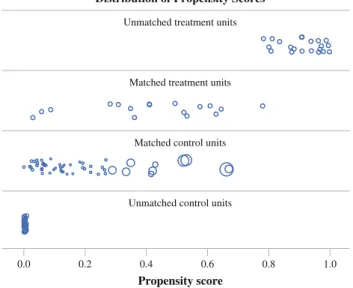
The propensity score for transfused patients was 0.688 ± 0.216, compared with 0.111 ± 0.159 in non-transfused patients (p \ 0.001), thus indicating a strong bias regarding most patient characteristics between the two groups. When performing the propensity score matching procedure, 54 patients had to be excluded (21 transfused patients and 33 nontransfused patients) because they could not be matched with patients from the other group (Fig.1). Hence, 74 patients were included in the propensity score-based analysis. After the matching procedure, the propen-sity score was nearly the same in the matched groups (0.413 ± 0.207 vs. 0.416 ± 0.216, p = 0.953). Figure1
displays the change in the distribution of the propensity score due to the matching procedure. After propensity score matching, no significant differences in the patient characteristics were found between patients receiving blood transfusions and those who did not. The study pop-ulation obtained by the matching procedure is depicted in Table2.
Blood Transfusion as a Prognostic Factor for Overall Survival
An unadjusted Cox proportional hazards regression analysis revealed that blood transfusion was a statistically significant prognostic factor and was associated with an approximately 105 % greater risk of overall mortality (HR of death 2.05, 95 % CI 1.19–3.51, p = 0.010) (Table3). The 3-year overall survival for patients receiving blood transfusions was 34 % (95 % CI 20–56), compared with 62 % (95 % CI 50–76) for patients who were not trans-fused (Fig.2, left). After adjusting for a variety of potential confounding factors in risk-adjusted Cox regression analyses, blood transfusion had a small non-significant effect on the risk of death in the full model (HR 1.14, 95 % CI 0.52–2.48, p = 0.745) and blood transfu-sion was not selected as an independent prognostic factor in a backward variable selection procedure. After adjust-ing the data accordadjust-ing to the propensity score analysis, blood transfusion was confirmed to have no effect on the risk of death (HR 1.02, 95 % CI 0.39–2.62, p = 0.974). After propensity score adjustment, the 3-year survival for transfused patients was 25.9 % (95 % CI 10.0–66.9), compared with 31.4 % (95 % CI 19.7–349.9) for non-transfused patients with comparable Kaplan–Meier curves (Fig.2, right).
Disease-free Survival
Unadjusted Cox proportional hazards regression analysis revealed that blood transfusion was a statistically significant prognostic factor for disease-free survival (HR 1.59, 95 % CI 1.00–2.51, p = 0.049). After risk adjustment in the multi-variate Cox regression analysis (HR 0.80, 95 % CI 0.41–1.59, p = 0.526) or the propensity score analysis (HR 0.62, 95 % CI 0.24–1.58, p = 0.295), blood transfusion was no longer a prognostic factor for disease-free survival. Sensitivity Analyses
To analyze a potential dose-dependent association between blood transfusion and survival blood transfusions
were treated as a numerical variable. In unadjusted Cox regression, the number of blood transfusions significantly impaired overall survival (HR 1.09, 95 % CI 1.00–1.19, p = 0.042) and as a tendency impaired the disease free survival (HR 1.06, 95 % CI 0.98–1.14, p = 0.150). In multivariable analysis, the number of blood transfusions did not significantly influence overall survival (HR 0.99, 95 % CI 0.87–1.11, p = 0.822) or disease free survival (HR 0.94, 95 % CI 0.84–1.04, p = 0.216). In none of the analyses, the number of blood transfusions was selected as an independent prognostic factor. An additional propensity score matched analysis compared patients receiving two or more blood transfusions (n = 32) against patients receiv-ing one or no blood transfusion (n = 96). After exclusion of 70 patients, 12 patients with two or more blood TABLE 1 Patient characteristics and outcome
Characteristic Variable Total Transfusion No transfusion p
(n = 128) (n = 38) (n = 90) Follow-up (mo) 22.9 ± 19.0 23.7 ± 16.2 22.6 ± 20.2 0.732a Age (y) 63.5 ± 10.7 66.4 ± 9.2 62.2 ± 11.1 0.032a Gender Male 85 (66.4 %) 23 (60.5 %) 62 (68.9 %) 0.360b Female 43 (33.6 %) 15 (39.5 %) 28 (31.1 %) ASA stage II 78 (60.9 %) 20 (52.6 %) 58 (64.4 %) 0.211b III 50 (39.1 %) 18 (47.4 %) 32 (35.6 %) Preoperative hemoglobin (g/l) 129.3 ± 14.7 124.6 ± 15.4 131.2 ± 14.1 0.026a
Tumor localization Intrahepatic 30 (23.4 %) 9 (23.7 %) 21 (23.3 %) 0.006b
Central/hilar 37 (28.9 %) 18 (47.4 %) 19 (21.1 %) Distal 61 (47.7 %) 11 (28.9 %) 50 (55.6 %) UICC stage I 22 (17.2 %) 3 (7.9 %) 19 (21.1 %) 0.006b II 87 (68.0 %) 24 (63.2 %) 63 (70.0 %) III 19 (14.8 %) 11 (28.9 %) 8 (8.9 %) Tumor size (cm) 3.5 ± 2.8 4.0 ± 3.1 3.3 ± 2.6 0.234a
Operation (Extended) right hemihepatectomy 30 (23.4 %) 14 (36.8 %) 16 (17.8 %) 0.002b
(Extended) left hemihepatectomy 30 (23.4 %) 10 (26.3 %) 20 (22.2 %)
Minor liver resection 7 (5.5 %) 3 (7.9 %) 4 (4.4 %)
Whipple procedure 55 (43.0 %) 7 (18.4 %) 48 (53.3 %)
Total pancreatectomy 6 (4.7 %) 4 (10.5 %) 2 (2.2 %)
Vascular resection No 112 (87.5 %) 29 (76.3 %) 83 (92.2 %) 0.013b
Yes 16 (12.5 %) 9 (23.7 %) 7 (7.8 %)
Intraoperative blood loss 100 ml 10.7 ± 7.5 16.7 ± 8.7 8.1 ± 5.2 \0.001a
Length of hospital stay (d) 21.9 ± 16.0 30.6 ± 19.9 18.2 ± 12.4 0.001a
Dindo grade 0 45 (35.2 %) 4 (10.5 %) 41 (45.6 %) \0.001b
I 22 (17.2 %) 5 (13.2 %) 17 (18.9 %)
II 33 (25.8 %) 19 (50.0 %) 14 (15.6 %)
III 25 (19.5 %) 8 (21.1 %) 17 (18.9 %)
IV 3 (2.3 %) 2 (5.3 %) 1 (1.1 %)
Values are presented as n (%) or mean ± standard deviation
ASA American Society of Anesthesiologists, UICC International Union Against Cancer
a t test
TABLE 2 Risk for blood transfusions and study population after propensity score matching Characteristic Variable Risk in full logistic regression Risk in logistic regression after variable selection Study population after propensity score matching a OR (95 % CI) p b OR (95 % CI) p b Transfusion (n = 17) No transfusion (n = 57) p Age (y) 1.10 (1.03–1.20) 0.004 1.09 (1.03–1.18) 0.003 65.1 ± 8.8 68.2 ± 9.7 0.230 c Gender Male Reference 0.866 – 1 0 (58.8 %) 32.3 (56.7 %) 0.877 d Female 0.88 (0.20–3.74) – 7 (41.2 %) 24.7 (43.3 %) ASA stage II Reference 0.933 – 1 2 (70.6 %) 29.6 (52 %) 0.175 d III 0.94 (0.24–3.62) – 5 (29.4 %) 27.4 (48 %) Preoperative hemoglobin (g/l) 0.99 (0.95–1.04) 0.728 – 12.7 ± 4.9 13.5 ± 5.4 0.816 c Tumor localization Intrahepatic Reference 0.922 – 1 (5.9 %) 5.7 (9.9 %) 0.690 d Central/hilar 1.43 (0.11–22.14) – 9 (52.9 %) 23.9 (41.8 %) Distal 1.01 (0.07–16.56) – 7 (41.2 %) 27.5 (48.2 %) UICC stage I Reference 0.032 Reference 0.006 1 (5.9 %) 4.6 (8.1 %) 0.923 d II 14.7 (1.78–249.4) 16.8 (2.29–242) 11 (64.7 %) 37.8 (66.4 %) III 23.6 (1.42–660) 34.8 (3.19–672) 5 (29.4 %) 14.6 (25.6 %) Tumor size (cm) 1.17 (0.81–1.76) 0.411 – 2.8 ± 0.8 2.9 ± 1.7 0.650 c Vascular resection No Reference 0.821 – 1 2 (70.6 %) 39.1 (68.6 %) 0.874 d Yes 1.26 (0.17–9.25) – 5 (29.4 %) 17.9 (31.4 %) Intraoperative blood loss (100 ml) 1.26 (1.14–1.44) \ 0.001 1.28 (1.16–1.44) \ 0.001 12.7 ± 4.9 13.5 ± 5.4 0.556 c Dindo grade 0 Reference \ 0.001 Reference \ 0.001 3 (17.6 %) 12.3 (21.6 %) 0.986 d I 0.59 (0.04–6.16) 0.77 (0.08–6.60) 2 (11.8 %) 5.9 (10.4 %) II 20.4 (3.94–157.8) 22.6 (4.70–158) 6 (35.3 %) 17.2 (30.2 %) III 2.32 (0.31–19.51) 2.36 (0.39–16.56) 6 (35.3 %) 21.2 (37.2 %) IV 21.1 (0.93–856) 27.8 (1.22–1221) 0 (0 % ) 0.4 (0.7 %) OR odds ratio, CI confidence interval ASA American Society of Anesthesiologists, UICC International Union Against Cancer a Data are presented as mean ± standard deviation, or as n (%) with decimals for nontransfused patient numbers caused by weighting b Likelihood ratio test c Weighted t test d Weighted Chi square test
transfusions and 46 patients with one or no blood trans-fusions remained in the analysis. The propensity scores were nearly the same in these two matched groups (0.354 ± 0.151 vs. 0.344 ± 0.135, p = 0.822). In this analysis, overall survival (HR 1.08, 95 % CI 0.38–3.02, p = 0.888) and disease free survival (HR 0.86, 95 % CI 0.31–2.39, p = 0.773) were not influenced by blood transfusions.
Another sensitivity analysis was performed including the 13 patients who died during the hospital stay and the 17 stage IVa cholangiocarcinoma patients. After propensity score matching, blood transfusion did not influence overall survival (HR 0.72, 95 % CI 0.37–1.42, p = 0.336) or disease-free survival (HR 0.93, 95 % CI 0.50–1.73, p = 0.817) confirming the results.
DISCUSSION
To date, only a few reports have focused on the impact of blood transfusion on outcome after resection for chol-angiocarcinoma.12,13 This study is the first to use propensity score methods to assess this issue in patients undergoing curative resection for cholangiocarcinoma, with an ultimate goal of differentiating between the direct effects of transfusion and the effects of confounding fac-tors. Perioperative blood transfusion was one of the independent prognostic factors for overall survival in the
unadjusted analysis of the entire study group. After adjustment, our results indicate that perioperative blood transfusion does not influence overall or disease-free sur-vival in cholangiocarcinoma patients. These results were obtained using both multivariate Cox regression and pro-pensity score-adjusted analyses. Thus, the negative association between blood transfusion and oncological outcome is likely not associated with blood transfusion itself but rather with the clinical circumstances necessi-tating the transfusion.
However, even though blood transfusion did not decrease survival in the present investigation, the avoid-ance of unnecessary blood transfusions is of cardinal importance for various reasons. In addition to the costs, the possible negative sequelae of blood transfusion are well known, including alloimmunization, the transmission of viral diseases, graft-versus-host disease, and an increased postoperative infection rate.22–26
In the present study, 38 of the 128 patients (29.7 %) were transfused during or after resection. Our transfusion rate compares favorably with those found by others, with reported blood transfusion requirements of 10–53 %.8,27 Blood transfusion was associated with a 105 % increased risk of mortality in the unadjusted analyses. However, as a result of the marked differences in various prognostic factors between the transfused and nontransfused patients, this association was merely coincidental. To further adjust for unobserved variables, mixed-effects Cox regression modeling was applied.28 In the risk-adjusted analyses, blood transfusion did not remain an independent predictor of overall survival. Therefore, the increased risk observed in the unadjusted analysis is due to differences in the baseline characteristics and not to blood transfusion itself. The same conflicting findings were also obtained for other malignancies with respect to disease-free survival. Several authors have demonstrated that the time to recurrence is shorter in patients who receive blood transfusions.29–32 Other authors, however, have not been able to identify any adverse relationship between blood transfusion and the recurrence of cancer. Regarding autologous and allogeneic blood transfusion, a randomized trial by Busch et al. that included 475 colorectal cancer patients did not find that autologous blood transfusion improved the prognosis in colorectal cancer patients compared with allogeneic blood transfusion. The authors concluded that the circumstances necessitating blood transfusions are the real predictors of prognosis and not the blood transfusions.33
Improvements in surgical techniques, anesthetic proto-cols, and medical management have significantly improved outcomes for patients undergoing liver and pancreatic cancer surgery, with acceptable morbidity and mortal-ity.6,15,34,35 Nevertheless, these procedures, especially extended hepatectomies, are frequently accompanied by
Distribution of Propensity Scores Unmatched treatment units
Matched treatment units
Matched control units
Unmatched control units
1.0 0.0 Propensity score 0.8 0.6 0.4 0.2
FIG. 1 Distribution of the propensity scores. Each circle represents one patient. The distributions of the propensity scores for patients with and without blood transfusions (treatment units and control units) who could be matched are shown. The propensity scores for patients who could not be matched because their characteristics could not be matched with those of patients from the other group are also shown. The sizes of the circles for matched patients without blood transfusions (control units) represent the weights obtained by the propensity score matching procedure
TABLE 3 Prognostic factors for overall survival Prognostic factor Variable Cox regression Unadjusted a Full model b Variable selection c After propensity score matching d HR (95 % CI) p e HR (95 % CI) p e HR (95 % CI) p e HR (95 % CI) p e Blood transfusion No Reference 0.010 Reference 0.745 – – Reference 0.974 Yes 2.05 (1.19–3.51) 1.14 (0.52–2.48) – – 1.02 (0.39–2.62) Age (y) 1.02 (0.99–1.05) 0.129 1.02 (0.99–1.05) 0.119 1.03 (1.00–1.06) 0.025 Gender Male Reference 0.638 Reference 0.369 – – Female 1.14 (0.66–1.96) 1.41 (0.67–2.98) – – ASA stage II Reference 0.356 Reference 0.238 – – III 1.31 (0.74–2.29) 1.47 (0.78–2.76) – – Preoperative hemoglobin (g/l) 0.99 (0.97–1.01) 0.453 1.00 (0.98–1.02) 0.668 – – Tumor localization Intrahepatic Reference 0.032 Reference 0.113 Reference 0.002 Central/hilar 2.27 (1.15–4.46) 3.66 (0.98–13.74) 4.53 (1.63–12.6) Distal 1.22 (0.58–2.53) 2.03 (0.57–7.21) 2.10 (0.70–6.26) UICC stage I Reference 0.010 Reference 0.231 – – II 3.08 (1.10–8.69) 2.39 (0.79–7.24) – – III 4.74 (1.53–14.70) 1.98 (0.50–7.91) – – Tumor size (cm) 1.00 (0.91–1.09) 0.971 1.09 (0.93–1.27) 0.283 1.13 (0.98–1.31) 0.094 Vascular resection No Reference 0.087 Reference 0.906 – – Yes 1.91 (0.96–3.81) 1.06 (0.42–2.64) – – Intraoperative blood loss (100 ml) 1.03 (0.99–1.06) 0.145 1.02 (0.96–1.07) 0.547 – – Data are presented as hazard ratios with 95 % confidence intervals (Wald type) and p values of the likelihood ratio test Prognostic factors for overall survival in a Cox proportional hazards regression analyses for each factor separately b Cox proportional hazards regression analysis for all factors c Cox proportional hazards regression analysis after backward variable selection d Cox proportional hazards regression analysis including weights obtained by propensity score matching with stratification for the subclasses obtai ned by the propensity score matching procedure e p values for likelihood ratio test
substantial blood loss, and many patients require allogeneic blood transfusions during either the operation or the post-operative period.35–37The indications for blood transfusion are obviously determined by numerous factors, such as the amount of blood lost during surgery, the extent of the surgical procedure, and the skill of the surgeon. Many experimental and clinical studies have demonstrated that blood transfusion may have an adverse effect on postop-erative outcomes after surgery for various malignant neoplasms because of the induction of posttransfusion immunosuppression.38–42 Using a multivariate analysis, Gozzetti et al.43studied 522 patients undergoing elective liver resections for benign and malignant liver diseases and observed a significant correlation between blood transfu-sion and long-term survival in patients with metastatic tumors and HCC. According to our results, blood transfu-sion is a surrogate marker for higher-risk patients and does not impact disease-free or overall survival. Previous pro-spective randomized trials were designed to compare allogeneic, autologous, and leukocyte-depleted blood transfusions.33,44,45 These trials demonstrated that autolo-gous and leukocyte-depleted blood transfusions do not result in better outcomes than allogeneic transfusions for patients with colorectal cancer.46
This study has several limitations. First, this was a ret-rospective and not a randomized controlled study including a rather small number of patients receiving blood transfu-sion. However, it is nearly impossible and ethically questionable to perform a randomized trial to study this association. Second, this analysis included a mixture of intrahepatic, hilar, and distal cholangiocarcinoma. This heterogeneity and possible changes of the surgical and perioperative management over time, might have intro-duced a relevant bias. Third, the exclusion of patients in the propensity score-matched analysis resulted in further
decrease of an already small sample size and therefore in a relevant loss of statistical power.47 Additionally, a cutoff effect for the amount of blood transfusions can not be excluded. Despite these limitations, the adverse effect of blood transfusion disappeared after risk adjustment for both overall and disease-free survival. Fourth, as a result of the propensity score methodology, the results are partly based on advanced cholangiocar-cinoma patients with a poor oncologic outcome. This poor outcome might have hidden a potential negative prognostic impact of blood transfusions. Finally, as a result of normal physiological ageing and metabolic processes there is leaching of biologically active sub-stances from the cells into stored blood products. These substances have immunomodulatory effects promoting cell growth and angiogenesis and may therefore have a direct effect on tumor growth.48 In the present study, we could not control for a possible negative effect of blood storage duration on the oncological outcome.
In summary, blood transfusion in patients after curative resection for advanced cholangiocarcinoma is not associ-ated with worse overall and disease-free survival after risk adjustment in multivariate Cox proportional and propensity score analyses, irrespective of the possible immunosup-pressive effects of allogeneic blood transfusion. Blood transfusion merely serves as a surrogate parameter for other poor prognostic factors. Therefore, the administration of autologous blood transfusions does not seem to influence the oncologic results. Still, the avoidance of unnecessary blood transfusions remains of cardinal importance as a result of the other possible negative sequelae of blood transfusion.
CONFLICT OF INTEREST The authors declare no conflict of interest. No blood substitution (n = 90) Blood substitution (n = 38) 128 Patients at risk Two-sided P-value = 0.010 100 80 60 40 20 5 0
Years after operation Proportion surviving (%) 4 3 2 1 8 11 28 49 85 No blood substitution (n = 57) Blood substitution (n = 17) 74 Patients at risk Two-sided P-value = 0.974 100 80 60 40 20 5 0
Years after operation Proportion surviving (%) 4 3 2 1 3 5 14 25 44
FIG. 2 Kaplan–Meier curve for overall survival in the unadjusted and propensity score-adjusted analyses. Kaplan–Meier curve for overall survival in the unadjusted (left) and propensity score-adjusted analyses (right). The numbers of patients at risk are given below each plot
DISCLOSURE None.
FUNDING This study received no financial support.
REFERENCES
1. Gatto M, Alvaro D. New insights on cholangiocarcinoma. World J Gastrointest Oncol. 2010;2:136–45.
2. Blechacz BR, Gores GJ. Cholangiocarcinoma. Clin Liver Dis. 2008;12:131–50. doi:10.1016/j.cld.2007.11.003.
3. Siegel R, Naishadham D, Jemal A. Cancer statistics, 2012. CA Cancer J Clin. 2012;62:10–29.
4. Yeh CN, Jan YY, Chen MF. Influence of age on surgical treatment of peripheral cholangiocarcinoma. Am J Surg. 2004;187:559–63. 5. DeOliveira ML, Cunningham SC, Cameron JL, et al.
Cholangi-ocarcinoma: thirty-one-year experience with 564 patients at a single institution. Ann Surg. 2007;245(5):755–62.
6. Jarnagin WR, Gonen M, Fong Y, et al. Improvement in perioper-ative outcome after hepatic resection: analysis of 1,803 consecutive cases over the past decade. Ann Surg. 2002;236:397–406. 7. Neuhaus P, Thelen A, Jonas S, et al. Oncological superiority of
hilar en bloc resection for the treatment of hilar cholangiocarci-noma. Ann Surg Oncol. 2012;19(5):1602–8.
8. Welsch T, Degrate L, Zschabitz S, Hofer S, Werner J, Schmidt J. The need for extended intensive care after pancreaticoduoden-ectomy for pancreatic ductal adenocarcinoma. Langenbecks Arch Surg. 2011;396:353–62.
9. Blajchman MA. Immunomodulation and blood transfusion. Am J Ther. 2002;9:389–95.
10. Bordin JO, Blajchman MA. Immunosuppressive effects of allo-geneic blood transfusions: implications for the patient with a malignancy. Hematol Oncol Clin North Am. 1995;9:205–18. 11. Amato A, Pescatori M. Perioperative blood transfusions for the
recurrence of colorectal cancer. Cochrane Database Syst Rev. 2006;(1):CD005033. doi:10.1002/14651858.CD005033.pub2. 12. Nagino M, Kamiya J, Arai T, Nishio H, Ebata T, Nimura Y. One
hundred consecutive hepatobiliary resections for biliary hilar malignancy: preoperative blood donation, blood loss, transfusion, and outcome. Surgery. 2005;137:148–55.
13. Liu CL, Fan ST, Lo CM, Tso WK, Lam CM, Wong J. Improved operative and survival outcomes of surgical treatment for hilar cholangiocarcinoma. Br J Surg. 2006;93:1488–94.
14. Fleming ID, Cooper JS, Henson DE, Hutter RVP, Kennedy BJ, Murphy GP. AJCC cancer staging manual. 5th ed. Philadelphia: Lippincott-Raven; 1997.
15. Hartwig W, Hackert T, Hinz U, et al. Pancreatic cancer surgery in the new millennium: better prediction of outcome. Ann Surg. 2011;254:311–9.
16. Schemmer P, Bruns H, Weitz J, Schmidt J, Buchler MW. Liver transection using vascular stapler: a review. HPB (Oxford). 2008;10:249–52.
17. Chen X, Ishwaran H. Pathway hunting by random survival for-ests. Bioinformatics. 2013;29:99–105.
18. Grambsch PM, Therneau TM. Proportional hazards tests and diagnostics based on weighted residuals. Biometrika. 1994;81: 515–26.
19. Joffe MM, Rosenbaum PR. Invited commentary: propensity scores. Am J Epidemiol. 1999;150:327–33.
20. Hansen BB, Klopfer SO. Optimal full matching and related designs via network flows. J Comput Graph Stat. 2006;15:609–27. 21. Freedman LS. Tables of the number of patients required in
clinical trials using the logrank test. Stat Med. 1982;5(1):121–9. 22. Blumberg N, Heal JM. Perioperative blood transfusion and
colorectal cancer recurrence. Transfusion. 1994;34:450–2.
23. Kwon AH, Matsui Y, Kamiyama Y. Perioperative blood trans-fusion in hepatocellular carcinomas: influence of immunologic profile and recurrence free survival. Cancer. 2001;91:771–8. 24. Peterman TA, Jaffe HW, Feorino PM, et al.
Transfusion-associ-ated acquired immunodeficiency syndrome in the United States. JAMA. 1985;254:2913–7.
25. Arsura EL, Bertelle A, Minkowitz S, Cunningham JN Jr, Grob D. Transfusion-associated-graft-vs-host disease in a pre-sumed immunocompetent patient. Arch Intern Med. 1988; 148:1941–4.
26. Wei AC, Tung-Ping PR, Fan ST, Wong J. Risk factors for peri-operative morbidity and mortality after extended hepatectomy for hepatocellular carcinoma. Br J Surg. 2003;90:33–41.
27. Grutzmann R, Ruckert F, Hippe-Davies N, Distler M, Saeger HD. Evaluation of the International Study Group of Pancreatic Sur-gery definition of post-pancreatectomy hemorrhage in a high-volume center. Surgery. 2012;151:612–20.
28. Govindarajulu US, Lin H, Lunetta KL, D’Agostino RB, Sr. Frailty models: applications to biomedical and genetic studies. Stat Med. 2011;30:2754–64.
29. Blumberg N, Agarwal MM, Chuang C. Relation between recur-rence of cancer of the colon and blood transfusion. Br Med J (Clin Res Ed). 1985;290:1037–9.
30. Hyman NH, Foster RS Jr, DeMeules JE, Costanza MC. Blood transfusions and survival after lung cancer resection. Am J Surg. 1985;149:502–7.
31. Acheson AG, Brookes MJ, Spahn DR. Effects of allogeneic red blood cell transfusions on clinical outcomes in patients under-going colorectal cancer surgery: a systematic review and meta-analysis. Ann Surg. 2012;256:235–44.
32. Hyung WJ, Noh SH, Shin DW, et al. Adverse effects of peri-operative transfusion on patients with stage III and IV gastric cancer. Ann Surg Oncol. 2002;9:5–12.
33. Busch OR, Hop WC, Hoynck van Papendrecht MA, Marquet RL, Jeekel J. Blood transfusions and prognosis in colorectal cancer. N Engl J Med. 1993;328:1372–6.
34. Poon RT, Fan ST, Lo CM, et al. Improving perioperative outcome expands the role of hepatectomy in management of benign and malignant hepatobiliary diseases: analysis of 1222 consecutive patients from a prospective database. Ann Surg. 2004;240:698–708. 35. Gomez D, Morris-Stiff G, Wyatt J, Toogood GJ, Lodge JP, Prasad KR. Surgical technique and systemic inflammation influ-ences long-term disease-free survival following hepatic resection for colorectal metastasis. J Surg Oncol. 2008;98:371–6. 36. Nuzzo G, Giuliante F, Ardito F, et al. Improvement in
periop-erative and long-term outcome after surgical treatment of hilar cholangiocarcinoma: results of an Italian multicenter analysis of 440 patients. Arch Surg. 2012;147:26–34.
37. Vauthey JN, Pawlik TM, Abdalla EK, et al. Is extended hepa-tectomy for hepatobiliary malignancy justified? Ann Surg. 2004;239:722–30.
38. Edna TH, Bjerkeset T. Association between transfusion of stored blood and infective bacterial complications after resection for colorectal cancer. Eur J Surg. 1998;164:449–56.
39. Tartter PI, Burrows L, Papatestas AE, Lesnick G, Aufses AH Jr. Perioperative blood transfusion has prognostic significance for breast cancer. Surgery. 1985;97:225–30.
40. Yamamoto J, Kosuge T, Takayama T, et al. Perioperative blood transfusion promotes recurrence of hepatocellular carcinoma after hepatectomy. Surgery. 1994;115:303–9.
41. Jagoditsch M, Pozgainer P, Klingler A, Tschmelitsch J. Impact of blood transfusions on recurrence and survival after rectal cancer surgery. Dis Colon Rectum. 2006;49:1116–30.
42. Busch OR, Hop WC, Marquet RL, Jeekel J. The effect of blood transfusions on survival after surgery for colorectal cancer. Eur J Cancer. 1995;31A(7–8):1226–8.
43. Gozzetti G, Mazziotti A, Grazi GL, et al. Liver resection without blood transfusion. Br J Surg. 1995;82:1105–10.
44. Heiss MM, Mempel W, Delanoff C, et al. Blood transfusion-modulated tumor recurrence: first results of a randomized study of autologous versus allogeneic blood transfusion in colorectal cancer surgery. J Clin Oncol. 1994;12:1859–67.
45. Houbiers JG, Brand A, van de Watering LM, et al. Randomised controlled trial comparing transfusion of leucocyte-depleted or buffy-coat-depleted blood in surgery for colorectal cancer. Lan-cet. 1994;344:573–8.
46. Marquet RL, Busch OR, Jeekel J, Heiss MM, Amato AC. Are allogeneic blood transfusions acceptable in elective surgery in colorectal carcinoma? Eur J Cancer. 1999;35:352–60.
47. Jung SH, Chow SC, Chi EM. A note on sample size calculation based on propensity analysis in nonrandomized trials. J Biopharm Stat. 2007;17:35–41.
48. Upile T, Jerjes W, Mahil J, et al. An explanation for the worsened prognosis in some cancer patients of perioperative transfusion: the time-dependent release of biologically active growth factors from stored blood products. Eur Arch Otorhinolaryngol. 2011;268(12):1789–94.