J Neurol (2008) 255:762–763
DOI 10.1007/s00415-008-0800-3
LETTER TO THE EDITORS
JON 2800
unspecific central nervous system symptoms [2]. Herein, we present a patient who developed a severe re-versible extrapyramidal syndrome after inhalation of IAA.
Together with his troop, a 21-year-old soldier was ordered to test the impermeability of his gas mask with IAA gas. In Switzerland, this procedure is called “banana gas test”. In the days prior to the test, he had the same diet as his army colleagues. He did not suffer from any kind of injury during the few weeks before the test, and renewal of tetanus vaccination was several months earlier. Furthermore, he did not consume drugs, and was not on any medication prior to the test. During the “banana gas test”, our patient remarked a discrete banana-like odor. Half an hour later, dizziness with disturbed shimmering vision occurred, to-gether with severe pain and stiff-ness in his jaw, and a progressive difficulty to swallow. The military physician consulted assigned the patient immediately to the emer-gency unit of our hospital. On neu-rological examination, we found signs of a cholinergic crisis, includ-ing bilateral miosis, hypersaliva-tion, increased sweating, and nau-sea. Furthermore, the patient showed an extrapyramidal syn-drome, including severe painful rigidity of the mimic muscles, par-ticularly in the jaw, but also in his neck and arms, consecutively lead-ing to generalized slowness of motor functions, severe dysarthria, and trismus with inability to close eyes and mouth. Furthermore, we found a high-frequency medial amplitude tremor in both arms,
Christian R. Baumann René Jenni
Hans H. Jung
Severe extrapyramidal
syndrome after
exposi-tion to isoamyl acetate
vapour
Received: 2 July 2007 Received in revised form:
25 September 2007 Accepted: 29 October 2007 Published online: 17 March 2008
Sirs: At room temperature, the low-molecular-weight ester isoamyl acetate (IAA, syn. butanol acetate, C7H14O2) is a liquid
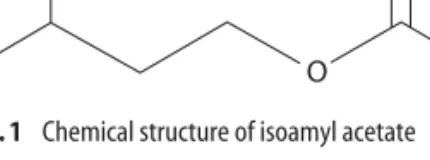
with an intense, but pleasant banana-like odour (Fig. 1). Honey bees use IAA as an alarm phero-mone, i.e. a chemical substance produced by living organisms that transmits a message to other mem-bers of the same species. Bees store IAA in their poison sting. After release in the course of an attack, the odour of IAA alerts other bees to behave defensively, i.e. sting or charge [1]. Due to its strong smell, which can be perceived already at low concentrations, and because of supposedly low toxicity, IAA is used to test the effectiveness of res-pirators or gas masks. IAA vapour is known to irritate eyes, skin and respiratory tract, and to cause mild
injection of both conjunctivae, and an exanthema on face and trunk. Cranial nerve findings, tendon re-flexes, and sensibility were normal. Blood pressure was 130/65 mm Hg in lying position, heart rate was 64 per minute. After intravenous administration of 5 mg biperiden, muscle tone and movements par-tially normalized. The patient re-ported feeling a subjective relax-ation. Later on, tremor amplitude and frequency also decreased.
Laboratory studies showed no evidence of intoxication or infec-tion. Potassium was discretely de-creased (3.2 mmol/l, normal: 3.5– 5.0), creatinine kinase was elevated (819 U/l, normal: < 190), leukocyte count slightly increased
(10.68 × 10³/μl). Other serum
elec-trolytes and liver/renal function tests were normal. Toxicological screening analysis did not reveal intoxication by drugs or pharma-ceuticals. Cerebral computed to-mography was normal.
During the following 48 hours, the neurological symptoms remit-ted without further medication, whereas a very discrete erythema-tous exanthema remained on the right forearm.
After inhalation of IAA vapour, our patient developed a choliner-gic-like crisis with a severe extra-pyramidal syndrome, which remit-ted after anticholinergic treatment with biperiden. The skin findings in our patient were interpreted as a toxic-irritative exanthema, proba-bly due to the exposition to IAA. It is known that IAA vapour may cause central nervous system symptoms such as headache, nau-sea, dizziness, drowsiness, dis-turbed coordination and confusion [2]. However, to our best knowl-edge, an acute cholinergic-like cri-sis with severe extrapyramidal symptoms as a consequence of iso-amyl acetate inhalation has not been reported before. Only in an old study dating from 1933 was
C. R. Baumann, MD (쾷) · H. H. Jung, MD Dept. of Neurology University Hospital Frauenklinikstrasse 26 8091 Zürich, Switzerland Tel.: 01-255/5511 Fax: 01-255/4380 E-Mail: [email protected] R. Jenni, PhD
Swiss Federal Institute of Technology Zurich, Switzerland
C. R. Baumann, MD
Harvard Institutes of Medicine Beth Israel Deaconess Medical Center Boston, USA
O O
Fig. 1 Chemical structure of isoamyl acetate
762_763_Baumann_JON_2800.indd 762
763
spastic paralysis observed in guinea pigs subsequent to subcuta-neous application of IAA [3].
Based on history, clinical find-ings, the course of the symptom-atology, laboratory examinations, and cranial computed tomography, we could not find other potential causes for the symptomatology, such as other intoxication, adverse reactions to other medications, botulism, tetanus, hypocalcemia, meningitis, or encephalitis. Hence, the observations in our patient suggest that IAA may enhance cholinergic functions and inhibit the nigrostriatal dopaminergic system via unknown mechanisms. Pertaining to the ‘fight or flight’ reaction of honey bees after expo-sition to IAA, Hunt raised the hypothesis whether IAA might
stimulate the release of neuropep-tides and/or biogenic amines [1]. There might be an analogous situa-tion as found in organophosphate poisoning where inhibition of syn-aptic acetylcholinesterase may lead to acute cholinergic crisis, and neu-rotoxic extrapyramidal symptoms have also been observed and con-sidered to be related to the impedi-ment of acetylcholine to modify the dopaminergic system [4].
In conclusion, this case docu-ments a cholinergic-like crisis with severe extrapyramidal syndrome after inhalation of isoamyl acetate vapour in a military camp, but the underlying pathophysiology re-mains hypothetical. Based on our observations, we believe it is not acceptable to expose young soldiers to a substance with unclear toxicity.
References
1. Hunt GJ (2007) Flight and fight: A com-parative view of the neurophysiology and genetics of honey bee defensive behavior. J Insect Physiol 53:399–410 2. National Library of Medicine, see:
http://chem.sis.nlm.nih.gov/ chemidplus/jsp/common/ChemFull. jsp?MW=130.186
3. Flury F, Wirth W (1933) Zur Toxikologie der Lösungsmittel. Archiv fuer Gewer-bepathologie und Gewerbehygiene (today: International Archives of Occu-pational and Environmental Health) 5:1–90
4. Hsieh BH, Deng JF, Ger J, Tsai WJ (2001) Acetylcholinesterase inhibition and the extrapyramidal syndrome: a review of the neurotoxicity of organophosphate. Neurotoxicology 22:423–427
762_763_Baumann_JON_2800.indd 763