HAL Id: inria-00395837
https://hal.inria.fr/inria-00395837
Submitted on 16 Jun 2009
HAL is a multi-disciplinary open access
archive for the deposit and dissemination of
sci-entific research documents, whether they are
pub-lished or not. The documents may come from
teaching and research institutions in France or
abroad, or from public or private research centers.
L’archive ouverte pluridisciplinaire HAL, est
destinée au dépôt et à la diffusion de documents
scientifiques de niveau recherche, publiés ou non,
émanant des établissements d’enseignement et de
recherche français ou étrangers, des laboratoires
publics ou privés.
Lower Bounds for Pinning Lines by Balls
Otfried Cheong, Xavier Goaoc, Andreas Holmsen
To cite this version:
Otfried Cheong, Xavier Goaoc, Andreas Holmsen. Lower Bounds for Pinning Lines by Balls. [Research
Report] RR-6961, INRIA. 2009, pp.12. �inria-00395837�
a p p o r t
d e r e c h e r c h e
IS S N 0 2 4 9 -6 3 9 9 IS R N IN R IA /R R --6 9 6 1 --F R + E N G Domaine 2INSTITUT NATIONAL DE RECHERCHE EN INFORMATIQUE ET EN AUTOMATIQUE
Lower Bounds for Pinning Lines by Balls
Otfried Cheong — Xavier Goaoc — Andreas Holmsen
N° 6961
Centre de recherche INRIA Nancy – Grand Est LORIA, Technopôle de Nancy-Brabois, Campus scientifique, 615, rue du Jardin Botanique, BP 101, 54602 Villers-Lès-Nancy
Téléphone : +33 3 83 59 30 00 — Télécopie : +33 3 83 27 83 19
Lower Bounds for Pinning Lines by Balls
Otfried Cheong
∗, Xavier Goaoc
†, Andreas Holmsen
‡Domaine 2 — Algorithmique, programmation, logiciels et architectures ´
Equipe-Projet Vegas
Rapport de recherche n°6961 — June 2009 — 12 pages
Abstract: A line ℓ is a transversal to a family F of convex objects in Rd if
it intersects every member of F . In this paper we show that for every integer d ≥ 3 there exists a family of 2d − 1 pairwise disjoint unit balls in Rd with the
property that every subfamily of size 2d − 2 admits a transversal, yet any line misses at least one member of the family. This answers a question of Danzer from 1957.
Key-words: Discrete Geometry, Geometric Transversal, Helly-type Theorem
Otfried Cheong was supported by the Korea Science and Engineering Foundation Grant R01-2008-000-11607-0 funded by the Korean government. Andreas Holmsen was sup-ported by the Brain Korea 21 Project, the School of Information Technology, KAIST, in 2008. The cooperation by Otfried Cheong and Xavier Goaoc was supported by the INRIA ´Equipe Associ´ee KI.
∗
[email protected]. Dept. of Computer Science, KAIST, Daejeon, South Korea.
†[email protected]. VEGAS Project, INRIA Nancy Grand Est, Nancy, France.
‡[email protected]. Dept. of Computer Science, KAIST, Daejeon, South
Lower Bounds for Pinning Lines by Balls
R´esum´e : Une droite ℓ est une transversale `a une famille F de convexes de Rd
si elle coupe chaque membre de F . Dans cet article, nous montrons que pour tout entier d ≥ 3, il existe une famille de 2d − 1 boules disjointes de mˆeme rayon dans Rd sans droite transversale et telle que toute sous-famille de taille 2d − 2
admet une droite transversale. Cela r´epond `a une question de Danzer de 1957. Mots-cl´es : G´eom´etrie Discr`ete, Transversales G´eom´etriques, Th´eor`emes `a la Helly
Lower Bounds for Pinning Lines by Balls 3
1
Introduction
A straight line that intersects every member of a family F of compact convex sets in Rd is called a line transversal to F . An important problem in
geomet-ric transversal theory is to give sufficient conditions on F that guarantee the existence of a transversal. As an example consider the following result due to Danzer [3].
Theorem (Danzer, 1957). A family F of pairwise disjoint congruent disks in the plane has a transversal if and only if every subfamily ofF of size at most 5 has a transversal.
Simple examples show that the disjointness or congruence can not be dropped, nor can the number 5 be reduced. Danzer’s theorem has been very influential on geometric transversal theory. In 1958, Gr¨unbaum [8] showed that the same result holds when congruent disks is replaced by translates of a square, and conjectured that the result holds also for families of disjoint translates of an arbitrary planar convex body. This long-standing conjecture was finally proven by Tverberg [12] after partial results were obtained by Katchalski [11].
Theorem (Tverberg, 1989). A family F of pairwise disjoint translates of a compact convex set in the plane has a transversal if and only if every subfamily of F of size at most 5 has a transversal.
In a different direction, Danzer’s theorem was recetly generalized by the present authors together with S. Petitjean [2]. This is a higher-dimensional analogue of Danzer’s theorem, and it solves a problem which dates back to Danzer’s original article.
Theorem (Cheong-Goaoc-Holmsen-Petitjean, 2008). A family F of disjoint congruent balls in Rd has a transversal if and only if every subfamily of size at
most 4d − 1 has a transversal.
It should be noted that there are examples which show that Tverberg’s theorem does not extend to dimensions greater than two [10]. The theorem just stated provides an upper bound on the Helly-number for line transversals to disjoint congruent balls in Rd. However, a missing piece in this particular line
of research has been a matching lower bound, a problem which again dates back to Danzer’s original article. The main result of this paper is the following. Theorem 1. For everyd ≥ 3, there exists a family of disjoint congruent balls in Rd which does not have a transversal but where every subfamily of size at most 2d − 2 has a transversal.
Thus the Helly-number for line transversals to disjoint unit balls in Rd is
determined up to a factor of 2.
The crucial idea for the proof of Theorem 1 is the notion of a pinning, which was also used in [2]. Intuitively, a line transversal l to a family F is pinned if every line l′ sufficiently close to, but distinct from l fails to be transversal to
F. In [2] we showed that if a line is pinned by a family F of disjoint balls then there is a subfamily G ⊂ F of size at most 2d − 1 such that l is pinned by G. Here we will show that there exists minimal pinning configuration of disjoint (congruent) balls in Rd of size 2d − 1. By this we mean a family of 2d − 1
4 Cheong & Goaoc & Holmsen
disjoint balls with a unique transversal l which is pinned but where no proper subfamily pins l. Theorem 1 then follows by slightly shrinking each member of the pinning configuration about its center.
There are many surveys that cover geometric transversal theory, among oth-ers [4, 5, 7, 13]. For detailed information on the transvoth-ersal properties to families of disjoint balls the reader should consult [6].
2
Existence of stable pinnings
Let F be a family of compact convex sets in Rd. The set T(F ) of all line
transversals to F forms a subspace of the affine Grassmanian, which is called the space of transversals to F . A set F pins (or is a pinning of) a line ℓ if ℓ is an isolated point of T(F ); we also say that ℓ is pinned by F , or that the pair (F , ℓ) is a pinning configuration. If F pins ℓ and no proper subset of F does, then F is a minimal pinning of ℓ. A minimal pinning configuration consisting of pairwise disjoint balls in Rdhas size at most 2d − 1 [1, 2]. Our goal is to show
that this constant is best possible in all dimensions.
Theorem 2. For anyd ≥ 2, there exists a minimal pinning by 2d − 1 disjoint congruent balls in Rd.
A pinning configuration (F , ℓ) consisting of disjoint balls B1, . . . , Bn in Rd
is stable if there exists an ε > 0 such that any configuration F′ = {B′
1, . . . , B′n},
where the center of B′
i has distance at most ε from the center of Bi and Bi′ is
tangent to ℓ, is also a pinning of ℓ.
Pinning patterns. A halfplane pattern is a sequence H = (H1, . . . , Hn) of
halfplanes in R2
bounded by lines through the origin. A halfplane pattern is a pinning pattern if no two halfplanes are bounded by the same line, and if for every directed line ℓ not meeting the origin and intersecting each halfplane there exist indices i < j such that ℓ exits Hj before entering Hi.
We first observe that pinning patterns are invariant under small perturba-tions of the halfplanes (that is, if each halfplane is rotated about the origin by a sufficiently small angle). More precisely, two halfplane patterns are equivalent with respect to the pinning pattern property if the cyclic order of the halfplane boundaries and their orientation is the same, or, equivalently, if the cyclic order of the inward and outward normals of the halfplanes is identical.
Let ni∈ S 1
denote the outward normal of Hi (throughout the paper, we let
Sd−1 denote the set of unit vectors or, equivalently, directions in Rd). We call
a halfplane pattern of five halfplanes a σ5-pattern if the outward and inward
normals appear in the order (see Figure 1)
n1, −n3, n5, n2, −n4, −n1, n3, −n5, −n2, n4.
It is easy (but a bit tedious) to verify manually that any σ5-pattern is a pinning
pattern. We will give a somewhat more elegant argument below, but let us first understand the significance of this fact.
Stable pinnings from pinning patterns. The existence of a pinning pat-tern in the plane allows us to prove the existence of a stable pinning of a line by five disjoint balls in R3
.
Lower Bounds for Pinning Lines by Balls 5 H1 H3 H5 H2 H4 n1 n3 n5 n2 n4
Figure 1: A σ5-patterns, as an arrangement of halfplanes through the origin (left)
and as a cyclic order of outward and inword normals on S1
(right).
Let C = (B1, . . . , Bn) be a sequence of balls tangent to a directed line ℓ,
which touches the balls in the order B1, . . . , Bn. We choose a coordinate system
where ℓ is the positive z-axis. Projecting ball Bi on the xy-plane results in a
disk whose boundary contains the origin; we let Hi denote the halfplane (in the
xy-plane) containing this disk and bounded by its tangent in the origin. We call the halfplane pattern H = (H1, . . . , Hn) the projection of C along ℓ.
Lemma 1. Let C be a sequence of disjoint balls in R3
touching a line ℓ in the order of the sequence. If the projection of C along ℓ is a pinning pattern, then C is a pinning of ℓ.
Proof. We show that no line other than ℓ intersects the members of C = (B1, . . . , Bn) in the same order, implying that ℓ is pinned by C. Let H =
(H1, . . . , Hn) be the projection of C, and assume that such a line g exists. If
g is neither parallel nor meets ℓ, its projection g′ on the xy-plane does not
go through the origin. Since g meets each Bi, g′ intersects each halfplane Hi.
Since H is a pinning pattern, there must then be indices i < j such that g′exits
Hj before entering Hi. But this implies that g must intersect Bj before Bi, a
contradiction.
If g is parallel to ℓ then its projection on the xy-plane is a point lying in T1≤i≤nHi. Since H is a pinning pattern, this intersection must have empty
interior as otherwise any line pointing into the sector and not meeting the origin does not exit any halfplane; as no two halplanes in H are bounded by the same line, we getT1≤i≤nHi= {O}, and so g is ℓ, a contradiction.
If g meets ℓ, we argue that there exists a line that intersects the balls in the same order as ℓ and is neither parallel to nor secant with ℓ, which brings us back to the first case above. Specifically, let si be a segment joining a point in
Bi∩ ℓ and a point in Bi∩ g and g1a line through g ∩ ℓ and the interior of one of
the si. Since g and ℓ intersect the balls in the same order, so does g1. If no si
is reduced to a single point, g1 intersects the open balls and can be perturbed
into the desired line. If some si is reduced to a single point, that point is g ∩ ℓ
and g1 meets every other segment in its interior; we can thus translate g1to (i)
keep intersecting all balls other than Bi, (ii) move closer to the center of Bi and
(iii) stop intersecting ℓ; this yields the desired line.
6 Cheong & Goaoc & Holmsen
In fact, we can strengthen the lemma as follows. Lemma 2. LetC be a sequence of disjoint balls in R3
touching a lineℓ in order of the sequence. If the projection ofC along ℓ is a pinning pattern, then C is a stable pinning ofℓ.
Proof. Consider moving the center of a ball Biin the collection C. In the
projec-tion H, the halfplane Hi remains unchanged or rotates about the origin. Since
we observed above that pinning patterns are invariant under sufficiently small rotations of each halfplane, the resulting collection is a pinning by Lemma 1. And so C is a stable pinning of ℓ.
σ5-patterns are pinning patterns. The following lemma characterizes
pin-ning patterns.1
In addition to proving that σ5-patterns are pinning patterns,
we have used a higher-dimensional version of the sufficient condition to experi-mentally find pinning patterns in R3
.
Lemma 3. A halfplane pattern H is a pinning pattern if and only if for any direction u ∈ S1
there exist indices i < j < k such that {ni, nj, nk} positively
span2
the plane, hu, nii < 0, and hu, nki > 0.
Proof. A directed line with direction u exits halfplane Hiif and only if hu, nii >
0 and enters Hi if and only if hu, nii < 0. We first prove that the condition
implies that H is a pinning pattern. Let g be a line not meeting the origin and meeting each Hi, let u be its direction, and let i < j < k be a triple
satisfying the conditions. Since {ni, nj, nk} positively span the plane, we have
Hi∩ Hj∩ Hk= {0}. As g does not contain the origin, g ∩ Hj and g ∩ (Hi∩ Hk)
are disjoint. From hu, nii < 0 and hu, nki > 0, we get that g enters Hiand exits
Hk. We are thus in one of three cases: (i) g does not intersect Hi∩ Hk, and so
exits Hk before entering Hi, (ii) g intersects Hi∩ Hk before Hj, and thus exits
Hk before entering Hj, or (iii) g intersects Hi∩ Hk after Hj, and thus exits Hj
before entering Hi. In each of these cases, g exits Hu before entering Hv for
some u < v. Since this holds for any line g not containing the origin, it follows that H is a pinning pattern.
We now prove the other implication. Assume that H is a pinning pattern and let u be a direction. We let g1and g2be two lines with direction u such that the
origin lies in between these two lines. Since H is a pinning pattern, there exist indices a < b and α < β such that g1exits Hb before entering Ha, and g2 exits
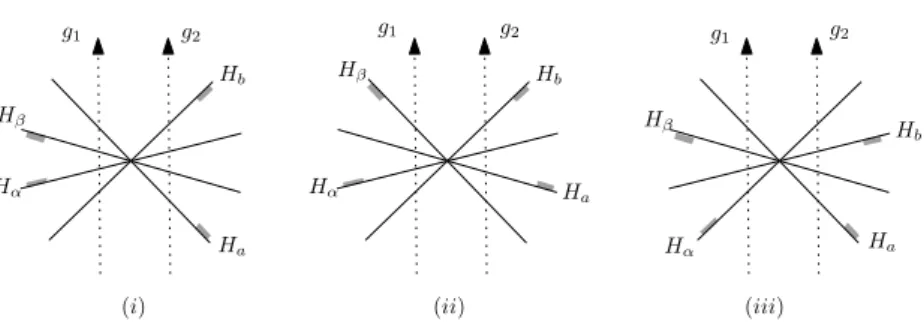
Hβ before entering Hα. Assume first that no two elements in {a, b, α, β} are
equal and consider the arrangement of {Ha, Hb, Hα, Hβ}; up to exchanging the
roles of g1 and g2, we are in one of the situations (i)–(iii) depicted in Figure 2.
In each case, we give an unordered triple of indices whose halfplanes have outer normals that positively span the plane (or, equivalently, intersect in exactly the origin):
In situation (i), the triple is (a, α, β) if a < α and (α, β, b) otherwise,
In situation (ii), the triple is (a, β, b) if a < β and (α, β, b) otherwise,
1
The necessary condition is actually not used in this paper, and only included for com-pleteness
2The vectors
{v1, . . . , vk} positively span the plane if any vector in R2can be written as a
linear combination of the viwith non-negative coefficients.
Lower Bounds for Pinning Lines by Balls 7
In situation (iii), the triple is (a, α, β) if a < α and (α, a, b) otherwise.
Hb g1 g2 Ha Hα Hβ (ii) (iii) g1 g2 Ha Hb Hβ Hα (i) Ha g1 g2 Hb Hα Hβ
Figure 2: The three possible situations for Ha, Hb, Hα and Hβ.
The smallest element must belong to {a, α} and the largest to {b, β}. Since g1 and g2 enters (resp. exit) Ha and Hα (resp. Hb and Hβ), it follows that
u makes a negative (resp. positive) dot product with the outer normal of the halfplane with lowest (resp. highest) index; this implies the condition.
Consider now the case where {a, α, b, β} are not all distinct. Since g2 exits
Hbafter entering Ha, at least three elements of {a, b, α, β} are pairwise distinct;
for the same reasons as above, this triple of indices satisfies the condition. Lemma 4. Anyσ5-pattern is a pinning pattern.
Proof. There are four triples of indices of outer normals in a σ5-pattern that
positively span the plane: {1, 2, 3}, {1, 3, 5}, {2, 3, 4} and {3, 4, 5}. Figure 3 shows, for each triple, the interval of directions that enter the first and exit the last member. The union of these (open) intervals covers S1
. By Lemma 3, such a pattern is a pinning pattern.
H1 H3 H5 H 2 H4 123 13 5 23 4 345
Figure 3: A σ5-pattern satisfies the condition of Lemma 3.
Combining Lemmas 2 and 4 we obtain:
Theorem 3. There exist sequences of five disjoint congruent balls in R3
that are stable pinnings.
8 Cheong & Goaoc & Holmsen
Higher dimensions. We now show the existence of stable pinnings by finite families of disjoint balls in arbitrary dimension.
Theorem 4. For any d ≥ 2, there exists a stable pinning of a line by finitely many disjoint congruent balls in Rd.
Proof. Let ℓ be the xd-axis in Rd and let Γ be the space of all three-dimensional
flats containing ℓ. The natural homeomorphism between Γ and the space of two-dimensional linear subspaces of Rd−1implies that Γ is compact.
For every T ∈ Γ we can construct a quintuple QT of disjoint balls in Rd
tangent to ℓ such that their restriction to T projects along ℓ to a σ5-pattern.
By construction, QT pins ℓ in T . By continuity, there exists a neighborhood NT
of T in Γ such that QT pins ℓ in any T′∈ NT. The union of all NT covers Γ.
Since Γ is compact, there exists a finite sub-family {T1, . . . , Tn} such that the
union of the NTi cover Γ. Let C denote the union of the QTi.
By construction, C is a finite collection of balls such that the intersection of C with any 3-flat T ∈ Γ is a stable pinning of ℓ in T . Let ε > 0 be such that any collection C′ obtained by perturbing C by at most ε remains a pinning of ℓ in
each T ∈ Γ. If such a perturbation C′ of C does not pin ℓ then there is another
transversal ℓ′ of C′ in Rd with the same order. There is a three-dimensional
affine subspace T containing both ℓ and ℓ′. Since the set of line transversals
with a fixed ordering on family of disjoint balls is connected [2], this implies that ℓ is not pinned by C′∩ T in T , and since T ∈ Γ this is a contradiction. Thus,
any such perturbation C′ pins ℓ in Rd, implying that C is a stable pinning.
Finally, we observe that we can replace a ball B ∈ C touching ℓ in point p by moving the center of B on the segment towards p. Since this does not change the halfplane pattern in the projection, C remains a stable pinning, and so we can choose C to consist of pairwise disjoint congruent balls.
By further shrinking the balls, we could even enforce that any two are sep-arated by a hyperplane orthogonal to ℓ.
3
The size of stable pinnings
In this section, we will show that families of k < 2d − 1 balls cannot be stable pinnings of a line in Rd. Instead of balls, we will work with simpler objects
we call screens (half-hyperplanes orthogonal to the line to be pinned), and the lower bound we obtain will carry over to balls.
Screens and lines. Let ℓ be the positively oriented xd-axis in Rd. For λ ∈ R
and direction vector n ∈ Sd−2, consider the set
S(λ, n) := {(x, λ) ∈ Rd| x ∈ Rd−1, hn, xi ≤ 0},
where the notation (a, b) denotes a vector whose coordinates are obtained as the concatenation of the coordinates of the vectors a and b.
We call S(λ, n) a screen. A screen is a (d − 1)-dimensional halfspace of a hyperplane orthogonal to ℓ; the screen S(λ, n) is tangent to ℓ in the point (0, λ). We identify S = R × Sd−2 with the space of all possible screens.
Lower Bounds for Pinning Lines by Balls 9
Consider now the space L of lines not orthogonal to ℓ. Any line in L must intersect the planes xd= 0 and xd= 1. We identify L with R2d−2by identifying
the line meeting the points (u0, 0) and (u1, 1) with the point (u0, u1) ∈ R 2d−2.
For (λ, n) ∈ S, let H(λ, n) ⊂ L denote the set of those lines g ∈ L that intersect S(λ, n).
Lemma 5. For(λ, n) ∈ S, the set H(λ, n) is the halfspace of R2d−2 through
the origin with outer normal Φ(λ, n) := ((1 − λ)n, λn).
Proof. The line (u0, u1) ∈ L intersects the hyperplane xd = λ in the point
((1 − λ)u0+ λu1, λ). This point lies in S(λ, n) if and only if
hn, (1 − λ)u0+ λu1i ≤ 0,
and since
hn, (1 − λ)u0+ λu1i = h(1 − λ)n, u0i + hλn, u1i = h((1 − λ)n, λn), (u0, u1)i
the lemma follows.
Let N ⊂ R2d−2 denote the set of vectors Φ(λ, n), for some (λ, n) ∈ S.
The function Φ is a bicontinuous bijection from S to N, and so S and N are homeomorphic. In particular, N is locally homeomorphic to Rd−1, and so N is
a (d − 1)-dimensional manifold in R2d−2. We need to argue that it is nowhere
contained in a hyperplane, that is, that there is no neighborhood of a point in N that is contained in a hyperplane.
Lemma 6. N is nowhere locally contained in a hyperplane of L.
Proof. We assume, by way of contradiction, that N is contained in a hyperplane in a neighborhood of the point Φ(λ, n) = ((1 − λ)n, λn). Let this hyperplane be h(a, b), (u0, u1))i = c, where a, b ∈ Rd−1 and c ∈ R. This means that for ε ∈ R
sufficiently small and η ∈ Sd−2sufficiently close to n,
h(a, b), ((1 − λ − ε)η, (λ + ε)η)i = c. Separating out the terms with ε, we obtain
h(a, b), ((1 − λ)η, ληi + εhb − a, ηi = c.
Since this holds for any ε small enough, we must have hb − a, ηi = 0. Since no neighborhood on Sd−2 can lie in a hyperplane, it follows that b = a. We thus
have
ha, (1 − λ)η + ληi = c,
which implies ha, ηi = c. Again, no neighborhood on Sd−2lies in a hyperplane,
a contradiction.
Strict transversals to screens. Given a family F ⊂ S of k screens, a line g ∈ L is a strict transversal of F if it meets the relative interior of each screen. Recall that the line ℓ meets every screen of F , but since ℓ only touches their boundary, it is not a strict transversal. If g ∈ L is a strict transversal of F , then any line g′∈ L sufficiently close to g must also be a strict transversal. Indeed,
F has a strict transversal if and only if the intersection of the halfspaces H(λ, n) for S(λ, n) ∈ F has non-empty interior.
10 Cheong & Goaoc & Holmsen
Lemma 7. LetF be a family of k ≤ 2d − 2 screens. If F has no strict transver-sal, then thek normals Φ(λ, n), for (λ, n) ∈ F, are linearly dependent.
Proof. If F has no strict transversal, then the intersection of the halfspaces H(λ, n) for (λ, n) ∈ F has empty interior. However, the intersection of k ≤ 2d − 2 halfspaces through the origin in R2d−2 can have empty interior only if
the outward normals of the halfspaces are linearly dependent. It follows that the normals Φ(λ, n), for (λ, n) ∈ F, are linearly dependent.
We can represent3
a family of m screens as a point in Sm. Let X
m ⊂ Sm
be the space of those families F of m screens that have a subfamily F′ ⊆ F of
at most 2d − 2 screens with no strict transversal. Lemma 8. Xm⊂ Sm has empty interior.
Proof. Let F be a family in Xm. We perturb F , element by element, into a
family F′ with no subset of at most 2d − 2 screens with linearly dependent
vectors. The first element of F need not be changed. Assume we already perturbed the first i elements of F . Every subset of at most 2d − 3 among these i already fixed normals span a linear subspace of L. By Lemma 6, N lies nowhere locally inside a hyperplane or, since it is a d − 1-manifold, locally inside a finite union of hyperplanes. Thus we can choose the (i + 1)thelement outside
of each of these subspaces, and by induction obtain the desired perturbation of F.
A necessary condition for pinning Consider now a collection C of balls tangent to the line ℓ (still assumed to be the xd-axis). If (p, λ) is the center of
ball B ∈ C, we consider the screen S(B) = S(λ, −p/||p||). This screen touches ℓ in the same point that B does, and its boundary is contained in the tangent hyperplane to B at this point.
Lemma 9. Let C be a collection of balls tangent to ℓ. If the family of screens F := {S(B) | B ∈ C} has a strict transversal, then C does not pin ℓ.
Proof. If F has a strict transversal, then the halfspaces H(λ, n) for (λ, n) ∈ F intersect with non-empty interior. This implies that there exists a segment τ in L with one endpoint at the origin and which is, except for that point, contained in the interior of each halfspace H(λ, n).
Consider moving a line g ∈ L along τ . The trace of g on the hyperplane xd= λ is a straight segment. Since τ lies in the interior of H(λ, n), this trace lies
in the relative interior of S(λ, n). But this implies that if we make τ sufficiently short, the trace also lies in the interior of each ball B. It is therefore possible to move a line g, starting with g = ℓ, while intersecting each ball B. It follows that C is not a pinning of ℓ.
We now obtain the desired lower bound on the size of stable pinning config-urations of balls:
Theorem 5. Any pinning of a line byk ≤ 2d − 2 balls in Rd is instable.
3Note that this is not a bijection as not every point in Sm represents a set of distinct
screens.
Lower Bounds for Pinning Lines by Balls 11
Proof. Let C be a pinning of ℓ. Let F := {S(B) | B ∈ C} be the corresponding family of screens. By Lemma 9, F does not have a strict transversal, and so F ∈ Xk. By Lemma 8, Xk has empty interior, and so we can find F′ ∈
Sk\ Xk arbitrarily close to F . Since F′ can be realized as the set of screens of
a perturbation of C, the theorem follows.
4
Consequences
Lower bound for minimal pinnings. Theorem 2 follows immediately from Theorem 4 and the following lemma:
Lemma 10. IfC is a stable pinning of a line by finitely many balls in Rd
, then there exist minimal pinnings ofℓ by 2d − 1 balls arbitrarily close to some subset of C of size 2d − 1.
Proof. Let m denote the number of balls in C, and let F := {S(B) | B ∈ C} be the corresponding family of screens. Since Xm⊂ Smhas empty interior, we can
find a family F′⊂ Sm\X
marbitrarily close to F . Let C′be the correspondingly
perturbed family of balls.
By definition of Xm and Lemma 9, no subfamily of at most 2d − 2 balls of
C′ is a pinning. However, any minimal pinning of a line by disjoint balls in Rd
has size at most 2d − 1 [2], so there must be a subfamily C′′⊂ C′ of 2d − 1 balls
that is minimally pinning.
Helly number for transversals to disjoint unit balls. Hadwiger’s transver-sal theorem [9] can be extended to families of disjoint balls in arbitrary dimen-sion [1, 2]: a family F of disjoint balls in Rd has a line transversal if and only
if there is an ordering on F such that every hd members have a line transversal
consistent with that ordering. The smallest such constant hd is at most 2d and
at least the size of the largest minimal pinning family of disjoint balls in Rd;
Theorem 2 implies that this number is 2d − 1 or 2d. Similarly, we obtain that 2d − 1 is a lower bound for the Helly number of the generalization of Helly’s theorem to sets of transversals to disjoint (unit) balls.
Proof of Theorem 1. The proof of Theorem 4 shows that there exists a stable pinning of a line ℓ by finitely many disjoint unit balls in Rd such that any two
balls can be separated by a hyperplane orthogonal to ℓ. Lemma 10 now implies that there exists a minimal pinning F of a line ℓ by 2d − 1 disjoint unit balls in Rd such that any line intersecting a subset of the balls does so in an order
consistent with the geometric permutation induced by ℓ. Since F is a pinning of ℓ by disjoint balls, F has no other transversal consistent with the geometric permutation induced by ℓ. The statement then follows in the case of open balls. Reducing the radii of the balls slightly gives a similar construction for closed balls.
5
Final remarks
Our lower bound construction is hardly effective, given its use of the compact-ness of the set of 3-spaces through a fixed line; actually constructing minimal
12 Cheong & Goaoc & Holmsen
pinnings of size 2d − 1 (or any given size) seems challenging. Another natural question is whether any of the results obtained for pinning lines by disjoint balls extend to more general pinnings, for instance pinnings of lines by (disjoint) con-vex sets. In that direction, little is known, not even whether the size of minimal pinnings is bounded by a function of d.
References
[1] C. Borcea, X. Goaoc, and S. Petitjean. Line transversals to disjoint balls. Discrete & Computational Geometry, 1-3:158–173, 2008.
[2] O. Cheong, X. Goaoc, A. Holmsen, and S. Petitjean. Hadwiger and Helly-type theorems for disjoint unit spheres. Discrete & Computational Geom-etry, 1-3:194–212, 2008.
[3] L. Danzer. ¨Uber ein Problem aus der kombinatorischen Geometrie. Archiv der Mathematik, 1957.
[4] L. Danzer, B. Gr¨unbaum, and V. Klee. Helly’s theorem and its relatives. In V. Klee, editor, Convexity, Proc. of Symposia in Pure Math., pages 101–180. Amer. Math. Soc., 1963.
[5] J. Eckhoff. Helly, Radon and Caratheodory type theorems. In Jacob E. Goodman and Joseph O’Rourke, editors, Handbook of Convex Geometry, pages 389–448. North Holland, 1993.
[6] X. Goaoc. Some discrete properties of the space of line transversals to disjoint balls. In Non-Linear Computational Geometry, volume 151, pages 51–84. Springer, 2009.
[7] J. E. Goodman, R. Pollack, and R. Wenger. Geometric transversal theory. In J. Pach, editor, New Trends in Discrete and Computational Geome-try, volume 10 of Algorithms and Combinatorics, pages 163–198. Springer-Verlag, Heidelberg, Germany, 1993.
[8] B. Gr¨unbaum. On common transversals. Archiv der Mathematik, 9:465– 469, 1958.
[9] H. Hadwiger. Uber eibereiche mit gemeinsamer treffgeraden. Portugal¨ Math., 6:23–29, 1957.
[10] A. Holmsen and J. Matouˇsek. No Helly theorem for stabbing translates by lines in Rd. Discrete & Computational Geometry, 31:405–410, 2004.
[11] M. Katchalski. A conjecture of Gr¨unbaum on common transversals. Math. Scand., 59(2):192–198, 1986.
[12] H. Tverberg. Proof of Gr¨unbaum’s conjecture on common transversals for translates. Discrete & Computational Geometry, 4:191–203, 1989.
[13] R. Wenger. Helly-type theorems and geometric transversals. In Jacob E. Goodman and Joseph O’Rourke, editors, Handbook of Discrete & Compu-tational Geometry, chapter 4, pages 73–96. CRC Press LLC, Boca Raton, FL, 2nd edition, 2004.
Centre de recherche INRIA Nancy – Grand Est LORIA, Technopôle de Nancy-Brabois - Campus scientifique
615, rue du Jardin Botanique - BP 101 - 54602 Villers-lès-Nancy Cedex (France)
Centre de recherche INRIA Bordeaux – Sud Ouest : Domaine Universitaire - 351, cours de la Libération - 33405 Talence Cedex Centre de recherche INRIA Grenoble – Rhône-Alpes : 655, avenue de l’Europe - 38334 Montbonnot Saint-Ismier Centre de recherche INRIA Lille – Nord Europe : Parc Scientifique de la Haute Borne - 40, avenue Halley - 59650 Villeneuve d’Ascq
Centre de recherche INRIA Paris – Rocquencourt : Domaine de Voluceau - Rocquencourt - BP 105 - 78153 Le Chesnay Cedex Centre de recherche INRIA Rennes – Bretagne Atlantique : IRISA, Campus universitaire de Beaulieu - 35042 Rennes Cedex Centre de recherche INRIA Saclay – Île-de-France : Parc Orsay Université - ZAC des Vignes : 4, rue Jacques Monod - 91893 Orsay Cedex
Centre de recherche INRIA Sophia Antipolis – Méditerranée : 2004, route des Lucioles - BP 93 - 06902 Sophia Antipolis Cedex
Éditeur
INRIA - Domaine de Voluceau - Rocquencourt, BP 105 - 78153 Le Chesnay Cedex (France)
http://www.inria.fr