HAL Id: in2p3-00024305
http://hal.in2p3.fr/in2p3-00024305
Submitted on 21 Dec 2006HAL is a multi-disciplinary open access
archive for the deposit and dissemination of sci-entific research documents, whether they are pub-lished or not. The documents may come from
L’archive ouverte pluridisciplinaire HAL, est destinée au dépôt et à la diffusion de documents scientifiques de niveau recherche, publiés ou non, émanant des établissements d’enseignement et de
Important pickup coupling effect on
8He(p, p) elastic
scattering
F. Skaza, N. Keeley, V. Lapoux, N. Alamanos, F. Auger, D. Beaumel, E.
Becheva, Y. Blumenfeld, F. Delaunay, A. Drouart, et al.
To cite this version:
F. Skaza, N. Keeley, V. Lapoux, N. Alamanos, F. Auger, et al.. Important pickup cou-pling effect on 8He(p, p) elastic scattering. Physics Letters B, Elsevier, 2005, 619, pp.82-87.
Important pickup coupling effect on
8He(p,p)
elastic scattering
F. Skaza
a, N. Keeley
a, V. Lapoux
a,1,2,
N. Alamanos
a,
F. Auger
a, D. Beaumel
b, E. Becheva
b, Y. Blumenfeld
b,
F. Delaunay
b, A. Drouart
a, A. Gillibert
a, L. Giot
c,
K.W. Kemper
d, R.S. Mackintosh
e, L. Nalpas
a, A. Pakou
f,
E.C. Pollacco
a, R. Raabe
a,3, P. Roussel-Chomaz
c,
J.-A. Scarpaci
b, J-L. Sida
a,4, S. Stepantsov
g, R. Wolski
g,haCEA-Saclay, DSM/DAPNIA/SPhN, F-91191 Gif-sur-Yvette, France bInstitut de Physique Nucl´eaire, IN
2P3-CNRS, F-91406 Orsay, France cGANIL, Bld. Henri Becquerel, BP 5027, F-14021 Caen Cedex, France
dDepartment of Physics, Florida State University, Tallahassee, Florida
32306-4350, USA
eDepartment of Physics and Astronomy, The Open University, Milton Keynes,
MK7 6AA, UK
fDepartment of Physics, University of Ioannina, 45110 Ioannina, Greece gFlerov Laboratory of Nuclear Reactions, JINR, Dubna, RU-141980 Russia hThe Henryk Niewodnicza´nski Institute of Nuclear Physics, PL-31342 Krak´ow,
Poland
Abstract
The8He(p,p) and (p,d) reactions were measured in inverse kinematics at 15.7 A·MeV
and analyzed within the coupled reaction channels framework, the (p,d) cross sec-tion being particularly large. We find that coupling to8He(p,d) pickup has a
pro-found effect on the8He(p,p) elastic scattering, and that these strong coupling effects
should be included in analyses of proton elastic and inelastic scattering. Through its modification of the elastic scattering wave functions this coupling will strongly affect the extraction of spectroscopic information such as the relationship between neutron and proton nuclear deformations, with important consequences for our un-derstanding of the structure of exotic nuclei.
Key words: 8He(p,p), (p,d), coupled reaction channels calculations, dynamic
polarization potential
PACS: 25.60.Bx, 25.60.Je, 24.10.Eq
Strong coupling effects in low-energy nuclear reactions are well established for heavy-ion collisions, and lead to important modifications of the effective nucleus-nucleus interaction. The16O + 208Pb system is a well documented
ex-ample, with coupled reaction channels (CRC) calculations showing how inelas-tic scattering and transfer channels generate a dynamic polarization potential (DPP) with a substantial real part [1,2], having important consequences for elastic scattering and fusion.
Important effects on (p,p) elastic scattering due to coupling to (p,d) pickup have been demonstrated for stable nuclei [3–5]. The effect is particularly large for light nuclei [4], reducing with increasing target mass and incident pro-ton energy, although remaining significant for 50 MeV propro-tons incident on
64Zn. Pickup coupling was also found to significantly affect inelastic scattering,
mainly through the modification of the elastic scattering wave functions [3], leading to significant changes in the extracted deformation parameters. How-ever, the possibility of such strong coupling effects has come to be ignored in analyses of proton elastic and inelastic scattering, although a recent study of
6He(p,p) postulated the existence of a repulsive real DPP due to breakup that
gave improved agreement with the data [6], subsequently further investigated through coupled discretized continuum channels (CDCC) calculations [7].
We report here a measurement of8He(p,p) scattering at 15.7 A·MeV incident
energy. Data for8He(p,d) populating the 3/2− ground state resonance of the
unbound7He measured in the same experiment have been previously reported
[8], and the cross section is found to be very large. This should therefore be a case where (p,d) coupling will have an important influence on the8He(p,p)
scattering. We present CRC calculations including8He(p,d) pickup to the 3/2−
ground state of7He which demonstrate the profound influence of this coupling
on the elastic scattering and, hence, on the nucleon-nucleus interaction in a way that falls outside the scope of local-density folding models.
The8He beam was produced by the ISOL technique and accelerated to 15.7A·MeV
by the CIME cyclotron at the SPIRAL facility [9], with no contaminants. The maximum (average) intensity in the experiment was 14000 (5000) p/s. The proton target was a 8.25 mg/cm2 thick polypropylene (CH
2)n foil. The
de-tection system consisted of the MUST array [10] to detect the light charged particles, a plastic wall for the detection of the projectile-like fragment, and two beam tracking detectors (CATS) upstream of the target. The position sensitive CATS detectors [11] were used to improve the definition of the beam position and incident angle on target. They provided particle by particle
po-1 Corresponding author 2 E-mail: [email protected]
3 Present address: IKS, University of Leuven, B-3001 Leuven, Belgium
4 Present address: CEA DIF/DPTA/SPN, B.P. 12, F-91680 Bruy`eres-le-Chˆatel,
sition and time tracking of the beam.
The MUST array consists of eight three-stage telescopes, each 6 × 6 cm2.
The first stage is a 300 µm-thick double-sided Si-strip detector which provides horizontal and vertical position, time-of-flight (TOF) with respect to the beam detectors, and energy loss of the recoil proton. The second stage is a 3 mm-thick Si(Li) giving the energy for protons up to 25.4 MeV, and the third stage a 1.5 cm-thick CsI allowing the detection of protons up to 75 MeV in energy. The array was assembled in a wall configuration located 15 cm from the target. The wall was placed in two positions, covering the angular range between 30◦–90◦ (lab.). At this distance, the 1 mm wide strips result in an
angular resolution of 0.4◦ (lab.) for the detection of the scattered particle.
For the less energetic recoil particles stopped in the first stage, e.g. protons with energies below 6 MeV, mass identification was obtained using the energy versus TOF technique. Particles were identified in the correlation plot of their energy loss, ∆E, in the Si-strip detector versus their TOF. The TOF was measured between the Si-stage and the start signal given by the passage of the incident particle through the second CATS detector. Protons from 6 to 25 MeV were unambiguously identified by the ∆E-E method using energy loss measurements in the Si Strip and the Si(Li) detectors. The energy resolution obtained varied between 600 keV and 1 MeV, depending on target thickness and the reaction kinematics. Events with a p or d in coincidence with the heavy ejectile, plus a particle detected in the two CATS detectors to provide the incident beam trajectory, were retained to build the kinematical spectra and subsequently extract the (p,p) and (p,d) angular distributions.
The elastic data extend from 20◦–110◦, and the transfer data from 27◦–85◦,
in their respective center of mass (c.m.) systems. To measure angular distri-butions from 40◦ down to 20◦ (c.m.) where the energy of the recoiling protons
decreases to 1.5 MeV, a 1.48 mg/cm2 polypropylene target was used. To
ob-tain good statistics at large angles, from 40◦ to 110◦ (c.m.), a 8.25 mg/cm2
target was used. The overall values for the statistical plus systematic errors in the angular distributions arise from the detection efficiency and reconstruc-tion process, which gives ± 5 % uncertainty, including the effect of background subtraction (± 2 %); the target thickness (± 5%); and the efficiency in the detection of the incident particles (± 2%). This results in a total uncertainty of ≃ ±7.5 % in the normalization of the data for elastic scattering and transfer to the 7He ground state.
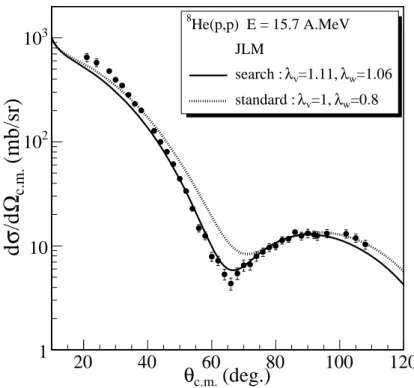
In Fig. 1 the measured elastic scattering angular distribution is compared to optical model calculations performed within the framework of the micro-scopic nucleon-nucleus JLM potential [12], using a no-core shell model 8He
density [13]. The JLM potential is complex and the data for well-bound nu-clei were found to be well reproduced with slight variations of the real and
(deg.)
c.m.θ
20 40 60 80 100 120(mb/sr)
c.m.Ω
/d
σ
d
1 10 2 10 3 10 He(p,p) E = 15.7 A.MeV 8 JLM =1.06 w λ =1.11, v λ search : =0.8 w λ =1, v λ standard :Fig. 1. Optical model calculations using the JLM potential compared to the8He+p
elastic scattering data. See text for details.
imaginary parts, V and W . The required normalization factors, λV and λW,
re-spectively, are found to be close to unity. For well-bound light nuclei (A ≤ 20), the only modification required is λW = 0.8 [14], adopted as a “standard”
nor-malization.
The standard JLM (dotted curve) does not reproduce the data. Best agreement was obtained with λV = 1.11, λW = 1.06 (solid curve), but the data at
angles smaller than 40◦ (c.m.) are significantly underpredicted. It should be
emphasized that simply modeling the DPP by a renormalization of the JLM potential is unable to reproduce the whole angular range of the data.
Clearly, we need to include explicitly in our calculations the effect of coupling to other reaction channels. To investigate the effect of coupling to (p,d) pickup on8He(p,p) scattering a series of CRC calculations was carried out using the
code FRESCO [15]. The JLM prescription was retained for the p+8He optical
potential. We should include in the coupling scheme, a priori, the following reactions: elastic, inelastic scattering and transfer reactions to the ground or excited states of the nuclei produced in the exit channel, either in bound or res-onant states. But this requires the corresponding inputs, transition strengths to the excited states and spectroscopic factors. To simplify, we limitate the cou-pling scheme to the main channels which may contribute significantly in terms of angular distributions in the domain treated in our analysis. The experimen-tal observations can help us in determining which states should be included
in the coupling scheme, or not. In the 8He(p,p’) experiment at 72 A·MeV
re-ported in Ref. [16], the first excited state of8He was found to be a 2+ located
at 3.6 MeV. The cross sections measured between 20◦ to 50◦(c.m.) were found
to lie below 1 mb/sr; a weak excitation of the 2+ 8He was found [17]. In our
experiment, as mentioned in Ref. [8], inelastic (p,p’) to the 2+ excited state
was also selected. These cross sections at 15.7 A·MeV will be presented and analyzed in a forthcoming article. Compared to the angular distributions of the (p,d) transfer reaction, they were found to be twice up to 5 times lower in the angular range from 20◦ to 80◦ (c.m.). We also face the problem of the exit
channel of the (p,d) reaction. It is beyond the scope of present CDCC calcu-lations to include within the coupling scheme the continuum of the unbound
7He states and calculate the transfer reaction. The best calculation which can
be performed, at the present stage, is to consider the deuteron states within the continuum. In Ref. [18], Halderson showed that the recoil corrected con-tinuum shell model predictions support a low-lying 1/2− excited state for7He
at 1 MeV, as found by Meister et al. [19]. Our recent results [8] also indicated this low-lying excited state of7He; it is weakly excited, and roughly the cross
sections are 10 times lower than the (p,d)7He
gs ones. In Ref. [20], at 50A·MeV,
a resonance at 2.9 MeV was observed in 7He, the cross sections (from 5◦ to
15◦ (c.m.)) were found to be 5 times less than the (p,d)7He
gs. Consequently,
in our analysis, we did not explicitly include the coupling to the 7He excited
states and we considered (p,p) and (p,d)7He
gs as the main coupled reactions.
The CDCC formalism was employed in the exit channel, as described in Ref. [21]. The bare d+7He potential was of Watanabe type [22], the n and
p plus 7He optical potentials being calculated using the global
parametriza-tion of Koning and Delaroche [23]. Couplings to deuteron breakup with the neutron and proton in relative S and D states were explicitly included using the CDCC formalism and the coupling scheme presented in Fig. 2.
For the transfer step, the neutron-proton overlap was calculated using the Reid soft-core potential [24], including the D-state component of the deuteron ground state. The same interaction was used to calculate the exit channel deuteron potentials. The n+7He binding potential was a Woods-Saxon well
with the “standard” geometry of R0 = 1.25 × A1/3 fm, a = 0.65 fm, the well
depth being adjusted to give the correct binding energy. The spin-orbit term was omitted as it has no effect on the calculated cross section. Transfers to unbound states of the “deuteron” were included in addition to that to the deuteron ground state. The full complex remnant term and non-orthogonality correction were also included.
There were three adjustable parameters, the real and imaginary normaliza-tions of the JLM entrance channel potential and the spectroscopic factor for the 8He(0+)/7He(3/2−) overlap. All three were adjusted to obtain the
opti-mum simultaneous agreement with the elastic scattering and transfer data.
He p
8He d
7l=0 l=2
Fig. 2. Coupling scheme used in the CRC calculations.
The normalization of the (real) JLM spin-orbit potential was constrained to be the same as that of the real central potential.
In Fig. 3 we present the calculated angular distributions for 8He(p,p) and 8He(p,d) compared to the data. The results shown are for the final calculation
with JLM normalization factors λV = 1.05, λW = 0.2. A 8He(0+)/7He(3/2−)
spectroscopic factor of C2S = 3.3 gave the best agreement with the data,
slightly smaller than the value (4.1±1.3) obtained in the CCBA analysis of ref. [8], but within the quoted uncertainty.
Excellent agreement between the calculated and measured elastic scattering is obtained over the whole angular range, which was not possible in the optical model calculations shown in Fig. 1. The very large effect of the (p,d) coupling on the elastic scattering is evident. Note that in the full CRC calculation the pickup coupling generates a considerable fraction of the total absorption; only a small component of the JLM imaginary potential is retained (λW = 0.2),
which may be mostly attributed to compound nucleus effects. For comparison, the no-coupling calculation using the bare JLM potential with λV = 1.05,
λW = 0.2 is also shown in Fig. 3.
The agreement between the calculated and measured (p,d) angular distribu-tions is less good, the calculadistribu-tions overpredicting the data for angles greater than 50◦ in the c.m. system. This is probably due to the use of global
po-tentials as a basis for the exit channel bare potential and could be improved by tuning the potential parameters, although we have chosen not to do so to show the quality of agreement that may be obtained with such potentials.
The large change in the elastic scattering induced by the pickup coupling may be represented as a substantial DPP. To obtain the local and L-independent representation of this DPP, we followed the procedure which was used to ob-tain the DPP for the6He+p system in Ref. [7]. The elastic scattering S-matrix
is generated by the full CRC calculations (including coupling processes), and the total local optical potential is obtained by subjecting this S-matrix to an inversion procedure Slj → V (r). The inversion is carried out using the
20
40
60
80
100 120
θ
c.m.(deg)
10
010
110
210
010
110
210
3d
σ
/d
Ω
(mb/sr)
No coupling
CRC (full)
CRC (nono)
Fig. 3. 8He(p,p) (upper panel) and 8He(p,d) (lower panel) calculations compared
to the data. The solid curves denote the full CRC calculation with λV = 1.05,
λW = 0.2 and the dotted curve indicates the no-coupling calculation with the same
bare potential. The dashed curves denote the result of a CRC calculation omitting the non-orthogonality correction.
iterative-perturbative inversion method of Kukulin and Mackintosh [25] which can give very reliable potentials, including orbit potentials for the spin-half case, for all relevant radii. The bare diagonal proton potential (i.e without coupling) of the CRC calculation is then subtracted from V (r) and the remain-der is identified as the DPP. The result is shown in Fig. 4 for two cases, the solid line being the DPP in the case of the full CRC calculation and the dashed line the DPP from the CRC calculation with the non-orthogonality correction omitted. Previous calculations [3–5,26] omitted the latter, but the qualitative finding that pickup leads to substantial repulsion as well as absorption is con-firmed. We find that the non-orthogonality correction changes the shape of the real DPP in particular, so that for a 8He target it is largely in the
nu-clear center. For this reason, the effect on the real central volume integral, as
-5 0 5 10
Real central
CRC
NONO
-5 0 5Imag central
-0.5 0Real spin-orbit
-3 -2 -1 0 0 1 2 3 4 5 6 7 8Im spin-orbit
r (fm)
potential (MeV)
Fig. 4. DPP generated by the8He(p,d) coupling obtained as explained in the text.
presented in Table 1, is just 7%.
Other features of the DPP are a significant imaginary spin-orbit term and an emissive imaginary central term at the nuclear center. Emissivity at the nu-clear center often occurs in local representations of a fundamentally non-local and, in principle, L-dependent potential [25]. This emissivity and the other characteristics of the radial form of the DPP (accounting for the better fit to elastic scattering than renormalized JLM potentials), can be traced to the fact that the contribution of the pickup coupling to the effective nucleon-nucleus potential lies outside the scope of what could be described within the frame-work of folding models based on an underlying local-density approximation. We therefore conclude that the inclusion of pickup coupling is essential for a
JR hr2i1/2R JI hr2i1/2I JSOR JSOI
OM 704.14 3.092 55.37 3.336 26.60 0.005 CRC 653.94 2.938 307.47 4.138 40.27 1.25 NONO 571.28 2.840 252.62 4.360 33.15 6.55 Table 1
Volume integrals per nucleon pair/(MeV fm3), and rms radii/fm of the bare
poten-tial (OM) and the potenpoten-tials found by inversion for the full CRC calculation and for the CRC calculation in which the non-orthogonality term was omitted (NONO).
complete understanding of proton scattering.
The modification of the elastic scattering wave functions by the pickup cou-pling also has important implications for proton inelastic scattering and the information that may be drawn therefrom. If one follows the usual conventions and renormalizes the transition potentials by the same factors as the entrance channel optical potential, be they of phenomenological form or calculated mi-croscopically from theoretical transition densities, the effect on the level of agreement with data will be important. A full investigation of the magnitude of this effect for the L=2 8He(p,p′) transition to the 2+ first excited state
is left for a later comprehensive article, but test calculations using collective model form-factors show a decrease of 14 % in the nuclear deformation length extracted from a CRC calculation compared to that obtained from a DWBA calculation.
To summarize, we have shown that for a particular case, 8He, the explicit
inclusion of (p,d) coupling has a profound influence on the calculated elastic scattering. Combined with the results of previous studies for stable nuclei [3– 5,26], we may infer that this effect is probably general throughout the chart of the nuclides. Evidently, an investigation of the systematics of the effect to determine under what circumstances it is most pronounced would be of great interest. However, it appears necessary to measure the (p,d) reaction and include this effect in analyses of proton scattering for radioactive beams if correct inferences are to be drawn. Through its modification of the elastic scattering wave function the pickup coupling will also have an important influ-ence on the calculated inelastic proton scattering, with all that this implies for the extraction of information such as Mn/Mpratios from data for this process.
References
[1] I.J. Thompson et al., Nucl. Phys. A 505 (1989) 84.
[2] S.G. Cooper and R.S. Mackintosh, Nucl. Phys. A 513 (1990) 373.
[3] R.S. Mackintosh, Nucl. Phys. A 209 (1973) 91. [4] R.S. Mackintosh, Nucl. Phys. A 230 (1974) 195.
[5] R.S. Mackintosh, A.A. Ioannides, and I.J. Thompson, Phys. Lett. B 178 (1986) 1.
[6] V. Lapoux et al., Phys. Lett. B 517 (2001) 18.
[7] R.S. Mackintosh and K. Rusek, Phys. Rev. C 67 (2003) 034607. [8] F. Skaza et al., submitted to Phys. Rev. C.
[9] A.C. Villari et al., Nucl. Phys. A 693 (2001) 465.
[10] Y. Blumenfeld et al., Nucl. Instrum. Methods A 421 (1999) 471. [11] S. Ottini et al., Nucl. Instrum. Methods A 431 (1999) 476.
[12] J.-P. Jeukenne, A. Lejeune, and C. Mahaux, Phys. Rev. C 16 (1977) 80. [13] P. Navr´atil and B.R. Barrett, Phys. Rev. C 57 (1998) 3119.
[14] J.S. Petler et al., Phys. Rev. C 32 (1985) 673. [15] I.J. Thompson, Comput. Phys. Rep. 7 (1988) 167. [16] A.A. Korsheninnikov et al., Phys. Lett. B 316 (1993) 38.
[17] L.V. Chulkov, C.A. Bertulani et A.A. Korsheninnikov, Nucl. Phys. A587 (1995) 291.
[18] D. Halderson, Phys. Rev. C 70, 041603 (2004). [19] M. Meister et al., Phys. Rev. Lett. 88, 102501 (2002).
[20] A.A. Korsheninnikov et al., Phys. Rev. Lett. 82, 3581 (1999).
[21] N. Keeley, N. Alamanos, and V. Lapoux, Phys. Rev. C 69 (2004) 064604. [22] S. Watanabe, Nucl. Phys. 8 (1958) 484.
[23] A.J. Koning and J.P. Delaroche, Nucl. Phys. A713 (2003) 231. [24] R.V. Reid, Jr., Ann. Phys. (N.Y.) 50 (1968) 441.
[25] V.I. Kukulin and R.S. Mackintosh, J. Phys. G: Nucl. Part. Phys. 30 (2004) R1. [26] S.G. Cooper, R.S. Mackintosh, and A.A. Ioannides, Nucl. Phys. A472 (1987)