Analysis of Japanese Software Business
by
Kenichiro Inada
Submitted to the System Design and Management Program in Partial Fulfillment of the Requirements for the Degree of
Master of Science in Engineering Management
at the
Massachusetts Institute of Technology June 2010
ARCHNES
MASSACHUSETTS INSTrtUTE OF TECHNOLOGYJUN 16
2010
LIBRARIES
@2010 Massachusetts Institute of Technology. All rights reserved.
,--7 . 712
Signature of Author
Kenichiro Inada System Design and Management Program June 2010
Certified by
Michael A. Cusumano Thesis Supervisor
(
MIT Sloan School of Management
C
1
on)f
Accepted by
-~&-y Patrick Hale
Director System Design and Management Program
Analysis of Japanese Software Business
by
Kenichiro Inada
Submitted to the System Design and Management Program in Partial Fulfillment of the Requirements for the Degree of
Master of Science in Engineering Management at the
Massachusetts Institute of Technology
Abstract
Today, our society is surrounded by information system, computers, and software. It is no exaggeration to say that our daily life depends on software and its function. Accordingly, the business of software has made miraculous growth in the last two decades and is playing a significant role in various industries. In accordance with the growing business needs for
effective software and information systems, various firms in various countries have entered the business of software seeking for prosperity. Some have succeeded, some have failed. What distinguishes these firms is its ability to manage and deliver quality products on demand, on time, at a low cost. To achieve such goal, software firms have thought out different methods and tools striving to establish its practice. Nevertheless, many software firms around the globe are struggling to satisfy its clients to achieve business success.
With no exception, Japanese software firms are facing difficulties of managing software projects. While its ability to deliver high quality product is well acknowledged among software industry, its high cost structure and schedule delays are thought of as serious problems. Moreover, some of the transitions in the industry are forcing Japanese software firms to seek new opportunities. Therefore, it is important for Japanese software firms to establish more productive ways of developing software products and effective business strategies.
Primal objective of this paper is to analyze the present conditions of Japanese software firms and to derive some recommendations which could enhance its current situation. It will
also include the discussion of software development practices in US and India firms to better understand strength and weaknesses of Japanese firms and capture some important concepts which can be applied to improve current practice.
Thesis Supervisor: Michael A. Cusumano
Acknowledgements
I would first like to thank my thesis supervisor, Professor Michael A. Cusumano, for supervising my thesis work and providing me warm support and advice throughout. Without his support, this work would not have been as complete nor satisfying. It has been an honor to work with him and will remain as one of my greatest experience of my study here at MIT.
I also would like to thank the SDM community for making my academic experience so fruitful and pleasant. Faculties involved in the SDM program, with abundant knowledge and experience,
have inspired me throughout my graduate study in the SDM program. Also staffs at SDM have
been extremely supportive and made me feel at home. Lastly, I am thankful to all my
classmates of the SDM'09 cohorts who have encouraged me and supported me throughout the program. Their presence has made the experience precious and the friendship we have built will remain as my personal asset for life.
Finally, I would like to thank my wife, Rumi, and my daughter Aoi. Despite the difficulty of adopting in a new environment, Rumi has always been beside me and have supported me.
Without her love and assistance, I could not have enjoyed the experience at SDM as much as I
did. Aoi who came to Boston when she was 3 months old is now 20 months old. Just watching her grow up has been one of my greatest pleasures. Her presence and warm smile has been the greatest source of my motivation.
Table of Contents
Chapter 1: Introduction... 7
1.1 Background ... 7
1.2 Research objective and m otivation ... 8
1.3 Overview ... 9
Chapter 2: Key Perspectives... 12
2.1 Custom ize software vs. Package Software... 12
2.2 Onshore developm ent vs. Offshore developm ent ... 15
2.3 W aterfall developm ent vs. Iterative developm ent... 16
2.4 Traditional application vs. W eb application ... 18
Chapter 3: Case Study - Japanese Firm ... 22
3.1 Characteristics of software developm ent at Japanese firm s... 22
3.2 Description of sam ple com pany... 24
3.2.1 Organization... 25
3.2.2 Com pany philosophy ... 26
3.2.3 Overview of software developm ent by data ... 29
3.3 Description of sam ple project ... 34
3.3.1 Overview ... 34
3.3.2 Custom er relationship ... 35
3.3.3 Partner relationship ... 37
3.3.4 Offshore developm ent... 38
3.3.5 Developm ent process ... 40
3.4 Challenges ... 43
Chapter 4: Reference Study - US Firm ... 45
4.1 Basic strategies of software developm ent at US firm s ... 46
4.1.2 W orking in sm all team s ... 49
4.1.3 How innovation is inspired ... 50
4.2 Agile softw are developm ent ... 52
4.2.1 Extrem e program ming ... 54
4.2.1.1 XP Values ... 54
4.2.1.2 X P Practices ... 56
4.2.1.3 How effective is XP. ... 60
4.2.2 SCRUM ... 61
4.3 Capability M aturity M odel (Integrated) ... 64
Chapter 5: Reference Study - India Firm ... 70
5.1 General advantages of Indian software firm s... 71
5.2 Business strategies of Indian software firm s ... 74
5.2.1 Tata Consultancy Service ... 74
5.2.2 Infosys Technologies... 78
5.2.3 W ipro Technologies... 81
Chapter 6: Sum m ary and Recom m endations ... 86
6.1 Sum m ary of conditions surrounding Japanese softw are firm s ... 86
6.2 Recom m endations ... 90
Chapter 1: Introduction
1.1 Background
As our society became more and more dependent on information systems, which
accordingly has become extremely complex especially in the past several years, managing
system and software development projects become tremendously challenging in terms of meeting project deadlines and assuring quality of the system. In order to overcome such difficulty, software development firms around the world have thought out and practice numerous methods and tools to improve productivity and quality of software development projects. However, despite all of the efforts, it is true that many of the software development projects today fail to do so. According to the Standish Group's Chaos Report 2009 1, only 32% of all projects are delivered on time, on budget, with required features and functions, 44% were either late, over budget, and/or with less than the required features and function and 24% failed which are cancelled prior to completion or delivered and never used. In another words, almost 70% of all software projects are unsuccessful in some way. Among various factors of such failures, most frequently attributed to are incomplete requirements, changing
requirements, lack of resources, lack of planning, and unrealistic time frames. Essentially, software development projects are facing difficulties both in managing client relation and internal development activities. As such, this thesis attempts to research and compare different management styles and development practices in different firms in different countries. It aims to investigating what type of development practices are used in different countries and
evaluate its effectiveness. Through investigating different practices, this thesis aims to seek
ideal practices and management styles.
1.2 Research objective and motivation
Primal objective of this thesis is to make suggestions to a Japanese software firm,
Company N, in this thesis for anonymity, which specializes in development of customized
software. Suggestions will target improvement of current software development practices
common to many of the Japanese software firms. Japanese software firms, including company
N, are well perceived among the industry as one of the most effective in terms of quality
control but with lack of productivity, creativity, and flexibility. To explore the context of such
reputation, development practices of company N will be organized to be compared with those
of different companies in different parts of the world. As such, this thesis will also include the
discussion of some of the practice and management style pursued in software firms of
countries beside Japan. Target countries for this investigation will be United States and India
which are both important players in the software industry. Investigation will also include the
process of understanding societal backgrounds, cultural customs, and corporate strategies
which may have resulted in current software development practices. With the result of this
comparison, conclusion on whether current Japanese practice can be improved and suggestion
1.3 Overview
Basic structure of this thesis is explained below.
Chapter 1: Research objectives and motivation for conducting this research is explained as well as a brief overview.
Chapter 2: Key factors which greatly affect how software development projects are managed today are described. Following contrasting factors are presented.
e Customize Software vs. Package Software
* Onshore Development vs. Offshore Development
e Waterfall Development vs. Iterative Development
* Traditional Application vs. Web Application
Insights provided in this section focuses on how different factors affect software development processes and how they are managed. In today's software industry, these four dimensions are considered as a significant determiner. As such, in chapter 2, we will discuss the four
dimensions and briefly look into how they affect management of software development projects.
Chapter 3: This chapter will primarily be a case study of a Japanese software firm, Company N, based on author's personal experience working at the company. To provide better
understanding of a typical Japanese software firm, brief introduction of Company N including its organizational structure, history, and company philosophy will be provided. Also, for the
purpose of presenting practical representation of software development style pursued in Japan, 9
it will discuss activities pursued at a department within Company N which is responsible for
managing consultation and system development services for a convenience store chain.
Through the discussions of relationships between various stakeholders of the project, management strategies and development practices will be introduced. Alongside, data
extracted from Company N's confidential data will add to the depiction of general
characteristics of software development pursued in Japan.
Chapter 4: Focus of this chapter is on software firms in United States. First section will be
looking at practices of two of the most successful software firms in the world, Google and
Microsoft, to understand basic characteristics of firms in US software industry and to introduce
some of the business strategies pursued. Then, in the second and third section, we will be
looking at "agile software development" and "capability maturity model" in some details, both
of which originated from US software development practices.
Chapter 5: In chapter 5, we will discuss Indian software industry and how they have evolved
into a global player. First, general understanding to what the strength of Indian software firms
will be introduced. Then, business strategies and development practices of top three players of
India, namely TCS, Infosys, and Wipro, will be introduced. As it will be discussed in the chapter,
most software firms of India, including these three firms, share basic strategies in providing
software solution services. As such, through the discussion of three firms, this chapter aims to
depict strategies of Indian software firms and explore the secrets of its success in the global
Chapter 6: As a conclusion of this paper, chapter 6 will summarize the findings from three case
Chapter 2: Key perspectives
Before getting into the discussion of characteristics of software firms in different
country and its comparison, it is worthwhile to understand what it is that's making these
distinctions. In this chapter, some important factors which critically affect software
development activities and business operation of individual firms are to be introduced. Such
factors, at the same time, are good representations of some important transitions occurring in
the software industry. The discussion will present these factors contrastively and briefly explain
what each of those factors mean to software development. Some of these factors evolve as a
result of firms' occupation or what they aim to achieve, some occur as a result of chosen
corporate philosophy and strategy. Through touching on these factors, discussion in this
chapter will support the reader in understanding the context of software development
activities which will be presented in later chapters. It will also provide some background
information of how software firms evolved its current practices and better understand how
they can be effective under certain circumstances.
2.1 Customize software vs. Package software
Type of service or product that a certain software firm specializes in has a significant
effect on its software development activities and strategies. In that perspective, there are two
types of software, namely customize software and package software. Customize software
literally is a custom-made software developed for the purpose of fulfilling business need of a
particular client. In most cases, customize software is only used by a single client with details kept private. Application of customize software, depending on requests of client, extends to entire aspects of business from online shopping site to internal human resource management system. It varies in every aspect of software development including size and function of the software, user of the software, hardware it operates on, and method of delivery. On the other hand, package software in most cases do not assume specific user as a target. Rather, it is meant to provide convenience through the use of software to general consumers or multiple clients who share common business needs. Accordingly, a package software generally includes numerous functions to fulfill as many users' needs as possible. Microsoft's Office series and SAP's ERP products are good examples of package software. Such differences between
customize and package software in nature of the service provided and the intended user brings significant difference in development activities pursued at software firms.
First thing that comes up to our mind is the difference in the source of software requirements. In other words, who has the idea of what the software should do. For a
customize software, of course, system requirements is with the client where the business needs exist. Accordingly, software firms must conduct series of meetings to understand clients'
business needs and what they aim to achieve through the use of intended software. So in a sense, for software firms, requirements definition phase remains somewhat passive. In the case of package software, based on market research and voice of consumers, software firms evolve its own ideas about new solutions to be embedded in a software product which can fulfill consumers' needs. Therein, activities related to defining software requirements are internal. In these regards, defining software requirements brings different set of challenges for software
firms in managing software development. While there is a difficulty of evolving ideas which
successfully captures general consumers' needs in package software, there exists significant
difficulty of understanding certain client's needs and sharing common image of the intended
final product in customize software. Also, in order to understand what the client is looking for,
engineers must first understand clients' business and its operation which brings additional
challenge for software firms.
Another significant difference is the constraints imposed on software firms in terms of
delivery schedule. Most customize software development projects are based on a contract
between client and software developer. Important part of such contract is to deliver the
software by the intended schedule which often is a critical matter involving important strategic
decision on the client side. For example, if it involves client's launch of a new business such as
online shopping site, it is critical that the system is delivered and ready to operate on the
announced date. Failure to do so will damage client's reputation in the market and as a result,
software firms will jeopardize relationship with that client. Therefore, it is absolutely critical
that the schedules are met and in most cases they are non-negotiable. On the other hand, in
the case of package software, time management is relatively simpler because it does not
involve any contracts with any entity. In other words, decision regarding delivery of the product
can be made internally. If the delivery of software product is delayed, the only concern is that
they will not be making any money until the product is ready. Accordingly, software firms often
alter delivery schedule depending on the progression of its development. Nevertheless, there
high-quality products with delayed schedule to low-quality products that is delivered on
schedule. In that sense, package software has greater liberty in terms of schedule management.
2.2 Onshore development vs. Offshore development
Offshore development has been a big trend in the software industry over the last decade or so which has brought significant changes in the way software firms manage
development projects. The term offshore development indicates the use of labor force outside of the country where particular software firm is located. In contrast, onshore development relies on domestic partners for the manpower to pursue software development projects, particularly for engineers with programming abilities. For software firms, the decision to pursue offshore development evolve around multiple factors such as the nature of software being built, importance of the software, degree of privacy, availability of talents, cost of domestic labor force, and client's location. Of all the factors, cost of domestic labor is by far the greatest
determining factor. For many of the IT advanced countries where quality of life is relatively high, cost of domestic labor accordingly has become high. Consequently, in these countries, software firms are striving to secure cheaper labor force through offshore development. In today's highly
evolved and globalized environment of the software industry, low-cost delivery has become extremely critical for software firms in order to acquire contracts with clients or to introduce high-quality products to the market with competitive price. In that sense, managing offshore development has become one of the key strategic aspects for software firms.
In return of the significant cost advantage offshore development has brought to
software developers, it has imposed great difficulties of managing software development
projects. Most of these difficulties arise from communication problems which are caused by
differences in culture, language, location, and time zone. In order to handle such difficulties,
software firms have thought out different methods and styles in managing software projects
which we will be discussing later on in this paper. However, despite all of the efforts, it is also
true that engineers involved in offshore development are noticing some inevitable
disadvantages in terms of productivity and quality over onshore development. Nevertheless,
software firms of the IT advanced countries are striving to benefit from low-cost advantage of
offshore development and subsequently have lead to the establishment of numerous
down-stream developers in the IT emergent countries such as India and China. Subsequently, these
two countries has been the primary destination of offshore development for many firms in
Europe, United States, and Japan over several years now and have achieved significant growth
to acquire major role in the value chain. As it will be discussed in Chapter 5, some of the firms
originating from these countries have moved up the value chain to provide upstream
value-added service for world's top players in various industries. Such trend is expected to continue
and the competition most likely will intensify for existent players. Therein, it is absolutely
critical for software firms to appropriately manage offshore development to provide
high-value-added services at a low cost.
Waterfall model is a traditional software development method where different phases
of software development are completed in a sequential order and not recursively. Essentially, output from one phase is an input for the next phase and so forth. Therefore, engineers plan
their work based on the premise that all of the tasks from previous phases are completed. Meanwhile, iterative development does not require tasks to be executed in a complete
sequential order. Unlike in the waterfall model, tasks are done in parallel wherever possible in the iterative model. So for example, software developers may begin to write codes before completion of the requirement definition phase and ask their clients for feedback to reflect on the work-in-progress system specification documents. Although both models have advantages
and disadvantages, the recent trend has been on the iterative development. In today's fast evolving environment where sudden changes in client's business needs are everyday incident, conventional waterfall model does not serve well. To cope with frequent changes in the requirements, many of the software firms are now pursuing iterative development. Extreme programming, which will be discussed in Chapter 4, is a good example of an iterative
development.
Despite the significant advantage of pursuing iterative development method, the choice of which development model to pursue is a critical strategic decision for software firms which require consideration of multiple factors such as the two factors discussed earlier in this chapter. First, regarding the type of software a firm provides, waterfall development may fit better with customize software by minimizing the burden on client's side because of limited interactions. In particular, in the case where business needs are clearly defined by the client, waterfall development allows developers to work in a most productive manner. Meanwhile, for
firms which develop package software, iterative development makes more sense because its
development activities are concluded internally and recursive execution is not a problem.
Moreover, since the process of developing package software often involves try and error type
of activity in the attempt to realize abstract idea into a product, iterative development seems to
serve better. Secondly, paying attention to the general propensity of pursuing offshore
development, it is difficult to determine which of the development style work better. While
minimizing interaction by pursuing waterfall development could mitigate the difficulty arising
from geographical distance and time zone, limited opportunity to communicate may increase
the chance of misunderstanding software requirements. In contrary, iterative development
model which requires frequent communication may increase the burden of overcoming
communication issues. However, if developers can appropriately overcome such difficulty,
iterative development can nullify disadvantage of offshore development and bring out the best
result. Overall, there isn't a definite solution on which development style matches certain
circumstances. It is important that software firms consider various conditions and all
stakeholders to establish own style of development.
2.4 Traditional application vs. Web application
Last dimension to be considered develops around the type of software or application
being developed which also relate to the technologies applied. In a traditional application,
which refers to software before the popularization of the internet, main focus was on back
apparent. Moreover, business environment in terms of the rate of change and the degree of
new business introduced was much moderate than what we are experiencing today. In such
environment, software development was relatively simple and easy to manage. However, as
internet usage expanded and web application became popular, complexity of developing
software increased tremendously. First, due to the exposure of software application through
the internet as represented by an online shopping site, amount of consideration and effort put on user interfaces and usability increased significantly. Consequently, defining software
requirements became laborious and involved many changes causing substantial rework. Second, in the internet driven environment where speed of adopting to changes in the business
environment is critical, software application which support these businesses are required to stay flexible to change. To handle these complexities accompanied in the web oriented environment, software firms are forced to establish more productive and efficient ways of developing software.
According with the business trend of internet usage and the evolution of web technologies, tools and methods used for software development has evolved. For example, tools such as the CMS (contents management system) and IDE (integrated development environment) are what enable software developers to pursue iterative development while maintaining its productivity. With the evolution of web server technologies along with all of the tools available, software developers are able to reflect and modify application based on
feedbacks from a client and compile on web server to get further feedback during a single meeting. Early construction of prototypes and repetitive feedback sessions are good examples of practices which are important components of iterative development method. Such prompt
response was not possible in the era of traditional application. Therein, the evolution of web
application and the trend of iterative development may not be discussed separately.
Looking further into the evolution of web technologies, era of the cloud computing
which is expected to bring another major shift to the software industry are thought of as a near
future. Cloud computing technology, which enables IT solution providers, including software
firms, to provide various services through virtual network will further require speed and
flexibility on both end of the software business. Type of service that is expected to be provided
through cloud computing extends to aspects of hardware, platform, and software which
essentially cover every component of software solution service. Consequently, its impact on
related stakeholders is outstanding. In the stand point of software providers, ease of
distributing software will bring greater opportunity while intensifying competition. In such
environment, productivity becomes much critical for software firms. In addition, for those
software firms which specializes in customize software, it might be necessary to think flexible
and consider package software type of business to make the most of cloud computing.
Meanwhile, from the perspective of software users, cloud computing will provide greater
options on what type of service to utilize from the cloud, and what to manage on its own as
core competence. Moreover, the use of services provided through cloud computing will
certainly speed up the software business. For example, in the traditional system development,
substantial amount of cost and time is spent on establishing hardware and platform of the
system besides developing the software. In cloud computing environment where hardware and
platform service can simply be purchased and used via virtual network, main focus of the client
will be on delivering innovation and providing attractive contents, essentially the software
portion of a system. Accordingly, expectation on software firms in terms of innovation,
technology, cost, quality, and speed will increase dramatically. Overall, coming cloud computing
era will require software firms to improve current development practices in various aspects just as we saw when the internet and web application technology popularized.
Chapter 3: Case Study - Japanese Firm
This chapter aims to organize and describe the characteristics of software development
practices at Japanese firms. As discussed previously, software development practices are
greatly affected by cultural backgrounds and corporate strategy that each firm is based upon.
Without exception, many of the characteristics of Japanese software development can be
explained as a result of such factors. Therefore, to begin the chapter, some of the
characteristics of Japanese software development along with its background and how it has
affected the evolution of software development will be introduced.
Second and third section of this chapter will consist of a case study of a Japanese
software development firm with focus on particular project which the author has been involved
in over seven years. First, general information about the firm and basic philosophy as well as its
business strategy will be introduced. Then, focus of the discussion will be shifted to a particular
software development project which will describe key activities within software development
processes practiced at Company N. Note that name of this organization and sources of data
provided are disguised for anonymity.
3.1 Characteristics of software development at Japanese firms
Professor Cusumano, in his book "The Business of Software" and an article "The Puzzle
Japanese software firms and its software development practices. Here are some excerpts from
his writings.
" Most systems are custom-built for specific customers in Japan and contain relatively few innovative features, by design.
e The country has underinvested in basic research and higher education. Japan has had
relatively weak university training in computers and information systems.
" Major Japanese producers of software have had to train most of their own people on the job and have ended up treating software development mainly as a problem in production.
* Big Japanese companies have tackled large-scale systems development with heuristics, process discipline, some capital, and manpower.
" Good at cranking out multiple versions of custom or semi-custom applications that follow standardized design patterns and evolve little from their original parameters. " Japanese packaged software development is merely a few percent of the total
industry.
e Japanese projects had one-fourth the number of defects reported by customers in the
first 12 months after shipment compared to U.S. projects.
All of the points presented above by Professor Cusumano were, for the author, a working
software engineer in Japan, very convincing and agreeable. To add on to the points made by Professor Cusumano, below are some of the characteristics which, based on personal
experience, seems to be taking a significant role in terms of shaping software development
practices in Japan.
" People of Japan, including software engineers, are culturally and educationally
accustomed to following rules or working under strict discipline.
" Japanese industries are traditionally adept in imitating existing products or system to
improve them in different ways.
" Labor cost in Japan remains relatively high while investment from various industries on information systems is decreasing.
It seems to be that there are multiple factors responsible for evolving Japanese software
development to the state it is now, including its culture, traditions, educational circumstances
and economical situations. In the next two sections of this chapter, case study on a Japanese
software firm will be presented to discover that these characteristic actually accord with
corporate strategies and development methods taken at a typical Japanese software firm.
Explanation of some background information and analysis will be provided alongside to support
points that were presented in this section.
3.2 Description of a sample company
This section aims to describe software development at Company N in general and how
they are managed. Interestingly enough, characteristics of software development at Company
this section will provide real live example of how software firms of Japan operates and how it
shapes its software development projects.
3.2.1 Organization
Company N is one of the largest IT consulting firm in Japan with over 5,000 employees.
The company started its service in the 1960's as a consulting firm as well as a system integrator
and has grown steadily over the past several decades. Its broad service covers multiple
industries including securities, finance, insurance, distribution, and public services. Historically, Company N has its business strength in the financial and distribution industries. Also, just as
most of the large software firms of Japan are, Company N provides customized and integrated
IT solution service to most of their customers meaning that the service covers all stages of
system development. More specifically, responsibility of Company N includes consulting service
at the launch of new businesses, development of the software or system, and maintenance of
the system. In addition, with many of the customers, Company N is under contract to develop
and manage data centers as well. Accordingly, Company N has successfully maintained long
term relationships with many of its customers.
As discussed in the previous paragraph, one of the advantages of Company N as a
software firm is the long and firm relationship with their customers. In many cases, Company N
manages development and maintenance of the entire system for their customers. In other
words, many of the customers outsource their entire system to Company N. To appropriately
manage such responsibility, although depending on the size of the outsourced system,
department successfully accumulates adequate knowledge regarding customers' business and
operation so as to sufficiently support them as a true business partner. Deep understanding of
customers' business has supported Company N greatly in achieving trust from their customers
and to build long term relationship as discussed.
3.2.2 Company philosophy
To better understand fundamental business strategy of Company N, taking a moment to
deliberate company philosophy is worthwhile. Out of several items mentioned as company
philosophy, I would like to emphasize two points which significantly influence company's
activities in software development projects.
First one is a phrase mentioned in the corporate mission which states that the
company's goal is to "prosper together with customers". This simple philosophy is reflected
significantly on how Company N operates its service to customers. As discussed previously,
Company N is involved in all stages of software development starting from the planning and
launch of a new business, development of the software itself, and maintenance of the delivered
system. In other words, Company N has multiple opportunities to gain sales within different
stages of software development. Out of these multiple opportunities, Company N depends on
system maintenance to gain sales and the philosophy is the exact reason why because in the
maintenance phase, it would be apparent if the new business was successful or not. To be more
specific, Company N charges its customers based on the amount of data processed through the
system, meaning that their profit depends on whether the delivered software or system was
useful or not. By adopting such business model, Company N and its customers establish a
win-win relationship in the long run. Meanwhile, this has a substantial impact on how software
development is handled because in most cases, major portion of software development costs are covered through profits made in the maintenance phase. Although budget planning and
resource allocation is done for every software development phase, majority of the cost will be covered through turnovers in the maintenance phase. Unfortunately, this method frequently opposes ambiguity and laxness on cost management knowing that it will be reimbursed in through the maintenance phase. In software development, this causes a great difficulty in terms of freezing the requirement. Without definite limitations on the budget, customers continuously attempts to add new functions to the system and creates difficulty on project managers. Therein, appropriate control of system requirements is a challenge for Company N.
Another important philosophy pursued at Company N is for every employee to become a "true professional". Due to the nature of the service which the company provides, training their employees to become professionals of what they do is crucial. Therefore, similar to how manufacturing company would invest millions of dollars on factories and new technologies, Company N spends substantial amount of its profit on training their employees. Newcomer training program is a good example showing how serious Company N is about training their employees. As discussed earlier, one of the unique characteristics of Japanese software industry is the scarce relationship between academic achievements of his/her school days and professional work. Without exception, many of the newcomers who enter Company N are absolutely new or an amateur to the discipline of software. To handle this reality, Company N executes extensive training course lasting 6 months for newcomers. Through this training
program, each employee achieves basic understanding of software development and acquires
programming abilities in basic languages such as C, Java, and COBOL as well as fundamental
skills as a business person. Newcomer training continues after 6 months by means of OJT where
each newcomer is assigned to a well experienced instructor at their assigned departments.
Primary objective of the OJT is for newcomers to acquire customer specific knowledge as well
as to perform their programming skills in actual work environment. Although most of the
programming is outsourced to partner companies which specializes in programming,
newcomers spend their first year at Company N as programmers to comprehend software
programming skills to prepare themselves to become professional project managers. In
addition to the newcomer training, Company N continuously provides training courses which
individual employees can attend based on assigned projects, degree of responsibilities, and
personal interests. Through providing various well organized training programs, Company N
trains every employee to become a true professional throughout their career.
It is interesting to discuss how recruitment and training style of the software industry of
Japan affect some of the characteristics of its software development. As discussed previously,
because many of the employees do not hold a computer science degree and are not
programming specialists, it is unlikely that one of them will become so-called "super
programmer" capable of creating innovative software product or leading the company with a
novel development method. In the case of Company N, strategy is rather practical and it
focuses on managing and organizing software development projects without taking significant
role in the actual programming. Such strategy, to distinguish the labor of programming to
outside partner companies, both domestic and international, is common in Japanese software
industry. This, in part, can be thought of as an attribute of the unique relationship between
academia and business in Japan.
3.2.3 Overview of software development by data
To better understand the nature of software development practiced in Japan, particularly at Company N, couple of generic data indicating important factors of software
development activities at Company N will be presented here. All of the data presented in this
section is based on Company N's confidential information provided in the year 2009 as a
summary report of various projects conducted in the previous years. Again, for anonymity, the
title of this report will be covered.
One of the most frequently raised issue in software development is the difficulty of
completing projects within allocated cost and schedule. Is this also true of Japanese software
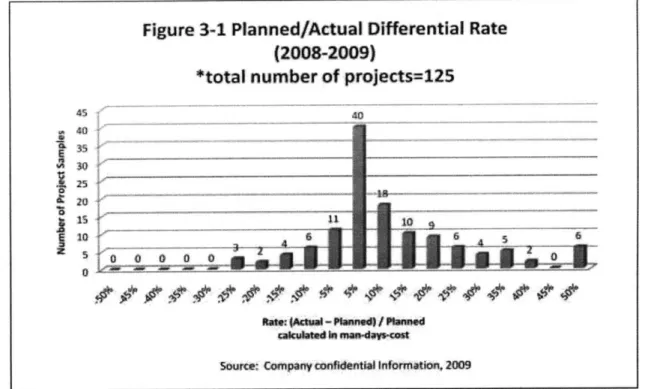
development projects? Below is a data describing the difference between planned and the
actual man-days-cost, which essentially represents the man-power and time spent on various
projects conducted between 2008 and 2009 at Company N. Total number of sample project
included in this figure is 125. Note that the index is acquired through following calculation.
As shown in Figure 3-1, cost and schedule overrun is an apparent challenge at Company N with
close to 80% of the project overrunning its initial plan. Moreover, with one out of four projects
overrunning its plan by over 20%, it is critical as a software company to prove its cause and act
to improve current development practices. In the same report, project managers reported
some of the common reasons for such overrun as followed.
" Requirements were added by the customer after the onset of the project
" Ambiguous functional design lead to increased working hours
e Lack of appropriate outside interface definition lead to functional complexity and
added to programming effort
* Insufficient review process in the functional design and detailed design caused
programming rework
Figure 3-1 Planned/Actual Differential Rate
(2008-2009)
*total number of projects=125
- 6
u~uJ.s'10
S aUC dfanmad#wwstaf
sourcet copanycomnfldential nfermaieth 2009
Iii I
* Preparation and execution of the system test involved greater effort than initially
planned
As represented in these comments, many of the problems arise from managerial difficulties
rather than technical. This is exactly the reason why managing software development processes
is crucial to a software company. By appropriately managing relations with customers, partners,
and your own employees, software firms can resolve many of these problems.
Another interesting data to look at is related to the quality which, as previously
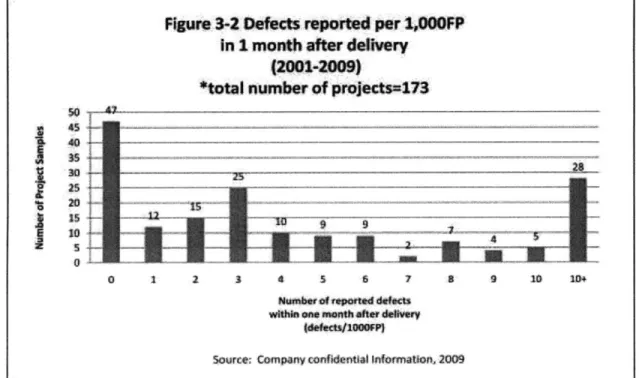
discussed, is thought of as one of the strength of Japanese software industry. Figure below
represents number of defects reported within one month after delivery at Company N.
Figure
3-2 Defects reported per 1,OOOFP
In I
month
after delivery
(2001-200)
*total number of projects;=173
40 a+ 40- - - -30 20 Nuimbrot d *fects 1defcts/1000FP
Source: Company confidential Informataon 2009
Median of the numbers represented in Figure 3-2 is "2.5" defects per 1,OOOFP. This number, if
"Software Kaihatsu Hakusho 20083", Japanese software industry in total is "0.18" for the same
figure. Accordingly, Company N shows slightly higher quality level compared to other software
firms in Japan. Looking beyond, in an article "Software Development Worldwide: The State of
the Practice4", Professor Cusumano and his colleagues reported worldwide comparison of
similar figures. This article concludes that Japanese projects had one tenth of defects compared
to projects in India and one twentieth of defects compared to projects in US. Although there
may be differences in the nature of software development projects handled in each countries,
which may be the cause to some extent, these numbers show apparent advantage of Japanese
software development in terms of quality control.
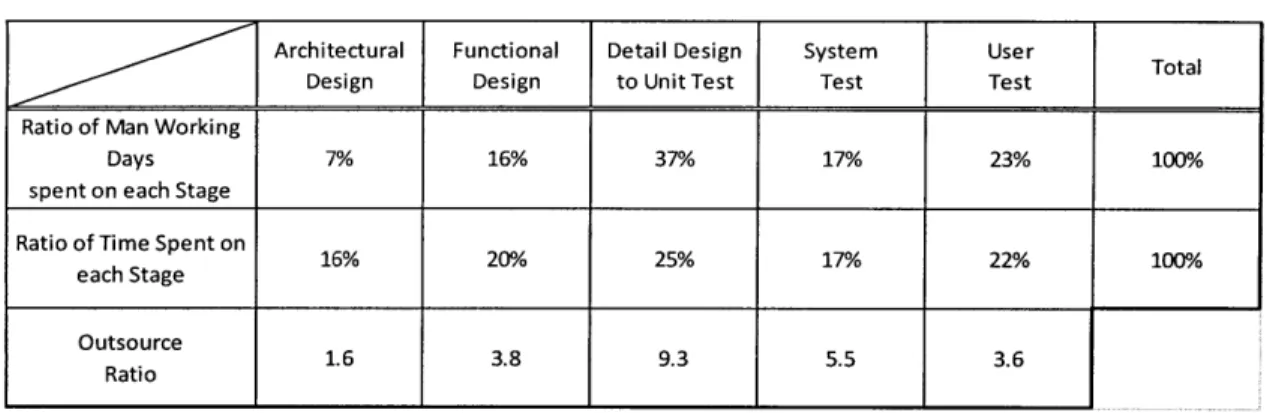
Next data introduced represents the ratio of man-working-days devoted to each of the
five stages of software development cycle, namely architectural design, functional design, detail
design to unit test, system test, and user test. It also provides the ratio of outsourcing for each
of the stages. Ratio of outsourced work is calculated by the following.
>
Ratio of Outsource = Partner Man Working Days / Employee Man Working DaysIn other words, this number represents how many engineers are outsourced for every
employee at Company N. Higher the number, greater dependencies on outside partner
Figure 3-3 Effort spent per development phase and outsource ration
Architectural Functional Detail Design System User
Total
Design Design to Unit Test Test Test Ratio of Man Working
Days 7% 16% 37% 17% 23% 100%
spent on each Stage
Ratio of S Spent on 16% 20% 25% 17% 22% 100%
each Stage Outsource
1.6 3.8 9.3 5.5 3.6
Ratio
Source: Company confidential Information, 2009
Couple of insights can be drawn from Figure 3-3.
" As commonly acknowledged within the software industry, greatest effort of work, close to 40%, is put on the actual development stage including detailed design,
programming, and unit test.
* Despite the fact that many of the issues arise due to ambiguous requirement definition and changed requirements, man-working-days spent on upper stage of development are relatively low.
e In the upper stages of development, namely architectural design and functional design,
ratio of man-working-days devoted are relatively low while time spent are equally distributed throughout the 5 stages. In other words, upper stage of development is completed by few engineers spending longer hours while the actual development
* Apparent dependency on outsource can be observed in programming and unit tests.
Meanwhile, low dependency for the upper stages and user test is naturally accepted
due to high involvement of the customers.
As can be understood from these findings, appropriate management of different stages and
efficient use of outsourcing is crucial for successful software development. In the next section,
closer view of a particular project focusing on these matters will be presented.
3.3 Description of a sample project
To better describe the actual activities and relationships between various stakeholders
involved in Japanese software development, analysis of a sample project will be presented. This
section aims to describe fundamental activities crucial to software development projects
through a sample project managed by Department R, one of the most profitable departments
at Company N.
3.3.1 Overview
Department R is responsible for managing consultation and system development
services for a convenience store chain X. It consists of approximately 120 employees all devoted
for this single client. Company N started its relationship with Client X, approximately 30 years
ago and has strengthened its relationship over the years. This is a very good example of a
success abiding by the company philosophy of "prospering together with customers". Through
business of their customers and the system which support it. Client X, whose policy is not to own any infrastructure on its own, outsources management of the entire information system including development and maintenance. To handle such responsibility, Department R maintains various teams divided by system functionality from accounting, ordering system, distributions, and back-office support. In addition to Department R, Company N operates additional department responsible for managing data center for Client X. It is not too much to state that Department R operates as the information systems department for its client. Company N considers such long and firm relationship with various clients as the greatest advantage for a system integrator.
In the next four sections, we look deeper into specific activities at Department R with a focus on factors discussed in Chapter 2. Although it will only introduce activities of a single department, Department R being one of the most innovative organizations within the company, it will be a good representation of how software development is managed at Company N.
3.3.2 Customer Relationship
As noted earlier, Client X's basic principle is to not manage information systems on its own. Instead, it outsources development of information systems to system integrators such as Company N. To manage tight relationship with partner companies, Client X establishes
information systems department whom accordingly is the primary stakeholder for Department R. Information systems department of Client X and Department R of Company N has
established strong relationship over the years to enhance smooth operation and manages 35
various activities to support acquirement of business know-how. Such activities include sending
employees to work at Client X's office for certain period of time, visitation of factories, and
attending training programs hosted by one another. Through these activities, Department R
continuously attempts to understand Client X's business and seeks new opportunities for
system proposal.
In terms of software development, projects operate under clear division of
responsibilities between the two companies. Although final decision making is, of course, made
by Client X, significant part of the authority is given to Company N which shows great trust.
Here is how development projects proceed. During the requirement definition phase, including
architectural design, the two entities go through number of meetings to define basic
requirements of the system. Meetings are held frequently, in most cases on daily basis, depending on progression of the project. At this stage, Client X takes initiative in describing
their needs and the responsibility of Company N is to propose a functional and feasible plan to
resolve client's needs. After the requirement definition stage, Company N begins the actual
development of the software starting with the functional design and from this point up until the
system testing phase, the only substantial involvement of Client X is the weekly progression
check unless there are significant rework necessary regarding defined requirements. During the
user test which is conducted after the system test, members from Client X are responsible for
checking the usability and functionality of the system from user's perspective. At this point, in
some projects, unfortunately, serious issues may surface such as misunderstanding of
requirements, omission of requirements, and inappropriate functionality. Such problem
regarding requirements definition leading to substantial rework is very common and most
troublesome in software development. In the case of Client X and Company N, such rework is in most cases resolved on Company N's expense meaning overwork for members of Department R and sometimes adding manpower temporary. However, in such cases, both parties are to be accused. First, improvement in accuracy of the requirement definition is necessary, second, client side needs to get more involved in the course of development in order to confirm functionality, and third, developer side needs to take initiative in confirming functionality with its client.
3.3.3 Partner Relationship
At Department R, most of the programming effort is outsourced to its partner companies in order to allow project members to focus on building client relationship and managing projects. Historically, Department R has been in long term contract with several partner companies which can act as the pillar of development projects. In addition to these main partners, short term contracts are concluded based on scale and schedule of project progression. All partners, long term and short term, are asked to be permanently stationed in the same building with which the members of Department R are settled in. This allows frequent reviews of the outsourced work. By contract, all programming efforts and unit tests are to be given final reviews by employees of Department R who are responsible for managing the project. Of course, partner companies conduct internal reviews before presenting to members of Department R. Such twofold reviewing processes play significant role in quality control by
ensuring fulfillment of the requirements presented by the client and checking for any flaws in
the result of unit tests.
As noted earlier, primal responsibility of partner companies, in the case of Department
R, are to program software based on presented functional design. However, as partner
companies develop a long term relationship with Department R and acquire sufficient
knowledge about Client X, they are asked to extend their roles. For example, some of the most
experienced programmers of main partner companies are assigned leadership roles to manage
other partner companies together with employees of Department R. As seen in this example,
presence of partner companies, especially the main partners, are essential for Department R to
successfully complete software development projects.
One of the recent issues in Japanese software development industry is the high cost of
labor in Japan. According to the tight economical situations which many of the Japanese
companies are facing, general investment for information system has fallen which has forced
software companies including Company N to seek cheaper labor force outside of Japan leading
to the trend of offshore development. Such trend, together with the high dependencies on
domestic partner companies, have changed ways which Department R manages software
development projects greatly.
Department R, just as most of Japanese software companies were, started offshore
development in the year 2000. Due to lack of English skills, cultural similarities, and geographical proximity, Company N has chosen Chinese software developer as offshore
development destination instead of partnering with players of India. Such partnership strategy has been the trend of offshore development in Japan. According to an article presented by
Sakura Kojima and Makoto Kojima, "Making IT Offshoring Work for the Japanese Industries5.,
Japanese software companies tend to prioritize language proficiency when choosing offshoring destination and the fact that there were 63,000 Chinese students studying in Japan (in 2005) as opposed to 364 Indian students clearly explains why Japanese firms chose China as its partner.
In the same article, Kojima indicates the following as valuable lessons for successful offshore projects.
" Enhancing language proficiency and mutual cultural understanding is critical
e Investment in knowledge transfer education, especially at initial stage, is critical
e Regular execution of joint reviews are critical
* Long-term contract based on partnership may improve motivations of Chinese vendors Interestingly enough, all of the lessons raised above are incorporated into Department R's offshore development policies. To support Chinese engineers to learn Japanese and understand Japanese culture, Department R invites several members each year from China for a year-long training in Japan. During this training program, members from China not only brushes up their language skills but acquires knowledge about Client X and software development methods practiced at Department R which supports them significantly later on. Such exchange of
personnel happens both ways. In the initial stage of projects, Department R sends employees to
China for the purpose of communicating software requirements and to transfer necessary
knowledge required to execute development tasks. Once the programming tasks are on track,
code reviews and test reviews are carried out on daily bases to complement for the risks of
offshore development. In case if members of Department R are not at site, videoconferences
are held using interpreter if necessary. In terms contracts, Company N is under long term
contract with most of offshore development destinations in China. The objective of this long
term relationship is to mimic the domestic long term relationship with Japanese developer
which has been the motive power for Company N in the past.
Despite all of the efforts, Department R has experienced some difficult issues related to
offshore development. First, language barriers are inevitable which slows down development
and possibly lead to substantial rework due to miscommunication of requirements. Second,
quality degradations were verified due to low motivation and skills of offshore programmers.
Third, lack of earnestness to understand customer's requirements were critical. To resolve
these issues and benefit from offshore development, Department R seeks to establish some
adjustments in current offshore development practices.
3.3.5 Development Process
With the explanation of current software development practice up to this point, it may
be clear that Department R manages its software development under a waterfall model rather
than an iterative development. As presented earlier, requirement definition is generally
conducted upfront between Client X and Department R. Then, based on defined system requirements, project managers undertake the actual development phase with its partner developers. During this phase, there aren't any significant interchanges between the client side and the developer side. Therefore, software is developed based on requirements defined upfront and if not specified in the requirements, judgment of members of Department R who is supposed to have sufficient understanding of Client X's business to make such decision. In a sense, development stage is operated in an iterative manner between Department R and partner developers, particularly with the offshore partners. However, in general, development processes are designed based on the premise that no rework will occur between individual development stages. To illustrate this premise, explanation of documents that Department R is responsible for submitting to Client X is lucid. At the end of each stage, Department R delivers various documents to Client X. Such documents include, "requirements definition", "functional design definition", "system test report", "user test planning", and "user test report". Each of these documents needs to be approved by Client X before moving on to the subsequent stage
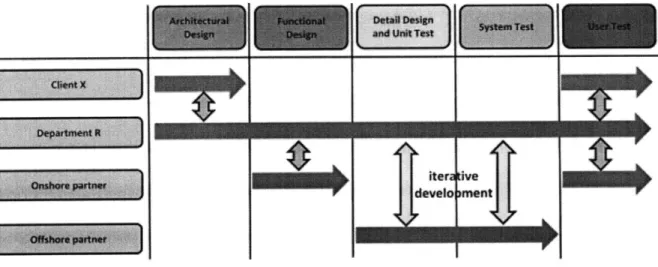
in development cycle which clearly shows character of a waterfall model development. Figure 3-4 is a representation of development model practiced at Department R showing active players involved in the development.
Figure 3.4 Task responsiblites and interchanges between parties
While Department R is involved throughout the development process as sort of a control tower,
other players have specific stages they are responsible for. One of the problems with such
method is that extra effort is required to explain system requirements and expected tasks every
time new players get involved. For example, Department R must explain system requirements
to both onshore and offshore partners along with the explanation of project progression up to
the previous stage of development.
As it is for most of the software firms, which operates a waterfall model development,
greatest issue for Department R is the change of requirements in the later stages of
development. It is not rare for Department R to face significant rework after the testing phases.
However, it is almost as if members have reconciled to it because in most cases, Department R
complies with the request for modifying requirements. This is probably because of the vocation
to protect the long term relationship with Client X and also because of the "customer first"
state of the mind ingrained in Japanese culture. Anyway, it is essential for Department R to
3.4 Challenges
In this section, to close this chapter, issues inhabited in software development at a typical Japanese software firm will be stated as a summary.
As repeatedly mentioned throughout this chapter, biggest challenge for Department R is how to avoid changes in requirements and handle them in the event it occurs. This probably is a common challenge for many of the Japanese firms, especially those operating under a waterfall model development. In the present state of affairs, while acknowledging some of the
weaknesses of this model, many of the Japanese software firms cope with it in order to minimize cumbersome interchanges between various players within the project and to
maintain trustworthy relationship with their clients. As a result, however, in many cases result in significant cost and schedule overruns. To successfully provide software development and system integrating services in the recent cost driven and global environment, Japanese software firms must alter current practices and establish more efficient way of managing software development projects.
In addition, as high cost structure of Japanese labor becomes outstanding and dependency on inexpensive offshore labor force become increasingly apparent, stronger relationship with Chinese and other new emergent software developer will become significant. Accordingly, Japanese software firms are urged to improve current practices to overcome communication and cultural barriers. Alongside, clear division of responsibility between
onshore and offshore partners to bring out best overall performance will be an important task
for software firms like Company N.
Next two chapters will focus on software development practices of United States and
India. What are the differences? What are the similarities? What can be applied to improve
Chapter 4: Reference Study - US Firm
As mentioned in the introduction of this paper, one of the objectives of this thesis is to analyze Japanese software development in contrast to those of leading players in the industry, namely United States and India. This chapter focuses on the former, software practices in US software firms, discussing some of the important characteristics commonly observed along with two of the important software development concepts, agile software development and
capability maturity model, which originated from software practices in the US.
First section of this chapter focuses on two of the most famous, profitable, and influential firms in US software industry, namely Microsoft and Google. One of the facts that are commonly acknowledged within the global software industry is the supremacy of US firms in the production of packaged software and internet service. In that sense, focusing on these two companies would successfully capture one of the important characteristics of US software
industry. Microsoft started its business in 1975 and expanded steadily synchronous to the spread of computer usage during the last 35 years. Literally, it has been the leading software company in the world, showing overwhelming presence among the industry and has become a role model for software firms around the world. Meanwhile, Google which was established in 1998 has acquired top share in search engine business and its method of managing software
development is another focus of interest among software industry. Although these two companies have contrastive history as software firms, there are some interesting