Clearinghouse:
A Payment Framework for Distributed Object
Systems
by
Ellis Y. Chi
Submitted to the Department of Electrical Engineering and
Computer Science
in Partial Fulfillment of the Requirements for the Degree of
Master of Engineering in Electrical Engineering and Computer
Science
at the
MASSACHUSETTS INSTITUTE OF TECHNOLOGY
February 7, 1997
Copyright 1997 Ellis Y. Chi. All rights reserved.
The author hereby grants to M.I.T. permission to reproduce
distribute publicly paper and electronic copies of this thesis and to
grant others the right to do so.
Author ...
...
..
..
....
...
Department of Electrical Engineering and Computer Science
A A
February 7, 1997
Certified by...
Accepted by ... "..
Hal Abelson
Professor
Thesis Supervisor
F. R. Morgenthaler
Department VCommittee on Graduate Theses
SAR
2
11 9197IX.
Chairman,
··, -;. i;..:·~ J·· '~: ??'Clearinghouse:
A Payment Framework for Distributed Object Systems
by
Ellis Y.
Chi
Submitted to the Department of Electrical Engineering and Computer Science on February 7, 1997, in partial fulfillment of the
requirements for the Degree of
Master of Engineering in Electrical Engineering and Computer Science
Abstract
This thesis describes the design and the details of the preliminary implementation of Clearinghouse: a "per-call" payment framework for an interoperable, distributed object environment.
Clearinghouse has two notable features. First, it has a paymethod abstraction layer which simultaneously supports multiple payment methods; in other words, Clearing-house can be used for any payment method (e.g. PayWord [20] or credit card) as long as its implementation conforms to the interface of the abstraction layer. The paymethod abstraction layer allows individual payment methods to evolve without requiring changes to be made to the existing payment framework or to objects being paid using the payment methods. Second, this payment framework provides a user an "electronic wallet" residing in the local Clearinghouse process. This feature allows the user the option to select and configure one or more supported payment methods before initiating a network call to purchase a remote object invocation.
Clearinghouse is an extension module of ORBlite [6], a "software bus" which enables interoperability among distributed object systems possibly implemented in different programming models and on operating systems. Adding the payment frame-work to ORBlite provides an electronic commerce capability to the distributed ob-jects.
Thesis Supervisor: Hal Abelson Title: Professor
Acknowledgments
I would like to thank the whole ORBlite team for their support and care during the last six months, especially Evan Kishenbaum and Keith Moore, who offered valuable technical advice and personal support. They spent so much time and effort to ensure that I could proceed with the project. Their critical evluations have always helped me succeed on different occasions and in aspects during the last six months.
My thesis advisor, Professor Hal Abelson has displayed much patience and has offered me concrete guildlines for the thesis.
In addition, I would like to thank Marvin Keshner and Richard Baer for being my great on-site coordinators over the past three years. Marvin, in particular, has given me the confidence and courage to take on this challenging assignment. Yee-Hsiang Chang was my first supervisor at HP Labs, and since then he has offered me the advice and help beyond the normal reponsibilities of a supervisor. Vivian Shen has always been very helpful to me.
I would also like to thank Chris Yu for being my great cubicle mate during the first three months of my thesis assignment. Also I would like to thank Barabara Alles and Justin Liu for kindly reviewing the preliminary version of section 1.3 and chapter 14, Evan Kirshenbaum and Keith Moore for proofreading the abstract and chap 1 of my final draft, and Angie Hsu for reviewing part of this acknowledgement.
Last but not least, I would like to thank my parents, Vincent and Helen Chi, for having gone through so many hardships to ensure my proper growth and development for the last 22 years.
Contents
1 Introduction 1.1 Introduction.... 1.2 Design Issues 1.3 A Simple Example 1.4 Organization 2 Background2.1 Building an Open Object Environment . . . . 2.1.1 Problems with Developing Large Computer Systems ... 2.1.2 O M G . . . .
2.1.3 C O R B A . . . . 2.1.4 O R B . . . ... . . .
2.2 O R B lite . . . . 2.3 Choosing Payment Framework as a Common Facility . . . .
3 Comparison with Other Payment Frameworks
3.1 Aggregated vs Per-Call Payments ...
3.2 Supporting Single vs Multiple Payment Methods . . . .
4 Thesis Project
5 Overview of Clearinghouse
5.1 Overview of the Payment Framework . . . . 5.1.1 Client: Issuing an ORBlite Payment . . . ...
... ... ... ... ... . . . . . . . . . ... ...
5.1.2 Server: Verifying the Payment and Issuing an Change 5.1.3 Client: Verifying the Change . . . . 5.2 Architectural Overview of Clearinghouse . . . . 5.3 Trust M odel . . . .
6 PayMethod Abstraction Layer
6.1 Design Issues . .. .. .. ... .. .. .. .. 6.1.1 Payment-Cycle Modeling . . . . 6.1.2 Credit-Based and Debit-Based PayMethod 6.1.3 PayMethod Entities ...
6.1.4 PayMethod Data ... 6.1.5 PayMethod Functions ... 6.1.6 Configuration ...
6.2 Implementation Details: PayMethod . . . . 6.2.1 PayMethod::Handle . . . . 6.2.2 PayMethod::Info ... 6.2.3 PayMethod::Customer/Vendor/Broker . . 6.2.4 PayMethod Data . . . . 7 PayWord 7.1 Design Issues . . . .. . . . .. . 7.1.1 The PayWord Protocol . . . . 7.2 Implementation Details-PayWord . . . . 7.3 Implementation Details . . . .
7.3.1 PayWord::Hash ... 7.3.2 PayWord_Chain ...
7.3.3 PayWord_Commitment . . . . 7.3.4 PayWord Data-PayWord _Payment . . . . . 7.3.5 PayWord Data-PayWord_RedemptionList . 7.3.6 PayWord Data--PayWord_-Receipt . . . . . 7.3.7 PayWord Data-PayWordAckInfo ... .. 26 .. 26 .. 28 *.. 30 31 . . . . 31 . . . . . 31 . . . . . 32 . . . . 33 . . . . 34 . . . . 34 . . . . 35 . . . . . 35 . . . . . 35 . . . . 38 . . . . . 38 41 . . . 41 . . . 41 . . . 45 . . . 46 .. . 46 .. . 46 . . . 48 . . . 51 . .. 53 . . . 53 53
7.3.8 7.3.9 7.3.10 7.3.11 7.3.12 PayWordHandle .... PayWord_Customer . PayWordVendor . . . . PayWord_Broker . . . PayWord_Info ... 8 Wallet 8.1 W allet ... 8.1.1 Design Issues . . . . 8.1.2 Implementation Details . 8.2 EW allet ...
8.3 CWallet, VWallet, BWallet . . . 8.4 W allets ... ...
9 _OrbliteSlip, PaySlip, & RedeemSlip
9.1 _O rbliteS lip . . . . 9.1.1 D esign Issues . . . . 9.1.2 Implementation Details ...
9.2 P aySlip . . . . 9.3 Redeem Slip . . . .
10 RequestSlip & Ack_Slip
10.1 Request_Slip . . . . 10.1.1 D esign Issues . . . . 10.1.2 Implementation Details . . . . 10.2 A ck_Slip . . . .
11 The Communication Protocol: A Modified IIOP
12 PriceModule 12.0.1 D esign Issues . . . . 12.0.2 Implementation Details . . . . 60 61 61 63 64 65 66 : : : : :
13 Pay_Util 81
13.1 D ate . . . . 81
13.2 AuthInfo and Certificate ... 81
13.3 PGPGlue and MD5Glue ... 82
14 Putting It All Together 84 15 Threats 88 16 Complete Work and Test Results 89 17 Future Work 92 18 Conclusion 95 A Example Code for Clearinghouse Users 97 A .1 Server Code .. . . . .. . .. . . . . .. . . . .. .. . . . .. . 97
A.1.1 Creating an IDL interface . ... . 97
A.1.2 Generating the Stub and the Skeleton . ... 98
A.1.3 Object Definition of the Stock Agent . ... 98
A.1.4 A Simple NetStock Server . ... . 99
List of Figures
2-1 Stub and skel generated by an IDL compiler. . ... . 16
2-2 Stub and skel with an ORB. . ... .... 17
2-3 The ORBlite architecture. ... 18
2-4 Making a remote invocation using ORBlite. . ... 19
5-1 The steps of issuing a payment and getting change in Clearinghouse . 27 5-2 Architectural Overview of Clearinghouse. AuthInfo and Certificate are depended by most modules. ... 29
6-1 Payment-cycle model for credit- and debit-based payment methods in Clearinghouse .. . . . . . . . ... 33
6-2 The module dependency diagram of PayMethod, the implementation of the paymethod abstraction layer. . ... 40
7-1 Summary of the Payword protocol. Thick arrows represent interactions using non-Payword protocols. ... 44
7-2 Module Dependency Diagram for PayWord classes. . ... 59
Chapter 1
Introduction
1.1
Introduction
This thesis describes the design and the details of the preliminary implementation of Clearinghouse: a "per-call" payment framework for an interoperable, distributed object environment.
Clearinghouse has two notable features. First, it has a paymethod abstraction layer which simultaneously supports multiple payment methods; in other words, Clearing-house can be used for any payment method (e.g. PayWord [20] or credit card) as long as its implementation conforms to the interface of the abstraction layer. The paymethod abstraction layer allows individual payment methods to evolve without requiring changes to be made to the existing payment framework or to objects being paid using the payment methods. Second, this payment framework provides a user an "electronic wallet" residing in the local Clearinghouse process. This feature allows the user the option to select and configure one or more supported payment methods before initiating a network call to purchase a remote object invocation.
Clearinghouse is an extension module of ORBlite [6], a "software bus" which enables interoperability among distributed object systems possibly implemented in different programming models and on operating systems. Adding the payment frame-work to ORBlite provides an electronic commerce capability to the distributed ob-jects.
1.2
Design Issues
The major design issues for developing a payment framework within ORBlite are: * conforming with the ORBlite architecture, and
- Since Clearinghouse is designed as a "per-call" payment framework, the payment should be appended to a request for an object invocation, rather than requiring the establishment of a separate channel to handle the pay-ment. Therefore, any information used for triggering Clearinghouse should be appended as a transparent attribute for an object invocation.
* evolving independently of the ORBlite framework and ORBlite user applica-tions.
- A system which is built with this design issue in mind will be easier to maintain than a system built without it. ORBlite allows user applications to evolve independently of the communication infrastructure. As a service provided to ORBlite users, Clearinghouse should follow the same rule. The major design issues for building a paymethod abstraction layer in a payment framework are:
* providing a complete set of interfaces to allow necessary interactions between a payment method and other modules in the payment framework, and
- The paymethod abstraction layer should allow each payment method built underneath the layer to provide all the basic functionalities that the pay-ment method can cover for a paypay-ment cycle.
* imposing minimum restrictions on the mechanism, data structures, and the set of configurable parameters,
- Each payment method has its own way to carry out a payment and its own representation of payment data. The paymethod abstraction layer should not impose any restrictions on them except for their ability to carry out the basic functionalities as mentioned in the previous item.
The major design issues for providing an ORBlite user an "electronic wallet" with the capability of selecting and configuring a supported payment method before making purchases are:
* interacting with payment methods through the paymethod abstraction layer, and
- The paymethod abstraction layer separates the behavior of the basic func-tionalities from their implementation. Therefore, an "electronic wallet" taking advantage of the abstraction layer can treat all payment methods in the same way and does not need to modify its implementation when a user adds a new payment method to the wallet.
* providing a channel to configure and select supported payment methods and
set default parameters for each transaction.
- Recalling the second bullet of the design issues for building a paymethod abstraction layer, each payment method will have its own set of config-urable parameters. Clearinghouse wallets should allow users to configure these parameters.
1.3
A Simple Example
Here is an example to illustrate the application of Clearinghouse.
NetStock is a company that provides on-line stock quotes through the Internet.
NetStock has a set of electronic agents which send out instant stock quotes. To make these electronic agents available to the public, a NetStock software developer ''publishes'' them using the ORBlite framework. Since the company is ''selling'' on-line accesses to stock quotes, the developer also needs to register each agent, its access price, and the NetStock's account
information with a special repository.
A customer wants to get a stock quote. At a front panel (e.g a web browser), he issues a ''get-stock-quote'" command and an authorization to pay an ''electronic token'' for a poll. The front panel sends the ''get-stock-quote'' command to a NetStock server through the ORBlite framework. The ORBlite framework handles the payment and forwards the command to a stock-quote electronic agent at the NetStock server. Once the payment is cleared, the customer will get the requested stock quote. The customer may continue polling the stock quotes of the same company.
1.4
Organization
This thesis is divided into eighteen chapters. Chapter two gives a brief history for the growth of distributed objects in an open computing environment, introduces OR-Blite (the communication backbone used for the payment framework), and states the motivation behind the thesis project. Chapter three compares some of the Internet commercial applications with Clearinghouse. Chapter four restates the thesis of the project. Chapter five gives an overview of Clearinghouse and a trust model on which it is based. From Chapter to six to Chapter thirteen, the thesis describes the design decisions and the implementation details of the data types of Clearinghouse. Chap-ter fourteen revisits the example in section 1.3, with a detailed descriptions for the internal operations of Clearinghouse. Chapter fifteen discusses the possible threats
to Clearinghouse. Chapter sixteen shows the result of the thesis project. Chapter seventeen proposes possible future work, and chapter eighteen concludes the thesis.
Chapter 2
Background
This chapter consists of two parts. The first part gives a brief description of CORBA and the ORBlite architecture. The intent is to provide enough information to address the rationale of the design of the thesis project. The second part defines the goal and the scope of the thesis based on the direction of ORBlite.
2.1
Building an Open Object Environment
2.1.1
Problems with Developing Large Computer Systems
There are two major problems with building large computer systems:
1. Systems are becoming complex: As computer systems become more popular, they are expected to perform larger and more complicated tasks. Building these systems entirely from scratch becomes infeasible. [7]
* Observation: Various parts of a proposed system are often found at exist-ing systems built by different vendors in different computexist-ing environments which include hardware platforms (e.g. PC-compatibles and Unix work-stations) and operating systems (e.g. Windows NT and HP-UX) [7]. 2. The evolution of the systems is unpredictable: The development of a system is
to predict how a system is going to evolve [6].
* Observation: A system becomes more evolvable if it is broken into indi-vidual pieces which only states the behavior rather than the actual imple-mentation.
2.1.2
0MG
OMG (the Object Management Group) was founded in May 1989 by Christopher Stone and eight companies [13].1 It aims at providing a solution to the problems listed in section 2.1.1 based on the observations.
It specifies standards which enable an open communication infrastructure for dis-tributed systems built based on the standards. The open computing environment allows systems to interoperate across different hardware platforms and operating sys-tems [13].
In addition, OMG specifies the management of different systems in the open envi-ronment as objects. This allows new systems to be built based on the existing objects (or systems) which may be implemented in another computing environment [13].
Today, OMG has over 700 members; they include software vendors, software de-velopers, and end users. The consortium continues to promote the use of object technology in an open computing environment for distributed applications [13]. Im-plementations of OMG specifications have been found in over 50 operating systems
across the world [13].
2.1.3
CORBA
CORBA is an acronym for Common Object Request Broker Architecture. It is a standard defined by OMG to enable interoperability across heterogeneous computing environment. CORBA defines a common language called IDL to describe an object
1
The eight companies were: 3Com Corporation, American Airlines, Canon, Inc., Data General, Hewlett-Packard, Philips Telecommunications N.V., Sun Microsystems and Unisys Corporation
IDL
descril
C++
C++ Stub
Java Skeleton
Java
Caller
Object
Impl
Figure 2-1: Stub and skel generated by an IDL compiler.
interface (rather than implementation). Objects written to IDL can interoperate with one another regardless of their operating systems and hardware platforms [17].
The implementation of the interoperability is accomplished by using IDL compiler. An IDL compiler takes in an IDL file defining the interface to an object and generates the code in a conventional programming language, such as C++ or Smalltalk, which allows objects to communicate across an open infrastructure. The code consists of two parts, a client-side stub and a server-side skeleton, which are both illustrated in figure 2-1.2
To make an invocation to an object, the caller calls an operation of the object presented in the stub. From the caller's viewpoint, all it sees is the stub code, whose
2
Figure 2-2: Stub and skel with an ORB.
interface is presented in the same language as that of the caller code (in the above figure, C++). Once the stub is called, it will forward the call (through some com-munication channel) to the skeleton. Similar to the stub, the skeleton presents the invocation through a well-defined interface.
2.1.4
ORB
An Object Request Broker (ORB) provides the communication infrastructure between objects. The communication mechanism is transparent to the objects. The interaction among an ORB, a stub, and a skeleton is shown in figure 2-2.
2.2
ORBlite
ORBlite is an implementation of the CORBA2.0 standard. Therefore, it has an IDL compiler and an ORB. In addition, the focus of the ORBlite architecture is to allow piece-wise evolvability within ORBlite [6], and this is done by providing abstraction layers. The two layers that will be discussed are the language mapping abstraction layer and the protocol abstraction layer. The ORBlite architecture is
shown in figure 2-3.
The IDL compiler of ORBlite offers a few language mappings (e.g. C++, Java,...) to application developers. To avoid tying the ORBlite core and the rest of ORBlite to a specific language mapping, the language mapping abstraction layer is provided between the IDL-compiler-generated code and the ORBlite core (see figure 2-3). The protocol abstraction layer allows the ORBlite core to select from a set of
communica-Protocol Abstraction Layer
and ORBlite core
Language Abstraction Layer
Figure 2-3: The ORBlite architecture.
tion protocols for the object without requiring the object implementation to conform with any convention imposed by the communication protocols. In other words, the actual communication protocol is transparent to application developers. Each module in ORBlite has a well defined interface which allows each of them to evolve indepen-dently. ORBlite is a prototype developed at Hewlett-Packard Laboratories, Palo Alto, California, USA. A detailed description of ORBlite is published in [6]. Figure 2-4 gives the overview of making an ORBlite remote invocation. 3
2.3
Choosing Payment Framework as a Common
Facility
The goal of ORBlite conforms with that of the OMG: to provide an open object infrastructure. As the ORBlite infrastructure provides great interoperability
be-3
objf
rglist)
Figure 2-4: Making a remote invocation using ORBlite.
2.
tween objects, it is envisioned that there will be commercial services implemented as CORBA-compliant objects. To support this, I chose to implement a payment framework for ORBlite. I believe that the common features enabling electronic com-merce should be encapsulated in the middleware layer. In fact, this direction has been practiced in the World Wide Web where applications [12, 16, 5] are developed to provide common functionalities for financial transactions to take place.
Chapter 3
Comparison with Other Payment
Frameworks
In this chapter, the payment models of other payment frameworks will be compared and discussed with Clearinghouse payment model.
3.1
Aggregated vs Per-Call Payments
Most current payment frameworks have an aggregated payment model, e.g. using a "shopping cart" to collect a list of "object descriptions" and then pay for them in another call to vendors [12, 16, 21, 5]. This model separates payments from object invocations. It is good for selling items which require to establish a secure session (e.g. SSL) to complete the payment. However, this model is not suitable for users who have a specific item in mind to purchase, or the items costs relatively cheap. The reason is that payment under an aggregated model requires additional network calls, e.g. sending a "check-out" signal to initiate the purchasing process.
An aggregated model requires a user to pay either before or after the receipt of objects. In a "pay-before-call" model, vendors are protected by the model since they can ensure the receipt of money before delivering the requested items to customers. However, the customers are not guaranteed to get the purchased items. In a "pay-after-call" model, vendors deliver goods to customers before payments take place.
This model is suitable for offering a preview for object contents, such as an abstract of a document [5]. This model offers more protection to customers; it ensures a success of delivery before paying for the requested items. In a "pay-per-call" model, customers have to include payment with the request of purchased objects, and vendors have to deliver the purchased object right away. Neither the vendor or customer is protected.
Clearinghouse has chosen the "pay-per-call" model because it focuses on providing the micropayment capability to objects, and it is more important not to add in extra network calls for enabling the commerce capability to the objects. Though the framework can support a macropayment method, such as credit card, it does not offer the protection found in the aggregated payment model.
3.2
Supporting Single vs Multiple Payment
Meth-ods
Some current payment frameworks have been designed based on a single payment method, e.g. credit card [12, 16]. Incorporating a single payment method into the frameworks may be easier to design; however, these frameworks cannot handle the evolvability of the single payment methods without making changes to the framework.
In addition, these payment frameworks do not allow vendors to provide their own payment methods through the frameworks.
Other payment frameworks allow vendors and even customers to choose their preferred payment methods[21]. However, these payment frameworks provide the flexibility by processing payments off-line.
Clearinghouse aims at providing the evolvability of payment methods within the framework without affecting other modules of the framework or any existing objects in legacy applications. In addition, it supports multiple on-line payment methods simultaneously within the framework. Therefore, vendors and even customers can select any supported payment methods to make a payment.
Chapter 4
Thesis Project
The thesis project is the design and a first-stage software development of Clear-inghouse: a payment framework for distributed systems using the ORBlite commu-nication infrastructure. Clearinghouse provides "pay-per-call" capability to object invocations. This is different from most of the current payment paradigms in which payments are separate from purchased objects (or object descriptions). Clearinghouse has chosen a "pay-per-call" model to provide a suitable environment for deploying micropayment, since a "per-call" payment does not require additional network calls. Clearinghouse provides a paymethod abstraction layer to support different payment methods simultaneously. The paymethod abstraction layer allows individual payment methods to evolve without requiring changes made to the payment framework or ob-jects being paid by the payment methods. Thus, Clearinghouse users do not need to suffer from implementing an entire payment framework for a new payment method. By using the existing of ORBlite framework, Clearinghouse users can make "per-call" payments using the interface of ORBlite, with an additional attribute which will be transparent to the ORBlite implementation. By using electronic wallets which lo-cally reside in Clearinghouse users' processes, the users may take advantage of the paymethod abstraction layer to select their own sets of payment methods (either micro- or macropayment schemes) and configure them before issuing a "per-call" payment. In other words, Clearinghouse allows the users to add or delete their fa-vorite payment methods in their wallets, unlike existing payment frameworks, which
give every user the same wallet. In addition to offering a payment service, Clearing-house allows a user to determine whom to trust, and it lets an object provider (either a vendor or a broker) determine the pricing model for the object.
A design restriction of developing a payment framework within ORBlite is con-formance with the ORBlite architecture; the payment framework should not change the existing implementation of the ORBlite core or any of the ORBlite abstraction layers. The design issues of building a paymethod abstraction layer are to form a unified transaction model for each payment method and build an interface based on this model. In order for a Clearinghouse wallet to configure a "per-call" payment, the wallet should provide ways to configure the payment methods.
The implementation goal of this thesis project is to prototype this framework. The major part of the payment framework is the design of the paymethod abstraction layer. A payment method will be shown to demonstrate the use of the paymethod abstraction layer with a user wallet. The implemented payment method only handles payments at this time. As later sections show, the redemption process can be modeled much in the same way as the payment process and therefore is considered as the next step for the framework development.
The implementation of Clearinghouse is formed by a set of data types which forms the abstraction layer, the wallet, a payment-capable communication protocol, and a payment method derived from the paymethod abstraction layer. The communication protocol is an enhanced implementation of IIOP (Internet Inter-Orb Protocol), a RPC OMG-standard protocol.' The enhanced IIOP is responsible for the network communication between the client and the server of the payment framework. The project implements a payment method called PayWord (a micropayment protocol proposed in [20]) to demonstrate the use of the payment framework.
Chapter 5
Overview of Clearinghouse
This chapter provides the overview of the payment framework. It shows how a cus-tomer issues a payment and sends it to a vendor, and it describes the trust model of Clearinghouse.
5.1
Overview of the Payment Framework
This section gives a general idea on how Clearinghouse operates by describing a purchase made by an ORBlite user. The user will get the change for the payment from a vendor and verifies its validity. Figure 5-1 graphically shows how an ORBlite user issues a payment and gets a change back from a vendor.
5.1.1
Client: Issuing an ORBlite Payment
To make a remote object invocation, the ORBlite user has an ORBlite-compliant front panel which interacts with the stub generated by an IDL compiler. To issue a "per-call" payment, the end-user application includes an _orbliteslip as an addi-tional attribute to the remote invocation. The attribute is transparent to the rest of the ORBlite framework. When the request for a remote invocation reaches a payment-enabled communication protocol (such as PP, which will be discussed in section 11), PP_Client extracts the _orblite-slip from the ORBlite client's request. The _orblite-slip will be forwarded to the ORBlite user's wallet. The wallet then
sends the request for issuing a payment of a specific payment method through the paymethod abstraction layer. The specific payment method generates a payment and returns it to the wallet. The wallet also obtains payment-specific information for change through the paymethod abstraction layer, and the job dispatching is done in the same way as getting the payment. The wallet puts the results into a requestslip which will be forwarded to PP_Client.
5.1.2
Server: Verifying the Payment and Issuing an Change
The server of the payment-enabled communication protocol (PP_Server) receives the requestslip. PPServer forwards the requestslip to the price module. The price module queries the price for the object invocation. Then it calls the vendor's wallet to verify the contents in the requestslip. The vendor's wallet unpacks the requestslip and dispatches the payment to the specific payment method through the paymethod abstraction layer, provided that the payment method is supported by the abstraction layer. Once the payment is verified, the vendor's wallet asks the specified payment method to generate a change through the abstraction layer. After that, the vendor's wallet creates an ack_slip, containing a receipt (change for the transaction) and the status of the transaction, and sends it back to the customer through PP_Server.
5.1.3
Client: Verifying the Change
Similar to the mechanism of issuing the requestslip, PP_Client forwards the ackslip to the client's wallet. The client's wallet unpacks the ackslip and forwards the receipt to a specific payment method through the paymethod abstraction layer. The payment method verifies the contents of the receipt. The result will be forwarded to PP_Server. PP_Server puts the result of the verification of change and the price quoted by the server into the original _orbliteslip. PP_Server then sends the _orbliteslip back to the customer through the ORBlite.
Front Panel
ORBlite 1. Create a PaySlip user (PM1) PayMethodl:: Handle ota Cn Cn H0 m-q c/ 0gC-tC( Oqn o Cn 03 6. 7. Ph 22. verify(PM 2 4.m withdraw 5. PM1: Paymen ck_info0 12::AckIn [2: :Receip Wallet 0 t fo t) 3. Boolean R, 3. issue_ payment 0 8. Request Sli, 21. rify(Ack_S1 'sult Orblite_Slip(PaySlip) PP_Client 2.issueo 9. RequestSlip 20. verify(Ack_Slip) p) PP_Server 10. RequestSlip 19. Ack_Slip .Price Module 11 verify(Reques 18. Ack_Sli, _Slip) rerify(Request_ 71 Ack Slia Wallet (PM1) PayMethodl:: dr · · Hani Slip) 13. verify(PM1::PI 14. Boolean Res 15. change(P] 16. PI lie (PM2) PayMethod2:: Handle lyment) ult q12::Ack_Inl 12::Receipt (PM2) PayMethod2:: Handle =A . -'- -
7Ac
_
h
5.2
Architectural Overview of Clearinghouse
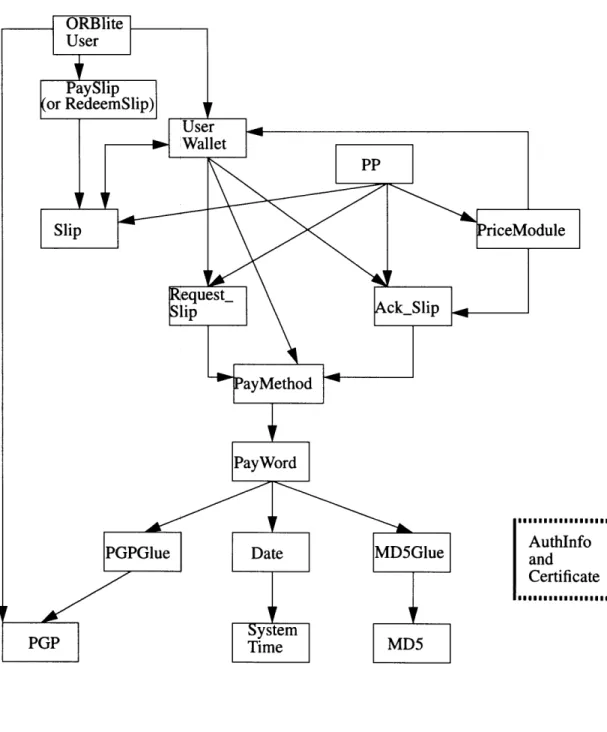
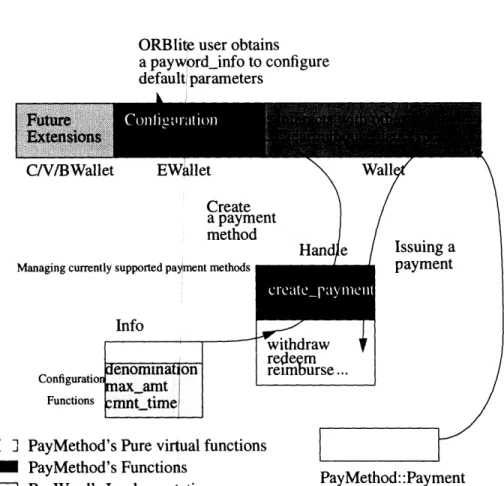
Figure 5-2 shows the architectural overview of Clearinghouse. A detailed description of each module will be described from Chapter 6 to Chapter 13. PayMethod is the implementation of the paymethod abstraction layer. It manages payment methods currently supported in the framework and provides a separation between the imple-mentation of individual payment methods and their behavior. PayWord is a mirco-payment protocol, and it is implemented according to the interfaces of the paymethod abstraction layer. It relies on Date and PGPGlue to generate digital signatures for payword commitments, and it uses MDGlue to generate payword hash values. User wallets are formed by a group of classes which make use of PayMethod to get a trans-parent and uniform way to access and configure individual payment methods. It is also responsible for assembling instances of RequestSlip and AckSlip. _OrbliteSlip is used to trigger Wallet to issue and verify requestslips or ackslips. Its derived class, PaySlip (or RedeemSlip) is used as a transparent attribute in an ORBlite invo-cation to indicate an ORBlite user's wish to issue a payment for the object call. An ORBlite user, with a proper PGP keyID and a pair of public and private keys, con-figures the payslip.- RequestSlip and AckSlip contains a payment method data in an byte-stream form. They get the byte-stream representation through the interfaces of the paymethod abstraction layer. PP is a commerce-enabled, modified IIOP. It locates the _orblite.slip within the attribute list of an object invocation and triggers it to issue a request-slip. PP provides a communication channel for sending out the content in request-slips and ackslips. PriceModule provides the price of the object invocation and is responsible for requesting Wallet to verify requestslips and issue ack.slips. Date, PGPGlue, and MDGlue (belong to a group of classes called PayUtil) rely on external modules (system time, PGP [3], and MD5 [19] respectively) to pro-vide common utilities for PayWord (and possibly to other parts of Clearinghouse in the future). AuthInfo and Certificate also belong to PayUtil; they are the data
1
This is because currently the authentication and authorization data in Clearinghouse is PGP-oriented. In the future, users may be able to use any type of security mechanisms supported by Clearinghouse.
ate
I..'.'.
Figure 5-2: Architectural Overview of Clearinghouse. AuthInfo and Certificate are depended by most modules.
structures for user authentication and authorization within Clearinghouse.
5.3
Trust Model
A trust model is a set of rules and assumptions which form the skeleton of a security system. The security assessment of a system should evaluate the system against its trust model.
The trust model of Clearinghouse assumes that data are intact between the entry point of the ORBlite framework and the point right before the data are sent on to a network. In other words, only the network is not trusted. Under this assumption, data can be stored in cleartext format within the ORBlite process, and they only need to be encrypted if they are exposed to the communication channel. The communica-tion protocol therefore does not need to be a secure medium; however, it should be reliable. The integrity and authenticity of the data which are transmitted through the communication protocol are enforced by the security measures of a payment method. The action of an ORBlite user (a human or a computer process) cannot be con-trolled by Clearinghouse. They have to be trusted for providing the correct infor-mation. However, their exposure to the implementation of the payment framework and that of ORBlite should be minimal. They are only allowed to see the function declaration for classes AuthInfo, Certificate, C/V/BWallet, EWallet, PaySlip, and RedeemSlip.
Chapter 6
PayMethod Abstraction Layer
6.1
Design Issues
The purpose of the paymethod abstraction layer is to separate the implementation de-tails of each specific payment method from the use of the payment method. By mataining a stable API, the abstraction layer allows each payment method to evolve in-dependently of the payment framework. To provide such a flexibility, the paymethod abstraction layer needs an interface that will cover any payment methods.
6.1.1
Payment-Cycle Modeling
The interface is designed based on the modeling of payment cycles. In a payment cycle, there are four entities: a customer, a vendor, an issuing broker and an acquiring broker, and there are four types of transaction processes being modeled: payment, redemption, change, and reimbursement.
A payment is a transfer of funds from one entity to another. The payer is viewed as a customer, while payee a vendor. In some payment methods, such as E-cash [2], money can only be used for payment once. For this reason, a payment in Clearing-house is modeled as a transfer of "unspent" money from a customer to a vendor.
A redemption can be viewed as a transfer of "spent" funds from one entity to another. The entity that issues a redemption is modeled as a vendor, while the one
accepts the redemption is a broker. A redemption process is very similar to a payment process, except that the states of the funds are different.
Change is a response to an excessive payment, and it can be modeled in two ways. It can be another payment in response to a payment having been sent in the reversed direction. It can also be modeled as a transfer of "unspent" money from one entity to another. However, the state of the money will remain "unspent," which means that the recipient of the money can later on use the money for a payment.
Reimbursement is a response to the clearance of a redemption. It should provide a response to a redemption in the same way as a change to a payment. In other words, a reimbursement can be modeled as a change for a redemption.
Billing is not modeled in Clearinghouse. The reason is that billing is often a separate process and is handled in a separate channel.
6.1.2
Credit-Based and Debit-Based PayMethod
A payment method may be credit-based or debit-based. In a credit-based payment method, money is generated by a customer in the payment cycle. The money does not require a direct certification by a broker, and the customer will be billed after the payment takes place. In a debit-based payment method, a customer has to purchase the specific form of monrey before using the payment method [1].
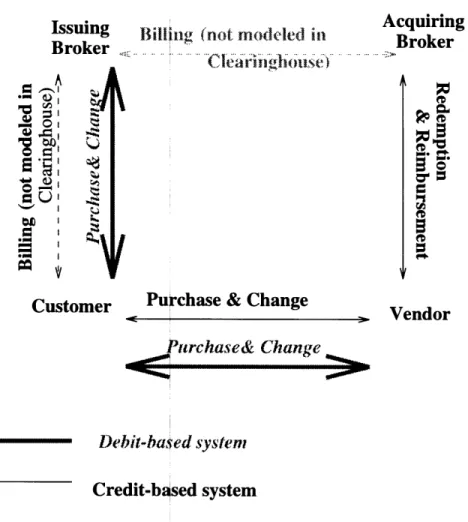
The interactions among the entities in a credit-based payment method are quite different from that in a debit-based payment method.' The differences are shown in figure 6-1. In a debit-based payment method, the customer issues a payment to purchase money from an acquiring broker.2 In a credit-based payment method, this
step is modeled as a billing process. For both types of payment methods, there is always a payment between the customer and the vendor. A debit-based vendor does
1
In this case, a debit-based payment system means that the payment method is debit-based from the viewpoints of all parties. The term "credit-based" also carries the same implication. This statement has to be made ýlear since there are payment methods which are in mixed mode (e.g. In MicroMint, customers have to purchase tokens from brokers in advance, while vendors have to redeem tokens from broker.) [1, 20] . It will be very confusing to ORBlite users if they try to reason the model with a mixed-motle payment methods
2
Issuing Broker A 1 011 U I~OI a=I "3 Qit ! V Customer
Acquiring
Billrng (not modeled in
Broker
SClreaorrmhose
Purchase & Change
IC : Vendor
archase& Change
Debit-baSed system
Credit-based system
Figure 6-1: Payment-cycle model for credit- and debit-based payment methods in Clearinghouse.
not need to redeem a payment from the acquiring broker since a customer has paid for it in advance. A credit-based vendor, however, has to issue a redemption to the acquiring broker. The interactions between the issuing and the acquiring broker are always modeled as billing processes.
6.1.3
PayMethod Entities
Based on the modeling discussed in the previous two chapters, a payment method should provide the following three entities:
* Customer : A customer holds "unspent" payments.
I .
a.
.i
i.
o ots- )
* Vendor: A vendor should collect payments and turn them from an "unspent" state to a "spent" state.
* Broker: A broker collects "spent" payments.
The modeling of issuing brokers and acquiring brokers has been merged; this is because the relationship between the two is not modeled in Clearinghouse, and merging the two entities will not affect the operations of the rest of the entities.
6.1.4
PayMethod Data
A payment method should also have data structures for a payment, redemption, and receipt. A receipt is a merged data structure for change and reimbursement. As discussed earlier in section 6.1.1, they are modeled as the same data in Clearinghouse.
6.1.5
PayMethod Functions
To generate a payment, redemption, and a receipt, a payment method requires a set of data generating functions: withdraw, redeem, change, and reimburse. The data also require a set of verifying functions and functions which "adjust or undo" the effect of data generation and verification.
However, depending on whether a payment method is a credit-based, debit-based, or even a mixed-mode payment method, the above functions may belong to different entities for different payment methods. For example, in Millicent [4] (a debit-based payment method), a change has its own data structure and is issued by a Millicent broker or vendor. While in PayWord [20] (a credit-based payment method), a change can be modeled as a payment and thus can be issued by a PayWord customer. There-fore, the abstraction layer should not declare interfaces for the PayMethod functions in PayMethod entities.
6.1.6
Configuration
Each payment method may have its own set of parameters. For example, in PayWord [20], the denomination of a chain and the validity of a commitment should be config-urable by Clearinghouse users. This set of data should not be pre-defined in Wallet or other data types within Clearinghouse, since this will violate the paymethod abstrac-tion layer. Derived payinethods should be allowed to provide its own configuraabstrac-tion parameters to Clearinghouse users.
6.2
Implementation Details: PayMethod
PayMethod is the implementation of the paymethod abstraction layer. It is an abstract base class, and it defines the interfaces on which a payment method (represented as a derived class) is based. Besides forming a skeleton for the design of derived payment methods, this paymethod abstraction layer maintains all payment methods currently supported by the payment framework. PayMethod consists of nine nested classes which form a basic structure for derived payment methods. These nested classes are: Info, Handle, Customer, Vendor, Broker, Payment, Redemption, Receipt, and AckInfo.
6.2.1
PayMethod::Handle
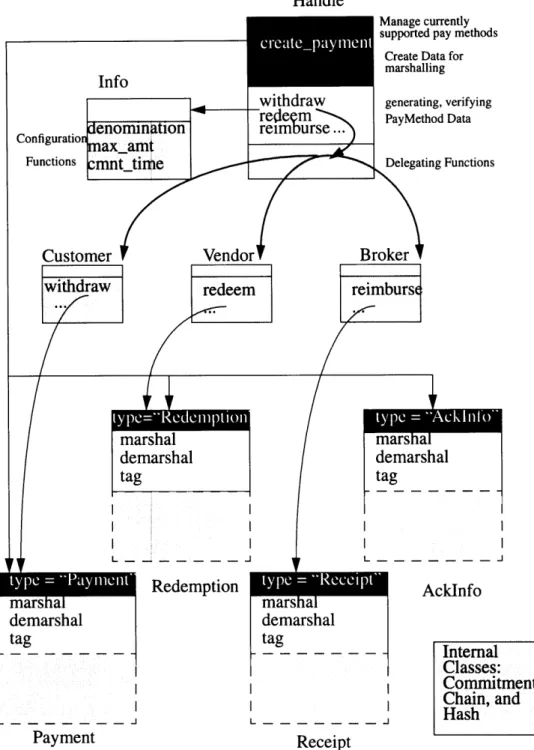
PayMethod::Handle is the core of the paymethod abstraction layer. It is the entry point for Wallet to reach other nested classes in PayMethod. PayMethod::Handle has three functionalities. It is responsible for declaring the interface for derived payment methods, creating (and deleting) derived paymethod data, and managing payment methods currently supported by the abstraction layer.
Job Dispatching Interface
virtual PayMethod::Payment *withdraw(const AuthInfo &,
const Certificate &recipient, const Orblite::ULong amt) = 0; virtual PayMethod::Redemption *redeem(const AuthInfo &,
const Certificate &recipient) = 0; virtual PayMethod::Receipt *change(const AuthInfo &,
const PayMethod::AckInfo &, const Orblite::ULong amt) = 0; virtual PayMethod::Receipt *reimburse(const AuthInfo &,
const PayMethod::AckInfo &,
const Orblite::ULong amt) = 0; virtual PayMethod::AckInfo *ack_info(const AuthInfo &) = 0;
virtual Orblite::Long verify(const AuthInfo &,
PayMethod::Payment &) = 0; virtual Orblite::Long verify(const AuthInfo &,
PayMethod: :Redemption &) = 0; virtual Orblite::Long verify(const AuthInfo &,
PayMethod::Receipt &) = 0; virtual Orblite::Boolean readjust(const AuthInfo &,
PayMethod::Payment &) = 0; virtual Orblite: :Boolean readjust(const AuthInfo &,
PayMethod::Redemption &) = 0; virtual Orblite:I:Boolean revert(const AuthInfo &,
PayMethod::Receipt &) = 0; virtual Orblite::Boolean revert(const AuthInfo &,
PayMethod::Payment &) = 0; virtual Orblite::Boolean revert(const AuthInfo &,
PayMethod::Redemption &) = 0;
As discussed in section 6.1.5, the generation, verification, and reversion of a pay-ment, redemption, and receipt may be defined in different entities (nested classes) in different derived payment methods. PayMethod::Handle has declared a set of inter-faces (C++ pure virtual functions) so that derived instances of PayMethod::Handle
can redirect incoming requests to the entities implementing the actual functions. Therefore, derived payment methods have the flexibility of implementing the gen-erating, verifying, and reverting functions in different entities. Derived paymethod handles are expected to have references to the their entities.3
3
Creating Paymethod Data
Class PayMethod::Handle also provides functions to create empty instances of derived paymethod data. They are used for demarshalling data from a stream back to derived paymethod data (discussed further in section 10.1).
The following is a list of functions for creating paymethod data in PayMethod::Info: public:
static Payment *create_payment(const Orblite: : Identifier &tag); static Redemption *
create_redemption(const Orblite: : Identifier &tag);
static Receipt *create_receipt(const Orblite: :Identifier &tag); static AckInfo *create_ackinfo(const Orblite::Identifier &tag); private:
virtual Payment *payment() const = 0;
virtual Redemption *redemption() const = 0; virtual Receipt *receipt() const = 0;
virtual AckInfo *ackinfo() const = 0;
Managing Currently Supported Payment Methods
PayMethod::Handle maintains a list of instances of derived PayMethod::Handle which have been linked into the payment framework. These functions for managing the currently supported payment methods are not to be inherited. PayMethod::Handle declares the interface for creating and deleting any payment methods. Wallet locates the desired payment method handle and asks it to create an instance of its own type. The deletion is handled by the paymethod abstraction layer, and it deletes any handles in a user wallet (even the ones that are no longer supported by the abstraction layer) as long as the actIion is authenticated. Each derived PayMethod::Handle has to provide implementation for creating and deleting a handle.
When each derived payment method is linked to the payment framework, the pay-ment method will automatically register itself to the instance list of PayMethod::Handle. The implementation of this registration technique is the same as that of the transport abstraction layer in ORIlite [9].
6.2.2
PayMethod::Info
PayMethod::Info is referenced by PayMethod::Handle. It is the only nested class whose derived instances will be exposed to an ORBlite user. It provides a means to an ORBlite user to configure default parameters of each derived payment method. Providing a configuration channel for each payment method removes the need to pre-define a set of parameters for different payment methods in user wallets.
6.2.3
PayMethod::Customer/Vendor/Broker
The actual job requests from wallet, such as withdraw and change, are implemented by the derived classes of PayMethod::Customer, PayMethod::Vendor, and
PayMethod::Broker. PayMethod::Customer/Vendor/Broker provide very light inter-faces. This provides the flexibility for the derived payment method to decide which entity should actually handle a dispatched job. The reason for defining the three enti-ties is to provide a logical separation among the job requests from a wallet. Functions in a derived class of PayMethod::Customer should only handle "unspent payments." A derived PayMethod::Vendor is responsible for turning "unspent payments" into "spent payments." A derived PayMethod::Broker verifies "spent payments."
6.2.4
PayMethod Data
PayMethod Data is a general term for the nested classes whose derived instances will be sent through the communication protocol. These nested classes are: PayMethod:: Payment, PayMethod::1Redemption, PayMethod::Receipt, and PayMethod::AckInfo.
As the names suggested, PayMethod::Payment and PayMethod::Redemption are the abstract base classes for a payment and a redemption respectively. PayMethod:: Receipt contains a change for a payment or a reimbursement for a redemption. PayMethod::
AckInfo provides the sp ecification to Clearinghouse servers to generate change or reimbursement in a specified payment method.
IDL compiler generates the marshaling and demarshalling functions automatically and is a quick way to create a transmittable data representation for PayMethod data. The use of IDL-generated types will be seen often in other classes, such as PayWord, where data are going to be sent through a communication protocol.
The following shows the class declaration of PayMethod::Payment. The other three classes have the same function declarations.
class Payment
{
public:
virtual "Payment ();
virtual Orblite: :Boolean
marshal(_OrbliteTransportOutStream &) = 0; virtual Orblite ::Boolean
demarshal(_Orblite_TransportInStream &) = 0;
virtual const Orblite: :Identifier &tag() const = 0;
static const Orblite::Identifier &type();
As a result of being transmittable data types, the four abstract base classes declare two pure virtual functions: marshal() and demarshal(). In addition, tag() is declared as a pure virtual function to obtain the name of the derived payment method. As explained later in section 10.1.2, it is important to accompany a payment data with this information, since data being demarshaled from the wire are series of bytes which do not provide any information to turn the data back to their original forms. Function type() is defined for the same reason. Since all derived classes of each payment data are of the same type, either be Payment, Redemption, Receipt, or AckInfo, this function needs not be virtual at all.
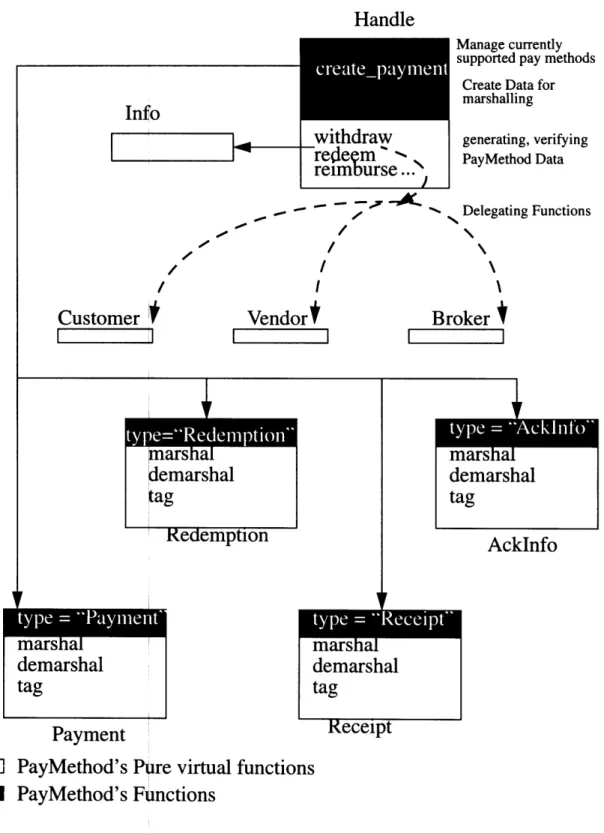
Figure 6-2 gives a structure of the PayMethod abstraction layer. The dotted lines mean that the dependencies between PayMethod::Handle and PayMethod entities are to be defined by PayMethod's derived class. The heights of the boxes reflect the number of functions defined for the classes.
Handle
sInfo
withdraw
redmurse m
...
reimbursev..
- N vanage currently upported pay methods Create Data for marshalling generating, verifying PayMethod Data Delegating FunctionsCustomer
I
IZ
Vendor*
zI
I
I
Broker
I
demarshal
tag
Redemption
Payment
PayMethod's Pure virtual functions
PayMethod's Functions
demarshal
tag
AckInfo
Keceipt
Figure 6-2: The module dependency diagram of PayMethod, the implementation of the paymethod abstraction layer.
marshal
demarshal
tag
M LII
r 1typ
Reep
tp=Acif
Chapter 7
Pay Word
7.1
Design Issues
PayWord is chosen as the payment method to demonstrate the use of the paymethod abstraction layer. The selection is based on two reasons. Firstly, an invocation of an object may cost infinitesimal amount. Therefore, the transaction should be handled by a payment method that provides a decent level of security and yet be computation-or stcomputation-orage-wise economic fcomputation-or small payments. PayWcomputation-ord amcomputation-ortizes the use of strong encryption algorithms (e.g. public key cryptography with long key lengths) to bring down the overhead cost of transactions.
Secondly, PayWord is a credit-based micropayment scheme. Money in PayWord is generated by customers. This has the advantage over a debit-based payment method in the framework development, since a debit-based payment method requires another payment method to acquire tokens prior to a payment.
7.1.1
The PayWord Protocol
The following is a sumnmary of the PayWord protocol extracted from [1]. A detailed description of PayWord can be found in [20].
Introduction
The PayWord protocol is proposed together with MicroMint. PayWord is a credit-based protocol to a customer, vendor, and broker. It is credit-based on a chain of hash values, called paywords [20]. Each payword represents a particular denomination or unit of value.
Paywords, Commitment, and User Certificate
Paywords are generated by a customer. They can be generated in advance or at the time of a purchase. To make a payword chain, a customer picks a random number as the nth payword, wn, and it is the "seed" for generating the rest of the paywords in the chain according to the following rule:
wi-1 = h(wi); where i = 1,..., n (7.1) where h is a cryptographically strong function, such as MD5 [19], which has to be one-way and collision-resistant. The last value computed, wo, is not part of the payword chain; it is the "root" of the chain and is embedded in a user-vendor-specific commitment.
A commitment authenticates w0o, and wo verifies the payword chain ({ wl, .. wn
}).
The chain is committed to a particular user-vendor relationship once its wO has been bound to a commitment (M). M is a signed message by a customer (shown in EQ 7.2). It consists of wo, a vendor identity V, the customer's certificate Cu, an expiration date D, and other information (IM) necessary for the commitment.
M = {w0o, V, Cu, D, IM}SKu (7.2) Before any transaction takes place, the customer must get a user certificate from a broker. The certificate (Cu) authenticates the customer's public key, which is used to sign a commitment during a purchase. Cu is a signed message consisting of the broker's identity, the customer's public key, the expiration date, and other related information.
Cu = {Broker id, customerpublic_key, expiration-date, other_in
fo}sK
The three types of data work together to provide a secure purchase. A payword is sent unencrypted, but it is authenticated by a user-vendor-specific commitment. The user's public key used for signing the commitment is in turn authenticated by the user's certificate.
Making Purchases
First, a customer sends a vendor a commitment (M, defined in EQ 7.2). The vendor decrypts M with the customer's public key and verifies V and D. The customer signature is proven by Cu. Thus, a third party cannot forge a commitment by signing it with an invalid key, nor can he pretend to be the customer without knowing the customer's private key. If M is verified, the vendor stores it until it expires.
When the customer wants to make a purchase with one payword, he sends a pair,
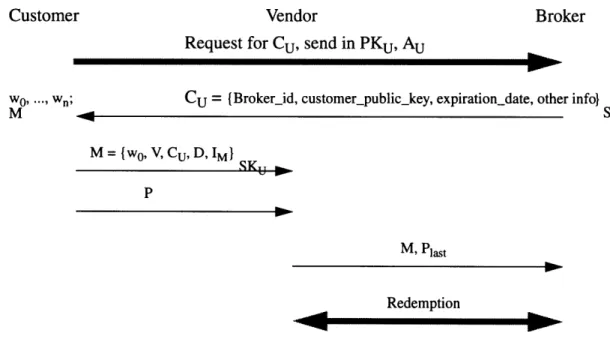
P = (wi, i), , where 1 < i < n . The vendor will see if h(w ) equals the payword previously sent. If verified, the vendor stores this last received payword pair (Plast), and the payment is considered valid. Figure 7-1 gives a summary of the Payword protocol (including redemption, which will be discussed in next subsection).
If a purchased item costs more than the value of one payword, the customer can pay more by skipping paywords. Assuming that the next unspent payword is wi + 1, each payword is worth one cent, and the item costs 5 cents, the customer can skip the first four unspent paywords and send (wi + 5, i + 5). The vendor verifies this pair by hashing the payword 5 times.
Redemption
A vendor only needs M and the last payword pair received (Past) for redemption. A broker verifies M and makes sure the last payword can be hashed into wi after last times. If every thing looks right, the broker debits the customer's account and credits
Request for CU, send in PKU, Au ---- ---
f o
w0, ..., Wn;
M CU = {Broker_id, customerpublic_key, expiration_date, other info} M = {wo, V, CU, D, SKB I SK M, Plast Redemption
4
c
Figure 7-1: Summary of the Payword protocol. Thick arrows represent interactions using non-Payword protocols.
r
the vendor's.
Forgery Prevention
Spent paywords are the one-way hash values of the unspent paywords of the same chain; therefore, knowing the spent paywords should not expose the value of the unspent ones. A payword chain is authenticated by a commitment, and it is signed by the customer. The identity of the customer is ensured by the user certificate (Cu), and it is signed by the broker.
Double Spending Detection
A payment in the Payword protocol consists of a commitment and its corresponding
set of paywords. Therefore, double spending in Payword means replaying the same paywords with the same commitment. The last spent payword and the root allow a vendor or a broker to keep track of all the spent paywords of a commitment. Replaying valid commitments can be found by searching for duplicates in a database. A vendor should store all the valid commitments received to prevent a customer from replaying a valid commitment. The broker should do the same to prevent the vendor from double depositing.
7.2
Implementation Details-PayWord
Class PayWord is a derived class of PayMethod. Besides the nine classes which are derived from the abstract base class, PayWord has implemented four additional classes: PayWord::Hash, PayWord_Chain, and PayWord_Commitment.' These four additional classes specific for the PayWord protocol and are used internally among the PayWord classes, and they will not be exposed to the paymethod abstraction layer. In the following subsections, the added four classes will be introduced first. Then PayWordPayment, PayWord RedemptionList, PayWord_AckInfo, and
Pay-'It seems that there is an inconsistent naming convention for PayWord. PayWord::Hash is defined as a nested class in an IDL file, while the rest are C++ implementation done by hand.
WordReceipt will be discussed. After that, PayWord_Customer, PayWord_Vendor, and PayWordBroker will show how the dispatched functions are categorized among the three according to the modeling of a credit-based payment method. Finally, the configuration capability of PayWord_Info will be discussed.
7.3
Implementation Details
7.3.1
PayWord::Hash
Design Issues
In the proposed PayWord protocol [20], the value of a payword hash represents a payment and is sent to the vendor. PayWord::Hash holds the hash value and is represented as a sequence of unsigned characters.
Implementation Details
PayWord::Hash contains a hash value of a payword chain, and its value has to be transmittable; therefore, it is represented as an IDL-generated type.
Currently, PayWord::Hash interacts with the rest of PayWord classes directly; however, a wrapper class could be defined to unify the naming convention of the PayWord classes.
7.3.2
PayWord_Chain
Design Issues
PayWord_Chain stores a series of payword hashes which are generated by the root
(also a payword hash) of the chain. It is represented as a singly linked list of entries each of which holds a payword hash. It is used by all PayWord classes except for Pay-Word_Info and PayWordHandle. PayWord_Chain is responsible for creating a series of paywords which are generated by a MD5Glue's function, verifying an incoming payword, and generate a payment.
PayWord_Chain also contains denomination and other data members required to keep track of the current status of the chain. Locks and mutexes are used to ensure that atomic insertion and deletion of entries are performed. Locks and mutexes are available from the standard ORBlite library.
Implementation Details
The following shows a subset of the class declaration of PayWord_Chain.
class PayWord_Chain
{
public:
PayWord_Chain(Orblite::ULong amt, Orblite::ULong den = 1); PayWordChain(PayWord::Hash &root, Orblite::ULong den);
"PayWordChain();
Orblite::Long verify(PayWord::Hash &, Orblite::ULong i);
struct PayWordPair {
PayWord: :Hash pwh; Orblite: :ULong pos;
};
PayWord_Pair payword(Orblite::ULong amt); PayWord::Hash root() const;
Orblite::ULong length() const; Orblite::ULong amt_left() const; Orblite::ULong denomination() const;
};
PayWord_Chain has two constructors. The first one is used for chain generation when a payment is issued. It is stored in payword_customer. It takes in the total amount for the chain and the denomination as parameters; a chain created by this constructor will get a seed and automatically generate a series of payword hashes (according to EQ 7.1). The random number of the root is obtained from PGP::seed, and the series of hash values is generated by MD5Glue::createmd.
The second constructor is used for storing verified payword payments. This con-structor takes in as parameters the root and the denomination from a received