HAL Id: hal-00524558
https://hal.archives-ouvertes.fr/hal-00524558v2
Submitted on 30 May 2011
HAL is a multi-disciplinary open access
archive for the deposit and dissemination of
sci-entific research documents, whether they are
pub-lished or not. The documents may come from
teaching and research institutions in France or
abroad, or from public or private research centers.
L’archive ouverte pluridisciplinaire HAL, est
destinée au dépôt et à la diffusion de documents
scientifiques de niveau recherche, publiés ou non,
émanant des établissements d’enseignement et de
recherche français ou étrangers, des laboratoires
publics ou privés.
Parity Broken Chiral Spin Dynamics in
Ba_3NbFe_3Si_2O_14
Mickael Loire, Virginie Simonet, Sylvain Petit, Karol Marty, Pierre Bordet,
Pascal Lejay, Jacques Ollivier, Mechthild Enderle, Paul Steffens, Eric
Ressouche, et al.
To cite this version:
Mickael Loire, Virginie Simonet, Sylvain Petit, Karol Marty, Pierre Bordet, et al.. Parity Broken Chiral
Spin Dynamics in Ba_3NbFe_3Si_2O_14. Physical Review Letters, American Physical Society, 2011,
106 (20), pp.207201. �10.1103/PhysRevLett.106.207201�. �hal-00524558v2�
M. Loire, V. Simonet, S. Petit, K. Marty, P. Bordet, P. Lejay, J. Ollivier,4 M. Enderle,4 P. Steffens,4 E. Ressouche,5 A. Zorko,6, 7 and R. Ballou1, ∗
1Institut N´eel, CNRS & Universit´e Joseph Fourier, BP166, 38042 Grenoble Cedex 9, France 2Laboratoire L´eon Brillouin, CEA-CNRS, CE-Saclay, F-91191 Gif sur Yvette, France
3Oak Ridge National Laboratory, Oak Ridge, Tennessee 37831 USA 4Institut Laue Langevin, BP156, 38042 Grenoble Cedex 9, France
5Institut de Nanosciences et Cryog´enie, SPSMS/MDN, CEA-Grenoble, 38054 Grenoble Cedex 9, France 6”Joˇzef Stefan” Institute, Jamova 39, 1000 Ljubljana, Slovenia
7EN → FIST Centre of Excellence, Dunajska 156, SI-1000 Ljubljana, Slovenia
(Dated: May 30, 2011)
The spin wave excitations emerging from the chiral helically modulated 120◦ magnetic order in
a langasite Ba3NbFe3Si2O14 enantiopure crystal were investigated by unpolarized and polarized
inelastic neutron scattering. A dynamical fingerprint of the chiral ground state is obtained, sin-gularized by (i) spectral weight asymmetries answerable to the structural chirality and (ii) a full chirality of the spin correlations observed over the whole energy spectrum. The intrinsic chiral nature of the spin waves elementary excitations is shown in absence of macroscopic time reversal symmetry breaking.
PACS numbers: 75.25.+z,77.84.-s,75.10.Hk
Ubiquitous in nature, chirality is what distinguishes a phenomenon from its materialization in a mirror [1]. Condensed matter physics and especially magnetism pro-vide a rich playground to investigate this phenomenon as it appears naturally to describe the arrangement of magnetic moments in non collinear magnets. The chiral-ity accounts there for the sense of rotation of the spins on moving along an oriented line. The latter can be a straight line around which the spins form an helix, or an oriented loop, for instance a triangle, at the summits of which the spins are orientated at 120◦ of each other
(see Fig. 1). For such coplanar spin configurations, it can be uniquely characterized on a bond connecting two consecutive spins ~Si and ~Sj by the parity breaking
vec-tor product ~χij = ~Si∧ ~Sj, defining the magnetic vector
chirality. As far as domains of opposite chiralities are equipopulated, the chirality is usually averaged to zero in centrosymmetric magnets. However, neutron scattering experiments evidenced a pure macroscopic chiral phase in non-centrosymmetric compounds [2, 3], as for instance the Ba3NbFe3Si2O14langasite [4].
While these studies focused on the ground state prop-erties, the way the associated excited states inherit from the chiral properties remains an open issue. In this letter, we address this intriguing question, investigating the spin dynamics in a Ba3NbFe3Si2O14 single crystal by means
of polarized neutron scattering experiments. Our study provides evidence for a fully chiral spin excitation spec-trum over the whole energy range. Chiral dynamics was already evidenced in a variety of magnetic materials [5– 11], but we emphasize that these studies were carried out under a magnetic field, revealing the chirality through a macroscopically breaking of the time reversal symmetry. In the Ba3NbFe3Si2O14 case, the chiral dynamics is
ob-c c ε =-1 ε =+1 εH=+1εH=-1 J3 J5 J4 a b J1 J2 b b J b a J2 a 2 c
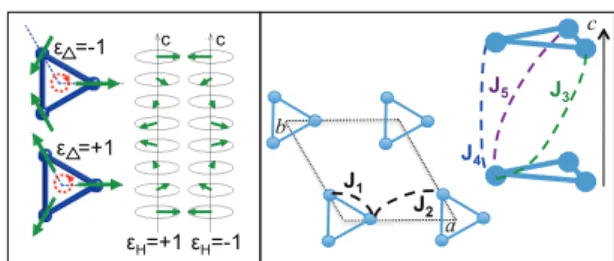
FIG. 1: from left to right: the two triangular chiralities ǫ△=
±1, the two helicities ǫH = ±1, and the magnetic exchange paths J1 to J5 in Ba3NbFe3Si2O14.
served in zero field, thus ascribable solely to the space inversion symmetry breaking. To our knowledge, this has never been reported so far.
The langasite Ba3NbFe3Si2O14presents static chirality
properties [4, 12, 13] hereafter briefly recalled. It crystal-lizes in the acentric space group P321 which confers the compound a structural chirality denoted ǫT = +(−)1
for right(left)-handedness. The magnetic carriers are the Fe3+ ions (S = 5/2, L = 0), arranged on small triangle
units (trimers) whose centers form triangular lattices per-pendicular to the trigonal c axis (see Fig. 1). A magnetic order sets in below the N´eel temperature TN = 27 K with
spins lying in the (a, b) plane and with the same 120◦
con-figuration on each trimer. This arrangement is helically modulated along the c axis with the period 1/τ ≈ 7 (see Fig. 4 of ref. 4). This magnetic order exhibits a single chirality of the helical order (named helicity), de-noted ǫH, and a single triangular chirality, denoted
ǫ△(see Fig. 1). We note that ~χij = S2sin(2πτ )ǫHc forˆ
consecutive spins along c andP∆ ~χij = (3
√
3/2)S2ǫ △ˆc
2 (0 k -1+τ) c* b* Q IN20 IN5 1 meV 2 meV 3 meV (0 -1 ) ℓ (0 0 ) ℓ (0 0 ) ℓ (0 0 ) ℓ −τ +τ −τ +τ
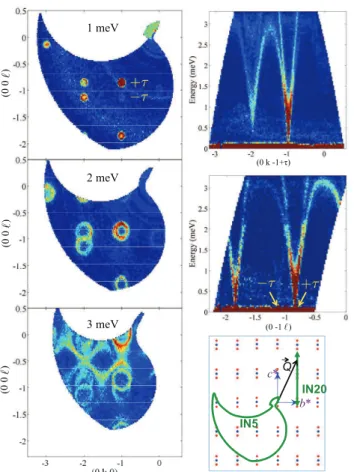
FIG. 2: Inelastic neutron scattering intensities at 1.6 K in the (b∗, c∗) scattering plane on the time-of-flight
spectrome-ter IN5. Displayed are intensity maps at constant transfer en-ergy (enen-ergy-cuts) and intensity maps along (0, k, −1+τ ) and (0, −1, ℓ) lines in the reciprocal space ( ~Q-cuts). In the bot-tom right sketch, the green area and arrow show the probed reciprocal vectors on the IN5 and IN20 spectrometers.
to +1(−1) for the right(left)-handed sense of rotation. According to [14, 15], polarized inelastic neutron scat-tering can probe the dynamical spin chirality. This ex-tends the concept of static chirality to the dynamics by following the orientation changes during coherent mo-tions of spins in space and time. Its statistical aver-age is proportional to the antisymmetric off-diagonal dy-namical magnetic susceptibility [16, 17]. We thus con-ducted experiments on the triple-axes spectrometer IN20 at the ILL in its polarized neutron set up, with polariz-ing Heusler crystals as monochromator and analyzer. We used the CRYOPAD device, to obtain strict zero-field environment at the sample position, and to prepare in-coming and outgoing neutron polarization independently. Ef =14.7 meV was kept fixed yielding an energy
resolu-tion of ≃ 1 meV and second order contaminaresolu-tions were removed by a PG(002) filter. The crystal, aligned with (0, k, ℓ) as scattering plane, was cooled down to 1.5 K in an Orange cryostat. Different cross sections were mea-sured, σ↑↑, σ↑↓ and σ↓↑where the subscripts indicate the
!"
(0 1 ) ℓ
−τ +τ −τ +τ
FIG. 3: (a-d) Magnetic scattering S( ~Q, ω) (red) and chiral contribution C( ~Q, ω) (blue) as a function of the transfer en-ergy at selected scattering wavevectors (0, 1, ℓ), extracted at 1.5 K by longitudinal neutron polarimetry on the triple-axis spectrometer IN20. The spectral weight is only significant for the branch emerging from the −τ magnetic satellites. (e) Dis-persion of the chiral scattering C( ~Q, ω) obtained by gathering the measurements at all ℓ.
incoming/outgoing neutron polarization parallel ↑ or an-tiparallel ↓ to the scattering vector ~Q. Additional cross sections were measured at selected points in ~Q and en-ergy transfers ~ω, allowing to separate the magnetic sig-nal from background, and to verify that phonon and in-coherent scattering are negligible in the investigated re-gion. σ↑↑ could therefore be used as background above
≈1.5 meV. The magnetic dynamical structure factor was then obtained by S( ~Q, ω) = 1
2π~
R
hMy( ~Q, 0)My(− ~Q, t) +
Mz( ~Q, 0)Mz(− ~Q, t)ie−iωtdt = (σ↑↓+ σ↓↑)/2 − σ↑↑ and
the chiral magnetic dynamical scattering by C( ~Q, ω) =
1 2π~
R
hMy( ~Q, 0)Mz(− ~Q, t) − Mz( ~Q, 0)My(− ~Q, t)ie−iωtdt
= (σ↑↓− σ↓↑)/2. Here, My,z( ~Q, t) are the Fourier
trans-formed spin components at time t perpendicular to ~Q within (y) or perpendicular (z) to the scattering plane.
To get first a global overview of the spin waves, an experiment using unpolarized neutrons was performed on the time-of-flight spectrometer IN5 at the ILL on a single crystal in rotation around the vertical zone axis a [18].
(0 k -1+τ) (0 -1 ℓ ) (0 0 ) ℓ 1 meV (0 0 ) ℓ 3 meV 2 meV (0 0 ) ℓ 3 meV (0 0 ) ℓ 1 meV
FIG. 4: Dynamical structure factor calculated in the linear approximation from the minimal model (see text) to compare with the measurements of Fig. 2.
The incident wavelength was fixed to 4 ˚A, the chopper speed to 16000 rpm, yielding an elastic energy resolution ≃ 0.1 meV. Standard corrections and a background (high temperature scan) subtraction were performed. The data were then reduced with the Horace suite software [19] to obtain the excitation spectra as function of ( ~Q,ω).
Fig. 2 summarizes our inelastic unpolarized neutron scattering results obtained on IN5. Two spin wave branches emerging from the ±τ magnetic satellites are identified [20]. They form delicate arches, with differ-ent maximum energies (lower branch clearly visible on IN5, maximum of the upper branch only observable on IN20). One of the branches is gapped with a minimum at around 0.4 meV whereas the other branch is found un-gapped down to the resolution (0.1 meV). A first unusual observation is the difference of intensities of the excita-tions emerging from the ±τ satellites associated to a node of the reciprocal lattice. This effect strongly depends on the considered reciprocal lattice node and is clearly vis-ible for instance around (0,-1,-1) in Fig. 2. This is a signature of the structural chirality as detailed below.
Fig. 3 gathers our inelastic polarized neutrons scatter-ing results of IN20. Energy-scans at constant ~Q were per-formed for different ℓ values along (0, 1, ℓ) with ℓ ranging
εT = -1 εT = +1 (0 1 ) ℓ (0 1 ) ℓ εT = -1 εT = -1 εT = +1 εT = +1 (εH=+1, ε =-1) (εH=+1, ε =+1) (εH=-1, ε =+1) (εH=-1, ε =-1) S( Q, ω) C( Q, ω) −τ +τ −τ +τ
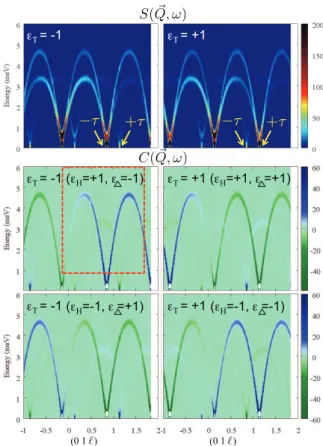
FIG. 5: Top: computed magnetic scattering S( ~Q, ω) for the two structural chiralities ǫT ±1. Below each of them,
com-puted chiral contribution C( ~Q, ω) for the 2 associated mag-netic ground states (ǫH, ǫ△ = ǫHǫT). The red frame points
out the calculation agreeing with the experiment in Fig. 3.e.
from -τ = −1
7 to 1.7 (see sketch in Fig. 2). The
mag-netic scattering S( ~Q, ω) (red lines in Figs. 3a-d) con-firms the magnetic origin of the two modes, although they are not as well separated as on IN5, due to the lower energy resolution. By extracting the chiral contri-bution C( ~Q, ω) (in blue), it is found that the lower mode is achiral (C( ~Q, ω)=0) whereas the upper mode has fi-nite chirality (see Fig. 3d and e). In addition, C( ~Q, ω) is positive and has a tendency to become negative for negative ℓ (compare Fig. 3a and c at low energy). This change of sign is due to the fact that the neutron probes the moment component perpendicular to ~Q, C( ~Q, ω) cor-responding then to the projection of the Fourier trans-formed dynamical chirality onto ~Q. This result actually perfectly reflects a globally unchanged chirality of the upper branch all the way up to the maximum of the dis-persion. At large ℓ values, C( ~Q, ω) equals the amplitude of S( ~Q, ω) (see Fig. 3d), pointing at a full chirality of the upper branch without chirality mixing.
To shed light on this remarkable result, a character-ization of the ground state can be done from a careful analysis of the spin waves. We propose a model, based
4 on mean-field calculations, that accounts qualitatively for
the magnetic order [4] (see Fig. 1). The in plane 120◦
spin arrangement is first stabilized by antiferromagnetic intra-trimer J1 and inter-trimer J2 interactions within
the (a, b) planes. Next, three inter-plane interactions J3
to J5, connect each moment to the 3 moments of the
up-per/lower trimer along the c axis. The acentric structure imposes different J3and J5, oppositely twisted around c.
The dominant one drives the helical modulation accord-ing to the structural chirality (J5 > J3,J4 for ǫT = −1
and J3 > J4,J5 for ǫT = +1). The two weakest
inter-actions allow tuning the periodicity τ of the helix. This model implies that the magnetic and structural chirali-ties are related (ǫ△ = ǫTǫH): for the investigated
crys-tal, ǫT = −1 is observed (strong J5), imposing opposite
senses of rotation for the helicity and the triangular chi-rality. We are left with two different solutions (out of four) for the magnetic chiralities (ǫH = +1, ǫ△ = −1)
and (ǫH = −1, ǫ△ = +1). The observed ultimate
se-lection of a single magnetic chirality was proposed [4] to originate from the antisymmetric Dzyaloshinskii-Moriya (DM) exchange interaction ~D.(~Si× ~Sj) with ~D the DM
vector, allowed in absence of inversion symmetry center between spins ~Si and ~Sj. It suffices to consider the DM
interaction inside the trimer with the same DM vector along the c axis for the three bonds [21]. This favors planar spin components and its sign selects a triangular chirality ǫ△, and hence a helicity ǫH since ǫ△= ǫTǫH.
Using the standard Holstein-Primakov formalism in the linear approximation [22], we computed S( ~Q, ω) and C( ~Q, ω) at zero temperature. As shown by the com-parison of Fig. 2 and 4, a good agreement between ex-periment and calculation is achieved with the exchange parameters (in meV) J1= 0.85 ± 0.1, J2 = 0.24 ± 0.05,
J3 = 0.053 ± 0.03, J4 = 0.017 and J5 = 0.24 ± 0.05
and a DM vector along c of ≈ 1%|J1|. The latter was
checked to produce the lower branch gap and to select a triangular chirality [23]. J3, J4, J5 were constrained to
fulfill the τ = 1/7 conditions and the set of best param-eters yields a Curie-Weiss temperature of 191 K, within less than 10% of the values obtained from susceptibility measurements [4, 24]. Other models have been proposed from spin wave measurements in Ba3NbFe3Si2O14, but
they fail in reproducing all the features revealed in our measurements [25, 26]. Interestingly, as shown by the calculations in Fig. 5, S( ~Q, ω) reflects the structural chi-rality: the asymmetric spectral weight of the branches emerging from the +τ and −τ satellites is inverted for ǫT = ±1. On the other hand, for a given ǫT, S( ~Q, ω)
does not depend on ǫ∆. The two corresponding magnetic
ground states yield however C( ~Q, ω) with opposite sign (see Fig. 5). S( ~Q, ω) and C( ~Q, ω) therefore provide with a strong dynamical fingerprint of the ground state chiral-ity. Finally, the calculated chiral scattering for (ǫH = +1,
ǫ△= −1) reproduces very well the measurements of Fig.
3: its sign, the absence of chirality of the lower branch and the full chirality of the upper branch. The calculated correlation functions show that the spins components in-volved are along a and b for the upper branch, and only along c for the lower branch, which yields a zero spin cross product and explains the absence of chirality.
In summary, the spin waves excitation modes emerg-ing from the totally chiral magnetic order in a struc-turally enantiopure single crystal of Ba3NbFe3Si2O14are
extremely unusual. A spectral asymmetry is evidenced by inelastic unpolarized neutron scattering as a finger-print of the crystal chirality. In addition, the use of polar-ized neutrons and polarization analysis led to the discov-ery that the spin waves with in-plane spin correlations are fully chiral at all energies. Chiral dynamics was predicted from spin waves calculation for a Heisenberg triangu-lar antiferromagnet with unbalanced domains of opposite triangular chirality [17]. This condition is obviously real-ized with a single chirality domain in Ba3NbFe3Si2O14.
However, the absence of chirality mixing of the spin dy-namics is not only observed close to the magnetic satel-lites as calculated [17] but up to the maximum of the dispersion branches (≈4.8 meV). It finally will be em-phasized that the crystal was in a strictly zero magnetic field (even the Earth’s magnetic field is excluded from it) during the experiment on IN20. This establishes the observation of a dynamical chirality unbiased by macro-scopic time-reversal symmetry breaking, but solely asso-ciated with the space inversion symmetry breaking.
This work was financially supported by the ANR 06-BLAN-01871. We would like to thank B. Canals and A. Ralko for fruitful discussions, A. Hadj-Azzem, J. Balay and J. Debray for the sample preparation.
[1] G. H. Wagni`ere, On Chirality and the Universal Asym-metry, WileyVCH, Z¨urich, Weinheim, 2007.
[2] M. Ishida, et al., J. Phys. Soc. Jap. 54, 2975 (1985). [3] M. Janoscheck, et al., Phys. Rev. B 81, 094429 (2010). [4] K. Marty, et al., Phys. Rev. Lett. 101, 247201 (2008). [5] B. Roessli, et al., Phys. Rev. Lett. 88, 237204 (2002). [6] D. Grohol, et. al. Nature Materials 4, 323 (2005). [7] V. P. Plakhty, et. al., Physica B 385, 288 (2006). [8] H. Braun, et. al., Nature Physics, 1, 159 (2005). [9] R. M. Moon, T. Riste and W.C. Koehler, Phys. Rev.
181, 920 (1969).
[10] S. W. Lovesey and G. I. Watson, J. Phys.: Condens. Matter 10, 6761 (1998)
[11] A. Gukasov, Physica B 267, 97 (1999).
[12] K. Marty, et al., J. Magn. Magn. Mat. 321, 1778 (2008). [13] K. Marty, et al., Phys. Rev. B 81, 054416 (2010). [14] M. Blume, Phys. Rev. 130, 1670 (1963).
[15] S. V. Maleyev, V. G. Bar’yakhtar, and R. A. Suris, Fiz. Tverd. Tela 4, 3461 (1962).
[16] S. V. Maleyev, Phys. Rev. Lett 75, 4682 (1995). [17] A. V. Syromyatnikov, Phys. Rev. B 71, 144408 (2005).
[18] J. Ollivier, et al., Neutron News 21 (2010) 22.
[19] T.G. Perring, et al., (2009) unpublished, http://horace.isis.rl.ac.uk/.
[20] Less intense modes are also detected dispersing from the ±2τ satellites and from the nodes of the reciprocal lattice. [21] T. Moriya, Phys. Rev. 120, 91 (1960).
[22] T. Holstein, and H. Primakoff, Phys. Rev. 58, 1098 (1940).
[23] A magnetocrystalline anisotropy and a symmetry-allowed component of the intra-triangle DM vector along the bond connecting two spins were also considered with-out further improving the neutron data interpretation. [24] H. D. Zhou, et al., Chem. Mater. 21, 156 (2009). [25] C. Stock, et al. arXiv:1007.4216.