HAL Id: hal-03139281
https://hal.inria.fr/hal-03139281
Submitted on 11 Feb 2021
HAL is a multi-disciplinary open access
archive for the deposit and dissemination of
sci-entific research documents, whether they are
pub-lished or not. The documents may come from
teaching and research institutions in France or
abroad, or from public or private research centers.
L’archive ouverte pluridisciplinaire HAL, est
destinée au dépôt et à la diffusion de documents
scientifiques de niveau recherche, publiés ou non,
émanant des établissements d’enseignement et de
recherche français ou étrangers, des laboratoires
publics ou privés.
Copyright
Loop
Rafael Lima Costa, Aline Carneiro Viana, Artur Ziviani, Leobino Nascimento
Sampaio
To cite this version:
Rafael Lima Costa, Aline Carneiro Viana, Artur Ziviani, Leobino Nascimento Sampaio.
Tact-ful Networking:
Humans in the Communication Loop.
IEEE Transactions on Emerging
Topics in Computational Intelligence, Institute of Electrical and Electronics Engineers, 2020,
�10.1109/TETCI.2020.3039520�. �hal-03139281�
Tactful Networking:
Humans in the communication loop
Rafael Lima Costa, Aline Carneiro Viana, Artur Ziviani, and Leobino Nascimento Sampaio
Abstract—This survey discusses the human-perspective into networking through the Tactful Networking paradigm, whose goal is to add perceptive senses to the network by assigning it with human-like capabilities of observation, interpretation, and reaction to daily-life features and associated entities. To achieve this, knowledge extracted from inherent human behavior in terms of routines, personality, interactions, and others is leveraged, empowering the learning and prediction of user needs to improve QoE and system performance while respecting privacy and fostering new applications and services. Tactful Networking groups solutions from literature and innovative interdisciplinary human aspects studied in other areas. The paradigm is motivated by mobile devices’ pervasiveness and increasing presence as a sensor in our daily social activities. With the human element in the foreground, it is essential: (i) to center big data analytics around individuals; (ii) to create suitable incentive mechanisms for user participation; (iii) to design and evaluate both human-aware and system-human-aware networking solutions; and (iv) to apply prior and innovative techniques to deal with human-behavior sensing and learning. This survey reviews the human aspect in networking solutions through over a decade, followed by discussing the tactful networking impact through literature in behavior analysis and representative examples. This paper also discusses a framework comprising data management, analytics, and privacy for enhancing human raw-data to assist Tactful Networking solutions. Finally, challenges and opportunities for future research are presented.
Index Terms—Human behavioral perception, human-aware, next-generation networks.
I. INTRODUCTION
Computing and networking systems design are increasingly dealing with user expectations. The Multi-Protocol Label Switching (MPLS) and Software-Defined Networking (SDN) are examples of technologies apt to assist operators in pro-viding QoS and QoE services through user-oriented traffic differentiation. In the last decade, several initiatives based on direct user involvement gained attention as enablers for wireless communications, e.g., User-centric Networks, Device-to-Device Communication (D2D), and recently, User-in-the-loop and Human-in-the-User-in-the-loop proposals. Although having the user as the central concern, the first solutions in User-centric Networks still did not see the user as an individual, but rather as a network active element. Hence, frequently, only
Rafael L. Costa is with ´Ecole Polytechnique/IPP and Inria, France and with Federal University of Bahia, Brazil (e-mail: [email protected]); Aline C. Viana is with Inria, Palaiseau, France (e-mail: [email protected]); Artur Zi-viani is with the National Laboratory for Scientific Computing (LNCC), Brazil (e-mail: [email protected]); and Leobino N. Sampaio is with Federal University of Bahia, Brazil (e-mail: [email protected]). This work was supported in part by the FAPERJ, FAPESB, CNPq, CAPES, INCT-CiD, EMBRACE associate team Inria project, and ANR MITIK project (PRC AAPG2019).
user features measured from the network point of view were considered, ignoring the intrinsic ones from human activity, e.g., daily routines and personal preferences.
In the D2D initiatives, considered one of the 5G en-ablers [1], different proposals started to focus on human aspects, such as mobility and social links. Lately, “User-in-the-loop” and “Human-in-“User-in-the-loop” research brought more attention to taking advantage of human behavior’s unique features to leverage computing powers owned by users. In [2], authors survey recent “Human-in-the-loop” efforts and discuss topics such as crowdsensing applications and data assembly, incentive mechanisms for human-collaboration, human-data privacy, and exploring human factors through human-system interaction, user demand prediction, and learning-aided dy-namic system control. In this survey, differently from previous research, we bring a human perspective closer to individual aspects, considering attributes that could link to performance, plus decoupling the human factor from the networking system point of view, targeting a more personalized network service. Therefore, our goal is a more in-depth investigation about which aspects of human behavior and their peculiarities could help the modeling of future mobile networks, including knowl-edge from other areas like psychology and philosophy.
This paper argues that the following paradigm shift is required: from a network controlling, tracking, and monitoring networking usersto a network perceiving the needs and adapt-ing to inherent behaviors of humans behind networkadapt-ing devices while respecting their privacy. We denominate this paradigm Tactful Networking and it calls for having, progressively, computer networks and mobile devices that understand and react to human-behavior characteristics. Tactful Networking groups concepts from human behavior research, not only from computer networking but also from other areas. One of the goals of this paper is to bring a comprehensive survey digging into the human-traits peculiarities, showing the trend in human-aware networking. Thus, this paper advocates that by considering the tactful networking paradigm, consolidated technologies (e.g., MPLS, SDN) and novel ones can help achieve better QoE-aware services over the Internet.
Future wireless network generations, including their models, architectures, protocols, communication types, and related technologies, are expected to be tactful, i.e., sensitive and adaptive to human context, behavior, and interest. The tactful networking goal is to offer services that consider daily inherent human characteristics and behavior, including capabilities and perception, to fulfill user expectations more naturally.
The study of human behavior has occurred for years in psy-chology, physics, and sociology. Recent advances in big data
COPYRIGHT NOTICE
This is the accepted version (not the IEEE-published version) of the paper 10.1109/TETCI.2020.3039520
collection/analysis, machine learning, edge computing, haptic systems, human-computer interaction, computational social science, and other directions have shown that human-behavior investigation is also vital in networking [3], [4]. Examples of individual characteristics include mobility, preferences, in-terests, humor, sharing wills, age, socioeconomic status, or contextual routines, which can be studied to offer a proper human-aware network service. Incorporating the capability of human behavioral perception into networking solutions has the potential to bring an open-ended vision for what networks should be able to do while fostering the deployment of new 5G applications. This paper surveys literature works in this direction. The context herein discussed strengthens the need for the design of incentive and recommendation mechanisms and the emergence of innovative networking applications and services. It also offers support to new business models that, overall, are getting increasing interests from carriers and application developers. The implementation of tactful networking can become a win-win situation. The user will have better QoE when accessing an operator network closer to her requirements (thus bringing her the feeling of accessing personally designed services; one of the future considerations envisaged in 6G). Meanwhile, an operator can maximize profit by managing resources and system performance with lower cost while offering new user-behavior-based services.
This paper’s central focus is thus to discuss why and how the humans can be under the spotlight for future generation network architectures. This paper’s contributions feature a survey on human behavior’s evolution as a central element for dealing with challenges into networking solutions. We cover over a decade of initiatives through a timeline in which we see a considerable change towards understanding the human role in computer networks. This change culminates into what we call the Tactful Networking paradigm. Furthermore, this survey discusses the Tactful Networking paradigm, which groups several human aspects applied in prior solutions, and other ones from different areas of knowledge, such as psychology and philosophy. This paper investigates more in-depth into the particularities of these human-traits through surveying literature works on behavior analysis. Essential findings in each human trait, including challenges for their use, examples of services, and applications, are also featured. Moreover, this paper debates over a general framework for processing human-behavior raw data and preserving its pri-vacy while assisting Tactful Networking applications. This framework comprises examples of data sources, challenges, and solutions in the context, serving as a best-practice guide for dealing with raw human data into networking. Finally, the paper highlights deliberations about what is necessary for Tactful Networking solutions to evolve, pointing out fu-ture directions for further investigation, and how users and enterprises can benefit from the discussed paradigm. The remainder of the paper is structured as follows. In Section II, we survey the evolution from user-centric to human-aware communications. Section III presents the Tactful Networking perspective, bringing innovative discussions from the human point-of-view in computer networks. Section IV features a framework discussion with practices on data management,
analytics, and privacy, employed to extract useful knowledge from different heterogeneous data sources of human behavior. Finally, Section V concludes the survey, also presenting the research challenges in the area.
II. FROM USER-CENTRIC TO HUMAN-AWARE COMMUNICATIONS
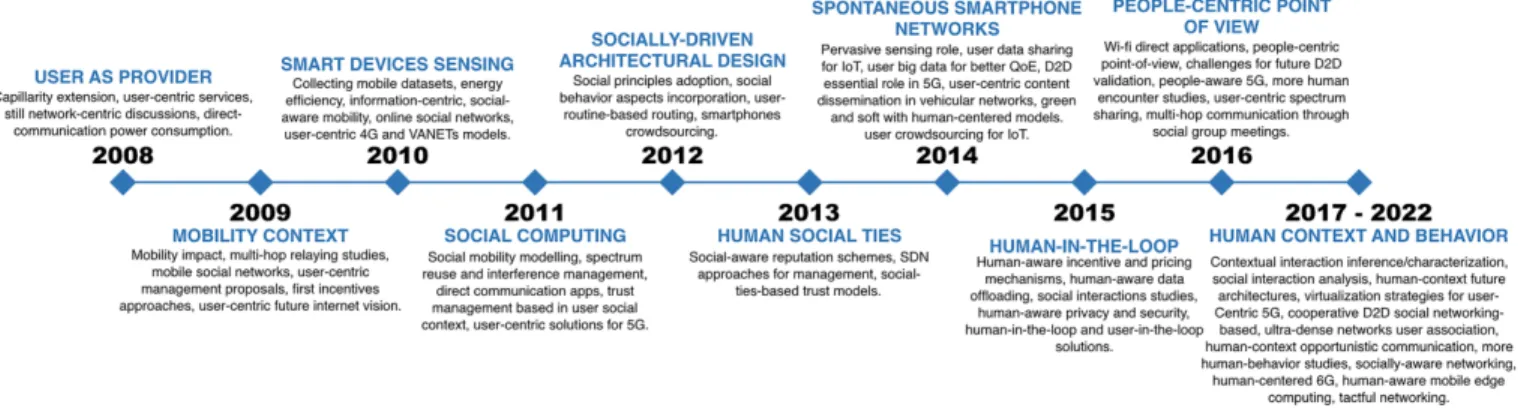
Literature solutions based on a user-centric design brought more attention not only to user requirements, expectations, and QoE but also on how the user participation can help to solve challenges in the context of mobile networks. These user-oriented approaches assisted mobile network design in differ-ent challenges, including energy and spectrum efficiency, rout-ing, computing capacity, and capillarity extension. This sec-tion surveys the human-perspective into networking through a timeline, depicted in Figure 1. This timeline summarizes the research evolution from user-centric communication to more recent human-aware approaches. We highlight essential works, directions, milestones, and accomplishments for over a decade, showing a considerable change towards understanding the human role in computer networks. As the survey covers an extended period, more examples and citations are from more recent research. The Tactful Networking perspective (Section III) features different human-traits applied in some of these previous works herein mentioned, added to other insights from interdisciplinary research featured on this survey.
From 2008, we highlight the “user as provider” concept from user-centric communication [5], a solution for capillar-ity extension and data offloading through user participation. The user-centric main idea was for the user to act as a service/connectivity provider in specific scenarios: network edge, crowded places, and disasters. Despite many challenges identified [5], most discussions were still from a network, de-vice, performance, and services perspectives, such as routing, access control, power consumption, and data privacy.
In 2009, the user mobility context [6] was a key topic with discussions about the main mobility aspects, the limitation of current protocols for user-centric models, and a user-centric future internet vision. The impact of user-location sensing [7] revealed issues related to control and privacy. It also ap-peared research [8] about economic interactions between users, ISPs, and community providers to build incentive mechanisms guided by user characteristics such as uncertainty, selfishness, and sensitivity to device resources consumption [2].
During 2010, the importance of smart devices and online social networks (OSNs) sensing appeared in [9]. They gather user attributes and social graphs from social networks to infer other users’ characteristics. This kind of sensing involves col-lecting mobile datasets from user devices to assist opportunis-tic routing architectures, such as [10]. They analyze and clas-sify users’ interactions according to their interests and activity. Further, human mobility analysis kept appearing. In [11], user contacts are mapped to social graphs for achieving better DTN routing performance. Studies in user behavior, preferences, attributes, and context started to be more common. User-provided parameters served as input to advanced network provisioning [12]. Approaches for user-centric 4G appeared,
Fig. 1. Timeline with the evolution of user-centric initiatives to human-centered future network generations.
like the QoS-based network selection algorithm relying on user preferences in [13]. Furthermore, in [14], cooperative user-centric communication and network selection to achieve user satisfaction while overcoming network conflicting interests.
From 2011 we highlight social computing studies in dif-ferent initiatives, such as human social aspects in mobility modeling for improving mobile network operation [15], access control, trust management [16], and privacy [17]. Among the characteristics considered were similarity of user-profiles, reputation, and friendship history in social networks. User-provided networks/services relying on user-preferences tar-geted energy efficiency, QoS [18], among others. Mobility analysis appears in different domains, such as investigating mobility models, network selection, and handover techniques based on displacement prediction, context, user profiles, and preferences [19]. Task composition in urban computing based on social, spatial, and temporal aspects also appeared [20]. In [21], authors affirm future internet will be user-centric and context-aware. In [22], a novel user-centric architecture for 5G, gives the mobile terminals the power to change the Radio Access Technology based on user criteria.
Discussions about a socially-driven Internet architectural design were frequent in 2012. In [23], the role of prospective consumers (also services providers) appears as an Internet trend of user empowerment. Social aspects appeared in mul-tiple initiatives. Among those, data forwarding and privacy, social similarities from mobility, opportunistic routing based on social structures from daily routines, a user-centric social-network framework, social user-profiling, social context-based routing, user behavior in “smart-grid” communications, and user cooperation in peer-to-peer systems [24] and in energy-efficient routing. A QoS-based incentive mechanism for user-centric networks appears in [25]. User-user-centric resource al-location, cache distribution, energy-efficiency [26], service exposure model [27], connection sharing, and user sensing for wireless access are other examples. In mobility manage-ment, aspects studied include user-device resources, locations, user-profile, context, preferences, user-perspective mobility schemes, identity, and handoff/handover solutions. A survey on handover management in mobility architectures is in [28]. In 2013, human social ties studies appeared frequently. Challenges and solutions from OppNets and DTN to Mobile
Social Networks (MSNs) are in [29], focusing on works related to security, privacy, and trust in MSNs. Environment, context, reputation, community check, and other aspects ap-peared in trust management, cooperative models, and mobility analysis [30]. A survey [31] on mobile social networking middleware brought a valuable remark about opportunistically created communities that should be determined not only by shared interests or contacts but also by mobility-related context like physical location and co-presence. The paper [32] calls attention to user empowerment discussions in data offloading, where the decision making shall not belong only to the network, but to the user. A debate about a self-adaptive system for data dissemination in opportunistic networks relying on a recognition heuristic with human-brain-like decisions is in [33]. Social ties and user characteristics, such as com-munities, visited locations, friendship, selfishness, people’s daily routines, and others, were used in MSNs, DTN, and routing initiatives [34], [35]. In [36], privacy, and anonymity of user sensitive data were a concern. In [37] is discussed the importance of users as participatory sensors to understand city dynamics and their inhabitants’ urban behavioral patterns. In [38], user-perceivable metrics such as application quality, energy, and monetary costs were applied to optimize network use. User ubiquity applied to extend network service, interac-tivity, and interoperability in rural areas and opportunistically share content based on user preferences. Human social-ties applied to satisfy user requirements in bandwidth allocation.
Meanwhile, in 2014, the potential of spontaneous smart-phone networks and cooperative relaying was considered in different works, making services adaptive to both user and network requirements [39], [40]. Discussions in Device-to-device communications for 5G included security, privacy, in-terference management, resource allocation, and pricing mod-els [41]. Moreover, in the 5G context, we found works about reaching a superior user experience alongside new services and applications [42], green and soft future network rethinking the cell-centric design [43], and a consumer-oriented 5G design. Other works proposed user-centered routing with user requests as central requirements for achieving optimal communication performance, and social-aware routing in user-centric net-works [44]. In [45], a resource allocation mechanism relies on a user-centric network utility maximization problem with user
traffic-profile status as input. In [46], user-centric solutions for communication services and network management focus on the tradeoff between security and performance. A Survey on Virtual Sensor Networks in terms of security and privacy is in [47]. These networks monitor large groups of people and store sensitive individuals’ information, such as per-sonal identity, behavior, interaction, preferences, and mobility. In [48], vehicular social networks are discussed through a taxonomy for content-dissemination approaches and a frame-work to support user satisfaction. Incentive and reputation mechanisms appeared in user-provided networks [49], IoT, and social networks. QoE and QoS are discussed in [50], [51]. Among the aspects considered were moving content closer to the edge to improve network quality, content-adaptation from user preferences, user-participation schemes to indicate satisfaction, and user recommendations. User-Centric Network Management was also a relevant topic [52] linked with tech-nologies such as SDN to mitigate the problem of sharing limited network capacity and resources efficiently and fairly. Context information, mobility management [53] in oppor-tunistic networks, and distributed social information applied to different initiatives. The lack of testbeds and datasets for mobility evaluation motivated research while ad hoc and mesh networks surveys [54], [55] pointed out future people-centric networking. The term “User-in-the-loop” appeared in [56] in a system where the user can actively participate in networking congestion situations.
From 2015 to 2017, human-aspects started to be even more frequent in cooperative networking. During 2015, we highlight Human-in-the-loop and User-in-the-loop approaches [57], [58], considering aspects such as human intents, psychological states, emotions, and actions inferred through sensory data. User-centric and user-provided wireless networking proposals are in [59], [60]. They emphasize people-centric networking, user interests, and social connections in different scenarios. In [61], appears an SDN-based 5G architecture relying on user location information. A survey on data offloading techniques, including those based on user cooperation, geographical con-text, and content popularity, is in [62]. A user-centric model for virtualized security at the network edge relying on user profiles appears in [63]. Another frequent subject was mobile users crowdsensing systems [64]. This subject appeared in different areas such as user privacy, reputation mechanisms, and considering aspects as user social preferences, traffic profile, environment data, and user behaviors (in terms of honesty). Mobility and Online Social Networks [65] studies kept appearing in opportunistic routing, forwarding, and dis-semination, handover management, recommendation systems (based on user opinions, preferences, and behavior in OSN), among others. User satisfaction, QoE, and QoS are in [66], reinforcing the user protagonism in networking services.
In 2016, terms like people-centric [67] kept appearing, re-inforcing the importance of understanding the human behind a device - an individual sharing contents, experiences, and acting as a mobile virtual sensor. In the 5G context, user-centric so-lutions, smooth user experience, and sensing user information to allocate resources appeared [68]. Research in Ultra-Dense Networks [69] also breaks the network’s paradigm controlling
its users to an architecture closer to their requirements. In [1], are pointed out technological breakthroughs that would bring a renaissance to wireless communication networks, including D2D communication, network ultra-densification, and big data analytics (due to the amount of data generated by the mo-bile users). Data Offloading appeared relying on user-device context (e.g., energy constraints), QoE, mobility, and other aspects. Advances in mobility and handover management, based on user preferences, QoE, power status, movements, lo-calization techniques, and geo-analysis, were also found [70]. Works with mobile crowdsourcing, extracting intelligence from OSNs, contextual information, social relationships, pri-vacy [71], security, QoS, reputation, and incentive mechanisms appeared. The importance of micro properties (known as EGO Networks) from personal networks of users in OSN is in [72]. They show that the structural properties of OSNs are similar to social networks formed offline. Understanding these properties can be essential to the creation of services for the future internet. User data aggregation in OSNs, the study of social relationships between people, and context applied to encounters coordination. In [73], a user-centric QoE prediction algorithm with machine learning, was proposed. A DTN Routing survey is in [74] and relates to Information-Centric Networks, IoT, and other architectures that can benefit from human-behavior information. User-centric versus Network-centric resource management appears in [75]. Other works included scheduling based on user cooperation, user-centric scheduling for flexible 5G design [76], an opportunistic data dissemination strategy in D2D, opportunistic D2D routing relying on social group meetings [77], user-centric energy-efficient wireless energy transfer, and opportunistic data trans-mission of urban sensing applications [78].
From 2017, we highlight human-in-the-loop and user-in-the-loop works, reinforcing the need for learning, adapting, and steering user behavior to exploit the human factor in future ubiquitous mobile systems [2], [79]. Other works included user preferences applied into several solutions: home networks management; municipal Wi-Fi deployment based on usage patterns and who are the users; group communication schemes in opportunistic ad-hoc networks; device-to-device communi-cation dealing with user need to have more efficient utilization of network resources including energy [80]; ultra-dense net-works [81], mobile edge netnet-works [82], extending user-centric Internet services with peer-to-peer interactions, and context-aware resource allocation. A user-centric context-context-aware radio access technology selection for 5G is in [83]. The paper [84] discusses 5G trials, challenges, and deployment. Authors argue that D2D, M2M, V2V, and IoT will play an important role in 5G. Here in this section, we cited different works applying user characteristics to solve challenges in the context of these communication types. Other works included user-provided networks with incentive mechanisms [85], cooperation-based cache [86], extracting social relations from users’ ratings [87], and mobility behavior analysis. Online Social Networks re-search kept appearing linked to cooperative D2D based on so-cial aspects [88], decentralized OSNs [89], and soso-cial network analysis methods in behavioral information security. Accord-ing to [90], we are movAccord-ing towards the 5G era, witnessAccord-ing a
transformation in the way networks are designed and behave, with the end-user placed at the epicenter of any decision.
In 2018, the trend related to centric initiatives, user-in-the-loop, and human-in-the-loop continued. In [91], spatial and social awareness are combined to outperform state-of-art D2D opportunistic routing protocols. In [92], a survey on IoT future proposes a four-layer architecture, including a sensing layer. A “human-in-the-loop” 5G system in [93] combines prediction from big data analytics centered in user demand with pushing and caching. In [94], a proposal for data offloading relies on user participation. They affirm most previous works in this context ignored user device constraints (such as battery power and computing capabilities) while their solution considers these parameters. In [95], user reliabil-ity propagation relies on mobile social network interactions. Their solution detects malicious and selfish nodes that affect network efficiency. An information-centric caching scheme through D2D in 5G is in [96]. Other examples are user-centric D2D content-sharing [97], human-in-the-loop radio resource allocation for haptic communications [98], user-centric ultra-dense-networks [99] dealing with resource allocation, content popularity learning from user spatiotemporal mobility, user-centric cooperative caching based on network topology, traffic distribution, channel quality, and file popularity [100], and dynamic AP grouping based on user mobility and behavior.
Finally, in 2019, the human-user context is linked with sub-jects such as urban computing, machine learning, distributed spectrum sharing in dynamic networks, wireless virtualization, and handover. Many of these initiatives link to future 5G. In [101] appears a survey on location-based social networks (LBSNs) as a source of user data to leverage urban computing solutions. A machine learning solution linked with 5G user-centric ultra-dense networks (UUDN) capable of improving network performance appears in [102]. A novel user-centric networking model where each user, based on uncertainty and their traffic model, can serve as access points for other users in their vicinity is in [103]. In [104], a 5G user-centric wireless access virtualization proposal allows users to benefit from a set of transmission points selected according to their environment and QoS requirements. This architecture represents a rupture to the traditional cell-centric scheme. In [105], handover op-portunities in user-centric networks rely on user characteristics such as direction and speed.
In the upcoming years, future generation mobile networks will deal with human context, behavior, and information, considering aspects such as mobility, interactions, social ties, traffic profile, personality, and others discussed in the fol-lowing section. Therefore, based on the discussions above and throughout the years, network models and solutions are becoming linked with a new level of understanding where human characteristics will have to be considered to offer better and more personalized service through tactful networking.
III. THE TACTFUL NETWORKING PERSPECTIVE
Traditionally, the design of computer networks happened through a service-provider perspective. This results in a gap between the way networking protocols and services are cre-ated (e.g., usually limited to service providers’ needs or types
of application) and the everyday user behavior or needs. We observe this gap in techniques currently used to optimize network performance. In particular, many of them adapt to network conditions (e.g., physical link conditions, topology changes) and are protocol or service-specific (e.g., successful delivery of messages or geographical network coverage).
New expected mobile applications and requirements raised by 5G/6G that rely on accurate users’ behavior or locations would worsen such a gap. All this stresses the urgency for a proactive accommodation of human behavior, which refers to the anticipation of users’ behaviors, allowing the services and the communication systems to adapt to it proactively [106], [107]. As an example of human behavior accommodation, consider mobility behavior and 5G. Although the concept of Mobility Management as a Service (MMaaS) is introduced in 5G, existing implementations are still feedback or signaling-related. Mobility-triggered decisions are based on devices signaling, which incur extra load. Furthermore, most of the in-discussion MMaaS specifications are architecture, protocol, or radio-related (e.g., SDN, optimizations on transport or mac layer protocols, millimeter-wave communication). The mentioned specifications fail in provisioning high reliability, currently tackled through flow or connectivity redundancy. Finally, 5G is expected to manage “on-demand mobility”: true AI is absent in 5G [107]. Hence, online mobility learn-ing/training and in-advance inference of accurate future move-ments or individuals’ mobility preferences (to novelty and diversity) constitute essential missed points in 5G.
In an Internet that has become essentially mobile [108], it has become urgent for networking services to accommodate users’ dynamic behaviors, no matter how dynamic they are or how uncertain their movements are meant to be. Behavior accommodation refers to the anticipation of users’ behavior (e.g., movements, interests, etc.), allowing the services and communication systems to be proactively adaptive.
In particular, since humans nowadays are often carrying and interacting through smart-devices, most of our activities reflect our real lives onto the digital binary world. Thanks to smart-devices massive adoption, mobile applications create a digital footprint that directly reflects our routines, interest, and whereabouts. Hence, our behavior and individual charac-teristics directly impact how we demand network resources and what kind of resources are requested. In this context, large datasets are collected by various stakeholders to leverage digital footprints and better learn our tastes, habits, and social lives. All this pops up new opportunities to enforce the under-standing of people’s behaviors and leverage this underunder-standing in networking solutions’ design.
As a result, we discuss the need for future network design to take human behavioral aspects into account to optimize network resources, services, and performance. In this sec-tion, we review the Tactful Networking paradigm, the human behavior aspects that can be extracted and leveraged from digital footprints, and literature on behavior analysis. Some of these human-behavior aspects cited herein appear in solutions described in the previous section. Furthermore, this section deliberates about each human-traits’ specific characteristics, also bringing other ones from interdisciplinary research.
A. The tactful networking concept
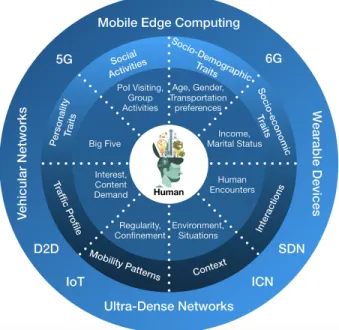
The Tactful Networking research paradigm herein discussed is a reference to the objective of adding perceptive senses to the network by assigning it with the human-like capabilities of observation, interpretation, and reaction to daily life features and involved entities. It is valuable to mention that the Tactful Networkingconcept is not the same as Tactile Internet [109], [110]. The latter regards research initiatives in which net-work connectivity aims to deliver real-time physical tactile experiences remotely. Conversely, being tactful is having or showing skill and sensitivity in handling with people. It also aggregates diplomacy, perception, tact, and care. Therefore, a tactful network can be more precisely defined as a network that considers human behavioral characteristics (i) to foresee user needs and actions; (ii) to self-adapt to the inherent het-erogeneity and uncertainty of individuals; (iii) while offering a better quality of experience and improving system efficiency. Figure 2 illustrates a tactful networking ecosystem where the human element is the epicenter of future networking solu-tions. His surroundings feature different aspects of his behav-ior that can bring valuable information to the networking do-main. Mobility patterns and interactions are examples applied (section II). Further, in this section, we discuss more aspects that can bring interesting insights into networking solutions. Among those, socio-demographic traits, socio-economic traits, and personality traits. More externally in the figure, we have several (but not limited to the ones herein listed) computer networking technologies or paradigms that already benefited or can benefit from the human-behavior data. Besides these and other technologies, new public-focused services (e.g., customized advertisement delivery or recommendations) or business models and opportunities can appear.
Fig. 2. Tactful Networking Ecosystem where human-related aspects are future mobile-networks enablers.
Table III-A summarizes some human multi-dimensional aspects to be considered. Following section features ideas behind their usability in tactful networking.
B. Behavior analysis in the literature
What tactful networking claims to consider are behaviors shaped by the fact that we are human beings. Some inherent examples are: (i) people habitually act as semi-rational entities, routinely moving and interacting within a reduced and pre-dictable geographic landscape [113] and tending to meet the same people; (ii) people build their life-routine in particular areas that can also link to their personality and social ties; (iii) human decision-making process deals with entropy and uncertainty, led by situations such as conflict, paradox, and noise [127]. Hereafter, we discuss literature works entitled to capture and analyze human behaviors.
a) Mobility: Understanding human mobility has many applications in several areas, such as the spread of diseases, city planning, traffic engineering, targeted product advertise-ments, and networking resource allocation. As routines and habits dictate our life, mobility data is relevant for inferring be-havior. For instance, in modern urban planning, understanding human travel patterns on the city level is essential. Similarly, mobile operators could better adapt their resource allocation or service provision if they understand their users’ displacement tendencies. Further, over 24% of Android applications build their services on top of human-mobility data. All this shows the importance of deciphering human motion.
Literature works have unraveled interesting properties of underlying large-scale mobility patterns: Recurrence and tem-poral periodicity of visited locations [113], [115]; Confine-ment (a small area an individual visits) [113], [115]; High predictability of human mobility [117]; Few unique network motifs (i.e., about 17) explaining the majority of daily hu-man mobility [128]; Population trip distance and radius of gyration distribution following a power law [115]; A very high uniqueness of individual trajectories (i.e., four random time-stamped locations identify one user among 1.5 million individuals in 95% of the time) [129]; Few trips to new places outside an individual radius and about 25% of human mobility relating to new places visits [130]; Tendency to minimize their efforts (i.e., following the shortest path while moving). This phenomenon repeats independently of countries, cultures, or transportation means being used.
b) Personality Traits: In recent years, personality predic-tion has attracted interest from the computer science research community. Technologies, services, or applications can be improved to answer users’ expectations and needs if such interested users’ personality is known and better understood. For example, recommendations on new places to visit and novel experiences to seek could reach to individuals more disposed to enjoy the information. Alternatively, online social networks or crowdsensing applications could better suggest new activities or connect individuals with similar personalities and interests. For capturing individuals’ personalities, the research community has been considering the Big5 personality model [119]. It delineates the OCEAN traits, as follows: Openness (to experiences) (O)is associated with intelligence, originality, creativity, and intellectual curiosity. Conscientious-ness (C) describes self-control, planning, and organizational skills. Extraversion (E) accounts for assertiveness, positive
TABLE I
KEY HUMAN ASPECTS FOR TACTFUL NETWORKING
Human Aspect Description Services or Applications
Context Relates to the logical or physical context in which an individual inter-acts. Aspects such as time of the day, weather conditions, location-based events [111], preferences (e.g., device interfaces, geographical areas [112], tools, applications), among others, are considered.
Recommendation or customized advertisement services; context-aware predic-tion systems (the use of context allows decreasing the required visiting history of users and improving accuracy prediction).
Interactions Study the features underlying human physical encounters, such as regular-ity [113], similarregular-ity [10], contact, or inter-contact duration in the temporal graph of encounters among individuals.
Interaction-based data offloading [62]; opportunistic applications or ser-vices [53]; proximity-based social networks [89]; prevention of cybersecurity attacks (e.g., understanding a malware propagation in mobile wireless networks) as well as of epidemic disease propagation.
Mobility Accounts for regularity [114], entropy, confinement [115], as well as time periodicity [116] of visits. Location similarity [117], displacement profile, important location and routine inference are also related.
Network resource allocation [52] and optimization; content pre-fetching; urban planning [101]; traffic engineering [118]; prevention of cybersecurity attacks (e.g., understanding a malware propagation in mobile wireless networks) as well as of epidemic disease propagation; crime prediction.
Personality
Traits Accounts for the OCEAN traits extracted through the Big5 model [119]: Openness, Conscientiousness, Extraversion, Agreeableness, Neuroticism. Relates to the understanding of the influence that personality traits may have on individuals’ behaviors (e.g., motion [120], physical/social relation-ships [121], preferences) or context.
Recommendation [122], [123] or customised advertisement services; incentive-based approaches; message propagation; smartphone usage understand-ing [124]; trust-management models.
Social Ties Relates to friendship in on-line social networks [125], [126] and includes the study of features underlying human social interactions, such as regu-larity, periodicity, simiregu-larity, centrality, in the graph of social contacts of individuals.
Message propagation [77]; Influence detection; Homophily inference; Recom-mendation or customised advertisement services.
Socio-demographic and socio-economic traits
Relates to gender [101], age, income [111], family or marital status. Recommendation or customised advertisement services; incentive-based ap-proaches; smartphone usage understanding; traffic profile modeling; traffic engineering; urban planning.
Traffic Profile Accounts for traffic volume, time periodicity, type of content, interest (including application, websites, and services).
Recommendation or customized advertisement services; traffic profile model-ing; network resource allocation and optimization; load balancing.
Others Any other human behavior facing their actions, habits, interests, pref-erences, and context in their day-to-day life: e.g., the human inherent and frequent will of sharing information (e.g., pictures, recommendations, opinions, arguments, and friendship).
On-line social networks; recommendation systems; pool transportation (e.g., blablacar, uber); home-sharing (e.g., Airbnb).
emotions, and captures the amount of social stimuli that we search for. Agreeableness (A) describes empathy, compassion, and altruism. Neuroticism (N) is associated with the tendency of experiencing negative feelings, anxiety, mood swings, and emotional instability. Personality traits levels are gathered through questionnaires built for this purpose by psychologists and available online.
Research has studied individual personality traits prediction through datasets since human-migration to the digital envi-ronment renders such prediction possible, and personality is predictive of a wide range of behavioral and social outcomes. Previous work investigates the relationship between person-ality and smartphone usage: i.e., if installed applications, calls, and the proximity of Bluetooth devices can lead to the prediction of the Big5 traits [131], [132].
Interactions and online social ties have also appeared to predict personality traits [120], [133]. In [120], authors reveal how Openness is correlated with check-ins at popular and social venues, while Neuroticism has a negative correlation with the number of venues visited. The connection between people’s social networks, the typical locations visited, and Ex-traversion is studied in [134]. Finally, [135] predicts Extraver-sion and Conscientiousness by analyzing mobile HTTP(S) traffic during weekend nights and weekdays mornings, linking Openness to visited web pages diversity.
c) Wireless encounters: Understanding user contacts is relevant when designing new opportunistic communication protocols. In this case, the problem mainly lies in quantifying the contacts’ quality according to a determined objective and correctly predicting encounters. To that end, the regularity of daily activities [113], [115], [117] applies; The tendency to
follow the shortest path to a certain destination [113]; The very common short and confined traveled distances [113], [115]; The prevalence of static phases spent at a few fixed locations, with rapid transitions among those [136]; The overnight move-ments invariance in dwelling places with usually lower contact opportunities [116]; to cite a few.
Protocols relying on human motion estimate mobile users’ potential to act as data forwarders, mainly leveraging sophis-ticated network analysis metrics such as centrality measures. In [35], [137], authors derive social-based metrics from users’ connectivity (such as betweenness centrality and neighborhood similarity) for more efficient opportunistic forwarding deci-sions and less overhead. In the same way, opportunistic data offloading relying on direct communication between devices appeared in [62], [77], [88], [91]. In such works, authors (i) study how temporal communities can assist minimizing the delivery delays; (ii) investigate the node interactions through centrality measures to derive reliable future communication possibilities, or (iii) determine the copies amount to be injected in the network to ensure performance.
Finally, although an elevated rate of regularity characterizes human behavior, random events or decisions can happen. Such situations are hardly predictable and are unlikely to repeat in the future; they originate from the fact that users are reasonable beings, whose decisions they take are based on their motivations, which may also change over time [117], [130]. The goal of characterizing random and regular encounters have motivated works, such as [10]. In [10], a finer-grained classi-fier, is introduced to describe random and social interactions. The performed analysis unveils significant differences among the dynamics of users’ interactions, which authors leveraged
to unveil social ties’ impact on opportunistic routing. d) Social ties: Social networks map vertices to individ-uals, while edges may represent friendship, work interactions, similarity, among others [125]. When building such a network, edges can derive from explicit information (e.g., declared friendship on Facebook) or from implicit knowledge inferred from the reciprocate behavior of the vertices (e.g., similarity), a phenomenon called homophily in the literature of complex network analysis.
Analysis of social networks usually relies on the high pre-dictability of human behaviors [126], [138], mostly driven by routinary activities. Hence, mechanisms such as preferential at-tachment and triangle formation model these networks vertices connections [139], leveraging the existence of communities or highly connected hubs in the network. This high predictability makes social networks different from random ones, such as the Erd˝os and R´enyi network [140] (where node connections are purely stochastic, being determined by a constant probability). Most recently, location-based social networks (LBSNs) have become relevant data sources for urban computing [101]. LBSN offers unprecedented geographic and temporal resolu-tions. It reflects individual user actions (temporal resolution) at the scale of entire world-class cities (global geographic resolution). For instance, users who share data in Foursquare, a popular LBSN, usually have the goal of showing to their friends where they are, while also providing personalized recommendations of places they visit. Nevertheless, when correctly analyzed for knowledge extraction, this data can suit for better understanding city dynamics and related social, economic, and cultural aspects [101], [111].
e) Content demand: Understanding individuals’ content consumption is relevant when looking for solutions (i) to manage the recent boost of mobile data usage and (ii) to improve communication services quality or the design of adaptable networking protocols [141]. Such perception can help identify traffic congestion periods or fill the gap between the infrastructure technology’s capacity and the mobile users’ traffic load.
A significant amount of work in the literature analyzes network traffic usage through voice calls and SMS messages, both extracted from traditional Call Detail Records (CDRs) [142], [143]. Although providing valuable insights, as the CDRs present time irregularity and scarcity of call traffic, they do not describe realistic data traffic demand patterns. Browsing (visited websites) behavior has also been applied in user profiling according to their traffic demand [144]. Still, other works have categorized the actual mobile traffic usage [145], [146]. Among those, [146] provides a profiling of individual users’ behavior –rather than a network-wide one – and a precise temporal network usage modeling, i.e., in terms of volume as well the frequency of traffic demand – rather than only considering total volume of traffic or a normalized volume. Among the outcomes, authors show: (i) the high day-wise similarity on sessions number, traffic volume, and inter-arrival time traffic parameters; (ii) such parameters from the same hours on different days present less variability than the parameters within the same day on different hours; (iii) the high correlation between upload/download traffic volume; (iv)
peak and non-peak hours can be easily identified when it comes to users’ traffic demands; (v) similar sessions number and duration occur when users are grouped by age range, irrespective of the users’ gender; (vi) male participation raises as the user age increases, while the female participation decreases with the age increase.
More recently, literature works have investigated network usage concerning other users’ behavior. In [146], [147], calls/SMS patterns or traffic demand of users and their socio-demographic factors (e.g., age and gender) are jointly in-vestigated. The relation between content consumption and mobility properties is considered in studies that focus on application interests [148], data traffic dynamics [149] and service usages [150]. Finally, in [151], authors describe their investigation on the predictability of mobile data traffic gener-ated by individual users, which is studied in isolation as well as jointly with mobility. Among the outcomes, authors show: (i) The possibility for predicting user traffic generation with an upper bound of 85%; (ii) By knowing the past activities history of an individual, apart of the traffic volume, it is possible to predict where it will occur with an 88% accuracy in average. This result is possible thanks to correlations between visited locations and traffic volumes; (iii) Including location information in the prediction process allows forecasting the future consumption of mobile data traffic with 5% higher accuracy, pushing the overall performance from 85% to 90%. Such results indicate a large space for predicting mobile data traffic and adapting network optimizing solutions based on the latter, such as caching and prefetching.
This section discussed the Tactful Networking paradigm, including a more granular view from aspects of human-behavior to assist future networking solutions. Following, in the next section, we discuss a framework for enhancing raw human data with best practices to deal with challenges in this context, data source examples, and other aspects. This framework comprises data management, analytics, and privacy.
IV. ENHANCINGHUMANRAWDATA TOASSIST
COMPUTERNETWORKINGSOLUTIONS
Throughout previous sections, we discussed why human-behavior data should become essential for future generations of mobile network architectures and models. Nevertheless, the “transformation” of raw data describing human behavior (usu-ally collected through smart-devices or social networks) into useful knowledge requires multiple iterations.
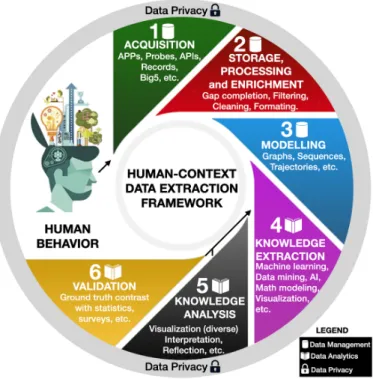
Figure 3 depicts a general framework to process and pre-serve the privacy of human-behavior raw data as a means of considering the tactful networking concept in current network-ing architecture and paradigms. The framework features three parts, Data Management, Data Analytics, and Data Privacy, which are discussed below along with its sub-items.
A. Data Management
1) Acquisition: Human behavior analysis requires data availability, sometimes, from multiple sources (e.g., cellular networks, applications, OSNs, census, and surveys).
Specific APIs, web crawlers, mobile crowdsensing applica-tions, or infrastructure-based sniffers are examples of means of collecting human-related data. APIs can be streaming-based, where data is gathered almost in real-time (after some user share information) or request-based. Online social networks, like Twitter and Foursquare, make available several APIs that could be from each kind, depending on the available information, such as account activity, geo (mobility), or user posts. When there is no straight access to information (e.g., data inside HTML pages or specific databases/search engines), web crawlers are necessary. These crawlers use text mining to analyze the desired information from web pages, for example, HTML tags contents. Further, mobile devices became a com-mon data source in the past decade. In the literature, there are two main ways of collecting mobile devices data. The first is to directly extract the sensory data from smartphones or other mobile devices [152]. The next possibility is through mobile crowdsensing datasets from special applications installed in volunteer smartphones, usually designed for research purposes. Thanks to mobile operating systems’ openness, such appli-cations can obtain diverse data from a mobile device (e.g., rotation, acceleration, GPS location, WiFi APs). On the other hand, these datasets usually have a limited number of users due to the difficulty involved in volunteer recruiting.
A secondary collection approach uses traffic logs collected from network infrastructure: i.e., WiFi or cellular networks. Operator-collected datasets, named CDRs, usually report logs of mobile network traffic demand and human footprints. CDR consists of time-stamped and geo-referenced records of voice phone calls or Internet usage of mobile network sub-scribers [141]. CDRs bring the benefit of encompassing huge populations (e.g., millions of users) over large (e.g., citywide or nationwide) geographic regions, and covering long peri-ods (e.g., months or years). Nevertheless, literature has also pointed out the limitations of CDRs: They are often largely incomplete since telecommunication events are punctual and provide information at specific time instants, which are also sparse and irregularly distributed over time [153]. Some of the first datasets used for human behavior analysis came through measurements from wireless network infrastructures. Such datasets contain logs of authenticated user associations to wireless networks, most often, Campus wireless networks. Such datasets are frequently used for contact inference and opportunistic-based research [10]. Here, two individuals are assumed to be in contact if both connect to the same WiFi access point on the campus. Although providing an approx-imation of contacts, such a strong hypothesis has been well accepted by the research community due to the lack of large direct contact datasets available for research purposes. Other examples can be found in [154], [155].
Another potential data source is the known Big Five survey [156], introduced at Section III to infer the personality traits of users. Data traces can include the Big Five Survey answers from users and make available associated information about personality traits. The Cambridge Analytica scandal in 2018 is an example of how important the information about user personality traits can be, and how it needs protection. A personality quiz on Facebook harvested data from users and,
according to investigations, was being used with malicious intentions.
Fig. 3. Tactful Networking Framework tackling management and analysis of human-behavior information to assist future network architectures.
2) Storage, Processing, and Enrichment: After acquired, data must be stored, processed, and enriched. In human behavior information, a possibly large amount of data needs secure, scalable, and fault-tolerant storage platforms. Large-scale distributed data computation is an essential aspect for data processing, as real-time and multiple parallel requests are frequent. As processing steps, associating and integrating data may be required: Where diverse data sources regrouping different data types (e.g., posts, media, location, actions, traits, and gestures) are simultaneously exploited to extract useful information. Moreover, data may present gaps, inconsistent information, semantic errors, or missing entries. Hence, data cleaning and enrichment responsible for normalization, spuri-ous data detection, geographical and temporal interpolation, among others, may be necessary to make up missing data and to fill the gaps, while limiting biasing the raw data. As examples, we could cite processes such as time discretization, to reduce the temporal resolution of CDR Datasets and make the data appear complete [117], [129], [157], trajectory recon-struction [116], to infer positions of the users at timestamps where the original data does not provide such information, and user filtering [153], [157] to eliminate those with not enough mobility information. Finally, dimensional reduction of multi-dimensional data may also be necessary before analysis, where feature selection has proven effectiveness.
3) Modelling: Finally, data must be modeled in a format helping the extraction of spatio-temporal information or rela-tion between different components of the data. Graphs have been the most used data format to model behaviors related to people’s spatio-temporal association with environment and ties
(i.e., interactions or social ties). Herein, a vertex in a graph can represent users in a network or their visited places [10], [91], [158]. At the same time, edges would connect vertex when there is an encounter between users, or when a user sequentially visits locations [159]. Spatio-temporal trajectories or time series of chronologically ordered points are other examples of formats in data modeling: e.g., modeling collected geographic data from human mobility as a set of spatio-temporal trajectories, representing data generated by a moving individual in geographical spaces [91], [112].
B. Data Analytics
Data analytics includes knowledge extraction and analysis as well as data validation, as discussed hereafter.
1) Knowledge Extraction and Analysis: These are funda-mental to find new insights on data. The process should typically be continuous to foster the adaptive capability of the whole system. Understanding data properties and the kind of problem to be addressed are part of knowledge extrac-tion. Among the types of knowledge extraction from data, we can mention pattern detection and modeling, correlation and causality among associated entities, behavior profiling, data classification or clustering, data changes or irregularity detection and modeling, to cite a few. Here, machine learning techniques, artificial intelligence, HCI methods, time series modeling, sophisticated networking metrics, statistics, and em-pirical analysis have become essential tools by research com-munity performing human behavior analysis. More recently, visualization techniques [160] have become very popular: Due to the complexity of big data, such techniques make data more accessible, understandable, and usable. Among the advantages brought by visualization tools, we can mention the possibility for: quick and clear information understanding; easy identification of emerging trends allowing a fast action based on what is seen; visual identification of relationships or patterns; analysis at various levels of detail.
When it comes to human-behavior diverse spatio-temporal information, there are challenges related to data association. Discovering association and relationships between data sets, detecting unusual objects, and classifying them are not triv-ial tasks, particularly when considering heterogeneous data sources. Machine learning approaches are common in knowl-edge extraction with different intentions, such as building a scientific knowledge base with crowdsourcing to correct information [161] and filling patient data gaps into a medical decision support system [162]. Artificial Intelligence (AI) also applies to knowledge extraction and analysis. Several examples can be found, such as in [163], where authors use an ontology approach to extract meta knowledge, create metadata with the information obtained, and query metadata from RDF files to acquire the required knowledge. In [164], an AI system for big-data analysis is proposed and evaluated through a logistics company, bringing gains in productivity.
Knowledge extraction can also occur through user activity in their social networks. User posts can make available a large dataset of valuable information, such as spatial, geographic, emotional, and personality traits. Again the example from
Cambridge Analytica Scandal fits in this matter. Knowledge extraction from social networks can apply for networking resource management and user prediction [111], decentralizing networking applications and resources, among others. Data mining, natural language processing, and other techniques can be applied to extract users’ information. These processes should typically be continuous with repeated iteration cycles to foster the whole system’s adaptive behavior while gaining new insights, discovering mistakes, and reconsidering decisions.
2) Validation: Data validation consists of verifying data correctness and usefulness. It intends to provide guarantees for the fitness, accuracy, and consistency of any input into an application or system. A used model validation technique for assessing how the results will generalize to an independent data set is cross-validation in statistical analysis. Another widespread data validation method is the crossing of data (usually incomplete or reduced) with what is called a ground truth data (i.e., typically official or completed data). Among ground truth examples are the CENSUS data or surveys with low-error margins, or more fine-grained datasets (e.g., GPS datasets used to validate CDR trajectory reconstruction techniques). Ground truth data may not be available for all situations. In this case, repeating more experiments might be necessary, or using a simulation environment as support to validate the use of specific data in multiple scenarios or under varying conditions.
After the validation, it is necessary to shape the information for the development of services and applications. These final products are expected to help operators develop enhanced human-aware networking solutions to match user expectations more naturally.
C. Data Privacy
As we trod along the smart-devices, online services, and big data era, user-data privacy must be guaranteed to support ap-plications and innovation while not harming individual rights and security. This data varies in different aspects, such as (i) quantity - guided by multiple sources and the human frequent “willingness to share” in several platforms; (ii) diversity -different types and formats generated by “sensors” or acquired from indirect sources; and (iii) quality - data precision must be certified to make sure the solutions adapt correctly to their users.
In the context of Tactful Networking, user data can be available online in a distributed fashion and might get queries from multiple agents, which requires care to avoid malicious use. Previous work [165] showed that even small pieces of information linked with other data sources could reveal sensitive information that most people would like to keep private. Violations in user privacy might also lead to losses (including financial), as they bring a lack of trust in the application or system. User-data privacy and security research appears linked to different aspects, such as authentication and authorization mechanisms, anonymization, incentive, and reputation schemes. In the section II, throughout the years, several initiatives combined human aspects for reliability and privacy, such as trustworthy interactions in mobile social
networks [95], and circles of trust from group meetings. Further, in [2], authors reviewed relevant publications linked to some of the aspects above. This section focus on recent ad-vances in privacy-preserving big data, including data mining, management, and publishing.
User data privacy is threatened not only by attackers or by gathering information available publicly. In some instances, employees and data scientists have full access to customers’ and companies’ sensitive and private information. As pre-viously stated, there is a trade-off between data utility and privacy risk. In [166], authors present a framework that allows privacy-preserving big data analytics while still providing high utility data for analysts. According to [167], due to a massive scale of diverse data generated by people, security, and privacy in Big Data still faces many challenges. They classify privacy preservation techniques in Big Data and discuss advantages and disadvantages. Finally, they present a differential privacy technique where agents (those who query the information) do not directly access the database. Within this technique, an intermediary software takes the query and adds noise to the results according to the privacy risk.
Big data publishing is also present in recent works. In [168], authors compare Datafly and Mondrian anonymization al-gorithms through thirteen parameters. Among those, perfor-mance, efficiency, increase in data size, and anonymization time. In [169], authors discuss the privacy problem in big data, methods to protect data publishing, evaluate big data (e.g., velocity, volume, variety, variability) from a privacy per-spective, and recommendations for future research. In [170], the authors find that existing anonymization techniques fail in the trade-off between data utility and privacy. They propose a Mondrian based k-anonymity approach combined with a Deep Neural Network-based framework. Experimental results show data utility without compromising privacy.
Finally, recent work also focused on privacy-preserving data mining. In [171], authors developed a protocol to facilitate users to outsource their encrypted databases and item-set mining to a cloud environment in a privacy-preserving manner. In [172], the authors propose a privacy-preserving method for POA (place of activity) mining, using a clustering algorithm to discover POA. Differential privacy mechanisms are embedded in access to raw location data and results. The method utility is shown through location datasets derived from geo-referenced social media. In [173], an item-centric algorithm mines fre-quent patterns from big uncertain data. Pattern mining aims to discover implicit and potentially useful information. Existing algorithms use transaction-centric mining that is more difficult to adapt to imprecise and uncertain data. Results show algo-rithm effectiveness with privacy-preservation. In [174], authors discuss privacy-preserving big data management and analytics techniques in static and dynamic distributed environments, including models, issues, approaches, and reference frame-works. Complementary, in [175], they propose a framework as an alternative to classical methods that guarantee big data privacy via security-inspired protocols. The framework comprises discussions about two study-cases.
As Data Privacy is crucial for the Tactful Networking paradigm evolution, proper techniques must suit the type of
data to be stored and analyzed. This section discussed recent works in Data Privacy Research. Following section features conclusions, future challenges, and research opportunities.
V. FUTURECHALLENGES ANDFINALCONSIDERATIONS
This paper discussed the Tactful Networking paradigm ex-plaining why and how humans should increasingly participate in the communication loop of future communication standards. For such a paradigm to progress, there are multiple issues from the human, networking, and computing systems perspectives to be dealt with. First, there is a need for changing modeling practices of network solutions. In addition to the focus on network performance and metrics, it is necessary to apply big data analytics related to human context and behavior information and to bring knowledge about human behavior combining ideas and methods from different areas such as machine learning, pervasive AI, HCI, stochastic modeling, psychology, sociology, computer networks, data science, and statistics. Throughout time, correlating this data will help to analyze routines, to build enhanced incentive mechanisms, and to predict situations and behavior. This kind of information will apply to orchestrate better how the network shall be-have from the operation point-of-view. The lack of publicly available rich datasets is also one of the obstacles for a better understanding of human aspects. This data also have to comprehend more significant populations, preferably full smart cities or metropolitan regions where sensing as a service will occur through billions of IoT sensors combined with cloud and edge technologies.
Second, emerging new applications, more people connected through more powerful smart-devices, cloud services mas-sification, among others, bring data traffic raise and chal-lenges to network core and edge. The wireless communica-tions technologies available will deal with improved capa-bilities user equipment that will accelerate the proliferation of performance-hungry applications. Such challenges call for having a new architectural paradigm for the current Internet. Here, intelligence should be brought from centralized comput-ing facilities to distributed and in-network computation. The envisaged scenario is to have network intelligence pushed at the edge, much closer to UEs, where learning, reasoning, and decision making will provide distributed autonomy, replac-ing the classical centralized structures: Integratreplac-ing collective intelligence in the network is essential. The natural Internet upgrade into a “network of subnetworks” is thus, a new trend, where “local” evolution is the key principle to enhance situa-tional awareness and adaptation of edge networks. Algorithms shall rely on knowledge extraction from user behavior, network heterogeneity, and uncertainty (brought by human-behavior or physical conditions of the network). As an example, by moving resources to the edge combining with human-aware knowledge can assist in fulfilling some 5G/6G requirements, innovative quality-aware services and applications, container-ized micro-services, and overlay networking solutions (e.g., Kubernetes [176]).
Despite the traffic increase in the past few years, commu-nication protocols remain limited, and, in many cases, they