The CMS electronic logbook
The MIT Faculty has made this article openly available.
Please share
how this access benefits you. Your story matters.
Citation
Bukowiec, Sebastian et al. “The CMS Electronic Logbook.” 2010 17th
IEEE-NPSSIEEE Real Time Conference (RT), 2010. 1–3. © Copyright
2010 IEEE
As Published
http://dx.doi.org/10.1109/RTC.2010.5750482
Publisher
Institute of Electrical and Electronics Engineers (IEEE)
Version
Final published version
Citable link
http://hdl.handle.net/1721.1/76609
Terms of Use
Article is made available in accordance with the publisher's
policy and may be subject to US copyright law. Please refer to the
publisher's site for terms of use.
The CMS Electronic Logbook
Sebastian Bukowiec, Member IEEE, Gerry Bauer, Barbara Beccati, Ulf Behrens, Kurt Biery, James Branson,
Eric Cano, Harry Cheung, Marek Ciganek, Sergio Cittolin, Jose Antonio Coarasa Perez, Christian Deldicque,
Samim Erhan, Dominique Gigi, Frank Glege, Robert Gomez-Reino, Derek Hatton, Yi Ling Hwong, Member IEEE,
Constantinos Loizides, Frank Ma, Lorenzo Masetti, Frans Meijers, Emilio Meschi, Andreas Meyer,
Remigius K. Mommsen, Roland Moser, Vivian O’Dell, Luciano Orsini, Christoph Paus, Andrea Petrucci, Marco
Pieri, Attila Racz, Olivier Raginel, Hannes Sakulin, Member IEEE, Matteo Sani, Philipp Schieferdecker,
Christoph Schwick, Dennis Shpakov, Michal Simon, Member IEEE, Konstanty Sumorok and Andre Sungho Yoon
Abstract– The CMS ELogbook (ELog) is a collaborative tool,
which provides a platform to share and store information about various events or problems occurring in the Compact Muon Solenoid (CMS) experiment at CERN during operation. The ELog is based on a Model–View–Controller (MVC) software architectural pattern and uses an Oracle database to store messages and attachments. The ELog is developed as a pluggable web component in Oracle Portal in order to provide better management, monitoring and security.
I. INTRODUCTION
logbook was originally a book for keeping the data from the log, a navigation tool used by mariners to estimate the speed of a vessel through water. Currently the term logbook is widely used in science and industry for recording various data on complex machines such as nuclear plants or particle accelerators. The reason for using a logbook remains the same, however the technology which is used has changed – now a computer based electronic logbook is used instead of paper.
The CMS [1]-[2] high-energy physics experiment, part of the Large Hadron Collider (LHC) at CERN has its own Electronic Logbook.
The Elog fulfills an important role as a tool to exchange opinions and store information about the experiment, problems and solutions, which are taken to solve them
Manuscript received May 28, 2010. This research project has been supported by a Marie Curie Early Initial Training Network Fellowship of the European Community’s Seventh Framework Programme under contract number (PITN-GA-2008-211801-ACEOLE) and in part by the DOE and NSF (USA) and the Marie Curie Program.
U. Behrens, D. Hatton and A. Meyer are with DESY, Hamburg, Germany. B. Beccati, S. Bukowiec (corresponding author. phone: +41 22 767 8086, fax: +41 22 766 8124, email: [email protected]), E. Cano, M. Ciganek, S. Cittolin, J. A. Coarasa Perez, C. Deldicque, D. Gigi, F. Glege, R. Gomez-Reino, Y. L. Hwong, L. Masetti, F. Meijers, E. Meschi, R. Moser, L. Orsini, A. Racz, H. Sakulin, C. Schwick, and M. Simon are with CERN, Geneva, Switzerland. P. Schieferdecker were with CERN, Geneva, Switzerland. P. Schieferdecker is now with Universität Karlsruhe, Karlsruhe, Germany.
J. Branson, M. Pieri and M. Sani are with University of California San Diego, La Jolla, California, USA. A. Petrucci was with University of California San Diego, La Jolla, California, USA. He is now with CERN, Geneva, Switzerland.
S. Erhan is with University of California, Los Angeles, California, USA and CERN, Geneva, Switzerland.
K. Biery, H. Cheung, R. K. Mommsen, V. O’Dell and D. Shpakov are with FNAL, Batavia, Illinois, USA.
G. Bauer, C. Loizides, F. Ma, C. Paus, O. Raginel, K. Sumorok and A. S. Yoon are with Massachusetts Institute of Technology, Cambridge, Massachusetts, USA.
allowing for a better understanding of the detector and creating a platform for the future improvements.
The first version of CMS ELogbook was an open source electronic logbook developed by Stefan Ritt [3]. This stand-alone application was file based and due to its file based
nature, the searching did not meet our requirements. As a result, it was decided to write a new, dedicated Elog
version for the CMS experiment, while keeping the same look and feel as the old one. This new version of the tool has the same interface making it easily recognized and accepted by the users.
The new Elog uses Oracle technologies and is written in the Java, XHTML and JavaScript programming languages.
II. ARCHITECTURE
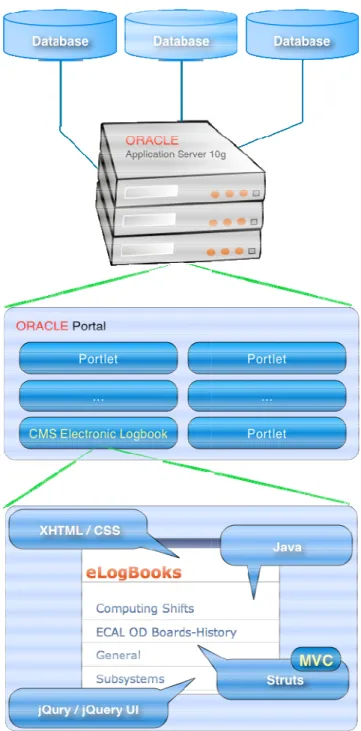
The ELog is a portlet running on OracleAS Portal (Fig. 1) that provides implementation of the portlet container [4]-[5]. OracleAS Portal [6] is a component of Oracle Application Server that provides a solution for building, deploying, and maintaining enterprise portals. OracleAS Portal displays information in the form of portal pages. There are three elements that define a portal page: region, item and portlet. Region defines page layout and contains either portlets or items. Item is defined as a static content stored by the portal and a portlet is a dynamic, reusable, pluggable web component that can draw generated content from many different sources. As different portlets can be placed on a common page, the user receives a single-source experience. Portlets generate content, and the portal controls the appearance. There are four types of portlets in OracleAS Portal: prebuilt portlets, portal tools, partner portlets and programmatic portlets. The Elog is the programmatic portlet based on the PDK-Java API and the Struts framework. Along with the PDK-Java API, OracleAS Portal gives a possibility to develop portlets using either JSR 168 standard [7] or PL/SQL API.
The OracleAS Portal has been chosen because it is scalable, secure and gives the possibility to monitor and manage all data and users. It is also well integrated into the CERN infrastructure, since the authentication uses a single sign-on (SSO) solution. Building separated applications and placing them together, gives the user a powerful, consolidated interface for monitoring and reporting, which is available for the whole collaboration.
A
In summary, the key advantages of the and OracleAS Portal are:
1. Portal container provided services; 2. Built in user customization; 3. Single sign-on mechanism;
4. Built in management system of users a Considering user interface, jQuery and jQu for handling more demanding requests on th to provide more useful and modern user int a fast and concise JavaScript Library that s document browsing, event handling, anim interactions for rapid web development provides abstractions for low-level interactio advanced effects and high-level, themeable w built on top of the jQuery JavaScript Library to build highly interactive web applications [9 As was said earlier, the new Elog is d and therefore whole structure of the too the database. The Elog uses Oracle data the messages, and the attachments.
The integration of the application flow and not part of the portlet APIs. By using the S it is possible to leverage the MVC architect publish applications within the portal. By ap to the ELog, core business model functionali from the presentation and application lo represents the business or database code, the the page design code and the Contr the navigational code. Such separation allow clarifies the design and provides an efficien makes developing, testing and maintainin framework and MVC model is detailed in s paper.
III. STRUTS FRAMEWORK
Struts is one of the most popular framew Java-based Web applications based on th Controller (MVC) design pattern which is organizing code [10]. It is a foundation for b application providing not only libraries but thereby making development faster and easi suggests MVC consists of three parts M Controller that creates a separation of conce an infrastructure for Web application [11]. In flow diagram is shown. The Model represent database code and controls data access and View represents the page design code, it con presented to the user and it collects user inpu represents the navigational code, it validat handles data flow and transformation betw View. Beside separating the code, this mak work of a group of programmers on the same enabling a better understanding of the applica maintenance much easier. Struts also off provides several useful features such as sim validations in the Controller or custom ta Whole flow control of the application is decla
use of portlets
and data.
ueryUI were used he client side and terface. jQuery is simplifies HTML mation, and Ajax
[8]. jQuery UI on and animation, widgets, which are y and can be used 9].
database oriented ol is defined in abase for storing d business logic is Struts framework, ture to create and pplying the MVC ity was separated gic. The Model e View represents
roller represents ws multiple views,
nt modularity that ng easier. Struts section III of this
works for building he Model-View-s reModel-View-sponModel-View-sible for building an MVC
also utility tools, ier. As the name Model, View and
erns and provides n Fig. 2 the struts ts the business or persistence. The ntrols how data is ut. The Controller tes input, and it ween Model and kes simultaneous e project possible, ation and making fers utilities that mple and complex
ags in the View. ared in the
struts-config.xml file. Struts only places re Controller. The developer is free portion in any way he wishes.
Fig. 1. Architecture overview.
IV. FEATUR
The ELog organizes messages in category may have unlimited level subcategories. Each subcategory ha entries are displayed as a list. Ins organized in threads.
Four views are available for b Threaded and Expanded. Users ca through the messages in the current chosen subcategories together in a s
estrictions on the View and to implement the Model
RES
nto categories, where each ls of other categories and as its own page where the side the list messages are browsing: Full, Summary, an navigate page by page t subcategory or display all
time period (day, week, month). This view a special personalization mechanism provid Portal allowing the chosen subcategories the profile of the user. Personal customization for each portlet separately. The mechanis the cookie mechanism in web browsers; the information is kept on the server side and is browsers to which is logged in the user.
The data for personal customization can or in the database with the difference tha the file is lost after each deployment of the p portal is fully responsible for accessin the personalization, the programmer must java bean with properties, setters and getter based personalization does not require any pr the database version requires a special table in The user can create a new message attachments with an optional description. available: rich and plain text editor.
The editing functionality allows only th the existing messages, while the reply functio the possibility to reply to any existing messag The ELog also provides the feature to sub subcategories. Any update (new or edit the subcategories is sent to the subscri It also includes a search engine, where different subcategories can be retrieved on t filters.
Using message id it is possible to disp directly without browsing the whole li the ELog contains RSS Feeds.
V. CONCLUSION
The ELog is extensively used by th collaboration, more than 3000 scientists and 38 countries, as a tool for communicatin information related to the commissioning the experiment. Every week users creat messages.
The tool is open for the future extensions the dynamically changing needs of users. T the developers is to prepare a reliable too interface that allows users to easily find st based on a wide range of search options.
ACKNOWLEDGMENT
The development team would like to to Stefan Ritt, the developer of the ELOG, f Style Sheets (CSS) that we have been p the CMS ELogbook.
We thank Omer Inam Alvi and Ad Aerts fo first version of the current CMS Elogbook.
w makes use of ded by OracleAS
to be saved in n is done per user sm is similar to
difference is that s available for all be kept as a file at data stored in
portlet. OracleAS ng the data in
only prepare the rs for them. File rerequisites while n the database.
that can have Two editors are he author to edit
onality gives user ge inside a thread. bscribe to chosen
ted message) in ibers by e-mail. messages from the base of given play the message ist. Additionally he entire CMS d engineers from ng and archiving and running of te around 1500 in order to meet The main goal of l with a modern tored information
give the credits for the Cascading partially used in for developing the
Fig. 2. Struts flow diagram.
REFERENCE [1] The CMS Collaboration, CMS Technic
1994.
[2] The CMS Collaboration (R. Adolphi e CERN LHC”, JINST 3 S08004 p. 361, [3] ELOG Project, Stefan Ritt, https://mida [4] Oracle Database 10g, http://www
database/oracle10g/index.html. [5] OracleAS Portal 10g, http://www.ora
portal/10g1014.html.
[6] OracleAS Portal 10g R2: Build Portle Guide.
[7] Java Portlet Specification (JSR detail?id=168.
[8] jQuery, http://jquery.com. [9] jQuery UI, http://jqueryui.com. [10] Struts, MVC architecture, http://struts.a [11] James Holmes, "Struts: The Complete 10, McGraw-Hill Osborne Media, 2006 ES
al Proposal, CERN LHCC 94-38, et al.), “The CMS Experiment at
2008. as.psi.ch/elog.
w.oracle.com/technology/products/ acle.com/technology/products/ias/ ets with Java, Volume 1, Student 168), http://www.jcp.org/en/jsr/
apache.org.
e Reference, 2nd Edition", pp. 3-6.