Publisher’s version / Version de l'éditeur:
ASTM Standardization News, 10, 12, pp. 26-32, 1982-12
READ THESE TERMS AND CONDITIONS CAREFULLY BEFORE USING THIS WEBSITE. https://nrc-publications.canada.ca/eng/copyright
Vous avez des questions? Nous pouvons vous aider. Pour communiquer directement avec un auteur, consultez la première page de la revue dans laquelle son article a été publié afin de trouver ses coordonnées. Si vous n’arrivez pas à les repérer, communiquez avec nous à [email protected].
Questions? Contact the NRC Publications Archive team at
[email protected]. If you wish to email the authors directly, please see the first page of the publication for their contact information.
NRC Publications Archive
Archives des publications du CNRC
This publication could be one of several versions: author’s original, accepted manuscript or the publisher’s version. / La version de cette publication peut être l’une des suivantes : la version prépublication de l’auteur, la version acceptée du manuscrit ou la version de l’éditeur.
Access and use of this website and the material on it are subject to the Terms and Conditions set forth at
Development of thermal insulation performance test methods
Bomberg, M. T.
https://publications-cnrc.canada.ca/fra/droits
L’accès à ce site Web et l’utilisation de son contenu sont assujettis aux conditions présentées dans le site LISEZ CES CONDITIONS ATTENTIVEMENT AVANT D’UTILISER CE SITE WEB.
NRC Publications Record / Notice d'Archives des publications de CNRC:
https://nrc-publications.canada.ca/eng/view/object/?id=837d78a6-79d8-4a23-9574-783d915bd24a https://publications-cnrc.canada.ca/fra/voir/objet/?id=837d78a6-79d8-4a23-9574-783d915bd24aSer
I
THl
~ 2 1 d
I&
National Research
Conseil national
10.
1096
1
Council Canada
de
recherches Canada
c. 2 1
BLDG
DEVELOPMENT OF THERMAL INSULATION PERFORMANCE
TEST METHODS
by Mark Bomberg
ANALYZED
Re~rinted
from
ASTM Standardization News, December 1982
p. 26
-
32
DBR Paper No. 1096
Division of Building Research
cause de l'insistance de plus en plus grande sur la
conservation de l'gnergie, les responsables des divers codes
de construction ont renforc'e les exigences relatives
2
la
rgsistance thermique des enveloppes de bat iments.
Bien que
ces exigences se rgfsrent
2
un niveau d'ef f
icacit6 nominal,
elles n'indiquent pas les diffsrences d'efficacit'e entre les
mat'eriaux en place et les estimations qui proviennent des
mesures en laboratoire.
Le but de ce r6sum6 est d'aider
2
1161aboration de m6thodes d'essai
permettant d'estimer
l'efficacit6 des isolants thermiques en service.
Authorized r e p r i n t from Standardization News, December 1982 copyright, ASTM, 1916 Race S t . , Phila., PA 19103, 1983
Introduction
With the growing emphasis on energy con- servation, various codes and building au-
Development of
-
thorities have raised the requirements for the thermal resistance of building enve- lopes. Although these requirements are re- lated to a nominal level of performance, very little is said about the difference be- tween material performance in-situ andPerformance
Test Methods
Mark
Bomberg
surements. This review discusses how to develop appropriate test methods for eval- uating the performance of thermal insula- tion under service conditions. This will probably be interpreted in different ways, depending on the form of the reader's in- volvement in the construction process. The word "appropriate" may well be replaced by one of the following: re- peatable and reproducible; accurate; sim- ple and quick to carry out; meaningful, allowing judgement; realistic, related to specified use conditions; or representa- tive, related to a set of average or extreme environmental conditions.
Even the word, "evaluating," may be related to one of the levels in the following scale:
1. Measurement of a minimum number of properties used for quality control (with accep- tance or rejection of the prod- uct as the output);
2. Measurement of properties or performance characteristics; 3. Measurement of performance
characteristics under specified testing conditions; or
4. Measurement of all the charac- teristics needed for predicting performance in any specified set of environmental condi- tions.
Although this scale focuses attention on the judgement value produced by the test, at the same time it increases the difficulty of providing an adequate test method.
In stressing the judgement aspect of the test one usually thinks about a for- malized system of design and testing, a performance or functional analysis as developed in the late sixties. Performance analysis has been defined as "an organized procedure or framework, within which it
ASTM C 976, Test for Thermal Performance of Building Assemblies by Means of a Cali- brated Hot Box, is used for testing win- dows and doors. (Photo courtesy of Owens Corning Fiberglas).
is possible to state the desired attributes of a material, component, or system in order to fulfill the requirements of the in- tended user without regard to the specific means to be employed in achieving the results."'
Performance analysis may have become an integral part of every researcher's training but it is not a panacea for predict- ing the performance of materials. With- out discussing the details of performance analysis, the author will try to show that the ASTM test method system, which is probably the most technically developed framework for test method development, can easily be brought closer to the aim of performance analysis by the introduction of blocks of standard test methods.
This paper deals with general questions of testing, and a reader without expe- rience in the laboratory may encounter difficulty in judging to what extent the test method affects the ranking of materials. One example, a block of thermal resis- tance testing methods, presents details from laboratory simulation of the possible effects of convection and the influence of framing members on convective air stream- lines in blown loosefill thermal insulations. Data are presented in dimensionless form to avoid any hint of a discussion of the performance of specific materials. The reader's attention is drawn to other as-
lNational Bureau of Standards, Special Publication
361, Vol. 1 8 2. Performance concept in buildings; Pro- ceedings from Joint RlLEMlASTMlClB Symposium, May 2-5.1972.
pects of the test series, namely, using a part of performance analysis for selecting the appropriate test method.
Test Method as a Part of
Material Specification
A central point in the assessment of any test method is the judgement value gener- ated by the test. It implies that without some criterion, defined by a material spec- ification or standard, the scope of a test cannot be specified; neither can the re- quired precision and accuracy be assessed. A set of statistical limits for the test preci- sion can be given, but the decision whether the precision is sufficient for the purpose, or indeed so excessive as to make the cost of obtaining results prohibitive, can only be made through comparison of the test results with the criterion.
A test method, being a part of a mate- rial specification, might have a large im- pact on material development. An exam- ple of a performance-oriented test is the determination of thermal resistance in production control of mineral fiber batts and blankets. The production line and process variables are controlled by a re- quirement to meet a given thermal resis- tance at the thickness of the product.
The value obtained in the quality con- trol (QC) test may be different from the actual performance under service condi- tions because of different mean tempera- tures, temperature gradient, thickness, or
moisture content, but it is relatively easy to correlate this number with the in-situ performance if the service conditions are well defined.
On the other hand, there are many test methods where correlation between lab- oratory test results and actual perfor- mance may be difficult to obtain. These methods may fail to evaluate the required property (performance aspect) or testing conditions beyond the scope of the realis- tic and representative, as defined in the Introduction. The reason for their reten- tion in the specification is often to distinguish between traditionally satisfac- tory and unsatisfactory materials.
Examples of such test methods are found in: ASTM: C 209, Testing Insulat- ing Board (Cellulosic Fiber), Structural and Decorative; C 240, Testing Cellular Glass Insulating Block; C 272, Test for Water Absorption of Core Materials for Structural Sandwich Constructions; D 2842, Test for Water Absorption of Rigid Cellular Plastics; and other water immersion test methods. They can scarcely be correlated with moisture pick-up and accumulation in building constructions.
The list of test methods in use that pro- duce values having no relevance to perfor- mance under service conditions could be very long. Although there is usually no op- position to a new test or requirement be- ing added to an existing material specifi- cation, the removal of inappropriate or misleading tests is seldom popular, as
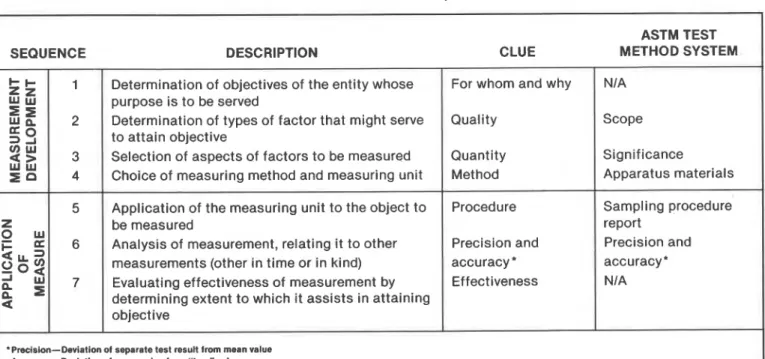
TABLE 1-MEASUREMENT SYSTEM (AFTER KIRCHERg)
I
SEQUENCE DESCRIPTIONASTM TEST
CLUE METHOD SYSTEM
1
Determination of objectives of the entity whose purpose is to be served
Determination of types of factor that might serve to attain objective
Selection of aspects of factors to be measured Choice of measuring method and measuring unit Application of the measuring unit to the object to be measured
Analysis of measurement, relating it to other measurements (other in time or in kind) Evaluating effectiveness of measurement by determining extent to which it assists in attaining objective
For whom and why Quality Quantity Method
I
Procedure Precision and accuracy' Effectiveness NIA Scope Significance Apparatus materials Sampling procedure report Precision and accuracy* NIA*Precision-Deviation of separate test result from mean value Accuracy-Deviation of mean value from "true" value
there may be some background unknown to the present membership for which the test was required. The goal is, however, not to remove tests but to replace them with better tests that describe material performance. If the material specifica- tions are to be used in building practice, the concept of ranking materials should change to one of describing the material performance that is required for the par- ticular application.
Review of the
Performance Analysis
There are four essential parts to any per- formance analysis approach:
1. requirements (functional and user), a qualitative statement identifying the needs of a user; 2. performance criteria, a quanti-
fied statement providing a spe- cific level of compliance with user needs;
3. test method (performance test or assessment), a physical mea- surement, method of calcula- tion, or subjective judgement in which materials, components, or systems are assessed for com- pliance with the performance criteria; and
4. evaluation (assurance and eval- uation), judgement by the de- sign professional based on expe-
rience and test information regarding the likelihood that a product or system will meet ser- viceability, reliability (durabil- ity), and maintenance criteria. An important part of the functional analysis approach is performance hierar- chy. For example, in formulating perfor- mance criteria on the level of general products one should examine the relation of this level to the building elements, not forgetting the relation to the lower level (materials), to superior levels of com- ponents, and to the assembly as a whole.
By concentrating on the relation be- tween a system (set of objects) and its at- tributes (properties of the objects) the per- formance analysis enhances better choice among alternative solutions on the lower level of the hierarchy; and easier follow- up of the effect of one decision on all other relevant decisions. The performance anal- ysis approach may, however, introduce difficulties:
1. In specifying the precise level of user requirements, although it is easier to accept health and safety requirements, those re- lated to socioeconomic vari- ables, such as comfort, and degree of energy conservation, are more difficult to formulate; 2. In selecting a minimal but adequate set of performance criteria;
3. In selecting the representative
environmental conditions un- der which a test should be performed;
4. In selecting representative in- teractions from the su~erior level analysis, a sealed double- glazing unit (product) can hardly be assessed without re- gard to the manner in which it will be installed in a wall; and
5. In designing a proper testing procedure to cover points 3 and 4.
These difficulties usually make it impossible to apply a performance ap- proach to a level lower than a building component. Even then, performance testing is seldom applicable. Expert judge- ment and standard tests are perhaps the only practical solutions.
The ~erformance approach may be compared to a measurement system. Table 1 gives the sequence of this system and the test method system used by ASTM. It is evident that while steps 4
through 6 are specified in a far more detailed way by the ASTM system, the lat- ter gives practically no description of ob- jectives and only a vague formulation of the factors that might serve to attain the objective (Steps 1 and 2, Table 1). It often follows in normal ASTM practice that a test originally developed by a laboratory for either quality control or research pur- poses is expanded and developed for a larger number of uses.
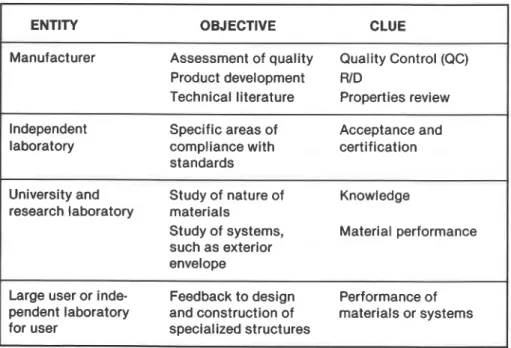
ENTITY OBJECTIVE CLUE
Manufacturer Assessment of quality Quality Control (QC)
Product development RID
Technical literature Properties review
Independent Specific areas of Acceptance and
laboratory compliance with certification
standards
University and Study of nature of Knowledge
research laboratory materials
Study of systems, Material performance such as exterior
envelope
Large user or inde- Feedback to design Performance of pendent laboratory and construction of materials or systems
for user specialized structures
TABLE 2-BUSINESS ENTITIES AND OBJECTIVES
IN THERMAL
INSULATIONS TESTING
Objectives of Thermal
Insulation Testing
A brief list of business entities and their ob- jectives (Table 2) illustrates the normal composition of a specification writing committee. There will be only a few de- signers among the members of a thermal insulation committee. Moreover, because safety aspects are by far the most impor- tant for the general public, the general in- terest group tends to emphasize safety as well as acceptance and certification as- pects. A specification writing committee will normally be concerned with mini- mum acceptance levels and with differen- tiating between satisfactory and unsat- isfactory materials.
Expectations have changed, however, over the last few years, with the growing awareness of the need for energy conser- vation. The designer and the user are both interested in the actual performance of a
material as a part of a system, such as a 2. To predict materiallproduct per- ture absorption testing methods currently heating-season-average; thermal resis- formance under specified ther- under development by a task group under tance; and moist, aged, often compressed mal conditions-acceptance and ASTM Subcommittee C16.31 on Chemi- material installed with possible faults in performance testing. cal and Physical Properties. Each method workmanship; rather than in the value with a trained professional judging the relates to the rate in one-dimensional flow designated by a laboratory test performed extent to results of a test series conditions, under either isothermal condi- at laboratory room temperature on dry correlate with actual performance, tions or a constant thermal gradient of specimens. This change in the require- a block of tests might be more valuable 1 Klmm. For ingress of moisture, either ments or objectives of thermal testing than a single test. A of tests would liquid water or water vapor from practi- should be accompanied by a change in the shed more light on the effect of changes in- cally saturated air is used. Although the approach to test methods. troduced between tests. Basically, the tests boundary conditions thus formulated aP- Precision requirements for the same test should not be so performance as pear to be of a similar type, the physical may differ. For example, in determining oriented. ~h~ variable selected processes involved differ markedly. thermal resistance a ten percent error for the series should, however, be as much The whole volume of the open pore sys- might be accepted in an estimate for an- performance oriented2
=
possible. tem is used in the water immersion test.nual energy consumption, whereas a sys- The rate of water intake under isothermal
tematic error of two percent in the test conditions provides some estimate of the
method would mean millions of dollars of
Block
of
Moisture
fraction of open pores and pore size dis- profit or loss for the manufacturer.Absorption Tests
tribution. Water vapor transport betweenThere are basically two different environments with 100 and 50 percent
groups of objectives (Table 2): The concept of a block of test methods is il- relative humidity (RH) represents a mo- 1. TO describe products-quality lustrated in Table 3, which show; mois- lecdar movement, equimolar diffusion, control (QC), properties re- ormu mu la ti on although in hygroscopic materials con-
used by Anderson. R. W., T h e need lor
view, and acceptance testing; perlorma- oriented insulation standards." Talk at In. densation, liquid and evaporation
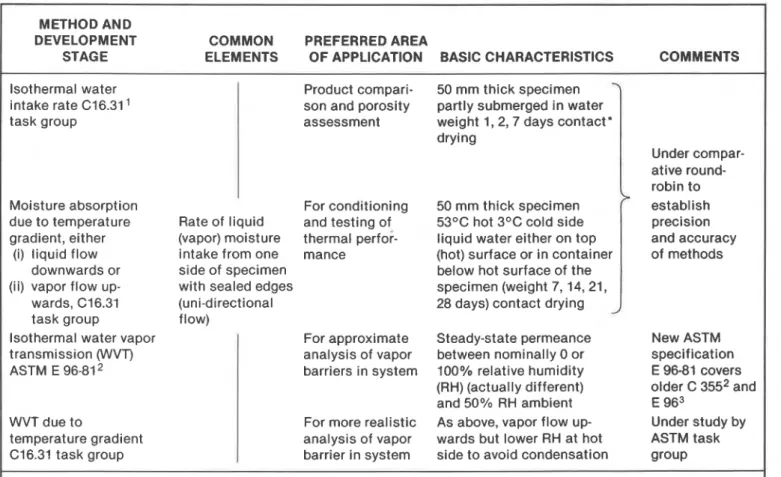
and tercel81, New Orleans, LA, May 9.1981. frequently occur when water molecules TABLE 3-METHODS FOR MOISTURE ABSORPTION TESTING OF THERMAL INSULATIONS
ASTM STANDARDIZATION NEWS, DECEMBER 1982 29
METHOD AND
I
DEVELOPMENT COMMON PREFERRED AREASTAGE ELEMENTS OF APPLICATION BASIC CHARACTERISTICS COMMENTS
Isothermal water intake rate C16.311 task group
Product compari- 50 mm thick specimen son and porosity partly submerged in water assessment weight 1, 2 , 7 days contact'
drying
Under compar- ative round- robin to
Moisture absorption For conditioning 50 mm thick specimen establish
due to temperature Rate of liquid and testing of 53OC hot 3OC cold side precision gradient, either (vapor) moisture thermal perfoi- liquid water either on top and accuracy
(i) liquid flow intake from one mance (hot) surface or in
downwards or side of specimen below hot surface of the
(ii) vapor flow up- with sealed edges specimen (weight 7, 14, 21,
wards, C16.31 (uni-directional 28 days) contact drying
task group flow)
Isothermal water vapor transmission (WVT) ASTM E 96-81
WVT due to
temperature gradient C16.31 task group
For approximate Steady-state permeance New ASTM
analysis of vapor between nominally 0 or specification barriers in system 100% relative humidity E 96-81 covers
(RH) (actually different) older C 355* and
and 50% RH ambient E 963
For more realistic As above, vapor flow up- Under study by analysis of vapor wards but lower RH at hot ASTM task barrier in system side to avoid condensation group
'Contact drying-special procedure to remove excess water from specimen surface employing contact with pre.selected plywood
1~16.31 on Chemical and Physical Properties
*C 355, Standard Test Methods for Water Vapor Transmission of Thick Materials 3~ 96, Standard Test Methods for Water Vapor Transmission ol Materials
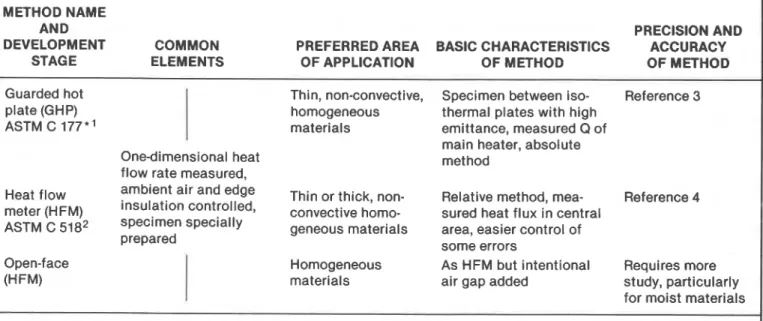
TABLE 4-STEADY-STATE METHODS FOR LABORATORY DETERMINATION OF THERMAL CONDUCTIVITY
METHOD NAME
AND PRECISION AND
DEVELOPMENT COMMON PREFERRED AREA BASIC CHARACTERISTICS ACCURACY
STAGE ELEMENTS OF APPLICATION OF METHOD OF METHOD
Guarded hot Thin, non-convective, Specimen between iso- Reference 3 plate (GHP) homogeneous thermal plates with high
ASTM C 177*' materials emittance, measured Q of main heater, absolute One-dimensional heat met hod
flow rate measured,
Heat flow ambient air and edge Thin or thick, non- Relative method, mea- Reference 4 meter (HFM) insulation convective homo- sured heat flux in central
ASTM
C
5182 specimen specially geneous materials area, easier control ofprepared some errors
Open-face Homogeneous As HFM but intentional Requires more (HFM) materials air gap added study, particularly
for moist materials
C 177, Test for Steadystate Thermal Transmission Properties by Means of the Guarded Hot Plate 2~ 518. Test for Steady4tate Thermal Transmission Properties by Means of the Heat Flow Meter
-
move across the specimen.
The presence of a thermal gradient in- creases the probability of internal conden- sation. Moisture intake under a constant temperature gradient thus represents a dynamic equilibrium between thermally driven vapor flow and capillary liquid flow (wicking). This kind of test relates best to material performance in roofing during winter conditions.
Downward flow of water due to gravity and vapor flow due to a thermal gradient provides an additional comparison with the previous test. It shows drainage capa- bility of a material and may or may not relate to the moisture content of exterior underground basement insulation or rain- protected piping insulations.
Finally, the last method, water vapor transmission (WVT) due to temperature gradient, may be needed where condensa- tion does not occur next to the material surface. Study has shown that estimates from this technique are quite different from those of ordinary dry-cup WVT test^.^,^ As a matter of fact, the isothermal WVT test has little correspondence to the physical phenomena in heat moisture transport that occurs in building enve- lopes except for testing related to vapor barriers and membranes.
k h a n g , S. C., and Hutcheon, N. B., Dependence of Water Vapor Permeability or Temperature and Hu- midity," Trans of ASHVE, pp. 437-450.
4 ~ j a e r , A., and G. Christensen, Measurements of Mois- ture Transfer in Building Materials, (in Danish), Building Research Institute, Copenhagen, 1971.
Although methods listed in Table 3 have no direct correlation with conditions in use, and the conditions selected for test- ing may greatly exceed the severity of natural exposure, each of the procedures focuses attention on one variable and per- mits comparison of results with those of similar tests performed under different conditions. For example, an isothermal water intake may be compared with that under a temperature gradient; comparing water and vapor ingress at the same temperature may shed some light on the material structure and porosity.
Block
of
Thermal
Resistance Tests
Tables 4 and 5 show thermal conductiv- ity determination. While research on guarded hot plate (GHP) and heat flow meter (HFM) has been presented else-
here,^,^
open face HFM testing requires more information. In-situ performance of fibrous loose-fill insulations may differ from that determined in the laboratory by traditional methods. In addition topreviously discussed effects of blowing technique and sample preparation, there is some concern about the possibility of convection. 7,8 Material exposed to air. at its upper surface may yield a different thermal resistance from that determined when it is in contact with the plates of the GHP or HFM apparatus.
Observations, with an infra-red cam- era, on ceilings containing low density insulation have indicated regions of differ- ing temperature. The temperature pat- tern appears to be characteristic of con- vective heat flow and seems to correlate with joist locations. This implies that con- vection is initiated by a smaller air flow resistance and increased temperature gra- dient in the material adjacent to and above the joist.
Other experiments with a 600 mm open face HFM apparatus have shown differ- ences of between 13 and 25 percent com- pared to traditional tests when the effects of an air space above the specimen, and of spacers (simulated joists) in the specimen, and of drying the specimen are combined. The ranges exceed the difference nor- mally found between products within the same generic material group and density.
5~omberg, M. and K. R. Solvason, "Precision and Ac-
curacy of Guarded Hot Plate Method," Proceedings from This difference be and
the 17th International Thermal Conductivity Conference,
June 15-18, 1981, Washington, DC (in preparation, 'Bomberg, M. and K. R. Solvason. "How To Ensure Plenum Press). Good Thermal Performance of Cellulose Fibre Insula- 6~omberg, M. and K. R. Solvason, "New Design of tion," J. Thermal Insulation, Vol. 4, 1980, pp. 93-114 and Heat Flow Meter Apparatus for Testing Low Density Ther- 119-133.
ma1 Insulations," Presented at the ASTMIDOUORNL 6~omberg, M., and K. R. Solvason, "How To Ensure Thermal Insulation Conference, Clearwater Beach, FL, Good Thermal Performance of Blown Material Fibre Insu- Dec. 8-10,1981. lation," J. Thermal Insulation, Vol. 4, 1981, pp. 187-213.
perhaps a new kind of standardized test- ing should be introduced for blown insulations.
If a new test is developed, it might be
based on a guarded or calibrated hot box te: method, since a larger volume is needed to average the effects of variability in the density and structure of the material.
Open face HFM testing could, how- ever, be used for a qualitative assessment. If the results of such a test were less than
85 percent of the standard HFM test, a large scale test such as a horizontal calibrated or guarded hot box test should be required.
Conclusion
There is a need to develop new perfor- mance-oriented test methods for thermal insulation. In the current approach all materials with the same R-value that are tested under laboratory conditions at 24OC mean temperature are consid- ered equivalent. They may, however, show different performance under service conditions.
Thus, although the goal is to develop a performance-oriented set of testing meth- ods, the only realistic approach is to develop a test for a selected property of the material and perhaps expand it into a system of test methods. Two examples of such a system, called a block of testing methods, are discussed in this review. By retaining the high precision and accuracy
the existing test and A simulated attic and roof of a house are tested over a calibrated hot box in an environ-
the test with only One performance- mental chamber. The chamber can range in temperature from plus 150°F to
-
50°F and willoriented variable changed, the block of accommodate an entire house. (Photo courtesy of Owens Corning Fiberglas).
TABLE 5-FURTHER DEVELOPMENT OF SIMULTANEOUS HEAT AND MOISTURE TESTING METHODS
ASTM STANDARDIZATION NEWS, DECEMBER 1982 3 1
COMMENT ON BASIC
COMMON PREFERREDAREAOF CHARACTERISTICS OF
METHOD ELEMENTS APPLICATION METHOD
Effective thermal conductivity of closed system
Study of effects of known Material with known (or predictable) moisture moisture content enclosed content on thermal resistance (sealed in foil) will redis-
tribute moisture under constant A T
Effective thermal conductivity Intake or redistribution Study of changes in thermal Material and moisture of open system of moisture in the resistance during moisture source enclosed together,
specimen due to ther- absorption under temperature material increases
ma1 gradients
gradient moisture content under
Moisture absorption due to freeze-thaw cycling
constant A T
Prediction of maximum As for open system, but moisture content for study of freeze-thaw cycling thermal resistance increases moisture content
tests would enhance the study of a particu- lar performance aspect. Whether test methods are property oriented, and the extent to which they will relate to the ma- terial performance depends on:
1. the known correlation between
in-situ observations and test re- sults, and
2. the experience of the profes- sional exerting judgement.
When comparing the ASTM test method structure with a generally described pro-
cess of measurement for business pur-
poses, one may notice relatively poor definition of objectives in the ASTM system. It may be that the test objectives cannot be better defined because ASTM members represent many different inter- ests. Introducing a block of test methods may, however, promote more specific testing objectives without any loss of comparability.
To write a specification for material testing requires a thorough knowledge of the material characteristics and service conditions as well as expertise in testing techniques. These skills are well repre- sented within ASTM, and it is natural that
the development of test methods should be concentrated in ASTM. If, however, ASTM does not have sufficient input from consulting engineers, designers, and the building science field working contact with appropriate organizations, such as the American Society of Heating, Refrig- erating and Air-Conditioning Engineers (ASHRAE), should be established. A spe- cialized forum, including seminar-work-
shops, would produce a better under- standing of research needs and more precise formulations of testing objectives. Last but not least, better communication between testing laboratories and material writing specification committees should be encouraged. The theme for such a com- munication could be: the selection of testing methods whose results can be cor- related to in-service performance. H
tions. Bomberg was born and educated in Warsaw, Poland. He ob- tained an M.Sc. in civil engineering, and a D.Sc. at the Warsaw Institute of Technology. Between 1967 and
1975, Bomberg worked at the Divi-
sion of Building Technology, Lund Instituteof Technology. He then emigrated to Canada, joining theNa- tional Research Council of Canada in Saskatoon and later in Ottawa. He is responsible for the development of test methods for testing thermal
This publication is being d i s t r i b u t e d by the Division of Building R e s e a r c h of the National R e s e a r c h Council of Canada. I t should not b e reproduced in whole o r in p a r t without p e r m i s s i o n of the original publisher. The Di- vision would b e glad t o b e of a s s i s t a n c e in obtaining s u c h p e r m i s s i o n .
Publications of the Division m a y b e obtained by m a i l - ing the a p p r o p r i a t e r e m i t t a n c e ( a Bank, E x p r e s s , o r P o s t Office Money O r d e r , o r a cheque, m a d e payable t o the R e c e i v e r G e n e r a l of Canada, c r e d i t NRC) t o the National R e s e a r c h Council of Canada, Ottawa. K1A OR6
.
Stamps a r e not acceptable.A l i s t of a l l publications of the Division i s available and
m a y b e obtained f r o m the Publications Section, Division of Building R e s e a r c h , National R e s e a r c h Council of Canada, Ottawa. KIA OR6.