Publisher’s version / Version de l'éditeur:
Vous avez des questions? Nous pouvons vous aider. Pour communiquer directement avec un auteur, consultez la première page de la revue dans laquelle son article a été publié afin de trouver ses coordonnées. Si vous n’arrivez pas à les repérer, communiquez avec nous à [email protected]. Questions? Contact the NRC Publications Archive team at
[email protected]. If you wish to email the authors directly, please see the first page of the publication for their contact information.
https://publications-cnrc.canada.ca/fra/droits
L’accès à ce site Web et l’utilisation de son contenu sont assujettis aux conditions présentées dans le site LISEZ CES CONDITIONS ATTENTIVEMENT AVANT D’UTILISER CE SITE WEB.
Proceedings of the 8th IASTED International Conference on Computer and
Advanced Technology in Education (CATE 2005), 2005
READ THESE TERMS AND CONDITIONS CAREFULLY BEFORE USING THIS WEBSITE. https://nrc-publications.canada.ca/eng/copyright
NRC Publications Archive Record / Notice des Archives des publications du CNRC :
https://nrc-publications.canada.ca/eng/view/object/?id=28cf1274-de67-4314-a727-9c99511cf877 https://publications-cnrc.canada.ca/fra/voir/objet/?id=28cf1274-de67-4314-a727-9c99511cf877
NRC Publications Archive
Archives des publications du CNRC
This publication could be one of several versions: author’s original, accepted manuscript or the publisher’s version. / La version de cette publication peut être l’une des suivantes : la version prépublication de l’auteur, la version acceptée du manuscrit ou la version de l’éditeur.
Access and use of this website and the material on it are subject to the Terms and Conditions set forth at
Culturally Appropriate Web Interface Design: Web Crawler Study
Kondratova, Irina; Goldfarb, Ilia; Gervais, R.; Fournier, L.
National Research Council Canada Institute for Information Technology Conseil national de recherches Canada Institut de technologie de l'information
Culturally Appropriate Web Interface
Design: Web Crawler Study *
Kondratova, I., Goldfarb, I., Gervais, R., and Fournier, L.
August 2005
* published in the Proceedings of the 8th
IASTED International Conference on Computer and Advanced Technology in Education (CATE 2005). August 29-31, 2005. Oranjestad, Aruba. pp. 359-364. ACTA Press, Anaheim/Calgary/Zurich. NRC 48253.
Copyright 2005 by
National Research Council of Canada
Permission is granted to quote short excerpts and to reproduce figures and tables from this report, provided that the source of such material is fully acknowledged.
CULTURALLY APPROPRIATE WEB INTERFACE DESIGN:
WEB CRAWLER STUDY
Irina Kondratova and Ilia Goldfarb NRC IIT e-Business
46 Dineen Drive
Fredericton, NB, Canada E3B 9W4 [email protected]; [email protected]
Roger Gervais and Luc Fournier
Centre international de développement de l’inforoute en français (CIDIF)
165, boulevard Hébert
Edmundston, NB, Canada E3V 2S8 [email protected];
Abstract
This paper discusses issues related to the design of culturally appropriate web user interfaces in the age of globalization. A research study that focuses on the identification and rating of the visual web interface design elements that act as “cultural markers” or “cultural attractors” is discussed. A new approach to user interface development that utilizes a cultural interface prototyping tool is presented. The tool is making use of the repository of cultural elements that is being populated with cultural data collected on a large number of country specific websites. A web crawling technology that collects data on verifiable culture specific web page design elements is discussed. The cultural user interface prototyping tool could potentially save time and money, which is currently being spent by Web applications development teams on the preliminary international interface design that is frequently rejected by the local users as culturally inappropriate.
Key Words
Cultural interface design, localization, web crawler.
1. Introduction
We are all beginning to appreciate that the world is rapidly becoming a global marketplace. This is especially true for Web-based applications and services that could be accessed globally. Globalization in this case affects most computer-mediated communication and, in particular, user interface design for the Internet, including e-business and e-learning applications. In this new global economy, as noted by Barber and Badre [1]: “As a consequence of existing international WWW users and in anticipation of potential users, usability takes on an immediate and relevant cultural context”. This broadens
the research area of internationalization and localization.
Internationalization is the process of designing an
application so that it can be adapted to various languages and regions without engineering changes. Localization refers to “the process of adapting a product to a specific international language or culture so that it seems natural to that particular region, which includes translation, but goes much farther. True localization considers language, culture, customs, technical and other characteristics of the target locale. While it frequently involves changes to the software’s writing system, it may also change the keyboard usage, fonts, date, time and monetary formats. Graphics, colors and sound effects also need to be culturally appropriate”[2].
2. Cultural Interface Design
The importance of culturally appropriate interface design for Web-based e-business and e-government applications is emphasized by many researchers [3], [4], [5], [6], [7], [8]. Specifically, it is noted that the “culturability” [1], a combination of culture and usability in Web design, directly impacts on the user’s perception of credibility and trustworthiness of websites [6], [9], [10]. A culturally sensitive e-commerce framework developed by Sudweeks and Simoff [11] is listing cultural appeal as one of the four important factors impacting on sustainability of e-Commerce activity, along with economic appeal, usability and general attitude towards e-commerce, thus reflecting the importance of cultural factors in e-commerce applications.
The important role of culture in user interface acceptance is emphasized by a number of researchers [12], [13], [14] and [4] where the authors claim that there are significant cultural differences between user acceptances of interfaces for different cultural groups.
There is a growing body of evidence that supports the importance of culturally appropriate design for e-learning applications [15], [16], [17], [18], [19]. This is not surprising, considering the influence of user interface design on the usability, accessibility and acceptability of software. “Usability is the measure of the quality of user’s experience when interacting with a product or system” [20]. It includes factors such as ease of learning, efficiency of use, memorability, error frequency and severity, and subjective satisfaction. Thus, applying culturability design principles in the design process of e-learning materials is an important factor to consider.
3. Cultural “Look And Feel” Elements
For the purpose of identifying the elements that define cultural user interface (CUI) design, it would be appropriate now to review the previous research work related to the cultural web design. Fitzgerald [21] wrote a comprehensive overview of issues related to cross-cultural web design. In his paper, Fitzgerald presents a thorough review of the models developed by researchers for managing the “subjective” aspects of cross-cultural web design. The most important of these models are cultural dimension (n-factor) models [22], [23], [24], and [25], cultural marker models by Badre [1] and cultural attractors by Smith et al. [8].
Cultural dimensions models attempt to measure and compare different cultures, using a number of cultural factors. The number of factors varies from a four-factor model by Hall [22], to five-factor model by Hofstede [23], a seven-factor model by Trompenaars [24], and a nine-factor model by Khaslavsky [25], which combines Hall’s, Hofstede’s and Trompenaars’ models. The most cited cultural factor model is Hofstede’s model [23]. This cultural model contains five factors including: Power distance; Uncertainty avoidance; Masculinity vs. Femininity; Individualism vs. Collectivism; Time orientation (orientation to past, present and future). To date, several empirical research studies were conducted in order to evaluate the influence of these five cultural factors on human performance and user acceptance, including studies by Ford and Gelderblom [26] and Sun [4]. Based on this model, cultural interface design guidelines were produced by Sheridan [27] and Marcus [28]. Ford and Gelderblom [26] did not find a strong correlation between human performance in groups of users differing in four of the five factors. In addition to this, work of Del Galdo and Nielsen [5] and Fernandes [29] has shown that it is difficult, if not impossible to translate these models, designed for the business arena, into user interface designs for particular cultures. It is worth mentioning that Hofstede [23] conducted his studies almost 20 years ago, using a large group of global IBM employees, thus limiting the results to a particular time and a particular “slice” of the local population [30].
Badre [13] in his work defines “cultural markers”: “Cultural markers are interface design elements and features that are prevalent, and possibly preferred, within a particular cultural group”. In his work, Badre [13] provides a detailed list of cultural markers corresponding to web design elements such as color, spatial organization, fonts, shapes, icons, metaphors, geography, language, flags, sounds, motion, preferences for text vs. graphics, directionality of how language is written (left to right vs. right to left), help features and navigation tools. Empirical studies focused on evaluating the influence of cultural markers on user performance and acceptance of websites, indeed, found some evidence of user preference for websites with cultural markers from their own cultures [13], improved performance for users on their local sites [14], or some cultural differences (especially in the usage of certain cultural markers) between websites for different countries, such as UK and Korea [31]. In general, it appears that the cultural markers approach is the one that is easier to “map” directly into culturally appropriate design elements, for a website. Smith et al. [8], in their work, define cultural design elements as “cultural attractors”, and list a number of them: colors, color combinations, banner adverts, trust signs, use of metaphor, language cues and navigation controls. In turn, Sun [4], in his pilot study, focuses on only four major categories of cultural markers: language, visuals, colors and page layout, and evaluates these categories for nine commercial websites (Adobe and IBM Lotus software). In spite of the wealth of information available, on the issues related to designing international user interfaces, it is not easy for Web designers and developers to acquire a deep cross-cultural understanding of cultural user interface (CUI) design. There are a number of existing cultural models and theories, described earlier in this paper, which can be used to develop a set of broad cross-cultural guidelines, similar to ones developed by Marcus [28]. However, this approach results in a mostly theoretical model of cross-cultural design, while the practical website development approach requires effective prototyping.
4. CUI Design Tools
According to Smith et al. [8], currently there is a lack of supporting tools that can facilitate the practical culturally appropriate website development process. The need for the development of global user interface, and information design tools is echoed by Ackerman [32], who envisions the future where designers will have a set of tools: design templates and libraries of images that will help them in designing culturally appropriate Web user interfaces. Smith et al. [8] also express the need for research studies that will allow software localization companies and others to create “reusable libraries”, aiding in more efficient website localization, by providing reusable “building blocks” specific to particular cultures.
4.1 Rapid prototyping for interface design
This section of the paper describes functional requirements for a cultural interface design and prototyping tool that, we believe, could potentially address the practical needs of web designers; a tool that utilizes reusable design elements for efficient website localization. We envision that this rapid prototyping tool would be especially useful for SMEs that want to develop e-business applications for international markets, but frequently do not have in-house localization expertise and are lacking the financial resources for hiring a professional localization company [3]. The rapid prototyping tool for the cultural user interface development would be of great interest to developers of technology-based training materials for the international learners community, since e-learning industry, especially in Canada, mostly consists of SMEs, or small, university-based, e-learning development teams.
The idea, of the cultural interface design prototyping tool, was born as a result of previous research efforts by the authors of this paper. During the past three years, one of the authors conducted a research study that investigated what could be done to improve the overall visual quality and learning impact of educational multimedia courseware [33]. Within this study, it was found that there is a widespread lack of visual literacy among educational courseware developers, and in particular a lack of training in the art of visual presentation among instructional designers, who lead the courseware development teams. As a possible method for overcoming this problem, it was proposed to have a stand-alone “look and feel” software advisor tool aiding the development team leaders. This tool would assist in the creation of professional and effective presentation models that could be discussed in initial meetings with clients [34]. Similar to this, the advisor tool will assist in speeding up the development process, ensuring the cultural “appeal” of technology-based learning materials produced for the global market, and, as a result, may lead to improved learner acceptance and satisfaction with the learning product.
4.2 CUI design steps
The cultural “look and feel” advisor tool would lead the developer through a set of steps, in order to generate the “look and feel” of the cultural user interface, including the general design steps such as color and style selection, choosing the appropriate layout, graphics, typography, etc. [35]. The choice of design elements for the website should be partly based on general cultural preferences specific for a particular country (region), as well as, on the particular cultural preferences for website design. For example, the choices of color combinations presented to
the user could be partially based on the existing international color combinations such as the one developed by Cabarga [36], or Kobayashi Ltd. in Japan [37]. However, many of these culturally appropriate color combinations are dated and were originally designed for print materials. In order to verify the appropriateness of these color combinations for website design, it is necessary to conduct a “cultural audit” of websites from different countries, to gather current information on the colors and color combinations used by particular cultures. Other culture-specific website design preferences such as layout, graphics and typography can be also verified by conducting a “cultural audit”.
5. Cultural Web Spider
As part of our ongoing project, in order to produce the cultural user interface templates to be used by the rapid CUI prototyping tool, we are currently implementing an automated “cultural audit” of a large number of websites, from different countries. This is being achieved through the use of a Cultural Web Spider (Web crawler), designed to extract information on culture specific Web page design elements (cultural markers) from the HTML and CSS code of websites for a particular country domain (eg: .ca for Canada, .fr for France, .jp for Japan, etc.).
The Cultural Web Spider (CWS) is utilizing Google APIs Web services [38] to search for particular cultural markers on web pages for top ranked websites for a particular country domain. With the Google Web APIs service, software developers can query more than 8 billion web pages in the Google index directly from their own computer programs. In addition, Google API allows restricting the search to country domain websites written in a particular language. In this way, for example, the automated “cultural audit” for top ranked Russian domain websites (.ru) could be limited to sites written in Russian, thus assuring reliability of study results. Language restriction also provides an opportunity to conduct separate audits for culture-specific websites in countries with several official languages in use, for example the cultural audit on a number of top-ranked Canadian websites in Google index will be conducted for French and English web pages separately.
A CWS tool is a Web carnivore: an “intelligent Web search agent that takes as input a specialized information need and returns as output search results that satisfy the information need” [39]. Lately, the Google API has enabled rapid development and easy maintenance of a wide range of intelligent carnivores for efficient information gathering on the Web [40]. We believe that the utilization of a Web carnivore for cultural information gathering should provide data that is more representative of a particular country’s cultural preferences since the Crawler is searching top-ranked (the most popular) pages in Google index for a particular country and language.
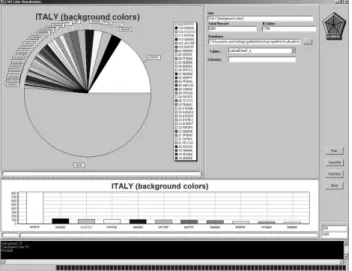
Search results produced by the CWS tool for a particular country domain are stored in the country database and then analyzed for country-specific cultural marker usage patterns. For example, a recent search was conducted for a page and table background color information on 900 top-ranked websites in Google index for Italy (.it domain). This search was restricted to pages written in Italian. The results of the search were stored in the database and visualized using the CWS visualization tool developed at NRC. The results are presented in Figure 1. The CWS Visualization tool makes it easier to analyze the search results for color combination preferences and create Web color palette for a particular country.
Cultural markers “harvested” by the CWS tool include color combinations, layout, graphics, fonts and multimedia elements on web pages. Clearly, not all cultural markers could be automatically collected. By their nature, some cultural markers, especially those related to images, such as icons, flags, pictures related to geography, shape and architecture require involvement of human evaluators. There are some automatic image classification tools [41], [42] that in the future could be utilized in our project to identify high level details on the images used on the country-specific website such as colors, shapes and faces.
Figure 1. CWS color visualization tool: Page and Table background colors for Italy.
It is important to underline the fact that there are other limits imposed by the nature of the automated Web “harvesting” process. For example, it would be difficult, if not impossible to automatically extract meaningful cultural information from the IBM corporate localized websites [35]. In this case, to maintain corporate brand identity, IBM designers kept the same colors and layout for all localized websites, with the only difference being images posted on these websites.
6. Conclusions
Research shows that, in the global software development market, only careful consideration of local users’ needs will achieve long lasting success and client satisfaction with the cultural “look and feel” of the final product. This, in turn, impacts on the success of global e-business and e-learning enterprises. Presently there is a large number of existing cultural models for cross-cultural communications. Some of them are translated in to broad guidelines for cross-cultural user interface design [27], [28], while other guidelines are currently being developed [4].
However, there is a lack of tools that can assist Web developers in creating a first draft of a cultural user interface, for a particular locale, that is verifiably culturally appropriate. In addition to this, there is a lack of tools that enable productive discussions of the prototype cultural user interface with the client, who might not be familiar with the cultural models and design guidelines of the market they are requesting the software for.
In view of this, the authors propose a new approach to cultural user interface development that utilizes a cultural “look and feel” prototyping tool that will be developed based on the results of our research study that utilizes semi-automated search and analysis of a large number of websites for particular locales. This study will result in the databank of cultural information forming the basis of Culture Specific Web design templates for the cultural interface design prototyping tool. This tool is envisioned as an advisor tool that can aid Web development teams in the quick production of the first draft of the cultural “look and feel” design. Additionally this tool could be used in meetings with clients, in order to effectively identify the client’s preferences for the product interface design, while at the same time permitting only those changes requested by the client that are also culturally appropriate.
References:
[1] W. Barber & A. N. Badre, Culturability: The merging of culture and usability, Proc. 4th Conference on
Human Factors and the Web, Baskin, Ridge, New Jersey,
1998.
[2] GALA. Globalization and Localization Association. Terminology. Online. http://www.gala-global.org/, 2004.
[3] G. Hornby, P. Goulding & S. Poon, Perceptions of export barriers and cultural issues: the SME e-commerce experience, Journal of Electronic Commerce
Research, 3 (4), 2002, 213-226.
[4] H. Sun, Building a culturally-competent corporate web site: An exploratory study of cultural
markers in multilingual web design, Proc. 19th annual
international conference on computer documentation,
New York, ACM Press, 2001, 95-102.
[5] E. M. Del Galdo & J. Nielsen, International
User Interfaces (New York, New York: John Wiley &
Sons, 1996).
[6] A. Marcus & E.W. Gould, Cultural dimensions and global Web user interface design: What? So what? Now what? Proc. 16th Conference on Human Factors
and the Web, Austin, Texas, 2000.
[7] S. A. Becker, An exploratory study on Web usability and the internationalization of US e-businesses,
Journal of Electronic Commerce Research, 3 ( 4), 2002,
265-278.
[8] A. Smith, L. Dunckley, T. French, S. Minocha & Y. Chang, A process model for developing usable cross-cultural websites, Interacting with Computers, 16 (1), 2004, 69-91.
[9] B. J. Fogg, Persuasive technology (Morgan Kaufmann Publishers, 2002).
[10] S. L. Jarvenpaa, N. Tractinsky, L. Saarinen & M. Vitale, Consumer trust in an Internet store: A cross-cultural validation, Journal of Computer Mediated
Communication 5 (2), 1999,
http://www.ascusc.org/jcmc/vol5/issue2/jarvenpaa.html. [11] F. Sudweeks & S. Simoff, Culturally Commercial: A cultural e-commerce framework, Proc.
OZCHI 2001, Fremantle, Western Australia, 2001,
148-153.
[12] V. Evers & D. Day, The role of culture in interface acceptance, In S. Howard, J. Hammond and G. Lindegaard (Ed), Human Computer Interaction,
Interact’97 (London, UK, Chapman and Hall, 1997).
[13] A. Badre, The effects of cross cultural interface design orientation on World Wide Web user performance,
GVU Tech Reports, 2000,
http://www.cc.gatech.edu/gvu/reports/2001/
[14] C. Sheppard & J. Scholtz, The effects of cultural markers on website use, Proc. 5th Conference on Human
Factors and the Web, Gaithersburg, Maryland, 1999.
[15] C. McLoughlin, Culturally inclusive learning on the web, Proc. Teaching and Learning Forum 99, 1999,
http://lsn.curtin.edu.au/tlf/tlf1999/mcloughlin.html.
[16] D. Priutt-Mentle, Cultural dimensions of multimedia design for instruction, Proc. National
Educational Computing Conference, Seattle, USA, 2003.
[17] A. E. Barron, & C. Rickerman, Going Global. Designing e-Learning for an international audience, Proc.
ASTD TechKnowledge® 2003 conference, 2003,
http://www1.astd.org/tk03/session_handouts/.
[18] R. Pfremmer, Content Design Considerations for Localizing E-learning Projects. MultiLingual computing, 2004, http://www.multilingual.com.
[19] S. Seufert, (2002). Cultural perspectives, in Adelsgerger, H. H.; Collis, B., Pawlowski, J. M. (Eds),
Handbook of Information Technologies for Education and Training (Berlin: Springer, 2002).
[20] US Department of Health and Human Services, Usability.gov: Usability basics, 2004, http://usability.gov/basics/index.html.
[21] W. Fitzgerald, Models for cross cultural communications for cross-cultural website design, NRC/ERB-1108, 2004, NRC Publication Number: NRC 46563, http://iit-iti.nrc-cnrc.gc.ca/publications/nrc-46563_e.html.
[22] E. Hall & M. R. Hall, Understanding cultural
differences (Yarmouth, Maine: Intercultural Press, 1990).
[23] G. Hofstede, Cultures and organizations: software of the mind (New York, NY: McGraw-Hill,
1991).
[24] F. Trompenaars, Riding the waves of culture: Understanding cultural diversity in business (London:
Nicholas Brealey, 1993).
[25] J. Khaslavsky, Integrating culture into interface design, Proc. CHI 98 conference summary on Human
factors in computing systems, Los Angeles, CA, 1998,
365-366.
[26] G. Ford & H. Gelderblom, The effects of culture on performance achieved through the use of human-computer interaction, Proc. 2003 annual research
conference of the South African Institute of Computer Scientists and Information Technologists on Enablement through technology (SAICSIT 2003), South African
Institute for Computer Scientists and Information Technologists, 2003, 218-230.
[27] E. F. Sheridan, Cross-cultural web site design: Considerations for developing and strategies for validating locale appropriate on-line content,
MultiLingual computing, No. 43, 12 (7), 2001,
http://www.multilingual.com.
[28] A. Marcus, Cross-cultural web user-interface design, Proc. Human-Computer Interaction (INTERACT
'01), 2001, 832-834.
[29] T. Fernandes, Global Interface Design
(Academic Press, 1995).
[30] J. Jagne, Integrating cultural and social factors of the shopping metaphor, in the context of indigenous users, into e-Commerce interface design, Technical
Report: IDC-TR-2004-004, 2004. Interaction Design
Centre, School of Computing Science, Middlesex University.
http://www.cs.mdx.ac.uk/research/PhDArea/research_stu dents/Jainaba/IDC-TR-2004-004.pdf
[31] R. Juric, I. Kim & J. Kuljis, Cross cultural web design: an experience of developing UK and Korean cultural markers, Proc. 25th International Conference
Information Technology Interfaces ITI 2003, Cavtat,
Croatia, 2003, 309-313.
[32] S. Ackerman, Mapping user interface design to culture dimensions, Proc. International Workshop on
Internationalization of Products and Systems, Austin, TX,
2002.
[33] I. Goldfarb, The Art of Multimedia in Education,
Graduate studies thesis, Faculty of Education, University
of New Brunswick, Fredericton, New Brunswick, Canada, 2004.
[34] I. Goldfarb & I. Kondratova, “Look and Feel" interface design tool for educational multimedia courseware, Proc. EDMedia 2004 - World Conference on
Educational Multimedia, Hypermedia and Telecommunications, Lugano, Switzerland, 2004,
1779-1784.
[35] I. Kondratova & I. Goldfarb, Cultural visual interface design, Proc. EDMedia 2005 - World
Conference on Educational Multimedia, Hypermedia and Telecommunications, Montreal, Canada, 2005 (in press).
[36] L. Cabarga, The designer’s guide to global color combinations. 750 color formulas in CMYK and RGB from around the word (Cincinnati, Ohio: HOW Design
Books, an imprint of F&W Publications Inc., 2001). [37] S. Kobayashi, Color image scale (Kodansha
International, 1991).
[38] Google, Google Web APIs, 2005, http://www.google.com/apis/.
[39] R. Kraft, S. Kim & R. Stata, Extending the Google API for web carnivores, Proc. WWW2004, 2004. [40] T. Finin, Y. Peng, R. S. Cost, J. Sachs, A. Joshi, P. Reddivari, R. Pan, V. Doshi & L. Ding, Swoogle: A search and metadata engine for the Semantic Web, Proc.
CIKM’04, 2004.
[41] T. Gevers & A. W. M. Smeulders, PicToSeek: Combining color and shape invariant features for image retrieval, IEEE Transactions on image processing, 9 (1), 2000.
[42] J. R. Smith & S-F. Chang, VisualSEEk: A fully automated content-based image query system, Proc. ACM