HAL Id: hal-00000531
https://hal.archives-ouvertes.fr/hal-00000531
Submitted on 28 Jul 2003
HAL is a multi-disciplinary open access
archive for the deposit and dissemination of
sci-entific research documents, whether they are
pub-lished or not. The documents may come from
teaching and research institutions in France or
abroad, or from public or private research centers.
L’archive ouverte pluridisciplinaire HAL, est
destinée au dépôt et à la diffusion de documents
scientifiques de niveau recherche, publiés ou non,
émanant des établissements d’enseignement et de
recherche français ou étrangers, des laboratoires
publics ou privés.
Hector de Vega
To cite this version:
Hector de Vega. Early Cosmology and Fundamental Physics. Chalonge School in Astrofundamental
Physics, September 2002, NATO ASI., 2003, Palermo, Italy. pp.1-19. �hal-00000531�
ccsd-00000531 (version 1) : 28 Jul 2003
H. J. de Vega
LPTHE, Universit´e Pierre et Marie Curie (Paris VI) et Denis Diderot (Paris VII), Tour 16, 1er. ´etage, 4, Place Jussieu, 75252 Paris, Cedex 05, France
This is a pedagogical introduction to early cosmology and the host of fundamental physics involved in it (particle physics, grand unification and general relativity). Inflation and the inflaton field are the central theme of this review. The quantum field treatment of the inflaton is presented including its out of equilibrium evolution and the use of nonperturbative methods. The observational predictions for the CMB anisotropies are briefly discussed. Finally, open problems and future perspectives in connection with dark energy and string theory are overviewed.
Contents
I. The history of the universe 1
II. Fundamental Physics 2
III. Essentials of Cosmology 3
IV. Inflation and the Inflaton Field 5
V. Out of Equilibrium Field Theory and Early Cosmology 6
VI. Open Problems and Outlook 13
References 14
I. THE HISTORY OF THE UNIVERSE
The history of the universe is a history of expansion of the space and cooling down. During all its history the universe as a whole is homogeneous and isotropic in an excellent approximation, therefore it is described by a Friedmann-Robertson-Walker (FRW) geometry
ds2= dt2− a2(t) d~x2 (1.1)
where the scale factor a(t) grows with t. We consider the space part flat according to the observed value of the density Ω ≃ 1.
Physical lengths increase as · a(t) and the temperature decreases as T (t) ∼ a(t)1 .
Usually, time is parametrized by the redshift z defined according to astronomer’s convention:
1 + z = a(today)
a(t) .
This formula gives the redshift of an event taking place at time t in the past. Large z corresponds to early times when a(t) ≪ a(today).
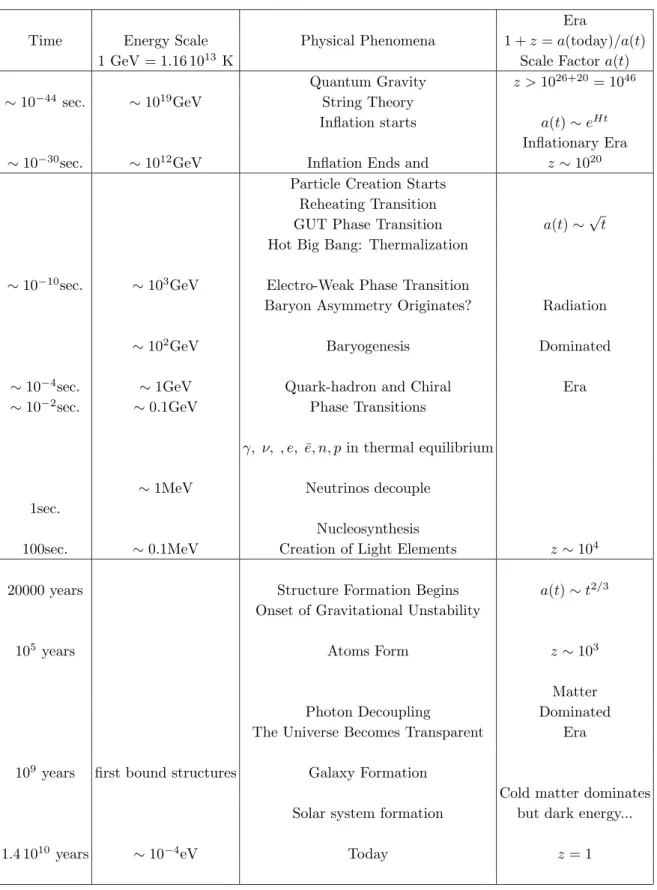
A summary of the history of the universe is given in table 1.
∗Based on Lectures at the 9th. Chalonge School in Astrofundamental Physics, Palermo, September 2002, NATO ASI. To
II. FUNDAMENTAL PHYSICS
In order to describe the early universe we need: • General Relativity: Einstein’s Theory of Gravity
The matter distribution determines the geometry of the spacetime through the Einstein equations. For the geometry eq.(1.1), the Einstein equations reduce to one scalar equation, the Einstein-Friedman equation · 1 a(t) da dt ¸2 = 8 ̉ 3 G ̊(t) , (2.1)
where G stands for Newton’s gravitational constant and ̊(t) for the energy density. • Quantum Field Theory and String Theory to describe Matter
Since the energy scale in the early universe is so high (well beyond the rest mass of particles), a quantum field theoretical description for matter is unavoidable. Only such context permits a correct description of particle production, particle decays and transmutations.
Electromagnetic, weak and strong interactions are well described by the so-called the standard model. That is, quantum chromodynamics (QCD) combined with the electroweak theory (electromagnetic and weak interactions). This a non-abelian gauge theory associated to the symmetry group SU (3) ⊗ SU(2) ⊗ U (1). The SU (3) corresponding to the color group of QCD while SU (2) ⊗ U(1) describes the electroweak sector. To this scheme, one adds presently neutrino masses (through the see-saw mechanism) to explain neutrino oscillations.
The energy scale in QCD is about ∼ 100MeV ≃ 1012K corresponding to the chiral symmetry breaking
while the energy scale for the electroweak is the Fermi scale ∼ 100GeV ≃ 1015K.
The standard model has been verified experimentally with spectacular precision. However, it is an incomplete theory of particles. How to complete it is a major challenge. It seems obvious that extensions of the Standard model will be symmetric under a group containing SU (3) ⊗ SU(2) ⊗ U(1) as a subgroup.
The simplest proposals for a Grand Unified Theory (GUT) include SU (5), SO(10), SU (6) and E6 as
symmetry group. Munification MZ mb mµ me [α1(α, sin2θw)]−1 [α2(α, sin2θw)]−1 [α3]−1
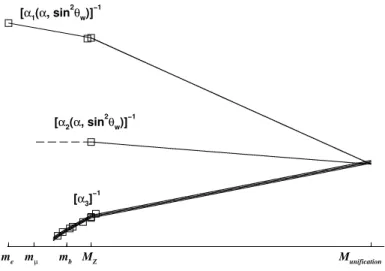
FIG. 1: Evolution of the weak α1, electromagnetic α2 and strong α3couplings with energy in the MSSM model. Notice that only α3decreases with energy (asymptotic freedom) extracted from ref.[9]
The unification idea consists in that at some energy scale all three couplings (electromagnetic, weak and strong) should become of the same strength. In this case, such grand unified scale turns out to be
E ∼ 1016GeV. The change of the couplings with the energy (or length) is governed in physics by the
Many extensions of the Standard model use supersymmetry in one way or another.
Supersymmetry transformations mix bosons and fermions. Supersymmetry as well as GUT-symmetry should leave invariant the evolution laws (the lagrangian) at sufficiently enough energy. Notice that the physical states (or density matrices) describing the matter need not to be invariant. For example, any thermal state at non-zero temperature cannot be invariant under supersymmetry since Bose-Einstein and
Fermi-Dirac distributions are different. Somehow, the early universe with T & 1014GeV is one of the less
supersymmetry invariant situations in nature.
Generally speaking, the symmetry increases with energy. This is true in general, in statistical mechan-ics, condensed matter as well as in cosmology. For example, a ferromagnet at temperatures higher than the Curie point is at the symmetric phase with zero magnetization. Below the Curie point, the non-zero magnetization reduces the symmetry.
The same effect happens in the universe for symmetry breaking. The universe started with maximal symmetry before inflation and this symmetry reduces gradually while the universe expands and cools off. The symmetry breaking transitions includes both the internal symmetry groups (as the GUT’s symmetry group that eventually reduces to the SU (3) ⊗ SU(2) ⊗ U(1) group) as well as the translational and rotational symmetries which are broken by the density fluctuations and the structure formation. These last produced by gravity instabilities.
It should be noticed, however, that no direct manifestation of supersymmetry is known so far. An indication comes by studying the energy running of the (electromagnetic, weak and strong) in the standard model and in its minimal supersymmetric extension (MSSM). As depicted in fig. 1 all three couplings
meet at E ≃ 3 · 1016GeV in the MSSM. The coupling unification becomes quite loose in the Standard
Model. This is why the renormalization group running of the couplings in the MSSM supports the idea that supersymmetry would a necessary ingredient of a GUT. For a recent outlook see [1].
It must be noticed that neutrino masses in the see-saw mechanism naturally call for a mass scale of
the order of the GUT scale. This is the second evidence that an energy scale around 1015GeV plays a
crucial role. The third evidence comes from inflation (see below).
III. ESSENTIALS OF COSMOLOGY
The essential observational evidence about the Universe can be summarized as: • Isotropy and Homogeneity
The Universe is isotropic and homogeneous for large enough scales. Today this corresponds to L & 100Mpc. Galactic surveys and the cosmic microwave background strongly support this evidence. Therefore, the geometry of the universe is described by eq.(1.1).
• Hubble Expansion
Objects in the universe move at a speed proportional to their distance according to Hubble’s law: dR
dt = H(t) R(t) where H(t) =
˙a(t)
a(t).
This is an immediate consequence of eq.(1.1). At present time H = 72 7km/(sec Mpc). Notice
that objects at distances R > 1
H cannot be in causal contact with us since their velocity would be
higher than the velocity of light. dH≡ H1 is then the cosmological horizon around us.
• Cosmic Microwave Background
The CMB is isotropic up to ∼ 10−4. It is the best known black body spectrum with deviations less
than 0.005%. No laboratory spectrum can beat it so far. Its temperature is TCM B= 2.7277K.
The Einstein-Friedman equation (2.1) is supplemented by the continuity equation
˙̊(t) + 3(t)H(t) [̊(t) + p(t)] = 0 , (3.1)
where p(t) stands for the pressure. The continuity equation follows from the Einstein equations (Bianchi identity).
The equation of state must be computed from the appropriate theory of matter considered. That is, the equation of state depends on the nature of matter.
Era
Time Energy Scale Physical Phenomena 1 + z = a(today)/a(t)
1 GeV = 1.16 1013 K Scale Factor a(t)
Quantum Gravity z > 1026+20= 1046
∼ 10−44 sec. ∼ 1019GeV String Theory
Inflation starts a(t) ∼ eHt
Inflationary Era
∼ 10−30sec. ∼ 1012GeV Inflation Ends and z ∼ 1020
Particle Creation Starts Reheating Transition
GUT Phase Transition a(t) ∼√t
Hot Big Bang: Thermalization
∼ 10−10sec. ∼ 103GeV Electro-Weak Phase Transition
Baryon Asymmetry Originates? Radiation
∼ 102GeV Baryogenesis Dominated
∼ 10−4sec. ∼ 1GeV Quark-hadron and Chiral Era
∼ 10−2sec. ∼ 0.1GeV Phase Transitions
˼, ̆, , e, ¯e, n, p in thermal equilibrium
∼ 1MeV Neutrinos decouple
1sec.
Nucleosynthesis
100sec. ∼ 0.1MeV Creation of Light Elements z ∼ 104
20000 years Structure Formation Begins a(t) ∼ t2/3
Onset of Gravitational Unstability
105years Atoms Form z ∼ 103
Matter
Photon Decoupling Dominated
The Universe Becomes Transparent Era
109years first bound structures Galaxy Formation
Cold matter dominates
Solar system formation but dark energy...
1.4 1010 years ∼ 10−4eV Today z = 1
TABLE 1. The history of the Universe. Time, typical energies and main physical phenomena from the begining till today.
The most symmetric and simplest possibility is an energy-momentum tensor proportional to the unit tensor,
TB
A = Λ ˽BA 0 ≤ A, B ≤ 3 .
where Λ is a constant. This corresponds to a constant energy density ̊(t) = Λ and a negative pressure p = −̊. Λ is usually called the cosmological constant. A constant energy density in the Einstein-Friedman equation (2.1) leads to an exponentially expanding universe with
a(t) = a(0) eH t.
This describes a De Sitter universe with H =q8̉3 G Λ.
Ultrarelativistic particles like radiation (hot matter) have the equation of state p = 13 ̊ which leads
through eqs.(2.1) and (3.1) to the FRW radiation dominated universe with a(t) = pt/t0. The energy
density dilutes here with time as ̊(t) = ̊0a(t)−4.
Nonrelativistic particles (cold matter) obey p = 0. It follows from eqs.(2.1) and (3.1) the matter
dominated universe with a(t) =³t
t0
´23
. The energy density dilutes here with time as ̊(t) = ̊0 a(t)−3.
That is, they dilute the rate of expansion of the space volume while massless particles get an extra factor a(t) due to the red-shift of their energies.
Strings exhibit a richer behaviour[3]. Three different behaviours are found with the following equations of state,
• Stable strings p = 0, they behave as nonrelativistic matter.
• Unstable strings p = −̊3, this behaviour is only exhibited by strings. It implies a dilution ̊ =
̊0
a2(t).
• Dual to unstable strings p =̊3, they behave as radiation.
It must be stressed that a string during its time evolution changes from one behaviour to another. A cosmological model describing the radiation dominated and matter dominated eras with strings is realized with a gas of classical strings[3].
IV. INFLATION AND THE INFLATON FIELD
Inflation is part of the standard cosmology since several years.
Inflation emerged in the 80’s as the only way to explain the ‘bigness’ of the universe. That is, the value
of the entropy of the universe today ∼ 1090∼ (e69)3. Closely related to this, inflation solves the horizon
and flatness problem explaining therefore the quasi-isotropy of the CMB. For a recent outlook see [2]. The inflationary era corresponds to the scale of energies of the Grand Unification. It is not yet known which field model appropriately describes the matter for such scales. Fortunately, one does not need a detailed description in order to investigate inflationary cosmology. One needs the expectation value of the
quantum energy density (T00) which enters in the r. h. s. of the Einstein-Friedman equation (2.1). This is
dominated by field condensates. Since fermions fields have zero expectation values only the bosonic fields are relevant. Bosonic fields do not need to be fundamental fields. They can be pairs fermion-antifermion
< ¯ΨΨ > in a GUT. In order to describe the cosmological evolution is enough to consider the effective
dynamics of such condensates. In fact, one condensate field is enough to obtain inflation. It is usually called ‘inflaton’ and its dynamics can be described by a Ginsburg-Landau lagrangian in the cosmological background eq.(1.1). That is, an effective local Lagrangian containing terms of dimension less or equal than four (renormalizable),
L = a3(t)" ˙̏ 2 2 − (∇̏)2 2 a2(t) − V (̏) # (4.1)
Here, the inflaton potential V (̏) is usually a quartic polynomial: V (̏) = m2
2 ̏ 2+̄
4 ̏ 4.
The inflaton field ̏ may not correspond to any real particle (even unstable). It is just an effective description of the dynamics. The detailed microscopical description should be given by the GUT. For-tunately, we do not need to know it in order to get a description of the cosmological evolution. Indeed, a more precise description should be possible from a microscopic GUT. Somehow, the inflaton is to the microscopic GUT theory like the Ginzburg-Landau theory of superconductivity is to the microscopic BCS theory.
The inflaton model contains here two free parameters: m2 and ̄. In order to reproduce the CMB
anisotropies one has to choose m2 around the GUT scale and the coupling very small ̄ ∼ 10−12. A
model with only one field is clearly unrealistic since the inflaton then describes a stable and ultra-heavy (GUT scale) particle. It is necessary to couple the inflaton with lighter particles. Then, the inflaton decays into them.
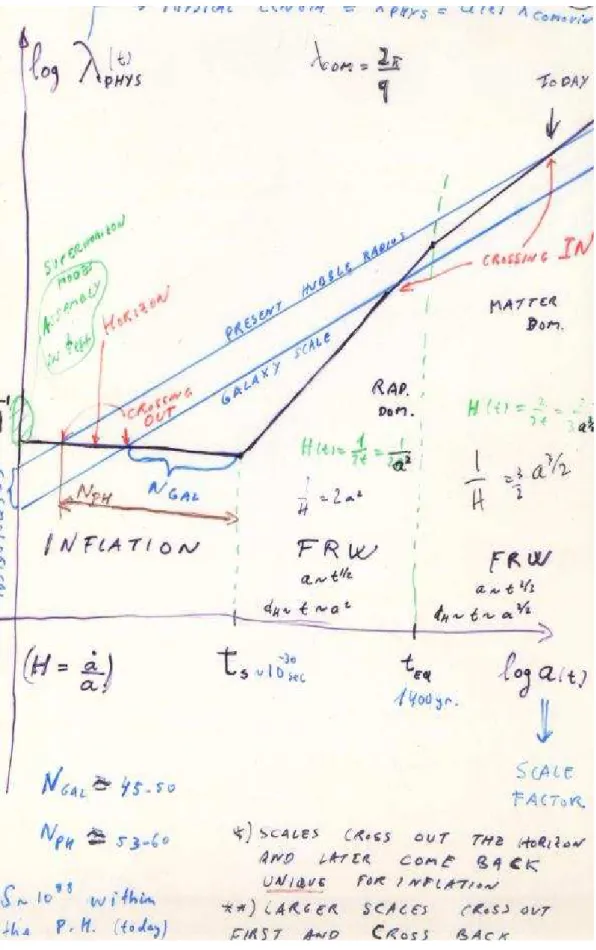
Fig. 2 shows how microscopic scales (even transplanckian) at the begining of inflation become astro-nomical and produce the CMB anisotropies as well as the large scale structure of the universe. The crucial fact is that the excitations can cross the horizon twice, coming back and bringing information from the inflationary era.
There are many available scenarios for inflation. Most of them add extra fields coupled with the inflaton. This variety of inflationary scenarii may seem confusing since many of them are compatible with the observational data[8]. Indeed, future observations should constraint the models more tightly excluding some of them. Anyway, the variety of acceptable inflationary models shows the power of the inflationary paradigm. Whatever is the correct microscopic model for the early universe, it must include inflation with the features we know today.
The scenarii where the inflaton is treated classically are usually characterized as small and large fields scenarii. In small fields scenarii the initial classical amplitude of the inflaton is assumed small compared
with |m|/√̄ while in large field scenarii the inflaton is initially of the order ∼ |m|/√̄[10]. The first
type of scenarii is usually realized with broken symmetric potentials (m2< 0) while for the second type
scenarii (‘chaotic inflation’) one can just use unbroken potentials with m2> 0.
Most of the work on inflation considers the inflaton field as a classical field. This treatment is not accurate. The energy scales at which inflation takes place call for a fully quantum treatment of the inflaton. This have been the subject of refs.[4]-[7].
The coupled dynamics of the quantum inflaton and the geometry contains rich physics. Therefore, we studied first the non-linear out of equilibrium dynamics just in Minkowski spacetime[6]. Later, the quantum inflaton dynamics in fixed cosmological backgrounds as de Sitter[7], radiation dominated and matter dominated FRW. Finally the coupled dynamics of the inflaton and the scale factor was studied in [4] for a ‘new inflation’ type scenario and in ref.[5] for tsunami inflation. In all cases, out of equilibrium field theory methods are used together with the nonperturbative large N approach in order to deal with
the huge energy densities (∼ m4/̄) non-analytic in ̄.
In our treatment we consider gravity semiclassical: the geometry is classical and the metric follows from the Einstein-Friedman equations where the r.h.s. is the expectation value of a quantum operator. Quantum gravity corrections can be neglected during inflation because the energy scale of inflation ∼ minf laton∼ MGU T ∼ 10−5MP lanck. That is, quantum gravity effects are at most ∼ 10−5and can be
neglected in this context.
V. OUT OF EQUILIBRIUM FIELD THEORY AND EARLY COSMOLOGY
As stressed before, the dynamics of inflation is essentially of quantum nature. This is extremely important, especially in light of the fact that it is exactly this quantum behavior give rise to the primordial metric perturbations which imprint the CMB.
The inflaton must be treated as a non-equilibrium quantum field . The simplest way to see this comes from the requirement of having small enough metric perturbation amplitudes which in turn requires
that the quartic self coupling ̄ of the inflaton be extremely small, typically of order ∼ 10−12. Such
a small coupling cannot establish local thermodynamic equilibrium (LTE) for all field modes; typically the long wavelength modes will respond too slowly to be able to enter LTE. In fact, the superhorizon sized modes will be out of the region of causal contact and cannot thermalize. Out of equilibrium field theoretic methods permit us to follow the dynamics of quantum fields in situations where the energy
FIG. 2: Physical lengths λphys = a(t) λcomoving vs. the scale factor a(t) in a log-log plot. The black line is the horizon. One sees that some wavelengths can cross the horizon twice bringing information from extremely short wavelength modes during the inflationary era. These transplanckian modes are responsible of the observed CMB anisotropies.
density is non-perturbatively large (∼ 1/̄). That is, they allow the computation of the time evolution of non-stationary states and of non-thermal density matrices.
Our programme on non-equilibrium dynamics of quantum field theory, started in 1992[4]-[7] to study the dynamics of non-equilibrium processes from a fundamental field-theoretical description, by solving the dynamical equations of motion of the underlying four dimensional quantum field theory for the early universe dynamics as well as high energy particle collisions and phase transitions out of equilibrium.
The focus of our work is to describe the quantum field dynamics when the energy density is high.
That is, a large number of particles per volume m−3, where m is the typical mass scale in the theory.
Usual S-matrix calculations apply in the opposite limit of low energy density and since they only provide information on in ջ out matrix elements, are unsuitable for calculations of expectation values.
In high energy density situations such as in the early universe, the particle propagator (or Green function) depends on the particle distribution in momenta in a nontrivial way. This makes the quantum dynamics intrinsically nonlinear and calls to the use of self-consistent non-perturbative approaches as
the large N limit. In this approach, the inflaton becomes a N -component field ~Φ = (Φ1, . . . , ΦN) with a
selfcoupling of the order 1/N . That is,
L = a3(t) " 1 2 ˙~Φ 2 (x) −12(~∇~Φ(x)) 2 a2(t) − V (~Φ(x)) # (5.1) V (~Φ) = m 2 2 ~Φ 2+ ̄ 8N ³~Φ 2´2+1 2̇ R ~Φ 2, (5.2)
where m2> 0 for unbroken symmetry and m2< 0 for broken symmetry. Here R(t) stands for the scalar
curvature
R(t) = 6µ ¨a(t)a(t)+ ˙a
2(t)
a2(t)
¶
, (5.3)
The ̇-coupling of Φ(x)~ 2 to the scalar curvature R(t) has been included since arises anyhow as a
conse-quence of renormalization[7].
We consider translationally invariant quantum states |Ω > or density matrices ˆ̊(t) consistent with the
geometry. Inhomogeneities will arise as quantum fluctuations. That is, ~
P |Ω >= 0 or [ ~P , ˆ̊(t)] = 0 .
The expectation value of the field Φ plays the role of order parameter and can be chosen in a fixed direction (say 1) in the internal space,
< Φi(~x, t) >≡ Tr [ˆ̊(t)Φi(~x, t)] = ˽i1̏(t)
It is convenient to write the field operator Φ as
Φi(~x, t) = ˽i1̏(t) + Ψi(~x, t) , 1 ≤ i ≤ N ,
where the field operator Ψ has zero expectation value by construction: < Ψi(~x, t) >= 0.
Translational invariance allows to expand the field operator Ψ in Fourier integral,
Ψi(~x, t) = Z d3k (2̉)3 h ˺i(~k) ̏∗k(t) ei~k⋅~x+ ˺ † i(~k) ̏k(t) e−i~k⋅~x i (5.4)
where the ˺†i(~k), ˺i(~k), 1 ≤ i ≤ N are creation-annihilation operators and the ̏k(t) mode functions.
The functions ̏k(t) contain all the information about the dynamics and are determined by the evolution
equations and the initial conditions as we shall see below. For the vacuum state (Minkowski spacetime)
the ̏k(t) have just a harmonic time dependence ei ̒ktwith ̒k =
√
m2+ k2.
In the large N limit this model becomes an infinite set of harmonic oscillators with time dependent
frequencies that contain the expectation value < [Ψi(~x, t)]2 >. That is, the dynamics is non-linear and
The quantum fluctuations of Ψi are readily obtained from eq.(5.4) with the result, < [Ψi(~x, t)]2>= Z d3k (2̉)3 |̏k(t)| 2 cothΘk 2 (5.5)
where the parameter Θk depends on the initial state chosen[5].
In order to write the evolution equations it is convenient to choose dimensionless variables:
̍ = m t ; h(̍ ) = H(t) m ; q = k m ; ̒q =̒k m ; ; g = ̄ 8̉2 ; fq(̍ ) = √ m ̏k(t) , g Σ(̍ ) = ̄ 2 m2N < [Ψi(~x, t)] 2 > ; ̀(̍ ) =r ̄ 2 ̏(t) m . (5.6)
The derivation of the equations of motion for the mode functions and the field expectation value was given in ref.[4, 5] in the limit N ջ ∞. The set of coupled, self-consistent equations of motion for the quantum fields and the scale factor are
· d2 d̍2 + 3 h(̍ ) d d̍ + M 2(̍ )¸̀(̍ ) = 0 · d2 d̍2 + 3 h(̍ ) d d̍ + q2 a2(̍ )+ M 2(̍ )¸f q(̍ ) = 0 . (5.7)
Here, M2(̍ ) = 1 + ̀2(̍ ) + g Σ(̍ ) plays the role of effective mass squared. The sign + corresponds to
unbroken O(N ) symmetry while the sign − corresponds to the broken symmetry case. Notice that the zero mode (field expectation value) ̀(̍ ) obeys the same equation of motion as the q = 0 mode.
The quantum fluctuations Σ(̍ ) need to be subtracted for ultraviolet divergences associated to mass and coupling constant renormalization,
Σ(̍ ) = Z ∞ 0 q2dq · |fq(̍ )|2− 1 q a(̍ )2 + Θ(q − 1) 2q3 µ M2(̍ ) m2 − R(̍) 6m2 ¶¸ (5.8)
Notice that the mass and coupling constant renormalizations are identical to the Minkowski case since the high frequency regime is not affected by the curved spacetime. Eqs.(5.7) are coupled to the Einstein-Friedman equation for the scale factor,
h2(̍ ) = L2ǫ(̍ ) , where L2≡16 ̉N m2
3 M2
P l̄
. (5.9)
with the renormalized energy density ǫ(̍ ) given by[5]
ǫ(̍ ) ≡ ̄ 2N m4hT 00 iR = gΣ(̍ ) 2 + [gΣ(̍ )]2 4 + g 2 Z q2dqn| ˙fq(̍ )|2− S1(q, ̍ )+ + q 2 a2(̍ )£|fq(̍ )| 2 − S2(q, ̍ )¤ ¾ , (5.10) S1(q, ̍ ) = q a4(̍ )+ 1 2qa4(̍ )£B(̍ ) + 2 ˙a 2¤ + Θ(q − 1) 8q3a4(̍ ) h −B(̍)2− a(̍)2B(̍ )+¨
+3 a(̍ ) ˙a(̍ ) ˙B(̍ ) − 4 ˙a2(̍ ) B(̍ )i ,
S2(q, ̍ ) = 1 qa2(̍ )− 1 2q3a2(̍ ) B(̍ ) + Θ(q − 1) 8q5a2(̍ ) ½ 3B(̍ )2+ a(̍ )d d̍ h a(̍ ) ˙B(̍ )i ¾ , with B(̍ ) ≡ a2(̍ ) M2(̍ ) .
The subtractions performed essentially correspond to the divergent part of the zero point fluctuations and ensure the finiteness of the energy density as well as the covariant conservation (Bianchi identity)
˙ǫ(̍ ) + 3 h(̍ ) [p(̍ ) + ǫ(̍ )] = 0 , where the renormalized pressure p(̍ ) follows from eq.(5.10) and [5]
p(̍ ) + ǫ(̍ ) = g Z q2dq ½ | ˙fq(̍ )|2− S1(q, ̍ ) + q2 3a2(̍ )£|fq(̍ )| 2 − S2(q, ̍ )¤ ¾ . (5.11)
These evolution equations are supplemented by the initial conditions. In general, they take the form,
̀(0) = ̀0 , ˙̀(0) = ̇0 , fq(0) = 1 pΩq , f˙q(0) = − [̒q ˽q+ h(0) + i Ωq] fq(0) ̒q = s q2+ ¯ ¯ ¯ ¯ 1 + ̀2 0+ gΣ(0) − R(0)6m2 ¯ ¯ ¯ ¯ , a(0) = a0 , h(0) = h0. (5.12)
We usually choose ̇0= 0 since one can always enforce that by a shift in the time variable. For simplicity
we take a0= 1. The parameters Ωq and ˽q are arbitrary and characterize the initial density matrix (the
initial state).
The inflationary scenarii described by a classical inflaton field correspond to the choice of the vacuum
state for the oscillators. That is, Ωq= ̒q, ˽q= 0. In that case the quantum fluctuations are of the order
one at the initial time Σ(0) = O(1) and hence g Σ(0) ≪ 1.
The tsunami inflationary scenario correspond to a band of excited quantum modes in the initial state, thus the name ‘tsunami-wave’[5]. This initial state models a cosmological initial condition in which the energy density is non-perturbatively large, but concentrated in the quanta rather than in the field expectation value.
In summary, we have an infinite number of coupled non-linear differential equations (5.7)-(5.10) which
are local in time but non-local in the wavenumbers q. The unknowns are a(̍ ), ̀(̍ ), fq(̍ ), 0 ≤ q ≤ ∞
and the initial conditions are listed in eq.(5.12).
Eqs.(5.7)-(5.10) can be solved analytically for short and late times. Otherwise, the numerical treatment
is easy to implement. Notice that all physical quantities are computed from the mode functions fq(̍ ), 0 ≤
q ≤ ∞, the zero mode ̀(̍) and the scale factor a(̍). For example, the equal-time correlators of the field Ψ are given by < Ψ(~x, ̍ ) Ψ(~y, ̍ ) >= Z d3q (2̉)3 |fq(̍ )| 2 cothΘq 2 .
The resolution of eqs.(5.7)-(5.10) is discussed in detail in refs.[4] as well as the observational implications through the density fluctuations. We present here now the crucial features.
Let us consider a new inflation scenario with broken symmetry as in ref.[4]. Assuming initially the
ground state for the quantum modes fk and ̀0= ̇0= 0 (opposite to the tsunami scenario [5]). We then
have that g Σ(0) ≪ 1, and we can approximate the effective mass for short times as M2(̍ ) = − in the
mode equations (5.7) · d2 d̍2 + 3 h0 d d̍ + q2 [a0]2e2 h0̍ − 1 ¸ fq(̍ ) = 0 with solution fq(̍ ) = e− 3 2h0̍ h a(q) J̆ ³q h e −h0̍ ´ + b(q) J−̆ ³q he −h0̍ ´i , (5.13) where ̆ ≡qh12 + 9
4, J̆(z) stand for a Bessel function and the coefficients a(q) and b(q) are determined by
the initial conditions[4]. Since the argument of the Bessel functions tends to zero very fast for increasing time, the second term in eq.(5.13) dominates and we have
fq(̍ ) ≃ e− 3 2h0̍b(q) J −̆( q h e −h0̍ ) ≃ b(q) Γ(1 − ̆) µ 2h q ¶̆ e(̆−3/2)h0̍ . (5.14)
We see that the mode functions grow exponentially fast in time due to the spinodal instabilities. [Recall
that broken symmetry implies m2< 0 in V (̏) eq.(4.1)]. Notice that the growth of the modes here (de
Sitter spacetime) is different to the growth in Minkowski and FRW spacetimes[6, 7]. Notice furthermore
that eq.(5.14) applies when ̄phys = 2̉ eh0̍/q > 2̉/h0. That is, after the modes have crossed out the
horizon. The physical meaning of the growth of the mode functions is that particles are created at the expense of the dark energy (uniformly distributed energy) driving inflation.
This linear approximation breaks down when gΣ(̍ ) is no more negligible compared with unity. Esti-mating Σ(̍ ) for short times from eqs.(5.5) and (5.14) yields [4],
̍nl≃
1
(2̆ − 3) h0
ln1
g+ O(1) (5.15)
For ̍ > ̍nl (the nonlinear time), the nonlinear effects of backreaction through Σ(̍ ) become very
im-portant, and the contribution from the quantum fluctuations competes with the tree level terms in the
equations of motion, shutting-off the instabilities. Beyond ̍nl, the full numerical analysis of
eqs.(5.7)-(5.10) shown in figs. 3–5 captures the correct dynamics.
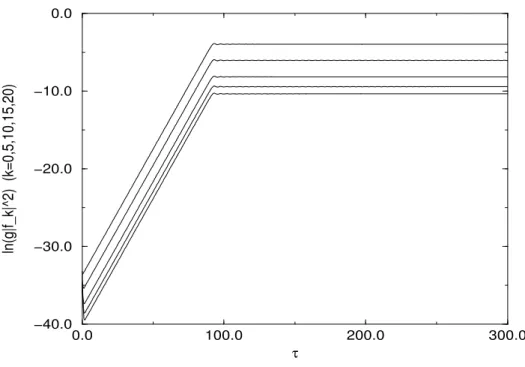
Figs. 3–5 show gΣ(̍ ) vs. ̍ , h(̍ ) vs. ̍ and ln |fq(̍ )|2 vs. ̍ for several values of q with larger q′s
corresponding to successively lower curves. They correspond to g = 10−14; ̀
0= 0 ; ̇0= 0 and we have
chosen the representative value h0= 2.0.
Figs. 3 and 4 show clearly that when the contribution of the quantum fluctuations gΣ(̍ ) becomes of order 1 inflation ends, and the time scale for gΣ(̍ ) to reach O(1) is very well described by the estimate
eq.(5.15). From fig.3 we see that this happens for ̍ = ̍nl≈ 90, leading to a number of e-folds Ne≈ 180
which is correctly estimated by eq. (5.15).
Fig. 5 shows clearly the factorization of the modes after they cross the horizon as described by eq.(5.14). The slopes of all the curves after they become straight lines in fig.5 is given exactly by 2̆ − 3, whereas the intercept depends on the initial condition on the mode function and the larger the value of q the smaller the intercept because the amplitude of the mode function is smaller initially. Notice from the figure that when inflation ends and the non-linearities become important all of the modes effectively saturate. This is also what happens for the zero mode: exponential growth in early-intermediate times (neglecting the decaying solution), with a growth exponent given by ̆ − 3/2 and an asymptotic behavior of small oscillations around the equilibrium position, which for the zero mode is ̀ = 1, but for the q 6= 0 modes depends on the initial conditions. All of the mode functions have this behavior once they cross the horizon. We have also studied the phases of the mode functions and we found that they freeze after horizon crossing in the sense that they become independent of time. This is natural since both
the real and imaginary parts of fq(̍ ) obey the same equation but with different boundary conditions.
After the physical wavelength crosses the horizon, the dynamics is insensitive to the value of q for real and imaginary parts and the phases become independent of time. Again, this is a consequence of the factorization of the modes.
The growth of the quantum fluctuations ends inflation at a time given by ̍nl [eq.(5.15)]. Furthermore,
the calculation of the pressure from eq.(5.11) shows that during the inflationary epoch p(̍ )/˾(̍ ) ≈ −1
and the end of inflation is rather sharp at ̍nl. p(̍ )/˾(̍ ) oscillates between 1 with zero average over
the cycles, resulting in matter domination. Moreover, h(̍ ) is constant (and equals to h0) during the de
Sitter epoch and becomes matter dominated after the end of inflation with h−1(̍ ) ≈32(̍ − ̍nl).
All of these features hold for a variety of initial conditions. As an example, we show in ref.[4] the case
of an initial Hubble parameter of h0 = 10. The reason why our results are independent on the details
of the initial conditions stemmed from the fact that the spinodal instabilities dominate the dynamics. Therefore, small changes on the initial data only have an irrelevant physical effect. The same is true for tsunami inflation[5].
We computed in ref.[4] the density fluctuations for cosmologically relevant modes (see fig. 2). We found, |˽k(tf)| = 3 5 ̉ Γ(̆) (̆ − 32) F(H0/m) µ 2H0 k ¶̆−32 , (5.16)
0.0 100.0 200.0 300.0 τ 0.0 0.5 1.0
λΣ(τ)/8π⊥2
FIG. 3: gΣ(τ ) vs. τ , for η(0) = 0, ˙η(0) = 0, g = 10−14, h 0= 2.0. 0.0 100.0 200.0 300.0 τ 0.0 0.5 1.0 1.5 2.0h
FIG. 4: h(τ ) vs. τ , for η(0) = 0, ˙η(0) = 0, g = 10−14, h 0 = 2.0.where the function F(H0/m) computed in in ref.[4] encodes the information from the quantum
fluctua-tions Σ(̍ ). We read the power spectrum per logarithmic k interval as,
Ps(k) = |˽k|2∝ k−2(̆−
3
2). (5.17)
leading to the index for scalar density perturbations
ns= 1 − 2
µ
̆ − 32
¶
0.0 100.0 200.0 300.0 τ −40.0 −30.0 −20.0 −10.0 0.0 ln(g|f_k|^2) (k=0,5,10,15,20) FIG. 5: ln |fq(τ )| 2 vs. τ , for η(0) = 0, ˙η(0) = 0, g = 10−14, h
0 = 2.0 for q = 0.0, 5, 10, 15, 20 with smaller q corresponding to larger values of ln |fq(τ )|
2 .
The recent WMAP observations[8] are compatible with this red spectrum.
VI. OPEN PROBLEMS AND OUTLOOK
The Universe today is formed by a 73% 4% of dark energy and 23% 4% of dark matter. Here are two of the greatest open questions.
Dark energy is continuously distributed energy in the Universe. It amounts to a uniform density of about four proton masses per cubic meter. It seems natural to think that it is due to zero point quantum fluctuations. A naive calculation in a fixed spacetime yields a completely wrong order of magnitude. It must then be a dynamical quantity that evolves with the universe. No theoretical explanation for the dark energy is available today. Notice, however that the dark energy in the inflationary universe plays a clear role in a quantum field theory treatment and transforms into the created particles (see sec. V and ref.[4, 5]). Dark matter is a further open problem. The nature of the particles that forms it is still unknown.
The physics beyond GUT’s is a fascinating but unchartered territory. The quantum gravity phenomena receive a great deal of attention since many years[11]. It may be very well that a quantum theory of gravitation needs new concepts and ideas. Of course, this future theory must have the today’s General Relativity and Quantum Mechanics (and QFT) as limiting cases. In some sense, what everybody is doing in this domain (including string theories approach) may be something analogous to the development of the old quantum theory in the 10’s of this century[12]. Namely, people at that time imposed quantiza-tion condiquantiza-tions (the Bohr-Sommerfeld condiquantiza-tions) to hamiltonian mechanics but keeping the concepts of classical mechanics.
The main drawback to develop a quantum theory of gravitation is clearly the total lack of
ex-perimental guides for the theoretical development. Just from dimensional reasons, physical effects
combining gravitation and quantum mechanics are relevant only at energies of the order of MP lanck =
p~c/G = 1.22 1016Tev. Such energies were available in the Universe at times t ∼ t
P lanck= 5.4 10−44sec.
Anyway, as a question of principle, the construction of a quantum theory of gravitation is a problem of fundamental relevance for physics and cosmology.
Recent work pays a great deal of attention to branes in string theory. These are classical vacua of string theory. The quantum vacuum of string theory is unfortunately unknown. It is not yet clear
whether branes teach us anything about it. Notice that only in the simplest field theories (like ̏4) the
classical and the quantum vacuum are the same. Already in Yang-Mills theory or QCD, the classical and quantum ground state are radically different.
[1] F. Wilczek, hep-ph/0212128 and references therein. [2] M. S. Turner, astro-ph/0212281 and references therein.
[3] H. J. de Vega and N. Sanchez, Phys. Rev. D50, 7202 (1994) and Lectures at the 1995 Chalonge School, astro-ph/9512074, in [11].
[4] D. Boyanovsky, H. J. de Vega, ‘Current Topics in Astrofundamental Physics’, Chalonge School 1999, p. 37-97, Proceedings edited by N. Sanchez, Kluwer publishers, Series C, vol. 562, 2001, astro-ph/0006446.
D. Boyanovsky, D. Cormier, H. J. de Vega, R. Holman and S. P. Kumar, Phys. Rev. D57, 2166 (1998). [5] D. Boyanovsky, H. J. de Vega and F. J. Cao, Nucl. Phys. B 632, 121 (2002).
‘Tsunami Inflation: Selfconsistent Quantum Dynamics’, VIII`eme Course de l’´Ecole Internationale de Physique Astrofundamental ‘D. Chalonge’, p. 45-80 in the Proceedings, H. J. de Vega, I. M. Khalatnikov and N. S´anchez Eds., vol. 40, Kluwer 2001.
[6] D. Boyanovsky, H. J. de Vega, R. Holman, J. F. J. Salgado, Phys. Rev. D54, 7570 (1996). D. Boyanovsky, C. Destri, H. J. de Vega, R. Holman, J. F. J. Salgado, Phys. Rev. D57, 7388 (1998).
[7] D. Boyanovsky, D. Cormier, H. J. de Vega, R. Holman, Phys. Rev. D55, 3373 (1997). D. Boyanovsky, D. Cormier, H. J. de Vega, R. Holman, A. Singh et M. Srednicki, Phys. Rev. D56, 1939 (1997).
[8] P. de Bernardis et al.,[Boomerang collaboration], Nature, 404, 955 (2000), C.B. Netterfield et al [Boomerang collaboration], Astrophys. J. 571, 604 (2002).
S. Hanany et al. [Maxima collaboration], Astrophys J. 545, L5 (2000), A.T. Lee et al. [Maxima collaboration], Astrophys J. 561, L1 (2001).
N.W. Halverson et al. [Dasi collaboration], Astrophys. J. 568, 38 (2002). A. Benoit et al. [Archeops collaboration], astro-ph/0210305 and 0210306.
D. N. Spergel et al. ph/0302207 and 0302209, A. Kogut et al. ph/0302213, L. Page et al. astro-ph/0302220, H. V. Peiris et al. astro-ph/0302225 [WMAP collaboration].
[9] ‘Supersymmetry Structure and Phenomena’, N. Polonsky, Lect. Notes Phys. M68, 1-169 (2001), Springer-Verlag, Heidelberg. P. Langacker and N. Polonsky, Phys. Rev. D47, 4028 (1993).
[10] See, for example ‘Cosmological Inflation and Large Scale Structure’, A. R. Liddle and D. H. Lyth, Cambridge Univ. Press, 2000.
[11] ‘String Gravity and the Physics at the Planck Energy Scale’, Proceedings of the NATO ASI, Edited by N. S´anchez, vol. 476, Kluwer, 1996.