HAL Id: hal-00016079
https://hal.archives-ouvertes.fr/hal-00016079
Submitted on 19 Dec 2005
HAL is a multi-disciplinary open access
archive for the deposit and dissemination of
sci-entific research documents, whether they are
pub-lished or not. The documents may come from
teaching and research institutions in France or
abroad, or from public or private research centers.
L’archive ouverte pluridisciplinaire HAL, est
destinée au dépôt et à la diffusion de documents
scientifiques de niveau recherche, publiés ou non,
émanant des établissements d’enseignement et de
recherche français ou étrangers, des laboratoires
publics ou privés.
Optical storage of high density information beyond the
diffraction limit : a quantum study
Vincent Delaubert, Nicolas Treps, Gao Bo, Claude Fabre
To cite this version:
Vincent Delaubert, Nicolas Treps, Gao Bo, Claude Fabre. Optical storage of high density information
beyond the diffraction limit : a quantum study. Physical Review A, American Physical Society, 2006,
73, pp.013820. �hal-00016079�
ccsd-00016079, version 1 - 19 Dec 2005
study
V. Delaubert,1 N. Treps,1 G. Bo,2 and C. Fabre1 1Laboratoire Kastler Brossel, UPMC, Case 74, 4 Place Jussieu, 75252 Paris cedex 05, France
2
Laboratoire Pierre Aigrain, Ecole Normale Sup´erieure,
24 rue Lhomond, 75231 Paris Cedex 05, France (Dated: December 19, 2005)
We propose an optical read-out scheme allowing a demonstration of principle of information extraction below the diffraction limit. This technique, which could lead to improvement in data read-out density onto optical discs, is independent from the wavelength and numerical aperture of the reading apparatus, and involves a multi-pixel array detector. Furthermore, we show how to use non classical light in order to perform bit discrimination beyond the quantum noise limit.
PACS numbers: 42.50.Dv; 42.30.Va; 42.30.Wb
Introduction
The reconstruction of an object from its image beyond the diffraction limit, typically of the order of the wave-length, is a hot field of research, though a very old one, as Bethe already dealt with the theory of diffraction by sub-wavelength holes in 1944 [1]. More recently, theory has been developed to be applied to the optical storage prob-lem, in order to study the influence of very small vari-ations of pit width or depth relative to the wavelength [1, 2, 3, 4, 5, 6]. To date, only a few super-resolution techniques [7] include a quantum treatment of the noise in the measurement, but to our knowledge, none has been applied to the optical data storage problem.
Optical discs are now reaching their third generation, and have improved their data capacity from 0.65 GB for compact discs (using a wavelength of 780 nm), to 4.7 GB for DVDs (λ = 650 nm), and eventually to 25 GB for the Blu-Ray discs (using a wavelength of 405 nm). In ad-dition to new coding techniques, this has been achieved by reducing the spot size of the diffraction-limited fo-cused laser beam onto the disc, involving higher numeri-cal apertures and shorter wavelengths.
Several further developments are now in progress, such as the use of volume holography, 266 nm reading lasers, immersion lenses, near field systems, multi-depths pits [8], or information encoding on angle positions of asym-metrical pits [9]. These new techniques rely on bit dis-crimination using small variations of the measured sig-nals. Therefore, the noise is an important issue, and ultimately, quantum noise will be the limiting factor.
In this paper, we investigate an alternative and com-plementary way to increase the capacity of optical stor-age, involving the retrieval of information encoded on a scale smaller than the wavelength of the optical reading device. We investigate a way to optimize the detection of sub-wavelength structures using multi-pixel array. An attempt to a full treatment of the optical disc problem being far too complex, we have chosen to illustrate our proposal on a very simple example, leaving aside most technical constraints and complications, but still
involv-ing all the essence of the overall problem.
We first explain how the use of an array detector can lead to an improvement of the detection and distinction of sub-wavelength structures present in the focal spot of a laser beam. We then focus on information extraction from an optical disc with a simple but illustrative exam-ple, considering that only a few bits are burnt on the dimensions of the focal spot of the reading laser, and show how the information is encoded from the disc to the light beam, propagated to the detector, and finally detected. We explain the gain configuration of the array detector that has to be chosen in order to improve the signal-to-noise ratio (SNR) of the detection. Moreover, as quantum noise is experimentally accessible, and will be a limiting factor for further improvements, we per-form a quantum calculation of the noise in the detection process. Indeed, we present how this detection can be optimized to perform simultaneous measurements below the quantum noise limit, using non classical light.
I. PROPOSED SCHEME FOR BIT SEQUENCE
RECOGNITION IN OPTICAL DISCS
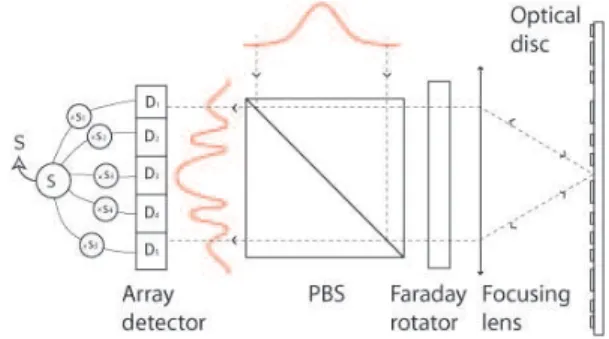
FIG. 1: Color online Scheme for information extraction from optical disc, using an array detector.
We propose a novel optical read-out scheme shown on figure (1) allowing information extraction from optical
2 discs beyond the diffraction limit, based on multi-pixel
detection. Bits, coded as pits and holes on the optical disc, induce phase flips in the electric field transverse profile of the incident beam at reflection. The reflected beam is imaged in the far field of the disc plane, where the detector stands. In the far field, the phase profile induced by the disc is converted into an intensity profile, that the multi-pixel detectors can, at least partly, reconstruct.
Taking into account that a lot of a priori information is available - i.e. only a finite number of intensity profiles is possible - we propose to use a detector with a limited number of pixels Dk whose gains can independently be
varied depending on which bit sequence one wants to detect. The signal is then given by
S =X
k
σkNk (1)
where Nk is the mean photon number detected on pixel
Dk, and σk is the electronic gain of the same pixel.
Ide-ally, to each bit sequence present on the disc corresponds a set of gains chosen so that the value of the measure-ment is zero, thus cancelling noise from the mean field. Measuring the signal for a given time interval T around the centered position of a bit sequence in the focal spot, and testing, in parallel, all the pre-define sets of gain in the remaining time, allows to deduce which bit sequence is present on the disc.
We will first show that this improvement in density of information encoded on an optical disc is already possi-ble using classical resources. Moreover, as the measure-ment is made around a zero mean value, the classical noise is mostly cancelled. Hence, we reach regimes where the quantum noise can be the limiting factor. We will demonstrate how to perform measurements beyond the quantum noise limit, using previous results on quantum noise analysis in multi-pixel detection developed in refer-ence [10].
II. ENCODING INFORMATION FROM A DISC
ONTO A LIGHT BEAM
We have explained the general principle of reading-out sub-wavelength bit sequences encoded on an optical disc, and now focus on the information transfer from the optical disc to the laser beam, through an illustrative example.
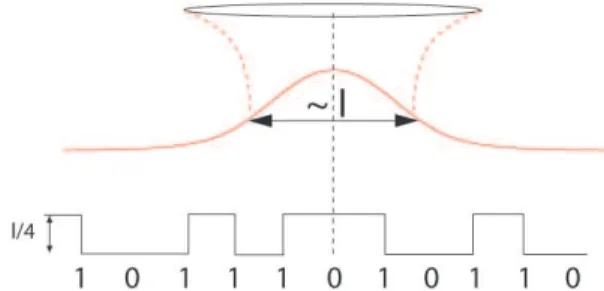
Let us recall that bits are encoded by pits and holes on the disc surface: a step change from hole to pit (or either from pit to hole) encodes bit 1, whereas no depth change on the surface encodes bit 0, as represented on figure (2). A hole depth of λ/4 insures a π phase shift between the fields reflected by a pit and a hole. In this section, we compute the incident field distribution on the optical disc affected by the presence of a bit sequence in the focal spot, and finally analyze the intensity back reflected in the far field, in the detection plane, as sketched on figure (1).
FIG. 2: Color online Example of bit sequence on an op-tical disc. The spacing between the bits is smaller than the wavelength, the minimum waist of the inci-dent laser beam being of the order of λ. A hole depth of λ/4 insures a π phase shift between fields reflected on a pit and a hole.
A. Beam focalization
Current optical disc read-out devices involve a linearly polarized beam strongly focused on the disc surface to point out details whose size is of the order of the laser wavelength. The numerical aperture (N A) of the focus-ing lens can be large (0.47 for CDs, 0.6 for DVDs, and 0.85 for BLU RAY discs), and the exact calculation of the field cannot be done in the paraxial and scalar ap-proximation. Thus, the vectorial theory of diffraction has to be taken into account.
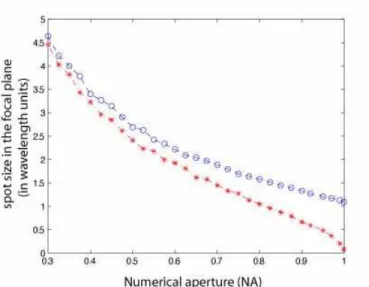
The structure of the electromagnetic field in the focal plane of a strongly focused beam has been investigated for decades now [11], as its applications include areas such as microscopy, laser micro-fabrication, micromanip-ulation, and optical storage [12, 13, 14, 15, 16, 17, 18, 19]. In our case of interest, we can restrict the field calcu-lation to the focal plane, which is the disc plane. Thus Richards and Wolf integrals [20], which are not suitable for a general propagation of the field, but which can pro-vide the field profile in the focal plane for any type of polarization of the incoming beam as long as the focus-ing length is much larger than the wavelength, can be used to achieve this calculation. These integrals have al-ready been used in many publications dealing with tight focusing processes [21, 22, 23, 24, 25, 26, 27, 28]. As highlighted in these references, the importance of the vec-torial aspect of the field can easily be understood when a linearly polarized beam is strongly focused, as the po-larization of the wave after the lens is not perpendicular to the propagation axis anymore and has thus compo-nents along this axis. In order to estimate the limit of validity of the paraxial approximation, we computed fo-cused spot sizes of linearly polarized beam in the focal plane for different numerical apertures, first in the parax-ial approximation, and then calculated with Richards and Wolf integrals. The results are compared on figure (3) for an incident plane wave in air medium with λ = 780nm, where the spot size is defined as the diameter which con-tains 86% of the focused energy, as in reference [29]. We
FIG. 3: Color onlineEvolution of the focused spot size of an incident plane wave with the numerical aperture (for λ = 780 nm in air medium). The spot size is limited to the order of the wavelength in the non-paraxial case (o), whereas it goes to zero for very high numerical apertures in the paraxial case(∗).
see that when the numerical aperture exceeds 0.6, a good prediction requires a non-paraxial treatment. Moreover, whereas there is no theoretical limit to focalization in the paraxial case, we see that non paraxial effects pre-vent us to reach a waist smaller than the order of the wavelength. Note that this limit is not fundamental and can be overcome by modifying the polarization of the in-coming beam. Quabis et al. have indeed managed to reduce the spot area to about 0.1 λ2
using an incident radially polarized doughnut beam [21, 24].
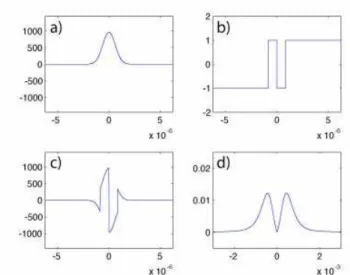
As our aim is to present a demonstration of princi-ple and not a full treatment of the optical disc problem, the following calculations will be done using the physi-cal parameters of the actual Compact Discs (λ = 780nm and N A = 0.47, corresponding to a focalization angle of 27 degrees in air medium). In this case, the paraxial and scalar approximations are still valid. Indeed, figure (4), giving the transverse profile of the three field com-ponents and the resultant intensity in the focal plane using the former parameters, shows that although the field is not strictly linearly polarized as foreseen before, Ey ≪ Ez ≪ Ex, and we can thus consider that only Ex
is different from zero with a good approximation. Note that the exact expression would not intrinsically change the problem, as our scheme can be adapted to any field profile discrimination.
B. Reflection onto the disc
In order to compute the reflected field, we simply as-sume that bumps and holes are generated in such a way
FIG. 4: Color onlineNorm of the different field compo-nents and resultant intensity in the focal plane with a linearly polarized incident field along the x axis, focused with a 0.47 numerical aperture.
that they induce a π phase shift between them at reflec-tion on the field profile. Note that the holes depth is usually λ/4, but precise calculations would be required to give the exact shape of the pits, as they are supposed to be burnt below the wavelength size, and as the field penetration in those holes is not trivial [4, 5, 6]. As we have shown that only one vectorial component of the field was relevant in the focal plane, we can directly apply this phase shift to the amplitude profile of this component.
We first envision a scheme with only three bits in the focal spot, which means that 23
different bit sequences, i.e. a byte, have to be distinguished from each other, using the information extracted from the reflected field. Note that we neglect the influence of other bits in the neighborhood. A more complete calculation involving this effect with more bits will be considered in a further approach.
The amplitude profiles obtained when the incident beam is centered on a bit of the CD are presented on figure (5), for a particular bit sequence. Note that we have chosen the space between two bits on the disc equal to the waist size of the reading beam. The first three curves respectively show the field amplitude profile inci-dent on the disc, an example of a bit sequence, and the corresponding profile just after reflection onto the disc. We see that binary information is encoded from bumps and holes on the CD to phase flips in the reflected field.
C. Back propagation to the detector plane
In order to extract the information encoded in the transverse amplitude profile of the beam, the field has to be back propagated to the detector plane. A circula-tor, composed of a polarizing beam splitter and a Fara-day rotator, ensures that the linearly polarized reflected beam reaches the array detector, as shown on figure (1).
4
FIG. 5: Color onlineModifications of the transverse am-plitude field profile trough propagation, in the case of a 111 bit sequence in the focal spot : a) incoming beam profile, b) 111 bit sequence, c) corresponding reflected field in the disc plane, d) far field profile in the detector plane .
Assuming that the detector is positioned just behind the lens plane, the expression of the detected field is given by the far field of the disc plane, apertured by the diameter of the focusing lens. As the focal length and the diameter of the lens are large compared to the wavelength, we use Rayleigh Sommerfeld integral to compute the field in the lens plane [30]. As an example, the calculated far field profile when the bit sequence 111 is present in the focal spot is shown on the fourth graph of figure (5).
The presence of the lens provides a limited aperture for the beam and cuts the high spatial frequencies of the field, which can be a source of information loss, as the difference between each bit sequence can rely on those high frequencies. However, we will see that enough infor-mation remains in the low frequency part of the spatial spectrum, so that the 8 bits can be distinguished. This is due to the fact that we have in this problem a lot of a priori information on the possible configurations to distinguish.
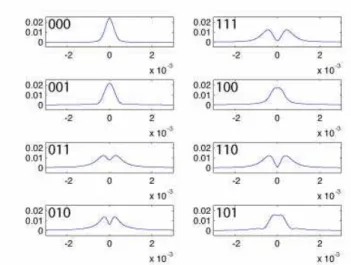
We see on figure (6) that, with the physical parameters used in compact disc read out devices, 6 over 8 profiles in the detector plane are still different enough to be dis-tinguished. At this stage, we are nevertheless unable to discriminate between symmetric configurations, because they give rise to the same far field profile. Therefore, 100 and 001, and 110 and 011, cannot be distinguished. Note that this problem can be solved thanks to the rotation of the disc. Indeed, an asymmetry is created when the position of the disc relative to the laser beam is shifted, thus modifying differently the two previously indistin-guishable profiles. As shown on figure (7), where the far field profiles are represented after a shift of w0/6 in the
FIG. 6: Color onlineField profiles in the array detector plane, for each of the 8 bit sequence configuration. Note that they are clearly distinguishable, except for the bit sequences 100 and 001, and 011 and 110, which have the same profile because of the symmetry of the bit sequence relative to the position of the incident laser beam.
position of the disc, the degeneracy has been removed. Moreover, it is important to notice that the other profiles experience a small shape modification. This redundant information is very useful in order to remove ambiguities while the disc is rotating.
III. INFORMATION EXTRACTION FOR BIT
SEQUENCE RECOGNITION
In this section, we describe the detection,present some illustrative results, and the way they can be used to in-crease the read-out precision of information encoded on optical discs. We show here that a pixellised detector with a very small number of pixels is enough to distin-guish between the 8 bit sequences. Note that for techni-cal and computing time reasons, it is not realistic to use a CCD camera to record the reflected images, as such cameras cannot yet combine good quantum efficiency and high speed.
A. Detected profiles
For simplicity reason, we limit our calculation to a 5 pixels array detector D1..D5, each of whom has an
elec-tronic gain σ1..σ5, as shown on figure (8). The size of
each detector has been chosen without a systematic opti-mization, which will be done in a further approach. Gain values are adapted to detect a mean signal equal to zero for each bit configuration present in the focal spot, in
or-FIG. 7: Color onlineField profiles in the array detector plane, for each of the 8 bit sequence configuration,
when the position of the disc has been shifted of w0/6
relative to the incident beam. The profile degeneracy for 100 and 001, and 011 and 110 is raised. Note that the other profiles have experienced a much smaller shape modification between the two positions of the disc.
der to cancel the common mode classical noise present in the mean field [10]. It means that for each bit sequence i, gains are chosen to satisfy the following relation
5
X
k=1
σk(i)Nk(i) = 0 (2)
where Nk(i) is the mean photon number detected on pixel
Dk when bit i is present in the focal spot on the disc
Nk(i) =
Z
Dk
ni(x)dx (3)
where ni(x) is the number of photon incident on the array
detector, at position x, when bit sequence i is present in the focal spot.
As all profiles are symmetrical when the incident beam is centered on a bit, we have set σ1 = σ5 and σ2 = σ4.
In addition, we have chosen σ3= −σ21. Using these
rela-tions and equation (2), we compute gain values adapted to the recognition of each bit sequence. Note that the calculation of each gain configuration requires a priori information on the far field profiles, or at least an exper-imental calibration using a well-known sample.
Now that these gain configurations are set, we can in-vestigate for a bit sequence on the optical disc.
FIG. 8: Color onlineFar field profiles in detection the plane for each bit configuration, and array detector
geometry. The 5 detectors D1..D5 have electronic
gains σ1(i)..σ5(i) according to the bit sequence i which
is present in the focal spot.
B. Classical results
The expression of the detected signal Si(j) is given by
Si(j) = 5
X
k=1
σk(j)Nk(i) (4)
where i refers to the bit sequence effectively present in the focal spot, and j to the gain set adapted to the de-tection of the bit sequence j. It merely corresponds to the intensity weighted by the electronic gains. Note that for i = j - and only in this case if the detector is well chosen - the mean value of the signal Si(i) is equal to
zero, according to equation (2). All possible values of Si(j) are presented for a total number of incident
pho-tons Ninc = 25, in table (I) where i is read vertically,
and corresponds to the bit sequence on the disc, whereas j is read horizontally and refers to the gain set adapted to the detection of bit j. In order not to have redundant information, we have gathered results corresponding to identical far field profiles. A zero value is obtained for only one gain configuration, allowing an identification of the bit sequence present in the focal spot.
The reading process to determine which bit sequence is lit on the disc follows these few steps :
• the time dependent intensity is first measured on each of the five detectors with all electronic gains set to one.
• these intensities are integrated for a time T . • the signal is then calculated, using the different gain
6 000 001/100 010 011/110 101 111 000 0 -34 -204 -254 -77 -303 001/100 15 0 -76 -99 -19 -121 010 23 20 0 -6 16 -13 011/110 24 22 5 0 19 -5 101 19 11 -36 -50 0 -63 111 24 23 9 5 20 0
TABLE I: Detected signals Si(j) where i is read
verti-cally and corresponds to the bit sequence on the disc, whereas j is read horizontally and refers to the gain set adapted to the detection of bit j. A zero value means that the tested gain configuration is adapted to the bit sequence.
• the bit sequence effectively present in the focal spot is determined by the only signal yielding a zero value.
Note that the second step just corresponds to the Nk
measurements. The integration time T is chosen as the time interval during which the signal leads to the de-termination of a unique bit sequence. The third step corresponds to the simple calculation of a line in table I. This can be done in parallel thanks to the speed of data processing on dedicated processors, and the reading rate will thus not be affected compared to current devices. Finally, note that the last step requires a good choice of the parameters in order to be able to distinguish all bit sequences. It means that the noise level has to be smaller than the difference between the two closest values from 0, in order to get a zero mean value for only one bit se-quence. Indeed, there must be no overlap between the expectation values when we take into account the noise and thus the uncertainty relative to each measurement. Note that using the zero value as the discriminating fac-tor could be combined with the use of all the calculated values, as each line of table (I) is distinct. We just need to know how to weight each data point according to the noise related to its obtention.
IV. NOISE CALCULATION
A. The shot noise limit
To include the noise in our calculation, we separate classical and quantum noise contributions. The classical noise comprises residual noise of the laser diode, mechan-ical and thermal vibrations. The major part of this noise is directly proportional to the signal, i.e. to the number of detected photons. For a detection of the total number of photons Ninc in the whole beam during the
integra-tion time of the detector, the classical noise contribuintegra-tion phδN2
inci would thus be written as
q hδN2
inci = βNinc (5)
where β is a constant factor. And the individual noise variable δNi(k) arising from detection on pixel Dk is
given by
δNi(k) =
Ni(k)
Ninc
δNinc (6)
Using equations 4, 5 and 6, a simple calculation yields the variance of the signal arising from the classical noise
hδ ˆS2 i(j)iCl= BS2 i(j) Ninc (7) where the constant B = Nincβ2 is the classical noise
fac-tor, and is chosen so that, when B = 1 and when all the intensity is detected by one detector, the classical noise term is equal to the shot noise term. Note that classical noise does not deteriorate measurements having a zero mean value. For this reason, we have chosen to discrim-inate bit sequences by choosing gains such as Si(i) = 0,
as mentioned earlier.
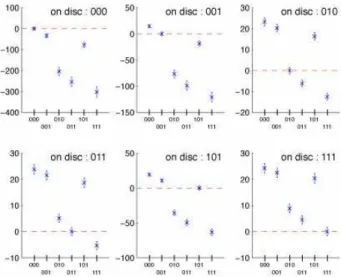
FIG. 9: Color onlineClassical noise (10 dB of excess noise) represented as error bars, for λ = 0.78µm, N A = 0.47, and 25 detected photons. Each inset cor-responds to the 6 signals obtained for the different gain configurations, when one particular bit sequence is present in the focal spot. Each bit sequence present in the focal spot can be clearly identified as only one gain configuration can give a zero value for each inset.
The calculation of the quantum contribution requires the use of quantum field operators, describing the quan-tum fluctuations in all transverse modes of the field. By changing the gain configuration of the array detector, not only the signal Si(j) is modified, but also the related
quantum noise denoted hδ ˆS2
i(j)iQu, as different gain
con-figurations are sensitive to noise in different modes of the field. We have shown in reference [10] that for a multi-pixel detection of an optical image, the measure-ment noise arises from only one mode component of the
field, referred to as the detection mode, or noise-mode [31]. The expression of the quantum noise is then :
hδ ˆS2 i(j)iQu= f 2 i,jNinchδ ˆX 2 wi,ji (8)
where δ ˆXwi,j is the quantum noise contribution of the
noise-mode wi,j(x) which is defined for one set of gain j,
when the bit sequence i is present in the focal spot, as ∀x ∈ Dk wi,j(x) =
σk(j)ni(x)
fi,j
(9) and where fi,jis a normalization factor, which expression
is f2 i,j= P5 k=1σ 2 k(j)Nk(i)dx Ninc (10) The noise-mode corresponds in fact to the incident field profile weighted by the gains. The shot noise level corre-sponds to hδ ˆX2
wi,ji = 1.
The variance of the signal can eventually be written as: hδ ˆS2 i(j)i = f 2 i,jNinchδ ˆX 2 wi,ji + BS2 i(j) Ninc (11)
FIG. 10: Color onlineShot noise represented as error bars, for λ = 0.78µm, N A = 0.47, 25 detected photons. Some bit sequences cannot be determined without ambiguity because of the noise level.
We have first represented the classical noise with an excess noise of 10 dB, as error bars for each result Si(j),
on figures (9). We have chosen a representation with a number of detected photons of only 25. Each of the 6 in-sets refers to the measurement obtained for a particular bit sequence in the focal spot. The 6 data points and as-sociated error bars refer to the results obtained when the 6 gain configurations are tested. One inset thus corre-sponds to one line in table (I). We can see that with this
choice of parameters, the bit sequence effectively present in the focal spot can be determined without ambiguity by the only zero value. The sequence corresponds to the one for which the gains were optimized. We see that bit sequence discrimination can be achieved even with a very low number of photons. The relative immunity to classical noise of our scheme arises from the fact that measurements are performed around a zero mean value. Thus, given this limit in the minimum necessary photon number and the flux of photons one can calculate the maximum data rate, which is found to be 2.107
M bits/s (this estimation takes into account an integration time T corresponding to 1/10 of the delay between the read-out process of two adjacent bits with a 1mW laser). This very high value shows that classical noise should not be a limit for data rate in such a scheme.
The effect of quantum noise is very small, but becomes a limiting factor for such a small number of detected pho-tons, or for a large number of bits encoded on the disc in the wavelength size. In order to see independently the effect of each contribution to the noise, we have thus represented on figure (10) the shot noise also for 25 de-tected photons, appearing as the threshold under which it is impossible to distinguish bit sequences because of the quantum noise. Note that for the represented case, the shot noise is the most important contribution, and that it prevents a bit sequence discrimination, as a zero value for the signal can be obtained for several gain con-figurations in the same inset.
B. Beyond the shot noise limit
When the shot noise is the limiting factor, non classi-cal light can be used to perform measurements beyond the quantum noise limit. We have shown in reference [10] that squeezing the noise-mode of the incident field was a necessary and sufficient condition to a perfect measure-ment. What we are interested in is improving the mea-surements that yield a zero value, which are obtained when the gain configuration matches the bit sequence in the focal spot, as Si(i) = 0. Using equation (11), we
see that wi,i has to be squeezed. As no information on
the bit present in the focal spot is available before the measurement, in order to improve simultaneously all the bit sequences detections, the 6 noise-modes have to be squeezed at the same time in the incident field. These 6 transverse modes are not necessarily orthogonal, but one can show that squeezing the subspace that can gen-erate all of them is enough to induce the same amount of squeezing.
The quantum noise with 10 dB of squeezing on the sub space generated by the wi,i is represented as error
bars on figure (11). The noise of each noise-mode wi,j is
computed using its overlap integrals with the generator modes of the squeezed sub space, assuming that all modes orthogonal to the squeezed subspace are filled with coher-ent noise. In this case, the effect of squeezing, reducing
8
FIG. 11: Color onlineQuantum detection noise repre-sented as error bars, for λ = 0.78µm, N A = 0.47, 25 de-tected photons and −10 dB of simultaneous squeezing for all the flipped modes. The ambiguity in presence of shot noise has been removed and each bit sequence can be identified.
the quantum noise on the measurements, and especially on the measurement for which the gains have been opti-mized, is enough to discriminate bit sequences that were masked by quantum noise.
V. CONCLUSION
We have proposed a novel way of information ex-traction from optical discs, based on multi-pixel
detec-tion. We have first demonstrated, using only classical resources, that this detection could allow large data stor-age capacity, by burning several bits in the spot size of the reading laser. We have presented a demonstration of principle through a simple example which will be re-fined in further studies. We have also shown that in shot noise limited measurements, using squeezed light in ap-propriate modes of the incident laser beam can lead to improvement in bit sequence discrimination.
The next steps are to study in details how to extract the redundant information when the disc is spinning, and to systematically optimize the number of bits in the focal spot, the number and size of pixels in the array detector. Such a regime involving a large number of bits in the focal spot will ultimately be limited by the shot noise, and will require the quantum noise calculations presented in this paper.
VI. ACKNOWLEDGMENT
We thank Magnus Hsu, Ping Koy Lam and Hans Ba-chor for fruitful discussions.
Laboratoire Kastler Brossel, of the Ecole Normale Su-perieure and University Pierre et Marie Curie, is asso-ciated to CNRS. This work has been supported by the European Union in the frame of the QUANTIM network (contract IST 2000-26019).
[1] H. A. Bethe, Phys. Rev. 66 7 and 8, 163 (1944) [2] D. S. Marx, and P. Psaltis, J. Opt. Soc. Am. A 14 6,
1268 (1997)
[3] D. S. Marx, and P. Psaltis, Appl. Opt. 36 25, 6434 (1997) [4] X. Wang, J. Mason, M. Latta, T. C. Strand, D. S. Marx,
and P. Psaltis, J. Opt. Soc. Am. A 18 3 565 (2001) [5] W.-C. Liu, and M. W. Kowarz, Appl. Opt. 38 17, 3787
(1999)
[6] J. M. Brok, and H. P. Urbach, J. Opt. Soc. Am. A 20 2, 256 (2003)
[7] M. Kolobov et al, Opt. Let. 85, 3789 (2000)
[8] M.T.L. Hsu, W.P.Bowen, C.Fabre, H.-A. Bachor and P.K. Lam, ”Two-Pixel Phase Coding of Optical Beams Using Squeezed Light” (to be submitted)
[9] P. T¨or¨ok, Proceeding AOI conference (2005).
[10] N. Treps, V. Delaubert, A. Maˆıtre, J.M. Courty and C. Fabre, Phys. Rev. A 71, 013820 (2005)
[11] A. G. van Nie, Rigorous calculation of the electromag-netic field of a wave beam, Philips Res. Rep. 19, 378?394 (1964).
[12] M. Lax, W. H. Louisell, and W. B. McKnight, Phys. Rev.
A 11, 1365 (1975).
[13] S. R. Seshadri, J. Opt. Soc. Am. 19, 2134 (2002) and references therein.
[14] A. Ciattoni, B. Crosignani, and P. Di Porto, Opt. Com-mun. 177, 9 (2000).
[15] Q. Cao and X. Deng, J. Opt. Soc. Am. A 15, 1144 (1998). [16] B. T. Landesman and H.H. Barrett, J. Opt. Soc. Am. A
5, 1610 (1988).
[17] G. Rodriguez-Morales and S. Chavez-Cerda, Opt. Let. 5, 430 (2004).
[18] Z.Ulanowski and I. K. Ludlow, Opt. Let. 25 1792 (2000). [19] T. A. Nieminen, H. Rubinsztein-Dunlop, and N. R.
Heck-enberg, submitted to Elsevier.
[20] B. Richards, E.Wolf, Electromagnetic diffraction in opti-cal systems, Proc. R. Soc. A 253, 359 (1959).
[21] S. Quabis, R. Dorn, M. Eberler, O. Gl¨ockl, and G.
Leuchs, Appl. Phys. B 72, 109 (2001).
[22] L. Novotny, R. D. Grober, and K. Karrai, Ot. Let. 26, 789 (2001).
[23] R. Dorn, S. Quabis, and G. Leuchs, preprint : arxiv/physics/0310007.
[24] S. Quabis, R. Dorn, M. Eberler, O. Gl¨ockl, and G. Leuchs, Opt. Com. 179, 1 (2000).
[25] C. J. R. Sheppard, J. Opt. Soc. Am. A 18, 1579 (2001).
[26] P. T¨or¨ok, P. Varga, Z. Laczik, and G. R. Booker, J. Opt.
Soc. Am. A 12, 325 (1995).
[27] K. S. Youngworth, and T. G. Brown, Opt. Expr. 7, 77 (2000).
[28] Q. Zhan, and J. R. Leger, Opt. Expr. 10, 324 (2002). [29] A. E. Siegman, Lasers, Mill Valley, CA: University
Sci-ence (1986)
[30] M. Born, E. Wolf, Principle of optics, Cambridge Uni-versity Press (1959)
[31] V. Delaubert, N. Treps, C. C. Harb, P. K. Lam and H-A. Bachor, Surpassing the quantum noise limit on
dis-placement and tilt measurement of a gaussian beam,
sub-mitted in 2005
[32] N. Treps, N. Grosse, W. P. Bowen, M. T. L. Hsu, A. Maˆıtre, C. Fabre, H.-A. Bachor, P. K. Lam , J. Opt. B 6, S664 (2004).