HAL Id: tel-02472550
https://tel.archives-ouvertes.fr/tel-02472550
Submitted on 17 Aug 2020
HAL is a multi-disciplinary open access archive for the deposit and dissemination of sci-entific research documents, whether they are pub-lished or not. The documents may come from teaching and research institutions in France or abroad, or from public or private research centers.
L’archive ouverte pluridisciplinaire HAL, est destinée au dépôt et à la diffusion de documents scientifiques de niveau recherche, publiés ou non, émanant des établissements d’enseignement et de recherche français ou étrangers, des laboratoires publics ou privés.
processes of mobilization, demobilization, and related
humanitarian interventions
Magali Chelpi-den Hamer
To cite this version:
Magali Chelpi-den Hamer. Militarized Youths in Western Côte d’Ivoire : local processes of mobiliza-tion, demobilizamobiliza-tion, and related humanitarian interventions. Social Anthropology and ethnology. École des Hautes Études en Sciences Sociales (EHESS); Université d’Amsterdam, 2011. English. �tel-02472550�
Militarized Youths
in Western Côte d’Ivoire
Local processes of mobilization, demobilization,
and related humanitarian interventions
(2002-2007)
ACADEMISCH PROEFSCHRIFT
ter verkrijging van de graad van doctor aan de Universiteit van Amsterdam op gezag van de Rector Magnificus
prof. dr. D.C. van den Boom
ten overstaan van een door het college voor promoties ingestelde commissie,
in het openbaar te verdedigen in de Agnietenkapel op dinsdag 4 oktober 2011, te 10:00 uur
door
Magali Lara Barbara Chelpi
Promotores:
Prof. dr. I.S.A. Baud Prof. dr. J.-P. Chauveau Overige leden:
Prof. dr. M. Agier
Prof. dr. R. Bazenguissa-Ganga Prof. dr. G.C.A. Junne
Prof. dr. K. Vlassenroot
African Studies Collection, Vol. 36
Militarized youths
in Western Côte d’Ivoire
Local processes of
mobilization, demobilization,
and related humanitarian interventions
(2002-2007)
Published by:
African Studies Centre P.O. Box 9555
2300 RB Leiden The Netherlands [email protected] www.ascleiden.nl
Cover design: Heike Slingerland
Cover photo: ‘Market scene, Man’ (December 2007) Photographs: Magali Chelpi-den Hamer
Printed by Ipskamp Drukkers, Enschede ISSN: 1876-018X
ISBN: 978-90-5448-107-2
This book is dedicated to
vii
Contents
List of maps, tables, figures and boxes ix
List of photographs x
Abbreviations xi
Foreword xiii
Acknowledgements xv
1 INTRODUCING THE STUDY 1
Research approach 3
Defining militarized youths 6
Structure of the book 8
2 METHODOLOGY 11
Methodological choices 12
Ethical considerations 19
3 SOME THEORETICAL CONSIDERATIONS 27
The paradox of post-conflict interventions 28
Some theoretical reflections on war and mobilization processes 37
Concluding remarks 49
4 A CONDUCIVE HISTORICAL AND POLITICAL TERRAIN TO THE MILITARIZATION OF CIVILIANS 51
From cosmopolitan politics to a politics of ethnic polarization 52
From the Coup to the war 62
2000-2010: a decade of FPI rule 67
The place of humanitarianism in Côte d’Ivoire 73
Concluding remarks 84
5 THE IMMEDIATE CONTEXT 87
The general atmosphere: Chronology of violent events in the west (2002-2007) 88
Multi-ethnic agrarian societies 107
The fieldwork locations and the western humanitarian context 113
viii
6 ARMED FACTIONS OPERATING IN THE WEST 127
Counter-insurgent movements 128
Insurgent movements 136
Concluding remarks 141
7 MILITARIZED CIVILIANS:DIVERSITY OF TRAJECTORIES, DIVERSITY OF MOTIVES FOR ENLISTMENT 143
Who ‘took up’ arms in the west? 145
The specificities of the youngest recruits 151
What drove young civilians to military life? 152
Concluding remarks 161
8 BLURRED SPACES:MILITARIZED YOUTHS AND THEIR
RELATIONSHIPS WITH THEIR IMMEDIATE ENVIRONMENT 165
Part-time recruits 166
Social relationships within the armed groups 168
The military-civilian nexus 176
The humanitarian-military nexus 182
Concluding remarks 185
9 RETURN TO CIVILIAN LIFE FOR MILITARIZED POPULATIONS:
TWO STANDARD HUMANITARIAN INSTRUMENTS UNDER THE LENS 187
The global approach to reinsertion and reintegration 188
DDR in Côte d’Ivoire 194
Reinsertion under the lens: how were cash allowances spent? 198
Assessment of a pilot initiative fostering economic reinsertion 208
The specificities of the youngest recruits 220
Concluding remarks 223
10 CONCLUSIONS 225
The main empirical and conceptual findings 226
The step forward 235
Appendix 1: Chronology of violent events in the west (2002-2007) 237
Appendix 2: Checklist of individual interview guidelines 253
References 255
English summary 267
ix
List of maps
4.1 Areas of intervention of humanitarian agencies 75
5.1 Types of violent events in western C.d’I (19 Sept.-31 Dec. 2002) 92 5.2 Types of violent events in western C.d’I (1 Jan.-23 May 2003) 93 5.3 Types of violent events in western C.d’I (May 2003-Dec. 2005) 94 5.4 Types of violent events in western C.d’I (2006) 95
5.5 Geographical origin of the main ethnic groups in Côte d’Ivoire 108
List of tables
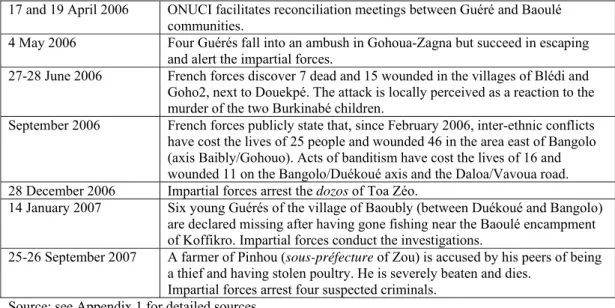
5.1 Chronology indicative of the atmosphere of violence in western CI 89-91 5.2 Series of events showing the increased implication of the impartial forces in local
mechanisms of conflict resolution 125
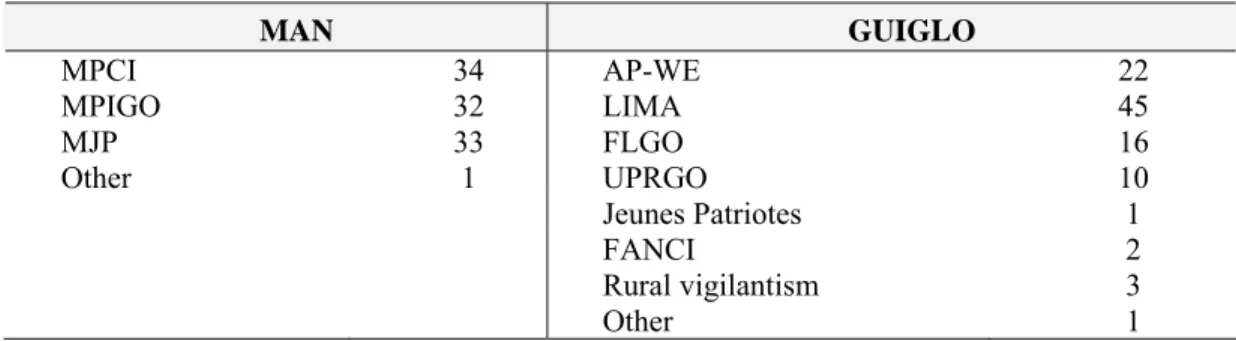
6.1 Claimed affiliation of the militias listed by the PNDDR 129 6.2 First faction integrated by respondents 135
6.3 Cities of origin of militia recruits listed by the PNDDR 137 6.4 Respondents’ ethnic group 138
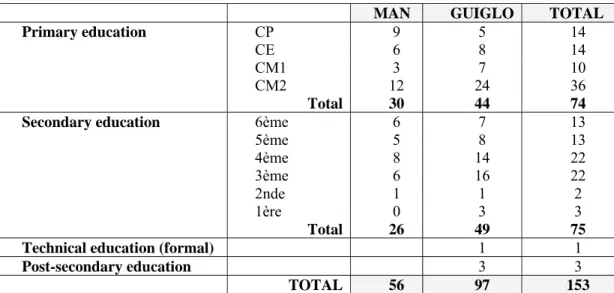
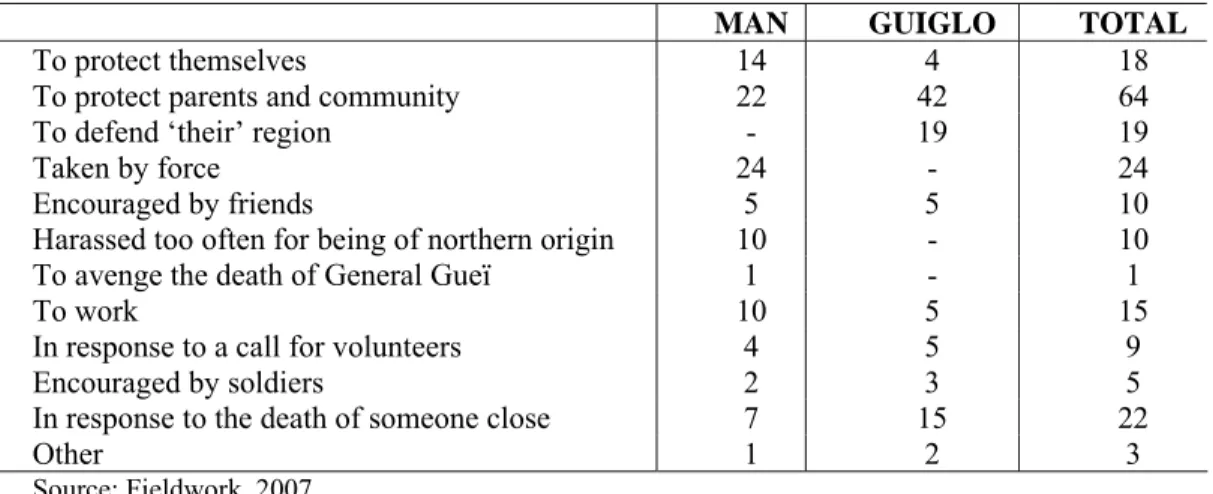
7.1 Last year of schooling before dropping out 146 7.2 First reason given for joining an armed movement 160 9.1 Distribution of recruits by reinsertion streams – Guiglo 211 9.2 Distribution of recruits by reinsertion streams – Man 211
9.3 Nature and costs of individual kits in the small business track 214
List of figures
4.1 The planned Ivoirian process 83
9.1 Which reinsertion activities have respondents engaged in? 213 9.2 Were respondents familiar with this activity before the war? 213 9.3 Profiling sheet 218
List of boxes
5.1 The three Zou wars 105
6.1 Testimony of a MILOCI recruit 133 7.1 A selection of educational accounts 147 7.2 A typical ‘hypermobile’ youth 149
x
List of photographs
1 Patchwork of pro-governmental militia elements 10 2 Female recruits, Guiglo 10
3 Market scene, Man 86
4 Rebel taxation on small businesses, Man 86
5 Pork farm sponsored by the GTZ-IS project, Guiglo 126
6 Apprentices fixing a motorbike, Man (incl. ex-child recruit) 126 7 On the way to Dompleu, 5km of Man 142
8 Market scene, Guiglo 142
9 Ex-combatant taking part in production of charcoal, Guiglo 164 10 Soccer team, Man, including one ex-combatant 164
11 Apprentices, including former militarized recruits, in a tailoring workshop, Guiglo 236
12 Informal training in electricity, Man (GTZ-IS was paying there tuition for three elements of the Forces Nouvelles 236
13 Small business sponsored by the GTZ-IS project, Guiglo 252 14 Poultry farm sponsored by the GTZ-IS project, Man 252 15 Owner and apprentices in a wielding workshop, Man 274 16 Tailoring workshop hosting former child recruits, Man 274
xi
Abbreviations
APO Accord Politique de Ouagadougou
ANADER Agence Nationale d’Appui au Développement Rural AP-Wê Alliance Patriotique Wê
CAR Central African Republic
CCI Centre de Commandement Intégré
CI Côte d’Ivoire
CNDDR National Commission for DDR CTO Centre de Transition and d’Orientation
DDR Disarmament, Demobilization and Reintegration DRC Democratic Republic of Congo
ERNWACA Educational Research Network for West and Central Africa ECOWAS Economic Community of West African States
EM Etat Major
FAFN Armed Forces of the Forces Nouvelles FANCI National Armed Forces of the Côte d’Ivoire FAO Food and Agriculture Organization FDS Forces de Défenses et de Sécurité
FLGO Forces de Libération du Grand Ouest FPI Front Populaire Ivoirien
FRGO Forces de Résistance du Grand Ouest FS-Lima Forces Supplétives Lima
GTZ-IS GTZ-International Service
HI Handicap International
IAHCC UN Inter-Agency Humanitarian Coordination Meeting ICRC International Committee of the Red Cross
IDA International Development Association
INGO International Non-Governmental Organization IOM International Organization for Migration
IRC International Rescue Committee
MARP Méthode Active de Recherche et de Planification Participative MDM Médecins du Monde
MILOCI Mouvement Ivoirien pour la Libération de l’Ouest de la Côte d’Ivoire
MINUCI United Nations Mission in Côte d’Ivoire MJP Mouvement pour la Justice et la Paix
MPCI Mouvement Patriotique pour la Côte d’Ivoire MPIGO Mouvement Populaire Ivoirien du Grand Ouest MSA Mouvement Socialiste Africain
xii
NGO Non-Governmental Organization NRC Norwegian Refugee Council
ONUCI Opération des Nations Unies en Côte d’Ivoire PCO Plan Conjoint des Operations
PDCI Parti Démocratique de Côte d’Ivoire
PDR Prevention, Demobilization and Reinsertion programme PDR Prevention, Demobilization and Reintegration programme PIT Parti Ivoirien des Travailleurs
PNDDR National Disarmament, Demobilization and Reintegration Plan PNDDR-RC Programme National de Désarmement, de Démobilisation, de
Réinsertion et de Réhabilitation Communautaire
PNRRC Programme National de Réinsertion et de Réhabilitation Communautaire
PSI Parti Socialiste Ivoirien RDR Rassemblement des Républicains RUF Revolutionary Unitary Front SAA Syndicat Africole Africain
SC Save the Children
UDPCI Union pour la Démocratie et la Paix en Côte d’Ivoire UNDP United Nations Development Programme UNHCR United Nations High Commissioner for Refugees UNICEF United Nations Children’s Fund
UNOCHA United Nations Office for the Coordination of Humanitarian Assistance
UPRGO Union des Patriotes pour la Résistance du Grand Ouest
xiii
Foreword
I slept twice with my shoes on, a small bag packed at the foot of my bed, ready to literally run away as fast as I could if armed men were to enter my home. The first time was in Bétou, Republic of Congo (RoC), a small and very isolated town on the Ubangui River, hidden within the deep forest that borders the Central African Republic (CAR) and the Democratic Republic of Congo (DRC). That was in March 2003, right after a Coup had ousted the Patassé regime from the neighbouring Central African Republic. Mercenaries from the other Congo (DRC) had lent a hand in supporting the counter-insurgency, but they had been defeated and were therefore on their way home, looting everything they could as they passed through. When they showed up on the outskirts of Bétou carrying fridges and radios on their heads (Bétou was their first Congolese stop after their rout in Central Africa), there was tangible tension in town. Shops had closed early and any movement outside was literally suspended. The sous-Préfet wel-comed the armed men right before they entered the town and promised them support (he was later heavily criticized for this). Despite its unconventional char-acter, his mediation worked quite well. The bulk of the pirogues1 in Bétou were requisitioned that same night and the Congolese mercenaries immediately cross-ed the river to DRC; they were all gone by the next morning. Bétou was com-pletely spared.
The second time I slept with my shoes on was a year later, in Abidjan, following the violent events of 25 March 2004, when so many people perceived as ‘political opponents’ were killed, injured, or went missing. The government had played a major role in these disturbing events. I was then staying in a rented house with no particular security safeguard besides an old Burkinabé and his wife (and myriad kids), who had been ‘guarding’ the house for several years and who actually were making their living by selling matches, Maggi cubes and batteries through a small hole dug in our cement fence. I was then particularly concerned by the anti-French discourse promoted by young mobs close to the Presidential party and massively relayed by the main media. It is curious how quickly terrible things run through your head. I think my main fear then was of being raped. Or being hurt ‘for fun’, ‘to set an example’, or for merely being white or French. Being ‘unfortunately’ killed was also a harrowing yet realistic threat that at the time seemed to me to lie within the range of possibilities. As I
1
xiv
stayed inside for three days, keeping connected with a range of local contacts in the outside world by cell phone, I thought of the ICRC workers slaughtered in Eastern Congo in early 2001 (in Ituri), the abduction of a colleague of mine in the Ruzizi Plain the same year on 11 September (I was in the car behind), and I could not help wondering to myself what on earth I was doing there, far from my own home and exposed to events that were far beyond my control and that could affect my life in the worst ways.
Luckily, the person who would later become the father of my daughters was there both times; in terms of moral support and shared experience, this is defi-nitely worth mentioning. And even more luckily, nothing happened. But the mere thought that it could have gone wrong is haunting. Maybe this is what triggered my interest in violent young African mobs. Or perhaps it was my father’s furtive involvement in the OAS2, when he was 18 and prone to being brainwashed, like many of his contemporaries. So when the opportunity arose to earn a living doing research and when a few doors opened in Côte d’Ivoire that made it possible to focus on armed groups, I jumped on the train and put my ‘humanitarian’ hat on hold. The journey lasted many years and took more than one turn.
2
OAS stands for Organisation de l'Armée Secrète and was a short-lived French nationalist underground organization during the Algerian War (1954-62). The OAS used armed struggle in an attempt to prevent Algeria's independence.
xv
Acknowledgements
This book would never have emerged without the critical insights of my two pro-motors. Isa Baud gave me the possibility to pursue this research at the university of Amsterdam and ample freedom to develop myself in the areas I wanted. For that, I am extremely grateful. 1 Jean-Pierre Chauveau pushed me to improve my analysis, to be more nuanced, more modest, to contextualize more; he made me grow as an analyst. His extensive knowledge of Côte d’Ivoire and his current interest in studying local processes of mobilization were very valuable assets, and I tapped into his expertise in full confidence. We did not meet often, but when we did, it was quite extensive: usually eight consecutive hours of analytical talks .... In February 2010, I went out of such talk with the feeling of having taken a cold shower. It took me four months to digest everything and to come up with a proper problematization. In February 2011, I went out of the same talk with the feeling of finally seeing the end of a long tunnel. I was close to a sense of completeness.
To Ate Poorthuis and the GIS team, many many thanks for your help in map-ping the chronology of violent events for my fieldwork area. To my closest col-leagues, Inti, Sanne, Mieke, Hulya, we embarked in this adventure together, we disembark one after the other. I am sure though that the developed friendships will last far beyond this new diploma. To the other colleagues from the depart-ment, I have been quite asocial lately, avoiding meetings, tea talks, guest lec-tures, even the department free drinks. For a few years, my time has been divided between work, studious weekends, a general feeling that my PhD is an impos-sible wall to break, and the basic logistics of a household of four. I am very happy that this is about to change.
A few people have read part of all of the manuscript and have provided valu-able comments and encouragements. Many times, it opened a door to more re-flection and forced me to nuance my writings even more. The revised versions have not been less catchy – at least in my opinion. To name these informed readers, special thanks to Yvan Guichaoua, Virginie Mamadouh, Marielle Debos, and David Raats, the latter for the sharp English editing. I would also like to thank the jury members of my PhD committee who took the time to read my work and to comment on it.
1
xvi
During my time on the field, I am particularly grateful to the following per-sons: Césaire Brou, with whom I interviewed the bulk of the low-ranking recruits in this study, Franck Dakoury Gbaka, Diomandé Kongué and Diomandé Tiémo-ko, who all helped me to collecting data in the villages of Zou and Zeregbo during the period of preliminary fieldwork. For various logistical support and for the very nice after-work talks, many thanks to the GTZ-IS team, the IRC and ODAFEM, especially Jean Mapouala, Louis Falcy, Matias Meier, Denis Doua, Khalil, and Marie-Chantale. Collecting primary information is always chal-lenging and this work could not have been written without the contribution of the militarized civilians I interviewed. Special thanks then to these men, women, boys and girls who unconditionally agreed to share with me their difficult per-sonal stories. Their experiences are extraordinary. I tried my best to give them all the credit they deserve. If I distorted any meaning in the process, I sincerely apo-logize.
Last and far from being least, I am deeply indebted to my family. Roelof, you know me better than anyone. Thank you for everything. Anna and Tess, apolo-gies for the days away writing (and the mood swings); but be sure I left you in very good hands.
1
Introducing the study
The recent conflict in Côte d’Ivoire has led to the militarization of many young civilians on both belligerent sides. While some participated in combat and fought on the front line when violence was at its peak (Fall 2002 – Spring 2003), others assumed more backstage functions, from the maintaining of military positions, when places were won from the enemy, to basic logistical duties. There are many tasks within an armed group, and low-ranking recruits usually navigate between those depending on conflict phases and individual skills.1 Where some youths were only militarized for a few months (at the onset of conflict), others have continued their involvement in armed movements over the years, after the main clashes were over, with some being particularly vocal about it. What is of parti-cular interest is the fact that many of these youths have assumed a function of ‘commuting’ conscripts, alternating periods of semi-military work, where they had to report to some kind of warlike hierarchy, with periods at home where they were back to a quasi daily routine. This became particularly characteristic as the Ivoirian war evolved into a situation of ‘no peace, no war’ with sporadic violence still occurring, but only at certain periods and within specific settings.
1 Multitasking is particularly characteristic of civilian recruits. Examples of activities included securing
of particular places through the set-up of checkpoints, transmission of information between bases, registration of men and equipment going in and out military camps, collecting taxes from local economic operators, cleaning weapons, cooking, cleaning, sports (to stay in shape), and compulsory presence every morning at roll call, during the gathering of troops.
As the main theatre of violence, the west of the country has been particularly affected by the militarization of the civilian population. It has been chosen as terrain for this particular research. If the initial rationale behind arming the youths was most probably linked to self-defence in the case of counter-insurgent movements, and to the necessity to numerically strengthen the base of the re-bellion in the case of the insurgents, those who belonged to these violent move-ments were generally quite negatively perceived by those who stayed outside these mobilization processes. In mainstream media and the dominant line of thinking in public opinion, there has been a strong inclination to amalgamate them with thugs and petty thieves and even if the picture has tended to be more nuanced at the local level, negative perceptions have tended to prevail: milita-rized youths in western Côte d’Ivoire have been socially and negatively marked, a paradox in many ways, since conscription has always been a necessary feature of civil wars, regardless of context. The way militarized civilians have been pub-licly framed in the country has fed the ‘loose molecule’ hypothesis popularized by Kaplan in the mid-1990s (Kaplan, 1994), where the stand is taken that the most likely profile of Ivoirian low-ranking recruits is that of jobless, uneducated, and dissocialized youths with few alternative prospects other than to resort to violence to make ends meet. Despite having received a great deal of criticism (Guichaoua, 2007; Peters, 2004; Richards, 1996), this view continues to remain quite anchored in popular sociology and is still popular in certain circles of aca-demics, donors and practitioners.
But surely, not every youth drawn into an armed group has turned bandit in western Côte d’Ivoire and this book pays particular attention to avoid such over-simplification. If it is likely that some recruits saw an easy way to earn their living by turning criminal and extorting civilians (by making use of their position of power and their relatively easy access to weapons), many did not take part in such activities and limited themselves to doing what was asked of them by their hierarchy (which often only meant – once the period of open war was over – filling a shift at a checkpoint every fortnight or so). The scapegoating of these youths has probably been convenient for strategic purposes, and by offering a plausible explanation to violent events may even have participated in fuelling existing tensions by triggering a certain propensity for retaliation. But such a perspective had the detrimental effect of masking important differences of characteristics across settings and between the different movements. Who joins armed groups, and why, eventually remain empirical questions whose answers vary considerably across contexts; so do processes of demobilization, and – within those – the place of humanitarian action aimed at facilitating a return to civilian life for this militarized population. The objective of this study is to shed light on these topics in the specific context of western Côte d’Ivoire, taking as
time span the combat operations of 2002-2003 to the partial demobilization of the pro-government militias in 2006-2007.
Research approach
This research explores – from the very particular perspectives of young civilians who were militarized for some time before receiving short-term reinsertion assistance – the different processes which led to their militarization and de-militarization. There has been no such study to date for western Côte d’Ivoire, despite the fact that the region has been home to most persisting non-State armed groups involved in the Ivoirian conflict and was the territory most affected by warfare. Yet notwithstanding this lack of empirical grounds, western armed groups have been a priori viewed in an extremely negative light with an overemphasis on their irrationality, violence and lumpen individuals. This book is a first-hand attempt to bring some nuance to the fore for this specific geo-graphical area.
To examine the different processes that led to the militarization and demilitari-zation of such youths, I positioned myself at the intersection of what remained of a warlike apparatus in two settings located on either side of the former front line (two settings that could potentially be seen as sustaining a certain form of latent mobilization at the time the fieldwork was conducted), with what grounded the structures of interventions themselves (by placing externally-driven ‘post-con-flict’2 interventions into perspective in those two contexts). The main puzzle I wanted to address was to understand the extent to which externally-driven interventions targeting militarized civilians should be conceived as special pro-cesses compared to other social propro-cesses at play in the local environment.3 After
all, and as it is exemplified several times in this study, for this particular type of recruit (militarized youth, non-professional and low-ranking), the borders are quite blurred between the different social arenas in which they find themselves evolving.
There is no doubt that the fact that I used to be part of the humanitarian scene before entering academia has shaped the way I approached the topic, both in terms of choice of methodology (by using humanitarian interventions as main outlook on how to empirically approach the topic of militarized civilians) and in
2 The term ‘post-conflict’ is only used here for descriptive purposes. Refer to footnote 4 for the
con-cepttual view of ‘war’ and ‘peace’ used in this study.
The terms ‘intervention’ and ‘humanitarianism’ refers in this study to humanitarian interventions tar-geting militarized civilians, aiming at facilitating their return to civilian life.
3 Going beyond this main questioning, it could also be worth reflecting on the extent to which an
indi-genous process of peace-building would be possible in western Côte d’Ivoire, given the existing knowledge of the local context.
terms of how I read and interpreted the existing theory (by drawing on personal experience when placing humanitarianism in a larger context of norms, of strategies of actors, and when ultimately bringing to the fore the relationship between militarized recruits and their social fabric). The Ivoirian context was not unknown to me before the start of this research (although the topic of militarized youths was), and having worn a ‘practitioner hat’ there for a year in 2003-2004 partly explains why I was so keen on attempting to formulate improvement strategies for existing interventions. But a practitioner background does not ex-clude reasoning, nor does it exex-clude a genuine willingness and ability to under-take in-depth analytical social exploration; several conceptual questions appeared relevant to examine as I dug deeper into the subject. What does it mean to be a ‘reinserted’ or a ‘reintegrated’ rebel or militia, and what does thinking in terms of dichotomy bring to the analysis when making the distinction between ‘reinserted’ and ‘non-reinserted’ recruits? Is it expected that there will be no regression into armed groups for the ‘reinserted’ ones? Under no circumstances?
If this is the expectation that motivates both the promotion of targeted inter-ventions and the reasoning in terms of dichotomy (reinserted/non-reinserted), one has to seriously explore the specific context under investigation to assess the extent of influence of external interventions. With that in mind, I examined two particular geographical locations of western Côte d’Ivoire from both a micro-regional-level perspective and from the particular viewpoints of the recruits I interviewed. The fieldwork areas differed in terms of belligerent side (rebel-controlled vs. government-(rebel-controlled) and in terms of main characteristics (size, rural/urban, ethnicity) and are further described in the immediate context section. It could be argued regarding many aspects that, when post-war settings are mainly shaped by external interventions, there is a tendency to promote the forgetfulness of dreary events and to encourage the framing of the view that war was only an unfortunate interlude that disrupted a peaceful routine. Programmes that specifically address the reinsertion of militarized youths are generally keen on fostering non-military alternatives to soldiering and the option of integrating the regular army is rarely first brought to the fore, even when explicitly planned in a national security reform plan. In sum, when humanitarianism is at the core of a post-conflict setting, what tends to be artificially reproduced is the pre-war situation. There are however three major downsides to this situation: first, the impact of interventions on their direct environment tends to be overestimated; second, such a perspective tends to downplay the importance of war itself by reducing it to an anomaly and a brief episode upsetting some kind of (imaginary)
untroubled order;4 and third, if post-conflict interventions end up recreating the
pre-war situation, it implicitly implies that humanitarianism can play a significant role in reproducing violent conflict, even if it does so unintentionally. After all, ‘the seeds of war are to be seen shooting up in peace’ (Richards, 2005a). By being de facto entangled in a given socio-politico-historical context, planned interventions inherit existing social networks and power relations which they have little control over. If they temporarily provide some kind of ‘protected’ humanitarian space, pre-war power relations are likely to continue to prevail, as well as social networks built during the war, which includes friendships and patronage relationships built within the military. It is also in this respect that humanitarianism targeting ex-combatants can potentially be seen as sustaining some form of latent mobilization: by keeping demilitarized people together, the setting they provide could possibly serve as platform to reactivate a military engagement in a later phase.
But another way to comprehend a post-conflict situation, much more appro-priate for the Ivoirian context, is to place humanitarianism to the side of a given system (instead of at its core) and to basically consider that planned interventions implemented in post-conflict contexts are just additional social opportunities among a wide array of other social opportunities. That does not mean that they do not have effects, and that these effects do not influence the local systems in some ways. Humanitarianism after all remains embedded in local stakes, what-ever place it has in the local environment. But there are three advantages when taking this perspective: first, it suspends preconceived judgment in terms of impact; second, it acknowledges the agency of people who operate and who participate in such interventions; and third, it rests on the basic assumption that humanitarianism emerges from social action and is therefore as much subject to social changes as other social processes. External interventions would therefore not be necessarily ‘special’ and do not necessarily require to be treated specific-ally, especially in the Ivoirian case, a country with a strong State apparatus, myriad civil society representatives and a civic culture accustomed to mediation and consultation.
What I propose to do in this study is to build on that second perspective (the one that posits humanitarianism to the side of a given system) by drawing on my own interpretation of the situation in western Côte d’Ivoire. Humanitarianism
4 This remark relates to a certain view of ‘war’ and ‘peace’ that chooses not to impose a sharp
cate-gorical distinction between the two concepts, but that prefers instead to speak of a continuum. It avoids ‘quarantining war as a “disease” ’, and places war within the range of social possibilities. This perspective brings to the fore that ‘pre-war’ peace is often overestimated. It also points out that the shifts towards intense armed conflict is a process with many twists, turns and pauses and that return to peace ‘is a rocky path with many pitfalls’ (Richards, 2005a).
was never at the core of social change there and this point is proven on several occasions in this work; hence, it is a reasonably well-grounded hypothesis. During the period under study, the number of international humanitarian actors remained relatively marginal in comparison with other contexts. There were no more than 13 international NGOs in the area bounded by Duékoué, Toulepleu, Danané and Man, with a slight variation in numbers depending on the conflict phase, political developments, and availability of funding. The main question this study therefore attempts to address is determining the extent to which, in such situations, externally-driven interventions targeting militarized civilians should be conceived as special processes compared to other social processes at play in the local environment. The study will place ‘post-conflict’ humanitarianism into perspective in the contexts under examination, and will try to determine what eventually comes out of a humanitarian apparatus targeting ex-combatants when it does not play such a central role in their immediate contexts.5
There are two levels of reading. The first one – more descriptive – focuses on the different processes that led to the militarization and demilitarization of young civilians. I examine this point foremost by exploring the mobilization and de-mobilization contexts of western Côte d’Ivoire from the points of view of the ‘reinserted’ recruits interviewed. The second reading is more analytical, and reflects on the meanings of being a ‘reinserted’ rebel or militia, and on the relevance of thinking in terms of dichotomy when the different social arenas in which militarized civilians evolve overlap to such a degree. This naturally leads me to reflect on the extent to which complex socio-economic reinsertion pro-cesses can genuinely be driven by post-conflict interventions. I clarify below the conceptual framework I use for the scope of this work.
Defining militarized youths
The term ‘militarized youths’ encompasses a diversity of profiles in western Côte d’Ivoire, which are not exclusive but which have several conceptual implications. A first pattern consists of militarized youths locally recruited on both belligerent sides and affected in surroundings they know. On the counter-insurgent side, the proportion of the autochthonous6 population who were drawn into an armed
5 When it does, what tends to be reproduced is the pre-war situation.
6 In Côte d’Ivoire, people define their ‘autochthony’ foremost in terms of geographical origin. The
Ivoirian territory has in fact been divided along ethnic lines for a long time and the existing divisions are not called into question by the current conflict. In the western region, the Guéré (or Wê) are the autochthonous population in Duékoué, Guiglo, Blolequin and Toulepleu, while the Yacoubas (or Dan) are the autochthonous population in Man and Danané. At the local level, the term ‘allochthone’ designates an Ivorian from a different region (in Guéré territory for instance, allochtones would be Baoulé, Yacouba, Sénoufo, Lobi, etc.) and the term ‘allogene’ designates a foreigner from a foreign
group was greater than the proportion of the non-autochthonous residents, but given that not everyone was living in the area when the war started, it is interesting to empirically check the extent of locality of the recruitment. The main peculiarity of the ‘local’ recruits is that they always remained involved in their pre-war social groups (close and extended family, friends, acquaintances); they simply forged additional social networks during the war, with some emer-ging from their participation in an armed group.
A second pattern consists of militarized youths who were not based in the western region when the war started but who were drawn into the movement either out of solidarity (the ones native to the region or those whose ideas had found resonance with a particular armed group), or by the prospect of possible post-war rewards. An important rationale indeed, when continuing to maintain close relationships with the armed group over time, was the prospect of benefit-ing from some sort of reinsertion or reintegration support promoted by post-conflict interventions. Another reasonable assumption could also be to hypothe-size that those non-natives of the West would be more likely to stick with their respective armed groups if only to benefit from free accommodation where they lacked a pre-war footing, and from expressions of paternalist support on the part of their leaders.
A third pattern consists of people who were temporarily sent outside their place of residence at the beginning of the war, to fight on the front line or to assume logistical functions for advanced bases during the period of open fight-ing, before returning home. This was notably the case for many pro-government militia elements who lent a hand to the national army from late 2002 to early 2003 in pushing back the rebels. A variant was to remain in a military setting for a year after the period of open war had passed – a setting that sustained a form of violent mobilization potentially ready to be reactivated, were hostilities between belligerents to be resumed. On the counter-insurgent side, militia leaders set up several such paramilitary encampments in the region they controlled near the former front line. These were functional until 2005, when the bulk of self-de-mobilization occurred for the pro-government militias.7 On the insurgent side, since at the time the fieldwork was being conducted the rebel État-Major had no intention of starting to releasing recruits (talking about demobilization was then taboo in the rebel-controlled areas), a typical pattern was that most militarized civilians who had been drawn into the rebel forces continued to be based outside
country (Burkinabé, Malien, Togolese, etc.). In practice, the terms are often used interchangeably and there is less and less distinction made between allochtones and allogenes, who are usually treated and considered the same by the autochthonous population.
7 The base of UPRGO was in Zagné, the base of MILOCI was in Kahadé, the base of FLGO was in
their pre-war place of residence, with limited visibility on their geographical future. A standard trajectory was to have been active on the front line for a few months, at more or less advanced positions and in mobile bases as armed groups were advancing or retreating, and then to follow the group to a fixed base in one of the main localities of the West, where some military obligations persisted.
In contrast to this third pattern, a fourth one consists of youths who stayed in their place of residence for the entire war and who assumed the function of local vigilante.8 This only happened on the counter-insurgent side: in many localities,
young civilians joined a local checkpoint team to ensure the security of their village and neighbouring localities, until the dismantlement of the rural check-points in 2005.9 If similar ‘vigilante’ phenomena occurred in other Ivoirian regions, what was specific to the west was to view the participants in this cir-cumstantial phenomenon as functioning at the same level as those who parti-cipated in warfare, notably by sustaining an idea of ‘post-war reward’ and by including some of them in the list of recipients of potential intervention benefits.
This patchwork of engagement types was characteristic of the militarized youths encountered during the study and cannot be delinked from the under-standing of a certain temporality of conflict. What was the norm in 2002-2003, during the period of open fighting, was different from what occurred in 2004, when pro-government militias were still encamped in a military setting. This also differed from the situation in 2007, when the bulk of the pro-government militias had self-demobilized and when the rebel forces were continuing to militarily and administratively control the northern half of the country. The borders between the different spheres (military, civilian, humanitarian) have never been strict, varying according to the phases of conflict, individuals’ social networks and the extent of locality of the recruitment.
Structure of the book
The book is organized in nine chapters and a concluding essay. Chapter 1 intro-duces the study. It stresses the rationales of undertaking such research and pin-points the questions the study eventually aims to address. Chapter 2 describes the research approach in very practical terms by explaining the methodological choices made and by reflecting on certain ethical considerations. Chapter 3 gives a brief overview of the theoretical debates relevant to this work by highlighting the paradox of external interventions and aspects of social movements theories that would be impossible to circumvent, given the scope of this study.
8 This trend was also observed in other Ivoirian regions (Chauveau et al., 2010).
9 They reappeared from time to time in the western region, but very rarely and very briefly. In other
Chapters 4 and 5 contextualize youths’ mobilization and demobilization. Chapter 4 places contentious movements into perspective by exploring the extent to which particular mobilizing and demobilizing contexts have been shaped by their historicity. Chapter 5 continues this contextualization exercise by exploring the extent to which, in the fieldwork locations, particular mobilizing and demobilizing contexts have been shaped by their immediate environments. It is a necessary step to assess the importance of historicity in such processes compared to more contingent and circumstantial factors. Based on a solid work of document reconstitution, Chapter 5 presents the main aspects of the conflict in the western region and the detailed ethnographic contexts of the geographical areas under study. In Chapter 6, the different armed factions that operated in the west during the period under study are described in detail, which brings to the fore the internal dynamics of these groups, their degree of ethnic mixity, which factions emerged earliest, which ones were absorbed by other groups, and the extent of ‘locality’ of recruitment.
Chapters 7, 8 and 9 are the empirical core of this book. Chapter 7 explores the profiles and motives of several young militarized civilians on both belligerent side. Chapter 8 reflects on the complex relationships militarized youths have had, throughout the years, with their immediate environment. It notably stresses the fluidity of borders between the military, civilian and humanitarian spheres, as well as their evolution over time. Chapter 9 examines processes of demobili-zation and of return to civilian life, and the extent to which such complex (re)socialization processes are externally driven. If it is increasingly recognized that this transition is foremost driven by endogenous factors, post-conflict inter-ventions have become unavoidable in the past decade, for better or for worse, and there is therefore the need to understand what they can reasonably achieve in order to place them better in their operational contexts. Chapter 10 concludes by outlining the theoretical contributions this study has made to the field and by formulating practical propositions.
Photograph 1: Patchwork of pro-governmental militia elements
2
Methodology
For a number of reasons – mainly linked to length of stay and instruments used for collecting the data – this work is not a classical ethnography. It was none-theless largely inspired by anthropological work and by actor-oriented ap-proaches.1 With some exceptions, I did not observe respondents in situ (nor when engaged or when carrying out routine tasks); I focused instead on reconstructing their perceptions of past events by providing an artificial platform of exchange and by taking their life story as point of departure. This methodological choice was mainly guided by the object of study: after all, I was studying processes of mobilization a posteriori and the bulk of the youths I interviewed had been mobilized in 2002-2003, five years before the start of data collection. The primary data I gathered foremost stems from 237 semi-structured one-on-one interviews2 I conveyed with male and female low-ranking recruits between 14
1 Actor-oriented approaches stress the interplay of internal and external factors when exploring social
change. At the same time, they take the stand that human action and consciousness play a central role in that interplay. The concept of agency is central in this perspective and social actors are assumed to have a genuine capacity to process social experience, to devise ways of coping with life, even under the most extreme circumstances. A core feature pointed out by Giddens (1979) is that at any point in time, anyone has the capacity to act otherwise.
2 The 237 respondents consisted of 200 men, 16 women and 21 adolescents enrolled in a reinsertion
project. I also interviewed 5 former militia recruits who were not involved in any project and a dozen local entrepreneurs who had agreed to take on some of these youths as apprentices in the workshops they owned. The detailed interview guidelines are presented in appendix 2. The guidelines were usually used as a checklist and interviews took the form of a friendly conversation.
and 35 years old.3 At the time of the first meeting, half of them had already left
their respective armed groups (the pro-government militias) and nearly all of them were involved in an NGO-led reinsertion project. Systematic information was collected on their pre-war lives (educational and professional trajectories, relationships with close family, social networks), their motivations to join armed groups, their actions during the war (or perhaps better said, whatever they wanted to tell me about that period), and how they saw their future and options outside armed groups, including their own reflections on the reinsertion project in which they were participating. The relatively large number of cases from both belli-gerent sides had the merit of providing a great variety of patterns. The bulk of the data was collected in Man, Guiglo and Blolequin, the respective strongholds of rebel and pro-government armed groups in western Côte d’Ivoire. Perhaps I was too cautious, but I chose to conduct most interviews within the premises of three reinsertion centres ran by humanitarian agencies and used at the time of the data collection for project purposes. A few interviews were done in a village near Guiglo (Zouan) and in Abidjan, with former recruits who had not received any reinsertion assistance. The fieldwork periods were November-December 2006, April-May 2007, June 2007, and follow-up interviews were conducted in November-December 2007. I also continued to contact several respondents by phone until the summer of 2008, to get a sense of how they were getting on as the years passed.
Prior and during the data collection phase, I had to make a certain number of choices, weighing what I wanted to do against what at the time seemed realistic to accomplish. How should I empirically define ‘youth’ in this study? Which characteristics should I use to choose my sample? Where do I do fieldwork? How should I deal with child respondents? In surroundings extremely ‘humanitarian-ized’, how can I – if not avoid – at least minimize being confused with development practitioners? Additional dilemmas emerged while undertaking the analysis, not the least related to how to deal with issues surrounding cate-gorization. And as I was largely drawing on respondents’ narratives, how to avoid falling into the trap of taking a too individualistic approach? I reflect on those points below.
Methodological choices
First dilemma: how best to contextualize individual narratives?
When drawing on personal narratives, the obvious risk is to fall into an extreme form of methodological individualism that partly distorts social phenomena
cause it fails to relate individual experiences with the wider structure. The analyst in fact has to be particularly careful not to exaggerate the instrumental rationality of individuals too strongly, or there is a real danger of remaining confined in a deterministic approach that bounds human choices and decisions by motives and previously existing causes, regardless of the structural aspects.4 To avoid such
trap, I engaged in a process of document reconstitution to get a good grasp of the local context (by ‘local’ I mean the immediate environment of the people under study). I was particularly interested in developing a coherent version of the recent history of the western region by generating a detailed timeline of violent events since 2002, in order to get a sense of the general atmosphere in which res-pondents had evolved.5 After all, in many cases, among the driving rationales for explaining military engagement were the circumstances. I therefore extensively tapped into journalistic sources, particularly Ivoirian newspapers archives (Fraternité Matin, 24 Heures, Notre Voie, L’inter, Le Front, Soir Info) and those of national and international press agencies (Agence Ivoirienne de Presse, Agence France Presse, BBC, PANA Press, Reuters). Luckily, Côte d’Ivoire is home to a plethora of media and hosts at least a dozen daily newspapers with wide circulation throughout the country and easy internet access. Far from denying the partiality of certain sources and the politicized nature of some documents (Ivoirian newspapers are well-known for their political engagement and aggressive tone), my goal was to extract the most ‘factual’ information; hence, I treated the various articles as valuable primary documents that ac-counted for a particularly violent period. I completed this documentation with UN and INGO situation reports on western Côte d’Ivoire, impartial forces up-dates, and secondary sources (International Crisis Group analysis, IRINNews, and UNOCHA Bulletins). This reconstruction work had the merit of clarifying the different conflict phases and of introducing a certain temporality to the analysis of the conflict in the west of the country. It was a necessary step to understand, a posteriori, local processes of mobilization.
4 Long (2001) in fact warns us that many ‘micro’ studies fall short because of a tendency to adopt a
voluntaristic view of decision-making, by highlighting too much the transactional nature of actors’ strategies while not examining enough how these individual choices were shaped by larger frames of meaning and action and by the distribution of power and resources. One acts in a certain way not only because of individual characteristics. The ability of people to build up room to manoeuvre only takes on full meaning when it is related to structural aspects and specific historical patterns. These actually partly explain how such room to manoeuvre is framed (Abbink, 2005; Carney, 1999; Giddens, 1979).
Second dilemma: doing research in militarized settings
Man and Guiglo were both extremely ‘militarized’ and ‘humanitarianized’ in 2006 and 2007 – the period when I was doing fieldwork – which raised several dilemmas. How could I best approach such a messy field without unnecessarily putting myself and others at risk? How could I avoid being taken for a humanitarian practitioner while using the premises they used to conduct my first interviews? In Man, at the time of doing fieldwork, the local administration was completely managed by rebel officers. No recruits had yet been officially demobilized and none had received financial compensation. The mere prospect of releasing low-ranking recruits was not even debatable with the highest in command five years after the start of the conflict. In Guiglo, 981 militia elements had gone through a demobilization process and had received some kind of financial compensation. The local administration was also fully military and pro-government militias had an extremely bad reputation. They were particularly prone to hostile demonstrations against the UN and the French impartial forces, a characteristic I could fully observe in early 2006, when I was not yet doing fieldwork for this study but was nonetheless in the area for consulting activities.6 It was in such settings that I started my research at the end of 2006. Needless to say, timing was quite crucial for the success of my data collection and I could probably not have approached the youths the way I did if I had conducted the interviews earlier (at least in Guiglo). If I was regularly monitoring the changes taking place in terms of local security, my fieldwork occurred during a relative period of calm and I was never caught in the wrong place at the wrong time. Because of the sensitivity of the topics I wanted to talk about and the risk that my actions could be misinterpreted by the military hierarchy if I went into too much detail, I adopted a rather low profile and opted, for this particular project, not to seek formal approval of the local authorities when carrying out the research. When I met the military Préfet in Guiglo and the Com’Zone in Man, I introduced myself as a researcher from the University of Amsterdam interested in studying the impact of war on local youth. I purposely kept the definition broad to avoid
6 On 18 January 2006, following a peaceful demonstration in front of the UNOCI base to protest against
a controversial communiqué (the International Working Group on Côte d’Ivoire had just announced that the mandate of the Ivoirian National Assembly due to expire on 16 December 16 2005 would not be extended), the event degenerated into a violent confrontation between the UN Bangladeshi peace-keepers and an angry mob. It resulted in the deaths of five protesters and the wounding of thirty-nine others (Human Rights Watch, 2006). In response to the shootings, a militia leader called everyone on the radio ‘to come into town to avenge the death of those struck down by the assassins' bullets.’ Shortly after, militia leaders once again used the radio to incite violence against all UN and human-itarian organizations. Several offices were burned, twenty cars tagged humanhuman-itarian were extensively damaged, office equipment was looted (computers, electric generators), as well as food and medical supplies stocks (the WFP warehouse was completely emptied).
giving the impression that I was only focusing on militarized youth. As an extra precaution, I temporarily downplayed my French identity, overemphasizing my Dutch background instead. This discourse was generally well received and in Guiglo, the Préfet was particularly keen on sharing his thoughts on the subject. As I did not feel comfortable undertaking such research without the quasi cer-tainty that an umbrella organization would help me reach a safer place elsewhere should the local situation abruptly deteriorate, I approached two international development agencies and asked them to include me in their evacuation plan. One of them was the German NGO GTZ-IS. I had heard they had just begun a pilot project in Man and Guiglo for reinserting young recruits and I used them as gatekeeper to get access to 216 respondents.
Third dilemma: doing research tapping into humanitarian practice
There is an inherent tension in doing research while tapping into practice and in combining an approach that critically examines actions of development by using external interventions as means of accessing the bulk of respondents. There seems to be some kind of irreconcilable contradiction between the two and a real danger of bias for the analysis. I would argue that such a tension can yield productive results if the researcher pays sufficient attention to a range of things. To begin with, planned interventions offer a relatively easily accessible tank of potential respondents. While some would argue that it biases the selection of cases, not selecting respondents who are engaged in projects would probably also lead to bias as humanitarianism has become so much part of the local environ-ment that it would be a mistake to systematically discard anyone who participates in an NGO-driven intervention. Now indeed, critics point more to the question of balance. The problem is not so much framed in terms of whether or not project participants should be excluded from a selection of cases, but to keep a fair proportion of those who are benefiting from some kind of assistance and those who are not, to overcome the risk of encountering the same type of profile among the respondents.7 I would argue that such precaution is perhaps not necessary in certain contexts where external interventions have very limited impact on people’s lives. Also, it tends to conceive ‘project participants’ or ‘target popula-tions’ as a homogeneous group, with ‘post-project’ lives drastically different (and better) from the ‘pre-project’ ones. In reality, there is a great variety of patterns and different individual responses to similar structural and circumstantial condi-tions. In western Côte d’Ivoire, the reinsertion projects under study had very limited impact on project participants’ lives. I nuance that point more in Chapter
7 It could be hypothesized that those who benefit from programme interventions have a better social
9, but the general impression was that the project fulfilled more a function of networking (with project participants adding ‘fellow participants’ and ‘project staff’ to their social network and range of opportunities) than a function of sup-port per se, although this indeed varied depending on individuals.
The fact that my initial encounters took place in centres run by NGOs for reinsertion purposes was nonetheless an issue I needed to mitigate. During my first visit to the centres, NGO staff – with approval of their hierarchy – organized an informal meeting with the youths present that day, where I was given the opportunity to introduce myself and to explain why I was there. For the sake of clarity, I explained that I was interested in hearing the life stories of young people who had spent some time in the militias/rebellion in order to compile such testimonies in a book. I emphasized that I was not interested in names, but in understanding from their points of view what drove them in and out armed groups and why they acted the way they did. I also emphasized that nobody had to meet with me if they did not want to. Interviews were not compulsory. I stated several times that I was not part of the project staff, that I could not materially help (so as not to raise undue expectations), and that any information shared with me would be kept confidential. While it is unlikely that everyone present at the meetings understood clearly what I intended to do, several youths volunteered to talk to me on my next visits. In terms of order, as I came to realize afterwards, the first persons I met in Guiglo were close to the militia leaders, some were even related to them. When I interviewed adolescent recruits in Man (they were hosted in a separate centre), the first person I met was the ‘President’ of the youths, followed by main members of his ‘bureau’. In order to help basic project man-agement, the creation of a certain hierarchy amongst the children had been encouraged by the local NGO running the centre to facilitate collective inter-actions with project staff. A ‘President’, a ‘Treasurer’, a ‘Secretary’, a ‘Chief of Hygiene’ had therefore been named by their peers and were mediating collective demands. During my next visits, more and more adolescents registered their names to schedule an interview with me, probably reassured by what early interviewees had reported to them and by my frequent visits to the centre. If one message had been clearly passed on, it was that I was not a threat.
In Man, Guiglo and Blolequin, most interviews were done inside, in a quiet room, and it was usually not a problem to conduct them in French (commu-nication was difficult with ten respondents in Man and interviews had to be cut short as I did not have enough knowledge of their respective local language to be able to carry on in-depth interviews without the help of a translator). Some interviews were filmed, some were taped and I took notes of the rest. With the
youngest respondents, nearly all exchanges were filmed, unless they did not want this to be done.8 I was more cautious with older recruits, as I feared – perhaps too much – that there was a greater risk my intentions would be misinterpreted. I, for instance, intentionally avoided asking from the start if I could tape interviews. It was only if I felt a conducive climate in the one-on-one exchange that I would ask the respondent if he or she would not mind if our exchanges were recorded. Although I had my camcorder with me nearly all the time, I was determined to only use it if I was completely sure that my intentions would not be misunder-stood.
Fourth dilemma: how to empirically define youth for the scope of this study?
Since this work focuses on militarized youths, there is the need to define what is understood to be a ‘youth’ in this particular study. To be young is not a matter of biological age, and many scholars would agree with such a statement. Chauveau defines youth in terms of relational position. To him (and I share his view), being young is socially and culturally constructed, in relation to other generations, and in relation to access to relevant assets and resources that confer a certain social status (Chauveau, 2005a). If the notion of youth is a heuristic concept, there is also no universal definition of childhood, and the concept remains locally de-fined. Conceptualizing youth and childhood this way, in terms of local categories of perception, is in sharp contrast with the ‘target group’ categories built to meet the needs of external interventions. Those categories are in fact often constructed in ad hoc ways and according to age benchmarks defined by international standards, which are quite far from the lived realities of the people they attempt to define. In the normative approachpromoted by planned interventions, a child is considered a child until the age of 18 (the age after which he/she is no longer eligible to receive child benefits), and a youth usually ceases to be young at 25 (the age limit is sometimes extended to 30). Defining childhood and youth along these lines inevitably suffers from a lack of solid grounds at the local level. Rosen has been among the fervent critics of such ‘politics of age’, a term he himself coined. When reflecting on the definition of childhood (Rosen, 2007), he argued that one effect of the ‘straight-18’ focus widely promoted in international law has been to shape the concept of childhood in a very strict way (bounded by numerical age) at the expense of more interesting reflections, discounting the more varied and complex local understandings of children and childhood and using age categories as instruments to advance specific agendas. Rosen espe-cially pointed out that the mainstream discourse has tended to stifle the fact that
8 It never happened. I forgot my camera twice during the period I did interviews, and each time,
older teenagers are likely to differ from younger children in many ways and that there is a tendency to infantilize 16 and 17-year-old recruits in contexts where adolescence and military life are not necessarily seen as antinomic. He has also stressed that by focusing too much on the older teenagers (the recruitment age debate focused on the ages 15 to 18),9 the youngest ones have been forgotten,
despite the fact that many child recruits are in their early teens when they are recruited (which this case study also illustrates).
But if youth and childhood are conceived as relational positions locally defined, does this thus mean that there are no limits to calling someone ‘young’ or a ‘child’? Abbink (2005) strongly argues in favour of such a benchmark, argu-ing that havargu-ing no strict definition for youth does not mean that middle-aged people should be categorized as young. Even if some of the ‘middle-aged’ share common characteristics with younger persons (not yet having secured stable work, not yet having been in a position to raise a family, etc.), many of them miss the transition to adulthood because of poverty and deprivation (ibid) – I would add bad luck. As years pass by, their lives take a tragic turn and they eventually lose their youth. Their future no longer lies before them.
The line between ‘young’ and ‘child’ is a more blurred one and needs to be framed along cognitive development terms. Recent research has shown that children in different cultures are likely to engage in complex moral reasoning at a much younger age than expected (Boyden, 2007; Rosen, 2005; Rosen, 2007). In developing countries in particular, where most people are used to fending for themselves from an early age, context and experience have proved to play a
9 In the late 1990s, there was considerable debate on which minimum age for recruitment to set in
inter-national law and a range of actors actively lobbied for abolishing the then marker of 15 as the mini-mum tolerated age for recruitment, and for raising this age limit to 18 in official documents (Harvey, 2000). INGOs were particularly active in pushing this view, along with the International Committee of the Red Cross, the Swedish government and the Quaker UN Office in Geneva (Brett, 2005; Rosen, 2007). Those in favour of the change were mainly arguing that the 1989 UN Convention of the Rights of the Child (UNCRC) had failed to completely prohibit child recruitment and were particularly keen on underlining a contradiction in the Convention since on the one hand, a child was defined in the text as anyone under 18 in need of special protection, and on the other hand, recruitment of 16 and 17-year-olds was tolerated. Proponents were therefore keen to have such an ‘anomaly’ corrected in international law by raising the benchmark to 18. On the opposite side, people feared that too much focus on age would distract international attention from more fundamental issues such as forced recruitment. Ryle (1999) notably argued that what eventually mattered was the way conscription took place, not chronological age. Whether recruits are 16, 18 or 21 is of lesser importance, as long as these people willingly enter the force. After several stalls in the negotiation process, an optional protocol to the Convention of the Rights of the Child on involvement of children in armed conflict was adopted in 2000 (United Nations, 2000). It called on states ‘to take all feasible measures to ensure that members of their armed forces who have not yet attained the age of 18 years do not take a direct part in hostilities’ (Article 3). With respect to state armies, it forbade compulsory recruitment before the age of 18 while tolerating voluntary enlistment of 16 and 17-year olds, provided states maintain minimum safeguards to protect the minors in their ranks. With respect to non-state armed groups, it uncondi-tionally forbade recruitment under the age of 18 and criminalized the practice (Article 4).
major role in the development of human cognition and in influencing modes of action. Age and maturity are no longer conceived as necessarily going hand in hand, and adulthood is no longer overestimated by assuming grown-ups’ immu-nity to being influenced.
For the scope of this study, I gave up trying not to bracket ‘youth’ into two figures, as I kept meeting 14-year-old mothers who were already fending for themselves for several years and 42-year-old ‘Présidents des Jeunes’ in the areas I toured (which appeared somewhat odd since they generally did not resemble adolescents or twenty-year-olds or people in their early thirties). If I tried in the beginning to look for some kind of remnants of an intricate age system in the societies I visited (a system in which generational issues are mitigated by the assigning of a social role to age groups, the maintenance of clear boundaries between them, and the existence of strict codes of behaviour), it became clear that such a system was long gone in western Côte d’Ivoire, and that the civil war had challenged it even more (despite the fact that some underlying ideas con-tinued to persist in terms of reciprocity and mutual obligations). So when is one young in this book and who was included in the sample of militarized civilians? I pragmatically opted for men and women between 14 and 35 years old.
Ethical considerations
Beyond methodological challenges, studying militarized youths is an ethical minefield. The ‘do no harm’ imperative is trickier to reach in conflict zones due to exacerbated political polarization, the presence of armed groups, and the general unpredictability of events. I tend to agree with scholars who point out that research cannot be ethically conducted everywhere and should not even be attempted in certain settings. One difficulty is to find satisfactory ways to address consent. If tackling the issue is often used as an example of good practice leading to an ‘ethically correct’ research, how best to do so is a major point of debate in culturally diverse settings. Another difficulty is to mitigate the potential stress respondents might experience as they recall disturbing events. But doing research on armed groups in war-affected areas is also disturbing because the researcher is fully confronted with certain practices and ideas about violence, whatever his/her own views are on deontological ethics. To what extent can one suspend judg-ment? How to minimize emotional shakes? Can one keep a fresh mind after hearing about the same atrocities for the umpteenth time? Researchers are not immune to feelings, and some discourses can be hard to swallow, even for the most open-minded. Wood (2006) mentions these emotional dynamics because she is persuaded inadequate attention to them may lead field researchers to make errors in judgment.