People’s Democratic Republic of Algeria Ministry of Higher Education and Scientific Research
University of Frère Mentouri, Constantine Faculty of Letters and Languages
Department of English
Reading and Writing Integration to Enhance Students’
Performance in Writing: Case Study of Second Year Students
of English at the Teachers’ Training School and Mentouri
Brothers University, Constantine 1
Thesis submitted to the Department of Letters and English in Candidacy for the Degree of LMD Doctorate in Foreign Language Didactics
Candidate: Mrs. Esma FETSI Supervisor: Prof. Abdelhak NEMOUCHI
Board of Examiners:
Chairwoman: Prof. Farida Abderrahim University of Frères Mentouri, Constantine Supervisor: Prof. Abdelhak Nemouchi University of Oum El-Bouaghi
Member: Prof. Said Keskes University of Setif Member: Prof. Nawel Abdellatif University of Setif
Member: Prof. Youcef Beghoul University of Frères Mentouri, Constantine Member: Prof. Ryad Belouahem University of Frères Mentouri, Constantine
DEDICATION
To the dearest person who passed away before I finish this work and make him proud of me, to my grandfather Mehieddine
You have always wondered when I would stop studying while I answered that my passion cannot have an end
To my grandparents Zoubeida FETSI, Latra and Sebti NOUIOUA
To My loving mother who has been the most helpful and encouraging person without whom this work could have never been completed
To my supportive father, Hacen, and my husband, Billel Dous, whose first and foremost interest is that I have a great career in the domain that I love the most
To my brothers Oussama, Mohammed, Ibrahim, Soheib, and Ishak, you are my pride, always there for me
To my cheering aunts and uncles, FETSI and NOUIOUA
Especially my dear uncles: Abderrahmen Fetsi and his wife Naziha Djaou, Nabil Fetsi and his wife Nihed Zemouli
To my best friends ever, Amel HETTAB, Sabrina BOUKAOUD, Asma Ines MILI, and Samiha BRAHIMI
To the sisters that I could not have, my cousins Dalila and Iness
To my sweethearts, Lyn and Abderrahmen, your mama wants you to be proud of her.
ACKNOWLEDGEMENTS
In the first place, all praise and thanks is due to Allah Whose Grace and Guidance brought this thesis to light. He made several individuals contribute, in one way or another, and provide their valuable assistance in the preparation and completion of this work.
My utmost gratitude is to Prof. Abdelhak Nemouchi, my supervisor and spiritual father, whose encouragement, patience, knowledge, and trust were my boost. I thank him for his constant guidance and insightful criticisms without which this work could not have been realized in a finished thesis.
Special thanks go to Prof. Farida Abderrahim, in charge of Foreign Language Didactics, for accepting to chair the Board of examiners. I am also grateful for the other members of the board; Prof. Said Keskes, Prof. Nawel Abdellatif, Prof. Youcef Beghoul, and Prof. Ryad Belouahem.
Much appreciation is to my first teachers of English Mrs Benachour and Mrs Satour in the Middle School, Miss Karima Doumengi in the high school; their teachings are still engraved in my memory and were inspiring me to be a good teacher like them.
My sincere gratitude goes to DR. Rania Boudaoued and Dr. Mehdi Gridi for their tremendous help in distributing and collecting the questionnaires both in our Department and L‟ENS and to Dr. Khadidja Kouicem who kindly guided me in some points of this work.
Last but not least, all my gratitude goes to my family, especially my mother who helps me a lot with my daughter; she gave her all so that I finish my thesis. My brothers and cousin Ines also have never neglected a request, like take this and do that, while I was ill and needed to continue my work. To all these people and others, who in one way or another have lent their hands in this work, I present my deepest sense of gratitude.
ABSTRACT
Reading and writing are often thought of as integrated skills. Some thinkers consider that they ought to be taught as a single subject, while others see the opposite. In our immediate environment, we notice that in the Teachers Training School they are taught as separate modules; while in Mentouri University there is no room for reading. This situation leads us to think that if reading is really indispensable for the mastery of writing, then we are tempted to believe our students are handicapped; in that, they learn writing without reading. This study aims first at shedding light on the different approaches and methods of teaching and integrating reading and writing, as well as assessing the development of the writing skill in the second year students of both departments. Second, it also aims at investigating the potential positive impacts that reading might have on improving the writing skill. We hypothesize that if Reading and Writing were taught as integrated skills, the students' performance in Writing would be enhanced significantly. To test our hypothesis, we have chosen the descriptive method. Teachers and students questionnaires with students‟ scores in Written Expression and Reading Techniques were analyzed and manipulated with adequate statistical procedures to study the perceptions of the informants and compare the performances of the students in the exams. This revealed that the Teachers Training School students were better writers and readers than Mentouri Brothers University students. Through this study, we assume that reading plays an important role in developing students‟ writing performance. Hence, we want to prove that reading needs to be taught as a module on its own right in the English Department of Mentouri University to help our students improve their writing skills.
Key words: Reading, Writing, Integration, Reading Techniques, Written Expression, Writing Performance.
ABBREVIATIONS
EFL: English as a Foreign Language ENS: Ecole Normale Superieure
ESL: English as a Second Language FL: Foreign Language Fr: Frequency L1: First Language L2: Second Language N: Number of Responses SVO: Subject-verb-object VSO: Verb-subject-object
TTS: the Teachers‟ Training School Univ1: Mentouri University
LIST OF FIGURES
Figure 1.1 The Reading Process 18
Figure 2.1. Macro-Stages in the Cognitive Development of the Writing Skill. 73
Figure 3.1. Patterns of Written Discourse 91
Figure 3.2. A Process Model of Writing Instruction 102
Figure 4.1. The Directional Hypothesis 131
Figure 4.2. The Nondirectional Hypothesis 132
Figure 4.3. The Bidirectional Hypothesis 134
Figure 6.1. Writing Scores Range in the TTS and Mentouri University Students 185
Figure 7.1. Informants Degrees 204
Figure 7.2. Informants Years of Experience 205
Figure 7.3. Informants Perception of Reading 207
Figure 7.4. Frequency of Using Comprehension Questions 211
Figure 7.5. Most Emphasized Aspect of Text Presentation 213
Figure 7.6. The Importance of New Vocabulary 215
Figure 7.7. Strategy of Presenting Reading Texts 218
Figure 7.8. Frequency of Using in Class Silent Reading 221
Figure 7.9. Criteria of Selecting the Reading Material 222
Figure 7.10. The Importance of at-home Readings in Improving the Reading Skill 224
Figure 7.11. Frequency of Assigning at-home Readings 225
Figure 7.12. Informants‟ Perception of Students' Motivation to Read 226
Figure 7.14. Description of Students as Reader 229
Figure 7.15. Informants' Perception of Students' Level in Reading 229
Figure 7.16. Sufficiency of Time Advocated to Written Expression 230
Figure7.17. Informants' Teaching Approach 232
Figure 7.18. Mostly Used Written Expression Tasks 234
Figure 7.19. Students' Tendency to Follow the Writing Stages 236
Figure 7.20. Frequency of Teacher Assistance in the Classroom 238
Figure 7.21. Informants' Perception of Students' Problems in Writing 240
Figure 7.22. Informants' Perception of Students' Level in Writing 243
Figure 7.23. Informants' Perception of How to Improve Writing Skills 245
Figure 7.24. The Place of Reading in the Writing Class 247
Figure 7.25. Writing Timing in the Syllabus 248
Figure 7.26. Students are Inspired by what they Read 249
Figure 7.27. Reading and Writing are not Related 250
Figure 7.28. Reading-Writing Degree of Overlapping 251
Figure 7.29. Collaboration with Teachers of Reading Techniques or Literature 253
Figure 7.30. Frequency of Collaboration with Reading Techniques or Literature Teachers 254 Figure 7.31. Informants' Reference to Writing Techniques 255
Figure 7.32. Students‟ Frequency of Applying Reading Techniques in Writing 256
Figure 7.33. Informants Opinions on "Good Readers are Good Writers" 257
Figure 7.34. Students' Attitude toward Reading 261
Figure 7.35. Students' Frequency of Retaining the General Idea 263
Figure 7.37. Students' Most Occurring Reading Difficulties 266
Figure 7.38. Students' Favored Reading Strategies 270
Figure 7.39. Frequency of Interesting Classroom Readings 273
Figure 7.40. Aspects of Reading Motivation 274
Figure 7.41. Frequency of at-home Readings 275
Figure 7.42. Frequency of Applying Reading Strategies 276
Figure 7.43. Students' Perception of their Level in Reading 277
Figure 7.44. Students Face Problems in Writing 278
Figure 7.45. Students' Severe Problems in Writing 279
Figure 7.46. Students Consider their Readers' Reactions 282
Figure 7.47. Students Favored Writing Tasks 283
Figure 7.48. Students' Tendency to follow the Writing Stages 284
Figure7.49. Students' Perception of the Means to Overcome Writing Problems 286
Figure 7.50. Students' Perception of their Own Level in Writing 287
Figure 7.51. Students' Perception of Reading Inspiring their Writing 288
Figure 7.52. Frequency of Using Literature Items 289
Figure 7.53. Frequency of Analyzing Writers' Techniques and Styles 290
Figure 7.54. Good Readers are Good Writers 291
LIST OF TABLES
Table 3.1. Features of the Analytic Rating Scale 117
Table 6.1. Students‟ Overall Behaviour in the Written Expression Exam 183
Table 6.2. Score Range between the TTS and Mentouri University Students 184
Table 6.3. TTS Students‟ Overall Behaviour in Reading and Writing 192
Table 6.4. Score Range in Written Expression and Reading Techniques 193
Table 6.5. Corresponding Score Range between Reading Techniques and Written Expression 195
Table 6.6. (0-5) Range in Reading Techniques 195
Table 6.7. (6-10) Range in Reading Techniques 196
Table 6.8. 11-15 Range in Reading Techniques 197
Table 6.9. 16-20 Range in Reading Techniques 197
Table 7.1. Informants Degrees 204
Table 7.2. Informants Years of Experience 205
Table 7.3. Informants Perception of Reading 207
Table 7.4. Frequency of Using Comprehension Questions 211
Table 7.5. Most Emphasized Aspect of Text Presentation 213
Table 7.6. The Importance of New Vocabulary 215
Table 7.7. Strategy of Presenting Reading Texts 218
Table 7.8. Frequency of Using in Class Silent Reading 221
Table 7.9. Criteria of Selecting the Reading Material 222
Table 7.11. Frequency of Assigning at-home Readings 225
Table 7.12. Informants‟ Perception of Students' Motivation to Read 226
Table 7.13. Frequency of Using Authentic Texts 227
Table 7.14. Description of Students as Reader 229
Table 7.15. Informants' Perception of Students' Level in Reading 229
Table 7.16. Sufficiency of Time Advocated to Written Expression 230
Table7.17. Informants' Teaching Approach 232
Table 7.18. Mostly Used Written Expression Tasks 234
Table 7.19. Students' Tendency to Follow the Writing Stages 236
Table 7.20. Frequency of Teacher Assistance in the classroom 238
Table 7.21. Informants' Perception of Students' Problems in Writing 240
Table 7.22. Informants' Perception of Students' Level in Writing 243
Table 7.23. Informants' Perception of How to Improve Writing Skills 245
Table 7.24. The Place of Reading in the Writing Class 247
Table 7.25. Writing Timing in the Syllabus 248
Table 7.26. Students are Inspired by what they Read 249
Table 7.27. Reading and Writing are not Related 250
Table 7.28. Reading-Writing Degree of Overlapping 251
Table 7.29. Collaboration with Teachers of Reading Techniques or Literature 253
Table 7.30. Frequency of Collaboration with Reading Techniques or Literature Teachers 254 Table 7.31. Informants' Reference to Writing Techniques 255
Table 7.32. Students‟ Frequency of Applying Reading Techniques in Writing 256
Table 7.34. Students' Attitude toward Reading 261
Table 7.35. Students' Frequency of Retaining the General Idea 263
Table 7.36. Frequency of Comprehension Difficulties 264
Table 7.37. Students' Most Occurring Reading Difficulties 266
Table 7.38. Students' Favored Reading Strategies 270
Table 7.39. Frequency of Interesting Classroom Readings 273
Table 7.40. Aspects of Reading Motivation 274
Table 7.41. Frequency of at-home Readings 275
Table 7.42. Frequency of Applying Reading Strategies 276
Table 7.43. Students' Perception of their Level in Reading 277
Table 7.44. Students Face Problems in Writing 278
Table 7.45. Students' Severe Problems in Writing 279
Table 7.46. Students Consider their Readers' Reactions 282
Table 7.47. Students Favored Writing Tasks 283
Table 7.48. Students' Tendency to Follow the Writing Stages 284
Table7.49. Students' Perception of the Means to Overcome Writing Problems 286
Table 7.50. Students' Perception of their Own Level in Writing 287
Table 7.51. Students' Perception of Reading Inspiring their Writing 288
Table 7.52. Frequency of Using Literature Items 289
Table 7.53. Frequency of Analyzing Writers' Techniques and Styles 290
Table 7.54. Good Readers are Good Writers 291
TABLE OF CONTENTS
General Introduction
11. Statement of the Problem 1
2. Aims of the study 2
3. Research Questions and Hypotheses 3
4. Means of the Research 4
5. Structure of the Study 5
Chapter One: Reading as a Skill
10Introduction 10
1.1. Nature of Reading: A Brief History 11
1.2. Definition of Reading 13
1.3. The Reading Process 14
1.3.1. Recognition 15
1.3.2. Association 16
1.3.3. Comprehension 16
1.4. Component Skills in Reading 18
1.4.1. Automatic Recognition Skills 19
1.4.3. Formal Discourse Structure Knowledge 21
1.4.4. Content/World Background Knowledge 21
1.4.5. Synthesis and Evaluation Skills/Strategies 22
1.4.6. Metacognitive Knowledge and Skills Monitoring 23
1.5. Reading Speed 25
1.6. Reading in the Second Language 28
1.7. Second Language Reading Research 30
1.7.1. Schema Theory 30
1.7.2. Automaticity 31
1.7.3. Reading and Vocabulary Acquisition 32
1.7.4. Comprehension Strategy Instruction 33
1.8. Reading Attitudes 35
1.8.1. Factors Influencing Reading Attitudes 36
1.8.2. The Relation between Attitudes and Reading Achievement 38
1.9. Reading Purposes 39
1.10. Reading Strategies 42
1.11. Reading Models 44
1.11.1. Bottom-up Model 44
1.11.3. Interactive Reading Model 46
Conclusion 46
Chapter Two: Writing as a Skill
50Introduction 50
2.1. Nature of Writing 52
2.2. Definition of Writing 53
2.3. The Writing Process 54
2.3.1. Prewriting 56 2.3.2. Writing 58 2.3.3. Rewriting 59 2.4. Writing Essentials 61 2.4.1. Organization 61 2.4.2. Clarity 62 2.4.3. Word choice 64 2.4.4. Coherence 65 2.5. Writing Mechanics 66
2.5.1. Punctuation and Capitalization 66
2.6. Acquisition of Writing 68 2.7. Types of Writing 70 2.7.1. Academic Writing 70 2.7.2. Cognitive Writing 72 2.7.3. Science Writing 74 2.7.4. Creative Writing 77 2.7.5. Cooperative Writing 78 Conclusion 80
Chapter Three: Approaches and Assessment of Writing
85Introduction 85
3. 1. Approaches to Teaching Writing 86
3.1.1. The Controlled-to-Free Approach 86
3.1.2. The Free-Writing Approach 88
3.1.3. The Paragraph-Pattern Approach 90
3.1.4. The Grammar-Syntax-Organization Approach 91
3.1.5. The Communicative Approach 92
3.1.6. The Power Writing Approach 95
3.1.7. The Product-Oriented Approach 97
3.1.9. The Genre-Based Approach 103
3.1.10. The Process Genre Approach 105
3.2. Assessment of Writing 106 3.3. Methods of Assessment 110 3.3.1. Formative Evaluation 111 3.3.2. Summative Evaluation 113 3.3.3. Holistic Scoring 114 3.3.4. Analytic Scoring 116 3.3.5. Portfolio Assessment 118 3.3.6. Self-assessment 120 3.3.7. Peer-evaluation 122 Conclusion 124
Chapter Four: Reading-Writing Integration
126Introduction 126
4.1. The Nature of the Reading-Writing Relationship 127
4.1.1. Reading-writing Relationship in the First Language 129
4.1.1.1. The Directional Hypothesis 129
4.1.1.2. The Nondirectional Hypothesis 130
4.1.2. Reading-writing Relationship in the Second Language 134
4.2. Related studies 137
4.3. The Value of Connection 139
4.4. Instructional Principles for Teaching Reading-Writing Connection 143
4.4.1. Shanahan‟s Instructional Principles 143
4.4.2. Goen and Gillotte-Tropp‟s Objectives and Principles 145
4.5. Difficulties with Integration Tasks 147
4.6. Instructional Applications for Successful Reading-Writing Tasks 149
Conclusion 151
Chapter Five: Research Methodology and Procedures
153Introduction 155
5.1. Research Methodology 156
5.1.1. Sampling and Research Participant 156
5.1.1.1. Students Participants 157
5.1.1.2. Teachers Participants 160
5.1.2. Research Design 161
5.1.3. Research Methods 162
5.1.4.2. Student and Teacher Questionnaires 163 5.1.5. Statistical Methods 164 5.1.5.1. Descriptive Statistics 164 5.1.5.1.1. Central Tendency 164 5.1.5.1.2. Dispersion 165 5.1.5.2. Inferential Statistics 165
5.1.5.2.1. The Statistical Test 165
5.1.5.2.2. T–test for Independent Samples 166
5.2. Research Procedure 168
5.2.1. Pilot Study 169
5.2.1.1. The Study Direction: Identification of the Problem 169
5.2.1.1.2. Research Instruments 170
5.2.1.1.2.1. Comparing Students‟ Scores 170
5.2.1.1.2.2. Student and Teacher Questionnaires 172
5.2.2. Conducting the Main Study 173
5.2.2.1. Written Expression and Reading Techniques Students‟ scores 173
5.2.2.2. Teacher Questionnaires Description 174
5.2.2.3. Student Questionnaire Description 175
Chapter Six: Results and Interpretation of Students’ Scores Comparison
Introduction 178
6.1. The Importance of Reading and Writing Together in Mentouri University Curriculum 179 6.2. Students‟ Overall Performance in Written Expression Exam 182
6.3. Students‟ Score Range between both Groups 183
6.4. Testing the Research Hypothesis 184
6.4.1. t-test for the Experimental and Control Group Scores‟ Comparison 185
6.4.2. Interpretation of the Statistical Results 186
6.5. The Importance of Reading Techniques in the Curriculum 188
6.6. Comparing TTS Students Overall Performance in Reading Techniques and Written Expression 191
6.7. Comparing Students‟ Overall Score Range in Reading Techniques and Written Expression 192
6.8. Corresponding Score Range between Reading Techniques and Written Expression in the TTS Students 193
6.8.1. Findings and Discussion 194
6.9. Interpretation of the Results Obtained from the Scores‟ Comparison 197
Introduction 202
7.1. Teachers Questionnaire 203
7.1.1. Analysis and Discussion of the Results 203
7.1.2. Summary of the Main Findings 258
7.2. Students‟ Questionnaire 260
7.2.1. Analysis and Discussion of the Results 260
7.1.2. Summary of the Main Findings 292
Conclusion 293
Chapter Eight: Overall Discussion and Pedagogical Implications
295Introduction 296
8.1. Overall Discussion of the Major Results in Relation to the Research Questions 297
8.2. Pedagogical Implications 304
8.2.1. Implications for Teaching 304
8.2.1.1. On the Place of Reading in a Writing Program 304
8.2.1.2. On the Effectiveness of Reading in Repairing Writing Pitfalls 305
8.2.1.3. On the Relation between Attitudes and Reading/Writing Achievement 307
8.2.1.4. On the Significance of Teaching Reading and Writing in Tandem 310
8.2.2. Implications for Further Research 311
8.2.3. Limitations of the Study 313
General Conclusion
References
Appendices
General Introduction
1. Statement of the Problem 1
2. Aims of the Study 2
3. Research Questions and Hypothesis 3
4. Means of the Research 4
General Introduction
1. Statement of the Problem
Reading is an activity made up of a large number of skills of both a motor and cognitive kind. Teaching reading implies guiding students towards getting meaning from printed or written material. In addition to facilitating reading comprehension of the written material assigned by teachers, learners should be encouraged to read other materials with ease and enjoyment. Enthusiasm and positive attitudes towards reading, then, play an important role in the act of reading.
With the decline of the Grammar Translation Method and the emergence of the direct method, there has been little attention to the systematic teaching of reading in beginning and intermediate classes. Hence, there were no preparations to facilitate the acquisition of reading fluency in EFL advanced learners.
Shortly after the Natural Approach has proved to be deficient, extensive reading received great emphasis in different teaching methods claiming the need to combine the four skills and never neglect one at the expense of the other. Besides, research has proved the effectiveness of reading in improving the other language skills mainly writing.
However, it is worth mentioning that for the reader, whether hesitant or fluent, reading is the act of engaging in a single coordinated activity which implies that he will depend on written signs to get the meaning. Thus, writing is as important as reading for the EFL student in learning the English language and the teaching of composition is inextricably bound up with the teaching of reading. The old-fashioned claim that reading is passive while writing is an active act has been widely discussed and denied since the reading process encompasses
different mental stages (recognition, association, comprehension) and the reader engages in a reader-text-writer relationship.
When asking the teachers of the English Department of Mentouri Brothers University about the quality of their students‟ writings, we always get the same answer that most students‟ written achievements do not meet the requirements of high academic English. The first reason for this deficiency, according to the same teachers, is the lack of reading whose primary benefit is widening the students‟ language register. So, if reading is of that importance, why do not we integrate it in the curriculum? We know that our students do not tend to work unless they are asked to; thus, adding reading assignments may help them engage in more reading situations. Conversely, in the TTS, where reading complements writing, more teachers are in favor of their students‟ good quality of writing. This situation leads us to think that the implementation of reading along with writing in the curriculum of second year students of Mentouri University could be beneficial in improving their writing.
Mastering the writing strategies and mechanics is essential to improve students‟ writing and help them acquire better writing skills. This can also be gained through extensive in-class or at-home reading. Teachers can devote a part of their writing course to read a sample text as a model for writing where the students try to extract and use specific language forms or writing techniques.
2. Aims of the study
The present research work has four aims. The primary aim behind this study is to investigate the relationship between reading and writing and how reading affects writing in the teaching of English as a foreign language. The second aim is to shed light on the different approaches and methods of teaching and assessing writing. The third aim is to investigate how
reading and writing are integrated in a second year English course in both departments in question. The fourth aim is to evaluate the development of both skills in the students of the Teachers‟ Training School and Mentouri University.
3. Research Questions and Hypothesis
The problem we are confronted with in this study turns around establishing a possible relationship between reading in a foreign language and improving the writing ability for EFL learners. Five questions are to be raised around this problem.
Q1: Is reading comprehension of any help to EFL learners in improving their writing skills?
Q2: Do EFL learners use their previous readings to produce more successful pieces of writing?
Q3: What are the major problematic areas in the students‟ writing that can be repaired by constant reading practice?
Q4: To what extent does teaching writing on its own right as in the Department of English at Mentouri University or teaching it in combination with Reading Techniques as in the Teachers‟ Training School, affect the students' performance in Writing?
Q5: What are the teachers‟ perspectives concerning the amalgamation of reading in teaching writing both in the Teachers‟ Training School and Mentouri Brothers University English departments?
There would be a significant difference in Written Expression achievement at the end of the fourth semester between second year students of English who have undergone the Reading Techniques subject and those who have not.
4. Means of the research
In order to assess the validity of our hypothesis and achieve the aims of the study, we have chosen the descriptive method. Two questionnaires are to be delivered to both students and teachers of the English Departments in Mentouri University and the Teachers Training School in addition to students‟ scores which are to be calculated in order to determine the correlation coefficient between reading and writing. The first questionnaire addressed to the students of second year in the TTS and Mentouri University to inspect their attitudes toward reading and writing and their opinion about the connection of both skills. The second questionnaire (the teacher questionnaire) was actually split out into two questionnaires; one that is addressed to the teachers of Written Expression in both English departments and the other one to the teachers of Reading Techniques in the TTS. The major aim behind the teacher questionnaires is to know about their perceptions about the significance of incorporating reading in teaching writing.
The students‟ scores of Written Expression and Reading Techniques where collected at the end of the second semester of the academic year 2013-2014 so as to compare students‟ writing performance in both groups besides the association of the TTS students‟ scores in Reading Techniques and Written Expression to determine the effect of incorporating reading in the second year official program.
5. Structure of the study
The present thesis is made up of eight chapters. The first four chapters are devoted to the fundamental research while the other four constitute the empirical work.
The first chapter is mainly an analysis of the reading skill. Different definitions of reading are inspected in addition to introducing its component skills and process, theories of second language reading along with the affective aspect of reading, which is dealt with under the section of reading attitudes. Reading purposes and strategies are also investigated in this chapter.
In the second chapter, we tried to touch different aspects of the writing skill starting from the writing process to the essentials for good writing until the various types of writing.
This study‟s main purpose is to prove the effectiveness of using reading to improve writing. Hence, the skill that we want to develop is writing. This made it a necessity to go deep in the methods of teaching this skill and the types of evaluating students‟ written achievements. These two aspects constitute the third chapter.
The fourth chapter offers a historical overview of how the reading-writing connection was perceived in light of some field works. This connection is actually supported by a set of hypotheses; the directional, bidirectional, and non-directional hypothesis. Likewise, we attempt to demonstrate the value of this connection along with some instructional principles and applications for successful integration tasks.
The fifth chapter initiates the field investigation. It provides definitions of the methodological concepts used in this paper and paves the way to the coming chapter by offering descriptions of the field work procedures.
Chapter six is devoted to the empirical analysis and comparison of the TTS and Mentouri University students‟ scores in Written Expression to classify both groups in terms of good writing. Moreover, the same TTS students‟ writing scores are to be compared to their corresponding scores in Reading Techniques as a measure to prove or deny the famous saying that good readers are good writers, and thus, confirm or reject our assumption that reading should be taught with writing to improve students‟ writing abilities.
Chapter seven provides a presentation and analysis of the research findings in the second means of research, questionnaires, by analyzing, discussing, and linking together the teachers‟ and students‟ responses.
The eighth and last chapter is a summary of the main findings of the present study offering answers to the research questions, some pedagogical implications, and suggestions for future research. Further, this study, like any human work, has its limitations which are also clarified in this chapter.
Chapter One
Reading as a Skill
Introduction 10
1.1. Nature of Reading: A Brief History 11
1.2. Definition of Reading 13
1.3. The Reading Process 14
1.3.1. Recognition 15
1.3.2. Association 16
1.3.3. Comprehension 16
1.4. Component Skills in Reading 18
1.4.1. Automatic Recognition Skills 19
1.4.2. Vocabulary and Structural Knowledge 20
1.4.3. Formal Discourse Structure Knowledge 21
1.4.4. Content/World Background Knowledge 21
1.4.5. Synthesis and Evaluation Skills/Strategies 22
1.4.6. Metacognitive Knowledge and Skills Monitoring 23
1.5. Reading Speed 25
1.7. Second Language Reading Research 30
1.7.1. Schema Theory 30
1.7.2. Automaticity 31
1.7.3. Reading and Vocabulary Acquisition 32
1.7.4. Comprehension Strategy Instruction 33
1.8. Reading Attitudes 35
1.8.1. Factors Influencing Reading Attitudes 36
1.8.2. The Relation between Attitudes and Reading Achievement 38
1.9. Reading Purposes 39
1.10. Reading Strategies 42
1.11. Reading Models 44
1.11.1. Bottom-up Model 44
1.11.2. Top-down Model 44
1.11.3. Interactive Reading Model 46
“To learn to read is to light a fire, every syllable that is spelled out is a spark”
Chapter One
Reading as a Skill
Introduction
To speak about reading, one has to refer primarily to the very old teaching method which focused on developing the reading skill, namely, the Grammar Translation Method. According to this method, the principal aim behind learning a foreign language was to read its literature. This was the reason why reading and writing were the major focus while little or nearly no emphasis was put on speaking or listening (Richards and Rodgers, 2001).
The reading skill has received much interest in the beginning of literature especially that the Grammar Translation Method had focused on its development in teaching or learning a foreign language. Students had to learn first how to read, develop their reading abilities in the foreign language before moving to write in that language which was given less interest compared to reading.
Although the spread of the notion of communicative competence has denied appropriate consideration to the reading competence, many language teachers realize that the mostly needed skill for their students is reading (Dubin, 1982). The reading process, however, has received much interest mainly from a psycholinguistic perspective. Scholars like LaBerge and Samules (1974) and Goodman (1976) have focused on the active cognitive processes of reading and shed light on the complexity of the skill of information processing as well as the interrelations between the different stages of the process of reading. The process of reading along with the component skills incorporated within will be discussed thoroughly in this chapter.
Reading in a second language has received a great interest in literature and many studies have been conducted on the notions of schema theory, automaticity, vocabulary acquisition through reading, and comprehension strategy instruction. The affective aspect in reading also has been emphasized and the factors that influence students‟ attitudes toward reading have been unveiled to identify the relationship between attitudes and reading achievement. In addition to these elements, this chapter will also illustrate reading purposes, reading strategies, and reading models including the bottom-up model, the top-down model, and the interactive reading model.
1.1. Nature of Reading: A Brief History
In the late twenties, and primarily in the United States and Canada, educators became conscious of the fact that few high school or even college graduated students spoke any foreign language correctly and fluently. Professor Coleman on the head of a commission of American and Canadian educators prepared a report (Coleman, 1929; cited in Finocchiaro, 1982) stating that after long researches and observations, there seems no one could learn to understand or use the spoken language within the short time given in schools for language study. They suggested the reading skill to be emphasized, and that only the grammatical structures contained in the reading selections need to be taught in order to guarantee recognition. With the rise of the Reading Method and the notion of selecting interesting books at the reading level of students, many of them derived a positive feeling of achievement, and this proved its efficacy. Silberstein (cited in Grabe, 1991) notes that reading was considered as little more than a reinforcement for oral language instruction in the mid- to late 1960‟s. While the audiolingual method was receiving more interest, teaching reading was merely a tool to examine grammar and vocabulary, or as drills for pronunciation practice. In the late
1960‟s, more advanced academic skills were needed for the university level. Unfortunately, the audiolingual method which focused solely on oral language skills was unable to tackle this need. Hence, ESL instruction was shifted in the early 1970‟s to emphasize advanced reading and writing instruction (Grabe, 1991).
The spread of the notion of communicative competence, as explained by Dubin (1982:14) has deprived the reading competence of getting appropriate consideration.
[It] has eclipsed attention to the competence required for reading well in a new language. Perhaps in reaction to its apparent association with „the old-fashioned‟ grammar-translation method, language teachers have turned away from the reading skill. But today, especially in language programs designed to meet specific needs, many teachers realize that the skill students need the most is reading.
Notoriously, first language research has a longer history than second language research and it has achieved remarkable progress in learning about the reading process. Besides, as claimed by Dubin (1982), learning to read is a process associated with the student‟s first language instruction. Thereby, the current views of second language reading are bent by research on first language learners. In addition, cognitive psychology has always considered comprehension research as their major domain. Hence, first language reading research is believed to put the finding stones of second language reading research to better understand how fluent L1 readers proceed in their developmental direction of the reading ability, and transfer the data obtained to decide how best to move ESL students in that direction (Grabe, 1991).
1.2. Definition of Reading
Since the past three decades, models of the reading process emphasized the interactive relation of reader and text, claiming reading to be an active complex cognitive process in which reader and text interact to (re)create meaning. Although reading has sometimes been believed as a passive or receptive skill early in 1917, Zamel (1992) and Thorndike (cited in Silberstein, 1994) ascertained the notion of the active participatory process related to problem solving and involving the dynamic contribution of the reader. Considering the psycholinguistic perspective of reading, which has been developed by scholars like Goodman (1967) and Smith (1971), it has also focused on the active cognitive processes of reading. In short, Silberstein (1994) and Widdowson (1979) consider reading as a complex information processing skill in which the reader interacts with the text in order to (re)create effective meaningful discourse. Goodman (1976) delineates reading as „a psycholinguistic guessing game‟ because it is all about the interaction between thought and language where producing an oral language out of the graphics and building meaning from this act are two tasks for the reader to complete the process of reading:
In oral reading, the reader must perform two tasks at the same time. He must produce an oral language equivalent of the graphic input which is the signal in reading, and he must also reconstruct the meaning of what he is reading.
Goodman (1976: 102)
Grabe (1991-2009) states that reading is purposeful; the reader has a purpose for reading (for pleasure, looking for information, research, and so on.). It is also interactive; that is to say, the reader uses his background knowledge and the information from the paper to be read. Besides, the fact that many skills work together in a simultaneous course to achieve the process of reading makes its interactivity. Reading is about comprehending; the fluent reader
expects to understand everything in the text. Perhaps most importantly, reading is flexible; effective reading is achieved through a range of strategies including adjusting the reading speed, skimming, anticipating information to come, and so on. As a final point, reading
develops gradually (an evaluative process); fluent reading is not attained at once. It is rather
the result of continuing effort and gradual improvement. All these points in reading make its complexity.
To Grabe and Stoller (2001), reading is considered as the most significant academic language skill in the ESL context and the gradual unfolding of meaning resulting in the comprehension of the text. Conversely, Grellet (1987:7) has given reading the notion of “a constant process of guessing”. He goes further to establish that reading is not merely associating the recognized units of text, but also analysis and inference. This notion involves the ability of the reader not only to guess the next unit of the text based on the previously recognized unit, but rather to submerge him/her in the process of analyzing and inferring meaning. Hence, as Zamel (1992: 468) states, “if [reading] is to represent engaged and meaning-making activity, [it] must allow for the ways in which readers contribute to and make connections with the text”.
1.3. The Reading Process
The reading process starts by joining different individual units of the text (Abrar-UL-Hassan, 2005). That is to say, while reading, readers go through different stages before attaining full comprehension of the text in hand; from recognition and combination of the letters to association and reconstruction of meaning. Mayer‟s (1984) and Wittrock‟s (1990) theories of comprehension say that the reading process involves creating referential connections between the mental representations of ideas or propositions that have been
presented in different modes. They also allege that successful storage of these connections, together with the two forms of mental representation (verbal and visual) of these propositions in long term memory, will certainty result in a better comprehension.
Many divisions have been given to the reading process. Goodman‟s (1988) cognitive processes include recognition of text and initiation of reading, prediction of the information from the text, confirmation and verification of the predictions, correction if there are disconfirmations, and termination of the reading act. Celce-Murcia & Olshtain (2000: 119) describes the reading process and the reader‟s task to: “decode the message by recognizing the written signs, interpret the message by assigning meaning to the string of words, and finally, understand what the author's intention was.”
Grabe and stoller (2001) argue that in spite of the complexity of reading and the difficulty to divide it into clear-cut stages, all types of reading involve the same stages in the process. To broadly analyze the reading process, there appear to be three stages of the process: recognition, association, and comprehension.
1.3.1. Recognition
Recognition or initiation for Goodman (1988) entails that the brain must recognize text and initiate reading at the first cognitive phase of the reading process. There are different
levels of recognition along the reading process. Gunderson (1997) presents a long list of content reading skills. He includes „recognizing the significance of the content and important details‟ of the text on top of his list as the first content reading skills to be mastered by the reader in order to achieve better comprehension. More to the point, this entails recognizing words, structure, and content. As the reader‟s eye moves through the passage, his brain
idea is scrutinized by Ediger (in Abrar-UL-Hassan, 2005) who claims the ability of fluent readers to recognize and understand printed words and use their prior knowledge of the language structure to ultimately form a mental notion of the topic.
1.3.2. Association
As the recognized units are assembled and outlined, association of meaning is set in motion to draw out different layers of meaning. Once this process is launched, all the units contribute to the development of the meaning of the text and it persists until full comprehension of the text is accomplished. According to Abrar-UL-Hassan (2005), visual channels work out the simple recognition of language, whereas the brain starts the complex phase to derive meaning through context. At this stage of the reading process, the reader puts together his mental abilities in connection with the context to develop the association of the units of meaning. This will provide a clear foundation to the comprehension of the reader.
1.3.3. Comprehension
The ultimate objective of any reading activity is comprehension or the reconstruction of meaning. Hence, in teaching reading, it is more advisable to include a range of comprehension strategies. These strategies are defined by Pardo (2004) as the mental processes that good readers use to understand text. They must be taught explicitly for the purpose of developing independent readers who engage meaningfully with text.
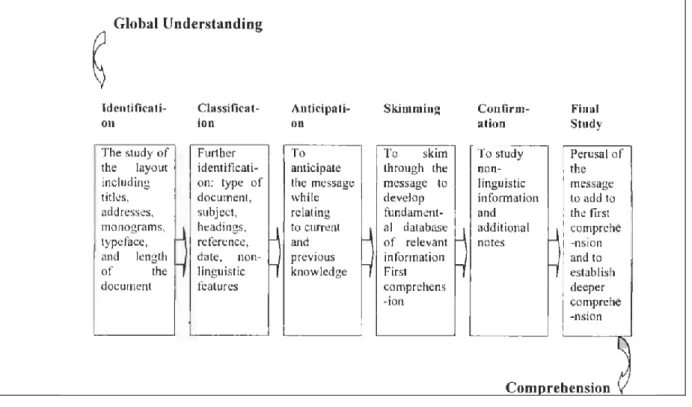
Unlike reading, which starts the moment we put the eye on the first letter or word, the process of comprehension begins before we start to read and continues even after the reading is finished. This process of comprehension can be accomplished by following the most common strategies of reading; reading, during reading, and post-reading. In the
pre-reading stage, Prado (2004) and Abrar-UL-Hassan (2005) affirm that good readers preview the text and identify what it is about by studying the layout, activating the background knowledge (schema) about the topic introduced, and having a quick view on the title and the text in general (skimming or „First Comprehension‟). As to the teacher‟s role in this stage, s/he activates the schema by introducing the topic and creating a kind of debate with the students about it to help them predict broadly what the piece of reading will be about and what kind of information they will get as they go through the text. During reading, readers find themselves face to face with an amount of information that they must retain and process in order to understand the message and create a chronological picture of the ideas. This can be best achieved when the teacher begins with a purpose and poses questions that students should try to answer as they read. In addition to many other strategies they can use to make meaning during reading itself. In the post-reading stage, the process of comprehension continues when the readers try to generate the information they got from the text and establish deeper comprehension by answering comprehension questions, studying vocabulary, discussing author‟s purpose and reasoning, examining grammatical structures, follow-up writing or other extension activities like summarizing and paraphrasing.
Figure 1.1. The Reading Process (Abrar-UL-Hassan, 2005: 80)
1.4. Component Skills in Reading
The complexity of the reading process has always fascinated researchers and pushed them to try to understand and analyze the process. It is often divided into lower-level processing skills (identification) and higher-level comprehension and reasoning skills (interpretation). To arrive at a better understanding, Rayner and Pollatsek (1989) and Grabe (1991) subdivided the reading process into at least six general component skills and knowledge areas:
1. Automatic recognition skills
2. Vocabulary and structural knowledge 3. Formal discourse structure knowledge 4. Content/world background knowledge 5. Synthesis and evaluation skills/strategies
6. Metacognitive knowledge and skills monitoring
1.4.1. Automatic Recognition Skills
Automaticity refers to the reader‟s ability to decode and recognize the words. This process of decoding becomes faster with time and practice, i.e. exposure to large amount of texts. Therein, the reader becomes fluent and comprehension is achieved more rapidly. As for Samuels and Flor (1997), it is the ability to perform complex skills with minimal attention and conscious effort. Automatic recognition or perceptual skills have first been considered important in second language reading in the early 1990s. Many cognitive psychologists advocate the effectiveness of automaticity in reading to fluent reading.
Grabe (1991) declares that automaticity is achieved when the reader is unaware of the process and uses little processing capacity. He proceeds that “the primary focus of automaticity research has been on the feature, letter, and word levels, playing a crucial role in descriptions of lexical access skills of fluent readers.” (Grabe, 1991: 380)
The theory of automatic processing reveals that word recognition skills are improved when learners read repeatedly and repeated reading improves learners‟ reading fluency (Therrien and Kubina, 2007). Many researchers believe that fluency problems stem from poor decoding skills in the learners. When the act of decoding is too slow, short-term memory is held back which delays the flow of thoughts and impedes comprehension. Hence, repeated reading develops word recognition and decoding skills by providing students with constant exposure to the same words (LaBerge and Samules, 1974; Therrien and Kubina, 2007). It is then widely believed that automaticity is a necessary skill for fluent readers, and it accompanies them all through the reading process facilitating comprehension and assuring meaning.
1.4.2. Vocabulary and Structural Knowledge
It is evident that vocabulary and syntactic knowledge are at the heart of any reading process. Oakhill and Cain (2007) and Tankersley (2003) include vocabulary knowledge with lower level skills and argue that it has a high correlation with reading comprehension. One cannot read a text and fully comprehend it if they do not have the least vocabulary contained in it. Correspondingly, knowing about the structure of the text facilitates the reading and guarantees comprehension. According to Stanovich (1986), vocabulary knowledge has similarly been recognized as a finding stone of the reading ability. Grabe et al. (2011) focused on the relationship between percentage of vocabulary known in a text and level of comprehension of the same text. They concluded that an amount of 98 of coverage target is required for readers of academic texts to achieve comprehension. In other studies, Grabe (1991-2009) states that first language reading researches have designated an estimation of recognized vocabularies of fluent readers to range from 10,000 words to 100,000 words. As for second language readers, it is far lower, often raging from 2,000 to 7,000 words. The need to a native-like fluency requires knowledge of vocabulary approximate to the larger estimates for first language readers. Therefore, fluent readers need a thorough knowledge of language structure and vocabulary recognition. However, for the students, they must be encouraged to use word analysis and context clues to derive the meaning of unfamiliar words.
Assuming that there are three main constituents of word identity; phonology, meaning and orthography, some studies have recently spotted their influence on the acquisition of orthographic knowledge using an orthographic learning paradigm. This exemplar emphasizes the idea of orthographic knowledge enhancement with the same word being encountered repeatedly (Hilte and Reitsma, 2011). With the orthographic knowledge, readers can build a
link between the images of the words and their meanings. Experiments in the field have shown that extensive vocabulary promotes comprehension skills (Beck, Perfetti and McKeown, 1982; McKeown, Beck, Omanson and Perfetti; 1983; McKeown, Beck, Omanson and People, 1985; cited in Pressley, 2000: 548; Tankersley, 2003), whereas the failure to recognize even 2% of the words of a given text will hamper comprehension (Wallace, 2007).
1.4.3. Formal Discourse Structure Knowledge
Explicit awareness about formal discourse structure, or formal schemata, is about knowing how the text is organized. Having this knowledge, the readers can make better use of the text organization to construct a meaning-based representation (Oakhill and Cain, 2007). For example, when asked to use the same organization, generally in certain types of text organization like comparison-contrast, good readers appear to recall information and write better than poor readers who are in short of this knowledge (Grabe, 1991). Research in second language contexts has also shown that more specific and logical patterns of organization, like cause-effect, comparison-contrast, and problem-solution, improve recall in comparison to texts with a collection of facts (Carrell, 1984). Awareness of discourse structure is often associated with reading strategies such as recognizing main ideas and inferring connections among parts of the text as declared by Grabe (2009). He perceives to say that this awareness involves applying strategies in order to interpret discourse level paradigms of organization.
1.4.4. Content/World Background Knowledge
Content schemata are the prior knowledge of the information related to the text. They are also critical to the construction of a meaning. They are shown to have a large effect on
reading abilities (Grabe et al., 2011). For instance the case of a scientific text about the function of a given software program with mathematical terms and descriptions like algorithm equations. A reader out of the field, and having no clue about the terminology, will find it difficult, if not impossible, to understand the function of that program. Likewise, cultural knowledge has been shown to strongly influence comprehension (Carrell, 1984). Cultural background of the L2 readers has often posed a problem of understanding. When the readers are unaware of some aspect in the culture of the target language, and they are confronted with some situations, they are likely to fail in building a correct understanding of the case in hand. Consequently, content background knowledge is another finding stone of reading comprehension without which meaning can be destroyed or miscarried.
1.4.5. Synthesis and Evaluation Skills/Strategies
The most subtle strategy is making use of previous knowledge (Grabe, 2009). Even brilliant students find it a tedious and difficult task to read about unfamiliar topics. Competent readers use their prior knowledge about the topic of the text and compare, or synthesize the actual information provided in the text with other sources of information they met before. Grabe (2009) described this skill as complex evaluation and critical reading. This is what makes synthesis and evaluation skills/strategies crucial components of reading abilities. Grabe (1991) reveals in the same contexts that predictions play an important role in promoting the reading ability. He goes on to affirm that if fluent readers are put in the real-time constraints of the reading process, they will not predict the upcoming words; rather, prediction helps them anticipate later developments within the text and foresee the author‟s point of view regarding the present information and take a position vis-à-vis his intentions.
1.4.6. Metacognitive Knowledge and Skills Monitoring
Metacognition was first described by Flavell (1979) as the individual‟s knowledge about the cognitive processes and the ability to control the use of appropriate processes to get the most out of learning. This definition is intended to refer to cognition about cognition. As to Grabe (1991) and Schraw (2001), metacognition refers to the individual‟s knowledge about cognition and self-regulation of cognition. That is to say, recognizing how language functions and how patterns of structure are organized using appropriate strategies to complete specific goals. In the case of reading, Grabe (1991) states that:
[…] this would include recognizing the more important information in a text; adjusting reading rate; using context to sort out a misunderstood segment; skimming portions of the text; previewing headings, pictures, and summaries; using search strategies for finding specific information; formulating questions about the information; using a dictionary; using word-formation and affix information to guess word meanings; taking notes; underlining; summarizing information; and so on.
(Grabe, 1991: 382) He goes on to say that the competent reader monitors his cognition when he recognizes any problem concerning the information in the text or the inability to understand it. Self-regulation strategies would include combining metacognitive knowledge, planning, monitoring understanding, checking effectiveness of strategies, revising strategies being used, and so on.
Both knowledge about cognition and regulation of cognition are interrelated components of metacognition which are essential for successful understanding and learning (Schraw, 2001). In a reading class, it is necessary to work on both aspects in order to increase learners‟ metacognition. Wilawan (2013) maintain that metacognitive knowledge or thinking
about thinking includes three components; declarative; knowing what the strategy is, procedural; knowing how it is used, and conditional; when it should be applied.
According to O'Malley, et al. (1985: 561), "students without metacognitive approaches are essentially learners without direction or opportunity to review their progress, accomplishments, and future directions". Hartman (2001: 35) reported that college students, who lack metacognitive knowledge and do not know what they are doing when performing a task, generally encounter impediments when performing the following learning tasks:
1. Determining the difficulty of a task
2. Monitoring their comprehension effectively 3. Planning ahead
4. Monitoring the success of their performance 5. Using all relevant information
6. Using a systematic step by step approach to completing a task 7. Curtailing the frequent jumping to conclusions
8. Using adequate or correct representations
On the other hand, earlier research has indicated a positive relationship between students‟ improved reading performance and their awareness and use of the reading strategies (Carrell, 1991; Pressley, 2000).
The aforementioned component skills are said to be the most effective to reading abilities as indicated by Grabe (1991). As for Grabe and Jiang (2014:14), L1 and L2 research has even highlighted the following factors as strongly impacting reading abilities and explain individual differences in reading comprehension:
1. efficient word recognition processes (phonological, orthographic, morphological, and semantic processing);
2. a large recognition vocabulary (vocabulary knowledge);
3. efficient grammatical parsing skills (grammar knowledge under time constraints);
4. the ability to formulate the main ideas of a text (formulate and combine appropriate semantic propositions);
5. the ability to engage in a range of strategic processes while reading more challenging texts (including goal setting, academic inferencing, monitoring); 6. the ability to recognize discourse structuring and genre patterns, and use this knowledge to support comprehension;
7. the ability to use background knowledge appropriately;
8. the ability to interpret text meaning critically in line with reading purposes;
9. the efficient use of working memory abilities; 10. the efficient use of reading fluency skills;
11. extensive amounts of exposure to L2 print (massive experience with L2 reading);
12. the ability to engage in reading, to expend effort, to persist in reading without distraction, and achieve some level of success with reading (reading motivation).
1.5. Reading Speed
Reading speed is a major factor in competent reading and a source of comprehension impediment. Even native readers of English face this limitation. They often tend to cover
everything in the piece to be read at more or less than 250-400 words a minute (Graesser, 2007), no matter the comprehension attained or the difficulty of the material. Even though, some researchers have noted still higher speeds -like McLaughling (cited in Ferguson: 1969) in his article “Reading at „Impossible‟ Speeds” who claims that if readers use contextual clues while reading, they can reach speeds up to 800-1000 words a minute-. For Grabe (2009), L2 College students may only read at 80-120 words per minute, even though they perform pretty well on comprehension tests taking enough time to complete the task. As a consequence, for Ferguson (1969), simple materials of little importance are often well comprehended, and complex materials usually of greater importance are left behind. Moreover, concentration is most of the time low for whole sections of the material are read superficially with almost no comprehension.
Reading speed and reading comprehension are two crucial components of skilled reading (Fraser, 2004). LaBerge and Samuels (1974), in their model, developed the idea that reading comprehension and reading speed are two distinct but related factors and both should be incorporated in a reading program. They emphasized the importance of automaticity of certain components of the reading process. On the whole, they conceive that when readers are able to quickly identify words, they will comprehend better because by then, they can shift attention to comprehension, that is to say, the meaning and relationship of the words.
Practically, not all readers get the same information from the same text. Some researchers say that efficient readers read faster and get more information than poor readers. As to Goodman (1973), the proficient reader uses appropriate strategies which give as a result the most trustworthy prediction with minimum use of the information available. He perceives that the reader takes in only a part of what he sees because he knows how to organize his assumptions according to the language structure and meaning, and also he has learnt to shift
his attention from the least important to the most important information. Specifically, it is not necessary to read every word in a text to be a skilled reader, rather if readers do only pick up key words, this will increase their speed and comprehension.
One could argue that slow readers are often embarrassed in front of their fellows. They even feel the reading tasks hard and unpleasant which causes them to fail their reading assignments and not to appreciate the taste of the reading material (Hayland, 1990). Hayland adds that the main reason behind slow reading in students is the classroom methodology in reading lessons. He continues that the texts used in classrooms are only used to present language items like vocabulary rather than the encouragement of the act of reading. This is what makes students feel vulnerable about passing over words and thus unconfident readers.
For Fraser (2004), the lack of extensive exposure to the foreign language is one of the many factors that sustain slow reading. This is what affects their automaticity as well as comprehension (LaBerge and Samuels, 1974; Grabe, 1991). Another factor presented by Fraser (2004) is the large number of unfamiliar vocabulary students stumble upon. She also mentions the lack of automaticity in word recognition and the structural differences between the writing systems of L1 and L2 to be essential factors for reading fluency. Thus, for her, the major goal for educators is to improve reading fluency for L2 learners. Nonetheless, the previously mentioned component skills of the reading ability play also an important role in enhancing the reading speed. In other words, readers with high automatic recognition skills and having a vast bank of vocabulary, which helps them recognize formal discourse, are likely to cover most of the information provided in the text. Not to forget, of course, the impact of content background knowledge, evaluation and metacognitive skills which help save time and keep the readers‟ attention on comprehending the material.
1.6. Reading in the Second Language
Although Bernhardt and Kamil (2006) argue that the present models of research oversimplify both literacy knowledge (L1 knowledge) and language knowledge (L2 knowledge) to the L2 comprehension process, there is a growing consensus that second language reading is affected by first language reading. There are two main hypotheses representing the relationship between L1 and L2; the linguistic interdependence hypothesis and the linguistic threshold hypothesis. Yamashita (2004) explains that the first hypothesis suggests a correlational relationship between L1 reading ability and L2 reading, and the second hypothesis permits the L1 reading ability transfer to the L2 reading with the learners‟ linguistic fundamentals as a condition for the transfer to take place. She goes on to say that many attempts to find out which hypothesis explains best the relationship between L1 and L2 reading resulted in supporting the linguistic threshold hypothesis. In their study which investigates the relationship between first and second language reading, Carrell, Eisterhold, Kroll, Kuehn, and Silberstein (1990) sustain this hypothesis and claim that adult language learners can utilize their literacy skills in developing their L2 reading. However, Yamashita conducted a study which focuses the importance of the affective domain in the reading ability of L2 learners, unlike the other studies claiming only the cognitive domain (the linguistic threshold hypothesis). The study has demonstrated that learners‟ attitudes and feelings towards reading ether in L1 or L2 need to be understood to encourage them to get involved in extensive reading. The findings of the study suggest that cognitive and affective domains of reading relate differently in L1 and L2 (Yamashita, 2004).
Koda (2008) stresses the importance of second language reading research in the formation and development of L2 reading skills: