The people's Democratic Republic of Algeria Ministry of Higher Education and Scientific Research
Mentouri University- Constantine Faculty of Letters and Languages
Department of English
Students’ Difficulties in English- Arabic
Translation of Collocations
Case Study: Third Year Students of English
Dissertation submitted in partial fulfillment of the requirements for the Master degree in English (Applied Language Studies)
Submitted by: Selma Boussalia Supervisor: Dr. Haoues Ahmed Sid
Dedication
I offer this work to my parents first, thanks to their encouragement and sustain.
To my brothers and sisters: Abdelghani, Houssem eddine, Karima and Samiha. To my uncles, aunts and all my cousins especially Fatima, Souad and Massika. To all my friends and classmates especially Amina, Mina, Chahra and Fatima.
Acknowledgment
I am very grateful to my supervisor Dr Ahmed Sid Houas, thanks to his help, encouragement, and special guidance.
Special thanks to Mrs. Moussa and Mr. Kaouach Thanks for all my teachers.
Abstract
Collocations present specific problems in translation. They are particularly difficult for foreign learners of a language. This may be ascribed to the relative difficulty in predicting the constituent elements of a collocation, the considerable variation in collocability across languages and the lack of adequate resources on collocation. The purpose of this research is to examine whether students’ difficulties in translating collocations are the result of their unfamiliarity with English language and culture. In order to conduct this research, two tests are carried out. The first test is a translation task that involves ten English contextualized collocations of different types. The second test is a multiple-choice task. This test was administrated to 30 students of English. The results revealed that the participants' performance in the test was considerably low. They show evidence of students' unfamiliarity with English collocations which is a reflection of their inability to master the English language and their ignorance of its culture. This can explain their failure to translate them correctly. The results have also given evidence of the students' extensive transfer from their first language. This transfer is often negative and leads them to errors. In the light of the results, it seems necessary for students to improve their collocational competence. Similarly, teachers should draw the students' attention to the complexity of translating collocations in order to increase their awareness of this phenomenon and therefore to overcome the difficulties they face in translating collocations.
List of Tables
Table 1: Students' Translations of the Collocation 'Relieve a sigh'………...…25
Table 2: Students' Translation of the Collocation 'Rural dwellers'………..………27
Table 3: Students' Translation of the Collocation 'Fat salary'………...28
Table 4: Students' Translation of the Collocation 'Dry wine'……….30
Table 5: Students' Translation of the Collocation 'Narrow money'……….32
Table6: Students' Translation of the Collocation 'Court of appeal'……….34
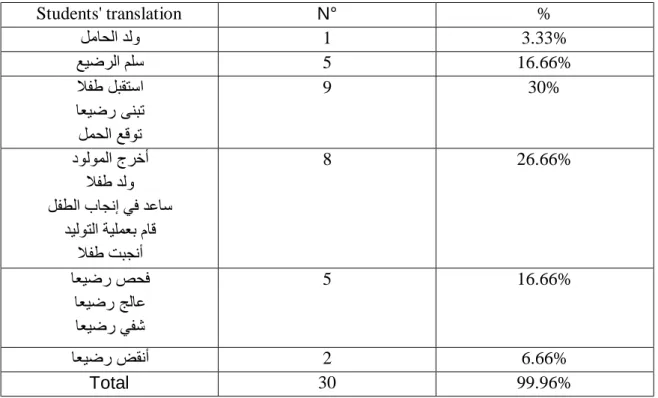
Table7: Students' Translation of the Collocation 'Deliver a baby'………..35
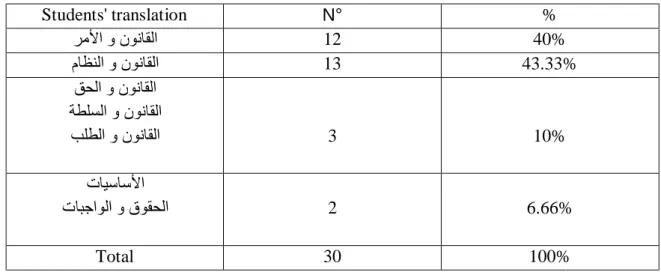
Table 8: Students' Translation of the Collocation 'Law and order'………37
Table9: Student's Translation of the Collocation 'The sunshine industries'………38
Table10: Students' Translation of the Collocation 'Green worker'………...40
Table 11: Students' Answers to the Collocation 'Brain drain'………...43
Table 12: Students' Answers to the Collocation 'Obey the law'………..44
Table 13: Students' Answers to the Collocation 'Pay a respect'……….45
Table 14: Students' Answers to the Collocation 'Nuclear family' ………..46
Table 15: Students' Answers to the Collocation 'Ginger hair' ………....47
Table 16: Students' Answers to the Collocation 'Play a joke'………..48
Table 17: Students' Answers to the Collocation 'Expecting a baby' ………...49
Table 18: Students' Answers to the Collocation 'The dawn breaks' ………...50
Table 19: Students' Answers to the Collocation 'Data processing' ……….51
Table 20: Students' Answers to the Collocation 'Poet laureate'………...52
List of Figures
Figure1: Students' Translations of the Collocation 'Relieve a sigh'………...…….25
figure2: Students' Translation of the Collocation 'Rural dwellers'………..………27
figure3: Students' Translation of the Collocation 'Fat salary'………...29
Figure 4: Students' Translation of the Collocation 'Dry wine'………...30
Figure 5: Students' Translation of the Collocation 'Narrow money'………32
Figure 6: Students' Translation of the Collocation 'Court of appeal'………...34
Figure 7: Students' Translation of the Collocation 'Deliver a baby'………36
Figure 8: Students' Translation of the Collocation 'Law and order'………....37
Figure 9: Students' Translation of the Collocation 'The sunshine industries'…………..39
Figure 10: Students' Translation of the Collocation 'Green worker'………40
Figure 11: Students' Answers to the Collocation 'Brain drain'………....43
Figure 12: Students' Answers to the Collocation 'Obey the law'……….44
Figure 13: Students' Answers to the Collocation 'Pay a respect'………45
Figure 14: Students' Answers to the Collocation 'Nuclear family' ………...46
Figure 15: Students' Answers to the collocation 'Ginger hair' ………....47
Figure 16: Students' Answers to the Collocation 'Play a joke'………48
Figure 17: Students answers to the collocation 'Expecting a baby' ………49
Figure 18: Students Answers to the Collocation 'The dawn breaks' ………50
Figure 19: Students Answers to the Collocation 'Data processing' ……….……...51
Figure 20: Students Answers to the Collocation 'Poet laureate'………..52
CONTENT
Introduction……….……1
Chapter One: Collocations in Translation………...3
Introduction ………..3
1.1. Translation………..………3
1.1.1 Definition of Translation………..…...….3
1.1.2. Translation Problems………..…4
1.1.2.1. Cultural Problems in English- Arabic Translation………..4
1.1.2.2. Lexical Problems in English – Arabic Translation………..5
1.2. Collocations………...8
1.2.1. Definition of Collocations……….8
1.2.2. Collocational Meaning………..9
1.2.3. Collocational Range………11
1.2.4. Collocational Patterning across Languages………...13
1.2.5. The Importance of Collocations in Language………...14
1.2.6. Types of Collocations………...15
1.2.6.1. Grammatical Collocations………15
1.2.6.2. Lexical Collocations………...16
1.2.7. Collocations and Register……….16
1.2.8. Collocations and Culture……….17
1.2.8.1. Culture –Specific Collocations………17
1.2.8.2. Collocations and Connotations………18
1.2.9. Difficulties and Problems in Translating Collocations………19
Conclusion………..22
Chapter Two: Data Analyses Introduction……….23
2.1. The Test………...23
2.1.1. The Sample………....23
2.1.2. Description of the Test………..24
2.1.2.1. Task One………...24 2.1.2. Task Two………...………24 2.2. Data Analysis………..……….25 2.2.1. Task One………...25 2.2.1.1. Sentence One………..25 2.2.1.2. Sentence Two……….27 2.2.1.3. Sentence Three………...28 2.2.1.4. Sentence Four……….………30 2.2.1.5. Sentence Five………..32 2.2.1.6. Sentence Six………..……….34 3 2.2.1.7. Sentence Seven………...35 2.2.1.8. Sentence Eight………37 2.2..1.9. Sentence Nine………...38 2.2.1.10. Sentence Ten……….40 2.2.2. Task Two………..43 2.2.2.1. Sentence One………..43 2.2.2.2. Sentence Two……….44 2.2.2.3. Sentence Three………...………45 2.2. 2.4. Sentence Four………46 2.2.2.5. Sentence Five………..………47 VII
2.2.2.6. Sentence Six ………..48
2.2.2.7. Sentence Seven ………..…………49
2.2.2.8. Sentence Eight………....50
2.2.2.9. Sentence Nine……….51
2.2.2.10. Sentence Ten……….52
2.3. Collocations Translation Suggestions ……….53
Conclusion………...55
General conclusion………..56
Bibliography………...57
1
Introduction
1. Statement of the Problem
The translation of collocations is an ever-lasting struggle for learners of English to match the proper noun with the proper verb or adjective. The problem is that language is not made up of a large number of words that can be used together in free variation; words have a certain tolerance of compatibility. Like individual words, collocational patterns carry meaning and can be culture-specific; this in addition to their largely arbitrary nature, gives rise to numerous problems in translation.
As a student at the Department of English, I observed that Algerian learners of English encounter serious problems in translating collocation sequences from English into Arabic. Therefore, it is important to investigate whether these problems in translating English collocations are the result of their unfamiliarity with English language and culture.
2. Aim of the Research
The objective of this research is to shed some light on the most significant areas of difficulty that 3rd year students of English face when translating collocations from English into Arabic. This research aims also at checking students' familiarity or unfamiliarity with English collocations and its influence on these difficulties. This study aims also at attracting the learners' attention to the complexity which implicates the translation of collocations and therefore to help them to overcome these difficulties
3. Research Questions
1. Do students translate collocations as ready-made combinations or as free combinations, i.e. do they translat e co llo cat io ns o n phrase basis or on word for word basis?
2
2. Are students familiar or not with English collocations?
3. Are students' difficulties in translating collocations due to their unfamiliarity with English language and culture
?
4. Does interference from the students' first language lead them to make mistakes?
4. Hypothesis
To fulfill the aim of the research the following hypothesis is elaborated:
If students are unfamiliar with English language and culture, then they will face difficulties in translating collocations from English into Arabic.
5. Research Methodology
Because this study investigates problems and their causes, the research is an analytical one. In order to conduct this research, a set of collocations are selected to be translated by subjects of the study in addition to a multiple-choice test. The mistakes made by subjects are identified and analyzed. The subjects of this study are selected randomly from third year students of English at the University of Mentouri, Constantine.
6. Structure of the Study
This work is divided into two chapters. The first chapter is a literature review on translation and collocations. The second chapter is a practical one that includes two tasks given to third year students of English. The first task is a translation task and the second one is a multiple-choice task.
3
CHAPTER ONE
Collocations and Translation
Introduction
The translation of collocations is difficult for non-native speakers of a language. Differences in the collocational patterning of the source and target languages create potential pitfalls and can pose various problems in translation. The difficulty for the learner is not to recognize a source language collocation but to find an acceptable target language equivalent.
In this chapter, a brief definition of translation and the main problems that make the translator's task difficult is pointed out. Then different definitions of collocations are given, their types, connotative meaning, and their main problems in translation are also presented.
1.1. TRANSLATION 1.1.1. Definition
There is no general agreement on the definition of translation, but basically, to translate is to transfer a SL text into a corresponding TL text. So, in the process of translating, two languages are involved, the SL or the language of departure and the TL which is the language of arrival or the language which is being translated into.
In recent researches that are related to translation, many definitions have been given on what a translation is and what happens in the translating task. Catford, for example defines translation as the "replacement of textual material in one language (SL) by equivalent textual material in another language (TL)" (1965:20). From this definition, it is understood that translation is the attempt to replace a message or statement in one language by the same m e s s a g e o r s t a t e m e n t i n a n o t h e r l a n g u a g e ( T L )
4
In his turn, Ghazala defines translation as follows: "Translation is generally used to refer to all the processes and methods used to convey the meaning of the SL into the TL" (1995:1). So, for Ghazala the main aim of translation is to transmit the meaning of the SL into the TL. In addition, meaning is not the result of lexemes, but it is a mixture of language components which are grammar, vocabulary, style and phonology.
1.1.2. Translation Problems
The translator most probably faces serious problems in translating. There could be a loss of meaning due to a number of factors such as social and cultural differences, and lexical and grammatical invarieties of two different languages. These factors make the translation task difficult.
1.1.2.1. Cultural Problems in English – Arabic Translation
According to Rubel and Rosman, "Translation is central to write about culture, that all cultures are different, and that cultural translation is difficult if not impossible task, " (2003: 8). Translation is viewed as a cultural practice. Therefore, we can argue that the translation difficulties inherent in it are due very largely to the linguistic differences between the SL and culture and that of the TL and culture. The more differences between the SL culture and TL culture, the more difficulties in translation. In the case of English and Arabic languages, it should be clear that the problems in the English Arabic translation stem from the fact that they have different cultures; English culture is strictly different from the Arabic one because they are coming from different origins. While English belongs to the Indio European language f a m i l y g r o u p , A r a b i c p e r t a i n s t o a g r o u p o f S e m i t i c l a n g u a g e f a m i l y .
Each language contains elements which are derived from its culture (such as greeting, fixed expressions…). Those cultural elements are considered the most difficult items in translation.
5
According to Shuttelmortls and Cowie (1997:34), "It is well known that translating words denoting elements of the source culture present particularly several problems for the translator since their cultural significance in SL can never be fully reproduced in TL ". For example, the Arabic word " ﺔ ﻠﻗد" (a kind of dates) has no total equivalent in English, because it is a part of the Arab culture but not the English one. English people do not distinguish between different kinds of dates, thus they refer to any kind as only "date". Another example is the expression "fine"which is translated as " ﷲ ﺪ ﻤﺤﻟا" in Arabic and which literally means "praise to God". They are not totally equivalent because the first one contains a religious implication, while the last one does not. Therefore, an awareness of such issues can at times make it more appropriate to think of translation as a process which occurs between cultures rather than simply between languages.
1.1.2.2. Lexical Problems of English Arabic Translation
According to Ghazala, “the greatest numbers of problems posed to the students of translation are the lexical problems" (1995:80). Students generally give the prime importance to words in translation; more dangerously, they understand translation as translation of individual words, and thus, they make mistakes.
1.1.2.2.1 Literal Translation
There are different kinds of literal translation, but Catford argues that literal translation takes word for word translation as its starting point (1955: 25).
A. Word for Word Literal Translation
Each individual word is translated into an equivalent word in Arabic and the word order is the same as in English. For example, "Stop beating around the bush" would be translated into
6
" ةﺮﯿﺠ ﺸﻟا لﻮ ﺣ بﺮ ﻀﻟا ﻒﻗوأ". Ghazala (1995:85) criticizes this kind of translation to the point that he thinks that literal translation is dangerous and destroys the meaning. He says: "The problem for students is that they think that literal translation is applicable to everything in
language, this makes them commit many mistakes" (ibid.).
B. One to One Literal Translation
Each SL word or phase is translated into an identical word or phase in the TL. That is, an idiom would be translated into an idiom, an adjective into an adjective, a collocation into a collocation. For example, "He is a young man. He is a kind hearted" would be translated ﻮ ھ"
ﺎﺑﺎ ﺷ نﻮ ﻜﯾ .
ﺐ ﻠﻘﻟا ﺐ ﯿﻃ نﻮ ﻜﺑ ﻮ ھ
" . This method is similar to the first one, in that it insists on having the same word order and having the same type and number of words. However, it is more acceptable and better than the first one since it takes context into consideration and translates special and metaphorical SL words and phrases into special words and phrases.
C. Literal Translation of Meaning (Direct Translation)
It is the translation of meaning in context. It takes into consideration the grammar and the word order of the TL. Metaphorical and special uses of language are also accounted for in the TL. For example, ''to beat around the bush'' would be translated into ' روﺪ ﯾ و ﻒ ﻠﯾ (ibid.). Ghazala considers the literal translation of meaning the best method of literal translation and the most acceptable one. Hence, it is recommended for students.
1.1.2.2.2. Synonymy
Two or more words which have very closely related meaning are called synonyms. It can however be maintained that there are no "total synonyms" (Palmer, 1976:59). Thus, two words can often substitute for each other in sentences. However, sometimes one word is
7
appropriate in a sentence, but its synonym would be odd. For example, hot may be translated into Ǜ ҳ, һǛ but hot welcome can be translated only into Ǜ ҳ Ǜ Қ ǚ and һǛ Ǜ Қ ǚ is odd. Thus, synonymy may create many problems for students in translation because they think that any two synonyms can be substituted interchangeably in all environments.
1.1.2.2.3. Polysemy
Polysemy is the case where the same word may have a set of different meanings; such a word is polysemic. A polysemic word may create many problems in translation, because it is only the surrounding words or the context that determines the intended meaning. For example, the polysemic word run may be translated in many different words in Arabic as Ұ , Ө ¤ , each meaning depends on the context.
1.1.2.2.4. Idioms
An idiom is a combination of words in which the meaning is opaque, i.e., it is not related to the meaning of the individual words. Idioms pose many difficulties in translation because they are culture-specific and differ from language to language and from culture to culture. For example to kick the bucket equals ғ Ǜ .
1.1.2.2.5. Collocations
Collocations are two or more words that often co–occur in different environments. Collocations create many difficulties in translation because the meaning of the word changes when it combines with other words. Thus, they cannot be translated on word for word basis.
So, lexical problems of translation are therefore critical to any SL and TL text. Without solving them, we cannot translate effectively. However, they are not enough to cover all the important problems of translation.
8
1.2. COLLOCATIONS1.2.1. Definition
There are actually different definitions of the notion of collocation, however all linguists agree that a collocation is an expression consisting of two or more words that usually occur together in an arbitrary way. The British linguist Firth is often quoted as one of the earliest who dealt with the collocational phenomenon. According to Palmer (1976: 94), Firth argued, ''You shall know a word by the company it keeps''. Firth gives an illustrative example of the word 'night' where one of its meanings allows its collocability with 'dark'. In an article of modes of meaning published back in 1951, Firth introduces his classical definition of collocation as '' the company words keep together''. (cited in Zughoul, 2001:02). However, for Firth, this keeping company, which he called collocations, was merely a part of the meaning of the word. In his turn, Ghazala (1995:108) defines collocation as ''a combination of two or more words that always occur together consistently in different contexts in language''. So, Firth and Ghazala emphasize the importance of context of surrounding words for the collocation to be understood. To illustrate this point, Manning and Schutz (1999:142) use Halliday's example of ''strong tea'' vs. ''powerful tea''. The words ''powerful'' and ''strong'' are merely synonyms, but it is a convention in English to speak about ''strong tea'' not ''powerful tea'', although any speaker of English would also understand the latter unconventional expression.
A collocation occurs more often by chance, its components co-occur naturally. According to Baker (1992: 47), ''a collocation is a systematically arbitrary restriction which does not follow logically from the prepositional meaning of a word''. For example, one must learn that English people ''toast bread'' and not ''grill it'' even if there is no big difference in their ways of exposure to fierce heat (Armstrong, 2005:34).
9
Using a word naturally conditions learning its collocates or other words that often co-occur with it (McCarthy, 2005: 12). For example, if someone wants to learn the word ''heavy'' he needs to know that some of its collocates are'' smoker '', '' drinker", "traffic", ……etc, and that these collocates can be used with adjectives like ''strong'' or ''big ''. Moreover, the meaning of the word changes when it combines with other words. The word 'heavy' means “weighing a lot'', but when it is combined with '' smoker'' it means 'a person who smokes a lot'.
Furthermore, collocational pattering is different from one language to another. For example, the word'' strong '' in English and يﻮ ﻗ" " in Arabic collocate with the same equivalent in some combinations as in '' strong man '' " يﻮ ﻗ ﻞ ﺟر", ''strong influence'' " يﻮ ﻗ ﺮﯿﺛﺄ ﺗ". However, they differ in other combinations as '' strong tea ''; one cannot say " يﻮ ﻗ يﺎ ﺷ" in Arabic but يﺎ ﺷ"
ﺰﻛﺮﻣ
" (Mehdi Ali, 2008:30).
Finally, it is very important to mention that not all combinations are collocations. According to Maning and Schutz (1999:173), the best way to distinguish between a collocation and a free combination is to translate it into another language; if the literal translation or word for word translation does not work, then this is evidence that this is a collocation. For example "to pay a visit '' is a collocation because one cannot say in Arabic ةرﺎ ﯾﺰﺑ ﻊﻓﺪ ﯾ" '' but ةرﺎ ﯾﺰﺑ" مﻮ ﻘﯾ or "
simply "روﺰﯾ", so 'to pay a visit' is a collocation in English.
1.2.2. Collocational Meaning
According to (Leech, 1974:20), collocation meaning "consists of the associations of a word acquired on an account of the meaning of words which tend to occur in its environment". Leech illustrates this point by the words ' pretty' and ''handsome' and the collocates of each. These words share the common grounds of 'good looking' but they are differentiated by the range of nouns with which they are likely to co-occur. Usually, words do not exist in isolation but in combinations. A word gains different meanings when it collocates with other words. As Baker states, " what we do when we are asked to give account of the meaning of a word in
10
isolation is to contextualize it in its most typical collocations rather that the rarer ones" (1992: 53). This means that the word meaning changes as its collocates change. Baker illustrated this point by the adjective "dry" which means in isolation" free from water" and it keeps this meaning when it collocates with things such as "clothes, river, weather..”; however, in many other combinations, dry does not mean" free from water " as in:
1- Dry cow: a cow that does not yield milk.
2- Dry bread: bread served alone without butter or jam. 3- Dry book: a book that is boring or uninteresting.
4- Dry voice: cold voice, in the sense it does not express emotion. 5- Dry wine: wine without sugar.
6- Dry humour: pretending to be serious, ironic
From this example, it is noticed that the meaning of "dry" depends largely on its pattern of collocation. Moreover, each example has a unique meaning which is totally different from the core meaning of 'dry', and which is different from other meanings. According to Armstrong (2005:98), "In many cases, success in finding the right collocation seems simply to depend on an adequate range of reading". That is to say, students need to know as many collocational meanings as possible, because knowing the core meaning of the lexical item is not sufficient and may lead them to mistranslate the collocation in TL since not all their meanings are given in the dictionary.
Moreover , words may have more specific meanings in particular collocations. Thus, one can speak of 'abnormal' or 'exceptional weather' if there is snow in summer, but an 'exceptional child' is not an 'abnormal child'. An 'exceptional child' is a very good child who has more capacities than usual, whereas an 'abnormal child' refers to a child who has a defect or less capacities than usual (Palmer, 1976: 96).
11
Furthermore, the meaning of a collocation cannot be predicted from the meaning of its constituents. According to Manning and Schutz (1999:141), “collocations are not fully compositional because their meanings cannot be predicted from the meaning of their parts; there is always a meaning added to the combination”. This can be illustrated in the following example:
Strong (adj.): means not easily broken or injured.
Tea (n): A drink made by powering boiling water on the tealeaves. Strong tea: it is a kind of tea having a lot of tea in it.
So in the collocation "strong tea", the adjective "strong" has acquired the meaning which is closely related, but slightly different from the core meaning (not easily broken or injure). This example illustrates the fact that words having different meanings combine together and form words having totally different meanings.
1.2.3. Collocational Range
The collocation range is the set of all possible words that may collocate with a given lexical item. As Baker states it, " range refers to the set of collocates which are typically associated with the word in question "(1992; 49). Some words have a much broader collocational range than others. The word "run" for example has a wide collocational range. It may collocate with company, business, river, water, car, stockings, tights, nose, wild, debt, bill and colour, while other words have a rather limited collocational range. The English word "shrug" for example occurs only with" shoulders" and does not occur with other words (Baker, 1992; 50).
In translation, translators must be aware of the collocational range of the word concerned both in SL and TL because a lexical item and its equivalent in TL may have different collocates and therefore different meanings. For example, in English it may be denoted to " ةﺮ ﺑﻹا ﺐ ﻘﺛ" as "the eye of needle", whereas Arabic uses another word " ﻢ ﺳ" for the same goal. On the other hand, the collocational range of the word " ﻦﯿ ﻋ" in Arabic is wide and has different meanings,
12
which do not exist in English. It can be said in Arabic " ﮫ ﻨﯿﻌﺑ ﻮ ھ", "It is none other that he", " ﮫ ﻨﯿﻋ ﺐﺒ ﺴﻠﻟ" "for the same reason", '' ﻦﯿ ﻋ ضﺮ ﻓ'', "individual duty", ﺮﻌ ﺸﻟان ﻮ ﯿﻋ''gems of poetry'', '' نﺎ ﯿﻋﻷا ﺲ ﻠﺠﻣ'', ''senate or house of hoods''….etc (Mehdi Ali, 2008:32). So, translators must avoid literal translation in such cases because they may end in something unnatural and meaningless as if they translate " ﮫ ﻨﯿﻌﺑ ﻮ ھ'' into "he is by his eye" which makes no sense for native speakers of English. This is due to the fact that "different languages have different collocational ranges, what collocates in one language does not necessarily collocate in another" (Zughoul, 1991:12).
The collocational range may be influenced by two main factors. The first is its degree of specificity; the more general the word, the broader is the collocational range, the more specific, the more limited is the collocational range (Baker, 1992: 50). For example, the verb “cook" has much broader collocational range than any of its hyponyms as "boil, simmer, fry, toast, bake, and grill". People cook eggs, potatoes, vegetables, and meat, but they can only bake bread. So, "cook" has a broader collocational range than "bake" because "cook" is more general than "bake".
The second factor that determines the collocational range is the number of senses the word has. Most words have more than one sense (polysemous words), and each sense collocates with different words. For example the verb "break" in its sense of "causing something to be damaged and separated” collocates with concrete objects such as glass, plate, window… etc. In its sense of interrupting something, it collocates with abstract ones as silence, journey, and it collocates with other words such as "law'', in its sense of doing something against the rules . So the more senses the word has, the more its collocational range is wider.
The collocational ranges are not fixed since people create new collocations all the time. That is to say, there is no impossible collocation. As Baker maintains: "New and unusual
13
combinations of words occur frequently and we do not necessarily dismiss them as unacceptable" (1992:51).
1.2.4 .Collocational Patterning across Languages
Word patterns differ from one language to another. Thus, the SL may express an idea in one lexical item, while the TL may express the same idea in two or three lexical items. Therefore, total equivalence in the number of words that form a collocation between the SL and TL does not exist. As Baker states (1992: 68), "A language may express a given meaning by means of a single word, another may express it by means of transparent fixed expression and the third may express it by means of idiom". Therefore, the same lexical item may be expressed differently from one language to another because of difference of their collocational patterning. For example, the English collocation "common law marriage" consists of three words, while its equivalent in Arabic "ﻲﻓﺮﻌﻟا جاوﺰﻟا " consists of only two lexical items. Similarly, the collocation "to shake hands" consists of two words, while its equivalent in Arabic " ﻓﺎﺼﯾﺢ " is only one word. Arabs do not usually say "يﺪﯾﻷﺎﺑ ﺢﻓﺎﺼﯾ" but only " ﻓﺎﺼﯾﺢ " since this word already expresses the use of hands and people have a hand–shake " ﺔﺤﻓﺎﺼﻣ" only by hands (Ghazala, 1995:08). This example illustrates quite clearly the difference in c o m b i n a t i o n s p a t t e r n s a c r o s s t h e t w o l a n g u a g e s .
Furthermore, not only a concept may be expressed differently in TL, it may not exist at all in TL as well. Thus, not all SL collocations can be rendered as TL collocations. For example, the collocation "it rains cats and dogs"; its equivalent in Arabic is " ةراﺰ ﻐﺑ ءﺎﻤ ﺴﻟا ﺮ ﻄﻤﺗ" but not ﺮ ﻄﻤﺗ
ﺎﻤ ﺴﻟا ء و ﺎ ﺑﻼﻛ ﺎ ﻄﻄﻗ
" ” because it does not exist at all in Arabic (Ghazala,1993:28). Therefore, students should not insist on translating any SL collocation into TL collocation as well as not insisting on having the same number of words of the SL collocation because they may end in something wrong or unnatural in TL.
14
1.2.5. The Importance of Collocations in LanguageCollocations play a vital role in language. They are its beautiful part, in addition to their role in the coherence of the structure of language (Ghazala, 1995:130). According to Manning and Schutz(1999:142), collocations are important for a number of expressions, but the most important role of collocations is the generation of natural language. Thus, people make sure that their output sound natural and try to ovoid mistakes such as "powerful tea" or "take a decision" because they sound unnatural for native speakers of English. Oxford Collocations Dictionary maintains: "Collocations is the way words combine in a language to produce natural sounding speech and writing" (2002:7). For example, "Smoking is strictly forbidden" is more natural than "Smoking is strongly forbidden". So, collocations give the most natural way of saying something. Furthermore, collocations give an alternative of saying something that may be more expressive or precise. For example, instead of repeating, "it was very cold and very dark " one can say, "It was bitterly cold and pitch dark" (McCarthy, 2005:6).
Collocations have many functions. One function is noted in Oxford Collocations Dictionary as follows: "Language that is collocationnaly rich is more precise. The precise meaning in any context is determined by the context, by the words that surround and combine with the core word, by collocations" (2002:9). So, collocations make language more precise, rich and appealing.
Another function of collocations is that with them people are able to talk about any subject and communicate effectively. Also knowing which nouns are used with which verbs, which adjectives are used with which nouns improves ones linguistic competence (Saricas, 2006:36). For example, instead of saying "big meal", it is better to say "substantial meal", and instead of saying "poverty causes crime" one should say, "poverty beads crime" (McCarthy 2005:03).
15
In the case of word sense disambiguation, collocations help to distinguish between different senses of polysemous words. This is because a polysemous word has many senses, but it has only one sense in a given collocation (Seratan, 2009:1). For example, the polysemous word "run", which has many senses, has only one sense in the collocation to "run a company" which is "to manage it". According to Seratan," Collocational knowledge is crucial for ensuring native like selection, i.e., the choice of appropriate or preferred way to convey a given meaning" (2009:1). That is to say, knowing the language vocabulary is important, but it
is not sufficient to speak a native like language.
1.2.6. Types of Collocations
Collocations fall into two major categories: grammatical collocations and lexical collocations. Bahn (1933:57).
1.2.6.1. Grammatical Collocations
According to (Bahn, 1993:57), "(usually) consist of a noun, an adjective or a verb, plus a preposition or a grammatical structure such as an infinitive or clause".
1- Noun + preposition: a play on ( words ): (ظﺎﻔﻟﻷا ) ب ﺐﻋﻼﺘﻟا
2- Preposition + noun: by surprise (ةﺮﻏ ﻦﯿﺣ ﻰﻠﻋ), at the example ( of ) بﺎﺴﺣ ﻰﻠﻋ 3- Adjective + preposition: afraid of ( ﻦﻣ ﻒﺋﺎﺧ), contrary to ﺲﻜﻋ ﻰﻠﻋ
4- Verb + preposition: wait for ( somebody) ( ﺮﻈﺘﻨﯾ ), call at (ﻰﻠﻋ يدﺎﻨﯾ
1.2.6.2. Lexical Collocations
According to Benson (1985:62) "lexical collocations contain no subordinate element, they consist of two lexical components''. Unlike grammatical collocations, lexical collocations do
16
not consist of a preposition, an infinitive or a clause; they are combinations of two lexical items (noun + adjective, adjective + noun, verb + adverb… etc) Bahn (1993; 57).
1- Verb + noun: withdraw an offer, pass a law 2- Adjective + noun: black market, idle talk 3- Noun + verb: wolves howl , bell ring: 4- Adjective + adjective: closely acquainted. 5- Verb + adverb: apologize humbly
6- Adverb + adjective: deeply absorbed
The main characteristics of lexical collocations are that their meanings generally reflect the meaning of their lexical components. Also, the sequences of lexical items often co occur in an arbitrary way, i.e., native speakers are not aware of them, for example when native speakers say a "murder" , the word "commit" will come to their mind readily (Wu,1996:464)
1.2.7. Collocations and Register
According to Amstrong (2005:73), "Register refers to the dimension of linguistic variation that responds to subject matter, in other words, the technical vocabulary or jargon". That is to say, register is the language appropriate to a field of activity. The more register is specific, the more it seems unfamiliar for a non-specialist.
Register specific collocations, according to Baker (1992:52), "are not simply the set of terms that go with a discipline, they extend far beyond the list of terms that one normally finds in specialized dictionaries and glossaries". Baker illustrated this point by the collocations "biased errors" and "tolerable errors" which seem untypical to someone who is not familiar with the statistics, though they are very common in the statistics register. McCarthy (2005:11) agrees with Baker and says: "often, collocations rather than individual words suggest a
17
particular register". That is to say, there are collocations that are specific to each domain of
science and technology, for example:
1. Medicine: general anesthetic "مﺎﻌﻟاﺮﯾﺪﺨﺘﻟا", forensic medicine "ﻲﻋﺮﺸﻟاﺐﻄﻟا". 2. Economy: hard currency "ﺔﺒﻌﺻ ﺔﻠﻤﻋ", black market "ءادﻮﺳ قﻮﺳ" 3. Computer: essay bank "تﺎﻣﻮﻠﻌﻤﻟا ﻚﻨﺑ", data processing "تﺎﻣﻮﻠﻌﻤﻟا ﺔﺠﻟﺎﻌﻣ"
4. Physics and chemistry: specific gravity "ﻲﻋﻮﻨﻟا نزﻮﻟا", organic chemistry: " ﯾﻮﻀﻋ ءﺎﯿﻤﯿﻛﺔ "
5. Law: death sentence" ماﺪ ﻋﻹﺎﺑ ﻢ ﻜﺣ", attorney general " ةﺎ ﻀﻘﻟا ﻲ ﺿﺎﻗ". Some of them can be translated literally as "black market" " ءادﻮ ﺳ قﻮ ﺳ" but most of them
cannot. Therefore, the translator must preserve them in order not to get an ironic output of translation such as if he translates "hard currency" into "ﺔﯿﺳﺎﻗ ﺔﻠﻤﻋ". Ghazala (1993:39).
1.2.8. Collocations and Culture
1.2.8.1. Culture Specific Collocations
Baker (1992:59) defines culture - specific collocations as "collocations that reflect the cultural setting in which they occur". Culture-specific collocations may denote a concrete concept that bears some cultural specificity which may carry a connotative meaning. بﺎ ﺠﺤﻟا تﺪ ﺗرا" " is a culture - specific collocation which denotes a kind of clothes worn by Muslim women; it has a cultural and religious background. So, it has no total equivalent in English; although it can be referred to ' بﺎ ﺠﺤﻟا' as 'veil' or 'scarf', it does not convey the same meaning, because " بﺎ ﺠﺤﻟا " in Arabic does not mean " scarf " that covers the head only but it covers the whole body and it has specific characteristics. Similarly, the English culture specific collocation "Easter egg", which denotes some kind of food used on a special occasion, has no equivalent in Arabic because it is not a part of the Arabic culture, thus it is unfamiliar to Arabs.
18
Culture-specific collocations may also denote abstract concepts such as good, evil, courage, wisdom, optimism and pessimism. For example, the English word "owl "and the Arabic word " مﻮ ﯾ " are linguistically equivalents but culturally not. In the English culture "owl" refers to wisdom while in the Arabic society it refers to pessimism. So, if someone translates the combination " مﻮﺒﻟﺎ ﻛ ﻮ ھ into" he is like an owl "he may confuse the target reader because" ﻮ ھ" مﻮﺒﻟﺎ ﻛ" means a pessimistic person while" he is like an owl "means a wise person. Therefore, if translators want to translate it into English they should look for another word that suggests pessimism in order to preserve the same meaning.
1.2.8.2. Collocation and Connotation
Culture-specific collocations are difficult to translate not just because they denote concepts, which are specific to a given culture, but also because they carry connotations. According to Armstrong (2005:70), "connotation is the secondary meaning attaching to words beyond their central denotation ". The denotative meaning, which is also called the prepositional "," the conceptual meaning "or the "core meaning" is the meaning of the word as it is found in the dictionary. It is objective because the sense is always the same and all people agree about it. The connotative meaning, on the other hand, is subjective in that people differ about it. The word "black cats" for example, has the same denotative meaning in the two languages but it has a different connotative meaning from English and Arabic. While it has a positive connotative meaning in English 'good luck', it has a negative connotative meaning in Arabic 'bad lack'. (McCarthy, 1990:18). Moreover, collocations may have different connotative meanings even in the same language. For example, in Arabic although the collocations " ﻞ ﺟر ﺔ ﯿھاد" and " ﻚ ﻨﺤﻣ ﻞ ﺟر " have the same denotative meaning "intelligent man ", they have different connotative meanings. " ﯿھاد ﻞ ﺟرﺔ " has a negative connotative meaning in that
19
intelligence here is used to achieve bad goals, whereas " ﻚ ﻨﺤﻣ ﻞ ﺟر" has a positive connotative meaning in that intelligence aims at good purposes.
Connotation is the most difficult part to translate because it is often culture-specific word. Therefore, translators must try as possible as they can to preserve the connotative meaning expressed in the SL but they should also reflect the values and norms of the TL in order to avoid concepts that may be confusing to the target reader.
1.2.9. Difficulties and Problems in Translating Collocations
The translation of collocations is difficult for non-native speakers of a language and creates many problems for students and translators.
The main problem for students is to find the proper TL equivalent collocations. According to Armstrong (2005:98), "the difficulty for translators is not so much to recognize a SL collocation as to find an acceptable TL equivalent ". That is to say, although the equivalent may exist in the TL, to choose the appropriate equivalent requires a good competence in both languages. In some occasions, one word collocation (SL) needs to be translated with two or three words collocation in TL (difference of collocational patterning across languages). For example ,"to misunderstand" is one word in English while its equivalent ' ﻢ ﮭﻔﻟاء ﻲ ﺴﯾ' in Arabic consists of two words and the expression 'A bit of information' is two words in English while its equivalent in Arabic ' ﺔ ﻣﻮﻠﻌﻣ' is one word. So, to do this translation successfully requires the translator's competence.
Another difficulty the students face is misinterpreting the meaning of a SL collocation. This is due to the influence of their native language (TL). This happens when a SL collocation seems familiar to students because it resembles another one in their native language. For example,
20
student may produce "This watch walks well"; instead of "this watch works well” which is a direct transfer from Arabic and which sounds odd to native speakers of English.
The choice between accuracy and typicality is another problem; students face a big difficulty when they have to choose between producing a typical collocation in TL and preserving the source meaning at the same time. For example, the nearest acceptable collocation for "hard drink" in Arabic is " ﻲﻟﻮ ﺤﻛ بوﺮ ﺸﻣ ", but they do not map completely because "hard drink " in English refers only to spirits as whisky, gin, and brandy; it does not include other alcoholic drinks such as beer or sherry. In Arabic, however, it refers to any alcoholic drink including beer, lager and sherry (Baker 1992). Therefore, there is a loss of meaning.
Another problem that students face is the difficulty of generalization. Some English words collocate with one and the same word in English but it is not necessarily in Arabic. For example, the adjective 'fat' in English collocates with ''man'' and its equivalent in Arabic '' ﻦﯿﻤ ﺳ" collocates with " ﻞ ﺟر ''; however, it collocates with 'salary' only in English since an Arab cannot say " ﻦﯿﻤ ﺳ ﺐ ﺗار" but " ﻢﺨ ﺿ ﺐ ﺗار. Students will face problems in this case because they cannot generalize about the meaning of a word which collocates with different words because it may differ from collocation to another and from language to language (Ghazala 1993:32).
The considerable variation in collocability across languages poses difficulties for students. There is more than one possibility of collocations in the TL for the same SL collocation. For example, hard task / daunting task ( ﺔﻗﺎ ﺷ ﺔ ﻤﮭﻣ) and sound sleep / fast sleep / deep sleep ( مﻮ ﻧ ﻖ ﯿﻤﻋ) (ibid:32). Usually, these collocations have the same translation in Arabic, but students think that they have different translations and commit mistakes.
Students may face difficulties also in translating some new English collocations. According to Saricas (2006:37), "new English collocations which use noun compounds or adjectives +
21
noun are proved to be difficult to translate". These are usually common in social sciences and computer language. Some examples of these collocations are "lead time", "acid rain", and "sunshine industries". The translation of a new English collocation is difficult because it needs a specific use that needs a clear context. Moreover, some of these new English collocations are decisive in their physical meaning. For example, "narrow money" does not suggest at all "ﻲﺼﺨﺸﻟا وأ فوﺮﺼﻤﻠﻟ ﺔﺼﺼﺨﻤﻟا دﻮﻘﻨﻟا " and students may translate it into " ﺔﻘﯿ ﺿ لاﻮﻣأ" or " ﺔﻠﯿﻠﻗ لاﻮﻣأ " which is a strange translation (Ghazala, 1993:20).
Not only linguistic differences between English and Arabic that constitute difficulties in translating collocations, cultural differences also play a significant role in these difficulties. Ghazala (2001:1) says: "Usually cultural terms are thought to pose the most difficult problem in translation". Culture may create difficulties for students because of the different interpretations of these concepts by different societies both in their denotative or connotative meanings. In addition, there may be some lexical gaps; a concept that may exist in one language may not exist in another. According to Baker (1992:60), "like culture-specific words, they (collocations) point to concepts which are not easily accessible to the target reader.”
In addition to linguistic and cultural differences, the overuse of literal translation proves to cause problems for students. As Ghazala maintains: "The central lexical problem faced (…) by students is their direct, literal translation of almost all words " (1995:84). The problem for students is that they think that literal translation can be applied for everything in language, thus they commit mistakes.
22
Conclusion
The interest in the translation of collocations comes from their great importance in language; they play a vital role in the coherence of the structure of language and thanks to them people can speak a native – like language. However, collocations illustrate considerable difficulties that foreign language students face when translating them because of their largely arbitrary nature i.e., they are not governed by semantic or syntactic rules. The difficulties can be related to the linguistic and cultural differences between English and Arabic -two sharply different cultures-. The overuse of literal translation is also a responsible factor for these problems. Students therefore, should not ignore the varieties of collocations and should be aware of cultural differences between English and Arabic They are required to be extra sensitive to collocations, to give the Arabic version the same beauty of the English text. This means that ignoring the concern with the translation of English collocations in Arabic results in a poor and oddtext.
23
CHAPTER TWO
Students' Translation of Collocations
Introduction
This chapter deals with the methodology used to test our hypothesis: whether students' difficulties in translating collocations are a result of their unfamiliarity with English language and culture. Therefore, students' familiarity or unfamiliarity with the English collocations is assessed in relation to the students' main difficulties in translating collocations. In addition to the description of the test and the sample, this chapter analyses the data that are collected from the test given to the subjects of the study.
2.1.1. The Sample
The sample of the study consists of 30 students chosen randomly from two groups of third year students of English (Applied Languages Studies) at the English Department, Mentouri University, Constantine. The sample subjects are a homogenous group of boys and girls because the sex and the age variables are not important in our study. The subjects have been chosen on the basis of the following criteria: they are supposed to be familiar with English– Arabic translation since they have studied it for two years. Thus, they are likely to have basic theoretical knowledge about translation. More importantly, third year students are in their final year of study, hence they are supposed to be competent in English and able to translate collocations correctly.
24
2.1.2. Description of the TestThe data are collected through a series of two tasks. The first task is a translation task, students were asked to translate ten English sentences that contain collocations into Arabic. The second task is a multiple-choice test where students were asked to fill in the blanks with the suitable word from a list of three words with the aim of checking students' familiarity or unfamiliarity with English collocations. This test will help us to know if culture and language specificity of collocations influence students' translation from English into Arabic.
2.1.2.1. Task One
The first task is intended to test students' competence in translating English collocations into Arabic. The task consists of ten simple sentences which contain English collocations that are specific to English language and culture. The students were asked to translate only the underlined words or the collocations from each sentence. This task helps us to know whether students translate collocations as restricted or free combinations.
2.1.2.2. Task Two
The second task consists of ten English sentences chosen randomly with the aim of checking students' familiarity or unfamiliarity with English collocations. In each collocation, one item is omitted and replaced by a blank. Then students were asked to fill in the blank by choosing a word from a list of three words that have approximately the same meaning. The main goal of this task was not to get meaningful combinations but to check students' ability to produce native–like combinations or collocations.
25
2.2. Data Analysis2.2.1. Task One
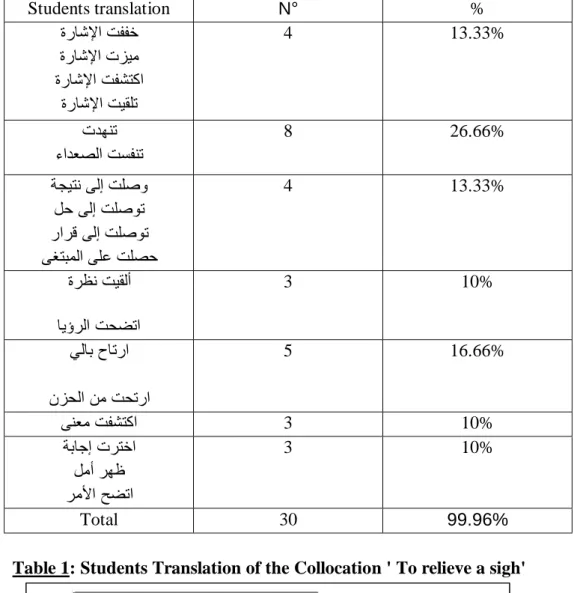
2.2.1.1. Sentence One: Finally, I relieved a sigh
Students translation N° % ةرﺎﺷﻹا ﺖﻔﻔﺧ تﺰﯿﻣ ةرﺎﺷﻹا ﺖﻔﺸﺘﻛا ةرﺎﺷﻹا ﻠﺗ ﺖﯿﻘ رﺎﺷﻹا ة 4 13.33% تﺪﮭﻨﺗ ءاﺪﻌﺼﻟا ﺖﺴﻔﻨﺗ 8 26.66% ﺔﺠﯿﺘﻧ ﻰﻟإ ﺖﻠﺻو ﻞﺣ ﻰﻟإ ﺖﻠﺻﻮﺗ راﺮﻗ ﻰﻟإ ﺖﻠﺻﻮﺗ ﻰﻐﺘﺒﻤﻟا ﻰﻠﻋ ﺖﻠﺼﺣ 4 13.33% ةﺮﻈﻧ ﺖﯿﻘﻟأ ﺖﺤﻀﺗا ﺎﯾؤﺮﻟا 3 10% حﺎﺗرا ﻲﻟﺎﺑ ﺖﺤﺗرا نﺰﺤﻟا ﻦﻣ 5 16.66% ﺖﻔﺸﺘﻛا ﻰﻨﻌﻣ 3 10% تﺮﺘﺧا ﺔﺑﺎﺟإ ﻞﻣأ ﺮﮭﻇ ﺢﻀﺗا ﺮﻣﻷا 3 10% Total 30 99.96%
Table 1: Students Translation of the Collocation ' To relieve a sigh'
0 5 10 15 20 25 30 1 S tu d e n ts' a n sw e rs \ةرﺎﺷﻹا تﺰﯿﻣ\ ةرﺎﺷﻹا ﺖﻔﻔﺧ ةرﺎﺷﻹا ﺖﯿﻘﻠﺗ \ةرﺎﺷﻹا ﺖﻔ ﺸﺘﻛإ ءاﺪﻌﺼﻟا ﺖﺴﻔﻨﺗ \تﺪﮭﻨﺗ ﺖﻠﺻﻮﺗ \ ﺔﺠﯿﺘﻧ ﻰﻟإ ﺖﻠﺻو \راﺮﻗ ﻰﻟإ ﺖﻠﺻﻮﺗ \ ﻞﺣ ﻰﻟإ ﻰﻐﺘﺒﻤﻟا ﻰﻠﻋ ﺖﻠﺼﺣ ةﺮﻈﻧ ﺖﯿﻘﻟأ \ ﺎﯾؤﺮﻟا ﺖﺤﻀﺗا نﺰﺤﻟا ﻦﻣ ﺖﺤﺗرإ \ﻲﻟﺎﺑ حﺎﺗرإ ﻰﻨﻌﻣ ﺖﻔ ﺸﺘﻛإ ﺢﻀﺗا\ ﻞ ﻣأ ﺮﮭﻇ ﺔﺑﺎﺟأ تﺮﺘﺧإ \ﺮﻣﻷا
26
From the table above, it is noticed that most of the subjects do not know that the equivalent of the English collocation 'to relieve a sigh ' in Arabic is ' ءاﺪﻌ ﺼﻟا ﺖ ﺴﻔﻨﺗ' or ' تﺪ ﮭﻨﺗ'. The proof is that only 26.66 % from the overall number of subjects translated it correctly. 16.66% of the subjects translated it into ' ﻲﻟﺎ ﺑ حﺎﺗرا ' or ' نﺰ ﺤﻟا ﻦ ﻣ ﺖ ﺤﺗرا' which reflect a part of the meaning but they are not the appropriate collocations in Arabic. 13.33% of the subjects confused between the word 'sigh' and 'sign', thus they translated it into' ةرﺎ ﺷإ'. Similarly, 10% of the subjects confused between the word 'sigh' and 'sight' and translated it into ' ةﺮ ﻈﻧ' or ' ﺔ ﯾؤ '. The remaining part of the subjects did not ر find an acceptable equivalent in Arabic; it is clear from their answers that they have just paraphrased it from the context 'Finally'. So, it is obvious that students vocabulary is poor. The problem for the students is not only in the word 'sigh' but also the word 'delivered'. Thus, 13.33 % of the subjects understood it as achieving a result or getting a desired goal. 10% translated it into ' ﻰ ﻨﻌﻣ ﺖﻔ ﺸﺘﻛا' and 10% used a different combination that has nothing to do with the adequate collocation ' ءاﺪﻌ ﺼﻟا ﺖ ﺴﻔﻨﺗ' or ' تﺪ ﮭﻨﺗ'. The results proved that students are not familiar with the collocation 'to relieve a sigh’.
27
2.2.1.2. Sentence Two: Rural dwellers live a very hard life.
Students' translation N° % ﻒﯾﺮﻟا نﺎﻜﺳ 21 70% ﻒﯾﺮﻟا ورﺎﻔﺣ نﻮﻋراﺰﻤﻟا لﺎﻤﻌﻟا نﻮﯿﻔﯾﺮﻟا لﺎﻤﻌﻟا 3 10% ﺔﯿﻣﺎﻨﻟا ﻖﻃﺎﻨﻤﻟا نﺎﻜﺳ 1 3.33% ﺔﻨﯾﺪﻤﻟا لزﺎﻨﻣ 2 6.66% ﻢﺟﺎﻨﻤﻟا لﺎﻤﻋ 2 6.66% ﻦﯿﻛﺎﺴﻤﻟا و ءاﺮﻘﻔﻟا 1 3.33% Total 30 100%
Table 2: Students' Translation of the Collocation 'Rural dwellers'
0 10 20 30 40 50 60 70 1
Stude nts' trans lation
ﻒﯾﺮﻟا نﺎﻜﺳ لﺎﻤﻌﻟا \ﻒﯾﺮﻟا ورﺎﻔﺣ لﺎﻤﻌﻟا \نﻮﯿﻔﯾﺮﻟا \نﻮﻋراﺰﻤﻟا ﺔﯿﻣﺎﻨﻟا ﻖﻃﺎﻨﻤﻟا نﺎﻜﺳ ﺔﻨﯾﺪﻤﻟا لزﺎﻨﻣ ﻢﺟﺎﻨﻤﻟا لﺎﻤﻋ ﻦﯿﻛﺎﺴﻤﻟا و ءاﺮﻘﻔﻟا
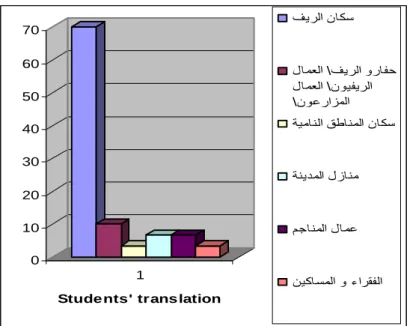
Figure 2: Students' Translation of the Collocation 'Rural dwellers'
Although subjects used word for word translation, 70% translated the collocation 'Rural dwellers' into its proper form in Arabic which is 'ﻒﯾﺮﻟا نﺎﻜﺳ'. 10% understood only the first part of the collocation 'rural' but misunderstood the last part ' dwellers' since they translated it as people who work in the countryside. Even if their collocations have a part of the meaning of
28
the collocation 'ﻒﯾﺮﻟا نﺎﻜﺳ' , but they are not the adequate equivalent because someone who is working in a particular place does not necessarily means that he is living in that place. On the other hand, 3.33% of the subjects translated the second part ' dwellers' correctly but mistranslated the first one. Thus, they destroyed the meaning because 'ﺔﯿﻣﺎﻨﻟا ﻖﻃﺎﻨﻤﻟا' is used to refer to an underdeveloped country which means that it indicates both the countryside and cities in an underdeveloped country. 6.66% translated it as 'ﺔﻨﯾﺪﻤﻟا لزﺎﻨﻣ ' because they did not distinguish between the adjectives 'civil' and 'rural', thus they end in a wrong translation that has merely the opposite meaning of the correct one. 6.66 % of the subjects translated it into 'ﻢﺟﺎﻨﻤﻟا لﺎﻤﻋ' and 3.33% translated it into 'ﻦﯿﻛﺎﺴﻤﻟا و ءاﺮﻘﻔﻟا' which are totally wrong translations.
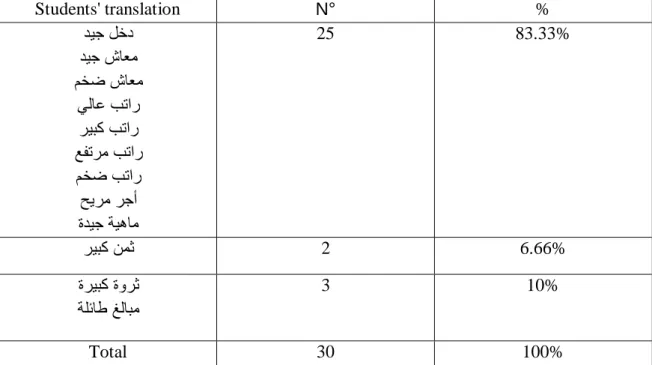
2.2.1.3. Sentence Three: He earns a fat salary
Students' translation N° % ﺪﯿﺟ ﻞﺧد ﺪﯿﺟ شﺎﻌﻣ ﻢﺨﺿ شﺎﻌﻣ ﻲﻟﺎﻋ ﺐﺗار ﺮﯿﺒﻛ ﺐﺗار ﻊﻔﺗﺮﻣ ﺐﺗار ﻢﺨﺿ ﺐﺗار ﺢﯾﺮﻣ ﺮﺟأ ةﺪﯿﺟ ﺔﯿھﺎﻣ 25 83.33% ﯿﺒﻛ ﻦﻤﺛ ﺮ 2 6.66% ةﺮﯿﺒﻛ ةوﺮﺛ ﺔﻠﺋﺎﻃ ﻎﻟﺎﺒﻣ 3 10% Total 30 100%
29
0 50 100
1
St ud ent s' t ranslat ion
ﻢﺨﺿ ﺐﺗار ﺮﯿﺒﻛ ﻦﻤﺛ
ﺔ ﻠﺋﺎﻃ ﻎﻟﺎ ﺒﻣ \ ةﺮﯿ ﺒﻛ ةوﺮﺛ
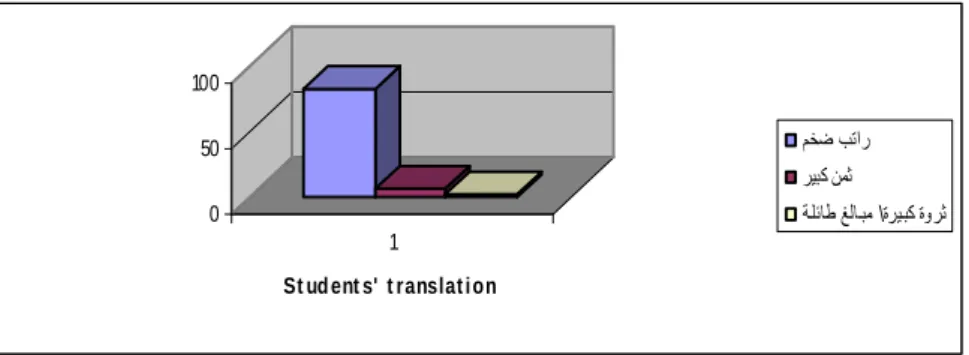
Figure 3: Students' Translations of the Collocation 'Fat salary'
Concerning the collocation 'Fat salary', 83.33% of the subjects translated it correctly because it is a very common collocation in English. 16.66% understand the meaning but they did not render the appropriate form. Thus 6.66% used the words 'ﻦﻤﺛ 'or 'ﺮﻌﺳ ' that are equivalents to the word 'price' in English and not ' salary'. Similarly, 10% translated it into' ةﺮﯿﺒﻛ ةوﺮﺛ ' or ' ﻎﻟﺎﺒﻣ ﺔﻠﺋﺎﻃ' which cannot be considered as an adequate equivalent to ' ﺐﺗار'.
30
2.2.1.4. Sentence Four: They drink a dry wine.Students' translation N° % فﺎﺟ ﺮﻤﺧ 6 20% صﺎﺧ عﻮﻧ ﻦﻣ ﺮﻤﺧ 1 3.33% قود نوﺪﺑ باﺮﺷ ﺶﻌﻨﻣ ﺮﯿﻏ باﺮﺷ ﺊﯿﺳ باﺮﺷ ﻞﯿﻘﺛ باﺮﺷ ﺺﯿﺧر ﺮﻤﺧ 9 30% ردﺎﻧ ﺪﯿﺒﻧ ﺶﻌﻨﻣ باﺮﺷ ﺪﯿﺟ ﺮﻤﺧ ﻒﯿﻔﺧ باﺮﺷ درﺎﺑ لﻮﺤﻛ لﻮﺤﻛ نوﺪﺑ ﺮﻤﺧ 9 30% لﻮﺤﻛ ﺮﻤﺧ 3 10% ﺢﺑر 1 3.33% Blank 1 3.33% Total 30 100%
Table 4: Students' Translation of the Collocation 'Dry wine'
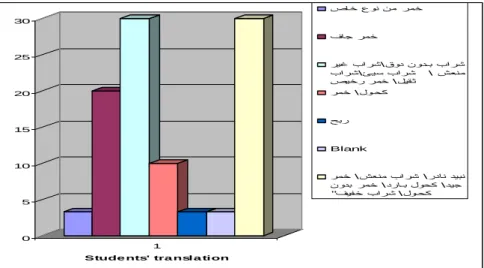
0 5 10 15 20 25 30 1 Stude nts' tra nsl a ti on صﺎﺧ عﻮﻧ ﻦﻣ ﺮﻤﺧ فﺎﺟ ﺮﻤﺧ ﺮﯿﻏ باﺮﺷ\قود نوﺪ ﺑ باﺮﺷ باﺮﺷ\ﺊﯿﺳ باﺮﺷ \ ﺶﻌﻨﻣ ﺺﯿﺧر ﺮﻤﺧ \ﻞﯿﻘﺛ ﺮﻤﺧ \ لﻮ ﺤﻛ ﺢﺑر Blank ﺮﻤﺧ \ﺶﻌﻨﻣ باﺮﺷ \ردﺎﻧ ﺪﯿﺒﻧ نوﺪﺑ ﺮﻤﺧ \ درﺎ ﺑ لﻮﺤﻛ \ﺪﯿﺟ "ﻒﯿﻔﺧ باﺮﺷ \ لﻮ ﺤﻛ
31
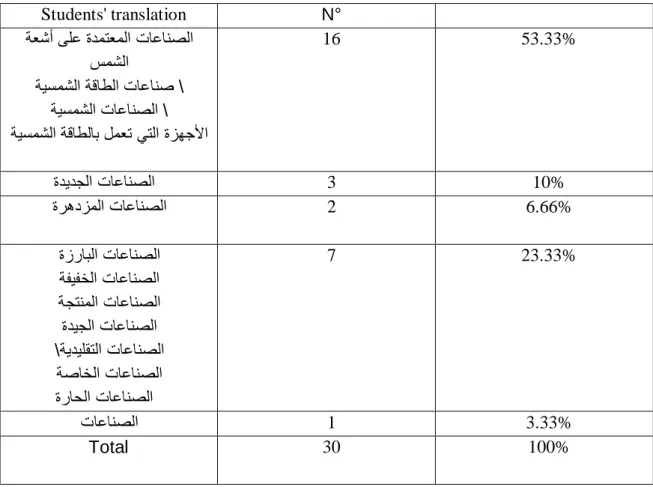
The results are not satisfying at all, because 0% of the subjects gave the correct translation of the collocation 'Dry wine'. Only 3.33% of the subjects translated it into صﺎﺧ عﻮﻧ ﻦﻣ ﺮﻤﺧ' which can be accepted as an acceptable equivalent. 20% of the subjects adopted a word for word translation and translated it into 'فﺎﺟ ﺮﻤﺧ'. 80% of the subjects mistranslated the meaning of the collocation 'Dry wine'. Therefore, 30% understood it as a 'good kind of wine', so they used adjectives such as ' ﺦﻟا...ردﺎﻧ ﺪﯿﺟ ﺶﻌﻨﻣ‘. On the other hand, 30% understood it as 'a bad kind of wine '; this is clearly evident in their translations as ﻞﯿﻘﺛ ﺊﯿﺳ ﺺﯿﺧر . 10% of the subjects eliminate the word ' dry' for two reasons: either they do not know its meaning in Arabic or they failed to find its appropriate equivalent. The same thing can be said about 3.33% who did not translate the collocation at all. So, for all 96.67% of the subjects the problem was not in the word' wine''. Only 3.33% of the whole subjects translated it wrong as' ﺢﺑر' because the students confused between the word 'wine' and 'win' and eliminate the last part of the collocation. This indicates that subjects do not know English collocations enough and not familiar with its culture. The problem is that subjects are not sure about the exact meaning of the word 'dry'. It has nothing to do with the word 'ﺮﻜﺳ نوﺪﺑ' which literally means 'without sugar'. The word 'dry ' acquires the meaning of 'ﺮﻜﺳ نوﺪﺑ' or 'ﻮﻠﺣ ﺮﯿﻏ' only if it collocates with the word 'wine'. The students mistranslate wine in this context because they failed to recognize that a word changes its meaning when it collocates with other words.
32
2.2.1.5. Sentence Five: You must reserve some narrow money.
Students' translation N° % لﺎﻤﻟا ﺾﻌﺑ لﺎﻤﻟا ﻦﻣ ﻞﯿﻠﻘﻟا ﺮﯿﻐﺻ ﻎﻠﺒﻣ دوﺪﺤﻣ لﺎﻣ 14 46.66% ﺔﻘﯿﺿ لاﻮﻣأ 1 3.33% ﻖﯿﻀﻠﻟ دﻮﻘﻧ ﺔﺟﺎﺤﻟا ﺖﻗﻮﻟ لﺎﻣ لﺎﻣ ﻲﻃﺎﯿﺘﺣا ﺪﺋاز لﺎﻣ تاﺮﺧﺪﻤﻟا 9 30% ةرﺎﻌﺘﺴﻣ دﻮﻘﻧ فﺎﻛ لﺎﻣ ﺔﻓوﺮﻌﻣ لاﻮﻣأ ﺔﯾﺪﻘﻨﻟا لاﻮﻣﻷا دﻮﻘﻧ ﻊﻄﻗ 6 20% Total 30 100%
Table 5: Students' Translation of the collocation 'Narrow money'
0 5 10 15 20 25 30 35 40 45 50 1
Stude nts' tra nsla tion
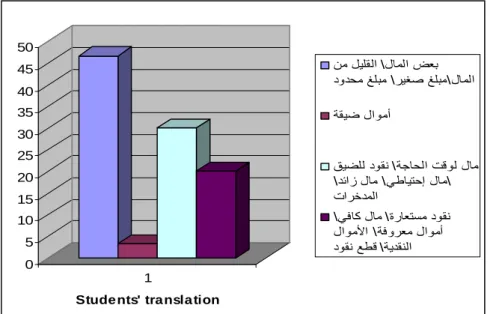
ﻦﻣ ﻞﯿﻠﻘﻟا \لﺎﻤﻟا ﺾﻌﺑ دوﺪﺤﻣ ﻎﻠﺒﻣ \ﺮﯿﻐﺻ ﻎﻠﺒﻣ\لﺎﻤﻟا ﺔﻘﯿﺿ لاﻮﻣأ ﻖﯿﻀﻠﻟ دﻮﻘﻧ \ﺔﺟﺎﺤﻟا ﺖﻗﻮﻟ لﺎﻣ \ﺪﺋاز لﺎﻣ \ﻲﻃﺎﯿﺘﺣإ لﺎﻣ\ تاﺮﺧﺪﻤﻟا \ﻲﻓﺎﻛ لﺎﻣ \ةرﺎﻌﺘﺴﻣ دﻮﻘﻧ لاﻮﻣﻷا \ﺔﻓوﺮﻌﻣ لاﻮﻣأ دﻮﻘﻧ ﻊﻄﻗ \ﺔﯾﺪﻘﻨﻟا
33
The collocation 'narrow money ' is a new English collocation that cannot be translated as a collocation in Arabic. Although students are not expected to find its adequate equivalent in Arabic, they are supposed to translate its appropriate meaning using any method such as a descriptive translation. However, the results reveal that 0% of the subjects failed to translate it into its appropriate meaning ' ﻲ ﺼﺨﺸﻟا وأ ﻲﻠﺋﺎ ﻌﻟا فوﺮ ﺼﻤﻠﻟ ﺔ ﺼﺼﺨﻤﻟا لاﻮ ﻣﻷا'. 3.33% of the subjects translated it literally as ' ﺔﻘﯿ ﺿ لاﻮ ﻣأ' which is an unacceptable combination in Arabic because the word ' ﺔﻘﯿ ﺿ' in Arabic usually co-occur with nouns that indicate size such as places, clothes, but not with لاﻮ ﻣأ' .This indicates that students cannot master even their mother tongue . 46.66% of the subjects understood it as 'small amount of money”. This is obvious from their translation as ﺎ ﻤﻟا ﻦ ﻣ ﻞ ﯿﻠﻘﻟا،ل دوﺪ ﺤﻣ لﺎ ﻣ. 30% paraphrased it from the context as 'money reserved for need'. 20% mistranslated it at all either because they did not know the meaning of the word 'narrow' or did not find its appropriate equivalent in Arabic. The problem for the students is that they insist on having the same word number because they ignore that collocational patterning differs from English into Arabic.
34
2.2.1.6. Sentence Six: The attorney asked for a court of appeal.
Students' translation N° % ﺔﻤﻜﺤﻣ فﺎﻨﺌﺘﺳﻻا 1 3.33% ﺔﯿﻓﺎﻨﺌﺘﺳإ ﺔﻤﻛﺎﺤﻣ فﺎﻨﺌﺘﺳا ﺔﻤﻜﺤﻤﻟا ﻦﻣ فﺎﻨﺌﺘﺳا ﻢﻜﺤﻟا 4 13.33% ﻢﻜﺣ ةدﺎﻋإ ﻢﻜﺣ ﻞﯿﺟﺄﺗ 4 13.33% راﺮﻗ فﺎﻨﺌﺘﺳا ﺔﯿﻓﺎﻨﺌﺘﺳإ ﺔﺴﻠﺟ فﺎﻨﺌﺘﺳا ﻲﺋﺎﻀﻗ 6 20% ءﺎﻀﻘﻟا ﺔﻤﻜﺤﻣ ﺎﯿﻠﻋ ﺔﻤﻜﺤﻣ تﺎﯾﺎﻨﺠﻟا ﺔﻤﻜﺤﻣ نذإ ﻢﻜﺤﻤﻟا ﻦﻣ ﺔﻤﻜﺤﻤﻟا ﻦﻣ نﺎﯿﺑ 8 26.66% ﺔﺒﻟﺎﻄﻣ ﺔﺴﻠﺟ \ ﻦﻌﻄﻟا رﻮﺘﺳد تﺎﯾﺎﻨﺠﻟا رﻮﻣﻷا ﺾﻌﺑ ءﺎﻐﻟإ 5 16.66% ﺔﻤﻜﺤﻣ 2 6.66% Total 30 99.97%
Table 6: Students' Translation of the Collocation ' court of appeal'
0 5 10 15 20 25 30 1
Stude nts' tra nsla tion
فﺎﻨﺌﺘﺳﻹا ﺔﻤﻜﺤﻣ ﻦﻣ فﺎﻨﺌﺘﺳإ \ﺔﯿﻓﺎﻨﺌﺘﺳإ ﺔﻤﻛﺎﺤﻣ ﻢﻜﺤﻟا فﺎﻨﺌﺘﺳإ \ﺔﻤﻜﺤﻤﻟا ﻢﻜﺤﻟا ﻞﯿﺟﺄﺗ \ﻢ ﻜﺤﻟا ةد ﺎﻋإ ﺔﺴﻠﺟ\فﺎﻨﺌﺘﺳإ راﺮﻗ ﻲﺋﺎﻀﻗ فﺎﻨﺌﺘﺳإ\ﺔﯿﻓ ﺎﻨﺌﺘﺳإ \ﻦﻣ تﺎﯿﺑ \ﺔﻤﻜﺤﻤﻟا ﻦﻣ ندإ ﺔﻤﻜﺤﻣ\ءﺎﻀﻘﻟا ﺔﻤﻜﺤﻣﺔﻤﻜﺤﻤﻟا ﺔﻤﻜﺤﻣ\تﺎﯾﺎﻨﺠﻟا ﺔﻤﻜﺤﻣ\ﺎﯿﻠﻋ ﺔﺴﻠﺟ \ﺔﻤﻜﺤﻤﻟا لﻮﺒﻗ \ءﻮﺠﻠﻟا ﺔﻤﻜﺤﻣ رﻮﺘﺳد \ﻦﻌﻄ ﻟا \ﺔﺒﻟﺎﻄ ﻣ ﺔﺴﻠﺟ ءﺎﻐﻟ’إ \ﺔﺴﻠﺠﻟا ﺔﯾاﺪ ﺑ \تﺎﯾﺎﻨﺠﻟا رﻮﻣﻷا ﺾﻌﺑ ﺔﻤﻜﺤﻣ