HAL Id: hal-01093532
https://hal.archives-ouvertes.fr/hal-01093532
Submitted on 10 Dec 2014
HAL is a multi-disciplinary open access
archive for the deposit and dissemination of
sci-entific research documents, whether they are
pub-lished or not. The documents may come from
teaching and research institutions in France or
abroad, or from public or private research centers.
L’archive ouverte pluridisciplinaire HAL, est
destinée au dépôt et à la diffusion de documents
scientifiques de niveau recherche, publiés ou non,
émanant des établissements d’enseignement et de
recherche français ou étrangers, des laboratoires
publics ou privés.
Human mobility and the worldwide impact of
intentional localized highly pathogenic virus release
Bruno Goncalves, Duygu Balcan, Alessandro Vespignani
To cite this version:
Bruno Goncalves, Duygu Balcan, Alessandro Vespignani. Human mobility and the worldwide impact
of intentional localized highly pathogenic virus release. Scientific Reports, Nature Publishing Group,
2013, 3, pp.810. �10.1038/srep00810�. �hal-01093532�
Human mobility and the worldwide
impact of intentional localized highly
pathogenic virus release
Bruno Gonçalves1, Duygu Balcan2& Alessandro Vespignani3,4
1Aix-Marseille Universite´, CNRS, CPT, UMR 7332, 13288 Marseille, France,2Computational Epidemiology Laboratory, Institute for
Scientific Interchange (ISI), Torino 10126, Italy,3Laboratory for the Modeling of Biological and Socio-technical Systems,
Northeastern University, Boston MA 02115 USA,4Institute for Quantitative Social Sciences at Harvard University, Cambridge MA,
02138 USA.
The threat of bioterrorism and the possibility of accidental release have spawned a growth of interest in modeling the course of the release of a highly pathogenic agent. Studies focused on strategies to contain local outbreaks after their detection show that timely interventions with vaccination and contact tracing are able to halt transmission. However, such studies do not consider the effects of human mobility patterns. Using a large-scale structured metapopulation model to simulate the global spread of smallpox after an intentional release event, we show that index cases and potential outbreaks can occur in different continents even before the detection of the pathogen release. These results have two major implications: i) intentional release of a highly pathogenic agent within a country will have global effects; ii) the release event may trigger outbreaks in countries lacking the health infrastructure necessary for effective containment. The presented study provides data with potential uses in defining contingency plans at the National and International level.
I
n recent years, public health officials have been increasingly alert to the possibility of biological weapon use through an act of bioterrorism. Among potential pathogenic agents, smallpox poses one of the greatest risks. While smallpox has been eradicated in 19801, many experts believe that smallpox virus could exist outside theofficial institutes in the US and Russia. The smallpox virus, which is called variola major, is highly pathogenic, and its intentional release into a population that is now largely susceptible (no one is certain about the residual protection of vaccination received over 30 years ago) can create a tremendous amount of social disruption and fatality. The possibility of a bioterrorist attack with smallpox is extremely limited and hampered by difficulties in using smallpox as a biological weapon; however, there is an obvious need for contingency planning and pre-paration. From a different perspective, smallpox is also used as the paradigmatic highly pathogenic agent that serves as a case study for the preparation of a bioterrorism event or a laboratory accident, as recently revamped by the engineered H5N1 debate2.
One of the main challenges in modeling intentional smallpox release is the choice of key epidemiological parameters and natural history of smallpox infection. The contagiousness of the disease in the present population, the release method of the virus, and many options in public health response, such as ring and mass vaccination, mobility restrictions create a wide range of scenarios for which it is crucial to develop epidemic models able to gauge the actual threat of a smallpox bioterrorist attack. In recent years, several studies have focused on the study of smallpox transmission and control in urban settings and at the level of individual countries. Different modeling techniques3,4, ranging from compartmental models5–12to highly detailed agent-based models13–15, generally agree
in concluding that case isolation and vaccination, if timely implemented, will be sufficient to halt the ongoing transmission and contain the outbreak. All studies, however, consider the situation in which the public health system is effectively implementing the containment policies and is in possession of vaccine stockpiles. While these assumptions are likely to hold in many wealthy countries, it is hard to imagine the same coordination and availability of stockpiles worldwide. Furthermore, smallpox has long incubation and prodromal periods that can last more than two weeks. Finally, it is plausible that the correct diagnosis of smallpox cases will not be immediate, as doctors would initially not consider this eventuality. It is thus likely that two to four weeks could pass from the smallpox attack before a worldwide emergency is declared. This implies that during this time the disease might spread to other countries by means of traveling people exposed to the virus16.
SUBJECT AREAS: COMPUTATIONAL BIOLOGY AND BIOINFORMATICS SYSTEMS BIOLOGY BIOLOGICAL MODELS EPIDEMIOLOGY Received 29 June 2012 Accepted 24 June 2013 Published 17 July 2013 Correspondence and requests for materials should be addressed to A.V. (a.vespignani@ neu.edu)
The potential threat represented by the global effects of a targeted smallpox release event has yet to be analyzed with the use of explicit models. Here, building on previous work, we have developed a large-scale structured metapopulation model that accurately describes the worldwide spread of smallpox during the initial period of time between the occurrence of the intentional virus release and its detec-tion by health officials. Thus we focus here on the level of worldwide diffusion of smallpox cases before any containment/mitigation pol-icy can be implemented.
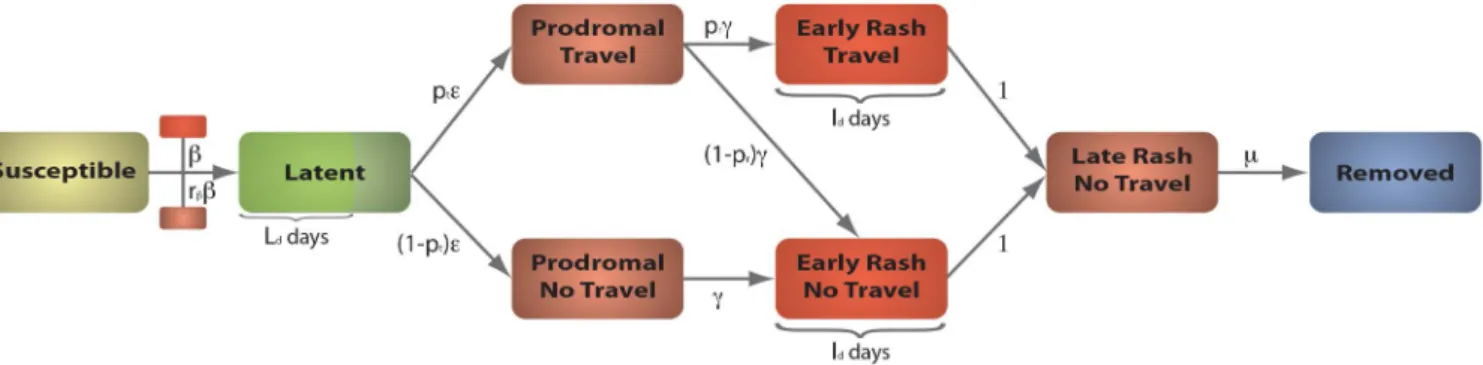
Smallpox’s natural history is generally subdivided into three dif-ferent stages: Latent, Prodromal, and Rash1,17. Upon infection,
indi-viduals spend an extended period of at least Lddays incubating the
infection6,10in the Latent compartment, after which they progress
with rate e into the prodromal state12,13,15,16,18–20. The Prodromal
per-iod, with an average duration of c21days6,9,12,15,18–20, is characterized
by fever and flu-like symptoms before finally displaying the typical liquid filled blisters that characterize smallpox rash. Rash typically lasts Iddays6,10and is eventually followed by a late rash period15,20,
after which recovery/death at a rate of m occurs. The relative infec-tiousness associated with the prodromal period and the different rash stages changes considerably in the literature1,16,17. It is also plausible
to consider that the transmission potential of the virus may change considerably because of the awareness of a smallpox outbreak. While infectiousness may be very high in the Rash stage, it is much simpler to detect and at least partially isolate those cases. Hospitalization of undetected cases at the beginning of the outbreak may lead to large transmissibility12,21,22, which is drastically reduced once the proper
health infrastructure is set up. In the following, we consider only the earliest outbreak stages during which the public health system is unaware of the virus spreading. The basic reproductive number R0,
gauging the transmissibility of the virus, is a parameter of the model and acts on the transmissibility of the various stages of the disease. We have considered, according to recent work12,13,15,23, that the
Prodromal period contributes 10% of the disease transmissibility and that during the late rash period the infectiousness of individuals is reduced by 90% because the severity of the disease leads to isolation
Figure 1|Compartmental smallpox model. Each susceptible individual in contact with an infectious case in Prodromal, Early Rash and Late Rash Stage, contracts the infection at rate rbb, b and rbb, respectively. Newly infected individuals enter a latency period during which they are not infectious yet and remain latent for a minimal duration of Lddays, after which they progress into the Prodromal Stage at per capita rate e. Individuals in prodromal stage are divided between those who are able to travel, which occurs with probability pt, and those who are restricted from traveling. Prodromal Stage is characterized by reduced infection transmissibility rbb and mean duration of c21days. A proportion prof individuals at the end of Prodromal Stage with traveling capability moves into Early Rash Stage to continue traveling while the rest – 1-pr– is withdrawn from traveling during this stage. Early Rash lasts for Iddays and is characterized by the highest transmissibility b of the virus. After Early Rash, infectious individuals proceed to Late Rash Stage during which they are restricted from traveling and their transmissibility is reduced to rbb. This last stage of infection is followed by permanent recovery at rate m.
Table 1 | Compartmental smallpox model parameters. Model parameters used in the baseline scenario and sensitivity analysis (in brackets) are reported
Initial conditions
Origin of pandemic London, England [New York, USA; Paris, France] Release strategy 5 individuals in Prodromal stage avoiding detection
Virus release with 10 civilians in Latent stage Outbreak detection
Upon detection of a cluster of 4 [2, 8] civilians in rash stage in a single country Transmission dynamics
R0 Reproduction ratio 5 [3, 7]
1-rb Reduction in transmissibility of infection during prodromal and late rash periods 90%
Ld Minimal duration in latent stage 7 days
e21 Average latency period proceedingL
d 5 days
c21 Average period of prodromal stage 3 days
Id Duration in early rash stage 5 days
m21 Average period of late rash stage 7 days [3.6 days, 11 days]
1-s0 Prior immunity 0% [20%]
Impact of disease on individual behavior
pt Probability of traveling during prodromal stage 50%
pr Probability of traveling during early rash stage proceeding prodromal stage with traveling
capability
20% [10%, 30%]
and identification of the cases. A key feature of our model is the mobility of individuals. It is therefore extremely important to assoc-iate the different stages of the disease with different mobility and travel capabilities. In particular, only a fraction ptof individuals in
the Prodromal period are allowed to travel. Prodromal individuals capable of traveling are still allowed to travel with probability prfor Id
days upon their progression to the Rash stage12. They are then
with-drawn from the pool of mobile individuals13. The compartmental
structure of the model, which includes the mobility classes, is reported in Fig. 1. In Table 1, we summarize the baseline parameters used in the study and the ranges considered for the sensitivity ana-lysis of the model. All values and ranges considered are based on an extensive analysis of the literature and the parameters generally adopted in major simulation studies. The transmission dynamics is simulated with a multinomial stochastic transmission model and the individuals’ mobility follows a stochastic dynamics too as detailed in the online supplementary information.
Results
In order to model the spread of smallpox as occurring from an intentional release in the environment, it is crucial to imagine dif-ferent release events19 and initial locations22. Similar to previous
published studies, we consider two release scenarios. The first scen-ario depicts the intentional release from 5 individuals who success-fully infect themselves with the virus in a major Western metropolis. These individuals move freely within the city (avoiding detection) and expose civilians to infection until they are removed from the population. The five individuals follow a deliberate release strategy and do not attempt international travel in order to limit the possibil-ity of detection. As well, they do not seek medical care. In the model those agents follow just local mobility and keep on in transmitting the disease till they enter the late rush compartment. A second release event scenario deals with directly targeting the population. This can easily result in several successful infections if it were attempted in a context where tens of thousands of people are in close proximity. However, given the quantities of aerosol that would be required and the logistics necessary to distribute it to such large numbers while avoiding detection, we believe that this would be extremely unlikely and choose to focus on the more likely case of a small-scale initial infection as done in previous studies3,10,11,13. In particular we consider
a case in which an aerosol version of the virus is dispersed in a closed environment, successfully exposing just 10 civilians. The victims are unaware that they have been exposed and continue to behave as they normally would. It is important to stress that the stochastic dynamics
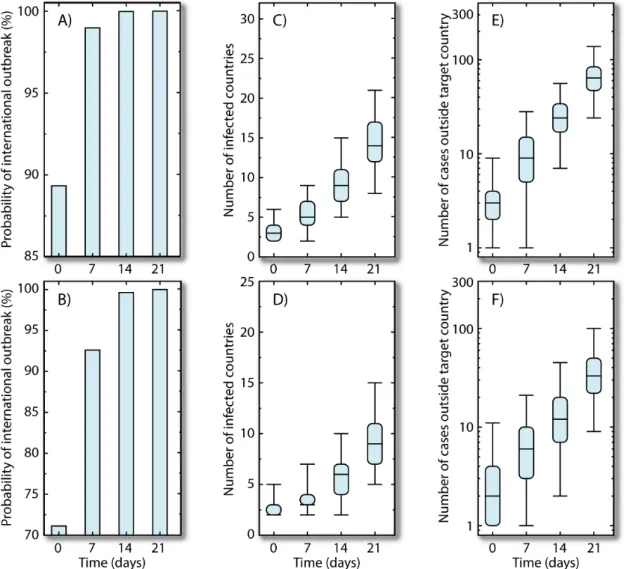
Figure 2|Timeline of international smallpox spread. Top) Intentional spread by five individuals avoiding detection and medical care. Bottom) Virus release with the exposure of 10 civilians. (A–B) Probability of observing an international outbreak (presence of cases outside the initial target country) at the time of initial detection and the following three weeks. (C–D) Number of affected countries conditional to the international outbreak. (E–F) Number of cases outside the target country conditional to global outbreak. Boxplots display the median, 50% and 95% reference ranges from 5,000 simulated events with the baseline parameters of Table 1.
of the model naturally takes into account the generation of infections at different times and thus generates in each realization a varying number of exposed and infected people during the period preceding the detection of the outbreak by the health system. In both scenarios, we consider London, UK as the target city. In the supplementary information, we report results for other major locations in Europe and the US.
The conditions for the detection from the public health commun-ity of the intentional release are discussed in the methods sections. In particular, we assumed that a minimum number of 4 infected cases (sensitivity analysis between 2 and 8 cases) seek health care in the rush stage. Before detection the world is totally unaware of the inten-tional release, no containment/mitigation policy is therefore imple-mented. We consider the moment of detection as the moment at which, in the most optimistic scenario, the international community can start working on issuing and implementing the containment/ mitigations contingency plans. This is a quite conservative assump-tion as medical doctors would hardly consider smallpox as a possible diagnosis until the onset of complications in the patients, and there-fore it is likely that the disease detection would require several more days to occur. Furthermore, the actual distribution of vaccine, imple-mentation of travel restrictions, the organization of a coordinated effort of international contact tracing may require extra time. For this reason we provide here snapshot of the worldwide impact of the intentional release without considering mitigation/containment
policies at the time of detection, as well as after 1 to 3 weeks after detection.
In Fig. 2 we report the number of countries affected and the small-pox cases observed outside the targeted country for the baseline transmission rate and for different delays after the initial outbreak detection. It is possible to observe that even at the moment of detec-tion of the small-scale outbreak, with R055, the 50% reference range
indicates that 2 to 4 countries have already imported at least one exposed individual. This is also observed with the number of exposed individuals dispersed in countries outside the target. The risk analysis for each country is composed of two components: the probability that a country will have at least one infected individual and the expected number of infected cases conditional to this event. In order to provide a global visualization of the risk worldwide, we provide risk maps at the level of single census area. In Fig. 3 we show a worldwide map that shows the probability of observing exposed individuals at the detection and after two weeks from detection of the release at the scale of the census area used in the numerical simulation. The statistics are obtained by analyzing 5,000 different stochastic realizations of the smallpox release with the same initial conditions. It is also important to stress that the reported outbreak probabilities refer to initial seeding events and small-scale outbreaks that may or may not lead to large-scale epidemics depending on local containment policies. In each different realization however the num-ber of cases is generally localized in specific census areas. For instance
Figure 3|Worldwide location of risk areas in the case of the intentional release of smallpox virus in London. The upper map reports the probability of observing exposed individuals at the time of detection and the lower map shows the same quantity two weeks from detection. The color code is in logarithmic scale and the results are at the finer scale allowed by the numerical simulations that depending on the region of the world ranges from 25 to 200 km. Maps were generated using ArcGIS.
if we consider Germany, we might observe a realization with 3 cases in Frankfurt, while in a different realization we may have 4 cases in Munich.
According to our statistical analysis, not only is the risk never geographically restricted, even at the time of detection or just a week later when the first coordinated interventions might be feasible (see Figs. 2, 3), it also increases rapidly both in terms of exposure size and probability. The reason for such a rapid international spread is due to the fact that London serves as a major connecting point between the various continents, with daily connections to other parts of Europe, Africa, Asia, and the Americas. However, other major hubs in the USA and Europe produce the same results, as shown in the supple-mentary information. At the early stage of the epidemic the world-wide exportation of cases from the target country can be assumed to be a Poisson process, thus assuming independence of each event and disregarding the possibility of cluster cases24–26. In this case the
cumu-lative probability distribution P(T) to have a first positive event in any given country within time T, i.e., one infected individual traveling from the initially targeted country, will be
P(T)~1{exp({ ðT
0
l(t)dt) ð1Þ where l(t) is the rate of positive case importation. The rate l(t) depends on the size of the outbreak in the initially targeted country and the traveling rate of individuals, that is proportional to the pas-senger traffic between the two countries v. In Figure 4 we show the local outbreak/importation of cases probability as a function of the daily passenger traffic of each country with the UK. At the time of detection the two quantities exhibit a high level of correlation (r.0.95, p,0.0001) and a roughly linear behavior. Indeed at the early stage of the outbreak the number of exposed cases in the ini-tially targeted country is very small and the exponential term in
Eq. (1) can be approximated as 1{Ð0Tl(t)dt, yielding a probability of outbreak well approximated by a linear scaling with the passenger traffic: P(T),v. After three weeks from the detection it is possible to observe that the curve exhibits the exponential behavior of Eq. (1) as a function of traffic (figure not shown). This non-linear behavior is indeed at the origin of the inefficacy of travel restrictions in slowing considerably the global spread of epidemics. Even severe travel restrictions reducing traffic of 50% or more generally delay the importation of cases of only two to three weeks at the most as already pointed out in the literature24,27–29. However, in the case of a
poten-tially catastrophic event such as a smallpox large-scale outbreak, drastic travel restrictions (to the extent of country isolation) may be appropriate in the framework of an international containment effort and deserve a separate careful study. This simple calculation shows clearly that the key parameter in the risk assessment of each country is the incoming traffic from the outbreak origin. A finer analysis considering catchment areas of specific airports, and ground transportation and commuting is however required to achieve pre-cise estimate especially within countries.
So far in this discussion, we have ignored any possibility of residual immunity from the global vaccination campaign that resulted in the eradication of smallpox 30 years ago. Several authors20,30have
poin-ted out that it is possible that as much as 20% of the global population remains immune, even though the long term effects of the vaccine are not well known. In order to test the effect of a residual immunity, we also inspect scenarios that allow for 20% of the population to be completely immune to contagion. Strikingly, we find that the overall results do not change significantly. There are roughly 40% less total cases, but they are still distributed across the globe, making a suc-cessful containment of the disease a major challenge. Further details and sensitivity analyses are presented in the supplementary information.
Many elements of uncertainty, some on the positive and some on the negative side, are present in the modeling assumption used in assessing the level of threat of the international spread resulting from the deliberate release of highly pathogenic virus. First of all, the transmissibility of the virus has an obvious impact on the inter-national spread. More accurate modeling of refined population structure may enhance or hamper the international spreading depending on the mobility habits of the infected individuals. We do not include age structure or income differences in identifying travelers. The model does not include cluster events in the importa-tion of infectious individuals such as those that may occur in the confined space of airplanes31. Similarly we do not include contact
structure and index case setting that may lead to super-spreading event as observed for instance in the SARS epidemic32. It is clear,
however, that time is a crucial factor. At the moment of the initial detection of an outbreak the number of infected individuals outside the target country is relatively small. A very effective contact tracing may lead to the timely identification and isolation of all cases before they can trigger large-scale outbreaks. On the other hand, one to two weeks of delay may lead to the impossibility of a 100% effective contact tracing of more than 50 individuals. The next step is, there-fore, the study of the effect of quarantine and other mitigation and containment policies, especially in the event of outbreaks in less developed countries, at the international level.
Discussion
The present work indicates that a deliberate smallpox release is likely to assume an international dimension even before the epidemic is identified. We show through large-scale individual-based simula-tions that biological targeted attacks on a single city can result in the presence of exposed individuals in several countries before the health system is aware of the release and the ensuing outbreak. Some of the countries that could be affected may not have health infra-structures able to timely cope efficiently with the emergency dictated
Figure 4|Probability of observing smallpox cases as a function of the traffic from the targeted country. The plot shows that initially the case importation/local outbreak probability in the top 20 countries at risk is well approximated by a linear scaling (solid line) with the traffic from the initially targeted country (high correlation coefficient r, with significant p-value). The size of the data points corresponds to the total population of the country. Data and scenarios are the same as reported in Table 2.
by a highly pathogenic virus outbreak. These findings highlight the presence of a systemic risk linked to modern human mobility that has to be faced by developing new contingency plans that consider the non-local dimension of epidemic spreading. The presented compu-tational approach is a potential starting point for the definition of optimized containment schemes and mitigation policies that includes the international dimension of epidemics caused by highly pathogenic viruses. For reasons related to dual-use risk of the results contained in this paper, according to the comments of biosafety reviewers, we have removed quantitative data on risk probability and outbreak size in different scenarios. Those additional outputs can be shared with government officials and biosecurity researchers upon request.
Methods
GLobal epidemic and mobility model.We use the GLobal Epidemic and Mobility (GLEaM) model24,33–38, which is based on a high definition geographically structured
metapopulation approach39,40. The model is composed of three layers. The first one,
the population layer, integrates distinct census areas for a total of 3,362 subpopulations in 220 countries around the world. For each subpopulation, the number of individuals is obtained from ‘‘Gridded Population of the World,’’ a project by Columbia University that provides population estimates worldwide for cells of 15 315 minutes of arc41. The second layer of the model contains information about
human mobility flows across the census areas. We consider both commuting flows, which is collected from various sources37, and airline traffic worldwide, which is
provided by commercial databases42,43. Within each subpopulation, the infection
dynamics takes into account the natural history and key parameters through a compartmental structure. The disease progression is simulated through a stochastic chain binomial and multinomial model44,45. Finally, the transportation layer allows
for the detailed description of the mobility of exposed and infected individuals, thus allowing the stochastic simulation of the worldwide unfolding of the epidemic. Further details concerning the model are in the supplementary information and in Refs 35, 37, 38. As we work with a fully stochastic model, we have considered, for each considered scenario and parameters’ set, a total of 5,000 stochastic realizations. The subpopulation structure covers explicitly almost 6 billion individuals with a time resolution of one day. Each set of realizations produces 27 GigaBytes of data and runs on 256 CPU cores.
Detection.What we are interested in is the quantitative assessment of the risk of the internationalization of the epidemic and the number of countries involved. Clearly, this risk assessment depends on the time elapsed from the biological attack. The point of interest is therefore the time at which the international community is able to issue a worldwide alert and start implementing containment and mitigation policies. This includes the ability of an effective contact tracing, the deployment of vaccine stockpiles for ring vaccination, travel restrictions, etc. Theoretically, the earliest time at which the detection can occur is when the first person in the rash stage is correctly diagnosed. Due to the current rarity of the disease and the difficult diagnostic, it is likely that an alert will only be possible after several civilian cases have already occurred. We assume that 4 individuals are required to enter the rash stage before successful detection is feasible and an alert issued46–49and make a sensitivity analysis
in the range of 2 to 8 individuals. We are, therefore, measuring the distribution of the number of countries affected and the specific risk posed for each individual country at detection time. In addition, from the successful detection of the smallpox outbreak to the implementation of effective contact tracing and worldwide coordinated response, including the deployment of a vaccine, most of the experts consider a time window ranging from 1 to 4 weeks. For this reason, we report data also for the three consecutive weeks (four consecutive weeks in the Supplementary Information) following the initial outbreak detection.
1. Centers for Disease Control and Prevention. Smallpox in Epidemiology and Prevention of Vaccine-Preventable Diseases. Atkinson, W. Hamborsky, J. McIntyre, L. Wolfe, S. eds. The Pink Book, 9thed. (Public Health Foundation,
Washington, DC, 2006).
2. Fouchier, R. A. M., Herfst, S. & Osterhaus, A. D. M. E. Restricted data on influenza H5N1 virus transmission. Science 335, 662 (2012).
3. Ferguson, N. M. et al. Planning for smallpox outbreaks. Nature 425, 681–685 (2003).
4. Koopman, J. Modeling infection transmission. Annu. Rev. Public Health 25, 303–326 (2004).
5. Gani, R. & Leach, S. Transmission potential of smallpox in contemporary populations. Nature 414, 748–751 (2001).
6. Meltzer, M. I., Damon, I., LeDuc, J. W. &Millar, J. D. Modeling potential responses to smallpox as a bioterrorist weapon. Emerg. Infect. Dis. 7, 959–969 (2001). 7. Kaplan, E. H., Craft, D. L. & Wein, L. M. Emergency response to a smallpox attack:
The case for mass vaccination. Proc. Natl. Acad. Sci. USA 99, 10935–10940 (2002). 8. Kaplan, E. H., Craft, D. L. & Wein, L. M. Analyzing bioterror response logistics:
the case of smallpox. Math. Biosci. 185, 33–72 (2003).
9. Kaplan, E. H. Preventing second-generation infections in a smallpox bioterror attack. Epidemiology 15, 264–270 (2004).
10. Grais, R. F., Ellis, J. H. & Glass, G. E. Forecasting the geographical spread of smallpox cases by air travel. Epidemiology and Infection 131, 849–857 (2003). 11. LeGrand, J., Viboud, C., Boelle, P. Y., Valleron, A. J. & Flahault, A. Modeling responses to a smallpox epidemic taking into account uncertainty. Epidemiology and Infection 132, 19–25 (2004).
12. Hall, I. M., Egan, J. R., Barrass, I., Gani, R. & Leach, S. Comparison of smallpox outbreak control strategies using a spatial metapopulation model. Epidemiology and Infection 135, 1133–1144 (2007).
13. Halloran, M. E., Longini Jr., I. M., Nizam, A. & Yang, Y. Containing bioterrorist smallpox. Science 298, 1428–1432 (2002).
14. Burke, D. S. et al. Individual-based computational modeling of smallpox epidemic control strategies. Academic Emergency Medicine 13, 1142–1149 (2006). 15. Riley, S. & Ferguson, N. M. Smallpox transmission and control: spatial dynamics
in Great Britain. Proc. Natl. Acad. Sci. USA 103, 12637–12642 (2006). 16. Fenner, F. & World Health Organization. Smallpox and its eradication. World
Health Organization Geneva, Switzerland (1988).
17. Cleri, D. J., Porwancher, R. B., Ricketti, A. J., Ramos-Bonner, L. S. & Vernaleo, J. R. Smallpox as a bioterrorist weapon: myth or menace. Infect. Dis. Clin. North. Am. 20, 329–357 (2006).
18. Eichner, M. & Dietz, K. Transmission potential of smallpox: estimates based on detailed data from an outbreak. Am. J. Epidemiol. 158, 110–117 (2003). 19. Bozzette, S. A. et al. A model for a smallpox-vaccination policy. N. Engl. J. Med.
348, 416–425 (2003).
20. Epstein, M., Cummings, D. A. T., Chakravarty, S., Singha, R. M. & Burke, D. S. Toward a Containment Strategy for Smallpox Bioterror: An Individual-Based Computational Approach (Brookings Institution, Washington, DC, 2004). 21. Mack, T. A different view of smallpox and vaccination. N. Engl. J. Med. 348,
460–463 (2003).
22. Kahn, L. H. Smallpox transmission risks: how bad? Science 297, 50–51 (2002). 23. Eichner, M. Case isolation and contact tracing can prevent the spread of smallpox.
Am. J. Epidemiol. 158, 118–128 (2003).
24. Bajardi, P. et al. Human mobility networks, travel restrictions, and the global spread of 2009 H1N1 pandemic. PLOS ONE 6, e16591 (2011).
25. Tomba, G. S. & Wallinga, J. A simple explanation for the low impact of border control as a countermeasure to the spread of an infectious disease. Math. Biosci. 214, 70–72 (2008).
26. Gautreau, A., Barrat, A. & Barthelemy, M. Global disease spread: statistics and estimation of arrival times. J. Theor. Biol. 251, 509–522 (2008).
27. Cooper, B. S., Pitman, R. J., Edmunds, W. J. & Gay, N. Delaying the international spread of pandemic influenza. PloS Med. 3, e12 (2006).
28. Hollingsworth, T. D., Ferguson, N. M. & Anderson, R. M. Will travel restrictions control the international spread of pandemic influenza? Nature Med. 12, 497–499 (2006).
29. Epstein, J. M. et al. Controlling pandemic flu: the value of international air travel restrictions. PLoS ONE 2, e401 (2007).
30. Enserink, M. Bioterrorism: how devastating would a smallpox attack really be? Science 296, 1592–1595 (2002).
31. Wagner, B. G., Coburn, B. J. & Blower, S. Calculating the potential for within-flight transmission of influenza A (H1N1). BMC Med. 7, 81 (2009).
32. Galvani, A. P. & May, R. M. Epidemiology: Dimensions of superspreading. Nature 438, 293–295 (2005).
33. W. Van den Broeck et al. The GLEaMviz computational tool, a publicly available software to explore realistic epidemic spreading scenarios at the global scale. BMC Infect. Dis. 11, 37 (2011).
34. Ajelli, M. et al. Comparing large-scale computational approaches to epidemic modeling: Agent-based versus structured metapopulation models. BMC Infect. Dis. 10, 190 (2010).
35. Balcan, D. et al. Modeling the spatial spread of infectious diseases: the GLobal Epidemic and Mobility computational model. Journal of Computational Science 1, 132–145 (2010).
36. Bajardi, P. et al. Modeling vaccination campaigns and the Fall/Winter 2009 activity of the new A(H1N1) influenza in the Northern Hemisphere. Emerging Health Threats Journal 2, e11 (2009).
37. Balcan, D. et al. Multiscale mobility networks and the spatial spreading of infectious diseases. Proc. Natl. Acad. Sci. USA 106, 21484–21489 (2009). 38. Balcan, D. et al. Seasonal transmission potential and activity peaks of the new
influenza A(H1N1): a Monte Carlo likelihood analysis based on human mobility. BMC Med. 7, 45 (2009).
39. Colizza, V., Barrat, A., Barthelemy, M. & Vespignani, A. The role of airline transportation network in the prediction and predictability of global epidemics. Proc. Natl. Acad. Sci. USA 103, 2015–2020 (2006).
40. Colizza, V., Barrat, A., Barthelemy, M., Valleron, A. J. & Vespignani, A. Modeling the worldwide spread of pandemic influenza: baseline case and containment interventions. PLoS Med. 4, e13 (2007).
41. The Gridded Population of the World Version 3 (GPWv3) and the Global Rural-Urban Mapping Project (GRUMP), Alpha Version. Center for International Earth Science Information Network (CIESIN), Columbia University; International Food Policy Research Institute (IFPRI); The World Bank; and Centro Internacional de Agricultura Tropical (CIAT). Available at: http:// sedac.ciesin.columbia.edu/data/collection/gpw-v3 (last accessed April 9 2013)
42. International Air Transport Association (IATA). URL http://www.iata.org (last accessed on april 9 2013).
43. Official Airline Guide (OAG). URL http://www.oag.com (last accesses on April 9 2013).
44. Gani, J. & Jerwood, D. Markov chain methods in chain binomial epidemic models. Biometrics 27, 591–603 (1971).
45. Halloran, M. E., Longini, I. M. & Struchiner, C. J. Binomial and stochastic transmission models. In ‘‘Design and Analysis of Vaccine Studies, Statistics for Biology and Health’’ (Springer., New York 2010, pp. 63–84).
46. House, T., Hall, I., Danon, L. & Keeling, M. J. Contingency planning for a deliberate release of smallpox in Great Britain–the role of geographical scale and contact structure. BMC Infect. Dis. 10, 25 (2010).
47. Longini Jr., I. M. et al. Containing a large bioterrorist smallpox attack: a computer simulation approach. Int. J. Infect. Dis. 2, 98–108 (2007).
48. Alibek, K. Smallpox: a disease and a weapon. Int. J. Infect. Dis. Suppl 2, S3–S8 (2004).
49. O’Toole, T. Smallpox: an attack scenario. Emerg. Infect. Dis. 5, 540–546 (1999).
Acknowledgements
We are grateful to the IATA and OAG for making the airline commercial flight database available to develop GLEaM. This work was partially funded by the DTRA-1-0910039
award to A.V. The views and conclusions contained in this document are those of the authors and should not be interpreted as representing the official policies, either expressed or implied, of the Defense Threat Reduction Agency or the U.S. Government.
Author contributions
B.G. performed the simulations. B.G., D.B., A.V. designed the study, analyzed the results and wrote the manuscript.
Additional information
Supplementary informationaccompanies this paper at http://www.nature.com/ scientificreports
Competing financial interests:The authors declare no competing financial interests. How to cite this article:Gonçalves, B., Balcan, D. & Vespignani, A. Human mobility and the worldwide impact of intentional localized highly pathogenic virus release. Sci. Rep. 3, 810; DOI:10.1038/srep00810 (2013).
This work is licensed under a Creative Commons
Attribution-NonCommercial-NoDerivs 3.0 Unported license. To view a copy of this license, visit http://creativecommons.org/licenses/by-nc-nd/3.0