HAL Id: hal-02372203
https://hal-amu.archives-ouvertes.fr/hal-02372203
Submitted on 20 Nov 2019HAL is a multi-disciplinary open access archive for the deposit and dissemination of sci-entific research documents, whether they are pub-lished or not. The documents may come from teaching and research institutions in France or abroad, or from public or private research centers.
L’archive ouverte pluridisciplinaire HAL, est destinée au dépôt et à la diffusion de documents scientifiques de niveau recherche, publiés ou non, émanant des établissements d’enseignement et de recherche français ou étrangers, des laboratoires publics ou privés.
Ontology based modelling for new- born behaviour
simulation during Cardio-Pulmonary resuscitation
Jean-Marc Mercantini
To cite this version:
Jean-Marc Mercantini. Ontology based modelling for new- born behaviour simulation during Cardio-Pulmonary resuscitation. Cardiac Diseases and Interventions in 21st Century, 2019, 978-1-83881-991-0. �hal-02372203�
HAL Id: hal-02372203
https://hal-amu.archives-ouvertes.fr/hal-02372203
Submitted on 20 Nov 2019HAL is a multi-disciplinary open access archive for the deposit and dissemination of sci-entific research documents, whether they are pub-lished or not. The documents may come from teaching and research institutions in France or abroad, or from public or private research centers.
L’archive ouverte pluridisciplinaire HAL, est destinée au dépôt et à la diffusion de documents scientifiques de niveau recherche, publiés ou non, émanant des établissements d’enseignement et de recherche français ou étrangers, des laboratoires publics ou privés.
Ontology based modelling for new- born behaviour
simulation during Cardio-Pulmonary resuscitation
Jean-Marc Mercantini
To cite this version:
Jean-Marc Mercantini. Ontology based modelling for new- born behaviour simulation during Cardio-Pulmonary resuscitation. Cardiac Diseases and Interventions in 21st Century, 2019. �hal-02372203�
Ontology based modelling for
new-born behaviour simulation during
Cardio-Pulmonary resuscitation
Jean-Marc Mercantini
Aix-Marseille University, Toulon University, CNRS Data Processing and Systems Laboratory (LIS-UMR 7020) Domaine universitaire de Saint Jérôme
Avenue Escadrille Normandie-Niemen 13397 Marseille cedex 20
France
This chapter concerns the formulation of a methodology and its implementation to elaborate a training simulator for medical staff who may be confronted with the critical situations of new-borns resuscitation. The simulator reproduces the different cardio-pulmonary pathological behaviours of new-borns, the working environment of resuscitation rooms, and the monitoring and control environment of the learners by a teacher. Conceptual models of new-borns behaviours combined with the cardio-pulmonary resuscitation gestures have been developed. The methodological process is jointly using cognitive approaches with formal modelling and simulation. Cognitive approaches are mobilized to elaborate application ontologies to be the bases for the development of the conceptual models and the specification of the simulator. Ontologies have been developed on the bases of a corpus of academic documents, return on experience documents, and practitioner interviews, by means of the Knowledge Oriented Design (KOD) method. A discrete event formalism has been used to formalize the conceptual models of the new-borns behaviours. As a result, a simulator has been built to train medical practitioners to face situations, which are reported to potentially cause errors and thus improve the safety of the resuscitation gestures.
Keywords: new-borns resuscitation, clinician training, ontology engineering, conceptual modelling, discrete event modelling, simulation.
1. Introduction
Approximately 15% of new-borns require respiratory support at birth, and 2% require complex resuscitation (intubation, chest compression and/or
epinephrine)[1]. In France, 25% of the causes of neonatal mortality are due to respiratory difficulties: intra-uterine hypoxia, asphyxia at birth, respiratory distress syndrome or other respiratory diseases.
Given these emergencies at birth, specialized technical equipment and skilled personnel are required to carry out all or part of the following procedures [1]: (i) the initial stage of stabilization (airway clearance, neonatal placement and
stimulation), (ii) ventilation, (iii) chest compressions, and (iv) medication or volume expansion.
These procedures are well known and quite simple to implement and execute. Criticality of induced situations is due to time constraints, stress, and the fact that they are not frequent situations. Medical personnel have to analyse the situation, diagnose the problem and perform the "right" actions within 60 seconds after birth to avoid critical delays in initiation of resuscitation [1]. A diagnostic or execution error can lead to irreversible damage or death. The problem is that despite the rarity of these situations, they require highly trained medical personnel.
The "Cyber-Poupon" project, from the Ab Initio Medical Company, is an answer to this problem of personnel qualification. It consists in designing and developing an integrated simulation system for the training of medical staff who may be
confronted with the critical situations of resuscitation of new-borns.
Currently, the main instrumented anatomical simulators of new-borns are marketed by the companies Laerdall, Simulaids, CAE, Gaumard or Medical-X. They all contain a large number of configurable physiological functions and most pathological behavioural scenarios of the new-born. These simulators are now widely used in resuscitation training centres. However, there are still many gaps that can interfere with learning objectives:
• Lack of realism in physical appearance (materials, resemblance)
• Lack of realism of the dynamic aspect (behaviour, movements, reactivity) • Non-automatic evaluation of the learner’s gestures (reaction of the robot to
resuscitation actions).
These inadequacies necessarily induce learner’s behaviours too far from what they must master in real situations. These shortcomings have led the responsible staff in charge of the neonatology service, from the “Conception” Hospital in
Marseilles, to develop their own simulation system jointly with the Ab Initio Medical company, and in partnership with the “Data Processing and Systems Laboratory” (Laboratoire d’Informatique et Systèmes – LIS) from Aix-Marseilles University.
The current work lies in the following research fields: (1) from the medical field perspective, the paper presents a software tool (simulator) to train medical staff to cardio-pulmonary resuscitation gestures to improve new-borns safety and (2) from a methodological perspective, the paper shows the importance of developing ontologies (i) for structuring a domain (at a conceptual level) as its actors perceive it and (ii) for using these ontologies to build computer tools with pedagogical perspective in that domain.
An overview of the new-born resuscitation is presented in Section 2 and Section 3 presents the Cyber-Poupon project. Section 4 describes the methodological approach and the process used to build the Simulator. In the Section 5 the
implementation of the process is developed and exemplified. Section 6 presents the conclusions.
2. The new-born resuscitation
2.1 Situations giving rise to resuscitation
The transition from fetal life to extra-uterine life is characterized by a series of events: the lungs move from an aquatic environment to an air environment,
pulmonary blood flow increases significantly, shunts through the oval foramen and the arterial canal change direction then close. This complex process may be
hampered by (i) a failure of normalization of the pulmonary vascular resistance, (ii) a lack of alveolar opening, (iii) a premature birth, and may provoke respiratory distress at birth requiring resuscitation.
Beyond these functional impediments, many other situations can lead to resuscitation in the workplace: maternal situations (such as drug addiction,
diabetes, hypertension, chronic diseases, etc.), fetal situations (such as prematurity, post-maturity, intravenous infection, etc.) and obstetric situations (such as
prolonged work, fast work, forceps delivery, caesarean delivery, etc.). In addition to birth cases identified as potentially requiring resuscitation, all births require the presence of at least one person trained to perform initial care and who will only take care of one new-born. She must be able to start resuscitation, including positive pressure ventilation and chest compressions.
2.2 The neonatal evaluation-resuscitation process
The International Liaison Committee on Resuscitation (ILCOR) publishes regularly recommendations on the management of newborns at birth [1]. Among these recommendations a newborn assessment-resuscitation process is provided (Figure 1), highlighting the questions that practitioners need to ask themselves, as well as resuscitation techniques to be undertaken. If the new-born does not require resuscitation (case 1), only routine care will be provided. If not (case 2), the new-born will probably need to receive one or more of the following actions [1]:
A. Initial steps in stabilization (clearing the airway, positioning, stimulating) B. Ventilation
C. Chest compressions
D. Medication or volume expansion
During this process, the practitioner observes the vital functions: breathing, heart rate, color (which results from the two previous ones) and tone. The steps of resuscitation follow one another stereotypically in the same order: (1) clear the airways by aspiration, head posture, stimulations; (2) ventilation; (3) chest compressions; (4) adrenaline and/or volume expansion. Each step lasts approximately thirty seconds. Figure 1 shows in flowchart form this evaluation-resuscitation process.
Figure 1: ILCOR neonatal flow algorithm from [1, 2]. Where red triangles are evaluation actions and green boxes are resuscitation actions.
2.3 Overview of the resuscitation technics
Clearing airway: it consists in positioning the new-born on the back and tilt the head slightly backwards by raising the chin. This gesture can be complemented (if necessary) by secretion suctioning.
Birth Term gestation? Breathing or crying Good tone? Provide warmth Open airway Dry, stimulate, reposition
HR below 100/min, gasping or apnea?
Positive-Pressure Ventilation SpO2 monitoring, Consider
ECG monitoring
Ensure adequate ventilation Consider EndoTracheal intubation Administer Epinephrine Consider hypovolemia Consider pneumothorax SpO2 monitoring Consider Continuous positive airway pressure
Postresuscitation care
Infant stay with mother for Routine care:
Provide warmth Ensure open airway Dry Ongoing evaluation Yes No 60s Labored breathing or persistent cyanosis ? No No HR below 100/min No HR below 60/min Yes Yes Chest compression coordinate with PPV No Yes HR below 60/min Yes Yes
Ventilation: it consists in increasing the air or oxygen supply of the new-born. It aims to increase alveolar ventilation, improve gas exchange and reduce the work of the respiratory muscles. Diverse ventilation techniques are available:
• The oxygen supplementation,
• Nasal ventilation (positive-pressure, non-invasive),
• Manual ventilation with mask (positive-pressure, non-invasive), • Manual ventilation on intubation probe (positive-pressure, invasive), • Mechanized ventilation on intubation probe (positive-pressure, invasive) Nasotracheal intubation: It consists to introduce a probe (or cannula) through the mouth (or nose) of the new-born until it penetrates the trachea. A ventilation system can then be connected directly to the probe.
Chest Compression: it consists in rhythmic compressions of the sternum that compresses the heart against the spine. It aims to ensure a blood flow from the heart to the vital organs. The compressions should be made on the lower third of the sternum and the thorax should be sink up to a depth of about 2 cm. Ventilation should be continued during chest compression.
Medication: it is rarely indicated during new-born resuscitation. In some cases (low heart rate despite good ventilation), it may be appropriate to administer epinephrine (adrenaline) or to proceed to a volume expansion.
3. The Cyber-Poupon project
The "Cyber-Poupon" project consists in developing a realistic simulation system designed to train hospital agents to the resuscitation gestures of new-borns
suffering from cardiopulmonary pathologies. The simulation system reproduces the different pathological behaviours of a new-born (New-Borns Simulator), the working environment of a resuscitation room (Resuscitation Environment
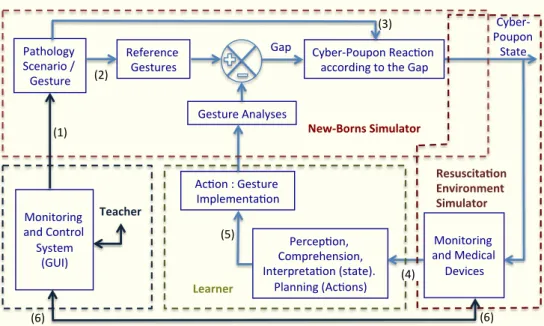
Simulator), and the monitoring and control environment of the learner by a teacher (Monitoring and Control System) (Figure 2).
Two categories of exercises are possible: (i) targeted training on one or more specific gestures (intubation, ventilation, etc.) or (ii) training in the diagnosis of a pathology followed by planning a Protocol and its execution.
In the first class of exercises, the professor chooses the gesture(s) to be executed (see (1) in figure 2), in the second class of exercises the professor chooses a scenario corresponding to a pathology (1). In both cases, the simulator generates the gesture reference model (2) and the Cyber-Poupon behaviour model (3) automatically. The comparison between the reference model of the gestures to be realized and the way they are actually performed produces a gap whose sign and amplitude will induce a new state of the Cyber-Poupon. This state is returned to the learner by visualizing physiological variables such as Oxygen Saturation (SPO2) or Heart Rate (4). The learner then adjusts his gestures (5) according to his analysis of this feedback. The teacher, through his Monitoring and Control system, receives the same information as the learner and can act directly on the learner's monitoring system (6). A set of cameras records the learner's work as the basis for the debriefing following the simulation session.
The simulation system belongs to the category of "Instrumented Anatomical Simulator" in reference to the classification of medical simulators proposed by [3]:
• virtual simulators with a 3D Graphical User Interface (3D GUI),
• virtual simulators with a 3D GUI and coupled to a force feedback system, • anatomical simulators consisting of a non-instrumented dummy, • Instrumented Anatomical Simulators (IAS).
IAS simulators consist of an instrumented dummy ("New-Borns Simulator" - Figure 2) and can be supplemented by a virtual interface ("Resuscitation
Environment Simulator" and "Monitoring and Control System" - Figure 2). They are recognized to provide a more realistic immersion of the learners.
Simulated reactions of the Cyber-Poupon are in accordance with the following learner's gestures: (1) Manual ventilation with mask (bag-mask ventilation), (2) Nasal ventilation, (3) Manual ventilation on intubation probe, (4) Mechanized ventilation on intubation probe, (5) Nasotracheal intubation, (6) Tracheal
suctioning, (7) Nasopharyngeal clearance, (8) Gastric emptying, (9) Extubation, (10) Chest compressions.
Figure 2: Functional diagram of the new-borns simulation system. Relationships labelled with a number between brackets (n) are detailed in the above paragraph.
4. Methodological approach
4.1. Analysis of the problem
Conception of new computer tools with pedagogical objectives requires deep reflexions about transmission and content. A wrong way to transmit or a wrong system of concepts (wrong content) can lead to "dormant fault" in the learner's cognitive system, which will be activated during work situations. For new-born resuscitation activities, it could lead to fatal accidents. The notion of ontology and works currently developed by the knowledge engineers community can bring interesting answers to this problem [4][5].
First defined in Metaphysics, Ontology studies being or existence and their basic categories and relationships, to determine what entities and what types of entities exist [6]. In formalizing the nature of things and the distinctions between them, Ontology is applied to fields such as Theology, Information Science and Artificial Intelligence [7]. The Ontology field studies the world as an organization of its fundamental categories and their inter-relationships [8].
Within Computer Sciences domain, ontology is often associated to knowledge related to objects of a delimited universe and their relations. Ontology refers to a conceptual language used for the description of this delimited universe (domain).
Pathology Scenario / Gesture
Reference
Gestures Cyber-Poupon Reac onaccording to the Gap
Monitoring and Medical Devices Percep on, Comprehension, Interpreta on (state).
Planning (Ac ons) Ac on : Gesture Implementa on Gesture Analyses Cyber-Poupon State New-Borns Simulator Learner Monitoring and Control System (GUI) Resuscita on Environment Simulator Teacher Gap (1) (2) (3) (4) (5) (6) (6)
The emergence of this notion in Knowledge Base System (KBS) engineering comes from the fact that the way to observe the world and its interpretation depend of the observer culture, his (her) means to observe it as well as to his (her) intentions. In this sense, it becomes necessary to resolve the difficulties caused by observation, representation and interpretation of (normal or critic) situations to facilitate problem solving (intent).
Definitions given by T.R. Gruber and M. Ushold are very pertinent in the context of pedagogical objectives: (1) “an ontology is an explicit specification of a
conceptualization, defined as an abstract simplified view of the world that one wishes to represent for some purpose” [8, 9], and (2) “One of the objectives of ontologies is to facilitate the exchange of knowledge between humans, between humans and machines as well as humans via machines” [10].
General benefits in developing ontologies for solving problems arising in the field of safety and Health care are the following:
• they structure the domain in highlighting concepts and semantic relations that are linking these concepts,
• they can be used to be the base for new computer tool design, • they can be used to be the base for new pedagogical approaches. More specific benefits (linked to the application) can be highlighted, such as:
• deep and guided analysis and modelling of the diverse pathological scenarii, • deep and guided analysis and modelling of the diverse protocols (gestures,
instruments, reasoning),
• deep and guided analysis and modelling of the new-born behaviours, • deep and guided analysis of the pedagogical tools to implement, • setting out and modelling the reference gestures and protocols. Tools so built are carrying knowledge shared by the actors of the domain (professionals, professors, learners), what makes them more effective to train medical staff to the right gestures within critical situations. The discourse is not to say that it is not possible to properly conceive new intelligent systems without using ontologies but, the use of ontologies oblige designers to follow a deep and guided methodological analysis of the problems to be solved and to express them by means of the right system of concepts.
Ontologies can also be defined according to their level of genericity as proposed by Guarino in [11]. The so-called top-level ontologies describe very generic concepts independent of any particular problem or domain. They must be "reusable from one domain to another and are designed to reduce inconsistencies in terms defined downstream" [12]. Domain ontologies and task ontologies respectively describe the concepts of a generic domain (such as medicine, industrial production, etc.), or the concepts of a generic task or problem (such as diagnosis, prognosis, planning, simulation, etc.). They specialize terms introduced by top-level ontologies. Application ontologies (the most specific) describe concepts related to a task (or problem) occurring in a particular domain (such as medical diagnosis or planning). They are both a union and a specialization of ontologies of tasks and domains.
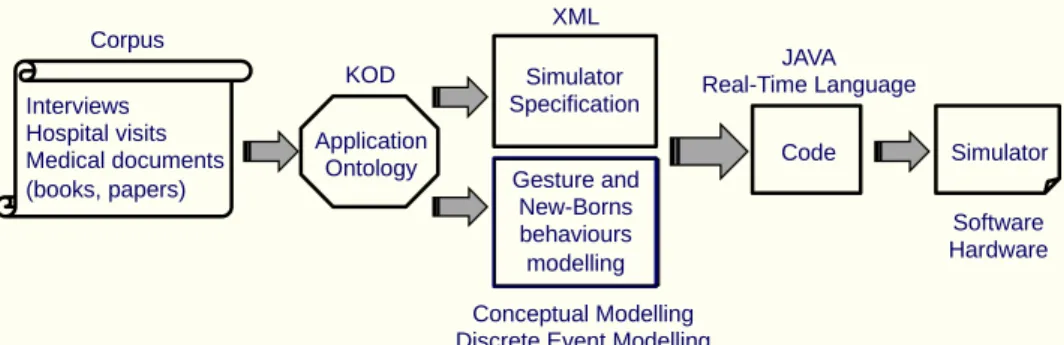
The proposed methodological process (Figure 3) consists in adopting
approaches and methods from Knowledge Engineering (KE) combined with formal modelling. It consists in developing application ontology aiming to model in a unified way the triplet Td = <Domain, Problem, Method>. In this sense, the ontology structures the Domain according to the Problem to be solved and taking into account the Problem Solving Methods. The application ontology is the foundation for the development of the conceptual models of the new-born resuscitation (medical gesture and new-born behaviours) and the specification of the simulator. The process is based on the "Knowledge Oriented Design” (KOD) method [13, 14].
Figure 3: The implemented methodological process. 4.2. The KOD method
KOD was designed to introduce an explicit conceptual model (the cognitive model) between the formulation of a software tool expressed in natural language, and its representation in a formal language (the software model). The inductive process of KOD is based on the analysis of a corpus of documents, comments and experts’ statements, describing the different aspects of the problem to solve (raw data). The fundamental bases of this method are coming from linguistics and cognitive anthropology. Its linguistics bases makes it well suited for the acquisition of knowledge expressed in natural language. For this, KOD proposes a
methodological framework to guide the acquisition of pertinent terms from the corpus, and to organize them by means of a terminological analysis (linguistic capacity). Thanks to its anthropological bases, KOD provides a methodological framework to guide the semantic analysis of the terminology to produce a cognitive model (conceptualisation capacity). KOD guides work from knowledge extraction up to the software model via the cognitive model development.
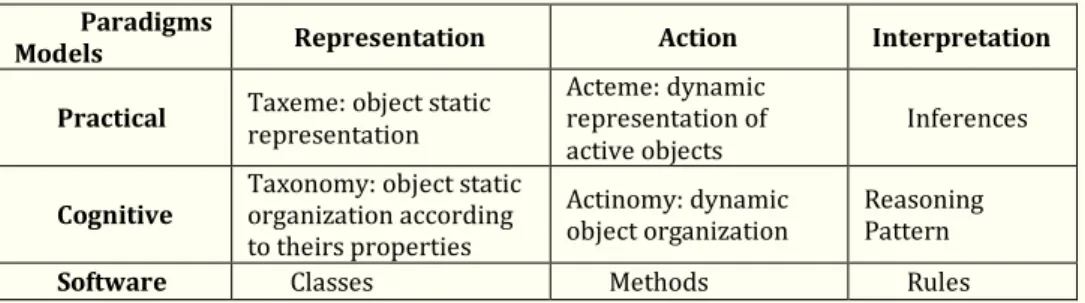
The implementing process of KOD requires the development of three kind of successive models: the practical models, the cognitive model and the software model (Table 1). Each one is developed according to the three paradigms: <Representation, Action, Interpretation / Intention>.
The Representation paradigm provides KOD with the ability to model the
knowledge of the domain such perceived and interiorized by actors. This knowledge universe is made of concrete or abstract objects in relation. KOD provides
methodological tools to develop the structure of this universe according to this paradigm. The Action paradigm provides KOD with the ability to model the behaviour of active objects that activate procedures upon receipt of messages. Action plans designed and performed by human actors, as well as those performed by artificial actors, are modelled with the same format. The Interpretation / Intention paradigm provides KOD with the ability to model the reasoning patterns used by human or artificial actors to interpret situations and elaborate action plans related to their intentions (reasoning capacity).
Practical models are the representation of a speech or document expressed in the terms of the domain, by means of “taxemes” (static representation of objects – French word), “actemes” (dynamic representation of objects – French word) and inferences (basic element of the cognitive reasoning pattern). A “taxeme” is a minimum grammatical feature; it is the verbalisation of an object or a class of objects. An “acteme” is the verbalisation of an act or a transformation, a unit of behaviour. An inference is the act or process of deriving logical conclusions from premises known or assumed to be true. The cognitive model is an abstraction of the practical models. It is composed of taxonomies, actinomies and reasoning patterns.
Interviews Hospital visits Medical documents (books, papers) Simulator Specification Code Simulator Application Ontology Corpus KOD XML JAVA Real-Time Language Gesture and New-Borns behaviours modelling Conceptual Modelling Discrete Event Modelling
Software Hardware
The software model results from the formalization of the cognitive model expressed in a formal language independently of any programming language.
Table 1. The KOD modelling space
Paradigms
Models Representation Action Interpretation Practical Taxeme: object static representation Acteme: dynamic representation of
active objects Inferences
Cognitive Taxonomy: object static organization according to theirs properties
Actinomy: dynamic
object organization Reasoning Pattern
Software Classes Methods Rules
4.3 Elaboration of the Models
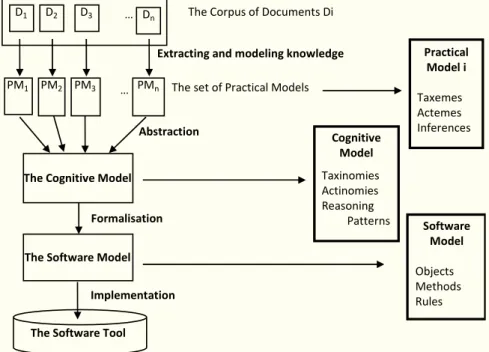
The first step consists in developing practical models (Mpi). Based on a corpus of documents (Di)(Figure 4), it consists in extracting terms and relations linking them through a terminological analysis to provide a terminological language. The terms of the language are classified into <taxemes, actemes, inferences> consistent with the three paradigms of the method (Table 1). At the end of this first step of the
modelling process, each document of the corpus (D1, D2, …, Dn) is modelled by means of a Practical Model (MP1, MP2, …, MPn) (Figure 4). Each Practical Model is a
representation of a specific case or aspect or point of view of the problem such perceived or lived by actors of the domain.
The second step consists in developing the cognitive model related to the problem, from the set of Practical Models. The process consists in: (i) analysing synonyms and homonyms terms occurring in the practical models, (ii) determining the pertinent identifier terms, (iii) transforming the resulting terms into concepts, and (iv) transforming the lexical relationships into semantic ones. In accordance with the three paradigms of the method, the cognitive model is made of
<taxonomies, actinomies, reasoning patterns> (Figure 4). Taxonomies result from taxeme classification as a hierarchical tree structure showing connections between concepts and objects. Actinomies result from an orderly organization of actemes defining an action plan. Reasoning patterns are modelling human reasoning leading to action planning before executing them. The KOD process encourages the
emergence of generic and consensual characteristics of the conceptual language with which the Cognitive model is expressed. Indeed, solving synonymy and homonymy problems promotes consensual characteristics and abstractions of practical models promote obtaining a conceptual and generic language.
The third step concerns the development of the software model requiring to previously translate the cognitive model by means of a formal language. The choice of the formal language depends on the properties of the conceptual model and of the methods implemented by the software tool to solve the problem. The formalization operation consists in integrating the elements of the conceptual model in the definition of classes and objects to constitute the formal model to be used for the software development. The implementation phase that follows consists in translating the formal model by means of a programming language.
Figure 4: The KOD design process
4.4 The ontology building process using KOD
Research work in Ontology Engineering has put in evidence five main steps for building ontologies [10, 15-18]:
1. Ontology Specification. It consists in providing a description of the problem as well as the method to solve it. Objectives, scope and granularity of the ontology to be developed are discussed and specified.
2. Corpus Definition. It consists to select information sources, which will allow the objectives of the study to be reached.
3. Linguistic Study of the Corpus. It consists in a terminological analysis to extract relevant terms and their relations. Linguistics is specially concerned to the extent that available data for ontology building are often expressed in natural language. Characterization of the sense of these linguistic expressions leads to determine contextual meanings.
4. Conceptualization. Relevant terms and their relations resulting from the linguistic study are analyzed. Terms are transformed into concepts and their lexical relations are transformed into semantic relations. The result is a conceptual model.
5. Formalization. It consists in expressing the conceptual model by means of a formal language.
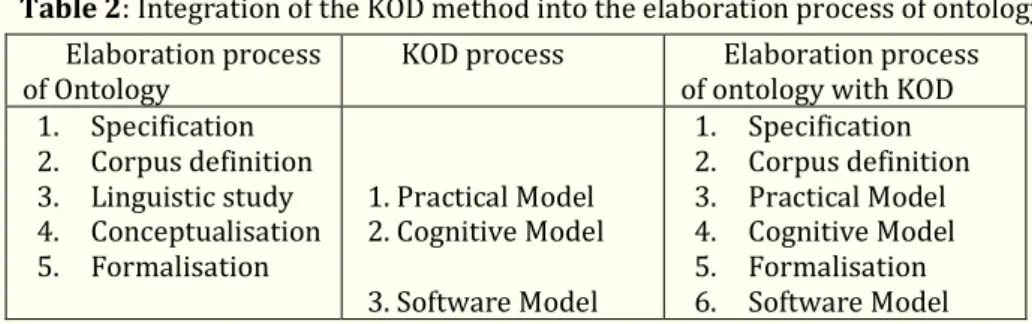
Projection of the KOD method on the general approach of ontology development shows that KOD guides the constitution of the corpus and provides tools to answer the operational stages 3 (linguistic study) and 4 (conceptualization) (Table 2). To illustrate ontology building using KOD, the following previous works can be cited: aircraft piloting errors [19], accidental seaside pollution [20] or simulation of supply chain vulnerability [21].
The Corpus of Documents Di
Extracting and modeling knowledge
The set of Practical Models
Abstraction D1 D2 D3 … Dn PMn PM3 PM2 PM1 …
The Cognitive Model
The Software Model
Practical Model i Taxemes Actemes Inferences Cognitive Model Taxinomies Actinomies Reasoning Patterns Formalisation Software Model Objects Methods Rules
The Software Tool Implementation
Table 2: Integration of the KOD method into the elaboration process of ontology Elaboration process
of Ontology KOD process of ontology with KOD Elaboration process 1. Specification 2. Corpus definition 3. Linguistic study 4. Conceptualisation 5. Formalisation 1. Practical Model 2. Cognitive Model 3. Software Model 1. Specification 2. Corpus definition 3. Practical Model 4. Cognitive Model 5. Formalisation 6. Software Model
5. Elaboration of the ontology for the Cyber-Poupon
5.1. Ontology specification
The KOD method does not offer tools facilitating the specification of ontology. To carry out this step, many authors recommend the use of the scenario concept [10, 18, 22] with the objectives to clarify and justify the ontology development, its future uses and its future addressees. We do not further develop this step but we illustrate it by giving summaries of the scenario that have been drafted within the framework of the triplet Td: <Domain, Problem, Method>.
The Domain is that of new-born cardio-pulmonary resuscitation. The Problem is to train medical staff to produce the right diagnosis, the right gesture planning and execution. The problem solving Method consists in the elaboration of a cooperative system of simulation. The ontology has to structure the domain with regard to the problem to be solved and taking into account the problem solving method. The ontology realizes the coherence of the triplet Td to serve as a basis for the design of the simulation tool. In this sense, it is important that the elaborating method of the ontology helps to conceptualize the triplet Td.
5.2. Corpus Definition
Definition and analysis of the corpus are based on the ontology specification and on the properties of the practical and cognitive models resulting from the
application of the KOD method. Thus, documents to be collected must be both representative of the triplet <Domain, Problem, Method> and meet the
requirements induced by the KOD modelling space (Table 1). The combination of the triplet (Td) with the KOD modelling space constitutes a helpful grid to analyse the ontology specification with the goal to define the documents of the corpus. The corpus is made of the following documents:
• Professional documents about medical protocols, • Academic documents about the resuscitation gestures,
• Technical documents about the main Instrumented Anatomical Simulators of new-borns,
• Interviews concerning the return on operating experience about well done resuscitation,
• Interviews concerning the return on operating experience about erroneously done resuscitation.
5.3. Elaboration of the Practical Models
This step consists in extracting from each document of the corpus, relevant knowledge (objects, actions, and inferences) for modelling new-borns pathological behaviours combined with the cardio-pulmonary resuscitation gestures.
5.3.1 Taxemes Modelling
The linguistic analysis is performed in two steps: verbalization and modelling into taxemes. Verbalization consists in paraphrasing corpus documents in order to obtain simple sentences allowing to qualify the employed terms. Terms are referring to objects, concepts, properties, values, or relationships between objects and values. Modelling consists in organizing paraphrases by means of binary predicates such as <Object, attribute, value>, where attribute defines a relationship between the object and a value.
Five kinds of predicative relationships are defined: classifying (is-a, kind-of), identifying (is), descriptive (position, failure mode, error mode, cause, etc.), structural (composed-of) and situational (is-in, is-below, etc.). The following example illustrates the process to obtain the taxemes in the case of the “Bag-Mask Ventilation” gesture. The extract is translated from [23] :
“Two types of manual insufflators are presented: AMBU type and Leardal type. Their design, principles and uses are roughly similar”
“…They are made of: the balloon, the injection and exhalation valves, the
pressure relief valve, the universal patient connector, and the oxygen connection. …” Paraphrases:
1. The “AMBU manual insufflator” is a manual insufflator 2. The “Leardal manual insufflator” is a manual insufflator 3. “manual insufflator” is made of a balloon
4. “manual insufflator” is made of an injection valve 5. “manual insufflator” is made of an exhalation valve 6. Etc.
Taxemes:
1. <AMBU manual insufflator, kind-of, Manual insufflator> 2. < Leardal manual insufflator, kind-of, Manual insufflator > 3. < Manual insufflator, composed-of, Balloon>
4. < Manual insufflator, composed-of, Injection valve > 5. < Manual insufflator, composed-of, Exhalation valve > 6. etc.
Two predicative relationships are used in this extract: the classifying and structural relationships. The extent of this analysis at the whole Corpus, have allowed obtaining the set of taxemes needed for the representation of the new-born resuscitation universe. Each object of the real world is modelled by the set of the related taxemes (Figure 5).
Figure 5: A subset of the New-Born taxemes
5.3.2 Acteme Modelling
Actemes model resuscitation activities, as well as new-born and object
behaviours. In order to obtain actemes, the linguistic analysis consists on identifying verbs that represent activities performed by the medical staff during resuscitation, new-born behaviours or object behaviours. An activity is performed by an action manager, by means of instruments, to modify the state (physical or knowledge) of the addressee. An Acteme is composed of textual items extracted from the corpus, which describe the state changing of an entity as described by domain experts. The following example illustrates how to extract actemes from the Corpus:
“... The manual bag mask ventilation is carried out by means of a manual insufflator by exerting repeated compressions of the balloon (50 cycles per minute for the new-born and 30 cycles per minute for the infant ...”
The activity (or action) is “Manual Bag-Mask VENTILATION”. Once identified, the activity is translated into a 7-tuple (the acteme). Each element of the 7-tuple must be previously defined as a taxeme:
<Action name, Action Manager, Addressee, Properties, State1, State2, Instruments> Where:
• Action Manager (Clinician or Learner) performs the action (Action Name); • Action (Action name) causes the change;
• Addressee (New-Born or Cyber Poupon) undergoes the action; • Properties describe the way the action is performed;
• State 1 is the state of the addressee before the change; • State 2 is the state of the addressee after the change;
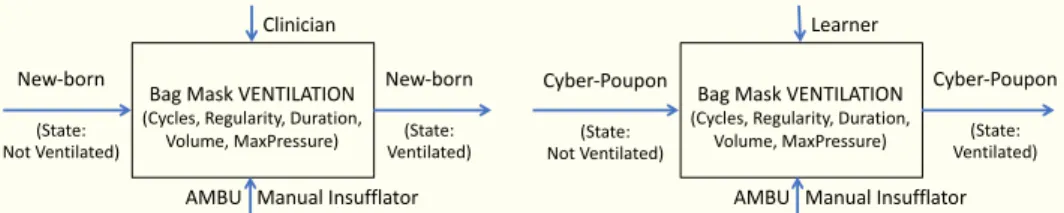
• Instruments, are means used to cause the change (the insufflator). The acteme “Manual Bag-Mask VENTILATION” is represented as following: <Manual Bag-Mask VENTILATION, Learner, Cyber-Poupon, (Cycles, Regularity, Duration, Volume, MaxPressure), Cyber-Poupon (not ventilated), Cyber-Poupon (ventilated), AMBU Manual Insufflator>
Actemes can be represented according to an actigram form (Figure 6) or to a table form (Table 3).
<New-Born, Composed-of, Limbs> <New-Born, Composed-of, Face> …
<New-Born, Composed-of, Epiglottis> <New-Born, Composed-of, Trachea> …
<New-Born, Composed-of, Lungs> …
<New-Born, OxygenSaturation, Real_Value> <New-Born, HeartRate, Real_Value>
<New-Born, RespiratoryFrequence, Real_Value> <New-Born, BloodPressure, Real_Value> <New-Born, Colour, Set_of_Colours> <New-Born, Tonicity, Discretised_Levels> …
Physiological components of the new-born implied in respiratory failure and resuscitation (Structural relation)
Physiological variables of the new-born implied in respiratory failure and resuscitation
(Descriptive relation)
Figure 6: Representation of the Acteme “Manual Bag-Mask VENTILATION” according to an actigram form. Modelling in real situation on the left-hand side and modelling in learning situation on the right-hand side.
Table 3: Representation of the Acteme “Manual Bag-Mask VENTILATION” according to a table form.
Action: Manual Bag-Mask Ventilation
COMPONENTS VALUES
Action Manager {Learner, Professor, Clinician}
Adressee {Cyber-Poupon, New-Born}
Adressee State1 {Not Ventilated}
Adressee State2 {Ventilated}
Instruments {AMBU Manual Insufflator,
Leardal Manual Insufflator
Properties {Cycles, Regularity, Duration,
Volume, MaxPressure }
The Cyber-Poupon state, summarized in Figures 6 by the terms "Not Ventilated" and "Ventilated", is in fact a subset of the Cyber-Poupon attributes (the physiological variables) that are affected by a respiratory failure and consequently, by a Bag-Mask Ventilation. The Action Manager evaluates the physiological state of the Cyber-Poupon, through the analysis of the following vector:
(Oxygen Saturation, Heart rate, Respiratory Frequency, Blood pressure, Colour, Tonicity, Screams)
Values taken by each attribute (physiological variables) evolves according to the right or wrong realization of the considered resuscitation gesture (action): the “Manual Bag-Mask Ventilation” in the case of the example. Properties of the action characterise the way the action is performed (Figure 10), where:
• Cycles, is the gesture frequency (number of cycles per minute), • Regularity, is the constance of the performed gestures,
• Duration, is the elapsed time during the balloon compression, • Volume, is the quantity of air or oxygen insufflated in lungs,
• MaxPressure, is the maximal pressure exercised by the Clinician (or Learner) during the manual compression of the balloon
The evaluation of these properties gives a measure of the right or wrong realization of the “Manual Bag-Mask Ventilation” gesture.
5.4. The cognitive model (conceptualisation)
Conceptualisation consists in developing the cognitive model by abstraction of the practical models. It is based on the operation of classification to produce taxonomies, actinomies and reasoning patterns.
Bag Mask VENTILATION (Cycles, Regularity, Duration,
Volume, MaxPressure) Cyber-Poupon (State: Not Ventilated) Cyber-Poupon (State: Ventilated) Learner
AMBU Manual Insufflator Bag Mask VENTILATION
(Cycles, Regularity, Duration, Volume, MaxPressure) New-born (State: Not Ventilated) New-born (State: Ventilated) Clinician
5.4.1 Taxinomy building
The first step consists in solving problems induced by homonym and synonym terms, with the objective to build a coherent and common terminology. The second step consists in analysing the nature of attributes (or relationships) that
characterize each object. From the nature of these attributes will depend the building of taxonomies (relationships "kind-of" or "is-a") or others kinds of tree structures (relationships "is-composed-of", “is-on", etc.).
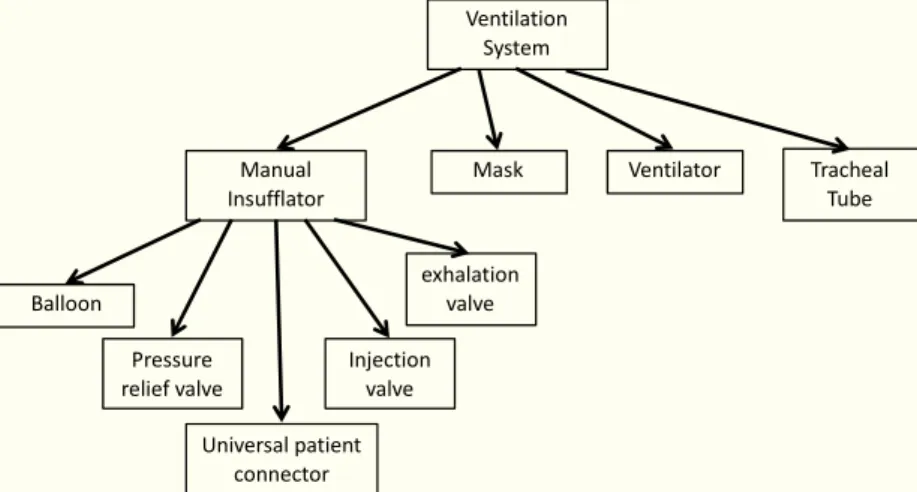
According to the previous example, it can be initiated: (1) the Manual Insufflators taxonomy where AMBU Manual Insufflator and Leardal Manual Insufflator are kind-of Manual Insufflators, and (2) a tree structure giving the composition of a Manual Insufflator (Figure 7), which is included in a wider tree structure (Ventilation System). All taxemes of the corpus have been organized in taxonomies and tree structures to express all the relationships between concepts.
The definition of a concept is achieved by combining the whole knowledge about it. As a result of the analysis of the knowledge related to “AMBU Manual Insufflator”, the concept is defined through its attributes as shown in Table 3.
Figure 7: Tree structure based on the “Composed-of” relation. Table 4: The attributes of the “Manual Insufflator” concept.
Manual Insufflator
ATTRIBUTES VALUES
Kind of Manual Insufflator
Composed of Balloon
Composed of Pressure Valve
Composed of Universal patient connector
Composed of Injection valve
Composed of Exhalation valve
Balloon Volume Real
Balloon compliance Real
Gas nature {Oxygen, Air}
5.4.2. Actemes abstraction
One result of the acteme analysis is that they can be classified into three main action categories: (i) actions related to new-born behaviours, (ii) actions related to resuscitation gestures, (iii) actions related to pedagogical services.
exhalation valve Pressure relief valve Universal patient connector Balloon Manual Insufflator Injection valve Ventilation System
Mask Ventilator Tracheal
Actions related to new-born behaviours are executed by the Cyber-Poupon as a result of the physiological state changes induced by the learner resuscitation gestures. Such actions include Tonicity change, Heart Rate change, SPO2 change, etc.
Actions related to resuscitation gestures are executed by the Clinician, and they have to be captured and qualified by the Cyber-Poupon. Each of these actions have been deeply analysed to elaborate the qualification process. Examples of such actions include Manual Bag-Mask Ventilation, Nasotracheal Intubation, Tracheal aspiration, Gastric emptying, Chest Compression, etc.
The actions related to pedagogical services are implemented to improve the simulator functionalities to assist the professor in its supervising and debriefing tasks such as: recording a simulation session, inserting comments during a simulation session, etc.
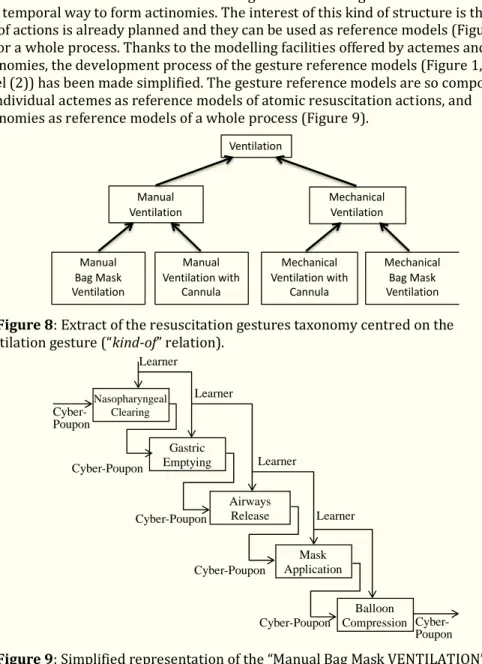
The actemes abstraction has led to two kinds of organization: action taxonomies and actinomies. As an example, Figure 8 presents the taxonomy of the Ventilation actions. Some actemes of the resuscitation gesture can be organized in a structural and temporal way to form actinomies. The interest of this kind of structure is that a set of actions is already planned and they can be used as reference models (Figure 9) for a whole process. Thanks to the modelling facilities offered by actemes and actinomies, the development process of the gesture reference models (Figure 1, label (2)) has been made simplified. The gesture reference models are so composed of individual actemes as reference models of atomic resuscitation actions, and actinomies as reference models of a whole process (Figure 9).
Figure 8: Extract of the resuscitation gestures taxonomy centred on the Ventilation gesture (“kind-of” relation).
Figure 9: Simplified representation of the “Manual Bag Mask VENTILATION” actinomy.
Ventilation
Manual
Ventilation Mechanical Ventilation
Manual Bag Mask Ventilation Manual Ventilation with Cannula Mechanical Ventilation with Cannula Mechanical Bag Mask Ventilation Nasopharyngeal Clearing Gastric Emptying Airways Release Mask Application Balloon Compression Cyber-Poupon Learner Learner Learner Learner Cyber-Poupon Cyber-Poupon Cyber-Poupon Cyber-Poupon Cyber-Poupon
5.4.3. Building of Reasoning Patterns
Reasoning Patterns are made of logical inferences to form a coherent complex reasoning. Inferences are modelling knowledge elements of the corpus that characterize cognitive activities of humans and machines. They are the basic elements of the Interpretation / Intention paradigm.
To illustrate this step of the methodological process, an extract of the new-borns behavioural analysis has been chosen. The example is focused on the “Balloon Compression” action within the “Manual Bag-Mask Ventilation” (Figure 10). As a result, a set of inferences (Reasoning Pattern) has been stated to control the Cyber-Poupon behaviours in response to the learner gestures. Inferences are built according to the “Interpretation / Intention” paradigm of the KOD method and they are expressed according to the following general form:
IF (Interpretation) THEN (Intention)
IF (Interpretation of the Learner gesture(s)) THEN (generate the induced Cyber-Poupon behaviour(s))
The Interpretation paradigm addresses observations of the Learner gesture(s), and the Intention paradigm consists in planning "pseudo-physiological" discrete states with the corresponding behaviour(s). Premise propositions result from the interpretation of observations (Learner gestures), and therefore, they are held to be true. The conclusion is related to “pseudo-physiological” state transitions.
Figure 10 highlights the Interpretation process where the gesture qualification is based on the gesture properties analysis. The Q variable is the result of the
interpretation process and values taken are [1, 0, -1], where:
- Q = Q1 =1, means that the gesture is rightly executed (positive value), - Q = Q0 = 0, means no gesture is executed (null value),
- Q = Q-1 = -1, means that the gesture is wrongly executed (negative value). For each state of the Cyber-Poupon, the following rules are describing the state transition function:
IF (Q1 and xi and elapsetime = dt1i) THEN e1; (Improvement) IF (Q0 and xi and elapsetime = dt0i) THEN e0; (Degradation) IF (Q-1 and xi and elapsetime = dt-1i) THEN e-1; (Degradation) IF (elapsetime = dtinti) THEN einti; (Degradation)
Where:
xi is the current state of the Cyber-Poupon, elapsetime is the time function, dt1i is the necessary right execution duration of the gesture to produce an
improvement transition (e1), dt0i is the duration after which no gesture produce a degradation transition (e0), dt-1i is the duration after which a wrong execution of the gesture produce a degradation transition (e-1), and dtinti is the time spent in the state i without enough improvement of the physiological variables. For each state of the Cyber-Poupon, the output functions, which describe the new-born behaviour, depend of the right or wrong execution of the gesture. The rules for the output functions are the following:
IF Q1 and xi THEN 1i IF Q0 and xi THEN 0i IF Q-1 and xi THEN -1i Where:
1i, 0i, -1i are the sets of output functions associated to the state xi according to Q1, Q0, Q-1. These functions are modelling the physiological variables of a new-born : Heart Rate (HR), Oxygen Saturation(SPO2), Color, Screams, Tonicity, Reactivity.
The new-born behaviours have been modelled by means of six discrete states where State0 is the "normal state" and State5 is the death. The resulting new-born
behaviours, for the ventilation gesture, is modelled by the state-chart diagram of the Figure 11.
Figure 10: Qualification of the Learner gesture (Observation, Analysis, Interpretation). (n) are the gesture properties: (1) Cycles, (2) Regularity, (3) Duration, (4) Volume, (5) MaxPressure. Q is the qualification variable.
Figure 11: State-chart diagram modelling the new-born’s behaviour according to the right or wrong execution of the ventilation gesture. e0,-1,int is a shortened notation meaning that the degradation transition can be e0, e-1, or eint.
6. Conclusion
The paper presents the methodology process implemented to develop a system of simulation to train medical practitioners to the resuscitation gestures. The process is based on building an application ontology used to elaborate conceptual models of the new-born behaviours and resuscitation gestures, and to specify the
Regularity Volume MaxPressure Duration Cycles Intrapulmonary pressure sensor (Observation) Analysis of the pressure signal (Analysis) Gesture Qualification (Interpretation) Learner gesture (Balloon compressions) (2) (3) (4) (5) (1) Measured gesture Zoom Time Q Normal State1 State2 State3 State4 Death e1 HR > 105 SPO2 > 65 HR > 60 SPO2 > 30 HR < 60 SPO2 < 30 HR > 30SPO2 > 20 HR < 30 SPO2 < 20 HR>150 SPO2>75 HR<105 SPO2<65 HR = 0 SPO2 = 0 e1 e0,-1,int e1 e1 e0,-1,int e0,-1,int e0,-1,int
system of simulation. The Manual Bag-Mask Ventilation gesture has been used to exemplify the implementation of the process. In the present state of realization, nasotracheal intubation and chest compression gestures have also been completely analysed, modelled and coded.
This work show that the use of an application ontology is relevant to ensure the consistency of the modelling and specification processes since both use the same stabilized vocabulary. Furthermore, the ontology structures the domain (new-born resuscitation) according to the problem to solve (training medical staff) and to the problem solving method (simulation). The ontology was obtained through a
cognitive approach, which consisted in applying the KOD method, which has proven to be adequate.
The simulation system including learners and professors management, simulation sessions and debriefing sessions is performed. Three resuscitation gestures are currently available. Future works concern the development of the other resuscitation gestures as well as the final robot of the new-born.
References
[1] Perlman JM, Willie J, Kattwinkel J, Wyckoff MH, Aziz K, Guinsburg R, Kim HS, Liley HG, Mildenhall L, Simon WM, Szyld E, Tamura M, Velaphi S. Part 7: Neonatal Resuscitation: 2015 International Consensus on Cardiopulmonary Resuscitation and Emergency Cardiovascular Care Science With Treatment Recommendations.
PEDIATRICS. November 2015; Volume 136; ISSUE Supplement 2.
[2] Bétrémieux P. Prise en charge et réanimation du nouveau-né en salle de naissance : synthèse, adaptation et commentaires pratiques des recommandations de l’International Liaison Committee on Resuscitation (ILCOR). Médecine & enfance. 2007; Volume 27. ISSN 0291-0233.
[3] Silveira RC. Modélisation et conception d’un nouveau simulateur d’accouchement (BirthSim) pour l’entrainement et l’enseignement des jeunes obstétriciens et des sages femmes [thesis]. Institut National des Sciences Appliquées de Lyon (INSA); 2004.
[4] Bimba AT, Idris N, Al-Hunaiyyan A, Mahmud RB, Abdelaziz A, Khan S, Chang V. Towards knowledge modelling and manipulation technologies: A survey. International Journal of Information Management. 2016;36:857-871.
[5] Allert H, Markkanen H, Richter C. Rethinking the Use of Ontologies in
Learning. In: Tomadaki E and Scott P, editors. Proceedings of Innovative Approaches for Learning and Knowledge Sharing (EC-TEL 2006). p. 115-125. ISSN 1613-0073.
[6] Wikipedia dictionary [Internet]. 2018. Available from: http ://en.wikipedia,org/wiki/Ontology.
[7] ISCID Encyclopedia of Science and Philosophy, International Society for Complexity, Information and Science [Internet]. 2008. Available from: http://www.iscid.org/encyclopedia/
[8] Gruber TR. Toward principles for the design of ontologies used for
knowledge sharing. Technical Report KSL-93-04; Knowledge Systems Laboratory; Stanford University. Revised in August 1993.
[9] Gruber TR. Towards principles for the design of ontologies used for knowledge sharing. International Journal of Human-Computer Studies. 1995; volume 43; n° 5/6; 907-928.
[10] Uschold M and Grüninger M. Ontologies: Principles, methods and applications. Knowledge Engineering Review. 1996;volume 11, n° 2, pp. 93-136.
[11] Guarino N. Semantic Matching: Formal Ontological Distinctions for Information Organization, Extraction, and Integration. In: Pazienza MT, editor.
Information Extraction: A Multidisciplinary Approach to an Emerging Information Technology. 1997; Springer Verlag: 139-170.
[12] Vandecasteele A. Modélisation ontologique des connaissances expertes pour l'analyse de comportements à risque : application à la surveillance maritime. Économies et Finances. École Nationale Supérieure des Mines de Paris, 2012.
[13] Vogel C. Génie cognitif. Paris, Masson, 1988 (Sciences cognitives).
[14] Mercantini JM, Tourigny N, Chouraqui E. Elaboration d’ontologies à partir de corpus en utilisant la méthode d’ingénierie des connaissances KOD. In: 1ère édition des Journées Francophones sur les Ontologies (JFO 2007). 18-20 Octobre 2007, Sousse (Tunisie). pp 195-214. ISBN : 978-9973-37-414-1.
[15] Dahlgren K. A Linguistic Ontology. International Journal of Human-Computer Studies. 1995; vol. 43, n°5, pp. 809-818.
[16] Fernández-López M. Overview of methodologies for building ontologies. In: Proceedings of the IJCAI-99 Workshop on Ontologies and Problem-Solving Methods (KRR5);August 2, 1999;Stockhom;Sweden;pp. 4-1 to 4-13.
[17] Aussenac-Gilles N, Biébow B and Szulman S. Revisiting Ontology Design: a method based on corpus analysis. In: Dieng R et Corby O, editors. Proceedings of the 12th International Conference on Knowledge Engineering and Knowledge
Management (EKAW-2000). Springer-Verlag; LNAI 1937, pp. 172-188. [18] Gandon F. Ontology engineering: a survey and a return on experience. Research Report n° 4396. INRIA;Sophia-Antipolis;mars 2002.
[19] Sadok S, Chouraqui E, Mercantini JM. Modeling the deviation to improve safety aircraft piloting activities. In: Proceeding of The 1st IEE International Conference on System Safety; 6-8 June 2006; London.
[20] Mercantini JM. Building a domain ontology to design a decision support software to plan fight actions against marine pollutions. In: Mercantini JM and Faucher C, editors. Risk and Cognition. Springer-Verlag; Intelligent Systems Reference Library; Vol. 80; January 2015.
[21] Sakli L, Mercantini JM, Hennet JC. Study of Supply Chain Vulnerability Based on Cognitive Engineering and ARIMA Formal Models. In: Proceeding of the 11th International Conference on Integrated Modelling and Analysis in Applied Control and Automation; 17-19 September 2018; Budapest.
[22] Caroll JM. Scenario-Based Design. In: Helander M, Landauer TK, Prabhu P, editors. Handbook of Human-Computer Interaction. 2nd ed. Elsevier Science B.V;1997. (Chapter 17).
[23] Lavaud J, Ayachi A, editors. Réanimation et transport pédiatriques. Book, 5th ed. Masson; 2004.
![Figure 1: ILCOR neonatal flow algorithm from [1, 2]. Where red triangles are evaluation actions and green boxes are resuscitation actions](https://thumb-eu.123doks.com/thumbv2/123doknet/14666356.740895/6.765.150.654.76.885/figure-neonatal-algorithm-triangles-evaluation-actions-resuscitation-actions.webp)