HAL Id: tel-01972898
https://tel.archives-ouvertes.fr/tel-01972898v2
Submitted on 8 Jan 2019
HAL is a multi-disciplinary open access archive for the deposit and dissemination of sci-entific research documents, whether they are pub-lished or not. The documents may come from teaching and research institutions in France or abroad, or from public or private research centers.
L’archive ouverte pluridisciplinaire HAL, est destinée au dépôt et à la diffusion de documents scientifiques de niveau recherche, publiés ou non, émanant des établissements d’enseignement et de recherche français ou étrangers, des laboratoires publics ou privés.
complex of species, case study of the tropical invasive
earthworm : pontoscolex corethrurus
Shabnam Taheri
To cite this version:
Shabnam Taheri. Macro and micro-evolutionary processes within a complex of species, case study of the tropical invasive earthworm : pontoscolex corethrurus. Environmental Engineering. Université Paris-Est, 2018. English. �NNT : 2018PESC1024�. �tel-01972898v2�
1
Thèse de Doctorat à l’Université Paris-Est Créteil
Ecole Doctorale SIE:
Sciences, Ingénierie, Environnement
Macro and micro-evolutionary processes within a complex
of species, case study of the tropical invasive earthworm;
Pontoscolex corethrurus
Shabnam Taheri
Date de Soutenance : 6 mars 2018
Membres du jury :
Myriam Valero, Professeur, CNRS, Roscoff Rapporteur Jorge Domínguez, Professeur, ECIMAT, UVIGO Rapporteur
Thibaud Decaëns, Professeur, CNRS, UM Examinateur
Rodolphe Rougerie, Maître de Conférences, CNRS, MNHN Examinateur Virginie Roy, Maître de Conférences, IEES-Paris, UPEC Examinatrice Lise Dupont, Maître de Conférences, IEES-Paris, UPEC Directrice de thèse
2
3
I. INTRODUCTION... 7
I.1. BIOLOGICAL INVASION ...8
I.2. SPECIATION AND CRYPTIC SPECIES ... 15
I.3. REPRODUCTIVE ISOLATION, POLYPLOIDY AND SPECIATION ... 25
I.4. MODEL OF STUDY: PONTOSCOLEX CORETHRURUS ... 28
I.5. THESIS OBJECTIVES AND STRUCTURE OF THE DOCUMENT ... 30
II. CHAPTER 1: WHAT DO ‘POSITIVE’ AND ‘NEGATIVE’ IMPACTS OF INVASIVE SPECIES DEPEND ON? ... 33
II.1. CHAPTER’S FOREWORD ... 34
II.2. ARTICLE ... 35
III. CHAPTER 2: HOW MANY INVASIVE LINEAGES WITHIN THE COMPLEX OF SPECIES PONTOSCOLEX CORETHRURUS? ... 49
III.1. CHAPTER’S FOREWORD ... 50
III.2. ABSTRACT ... 53
III.3. INTRODUCTION ... 55
III.4. MATERIAL AND METHODS ... 57
III.5. RESULTS ... 65
III.6. DISCUSSION ... 71
III.7. CONCLUSION ... 74
III.8. ACKNOWLEDGEMENT... 74
III.9. REFERENCES ... 75
III.10. SUPPLEMENTARY DATA ... 83
IV. CHAPTER 3: PHYLOGEOGRAPHY AND POPULATION GENETICS OF AN INVASIVE PEREGRINE EARTHWORM SPECIES ... 92
IV.1. CHAPTER’S FOREWORD ... 93
IV.2. ABSTRACT ... 95 IV.3. INTRODUCTION ... 96 IV.4. METHODS... 97 IV.5. RESULTS ... 104 IV.6. DISCUSSION ... 112 IV.7. CONCLUSION ... 114 IV.8. REFERENCES ... 115
IV.9. SUPPLEMENTARY DATA ... 119
V. CHAPTER 4: PLOIDY DEGREE OF PONTOSCOLEX CORETHRURUS COMPLEX SPECIMENS 123 V.1. CHAPTER’S FOREWORD ... 124
V.2. INTRODUCTION ... 126
V.3. MATERIALS AND METHODS ... 131
V.4. RESULTS AND DISCUSSION ... 134
V.5. CONCLUSION AND PERSPECTIVES... 138
V.6. REFERENCES ... 139
VI. GENERAL CONCLUSIONS AND PERSPECTIVES ... 141
VI 1. SPECIATION, HYBRIDIZATION AND GENETIC VARIATION WITHIN PONTOSCOLEX CORETHRURUS COMPLEX 142 VI.2. P. CORETHRURUS L1: THE INVASIVE SPECIES ... 147
VI.3. MIXED REPRODUCTIVE STRATEGY WITHIN A SPECIES COMPLEX AND/OR WITHIN A SPECIES... 151
4
VIII. REFERENCES (OUT OF CHAPTERS) ... 168 IX. LIST OF FIGURES AND TABLES ... 179 X. THESE EN FRANÇAIS : PROCESSUS MACRO- ET MICRO-EVOLUTIFS AU SEIN D’UN
COMPLEXE D’ESPECES, CAS D’ETUDE DE L’ESPECE TROPICALE ET INVASIVE DE VERS DE TERRE ; PONTOSCOLEX CORETHRURUS ... 183
5
First of all, I would like to express my gratitude to Kurdish institute of Paris and Doctoral school of Science, Engineering and Environment (SIE) for the financial support which permitted me to do my PhD during three years.
I want to express my gratitude to the revisers of my manuscript Jorge Domínguez, Myriam Valero, Thiabud Decaëns, Rodolphe Rougerie and Virginie Roy.
I am deeply grateful to Lise Dupont, my thesis supervisor, with whom I have worked since my masters’ internship. Her trust in me when I started working with her meant a lot to me. I would like to thank her for her constant availability and all the things she taught me during these years to make me a better student and a future researcher in the field of evolutionary biology.
I would like to thank members of BioDis group, for their support during these three years. Particularly, I would like to thank Naoise Nunan whom without his support I couldn’t participate the international conference on soil zoology in Japan.
During my thesis, I greatly benefited from vast collaborations all over the world and more precisely I would like to thank; Céline Pelosi whom was my co-supervisor during masters’ internship, and during chapter one, I benefited from her guides and useful discussions. George Brown, Luis Cunha and Elodie Da Silva for my two month stay in Curitiba, Brazil, and the collaboration for samplings in Brazil and Azores Island. Jean-Pierre Coutanceau and Chantal Guidi-Rontani for the cytogenetics experimentations. I am also grateful to Patrick Lavelle for his encouragement and enthusiast for the results I gained, and nice conversations we had during Japan’s conference. And finally, I would like to thank Thiabud Decaëns, for the samples he provided me from all over the world.
I was so lucky to have the support of my friends whom their presence meant a lot to me in different stages of this adventure; Valentina Cima, Matt Cabaret, Mahsa Dehghan, and also other PhD students with whom we shared constructive comments and warm encouragements; Romain Fougeyrollas and Charlotte Pruvost. I would like to thank particularly Maeva Hirsch, who helped me a lot in the redaction of French parts and was always present when I needed a friend.
I would like to express my gratitude to Hélène Audusseau and Marine Zwicke, two precedent ATERs of BioDis group. They were my colleagues at University, but eventually became friends and their experiences and suggestions helped me through my thesis.
I would like to show my greatest appreciation to my sister and brother in law, Parisa and Reza, for their constant heartwarming presence, even though from far.
My heartfelt appreciation goes to Milad for his unconditional love, constant presence in difficult moments, and his informatic helps and suggestions, all the way through this journey.
6
doctoral thesis of mine which I have written during long days and nights without sleep but with lots of love. To my angels without whom I wouldn’t be ‘’who I am’’.
ﺑ ﺰ ر ﮔ ﺘ ﺮ ﯾ ﻦ ﻗ ﺪ ر دا ﻧ ﯽ ھ ﺎ ﻧﺜ ﺎ ر ﭘ ﺪ ر و ﻣ ﺎ د ر ﺑ ﺰ ر ﮔ ﻮ ا ر و ﻣ ﮭ ﺮ ﺑﺎ ﻧ ﻢ ، ﮐ ﮫ اﯾ ﻦ ﻧ ﻮ ﺷ ﺘﺎ ر ر ا ﺑ ﮫ آﻧ ﮭ ﺎ ﺗﻘ ﺪ ﯾ ﻢ ﻣ ﯽ ﮐ ﻨ ﻢ . د و ﻓ ﺮ ﺷ ﺘ ﮫ ا ی ﮐ ﮫ '' و ﺟ ﻮ د م' ' ا ز و ﺟ ﻮ د آ ﻧ ﮭ ﺎ ﺳ ﺖ . ﺑ ﯽ ﻋ ﺸ ﻖ ﻧ ﺸ ﺎ ط و ط ﺮ ب ا ﻓ ﺰ و ن ﻧ ﺸ ﻮ د ﺑ ﯽ ﻋ ﺸ ﻖ و ﺟ ﻮ د ﺧ ﻮ ب و ﻣ ﻮ ز و ن ﻧ ﺸ ﻮ د ﺻ ﺪ ﻗ ﻄ ﺮ ه ز ا ﺑ ﺮ ا ﮔ ﺮ ﺑ ﮫ د ر ﯾﺎ ﺑ ﺎ ر د ﺑ ﯽ ﺟ ﻨﺒ ﺶ ﻋ ﺸ ﻖ د ر ﻣ ﮑ ﻨ ﻮ ن ﻧ ﺸ ﻮ د (یﻮﻟﻮﻣ)
7
8 I.1.1. General definition
Invasive species are often defined as those who overcome a geographical barrier and are found in areas out of their native zone. Another criterion used by scientists to determine that a species is invasive is based on its negative impacts on the ecosystem. But the question is; what is the threshold for a species to be considered as having negative impacts? One general definition that will be used in this thesis is : “a biological invasion consists of a species’ acquiring a competitive advantage following the disappearance of natural obstacles to its proliferation, which allows it to spread rapidly and to conquer novel areas within recipient ecosystems in which it becomes a dominant population” (Valéry et al., 2008).
Negative impacts of invasive species on indigenous biodiversity, ecosystem functions and services, and agricultural productivity (review in Anderson et al., 2017), may result in severe economic impacts which could range from millions to billions of dollars annually (Sakai et al., 2001). For instance, the cost of the invasion by the neotropical termite Nasutitermes corniger in Florida, was estimated between $6.9 and $9.9 million within ten years (Alvarez, 2016). Although some biological invasions could result in severe economic losses, there are a large number of non- native species that result in overall gains for society, or in no deleterious impacts at all. For instance, it has been estimated that 98% of food production in the United States relies on non- native crops and livestock (review in Alvarez, 2016). Therefore, reliable information on the potential negative impacts of invasive species is primordial for good policy decision-making programs since in some cases the costs of control, eradication and mitigation measures may exceed their benefits (Alvarez, 2016).
I.1.2. Steps of the biological invasion process
There are three main stages for successful introduction and following invasion of a species (Figure 1); 1) introduction of a new species in a new habitat, 2) species initial colonization and successful establishment, and 3) afterwards dispersal and secondary spread in new habitats (review in Sakai et al., 2001). In each stage, several factors impact the invasion process, these factors are related to the species characteristics, the environment it has invaded and propagule pressure (i.e., propagule number, size, and temporal and spatial patterns of propagule arrival) (Simberloff, 2009). The impact of propagule number is mainly related to decreasing the impacts of environmental stochasticity, while increasing propagule size enhances establishment probability by decreasing the effects of demographic stochasticity. For instance, Ahlroth et al. (2003) introduced propagules from 2 to 16 mated females of waterstriders (Aquarius najas) into 90 Finnish streams and found that the probability of population establishment increased with propagule size (Simberloff, 2009).
9
Figure 1 : Different stages of invasion and the factors influencing the success of each stage based on Sakai et al. (2001).
The phase one of the invasion is the introduction of a species into a new habitat which could be done deliberately or undeliberately by anthropochory, hydrochory, and phoresy i.e., dispersal by humans, water, and a nonparasitic relationship in which one species is carried by another, respectively (Sakai et al., 2001). Once the species is introduced in a new environment, the second phase of invasion starts. This phase is divided into two parts; initial colonization and establishment. The success of an invader in initial colonization depends on several characteristics. Self- fertilization or ‘selfing’ and parthenogenetic reproduction (types of uniparental reproduction that allow the establishment of a new population without the necessity of having a mating partner), are considered as one of the most important qualities of a species when introduced in a new habitat (Sakai et al., 2001). One of the reasons of flash invasion (i.e., recently initiated invasion by a very efficient clone) of Pseudosuccinea columella, an invasive hermaphroditic freshwater snail, from north America into the world is selfing (Lounnas et al., 2017). These results were inferred by population genetics analyses of eight nuclear microsatellite markers and two mitochondrial genes, where a unique haplotype/genotype was found in invaded populations. Among the successful parthenogenetic invasive species is the hemlock woolly adelgid, an insect that has spread across a large geographic temperature gradient in its introduced range (this insect is native to Asia as well as to the Pacific Northwest of the United States but now invasive in almost all of United States) (Lombardo and Elkinton, 2017). Another important quality of an invasive species in the second phase of invasion (initial colonization), is the r strategy of species (i.e., use of pioneer habit, short generation time, high fecundity, and high growth rates) (Sakai et al., 2001). The other stage of second phase of invasion is establishment. The success of an invasive species during this stage is closely linked to phenotypic plasticity and competitive ability. These abilities are important
10
species, especially with native ones (Sakai et al., 2001). An example of competitive ability between species could be the case of Prosopis juliflora, an aggressive invasive plant species, which releases L-tryptophan amino acid that inhibits the growth of other plants (Mukherjee et al., 2017). This allelopathic ability likely helped the establishment of P. juliflora as an invasive species. Once the invasive species is established it goes through the last phase of invasion which is the spread and dispersal in other habitats which are done naturally or aided by humans. Several factors are important in the success of this stage; such as factors influencing the propagules numbers, dispersal mode and death and birth rates (review in Sakai et al., 2001).
Most of the introduced species fail at the first stages of invasion process e.g., during establishment phase (Facon et al., 2003) and cannot carry on to other steps due to numerous reasons. One of the explanations could be related to founder effect or bottleneck effect (i.e., a sharp reduction in population size due to environmental events, which in turn causes big losses of genetic variations due to genetic drift). Therefore, scientists wondered how invasive species overcome this challenge of low genetic diversity while introduced into a new environment. Reduced genetic diversity can have two consequences; one is inbreeding depression that constrains the population growth and decreases the chance of population’s persistence. Another one is the limited ability to evolve in a new environment. However, consequences of genetic diversity reduction could be less visible by the increase of genetic variation through multiple introductions that could defeat inbreeding depression and drift (Sakai et al., 2001; Sax et al., 2007; Simberloff, 2009). These populations, due to multiple introductions from different locations in the world, could have new genotypes which could be better adapted to the environment, thus increasing the chance of persistence and spread (Sax et al., 2007; Simberloff, 2009). Less genetic diversity could also be due to parthenogenetic reproduction which is one of the characteristics that help invasive species in establishment phase (as mentioned above). Hence, how could a parthenogenetic invasive species have a successful invasion into new areas with weak genetic diversity in comparison with origin areas?
I.1.3. Parthenogenesis, a means of successful invasion
Parthenogenesis is a unisexual type of reproduction where the development of an egg occurs without fertilization, usually resulting in the production of female offspring (Simon et al., 2003). Different types of parthenogenetic reproduction are described in Box 1. Eight types of parthenogenetic reproduction exists; tychoparthenogenesis (or facultative), apomictic, automictic, gynogenesis, hybridogenesis, arrhenotoky, thelytoky, and deuterotoky, or amphitoky. The main difference between apomictic and automictic parthenogenesis is the meiosis retention in the latter. In most cases, parthenogenesis is thelytokous where asexually produced progenies are females (Lynch, 1984). However, haplodiploid insects utilize an arrhenotokous parthenogenetic system
11
(Lynch, 1984).
Box 1: Different modes of parthenogenetic reproduction (Simon et al., 2003; Suomalainen et al., 1987) Tychoparthenogenesis (or facultative): occasional, spontaneous production of eggs without fertilization. This type of parthenogenesis is specially known for at least 10 insect orders from which in 6 genera obligatory parthenogens exist. The cytological mechanism is similar to apomictic and automictic parthenogenesis. Apomictic parthenogenesis: suppression of meiosis and the fertilization of eggs from a mitosis like cell division, thus the offspring are genetically similar to their mothers except mutations. Apomixis is commonly found in invertebrates such as rotifers and all major groups of arthropods.
Automictic parthenogenesis: in contrast to apomixes, in this type of parthenogenesis meiosis is retained with restoration of diploidy by duplication or fusion of the gametes produced by the female parent. Generally, it leads rapidly to complete homozygosity of offspring. This type is common in many parthenogenetic stick insects and some weevils. However, one form found in unisexual lizards and Australian grasshoppers, known as endomeiotic doubling which involves replication of chromosomes prior to meiosis, that restores diploidy for the offspring. As the replicated chromosomes pair prior to meiosis I, the offspring are genetically identical to mothers and the heterozygosity is maintained.
Gynogenesis: a form of parthenogenesis in which sperm should be inoculation form a related bisexual species to stimulate egg development, without genetic contribution to the offspring.
Hybridogenesis: it’s a hemiclonal type of parthenogenesis in which half of the genome is transmitted sexually and the other half clonally. In this type sperm and egg nuclei fuse, in the offspring paternal genes are expressed but only maternal genome is transmitted to the next generation. Both gynogenesis and hybridogenesis are reported for a unisexual fish species in the genus Poeciliopsis.
Arrhenotoky: unfertilized eggs producing only male descendants Thelytoky: unfertilized eggs producing only female descendants
Deuterotoky, or amphitoky: unfertilized eggs producing descendants of both sexes
A parthenogenetic species, due to lack or limited rate of meiosis, have less genetic diversity than sexual species. In case of parthenogenetic invasive species, a drastic loss of variation is thus expected in the invaded areas in comparison with the area of origin, because a single clone has
12
markers which help us to identify the pathways of invasions and to count the number of introductions. For instance, through a phylogeography study, the invasion by a parthenogenetic snail, Melanoides tuberculate, was studied to evaluate the pathways and number of invasions from the Old World (from Africa to southeastern Asia) into the Neotropical area (from northern Argentina to Florida) (Facon et al., 2003). Based on two mitochondrial genes (12S and 16S), results showed that several clones have independently invaded the Neotropical area. Thus, though parthenogenesis promotes genetic uniformity in the short-term, new morphs can appear as a result of sporadic changes in ploidy and/or rare events of sexual reproduction, which help them invading new areas.
Population genetics and phylogeography approaches are useful tools to study the genetic diversity in both source and invading populations and to elucidate the mechanisms driving the success of invasive species (review in Lounnas et al., 2017).
I.1.4. Usefulness of population genetics and phylogeography approaches for a better understanding of biological invasions
Comparing the distribution of genetic variability within and among populations between the origin and invaded areas, could be useful to understand the routes of invasions and the genetic variations of invasive species in these populations (Lounnas et al., 2017). For many years, mitochondrial DNA (mtDNA) was used as the molecular marker of choice in phylogeographical studies in animals due to its lack of recombination, putative neutrality, and smaller effective population size, and consequently a shorter expected time to reciprocal monophyly between geographic regions. However, single-locus markers of mtDNA are often inadequate for accurate calculations of parameter estimates, and multi-locus data could intensely improve the performance of analytical methods (review in Hickerson et al., 2010).
The current molecular approaches for phylogeographic studies include several techniques for detecting and analyzing variation of mtDNA, and nuclear DNA (nDNA). These approaches include; Amplified Fragment Length Polymorphism (AFLP), Simple Sequence repeats (SSR) or microsatellites, Random Amplified Polymorphic DNA (RAPD), restriction site-associated DNA sequencing (RADseq.) and Single-Nucleotide Polymorphism (SNP). Based on the study, question, and information required, each of these approaches has advantages and disadvantages which are listed below in Table 1.
13
Table 1: Advantages and disadvantages of the most-used PCR based molecular approaches in phylogeography and population genetic studies (Aguirre-dugua and González-rodríguez, 2016; Andrews et al., 2016; Miah et al., 2013)
Method Advantages Disadvantages
AFLP
(dominant marker) -fast and simple -cheap
-genomic abundance high -low to moderate polymorphism -mostly from non-coding regions -reliable information for hundreds of loci
-no need for sequence data -can be used across species
-reproducibility is low
-difficult for assessing the homology among markers of the same molecular size
-the state of ‘present allele’ could correspond equally to an individual which is homozygous or heterozygous
-possible experimentations failure, due to changes in materials used RAPD
(dominant marker) -fast -cheap
-genomic abundance high -low to moderate polymorphism -no need for sequence data
-not reproducible -low accuracy
-not suitable across species
microsatellites
(co-dominant marker) -genomic abundance high -highly polymorphic -found in both coding and non- coding regions
-highly reproducible
-usable for fluorescent techniques
-high mutation rates -high development costs
-technical challenges during the construction of enriched libraries and species-specific primers
-sequence information needed SNP
(co-dominant marker) -a suite of unlinked nuclear genetic loci that capture a genome-wide picture of population history -highly polymorphic
-low mutation rates
-high number of SNP loci usually available
-high accuracy
-a maximum of only four characters states (A, T, G, C) making them less informative than microsatellites -sequence information needed
14
Ecosystem engineers are organisms that directly or indirectly modulate the availability of resources to other species, by causing physical state changes in biotic or abiotic materials (Jones et al., 1994). Earthworms have been recognized as typical ecosystem engineers and represent an excellent potential partner for humans in managing ecosystem services. Earthworms have important roles on biological (interactions with plants and other soil organisms), chemical (mineralization of organic matters of the soil) and physical (change in soil structure by burrowing activity) aspects of the soil (Blouin et al., 2013). Earthworms are especially useful for farming and agricultural practices. For instance, by their activities they release assimilable nutrients which increase soil fertility (Lavelle et al., 1992) and by their burrowing activity (Lavelle et al., 1997) they increase soil aeration and water absorption which are in interaction with plant species.
polyploidy. In case of polyploidy, co-dominant markers are not advisable (e.g., microsatellites, RFLP, SNP and RADseq.), because it is difficult to determine the number of copies of each of the alleles present. Among dominant markers, AFLP is highly valuable and its efficacy for having information on the genome has been reported in several studies. For instance, sympatric speciation (the evolution of reproductive isolation without geographic barriers) of two endemic palm species
Howea forsteriana and H. belmoreana on Lord Howe Island was shown by divergence of four loci
out of 274 AFLP markers between the two species, involving disruptive/divergent selection (Savolainen et al., 2006). AFLP method is also very useful for non-model species for which we don’t have much genomic information. With this method, we can have information about genetic variations relatively fast and easily, without the need to have sequence data.
The use of dominant markers such as AFLP is thus interesting for studying the genetic structure of soil living organisms for which very poor genomic data are available. For these taxa, molecular techniques have been rarely used but these methods have allowed to describe the spread of a few invasive earthworm species (Dupont, 2009).
I.1.5. Invasive earthworm species
Underground invasions have attracted less attention than above ground invasions, mostly due to the cryptic nature of soil environment and less apparent impacts of invasions (Bohlen, 2006; Fernández et al., 2016; Hendrix et al., 2008). Earthworms are known as ecosystem engineers (Box 2) thus, they can impact the soil ecosystem by their activities. When non-native earthworm species are introduced in a new habitat, they can alter soil structure, organic matter and nutrient cycling, and plant and animal communities below and above ground and replace or out-compete native earthworm species (Fernández et al., 2016; Hendrix et al., 2008).
15
unintentionally (e.g., in agricultural and horticultural products) or intentionally (e.g., for waste management and land bioremediation) (Hendrix et al., 2008). To be transported successfully to other regions in the world, the earthworms or cocoons should be highly tolerant to different soil conditions and structures (Fernández et al., 2016). Most peregrine (i.e., widely ranging species out of their native zone, often owing to human action) earthworms can be grouped in three families: Lumbricidae, Megascolecidae and Rhinodrilidae (Fernández et al., 2016). The majority of known peregrine species belong to the Lumbricidae family with 30 species. These species are found in the genera; Lumbricus, Allolobophora, Octolasion, Aporrectodea, Dendrobaena, Eisenia or
Eiseniella (Fernández et al., 2016). These species are mostly studied in temperate region and as
Hendrix et al. (2008) stated, despite the existence of higher number of species in tropical zone, the proportion of our knowledge on the existence of peregrine earthworm species in temperate zone is much higher than those in tropical region. It has been estimated that out of several thousand of earthworm species in tropical zone, only 51 peregrine species are known, while in temperate zone 45 peregrine species are known out of 500-600 estimated species.
To date, only three studies have investigated the phylogeography and population genetics of peregrine earthworm species i.e., Aporrectodea trapezoids (Fernández et al., 2016, 2011),
Aporrectodea rosea (Fernández et al., 2016) and Pontoscolex corethrurus (Dupont et al., 2012).
A common point of these studies is a high genetic diversity within samples of different locations. Using AFLP markers to investigate P. corethrurus population genetics in French Guiana, Dupont et al. (2012), showed that higher genetic diversity was observed in disturbed areas due to human activities which supplied these populations with migrants thus new genotypes. By comparing sequenced haplotypes in the ancestral distribution areas and the colonized lands, we can trace back roads of biological invasions and understand the success of peregrine species. For instance, two phylogeographic analyses using COI and COII genes revealed that Aporrectodea trapezoids and
Aporrectodea rosea peregrine earthworm species have undergone a similar pattern of
diversification (Fernández et al., 2016).
With the advent of molecular approaches in species taxonomy, several cryptic species (i.e., morphologically undistinguishable species) were revealed for earthworms (King et al., 2008; Novo et al., 2010, 2009; Pérez-Losada et al., 2009). Among these cryptic species, some are peregrine. Hence, one question remains to be answered; could a peregrine earthworm morphospecies, be a complex of several species?
I.2. Speciation and cryptic species
I.2.1. Processes of speciation and ‘grey zone’
Species concept has been controversial for scientists for a long time. This concept varies based on different scientific fields to define it. For instance, intrinsic reproductive isolation in the case
16
ecological species concept, fixed character state differences in the case of the phylogenetic concept, and different evolutionary role, tendencies, and historical fates in the case of evolutionary concept of species (De Queiroz, 2007). De Queiroz (2007) suggested that when there are debates on the existence of one species versus two species, we are in the ‘grey zone’ of speciation process (a process by which one species splits into two species), that’s where scientists in different disciplines come into conflict, but before and after the ‘grey zone’ they all agree that there is one species or two species (Figure 2).
Figure 2 : A simple illustration of speciation process after De Queiroz (2007). At first one species exists and with time it splits into two species. The SC1 to SC9 correspond to the progression of time.
Integrative taxonomy is an approach that highlights congruence among different disciplines and gives evolutionary explanations for incongruence among them, acknowledging that these different methods reflect different stages of the speciation process in the ‘grey zone’ (Dejaco et al., 2016). Integrative systematics require multifaceted skills in taxonomic, phylogenomic, and bio-informatic skills (Wen et al., 2017). Nowadays, species delimitations based on molecular approaches and bio-informatic software are used more and more.
17
Mitochondrial markers are widely used for species delimitations and cryptic species discovery studies. However, these markers are considered as a ‘double-edged sword’ due to their accelerated evolutionary rates (Akihito et al., 2016). Meaning that in one hand, significant amounts of sequence variation could be observed in closely related species and as maternally transmitted, interpretation of species identification is simplified (review in Yang et al., 2014). But at the other hand, because of the reduced Ne (effective population size) of mitochondrial genes compared to
nuclear genes, they may facilitate fixation of an introgressed haplotype lineage, even at low levels of introgression in a foreign population (review in Akihito et al., 2016). Hence, combining mtDNA and nDNA markers improves the power of genetic data for systematic studies (Song and Ahn, 2014). Meanwhile, evolutionary inference from single-locus data (nuclear or mitochondrial markers) has limitations including; lower power for detecting independent evolutions compared with multi-locus approaches, the potential discordance between gene trees and species trees and the lack of information on adaptive divergences (review in Fujisawa and Barraclough, 2013). Thus, single-locus analysis could lead us to an under or over estimation of existing species (Meyer and Paulay, 2005; Will and Rubinoff, 2004). With the decrease in the cost of high-throughput Sanger sequencing and the advent of Next Generation Sequencing (White et al., 2014), more and more studies are using multi-locus analysis. Table 2 shows some of the molecular species delimitation methods and they are organized based on single-locus and multi-locus types of input data for these methods. Among these methods, two are species validation approaches which require the user to assign samples to putative phylogenetics/phylogenomics lineages (i.e., BPP and SpedeSTEM), while the other approaches assign samples to groups without a priori information for discovering species (review in Carstens et al., 2013).
Table 2: Common single and multi-locus species delimitation methods based on Carstens et al. (2013) review Single-locus
/multi-locus Delimitation method Reference
Single-locus
Generalized Mixed Yule Coalescent
(GMYC) (Pons et al., 2006)
Automatic Barcode Gap Discovery
(ABGD) (Puillandre et al., 2012)
Bayesian Poisson tree processes (bPTP) (Zhang et al., 2013) Multi-rate Poisson tree processes (mPTP) (Kapli et al., 2017)
Multi-locus
Structure (Pritchard et al., 2000)
Gaussian Clustering (Hausdorf and Hennig, 2010)
O’Meara’s (O’Meara, 2010)
Species delimitation using species trees
(SpedeSTEM) (Carstens and Dewey, 2010)
Structurama (Huelsenbeck et al., 2011)
Bayesian Phylogenetics and Phylogeography (BPP)
18
Phylogenetics and phylogenomics permit us to visualize the relationships among species. In phylogenetics the sequences of a small number of genes are analyzed, while with phylogenomics entire genomes, or at least large portions of genomes are compared (Divakar and Crespo, 2015). Sequence capture and restriction site associated DNA sequencing (RADseq.) are emerging as two of the most useful reduced-representation genome sequencing methods for phylogenomics (Leaché et al., 2015). Sequence capture methods use short probes (60–120 nucleotides) to hybridize to specific regions of genome that are subsequently sequenced, these methods require some advanced level of knowledge of the genomes under investigation or of related species (Leaché et al., 2015). One of the sequence capture methods is Anchored Hybrid Enrichment (AHE), which is a cost-efficient (∼1% of the cost of traditional Sanger sequencing and ∼3.5% of the cost of high-throughput amplicon sequencing for projects on the scale of 500 loci × 100 individuals), and rapid (∼2 weeks of laboratory time) approach to obtaining data from hundreds of loci (Lemmon et al., 2012). Another sequence capture method is ultraconserved elements (UCEs) (Bejerano et al., 2010) which was originally described as an approach for resolving deep phylogenies (Leaché et al., 2015). Phylogenetic relationships were resolved for mammals, birds, turtles and archosaurs, fishes and squamates based on capture sequences (review in Leaché et al., 2015). At the other hand, RADseq methods (Baird et al., 2008) rely on restriction enzyme digestion of genomic DNA followed by the subsequent size-selection and sequencing of fragments that are of a certain size range, this approach requires limited to no previous knowledge of the genome (Leaché et al., 2015). This approach has been used for speciation analysis of animals with scarce genomic knowledge including mosquitos, plants, cichlids, and beetles (review in Leaché et al., 2015). Based on the scientific question, we could use one of these methods. Generally, sequence capture methods are more adapted for resolving relationships among distantly related species while RADseq. is mostly used for phylogeographic and population-level studies (Leaché et al., 2015).
In recent years, science of species delimitation has witnessed a dramatic increase in the number of available methods for delimiting species based on molecular results. Carstens et al. (2013) suggested that in order to have accurate species delimitation boundaries, researchers should apply a wide range of species delimitation analyses to their data and place their trust in delimitations that are congruent across different methods. For instance, Dejaco et al. (2016) based on congruence among different methods: using morphological examination; reciprocal monophyly on mitochondrial (COI), ribosomal DNA (ITS2) and AFLP profiles; bPTP on ITS2 and COI; and BAPS and Structure on AFLP, found six nominal species as taxonomic junior synonyms and two new species for the jumping bristletail genus Machilis from the European Eastern Alps (if species delimitations were done with only COI, 16 species by reciprocal monophyly or 20 by bPTP would be recorded).
19
With the help of molecular species delimitation methods, more and more cryptic species are recognized. For instance, nine putative species were found for the terrestrial gastropod genus
Pyramidula a case of cryptic species complex, based on mitochondrial and nuclear markers, and
GMYC, ABGD, BPP and SpedeSTEM methods (Razkin et al., 2017). Differentiating cryptic species is important because they impact and respond differently to the environmental pressures e.g., in their tolerance to pollution, reproductive timing, feeding mechanisms, and ecological traits (White et al., 2014) or while used as biological models in scientific studies (e.g., ecotoxicological, bioindicator for soil or water quality, etc.). Therefore, if the experimentations are done on several species or lineages, the results could be biased. For example, in Gammarus fossarum (an amphipod) complex of species, different concentrations of the fungicide tebuconazole were tested on cryptic lineages A and B (Feckler et al., 2012). After seven days, cryptic lineage A showed a significantly higher overall sensitivity compared to lineage B, with an approximate 50% more pronounced decline in feeding behavior (Feckler et al., 2012). However, as this study was done on only one population for each cryptic lineage, authors suggested further studies to draw definite conclusions. One of the organisms which is very important to humans due to their impacts on farming and agricultural activities, are earthworms. These organisms are used for ecotoxicological studies, and in cases of cryptic species (as they are common among earthworm species) misleading results could be obtained.
I.2.4. Molecular studies revealed several complexes of species in earthworms
Cryptic diversity has been revealed for several earthworm morphospecies; Hormogaster elisae Alvarez, 1977 (Novo et al., 2010, 2009), Metaphire paiwanna Tsai et al., 2000 (Chang et al., 2008), Allolobophora chlorotica Savigny, 1826 (Dupont et al., 2011; King et al., 2008),
Aporrectodea caliginosa Savigny, 1826 (Pérez-Losada et al., 2009), Lumbricus terrestris
Linnaeus, 1758 (James et al., 2010), Lumbricus rubellus Hoffmeister, 1843 (Donnelly et al., 2013),
Pontoscolex corethrurus Müller, 1856 (Cunha et al., 2014), Eisenia nordenskioldi Eisen, 1879
(Shekhovtsov et al., 2016a, 2013), and Eisenia nordenskioldi pallida Malevick, 1956 (Shekhovtsov et al., 2016b). Table 3 shows comprehensive information on these cryptic species studies. Only two studies have used multi-locus genomic DNA analysis by AFLP method for cryptic species discovery (Cunha et al., 2014; King et al., 2008), and other studies have used the amplification of mitochondrial and nuclear genes (with two studies using microsatellite markers; Donnelly et al., 2013; Dupont et al., 2011). These data show also that most of the species delimitations are based on the bootstrap or posterior priority values of phylogenetic trees constructed based on Bayesian Inference (BI), Maximum Parsimony (MP), and Maximum Likelihood (ML) methods, and further species delimitation methods e.g., ABGD, GMYC, mPTP
20
on specimens sequences (Martinsson and Erséus, 2017).
As mentioned earlier, combination of nuclear and mitochondrial markers could help to improve the construction of species relationships in phylogenetic trees. For instance Novo et al. (2009) found six cryptic lineages for Hormogaster elisae based on COI gene and phylogenetic trees done by BI, MP, NJ, and ML methods. One year after, results based on more intensive sampling effort and more molecular markers i.e., COI, 16S and 28S genes, showed the existence of five cryptic lineages within H. elisae. Amplification of two more genes, hence more information of species evolution, could explain the reason of finding five cryptic species instead of six. Both studies have been done on samples coming from central Iberian Peninsula but from different locations.
The molecular approaches and methods of species delimitation used, have important impact on the results obtained. For instance, Giska et al. (2015), didn’t find cryptic species for L. rubellus by RADseq. which is a multi-locus nuclear genome data, despite highly divergent mitochondrial lineages, while Martinsson and Erséus (2017) found seven cryptic species for this morphospecies by H3 gene (nuclear gene) phylogenetic tree and multi-locus species delimitation method (BPP). The first study was based on samples coming from Poland while the second one was on a wider range of countries; Norway, Sweden, Czech Republic, Denmark, Germany, New Zealand and USA. Between these two studies only one lineage; L. rubellus A, was common thus making it impossible to compare their results. One question remains to be answered; could we find the same number of cryptic species found by Martinsson and Erséus (2017) under a multi-locus nuclear genome data e.g. RADseq.? A similar example for disaccordance among studies for cryptic diversity is the case of Allolobophora longa. Pérez-Losada et al. (2009) suggested the existence of two cryptic species for
A. longa morphospecies based on concatenated ML, MP and BI phylogenetic trees using one
nuclear, and five mitochondrial markers (Table 3). Samples of this study came from 27 sites of western and central Europe (France, Finland, Germany, Spain, Denmark, Poland, United Kingdom, and Serbia). However, based on another study (Martinsson et al., 2015), the two divergent haplogroups based on samples from Sweden, Norway and Denmark, didn’t suggest the existence of cryptic species for A. longa. This study was done based on one mitochondrial (COI) and two nuclear markers (ITS2 and H3). Analyses were done by distance methods, parsimony networks and Bayesian coalescent trees, and the statistical distinctness of the groups was tested on gene trees using the genealogical sorting indexes. Unfortunately, in the latter study, results of the former study are not mentioned or discussed. Therefore, we have no information if any haplotypes were shared among the two studies, and eventually if cryptic species exist for A. longa or not.
Cryptic species discovery on invasive peregrine species are rare, and among them is
Aporrectodea trapezoids. Pérez-Losada et al. (2009) found two cryptic lineages within this
morphospecies based on mitochondrial genes COII, 12S, 16S, ND1, tRNA and one nuclear marker 28S for samples coming from four countries i.e., Spain, France, Poland and Serbia. In another study done on A. trapezoids samples from Spain, France, Portugal, Italy, Greece, Turkey, Algeria, Egypt and Australia, Fernández et al. (2011) found two lineages by COI, COII, 28S rRNA and H3
21
them differentiated evolutionary lines, thus they didn’t confirm the existence of cryptic species for
A. trapezoids morphospecies. Some of the haplotypes within the former study were found in the
latter study as well. However, eventually in Fernández et al. (2016) study, existence of cryptic species for A. trapezoids, through samples from the previous study plus specimens from Algeria and Balearic Islands and the amplification of one more gene; 16S, was suggested.
Some of these earthworm species have been widely used as models in different studies, thus we could question the credibility of studies done on these morphospecies, because different species have diverse impacts and respond differently to environmental conditions. For instance, Kille et al., (2013) showed that cryptic lineages within Lumbricus rubellus (i.e., LA and LB) adapt differently to soil contaminations. The results on methylation sensitive AFLP analyses on L.
rubellus cryptic lineages showed a clear association of methylation patterns with soil arsenic
concentrations for LB. These results suggested that LB utilizes epigenetic mechanisms to adapt to the presence of contamination, while LA doesn’t have this mechanism (Kille et al., 2013).
Proof of hybridization between cryptic species were found in three studies; between green and pink morphs of A. chlorotica and within pink morph lineages (Dupont et al., 2011), and between
L. terrestris and L. herculeus and A-B and A-H lineages of Lumbricus rubellus complex
(Martinsson and Erséus, 2017). Therefore, these cryptic species are in speciation process and reproductive isolation between them are not yet complete. Hybridization was not recorded in several cases of cryptic lineages sympatry i.e., for Aporrectodea caliginosa, Eisenia nordenskioldi
22
Table 3: A summary table of studies on the cryptic species discovery for earthworms
Species localities Nb of Mito.genes 1
nuclear genes or genome Analysis Method K2P Genetic div.2 Nb3 of lineages (species) Sympatry of lineages Hybridization between lineages Morph.4 differences between cryptic species Ploidy degree Rep.5 strategy Reference Hormogaster elisae 7 in temperate zone COI _ BI6, MP7, NJ8, ML 9trees 5.75% to 20.20% 6 _ _ _ ? Sexual Novo et al., 2009 16 in temperate zone COI, 16S 28S Concatena ted BI, MP, ML trees 9.49% to 18.31% 5 _ _ _ Novo et al., 2010 Metaphire paiwanna 11 in tropical zone COI, 16S NADH Concatena ted BI, MP, NJ, ML trees
_ 2 _ _ Yes ? ? Chang et al., 2008
Allolobophora chlorotica 24 in temperate zone COI, 16S AFLP Un- concatenat ed MP, NJ and BI trees + AFLP (NJ tree) 0.17% to 21.28% 5 by mitochondri al and 4 by AFLP trees Yes Yes some evidence for green morph by AFLP
No 2n Sexual King et al., 2008
1 Mitochondrial 2 Divergence 3 Numbers 4 Morphological 5 Reproduction 6 Bayesian Inference 7 Maximum Parsimony 8 Neighbor Joining 9 Maximum Likelihood
23 2 in temperate zone COI Microsatellit e NJ tree for microsatel lite
No 4 Yes Yes No Dupont et al., 2011
A. caliginosa 11 in tempetae zone COII, 12S, 16S, ND1, tRNA 28S Concatena ted ML, MP, BI trees No 2 Yes, but not precised for which ones No No 2n, 3n, 4n Sexual and parthenog enetic Pérez- Losada et al., 2009 A. trapezoides 12 in tempetae zone COII, 12S, 16S, ND1, tRNA 28S Concatena ted ML, MP, BI trees No 2 No No 3n, 4n Parthenog enetic A. longa 6 in tempetae zone COII, 12S, 16S, ND1, tRNA 28S Concatena ted ML, MP, BI trees No 2 No No 2n ? Lumbricus terrestris 21 in temperate
zone COI _ NJ tree
3.37% to 23.74% 2 No No Yes 2n Sexual James et al., 2010; 1in temperate zone COI H3 Single BI gene trees, multilocus analysis BPP No 2 No Yes No Martinsson and Erséus, 2017 Lumbricus rubellus 2 in tempertae zone COII Microsatellit e Populatio n genetic analyses (structure, AMOVA, Fst) No 2 No No No 2n Sexual Donnelly et al., 2013; 44 in temperate zone COI H3 Single BI gene trees, multilocus analysis BPP No 7 No Yes between two lineages A- B and A-H No Martinsson and Erséus, 2017
24 Pontoscolex corethrurus 3 in temperate zone s- rRNA, NADH 2, NADH 3 AFLP Concatena ted ML and BI trees + AFLP No 2 No No No ? Parthenog enetic and sexual (?) Cunha et al., 2014 Eisenia nordenskioldi nordenskioldi 10 in temperate and polar zones COI ITS2 ME and MP trees for COI + Concatena ted BI tree No 6 Yes, 4 lineages in one location No No ? ? Shekhovts ov et al., 2013 12 in temperate zone COI _ BI and
ME tree No ? Yes, in one location No No
Shekhovts ov et al., 2016a Eisenia nordenskioldi pallida 18 in temperate and polar zones COI ITS2 Un- concatenat ed ME, ML, BI trees No 5 lineages 2 Yes, and 3
No No 2n Sexual Shekhovts ov et al.,
25 I.3.1. Reproductive isolation
In order to know the mode and process of speciation in nature, it is necessary to determine how reduction of gene flow in the ‘grey zone’ occurs between species, sufficiently to allow each of them to become irrevocably committed to different evolutionary paths (Bush, 1994). Reproductive isolation is essential for the gene flow to be stopped, which is a consequence of a gradual process happening in the ‘grey zone’ and has two different types; pre- and postzygotic barriers (Widmer et al., 2009). Pre-zygotic barriers could be related to differences of habitat, behavioral changes, temporal differences or gametic incompatibilities between species. For instance, the recent evolution of Senecio eboracensis from Senecio vulgaris, two plant species which are interfertile and are both visited by generalist pollinators, is due to selfing of these species by which species boundaries are maintained (review in Widmer et al., 2009). Prezygotic barriers in animals are controlled by few major genes and are important during early stages of speciation, whereas postzygotic barriers are controlled by numerous genes of minor effect and accumulate more gradually (review in Widmer et al., 2009). Therefore, prezygotic barriers evolve faster than postzygotic ones in animals. Postzygotic isolation is related to hybrid sterility, hybrid inviability, and embryo mortality, and among them hybrid sterility most likely evolves faster than hybrid inviability (review in Widmer et al., 2009). For example, in a study based on data available in literature on 368 species, Price and Bouvier (2002) showed that complete loss of F1 hybrid fertility of birds takes on the order of millions of years, while loss of F1 hybrid viability occurs over longer timescales.
The evolution of complete reproductive isolation among species may take hundreds to millions of generations to occur, and during this long history populations change in size and spatial distributions, and the processes that enhance or erode barriers to gene flow including hybridization may occur (Abbott et al., 2013). Hybridization in a spatial context mostly occurs in ‘hybrid zones’; which is at abrupt parapatric boundaries. In this context, the exchange of genes occurs between locally adapted populations. In a temporal context, hybridizations occur with ‘secondary contacts’; which is after a period of independent evolution (Abbott et al., 2013).
In some cases, speciation is much faster i.e., polyploid speciation (the presence of three or more complete chromosome sets in an organism, in this case the organism may be immediately isolated reproductively from the other individuals of the same species). This type of speciation has been highly reported for plant species. For instance, Wood et al. (2009) showed that 15% of angiosperm and 31% of fern speciation events are accompanied by ploidy increase.
26
Polyploidization has been documented across a wide range of animal species (Schmid et al., 2015). Schmid et al. (2015) highlighted that in parthenogenetically reproducing animals, polyploidy is observed relatively frequently, however in sexually reproducing animals, polyploid species are rare. Possible barriers to polyploidization are the presence of sex chromosomes, prevalence of cross-fertilization, and the histological complexity of animals, which may explain why polyploidy is much rarer in animals than in plants. Polyploids originate from autopolyploidy (mutation in chromosome number) and allopolyploidy (hybridization and mutation in chromosome number) (Comai, 2005; Schmid et al., 2015). Polyploid species are reproductively isolated from other organisms because when polyploids mate with diploids, progenies with odd-numbered ploidies, such as triploids, are produced (Mallet, 2007). These offspring may be viable but typically produce sterile gametes with unbalanced chromosomal complements (aneuploidy) (Mallet, 2007). Polyploidy is thus a simple abrupt means of achieving speciation (Madlung, 2013; Mallet, 2007). For instance, allopolyploid speciation can result from somatic chromosome doubling in a diploid hybrid, followed by selfing to produce a tetraploid. This case was found in the allopolyploid
Primula kewensis plant which arose among cultivated diploid hybrids of Primula verticillata and Primula floribunda (Mallet, 2007). Karyotyping (i.e., process of arranging pairs of chromosomes
in order of size; Ferguson-Smith and Trifonov, 2007) has helped the determination of the ploidy degree of polyploid species. For instance, a pentaploid (5n= 65) froglet within Water Frog (Pelophylax esculentus) hybrid complexes was found.
The genetic advantageous of polyploidy are mainly related to heterosis that causes polyploids to be more vigorous, and gene redundancy that shields polyploids from deleterious mutations (Comai, 2005). Muldal (1952) suggested that because of polyploidy, parthenogenetic species could be found in a broadened span than sexually reproducing ones (Hongell and Terhivuo, 1989; Muldal, 1952; Viktorov, 1997). This fact is mainly related to high levels of heterozygosity and fit genomes which are maintained by avoiding segregation and recombination (Diaz Cosin et al., 2011), thus more tolerant to environmental fluctuations (Lynch, 1984; Viktorov, 1997). Parthenogenetic species often occur at higher altitudes, on islands or in island-like habitats, in dry environments, or in disturbed habitats compared to their sexual relatives (review in Lynch, 1984). Vandel (1928) introduced the term “geographic parthenogenesis” for referring to parthenogenetic organisms’ distribution. In this pattern, the sexual forms are mostly in central part and the parthenogenetic ones in marginal or disturbed habitats around the sexual ones (Vandel, 1928). For instance, in Taraxacum and Chondrilla genera, apomicts (asexually reproducing) have a much wider distribution. In the former, the apomicts dominate the northern regions while sexual ones are found in south and smaller parts of Europe, and in the latter, apomicts dominate the western and eastern parts and the sexuals occupy small parts in the middle of this region in Europe (Dijk, 2003). As mentioned earlier, one of the mechanisms helping invasive species to establish in a new environment is parthenogenetic reproduction due to the advantage of founding a population without the need for a partner. Another reason for the invasion success of parthenogenetic species
27
environmental conditions.
Polyploidy has been observed in earthworms, especially for peregrine and invasive species.
I.3.3. Polyploidy in earthworms
Parthenogenetic reproduction is common in earthworms, which could be related to the lack of sex determining chromosomes in them (Lynch, 1984). Parthenogenetic reproduction in earthworms could result in or maintains odd or even ploidy degrees, while sexually reproducing polyploid species have even numbers of ploidy (Terhivuo and Saura, 2006). For instance, for the athecal individuals (without spermathecae) of Amynthas catenus the ploidy degree are; 2n, 3n, and 4n, while the sexthecals (with spermathecae) are diploid (2n) (Shen et al., 2011).
Sometimes different ploidy degrees within one morphospecies could be observed by morphological differences and ecological preferences. For instance, polyploid species;
Dendrobaena subrubicunda (4n) and Octolasion cyaneum (10n), are larger specimens than their
diploid forms, because of clitellum displacement in some segments (Muldal, 1952). Difference in ecological preferences has also been observed for different ploidy degrees within a species. Viktorov (1997) demonstrated niche partition for diploid and polyploid individuals in sympatry. For instance, in south Siberia diploid Eisenia nordenskioldi f. pallida are endogeics while octoploid E. nordenskioldi f. typica are anecics (Viktorov, 1997). As mentioned above parthenogenetic species are widespread in a wider range than sexual ones in a pattern called “geographic parthenogenesis” which is also observed for the earthworms. For instance, sexual forms of Achaea trapezoids earthworm species are found in the circum-Mediterranean areas, while parthenogenetic ones are found in a wider range in the rest of the world (De Sosa et al., 2017b).
Despite the fact that more and more species complexes are found in earthworms, no studies have investigated the possible ploidy degree differences between cryptic species within a complex. This hypothesis could show the possibility of reproductive isolation among cryptic species which has occurred by polyploidization which is an abrupt speciation mechanism.
28 Pontoscolex corethrurus, is one the most widespread earthworm species in the tropical and
sub-tropical zones (Box 3). P. corethrurus is also one of the most studied in soil science and high numbers of studies in different disciplines exist on this morphospecies (Figure 3). P. corethrurus is in the Rhinodrilidae family and belongs to the genus Pontoscolex where already 20 species are known, with three distinct subgenera: Pontoscolex, Meroscolex and Mesoscolex. Pontoscolex genus has presumably originated from the Guayana shield (Righi, 1984) where high species diversity within this genus has been observed. This morphospecies is known to be present in a wide range of habitats from poor soils of pastures to rich soils of primary forests. In 2014, two cryptic lineages in P. corethrurus complex was found on São Miguel Island of Azores archipelago (Cunha et al., 2014). One lineage was found in a pineapple plantation and the other one in a hostile environment on a volcano caldera (Furnas). As an invasive species, no synthesis of its impacts on the environment and the type of environments it invades exist. This information could be useful, especially after the detection of the cryptic lineages, to find possible differences among studies due to working on several species instead of one. To date, despite high number of studies on ecological aspects, less biological studies have been done on this morphospecies thus, information on ploidy degree, reproduction strategy, and phylogenetic placement of P. corethrurus are lacking. This thesis alongside the publication of P. corethrurus mitochondrial genome by Conrado et al. (2017) (Appendix 1) are contributing to fill out the gaps of knowledge on this morphospecies. Box 3: Characteristics of Pontoscolex corethrurus, A) A juvenile specimen of P. corethrurus, B) Spherical cocoon of P. corethrurus.
29
Figure 3: Sum of times, P. corethrurus was cited per year from 1999 to 2017, based on Web of Science information. In 2016 the highest number of citations have been recorded with more than 1200 times.
30
In my thesis, I was interested to understand the mechanisms and characteristics which have important roles in the invasion success of the pan-tropical invasive earthworm species;
Pontoscolex corethrurus, based on all the studies done on this species. At the same time, as already
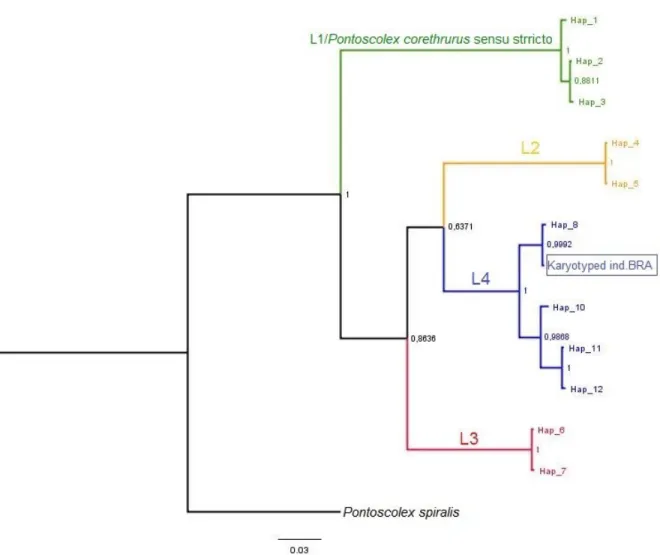
two cryptic lineages were found within P. corethrurus, I wondered if this pan-tropical invasive earthworm could be a complex of several species, where different species under the same morphology are widespread in different parts of the world. Subsequently, I was interested to know the invasion roads and the genetic structure of this invasive earthworm species in different populations throughout the world. It is noteworthy to mention that these issues have been rarely investigated for tropical peregrine earthworm species. Finally, I wondered if for P. corethrurus morphospecies a complex of species with different ploidy degrees exist (polyploid complex). These objectives were studied through four chapters.
Chapter 1: What do ‘positive’ and ‘negative’ impacts of invasive species depend on?
Context: Pontoscolex corethrurus, which is one of the most widespread earthworm species in
the tropical zone is one of the most studied in different disciplines of soil science. This species is specially known for its negative impacts on soil structure for strong soil compactions similar to bulldozer impacts but in some cases no compaction has been reported. A synthesis of all the studies done on this morphospecies is lacking.
Questions:
-What are the key traits in colonization success of P. corethrurus? -What are the impacts of this species when introduced in a new area?
-Can we find the proof of cryptic species existence in literature based on its impacts and responses to environment?
Approach: Bibliographic survey of 265 papers on all the present aspects of knowledge on P.
corethrurus from 1857 till 2017.
-This chapter was the subject of an article that has been published in the journal Soil Biology
and Biochemistry in January 2018.
Chapter 2: How many invasive lineages within the complex of species P. corethrurus?
Context: Two cryptic lineages within P. corethrurus morphospecies were found by Cunha et al. (2014) in a hostile environment i.e., a volcano caldera and in a pineapple plantation, on São Miguel Island of Azores archipelago. We wondered if in a world-wide scale we could find more cryptic species within this complex.
31
-What is the genetic structure and diversity within the P. corethrurus specimens?
-What is the phylogenetic placement of P. corethrurus type material, described for the first time by Fritz Müller (Müller, 1856) in 1856?
-Do we find quincunx formation of the setae at the last quarter of P. corethrurus body, for the other species in the genus Pontoscolex?
Approach: Phylogenetic and phylogenomic assessment using two mitochondrial (COI and 16S rDNA) and two nuclear (internal transcribed spacers 2 and 28S rDNA) markers and the approach of Anchored Hybrid Enrichment (AHE), accompanied with the examination of internal and external morphological characters.
- This article has been accepted for publication subject to minor revisions in Molecular
Phylogenetics and Evolution journal on 11th of December 2017.
Chapter 3: Phylogeography and population genetics of an invasive peregrine earthworm species
Context: This chapter aims to investigate the phylogeography and population genetics of the most widespread lineage belonging to the P. corethrurus complex in a world-wide scale.
Questions:
-Have the cryptic species in P. corethrurus complex reached reproductive isolation? -Has a ‘super-clone’ of the most invasive species in P. corethrurus complex invaded the world?
-What is the genetic diversity between the populations in the origin and invaded regions of of the most invasive species in P. corethrurus complex?
-What is the reproduction strategy of of the most invasive species in P. corethrurus complex?
Approach: Genotyping the specimens’ genome by AFLP method and re-used COI sequences from chapter two, to construct haplotypes network for of the most invasive species in P.
corethrurus complex.
-This chapter is presented in the form of an article that is in preparation for submission to the journal Diversity and Distributions.
Chapter 4: Ploidy degree of Pontoscolex corethrurus complex specimens
Context: Ploidy degree of P. corethrurus is still unknown despite being highly studied as a biological model in different disciplines. This information will help us understand the reproductive isolation between cryptic species within P. corethrurus complex. Meanwhile, it will help us to better define the type of molecular analysis (dominant or co-dominant markers), for future studies.
32
-What are the ploidy degrees of P. corethrurus complex species? -Does spermatogenesis exist for the specimens in this complex?
Approach: This chapter was done based on cytogenetics classical method.
33
II.
Chapter 1: What do ‘positive’ and ‘negative’ impacts of invasive
species depend on?
34
Synthesis of all the information available on an invasive earthworm species has never been done. This synthesis can give us valuable evidence on type of ecosystems a particular invasive species occupies, its impacts and responses to the environment, and the important characteristics which have made it a successful colonizer. Invasive earthworm species could alter soil structure and in some cases, have negative impacts which could be detrimental for agricultural crops. Thus, knowing their impacts in different types of ecosystems, could help us make appropriate decisions for control management policies of these species.
Pontoscolex corethrurus is one of the most studied invasive earthworm species in the tropical
zone. This species is found in a wide range of different types of ecosystems; pasture, forest, urban area, and plantations. In this chapter, we intended to gather all the information available in the literature on P. corethrurus. We were interested to understand the mechanisms of invasion success of this species. At the same time, we wanted to synthetize the impacts of this species on the ecosystems it invades, to understand if it has “negative” impacts as is mostly considered for invasive species. Finally, we wanted to search for possible differences among studies, that could be explained by the use of specimens belonging to different cryptic lineages for the experiments. This chapter has been published as a scientific review article in ‘Soil Biology and Biochemistry’ journal.
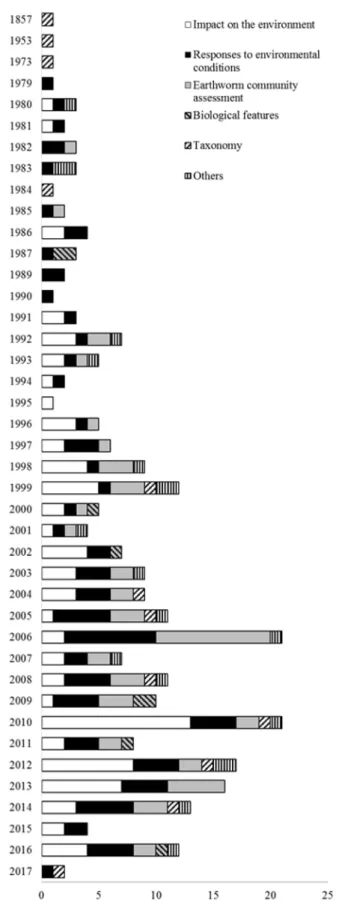
Bibliographic corpus on P. corethrurus was gathered from ISI Web of Science. Studies on this species were grouped into 6 major categories (Figure A 1): impact on the environment (33% of the studies), responses to environmental conditions (32%), earthworm community assessment (22%), biological features (3%), taxonomy (4%) and other subjects (i.e., genetics, biochemistry, geographical distribution and digestion) (6%). This chapter was realized by studying 265 articles. This study has been done in collaboration with Celine Pélosi, researcher of National Institute of Agronomic Research in France (INRA).
Figure A 1: Pie chart for the major study topics on Pontoscolex corethrurus based on Web of Science. “Impact on the environment” and “Responses to environmental conditions”, are the most studied topics on this species with 33% and 32%, respectively.
35
This article has been published in Soil Biology and Biochemistry journal in January 2018, situated in volume 116, pages 277-289. The title of this publication is: Harmful or useful? A case study of the exotic peregrine earthworm morphospecies Pontoscolex corethrurus.