HAL Id: tel-03118044
https://tel.archives-ouvertes.fr/tel-03118044
Submitted on 21 Jan 2021
HAL is a multi-disciplinary open access
archive for the deposit and dissemination of sci-entific research documents, whether they are pub-lished or not. The documents may come from teaching and research institutions in France or abroad, or from public or private research centers.
L’archive ouverte pluridisciplinaire HAL, est destinée au dépôt et à la diffusion de documents scientifiques de niveau recherche, publiés ou non, émanant des établissements d’enseignement et de recherche français ou étrangers, des laboratoires publics ou privés.
Target Shape Schemas
Jose Martin Lozano Aparicio
To cite this version:
Jose Martin Lozano Aparicio. Data Exchange from Relational Databases to RDF with Target Shape Schemas. Computer Science [cs]. Universite de Lille, Lille, FRA.; Universite de Lille, 2020. English. �tel-03118044�
Universit´e de Lille
Centre de Recherche en Informatique, Signal et Automatique de Lille Region Hauts-de-France
TH `
ESE
pr´esent´ee et soutenue le 14 d´ecembre 2020
Sp´ecialit´e : INFORMATIQUE
par
Jose Martin LOZANO APARICIO
Data Exchange from Relational
Databases to RDF with Target Shape
Schemas
´
Echange de donn´ees de bases de donn´ees relationnelles vers RDF avec
des sch´emas des constraintes sur cible
sous la direction de
Sławek STAWORKO
et
Iovka BONEVA
Jury :
Rapporteurs :
Jef W
IJSEN- Universit´e de Mons
Mirian H
ALFELD-F
ERRARI- Universit´e d’Orl´eans
Directeur :
Sławek S
TAWORKO- Universit´e de Lille
Co-encadrante :
Iovka B
ONEVA- Universit´e de Lille
Examinateurs :
Anne E
TIEN- Universit´e de Lille
i
Abstract: Resource Description Framework (RDF) is a graph data model which has
recently found the use of publishing on the web data from relational databases. We investigate data exchange from relational databases to RDF graphs with target shapes schemas. Essentially, data exchange models a process of transforming an instance of a relational schema, called the source schema, to a RDF graph constrained by a target schema, according to a set of rules, called source-to-target tuple generating cies. The output RDF graph is called a solution. Because the tuple generating dependen-cies define this process in a declarative fashion, there might be many possible solutions or no solution at all. We study constructive relational to RDF data exchange setting with target shapes schemas, which is composed of a relational source schema, a shapes schema for the target schema, a set of mappings that uses IRI constructors. Furthermore, we assume that any two IRI constructors are non-overlapping.
We propose a visual mapping language (VML) that helps non-expert users to spec-ify mappings in this setting. Moreover, we develop a tool called ShERML that performs data exchange with the use of VML and for users that want to understand the model be-hind VML mappings, we define R2VML, a text-based mapping language, that captures VML and presents a succinct syntax for defining mappings.
We investigate the problem of checking consistency: a data exchange setting is con-sistentif for every input source instance, there is at least one solution. We show that the consistency problem is coNP-complete and provide a static analysis algorithm of the setting that allows to decide if the setting is consistent or not.
We study the problem of computing certain answers. An answer is certain if the answer holds in every solution. Typically, certain answers are computed using a uni-versal solution. However, in our setting a uniuni-versal solution might not exist. Thus, we introduce the notion of universal simulation solution, which always exists and allows to compute certain answers to any class of queries that is robust under simulation. One such class is nested regular expressions (NREs) that are forward i.e., do not use the in-verse operation. Using universal simulation solution renders tractable the computation of certain answers to forward NREs (data-complexity).
Finally, we investigate the shapes schema elicitation problem that consists of con-structing a target shapes schema from a constructive relational to RDF data exchange setting without the target shapes schema. We identity two desirable properties of a good
target schema, which are soundness i.e., every produced RDF graph is accepted by the target schema; and completeness i.e., every RDF graph accepted by the target schema can be produced. We propose an elicitation algorithm that is sound for any schema-less data exchange setting, but also that is complete for a large practical class of schema-less settings.
Keywords: Data Exchange, Shapes Schema, Certain Query Answering, Consis-tency, Visual Mapping Language, Schema Elicitation
iii
R ´esum ´e: Resource Description Framework (RDF) est un mod`ele de graphe utilis´e pour
publier des donn´ees sur le Web `a partir de bases de donn´ees relationnelles. Nous ´etudions l’´echange de donn´ees depuis des bases de donn´ees relationnelles vers des graphes RDF avec des sch´emas de formes cibles. Essentiellement, ´echange de donn´ees mod´elise un processus de transformation d’une instance d’un sch´ema relationnel, appel´e sch´ema source, en un graphe RDF contraint par un sch´ema cible, selon un ensemble de r`egles, appel´e tuple source-cible g´en´erant des d´ependances. Le graphe RDF obtenu est appel´e une solution. ´Etant donn´e que les d´ependances g´en´erant des tuple d´efinissent ce processus de mani`ere d´eclarative, il peut y avoir de nombreuses solutions possibles ou aucune solution du tout. Nous ´etudions le syst`eme d’´echange de donn´ees relation-nel avec RDF constructive avec des sch´emas de formes cibles, qui est compos´e d’un sch´ema source relationnel, un sch´ema de formes pour le sch´ema cible, un ensemble de mappages utilisant des constructeurs IRI. De plus, nous supposons que deux construc-teurs IRI ne se chevauchent pas.
Nous proposons un langage visuel pour l’sp´ecification des correspondances (VML) qui aide les utilisateurs non experts `a sp´ecifier des mappages dans ce syst`eme. De plus, nous d´eveloppons un outil appel´e ShERML qui effectue l’´echange de donn´ees avec l’utilisation de VML et pour les utilisateurs qui souhaitent comprendre le mod`ele derri`ere les mappages VML, nous d´efinissons R2VML, un langage texte, qui capture VML et pr´esente une syntaxe succincte pour d´efinition des mappages.
Nous ´etudions le probl`eme de la v´erification de la consistance: un syst`eme d’´echange de donn´ees est consistent si pour chaque instance de source d’entr´ee, il existe au moins une solution. Nous montrons que le probl`eme de consistance est coNP-complet et four-nissons un algorithme d’analyse statique du syst`eme qui permet de d´ecider si le syst`eme est consistent ou non.
Nous ´etudions le probl`eme du calcul de r´eponses certaines. Une r´eponse est certain si la r´eponse tient dans chaque solution. En g´en´erale, r´eponses certaines sont calcul´ees en utilisant d’une solution universelle. Cependant, dans notre contexte, une solution universelle pourrait ne pas exister. Ainsi, nous introduisons la notion de solution de simulation universelle, qui existe toujours et permet de calculer certaines r´eponses `a n’importe quelle classe de requˆetes robustes sous simulation. Une de ces classes sont les expressions r´eguli`eres imbriqu´ees (NRE) qui sont forward c’est-`a-dire qui n’utilisent
pas le op´eration inverse. L’utilisation d’une solution de simulation universelle rend traitable le calcul de r´eponses certaines pour les NRE (data-complexity).
Enfin, nous ´etudions le probl`eme d’extraction de sch´ema des formes qui consiste `a construire un sch´ema de formes cibles `a partir d’un syst`eme constructif d’´echange de donn´ees relationnel vers RDF sans le sch´ema de formes cibles. Nous identifions deux propri´et´es souhaitables d’un bon sch´ema cible, qui sont la correction c’est-`a-dire que chaque graphe RDF produit est accept´e par le sch´ema cible; et la compl´etude c’est-`a-dire que chaque graphe RDF accept´e par le sch´ema cible peut ˆetre produit. Nous proposons un algorithme d’extraction qui convient `a tout syst`eme d’´echange de donn´ees sans sch´ema, mais qui est ´egalement complet pour une grande classe pratique de syst`emes sans sch´ema.
Mots-cl´es: ´Echange de donn´ees, sch´ema de formes, calcul des r´eponses certaines, consistance, langage visuel pour la sp´ecification des correspondances, extraction de sch´ema
Acknowledgements
First and foremost, I am grateful to the almighty God for blessing and guiding me in all the works performed for the completion of this research thesis work with his presence to complete successfully. Each moment during the course of this work, I experienced the grace of our Lord Jesus Christ, who continuously enhanced my intelligence even at the moments of despair, inspired me to move forward, opened before me unexpected avenues and enlightened my thoughts with His wisdom. Also, I am grateful to the Blessed Virgin Mary and all saints in heaven who with their intercession I obtained the perseverance to finish this thesis.
I would like to express gratitude to my supervisor Dr. Sławek Staworko and co-advisor Dr. Iovka Boneva. I appreciate their simplicity and art of feeding knowledge patiently to bring out the researching capability and deliver my research product suc-cessfully all through the endeavour.
This research benefits from the support of the R´egion Hauts-de-France by a grant from CPER Nord-Pas de Calais/FEDER DATA Advanced data science and technologies 2015-2020 and by the ANR project DataCert ANR-15-CE39-0009.
Last but not least, I would be glad to thank my dear parents, Nilda and Walter, and my dear wife, Edith. My immense gratitude to them, for their encouragement and advice. Their support throughout the years has been unwavering.
Contents
Contents vii
1 Preliminaries 9
1.1 Logic . . . 9
1.2 Relational databases . . . 13
1.2.1 Relational schema and dependencies . . . 16
1.2.2 Logic formalization . . . 18
1.2.3 Database queries . . . 20
1.3 Relational data exchange . . . 22
1.3.1 Data exchange setting . . . 25
1.3.2 Chase procedure . . . 26
1.3.3 Universal solution . . . 34
1.3.4 Certain query answering . . . 37
1.3.5 Consistency . . . 40
1.4 Resource description framework . . . 41
1.4.1 RDF graph . . . 44
1.4.2 Logic formalization . . . 45
1.5 Schemas for RDF graphs . . . 45
1.5.1 Typed RDF graph . . . 50
1.5.2 Shape constraints language . . . 50
1.5.3 Logic formalization . . . 52
1.5.4 Shape constraints as dependencies . . . 53
2 Relational to RDF data exchange 57 2.1 Relational to RDF data exchange setting . . . 57
2.2 R2RML: proof of concept . . . 64
2.3 Problems of interest . . . 68
2.3.1 Checking consistency . . . 69
2.3.2 Computing certain answers . . . 69
2.3.3 Visual mapping language . . . 70
2.3.4 Schema elicitation . . . 71
2.4 Related work . . . 73
3 Consistency 75 3.1 The opposite side of consistency: inconsistency . . . 75
3.1.1 Sources of inconsistency . . . 78
3.1.2 Importance of core pre-solution . . . 79
3.2 Value consistency . . . 79
3.2.1 Testing value consistency . . . 80
3.3 Node kind consistency . . . 95
3.3.1 Co-typing of a data exchange setting and co-typing graph . . . . 97
3.3.2 Co-typing of a graph . . . 98
3.3.3 Formalization . . . 101
3.3.4 Necessary condition . . . 101
3.3.5 Algorithm for testing node kind consistency . . . 102
3.4 Deciding consistency . . . 104
3.4.1 Decidability . . . 105
3.5 Conclusion . . . 110
3.6 Related work . . . 111
4 Certain query answering 113 4.1 Motivation and problems . . . 113
4.2 Results from existing approaches . . . 114
4.2.1 Super-weakly acyclic tgds . . . 114
4.2.2 Guarded tgds . . . 120
4.3 Simulation-based approach . . . 121
4.3.1 Preliminar notions . . . 121
CONTENTS ix
4.3.3 Robust query classes . . . 124
4.3.4 Universal simulation solution . . . 126
4.4 Conclusion . . . 135
4.5 Related work . . . 136
5 Visual mapping language 141 5.1 Motivation and use case . . . 141
5.2 Preliminary notions . . . 144
5.3 The intermediary language . . . 145
5.4 The visual mapping language . . . 149
5.5 ShERML . . . 154 5.5.1 Architecture . . . 154 5.5.2 VML Editor . . . 155 5.5.3 Materializer . . . 158 5.5.4 Converter . . . 160 5.5.5 Consistency checking . . . 161 5.5.6 Additional features . . . 162 5.6 Evaluation . . . 163 5.6.1 Methodology . . . 163 5.6.2 Results . . . 164
5.7 Discussion and conclusion . . . 166
5.8 Related work . . . 166
6 Shapes schema elicitation 171 6.1 Motivation . . . 171
6.2 Problem statement . . . 175
6.2.1 Schema-less data exchange setting . . . 175
6.2.2 Elicitation Problem . . . 178 6.3 M3 Elicitation algorithm . . . 179 6.3.1 Preliminary notions . . . 182 6.3.2 Algorithm . . . 190 6.4 Soundness . . . 191 6.5 Completeness . . . 193
6.6 Negative results . . . 202 6.7 Conclusion . . . 205 6.8 Related work . . . 206
Introduction
Motivation
Resource Description Framework (RDF) [Lassila & Swick 1999] is a well-established format that finds usage as data exchange language between web applications [Baker et al. 2012]. In many of these web applications, the data is exported from relational databases as evidenced by the proliferation of languages for mapping relational databases to RDF, such as R2RML [Das et al. 2011], direct mapping (DM) [Arenas et al. 2012] or YARRRML [Heyvaert et al. 2018] .
Take for instance R2RML [Das et al. 2011], which is a declarative mapping lan-guage recommended by W3C that allows the customization of what information from a relational database is relevant to be exported to RDF. As an example, consider the two following R2RML mappings, themselves in RDF format presented in Turtle syntax, exporting data about employees and departments from a relational database to RDF.
<#DeptMap>
rr:logicalTable[ rr:tableName “Dept”];
rr:subjectMap[rr:template “dept:{did}”; rr:class :TDept];
rr:predicateObjectMap[rr:predicate :name; rr:objectMap[rr:column “name”]].
<#EmpMap>
rr:logicalTable[ rr:sqlQuery “SELECT eid, name, email, did
FROM Emp NATURAL JOIN Email ”]; rr:subjectMap[rr:template “emp:{eid}”; rr:class :TEmp];
rr:predicateObjectMap[rr:predicate :name; rr:objectMap[rr:column “name”]]; rr:predicateObjectMap[rr:predicate:email; rr:objectMap [ rr:column “email”]];
rr:predicateObjectMap [rr:predicate :works; rr:objectMap[rr:template “dept:{did}”]];
In general, R2RML maps data from relational tables or query outputs and produces set of triples using templates for subjects, explicitly stated predicate names, and for objects either literal values coming from columns or templates. Additionally, a type for the subject can be declared. For instance, the first mapping maps data from relation Dept (did , name) into a set of triples with predicate :name. For every department, it creates a dedicated Internationalized Resource Identifier (IRI) and the class (rr:class) of each department IRI is declared as :TDept.
RDF has been originally proposed schema-less to promote its adoption but the need for schema languages for RDF has been since identified and deemed particularly im-portant in the context of exchange of data between applications [Gayo et al. 2017, W3C 2013]. Having schema allows to validate RDF graphs and one of the benefits of working with data conforming to a schema is an increased execution safety: applica-tions need not to worry about handling malformed or invalid data that could otherwise cause undesirable and difficult to predict side-effects.
One family of proposed schema formalisms for RDF is based on shape constraints. This class includes shape constraint language (SHACL) [Knublauch & Kontokostas 2017, Corman et al. 2018] and shape expressions schemas (ShEx) [Prud’hommeaux et al. 2018, Boneva et al. 2017, Staworko et al. 2015]. The two languages allow to define a set of types that impose structural constraints on nodes and their immediate neighborhood in an RDF graph. For instance, the types :TEmp and :TDept have the following ShEx definition
:TDept { :name xsd:Literal; :address xsd:Literal}
:TEmp { :name xsd:Literal; :email xsd:Literal?; :works @:TDept+ }
(where xsd:Literal is a new datatype that we introduce to XSD vocabulary). Essentially, every department IRI must have exactly one :name and :address property; and every employee IRI must have a single :name property, an optional :email property, and at least one :works property each leading to a department IRI (satisfying type :TDept).
We are considering the task of converting databases to RDF graphs. It is typically accomplished by a declarative formalism such as R2RML, DM, or YARRRML. Because of the importance of schema for RDF, we also require a target schema in any of the
CONTENTS 3 declarative formalisms. As a consequence of this lastly consideration, the following concerns arise:
1. Conceptual complexity of designing mappings in particular when schemas are large can become easily an error-prone process. Can we offer static analysis tools for identification of design errors.
2. The existence of a schema and the fact that mappings are expressed in a declara-tive way makes possible existence of different solutions to a given input. Which solution is most suitable and if it exists, can it be constructed, what can be said about querying such a solution.
3. The mapping needs to be specified using a formal language which can be chal-lenging to a non-expert user. Can we render this process more accessible while maintaining expressivity.
4. Many already existing solutions of exporting relational to RDF data only consider relational schema and mappings with no target schema. Can we propose a way to construct a schema and what is the good schema to the output graphs.
Formalization
We approach the above concerns by first formalizing the export of relational data to RDF as a data exchange problem. Data exchange has been mainly studied in the context of relational databases [Kolaitis 2005, Arenas et al. 2010, Barcel´o 2009]. Data exchange from relational databases to RDF has been studied recently [Sequeda et al. 2012,Boneva et al.2015], but with little to no schema information for the output RDF graph. None of these previous works can be used to address precisely the setting we have at hand.
In this manuscript, we formalize the process of exporting a relational database to RDF with target schema as a constructive data exchange setting where we use source-to-target generating dependencies as mappings. These mappings use an abstraction of IRI templates which we call IRI constructors to map entities from the relational database to IRIs in the RDF.
R2RML mappings presented at the beginning of this section can be expressed with the following logical formalism
Dept (did , name) ⇒ Triple(dep2iri (did),:name, name) ∧ TDept(dep2iri (did)), Emp(eid , name, did ) ∧ Email (eid , email ) ⇒
Triple(emp2iri (eid),:name, name) ∧ Triple(emp2iri (eid),:email, email ) ∧ Triple(emp2iri (eid),:works, dep2iri (did )) ∧ TEmp(emp2iri (eid)),
where dep2iri (did) = "dept:{did }" constructs an IRI for each department and the other IRI constructor emp2iri (eid) = "emp:{eid }" generates an IRI for each em-ployee.
This formalization trivially captures direct mapping (DM) [Arenas et al. 2012], large fragment of R2RML, and YARRRML since it is a succinct syntax for R2RML. Indeed, this formalization can express all four uses cases of R2RML [Auer et al. 2010] and it can cover 38 out of 54 test cases for R2RML implementations [Villaz´on & Hausen-blas 2012]. The test cases that we do not cover are those that use pattern-based function to transform data values and we do not cover those that use SQL statements with ag-gregation functions. With this formalization, we address 8 out of the 11 core function requirements for R2RML [Auer et al. 2010]. A relatively straightforward extension of this formalization to node datatypes can cover 10 out of the 11 core function re-quirements. However, for relative simplicity, we do not study our formalization with datatypes.
Problems of interest
In this manuscript, we employ the above formalization and address the previously iden-tified concerns by studying the following problems of interest.
Checking Consistency. A classical static analysis problem is testing consistency:
check-ing whether for a given source instance of a relational schema there will be always a well-defined target instance. If the setting is inconsistent then there is possible error in the designing of mapping. Then, the static analysis allows to find errors and if it
identi-CONTENTS 5 fies conditions that generate inconsistency then it is conceivable to extend to other kind of static analysis. This problem is complex because the source and target languages express constraints differently in an incompatible way. Additionally the mappings can add new constraints. In fact, we can view the problem of checking consistency as a variant of the problem of language containment i.e., does the language of the shapes schema contains the language of graphs produced from the source schema by applying the mappings.
Certain query answering and universal solutions. Certain answers allow to identify the
important answers because they are present in every solution. As such, we are interested in finding a good solution that has the property of allowing to easily compute certain answers. Thus, we study the problem of certain query answering where certain answers typically are computed on a universal solution because it preserves information [Fagin et al. 2005a]. However, in the context of relational to RDF data exchange, a finite universal solution might not exist even if the setting is consistent and admits solutions. Thus, an interesting problem is to check if it is possible to construct a finite solution that has similar properties to a universal solution and to identify the family of queries for which it can be used to compute certain query answers. Also, we are interesting in a low complexity for the construction of this finite solution.
Visual mapping language. It has been argued [Shneiderman 1983] that a simple
graph-ical interface facilitates the specification of mappings by the direct manipulation with drag-and-drop techniques and a visual language. Those kind of visual mapping lan-guages are known to be easy for non-expert users as evidenced by Clio system [Fagin et al. 2009]. The challenge in this problem comes in identifying the trade-off between simplicity and expressivisity. The goal is to provide an interface based on a visual map-ping language that is easy to use but does not hinder users with unnecessary details while allows to cover the most possible number of use cases or it is expressible as possible.
Schema elicitation. Shapes schema elicitation aims at constructing a target schema
from a set of mappings and a relational schema. An important issue in this construction is to define the properties of the desired target schema because there can be trivial solu-tions that produce a schema. For instance, solusolu-tions that produce universal schemas that accept any graph and not only graphs produced by the mapping. We want an algorithm
that makes an honest effort in capturing the structure of the graphs produced.
Contributions
In this section, we describe the contributions presented to solve the problems above.
Consistency. We have solved the problem of consistency by identifying a set of
nec-essary and sufficient conditions that guarantees the consistency. This characterization aims at constructing an inconsistent instance. One such condition is value consistency that guarantees that no two different values are equated to satisfy the shapes schema. For instance, in the previous example, an employee that has two different names is an example of value inconsistency. On the other hand, a mapping rule may declare the type of nodes it constructs as IRI or literal. A malformed set of rules may inconspic-uously produce a graph with a node whose declared type is both IRI node and literal node. The condition of node kind consistency guarantees the no co-occurrence of literal and non literal types for a node. We have developed an static analysis tool that allows to decided if a setting is consistent. The complexity of checking those conditions is coNP-complete. Initial findings have been published in AMW [Boneva et al. 2018] and further developed in ADBIS [Boneva et al. 2020].
Certain query answering. We have proposed a novel notion of universal simulation
so-lution, which is an adaptation of universal solution by replacing homomomorphisms with a weaker notion of simulation. A universal simulation solution always exists and it allows to compute certain answers to classes of queries that are robust under simulation. Intuitively, a robust query class is when a query is evaluated on a node, the query will behave in a same way under any node that is simulated. We can construct a minimal-size universal simulation solution to a given instance of the relational schema w.r.t. a constructive setting is exponential in the size of the shapes schema. If we consider the class of nested regular expressions, which are used as a navigational query language by SPARQL [P´erez et al. 2010] to query RDF, then the forward fragment is robust under simulation. The data complexity of computing certain answers for nested regular ex-pressions and any constructive data exchange setting is PTIME. We have published this result in ADBIS [Boneva et al. 2020].
CONTENTS 7
Visual mapping language. We have proposed a visual mapping language (VML) that
covers a large fragment of constructive relational to RDF data exchange setting. Also, we have developed ShERML, a tool that guides a user through interactive functionali-ties in the process of exporting relational data to RDF. In addition, we have proposed R2VML, a declarative mapping language that captures VML mappings and presents a user-friendly and succinct syntax for defining mappings. We have published the result related to the visual mapping language in ISWC [Boneva et al. 2019].
Shapes schema elicitation. We have investigated the problem of shapes schema
elici-tation and we have identified two desirable properties of the target schema, which are soundnessi.e., every produced RDF graph is accepted by the target schema; and com-pletenessi.e., every RDF graph accepted by the target schema can be produced. We have proposed an algorithm called M3, based on a method of minimal and maximal models, that produces a sound schema for any relational schema and set of mappings. We have shown that for relational schemas and mappings that are the result of the straightforward translation of a class of ER diagrams, the schema produced by M3 is also complete. Finally, we have presented two inherent limitations of the task at hand: a sound and complete schema might be of exponential size or worst even it might not exist. We are currently preparing for publication.
Organization
In this section, we describe briefly the content of each chapter of the manuscript.
Preliminaries. Chapter 1 provides the basic definitions and notations used throughout
this manuscript. First, we recall the notions of signatures, models, semantics and classes of formulas. Second, relational databases and dependencies are introduced with the definition and formalization of them. Third, we describe the concepts that are related to relational data exchange setting, which are chase, universal solution, certain query an-sweringand consistency. Fourth, RDF is presented and formalized. Finally, we present the shapes constraints language and show how these constraints can be expressed with dependencies.
ex-change setting. We present its formalization and define what is a solution to our setting. Also, we present R2RML and show which part of it is captured by our setting, and how this is captured. We end with an introductory presentation of the problems of interest.
Consistency. Chapter 3 provides the study of consistency problem. First, we identify
the sources of inconsistency by an example. Then, we present two conditions that will guarantee the absence of the source of inconsistency. Each condition is shown to be necessary for deciding consistency and an algorithm is presented for each condition to identify if the setting satisfies it. At the end of the chapter, we show that consistency is decidable.
Certain query answering. Chapter 4 provides the study of certain query answering
prob-lem. We start with an adaptation of two existing approaches to the problem of certain query answering. Then, we present our approach that investigates forward nested regu-lar expressions and introduces the notion of a universal simulation solution that allows to compute certain answers efficiently. We present the construction of a size-minimal universal simulation solution and show that its size is polynomial in the size of the source instance, but might be exponential in the size of the constraints.
Visual mapping language. Chapter 5 provides a tool that defines visual mappings. The
notions of human-computer interaction used to develop the tool are described at the be-ginning. Then, a text-based mapping language is defined and on top of this language is defined a visual mapping language. Based on these languages, we describe the tool de-veloped for facilitating the definition of mappings in a relational to RDF data exchange context. We do an evaluation of the tool and present its results.
Shapes schema elicitation. Chapter 6 defines the shapes schema elicitation problem
where the notions of soundness and completeness of a desirable target schema are de-fined. An elicitation algorithm is proposed based on minimal and maximal models described in the same section. Then, we show the soundness of the algorithm. We identify a class where the proposed algorithm is complete. Finally, we present inherent limitations of the task of producing sound and complete schema.
Chapter 1
Preliminaries
In this chapter, we recall the basic concepts and introduce the notation that will be used throughout this manuscript. We start in Section 1.1 by recapping fundamentals of logic. In Section 1.2, we recall basic notions of relational databases. Next, we describe a general notion of relational data exchange in Section 1.3. Then we describe RDF graphs and their formalization in Section 1.4. Finally, in Section 1.5, we discuss the notion of schemas for RDF graphs and introduce an abstraction formalism that captures a common fragment of two well-known schemas ShEx and SHACL.
1.1
Logic
We fix an enumerable set Dom of constant values. Because we deal with relational databases and RDF graphs in this manuscript, we need to distinguish for RDF, nodes and literals where nodes and literals can have null values; and we need to distinguish for relational databases, constants and null values. Thus, we specify the domain to be partitioned into three infinite subsets Dom = Iri ∪ Lit ∪ Blank, of IRIs, literals, and blank node identifiers respectively. Because relational databases deal with null values that are not blank nodes, we assume an infinite set of null literals NullLit ⊆ Lit for relational databases; and the set of all null values Null = NullLit ∪ Blank. We refer to the remaining elements as constants Const = Dom \ Null, and additionally, because relational databases use constants that are neither IRIs nor null literals, we identify non-null literals ConstLit = Lit \ NullLit = Const ∩ Lit.
The relational vocabulary is an enumerable set of symbols V = Va∪ VR ∪ Vf
partitioned into three pair-wise disjoint subsets: the set of first-order namesVa, the set
of relation namesVR, and the set of function namesVf. In our formulas, we are going
to use names of the constant values of Dom. So, we specify the set of first-order names, Va = VV ∪ Dom as a set of variable names VV and a set of names of the domain
corresponding to IRIs, literals and blank nodes.
For a function name or relational name, the number of inputs is called the arity of the function or relational name. We assume that each relation and function name come with a fixed arity. In the sequel, byVR(m)we denote the set of relation names of arity m, and analogously, byVf(n)we denote the set of function names of arity n. Every element of the vocabulary has its domain, the set of compatible values:
dom(v) = Dom, dom(R) = 2Domm, dom(f ) = DomDomn, dom(c) = {c} for any v ∈VV, c ∈ Dom, R ∈VRwith arity m, and for any f ∈Vf with arity n. We
point out that the domain of a constant symbol is the same constant value.
Syntax. A term is defined by the following recursive syntax:
t ::= a | f (t, . . . , t)
where a ∈Va, and f ∈Vf. A formula is defined with the following syntax:
ϕ ::= R(t, . . . , t) | ¬ϕ | ϕ ∧ ϕ | ∃v. ϕ | t = t
where R ∈VR, t is a term, and v ranges overV \ Vf. We use the following
syntactic-sugar:
∀v. ϕ ::= ¬∃v. ¬ϕ, ϕ ∨ ψ ::= ¬(¬ϕ ∧ ¬ψ), ϕ ⇒ ψ ::= ¬ϕ ∨ ψ.
Signatures and models. A relational signature R ⊆ V is a finite set of symbols. A
relational structureofR, or a model of R, is a function M that assigns to every symbol v ∈ R a compatible value vM ∈ dom(v). In essence, relational signature identifies a set of names whose interpretation is provided by a model. The size of a signatureR, denoted by |R|, is the number of symbols in the signature.
1.1. LOGIC 11 The union of two models M1 of R1 and M2 of R2, whose signatures are disjoint
R1∩R2 = ∅, is a model M1∪M2ofR1∪R2defined as follows (for any v ∈ R1∪R2):
vM1∪M2 = vM1 if v ∈R 1, vM2 if v ∈R 2.
Given two models M1 ofR1 and M2 ofR2, M1 is compatible with M2 if for all v ∈
R1∩ R2, vM1 = vM2. The merge of two compatible models M1 ofR1 and M2 ofR2
is a model M1] M2 ofR1∪ R2 defined as follows (for any v ∈R1 ∪ R2):
vM1]M2 = vM1 if v ∈R 1, vM2 if v ∈R 2\ R1.
A term over a signatureR is defined with
t ::= a | f (t, . . . , t)
where a ∈ Va∩ R, and f ∈ Vf ∩ R. A formula over a signature R is defined with:
ϕ ::= R(t, . . . , t) | ¬ϕ | ϕ ∧ ϕ | ∃v. ϕ | t = t
where R ∈VR∩R, t is a term over R, and v ∈ VV∪(Va∩R). Implicitly, all signatures
will allow to use equality symbol =.
Classes of formulas. We point out that any symbol inV can serve the purpose of a
vari-able, in particular the symbol present in a relational signatureR can also be bound with a quantifier (overriding whatever interpretation the structure assigns to this symbol). We identify the set of symbols used in a term as follows:
Vocab(a) = {a}
Vocab(f (t1, . . . , tn)) = {f } ∪
Sn
and the set of symbols used in a formula,
Vocab(R(t1, . . . , tm)) = {R} ∪
Sm
i=1Vocab(ti), Vocab(¬ϕ) = Vocab(ϕ),
Vocab(ϕ1∧ ϕ2) = Vocab(ϕ1) ∪ Vocab(ϕ2), Vocab(∃v. ϕ) = Vocab(ϕ),
Vocab(t1 = t2) = Vocab(t1) ∪ Vocab(t2).
Similarly, we can identify the set of unbound symbols used in a formula
Unbd (R(t1, . . . , tm)) = {R} ∪
Sm
i=1Vocab(ti), Unbd (¬ϕ) = Unbd (ϕ),
Unbd (ϕ1∧ ϕ2) = Unbd (ϕ1) ∪ Unbd (ϕ2), Unbd (∃v. ϕ) = Unbd (ϕ) \ {v},
Unbd (t1 = t2) = Vocab(t1) ∪ Vocab(t2)
Now, letR be a relational signature and ϕ a formula over R. The set of variables used in ϕ is varsR(ϕ) = Vocab(ϕ) \ R. The set of free variables of a formula ϕ is
fvarsR(ϕ) = Unbd (ϕ) \ R. The formula ϕ is closed iff it has no free variable i.e., fvarsR(ϕ) = ∅. An atomic formula has the form R(t, . . . , t), where R ∈ VR. A
formula is ground if it uses no variables whatsoever. A relational atom does not use any function symbols. A fact is a ground relational atom. A first-order (FO) formula over R uses only first-order variables i.e., varsR(ϕ) ⊆ Va. A second-order (SO) formula
overR uses second-order variables in addition to first-order variables i.e., varsR(ϕ) ⊆
Va ∪ VR ∪ Vf. A monadic SO logic (MSO) formula over R uses no second-order
functional variable and no second-order relational variable of arity higher than 1 i.e., varsR(ϕ) ⊆ V
(1)
R ∪Va. An existential second-order (∃SO) formula overR has the form
ϕ = ∃X1, . . . , Xn. ϕ, where X1, . . . , Xn ∈ VR∪ Vf, and ϕ does not have a quantifier
with a second-order variable inVR∪ Vf. If furthermore, all X1, . . . , Xn∈ V (1)
R , then ϕ
is an existential monadic SO (∃MSO) formula.
Semantics. We define the entailment relation between a relational structure M ofR
and a formula ϕ overR. First, we define an expression E over R as any term, variable name, function name or relation name. We identify the free variables V ⊆ fvarsR(E) of an expression. A valuation of V is a function θ that takes a symbol v ∈ V and yields a value in dom(v). By ∅ we denote the empty valuation of the empty set of symbols. Given a valuation θ of V , a symbol v ∈ V \ R, and a value w ∈ dom(v), θ[v/w] is
1.2. RELATIONAL DATABASES 13 valuation θ0of V ∪ {v} such that θ0(v) = w and θ0(z) = θ(z) for any z ∈ V \{v}. Given a relational signatureR, a model M of R, an expression E over R and a valuation θ of V such that fvarsR(E) ⊆ dom(θ) where dom returns the domain of θ, the interpretation of E w.r.t. θ and M is defined as follows:
v(M,θ) = vM if v ∈ Dom θ(v) Otherwise. for any v ∈ V, R(M,θ) = RM if R 6∈ dom(θ) θ(R) Otherwise. for any R ∈ V , f(M,θ) = fM if f 6∈ dom(θ) θ(f ) Otherwise. for any f ∈ V , f (t1, . . . , tn)(M,θ) = f(M,θ)(t(M,θ)1 , . . . , t (M,θ) n ) t(M,θ) = v(M,θ) if t = v, f (t1, . . . , tn)(M,θ) Otherwise.
for any term t.
Below, we define the entailment relation (M, θ) |= ϕ of a formula ϕ over R w.r.t. a model M ofR and a valuation such that dom(θ) ⊆ fvarsR(ϕ) is defined as follows:
(M, θ) |= R(t1, . . . , tn) iff (t (M,θ) 1 , . . . , t (M,θ) n ) ∈ R (M,θ),
(M, θ) |= ¬ϕ iff it is not true that (M, θ) |= ϕ, (M, θ) |= (ϕ1∧ ϕ2) iff (M, θ) |= ϕ1and (M, θ) |= ϕ2,
(M, θ) |= ∃v. ϕ iff (M, θ[v/w]) |= ϕ for some w ∈ dom(v). (M, θ) |= t1 = t2 iff (M, θ) |= t
(M,θ) 1 = t
(M,θ) 2 .
Finally, we say that ϕ is satisfied in M , in symbols M |= ϕ iff (M, ∅) |= ϕ.
1.2
Relational databases
We recall the basic notions of relational databases [Garcia-Molina et al. 2009]. A rela-tional database is a collection of tables where each table has a name and each column
of a table also has a name called attribute. From the modeling point of view, a table is seen as a relation. Each table gives some structural information on the relation, and the whole structural information of all relations is called the schema. Each row of the table is called a tuple and stores the attribute values. The set of tuples is the content of a table and the content of the whole database is called an instance. The schema also includes a set of constraints, which defines consistency of the instance. Here, we focus only on functional dependencies and inclusion dependencies. We illustrate the above notions with the following example.
Example 1.2.1. Consider the database in Figure 1.1 of an academic institute that or-ganizes conferences. Figure 1.1 shows an instance together with a schema including primary keyswhich are the attributes that are underlined and foreign keys which are rep-resented with arrows. This database stores information structured in a set of tables about researchers that have attended conferences, presented talks and for each talk stores the collaborators. This information is structured in the following tables:
• Table Researcher stores researchers with their name, email, expertise and team. • Table UniTeam stores teams associated to a university and located in a place. • Table Conference stores conferences with their name, year and place.
• Table Registration stores the date when a researcher is registered in a conference. • Table Talk stores the title of a researcher talk done in a conference;
• Table Collaborator stores tuples that indicate a researcher that has collaborated in a paper presented in a talk.
The schema of the conference database is composed of the relations that are the tables presented above and defines the following set of constraints:
(R1) every researcher and every conference have a unique identifier; (R2) every team of a university is identified by a unique name;
(R3) every collaborator is identified by a unique research ID, conference ID, title, and other research ID;
1.2. RELATIONAL DATABASES 15 Researcher
Idr Name Email Expertise Team
1 Jose Lozano [email protected] Maths ALG
2 Edith Tupac [email protected] Logic Pi
3 Steve [email protected] Algebra ALG
4 Bernard [email protected] Geometry Pi
UniTeam Team University
Place Pi University of Lille Lille ALG University of Lille Lille
Conference
Idc Name Year Place
1 ICDT 2019 Lille
2 ISWC 2019 Chile
Registration
Idr Idc Date
1 1 03-10-19
3 2 16-10-19
Talk
Idr Idc Title
1 1 Tutoring Web math platform 1 1 Skolemization of prenex formulas 3 2 On algebraic connectivity of graphs
Collaborator
Idr Idc Title Idrc
1 1 Tutoring Web math platform 4
3 2 On algebraic connectivity of graphs 2
Figure 1.1: Database instance of conference schema.
(R4) every registration and every talk are identified by a unique pair of research ID and conference ID;
(R5) every registration has a reference to the relation Researcher and a reference to the relation Conference;
(R7) every collaborator has a reference to the relation Talk and a reference to the rela-tion Researcher; and
(R8) every researcher has a reference to the relation UniTeam.
We can create the schema of the conference database in RDBMS using SQL syntax as shown in Figure 1.2. The primary keys in RDBMS are rules from R1 to R4, and the foreign keys are rules from R5 to R8.
CREATE TABLE UniTeam (
Team varchar,
University varchar, Place varchar,
PRIMARY KEY (Team,University)
);
CREATE TABLE Conference (
Idc int, Name varchar, Year date, Place varchar,
PRIMARY KEY(Idc)
);
CREATE TABLE Registration (
Idr int, Idc int,
Date date,
PRIMARY KEY (Idr,Idc),
FOREIGN KEY (Idr)
REFERENCES Researcher(Id),
FOREIGN KEY (Idc)
REFERENCES Conference(Id) );
CREATE TABLE Talk (
Idr int, Idc int,
Title varchar,
PRIMARY KEY (Idp,Idc,Title),
FOREIGN KEY (Idr,Idc)
REFERENCES Registration(Idr,Idc) );
CREATE TABLE Researcher (
Idr int, Name varchar, Email varchar, Expertise varchar, Team varchar,
PRIMARY KEY(Idr),
FOREIGN KEY (Team)
REFERENCES UniTeam(Team) );
CREATE TABLE Collaborator (
Idr int, Idc int,
Title varchar, Idrc int,
PRIMARY KEY (Idr,Idc,Title,Idrc),
FOREIGN KEY (Idr,Idc,Title)
REFERENCES Talk(Idr,Idc,Title),
FOREIGN KEY (Idrc)
REFERENCES Researcher(Id) );
Figure 1.2: Relational schema creation with SQL syntax.
1.2.1
Relational schema and dependencies
We assume an infinite set of attribute namesA ⊆ Va. A relational schema is a tuple
1.2. RELATIONAL DATABASES 17 • R is a finite set of relation names, each relation name with a given arity;
• attrs is a function attrs:R → P(A) that assigns to each relation name R ∈ R a finite set of attribute names whose cardinality is equal to the arity of R;
• Σfd is a set of functional dependencies (fds) of the form R : X → Y , where
R ∈ R is a relation name, and X, Y ⊆ attrs(R), and
• Σindis a set of inclusion dependencies of the form R[X] ⊆ P [Y ], where R, P ∈
R are relation names, X ⊆ attrs(R) and Y ⊆ attrs(P ) and |X| = |Y |. Also, we assume that the set of attribute names of every relation have a fixed order.
Intuitively, a fd R : X → Y means that values of attribute names in X determine the values of attribute names in Y in every tuple; and an inclusion dependency between two relations R and P , R[X] ⊆ P [Y ], means that every value of an attribute in X is the same value of an attribute in Y . We point out that key dependencies (kds) are a special case of functional dependencies where Y = attrs(R). Also, foreign key constraints are a special case of inclusion dependencies where Y is a primary key in P .
Given a finite set A ⊆ A of attribute names, a tuple over A is a function that maps from an attribute name to a value, i.e., t : A → Dom. We view a tuple as a record, consequently we write t.a for t(a). Let X ⊆ A be a set of attributes, by t.X we denote a tuple over X that consists of precisely the value of t on attributes in X, i.e., t : X → Dom and t.X(a) = t(a) for a ∈ X. An instance I of a relational schema R is a function I that maps every relation name R ∈ R to a finite set I(R) of tuples over attributes of R. The size of an instance I ofR, denoted by |I| is the sum of number of tuples by relation mapped by I.
An instance I of a relational schema R satisfies a fd R : X → Y , denoted by I |= R : X → Y , if for any pair of tuples in I(R) that agree on X also agree on Y . Formally, I |= R : X → Y iff ∀t1, t2 ∈ I(R). t1.X = t2.X ⇒ t1.Y = t2.Y .
An instance I of a relational schema R satisfies an inclusion dependency R[X] ⊆ P [Y ], denoted by I |= R[X] ⊆ P [Y ], if for any tuple t ∈ I(R), there is a tuple t0 ∈ I(P ) such that the tuple t over X agrees with t0 over Y . Formally, I |= R[X] ⊆ P [Y ] iff ∀t ∈ I(R). ∃t0 ∈ I(P ). ran(t) ⊆ ran(t0) ∧ t.X = t0.Y where ran returns the range of
Σfd ∪ Σind. The active domain adom(I) of the instance I is the set of values from
Dom used in I. For ease of use, when writing a functional dependency or inclusion dependency, we write a set of attributes A = {a1, . . . , an} as A = a1. . . an. We denote
the set of instances of a relational schema R by Inst (R).
Example 1.2.2 (cont. Example 1.2.1). Take the conference database, the relational schema R0 = (R0, attrs, Σfd, Σind) has the following relation names
R0 = {Researcher, UniTeam, Conference, Registration, Talk, Collaborator},
and we express the set of constraints with the following dependencies Σfd∪ Σind:
Researcher: Idr → Idr Name Email Expertise Team (R1) Conference: Idc → Idc Name Year Place (R1) UniTeam: Team University → Team University Place (R2) Collaborator: Idr Idc Title Idrc → Idr Idc Title Idrc (R3)
Registration: Idr Idc → Idr Idc Date (R4)
Talk: Idr Idc Title → Idr Idc Title (R4)
Registration[Idc] ⊆ Conference[Idc] (R5)
Registration[Idr ] ⊆ Researcher[Idr ] (R5) Talk[Idr Idc] ⊆ Registration[Idr Idc] (R6) Collaborator[Idr Idc Title] ⊆ Talk[Idr Idc Title] (R7)
Collaborator[Idrc] ⊆ Researcher[Id ] (R7)
Researcher[Team] ⊆ UniTeam[Team] (R8)
We recall that the set of functional dependencies in this example are primary keys and the inclusion dependencies are foreign key constraints.
1.2.2
Logic formalization
The relational signature of the relational schema R = (R, attrs, Σfd, Σind) is the set
1.2. RELATIONAL DATABASES 19 by MI we define the relational structure overR corresponding to I with RMI = I(R)
for all R ∈ R. In the sequel, we treat database instances interchangeably with their relational structures, and unless we state otherwise, we work only with instances that use literal constants from ConstLit.
In general, given a relational schema R = (R, attrs, Σfd, Σind), a database
con-strainteither functional or inclusion dependency is modeled by a dependency, which is any closed formula σ overR of the form
∀x, y. ϕ(x, y) ⇒ ∃z. ψ(y, z) where
• x, y and z are sequences of variables,
• ϕ(x, y) is a conjunction of atomic formulas over R and is called the body of σ, denoted as body(σ); and
• ψ(y, z) is called the head of σ, denoted as head (σ), and is either a conjunction of equality terms or a conjunction of atomic formulas overR.
We distinguish two types of dependencies by the form of head (σ):
• equality generating dependency (egd) if the dependency is a conjunction of equal-ity terms; and
• tuple generating dependency (tgd) if the dependency is a conjunction of atomic formulas.
In the sequel, we write x to denote a sequence of variables and for writing dependencies, we often drop the universal quantifier and write simply ϕ(x, y) ⇒ ∃z. ψ(y, z); and we assume that implicitly all free variables are universally quantified.
Any inclusion dependency can be expressed with tgds and any fd is in fact an egd. For instance, the following example illustrates how fds and inclusion dependencies can be expressed with tgds and egds.
following formulas overR0: Researcher(x1, y2, y3, y4, y5) ∧ Researcher(x1, z2, z3, z4, z5) ⇒ 5 ^ i=2 yi = zi, Registration(x1, x2, x3) ∧ Registration(x1, x2, y3) ⇒ x3 = y3, Conference(x1, y2, y3, y4) ∧ Conference(x1, z2, z3, z4) ⇒ y2 = z2∧ y3 = z3∧ y4 = z4, Talk(x1, x2, x3) ∧ Talk(x1, x2, x3) ⇒ x1 = x1∧ x2 = x2∧ x3 = x3.
We omit the key dependencies for UniTeam and Collaborator since there are similar to Talkbecause they do not imply other attributes. Now, we express the inclusion depen-dencies with the following formulas overR0:
Registration(x1, x2, x3) ⇒ ∃y. Conference(x1, y),
Registration(x1, x2, x3) ⇒ ∃y1, y2, y3, y4. Researcher(x1, y1, y2, y3, y4),
Talk(x1, x2, x3) ⇒ ∃y. Registration(x1, x2, y),
Collaborator(x1, x2, x3, x4) ⇒ ∃y. Talk(x1, x2, x3),
Researcher(x1, x2, x3, x4, x5) ⇒ ∃y1, y2. UniTeam(x5, y1, y2).
Finally, an instance I of R satisfies a dependency σ if I |= σ.
1.2.3
Database queries
A database query extracts data from an instance of a relational schema. Such extracted data is called an answer. Typically, a query is modeled by a first-order formula. Here we also treat Boolean queries where the answers are true or false. We illustrate an answer to a query in the next example.
Example 1.2.4 (cont. Example 1.2.2). Recall the conference database in Example 1.2.2. Consider the query ϕ1which asks the talks of Steve on the ISWC conference in the year
2019:
ϕ1(y) = ∃x1, x2, x3, x4, x5, x6. Researcher(x1, Steve, x2, x3, x4)∧
1.2. RELATIONAL DATABASES 21 The set of answers to ϕ1is {(Skolemization of prenex formulas)}.
Now, consider a Boolean query ϕ2 which asks if Steve has presented a talk on a
ICDT conference in the year 2019:
ϕ2() = ∃x1, x2, x3, x4, x5, x6, x7. Researcher(x1, Steve, x2, x3, x4)∧
Conference(x5, ICDT, 2019, x6) ∧ Talk(x1, x5, x7). (1.2)
The answer to this query is false.
We define queries using formulas. Let R = (R, attrs, Σfd, Σind) be a relational
schema. Let I be a database instance of R and let ϕ be a first-order formula. A valuation val of fvarsR(ϕ) is an answer to a query ϕ in I if and only if (I, val ) |= ϕ. The set of answers to a query ϕ in I is QA(ϕ, I) = {val | (I, val ) |= ϕ}. If a query is a closed formula, the answers are Boolean: true if QA(ϕ, I) = {∅}, otherwise is false. This kind of query is called Boolean query.
A conjunctive query is an existentially quantified conjunction of atomic formulas over a relational signature R and Boolean conjunctive query (BCQ) is conjunction of closed atomic formulas. The size of a conjunctive query Q is denoted by |Q| and it represents the number of atoms in Q.
A conjunctive query ϕ is acyclic if it has a join-tree, otherwise is cyclic. A join-tree is a tree T such that nodes are the relational atoms of the conjunctive query ϕ and for every variable x of ϕ the set of relational atoms with x forms a subtree of T .
Example 1.2.5. Consider a query ϕ(x, y) = ∃z, w. E(x, z) ∧ E(z, w) ∧ E(y, z). This query is acyclic because it has a join tree as seen in Figure 1.3.
E(x,z)
E(y,z) E(z,w)
1.3
Relational data exchange
We recall the classical data management problem called data exchange. Relational data exchange is the transformation from a source relational database to a target relational database. Such a transformation is defined by a set of mappings from the source rela-tional schema to the target schema. These elements constitute the data exchange setting. The result of a transformation of a source instance is an instance of the target schema, and if it satisfies the constraints (of target schema), it is called a solution. We illustrate the above notions with the help of the following example.
Example 1.3.1 (cont. Example 1.2.1 and 1.2.2). Suppose that the conference database needs to be transformed into a database that follows a different relational schema. Let this target schema contain the relations: Author, Publication and Conference; and the constraints be the following dependencies:
Author : IdAuthor → IdAuthor Name Country Conference: Name Year → Name Year BookTitle Place Publication: IdAuthor Title → IdAuthor Title BookTitle
Publication: Title → Title BookTitle Publication[BookTitle] ⊆ Conference[BookTitle]
Publication[IdAuthor ] ⊆ Author[IdAuthor ]
The relation Author stores the names of authors and their countries. The relation Con-ferencestores conference names, the year of realization, the booktitle and the place. The relation Publication stores publications, the authors of each publication and the book-title. Now, the following rules for transforming the conference database into the new schema are listed. We also give the logical definition that we explain latter.
1.3. RELATIONAL DATA EXCHANGE 23 who authors such a talk is mapped to an author. Formally,
Researcher(x1, x2, x3, x4, x5)∧Talk(x1, x6, x7) ⇒ ∃y1, y2. Author(x1, x2, y1)∧
Publication(x1, x6, y2). (1.3)
• A paper presented in a talk that was written by collaborator researcher is mapped to a publication and the collaborator researcher is mapped to an author. Formally,
Collaborator(x1, x2, x3, x4) ∧ Researcher(x4, x5, x6, x7, x8) ⇒ ∃y1, y2.
Author(x4, x5, y1) ∧ Publication(x1, x3, y2). (1.4)
• Every conference is mapped to a conference in the new schema. Formally,
Conference(x1, x2, x3, x4) ⇒ ∃y1. Conference(x2, x3, y1, x4). (1.5)
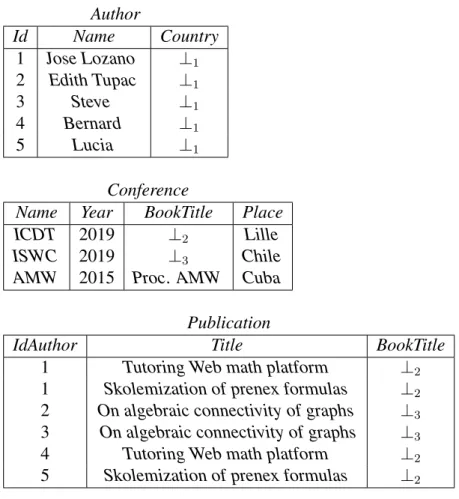
Figure 1.4 shows a target instance of the target schema obtained from the applica-tion of the set of rules to the source instance (conference database). This target instance includes null values (⊥1, ⊥2, ⊥3) to fill those attribute values that were not extracted
from the source instance. We see that this target instance is a solution because the set of functional and inclusion dependencies are satisfied. We denote this data exchange set-ting byE0that is composed of the source relational schema of the conference database,
the target relational schema and the set of rules specified before.
In the data exchange setting of Example 1.3, the existential variables represent the new fresh values that will be introduced in a tuple. There are cases where these new attribute values depend on the source instance such as transformation or extraction of attribute values or a set of attribute values. The representation of such transformation or extraction is done by the help of function names. If the function creates fresh values that depend on the set of all attributes then the function is called Skolem function. We illustrate the use of function names with the next example.
Example 1.3.2. Consider the target instance of Example 1.4 as the source database for a new data exchange setting. The target schema of this data exchange setting contains
Author Id Name Country 1 Jose Lozano ⊥1 2 Edith Tupac ⊥1 3 Steve ⊥1 4 Bernard ⊥1 5 Lucia ⊥1 Conference
Name Year BookTitle Place
ICDT 2019 ⊥2 Lille
ISWC 2019 ⊥3 Chile
AMW 2015 Proc. AMW Cuba Publication
IdAuthor Title BookTitle
1 Tutoring Web math platform ⊥2
1 Skolemization of prenex formulas ⊥2
2 On algebraic connectivity of graphs ⊥3
3 On algebraic connectivity of graphs ⊥3
4 Tutoring Web math platform ⊥2
5 Skolemization of prenex formulas ⊥2
Figure 1.4: Example of a solution.
only the relation Book, which stores a list of books with the attributes: id, title, country key abbreviated by ck and editor. The rule for transformation is that every conference is mapped to a book where:
• id is a number generated by a function whose parameters are name and year of conference;
• title is the booktitle;
• ck is the value that depends on the transformation of place; and
• editor is an invented value that depends on all attributes of conference. Formally,
∃fed. Conference(x1, x2, x3, x4) ⇒
1.3. RELATIONAL DATA EXCHANGE 25 where fed is a Skolem function, fid and fck are function names whose interpretations
are as follows.
• fidperforms the hash of the concatenation of name with year; and
• fckassigns an international country code by the value of the place.
A solution for this new data exchange setting is shown in Figure 1.5. Book
Id Name Ck Editor
422f7196b35 ⊥2 33 fed(ICDT, 2019, ⊥2, Lille)
9d1a8988af4 ⊥3 56 fed(ISWC, 2019, ⊥3, Chile)
fe257fa3467 Proc. AMW 53 fed(AMW, 2015, Proc. AMW, Cuba)
Figure 1.5: A solution for data exchange setting with function names.
1.3.1
Data exchange setting
A data exchange setting is a tupleE = (R, S, Σst, F), where
• R = (RR, attrsR, ΣRfd, ΣRind) is a source relational schema,
• S = (RS, attrsS, ΣSfd, ΣSind) is a target relational schema,
• F ⊆ Vf is a set of function names and
• Σstis a set of source-to-target tuple generating dependencies (st-tgds) where each
st-tgd σ is of the form
∀x. ϕ(x) ⇒ ∃y. ψ(x, y). We distinguish two sub-classes:
• when F = ∅, we call it first-order data exchange and we write w.l.o.g. E = (R, S, Σst)
• otherwise, we call it Skolemized data exchange.
Usually, the set of inclusion dependencies in the target schema are called target tuple generating dependencies (t-tgds)because the dependencies are expressed as tgds. We recall that the set of functional dependencies are expressed as egds. Given a data
exchange settingE = (R, S, Σst) and a consistent instance I of relational schema R, a
solutionto I w.r.t.E is any instance J of S such that I ∪J satisfy the set of dependencies Σst. By solE(I), we denote the set of all solutions to I w.r.t. E.
1.3.2
Chase procedure
The chase algorithm was originally used to decide logical implication of first-order constraints [Maier et al. 1979]. Here, we use the chase to construct solutions to data exchange. The chase procedure begins with a given source instance and iteratively constructs the solution by applying the given set of dependencies, which can be tgds and egds. At each step the chase identifies a dependency that is triggered i.e., the body of the dependency is satisfied and the head is not, and then applies it, i.e., if the dependency is a tgd, then its application generates new tuples, and if the dependency is an egd, then its application attempts an equation of values, which may result in a failure if the values are different constants. In general, the chase sequence might be infinite, but if it terminates, then it can end with a failure or give a consistent solution. This chase variant is called restricted chase. We recall the notion of chase with the help of the following example.
Example 1.3.3 (cont. Example 1.3.1 and 1.2.2). Recall the conference database I and the set of st-tgds Σst (rules in Example 1.3.1). The procedure initializes with an empty
instance J of the target schema. In Figure 1.6 we observe that the st-tgd (1.3) is triggered because the body of the dependency matches values in the instance I and the head of the dependency does not match values in instance J . The application of this dependency generates fresh values for matching the head of the dependency in J . By triggering the rules in Example 1.3.1, we get the following chase sequence.
• Dependency (1.3) is triggered by two tuples
Researcher(1, Jose Lozano, [email protected], Math, ALG) and Talk(1, 1, Tutor. . . )
and applying this dependency results in adding the tuples
1.3. RELATIONAL DATA EXCHANGE 27
Researcher(x1, x2, x3, x4, x5) ∧ Talk(x1, x6, x7) ⇒ ∃y1, y2. Author(x1, x2, y1)∧
Publication(x1, x6, y2)
Researcher
Idr Name Email Expertise Team 1 Jose Lozano [email protected] Math ALG
3 Steve [email protected] Algebra ALG
Talk
Idr Idc Title
1 1 Tutoring Web math platform 1 1 Skolemization of prenex formulas 3 2 On algebraic connectivity of graphs
Researcher Talk
x1 x2 x3 x4 x5 x1 x6 x7
1 Jose Lozano [email protected] Math ALG 1 1 Tutor. . .
Author x1 x2 y1 1 Jose Lozano ⊥4 Publication x1 x6 y2 1 Tutor. . . ⊥5
Figure 1.6: Matching of the body and the application of the head of the st-tgd 1.3.
• Dependency (1.3) is triggered by two tuples
Researcher(1, Jose Lozano, [email protected], Math, ALG) and Talk(1, 1, Skol. . . )
and applying this dependency results in adding only the tuple
Publication(1, Skol. . . , ⊥6).
Recall that Author(1, Jose Lozano, ⊥4) is already there. We observe that the
ap-plication of a tgd not always generates the whole head.
de-pendency that is triggered. Those dependencies are (1.3), which is triggered one more time, (1.4), which is triggered twice, and (1.5), which is triggered twice.
At the end of the chase sequence, we have the target instance, which we denote by J0,
seen in Figure 1.7. This instance is called a pre-solution. We point out that the chase with the set of st-tgds always terminates.
Author Id Name Country 1 Jose Lozano ⊥4 2 Edith Tupac ⊥10 3 Steve ⊥11 4 Bernard ⊥12 Conference
Name Year BookTitle Place
ICDT 2019 ⊥13 Peru
ISWC 2019 ⊥14 Chile
Publication
IdAuthor Title BookTitle
1 Tutoring Web math platform ⊥5
1 Skolemization of prenex formulas ⊥6
2 On algebraic connectivity of graphs ⊥7
3 On algebraic connectivity of graphs ⊥8
4 Tutoring Web math platform ⊥9
Figure 1.7: A pre-solution.
Now, we proceed with the set of target constraints where the chase is used to enforce the satisfaction of these constraints on the instance J0. We take those constraints as set
of dependencies (tgds and egds).
Author(x1, x2, x3) ∧ Author(x1, y2, y3) ⇒ x2 = y2∧ x3 = y3, (1.7)
Conference(x1, x2, x3, x4) ∧ Conference(x1, x2, y3, y4) ⇒ x3 = y3∧ x4 = y4, (1.8)
Publication(x1, x2, x3) ∧ Publication(x1, x2, y3) ⇒ x3 = y3, (1.9)
Publication(x1, x2, x3) ∧ Publication(x4, x2, y3) ⇒ x3 = y3, (1.10)
Publication(x1, x2, x3) ⇒ ∃y1, y2, y3. Conference(y1, y2, x3, y3), (1.11)
1.3. RELATIONAL DATA EXCHANGE 29 The chase sequence is as follows.
• Dependency (1.10) is triggered by two tuples
Publication(1, Tutor. . . , ⊥5) and Publication(4, Tutor. . . , ⊥9)
and applying this dependency results in equating the values
⊥9 = ⊥5.
• This dependency also triggers for publication of title On alg. . . and equates
⊥7 = ⊥8.
• Dependency (1.11) is triggered three times adding new tuples. The chase sequence ends with the following solution seen in Figure 1.9.
The chase sequence with these target dependencies and the rules of Example 1.3.1 is finite. However, the chase sequence can finish with a failure or even be infinite. A failure is when in the application of the egd, the two values to be equated are constants and not equal. In the following example, we illustrate the notion of failure.
Example 1.3.4. Suppose we have the table conference in Figure 1.8 of Conference database. During the chase, dependency (1.5) is triggered by this tuple adding
Conference
Idc Name Year Place
1 ICDT 2019 Peru
2 ISWC 2019 Chile 3 ICDT 2019 Chile
Figure 1.8: An instance of conference table.
Conference(ICDT, 2019, ⊥, Chile).
Dependency (1.8) is triggered by the last tuple added and the tuple
But the application cannot equate
Peru = Chile.
Thus, the chase ends with a failure.
A chase sequence is infinite when the application of a tgd always triggers another tgd. In the following example, we illustrate an infinite chase.
Example 1.3.5. Consider the source schema R1 with relation Worker(id , name, age),
and the target schema R2with two relations Emp(id , name) and Sup(super id , emp id ).
The target schema also contains the following tgd constraints.
Sup(x1, x2) ⇒ ∃y. Emp(x1, y),
Sup(x1, x2) ⇒ ∃y. Emp(x2, y), (1.13)
Emp(x1, x2) ⇒ ∃y. Sup(x1, y). (1.14)
These constraints impose that every employee has a supervisor and the value of emp id needs to exist in the database as an employee and the supervisor also is an employee. The st-tgd for exchanging data is
Worker(x1, x2, x3) ⇒ Emp(x1, x2).
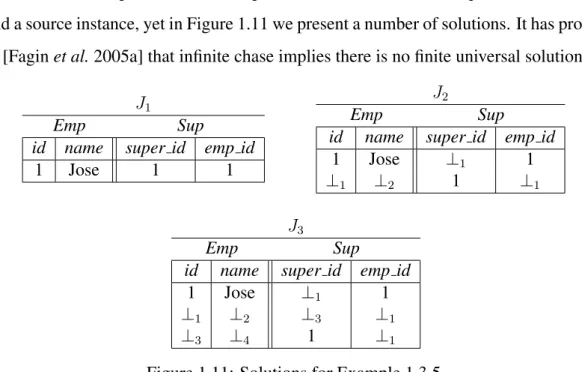
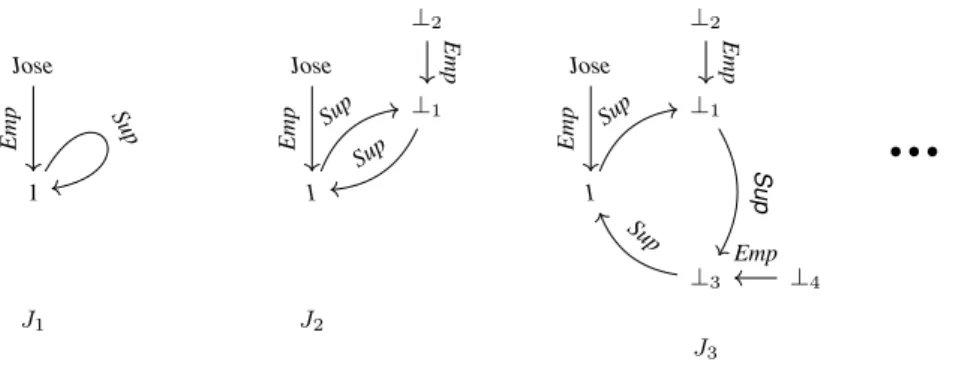
Take the following source instance Worker(1, Jose, 30). After applying the st-tgd we have an instance J1 with only one tuple Emp(1, Jose) and we observe that the tgd
(1.14) is triggered which results in adding the tuple Sup(⊥1, 1). Then this triggers the
tgd (1.13) which results in adding Emp(⊥1, ⊥2). Then, the tgd (1.14) is triggered again,
which results in adding the tuple Sup(⊥3, ⊥1) that causes tgd (1.13) to be triggered again
adding the tuple Emp(⊥3, ⊥4). Such result triggers the tgd (1.14) already triggered
before adding Sup(⊥5, ⊥3). This tgd (1.14) together with the tgd (1.13) are triggered ad
1.3. RELATIONAL DATA EXCHANGE 31 Author Id Name Country 1 Jose Lozano ⊥4 2 Edith Tupac ⊥10 3 Steve ⊥11 4 Bernard ⊥12 Conference
Name Year BookTitle Place
ICDT 2019 ⊥13 Peru ISWC 2019 ⊥14 Chile ⊥15 ⊥16 ⊥5 ⊥17 ⊥18 ⊥19 ⊥6 ⊥20 ⊥21 ⊥22 ⊥7 ⊥23 Publication
IdAuthor Title BookTitle
1 Tutoring Web math platform ⊥5
1 Skolemization of prenex formulas ⊥6
2 On algebraic connectivity of graphs ⊥7
3 On algebraic connectivity of graphs ⊥7
4 Tutoring Web math platform ⊥5
Figure 1.9: A Universal Solution.
Homomorphism
We define triggering of a dependency with the classical notion of homomorphism. First, we define a function called substitution as follows h : Va∪ Dom → Va∪ Dom. This
function is different from the identity function on the set of null values and variables, which we denote by adom(h). Furthermore, h assigns a value in Dom to every element in adom(h).
Now, a homomorphism h : I1 → I2 between two relational structures I1, I2 of the
same relational signatureR is a substitution from adom(I1) to adom(I2) that
• preserves the constant values i.e., h(a) = a whenever a ∈ Const, and
• for every R ∈ R and every (a1, . . . , an) ∈ I1(R) we have (h(a1), . . . , h(an)) ∈
I2(R) and n is the arity of R.
A homomorphism h0 extends a homomorphism h, written h ⊆ h0, if adom(h) ⊆ adom(h0) and h0(x) = h(x) for all x ∈ adom(h).
We define a mapping hF that will be used to define the notion of homomorphism from a formula into an instance. We use the notion of this homomorphism for chase purposes. LetF be a function signature and F be an interpretation of F. For a term t overF and a substitution h : Va∪ Dom → Va∪ Dom, we define hF(t) as:
hF(t) = h(x) if t = x ∈ Va a if t = a ∈ Dom f (hF(t0)) if t = f (t0) is a function term.
The mapping hF is extended on atoms and conjunctions of atoms as expected: hF(R(t, . . . , t)) = R(hF(t, . . . , t)) and hF( ^ i∈1..k Ri(ti, . . . , ti)) = ^ i∈1..k hF(Ri(ti, . . . , ti)).
Note that if the argument of hF does not contain function terms, the interpretation F is irrelevant so we allow to omit the F superscript and write e.g. h(t, . . . , t) instead of hF(t, . . . , t). A homomorphism h : ϕ → I ∪ F between the conjunction of atoms ϕ over signatureR ∪ F to an instance union the interpretation of function symbols, is a mapping from fvarsR∪F(ϕ) to Dom s.t. for every atom R(t, . . . , t) in ϕ it holds that R(hF(t, . . . , t)) ∈ I. Remark that if ϕ does not contain function terms, then F in the
above definition is irrelevant and we write h : ϕ → I instead of h : ϕ → I ∪ F and h(t, . . . , t) instead of hF(t, . . . , t).
Chase
We define formally the chase procedure for tgds and egds. Let I be a database instance of a relational schema R = (R, attrs, Σfd, Σind). Let σ be a tgd of the form
∀x. ϕ ⇒ ∃y. ψ
where ϕ and ψ are overR. We say that σ is triggered in I by h if • adom(h) = x,