HAL Id: tel-01581947
https://tel.archives-ouvertes.fr/tel-01581947
Submitted on 5 Sep 2017HAL is a multi-disciplinary open access archive for the deposit and dissemination of sci-entific research documents, whether they are pub-lished or not. The documents may come from teaching and research institutions in France or abroad, or from public or private research centers.
L’archive ouverte pluridisciplinaire HAL, est destinée au dépôt et à la diffusion de documents scientifiques de niveau recherche, publiés ou non, émanant des établissements d’enseignement et de recherche français ou étrangers, des laboratoires publics ou privés.
integrated economic and management model, with an
application to smallholders in India
Marion Robert
To cite this version:
Marion Robert. Modeling adaptive decision-making of farmer : an integrated economic and man-agement model, with an application to smallholders in India. Agriculture, economy and politics. Université Paul Sabatier - Toulouse III, 2016. English. �NNT : 2016TOU30251�. �tel-01581947�
i
Modeling adaptive decision-making of farmer: An integrated
economic and management model, with an application to
smallholders in India
Modélisation des décisions adaptatives de l’agriculteur : Un modèle
économique et décisionnel intégré, avec un cas d’étude en Inde
Marion Robert
iii
This thesis develops and discusses farmers’ decision-making modeling approaches for representing the adaptation of farming to global changes and water policies: their effects on agricultural economics and practices and water resources comprise critical information for decision makers. After a summary, six articles are presented.
The first article reviews bio-economic and bio-decision models, in which strategic and tactical decisions are included in dynamic adaptive and expectation-based processes, in 40 literature articles. The second article describes the case-study and presents a typology of Indian farmers from a survey including 684 farms in Berambadi, an agricultural watershed in South India.
The third article presents a step-by-step approach that combines decision-making analysis with a modeling approach inspired by cognitive sciences and software-development methods. This methodology bridges the gap between field observations and the design of the decision model. It is a useful tool to guide modelers in building decision model in farming system.
The fourth article describes the conceptual model NAMASTE, which was conceived to represents farmers adaptation processes under uncertainty. Since NAMASTE was designed in an extreme case of highly vulnerable agriculture, its generic framework and formalisms can be used to conceptually represent many other farm production systems.
The fifth article investigates the role of water management policies on groundwater resource depletion under climate change conditions. We built a stochastic dynamic programming farm model. The model reproduced decision on irrigation investment and cropping system made each year with the concern of future impacts on water availability for irrigation.
The sixth article describes the NAMASTE dynamic simulation model developed to model farming systems for evaluation and test of water management policies.
Key-words: farmers’ decision-making, farm typology, conceptual model, stochastic programming, water management policies, climate change, Berambadi watershed.
v
Cette thèse développe et discute une approche de modélisation des processus de décision des agriculteurs qui prend en compte l'adaptation des pratiques aux changements globaux et aux politiques de l'eau. En effet ces changements ont des effets sur l'économie et les pratiques agricoles ainsi que sur les ressources en eau et sont des informations essentielles pour la prise de décision. Après un synoptique de thèse, six articles sont présentés.
Le premier article est une revue de littérature d’une quarantaine d’articles sur les modèles bio-économiques et bio-décisionnels, dans laquelle les processus d’adaptation sont inclus dans les décisions stratégiques et tactiques.
Le deuxième article décrit le cas d’étude et présente une typologie des agriculteurs indiens déterminée à partir de 684 enquêtes d’exploitations agricoles dans le bassin versant agricole du Berambadi, au sud-ouest de l’Inde.
Le troisième article présente une méthodologie qui combine l'analyse des processus de décision avec une approche de modélisation inspirée des sciences cognitives et des méthodes de développement informatique. Cette méthodologie permet le passage entre les observations de terrain et la conception du modèle de décision. Il s’agit d’un outil utile pour les modélisateurs qui les guide dans la construction de modèles de décision pour les systèmes agricoles.
Le quatrième article décrit le modèle conceptuel NAMASTE, conçu pour représenter les processus adaptatifs de décision des agriculteurs dans un environnement incertain. Puisque NAMASTE a été conçu dans un cas extrême d'agriculture très vulnérable, son cadre et ses formalismes génériques peuvent être utilisés pour représenter conceptuellement de nombreux autres systèmes de production agricole.
Le cinquième article étudie le rôle des politiques de gestion de l'eau sur la baisse des ressources en eau souterraine dans des conditions de changement climatique. Nous avons construit un modèle agricole de programmation dynamique stochastique. Le modèle reproduit les décisions annuelles d'investissement en irrigation et de choix de systèmes de cultures réalisées avec le souci des impacts futurs sur la disponibilité de l'eau pour l'irrigation.
Le sixième article décrit le modèle dynamique de simulation NAMASTE développé pour l'évaluation et le test de politiques de l’eau sur les processus de décision des agriculteurs et la nappe phréatique. Mots-clés: processus de décision des agriculteurs ; typologie des exploitations agricoles ; modèle conceptuel ; programmation stochastique dynamique ; politiques de gestion de l'eau ; changement climatique ; bassin versant du Berambadi.
vii
I chose to present my thesis in an original way. As my written restitution is based on six articles either submitted or close to be submitted, and as it could be quite tedious to read and reread the article introductions that globally deal with the same theme (the one of my thesis), I chose to make a synoptic document of the thesis. This document of forty pages, gives in one hand the major advances (key messages found in the articles), and in the other hand deals with the introduction, the research approach and discussion-perspectives on the work that I conducted in depth. The reader can thus have an overview of the work done and go, if necessary, read the different articles. I also chose to provide a number of appendixes which could not be added to the articles but which can help understanding methodological items that could also be used by other researchers.
ix
I would like to begin by first thanking my PhD advisors, Dr. Jacques-Eric Bergez and Dr. Alban Thomas, for their trust, guidance and shrewd advice all along the thesis. Thank you very much for your time and availability despite your overbooked schedules and responsibilities. Your organization and confidence have kept me on schedule for the entire duration of this project. I am also very thankful to Jacques-Eric for following me up and encouraging me every day.
I would also like to thank my steering committee members Dr. Delphine Leenhardt, Dr. Aude Ridier, Dr. Alexandre Joannon, Dr. Victor Picheny, Dr. Stephan Couture, Dr. Arnaud Reynaud and Dr. Laurent Ruiz for their commitment, ideas and encouraging remarks.
I would also like to thank my PhD defense committee members Dr. Ken Giller, Dr. Florence Jacquet, Dr. Benoît Dedieu and Dr. Thierry Lamaze for participating to the defense and evaluation of my work, and for their interesting insights on it.
There are many people unnamed who have given me great support, both academically and emotionally, and I will forever be indebted to all of them. This represents a time and opportunity in my life that I will always cherish and surely reflect on as the true beginning of my professional endeavors. I would like to thank all my colleagues, with whom I have worked for the last three years and who have contributed to the development of my reasoning. I would like to thank specifically the co-authors of the articles that are the basis of this thesis: Jacques-Eric Bergez, Alban Thomas, Laurent Ruiz, Muddu Sekhar, Shrinivas Badiger, Hélène Raynal, Delphine Leenhardt, Magali Willaume, Jérôme Dury, Olivier Thérond, Pierre Casel, Eric Casellas, Patrick Chabrier and Alexandre Joannon.
I would also like to thank Eric and Pierre for their great job in the model computer implementation. Thank you so much for your patience and adaptation to my poor knowledge in IT.
Special thanks go to my colleagues from INRA, and particularly to the PhD students of the office B205 and to my Indian friends Buvi, Divya, Amit and Sreelash. Particular thanks to Ariane, Charlotte and André for their support and advice; and to Céline for the moments of relaxation.
I am also grateful to my friends Alice and Marie for their insightful advice and discussions.
Thank you to Michelle and Michael Corson and my sister for proof reading the English version on several parts of this document.
Warm thanks go to my parents for believing in my project.
Last and not least, loving thanks to Tony for his support and patience during evenings, week-ends and vacations, during my bad and good moods and for his technical support with C.
xi Published or submitted to peer-reviewed journals
1*Robert, M, Hu, W., Nielsen, M.K., Stowe, C.J. (2015) Attitudes towards implementation of surveillance-based parasite control on Kentucky Thoroughbred farm – current strategies, awareness and willingness-to-pay, Equine Veterinary Journal, Vol. 47 (6), doi: 10.1111/evj.12344
1*Robert, M., Stowe, C.J. (2016) Ready to Run: Price determinants of Thoroughbred from two-year-olds in training sales, Applied Economics incorporating Applied Financial Economics, Vol. 48, doi: 10.1080/00036846.2016.1164817
Robert, M., Dury, J., Thomas, A., Therond, O., Sekhar, M., Badiger, S., Ruiz, L., Bergez, J.E. (2016) CMFDM a methodology to guide the design of a conceptual model of farmers’ decision-making processes, Agricultural Systems, Vol. 148, p 86-94, doi: 10.1016/j.agsy.2016.07.010
Robert, M., Thomas, A., Sekhar, M., Badiger, S., Ruiz, L., Raynal, H., & Bergez, J. E. (2016). Adaptive and dynamic decision-making processes: A conceptual model of production systems on Indian farms. Agricultural Systems, doi : 10.1016/j.agsy.2016.08.001
Robert, M., Thomas, A., Bergez, J.E. (2016) Integrating adaptative processes in farming decision-making models – a review, Agronomy for Sustainable Development, doi: 10.1007/s13593-016-0402-x Robert, M., Thomas, A., Sekhar, M., Badiger, S., Ruiz, L., Willaume, M., Leenhardt, D., Bergez, J.E. (2016) Typology of farming systems for modeling water management issues in the semi-arid tropics (Berambadi watershed, India), Water (under review)
Robert, M., Bergez, J.E., Thomas A (2016) Stochastic dynamic programming approach to analyze adaptation to climate change - application to groundwater irrigation in India, European Journal of
Operational Research (submitted)
Robert, M., Thomas, A., Sekhar, M., Raynal, H., Casellas, E., Casel, P., Chabier, P., Joannon, A. & Bergez, J. E (2016) NAMASTE: a dynamic model for water management at the farm level integrating strategic, tactical and operational decisions, Environmental Modelling & Software (submitted)
xii
Robert, M., Thomas, A., Bergez, J.E. (2015) Modeling Adaptive Decision-Making of Farmer: an Integrated Economic and Management Model, with an Application to Smallholders in India In: the 5th International Symposium for farming Systems Design (FSD) ‘Multi-functional Farming systems in a changing world, 5th-10th September 2015, Montpellier, France
Robert, M., Thomas, A., Bergez, J.E. (2016) CMFDM: A methodology to guide the design of a conceptual model of farmers’ decision-making processes. In: the 8th International Congress on Environmental Modeling and Software Society (iEMSs), 12th-14th July 2016, Toulouse, France Robert, M., Thomas, A., Bergez, J.E. (2016) NAMASTE: A dynamic integrated model for simulating farm practices under groundwater scarcity in semi-arid region of India In: the 14th Congress on European Society of Agronomy (ESA), 5th-9th September 2016, Edinburgh, Scotland
Additional scientific contributions
Member of the scientific committee of the Ecole Chercheurs « Approches interdisciplinaires de la modélisation des agroécosystèmes » that will be hold the 7th-10th March 2017.
xiii
C
ONTENTSIntroduction – Synthesis Chapter ... 1
1.1. General introduction ... 2
1.1.1. Today’s and tomorrow’s challenges for the agriculture ... 2
1.1.2. Designing farming systems ... 3
1.1.3. Agricultural production systems and complex systems... 4
1.1.4. Global challenges in designing agricultural production systems ... 7
1.2. Thesis project ... 7
1.2.1. Research context ... 7
1.2.2. Thesis objectives ... 11
1.3. Thesis proceedings ... 16
1.4. Thesis results ... 17
1.4.1. Literature review on adaptation in decision models ... 17
1.4.2. The Berambadi watershed ... 19
1.4.3. A methodology to guide the design of a conceptual model of farmers’ decision-making processes ... 20
1.4.4. The conceptual model NAMASTE ... 22
1.4.5. Strategic decisions on investments and cropping systems modeled with a stochastic dynamic programming approach ... 24
1.4.6. The computer model NAMASTE ... 26
1.5. Discussions and prospects ... 28
1.5.1. Review on the thesis results ... 28
1.5.2. From the demonstration prototype to the production model ... 30
1.5.3. Verification and validation ... 34
1.5.4. A decision model for the AICHA project ... 37
1.6. Conclusion ... 42
Processes of adaptation in farm decision-making models- A review ... 45
2.1. Introduction ... 47
2.2. Background on modeling decisions in agricultural economics and agronomy ... 49
2.3. Method ... 51
2.4. Formalisms to manage adaptive decision-making processes ... 51
2.4.1. Formalisms in proactive adaptation processes ... 52
2.4.2. Formalisms in reactive adaptation processes ... 53
2.5. Modeling adaptive decision-making processes in farming systems ... 55
2.5.1. Adaptations and strategic decisions for the entire farm... 55
xiv
2.5.3. Sequential adaptation of strategic and tactical decisions ... 58
2.6. Discussion ... 59
2.6.1. Adaptation: reactive or proactive process? ... 59
2.6.2. Decision-making processes: multiple stages and sequential decisions ... 60
2.6.3. What about social sciences? ... 61
2.6.4. Uncertainty and dynamic properties ... 61
2.7. Conclusion ... 62
Acknowledgements ... 63
Table caption ... 64
Figure caption ... 66
Farm typology in the Berambadi watershed (India): farming systems are determined by farm size and access to groundwater ... 71
3.1. Introduction ... 73
3.2. Materials and methods ... 74
3.2.1. Case study: Hydrological and morphological description of the watershed ... 74
3.2.2. Survey design and sampling ... 75
3.2.3. Analysis method ... 76
3.3. Variability and spatialization of farm characteristics and practices ... 77
3.3.1. Farm structure ... 77
3.3.2. Farm practices ... 79
3.3.3. Water management for irrigation ... 80
3.3.4. Economic performances of the farm ... 81
3.4. Typology of farms in the Berambadi watershed ... 82
3.4.1. Characteristics of farm typology ... 82
3.4.2. Characteristics of the farm types ... 83
3.5. Discussion ... 85
3.6. Conclusion ... 87
Acknowledgements ... 88
Table caption ... 89
Figure caption ... 91
CMFDM: A methodology to guide the design of a conceptual model of farmers’ decision-making processes ... 99
4.1. Introduction ... 101
4.2. Founding principles of the methodology ... 101
4.3. The CMFDM methodology ... 103
4.3.1. Step 1: problem definition ... 103
xv
4.3.3. Step 3: data collection and analysis of individual case studies ... 103
4.3.4. Step 4: the generic conceptual model ... 104
4.4. Methodology implementation in a case study ... 105
4.4.1. Step 1: problem definition ... 105
4.4.2. Step 2: case study selection ... 106
4.4.3. Step 3: data collection and analysis of individual case studies ... 106
4.4.4. Step 4: the generic conceptual model ... 109
4.5. Discussion - Conclusion ... 111
Acknowledgements ... 114
Figure caption ... 115
Adaptive and dynamic decision-making processes: A conceptual model of production systems on Indian farms ... 123
5.1. Introduction ... 125
5.2. Modeling processes ... 126
5.2.1. Indian case study ... 126
5.2.2. Modeling steps ... 127
5.2.3. Conceptual validation ... 129
5.3. A conceptual model of production systems on Indian farms ... 130
5.3.1. What should be modeled ... 130
5.3.2. Modeling in NAMASTE ... 133
5.3.3. Description of the other systems in the model ... 142
5.4. Discussion ... 145
5.5. Conclusion ... 147
Acknowledgements ... 148
Table caption ... 149
Figure caption ... 150
A stochastic dynamic programming approach to analyze adaptation to climate change - application to groundwater irrigation in India ... 157
6.1. Introduction ... 159
6.2. Literature review on long-term farmer decisions under uncertainty ... 160
6.3. Methods ... 162
6.3.1. The farmer’s production problem ... 162
6.3.2. Data ... 166
6.4. Simulations and results ... 167
6.4.1. Scenarios ... 167
6.4.2. Results ... 169
xvi
6.6. Conclusion ... 174
Acknowledgements ... 175
Table caption ... 176
Figure caption ... 180
NAMASTE: a dynamic model for water management at the farm level integrating strategic, tactical and operational decisions ... 187
7.1. Introduction ... 189
7.2. Materials and methods ... 190
7.2.1. Conceptual modelling ... 190
7.2.2. RECORD: a modeling and simulation computer platform ... 191
7.3. Description of the farming system model ... 193
7.3.1. Models used to build the farming system model ... 193
7.3.2. Model structure ... 195
7.3.3. Dynamic functioning ... 195
7.4. Application case: the NAMASTE simulation model ... 196
7.4.1. Coupling the farming system model to the hydrological model... 197
7.4.2. NAMASTE simulaton ... 197
7.4.3. Calibration and validation ... 198
7.4.4. Simulation results ... 199 7.5. Discussion ... 201 7.6. Conclusion ... 203 Acknowledgements ... 204 Figure caption ... 205 Bibliography ... 215 Appendix ... 241
Appendix 1: Thesis sequence of events... 243
Appendix 2: Data used in NAMASTE development ... 245
Appendix 3: Conceptual model and Ontology ... 299
Appendix 4: Economic model - Model equations ... 305
Appendix 5: Economic model - Yield estimations and climatic expectations ... 307
Appendix 6: Operational decision and modeling ... 313
xvii
L
IST OF ACRONYMSACCAF: Adaptation to Climate Change of Agriculture and Forest AICHA: Adaptation of Irrigated Agriculture to Climate Change
AMBHAS: Assimilation of Multi-satellite data at Berambadi watershed for Hydrology And land Surface experiment
BDI: Belief-Desire-Intention
CEFIPRA: Centre for the Promotion of Advanced Research
CETIOM: Centre Technique Interprofessionnel des Oléagineux Métropolitains
CMFDM: Conceptual Modeling of the Farmer agent underlying Decision-Making processes CRASH: Crop Rotation and Allocation Simulator using Heuristics
CTA: Cognitive-Task Analysis DP: Dynamic programming
DSP: discrete stochastic programming
EDT: Doctoral School of the University of Toulouse INRA: French National Institute of Agronomy
NAMASTE: Numerical Assessments with Models of Agricultural Systems integrating Techniques and Economics
NDM: Naturalistic decision making
RECORD: Renovation and COORDination of agro-ecosystem modeling STICS: Simulateur multidisciplinaire pour les cultures standard
1
Chapter 1
2
1.1. G
ENERAL INTRODUCTION1.1.1. Today’s and tomorrow’s challenges for the agriculture
Agriculture is facing many challenges both in terms of productivity and revenue and in terms of environmental and health impacts. Agriculture must thus face a demand for increasing production regarding quantity, quality, accessibility and availability to secure food production and improve product quality to cope the needs of the world’s growing population (Meynard et al. 2012; Hertel 2015; McKenzie and Williams 2015). The FAO (Food and Agriculture Organization of the United Nations) estimates that global agricultural production must increase by nearly 60% from 2005/2007 to 2050 to meet the food demand of the estimated 9 billion people by 2050 while ensuring fair incomes for farmers (FAO 2012). Increasing agricultural productivity is all the more important to face the increasing competition for land, water and investment between urban, agricultural and industrial sectors (FAO 2011).
However, increasing agricultural productivity must be made within a framework of environmental and health constraints. First it should consider limiting the impact on the environment, by reducing the impacts on water and aquatic environments (nitrate, pesticide, drug residue pollutions through leaching and runoff), on air (nitrous oxide, methane, ammonia and other greenhouse gas) and finally on soil (soil structural discontinuity, compacted areas, risk of leaching and erosion, decline in soil biodiversity). It should also consider limiting habitat modification to encourage and maintain biodiversity. Second, agricultural productivity should take into account the scarcity of resources mobilized by agricultural production such as water resources, phosphorus and fossil energy (particularly for the production of nitrogen fertilization) (FAO 2011; Brown et al. 2015).
These agricultural challenges also have to be considered within the known context of climate change. Under climate change conditions, warmer temperatures, changes of rainfall patterns and increased frequency of extreme weather are expected to occur. The global mean temperature expected by the end of this century could be 1.8° to 4.0°C warmer than at the end of the previous century within an uneven pattern across the globe. Climate change could lead to extreme climatic events, such as increased intensity and frequency of hot and cold days, storms, cyclones, droughts and flooding (Anwar et al. 2013). Climate change alters weather conditions and thus has direct, biophysical effects on agricultural production and would negatively affects crop yields and livestock (Nelson et al. 2014). Sea-level rises will increase the risk of flooding of agricultural land in coastal regions. Changes in rainfall patterns may support the growth of weeds, pests and diseases (Lapeyre de Bellaire and al. 2016).
3 1.1.2. Designing farming systems
Facing the aforementioned challenges, conventional farming systems have their limitations and a particular attention is made on the dynamics of innovations likely to consider and resolve the former issues (Novak 2008). In a broad sense, innovation is seen as the action of "transforming a discovery on a technique, a product or a conception of social relationship into new practices" (Alter 2000).
In agronomy, innovation is generally defined as a process which promotes the introduction of new changes and leading to its spread and its recognition through applications cases (INRA Sens 2008; Klerkx et al. 2010). Innovation requires a design process based on scientific and / or empirical knowledge. The design process is conducted by agricultural and development research institutes in close collaboration with farmers to address their needs, their constraints and their knowledge on agricultural production systems (Le Gal et al. 2011).
Two ways of designing systems are distinguished: i) the rule-based design aims at gradually improving existing technologies and systems, based on predefined objectives and standardized evaluation processes (Meynard et al. 2012); ii) the innovative design is built to meet completely new expectations initially undetermined but getting more and more specific as the exploration process takes shape (Meynard et al. 2012; Lefèvre et al. 2014). In an uncertain and changing environment, traditional rule-based analytical frameworks are challenged. The adaptable design approaches that take into account varying objectives, skills and modes of validation and do not need to be specified in advance may be preferable (Meynard et al. 2012).
Different tools and methods have already been developed to address the issue of farming system designs. Loyce and Wery (2006) classified them into three groups: (i) diagnosis (e.g. Doré et al. 1997) allows to understand and evaluate agricultural systems from field measurements and surveys, (ii) prototyping (e.g. Vereijken 1997) consists in designing a limited number of systems based on expert-knowledge, in testing and evaluating them, and in adapting the prototypes; (iii) model and simulation based approaches (e.g. Romera et al. 2004) where the model allows to design a simplified representation of a real system and the simulation allows to change the state of the system in order to understand and evaluate its behavior.
Given the complexity of the agricultural production systems, simulation modeling is a commonly used tool for the design and the evaluation of innovative agricultural production systems (Bergez et al. 2010). Indeed, systemic modeling and dynamic simulations appear to be powerful tools to represent the dynamic interactions between biological and technical processes at different time and space scales and to assess and quantify the performances of a variety of alternative systems for a diversity of production contexts (Bergez et al. 2013).
4
1.1.3. Agricultural production systems and complex systems Definition and organization of farming systems
An agricultural production system is defined as a complex system of resources, technical activities, biological processes and decisional processes that aims at meeting farm production objectives by producing agricultural goods (Tristan et al. 2011). The agricultural production system is a complex matrix of interdependent items that are partially controlled by the farm manager or the farm household subjected to a socio-economic and climatic external environment (Figure 1.1).
Dury et al. (2013) identified five categories of objectives that drive decisional processes within farming systems: 1) financial like maintain, secure, increase or maximize farm income, 2) workload by decreasing, minimizing, maintaining or spreading working hours, 3) farm status considering the future of the farm, 4) technical aspects on crop management techniques, 5) environmental aspects with reasoning on biodiversity and pollution.
Decisional processes aim at developing a resource management strategy that transforms land, capital, labor resources into agricultural products taking into consideration infrastructure and intuitional constraints such as equipment, storage and transportation, marketing facilities and farm credits. This transformation is the result of farmer’s short-term technical activities on the farm. The farmer mobilizes knowledge to make decisions based on know-how, skills and specific observations made previously on his production system.
Agricultural production system may be composed of several production sub-systems with specific production objectives. Three main production subsystems are identified in Coléno et al., (2005): crop production, animal production and transformation unit. These sub-systems are interrelated since the end product and wastes of one sub-system may be used as inputs in others (Figure 1.1).
5
Figure 1.1 : Agricultural production system organized into three integrated production subsystems (from Coléno et al. 2005).
Management of farming system
The farmer dynamically plans and coordinates his technical activities on his farm at different time and space scales. However agricultural production systems are facing new challenges due to a constantly changing global environment that is a source of risk and uncertainty, and in which past experience is not sufficient to gauge the odds of a future negative event. Concerning risk, farmers are exposed to production risk mostly due to climate and pest conditions, to market risk that impact input and output prices, and institutional risk through agricultural, environmental and sanitary regulations (Hardaker 2004). Farmers may also face uncertainty due to rare events affecting, e.g. labor, production capital stock, and extreme climatic conditions, which add difficulties to the production of agricultural goods and calls for re-evaluating current production practices. To remain competitive, farmers have no choice but to adapt and adjust their daily management practices (Hémidy et al. 1996; Hardaker 2004; Darnhofer et al. 2010; Dury 2011).
Based on his past experience and on forecasts on weather and market prices, the famer can anticipate some events and production conditions. Thus he is able to plan several management options to face these different production conditions. However, given the limitations of human cognition to anticipate
6
the future, everything cannot be anticipated (Chavas 2012). The farmer must therefore be able to establish a reflexive analysis on the observations he made on his environment in order to instantly review his initial management plan and if necessary his production objectives. The farmer's decision-making process is therefore a dynamic sequence of planning, observation, reflection, adaptation, implementation as technical activities and learning processes (Risbey et al. 1999; Le Gal et al. 2011). This variable and uncertain production context justifies why a management plan repeated over several years won’t give the same production results and why different management plans may lead to the same production results. Farmer’s decision-making is a continuous process in time and space. Farmers make decisions based on his visibility and expectations on the production context that impact his management on the long-, medium- or short-term. Decisions may affect the whole agricultural production system, a production sub-system or even smaller spatial unit such as the plot (Cerf and Sebillotte 1988; Papy et al. 1988; Osman 2010). For instance, investing in equipments, in buildings or in lands are decisions that reflect a willingness to expand or modernize the farm. These decisions have long-term consequences because 1) loans are often over several years, 2) the farm structure and infrastructures are changed for the coming years (life duration of a tractor, building, etc.). However, decisions on selecting varieties and crop management techniques have an impact on the short term and at a local scale corresponding to the production season and the plot. Finally, deciding to delay the sowing, to extend the water turns or to apply pesticide treatment will have an immediate effect on the biophysical system because these decisions correspond to technical activities executed on each plot. Specificities of irrigated farming systems
A production system is considered as irrigated when water supply other than rainfall is provided on one or several plots. The irrigation water is pumped from a water point and distributed to the fields through appropriate water transport infrastructure. In irrigated production systems, crops benefit from both the contribution of rainfall and irrigation water to cover their water needs. Irrigation is an effective management tool against the variability and uncertainty of rainfall events. The irrigation water can come from surface water fed by the rainfall runoff like streams, rivers, ponds, lakes and dams. Irrigation water can also come from the aquifer that is fed by the rainfall drained into the ground. The deep aquifers are located between two impermeable layers leading to slow recharge compared to surface water reservoirs.
Irrigation water can come from different sources considered as collective when multiple users are identified or individual. Except for individual rainfall reservoirs, the other sources of irrigation are often subject to conflicts and management issues (Gleick 1993; Wolf 2007). Conflicts over rivers between upstream and downstream users are commonly seen as the upstream pumping will impact the downstream flow (Chokkakula 2015). On a reservoir, tensions appear when pumping exceeds the rainfall recharge from run-off particularly in drought conditions (Rajasekaram and Nandalal 2005).
7
For groundwater, pumping may exceed rainfall recharge. Moreover, lateral flows conduct the water table level to rebalance so that intensive pumping by one farmer impacts the yield of the neighbor’s borewell (Janakarajan 1999).
1.1.4. Global challenges in designing agricultural production systems
The production of knowledge on agricultural production system is an important issue while designing such system. Several types of knowledge have to be produced to understand the complexity of systems: 1) knowledge on the system structure to understand its organization and composition; 2) knowledge on internal processes e.g. decision processes, biophysical processes; and 3) knowledge on inputs and outputs to understand the exchanges of information and matters within the system and with the external environment as well as the impact of an entity on another entity (how climate change impacts on farmers’ decision making processes). The use of appropriate tools to collect and organize knowledge is important to ensure the quality of the knowledge production process.
Another challenge in designing agricultural production systems is to properly define the limits of the system to be designed. Agricultural production systems are too complex to be entirely designed as they are. The level of specificities and details to be considered depend on the initial research question. Designing agricultural production systems requires considering the time and space scales at which processes should be represented. Some processes may occur at several time and space scales (e.g. decision processes), others are specific to only one scale (e.g. sowing is made a defined date on a defined plot). An interesting issue in designing systems is to be able to upscale or downscale a representation.
1.2. T
HESIS PROJECT1.2.1. Research context The Indian agriculture
India is the most populous country in the world after China. India has 17.5% of the global population with 1.26 billion people in 2015. The growth rate of its population was 1.2% in 2014. A third of the Indian population (212 million) is undernourished and lives below the extreme poverty line (Central Intelligence Agency 2016). Famine and poverty remain a major obstacle to the country development. India is the world’s fourth-ranking agricultural power. In 2014, Indian agriculture accounted for 17.8% of GDP and employed 49.7% of the workforce. India has an important agricultural area of over 190 million hectares of which 37% is irrigated. Climatic gradient, topographic and soil diversity allow a wide range of crops (India Brand Equity Foundation 2016). The main agricultural products are wheat,
8
millet, rice, corn, sugarcane, tea, potato, cotton. Productivity and yields have risen sharply since the 1950s after the Green Revolution with the development of irrigation, the use of high-yield seeds and fertilizers and the availability of bank loans. However, subsistence farming is still dominant in India today. Farm households grow on small plots and crops are partly self-consumed (Dorin and Landy 2002). Indian farms have an average size of 1.5 hectares. This fragmentation of holdings is inheritance of the land reform made in 1947 after the Independence from the British that had the aim to redistribute land to poor farmers by restricting the size of the landed property (Chandra 2000). This fragmentation contributes to the low mechanization of farming where animal traction and manual labor are still dominant in Indian agriculture.
Three seasons regulate the farm cropping system: i) kharif (June to September) which corresponds to the South-West monsoon season, when almost all the cropping area is cultivated, either exclusively rainfed or with complementary irrigation; ii) rabi (October to January), the North-East monsoon season or winter season, when most of the plots where irrigation is possible are cultivated; and iii) Summer (February to May), the hot and dry season, when only few irrigated plots are cultivated. Despite the development of irrigation promoted by the Green Revolution, two-thirds of Indian agricultural production are still heavily dependent on the monsoon and are produced in kharif. Investments in infrastructure are also limited. Storage and conservation facilities of agricultural products are lacking in the rural area of the country and cause huge losses of up to 40% of crops for fruits and vegetables (Dorin and Landy 2002). After harvest, farmers are compelled to sell immediately their products and often at low prices. The lack of maintenance of irrigation canals and wells are causing the loss of over a third of transported water (Aubriot 2013). In this context of increasing population and industrial development, conflicts over the water resource use are increasing (Chokkakula 2015).
The Green Revolution also led to the main problems that the agricultural sector is facing today. The intensification of agricultural production with the massive use of fertilizers and pesticides heavily distorted the soil and led to a soil depletion with significant loss of nutrients (Dorin and Landy 2002). The intensive drilling and the development of submersible pumps caused a significant drop in the natural groundwater resources (Aubriot 2013). Climate change and rising temperatures are also encouraging intensifying irrigation. This intensification of practices and input uses increased the production cost of farmers who had to heavily borrow money. In addition, farmers still greatly rely on local merchants and wholesalers who push them to sell at low prices. Therefore, farmers are subject to multiple pressures that led some to desperate situations and even suicide. In recent years, the farmers' suicide rate has terribly increased (Mishra 2007). In 2014, the number of suicides has been estimated at 12 360, taking into account the population of farm owners and farm workers (National Crime Reports Bureau 2015).
9 The AICHA project
In the context of climate change and of agriculture increasingly relying on groundwater irrigation, it is crucial to develop reliable methods for sustainability assessment of current and alternative agricultural systems. The multi-disciplinary Indo-French research project AICHA (Adaptation of Irrigated Agriculture to Climate Change) (2013-2017) has aimed to develop an integrated model (in agronomy, hydrogeology and economics) to simulate interactions between agriculture, hydrology and economics and to evaluate scenarios of the evolution of climate, agricultural systems and water management policies.
The AICHA project is supported by the Indo-French Centre for the Promotion of Advanced Research (CEFIPRA), and the INRA flagship program on Adaptation to Climate Change of Agriculture and Forest (ACCAF),and includes researchers from the Indian Institute of Sciences (IISc), the Indo-French Cell on Water Science (IFCWS), Ashoka Trust for Research in Ecology and the Environment (ATREE), the French National Center of Scientific Research (CNRS) (UMR COSTEL) and the French National Institute for Agricultural Research (INRA) (UMR SAS, UMR LERNA, UMR AGIR, UMR EMMAH, UR RECORD).
The Berambadi watershed situated in the south west of India, with an area of 84 km², is an ideal site for this project. The Berambadi watershed is small enough to allow fine monitoring and large enough to include a large part of the variability of agricultural systems. It has been developed as a research observatory since 2002 by the Indo-French Cell of the Water Science Cell (LMI IFCWS − IISc/IRD) in Bangalore. It belongs to the Kabini river basin (about 7000 km², southwest of Karnataka), which is a tributary of the Kaveri River basin.
Due to the rain shadow of the Western Ghats on the South West monsoon rains, the Kabini basin exhibits a steep rainfall gradient, from the humid zone in the west with more than 5000 mm of rain per year to the semi-arid zone in the East with less than 700 mm of rain per year. The Berambadi watershed being in towards the East of the Kabini, its climate is tropical sub-humid (aridity index P/PET of 0.7) with a rainfall of 800 mm/year and PET of 1100 mm on average (Sekhar et al. 2016)
. A
moderate East-West rainfall gradient is observed at the scale of the watershed, with around 900mm rainfall per year upstream (West) and less than 700mm rainfall per year downstream (East).For the past 50 years the climate variability has intensified in this region (Jogesh & Dubash 2014). Predictions for 2030 announced an increase in temperature of 1.8 to 2.2 ° C, associated with lower annual rainfall especially during the monsoon (Jogesh & Dubash 2014). For a region such as southern India whose farm production heavily depends on monsoon and winter months, climate change will have severe repercussions on natural resources and on the agricultural economy.
10
Black soil (Vertisols and Vertic intergrades), red soil (Ferrasols and Chromic Lusivols) and rocky/weathered soil are the main soil types in the area and are representative soil types for granitic/gnessic lithology found in South India. These are representative of the soil types for granitic/gnessic lithology found in South India (Barbiéro et al. 2007). The hard rock aquifer is composed of fissured granite underlain by a 5-20 m layer of weathered material. Groundwater transmissivity and borewell yields decrease with water table depth (Maréchal et al. 2010).
During centuries, the traditional system of “tanks” has been efficiently used to extend the cropping season with the water stored during monsoon (Dorin and Landy 2002). However, poor maintenance of the water tanks and increasing silt deposition decreased its efficiency over time. At the Indian independence from the British in 1947, Prime Minister Jawaharlal Nehru decided that developing agriculture would be the priority of the country. He promoted huge irrigation projects based on the construction of large dams. This fundamentally altered the demand for irrigation in the Cauvery watershed and shifted the focus from not only using water flowing into the sea but also to dividing water resources (Pani 2009). The significance of this technological change was intensified by the growing demand for water. In the rural economy, the Green Revolution strategy that started in the 1960s was based on high yield seeds, chemical fertilizers and irrigated agriculture, which meant increasing the demand for water. The development of submersible pump technology in the 1990s resulted in a dramatic increase in borewell irrigation (Sekhar et al. 2006; Javeed et al. 2009). However, the fissured structure of the hard rock aquifer lowers the success ratz of drilled borewells. Indeed, whatever the borewell depth, it has to cross a fissure to get water in (Figure 1.2).
Figure 1.2 : Hard rock aquifer composed of fissured granite underlain by a 5-20 m layer of weathered material: only two borewells have access to groundwater (from Jacoby, 2015).
This shift from collective tanks to individual borewells has been largely encouraged by public policies that provide free electricity to farmer for groundwater irrigation. Thus, it led to considerable dependency from agriculture practices on irrigation groundwater. Increasing pumping combined with the low productivity of the aquifer lead to a rapid decline in the water table level (Dewandel et al.
11
2010; Perrin et al. 2011) and a decrease of borewell yields (Ruiz et al. 2015). As a consequence, continuous pumping leads to groundwater table drawback and reduces the availability of groundwater for irrigation (Dewandel et al. 2010; Perrin et al. 2011). This feedback makes predefined land-use scenarios unrealistic, since farmers need to adapt their actions continually according to groundwater availability (Ruiz et al. 2015).
The main originality of the project lies on its multidisciplinary approach that combines on the one hand the economic impacts on agricultural production and on the hydrological regime and on the other hand the feedback effects of the hydro-climatic-economic impact on farming practices, on land use and on agricultural productivity. The project involves several scientific issues. It aims at developing an integrated eco-agro-hydrological model able to take into account the direct effects of agricultural practices on water resources and the feedback effects by considering the adaptive behavior of farmer to climate change, resource availability and market development. This integrated modeling approach also answers the question of optimal water resource management in a context of increasing scarcity. It also deals with the issue of distribution of water resources and agricultural land in the context of climate change. The AICHA project analyzes scientific questions such as:
• modeling the hydrological transfers and their relationship with agricultural practices • coupling of economic models with agronomic simulators
• testing alternative scenarios of water resource management policies at the watershed scale. 1.2.2. Thesis objectives
Agricultural production systems are facing new challenges due to an ever changing global environment that is a source of risk and uncertainty. To adapt to these environmental changes, farmers must adjust their management strategies and remain competitive while also satisfying societal preferences for sustainable food systems. Representing and modeling farmers’ decision-making processes by including adaptation is therefore an important challenge for the agricultural research community. Three issues are at the core of this research:
Represent farmers’ decision-making and adaptation processes
What are the engaged processes in farmers’ decision-making?
Farmers’ decision-making processes are a combination of decision stages: i) the strategic decision stage, with a long-term effect (years to decades) on whole-farm organization (e.g., decisions about equipment investment, infrastructure development or farm expansion); ii) the tactical decision stage, with a medium-term effect (several months or seasons) on the farm cropping system and its resource management; and iii) the operational decision stage, with a short-term effect restricted to
12
specific plots and describing daily adjustments to crop management practices (Risbey et al. 1999; Le Gal et al. 2011). Some models focus on one particular type of decision – mainly strategic (Barbier and Bergeron 1999; Berge and Ittersum 2000; Hyytiäinen et al. 2011) or operational (Martin-Clouaire and Rellier 2006; Merot et al. 2008; Martin et al. 2011a; Aurbacher et al. 2013; Moore et al. 2014). Some others model two decision levels – strategic and tactical (Trebeck and Hardaker 1972; Adesina 1991; Mosnier et al. 2009) or strategic and operational (Navarrete and Bail 2007; Dury 2011; Taillandier et al. 2012a; Gaudou and Sibertin-Blanc 2013). However, to the best of our knowledge, the scientific literature does not offer models that include a decision model with the three decision stages within the same model.
How can we integrate adaptive behaviors in farmers’ decision-making processes?
In the early 1980s, Petit developed the theory of the “farmer’s adaptive behavior” and claimed that farmers have a permanent capacity for adaptation (Petit 1978). Adaptation refers to adjustments in agricultural systems in response to actual or expected stimuli through changes in practices, processes and structures and their effects or impacts on moderating potential modifications and benefiting from new opportunities (Grothmann and Patt 2003; Smit and Wandel 2006). Another important concept in the scientific literature on adaptation is the concept of adaptive capacity or capability (Darnhofer 2014). This refers to the capacity of the system to resist evolving hazards and stresses (Ingrand et al. 2009; Dedieu and Ingrand 2010) and it is the degree to which the system can adjust its practices, processes and structures to moderate or offset damages created by a given change in its environment (Brooks and Adger 2005; Martin 2015).For authors in the early 1980s such as Petit (1978) and Lev and Campbell (1987), adaptation is seen as the capacity to challenge a set of systematic and permanent disturbances. Moreover, decision-makers integrate long-term considerations when dealing with short term changes in production. Both claims lead to the notion of a permanent need to keep adaptation capability under uncertainty. Holling (2001) proposed a general framework to represent the dynamics of a socio-ecological system based on both ideas above, in which dynamics are represented as a sequence of “adaptive cycles”, each affected by disturbances. Depending on whether the latter are moderate or not, farmers may have to reconfigure the system, but if such redesigning fails, then the production system collapses. Adaptive behaviors in farming systems have been considered (modeled) in economic and bio-decision approaches. Formalisms describing proactive behavior and anticipation bio-decision-making processes and formalisms representing reactive adaptation decision-making processes are used to model farmers’ decision-making processes in farming systems. There is a need to include adaptation and anticipation to uncertain events in modeling approaches of the decision-making process.
13
How can we represent interactions between different dimensions of decision-making processes?
Some of the most common dimensions in adaptation research on individual behavior refer to the timing and the temporal and spatial scopes of adaptation (Smit et al. 1999; Grothmann and Patt 2003). The first dimension distinguishes proactive versus reactive adaptations. Proactive adaptation refers to anticipated adjustment, which is the capacity to anticipate a shock (change that can disturb farmers’ decision-making processes); it is also called anticipatory or ex-ante adaptation. Reactive adaptation is associated with adaptation performed after a shock; it is also called responsive or ex-post adaptation (Attonaty et al. 1999; Brooks and Adger 2005; Smit and Wandel 2006). The temporal scope distinguishes strategic adaptations from tactical adaptations, the former referring to the capacity to adapt in the long term (years), while the latter are mainly instantaneous short-term adjustments (seasonal to daily) (Risbey et al. 1999; Le Gal et al. 2011). The spatial scope of adaptation opposes localized adaptation versus widespread adaptation. In a farm production context, localized adaptations are often at the plot scale, while widespread ones concern the entire farm. Temporal and spatial scopes are easily considered in farmers’ decision-making processes; however, incorporating the timing scope of farmers’ adaptive behavior is a growing challenge when designing farming systems.
Conceive a flexible and resilient agricultural production system
How can we design agricultural production systems from field observations?
The agricultural research community has a particular interest in modeling farming systems to simulate opportunities for adaptation that ensure flexibility and resilience of farming systems. To account for actors and their actions in the environment, it is essential to precisely represent their making processes. Some methods have been developed to describe farmers’ decision-making processes such as the “model for actions” (Aubry et al. 1998a), rule-based models (Bergez et al. 2006; Donatelli et al. 2006) and activity-based models (Clouaire and Rellier 2009; Martin et al. 2013). However none precisely specifies the process between farmers’ decision-making and the modeling activity. There is no clear guiding framework explaining how to proceed from field studies to designing a model.
Which representation should be used in conceptual modeling of farming systems?
A conceptual model is a non-software description of a computer simulation model. It is the bridge between the real system and a computer model (Robinson 2008) and therefore requires simplification and abstraction (Robinson 2010). We identified three main ideas in the scientific literature that are interesting to consider when modeling a farming system: i) a systemic
14
representation is relevant (Martin et al. 2011b; Tanure et al. 2013), ii) dynamic processes bring the farming system to life (Bellman 1954; Mjelde 1986; Cerf and Sebillotte 1988; Papy et al. 1988; Osman 2010), and iii) farmers’ decision-making processes are flexible and adaptive over time and space (Grothmann and Patt 2003; Smit and Wandel 2006; Darnhofer 2014). However, to the best of our knowledge, there is no representation of farming systems that integrates these three aspects into a conceptual model.
How should the conceptual representation of farming system be implemented for computerized simulation?
Conceptual modeling is followed by software implementation that codes the conceptual results. In the past decade, several conceptual generic frameworks have been proposed for farm systems modeling (Bergez et al. 2013). To overcome problems which arise when building, simulating and reusing models (Reynolds and Acock 1997; Acock et al. 1999), generic computing platforms have been created to propose model repositories to facilitate their use and re-use (e.g. CropSyst (Van Evert and Campbell 1994) or ICASA (Bouma and Jones 2001)). The RECORD integrated modeling platform gathers, links and provides models and companion tools to answer new agricultural questions (Bergez et al. 2013). Coupling models representing the different entities of our agricultural production system should be facilitated by the use of such platform.
Consider a context of water scarcity and climate change
How can we account for the effect of groundwater level on farming practices and simulate the retro-action of farming practices and in particular irrigation, on the variability of the aquifer? In the Berambadi watershed, groundwater transmissivity and borewell yields decrease with water table depth (Maréchal et al. 2010). As a consequence, continuous pumping leads to severe water table drawdowns especially in hard rock aquifers and reduces the availability of groundwater for irrigation (Dewandel et al. 2010; Perrin et al. 2011). This feedback makes predefined land-use scenarios unrealistic, since farmers need to adapt their actions continually according to groundwater availability (Ruiz et al. 2015). Water table levels display a pattern that is atypical in hydrology: valley regions have deeper groundwater table levels than topographically higher zones. Thus, an unusual groundwater level gradient is observed; with a shallow groundwater table upstream and deep groundwater table downstream (Figure 1.3). This pattern results from intensive groundwater pumping since the early 1990s in villages located in the valley (where soils were more fertile) (Sekhar et al. 2011). Low costs of pumping water and subsidies for irrigation equipments encouraged farmers to drill even more borewells (Shah et al. 2009). This dramatic evolution is closely linked to the spatial distribution of soil type and groundwater availability, as
15
well as farming practices, access to the market, new agricultural technologies and technical know-how, and government aid (Sekhar et al. 2011). Modeling how farmer practices depend on groundwater availability and how the global impact of pumping, farming practices and climate change impact on groundwater variability is important to understand the retro-action dynamic between practices and natural resource in particular.
A) Stream drainage and depth to groundwater level
B) Topographic elevation and water table level
Figure 1.3 Groundwater level (GWL) in the Berambadi watershed. A) Stream drainage and depth to groundwater level, B) topographic elevation and water table level.
Which scenarios should be tested for water management policies?
The motivation is to assess the future level of groundwater in the Berambadi watershed. The challenge is then to identify, design, and evaluate policies that encourage a better management of groundwater by farmers in a context of climate change. In concrete terms this means the adoption of alternative management options or adaptations that can be achieved at minimal social cost. Essentially, there are two types of instruments that may be adopted by policy makers. The first type encompasses quantity-control instruments, such as norms or quota-based instruments that limit the withdrawals of groundwater. The second type includes price-based instrumentssuch as taxes or, conversely, subsidies intended to encourage the adoption of good practices and technologies. Price-based instruments act as incentives to reduce water use.
The first part of this thesis project focused on establishing a state-of-the-art of modeling approaches in agricultural systems, by taking into account the adaptation in the decision-making process of the farmer. The second phase of the thesis aimed to analyze real operating systems in order to achieve a conceptual modeling. Given the lack of stabilized methodologies in the scientific literature, it was
16
necessary to establish a methodology to move from case studies to the conceptual based model. The last phase of the thesis allowed the passage of the conceptual model to the computer implementation. This computer model was used to simulate scenarios of climate change and water management policies in order to identify farmers’ leverages and policy instruments to face these changes.
1.3. T
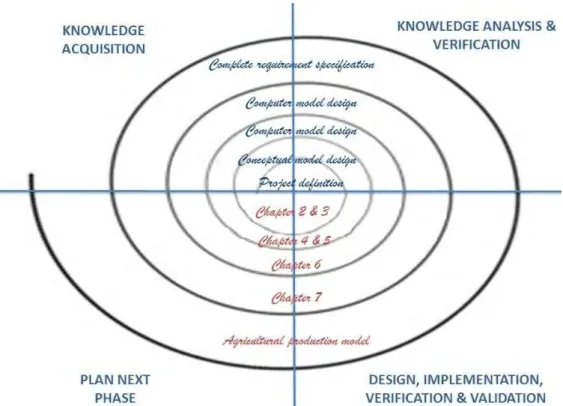
HESIS PROCEEDINGSThe main steps of the thesis can be summarized by the spiral cycle for the development of expert systems of Boehm (1988). The development of the simulation model NAMASTE (Figure 1.4) began with the expression of the needs formulated by the AICHA project to agree on what should be done in the model. An analysis of these needs helped formulating the project definition. Following the literature review (Chapter 2) and familiarization with the Berambadi basin (Chapter 3), we considered that the analysis and modeling of agricultural production systems in uncertain environment require taking into account the whole process of farmers’ decisions in integrating the different temporal and spatial scales of decision making.
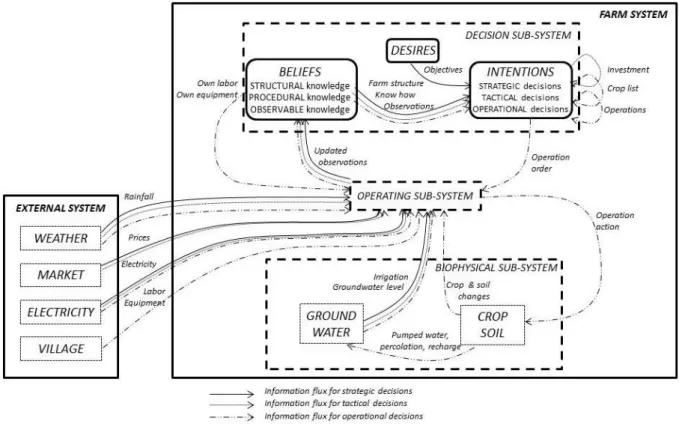
The conceptual model design formalizes the problem and chooses the functional specifications of the simulation model using a conceptual framework (Chapter 4 and 5). The farm was formalized with three entities (the decision-making system, the operating system and the biophysical system 3.4). The decision-making system has been described with the beliefs, desires, intentions formalism (BDI). The conceptual model was formulated in UML graphics to facilitate understanding between researchers, modelers, IT professionals and stakeholders of the project.
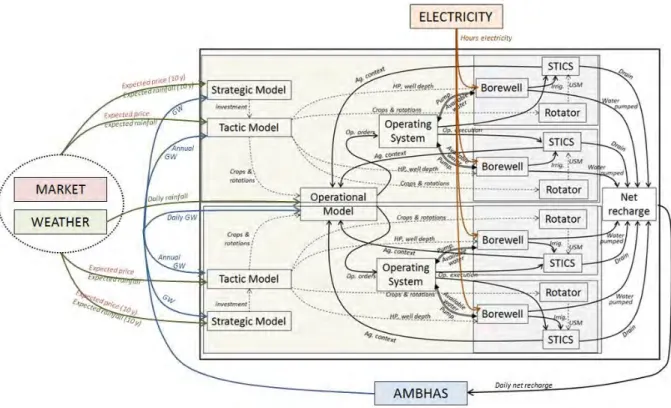
Conceptual modeling is followed by the computer implementation of the model on a simulation platform. Software development is done by coding the results of the design and functionality of the model highlighted in the previous steps. A first computer approach provides the economic decision model. A second computer approach adds the operation decision model coupled to the whole system.
17
Figure 1 4 : Main steps of the thesis inspired by the spiral cycle of Boehm (1988).
1.4. T
HESIS RESULTS1.4.1. Literature review on adaptation in decision models
Agricultural production systems are facing new challenges due to a constantly changing global environment that is a source of risk and uncertainty, and in which past experience is not sufficient to gauge the odds of a future negative event. Concerning risk, farmers are exposed to production risk mostly due to climate and pest conditions, to market risk that impacts input and output prices, and institutional risk through agricultural, environmental and sanitary regulations (Hardaker 2004). Farmers may also face uncertainty due to rare events affecting, e.g. labor, production capital stock, and extreme climatic conditions, which add complexities to producing agricultural goods and calls for re-evaluating current production practices. To remain competitive, farmers have no choice but to adapt and adjust their daily management practices (Hémidy et al. 1996; Hardaker 2004; Darnhofer et al. 2010; Dury 2011). Facing the aforementioned challenges, conventional farming systems have their limitations and a particular attention is made on the dynamics of innovations likely to consider and resolve the former issues (Novak 2008). The agricultural research community has a particular interest in modeling farming systems to simulate opportunities for adaptation that ensure flexibility and resilience of farming systems. In this context of global change, it is important to include adaptation to model farmers’ decision-making processes.
18
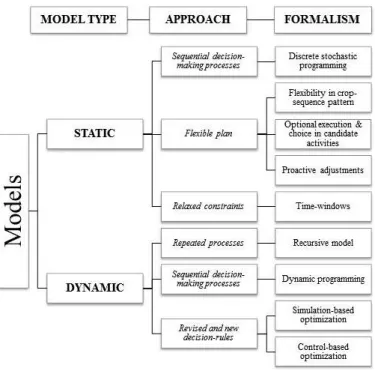
To review the way adaptive behaviors in farming systems has been considered (modeled) in bio-economic and bio-decision approaches; we analyzed approximately 40 scientific references. This work reviews several modeling formalisms that have been used in bio-economic and bio-decision approaches, comparing their features and selected relevant applications. We chose to focus on the formalisms rather than the tools as they are the essence of the modeling approach (Figure 1.5).
The major points are: adaptability, flexibility and dynamic processes are common ways to characterize farmers' decision-making. Adaptation is either a reactive or a proactive process depending on farmer flexibility and expectation capabilities. Various modeling methods are used to model decision stages in time and space, and some methods can be combined to represent a sequential decision-making process. Sequential representation is particularly interesting and appropriate to model the entire decision-making processes from strategic to tactical and operational decisions. Strategic adaptations and decisions influence tactical adaptations and decisions and vice-versa. Decisions made at one of these levels may disrupt the initial organization of resource availability and competition among activities over the short term (e.g., labor availability, machinery organization, irrigation distribution) but also lead to reconsideration of long-term decisions when the cropping system requires adaptation (e.g., change in crops within the rotation, effect of the previous crop). In the current agricultural literature, these consequences on long- and short-term organizations are rarely considered, even though they appear as an important driver of farmers’ decision-making (Daydé et al. 2014). Combining several formalisms within an integrated model in which strategic and tactical adaptations and decisions influence each other is a good starting point for modeling adaptive behavior within farmers’ decision-making processes.
Figure 1.5 : Typology of models to manage adaptive decision-making processes according to model type, approach, and formalism.
19 1.4.2. The Berambadi watershed
In semi-arid regions, agricultural production systems depend greatly on irrigation and encounter increasing challenges: growing uncertainty about response to climate change, severe depletion of natural resources, high price volatility in agricultural markets, rise in energy costs, greater pressure from public regulations (agricultural, environmental and health policies), and conflicts about sharing common water resources. Modeling farming systems while accounting for their flexibility is needed to assess water management policies targeted for specific geographical areas.
While modeling farming systems for assessing the development of such targeted water management policies, typifying farming systems is a fundamental step (Köbrich et al. 2003). Indeed, modeling all individual farms within a territory is rarely feasible if the number of farms is large and if the distribution of farming systems is heterogeneous. Typologies have been presented as a convenient tool to simplify the diversity of farming systems while effectively describing their heterogeneity (Valbuena et al. 2008; Daloğlu et al. 2014). As farm types are adapted to local constraints such as resource availability, the identification of their spatial distribution or location factors is also needed (Clavel et al. 2011).
Farmers’ investment decisions in irrigation and adopting cropping systems are inherently dynamic and are modified by changes in climate and agronomic, economic and social, and institutional conditions. To represent this diversity, we developed a typology of Indian farmers from a survey including 684 farms in Berambadi. The questionnaire answers provided information on the farm structure, cropping systems and farm practices, irrigation water management, and the economic performances of the farm. Descriptive statistics and multivariate analysis (Multiple Correspondences Analysis and Agglomerative Hierarchical Clustering) were used to analyze the relationships between observed factors,and to establish the farm typology. We identified three main types of farms: 1) large, diversified and productivist farms, 2) small and marginal rainfed farms, and 3) small, irrigated marketing farms (Figure 1.6). This typology represents the heterogeneity of farms in the Berambadi watershed. Used within a simulation model for the watershed, this typology should enable policy makers to better assess the potential impacts of agricultural and water management policies on farmers’ livelihood and groundwater table.
20
Figure 1. 6: Groundwater table gradient (colors) and farm typology (pir chart) for each of the five villages (V1 to V5) on the Berambadi watershed. TYPE 1 is large, diversified and productivist farms; TYPE 2 is small and marginal rainfed farms; and TYPE 3 is small, irrigated marketing farms.
1.4.3. A methodology to guide the design of a conceptual model of farmers’ decision-making processes The agricultural research community has a particular interest in decision-making processes design in farming systems but does not have a clear framework to guide it in how to proceed from field studies to designing the conceptual model. We identified a gap between field observations and the design of a conceptual decision model by modelers. Thus, we provide a necessary, original, and useful step-by-step methodology that guides data acquisition and analysis, incorporation of farmers’ knowledge, and model design. Developing a methodology for model design is necessary to ensure model transparency. It is essential to include information about the process followed to develop the conceptual or simulation model. This helps reproduce the work so that future researches can test any insights found or replicate the process in another study.
We propose an original and readily applicable methodology to formalize the conceptual modeling of the farmer agent underlying decision-making processes in farming system (CMFDM) and to guide data acquisition and analysis, the incorporation of expert knowledge, and the design of a model. The methodology combines techniques for system description based on field research in natural settings and techniques from the software engineering field regarding the use of software engineering language to support the development of a model. Theory building from cases is used to obtain a relevant theory from observing actual practices in a natural setting (Glaser and Strauss 1967; Eisenhardt 1989; Yin 2013). Cognitive-Task Analysis (CTA) is used to analyze and model the cognitive processes that gave rise to farmers’ task performance in farming systems (Jonassen 1997; Chipman et al. 2000). Unified